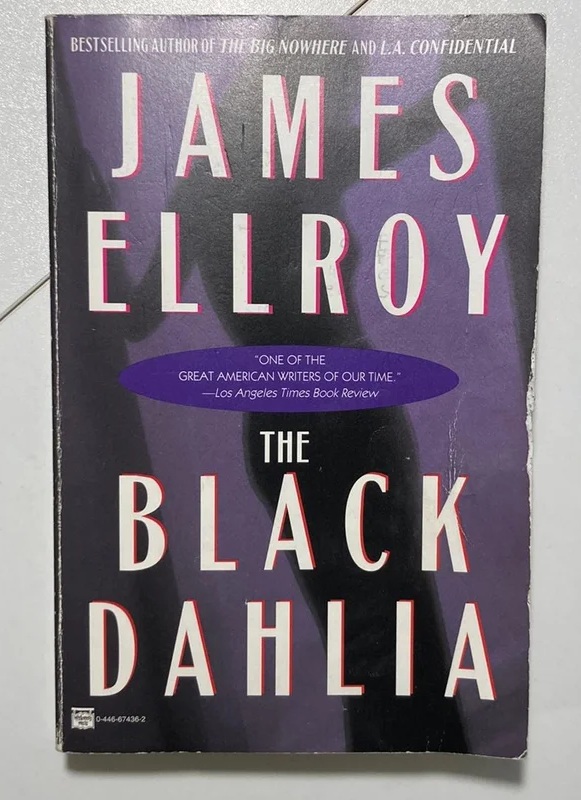
You may have noticed that most of the books I’ve reviewed this year have been relatively recent. This is because I am back studying part time and relying on audiobooks as I do the dishes to get through any reading at all. For the last week, I’ve been listening to James Ellroy’s The Black Dahlia. It’s a bit older than the other stuff I’ve read recently.
Grand Central Publishing – 1998 (first published 1987)
The Black Dahlia is an excellent book, and the subject matter is truly horrifying, but I’ve been on the fence as to whether I should post about it here or not. It contains horrendous acts of cruelty and depravity, so it kind of fits the bill, and it was previously reviewed on the toomuchhorrorfiction blog, so I reckon it’s fair game. While it’s not a horror novel, it is so dark that I imagine most people with an interest in horror will likely be interested. It’s also really good.
I didn’t know what to expect going in. I had seen people saying this book was great, but I didn’t know what kind of a book it was. It’s a novel. It involves a crime that really happened, but it’s not a novelisation or even speculative fiction. Most of the characters here are made up. The book is described as “neo-noir”. I’ve only read a few books of “noir” fiction, but Ellroy’s writing was far grittier than those. This was written in the late 80s, and it doesn’t hold back on any fronts. Everyone in this book is a piece of shit, but it’s this element that makes it believable. It’s also what makes the book very funny in parts.
After reading the book, I had to do a little research in the case. It’s truly horrible stuff. There’s a heavy metal band named after it. I remember I bought a ticket to see them once because Cephalic Carnage were opening for them. When I got to the show, I realised I had left my ticket at home, so I had to buy another. I left after a couple of the headliner’s songs. Not my thing. I wouldn’t cross the road to see Cephalic Carnage at this these stage either to be honest. I wish I could go back in time to save my money.
I reckon I’ll read more books by Ellroy in the future, but I doubt they’ll get reviewed here. This one was great though. Read it if you haven’t already.
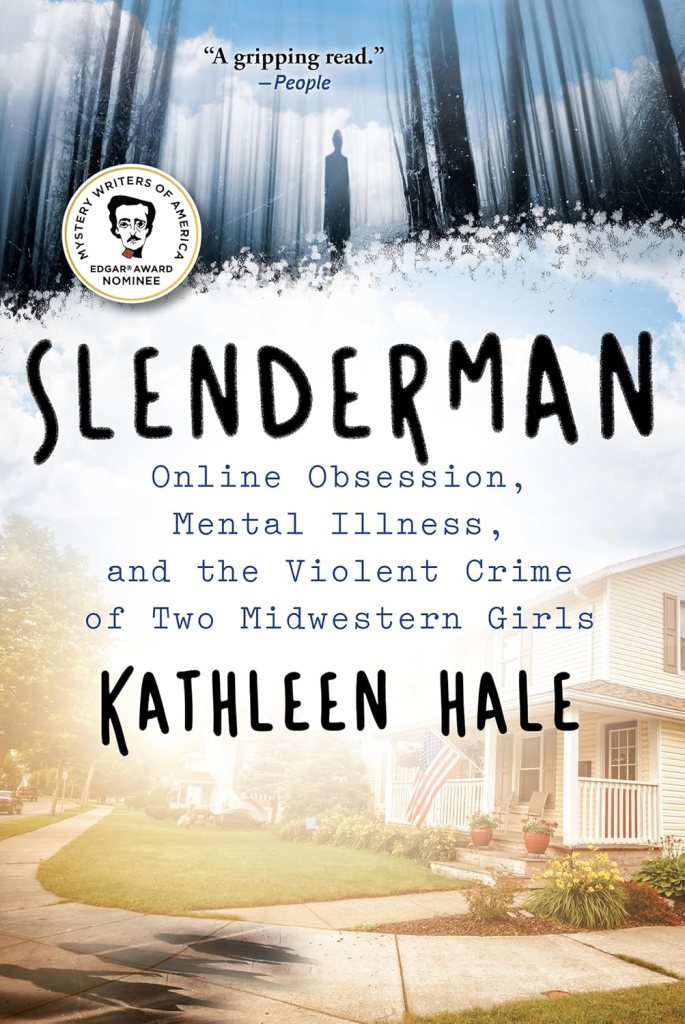
A few years ago I started posting about true crime books. For the last decade, the tagline of this website has read “Horror and Occult Book Reviews” and in keeping with the theme of the blog, I’ve only posted about crime books focusing on cases that involved the occult in some way. Most crimes are horrific in some regard, but horror fiction does not play into many crimes in the same way that occult beliefs frequently do. There is, however, one infamous criminal case in which horror fiction plays a central role, the 2014 Slenderman stabbing of Waukesha, Wisconsin. While the story of 2 children attempting to stab their friend to death as a sacrifice to a sinister internet boogeyman seems rather suitable for a website like this, I have avoided discussing it here for personal reasons.
At this point, I doubt many of the freaks who spend their time reading blogs like mine don’t know the story of Morgan Geyser and Annisa Weier. When they were 12 years old, they became convinced that a character they read about on the internet would let them come and live in his mansion if they murdered their best friend. This seems absolutely crazy, and that is because one of these girls was suffering from severe case of schizophrenia and the other kid was impressionable and messed up in her own ways. Together they formed a very toxic relationship that school counselors and parents failed to notice until it was too late. They stabbed their friend 19 times and left her to die in the forest while they headed towards the forest to find Slender Mansion.
The book I read, Slenderman: Online Obsession, Mental Illness, and the Violent Crime of Two Midwestern Girls, was good. It doesn’t focus on the sensational aspects of the story and rightfully directs its readers’ attention to the shortcomings of the education, rehabilitation and mental health systems in America.
Grove Press – 2022
While the victim of this affair is obviously the child who was stabbed, it’s hard to believe how badly the support systems in Morgan Geyser’s life failed her. This book was published 4 years ago, and Morgan was recently in the news again for trying to flee her group home. I don’t think anyone suspects she’s out to hurt anyone at this point, but she is clearly very insane. The entire story of this case is horribly depressing. If you’re interested though, this book is a good place to start.
So apart from the fact that I generally avoid reading about children getting hurt, I’ve specifically avoided covering Slenderman stuff in the past because of my personal connection to the story.
I was 16 years old when we got the internet in our house. My parents knew nothing about the web, and my friends were computer nerds. I very quickly learned how to delete my browser history and how to connect with other like minded weirdos. I used to post on a few different heavy metal forums, and on one of these I befriended a user called DevilMatt666. He was 14 years older than me, and I thought he was really cool. He had seen Pantera live and used to describe things that he liked as “mint”. I’m pretty sure he’s the person who first introduced me to the music of Glenn Danzig. We weren’t best friends or anything, but I would have interacted with this guy several times a week for at least 4 or 5 years. When the internet changed and forums started to die, Matt was one of the few posters I added on facebook.
I remember sitting in work one day in 2014, reading the news. I had seen mention of the Slenderman stabbing but hadn’t bothered reading about it properly. When I saw a headline mentioning this incident and the name Morgan Geyser, a bell went off in my head. I knew that name. My internet buddy Matt’s last name was Geyser, and I knew his kid’s name was Morgan because he posted about her all the time. I had seen a constant stream of pictures of this kid as she grew up. Honestly, one of the things I liked about Matt was the fact that he was a big, long haired heavy metal dude who was absolutely enamored with his little girl. Underneath the tattoos and sick goatee was a big softy. When I saw the photos in the news article, I knew it was her.
Matt disappeared from the internet for a while, and when he returned he was a broken man. In truth, the only things I remember about him from this point on were the endless posts about missing Morgan and not being able to stop crying. I saw comments and articles on the internet labelling him as a Satanist and a monster, but as far as I could see, he was a really lovely man. I got rid of facebook in 2020, and it was only after reading a recent article on Morgan’s escape that I read that he died 3 years ago. This was a real bummer, but even when he was alive I found it hard to imagine a happy ending to his story.
Knowing that he was dead and that calling attention to this case was no longer potentially going to upset him, I read this book about what happened. It was actually quite challenging to get through. Part of this is the fact that it’s an all round sad story, but my familiarity with some of the characters and the fact that I have my own kids now made it quite a struggle to get through. Keep an eye on your children.
Sorry, I am still on holidays, so my weekly post is late again. In April of last year, I mentioned my intention to do a post on books about Jack the Ripper. I recently reread Alan Moore’s From Hell for my post on Nicholas Hawksmoor, the Satanic architect, and before doing so I decided to prime myself by reading Donald Rumbelow’s The Complete Jack the Ripper.
The Complete Jack the Ripper – Donald Rumbelow
Virgin Books – 2016 (First published 1975)
This is the first and only non-fiction book I have read about the Whitechapel murders, and while I don’t have anything to compare it to, I was very pleased that I read this first. This book, as far as I can tell, restrains itself to the facts of the case. It outlines what is known about what happened in Whitechapel during the Jack the Ripper murders. It provides background on several of the key suspects in the murders, but it does not present any one of these characters as the likeliest candidate. The book does a very good job of making it very clear that this is a very complex case that, for many reasons, will likely remain unsolved. I don’t want to get into the events of the murders here as that information is available in a million other places, and I have no clever insights to offer. If you are interested in this case, I reckon this book is an excellent starting point. I’m actually a little hesitant to read some of the other books on the case as Rumbelow includes some details on why they’re probably not accurate.
From Hell – Alan Moore
Top Shelf – 2004 (First published 1999)
The first time I read from From Hell was an upsetting experience. I knew that some prostitutes were going to get butchered, but Moore’s story makes them people, and the violence was actually upsetting. It’s a phenomenal piece of art though. I only read a few graphic novels every year, but this is absolutely my favourite. The amount of research and thought that clearly went into is astounding. I strongly suggest that you keep 2 bookmarks handy while reading through it, one to keep your place in the story and one for the corresponding chapter notes at the back of the book. You must read both. I was very glad I had read Rumbelow’s book beforehand this time. Knowing something of the case made the depth of Moore’s work even more apparent.
White Chappell, Scarlet Tracings – Iain Sinclair
Gollancz – 1987
I read a bit of Iain Sinclair’s Lud Heat for my Hawksmoor post. I didn’t like it. I was slightly disappointed to find out that he had also written a book that involved the Ripper murders. I knew this guy’s ideas had influenced Alan Moore, and I decided that I should check out his Ripper book too. I was hoping that his White Chappell, Scarlet Tracings would be a bit more straight forward than his poetry. It’s not. It’s one of those arty books with a plot that’s buried underneath a weight of literary wank. I read it over a couple of days a few weeks ago. I’ve been putting off writing about it because I didn’t want to think about it, and now I don’t remember much of what little coherent plot there was. A bunch of ugly booksellers go on a road trip or something. There’s some flashbacks to the time of the killings, but nothing that was of any interest to me. Load of shite.
I’ve noticed a few times that people get upset when I dismiss books for being too deep or arty or clever. My review of Arthur Machen’s The Hill of Dreams was particularly offensive to one individual, and I recall somebody getting quite upset when I made fun of Stephen King’s attempt at critical writing in Danse Macabre. If you’re one of these people, fuck you, nerd. Kiss my hole.
These three books were my first real foray into Ripperology. I’m certainly not averse to the idea of reading more on the topic, but my curiosity has largely been satiated. I’d be interested in books that attribute Satanic, occult or extraterrestrial motives to the murders, and while I assume such books probably exist, I also assume that they’re complete rubbish. Much of the allure of reading about the Ripper murders is the fact that these brutal crimes have remained unsolved for more than a century despite the attention they have received. There’s so many theories and suspects that reading more facts about the case doesn’t really hold any appeal for me at this stage. I either want a definitive explanation of who was responsible or I want ridiculous (yet sincere) claims that it was a vampire.
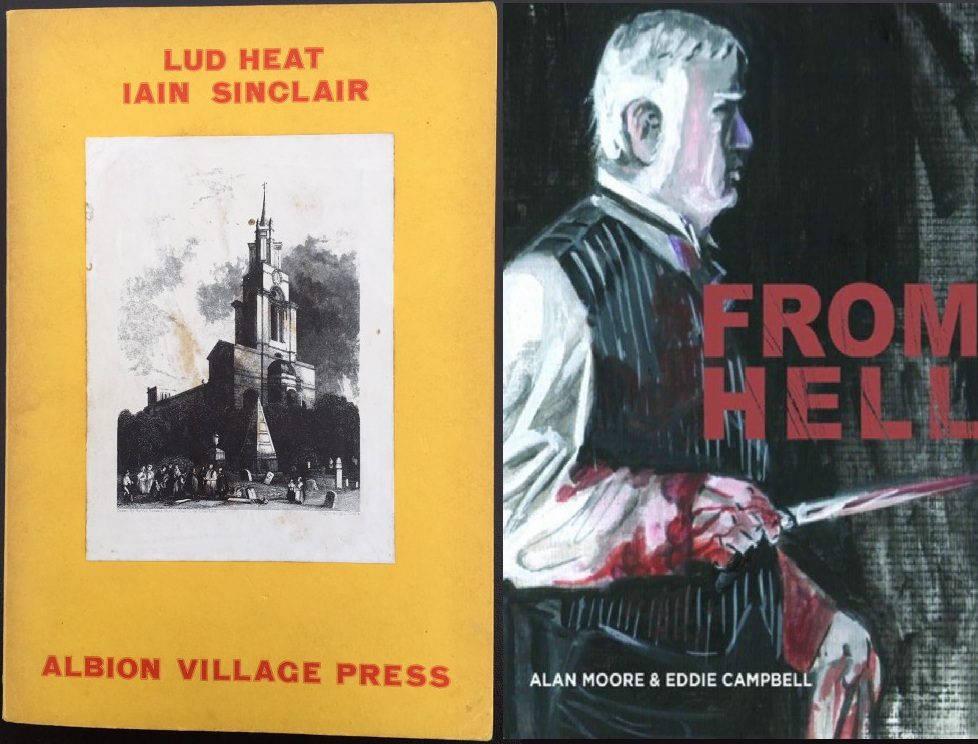
Sinclair’s Lud Heat (1975) and Moore’s From Hell (1999)
I first heard of Nicholas Hawksmoor when I read Alan Moore and Eddie Campbell’s From Hell, a graphic novel about the Jack the Ripper murders (more to come on that topic in the next few weeks!). Hawksmoor was an architect in the late 17th and early 18th centuries, and in Moore’s book, there are repeated references to the churches Hawksmoor designed in London. Moore suggests that the locations and designs of these churches bely their function as places of Christian worship. Hawksmoor was actually a Satanic pagan, and his churches were designed as talismans to serve in the great ritual of London city. The fact that Whitechapel, Jack the Ripper’s hunting ground, is situated between 2 of Hawksmoor’s churches is no coincidence.
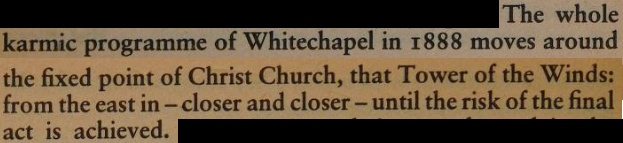
Quote from Sinclair’s Lud Heat
One of the major accomplishments of Moore’s meticulously researched work on From Hell is the synthesis of different conspiracies, characters and ideas from and about London in the late 1880s, and the notion of Hawksmoor’s churches being evil talismans originally comes from an author named Iain Sinclair. In 1975, he published a book of poetry called Lud Heat. The first section of the book is titled, Nicholas Hawksmoor, His Churches, and it’s here that Sinclair puts forth the idea that Hawksmoor deliberately infused his churches with sinister codes and symbols.
Quote from Sinclair’s Lud Heat
While there is no real evidence that Hawksmoor was a Satanist, he did incorporate obelisks, pyramids and other supposedly pagan symbols into his architecture. He was also extremely picky about the sites where his churches were to be built. When plotted on a map, they are said to form a pentagram, and Hawksmoor had them built in curious historical locations.
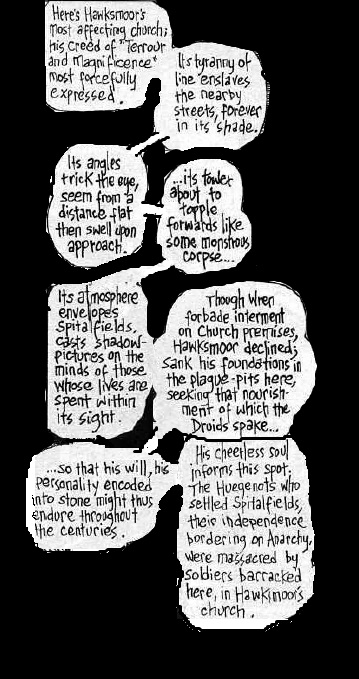
From Hell Chapter 4. Note the claim that the stone of the church will ensure the survival of Hawksmoor’s will.
Sinclair is a proponent of psychogeography. Psychogeography, as far as I understand it, is basically the process of walking around an area in an attempt to understand how its layout and architecture affect people. Alan Moore is friends with Sinclair and has openly acknowledged the influence of Sinclair’s ideas on From Hell. (Sinclair himself wrote a book about the ripper murders which I plan to read soon.)
Lud Heat is very much a poem about London. I’ve been to London a few times, but I don’t know the city well enough to really have a feel of what Sinclair is talking about. I also don’t care much for poetry, so while I read through his Hawksmoor poem, it didn’t really do much for me. This poem was published in 1975, and From Hell was finished roughly 20 years later, but halfway through this period, novelist Peter Ackroyd published Hawksmoor, another novel influenced by Sinclair’s ideas on Hawksmoor and psychogeography.
Harper and Row – 1985
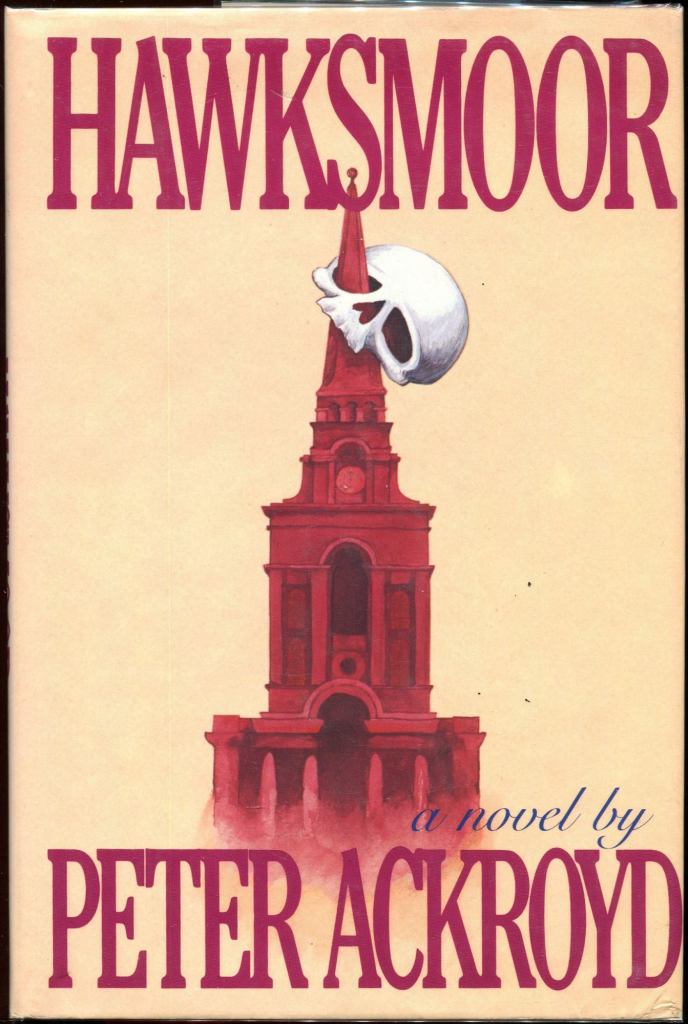
Hawksmoor has 2 storylines. One deals with the trials and tribulations of Nicholas Dyer, a cantankerous architect who was initiated into a sinister cult as a child after his parents died of the plague. There’s a few minor discrepancies, but Dyer is clearly based on the real Hawksmoor. This is confusing because the second narrative takes place 200 years later and focuses on a homicide detective named Hawksmoor…
As Dyer’s churches are erected, he commits ritual murder at the site of each of these edifices to instill them with a malignant power. When the narrative switches to the present day, the reader witnesses Hawksmoor investigating similar recent murders that have occurred in the same locations as Dyer’s sacrifices. He is unable to solve these crimes, and the implication is that the sinister power that was imbued into each of the churches is still at work today. It’s not quite clear whether the recent deaths are to reinvigorate the churches with fresh sinister power or whether these crimes are just a grisly echo of evil “reverberating down the centuries”.
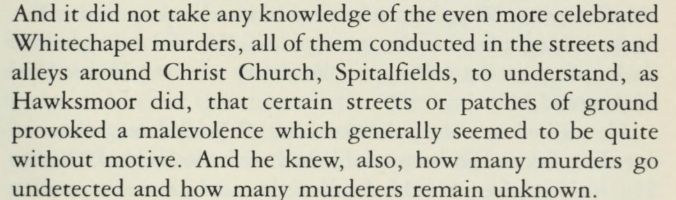
Quote from Ackroyd’s Hawksmoor (Remember that the Hawksmoor mentioned here is actually a police officer!)
Ackroyd only mentions the Whitechapel murders briefly his novel, but the notion that the design and locations of Dyer’s churches are responsible for violent deaths is central. Also, the fact that the murders in Ackroyd’s book are unsolvable does have an eerie parallel with the Jack the Ripper murders.
Ackroyd’s Hawksmoor is entertaining and at times quite funny, and while it’s more literary than what I usually read nowadays, I quite enjoyed it. I had been going through a bit of a lull with my reading material, and as I was reading this, it got me excited about books again. I have been meaning to read some books about Jack the Ripper for a while now, so I jumped at the chance to reread From Hell, and all of this talk of buildings being imbued with sinister powers caused me to revisit another old favourite.
Psychogeography seemed like quite a novel idea to me at first, but then I realised it was very similar to the mysterious science of megapolisomancy described in Fritz Leiber’s classic Our Lady of Darkness. Megapolisomancy: A New Science of Cities is a mysterious (and unfortunately ficitonal) book written by an even more mysterious character named Thibaut de Castries. De Castries believed that modern cities were dangerous places because of the materials used to construct their buildings. The layout and architecture of these buildings can drive people mad. De Castries claims that these pieces of architecture attract paramentals, bizarre entities that feed on human terror. A building designed in a particular way could be used to manipulate these entities into doing ones bidding.
Quote from Leiber’s Our Lady of Darkness
This is pretty much the exact idea that Sinclair, Ackroyd and Moore use in their respective books works involving Hawksmoor. Compare Thibaut’s thoughts there with the Sinclair’s description of Hawksmoor above. Note the emphasis on location, geometry and ritual.
De Castries dies before the events described in Our Lady of Darkness, but the effects of his work are felt long after he’s gone. Compare the following quote from Megapolisomancy with the events described in Ackroyd’s Hawksmoor and Moore’s From Hell. The buildings, these talismans of concrete are designed to house a lingering terror whose effects continue long into the future.
Quote from Leiber’s Our Lady of Darkness. De Castries probably doesn’t want to commit these “manipulations” to print because they involve ritual murders in the style of Hawksmoor!
In Our Lady of Darkness, the protagonist is terrorised by a paramental entity that had been coded onto the local architecture by an infernal work of neo-pythagorean meta-geometry (God, I love that phrase!). Ackroyd’s Hawksmoor leave rooms for a similar interpretation. The murders in From Hell are commited by a human of flesh and blood, but the murderer himself repeatedly refers to the influence of Hawksmoor’s churches on his heinous acts.
From Hell, Chapter 4 “magic… reverberating down the centuries”
Now at first I thought this was all a coincidence. Fritz Leiber’s first novel was first published before Sinclair, Ackroyd or Moore were born, and Our Lady of Darkness actually came out when Leiber was in his late 60s, 2 years after Sinclair’s Lud Heat had been published. Sinclair did not invent psychogeography, but the similarities between his ideas on Hawksmoor and Leiber’s megapolisomancy seem very specific. How would an old man have gotten wind of this new fangled version of psychogeography and put it into his novel? Now I can’t say for certain, but I’ve come across a potential explanation. Leiber was famous for popularizing the sword and sorcery genre along with English writer Michael Moorcock. These two authors were apparently good friends, and doubtlessly recommended books to each other. In 1995, Moorcock actually wrote an introduction to a new edition of Sinclair’s Lud Heat. He claims that he first met Sinclair as the author of Lud Heat, so it’s a long shot, but it’s not entirely impossible that Moorcock had read Lud Heat and suggested it to Leiber before Leiber wrote his first draft of Our Lady of Darkness. I know that Alan Moore is chummy with Moorcock, and Moorcock has also expressed praise for Ackroyd’s work, so it seems likely that Moorcock likely has some interest in their notion of psychogeography… It’s probably just a coincidence, but it’s fun to connect the dots.
I quite enjoyed writing this post. I’m going to have another post featuring From Hell in the near future. I generally avoid talking about graphic novels on here, but Moore is something of an authority on this stuff and I love him as an author and a person. It was funny reading through the appendix at the end of From Hell and seeing mention of my pal James Shelby Downard. Hawksmoor was initiated in freemasonry a few years before he died. I wonder what Downard would make of that!
I’m no expert on the Zodiac killer, but I have read Graysmith’s books and least have a sense of how complicated the case is and what kind of evidence would be required to confirm the killer’s identity. A new Netflix documentary recently came out confirming Graysmith’s claim that Arthur Leigh Allen was the killer, and while I am not convinced that it definitely wasn’t Arthur Leigh Allen, the claims put forth in that documentary are so damning that I find them suspicious. Either way, there are lots of reasons to think that Arthur Leigh Allen might have been the Zodiac, and until concrete evidence arises, Allen will be the measuring stick for all other Zodiac suspects.
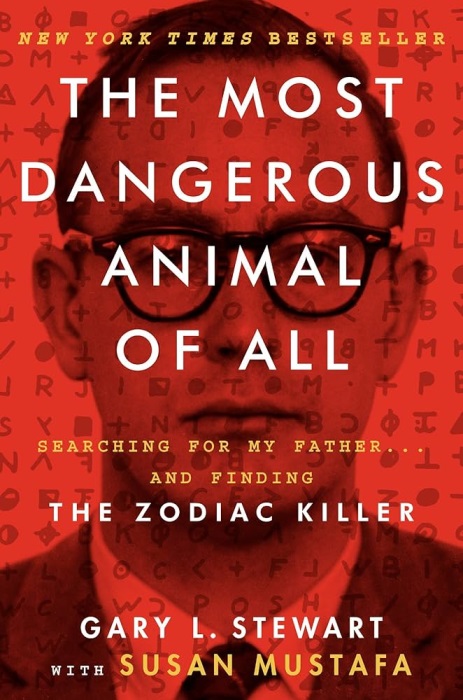
I think I have mentioned this before, but I am very busy these days, and I am having to rely on audiobooks from my local libraries to get any reading done. Unfortunately, my Libby account doesn’t really offer many books that fit in with the theme of this blog. The horror is all modern, and the occultism is all new-age. When I checked the true crime section, I found The Most Dangerous Animal of All, a book by a man who believes his father to be the Zodiac Killer. I thought it might be worth a read.
Harper – 2014
This book sucks. There’s nothing remotely convincing about any of the author’s claims, and many of these claims have been proven to be false. On reading about the author after finishing the book, I realized that there is a 4 part documentary on this book that basically proves that it’s complete bullshit. His dad was in Austria when the Zodiac did most of his killing. Even if the claims in here were all true, Allen is still a better suspect.
Ok, so the book is bullshit, but so are many of the books I enjoy. Is there anything interesting about this at all? Well, the author claims that his father was good friends with Anton LaVey and that he jammed with Bobby Beausoleil. His dad was a convicted paedophile (that much is beyond doubt), and so these links cast darker shadows on the high Priest of Satanism and Charlie Manson’s pal than they do on the author’s sicko father.
Also, the author is a whiny little weiner. Most of the book is about his boring, pleasant life with a nice family and how he acted like a wanker when he met his birth mother. He also repeatedly brings his faith into the story and makes himself sound like a twat. If the author’s father was actually in the Zodiac’s vicinity, it’s a real pity that the Zodiac didn’t murder him too. A child wouldn’t have been raped, and this awful book would never have been written.
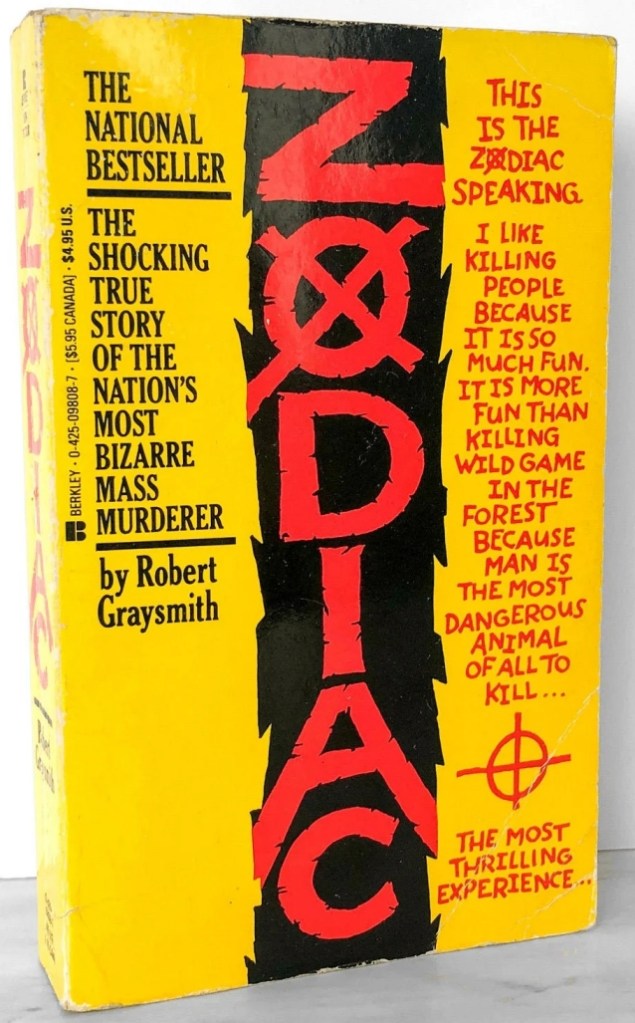
I’ve been planning on reading Robert Graysmith’s Zodiac for a while. I’ve gotten into weirdo true-crime books recently, and this is the book that served as the basis for the 2007 movie of the same name. The Zodiac killer, in case you don’t know, was a freak who killed 5 people over the course of a year and then spent 5 years writing threatening and bizarre letters to newspapers. For one of the attacks, he wore an executioner’s hood with his weird symbol sewn onto it. He claimed to have killed 37 people, but there is no proof that his kill count was this high. His letters boasted of collecting souls to serve as his slaves in the afterlife, and some of these letters were written in code. One of these codes was only cracked a few years ago. This guy was a real weirdo. Robert Graysmith was a cartoonist at the San Francisco Chronicle, one of the newspapers that received Zodiac’s first letters. He followed the case as it progressed and kept researching it for years after the Zodiac stopped sending letters.
Berkley Books – 1987 (First published 1986)
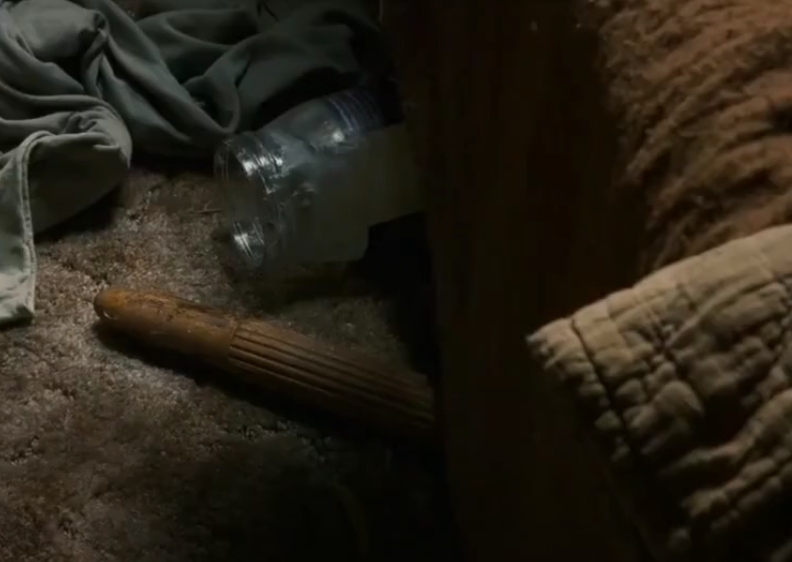
Zodiac lays out the facts of the case and focuses on pinning the blame on one particular subject, Bob Hall Star. Bob Hall Star is a pseudonym for Arthur Leigh Allen. Allen was the only person named by police as a Zodiac suspect. He was in the areas when the murders took place, he had bloody knives in his car on the day of one of the killings, he told his friends that he planned to become a killer named the Zodiac, and bombs were found in his house. Nobody was ever able to prove that he was the Zodiac, but it was proven that he molested children and didn’t wash his dildos after shoving them up his own ass.
“Several large, uncleaned dildos rolled out at his feet.” – Zodiac Unmasked: Chapter 8
I’m not convinced that Arthur Leigh Allen was definitely the Zodiac, but I really enjoyed this book. It’s well researched non-fiction, but it has a strong narrative, and it almost felt like a novel. I also really liked the movie that was based on it. You should definitely watch that if you haven’t.
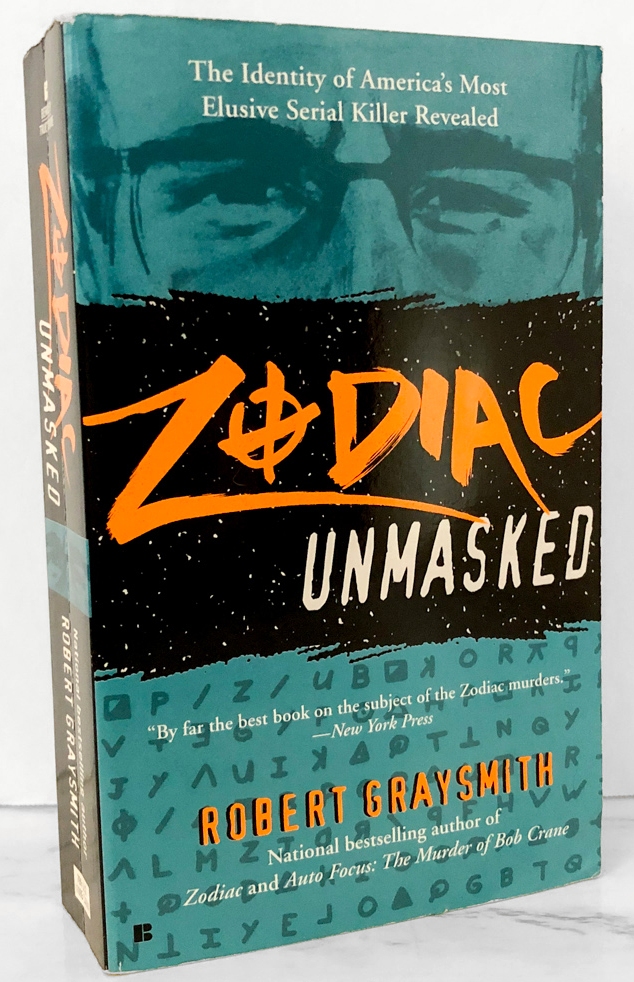
So Zodiac was published in 1986, but Arthur Leigh Allen was still free at that time, and nobody had been charged in the Zodiac case. In 2002, Graysmith put out a second book on the Zodiac case containing information that came to light after his first book had been published.
Berkley Books – 2003 (First published 2002)
Zodiac Unmasked is roughly twice as long as the first book. It’s not nearly as entertaining. The narrative structure and suspense have been replaced with meticulous, repetitive and sometimes boring detail. While the first book reads like a novel, the second feels like a vendetta. Robert Graysmith was certain that Allen was the killer.
I think that Arthur Leigh Allen was a disgusting human and a good suspect, but his handwriting and DNA didn’t match that found on the Zodiac artefacts. It’s certainly possible that he found a a way to make that happen, but it’s also possible that he was just an attention seeking creep who enjoyed the notoriety that came with being a suspect.
The first book sold millions of copies. It’s tells an interesting story. The second book merely presents more evidence to believe that story and will only be interesting to people who are already super interested in the Zodiac case. While the movie was based on both books, only a few scenes in the movie are based on parts of the second book. Admittedly, my favourite scene, the interrogation of the suspect, is taken from Zodiac Unmasked.
One of the most interesting parts from Zodiac Unmasked was the description of stuff that was found in Arthur Leigh Allen’s House after he died. The police found child-porn, bombs, guns and a video cassette. They weren’t allowed watch the video until they got special permission, but they were hoping that it might contain a confession or perhaps even footage of one of the Zodiac murders. When they got the permission and finally watched the tape, it was a video of Arthur Leigh Allen mooning the camera.
The Zodiac and Arthur Lee Allen, AKA The Dirty Dildo Boys
While it wasn’t as good as the first book, I still quite enjoyed Zodiac Unmasked. I listened to an audiobook version, and I found its repetitive nature quite soothing. It was the perfect thing to listen to before falling asleep. There are other books on the Zodiac Killer, and I may well read them in the future. It really is a fascinating case.
This is a book of texts that the government and the mainstream media didn’t want you to see! I use the past tense there because the stuff in here is very dated. It’s a Feral House compilation job, similar in style to Apocalypse Culture. I’ve had copies of the Apocalypse Culture books for years, but I’ve never read through either from start to finish because I don’t want to read the paedo-stuff. (Both books contain essays from real creeps.) I only read Secret and Suppressed because it contains “Sorcery, Sex, Assassination and the Science of Symbolism”, an extended version of James Shelby Downard’s Kill King 33° essay which was originally published in the first edition of Apocalypse Culture. The second edition of Apocalypse Culture replaced Kill King 33° with “The Call to Chaos: From Adam to Atom by Way of the Jornada del Muerto”, another piece by Downard. The second volume of Apocalypse Culture contains an entirely separate essay by Downard called “America, The Possessed Corpse”.
While “Sorcery, Sex, Assassination and the Science of Symbolism” is a longer version of the “Kill King 33°” essay in Apocalypse Culture, it’s actually not quite as long as the document titled “Kill King 33°: Masonic Symbolism in the Assassination of John F. Kennedy”. This document was co-written by our old pal Michael A. Hoffman II. This contains a few more details than the version in Secret and Suppressed. These extra details deal with stuff from Downard’s autobiography.
Honestly, all versions of this essay are truly ridiculous nonsense. The main idea is that JFK was assassinated by the Freemasons. The proof for this lies in the spellings of certain words and how they might be translated, some numerological nonsense, and some not-so-coincidental coincidences. Apparently the three tramps, the ones photographed in the park after JFK was killed, represent 3 of the characters in Waiting for Godot, Samuel Beckett’s 1949 absurdist play. Godot, the character who never shows up in that play, is obviously JFK. This play was written 14 years before Kennedy’s assassination. I assume Samuel Beckett was a member of the Illuminati to have this kind of foreknowledge. Later on, Downard points out that the guy who killed Lee Harvey Oswald, JFK’s alleged assassin, was named Jack Ruby. RUBY! Ruby slippers! Ruby slippers send you home. Jack Ruby sent Lee Harvey Oswald home! This has been there the whole time, and we didn’t notice it! WAKE UP!!!
Honestly, I was planning on doing a more in depth post on the writing’s of James Shelby Downard, but this has been enough. He was either a very insane person or a CIA psyop to make conspiracists look crazy.
Here’s a recap of the other pieces in Secret and Suppressed:
An Open Letter to the Swedish Prime Minster From a Survivor of Electromagnetic Terror
Robert Naeslund
This dude believed he was a victim of a mind control experiment. Boring.
Remote Mind Control Technology
Anna Keeler
Unreadable technical writing about mind control technology. Barely skimmed this one. Probably all true, but I’m not really interested.
Is Paranoia A Form of Awareness?
Kerry W. Thornley
The dude who knew Lee Harvey Oswald and created Discordianim reflects on conspiracy theories.
Sorcery, Sex, Assassination and the Science of Symbolism
James Shelby Downard
Discussed above.
Subliminal Images in Oliver Stone’s JFK
Dean Grace
A list of what the title describes. I haven’t seen that movie in years. I didn’t rewatch to check the list. Maybe I will when I am old and have more free time.
Terminator III
Associated Press
Newspaper articles about racist games that were available in the early 1990s. It’s surprising how naive people were about the insidious ways we would come to use technology.
The Masonic Ripper
Jim Keith
Jack the Ripper was a freemason. I came across this idea in Alan Moore’s From Hell. I assume it’s originally from another book.
The Erotic Freemasonry of Count Nicholas von Zinzendorf
Tim O’Neill
There once was a mason named Nick, He liked others to play with his…
Rumors, Myths and Urban Legends Surrounding the Death of Jim Morrison
Thomas Lyttle
I thought Jim Morrison was cool when I was 15. I become less interested in him as each year passes.
The Last Testament of Rev. Jim Jones
Jim Jones
This is a transcription of the Jonestown Death Tape. I had heard this recording before, but not since becoming a parent. I was able to read this, but I couldn’t listen to the recording of the babies screaming while their parents murdered them. Too much.
The Black Hole of Guyana
John Judge
This essay posits that the People’s Temple commune was a CIA experiment. I reckon it’s easier for some people to believe that a faceless government organisation would be capable of committing such an atrocity than any one specific person. Jim Jones was a real cunt.
Behold, A Pale Horse A Draft of Danny Casolaro’s Octopus Manuscript Proposal
Kenn Thomas
I am planning on reading Thomas’s book about the Octopus and Danny Casolaro soon.
Why Waco?
Ken Fawcett
The Waco tragedy was deliberate. Duh.
An Invitation to War
Ambassador April Glaspie & Saddam Hussein
American diplomat encouraging Saddam to start a war.
Inside the Irish Republican Army
Scott Smith
Scott Smith interviews an Irish freedom fighter. Brits out.
Recipes for Nonsurvival: The Anarchist Cookbook
Esperanze Godot
The Anarchist Cookbook is designed to kill the Anarchists who try to make its recipes. I remember getting a pdf of the anarchist’s cookbook when I was a kid. It was very disappointing. Never tried anything from it.
Silent Weapons for Quiet Wars
This is the document that somebody left in a photocopier than William Milton Cooper published in his Behold a Pale Horse
Secrets from the Vatican Library
This is a very long, boring document that claims that the bad jews kill children and drink their blood. There are good jews too, but it’s never discussed how to tell them apart.
AIDS: Act of God or the Pentagon?
When I was a kid, I was told that AIDS started when a man shagged a monkey. This story claims otherwise. I am not convinved.
“Clinton is the best guy for us”
Some American guy working for a pro-Israel organisation boasts about his political power.
Exposing the Nazi International
A neo nazi describes his relationship with Otto Skorzeny, a Nazi soldier who faked his own death. Boring and probably all bullshit.
Secret and Suppressed was a fairly interesting read. A lot of really fucked up things have happened since it was published though, and the paranoia that this book attempts to induce is widespread at this point. I think a lot of the claims made in this book are inaccurate, but I believe that things are just as bad as it makes them out to be.
I went a bit mad on books about Charles Manson last year. I remember seeing this book at the time, but I had had a little too much Charlie, so I put it off. Recently, I have been reading about James Shelby Downard, and any amount of research on that chap will bring you to a writer called Adam Gorightly. I was searching for a copy of Gorightly’s book about Downard, and I remembered that Gorightly had written a book about Manson.
The Shadow Over Santa Susana: Black Magic, Mind Control, and the Manson Family Mythos – Adam Gorightly
Creation Books – 2014
Gorightly doesn’t really push any specific theory of what happened, and in truth, there wasn’t a huge amount in here that I haven’t come across before. The Helter Skelter hypothesis is covered, but Gorightly also hints at some of the ideas that Tom O’Neill would later explore in Chaos. Mae Brussell, a name I recently became familiar with during my research on the Gemstone File, popped up a few times in here. She claimed that Manson was a CIA pawn used in an attempt to destroy 1960s counterculture. He was just another patsy like Sirhan Sirhan and Lee Harvey Oswald. At this point I would be surprised by any book dealing in conspiracies that doesn’t somehow drag in JFK.
Gorightly is a Discordian and counterculture kinda guy, and I found the tone of the book to be quite similar to Sanders’ The Family.The Shadow was written at a much later date though, and it includes much on what happened after the trial. It gets into the Son of Sam connection and even the Hand of Death cult that Henry Lee Lucas was a part of. I’m planning to do a detailed post in the future on the Son of Sam/Manson connection. I know that connection is probably made up, but I’ve come across it in quite a few different books now.
Perhaps the most surprising thing about this book was how it made me feel. It was comforting to come back to the Manson case, almost like meeting some old friends for coffee. I’ve been planning to read the revised version of Nikolas Schreck’s Manson book for a while, but now I reckon I’ll save it for the next time I have the blues. The Shadow Over Santa Susana would be pretty good for somebody who didn’t know much about the Manson story, but it was also pretty good for me as a refresher.
I was never particularly interested in Henry Lee Lucas until recently. I saw Henry: Portrait of a Serial Killer a long time ago, and I knew that it was roughly based on him. I had no idea of how many people he had supposedly killed until I read more about him in David McGowan’s Programmed to Kill. In that book, McGowan claimed that Henry had been involved in a Satanic cult and had killed hundreds of people. His source for this information was a long out of print book called Hand of Death. I had to read it.
Vital Issues Press – 1985
Hand of Death: The Henry Lee Lucas Story – Max Call
Henry Lee Lucas was born to a “sadistic bitch” of a mother. She wanted a baby girl, and when Henry came out of her womb she was very disappointed. Moments after his birth, she told bystanders that she would have her newborn baby hooking by age 5. She planned to dress him in girls clothes and charge extra. The first time she fed him, she said, “suck your mommy’s tittys” and pinched his dick to make him cry. Nobody who was present for this was alive when this book was written, but it will become clear as the story progresses that Henry Lee Lucas had an excellent memory, so he definitely would have been able to remember what his mom said to him moments after he came out of her womb.
a stinking man
After murdering his mother and serving time, Henry got out of jail and met Ottis Toole. They became lovers. After a killing spree, a car starts following them. When they confront the man in the car, a likeable chap named Don Meteric, he asks if they want to work as hitmen for Satanic organization. When they agree they are invited to a cult camp in a Florida swamp where they murder a man, eat his flesh and drink his blood and then partake in an orgy as his corpse is set on fire.
“a good looking young man by the name of Ottis Toole”
Henry then attends a murder school at the camp, but he’s so good with knives he ends up becoming one of the teachers there. The cult is called the Hand of Death. There were thousands of members at the time that Henry was a member, but nobody else has ever admitted to being a member.
Henry’s first assignment is to kidnap kids and for satanic paedos making snuff movies. He’s taught a chant to chant while he is sacrificing children to Satan, “Ambe ishke ho asseko.” I tried putting this through google translate, but it doesn’t seem to be any known language. Then I thought it might be an anagram. I played around with the letters for a bit, but the best I came up with was, “Homo Abe seeks his AK.” I’m not sure.
After killing some kids, Henry then takes Ottis’s 12 year old cousin on a romantic road trip. She gets horny when he’s about to kill, but Henry is a decent man and won’t have sex with this child until later. This is true love after all. It’s also quite confusing. A little later, after describing her 15 year old breasts as “soft and tender”, the author says Henry started sleeping with her when she was 9, even though he previously said 12. Whether it was 9, 12 or 15, this is a child being discussed.
When his 12 year old ‘wife’ converts to Christianity and tries to get him to pray, the actual real Satan touches the back of Henry’s head and tells him to ignore her. Henry obviously ends up killing her. (In real life, he had sex with her corpse, but for some reason this tidbit is left out of the book.) After this, he continues to kill until he is caught. He occasionally snorts a line of cocaine to leave him feeling “mellow and relaxed.”
When Henry is finally arrested, he’s given a Bible in jail he sees the light of Christ and decides that the only way he can redeem himself is by confessing to all 600 of the murders he committed.
That’s the story in this book. It turns out that while Henry admitted to 600 murders, he probably only killed 3 people, including his mom. It turns out that Henry really liked attention, and the police officers working his case got him to admit to a bunch of murders for their own benefit. It made them look like big-shots, and they were able to use him to help out their buddies. In the introduction to this book, Sheriff Jim Boutwell states that Henry had recently admitted to murdering a Texas police officer. This was very convenient for the police officer’s family as his death had previously been ruled a suicide and this meant that his family couldn’t access his insurance. When the insurance company discovered it was actually a murder, they had to pay up. Admittedly, that was a pretty nice thing for Henry to do, but admitting guilt to murders you didn’t commit allows the real murderers to walk the streets. The cops getting Henry to admit these murders claim that they truly believed he was the most prolific killer of all time, but in reality, he was a smelly, one-eyed idiot who would claim to be from the moon if it made his listener happy. These cops were treating him better than he had ever been treated in his life.
There’s a Netflix documentary that does a really good job of showing how awful these police officers were at their jobs. At one point in the show, Henry claims to have driven from the USA to Japan to commit murders. He does so in the presence of the cops who are using his testimony to close murder cases. It’s mad. I found it funny that the documentary doesn’t make a single reference to the Hand of Death, the book or the cult. They didn’t have to stoop so low to prove their point.
This book is complete garbage. It’s almost pornographic in its descriptions of child abuse, and most of the narrative is clearly a complete fabrication. There was never a Don Meteric or a Hand of Death. The last third of the book, the finding Jesus stuff, makes the exploitative nature of the first part particularly perplexing. Both Henry Lee Lucas and Ottis Toole did awful things, but both of their lives were horrifically sad. When Henry was a child, his own mother beat his head so badly that he suffered brain damage and lost an eye. Ottis Toole was raped by family members as a child. To paint these utterly tragic figures as elite satanic assassins for the sake of entertaining a bunch of repressed Christian perverts is truly despicable. Max Call was a scumbag.
There’s no such thing as serial killers. Ted Bundy, Ted Kaczynski, Jeffrey Dahmer, John Wayne Gacy, Charles Manson, David Berkowitz, Richard Ramirez and the likes were all framed by the government. None of these men committed all of the murders of which they were accused. They were all part of CIA mind control operations. Satanic ritual abuse and murderous Satanic cults exist, but they are just part of the US government’s mind control agenda.
This book starts off with a lengthy section describing different sex crimes committed against children. There really are a lot of sickos out there. The author claims that many of these crimes were committed by the US government to make their victims more susceptible to mind control. He points out that a high percentage of serial killers experienced sexual abuse as children. This was some bleak reading as proof of this. Paedophiles are truly the vilest form of life. Admittedly, I couldn’t help but giggle when a Satanic ritual abuse “victim” described how they were forced to play “poopoo baseball”
The next and longest section of the book details the crimes of America’s most notorious serial killers. McGowan includes all of the big ones with the noticeable exception of the Son of Sam. This is not because he thinks that David Berkowitz was any different to the other killers discussed but because he believes that Maury Terry said all that needed to be said about Berkowitz and his accomplices in The Ultimate Evil. This is fair; that book is exhaustive, and I’d imagine most of McGowan’s readers have probably read Terry, but the phrase “programmed to kill” actually came from one of the Son of Sam letters.
I went through a bit of a serial killer phase as a teenager, so I knew about John Wayne Gacy and Bundy, but most of my serial killer knowledge is limited to the names and lyrics of Macabre songs. I was aware that Edmund Kemper had a horrible temper and that Dahmer used to work in a chocolate factory, but although I knew that Richard Speck had done something outrageous, I didn’t know the specifics. It turns out this Speck guy killed 8 student nurses and was sentenced to life in prison. Some serial killers get murdered in prison due to their reputations, but Richard Speck managed to keep himself alive by injecting himself with estrogen and growing a pair of tits. In the late 80s, a lawyer snuck a video camera into the prison where Speck was locked up and made a video of him wearing blue satin panties, snorting cocaine and giving blowjobs to other inmates. What the heck Richard Speck?
A lot of the reasoning presented here is utterly ridiculous. The book was written in 2004, just a few years before smartphones became ubiquitous, and the writing here makes that obvious. Whenever I would read about a killer I hadn’t encountered before, I would check their wikipedia page, and in most cases that would make it very obvious how hard the author was trying to put his slant on things. I’d like to assume that a person wouldn’t get away with this kind of distortion of the truth anymore, but unfortunately it seems that more people are buying into this type of shit than ever before. This kind of thinking is a direct precursor to the Pizzagate conspiracy and that kind of nonsense. As soon as you point out how the research is flawed, believers will accuse you of having being duped by the same system that created these “satanic” killers. Some of this book is verifiable fiction too. When discussing Aleister Crowley, the author discusses the story about Crowley performing a ritual that killed his friend and drove him crazy… the one that Dennis Wheatley made up. McGowan also assumes the existence of the Hand of Death, a Satanic cult of assassins that existed only in the mind of Henry Lee Lucas (more on that in matter in a couple of weeks),
The book’s central premise is total madness anyways. The message is that serial killers are made, not born. I get the appeal of that idea. It’s hard for me to accept the fact that some men enjoy murdering children, but it wouldn’t make me feel much better if I found out that it was actually the government putting those sick desires into its citizens’ heads. Also, the notion that the American government is organised enough to do stuff like this is ridiculous.
Programmed to Kill really only covers American killers. I assume other countries do have serial killers, but I can only think of a few. It does seem a bit odd that America has so many. I read an article that claims that the amount of serial killers has been dropping in the last few decades. The CIA must be devoting their attention elsewhere.
This is a ridiculous book. It could only be convincing to a person with no way of verifying the claims made within. I mainly read it because I knew it mentioned the 4 Pi cult, but it didn’t contain anything about that mysterious group that I haven’t encountered elsewhere. It did put me onto a few other books about Satanic killers. It also forced me to spend a lot of time thinking about how horrible human beings are, and I started getting nervous leaving my house.








 Nocturnal Revelries