
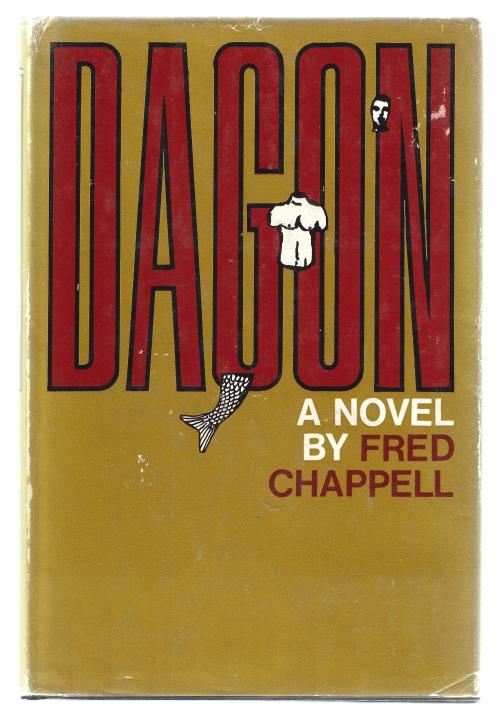
I’ve wanted to read Fred Chappell’s Dagon for years. I knew it was one of the more esteemed Lovecraftian novels and that it was written by a writer who wasn’t specifically a horror guy. I went into the book thinking that Fred Chappell was a noir fiction writer, but apparently I made that up. He was actually a poetry and literature kind of chap. Dagon confirms this. It’s definitely a bit deeper than tentacle monsters.
This book is categorized as Southern Gothic. I read some books by Faulkner and O’Connor when I was younger, and I mostly remember them being sad, sweaty, claustrophobic things. Chappell’s Dagon definitely contains those elements, but it starts off like half of August Derleth’s Lovecraftian stories: an academic inherits a farm that contains sinister and disturbing secrets. This one has bloody chains in the attic and a family of hideously ugly freaks living in a shack on the edge of the property. There’s also a pile of seemingly indecipherable documents containing references to Cthulhu and Yog-Sothoth that seemingly drive the reader insane.
From here on, I’m going to discuss how the book ends, so if you haven’t read it, go and do so before continuing with this post. The book is not a masterpiece, but it was thoroughly unpleasant, and I quite enjoyed reading it.
So after the protagonist reads some of the weird letters in his house, he falls in love with a freakishly ugly young woman and murders his wife. He then spends the rest of the book drinking himself to death and getting tortured by the ugly mutant. After being held down and tattooed in front of a bunch of people, he is thrown in a hole and dies.
My immediate response on finishing the book was that I loved it. I really enjoy when horror novels end horribly. I kept thinking about this one after finishing it though, and in retrospect, it doesn’t make a lot of sense. Why did the main character kill his wife? They had an argument, but murdering her was a bit excessive. Why was the girl so ugly? Her face is described as fishlike, but are we to believe her ancestors hailed from Innsmouth or was she just minging? Why does the author passively let her destroy him? Who are the people that she involves in his torture? Are they in a cult? Why are the Lovecraftian deities mentioned? Nothing supernatural happens here.
As somebody who mostly reads trashy fiction, it unnerved me to have so many unanswered questions at the end of a book, but none of these issues actually bothered me when I was reading. Things generally do seem more horrific when they don’t make sense, and I think that the omission of these explanations was intentional.
The combination of Lovecraftian horror and Southern Gothic doesn’t really work. (Although it worked a Hell of a lot better here than in Lovecraft Country!) The genres are just a little too far removed from each other to mesh cohesively, but Chappell’s effort to do so was about as successful as we could realistically hope it to be. It’s not a perfect book, but I enjoyed reading it and i am still thinking about it a week later.
I’ve been hitting the fiction hard recently. I read 4 novels this week, and I wasn’t sure which to post first. There’s lots of cool stuff coming up in the next few weeks, so check back regularly!
 Nocturnal Revelries