Sorry, I am still on holidays, so my weekly post is late again. In April of last year, I mentioned my intention to do a post on books about Jack the Ripper. I recently reread Alan Moore’s From Hell for my post on Nicholas Hawksmoor, the Satanic architect, and before doing so I decided to prime myself by reading Donald Rumbelow’s The Complete Jack the Ripper.
The Complete Jack the Ripper – Donald Rumbelow
Virgin Books – 2016 (First published 1975)
This is the first and only non-fiction book I have read about the Whitechapel murders, and while I don’t have anything to compare it to, I was very pleased that I read this first. This book, as far as I can tell, restrains itself to the facts of the case. It outlines what is known about what happened in Whitechapel during the Jack the Ripper murders. It provides background on several of the key suspects in the murders, but it does not present any one of these characters as the likeliest candidate. The book does a very good job of making it very clear that this is a very complex case that, for many reasons, will likely remain unsolved. I don’t want to get into the events of the murders here as that information is available in a million other places, and I have no clever insights to offer. If you are interested in this case, I reckon this book is an excellent starting point. I’m actually a little hesitant to read some of the other books on the case as Rumbelow includes some details on why they’re probably not accurate.
From Hell – Alan Moore
Top Shelf – 2004 (First published 1999)
The first time I read from From Hell was an upsetting experience. I knew that some prostitutes were going to get butchered, but Moore’s story makes them people, and the violence was actually upsetting. It’s a phenomenal piece of art though. I only read a few graphic novels every year, but this is absolutely my favourite. The amount of research and thought that clearly went into is astounding. I strongly suggest that you keep 2 bookmarks handy while reading through it, one to keep your place in the story and one for the corresponding chapter notes at the back of the book. You must read both. I was very glad I had read Rumbelow’s book beforehand this time. Knowing something of the case made the depth of Moore’s work even more apparent.
White Chappell, Scarlet Tracings – Iain Sinclair
Gollancz – 1987
I read a bit of Iain Sinclair’s Lud Heat for my Hawksmoor post. I didn’t like it. I was slightly disappointed to find out that he had also written a book that involved the Ripper murders. I knew this guy’s ideas had influenced Alan Moore, and I decided that I should check out his Ripper book too. I was hoping that his White Chappell, Scarlet Tracings would be a bit more straight forward than his poetry. It’s not. It’s one of those arty books with a plot that’s buried underneath a weight of literary wank. I read it over a couple of days a few weeks ago. I’ve been putting off writing about it because I didn’t want to think about it, and now I don’t remember much of what little coherent plot there was. A bunch of ugly booksellers go on a road trip or something. There’s some flashbacks to the time of the killings, but nothing that was of any interest to me. Load of shite.
I’ve noticed a few times that people get upset when I dismiss books for being too deep or arty or clever. My review of Arthur Machen’s The Hill of Dreams was particularly offensive to one individual, and I recall somebody getting quite upset when I made fun of Stephen King’s attempt at critical writing in Danse Macabre. If you’re one of these people, fuck you, nerd. Kiss my hole.
These three books were my first real foray into Ripperology. I’m certainly not averse to the idea of reading more on the topic, but my curiosity has largely been satiated. I’d be interested in books that attribute Satanic, occult or extraterrestrial motives to the murders, and while I assume such books probably exist, I also assume that they’re complete rubbish. Much of the allure of reading about the Ripper murders is the fact that these brutal crimes have remained unsolved for more than a century despite the attention they have received. There’s so many theories and suspects that reading more facts about the case doesn’t really hold any appeal for me at this stage. I either want a definitive explanation of who was responsible or I want ridiculous (yet sincere) claims that it was a vampire.
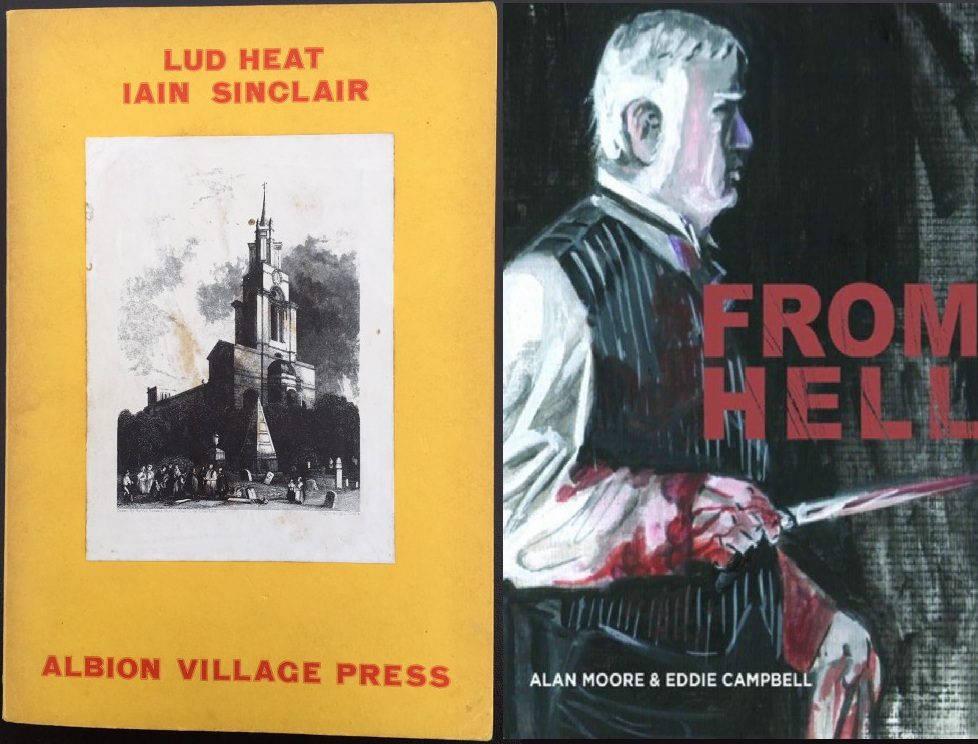
Sinclair’s Lud Heat (1975) and Moore’s From Hell (1999)
I first heard of Nicholas Hawksmoor when I read Alan Moore and Eddie Campbell’s From Hell, a graphic novel about the Jack the Ripper murders (more to come on that topic in the next few weeks!). Hawksmoor was an architect in the late 17th and early 18th centuries, and in Moore’s book, there are repeated references to the churches Hawksmoor designed in London. Moore suggests that the locations and designs of these churches bely their function as places of Christian worship. Hawksmoor was actually a Satanic pagan, and his churches were designed as talismans to serve in the great ritual of London city. The fact that Whitechapel, Jack the Ripper’s hunting ground, is situated between 2 of Hawksmoor’s churches is no coincidence.
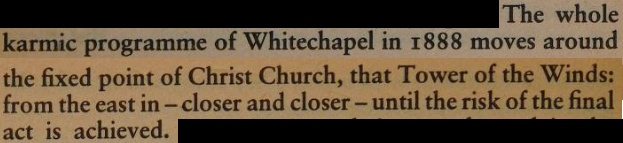
Quote from Sinclair’s Lud Heat
One of the major accomplishments of Moore’s meticulously researched work on From Hell is the synthesis of different conspiracies, characters and ideas from and about London in the late 1880s, and the notion of Hawksmoor’s churches being evil talismans originally comes from an author named Iain Sinclair. In 1975, he published a book of poetry called Lud Heat. The first section of the book is titled, Nicholas Hawksmoor, His Churches, and it’s here that Sinclair puts forth the idea that Hawksmoor deliberately infused his churches with sinister codes and symbols.
Quote from Sinclair’s Lud Heat
While there is no real evidence that Hawksmoor was a Satanist, he did incorporate obelisks, pyramids and other supposedly pagan symbols into his architecture. He was also extremely picky about the sites where his churches were to be built. When plotted on a map, they are said to form a pentagram, and Hawksmoor had them built in curious historical locations.
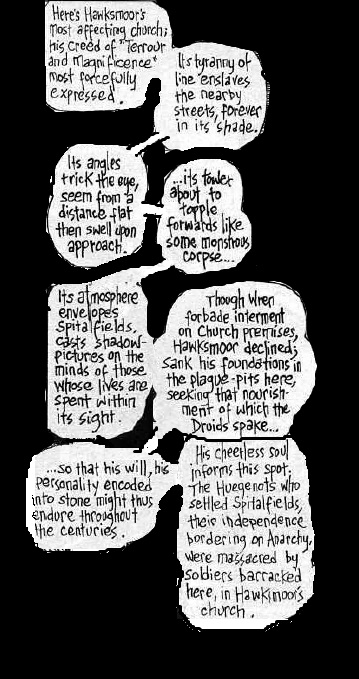
From Hell Chapter 4. Note the claim that the stone of the church will ensure the survival of Hawksmoor’s will.
Sinclair is a proponent of psychogeography. Psychogeography, as far as I understand it, is basically the process of walking around an area in an attempt to understand how its layout and architecture affect people. Alan Moore is friends with Sinclair and has openly acknowledged the influence of Sinclair’s ideas on From Hell. (Sinclair himself wrote a book about the ripper murders which I plan to read soon.)
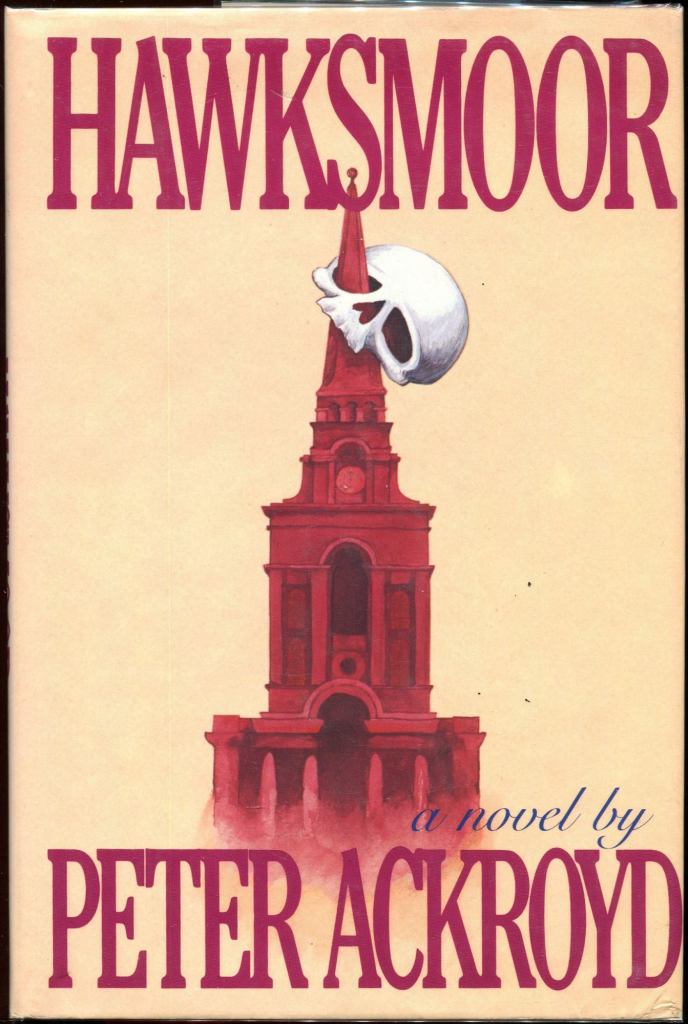
Lud Heat is very much a poem about London. I’ve been to London a few times, but I don’t know the city well enough to really have a feel of what Sinclair is talking about. I also don’t care much for poetry, so while I read through his Hawksmoor poem, it didn’t really do much for me. This poem was published in 1975, and From Hell was finished roughly 20 years later, but halfway through this period, novelist Peter Ackroyd published Hawksmoor, another novel influenced by Sinclair’s ideas on Hawksmoor and psychogeography.
Harper and Row – 1985
Hawksmoor has 2 storylines. One deals with the trials and tribulations of Nicholas Dyer, a cantankerous architect who was initiated into a sinister cult as a child after his parents died of the plague. There’s a few minor discrepancies, but Dyer is clearly based on the real Hawksmoor. This is confusing because the second narrative takes place 200 years later and focuses on a homicide detective named Hawksmoor…
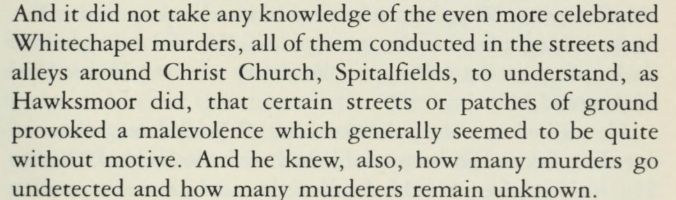
As Dyer’s churches are erected, he commits ritual murder at the site of each of these edifices to instill them with a malignant power. When the narrative switches to the present day, the reader witnesses Hawksmoor investigating similar recent murders that have occurred in the same locations as Dyer’s sacrifices. He is unable to solve these crimes, and the implication is that the sinister power that was imbued into each of the churches is still at work today. It’s not quite clear whether the recent deaths are to reinvigorate the churches with fresh sinister power or whether these crimes are just a grisly echo of evil “reverberating down the centuries”.
Quote from Ackroyd’s Hawksmoor (Remember that the Hawksmoor mentioned here is actually a police officer!)
Ackroyd only mentions the Whitechapel murders briefly his novel, but the notion that the design and locations of Dyer’s churches are responsible for violent deaths is central. Also, the fact that the murders in Ackroyd’s book are unsolvable does have an eerie parallel with the Jack the Ripper murders.
Ackroyd’s Hawksmoor is entertaining and at times quite funny, and while it’s more literary than what I usually read nowadays, I quite enjoyed it. I had been going through a bit of a lull with my reading material, and as I was reading this, it got me excited about books again. I have been meaning to read some books about Jack the Ripper for a while now, so I jumped at the chance to reread From Hell, and all of this talk of buildings being imbued with sinister powers caused me to revisit another old favourite.
Psychogeography seemed like quite a novel idea to me at first, but then I realised it was very similar to the mysterious science of megapolisomancy described in Fritz Leiber’s classic Our Lady of Darkness. Megapolisomancy: A New Science of Cities is a mysterious (and unfortunately ficitonal) book written by an even more mysterious character named Thibaut de Castries. De Castries believed that modern cities were dangerous places because of the materials used to construct their buildings. The layout and architecture of these buildings can drive people mad. De Castries claims that these pieces of architecture attract paramentals, bizarre entities that feed on human terror. A building designed in a particular way could be used to manipulate these entities into doing ones bidding.
Quote from Leiber’s Our Lady of Darkness
This is pretty much the exact idea that Sinclair, Ackroyd and Moore use in their respective books works involving Hawksmoor. Compare Thibaut’s thoughts there with the Sinclair’s description of Hawksmoor above. Note the emphasis on location, geometry and ritual.
De Castries dies before the events described in Our Lady of Darkness, but the effects of his work are felt long after he’s gone. Compare the following quote from Megapolisomancy with the events described in Ackroyd’s Hawksmoor and Moore’s From Hell. The buildings, these talismans of concrete are designed to house a lingering terror whose effects continue long into the future.
Quote from Leiber’s Our Lady of Darkness. De Castries probably doesn’t want to commit these “manipulations” to print because they involve ritual murders in the style of Hawksmoor!
In Our Lady of Darkness, the protagonist is terrorised by a paramental entity that had been coded onto the local architecture by an infernal work of neo-pythagorean meta-geometry (God, I love that phrase!). Ackroyd’s Hawksmoor leave rooms for a similar interpretation. The murders in From Hell are commited by a human of flesh and blood, but the murderer himself repeatedly refers to the influence of Hawksmoor’s churches on his heinous acts.
From Hell, Chapter 4 “magic… reverberating down the centuries”
Now at first I thought this was all a coincidence. Fritz Leiber’s first novel was first published before Sinclair, Ackroyd or Moore were born, and Our Lady of Darkness actually came out when Leiber was in his late 60s, 2 years after Sinclair’s Lud Heat had been published. Sinclair did not invent psychogeography, but the similarities between his ideas on Hawksmoor and Leiber’s megapolisomancy seem very specific. How would an old man have gotten wind of this new fangled version of psychogeography and put it into his novel? Now I can’t say for certain, but I’ve come across a potential explanation. Leiber was famous for popularizing the sword and sorcery genre along with English writer Michael Moorcock. These two authors were apparently good friends, and doubtlessly recommended books to each other. In 1995, Moorcock actually wrote an introduction to a new edition of Sinclair’s Lud Heat. He claims that he first met Sinclair as the author of Lud Heat, so it’s a long shot, but it’s not entirely impossible that Moorcock had read Lud Heat and suggested it to Leiber before Leiber wrote his first draft of Our Lady of Darkness. I know that Alan Moore is chummy with Moorcock, and Moorcock has also expressed praise for Ackroyd’s work, so it seems likely that Moorcock likely has some interest in their notion of psychogeography… It’s probably just a coincidence, but it’s fun to connect the dots.
I quite enjoyed writing this post. I’m going to have another post featuring From Hell in the near future. I generally avoid talking about graphic novels on here, but Moore is something of an authority on this stuff and I love him as an author and a person. It was funny reading through the appendix at the end of From Hell and seeing mention of my pal James Shelby Downard. Hawksmoor was initiated in freemasonry a few years before he died. I wonder what Downard would make of that!





 Nocturnal Revelries