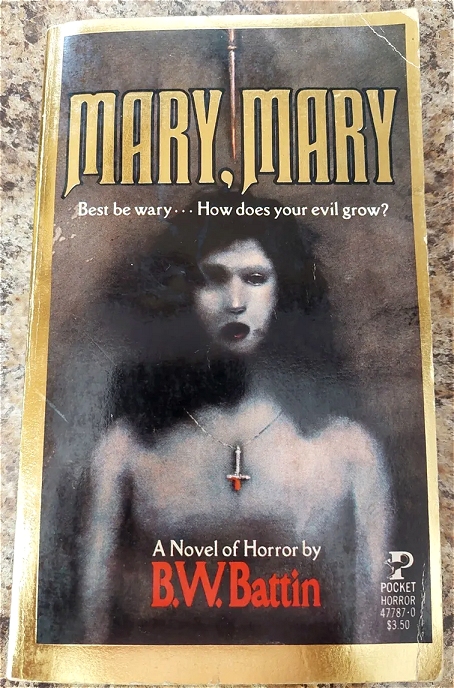
I started reading this book because it has a creepy cover.
Mary suffers from blackouts, brief periods during which she loses control over what she is doing and retains no memories. Also, she can’t tell anyone about these blackouts or she gets sick and passes out. When a murderer tries to kill her, Mary’s blackouts become more frequent and bad stuff starts happening to the people around her.
That’s the set-up. It’s a bit silly, but it has potential. It turns out that Mary was orphaned and has barely any memories of the mysterious orphanage where she grew up. Pretty much the only thing she does remember about it is that it was run by a Satanic nun. These details are revealed early on in the text, and in context, they set up the story in such a way that one ending seems inevitable. The writing is competent, and there is one particularly effective scene in a closed hardware store, but I was hoping that the author would drop in some shocking twists to elevate this beyond the realm of predictable thrillers. He didn’t.
This book ends almost exactly the way I thought it would. I say “almost exactly” because I thought there would be a slightly cheesy horror twist ending. There wasn’t though. This horror novel has a neat, complete happy ending. Yuck. No fucking thanks. In light of the predictable ending, the other faults of the book seem less forgiveable too. Why didn’t Mary just write her thoughts down instead of having to struggle to verbalise them to every new person she encounters? Also, why was she so afraid to tell her caring husband that she was seeing a psychiatrist? Stupid.
There’s a bit of suspense towards the middle of the book, but there is no real supernatural horror, novel depictions of Satanism, or extreme violence. Mary, Mary was a big let down. A few more of B.W. Battin’s books have cool covers, but I don’t feel any desire to check them out now.
I’m on my holidays at the moment, and I actually seem to have less time for reading than I usually do. Here’s a quick review of a quick little book that I quite enjoyed.
Overlook Collection – 2003 (First published 1996)
I haven’t read anything by Edward Lee since I gave up on his Bullet Through Your Face collection in 2020. I don’t mind vulgarity, but the amount of cocksnot in that book was tiresome. I recently came across a free copy of Goon, a book he co-authored with John Pelan, and it was short enough to convince me to give Lee another chance.
This is a brief splatterpunk novel about a serial killer/professional wrestler. It actually contains less wrestling than I was expecting.
I read 2 of the 3 stories in Bullet Through Your Face, but I gave up when I got to The Refrigerator full of Sperm, a story that was taken from Lee’s Splatterspunk: The Micah Hays Stories collection. You can imagine my disappointment when Micah Hays showed up as a character in Goon. Fortunately, it’s only a brief cameo appearance.
Things get weird at end (as they usually seem to in Lee’s books), but most of the plot of Goon is pretty much what you’d expect. There’s an instance of race-baiting in here that dates the book. I don’t think the authors were espousing racial hatred, but I don’t see two (sane) white guys feeling comfortable putting the same words to paper in 2023.
If you like wrestling and gross stuff, you’ll probably like Goon. It was quite a silly book, but it was short enough that I enjoyed it. It contains just the right amount of cocksnot, not too much, not too little.
In honour of Canada Day next Saturday, here’s some books by a Canadian author. Exactly one year ago, I read a horror novel by Sean Costello. It was great. I discovered that Costello had written two other horror novels, so I decided to read those too. Doing so was an excellent decision. I greatly enjoyed all three of these books.
Pocket Books – 1990
The Cartoonist
Scott, a successful psychiatrist with a horrible secret, meets a strange patient at his hospital. This drooling geriatric can’t walk or speak, but he can draw. At first the drawings seem random and unconnected, but Scott soon realises this is not the case.
I really enjoyed this novel. It’s set in Canada, and at its core, it’s about a father trying to protect his little girl. Both the antagonist and protagonist are horribly flawed people, but it was difficult for me not to empathise with both of them, and parts of this novel really got to me. In the 3 days leading up to me reading this book, I read 3 other “paperback from hell”-esque novels (The Kill, Joyride, and The Scourge) , and I had enjoyed each one less than the one before it. I was expecting the same from this one, but it was way, way better. It’s not perfect (my friend Micah made some valid criticisms when he reviewed it), but I found it very entertaining.
Pocket Books – 1989
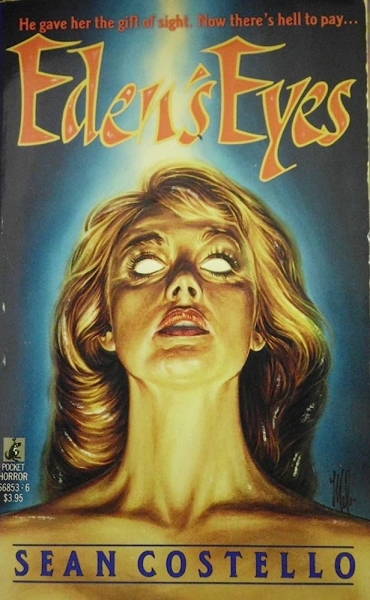
Eden’s Eyes
This book starts off with a father signing the consent forms to donate his recently deceased son’s organs. The eyes go to a blind author, the kidneys go to a sick child, and the heart goes to a homeless alcoholic. Unfortunately for everyone, the donor’s mother is not happy about the organ transplants, not happy at all.
That’s the basic premise of the book. That probably doesn’t make it sound like anything special, and in truth, it didn’t really feel like anything special for the first 50 or so pages. Then things started to get darker and weirder by the chapter. It ramps up and up and up, and the ending is bloody glorious. This is a slasher at heart, but the characters are interesting, and there’s weird supernatural elements that make it quite exciting.
I was so excited after the ending that I spent about 15 minutes trying to talk my wife into reading this one. (She wasn’t remotely interested.) Eden’s Eyes was a lot of fun to read.
Pocket Books – 1991
Captain Quad
I think this book may have the most off-putting title and cover of any horror novel ever. I didn’t want to read it, but I’m glad I did. It’s very dark, and I quite enjoyed it.
Peter Gardener is just about the greatest guy ever. He’s smart, athletic, handsome and kind. Unfortunately for him, he falls off his motorbike and breaks his neck. Being paralyzed from the neck down does two things to him. It gives him the opportunity to develop the ability to leave his body at will, and it also turns him into an evil psychopath.
That’s a horrible idea. It’s horrible because part of it is understandable. If I went from having the world in my pocket to losing the use of my body along with most of my relationships and dreams, I’m sure I’d become bitter. Hopefully not bitter enough to kill my mom, rape my ex, and shove an ice auger (basically a giant corkscrew) up an old friend’s anus, but definitely bitter.
Yes, this book gets very nasty. It was a bit like Eden’s Eyes in the way it transformed, fairly suddenly, from a gripping thriller to a gorefest.
Also like Eden’s Eyes, this one is about a person who develops psychic powers after going to a hospital. Sean Costello worked as an anesthesiologist, so this explains why sizeable parts of all three of these books take place in hospitals. The other books that came to mind when I was reading this were Trumbo’s Johnny Get Your Gun and Hallahan’s Keeper of the Children.
Captain Quad is unpleasant because Peter starts off as the good guy. He’s an extremely sympathetic character. You don’t want him to do the bad stuff he does, but it’s not too hard to understand why he does it. It’s difficult to read the book without imagining the same thing happening to yourself. I ride a bike to work every day, and the idea of getting hit by truck and paralysed is far more terrifying than a poltergeist. Honestly, the idea is almost a little too scary for a horror novel. I read these books to forget about my life, not to worry about it.
I really enjoyed these books, and I was really impressed with Costello’s writing. These are a step above a lot of the crap I read. Luckily for everyone, these three Canadian classics are now available as ebooks.
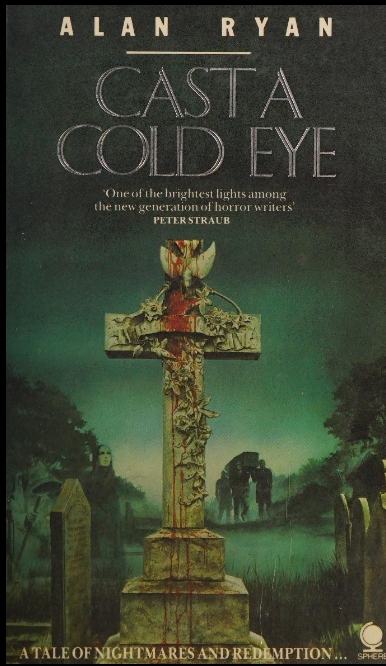
I reviewed Alan Ryan’s The Kill and Dead White last winter. I was originally going to talk about Cast a Cold Eye in the same post as those two books, but I realised that that pair were set in the same village and shared characters, so I kept Cast a Cold Eye for later.
Sphere – 1986 (Originally published 1984)
Jack, a successful American author, goes to Ireland and rents a house so that he can research and write his new novel. He’s staying in Doolin, a little village on the west coast of the island, and shortly after arriving, he sees some old men pouring a bottle of blood into a fresh grave. Soon thereafter, he starts to see ghosts of victims of the potato famine.
Alright. Let’s stop there. More potato famine horror? I was not a fan of the last book I read within that very niche genre. Fortunately, Alan Ryan’s writing is far, far better than Ann Pilling’s, and the story here is more intriguing, even if it does also feature very skinny ghosts.
I want to make it clear that my disdain for potato famine horror isn’t because I’m offended by the author turning the suffering of an oppressed group of real people into entertainment. It’s more the fact that the potato famine is the only thing a lot of North Americans know about Ireland. This is like an Irish author writing a horror novel set in America about a hamburger monster or a story set in Australia about a zombie kangaroo. (I think the only other horror novel set in Ireland that I’ve read by a non-Irish author was Paul Huson’s The Keepsake. Thankfully that one had no hungry ghosts. It was about a stone that turns into a vampire. Cool!)
In fairness though, Ryan does a pretty good job of making it seem that he really likes Ireland, and I would be shocked if part of this story isn’t autobiographical. He has to have been there to write some of the things he writes. Trust me. He references tea 45 times throughout the 350 pages.
I was 23 when I left Ireland. I wasn’t planning on a long term move, but things ended up that way, and I still miss Ireland greatly. It’s strange going back. I’ve been gone for long enough that little things that I grew up with seem foreign. There’s moments when I feel like a tourist in my home country.
It was interesting reading this book. Some of the descriptions about the landscape were great. I tend to travel more in Ireland when I return now than I ever did when I lived there, and the only time I’ve visited Clare, the county where this book is set, was as a tourist. Ryan gets the countryside right.
At the same time though, there were definitely a few cringey bits. I didn’t like the author’s idea of “Irish time”. Granted, the buses in Dublin are shit, but I don’t think Irish people are less punctual than anyone else. Not everyone wears woolen jumpers either. Also, the parts where people would say “I am” instead of “yes” annoyed me.
Of the three books I’ve read by Ryan, this one is probably the best horror novel. Dead White is good, but clowns aren’t scary. Skinny little children running around at night are scary. This is, at its heart, a good old-fashioned ghost story. The ending was ok, but things didn’t come together quite as much as I was hoping for. I really enjoyed reading this book, but I think a large part of my enjoyment stemmed from the fact that I’m going to Ireland in a few weeks, and all of the talk of rainy days and cups of tea made me really excited. I will try to track down Ryan’s short stories in the future.
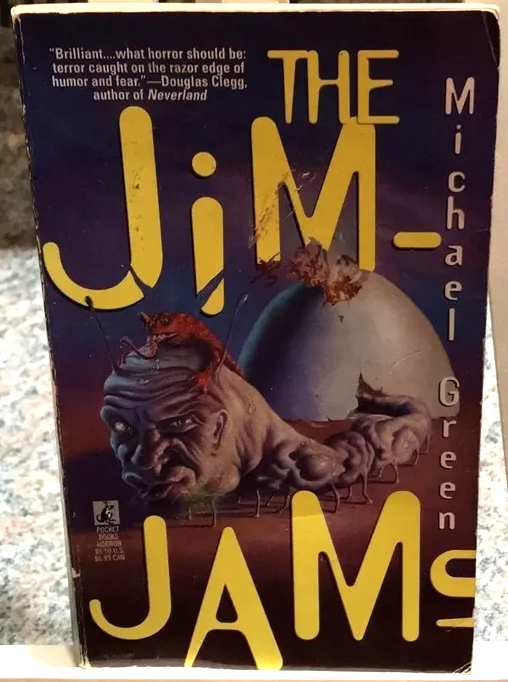
As soon as I heard of this rare, disgusting work of cosmic-horror, it jumped straight to the top of my to-read list..
Blue Turtle Island is an isolated holiday resort for old people. The small team of staff working there are in for a rough weekend. Not only has a gang of thugs sailed over with plans to mug the visitors, but there’s a weird… thing in the woods, and it’s having some rather strange effects on the creatures that come into contact with it.
It feel from the sky, and it seems to mess with the DNA of all lifeforms who encounter it, altering their physical structure and behaviour. Insects and small animals seem to morph into each other, and people get really messy. There’s lots of swelling, tumours, fluids, new orifices and more. Oh and there’s bugs in everything.
A plot centering on a bunch of old people is novel, but the real fun of this book lies in it’s relentlessness. It’s really gross. Think of all the horrible things that can happen to a human body, and then imagine most of them happening at once to the same body while that body is being infested with worms and spiders. There’s no great build-up here either. Things get gooey early on, and they never dry up.
There’s weird references to other horror writers in here. Different bugs are referred to as koontzes, bradburys and straubs. One character is called Farris too. Also, there is a direct reference to another horror author that had me laughing. One of the characters sees a mutated freak and assumes it’s an alien.”Feeling almost faint with excitement, Lana strove to keep in mind the courageous example of Whitley Strieber, a man she admired more than any other, an ambassador for all humankind who endured so many hardships during his encounters with Visitors from other worlds.”
The Jim-Jams reminded me of Edward Lee’s Slither. That one was also about people trapped on an island with gross mutating bugs. Both are very silly novels, but there’s enough self awareness and plot to keep them enjoyable. If you like Edward Lee, give The Jim-Jams a read.
This book has been out of print for almost 20 years, and it’s almost impossible to find. There’s no copies for sale online right now. I read it online at the Internet Archive, one of the greatest resources on the internet for people with an interest in books. The Internet Archive is currently in a legal battle with the biggest publishers in the world. You can show your support for libraries here.
The Travelling Grave and Other Stories by L.P. Hartley
Valacourt Books – 2017 This book was first published by Arkham House in 1947, but many of the stories were published years before that. In truth, I found it very boring. It’s mostly ghost stories, but none of them are particularly scary. The writing is quite dense at times too, and it usually didn’t feel worth the effort. It’s less than 250 pages, but it took me more than 4 months to get through it.
Here’s what I remember about the stories:
Story
My thoughts (includes spoilers)
A Visitor from Down Under
A lad listens to weird kids’ games on the radio and a ghost comes from Australia to get him. Shit and confusing.
Podolo
A creepy island. Somebody tries to kill a kitten? Maybe it’s a werewolf or something. I forget.
Three, or Four, for Dinner
Some lads arrange to meet another lad, but he dies. Shows up to dinner anyway. Supposed to be droll?
The Travelling Grave
A lad collects coffins. One can bury itself and does when a person is in it.
Feet Foremost
A ghost can’t come into the house because there is a step or something. Not scary at all.
The Cotillon
A lad kills himself, but he goes dancing afterwards.
A Change of Ownership
A truly idiotic man gets upset because he was too much of a wuss to invite his boyfriend in for some sex, so he has a nervous breakdown instead and imagines he is a ghost or something.
The Thought
A lad goes for a walk and gets confused. This went so far above my head. Hated it.
Conrad and the Dragon
Predictable fantasy story. Maybe for kids.
The Island
A lad gets caught by his girlfriend’s husband. At least one of them is dead.
Night Fears
A lad gets scared while working the night shift. Short.
The Killing Bottle
A lad gets mixed up with another chap who murders people who hurt animals. Then the other chap kills his own brother. Who knows what becomes of the dipstick protagonist?
A lot of lads.
I have nothing else to say about this book.
This is probably a poor time to mention this, as the above review is hardly riveting reading, but I have noticed a dramatic drop in traffic to this blog recently. Google updated its algorithm on the 15th of last month, and it seems to have worked against me. I’m seeing roughly half of what I had been seeing for the last 3 years. This is quite frustrating, as (with the exception of the above post) the content on here has been pretty good recently. I have glanced through a few pages explaining search engine optimization, but the thoughts of spending hours trying to make sure my posts are tagged and titled appropriately seems horrendously boring. I’d far prefer to spend my time reading a weird book. I’ll probably update the layout in the near future to make the 400+ posts on here easier to sift through, but until then, do me a favour and share this blog with your friends.
A friend recommended this to me a few weeks back. I found an ebook version online, but after reading the fourth paragraph, I ordered a physical copy. This is one I knew I’d want on my shelf.
We may think we are special – holy, honoured, valued – god’s chosen primates – but that is a fraud. The dupes of superhuman forces, we are misfits and abominations. We have no higher purpose – no saviour god died for our sins – we exist, only because our masters are infatuated with our meat.
page 1
Mirabello is an academic. He has a Ph.D, and he has lectured at different universities. His fields of research are fairly wacky, but I have no reason to belief that his research itself is questionable. He has appeared on some ridiculous documentaries and talk shows about aliens and conspiracies. Having an education doesn’t necessarily make a person a good writer, but Mirabello’s credentials, along with what I knew of this book, made it seem very, very intriguing.
The narrative in The Cannibal Within is framed as a memoir that was presented to the author due to his academic standing. A crazy lady walks into his office and gives him a document describing her bizarre experiences. She was abducted by cannibalistic trans-humans after her and her friend performed a Satanic ritual. The unholy freaks eat her friend and then kidnap the protagonist and lock her in a cage in their underground layer for decades. They do really bad stuff to her, but she takes it rather philosophically. While recounting the utterly horrendous abuses she suffered, she quotes from and/or discusses the work of Yukio Mishima, Friedrich Neitzsche, Plato, Aleister Crowley, H.P. Lovecraft, De Sade, Goethe, George Bataille, Octave Mirbeau and Philip K. Dick.
Oh, and there’s a big part at the end of the book that talks about how the trans-humans evolved from brain eating cannibal monkeys. This sounded very familiar to me, and it was immediately followed by a quote from The Beginning Was the End, my favourite book. Hell yes.
Also, the Satanic ritual that kicks things off is supposedly taken from the Red Book of Appin. Anyone remember mypost on that mysterious grimoire?
If you’re not familiar with this blog and/my reading proclivities, let it suffice to say that I have an interest in the above authors and texts. I felt very much that Mirabello had somebody like me in mind when he was writing this book. I can’t really say that it’s a brilliant book, but I also can’t pretend that I didn’t enjoy every page. I finished it in an afternoon. I really found it hard to put it down.
Who could resist?
When the book isn’t discussing the absurdity of life, it’s shoving giant mutoid cocks down your throat. There’s an awful lot of rape, in here, and the pricks doing the raping are all hilariously large. One of them is described as an “enormous fascist rod”. LOL.
Objectively, The Cannibal Within fails as a novel. It sets the scene, but doesn’t really go anywhere. The ending of the book felt like the point at which a team of marines, armed to the teeth, should have been entering the freaks’ burrow, Aliens style. I don’t need (or want) a happy ending, but I would have liked a bit more conflict. I suppose it would have taken a lot of effort to ramp up the gross-out sequences as a plot developed, but it would take that kind of commitment to make this a real masterpiece.
Mirabello, if you’re reading this, please write a sequel, a long one.
The Cannibal Within is splatterpunk for grad students. If you’re a misanthropic book-nerd with a penchant for the disgusting (and you probably are if you’re reading this blog) you will likely get a kick out of this horrid book. Honestly, I doubt anyone else will get past the first few pages.
The Rim of Morning: Two Tales of Cosmic Horror – William Sloane
NYRB Classics – 2015 (originally published as a collection in 1964)
This week’s book is The Rim of Morning by William Sloane. It contains To Walk the Night (1937) and The Edge of Running Water (1939), Sloane’s only novels. Both books went through several editions in the 50 years after they were published, and some of the covers are awesome, but other blogs have done posts about that, and I have nothing to add. The books were out of print for the 90s and early 2000s, but NYRB put out this collection with a new introduction a few years ago.
To Walk the Night
Two lads witness a scientist spontaneously combusting, and then one of them marries the scientists widow. She is a babe, but she’s also a real weirdo. This puts strain on the lads’ friendship.
Stephen King wrote the introduction to The Rim of Mourning. From what I know about his tastes, I’m not surprised King liked this book. It reads like a combination of Invasion of the Body Snatchers and Leiber’s Conjure Wife. It walks that line between sci-fi and horror nicely, and I really got into it after a few chapters. It’s suspenseful and very easy to read.
I found the ending a little underwhelming. The way the story is set up ensures no real surprises, but the explanation given (or at least hinted at) felt a bit flat. It was still enjoyable enough.
The Edge of Running Water
The second novel starts off fairly similar to the first. A lad goes to his friend’s house to help him with an experiment. When he gets there, he finds there are two women living in the house too. One is his friend’s sexy sister in law, and the other is a really annoying person who is helping with the experiment.
The nature of the experiment is not immediately discussed, but it involves a machine that makes a really upsetting noise. It turns out that the lad was trying to build a machine to let him talk to his dead wife, but he ends up making something much, much worse.
I quite enjoyed this book, but it’s very slow. The whole thing occurs over the period of 3 days or so, and I’m sure big chunks could have been cut. I enjoyed the brooding atmosphere though, and I found this one a bit creepier than To Walk the Night.
The supernatural elements of both books are not explicitly defined, and I think this is why these books get categorised as “cosmic horror”. They’re good. You should read them.
Avery Barker is a sineater, a man who ritually cleanses dead bodies of sin by eating a meal off their chest. He lives just outside of Beacon Cove, a small, extremely religious community in the mountains of Virginia. The service he offers is extremely important to this community, but it also renders him and his family as outcasts. The rest of the community believe that just looking at the sineater would be enough to kill a person. Unfortunately for everyone, Missy Campbell, the religious leader of the community, has gotten it into her head that the sineater has consumed too much sin and gone mad. Very bad things start happening, and it’s unclear as to who’s responsible.
The story centers around Joel, Avery’s youngest son and the only Barker to attend school. To make things complicated, he becomes friendly with Missy’s nephew, Burke. Joel is such a sympathetic character that I spent the whole book dreading that something bad would happen to him. It’s pretty obvious from the get-go that this book isn’t going to end happily.
I really enjoyed Sineater. It’s dark, and parts of it are very gross, but the story is good, and the characters are fun.
Apparently sineaters were a real thing in parts of Britain. I don’t think they were ever shunned to the extent that Avery is in this book though.
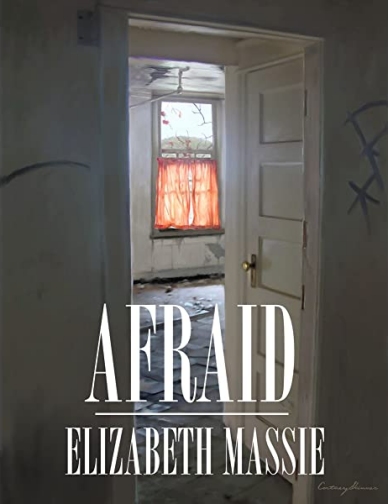
Afraid: Tidbits of the Macabre Crossroads Press – 2011
I read Massie’s collection Afraid: Tidbits of the Macabre a few months ago. I didn’t write anything down about it after reading it, but I remember quite a few stories about people locked in basements. It also had a weird story about a body part, I honestly can’t remember which, vacating its body. Cool. I enjoyed the collection well enough to want to read more of Massie’s work. Sineater was even better, and I plan to read more of her books in the future.
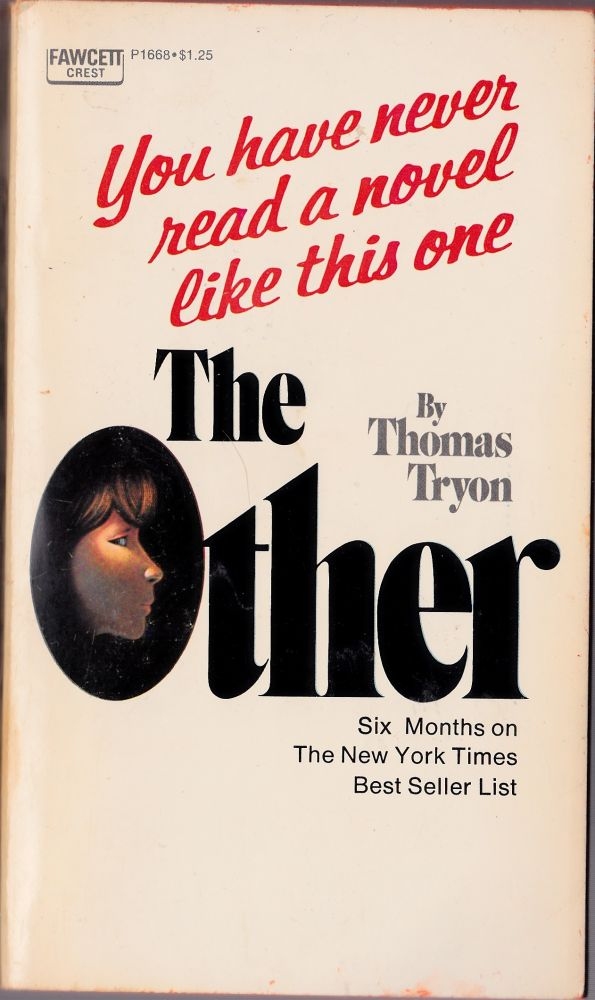
The only thing I knew about Thomas Tryon’s The Other before I read it was that it was a bestseller in 1971. It was only as I read it that I realised how influential a novel it has been on modern horror.
Niles and Holland are twin 13 year old boys who live on a farm in New England. Niles is quiet and easily led, and Holland is… well, Holland is a real bad kid. Their dad died a few months before the story begins, and from the beginning it seems pretty obvious that Holland had something to do with this. My suspicions ran wild as I was reading it. I suspected there was going to be some big plot twist, and I was trying to figure out what it was, but the story takes its time and Tryon holds on to his details, only ever giving just enough to keep his readers engaged.
The pacing got on my nerves a little bit during the first half of the novel, but when the twist was revealed and things clicked into place, it all felt worthwhile. I’m sure lots of people who haven’t read this book already know how it ends, but I won’t give anything away. I will mention that I was surprised at how unpleasant that part near the end is.
It was that particularly nasty bit that made me realise how influential this book is. I would be very surprised if Brenda Brown Canary’s choice of setting and violence in The Voice of the Clown were not influenced by Tryon’s book.
I didn’t really like the part where the boys’ grandmother, a crazy old Russian woman, teaches them a trick where they can enter the bodies of other creatures. I guess this makes it easier to accept the potentially supernatural goings on, but it was also a bit weird and unnecessary.
I can imagine some readers getting halfway through this book and not bothering to finish it. That would be a mistake. The pacing and all of the mysterious little clues that are offered throughout the book all come together at the end. I thought this was a very effective horror novel. At times I found it mildly shocking and horrifying. Read it if you haven’t already.
Harvest Home
Dell – 1987 (First published 1973)
I waited for six months to read another book by Tryon. I didn’t dislike The Other, but it was a bit slow, and I usually prefer things short and snappy. Harvest Home is actually pretty similar in pacing to its predecessor, but I ended up absolutely loving this book.
This novel starts when the Constantine family moves to Cornwall Coombe, a quaint rural village where everybody knows everybody. The new family is settling in and everything is going well until the father stumbles upon a ritual in which a local child with a learning disability is forced to choose the Harvest Lord by studying the entrails of a freshly sacrificed sheep. He sneaks away and pretends he has seen nothing, but after this, he starts to notice other strange goings on in the town. It turns out that there’s some fairly bad stuff happening behind the scenes.
I really, really enjoyed Harvest Home. Again, Tryon holds back details in a masterful way. I found this approach even more enjoyable here than it was in The Other. I think it was because the protagonist in this one was a little bit more relatable to me than the boys in his first novel. The pacing is slow, but the writing and characters are enjoyable enough to keep things entertaining between the big revelations. There was one part where the main character gets really drunk and ruins a party. I had to go back and read this section a second time to make sure I had understood everything that happened. It felt rushed and muddled the first time I read it. Reading back, it became apparent that this was clearly intentional. The author used barely any full stops (periods) in the whole passage. It’s probably a well known trick, but I found it really effective.
Tryon was an interesting guy. He was a relatively successful Hollywood actor before he was a writer. That fact made me assume his books would be trashy, but these two weren’t. They were really good. It seems like Thomas Tryon was a real cool guy.







 Nocturnal Revelries