
One night, when I was 11 or 12 years old, my parents left me downstairs in front of the TV. I didn’t concern myself with what they were doing because I had the opportunity to potentially see some boobs on the tv. I switched on to MTV, and to my great delight, I found a show that was basically a compilation of videos that MTV wouldn’t play during the day. I remember it had Come to Daddy by Aphex Twin and that black and white, sexy Wicked Game video. This was incredible. This was the best stuff I had ever seen. The next video that came on was for a song called “Devoured by Vermin” by a band named Cannibal Corpse. I’m assuming most of the people who read my blog what death metal is, but as a child growing up in 1990s Ireland, I did not. The “heaviest” music I had ever heard at that point had probably been the Red Hot Chili Peppers or something similar. This video was the most disgusting, depraved thing I had ever seen. It didn’t make sense to me. Why would a person make those noises? This wasn’t singing! This wasn’t music! This was evil. This was sick. I hated it. I remember going out with my friends the next day and telling all about it.

A few years later, I started getting interested in classic rock. Then I moved on and got some White Zombie and Korn cds. I liked that stuff, but I kept thinking back to that Cannibal Corpse song I had heard. My musical tastes were getting heavier, but I would never listen to that crap. It was just too much.
Then I got the internet. I spent about a month downloading the video for Devoured by Vermin off of Kazaa. I showed it to one of my best friends, and he was repulsed. I showed it to my cousin. She hated it. Their response was exactly what mine had been. Seeing this, I started to enjoy it. Part of it was seeing how people reacted, but another part of it was googling the band and reading their lyrics. Good grief! I very quickly became a fan of death metal.
Ok, but this is a book blog, why am I harping on about this music video?
Well, recently, I read James Herbert’s The Rats, a super influential horror novel from 1974 about a bunch of rats that attack London and start eating people. It only took a couple of chapters to realise that this book was the inspiration for the death metal song that got me hooked.
Ruthless gnawing vermin, feed
Cleaning off my bones while I breathe
Stenching greasy rodents, swarm
My body is losing its form– Cannibal Corpse
While I can’t find anything online stating that the book was the inspiration for these lyrics, it is well known that Alex Webster, bassist and lyricist for the band is a huge horror fan, and the words to the song could be describing several of the scenes in this infamous book.
The Rats
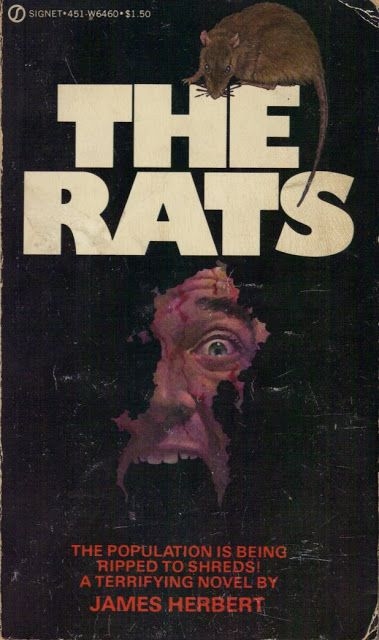
Like the song it inspired, this book is not subtle. It’s extremely violent to the point. I had read Herbert’s The Fog before, and while I enjoyed parts of it, I felt it dragged a little bit. The Rats is less than 200 pages, and they’re all good. There’s no surprises with this book. It’s exactly what you think it’s going to be. Go read it if you haven’t already.
Lair

Lair is a very predictable sequel. It’s 4 years after the first rat attack, and the rats have migrated to a nature reserve outside of London. None of the characters from the first book appear except for the rats. It’s so derivative of the first novel that I’d call it pointless if it didn’t contain the scene in which a priest is seen vomiting into an open grave where a bunch of mutant rats are eating the corpse of an old woman. Total redemption! While I definitely enjoyed Lair, it’s easily the worst book in the series.
Domain

Domain is a much more ambitious book than its predecessors. Not only are the rats back, but 5 nuclear bombs have also fallen on London for totally separate reasons. This is a post apocalyptic disaster novel where the protagonists have to be as wary of other humans as they do with the hideous, mutated, blood thirsty rodents that are trying to eat everything. This is highly enjoyable trash. I read these books in quick succession, and I was surprised by how much I enjoyed reading this one.
The City

The final entry in the series is a comic book called The City. I really enjoyed it, but it feels more like a separate work that was inspired by the trilogy of novels rather than a continuation of the story. The rats here are no longer just eating the humans; they have now become our masters. It’s horrendously bleak, and the art is cool. Definitely read this one if you get a chance.
This series, particularly the first book, is both infamous and influential in the field of horror literature, so I don’t feel pressed to say too much more about it. I’ve mentioned a few times when reading other horror novels about killer animals that I assumed they were rip-offs of Herbert’s work. I can now confirm that most the “animal attacks” books by John Halkin, Simon Ian Childer, Harry Adam Knight, David Anne and Nick Sharman that I have read are all knock-offs of The Rats. I feel like I’ve read a lot of these silly animal books in the last few years, and I’m planning on giving this particular genre a break for a while. It took me about 4 years to get around to The Rats after finishing Herbert’s The Fog, but I don’t think I’ll wait that long before returning to his work. I had a lot of fun reading these books.

 Nocturnal Revelries