
It will come as no surprise to anyone who has ever read this blog that I sometimes get obsessed with certain books. A few years ago, I first saw the cover of Garrett Boatman’s Stage Fright, and its heavy metal skeleton assured me that I would some day read it. A few months later, the cover of Stage Fright was featured in Grady Hendrix’s Paperbacks from Hell, and copies suddenly became scarce and expensive. It was already an obscure book that I couldn’t find much information about online, and this combined with its sudden scarcity made it all the more desirable.
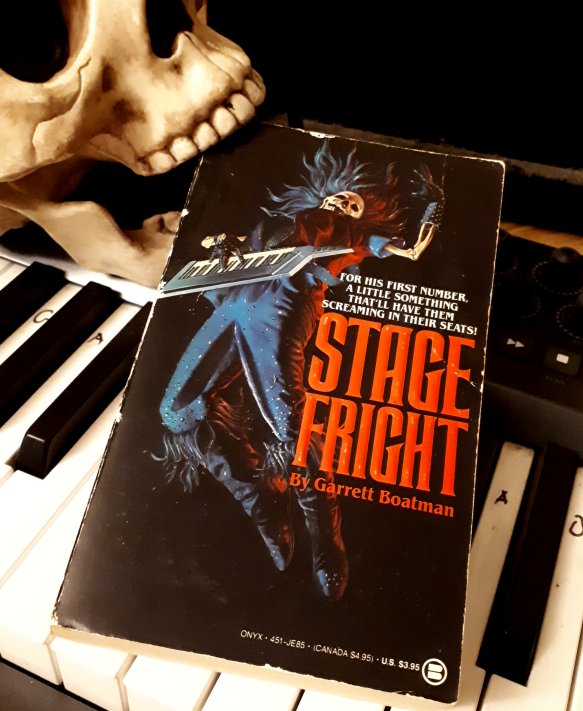
This time two years ago, I was scouring the internet for an affordable copy of Stage Fright, all the time kicking myself for not having bought one when they were going for 10 dollars (including postage). I’m not exaggerating; I was literally searching bookfinder and ebay every few hours. At one point, I was planning a trip to the United States to buy a copy from some dude in Washington, but he sold it before I could go through with this. I also spent hours searching for Garrett Boatman on social media to see if he had any copies left, but I couldn’t find any traces of him online. I presumed he was either dead or that ‘Garrett Boatman’ had been an alias. Fortunately, I eventually found a copy online for about 35 dollars and snapped it up. 35 dollars is too much to pay for a tattered old horror paperback, but after a bit of reasoning I convinced myself that it would be worth paying that much just to free up the time I had been spending looking for this damned book.
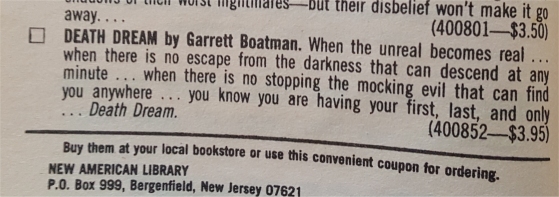
When I got around to reading it, Stage Fright did not disappoint. It was a bloody mishmash of horror and sci-fi. I rated it 5 out of 5 on goodreads and wrote a glowing review. In writing that review I came upon Joe Kenney’s review that noted a curious feature of the book. The inside cover of Stage Fright makes reference to a book by Garrett Boatman titled Death Dream. This was peculiar for two reasons. First off, the description of Death Dream lines up with the plot of Stage Fright, and secondly, there was no record of a book called Death Dream ever being published. Here was a mystery.
I had purchased, read and reviewed Stage Fright, so I set my sights on some other curious books and moved on. I briefly considered selling my copy, but I decided to hang on to it because it’s so cool. I had spent a long time obsessing over this book, and it’s one of the jewels of my collection.
Can you imagine my surprise and delight when Garrett Boatman came out of hiding and posted a comment on my blog’s facebook page? Here was the hitherto believed dead author of one of my favourite novels sending me a message! Might this be my chance to get the answers to all of the questions I had about this most curious volume?
Yes. It was. It turns out that Garrett Boatman is actually a really nice, patient and accommodating guy. He very graciously responded to my questions and has allowed me to publish those responses here. I’m absolutely delighted to be able to share this interview of sorts with you.
 Mr. Boatman
First off, can you tell me the story of writing Stage Fright? Where, when and how did you do it? How did you get it published once it was written?
In the 1950s, researchers at Tulane University discovered a protein antibody called taraxein in the blood of schizophrenics that caused schizophrenic behavior when injected in monkeys. Administered to inmate volunteers from the Louisiana State Penitentiary, taraxein produced schizophrenic episodes that lasted up to half an hour, presumably until the body’s defense mechanisms defeated the invading substance. Hmm, I thought. From the blood of schizophrenics. Now there’s an idea.
Two other elements went into the inspiration for Stage Fright. Growing up I watched a lot of Creature Features and especially enjoyed stories about mad scientists like Frankenstein, Nemo, Jekyll, Morbius from Forbidden Planet.
The third piece was my idea for a new type of performing art. I remember thinking when I was a boy walking in the Georgia woods wouldn’t it be great if I could make up music in my head and hear it playing in the air. As an adult I loved movies—especially horror, science fiction and fantasy. But making a movie takes money, a director, actors… I thought wouldn’t it be great if there was a technology that could record my dreams. I’d always been interested in dreams, especially nightmares which I enjoy. In controlling them and watching how they play out. I’d recorded my best dreams for years in my notebooks. In fact some of the dreams or schizophrenic sequences in Stage Fright derive from my dreams. Anyway, I came across articles on how dreams or thoughts might be recorded in Psychology Today and other publications, as well as how different parts of the brain processes different sensory input and came up with the dreamatron, a combination synthesizer-neural transmitter device. Edison had his “flickers.” I had my dreamies.
Stage Fright was my second novel. The original title was Death Dream. I wrote it long-hand, then typed it up on a second-hand IBM Selectric. I was unagented. I called New American Library because Signet published Stephen King. I asked to speak to an editor and got one, Matt Sartwell. He asked what I had. I told him about taraxein and my idea for a new media for performing arts. He asked me to send the manuscript and I signed a contract a couple months later. The book was originally intended for NAL’s science fiction imprint Ace with a print run of 90,000 copies, but NAL had recently launched a horror imprint, Onyx Books, and editor-in-chief John Silbersack decided to publish Stage Fright under the Onyx imprint with a print run of 70,000 copies. The new title was also John’s idea. And so it goes.
What can you tell me about the amazing cover art? The artist is uncredited in the book as far as I can see.
I have no information about the cover artist. He or she is not credited in Stage Fright. Paperbacks from Hell lists the cover artist as “unknown.” When I was shown the artwork for Stage Fright, the colors were circus bright. The skeleton’s face was white, hair blond, vest red. I think the pants were blue. The boots were buckskin. I said the colors should be darker. Silbersack agreed. When I got the mockup, I was pleasantly surprised. The art department did a great job.
What about this Paperbacks from Hell business? Did you know your book was going to be featured? If not, how did you find out about it?
No, I didn’t know. I’d been working on a dark-fantasy for the past few years, doing more writing than reading (which for me is a hardship since I’m a voracious reader), and when I finished editing the last volume in November, I ran a search keywords my name and Stage Fright and was thrilled to come up with hits on Nocturnal Revelries, Too Much Horror Fiction, Glorious Trash, Goodreads. It was the link from your review of my book on your post “One for the Rockers“ that sent me to Paperbacks from Hell.
(Ohhhhhh man, knowing this makes me so happy. I feel like I’ve played a small role in horror fiction history!)
How did it make you feel to find out that your book had been not just featured in Paperbacks from Hell but also included on its cover? That book won awards and has had a pretty big influence on the horror market in recent years. Do you accept the title of ‘Paperback from Hell’ for your book?
I write from that dark subterranean platform where the three tracks of science fiction, fantasy and horror meet. There was a time when my editor at NAL joked maybe I would be the King of Technohorror. So if the shoe fits…
But yes, I was tickled pink. Ordered a copy right away. Grady Hendrix must have good taste: he’s using the face from my cover for his Facebook image. Check it out. But really, Stage Fright is more than that. I am very interested in social evolution and how new technologies impact social evolution. I plan to further explore how my dream technology might help shape social evolution. Movies, cell phones, virtual reality all have an impact. If I can throw some frights in along the way, even better.
A couple of years ago, right after PfH came out, a lot of the books featured therein became highly sought after. I remember a time when the cheapest copy of Stage Fright available online was $300. Prices have dropped considerably since the big PfH boom, but copies of Stage Fright still don’t come cheap. Do you find that annoying or flattering?
Neither, I just shake my head in amazement. But I’m glad horror is back. Can I get a Hell Yeah?
Hell yeah, brother! Haha, so what are you plans for the future? Tell me about the new stuff you’re writing/have written.
Night’s Plutonian Shore is a doppelgänger novel, “creatures of the id” as Dr. Morbius called them in Forbidden Planet. One of my favorite tropes. Experimenting with psychotronic generators—similar to what the ancient Egyptians called “Wands of Horus,” a group of students accidentally produce doppelgängers. Survival instinct compels these creatures to murder their originals. My protagonist has a conscious and draws the line at murder; his double does not.
In The Clocks of Midnight, Rick and Fergi, having survived encounters with their doppelgängers, have relocated from New Jersey to Memphis, Tennessee. At the site of a multiple-vehicular accident, a dead man wakes to tell Rick, now an EMT, “The feeding has begun.” In Montreal, a shadow creature attacks two-hundred-year-old horologist Reginaldo da Silva, priest of the Goddess and guardian of the mandala that binds the Watchers to the Abyss. In the days of Enoch, the Watchers, sent to keep an eye on man, abandoned their task and cohabitated with humans, producing monstrous offspring, the Nephilim. The true Samhain, when the Pleiades stand at the zenith at the stroke of midnight and the veil between worlds is thinnest, approaches. And when the Goddess, posing as a vendor in a flea market, sells Rick a crystal that channels the energy of the stars, his life is catapulted into a confrontation with an ancient evil, one of the Grigori, a Watcher who escaped God’s avenging angels in the world’s youth and whose mission is to open the gates of the Pleiades and usher in a new reign of terror.
In The Mirror of Eternity, EMT Rick Scott arrives at the scene of a fire and finds an apartment block vanished, replaced by a warehouse dating to the time of paddle wheelers ablaze, and standing before the inferno, two antique horse-drawn pump wagons and firemen in peaked leather helmets and old-fashioned uniforms. Time is flowing back toward the singularity of the creation. Though he wants no part of magic or the Goddess or Her priest Reginaldo da Silva, he needs answers and, using a vintage 1934 Omega RAF pilot’s watch the ancient horologist has modified with complications created on the astral plane, travels back to 1583 to consult with John Dee and Giordano Bruno and to face demons and gods and in the process become what he never wanted.
The trilogy follows Rick’s reluctant journey from initiate to adept. His arc mirrors the alchemical stages of nigredo to albedo to rubedo.
These books will be available soon, and since this interview was first published, Mr. Boatman has confirmed that Stage Fright is going be rereleased as part of Valancourt’s Paperbacks From Hell series. (YES! I’ve been smiling since I found out yesterday!) I hope this information was as interesting for you as it was to me. You can find more information about Garrett Boatman and his books on his new website, https://www.garrettboatmanauthor.com/
Thank you Garrett!

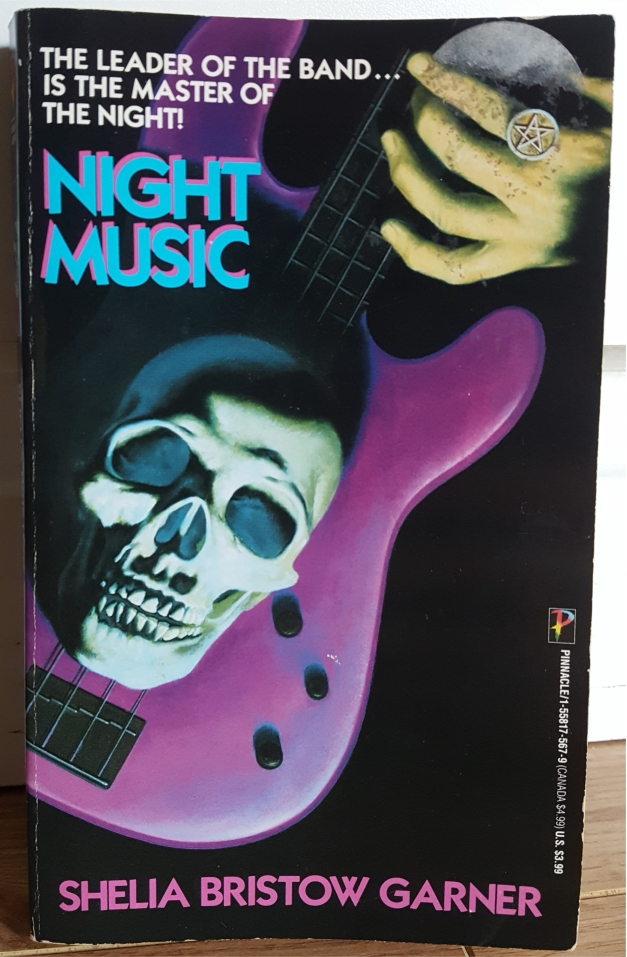 Night Music – Sheila Bristow Garner
 The author


 Nocturnal Revelries