The Bride of Christ and Other Fictions – Montague Summers Snuggly Books 2020
I have a collection of books by and about Montague Summers. A few years ago, somebody found a bunch of his writing that was long believed lost. It contained an unpublished collection of ghost stories that was finally put out last year. This collection was really, really cool. The publisher, Snuggly Books, announced that they had enough material for a second collection of unreleased fiction. It was to be titled The Bride of Christ. I ordered a copy as soon as it came out.
In his introduction to the text, Daniel Corrick notes that the pieces in this collection can be divided into four categories: the ghost stories, the Uranian pieces, the society pieces and the titular novella. I’m going to stick with these categories in my discussion too.
The ghost stories are very short little things. They’re not awful or unpleasant to read, but they’re not particularly memorable.
The Uranian pieces are mostly uninteresting. One of them, “The Parting of the Ways”, is ok. It’s a story about a lad falling in love with a lad who falls in love with a woman. It’s not a great story, but it is actually a story which is more than can be said about the other two Uranian “pieces” in here. I was going to say that it’s a bit odd that a self proclaimed Catholic priest would write stories about romantic affairs between teenage boys, but I guess that’s not really true at all.
The “society pieces” are boring garbage. Both are opening chapters to books that Summers never bothered to finish. These are boring stories about rich old British women trying to impress their friends. I read one, but couldn’t bring myself to finish the other. Pure crap.
The Bride of Christ, the longest piece in this book, appears at the start of the collection, but I was excited to read it, so I saved it for last. I was disappointed. It’s the story of a nun who falls in love with Jesus. The priest at her convent tells her this is not good. Just as the story seems to start, it ends. There is supposedly some debate over whether or not this work is complete. If this is the final product, it’s absolute shit. There’s simply not enough in here for it to be interesting. I’m giving Monty the benefit of the doubt and assuming it’s unfinished.
I understand why a publisher would choose to release two books of Summers’ fiction rather than trying to stick it all into one together, and as a collector of his work, I am pretty happy to own this collection of rarities. Honestly though, there isn’t going to be much of interest in this book to anyone other than Summers enthusiasts. I think taking the two ghost stories out of this one and adding them into Six Ghost Stories as an appendix would have made the best book. The leftovers aren’t really worth reading.
The Cormorant – Stephen Gregory Valancourt Books – 2013 (Originally published 1987)
This horror novel was reiussed by Valancourt books in 2013, so I knew it was going to be pretty good. It’s about a man who inherits a cormorant, a big dirty bird, from his uncle. I’ve done quite a few evil animal books this year, but I anticipated this one being quite a bit better. It won a Somerset Maugham Award, and I had seen it being compared to Poe’s writing. In ways it was classier than my standard fare, but it also contained more crass swearing and disturbing pervy bits than any of the horror novels about beetles or worms that I’ve read in 2020.
This is suspenseful, creepy, sometimes funny and breathtakingly dark. I’m not going to try any harder to convince you to read it. For the rest of this post, I am going to talk about the plot and give away big spoilers. If you haven’t read it already, fuck off and come back when you’re done.
The narrator repeatedly alludes to his previous career as a teacher, and although he claims to feel that he was never cut out for that job, his actions suggest otherwise. His final acts of vengeance against the cormorant prove that he is extremely efficient at teaching lessons.
The whole way through the book I was expecting him to turn violent against the bird. When he finally snaps, he does so with grace, determinacy and cunning. He hits the unruly bird on the wing with a fire poker, shoves it in a box and then gives it a golden shower. Take that, you filthy beast!
I have nothing else to say other than that the bathtub scene was weird and probably unnecessary and that the ending is unbearably grim. I really enjoyed The Cormorant, and I’ll definitely check out more of Gregory’s stuff when I get the chance.
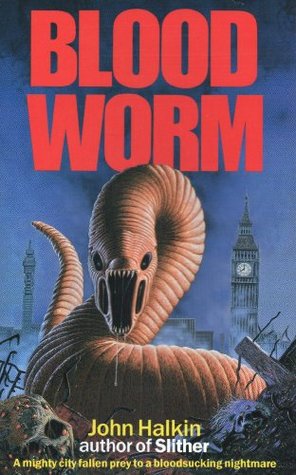
Earlier this year I read Slither (1980), Slime (1984) and Squelch (1985) by John Halkin. Although these books are about different characters and all take place in separate realities, they are regarded as a trilogy due to their titles and almost identical plots. Each book is about a wave of killer creepy crawlies (worms, jellyfish and butterflies respectively) wreaking havoc on Great Britain. These were not great books, but I found them mildly entertaining. Halkin also wrote Blood Worm, another horror novel about killer bugs, in 1987, and while it’s not considered part of the Slither series, it is frequently mentioned alongside it. I had to read it.
It was terrible.
A bunch of killer beetles start killing and eating people in London. The beetles are extremely dangerous, but the beetle grubs are far grosser. These grubs join together in huge numbers to create giant worms that feed on human flesh. Together, the beetles and blood worms seem to do more damage than the bugs in the Slither Trilogy books. They lay London almost entirely to waste. (I recently noted that the Slither Trilogy seemed like a rip off of James Herbert’s books, and the destruction of England’s capital city in Blood Worm makes it seem even more Herbertian.) Also, the main character in Blood Worm is an ex-soldier, not somebody was was involved in television. Aside from these 3 differences, this book is essentially the exact same as Slither, Slime and Squelch, just a bunch of uninteresting characters in unhappy marriages getting killed by bugs.
Blood Worm is a shit book. It’s uninspired drivel. Halkin wrote a few other horror novels, but they’re not about worms, so I’m not interested. One is called The Unholy, so maybe I’d read it to compare with this book, but I’m sure it’s absolute shit too.
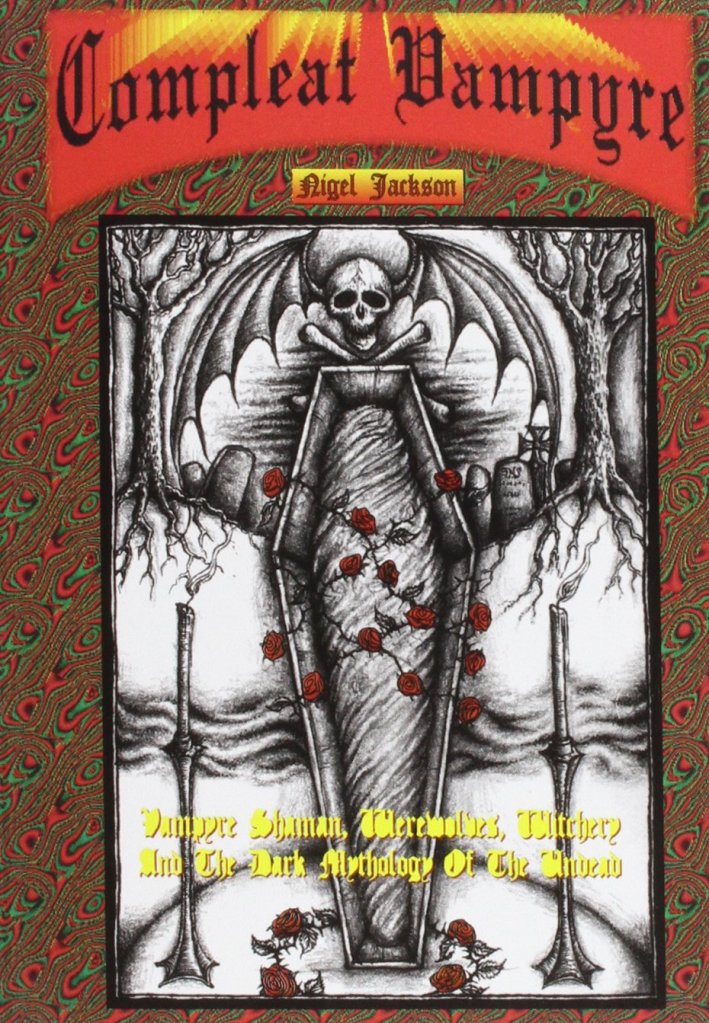
Compleat Vampyre: The Vampyre Shaman, Werewolves, Witchery & the Dark Mythology of the Undead Nigel Jackson Capall Bann – 1995
A few months ago I put out a call for occult book recommendations. I haven’t been as interested in occultism for the last year, and part of me thought that this was from overdoing it over the past few years. I was kindly recommended this book by a pal of mine. It looked pretty cool, so I decided to give it a go.
It’s rather dense, and despite its subject matter, I thought it was very dry. It’s only 180 pages, but it took me a month and a half to get through it. I didn’t take notes as I read through it either, so I don’t even remember much of what the author said in the first half of the book.
This seems like a thoroughly researched book, but the writing does not seem to be very critical. Most of the book is taken up with descriptions of vampires and werewolves from folklore, but the idea that these accounts might not be real is never really discussed. I’m not saying Nigel Jackson believed every word in this book, but he doesn’t do a very good job of clarifying which parts the reader is supposed to believe and which parts are just legends.
Ultimately though, this is presented as a book on occultism rather than one on folklore. Towards the end of the book, the author does give some instructions on how to shapeshift into a werewolf, but these instructions are pretty vague, and one would have to have a detailed knowledge of occultism and ceremonial magic to be able to pull them off.
The most interesting claim in the whole book is that the mysterious large cats seen throughout the English countryside (the ones discussed at length in The Goblin Universe by Ted Holiday) are actually transformed witches and wizards.
Honestly, I couldn’t give a bollocks. I have so little to say about this that I feel bad for wasting your time. I read the whole thing, but reading it felt like trying to paint water. I’d reread the same paragraph 3 times, but I was so uninterested that nothing would stick in my head. “Vampires, shadows, liminal… bleh bleh bleh.” Whatever. I’m not really qualified to judge a book like this. Maybe it’s great if you’re interested in this stuff. I certainly amn’t. I won’t say I’ll never read another occult book, but I doubt that I’ll ever get back into reading 2 a week like I was doing a few years ago.
Back in the days of internet chatrooms, I made friends with the drummer of a band called Ricin. Ricin were from St Helens in Merseyside, and they described themselves as a mixture of Metallica and the Red Hot Chili Peppers. During an MSN messenger conversation, this guy told me the frightening tale of Purple Aki.
Purple Aki is a big scary lad whose skin is so dark it supposedly looks purple. This imposing figure appears out of the shadows telling young men to let him feel their muscles. He gives relentless chase to anyone who dares refuse, and when caught these escapees are offered a choice, “Pop or slash.”
The stories of ol’ purple i used to hear was that he offered a choice of pop or slash, either get P slashed on one ass cheek and A on the other, or get ya ass popped.
Even then (2004ish) there was enough information on the internet to confirm that Purple Aki was no mere urban legend. Akinwale Arobieke was actually serving his second stint in prison at the time. He had been charged with multiple counts of indecent assault, harrassment, witness intimidation, threatening behaviour and even manslaughter.
I’m not from Merseyside, but there was something about the Purple Aki story that fascinated me. In 2006, Liverpool Magistrates’ Court for a Sexual Offences delivered a Prevention Order against Aki banning him from touching, feeling or measuring muscles and asking people to do squat exercises in public. There is nothing funny about sexual assault, but there is something a bit funny about a man being banned from touching muscles. Social media was really taking off at this point, and amoungst other things, Aki appeared in series of hilarious but poorly animated videos on youtube. The Purps was becoming a meme.
Purple Aki Facebook Pages
Purple Aki Facebook groups
4 years ago I signed into facebook to find that one of my closest friends had posted a link to a BBC documentary on Aki. I was pretty disappointed. Instead of a lighthearted review of the Purple Aki meme, this show told the sad story of a genuinely scary and dangerous creep. I think a lot of people see this guy as a big joke, but he really is quite a horrible person.
I recently did a youtube search for the series of cartoons I mentioned above. They seem to have been taken down, but I did find a video clip of Rikki Wiley (Riley?), a Liverpudlian comedian, talking about Aki. I was expecting the usual “Let me feel your muscles, boys” in an African accent routine, but this guy said something which I found fascinating (and very funny):
…my favourite piece of Purple Aki information: Purple Aki rose to prominence in South Liverpool in the late 80s. Now another person who rose to prominence in South Liverpool in the late 80s was a horror writer, and he wrote Hellraiser. Does anyone know his name? Clive Barker. Yes, very good, Clive Barker. Now at the time, Clive Barker was writing a novel, a very successful novel, went on to be turned into a film, and the main villain of that novel was based on Purple Aki. The film, the character, the book ‘Candyman’ is based on Purple Aki. I kid you not. Absolutely, you can look this up online. it’s absolutely true. It’s totally true.
And it is in fact also true that if you say Purple Aki three times… you’re a bit racist.
Now I know this is obviously a joke, and while some of it is simply untrue (there was never a book called Candyman), the main claim he is making seems fairly plausible. When I did as Wiley suggests and looked up this claim online, I could not find any definitive proof that the Candyman was based on Purple Aki.
While Clive Barker has not said that he based Candyman on Akinwale Arobieke, it does make sense. This happened in Liverpool and Barker is originally from Liverpool. Plus, Akinwale Arobieke does look alot like Candyman.
Of course wild stories still circulated – such as the one about him being the inspiration for Clive Barker’s ‘Candyman’ character, but mostly he has just faded into the local culture as a figure part bogeyman, part figure of fun…
Aki had surely been conjured up somewhere in the deepest recesses of the Scouse id. Plenty of people assumed he was an urban legend, a bit like the Candyman in Liverpool-born author Clive Barker’s short story.
The above are just a few of the mentions I found of Candyman and Aki together, and all of these comparisons were made before Wiley’s video was posted on youtube in 2018. Somebody straight up asked about the link on Clive Barker’s twitter account a few years ago, but there was never any response. I decided to investigate further.
Purple Aki. A name that’s whispered in the parks and playground of Merseyside. A threat made to kids. A name I’ve known all my life. Watch out or Purple Aki will get you. A bogey man that nobody was really sure even existed.
Benjamin Zand, Host of BBC’s ‘The Man Who Squeezes Muscles: Searching for Purple Aki’
I am the writing on the wall, the whisper in the classroom. Without these things, I am nothing. So now, I must shed innocent blood. Come with me.
Our names will be written on a thousand walls. Our crimes told and retold by our faithful believers. We shall die together in front of their very eyes and give them something to be haunted by. Come with me and be immortal.
Your death will be a tale to frighten children, to make lovers cling closer in their rapture. Come with me, and be immortal.
The Candyman – Candyman (1992)
Don’t pretend you don’t see the similarities.
If you haven’t read Clive Barker’s story or seen ‘Candyman’, the following paragraphs contain spoilers.
The Candyman character made his first big appearance in Clive Barker’s short story ‘The Forbidden’ from the 5th volume of his classicBooks of Blood collection. I have read that this story was based on a short, very arty film Barker made when he was 19 that was also called The Forbidden, but as far as I can tell, the only thing the story and the film have in common is their title. The film is a Faustian tale of an artist. I have very low threshold for arty films, and I only watched a few minutes before giving up, but it was made in 1978 when Aki was only 17, so I’d be fairly certain it had absolutely nothing to do with him.
Maybe (but probably not) an image of the Candyman from Clive Barker’s ‘The Forbidden’ (1978)
In the short story, Helen, a university student writing her thesis on graffiti, finds a big painting of a scary looking dude on the wall of an abandoned apartment. Beside this picture somebody has scrawled “Sweets to the Sweet.” This is in a neighbourhood where a bunch of murders are rumoured to have taken place. People are hesitant to talk of these murders, and it turns out that this is because the individuals who discuss them seem to draw the ire of the murderer. The local who tells Helen about the killings ends up having her child murdered because of her transgression, and Helen ultimately gets killed because she tells her friends. The Candyman needs people to talk about him for him to exist. The rumours feed his existence. This is made perfectly clear in the last lines of story as the protagonist is being burned alive and watching her husband approach the fire:
She willed him to look past the flames in the hope that he might see her burning. Not so that he could save her from death – she was long past hope of that – but because she pitied him in his bewilderment and wanted to give him, though he would not have thanked her for it, something to be haunted by. That, and a story to tell.
All throughout the story Helen’s marriage is presented as strained. By letting her husband know the Candyman has taken her, she is likely securing him as another victim for her killer. Her death is not solely to get revenge on a cheating spouse though. She’s giving the Candyman the power to exist; her murder is as much a seduction as it is an act of violence. This is a twisted tale in a very Barkerish (Barkernian?) way, but at it’s heart, it’s very much a story about the power and operation of urban legends.
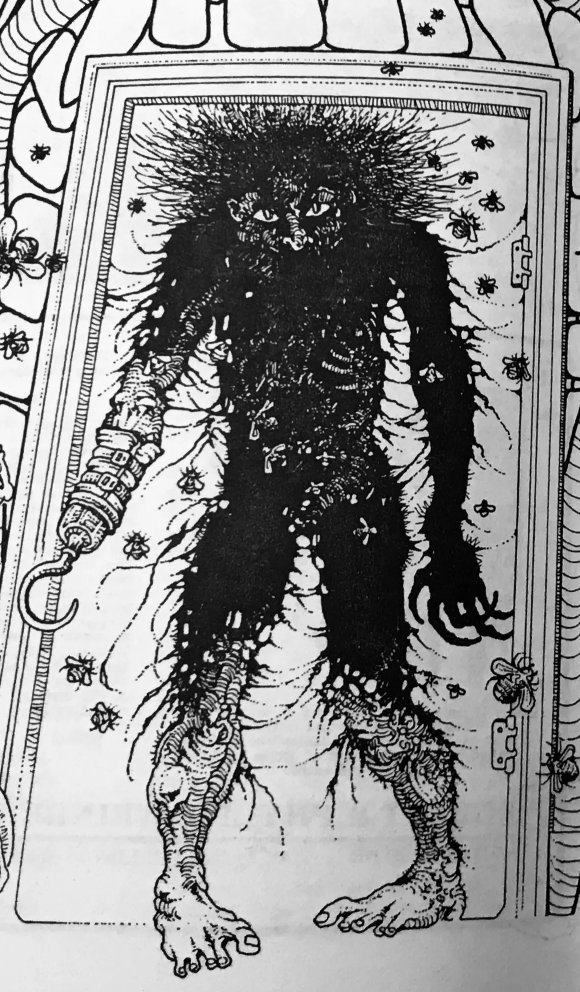
The thing is though, the Candyman in ‘The Forbidden’ looks nothing like Purple Aki:
He was bright to the point of gaudiness: his flesh a waxy yellow, his thin lips pale blue, his wild eyes glittering as if their irises were set with rubies. His jacket was a patchwork his trousers the same. He looked, she thought, almost ridiculous, with his bloodstained motley, and the hint of rouge on his jaundiced cheeks.
I mentioned that ‘The Forbidden’ was published in the 5th volume of The Books of Blood, but just prior to that, it had been published in a zine called Fantasy Tales. The subheading of the story in the zine is “A Terror Tale from the Books of Blood!”, so I assume the zine and book versions of the story are identical. The only difference is that the zine version includes an illustration by artist John Stewart. This is an artist’s impression of Barker’s creation, but it’s worth including here as it looks nothing like Akinwale Arobieke.
John Stewart’s 1985 Candyman illustration
Physically, I think it’s safe to say that this incarnation of the Candyman has little to do with Aki, but the story of ‘The Forbidden’, at its heart, is far more concerned with urban legends and the way they operate than the specific details of any one bogeyman. It’s not impossible that the story of Aki may have contributed to how Barker thinks about these concepts.
Both the 5th volume of Books of Blood and the aforementioned issue of Fantasy Tales were published in 1985, so ‘The Forbidden’ was probably written in that year or the year prior. Purple Aki was likely on the prowl at that stage, but he certainly wasn’t as notorious then as he would later become. It wasn’t until 1986 when Aki chased a kid in front of a moving train that he first ended up in the media spotlight. Did Clive Barker know about Aki prior to this? Well, I don’t know if he was in Liverpool at the time he was writing Books of Blood, but he was definitely in England, so it’s certainly not impossible. Also, Barker is gay, and I have heard that Aki has long been infamous in Liverpool’s gay community. This is pure speculation, but it doesn’t seem ridiculous to think that Barker might have heard of Aki before writing ‘The Forbidden’. Even if he had though, it really doesn’t seem that the Candyman in the story is based on Aki.
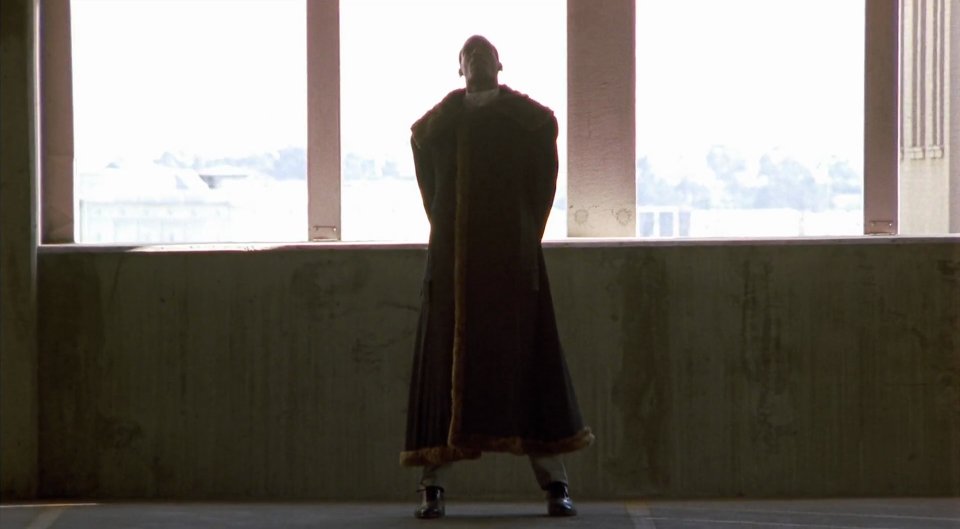
The movie Candyman was released in 1992. It’s pretty similar to the short story, but it gives a backstory to the Candyman and by doing so makes the tale less about the power of urban legend and more about a specific entity. The Candyman in the movie has a lot more in common with Aki than the one from the short story.
Let me feel your muscles, boys!
I found an article that claims that while Candyman is not based on a true story, it does incorporate some popular urban legends into its story. The first of these is Candyman’s hook for a hand. Stephen King writes at length about the urban legend of the hook handed maniac in his Danse Macabre, calling it “the most basic horror story I know”. The hook was in the original short story too, but the film added the ol’ “say his name 5 times and he’ll appear” thing. (The Candyman himself is the first to mention his name in the story.) I remember hearing a similar story about saying “Bloody Mary” 5 times into a mirror when I was kid. I think most people did. There’s definitely some urban legends being incorporated here, but is Purple Aki one of them?
Tony Todd, the actor who plays Candyman is a big Black guy. He’s 6’5″, the exact same height as Aki. He also looks nothing like the yellow creeper in the story. Was he cast because of his physical similarities with Akinwale Arobieke?
Well, the height thing is probably just incidental. Bigger is usually scarier when it comes to villains. As for his race, that’s more complicated.
Candyman’s Blackness is crucial to the backstory of the movie. In the film, he’s some kind of revenant or ghost who was originally killed by white guys because he was having an affair with a white woman. Despite this, his own attacks are generally focused on poorer Black families. He shouldn’t really have any motivation to kill these people, but I guess poor, unprivileged people are more likely to believe in urban legends. There’s other interesting stuff going on with race here too. At the beginning of the movie, Helen’s best friend and colleague won’t join her in attempting to summon Candyman. This Black character is not poor and underprivileged, but she seems to sense the danger quicker than her white counterpart. I don’t know exactly what kind of statement this was supposed to make, but I’m pretty sure the people making this movie were trying to be anti-racist.
Regardless of how well it does so, this is a movie that sets out to address racial inequality. The message is that racism is bad. I really, really doubt that the films writers, producers and actors would have been receptive if Clive Barker had shown up one day and said “Let’s make Candyman Black so he looks like a scary nonce I heard about back in Liverpool LOL!”
And while the movie is based on Barker’s ‘The Forbidden’, Bernard Rose is credited as the movie’s writer. I assume he is the one who changed the setting from Liverpool to Chicago and made Candyman Black. Barker had nothing to do with the casting of the movie. He was the “executive producer”, but as far as I know, that doesn’t mean he had a huge amount of creative control on the making of the film. Even if he did, I don’t think he would use it to sneak Purple Aki in.
I am not at all convinced that Purple Aki was the basis for any version of the Candyman. It seems unlikely that Aki’s reputation was big enough in 1984 to convince Barker to try to incorporate him into ‘The Forbidden’. As for the similarities between Aki and the movie Candyman’s appearances, I’m pretty sure they’re coincidental. This doesn’t seem to be a case of life imitating art either. While Candyman feeds off of his rumours, I’d be very surprised if Aki was delighted about the stories that are told about him.
Another crucial difference to note is that while Candyman’s Blackness is part of what makes us feel sorry for him, Purple Aki’s Blackness is part of what makes people laugh at him. Let’s be realistic. If he was a white guy, he’d be just another pervert. I’ve watched a bunch of videos of people describing him, and several say things like, “I’m not being racist; he’s just purple.” That is racist though. Even if his skin was a bit purple, why mention it? Nobody calls Charles Manson “Beige Charlie”. Are there really so many Akinwales of note in Liverpool that people have to classify them by their colour?
There is a part of me that feels sorry for Aki. He grew up without a family, and being a big gay Black lad in Liverpool in the 1980s doesn’t sound like a lot of fun. While he doubtlessly has been the victim of racism, he is also a sex offender and a child predator, so let’s all do the right thing and just call him ‘Pedo Aki’ from now on.
I’ve reviewed three of Barker’s books on this site in the last year, The Books of Blood, Cabal and The Hellbound Heart. I enjoyed all of them, but never had much to say. I feel like this post is finally giving Barker the level of attention he deserves. I’ll be reading more of his stuff in the future. Also, I saw there’s actually a reboot of the Candyman film franchise coming next year. I haven’t watched any of the sequels yet, but I might give the new one a go.
A few months ago I read a book called The Worms by Al Sarrantonio on a whim. I really liked it, so I decided to read more of his stuff.
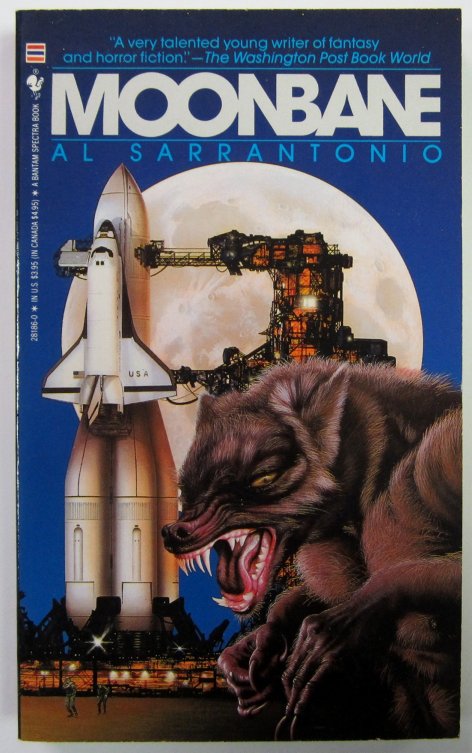
Moonbane Spectra – 1989
A bunch of evil werewolves from the moon land on Earth and start attacking humanuty, eating most but turning plenty of us into werewolves too. After witnessing the transformation of his son and death of his wife, a sensitive poet finds himself tagging along with a crew of scientists on their way to a military base to perform some kind of drastic rescue mission, the nature of which the scientists are hesitant to discuss. All I’ll say is that it involves a really big rocket and some REALLY big bombs.
Honestly, if you don’t want to read this after hearing that and seeing this book’s cover, you’re a lost cause. Rockets and moon-wolves. Cool!
Toybox Leisure Books – 2003 (Originally published 1999)
I had heard that Sarrantonio was a better short story writer than a novel writer, so I decided to check out his first story collection, Toybox. The person who told me that Sarrantonio’s stories were worth reading also mentioned a great likeness to the work of Ray Bradbury. Aside from Fahrenheit 451 and a couple of short stories, I hadn’t actually read anything by Bradbury when I started this. It often takes me a while to get through short story collections. I read one or two stories from different collections when I’m between novels. While I was dipping in and out of Toybox, one of the novels I read was Bradbury’s Something Wicked This Way Comes. This clarified for me what my friend had meant with his comparison. I soon thereafter read a couple of collections of Bradbury’s creepier stories, and this further confirmed my impressions. Sarrantonio’s short stories are very, very Bradburyian. Nearly all of them involve children, Halloween and carnivals. Some of the stories in this collection use almost identical premises to Bradbury tales. ‘Father Dear’, one of the stories in here is about a kid whose dad keeps him inside his house and lies to him about everything. There’s a Bradbury story called ‘Jack in the Box’ about a kid whose mom does almost the exact same thing. Whatever though, it’s hardly a bad thing to be compared to Ray Bradbury. (I’ve been loving the Ray recently.) I enjoyed Toybox plenty. ‘Pumpkin Head’ and ‘The Corn Dolly’ were probably my favourites in here, but it’s all pretty good.
Skeletons Bantam – 1992
This is an epic post apocalyptic novel in which the last remaining good guys on Earth are drawn together by dreams/psychic visions. (I mean epic in the literal sense here too.) It’s basically the same thing as Stephen King’s The Stand except the disease and bad guys in this book are the same thing. They’re skeletons. The skeletons of every human (and animal) that ever lived have risen from their graves and they are really angry with humanity.
There’s 4 narratives running throughout the book. The bulk of the story centers on a Cambodian politician stuck in Russia and an American girl who is unable to speak making their ways across their respective continents to meet eachother. The rest of the tale is told from the perspective of the risen Abraham Lincoln and Roger Garbage, a music industry cokehead who the skeletons keep alive for the purposes of arranging the biggest rock festival ever.
The novel is absurd, and there’s many little inconsistences and plot holes throughout the story, but there’s a scene in this book where the Beatles (in skeleton form) get back together to perform, so I found it pretty easy to ignore the problems and just go with it. I’m pretty sure this is supposed to be read for fun, so there’s no need to dissect it like a college professor. Although it’s about skeletons, the length and scope of the work make it more a fantasy than a horror novel, and while I enjoyed it well enough, it was probably my least favourite of the books I’ve read by Sarrantonio. (It’s not bad. I just really like short books at the moment.)
I can’t say that I was truly blown away by any of the books I’ve read by Al Sarrantonio, but I was entertained by all of them. They’re imaginative, fun and well written. I’ve read 4 of his books in the last 4 months, so I’ll give him a break for a while, but I look forward to reading more of his books in the future.
I read Fahrenheit 451 and a few of Ray Bradbury’s short stories when I worked as an English tutor years ago, and while I enjoyed this stuff, I had Bradbury pegged as a dystopian science-fiction kinda guy. Then I noticed his name popping up in discussions of horror fiction, and I realised I had better take a closer look at his output.
I am really glad I did so. Ray Bradbury was an amazing writer, and he wrote some awesomely dark fiction.
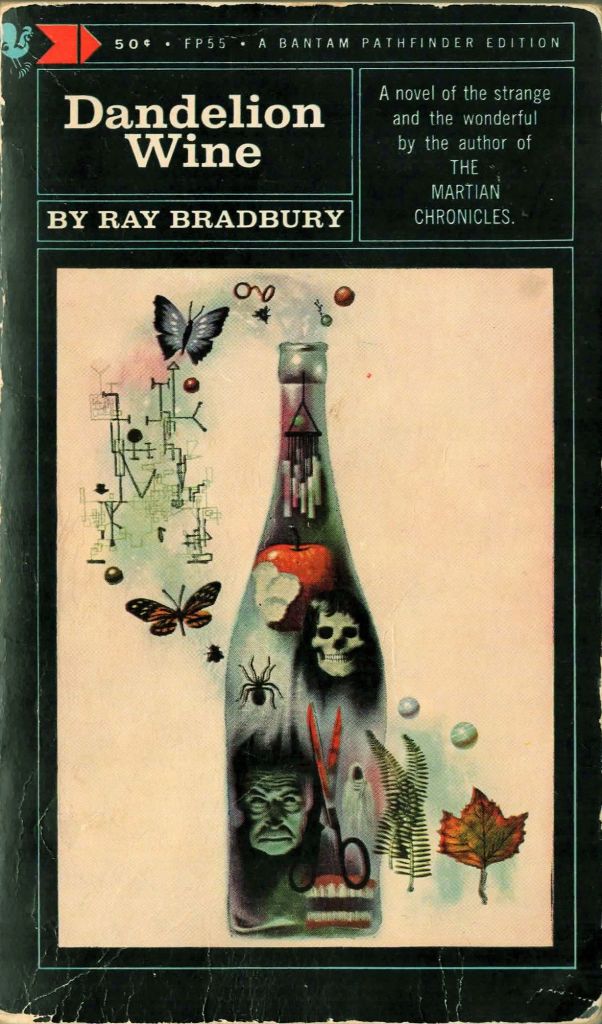
Dandelion Wine Bantam – 1968 (Originally published 1957)
Aside from two separate chapters about a serial killer and a witch, Dandelion Wine has nothing to do with horror. I am including it here because the characters in this book live in the same town as those from Bradbury’s considerably darker Something Wicked this Way Comes. Something Wicked is not a sequel, and you wouldn’t have to have read Dandelion Wine to enjoy it, but Dandelion Wine is a great book and it prepares the reader for the kind of dreamy fantasy that continues in Something Wicked.
Dandelion Wine is quite strange. It’s actually a bunch of short stories that Bradbury wrote and later worked together to form a novel about a young boy’s summertime. Much of it is clearly autobiographical, but there are peculiar parts about a happiness machine and the aforementioned witch that give the book a wonderous feeling. Can you remember dreaming about the summer holidays when you were a kid? Dandelion Wine is full of that majestic uncertainty and childish excitement. I don’t mean childish in a derogatory way here. Bradbury actually takes you back and reminds you of what it felt like.
If anything, this book is almost too sweet. Bradbury wrote it in the 1950s, and he was basing much of it on his own childhood in the 20s. It’s now a hundred years later, and with our pandemic, rising levels of extinction and catastrophic climate change, I don’t know if today’s children can be as full of optimism about their futures.
Still though, this is a beautifully written book, and I strongly recommend reading it before trying Something Wicked.
Something Wicked This Way Comes Bantam – 1969 (Originally published 1962)
This is the story of a strange carnival coming to town months after carnival season. To the book’s 13 year old protagonists, Jim Nightshade and William Halloway, nothing could seem more exciting, but when they hear the Carnival arrive in town in the middle of the night and sneak out of their houses to watch the tents erect themselves, they realise something strange is going on.
The boys discover a merry-go-round that can make a person older or younger, a salesman who has been turned into a wrinkled pipsqueak, and Mr. Dark, the remarkably sinister and aptly named carnival leader. Things get quite scary (especially the witch in the balloon scene, yikes!), and although Stephen King lists Something Wicked amongst horror novels in Danse Macabre, this is far more a work of dark fantasy than pure horror. Yes, there are horrific, scary things that happen in here, but there’s also a great deal of adventure and optimism going on.
Dandelion Wine is set during summer time, but Something Wicked is an autumn novel, taking place in the few days before Halloween. The two protagonists’ birthdays are approaching; they were both born within minutes of the 31st. The seasonal contrast between Dandelion Wine and Something Wicked is part of the reason I think you should read both novels. Contrast is a big thing in Something Wicked: the contrast between the two boys, one wild and dark, the other pale and reserved; the contrast of old and young, Will and his father, Jim’s childhood and the adult he wants to be; innocence and evil; hope and hopelessness… I’m not a professor, so I’m not going to discuss the significance of these contrasts, but I found it hard not to notice them as I was reading.
The writing on display in this book is top notch stuff. I planned to read again as soon as I had finished it.
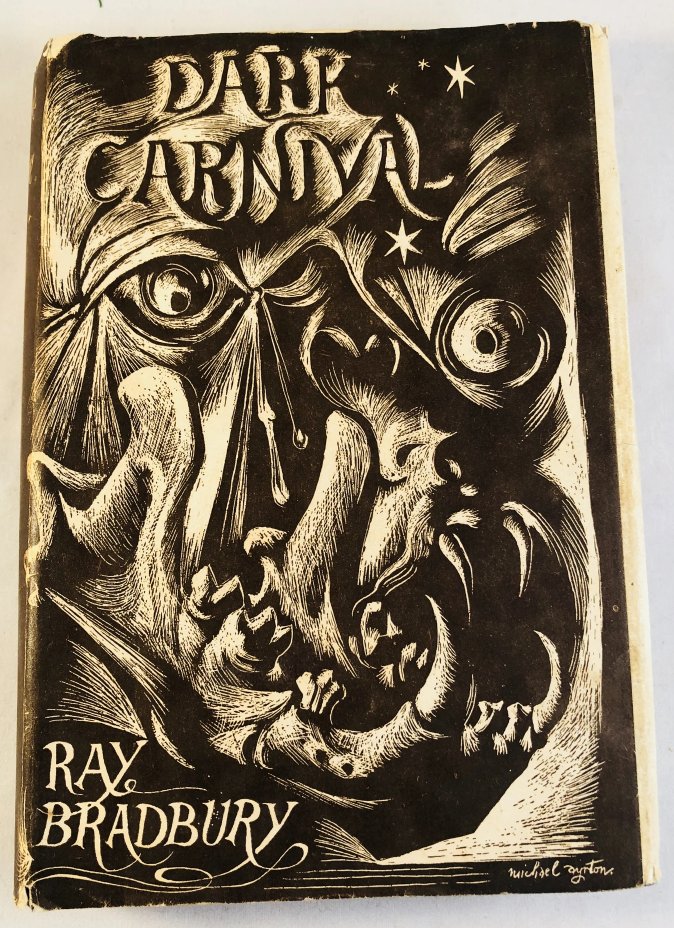
Dark Carnival Hamish Hamilton – 1948 (Originally published 1947)
When Ray Bradbury died, Stephen King released a statement saying, “Ray Bradbury wrote three great novels and three hundred great stories.” I had to include some of his stories in an overview of his work, but Bradbury wrote a lot, and I didn’t know where to start. I discovered that Dark Carnival, his first published collection of short stories, was originally put out by Arkham House, August Derleth’s publishing company. Arkham House specialised in horror and weird fiction, so this seemed like a natural starting point for somebody interested in Bradbury’s short horror fiction.
The original Arkham House edition of this book is extremely rare, and I was only able to track down a copy of the British edition, Unfortunately, this edition omits 7 stories: Interim, Jack in the Box, Reunion, The Coffin, The Maiden, The Night Sets and The Scythe.
The October Country Ballantine – 1956 (Originally published 1955)
In 1955, a second collection of Bradbury’s horror stories was released. The October Country contains 4 new tales and 15 of the stories from Dark Carnival (including 2 missing from the UK edition, The Scythe and Jack in the Box). Some of the stories carried over from Dark Carnival were edited or almost completely rewritten for this collection. These updated versions of the tales are the reason that Dark Carnival is rarely reprinted. Bradbury saw The October Country versions as definitive. (That being said, Gauntlet Press did get permission for a 2001 reprint of Dark Carnival that added a few more tales.)
I’m not going to separately discuss the stories in Dark Carnival and The October Country. To me, the two books are essentially just different editions of the same collection. It would be really nice if a publisher managed to collect all of the stories from all of the editions in one physical book.
It seems kind of pointless to write any more than a few sentences praising Ray Bradbury’s short stories. It’s pretty well established that he was one of the masters of this form of fiction. These stories are from early in his career, but they are undeniably brilliant. They’re creepy too, and some are suprisingly violent (The Smiling People). The Jar, The Small Assassin, The Dwarf, and The Man Upstairs were personal favourites, but the majority of the stories in these books are great.
How talented was death. How many expressions and manipulations of hand, face, body, no two alike. They stood like the naked pipes of a vast derelict calliope, their mouths cut into frantic vents. And now the great hand of mania descended upon all keys at once, and the long calliope screamed upon one hundred-throated, unending scream.
The Next in Line (1947)
Bradbury is one of the few writers I read whose skill with words actually amazes me. Seriously, if you like reading, get a copy of The October Country. This is the good stuff. I know that Bradbury wrote more scary tales, but I don’t think any of his later short story collections are as focused on horror as Dark Carnival or The October Country. Please correct me if I’m wrong; I would love another collection like these.
The Halloween Tree Bantam – 1974 (Originally published 1972)
An October overview of Ray Bradbury’s spooky books would be incomplete without The Halloween Tree. I didn’t realise that this book is actually a novel for children until after I started it. This is the story of a gang of kids whose Halloween night is turned upside down after one of their friends goes missing.
This is more a fantasy novel than a horror novel. It sees the boys flying through time on a kite made up of carnival posters and learning the history of Halloween. I thought the fantasy parts might be a bit too airy-fairy for adults and the historical parts a bit too dry for kids. I’m sure a certain type of nerdy older kid would really enjoy this, but I wasn’t hugely impressed.
Also, as an Irish person, I was a bit annoyed by two things. First off, Bradbury makes Samhain English. I’m pretty sure this is not accurate. Then he goes on to suggest that Ireland’s only influence on Halloween was the potato famine providing inspiration for beggar costumes. Piss off Ray Bradbury.
Honestly, you can probably skip The Halloween Tree. It’s fairly crummy.
With the exception of The Halloween Tree, I was extremely impressed with Bradbury’s work. Some of his short stories are far closer to “horror” than his novels, but these novels are something special. There’s definitely scariness here, but Bradbury presents his world through the eyes of children, and this combination makes these books feel very Halloweeny. This is crucial October reading. Pick up a Bradbury book right now.
Brian Keene is a name I have seen popping up in horror conversations for a long time. I followed him on twitter and asked him which of his books I should check out first, he courteously responded suggesting The Complex and Ghoul.
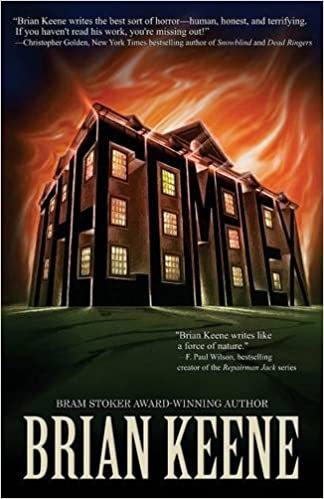
The Complex Deadite Press – 2016
Long term readers of this blog may have noticed that although I have reviewed countless books about witches, demons, aliens, werewolves, and vampires, I have not done a single book about zombies. I’m not interested in zombies. Night of the Living Dead is one of my favourite films, but even as a kid I thought that each sequel, clone and remake (apart from the 1990 one) was a bit less interesting than the original. The characters and settings change slightly, but the plot is always the same – a bunch of misfits are fighting to stay alive in a building surrounded by a horde of the approaching undead. It is a great concept, but I’ve already seen it 100 times. If you like that kind of thing, good for you, but it’s just not my cup of tea.
When Brian Keene recommended I read The Complex, I started it without reading the blurb. Guess what it’s about!
This is the story of a group of misfits fighting to stay alive in their apartment complex while a horde of bloodthirsty, deranged, naked freaks closes in on them. Perhaps these freaks don’t technically qualify as zombies, but they act an awful lot like them.
Ok, so I feel a bit awkward about this because Mr. Keene was polite to me, and I don’t want to be a jerk, but as soon as things got going I realised that this was exactly the kind of horror fiction that I avoid. I kept going with it though, and I reckon I enjoyed it about as much as I possibly could given the subject matter.
This is well written, action packed, easily digestible fiction. I can see why Mr. Keene would suggest it to a first time reader: it’s fun. I may think that I’m too cool to watch The Walking Dead, but I ripped through this zombie-esque novel in two sittings. It’s not my favourite novel ever, but it certainly wouldn’t put me off reading more books by Keene.
One thing that I did notice was that although Keene is woke enough to include a trans character in this novel, he was not woke enough to avoid fat-shaming the main antagonist of the story. Poor Tick-Tock’s weight is very much a part of what’s supposed to make him repulsive.
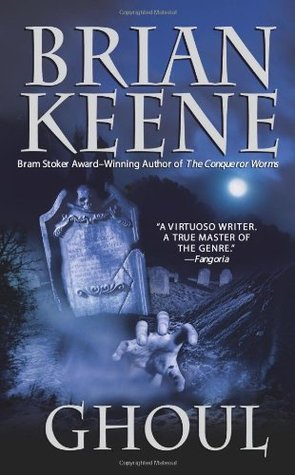
Ghoul Leisure Books – 2007
Three boys’ summer holidays are ruined by a corpse eating ghoul that lives in a cemetery. Sounds good, right? Honestly, this felt a bit like Stephen King ripping off Ray Bradbury. That might sound like a criticism, but I like when Stephen King rips off Ray Bradbury. (Think It.) It’s hard not to root for the protagonists when they’re children who like heavy metal. Ghoul was a fun read, but it wasn’t very scary. That being said, I was genuinely surprised at how grim the ending was. The “who’s the real monster?” question that runs through the book is pretty well answered in the final chapter.
In truth, neither The Complex nor Ghoul blew me away, but they were both enjoyable books. Despite my aversion to zombies, I reckon The Complex is the better novel. I thought it was a bit tighter. I’m planning to continue my series of of horror novels about worms with Brian Keene’s Earthworm Gods in the near future.
Rosemary’s Baby – Ira Levin Pan – 1974 (Originally published 1967)
I saw the movie version of Rosemary’s Baby a long time ago, and I knew that it was considered to be a faithful adaptation, so I wasn’t expecting many surprises when I got around to reading the book. While the book’s plot is pretty much identical to the movie, knowing how things were going to end only allowed me to further appreciate the way Levin structured his novel. There’s lots of seemingly irrelevant little things that happen throughout the story that end up having a big impact later on, and this novel is so masterfully written that it was still exciting to read knowing how it was going to end. The pacing and suspense at work here are awesome. This is thrilling stuff.
Maternal instinct is a primal and powerful thing, and Levin uses it to fuel this high tension nightmare. I remember reading a quote from Kurt Vonnegut about how good authors should be sadists and that a good protagonist must suffer if they are to relatable. I don’t know if Levin got this idea from Vonnegut, but he certainly believes in it. Rosemary is never presented in an even remotely negative light, but Levin forces her through devastating trauma.
I assume that most of my readers know how this story ends, but in case you don’t, I’m going to discuss that now, so read the book before you read the next paragraph.
I had a strange reaction to the climatic ending of this novel. All of Rosemary’s nightmares come true. She has given birth to the spawn of Satan, but that maternal instinct kicks in and she quickly comes to accept her child’s faults and commits to being a good mother to him. My personal response to this was relief. As a parent, I don’t want to read about any child being abandoned, abused or ignored, and while I don’t consider myself a Satanist, I am sympathetic to their cause. I also read most of this book with my kindle in one hand and my newborn daughter in the other. When Rosemary refers to her son as Andy Candy in the book’s final lines, I felt a sense of joy and relief.
Rosemary’s Baby works so well because 95% of the novel is entirely believable. The characterisation is great. A woman’s first pregnancy is an exciting but uncertain time, and it often happens around the same time that she moves into a new home. Apart from the Satan stuff, many, many people have very similar experiences to Rosemary. It’s really only in the last moments of the novel that Rosemary’s fears are confirmed and the supernatural establishes itself as a governing force in the story.
Son of Rosemary Onyx – 1998 (Originally published 1997)
Writing a sequel to Rosemary’s Baby had to have been a complicated process. It was impossible to continue the narrative in the same mundane world where most of the first novel takes place. Some of the events in the original novel, the Pope’s visit to New York for example, actually occurred. Setting the sequel in reality wouldn’t have worked. Readers can’t buy into neighbourly dining room conversations if they know the speakers are warlocks and witches. To deal with this issue Levin sets Son of Rosemary in a weird alternate universe.
In 1999, Rosemary wakes up from a coma after 20 something years. (She had been poisoned by the Satanists after planning to run away with her son.) The world she finds herself in is a strange place. It’s basically the late 1990s as they really were, except for the past few years, everyone on Earth has been idolising a guy named Andy. This Andy chap is being credited with bringing about world peace, and everyone really loves him. Rosemary quickly realises that this is her son, and the two have a high profile reunion on live TV.
The astute reader will quickly realise that Andy is the Antichrist prophecised in the Book of Revelation, but Andy swears to his mother that he has turned his back on evil and has dedicated his life to doing good. I started to see through his ploy once he tried to have sex with his mom.
Yep, a good chunk of this book is this Andy chap trying to get Rosemary to have sex with him.
Ok, I’ll imagine most of you have already read the book or decided not to read it based on what I’ve just told you. If you don’t fall into either of those categories, you might want to skip the next bit because I’m about to discuss the ending. I warn you though, this is a shit book that isn’t worth reading. A spoiler can’t make it much worse.
The ending of Son of Rosemary is perhaps the worst ending to a novel that I have ever read. After Andy has brought about the apocalypse and Rosemary is descending into Hell, she wakes up to discover that everything that happened over the course of the two novels was actually a dream. What the fuck? Ira Levin was a good writer. How the Hell did he think it was ok to end a book like that? Did he contract acute Alzheimer’s as he was concluding the book and revert back to grade 3 writing? It was all a dream? Piss off. If a 12 year old ended a story like that I’d kick them. Honestly, the ending to this was so bad that it actually made me like the original book less. Do not read this insane piece of garbage.
Stepford Wives Signet – 1994 (Originally published 1972)
Before reading the Rosemary books, I read Levin’s The Stepford Wives. This is another very famous book, but I had luckily avoided ever finding out what it was about. It’s a bit like Rosemary’s Baby in that both books finish with a shocking revelation for the female protagonist. It’s the kind of book that works better the less you know about it, so I’m not going to say much else other than that I really enjoyed it. It’s quick, exciting and creepy in a unique way. You should definitely read it if you haven’t already.
I don’t think any of Levin’s other books are horror novels, but Rosemary’s Baby and The Stepford Wives were so good that I fully intend on reading more his stuff in the future.
Genital Grinder – Ryan Harding Deadite Press – 2012
A few weeks ago I wrote a pretty scathing review of Edward Lee’s Bullet Through your Face. My main complaint was that the book seemed to exist solely for the sake of being gross and offensive. I read an ebook version, and when I was writing the review, I had to google for a jpg of the book’s cover. In doing so I clicked onto the publisher’s website and saw the cover of another book called Genital Grinder. I was literally in the process of complaining about a text that was too vulgarly disgusting, but a book named after an early Carcass song is not something I could pass up on. I needed to get my genitals ground immediately.
Imagine my concern when I started reading and realised that the introduction of the book was written by none other than Edward Lee. (I do actually like Lee; I just think that the last book I read by him sucked.) In this introduction Lee warns the reader that the stories in this book are real sicko stuff.
He wasn’t exaggerating. This book is vile. He first story is about a man getting stuck under a very fat woman who has just died of a heart attack. You can guess the first thing that happens, but what follows is both hideous and unexpected. Another of the tales is about two truly scummy dudes who find and violate the corpse of a car crash victim. These two gents, Von and Greg, show up in a couple of other stories, both of which involve kidnapping, rape and sadistic murders. The other stories, aside from the last one, are more of the same – lots of kidnapping, rape and brutal violence.
While this is pretty rough going, these tales are actually stories. Harding, while capable of being both repulsive and very funny, avoids the boring vulgarity that ruined the Lee book that led me to Genital Grinder. There’s suspense and plot twists and more high brow literature stuff in here. The last tale in the collection is an artier piece than the others, more in the vein of Koja or maybe even Ligotti. It wasn’t bad, but I thought it felt a bit out of place.
Many of the characters in this book are violent, sadistic, mysogynistic rapists. If you’re going to read a book called Genital Grinder, you probably shouldn’t expect it to be inoffensive, but I have to say, this was really, really rapey. Of all the acts of barbarity that occur in this novel, I don’t think any are performed by a female character. One of the stories features several woman being kidnapped, raped and surgically altered. One has her anus removed, and one has several vaginas implanted on her torso. Some parts of the book are so visceral that it feels like it’s encroaching on that fine line between violent horror and violent pornography. That being said, I understand that this is fiction, and I’m not accusing the author of anything. I just want to warn my readers before they check this out. This book is really fucked up.
This was a horrible, horrible book, but it was decently written, and some parts were quite funny. I would definitely consider reading more by Ryan Harding in the future.











 Nocturnal Revelries