
Demonology Past and Present by Kurt Koch and Satan, Satanism and Witchcraft by Richard W. DeHaan

2015-10-30 22.31.49
Well it’s Halloween today, and I thought I had better make a post to give you something to read before the trick-or-treaters come to set fire to your cat. Here’s a review of the two books that I have managed to read since September. Enjoy!
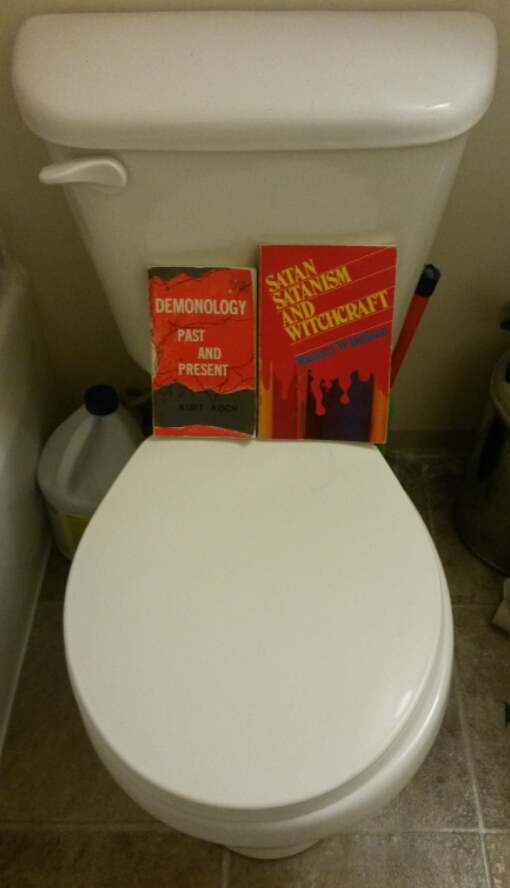
2015-10-29 20.36.21
Demonology Past and Present – Kurt Koch
Kregel -1973

Satan, Satanism and Witchcraft – Richard W. DeHaan
Zondervan – 1972

These ones aren’t just shitty books; they’re actually shit books. I have barely any free time anymore, and so I have to limit my leisure reading to my Sunday morning craps. Being in school has made it so that those holiest of moments on the Sabbath are now my only opportunity to read about Satan without feeling irresponsible. (I used to limit my toilet reading to the collection of Poe’s poems that I kept under the bathroom sink. Whenever my phone was out of battery and I couldn’t play solitaire while pinching a loaf, I would treat myself to an old ‘Edgar Allan Poo’.)

As you have probably guessed, these two books are awful. They came as part of a collection I purchased a few years ago from a hippy lady in the suburbs. She was selling a collection of 6 books, only 2 of which I actually wanted to read. I have since read and reviewed all 4 of the books that I was not interested in, but the ones I wanted have remained on the shelf. Anyways, both of these books deal with the topic of Satanism from a Christian point of view, and unsurprisingly, they are both repulsively stupid.

Let’s consider the authors for a moment. One of them is named Kurt Koch. Old Kurty is a classic case of “Koch by name; Koch by nature”. And what about his companion; Mr. Richard W. DeHaan? Well, they say that a picture speaks a thousand words, but the below picture only seems to repeat the word ‘wanker’ a thousand times.
2015-10-29 20.30.45

As i have probably mentioned elsewhere, I find it fascinating to read  the ideas of people who take each word of the Bible as being literally true. Let’s be completely honest here; 99% of the time, when a non-christian comes into contact with a christian, the non christian can instantly be sure of the fact that they are more intelligent than the christian. Oftentimes though, we can give the christian the benefit of the doubt;  although the person claims to be a christian, it can be safely assumed that they have not actually read the bible. When a person has actually read the bible and still claims to be a christian, you can safely infer that that person is an imbecile of the lowest order. To all whom encounter them, rubes of this variety seem to be entirely incapable of thinking critically.

On closer inspection though, these people are capable of a form of critical thinking. Unfortunately, the logic on which they base their thought is both flawed and perverse. Instead of using reason to reason, they use fear, prejudice and a unhealthy splash of utter nonsense. The authors of these two books are particularly fond of this approach. They weave a web of dogma around the topics of Satan and Satanism, and make themselves look like a pair of proper fools. One of the big points that both authors push is that many people who are having problems with their mental health are actually possessed by a demon and more in need of an exorcist than a psychologist or a doctor! My favourite argument that is put forth in either of these books though, is DeHaans argument for the consistency of the Bible’s attitude towards witchcraft. There has always been a bit of a problem with this issue; despite the infamous “thou shalt not suffer a witch to live” rule, there are actually quite a few witchy characters in the bible. There is a particular incident in Genesis when Jacob plays with some sticks to alter the appearance of the lambs being born to Laban’s flock. (Gen 30:37-43) He peels patterns into the bark on some sticks, and the animals who mate near the sticks will give birth to offspring with a similar pattern on their fur. Now let’s think about that for a moment. If a woman were to  have attempted something similar to this 500 years ago, she would almost definitely have been burnt as a witch. If somebody was to do something similar in the 1970s, the authors of these books would likely have attempted to perform an exorcism on them. How then does DeHaan get around the fact that Jacob, grandson of Abraham himself, was a dirty, occulting, sorcerer? Well, it turns out that God was actually trolling Jacob; he had organised the sheep to mate a certain way, and Jacob’s twigs never had any effect. Therefore, the sticks were a waste of time and Jacob hadn’t actually done magic. That’s fair enough, but DeHaan seems to think that this gets Jacob off the hook; however, it doesn’t change the fact that Jacob attempted to do magic. Just because he was a shit sorcerer doesn’t mean he wasn’t a sorcerer. It’s all about intent, you fucking dope DeHaan. (On a depressing side note, I just looked it up, and it seems that many people are still seriously discussing the tenability of Jacob’s approach to genetic engineering.) DeHaan’s twisted defenses of other biblical witches are just as unsatisfying, but this is hardly surprising. He is stretching the prim, white blanket of reason over an awkward, shit-brown, virulent mass of obtuse, dogmatic rubbish.

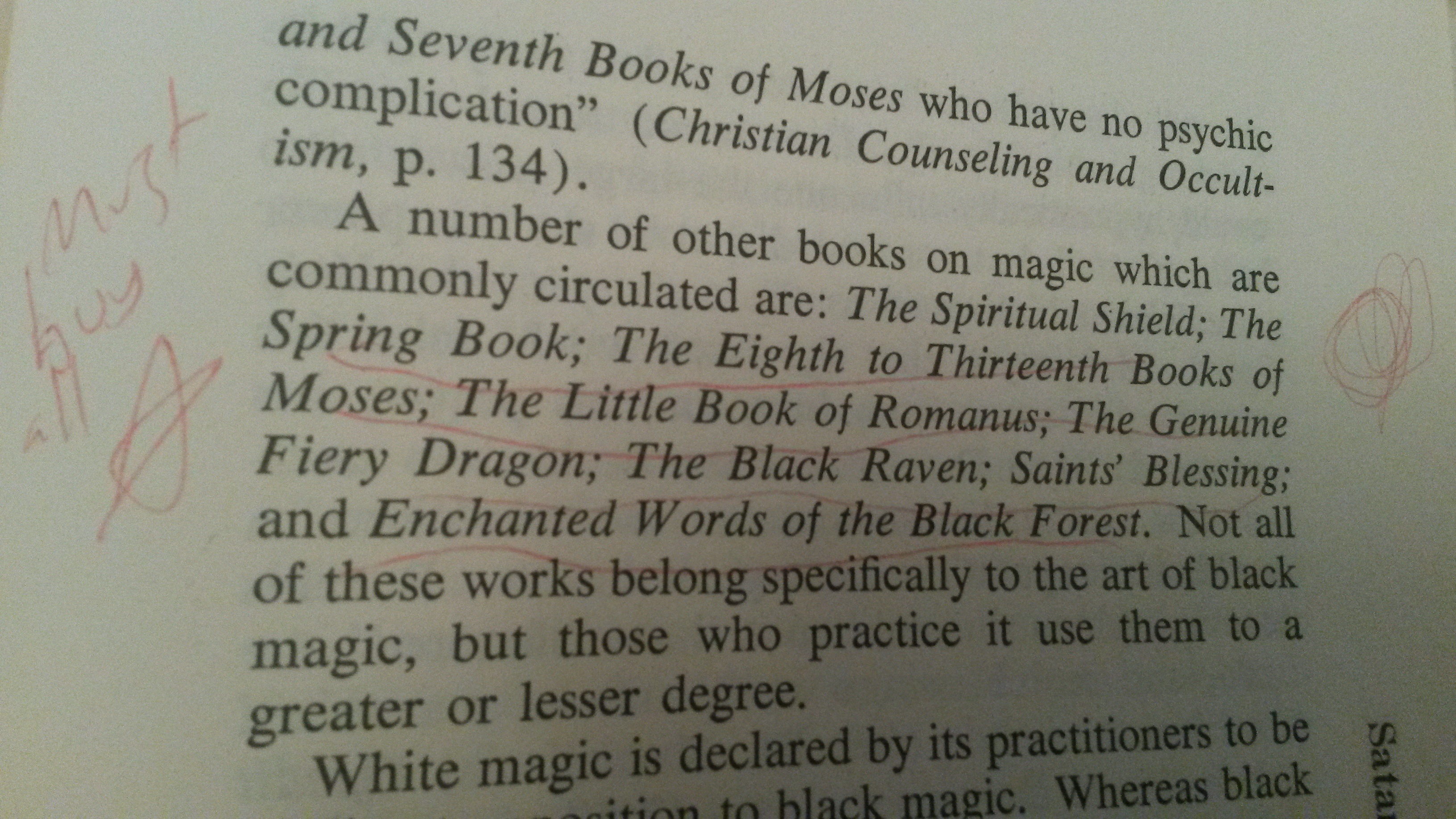
There was one cool part of DeHaan’s book where he lists some other books that you shouldn’t read. I haven’t heard of these, and maybe he made them up, but I’m sure as hell going to keep an eye out for them in the future. Let me know if you have copies!!!
20151030_221341

To conclude; these two books were truly moronic. Don’t waste your time with this kind of crap unless you’re crapping. School is really getting intense now, so it’ll probably be another little while before I post anything else. In the meantime, have a good Halloween, listen to metal, worship Satan and remember to keep it anti-christian!

The Bible

2015-08-22 16.05.29

I grew up in a Catholic household, and I went to mass every Sunday until I was 17 years old. I tried to read the Bible as a child, but I got a few pages into Genesis and stopped. I’ve since renounced my faith and made some sinister pacts with you know who, but in my reading I kept seeing references to this book and I decided to give it another go. I’m also an extremely petty person, and I enjoy knowing more about Christianity than most Christians. I started reading the Bible about 2 years ago, and I only recently finished the whole thing. It’s about 900 double pages long, so I took my time with it; reading a book here and there in between other texts. Parts of it are incredibly tedious, but some of it is really interesting. I remembered a lot of the New Testament stories from my church going days, but the Old Testament is filled with awesome bits that they never tell you at mass. I am quite certain that most ‘Christians’ would abandon their faith if they actually took the time to read and think about this awfully silly book of utter nonsense. Any person who reads and acknowledges all of the stories in this book as true is an utter imbecile.

One thing that surprises me about the Bible is the ignorance that surrounds the book. Most people (including Christians) don’t know what the Bible is. It seems that many people think that it is a book of rules. The Bible shouldn’t really be seen as a book. It is a library of arbitrary texts that were written by savages in the iron age . Some of them are instructional, many of them are historical and some are philosophical. The instructional books are intended for people living in the iron age, and any modern human who relies on these texts for guidance is a stupid fucking pig. The historical and philosophical books are still rather interesting, but it is extremely obvious that the people who wrote these books did not have the same standards of historical accuracy as we might hope for. Several of the books in here tell the same stories but give very different accounts of the same incidents.(Did Judas hang himself or did God blow him up?) I was walking through town yesterday and I saw a book entitled “The Juice Bible”. That is an idiotic title for a book that is comprised solely of juice recipes. To compose a true “Juice Bible” one could compile the top 50 results of a google search for the words “juice blog”, regardless of their content and reliability. Maybe that’s a silly analogy, but my point is that the Bible is basically a incoherent collection of assorted crap that was written and compiled without any sensible authority.

My favourite books are Genesis, Exodus, Judges, Job, Ecclesiastes, Ezekiel and Daniel. Isaiah and Jeremiah are soooooooo boring. The Gospels, Acts and Revelation are the juicy bits of the New Testament; the letters and epistles are all absolute gick.

This certainly won’t be my last post on the Bible. I’m going to do a post on my top 5 favourite Bible stories fairly soon. I assure you that my sermon will be most enlightening. Also, I have yet to read the apocrypha and pseudepigrapha, so expect posts on them at some stage too. I read some of the books on different websites and copied my notes into a hard copy that I stole from a hotel room. I didn’t stick to one translation, but the copy I work from is New American Standard. It’s one of the Gideon’s. I make a point to either steal or desecrate every hotel room Bible that I encounter. I encourage you to do the same. Don’t use reason or logic: Christians don’t understand those things! Be as childish and disrespectful as possible, and remember to have fun and be creative!
bible 1  bible 3bible 2

The Worship of the Serpent – The Rev. John Bathurst Deane

worship serpent
Health Research Books – ?

I’m not entirely sure how this book ended up on my wanted list (I think I came across the title when researching the Ophite gnostics), but I spent a few months last year trying to find an affordable copy.  The book was originally published in 1833 and text is available online, but I don’t like print-on-demand books and I ended up ordering a copy that was supposedly published in 1970. The publishing company is called Health Research Books, and there is a website url given on the back cover of the book. Strange for a book from 1970 right? The cover looks like shit; I don’t know what that fucking picture is supposed to be, but inside is a decent facsimile copy of the original book.

The idea behind the book is rather interesting. The author claims that the events in the Book of Genesis are literally true, and that all of humanity can trace its origins back to Noah’s family on the ark. He notes that all mythologies feature serpents or serpent-like creatures in some form or another, and he argues that all mythological serpents have their origins in the serpent of Eden. The fact that so many myths and stories contain serpents is intriguing, but the argument here is pretty weak. Deane spends most of the book discussing the etymologies of the names of different mythological serpents and gods and showing how these names could have originated in different words for snake. It was enjoyable enough, but at no point did I feel remotely convinced in what Deane was saying. Some mythological serpents are representatives of evil, but others are benevolent creators. Deane’s thoroughly protestant response to this is to claim that any culture in which the serpent has become a positive force must have been made up of savages.

Mankind’s obsession with serpents is fascinating; we just can’t get enough of those slithery fucks. Why do so many cultures incorporate snakes into their mythologies? This is a legitimately interesting question, but I don’t believe that the answer lies in-a-gadda-da-vida. This book’s responses to this question come from within a Christian paradigm, and the book ultimately serves as an example of the phenomenon it discusses rather than as an answer to the question it poses. The worship of the serpent  is a damn cool topic, but this book is only going to be useful to a psychology student interested in studying the egocentrism of 19th century Christian clergymen.

This picture of Medusa’s minging face was one of my favourite parts of the book.mingin

The Political History of the Devil – Daniel Defoe

2015-06-22 21.34.54
Nonsuch – 2007
When I was a kid, somebody described Hell to me as “the worst thing imaginable”. This naturally resulted in several nights of me lying awake in bed, trying my hardest to imagine the worst thing imaginable. I amused myself coming up with several repulsive and intrusive tortures involving instruments of both the sharp and blunt varieties, but I remember becoming quite upset after realizing that the worst imaginable punishment wouldn’t be being sentenced to an eternity of any kind of physical torment; no matter how bad the pain could be, it would be always be far worse if my shitty deeds had resulted not only in an eternity of torment for myself, but also for my family. Worse still would be my shitty deeds dooming every soul to an eternity of torment. If Hell was truly the worst scenario imaginable, then all it would take would be one sinner to doom every other soul: if Satan really wanted to obliterate any positivity in the suffering soul of a sinner, he would weigh them down with the guilt of having doomed everyone else to the same misery as themselves. I myself felt horrendously guilty after imagining this, because according the logic of my thought, Hell would evolve to correspond to the worst scenario ever imagined up until the present moment in time. As I was sure nobody else had yet thought of something so horrible, I concluded that I had just become responsible for dooming every soul to an eternity of communal torment. For even if I led a pious life, my irrevocably imagined worst-of-all-possible-hells would be activated on the death of the next sinner, and all would be lost.

There are countless other paradoxes that occur when reason is applied to religious dogma, and a few of these are discussed in The Political History of the Devil. In this book Daniel Defoe attempts to apply reason to dispel several myths about the Devil and his minions. Defoe however, was a solemn believer in the powers of Heaven and Hell, and there is a strange irony in his writing here. He uses reason to mock those who claim that the Devil might appear to human eyes, while simultaneously positing Satan’s existence. Although he feels comfortable making fun of the unfounded beliefs of children and the elderly, he is still willing to acknowledge every event in the Old Testament as true.

Now this book is written as satire, so attacking the writer’s logic is fairly pointless, but I just thought it was bloody cheeky to be making fun of people for their silly ideas about silly beliefs when the author himself clearly held those same silly beliefs. Truly, this is a silly book.

The book is divided into two sections. The first is a commentary on the different appearances of Satan within both Paradise Lost and the Bible (particularly the Old Testament). Some of this part is fairly interesting if you have read those texts. There was one part that I liked in which Defoe discusses the curse of Ham. The Curse of Ham, for those of you who don’t know, is the curse that God put on the descendants of Noah’s son Ham. Ham angered God, and God put a curse on him and his descendants, particularly his son, Canaan; “he said, Cursed be Canaan; a servant of servants shall he be unto his brethren.” (Genesis 9:25) This passage was used as a biblical justification of slavery. Apparently black people were believed to be the descendants of Ham and Canaan. Now I have deliberately withheld some information here. I’m sure you’re wondering what Ham could have done to deserve such a horrendous punishment. Let me tell you: Noah, the great Holy man and patriarch, got pissed drunk a few years after the flood, and his son Ham found him in a heap. Ham pulled up Noah’s gaberdine and buggered his own father. That’s right: Noah of the Ark was arse-raped by his son. Ok, it doesn’t actually say that his ring was penetrated in the Bible, but ‘seeing the nakedness of his father’ has long been understood as a euphemism for sodomy. And let’s be realistic here, even the angry God of the Old Testament wouldn’t be so cruel as to doom an entire race of people to centuries of oppression just because one man saw his dad’s willy by accident.

It really sucks that they never read that part of the Bible in mass – Ham by name, Ham by nature.

The second part of Defoe’s book is incredibly boring. It’s full of references to people and events that I’ve never heard of, the humour is dry and dated, and I don’t really care about what the author of Robinson Crusoe has to say about the Devil. This is by no means an ‘occult book’; there’s no esoteric knowledge in here. It’s supposed to be funny, but I wasn’t amused. It was a chore to finish, and the last 100 pages were extra shitty.

This particular edition looks nice on the outside, but there’s quite a few typos in the text. It was published in 2007, and the original price sticker on my copy says 25 euros. I bought it for 6 in 2013, and I was back in the bookshop recently, and it’s now down to 3.

I don’t want to be unfair. I’m sure Defoe was a good writer, but this is not a great book. I don’t get the jokes, and I don’t care about what he’s saying. This is what I get for buying a book based on its cover. If I lost my copy, I wouldn’t spend the 3 euro for another. I’ll give this turd of a book a measly 2/10.

The Autobiography of Saint Margaret Mary

TAN – 1986
mm

Imagine a father brutally torturing his daughter from the time she was 9 years old. Alongside physical torture, he doesn’t allow her to sleep or eat. When he does allow her to eat, he forces her to eat scabs, vomit and shit. As she grows older he hits her in the head and encourages her to cut herself. Her health is constantly poor, but the man keeps up his routine of abuse and degradation until her death.

Can you imagine any possible excuse for this kind of abhorrent behaviour? Could you be friendly if you met a person who admitted to committing such deeds? Would you be willing to worship that individual? Would you be comfortable to describe that person as the source of all goodness in the universe?

Well, if you’re Catholic then you should be answering ‘yes’ to all of the above questions. The Catholic church openly acknowledges that God put Saint Margaret Mary Alacoque through the aforementioned ordeals. St. Margaret Mary lived from 1647-1690, but she was only canonized in 1920. The credibility of her autobiography, in which she admits to eating both diarrhea and vomit, was affirmed by Pope Pius XI in 1928.

It genuinely puzzles me when I try to understand how any organization can retain credibility when one of its figureheads is a self-admitted poo-eater. I am not making this up:
It happened once, when I was tending a patient who was suffering from dysentery, I was overcome by a feeling of nausea; but He gave me so severe a reprimand, that I felt urged to repair this fault…. (“The Saint then performed an act so repulsive to nature that not only would no one have advised it, but no one would even have permitted it.” Words taken from Life of St. Margaret Mary, Visitation Library, Rose lands, Walmer, page 81) He then said to me: “Thou art indeed foolish to act thus!” [p83-84]
(The margin notes in my copy of the text refer to the vomit/turd feasts as “heroic actions”.)
It wasn’t even a healthy log of shit either; it was runny dysentery. This woman ate da poo-poo. She put turd in her mouth. A bona fide gick-licker is a Saint of the Catholic church. If you are a Catholic, you have to acknowledge that Catholic Popes are God’s representatives on Earth and are therefore infallible on issues of faith and morals. Therefore, if you are a Catholic, you have to acknowledge that Pope Benedict XV was correct in canonizing a soupy-scat-sucker.

Anyways, this book is Saint Margaret Mary’s own account of her miserable life. It’s genuinely one of the most disturbing books that I have ever read. Parts of it are like reading De Sade; it’s full of horrendous acts of torture and humiliating debasement. But it’s not the coprophagia or horrendous violence that make this such an upsetting read; De Sade used shit and blood to promote vice, but Margaret Mary is trying to use them to promote virtue. Personally speaking, I am not inspired to live a better life after reading the autobiography of a woman who mistook trots for treats. Neitzsche described Christianity as being anti-nature, as going against life itself; and this book is the perfect proof of this. This is exactly how not to live your life: Margaret Mary is literally the worst role model a person could have. She claims to have undergone the suffering for God’s sake, but I really think it was more for her own depraved satisfaction. If I was a Christian and I thought that God was actually pleased by the behaviour of this disgusting pervert, then I would seriously consider swapping sides; there’s no way Satan could be the bad guy if God was such a monstrous jerk.

I don’t think God or Satan had much to do with this case though. Margaret Mary was a kinky masochist, and nobody else deserves any of the blame. This woman was severely mentally deranged.
I bound this miserable and criminal body with knotted cords, which I drew so tightly that I had difficulty in breathing and eating. I left these cords so long that they were buried in the flesh that grew over them, and I could not extract them without great violence and excessive pain. I did the same with little chains which I fastened around my arms and which, on being taken off, tore away pieces of the flesh.
There are schools named after the person that wrote that. What kind of a horrible, irresponsible person would send their child to such a place?

The horniness of our love-starved saint isn’t just apparent in the aforementioned bondage scene; there’s an underlying current of eroticism throughout the whole book. This woman never got laid, and she probably never masturbated. I’m not a psychologist, but I am sure that the complete repression of a human’s sex drive could manifest itself in bizarre ways. Well, some of MM’s hallucinations (or visions) are rather steamy. At one point she imagines Jesus showing her a cross and saying, “Behold the bed of my chaste spouses on which I shall make thee taste all the delights of My pure love.” Note the forceful language that Jesus is using here. He’s not just allowing her to sample the delights; he’s making her taste them. He’s obviously the Dom in their kinky S&M relationship. He continues; “Little by little these flowers will drop off, and nothing will remain but the thorns, which are hidden because of thy weakness. Nevertheless, thou shalt feel the pricks of these thorns so keenly that thou wilt need all the strength of My love to bear the pain.” Unsurprisingly Jesus’s pillowtalk proves to be effective. Margaret Mary finds him simply irrestible; “These words delighted me, as I thought I should never find enough suffering, humiliations or contempt to quench the burning thirst I had for them, and that I could never experience greater suffering than that which I felt at not suffering enough; for my love for Him gave me no respite day or night.” Now I’m not into S&M, but even I felt a bit warm after reading that!

This is the most upsetting book that I have ever read. In a frustratingly unintentional manner, it highlights one of the most disgusting problems with Christianity: it’s a perverse and unnatural religion that values misery and suffering. Instead of inspiring pity or reverence, this book inspired repulsion and anger in me. The woman who wrote this book had severe mental health problems; if she were alive today she would undoubtedly be locked up in a mental instution. However, this mentally-disturbed, masochistic, deiphilic coprophage is recoginized as a saint of the Catholic church. I don’t think it is presumptuous to assume that part of a saint’s role is to be a role model. If you’re a Catholic, please read this book and think about whether or not you can accept Saint Margaret Mary as a role model. Ask yourself how you would feel if your daughter, sister, wife or mother started eating turds in the name of Jesus. Every time you put money into a church collection, you are funding an organization that condones this kind of filth. Think about the brown, soiled lips and the shitty fetid breath of Saint Margaret Mary next time you are receiving holy communion.

Corpus Christi.

I’m not going to give this a mark out of 10. It’s terribly written, and the content is either very boring or very gross. I enjoyed reading it, but I also hated reading it. I suppose it would be most accurate to say that I enjoyed hating it. Any person that could possibly enjoy this as a work of inspirational literature would have to be a  sadistic sexual deviant. If you’re interested in giving this a read, make sure to buy a second hand copy or just read it online. Always avoid giving money to Christian publishers.