Chuck Tingle’s Bury Your Gays

Tor Nightfire – 2024

The first time I encountered Chuck Tingle was when somebody I followed on twitter posted images of the covers of his earlier books. They had some ludicrous titles (check out his bibliography if you haven’t already seen them), and while I am definitely not beyond reading a book purely because it has a ridiculous title, Tingle’s titles were overt gay porn. I was happy they existed, but content to leave them for their target audience.

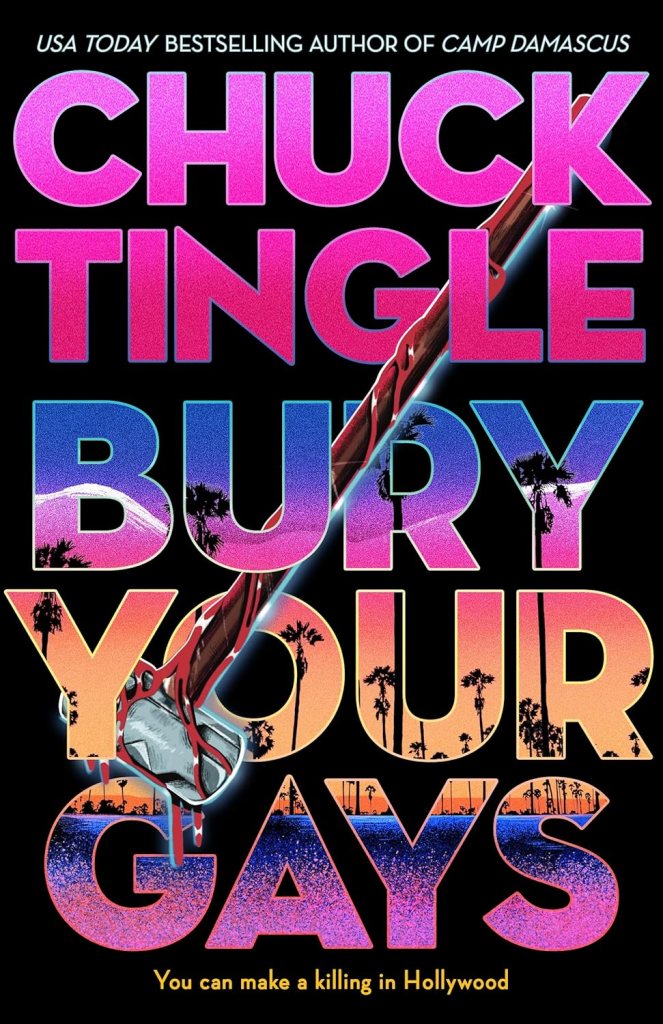
Recently, a colleague in work recommended me one of Chuck Tingle’s newer novels. I was a bit taken aback, assuming the title would reference anal penetration in some manner, but it was actually called Bury Your Gays, and it was supposed to be a horror novel. To be honest, I’ve been running a little dry for blog content recently. I’ve been busy and largely directing my creative energy elsewhere, so I was quite happy to take my buddy up on a horror book recommendation. I’m really glad I did. This book was actually very enjoyable.

This is the story of Misha Byrne, a gay screenwriter whose characters start showing up in real life. (It’s funny, after writing that, I realise that was the premise of a Brett Easton Ellis novel I read years ago.) I won’t give anything else away. It reminded me a little of David Sodergren’s Rotten Tommy in terms of the manic creativity behind the plot and characters. It’s really enjoyable when capable writers let their imaginations loose.

The book is surprisingly well written. There’s sci-fi elements and social critique, but some scenes are horrendously violent, and I think this definitely counts as a horror novel. The sledgehammer scene made me wince, but also made me hope that this book gets turned into a movie.

I also found that while it’s a gay novel in many respects (gay protagonist, gay title, gay issues…), none of this book felt obscure or foreign to a straight reader. (The last gay horror novel I read was largely gay porn, so maybe it’s just the contrast to that book that susprised me.) I wonder how queer readers feel about how accessible this gay novel is to straight readers. While the book doesn’t trivialise the queer experience, I felt Mr. Tingle framed it in a very relatable manner. Do queer readers want to read something that makes the queer experience relatable to the straights, or would they prefer it to be a little more militantly queer? Is it naive of me to be a little taken back by how easy it is to relate to queer characters?

It’s pretty cool to see how much recognition this novel is getting. It’s a good book, but the author’s story is inspiring too. He did something weird and stuck with it until he got popular. While the title of this book isn’t as overtly self-referential as some of the author’s other works (2017’s Pounded In The Butt By My Book “Pounded In The Butt By My Book ‘Pounded In The Butt By My Book “Pounded In The Butt By My Book ‘Pounded In The Butt By My Book “Pounded In The Butt By My Own Butt”‘”‘ for example), the plot of the novel revolves around that motif in a genuinely impressive manner. It’s really cool to see that kind of integrity and ingenuity. Chuck Tingle is a weirdo, a real weirdo, but weirdoes are awesome.

John Russo’s Voodoo Dawn

John Russo wrote Night of the Living Dead with George Romero. I have been meaning to read something by him for years. I settled on his 1987 novel, Voodoo Dawn.

Imagine – 1987

This was pure garbage. It only took a few hours to read it, but every second of those hours felt as if the author was laughing at me for wasting my time reading his filthy pile of shit.

A voodoo witchdoctor goes on a killing spree in an attempt to make a Frankensteinesque voodoo doll out of human body parts. The premise here is good, but the execution reeks of human excrement. The discussion of the life sized voodoo doll is limited to a few sentences, and the murders take up only a few pages. Most of this novel focuses on the business plans of a gang of up-and-coming advertising executives. It’s shockingly boring. There was a little bit of satisfaction when these boring squares died, but it would have been much more satisfying to witness the author being brutally dismembered with a machete for making me read through his boring, dull, uninspired shite.

At one point the author describes how one of the characters is struggling to flesh out her book on voodoo and how she ultimately resorts to inserting large quotations from other books instead of integrating their main ideas into her work. Russo then proceeds to insert a large quote from one of the books that the character was supposedly reading. He’s literally flaunting his inadequacies to his readers’ faces.

Apparently there’s a movie with the same title that was very, very loosely based on this book. I doubt I’ll watch it. Honestly, avoid this book like you would a leper. It’s a diaper full of diarrhea.

Poppy Brite’s Most Extreme Novel: Exquisite Corpse

Ok, so I know I said that I was going to get to regular posting 2 weeks ago, but I went camping last weekend and had no internet. I finished this novel, Poppy Z. Brite’s Exquisite Corpse, a few weeks ago, and it’s been stuck in my head ever since.

Gallery Books – 1997 (Originally published 1996)

I’ve read 3 other books by Poppy Z. Brite. I loved Lost Souls and Swamp Foetus. I didn’t like Drawing Blood so much. It felt more like fantasy than horror, and it was extremely homoerotic. I don’t mean that in a derogatory way, and I don’t want it to seem like I’m trying to give off “no homo” vibes here. I was able to enjoy the romance between the 2 male characters; I just didn’t like the cum eating. I guess I’m the kind of person who really only enjoys reading descriptions of people ingesting bodily fluids when these descriptions are purposely written to gross the reader out.

Anyone who has read Exquisite Corpse will probably be giggling at my squeamishness right now. Both of Brite’s publishers (Delacorte and Penguin) refused to publish this book after Brite submitted the manuscript. This is one of the most disgusting novels I have ever read.

The plot focuses on the intersection of the lives of 2 gay couples. One of these couples has recently broken up, and the other is comprised of a necrophile and a cannibal. The results are deeply disturbing and depressing. I don’t want to give anything else away, but Jesus this book was fucking grim.

At an early point in the novel, I considered giving up. There were a few chapters that were basically just gay porn. These weren’t just descriptions of what happened. This was clearly erotic writing. I generally skim over lengthy sex scenes in novels, regardless of the genders of the participants. I didn’t do that here because I was half expecting something horrible to happen, but it didn’t, and now I fear that I am a gay man.

I’m joking of course, but I was half right. Extremely horrible things do start happening in this book, and they are written about in such a way that sets them far, far apart from the generic splatterpunk book I have read here before. It’s a combination of Brite’s skill with the written word and the juxtaposition with the sexy parts of this book that make the violence in here so disturbing. At the same time, the actual brutality on display here is full on. There’s nothing left to the imagination. The viscera and gore are upsetting, but Brite also describes the psychology of the sadistic murderers too, and it was those parts that I found most upsetting. There’s one bit that genuinely disgusted me where the murderer is describing how the body of their victim acquiesces to the violence its undergoing with a kind of longing.

This book is seriously fucked up. It’s dark, disgusting and depressing. There were numerous points throughout that made me feel nauseous and made me question my sexuality. All in all, I enjoyed it.

There’s Always Freaks in the Basement: Ray Garton’s Live Girls and Night Life

I first encounered the writing of Ray Garton in the first Splatterpunks anthology. It contained a chapter that had been from his book Crucifax, presumably for being too edgy. It had a dead baby in it or something, and I wasn’t terribly impressed. Years later, I read that his vampire novel, Live Girls, was considered a classic in the field, so I sought it out and gave it a read.

Live Girls

Futura – 1987

Yeah, this is pretty good. There’s a peepshow in New York city where beautiful vampire women dance in glass boxes. There are gloryholes in the walls, and when the men stick their dicks in, they get a toothy blowjob that satisfies both their lust and the vampire’s hunger. There’s also a basement full of hideous mutants. This part isn’t explained properly. We’re told how they became mutants but not why they’re trapped in a cellar. As far as I’m concerned, the fact that they’re mutants is a perfectly good reason for them being kept in cellar. This is not high literature, but it’s fast paced and enjoyable. It’s also quite of its time (1987). The following passage had me laughing:

“He thought he was being raped by a homosexual.” he added.
She put her whole hand over her mouth and her eyes crinkled as she tried to hold the laughter in.

I can’t imagine those lines appearing in a modern novel.

Night Life

Subterranean – 2005

I waited a week and then read Night Life, the sequel to Live Girls. This was written almost 20 years after the first book. It features many of the same characters, and while it was decently entertaining, it just wasn’t as good as the first book. It’s one of those sequels where the author tries to rewrite new versions of all of the memorable parts of the first book. The vampire hideout in this one is a hotel rather than a peepshow, but the hotel also features a basement full of mutant freaks. There’s more rape in this one too, and it felt a bit vulgar. The rapists in the first book are female vampires. There’s an interesting element of subversion there. Not so in the sequel. I don’t want to come across as a prude here because I willingly read a novel by a writer who was known as a first generation splatterpunk, but the innocent woman being forced into an anal rape gangbang with 13 vampires was a bit silly. The ending was a bit abrupt, and I felt like Garton left it open with the plans to maybe write a third book in the series. Unfortunately, he died last year, so we’ll never find out what happens next.

If you’re going to read Live Girls (and I recommend that you do), you should probably read Night Life too. It’s not as good, but I did actually enjoy reading it. I am probably going to go back to read Crucifax soon.

Weird, Rare and Bad: Otto Fredrick’s Count Dracula’s Canadian Affair

You may not know this, but Tuesday is Canada Day. People in Canada get the day off work to clean their moose and harvest their maple syrup. I’ve done a few posts on Canadian stuff in the past (a Canadian ghost, a Canadian cult, Canadian mind control…), but the most infamous title of “Canadian” horror has long eluded me. I recently got my hands on it, and I thought this would be the perfect time to share it with you.

Otto Frederick’s Count Dracula’s Canadian Affair

Pageant Press – 1960

I don’t remember where I heard of this book, but on reading the title, I knew I had to track it down. A small amount of research on this book will show that it gained some of its infamy after appearing as number 3 in R.S. Hadji’s list of 13 Worst Stinkers of the Weird in the June 1983 edition of Twilight Zone magazine.

(I’ve previously reviewed numbers 11 and 12.)

Count Dracula’s Canadian Affair is a lot harder to track down than some of the other titles on this list. This is likely because it was printed by Pageant Press, a vanity press. Vanity presses were companies that would print books at the expense of the author, so it is hard to imagine that more than a few thousand copies were ever printed. The author was a clerk for the airforce living in Ohio, and he had 2 kids and a wife, so I doubt he had enough money for a huge run of hardbacks.

There’s also something infinitely collectible about this book. It’s rare, it sounds peculiar, it’s infamously bad, and it’s set in Canada. What self-respecting Canadian connoisseur of horror fiction could sleep easily without a copy of this book on their shelf? I’m not Canadian, and I literally spent years trying to track down a copy. I’m not exaggerating. Years.

I found a copy online a few years back, but it was a little more than what I was willing to pay. It disappeared soon thereafter. A few months back another copy appeared, but it was twice the price of the previous copy. I bought it anyways. It is by far the most expensive book I’ve bought, but I had to have it. I simply had to.

I read it last week. It is indeed very shit.

A brother and sister and their uncle move to the Canadian wilderness where their father has been given some land. They make friends with some local lumberjacks and then spend a few months turning an old logging cabin into a lakeside home. Unfortunately, a weird man in a military uniform keeps sneaking into their house when the men are away and assaulting the girl. She doesn’t really put up any resistance. If this was a better book, it would describe how she wasn’t sure if these visits were real or a dream, but the author isn’t that competent, so it just seems like getting raped doesn’t really bother her. She manages to keep it a secret, but when the family’s horses go missing, the men realise something is up. It turns out that Dracula is living on an island in their lake, disguising himself as a soldier.

The book ends shortly after this. There are no details given on how Dracula made his way to Canada or where he goes after the settlers chase him away.

Otto Fredrick

I believe that this was the author’s only book. I’m not surprised. He was not a good writer. This is more a moderately boring adventure novel than a horror novel, and the addition of Dracula to the plot seems forced and bizarre. It’s pretty short though, and I read it in 2 sittings, so the frustration and disappointment didn’t really hit me until after it was over. The elements for a decent novel were all here, but this mostly felt rushed and poorly thought out. If you’re expecting the Trailer Park Boys but with vampires, you’re in for disappointment.

Was this objectively terrible book worth the ridiculous amount of money that I paid for it? Reading it was not a particularly exciting experience, but seeing my copy on my bookshelf is priceless. There’s another copy available on Ebay now. Go and buy it, you coward.

It’s funny. A few years ago I did a post on Barry Hammond’s Cold Front, referring to it as “Canada’s rarest horror paperback”. It was recently republished, so it has definitely lost this title. Count Dracula’s Canadian Affair isn’t a paperback or truly Canadian, but surely it is now the rarest work of Canadian horror fiction! Unfortunately, I find it hard to imagine this one ever getting republished. Happy Canada Day!

Susan Hill’s The Woman in Black

I had originally planned a different post for this week, but I got about halfway through writing it and realised I needed to do more research. Luckily enough, I spent last Friday night reading Susan Hill’s novel, The Woman in Black.

Hamish Hamilton – 1983

I had seen the movie version with Daniel Radcliffe when it came out, but I had largely forgotten what it was about. (I do remember quite enjoying it though.)

A solicitor has to go and stay in the house of a recently deceased recluse in an attempt to find some important legal papers that had been in her possession. While he is staying in her isolated, desolate mansion, he starts to see an emaciated woman dressed entirely in black.

This is a good old fashioned ghost story, much in the style of M.R. James. At least one of the chapters is named after a story of his. I love this kind of fiction, especially when it’s done well, and this novel is just that. It starts off with the narrator’s family telling ghost stories on Christmas Eve. He leaves the room in a panic when it’s his turn, creating a blissful amount of tension. His tale is so terrifying that he can only tell it through writing, which is exactly what he proceeds to do. This is the kind of book that you want to read under a blanket. It’s very short too, and I find it hard to imagine reading it over more than a couple of sittings. I feel silly for not having read this classic sooner. If you haven’t read it, do so immediately.

Not much else needs to be said. This is an excellent ghost story. There was a novelisation of the sequel film that came out in 2014, but it’s supposed to be crap, so I have no interest.

Scott Smith’s The Ruins

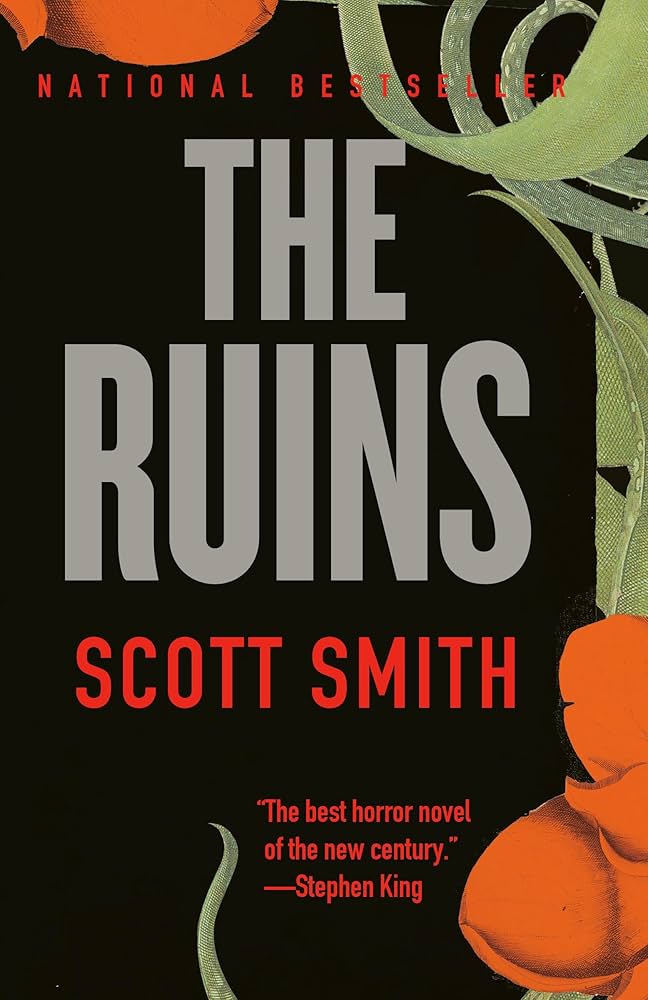
I read this on a whim recently, and though more modern than a lot of what appears on this blog, Scott Smith’s The Ruins was quite good.

Vintage – 2007 (First published 2006)

A bunch of young people go on vacation to Mexico and end up travelling into the jungle to see their friends who are supposedly working on an archaeological dig. When they get there, they get trapped on a hill that’s covered with an evil plant that won’t let them escape. Things get grizzly pretty quickly.

The plot is a bit silly, but this is well written, and there were a few genuinely scary moments. It really reminded me of The Troop by Nick Cutter. I just looked it up online, and apparently Cutter openly acknowledged that this book directly inspired his. Both books follow a small group’s nightmarish weekend on a remote and lethal location, and both feature the timeless combination of things that burrow inside people and sharp knives.

This kind of survival horror isn’t my favourite genre, but this was enjoyable. I am going to give Smith’s other, more famous, novel, A Simple Plan, a read soon.

Matt Ruff’s Lovecraft Country

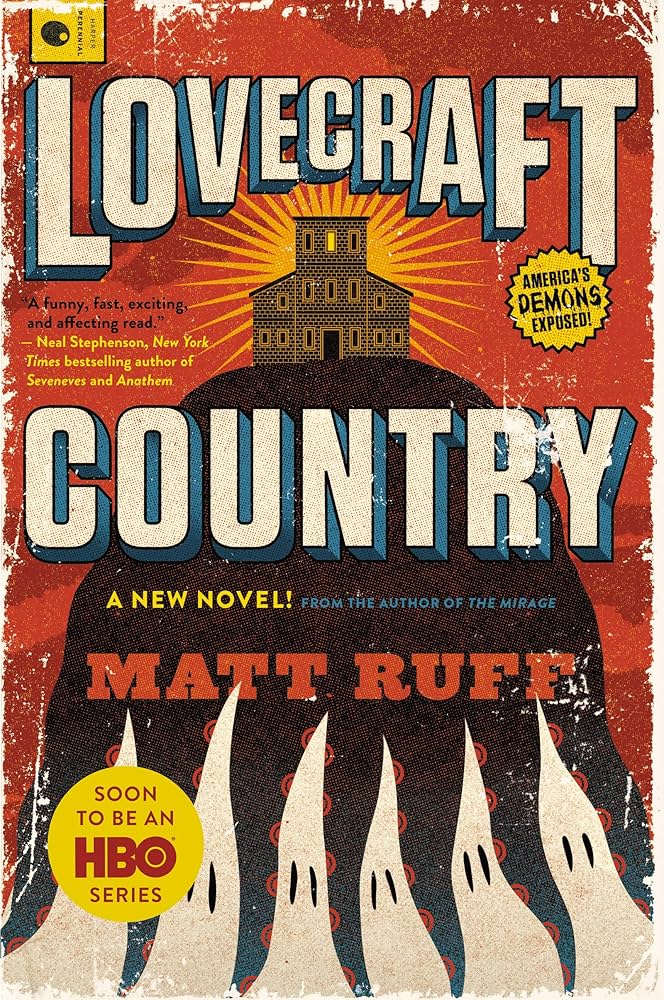
Lovecraft Country is an excellent title for a novel. Initially I assumed it was going to be Fear and Loathing in Las Vegas but with Cthulhu, the nightmarish diary of a drug user as they passed through Innsmouth and Arkham, not being able to distinguish between hallucinations and genuine sinister apparitions. That would have been awesome, but that’s not what this is.

Lovecraft Country – Matt Ruff

Harper – 2017 (First published 2016)

This is a novel that features Lovecraftian entities, but the horror it focuses on is actually that of American racism. First off, let me clarify immediately, that I am not an “anti-woke” asshole who disregards things because they mention race. I understand that racism was and continues to be a huge problem, especially in America. If you disagree with that sentiment, go stick a knife up your shitter. My complaint is not that racism shouldn’t be addressed; it’s that this is not a good way to do it. To me, the appeal of Lovecraft’s cosmic horror lies in its villains’ complete apathy towards human life. In Lovecraft’s best stories, there’s no bad guy who hates people because they were mean to him. He was writing about entities who see human life as nothing more than a mistake. We are slime to the Great Old Ones. What does Cthulhu care for the tribulations of man? To write a story that focuses on race against that backdrop seems absurd. If the world is soon to repopulated with a species of humanoid beetles, why should we care about the immediate suffering of one particular group of people?

In actuality, the Lovecraftian influence on this novel seems to come more from Lovecraft’s fantasy stories than his horror. The amount of Shoggothery in here is minimal. I kept hoping that really bad stuff was going to start happening to everyone, but it didn’t. This novel did not deliver the Lovecraftian horror that I am a fan of. If you want Lovecraftian horror with a black protagonist, I would recommend Victor LaValle’s The Ballad of Black Tom instead.

I hummed and hawed for a month after finishing Lovecraft Country, trying to figure out if I was going to read The Destroyer of Worlds, the book’s sequel. I eventually decided not to bother. I read that Ruff claimed that the first novel is a better book, and as I found this one quite boring, I decided not to bother with its sequel. I’m not going to bother with the TV show either.

The other thing is that the author is a white man. I’m certainly not of the opinion that an author should only write about characters of their own race, but this is very much a novel about the hardships endured by black people in the 1950s. While I thought that Ruff dealt with the topic in a sensitive manner, I am a white guy, so my opinion isn’t that important here. I guess a cast and crew of mostly black people worked on the TV adaptation though, so it’s probably ok. Personally, I wouldn’t touch this kind of thing with a 10 foot pole in my own fiction. I’d be afraid of being accused of virtue signaling or insensitivity. Ruff, at least in my opinion, manages to walk that fine line successfully, but it seems like the effort required in doing so made it much more difficult to deliver the promises made by the book’s title.

William Peter Blatty’s The Exorcist and Legion

The first time I heard of The Exorcist was when it was unbanned in Ireland in 1998. I was about 12 years old and still very Catholic. What I heard about this film was terrifying, and when I saw it a year or two later in a friend’s house, I was shitting myself. Part of this was due to my deeply ingrained fear of the devil, but it is also a very scary film. Despite losing my faith in the power of Christ, the original film still creeps me out every time I watch it. I first read the novel that the movie was based on just a few months before starting this blog, and I never got around to posting about it. I found an audiobook version recently, and decided to give it another go.

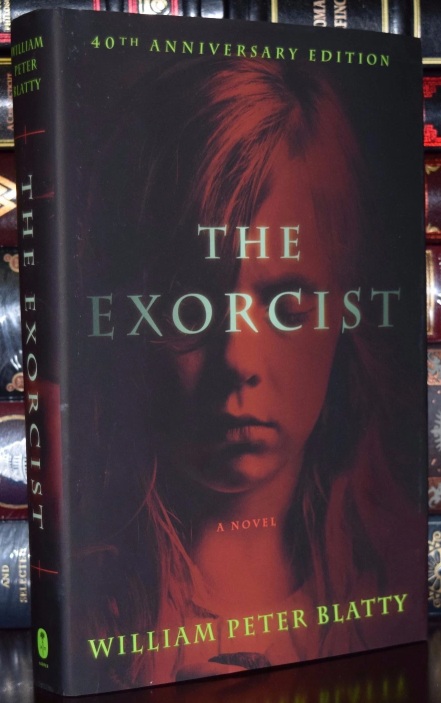
William Peter Blatty – The Exorcist (40th Anniversary Revised Edition)

Harper – 2011 (Originally published 1971)

I’m assuming anyone clicking onto a blog like this knows the story of The Exorcist, but in case you don’t, this is the story of a little girl getting possessed by a demon. The film follows the novel very closely, and if you like one, I’m sure you’ll like the other. The only problem here was that I realised very closely to the end of the book that the audiobook version I was listening to was a revised version. There’s a scene where a fat ghost priest shows up to Karras’s bedroom to warn him about the exorcism that I didn’t remember. This part was cheesy and dumb, and it cheapened the original. The ending is slightly different in the revised version too. The author tries to clarify that Karras is ultimately victorious at the end. I wouldn’t have noticed this if I didn’t compare it with my paperback copy of the original book, and while it’s not a huge change, I don’t like happy endings to horror novels, and I thought this was unnecessary. If you haven’t read The Exorcist before, make sure you read the original text and not the stupid revised version from 2011.

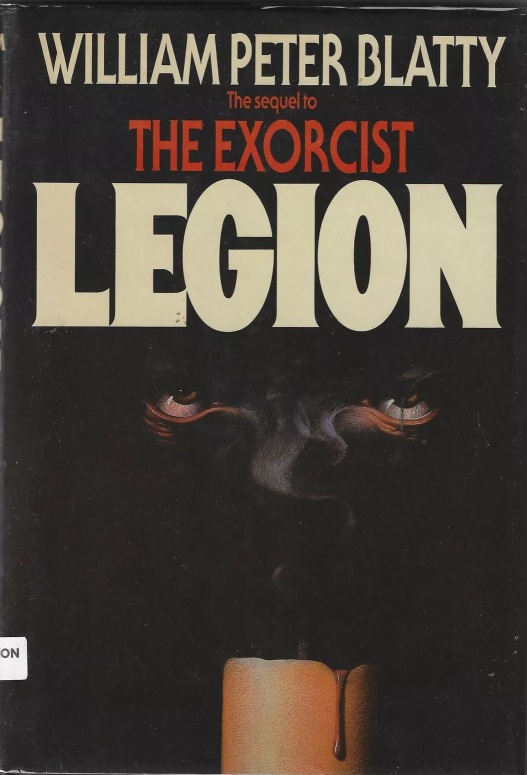
William Peter Blatty – Legion

Simon & Schuster – 1983

Directly after finishing The Exorcist, I read its sequel, Legion. A film version of this was released in 1990 as The Exorcist 3. William Peter Blatty, the author, had nothing to do with the 2nd Exorcist film, and Legion completely ignores the events in that film.

Honestly, I thought this book was trash. It follows the detective character from the first Exorcist novel as he tracks down a serial killer who is supposedly dead. The premise of the story would be fine, but every chapter gets bogged down in amateur philosophizing on the natures of evil and death. It’s painful.

Eventually it turns out that the murderer’s spirit has possessed Damien Karras, the exorcist from the first book. This makes absolutely no sense in the context of the revised version of The Exorcist, as after finishing that, the reader is expected to believe that Karras was victorious in defeating the demon. The functional premise of Legion is revealed to be that the evil spirit was victorious against Karras. This is a stupid horror novel, and while it’s pointless to get too critical here, it’s hard not to do so when the author spends half the book trying to make himself seem clever.

Well, there you go. I’ve finally done the 4 of the creepy children genre: The Omen, Rosemary’s Baby, The Exorcist and The Other.

Armageddon is Nigh! The Omen Novelisations

I’m not huge into novelisations. I’ve read the first 2 Halloween novels, the Jaws sequels and Teddy, but those books, or at least certain books in those series are known for being considerably different to the movie versions. I decided to check out the Omen novels as I knew that these ended up in a different timeline to the film series.

The Omen – David Seltzer

Signet – 1976

The novelisation of the first Omen film was actually written by the same guy who wrote the screenplay for the movie. It has probably been 20 years since I saw the movie, but I had a pretty clear idea of what was going to happen. A baby adopted by the US ambassador to Britain is the Antichrist, and he and his followers are going to fuck up anyone who figures this out. The only way to stop him is to stab him with a set of 7 magic daggers. Knowing what was going to happen didn’t stop me from enjoying this book. It was exciting and atmospheric, and it’s in no way surprising that the movie version was so successful.

Damien Omen II – Joseph Howard

Futura – 1990 (first published 1978)

I haven’t seen the second movie, and after reading its novelization, I have absolutely no desire to do so. It’s basically the exact same plot as the first one, but this time Damien is a young teenager. This movie and book were clearly made to make money. There is nothing of interest here.

The Omen: The Final Conflict – Gordon McGill

Futura – 1983 (first published 1980)

The third book is a little different. Damien is an adult here, and he has become head of the Thorn Corporation, a huge multinational corporation. He is wealthy and powerful and about to bring about the end of the world. He gets close, but then Jesus shows up unannounced and ruins his plans. There is a scene near the end of the book when he surprises his date by anally raping her. This seems inconsequential at the time, but it’s important in the next book.

Omen IV: Armageddon 2000 – Gordon McGill

Futura – 1983

So the 4th Omen novel has nothing to do with the 4th Omen movie. It was written as a direct sequel to the 3rd movie, but it was never produced. Damien is dead in this one, but because he was only stabbed with one of the 7 daggers, the reign of the Antichrist was not prevented, and his power was passed down to his son. “His son?”, I hear you say, “but Damien didn’t have a son!” Well, this is where the anal rape from the last book comes into play. It turns out that he actually got his girlfriend anally pregnant when he came up her ass, and nine months later she shat out an evil baby. Literally. This evil bum-baby is now a teenager, and he plays with his father’s corpse in an attempt to blow up the world. He comes pretty close.

Omen V: The Abomination – Gordon McGill

Futura – 1985

The 5th book is also by McGill and was also never produced. It’s more of the same. Junior is still intent on destroying the world, but a reporter figures out what he is doing and tries to stop him. By the time I got to this book I had had enough.

With the exception of the first book, this series was repetitive garbage. All the novels are about 200 pages, and there’s so many characters that it’s hard to care about any of them. Also, given the fact that the Antichrist’s aim is to bring around the end of the world, there’s not much tension in the 2nd, 3rd or 4th book. You know the end isn’t going to come in that book, and by the time you get to the 5th, you’ll be looking forward to all of these asshole characters dying. I watched the prequel movie that came out last year, and I quite liked it, but I have no desire to go back and watch any of the other movies now.