The Books that Villainized Dungeons and Dragons in the 1980s

I have no great interest in role-playing games, but I knew that Dungeons and Dragons was associated with the Satanic Panic of the 1980s, do I decided to look at the books that contributed to its infamy.
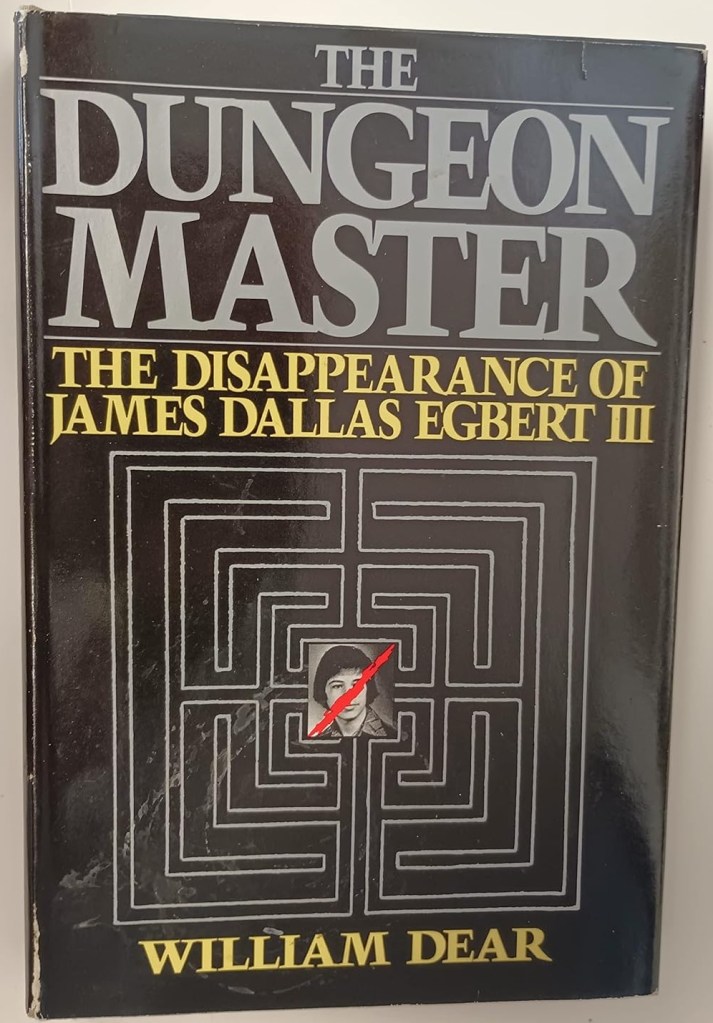
Houghton Mifflin Harcourt – 1984

The Dungeon Master: The Disappearance of James Dallas Egbert III – William C. Dear

Dallas Egbert the Third was a weird teenager. He was highly intelligent, but socially awkward. He tried to make up for this when he went to college by taking drugs. He was gay, and he got involved with some shady characters. His mom was pushy, and wouldn’t have approved of his lifestyle, so he decided to kill himself. He went down into the ventilation tunnels under his college so he could die, but he couldn’t do it, so he went to hide out in some of his gay friends’ homes. He was kept drugged and it seems likely he was sexually abused. A private detective, the author of this book, found him halfway across the United States. They returned home, but Dallas put a bullet in his head a few months later. He never gave his full account of what had happened to him when he was missing.

This book was written by the detective who found Dallas. It wasn’t a great book, and the author’s writing style was grating, but in fairness, it’s not overly bullshitty. There is a horrendously drawn out chapter describing the author’s experience playing Dungeons and Dragons, but despite his intial suspicions, he ultimately dismisses the idea that the game had anything to do with Dallas’s fate. The kid was all kinds of messed up. His interest in fantasy games and science fiction seemed like the only parts of his life he enjoyed.

The book is of its time. It repeatedly makes reference to “the gays”, but it doesn’t do so with any kind of malice. If you want to know about this sad and weird case, this is essential reading.

Dell – 1982 (Originally published 1981)

Mazes and Monsters – Rona Jaffe

I had very low expectations when I started reading Mazes and Monsters, and I can say with disappointment that it was exactly what I expected. This is a boring novel with nothing of any value. It’s truly as bad as it looks. Look at that shitty-ass cover again. Fucking lame shit.

This book is about 4 nerds who play “Mazes and Monsters”. All of the chracters are lame and annoying. One is very clearly based on Dallas Egbert, but he isn’t really the protagonist. The main character here gets so involved in the role-playing game that he becomes convinced he’s really a holy magician. He is so strongly convinced of this that he becomes impotent and kills a person. As much of the book is spent describing the backgrounds of the main characters’ parents as is spent on the plot. I assume this was because Jaffe’s audience were mostly middle-aged women with teenage children that needed some point of reference for understanding the plot. This was so, so boring and crap. If I owned a copy of this book, I would take it into the forest and defecate upon’t. The only good part was when one of the main characters’ mothers goes on a date with a gentleman who expresses disappointment over her haircut because her formerly long, curly hair had reminded him of pubic hair. Such a bizarre detail to include. I’m willing to bet that the author’s minge was infested with pubic lice.

Mazes and Monsters was published the year after Dallas Egbert died, and while it does make it seem like role-playing games are probably dangerous for impressionable youths, it doesn’t really try to link role playing games with the occult. Still, it’s a piece of shit, and you shouldn’t read it.

Chick Tracts – 1984

Dark Dungeons – Jack Chick

This is a Chick Tract that came out in 1984 that claims that playing Dungeons and Dragons leads to suicide and Satanism. It’s silly rubbish. Read it here.
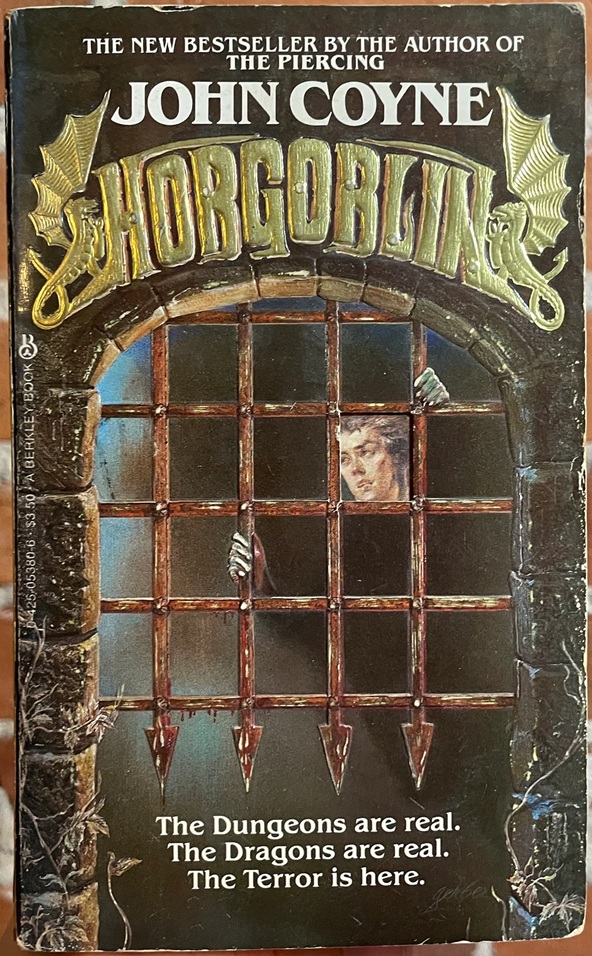
Berkley – 1982 (originally published 1981)

Hobgoblin – John Coyne

I’m throwing this book in here because other authors have linked it to the furor around RPGs in the 1980s. It’s about a young man who becomes obsessed with a game called Hobgoblin, but none of the really bad stuff that happens in here comes as a result of the game. Coyne’s book is more of an entertaining novel that features an RPG than a statement on the dangers of those games.

So a nerdy kid’s dad dies, and him and his mom have to move to a small town where she can work in the local castle. The caretaker there is a creepy Irish immigrant, and the manager starts fucking the boy’s mom. The boy is a stupid virgin, and chooses to start fights with the local football players instead of banging the hottest girl in school. It turns out there’s a weirdo living near the castle who likes murdering and sexually assaulting people.

So many parts of this book were completely unbelievable, but it was decently entertaining. There’s one part where two of the local jocks kidnap a girl, tear off all her clothes and abandon her, tied to a tombstone on the top of a hill. Then they break into the protagonist’s house and sexually assault his mom. Nobody does anything about this, and they face no repercussions. I know that attitudes toward sexual violence have change since the 1980s, but this was ridiculous.

The Irish elements were mildly interesting. The role playing game here, Hobgoblin, is set in Ireland, and all the characters in the game are supposed to come from Ireland. I didn’t recognize quite a few of them. I looked it up, and one of the main bad guys, the Black Annis, is actually from English folklore. Also, the old Irish caretaker character is very weird. Are we supposed to feel sorry for him or repulsed?

Ok, I’m going to include spoilers in this paragraph, so skip ahead if you want to read the book. I’m a bit confused about the ending. I just finished the book, and I don’t really understand what happened. The main bad guy was a badly brain damaged geriatric who must have been more than 80 years old. Despite this, he was able to brutally murder a bunch of people by himself over the course of about half an hour? Did he have some kind of magical power? Why was he killing people in the first place? Did I miss something?

Hobgoblin was alright. I don’t regret reading it. Mazes and Monsters was a mouthful of salty diarrhea. Dear’s book about Dallas Egbert was interesting as a historical source, but it wasn’t a particularly enjoyable book. I am quite done with books about Dungeons and Dragons.
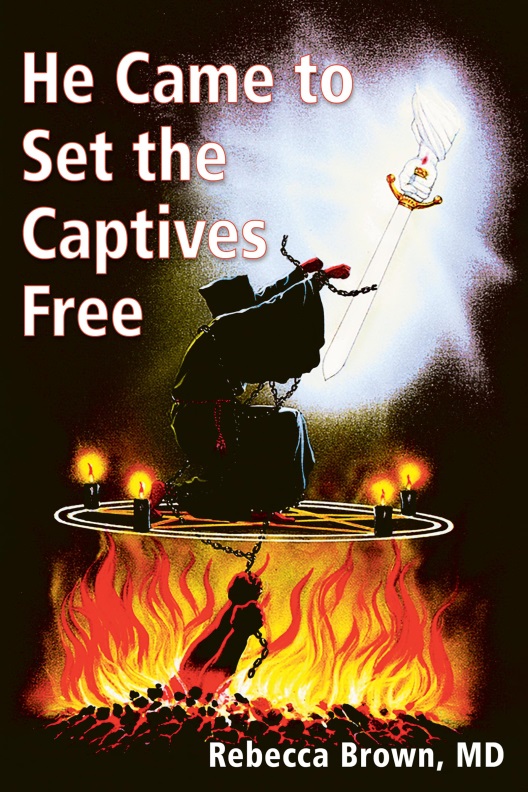
Threatening Werewolves and Having Tea with Satan: Rebecca Brown’s He Came to Set the Captives Free

1986 – Chick Publications

I’ve read a fair few Satanic Panic texts. They’re all pretty ridiculous, from the Devil’s rhymes in Michelle Remembers to the creepy illustrations in Don’t Take Me Back, Mommy to the cattle mutilation claims in Jay’s Journal. Those are all pretty silly, but none of those books are quite as ludicrous as Rebecca Brown’s He Came to Set the Captives Free. This is not a novel, but it has werewolves.

Just a bit of background before I start the summary. Rebecca Brown, the author, was actually a doctor, but her doctor’s license was revoked after she started telling cancer patients that they were possessed by demons. She told these patients that she was the only doctor who could help them as she would share their satanic illness. Sharing an illness apparently necessitates sharing treatment too, so Rebecca started giving her patients and herself opioids, and she became badly addicted to painkillers. After this a fellow doctor diagnosed her with schizophrenia. This is all a matter of public record. In fact, if you’re interested, here is the actual documentation detailing the loss of her medical license.

Ok, now that we have established that Rebecca Brown was actually a mad person, let’s look at the contents of her book about spiritual warfare.

Chapter 1.
Rebecca is a nurse with a muscular disease. One day, a pastor is brought to her emergency room. He has been tortured and crucified. Rebecca discovers there is a coven of Satanists nearby and one of the head nurses is doing their work at her hospital. This witch convinces sick people to die so they can be reincarnated, but she’s actually summoning demons to take their souls. She sends demons to attack Rebecca. They make her so sick she has to stop working. She almost dies.

Chapter 2.
Elaine, another woman, was born with a hair lip. Her mom couldn’t afford surgery, but a nurse at the hospital offered to pay for it in exchange for a vial of the baby’s blood. A high priestess of The Brotherhood, a satanic cult, drank the baby’s blood and in doing so allowed demons into the baby. Elaine grew up with extra strength and magical powers which she used to beat up a footballer player and a lesbian.

Chapter 3.
Elaine meets a girl at church camp who introduces her to the Brotherhood. She goes to a camp with a bunch of other psychic teens, and there she is forced to join the Brotherhood. She finds out that they sacrifice humans and this scares her, so armed guards beat her and lock her in a dark room. When she still refuses to join, a witch summons a scary demon to threaten her. This does the trick. She joins the cult and a different demon goes into her body.

Chapter 4.
As a member of the Brotherhood, Elaine is given ninja training. She is told that there are 1000 members of the cult in her city. She starts to summon demons by herself. They are physical monsters. One demon, Mann-chan, possesses her and takes control of her life.
Elaine gets her demons to beat up another woman. Then she meets Satan. The actual Satan appears as a man and they hang out. Later he shows up in front of Elaine and 1000 other people to stab a baby to death and take out its heart. Then Satan fucks Elaine.
This deformed, cleft-palate loner is so important that the devil, the 2nd most powerful entity in the universe shows up to coach her in his evil ways.

Chapter 5.
Elaine becomes a high priestess, and her and the most powerful witches get together in meetings that are guarded by literal werewolves. Even though demons possess her body, Elaine will not involve herself in sacrifices. As punishment for this stubbornness, Satan gives her cancer 4 times.

With a click of her fingers Elaine can turn a cat into a rabbit and back again. She later stands in front of a gun that’a fired 6 times, but some demons stop the bullets from hitting her.
She is sent to kill a family who are bringing satanists to Christ, but a host of angels form an impenetrable barrier around this family’s house. These angels ask Elaine to come to Jesus.

Chapter 6.
Satan chooses Elaine as his bride so she can mother his son. She gets more power and uses her mind to a woman into a wall so hard that the woman’s body literally goes into the wall.
Elaine makes friends with most of the famous (but here nameless) rockstars of the day, every one of them a servant of Satan.

Chapter 7.
This chapter is an insane rant about how demons torture each other and molest children in front of their parents and how werewolves, zombies and vampires are all real.

Chaper 8.
This section is all about human sacrifices. These are performed on Halloween, a holiday that the author traces back to the Druids in England. Elaine and her friends torture a hitchhiker, make him wear a crown of thorns, whip him and then crucify him. When he’s on the cross the high priest does a wee on him and then the congregation shit in their hands and throw it at him. Then they stick a spike into his head and Satan appears. Then they have an orgy and eat the dead man’s shitty flesh.

Chapter 9.
Some demons beat Elaine up. The devil orders her to infiltrate and destroy a church, but when she goes into the church, she is almost immediately converted.

Chapter 10.
Elaine gets sick and meets Rebecca, the Christian doctor, in the hospital. They make friends but Elaine throws a Bible at Rebecca when she is prescribed reading the Bible.

Chapter 11.
While in the hospital Elaine realises that some of the doctors are satanists who are trying to kill her. Even though she is now a Christian, she uses her demons to beat one so badly he can no longer work, and she astrally projects herself into another doctors apartment and unplugs his fridge to annoy him.
The good doctor speaks to god, and he tells her that Elaine is a satanist.

Chapter 12.
Elaine and Rebecca move in together. Man-chann and another demon possess Elaine. Satan comes in person to threaten Rebecca. (Keep in mind that in the real world, Rebecca actually lost her medical license because she was caught shooting up with Elaine.)

Chapter 13.
Elaine is possessed by demon and tries to kill Rebecca, but Rebecca makes a Jesus-forcefield and Elaine can’t touch her. As a result, Elaine tries to hang herself and cut herself. Eventually she goes into a coma. Rebecca exorcises her by reading the bible. The next day Rebecca comes home to find Elaine blue faced on the couch strangling herself with a belt.
Later Elaine is possessed by a woman named Sally who tries to stab Rebecca to death.
Elaine again tries to strangle Rebecca.
A sexy guardian angel appears to Rebecca. Some demons and satanists using astral projection attack Rebecca and Elaine, but some angels pick them up and carry them to their car. They go to a church and have a 10 hour exorcism.

The rest of the book is less focused on the story of Elaine and Rebecca. The remaining chapters contain the following useful information for concerned Christians:

Demons are passed from one person to another through sexual intercourse.
Incest within a family and any participation in homosexuality always leads to demonic infestation.
Board games, cartoon, rock music, meditation are all satanic.
Getting raped is a guaranteed way to get possessed by a demon.
Being a vegetarian is satanic.
Christians are god’s servants and Jesus owns them.
Satanists are infiltrating and destroying most local churches with great effect.
Most illnesses and depression are caused by demons.
If your dad rapes you when you are a child, a demon will possess you.
Demons, satanists’ astral projections, were-wolves, vampires and violent satanists are the most dangerous threats to Christians.

In these final chapters, the author also describes a conversation she had with a  actual werewolf that she met on a road at night. The werewolf is about to kill her, but she tells him that she believes in Jesus and then the werewolf runs away. She tells of a warlock coming to her house and giving her cat an evil spirit too. (Apparently satanists repeatedly try to murder her pets.) She also tells a story about a “negro couple” called “The Blacks” whose 4 year old daughter was skinned alive in front of them by satanists.

There’s a lot going on in this book, but I think that the important points to remember are that the authors of this book claim to have met with Satan, one of them had sex with Satan, and they both met werewolves. In reality, one of these women lost her job because she was injecting opioids into herself, her co-author, and her co-author’s mentally disabled child. So while it’s quite possible that Elaine and Rebecca saw the things they are describing, the fact is that they most likely witnessed these events while rolling around on Elaine’s apartment floor high on Demerol.

There’s no evidence for any of the claims made in this book, and it has been denounced as garbage by many Christian organizations. Unsurprisingly, there’s no record of any of the multiple assaults, kidnappings and murders detailed herein, and vampire sightings are still pretty rare. I suppose I shouldn’t be surprised, but it is genuinely astounding that anyone could write something like this and expect people to believe it. I’m amused by the idea of these 2 junkie lunatics believing that that they’re so important that the devil, the adversary of the creator of the universe, would drop into their kitchen to visit them. It’s cuckoo-crazy nonsense. Unfortunately though, plenty of people did and do believe this crap. This book is still in print after almost 40 years, and it’s available from all big bookstores. The author went on to have a successful career as a preacher. She’s dead now though. May she burn in Hell eternally!

David St. Clair’s Say You Love Satan: True Crime or Truly Awful

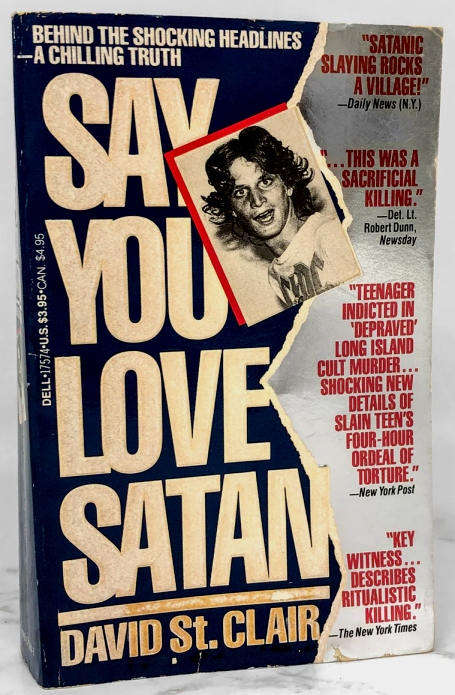
Say You Love Satan – David St. Clair

Dell – 1987

I can’t remember the first time I heard of Ricky Kasso, but I remember watching My Sweet Satan, a short movie roughly based on his last weeks alive, when I was teenager. This book, David St. Clair’s Say You Love Satan, has been on my goodreads to-read list since October 2016, and I was mistakenly under the impression it was the definitive version of the Kasso story. It only took a couple of pages for me to realise that this could not be the case.

I plan to focus on the book rather than the events it describes, but a bit of background on Ricky Kasso is probably necessary.

In 1984, Ricky Kasso, a homeless, mentally unstable, drug addicted, 17 year old, murdered Gary Lauwers, one of his friends, while tripping on hallucinogens in Northport, New York. His pal had stolen drugs from him a few weeks previously. Events like this, while certainly tragic, aren’t particularly rare, but Ricky Kasso was a fan of heavy metal and a self-professed Satanist. He had also previously been arrested for grave-robbing. While it seems that his tastes in music and his interest in the occult had little to do with the actual murder, he apparently ordered his victim to “Say you love Satan” while he was stabbing him in the face. Ricky killed himself a few days after being arrested for the murder. The media latched onto the satanic elements of the story and ran wild with them. Before long, people believed that the city of Northport was home to a coven of sadistic Satanists who had murdered Gary Lauwers as a sacrifice to the Devil.

It’s a fascinating story, and 3 years after it occurred, David St. Clair published this book. Say You Love Satan became, as far as I can tell, the most popular version of the Kasso story. Unfortunately, it’s a very, very shit version of the story. I haven’t read many true crime books, but the story here is presented as a novel, and it’s awful. St. Clair describes lengthy conversations that he wasn’t privy to, and he very clearly had absolutely zero insight into what these kids were like. It’s painful. Page 266 of this book contains some of the worst writing I have ever encountered.

The response from the teenage girl on discovering that her boyfriend has participated in a murder is quite funny, but the awful joke about the child’s corpse at the end is my favourite. How did this nonsense get published?

While this book is sensational, exploitative garbage, it’s not particularly accusatory. St. Clair makes it very clear that he doesn’t approve of heavy metal and occultism, but he also gives the details of Kasso’s unhappy upbringing and drug use, and he doesn’t give any consideration to the idea that there was a satanic cult operating in Northport. Still, the parts where he made fun of Judas Priest’s lyrics made me wince. He also interweaves lyrics from Ozzy Osbourne’s Bark at the Moon into the murder scene. This guy was a real weiner.

Not a fan of Priest or Ozzy

I did a bit of research of David St. Clair. It turns out he was a self-proclaimed psychic, and he also wrote a few other novels that were supposedly about real cases of Satanic possession. Most of his other books looked like trash, but I did actually order one based on its awesome cover art. I’ll review it here in a few months.

I also watched The Acid King, a recent documentary on Ricky Kasso, and everyone in that documentary hates St. Clair’s book. I get it. The people interviewed in that film knew the characters involved, and they have every right to be annoyed that David St. Clair didn’t do a better job of telling their friends’ story. I thought that he had made some scenes up for shock effect, particularly the part where they visit the Amityville haunted house to perform a ritual, but apparently that really happened. Ultimately, both the book and the documentary tell a very similar story. My complaint isn’t that that the author took too many liberties with his characters; it’s that he was an absolutely terrible writer. Apparently, parts of the book were plagiarized too. None of this should have surprised me. A few years ago, I read a book of essays on the Satanic Panic of the 1980s, and there’s an essay in there that contains much of what I discovered while reading Say You Love Satan.

This book is poorly written, but I have other reasons not to like it. I was a heavy metal teenager, and many of my friends are still heavy metal satanists. I’m also a parent, and both the murderer and his victim in this book were children. I knew how this book was going to end, but because the story is basically being novelized, I couldn’t help but root for the characters. A kid goes to library to take out books about witchcraft after listening to Black Sabbath with his friends? I want to give that kid a high five, not read about him murdering his friend and then killing himself. This is an extremely sad story, and the saddest parts really happened. Reading this book was a huge bummer.

Satanic Panic: Pop Cultural Paranoia in the 1980s – Edited by Kier-La Janisse & Paul Corupe

satanic panic pop-cultural paranoiain the 1980s.jpgSatanic Panic: Pop Cultural Paranoia in the 1980s 
Edited by Kier-La Janisse & Paul Corupe
FAB Press – 2018 (Originally published 2015)

This is a collection of essays about different elements of the Satanic Panic of the 1980s. I remember seeing something about this book when it came out and thinking that it looked cool, and when I recently saw that it contained an essay on Russ Martin’s sexy Satanic mind-control novels, I knew I’d have to read it. I got a couple of gift vouchers from work over the past year, and I was delighted to find a way to use those vouchers to pursue my interest in Satanism.

The essays in here are of varying quality, but most are pretty good. I guess it’s inevitable that each reader will like some better than others. Together they present a pretty comprehensive look at the Satanic Panic of the 1980s.

Reading the book over the course of a few days was a bit odd as the introductory background information in some of the essays is pretty similar. Geraldo’s infamous Exposing Satan’s Underground special gets quite a few mentions. I guess this two hour TV special is probably the defining peak of the panic. Despite multiple attempts, I’ve never managed to watch the whole thing through. After a few moments of it, I feel a maddening urge to listen to Slayer and throw stones through church windows.

I’ve encountered a lot of the material in this book before, and covered some of it on this blog. There’s essays on Michelle Remembers, Bob Larson, books by Phil Phillips, and one on the McMartin preschool trial. The McMartin essay was one of the more interesting in the book. It argues that the claims of Satanist involvement in that case actually prevented prosecutors from busting a real paedophile ring. There are also interesting essays on Chick Tracts, Dungeons and Dragons, and heavy metal in here.

I felt that a few of the writers went a bit overboard trying to make their essays feel academic. One of them even references Foucault. Ugh. We get it guys, you went to college…

(Haha, after writing that last bit, I looked up the guy who made the reference to Foucault, and he actually teaches a course on college writing in a college. Classic! Referencing ol’ Michel might be a surefire way to dazzle your liberal arts prof, but it don’t impress me much.)

This is a far fancier book than the ones I usually read. It looks and feels really nice. There’s so many cool pictures, and it felt like a lot of work was put into the layout. Just to flick through it is a cool experience. In sincerity, if you know any goths who have a birthday coming up, this would be perfect for their coffee table.

I don’t have much more to say about this one. Overall, it’s a very cool book. I’m quite sure I’ll reread some of these essays as research for future posts.

Don’t Make Me Go Back, Mommy – Doris Sanford

don't make me go back, mommy - doris sanfordDon’t Make Me Go Back, Mommy: A Child’s Book about Satanic Ritual Abuse
Doris Sanford

Multnomah – 1990

Jesus Shitting Christ, this book is miserable.

I searched for a copy of this book for several years. I went so far as annoying random people on facebook that lived in towns where the local library had a copy cataloged. I’d message these folks and ask them to go to that library to scan/photocopy the book for me. That plan never worked. When I finally saw a copy going for one cent, I bought it without thinking.

I was very excited when it arrived in the post, but as soon as I glanced inside, all excitement was replaced with sadness and discomfort. This book is truly horrible.

This is the story of 5 year old Allison. Allison attends a preschool where the teachers make her and the other children take part in depraved Satanic rituals. These kids are drugged, raped and forced to worship the Devil.

perverse satanic ritualWhat the fuck lads.

I think I thought I’d read through this and do my usual “haha, look how dumb and misinformed this evangelical Christian author is”, but this book is depressing, not amusing. Doris Sanford wrote this book to counsel the survivors of despicable child abuse, and while the events it depicts aren’t real, reading it is still a thoroughly unpleasant experience.

While we can rest assured that the events depicted in here never actually happened, we can not so easily discount the suffering that this book caused. It doubtlessly scared the shit out of any child unfortunate enough to get their hands on it, and I’m sure it terrified a few parents too. People will err on the side of caution when it comes to the safety of their children, and when confronted with something as horrifying as this book, many people will throw rational thought out the window and join the witch hunt. This book is exactly the kind of thing that makes problems worse instead of better.

library slip mommyAt least I know that nobody in recent history had borrowed this book from the church library it originally belonged to.
I would be willing to forgive anyone for overreacting if they solemnly believed that children were being abused, but Don’t Make Me Go Back, Mommy is more than just an overreaction; it is particularly insidious fearmongering. It was released in July 1990, the same month that saw Raymond Buckey acquitted for the second and final time. Buckey was the defendant in the McMartin Preschool trial, perhaps the most notable case of “Satanic Ritual Abuse” and to this day the most expensive criminal trial in American history. While child abuse doubtlessly does occur, there has never been ever any proof of the existence of an organised Satanic cabal of paedophile pre-school teachers.

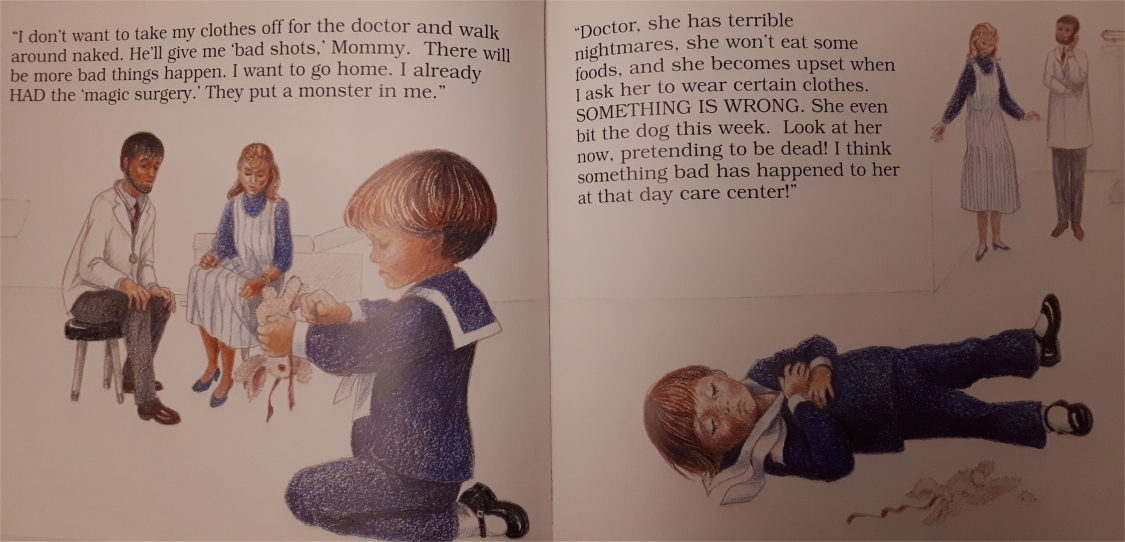
monster in meI got seriously bad vibes off these pages.
The Satanic Panic had been in session since 1980 when Michelle Remembers was published, and after 10 years with hundreds of claims but no evidence, things were beginning to cool off. Sanford’s book stoked the embers of paranoia and kept the conspiracy alive. Both the Martensville Satanic Sex Scandal and the Oak Hill Satanic Ritual Abuse Trial took place after the publishing of Don’t Make Me Go Back, Mommy. The latter case resulted in an innocent couple spending a combined total of over 40 years in prison. I’m fond of being dramatic, but realistically, this book could be partially to blame for either or both of these cases.

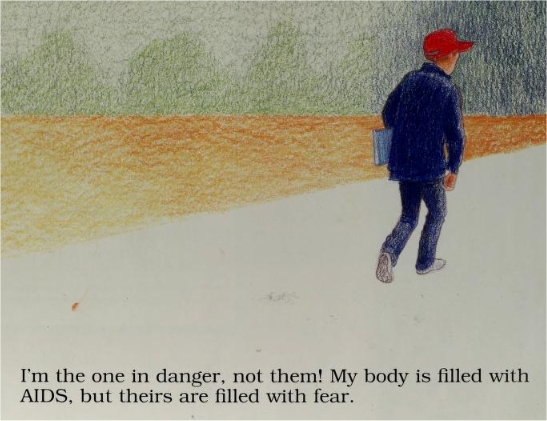
Doris Sanford wrote quite a few other books for children. While none were quite as mental as this one, the rest of her catalog is certainly curious. Some of these books like Brian is Adopted or Maria’s Grandma Gets Mixed Up, a classic tale of senility, are merely strange, but her 1989 opus, David Has Aids,  confirms her sadistic desires to petrify suffering children.david has aids sanfordmy body is filled with aidsdavid dying from aids

Children dying of AIDS isn’t remotely funny, but it’s hard not to laugh at how ill-conceived this book was. Seriously, what kind of a mental case would give this horrible rubbish to a child?

Sanford didn’t work alone though. Graci Evans worked as an illustrator for loads of her books, and the whole team at Multnomah publishing must have been mental to put this garbage out. Also, although the exact nature of her input is unclear, Lauren Statford was at least marginally involved in the creation of Don’t Make Me Go Back, Mommy (source). Statford is famous for writing Satan’s Underground, a discredited book in which she claimed to be a Satanic Ritual Abuse survivor. During the aforementioned McMartin Preschool trial, Statford sought out the parents of the supposedly abused children and told them that she had insider information on the abuse (source). Her story was so ridiculous that even these frightened parents didn’t believe her. After the whole Satanic Panic thing blew over, Statford changed her name to Laura Grabowski and claimed to be a Holocaust survivor. Statford was clearly a depraved, egomaniacal psychopath, and yet she was involved in the creation of a book for children. It is hard to believe that Sanford and co. meant this book to have a positive effect on anyone. Everyone involved in its creation of his horrible book was either a complete idiot or a sadistic pervert.

To this day, my post on Michelle Remembers is the largest source of traffic to this site. Because of this, I have considered reviewing more books on this topic, but while the Satanic Ritual Abuse phenomenon is fascinating, it’s also very depressing and I don’t enjoy reading books about it. I read gross, violent, perverted books all the time, but it’s these books by “Christian authors” that are the most ludicrous and upsetting.