
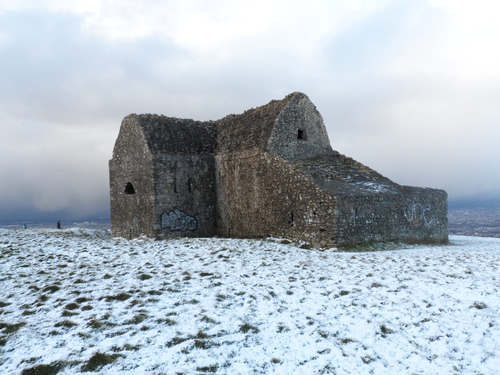
The Hellfire Club on top of Montpelier Hill.
In Dublin, the phrase ‘Hellfire Club’ is almost exclusively used to refer to the ruins of the hunting lodge on top of Montpelier Hill. Families walk up to these ruins on Sunday evenings after dinner, and everybody knows the legend of the Devil appearing there during a card game:
Some lads were up at the lodge, gettin’ locked, shaggin’ tarts and playin’ cards. One of of the lads drops his cards on the ground. He stoops over to pick them up and notices that the lad beside him has hooves for feet. He stands back up and the other lad (Satan) disappears in a flash of smoke.
That story scared the shit out of me when I was little. I had visited the lodge when I was a kid, but it wasn’t until 2 years ago that I got to go back.
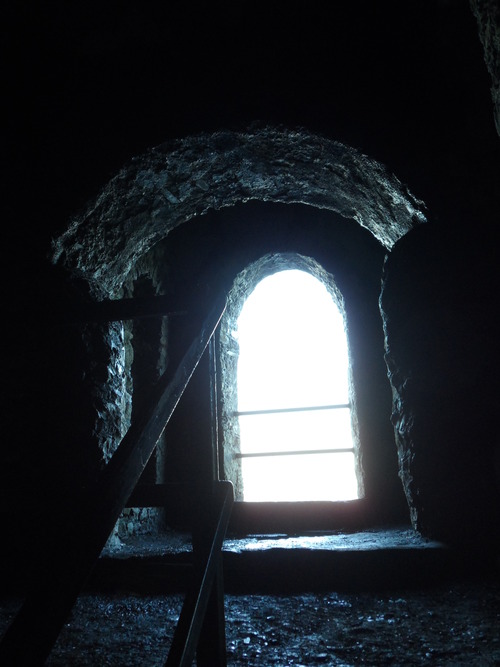
A view from inside.

The lodge was built over a pre-historic passage tomb.
Anyways, the original ‘Hellfire club’ was actually a group of 18th century English politicians. It was probably little more than an excuse to get drunk and talk lewdly, but it has literally become the stuff of legends. Several other clubs, including the one that met on top Montpelier hill, have inadvertently assumed the Hellfire moniker, and these groups are the subjects of the three books I am reviewing.

Blasphemers and Blackguards (The Irish Hellfire Clubs) – David Ryan
Merrion – 2012
This book gives an account of the several different organizations that were founded by wealthy rakes in Ireland during the 18th century. The clubs consisted of upper-class individuals who were able to use their place in society to get away with murder. The Irish clubs don’t seem to have been involved in much satanism, but it’s not hard to see how a group of licentious and wealthy individuals of Protestant descendency could gain a diabolical reputation in a country that was mostly populated by poor Catholics. Besides, the crimes that some of these groups committed were far more reprehensible than the boudoir blasphemy of the real Hellfire Club.
This book is fairly academic: it’s properly researched and sourced, and I never felt like the author was bullshitting. Ryan gives a trustworthy account of the facts about these clubs, while also delineating and discussing the folklore that has developed around the Hellfire legend. I’m from Dublin and I thoroughly enjoyed reading this account of the city’s shadiest secret. 7.5/10
The Hellfire Club – Daniel P. Mannix
New English Library – 1970
This book focuses on the The Order of the Friars of St. Francis of Wycombe. While the Friars were not the original Hellfire Club, they were definitely the most infamous. This book is full of tales of blasphemy, debauchery and political upheaval. Even the less lurid parts of the book are fairly interesting. John Wilkes comes across as a particularly interesting character.
The big problem with this book is that it’s not properly sourced. Many of the events herein are undoubtedly based in fact, but there are episodes in this book that seem to be taken straight out of works of fiction. One such episode, which involves a baboon dressed as Satan, is almost definitely based on a scene from Charles Johnstone’s novel, Chrysal, or the Adventures of a Guinea. Chrysal was a satirical novel published between 1760 and 1765 that poked fun at the political leaders of the time. The novel is narrated by a golden coin that at one stage enters into the pocket of a Hellfire monk. Somehow, the experiences of this imaginary golden coin managed to transmigrate themselves into facts in Mannix’s supposedly historical account of the Club.
That being said, the subtitle of this book is “Orgies were their pleasure, politics their passtime”, and I wasn’t particularly surprised or disappointed to find that this book is a tad sensational. I’m giving it a 6.5/10 for its entertainment value.
Do What You Will (A History of Anti-Morality) – Geoffrey Ashe
W.H. Allen – 1974
This book has sections on Rabelais, John Dee, the Marquis De Sade and Aleister Crowley, but it’s really about the Hellfire Club. Dashwood’s club is again the focus, but this time the author is reasonable in his assertions. Ashe presents very similar information to Mannix, but he does so in a far less credulous manner. This book is definitely worth reading if you want a legitimate account of the Monks of Medenham.
The subtitle of this book is ‘A History of Anti-Morality’, but more than half of the book’s chapters are on the Hellfire Clubs. I obviously find the clubs fascinating, and I understand that their members played an important role in the politics of the 18th century, but I’m not convinced that they are the single most important anti-morality movement in the history of the world. I’m certain that I’m not the only person to notice this as recent editions of this book have actually been renamed ‘The Hellfire Clubs’. Basically, Ashe has arbitrarily chosen several groups and individuals, and assigned them an inordinate amount of moral accountability. It’s not that any of the material here is irrelevant, it’s the fact that so much has been left out. Compiling a history of anti-morality would be an outrageously difficult and lengthy procedure, and ultimately Ashe has failed in this task.
I was very interested to read a book that had consecutive chapters on the Hellfire Clubs and the Marquis De Sade. There are many parallels with Hellfire legends and the events in De Sade’s fiction. I have often wondered if the Divine Marquis had heard tales about the Brotherhood of Wycombe and taken inspiration from them. Think about it; he was a nobleman and a libertine, writing only a few years after the dissolution of Dashwood’s posse. I find it hard to believe that he had never heard of the friars taking young harlots into the sacrilegious abbey at Medenham or the Hellfire caves at Wycombe. I’ve done a little research to verify this link but I haven’t found anything to substantiate it. If anyone has any suggestions on where to look, I would love to hear from you!
Anyways, although I think that this book falls short on what it sets out to do, I did enjoy reading it. The stuff in here isn’t bad; there’s just not enough of it. That being said, there is an abundant amount of information on the Hellfire Clubs in here, and I would urge anyone who has any interest in this topic to get their hands on this one. I’m going to give this one a 6.5/10.
BONUS REVIEW
Secret Societies – Nick Harding
Chartwell Books Inc. – 2006
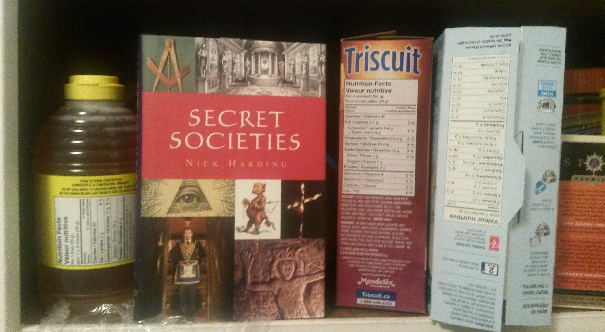
I’m not hugely interested in most secret societies. I inadvertently bought a copy of this book as part of a collection on satanism. It’s quite short and quite shit. It provides a little information on about 20 different secret societies, but doesn’t go into detail on any of them. I don’t really know why a person would buy a book like this. I suppose it would be quite good if you were taking a long flight and you needed something to halfheartedly glance at now and then. I am reviewing it as part of this post as it contains a section on Dashwood’s Hellfire Club. Let’s just give it a 4/10 and leave it at that.


 Nocturnal Revelries