“I am the fifth dimension! I am the eighth wonder of the world!” – Gef the Talking Mongoose

Gef! The Strange Tale of an Extra-Special Talking Mongoose – Christopher Josiffe
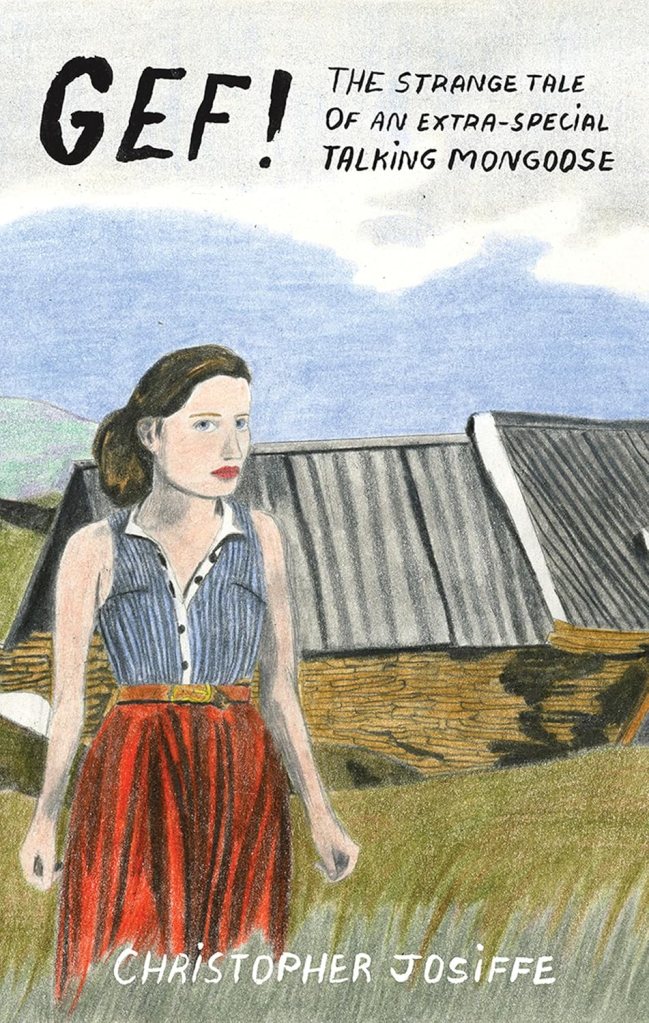
Strange Attractor Press – 2017

In 1931, a talking mongoose named Gef invited himself to live with a farming family on the Isle of Man. He stayed with them for a decade, engaging in long conversations, eating their food, catching them rabbits, keeping them up to date on island gossip and occasionally spitting and peeing on them. Several times he let them touch him and take very blurry photographs of him. Despite his brazen personality, Gef, or the Dalby Spook, as he was sometimes known, was generally hesitant to engage with anyone but the farmer, his wife and their daughter.

A lot of people, including my old pal Harry Price, dismissed this as a hoax, but the family remained adamant that they were telling the truth. There are several theories about different members of the family deliberately tricking the others, but none of the three ever admitted to such. They had little to gain from their fabulous claims, and they made an effort to shun some of the attention they received. This is an interesting case partly because one of the main reasons for believing the story is the fact that it is so ridiculous. If the family was deliberately conducting a hoax, we would expect them to do a better job.
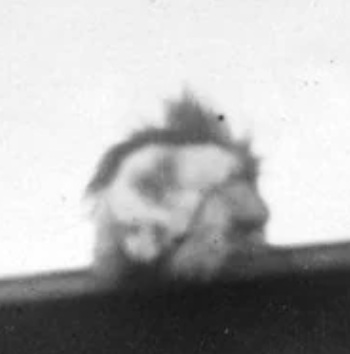
The clearest photo of Gef

Followers of this blog will know that I am generally quite skeptical of paranormal phenomenon, but personally, I’m not convinced this was entirely a hoax. I think it likely had more to do with mental illness than simple deceit. This family had moved to the Isle of Man because the father’s business ventures had failed. They were forced into a difficult existence where they were not only physically isolated but socially separate to their closest neighbours. I think it’s very possible that the father had a mental breakdown and managed to convince his family that his hallucinations were real. This may have led to the family to perform acts of deception as a means to avoid internal conflict. Either way, it’s a fascinating story.

I’ve come across mentions of Gef before, and I’ve had Josiffe’s book on my to-read list for ages, but I brought it to the top a few weeks ago. I was going to say that it was after coming across mention of Gef in Graham J. McEwan’s Mystery Animals of Britain and Ireland, but I just looked there and realised that Gef doesn’t get a mention! The last place I saw him referenced was actually in The R’lyeh Text, a grimoire of Lovecraftian magic! There’s an essay at the back of that book which claims that Gef may well have been an influence on Lovecraft’s Brown Jenkin from The Dreams in the Witch House. Josiffe repeats these ideas towards the end of his book and notes that it was very likely that Lovecraft would have encountered articles on Gef in the news during the 1930s.

This book was great. The author presents things very fairly, and does a good job of just presenting the facts of the case. If anything, I think he could have been a bit more dismissive. The last few chapters of the book look at phenomena (poltergeists, fairies, tulpas and witches familiars…) in an attempt to potentially explain what Gef might have been. I wasn’t convinced by any of these suggestions. The story is weird enough without anything supernatural or paranormal being brought in to explain it. Still, I appreciated the comprehensive nature of Josiffe’s work. I am quite certain that this will remain the definitive book on the Gef phenomenon forever. If you like books about weird stuff, you have to read this masterpiece. This is the best book I’ve read this year, and it may well remain so for the remaining 361 days of 2026.
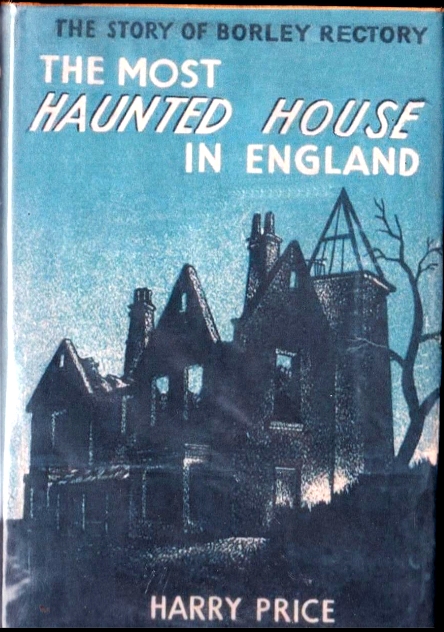
Harry Price and Borley Rectory: The Most Haunted House in England

It was roughly a year ago that I reviewed The Amityville Horror. That book is an unconvincing piece of trash, but if you read it as a novel (which it is), there are some genuinely creepy ideas. I recently saw somebody posting about this book, Harry Price’s The Most Haunted House in England, and I thought I’d give it a go in the hopes that it would creep me out.

Longmans, Green and Co. – 1940

The Most Haunted House in England: Ten Years’ Investigation of Borley Rectory,

So Borley Rectory was a big house where a bunch of ghost sightings and poltergeist activity supposedly occured. From 1929 until 1939, Harry Price, a paranormal investigator, catalogued a bunch of the weird stuff that happened there.

People reported seeing a ghost nun walk across the garden. Others saw a black coach ride through the same area. Guests at the rectory heard creaking noises during the night and saw weird messages written on the walls. The people who lived there saw things falling off shelves without having being touched. One of the women who lived there claimed that a ghost punched her in the eye and flipped her out of her bed.

The (entirely fake) story of Borley Rectory could be interesting if told by the right author, but Harry Price’s book is very boring. He does his best to make the paranormal happenings seem unscary. These ghosts don’t mean any harm. They just want attention. I hate this idea. If I wanted a friendly fucking ghost, I’d watch Casper.

The other thing is that none of what Price claims in here is remotely convincing. There’s a part where the woman who owns the house goes upstairs to bed because she’s feeling sick, and then a few minutes later a ghost throws something down the stairs. Price claims that it couldn’t have been the woman because she was too sick. Shortly after this, the people below hear a clattering noise coming from upstairs. When they run up to the old lady’s room, they find her and mattress on the ground. Apparently the ghost had pushed her out of bed! Nice try Granny.

The Rectory

Not only is the book not convincing, but Price’s close associates came out after it was published and claimed it was lies. Price set most of it up. One man went into the house with Price to witness poltergeist activity. When he was walking in front of Price, he thought he felt small objects bouncing off his back. When he turned around, Price abruptly started whistling and checking his watch. Later on, the man noticed a bunch of pebbles falling out of Price’s pockets when he was taking off his jacket. When confronted, Price said that a ghost must have put them there.

Price wrote another book about Borley Rectory a few years after this one, but I couldn’t bring myself to read it. The Rectory actually burned down before the first book was published, so I can’t imagine the next book has anything of substance to add. I saw a trailer for a movie based on Price’s story. I couldn’t be bothered watching the movie, but it looks a lot more entertaining than this boring book of lies and nonsense.

I got a notification from WordPress during the week telling me that this blog is now 9 years old. I don’t know whether to feel proud or ashamed. There’s been ups and downs, but I’ve been really enjoying it for the last year though, so I’ll probably keep it going for a while longer. There’s still so many books left to read. Please let me know if you have any recommendations!

Ghost Hunting Guide: Optimizing Your Paranormal Adventure by Dr. Dean Russell

Crossroad Press – 2012

The scope of this blog covers anything remotely spooky. I don’t believe in ghosts, but I like ghost stories, and I’m moderately interested in how a person would go about hunting a phantom. I read this book because it was very short, and I had some time to kill.

I suppose I expected a manual explaining the best methods to lure a specter out from underneath the stairs, followed by an appendix with tips on how to stop ectoplasm samples from dissipating. Maybe there would be a chart describing the different varieties of apparitions. Nope. That’s nothing close to what this book is.

Dean Russell (or Dr. Dean Russell) is an “organizational effectiveness consultant”. I think this means that he goes into companies to help them figure out how to operate more efficiently. That’s a respectable thing to do, and Dean seems to be pretty successful at it. His resume is probably pretty impressive to business people. In this book he has taken his knowledge of business and project management and applied it to the field of ghost hunting.

None of the advice given in this guide relates to anything spooky or supernatural. It’s all stuff about how to build an efficient team, how to budget an adventure and how to prepare for and deal with any setbacks you face during your outing.

Realistically, a ghost hunter probably should pay close attention to the above topics before stepping foot in a haunted house. They are practical considerations for almost any professional outing. They are also the kind of things that people who go ghost hunting probably don’t bother with.

If I was actually a ghost hunter, this book might give me pause for thought. I am not a ghost hunter though. I’m just a weirdo who likes creepy books, so I was just mildly amused at this strange little text. Dean Russell has also written a few novels about a guitar playing ghost fighter. Maybe I’ll give them a go some day.

The Big Grey Man of Ben MacDhui – Affleck Gray

The Big Grey Man of Ben MacDhui – Affleck Gray

Impulse Books – 1970

In 1891, a hiker had a creepy experience while climbing Ben MacDhui, one of the highest mountains in Scotland. He was pottering alone when he heard footsteps approaching him from behind. When he turned around, there was nobody there. He didn’t tell many people until 1925. After this, other climbers who noticed strange happenings while climbing Ben MacDhui came forward. In this book, Affleck Gray, a Scottish mountaineer and historian, collects every single iota of public discussion of the mysterious mountain and the Ferla Mor.

Ferla Mor comes from Fear Liath Mor, Scottish for Big Grey Man (technically “man grey big”). This is the name given to the phenomenon. Apparently people have seen a giant grey man walking around up there. It seems pretty likely that these sightings could have been the Brocken spectre, a spectral phenomenon that makes an observer’s shadow look like a giant. I’ve come across mentions of the Brocken Spectre before when reading books about bigfoot or the yeti, and it definitely could account for visions of a big grey man in the mountains.

It’s not just big shadowy men that people have encountered up this mountain though. Several people have heard creepy music and sinister footsteps. Members of the Aetherius society claimed that the mountain was used as an alien base, and some nutty spiritualists claimed that the Fear Liath Mor was actually a Buddhist master. Is this lad supposed to be a Sasquatch, a ghost, an alien or a what? Another witness claims to have seen a fox walking upright, wearing a top-hat… Yeah. When I said that Affleck Gray collected every iota of discussion of the weird stuff up this mountain, I was serious. I admire the comprehensive nature of this work, but it’s this exact feature of the book that makes it unbelievable. This is a collection of folklore more than anything else. The author never really tries to convince the reader that anything specific is going on, and this is the book’s saving grace.

Some of the chapters feel like filler. There is a big discussion on the possibility of life on other planets that has very little bearing on the rest of the book, and there’s an unreadable chapter on ley-lines. Things get a bit repetitive towards the end of the book too, but it’s fairly short, so it’s not unbearable.

There’s been a few editions of this book. I believe the first one came out in 1970. There is also an ebook available from Birlinn Press.

I’m not convinced that anything particularly weird has happened on this particular mountain. A surprising amount of the book is taken up with discussions on stuff that happened on other mountains. Mountains are weird places though. I think that a mountainside is the perfect place for a person to get a bit freaked out when they’re on their own, and I only wish that I had the opportunity to do so myself. I live fairly close to some mountains, but they’re full of bears and wolves and I’d get eaten within minutes. Ben Macdhui looks like it’s fairly close to Loch Ness and Aleister Crowley’s old house, so I’ll try and get over there once I’ve made my fortune.

The Amityville Horror – Jay Anson

The Amityville Horror – Jay Anson

Prentice Hall – 1977

Despite what it says on the cover, this book is definitely not “a true story”.

The Lutz family move into a new house right before Christmas. The kids are disappointed by their presents, the stepdad feels chilly, the dog pukes, the mom has some sex dreams about a man who isn’t her husband, there’s a reek of human shit in the basement, and the parents beat their kids with a strap. Oh, and some weird stuff happens too.

The family hear some creepy voices, see an evil talking pig, and get covered in green slime.

Honestly, I quite enjoyed the first few chapters. There was a part where the little girl asks her mommy if angels can talk that genuinely creeped me out. Unfortunately, things get silly pretty quickly. Once the mom started levitating I lost interest and the book became a chore to read. So many haunted house clichés are present here that it’s very difficult to take seriously. (Some of these clichés likely originated in this book, but that doesn’t make them easier to accept.) This is absolutely not non-fiction.

One of the most confusing features of this book is the character of Father Mancuso. He’s a Catholic priest who visits the Lutz family right after they move in so that he can bless their home. A spirit tells him to GTFO, and he runs away. The rest of the narrative goes back and forth between what’s happening to him and the Lutz family, and I was expecting him to make a grand return to help the family out during the climax of the book. He doesn’t though. He just shits out his bathroom so badly that he has to leave his house for several days and then picks some scabs on his hands. I’m not even exaggerating. It’s suggested that these events were caused by the evil entity in the Amityville house, but the book is set during flu season, and it seems absurd to suggest that an man getting a bad dose of the trots in January has anything to do with ghosts. Honestly, he craps out the shitter so bad that his neighbours complain. Dirty old fucker with a stinking asshole. I read online that he was kicked out of the priesthood after the book’s publication, but I couldn’t find out why. It likely had something to do with his repulsively reeking shitter.

There’s a whole slew of other books about the Amityville house and the Lutz family, but some are presented as fiction based on the truth, some are non-fiction that examines the fiction, and some are presented as nothing but fiction. (There’s also novelisations of movies that don’t seem to be involved in the literary canon of the Amityville mythos.) I’d be interested in looking at some of them just to see how they go between fiction/non-fiction, but three of the key Amityville texts were written by Hans Holzer. I read two books by Hans Holzer during my first year of keeping this blog. Gothic Ghosts and Elvis Presley Speaks are two of the worst books I have ever read, and I don’t want to read anything else by Holzer. (Do yourself a favour and go back and read my reviews of those books. Pure quality.) No. I think it’s safe to say that I won’t be wasting my time on Amityville.

I just noticed that tomorrow marks 8 years since my first post here on Nocturnal Revelries. I must be getting close to 600 books reviewed. I didn’t expect the blog to last this long. You may not have noticed, but since the beginning of this year, I have been deliberately alternating between fiction and “non-fiction”. I had been avoiding non-fiction for a few years, but I’m enjoying get back into it. I actually feel happier with the blog recently than I have in quite a while. Here’s to another 8 years. Hope you’ve been enjoying it!

How to make a Ghost: Conjuring Up Philip (The Philip Experiment)

Conjuring Up Philip: An Adventure in Psychokinesis
Iris M. Owen and Margaret Sparrow
Harper Collins – 1976

In the early 1970s a group of Canadians with an interest in the paranormal decided to try to create a ghost. They came up with a name and backstory for their ghost and then spent a year meditating together, focusing their attention on Philip, the character they had created. After a year, Philip started talking to them.

There’s no denying that that is a cool set up for a horror story, and at least two films have been loosely based on the Philip experiment. Copies of this book are hard to come by for a decent price at the moment too. That doesn’t always mean a book is good, but it does add to the mystique. I had to read this.

Unfortunately, this book is the literary equivalent to eating a cooked turd.

Philip chose to communicate with the group by knocking on a table. The group would ask a question, and he’d knock once for “yes”, twice for “no”. Occasionally he would excited and bump the whole table around. Ugh.

The book is a horrible read. It’s incredibly repetitive, and none of the sources it references are trustworthy. It gives the story of the Fox sisters as evidence of real poltergeist activity, but the Fox sisters themselves admitted that they had produced the noises that brought them attention. There was a chapter towards the end that discussed the psychology of poltergeist activity. It was so frustratingly stupid that I literally couldn’t bring myself to read it thoroughly.

I’ve never encountered a table rapping poltergeist, but I have encountered many, many idiots in my life. It’s much easier for me to believe that the people involved in this experiment were morons than it is for me to believe they created a ghost. Also, the whole way through the book, the authors discuss how the Philip experiment is going to have profound effects on the fields of psychology and even physics in the future. Here we are, almost 50 years later, and their work has had no effect on anything.

This is an poorly written, extremely boring book. When I was finished it, I was completely unconvinced in what the authors were saying. Directly after finishing the book, I watched the documentary referenced therein called “Philip the Imaginary Ghost”. This footage was shot during the experiment, and some of the scenes are discussed in the book. If I had watched the video before starting the book, I wouldn’t have bothered. Reading the book, you can’t fully appreciate how lame the people involved in writing it were. The footage is actually hilarious. It’s a bunch of dithering idiots singing at a table and pushing it around, pretending that a ghost is making it move. I genuinely don’t know if they were stupid enough to not realise that it was in fact them moving the table or if they were only stupid enough to think that people seeing them wouldn’t realise that they were moving the table. Part of me hopes that they were fully aware of how dumb they looked and were just acting like fools for a bit of fun. It truly boggles the mind.

Video footage of a “ghost” moving a table.

Ghost Story – Peter Straub

Ghost Story – Peter Straub
Pocket Books – 1980
(Originally published 1979)

I have heard a lot of good things about Peter Straub, and I knew that Ghost Story is considered to be one of his best books. It was the last book I read of the 10 discussed in Stephen King’s Danse Macabre, and it was also the last book of my summer vacation. (That might give you an idea of the backlog of posts I have.) I had high expectations for this book, and it did not disappoint.

This is a very long novel, but its influences are the short stories of Edgar Allan Poe, Ambrose Bierce, M.R. James, Arthur Machen, Nathaniel Hawthorne and Henry James. With the exception of Hawthorne, I have tracked down and read all of the supernatural fiction by these authors, so it’s not super surprising that I enjoyed this. (I read Hawthorne’s The Scarlet Letter and Twice told Tales years ago but none of his later short fiction. I’ll have to see if there is a dedicated collection of his ghost stories out there.) While this book wears its influences on its sleeve, it has in turn become very influential on modern horror. One of the stories in Ryan Harding’s Genital Grinder uses this book’s opening line as homage.

There’s a part in Stephen King’s Danse Macabre where King discusses how the unknown is perhaps the most potent element of horror. The scary thing behind the closed door is always scarier when that door remains closed. Regardless of how terrifying the menace actually is, by making itself known it loses some its power. (Sure it’s scary, but it’s teeth and claws could always be a little bit longer.) In short, the question is scarier than the answer.

I reckon the first half of Ghost Story is one of the greatest set-ups in all horror fiction. The mystery, atmosphere and tension are magnificent. What the hell is happening here? Why has this man kidnapped a child? Who or what is picking off the small group of old men in Milburn? What’s the unspeakable event that occurred between these old men and the mysterious Eva Galli in the past? How are the answers to these questions linked?

The problem with this book is that those questions have to be answered. As King notes, the answers are doomed to fall short of the horror of the questions themselves. The ending of this book is fine. The characters remain interesting, and there’s plenty of creepy bits, but for my money, the malevolent supernatural force at the heart of the story is just a little bit too complicated for the second half of the book to live up to the first.

Maybe that sounds like a jerk thing to say. There’s literally no way to keep this kind of tension consistent until the end of a story, so this critique isn’t really fair. At least Straub tried. Most writers wouldn’t be able to come anything close to what he has achieved in this book. There are some seriously creepy moments in here. Even thinking of one particularly skillful use of foreshadowing near the beginning of the book makes me shudder, months after finishing the novel.

Jesus she moved she can’t she’s dead.

I really enjoyed Ghost Story, and I recommend it to any fan of horror. Straub has written a bunch of other novels too, including two with Stephen King. I am entirely certain I’ll be reading more of him in the future.

Paperback Horror Classics by Ken Greenhall

Right now, paperback horror is all I can stomach reading, so I decided to check out Ken Greenhall’s stuff as I had heard he was one of the best. All three of these books were originally published under Greenhall’s ‘Jessica Hamilton’ pseudonym, and Valancourt reissued all three under the author’s real name in 2017.


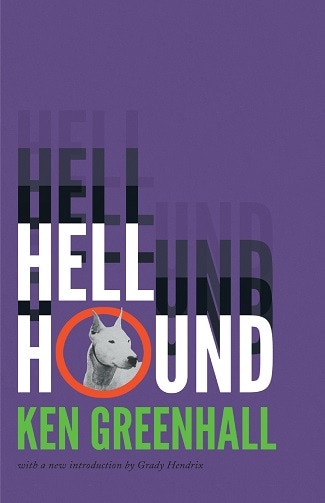
hell hound - greenhall

Hell Hound – Originally published 1977

This is the story of an evil dog. The dog is bad by himself, but halfway through the book, he gets adopted by a teenage Nazi.  I had read some glowing reviews of Greenhall’s work before reading this book, and I had pretty high expectations. It was certainly well written and entertaining, but large chunks of the narration are presented from the dog’s perspective. I know it’s stupid, but there was a little part of my brain that had a problem accepting this, even for the sake of a horror story. Whenever the dog would start to speak, I started to think of the scene in Derek Jarman’s movie about Wittgenstein where the philosopher explains the linguistic limitations of dogs. This was a fine horror novel though. It kept me entertained for an afternoon in quarantine.


ken greenhall elizabeth

Elizabeth – Originally published 1976

This one was quite creepy. Elizabeth is the story of a teenage girl who starts to see a woman in the mirrors around her house. The woman starts telling her what to do, and pretty soon, her family members start dying. The general consensus on Ken Greenhall is that he is a terribly underrated and forgotten writer, and this book convinced me of that. This is an extremely well written novel. The characters are super interesting, and there’s an impressive amount of atmosphere. There are also quite a few paragraphs throughout that require rereading, not because they’re complicated, but because they’re brilliant. I started this one afternoon and stayed up late that night to finish it. After reading it, I felt uncomfortable walking around my apartment with the lights off. This is a great horror novel, and I reckon it’s the best of Greenhall’s books.


ken greenhall childgrave

Childgrave – Originally published 1982

The title of this book put me off. Call me a wuss, but I don’t want to read about dead or dying children. When I started reading about a father and his 4 year old daughter, I felt uncomfortable and anxious. (I have a little girl, and it was hard to read this without picturing us as the characters.) This anxiety faded as I got further into the novel; the narrative voice is very self aware and quite funny, and this makes it seem unlikely that the protagonist will allow anything truly awful to happen. By the halfway point of the book, Childgrave feels like a comic, well-written, paranormal love story.

It’s not though. It gets very, very dark at the end. Grady Hendrix claims that stylistically Greenhall “was a direct heir to Shirley Jackson”. I don’t think Jackson’s influence on Greenhall was limited to style. Without giving too much away, I can say that the ending of Childgrave is only a few steps removed from one of Jackson’s most famous tales.

I don’t want to ruin the story for anyone who hasn’t read it, but I found the last few chapters of the book hard to stomach. They didn’t feel believable. The narrator makes a choice that seems completely unrealistic and out of character. He comes across as mildly unhinged throughout the book, but the choice he makes near the end violates human nature. It’s not believable. The whole book leads up to this choice too, and I found it hard to enjoy the rest of the story after that point.

Childgrave is the longest of the three novels by Greenhall that I read, and I can say that I probably enjoyed reading the first 5/6ths of this one more than the others. The characters are good, the plot is interesting and the writing is great. Unfortunately, I thought the ending made the whole book feel a bit dumb. I’m sure lots of Greenhall fans will disagree, but I’d bet the ones that do don’t have kids of their own. Come on, he wouldn’t do that! No way.


Greenhall wrote a few other books, but these were the ones that Valancourt chose to reissue, so I assume they’re the best. I enjoyed them, and I agree that Greenhall deserves more recognition as a writer. These are objectively better books than some of the tripe I’ve been reviewing recently.

Six Ghost Stories – Montague Summers


summers six ghost stories.jpgSix Ghost Stories – Montague Summers
Snuggly Books – 2019

A few months ago, I got an email from my pal Sandy Robertson telling me that Snuggly Books were going to release a collection of short fiction by Montague Summers. I have long been aware that Monty had written a collection of short stories, but I knew that only a couple of these stories had ever actually been published and that it was difficult to find affordable copies of the books wherein these tales were collected. I’m a big fan and collector of the occult-related non-fiction books written and translated by Monty, and I am also a big fan of short horror fiction, so you will believe that I was very excited to hear that Monty’s ghost stories were finally being published. I ordered this collection for my birthday and read it last week.

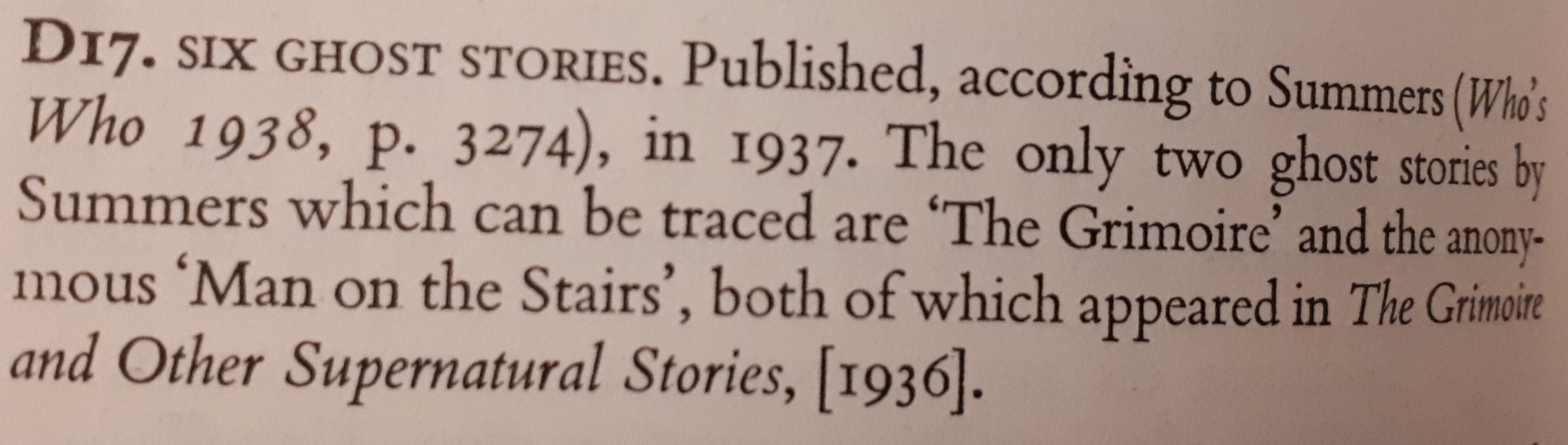
20191130_224224This is the note from Timothy d’Arch Smith’s bibliography of Summers where I first read of these fabled fables.

These six stories lived up to my expectations. They are mostly about people who some acquire some kind of peculiar haunted object that brings about visions and specters. The obvious comparison to make is to M.R. James, who apparently had the chance to read and commend these tales. Incidentally, Montague Summers, the man, has always reminded me of the characters in James’s tales.

The writing in here isn’t what you might expect if you have only read Summers’ books on witchcraft. There’s some very long sentences, but Monty seems self-aware when he’s being verbose, and this comes across as charming rather than tedious. My biggest criticism is probably that the tone of some of these stories remains too light-hearted for too long. Everything will be going fine and dandy for all of the characters, and then a ghost will jump out and scare a person to death right at the very end of the story.

My favourite tale in here was The Grimoire. This one has been previously published in different texts, and it’s not hard to see why it was chosen above the others. It’s the story of a bibliophile whose local dealer procures him an aged book of sinister black magic. When the collector translates a passage from this heinous tome, scary things start happening. (I can’t help but wonder if Sam Raimi read this tale before writing Evil Dead.) This one was particularly cool because it feels like Summers, an expert on books about black magic, could be the narrator.

While not all terribly original, these stories are competent, fun and generally pretty satisfying. I read one each night after my family had gone to bed, sipping a cup of peppermint tea and hearing the cold November breeze blowing through the willow trees our garden. It was great. I suggest you enjoy these tales in a similar manner.

These stories are entertaining in and of themselves, but there’s something very exciting about reading a collection of tales that were believed to be lost for more than half a century. Summers’ old manuscripts went missing shortly after he died in 1948, and they were only unearthed a few years ago. Snuggly Books put out this collection in October (I think this is the only book from 2019 that I’ll have reviewed in 2019.), and they are planning to put out a second volume of Summers’ fiction early next year. This collection will include a novella titled The Bride of Christ. Sign me up!

Ghosts, the Illuminati and a Swastika

ghosts illuminati swastika mcivor tyndall.jpgGhosts: A Message from the Illuminati
Dr. Alexander James McIvor-Tyndall

The Balance Publishing Co. – 1906

Hang on. A terrifying spectre, the Illuminati and a swastika on its cover? What frightful secrets must a book like this contain? Were the Nazis in contact with spirits? Did the Illuminati try to warn humanity of the coming horrors of World War II? Were the Nazis just an offshoot of the Illuminati? There’s so many questions raised by a cover like this. Fortunately for you, I have read this fairly hard to find book, and I am about to share with you its shocking revelations.

The Ghosts of the title are the rules of society. They are ghosts in the sense that the ideas behind them are as dead as the festering, rancid corpse of Michael Jackson. For instance, many people believe that life is not supposed to be full of joy. This notion is the result of the fact that human life used to be pretty shit. Back then, people told themselves that it was good to suffer in order to make themselves feel better about their shitty lives. But life isn’t that shit anymore, and the notion that it shouldn’t be filled with happiness is outdated – it is a Ghost of an idea. Fair enough, I accept the message of this book. I feel the same way about men wearing ties. Why fucking bother? To keep you warm? Fuck ties.

This book was published as part of a series of short books on mysticism, but there’s nothing particularly mystical about its message. It was published just two years after Crowley’s Book of the Law though, and there’s a very definite “Do what thou wilt…” vibe to the message here. There’s not a lot about the author, Dr. Alexander James McIvor-Tyndall (alias Ali Nomad), online, but I found a dead link that shared some interesting information on his life. He was English but moved to the States as a young man. Although trained as a doctor, he seems to have spent his life lecturing and writing about spiritualism and the likes. He had been working as a hypnotist several years prior to writing this book and had already published a book on palm-reading. Apparently he had also lectured on Theosophy as early as 1890. Only a few people would have had the chance to read Crowley’s Book of the Law when Ghosts was written, but as an English occultist writing in the early 1900s, it’s not impossible that Dr. Alexander James McIvor-Tyndall would have heard Crowley’s message (possibly through mutual friends in the Illuminati). He did go on to write a book about “the spiritual function of sex”, so if he wasn’t familiar with Crowley, the two men were at least working on similar wavelengths.

Presumably Ghost‘s message of nonconformity to the oppressive rules of society is coming directly from the Illuminati, but other than the title, the only reference to the Illuminati in this work is when the author introduces a quote from Hamlet, referring to its author as ” Shakespeare, the Illumined”. I guess the message of Ghosts falls in with the original purpose of the Illuminati, that of promoting equality and freedom.

The swastika on the cover makes the book seem rather curious indeed, but as I’ve already mentioned, Ghosts came out in 1906, so its appearance has absolutely nothing to do with the Nazis. (Unless of course the Nazis were just an offshoot of the Illuminati!) The author of this book actually went on to edit an occult magazine called The Swastika from 1907 until 1911, all issues of which are available here. (I love the internet.)

ghosts illuminati ad swastika.jpg
Advertisement taken from Swastika Magazine, Volume 3, Issue 4.

Despite having the most alluring cover of all time, Ghosts: A Message from the Illuminati isn’t hugely exciting. For those who clicked into this post hoping for a book about Nazi Occultists, stay tuned. I have a post on that topic scheduled for next week.