The Devil’s Own – Peter Robson

Ace Books – 1969
devil

I picked this one up from the bottom of the esoterica shelf in an out-of-the-way, used book store that mostly stocks old mystery novels. It had a picture of a man who is on fire on the front, and the heading on the back cover reads; ‘THE SPAWN OF LUCIFER…’ The most promising feature of all though, was the fact that when I started reading it, it was not yet listed on goodreads.com. Oh yes my friends, this kind of book is what it’s all about. It’s a collection of short accounts of the lives and atrocities of 25 of Satan’s most heinous disciples. Among the accused are Aleister Crowley, Rasputin, and John Dee, but many of the other names in here are a little less well-known.

The accounts given seem to be somewhat based in truth, but I suspect that they were mostly just patched together from urban legends, rumors, lies and complete fabrications. Some of the exaggerations are commonplace and believable, but others are downright silly. For instance; I have come across the mysterious figure of the Comte de St. Germain in several other books, and I was a little surprised to see him appear in this. Hitherto, I knew of his claims of being immortal, but that hardly seemed comparative to the cannibalistic orgies of the sadistic black magicians in this little collection. It all made sense however, when this book informed me that the Comte de St. Germain was actually “the Devil – in the guise of a gigantic werewolf.”

Most of the characters mentioned in here were definitely real people, but there are some accounts which are probably complete fabrications. There’s an interesting section on an evil priest named Raoul Hannah who lived in Belfast. He is supposed to have been involved in the slave trade, voodoo cults and human sacrifice. He is also apparently responsible for bringing the black mass to Ireland. According to the book,  this Satanic St. Patrick’s rituals always culminated in “the sacrificial murder of an unknown African Negro”. Given this peculiar fact, I wonder how often he was able to celebrate this sacrament; there probably weren’t many “African Negroes” in Northern Ireland in the 1930s. Anyways, I was fairly excited to do a little research on this lad, but the passage ended with a note:
In order to protect those whose families were quite innocently involved in the story of a man named “Raoul Hannah,” the real identities and the exact location of the town in the north of Ireland have been withheld.
I’ve searched online and can find no trace of this story. It’s a pity because it was one of the most interesting tales in here. I reckon it’s complete bullshit and that Peter Robson made it up to fill a few extra pages, but then again, there are only 3-4 sections in the book that I have not found some basis for. There’s a possibility that it is true and that Robson did just change the names. If you have any idea about where this story came from, please contact me and let me know.
(My hunch is that this is section is probably just a bio on Ian Paisley.)

There are other monstrous individuals in here whom I have not been able to track down. Two of the most diabolic, Raoul Plessy and Gustav Labahn, are probably fabrications of Robson’s. I would be happy enough to accept that these three suspicious entries were completely made up, but that would be to presume that they never existed only because they’re not mentioned online. In fact, there is one particularly horrific account in here that tells of a young girl named Bernadette Hasler being sadistically tortured by a religious order called “the Seekers of Mercy”. It seemed pretty bullshitty when I was reading it, but when I looked it up online I was disturbed to find an image of a teenage girl on the cover of a French crime magazine with the headline “Le Martyr de Bernadette torturée au mort au cours d’une séance exoricsme”. There’s also an article written in German that mentions the case, but I could find nothing in English. Now, I’m not taking two articles that I can’t read properly as evidence of Peter Robson’s account being accurate, but they have convinced me that it’s not complete bullshit. It’s weird to come across a story as disturbing as this without being able to find out more about it online. It makes me wonder about my dependence on the internet as a verifier of knowledge, and I am both simultaneously upset and excited to know that sometimes the truth isn’t out there.

There are other cool parts in this book. I liked the section on Abbé Boulan. I’ve already mentioned my interest in finding a reasonable account of this character, but as was to be expected, the account herein is fairly dubious. There are some glorious passages though:

Her arms were stretched out in the form of a cross, and she held black candles in her hands. A cloth with a cross embroidered on it was placed on her breasts, and the chalice was placed on her abdomen.Then a goat’s throat was cut, and the blood poured over the woman. Next, Boullan performed a ceremony over the woman which involved frequent kissing of her body and drinking  the goat’s blood. During the whole disgusting performance, the unfrocked priest screamed out curses and threats

I would genuinely rather read that than an accurate portrayal of anyone.

Also, there is a super cool fold-out advertisement in the center of the book.
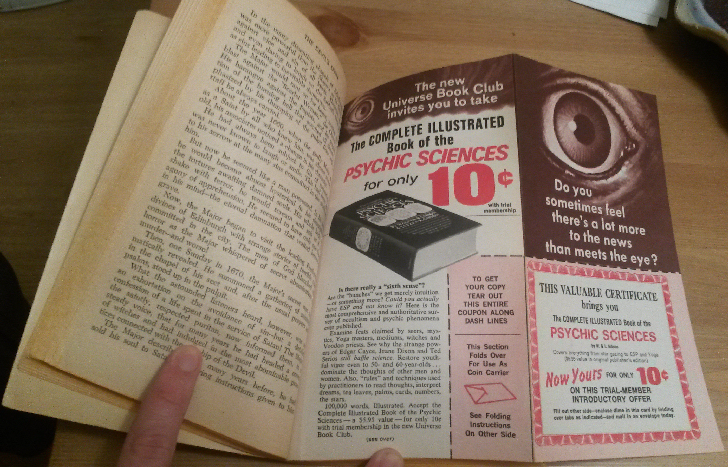
psyOnly 10 cents for a copy of the Complete Illustrated Book of Psychic Sciences?!?!?!

I really enjoyed this little book. It’s trash to the Nth degree, but it doesn’t pretend to be anything else. Buy a copy and read it on the way to work. 8/10.

Irish Witchcraft and Demonology – St. John D. Seymour

Dorset – 1992
irishj

I love books about witchcraft and demonology. I also love books from/about Ireland. I’m sure you can imagine my excitement on finding this little beauty. I actually read the book online, but managed to pick up a copy online for a reasonable price.

This edition is lovely. It’s a nice hardback, with lovely typeset and a very interesting cover. The image on the cover is from a painting by Richard Dadd called “The Fairy Feller’s Master-Stroke”. It’s not particularly Irish or witchy, but it’s cool all the same. Look it up on google there and have a gander. I really like it.

The contents of this book are pretty good too. Unlike a lot of European countries, Ireland never really had much of a problem with witches. It’s hard to know whether that was due to the fact that’s it’s an island and hence relatively isolated, or whether it was because the country had enough problems with the bleedin’ Brits during the witchcraze and didn’t have time to be getting upset over such silly nonsense. It could also be that the deeply superstitious Irish peasantry had been holding on to some ancient pagan traditions, and had never come to see witchcraft as an inherently negative thing. It was very probably due to these and a combination of other reasons that Ireland wasn’t much affected by the witchcraze of the middle ages.

Some parts in this book are great. I really liked the part on Alice Kyteler. TG4 did a great documentary on her that’s up on youtube. The house she lived in is now an inn, and I swear that the next time I’m in Ireland, I’m going to try to pay it a visit.

There’s a few aul stories in here about fairies and lads cheating the divil and that kind of craic. I enjoy reading that stuff immensely, but this might not be the book for you if you’re looking for pure, nasty witchcraft. That said, there are some grim incidents recounted in here. There’s one story about a woman who goes mad and kills her elderly neighbour:

One of the witnesses deposed that he met the accused on the road on the morning of the murder. She had a statue in her hand, and repeated three times: “I have the old witch killed: I got power from the Blessed Virgin to kill her. She came to me at 3 o’clock yesterday, and told me to kill her, or I would be plagued with rats and mice.”

The most chilling thing about that story is that it’s actually from 1911.

Overall, this is an enjoyable little book. A lot of it’s taken up with folktales that seem unlikely to have had any basis in truth, but there are a few sinister and curious accounts of what were doubtlessly real events. Seymour isn’t out to scare anyone and definitely comes across as critical of the witch craze. (Montague Summers, he is not.) Irish Witchcraft and Demonology is a decent attempt to compile the history of witchcraft in an almost witch-less country. It’s short, interesting and definitely worth a read. 8/10

Getting back to the cover illustration, check this lad out!paddy
Howiye Paddy!

The Black Arts – Richard Cavendish

Picador – 1972

blackarts

This book is a tricky one. Half of it’s great, half of it’s horrible. The sections on ritual magic, witchcraft and satanism are really interesting, but the book also contains comprehensive sections on numerology, cabala, tarot, astrology and alchemy. Personally speaking, when I buy a book on ‘the Black Arts’, I’m not really interested in reading about people playing with cards or counting the numbers in their names. I want blood rituals, human sacrifice and horrible acts of depravity. (Reading this book could be compared to going to a Slayer concert and then finding out that Tool are the opening band.) I’m going to largely ignore the parts that I didn’t like for this review; if you want to learn about tarot, fuck off and prance over to your nearest renaissance fair.

There’s some really interesting stuff  in here about demons from Biblical Pseudepigrapha. I’m still only about halfway through the Christian Bible right now, but I’m really looking forward to finishing that and then reading the Books of Enoch, the Testaments of Solomon and the Life of Adam and Eve. There’s something particularly exciting about the idea of Jehovah being good mates with the demons back in the day – Yeeeeeeoweh and de lads!

One of my favourite things about the book is the fact that it reads more like a history book  than a grimoire or set of instructions. A large amount of the information is utterly unbelievable, but Cavendish manages to reference his sources in such a way as to avoid any accusations of credulity that might be thrown at him. He politely leaves it up to the reader to decide what they think is bullshit and what’s legitimate, and this approach makes this kind of book far more interesting to read.

There’s a great bibliography and a ‘suggestions for further reading’ section at the back. I’ve already ordered quite a few of its sources, and I’ll hopefully get around to reviewing them here sometime soon. I’m going to pretend that I didn’t begrudgingly wade through 5 chapters of new-age shite and give this book a glorious 7.5/10.

The Occult A History – Colin Wilson

Random House – 1971
occult
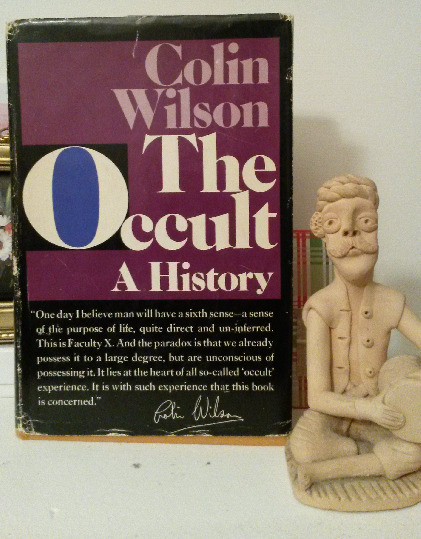
The title, ‘The Occult A History’, is a little misleading. A more accurate name might be ‘A ridiculous theory based on an unquestioning and incredibly naive consideration of the History of the Occult’. Colin Wilson comes across as frustratingly credulous. The following might be a typical paragraph in this book:

Tom was able to communicate with the leader of the great race of flying ape-dogs on the planet Durthyanus. Tom was a patient in mental hospital who was spoon-fed mush by a nurse and needed his nap-nap changed twice a day, but there is no reason not to believe that he had strong powers of interplanetary telepathy; most people who possess such gifts are actually completely untrustworthy.

That’s barely even an exaggeration! I understand that people who write books on the occult are often going to be more ‘open-minded’ than the average individual, but Colin Wilson comes across as a chump. The book is definitely well researched though. Wilson uses lots of interesting sources and I got loads of ideas for other books to read from this one. This book is actually quite an enjoyable read if you don’t waste too much time getting upset over the author’s ridiculous methods of reasoning. I really liked the chapters on Cagliostro and werewolves, but I couldn’t bring myself to finish the final chapter in which the author discusses ‘Faculty x’ in detail. ‘Faculty x’ is basically a 6th sense type thing that Wilson believed human beings were about to discover/develop. Well, this book was written more than 40 years ago and from what I can tell, we’re yet to x.

Sometimes I feel that I put too much faith in the authors of books on the occult. I’m not sure that people intelligent enough to make their living as writers could possibly believe the wacky crap that ends up getting published. I reckon that authors are spewing out this silly garbage just to increase their sales. It makes sense that a writer like Wilson would inject a little craziness into an otherwise reasonable historical account; books on the fantastic just aren’t as enjoyable when they’re logical. I mean it’s not likely that anybody would ever pay money for a book that sets out to disprove the validity of moleomancy.

gurd

(Wise words from Gurdjeff on the back cover.) This book is dumb but mostly fun. Read it, but don’t bother with the last chapter. 6.5/10