A few months ago, I did a post on some novels by Harry Adam Knight. Harry Adam Knight wasn’t a real person. It was a pseudonym used by John Brosnan and his friend Leroy Kettle. When writing that post, I discovered that Brosnan and Kettle had collaborated on more horror stuff under another name, Simon Ian Childer. I enjoyed the HAK books so much, I had to track down the SIC stuff. (Both of these books have been out of print since the 80s though, so they’re a bit harder to find.)
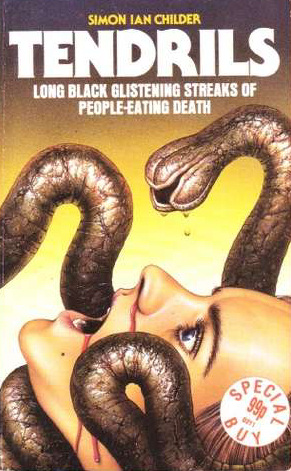
Tendrils Hunter Publishing – 1986
A plague of “worms” wreaks havoc on some small English towns while the only scientist who understands the situation enters into a complicated relationship with a journalist. Published one year after Squelch, the final entry in John Halkin’s Slither series, the first half of Tendrils feels very much like a slightly grislier version of Halkin’s books. After a while, the “worms” are revealed to be the tendrils of a far larger subcthonic entity that has been lying dormant since causing the extinction of the dinosaurs. This was a nice touch, but ultimately not enough to make Tendrils a novel worth writing home about.
I read this book and wrote the above summary in July. I thought I had written a more in-depth piece of literary analysis, but I guess not. It’s a pity, because I don’t remember much about this book. It was ok, but very forgettable. I have read so many books about worms this year that I’m finding it difficult to distinguish this one from all the others. It only took me a couple of days to read it though, so it can’t have been painfully bad.
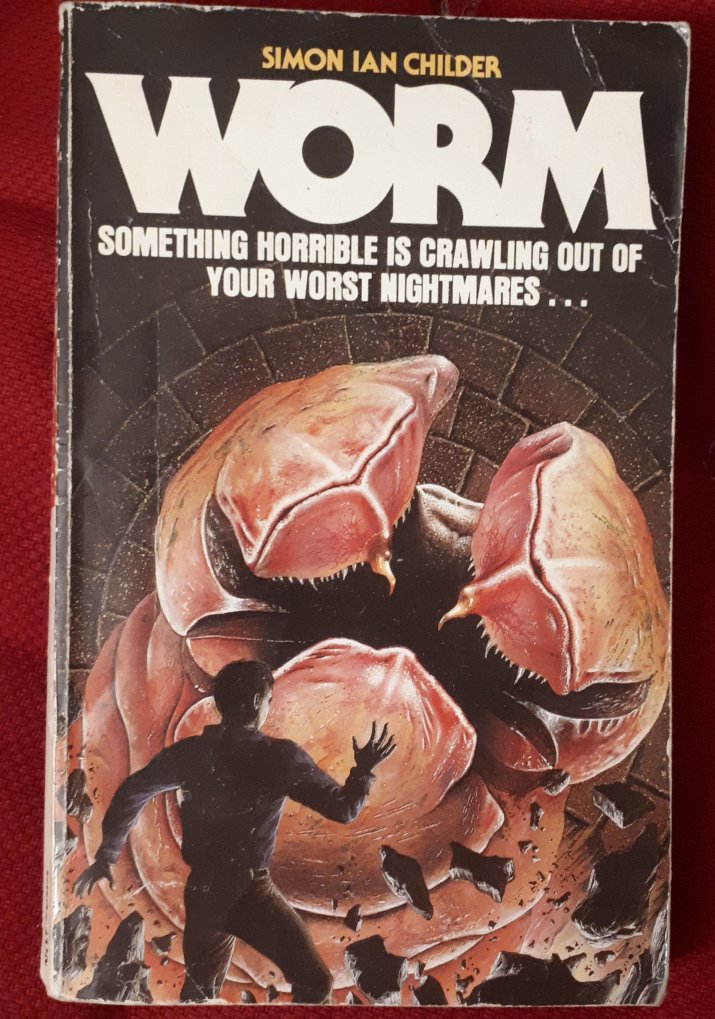
Worm Grafton – 1987
Tendrils was alright, but it wasn’t quite as good as the Harry Adam Knight books I had read. I thought that the authors may have decided to use the Simon Ian Childer pseudonym for works of less literary merit. On top of this, I have read more than my fair share of horror novels about worms this year. I didn’t have particularly high hopes when I started into Worm.
Honestly, this was one of the most enjoyable books I read in 2020. From the repulsive surgery of the opening chapter to the awfully satisfying ending, this book was fantastic. Don’t get me wrong, this pretty low brow stuff, but God damn it was fun. (Low brow as it is, there’s an implicit critique of British colonialism in the book’s plot that I quite enjoyed. The author was Australian, but Brosnan is a good Irish name. Good man Johnny.)
A giant carnivorous worm is found inside the body of a patient in a mysterious private hospital, and it’s up to Detective Ed Causey to figure out what’s going on. This is a crime noir adventure with flesh hungry worms. Fuck yes.
Brosnan wrote this one by himself, and it has everything I enjoyed about his other books; interesting characters, really gross bits and competent story telling. A few weeks ago, I read and reviewed John Halkin’s Blood Worm, another novel about giant worms eating the civilians of London. It was so terrible that it made me want to read less trashy 80s horror fiction. Reading Worm had the exact opposite effect. Finding a gem like this makes wading through the shit worthwhile. This one is the rarer of the two SIC books, so grab it if you find it.
I don’t know why Brosnan and Kettle used two different pseudonyms to write novels that belonged to the same genre, but I discovered that a later edition of Worm was put out under the Harry Adam Knight pseudonym. All of their books are pretty good though, and I am going to seek out Brosnan’s other novels. Fortunately, most of the stuff he put out under his own name is available as e-books.
Danse Macabre – Stephen King Berkley 1983 (Originally published 1981)
Stephen King’sDanse Macabre is a history of horror. It focuses on the 30 years prior to its publication in 1980. I have read most of the old classics of Gothic horror, and in recent years I have turned my attention to more modern stuff. When I started to read King’s book I assumed that I would be familiar with most of the stuff he was discussing.
I was wrong.
In an opening chapter King discusses Frankenstein, Dracula and Strange case of Dr. Jekyll and Mr. Hyde. I felt good. I had read all of these. King claims that nearly all modern horror stories can be traced back to these archetypal novels. I wasn’t convinced. These are certainly important books, but claiming that all horror can be traced back to them seems like a bunch of farfetched college-boy bullshit.
Then there’s some very long chapters on horror movies, TV and radio drama. I like horror movies, but I found these parts really, really boring.
After slogging through that stuff, I finally got to the section on horror fiction. I was expecting a broad overview of the field, but King limits his discussions to 10 books published between 1950 and 1980. He chose these books because they “seem representative of everything in the genre that is fine.” To my dismay and great shame, I had only read one out of these 10.
I put Danse Macabre down and sought out all the books King listed. It took me all of August to read them. It has taken me until the end of the year to finish writing about them. Here’s the list and some brief thoughts. Click the title of each book for my full reviews.
Strange Wine – Harlan Ellison This book was enjoyable, but I find it peculiar that King chose it was the only short story collection to discuss. It contains maybe 3 horror stories. King discusses Bradbury’s Something Wicked, but Bradbury’s Dark Carnival or October Country collections are far more horrory than that novel and this collection by Ellison. It really seems to me that King included Strange Wine on this list because Harlan Ellison was his friend.
Not all of these books were amazing, but most of them were really, really good. I had been planning on reading a few of them beforehand, but God knows how long it would have taken me to get around to them at my own pace.
When I had finally finished these ten books, I picked Danse Macabre back up, ready to read King’s thoughts on my previous month’s reading.
BORING.
Stephen King was an English teacher, and much of this book comes from lecture notes he gave at some writing college. He starts talking about the Apollonian and Dionysian natures of the characters in these novels. Dionysus, my bollocks. Also, if you look at this book’s publication date, it seems to have been written at the height of King’s cocaine use. Cocaine apparently gives its users a sense of grandiosity or inflated self esteem. This might explain how King thought it was acceptable to fill his book with such rambling pseudo-academic hogswash.
Danse Macabre is the most influential book that I read this year. It led me not only to read the books discussed therein but also several other books by their authors. Honestly, I really like Stephen King, and the novels discussed in here are great, but I found this book pretty boring. I far preferred reading the stories than King’s thoughts on them. I guess I don’t have much time for people sharing their opinions on books…
I would advise to stay away from King’s non-fiction, but I actually read his On Writing in February and thought it was great. I was seriously trying to do more creative writing, but then covid hit and I used it as an excuse to quit.
I figured it was about time to give this Ramsey Campell fellow a read. Here’s his first 3 novels.
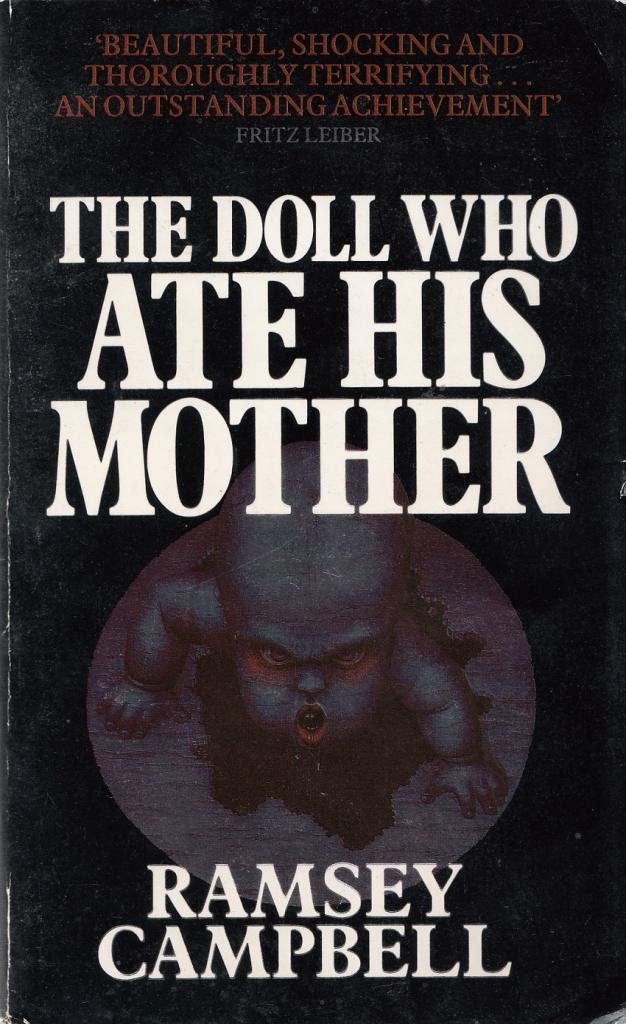
The Doll Who Ate His Mother Legend Paperbacks – 1989 (Originally Published 1976)
When I was looking at Campell’s bibliography on wikipedia, I saw a note beside the title of this novel that said, “(1976; revised text, 1985)”. I try to avoid reading anything about the plots of novels before I read them and so instead of risking a spoiler by figuring out which version of the text was better, I read both the 1976 and 1985 versions of the text side by side. Doing so was a bit of a waste of time though as the two versions are identical aside from one small paragraph near the conclusion of the book dealing with how one of the characters dies. I reckon the updated ending is a bit more cohesive in the context of the story, but it’s nothing huge, and if you’ve only a copy of the original version, I wouldn’t be rushing out to replace it for that single paragraph.
The story is pretty good. It’s about a sick freak who abuses animals and steals limbs off corpses. There’s a bit of black magic thrown in too. I enjoyed this book the whole way through, and it left me happy to read more by Campbell, but I chose this as my introduction to Campbell because of its inclusion in Stephen king’s Danse Macabre. It’s a fine first novel, but I’m not sure if it really deserves to be on the same list as The Haunting of Hill House and Something Wicked This Way Comes. I think its inclusion there might have had more to do with Stephen King wanting to include something more modern (or British perhaps) on his list of influential horror. Still though, this was a good read.
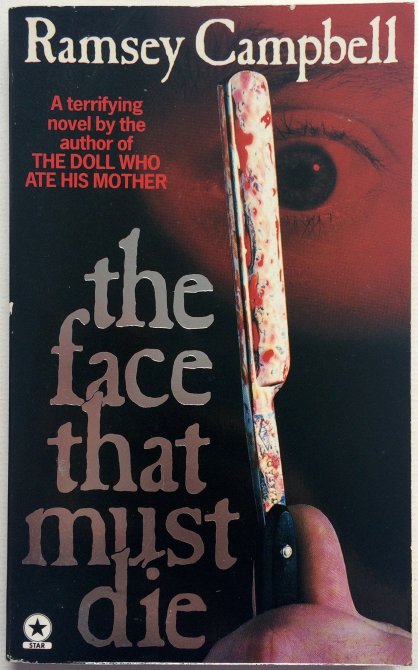
The Face that Must Die Star – 1979
The first thing I noticed about this book was that it felt very a bit like a sequel to The Doll Who Ate His Mother. It’s about totally different people, and there’s no supernatural element to this one at all, but the writing style and setting were so similar that it almost felt like a continuation. These two novels would make good episodes of some kind of horror series set in Liverpool.
The Face that Must Die is the horrible story of an insane serial killer who likes slicing people (especially if they’re gay) up with a razor. I don’t feel much need to say anything else about this novel. It’s pretty straightforward and very dark. There’s nothing to laugh about in this book, but there is some interesting insight into mental illness. In a sad and lengthy introduction Campbell explains that his mother suffered with severe mental health problems at the end of her life, and these problems seemed to give him ideas to fuel a serial killer. This book is fucking grim, but I liked it.
Like The Doll Who Ate His Mother, there are also two different versions of this novel. I read the “definitive” 1983 version, the author’s restoration of the original text.
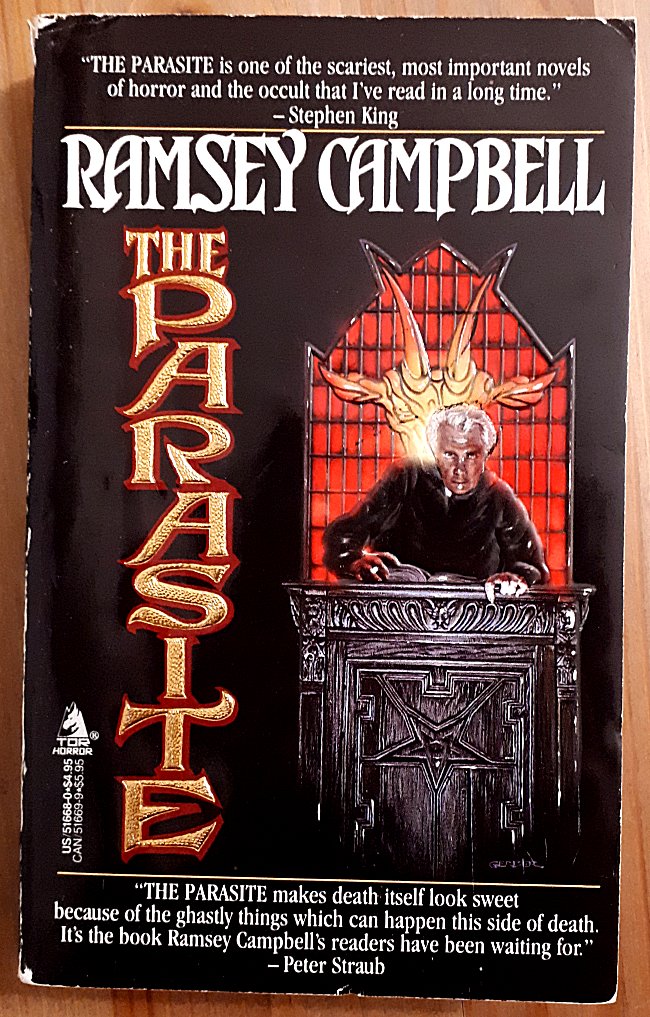
The Parasite Tor – 1989 (Originally Published 1980)
Of the three Ramsey Campbell novels I have read so far, The Parasite contains the scariest scenes. There’s a couple of parts in this book that actually left me feeling frightened. I occasionally suffer from sleep paralysis, and some of the stuff the protagonist goes through felt very familiar. Reading this before bed gave me nightmares.
This is the story of a film critic who starts developing psychic powers. Along with these powers, she also gains a mysterious bald stalker. Her newfound abilities start ruining her life, and by the end of the book she finds herself in the middle of a Lovecraftian nightmare of cosmic proportions.
The story itself is great, but the telling is scattershot. There’s a bunch of unnecessary characters, journeys and description. The Parasite is almost 340 pages long, and I reckon it would be a better book at 250-300 pages. In an afterword Campbell acknowledges as much himself. He even admits to including “some occult history and related bullshit to attract the Dennis Wheatley brigade”. Haha, in truth, I became very attentive when I got the the occult history paragraphs, but they’re not hugely important to the story. It was kind of cool to make the antagonist a member of the Golden Dawn.
Also, one of the most tantalizing parts of this story is a booked called Astral Rape by Hugh Willis. It’s first mentioned alongside some real occult texts, and I had already tried to track down a copy before Campbell made it clear that the book was fictional. I’ve had to file it alongside The Necronomicon and Megapolisomancy in the Library of the Unreal.
Despite its shortcomings, The Parasite was really good at times. If Campbell considers this his worst novel, I will be more than happy to check out more of his stuff in the future. Oh, and like the other two novels reviewed here, there are two versions of this book. They’re the same apart from the endings. I read both endings. I don’t have a favourite.
I have more of Campbell’s novels on my shelf, but I think the next thing I read by him will be his early Lovecraftian short stories. I’ve been meaning to get back into that kinda thing.
Strange Wine Warner Books – 1979 (First Published 1978)
Despite being discussed at length in Stephen King’s Danse Macabre, Harlan Ellison’s Strange Wine is not a horror collection. Ellison seemed to dislike the idea of being pegged as a genre writer, and this book is an interesting mix of horror, science fiction, humour and fantasy.
Every story has an introduction, and I found these a little grating at first. Ellison is fiercely opinionated, and there were a few moments that caused me to roll my eyes and think “What an asshole!”. These moments would soon be followed by Ellison acknowledging that he was an asshole, and this self-awareness made him a lot easier to read. If you spend any time reading about this guy, you’ll find stories of him being a jerk, but at least he was able to make fun of himself.
Some of the stories in here are great, but some of them are not great. The introduction to one of the stories, “The New York Review of Bird” is more entertaining than the tale itself. “From A to Z, In the Chocolate Alphabet” is an interesting literary experiment, but honestly, it’s not much fun to read. The stories that contain the most horror might be “Croatoan” and “Hitler Painted Roses”, but that’s debatable. I think my favourite story in the collection was, “Mom”, the tale of a Jewish mother coming back to haunt her son. It’s not a scary one, but I thought it was pretty funny. “Seeing” is also great. It’s about a space prostitute with mutant eyes. It’s really violent.
Her scream became the howl of a dog. He could not speak, because he had no part left in his face that could make a formed sound come out. He could see only imperfectly; there was only one eye. If he had an expression, it was lost under the blood and crushed, hanging flesh that formed his face.
Seeing
In Danse Macabre, King discusses Strange Wine, but he also mentions another of Ellison’s collections called Deathbird Stories. Initially I planned to read only these collections for this post, but then I realised that Ellison’s most esteemed stories are scattered throughout a bunch of different collections. Perhaps his best known story is called “I Have no Mouth and I must Scream”, and I thought I had better read that before anything else. It’s the title story of this 1967 collection, and this is where I went next.
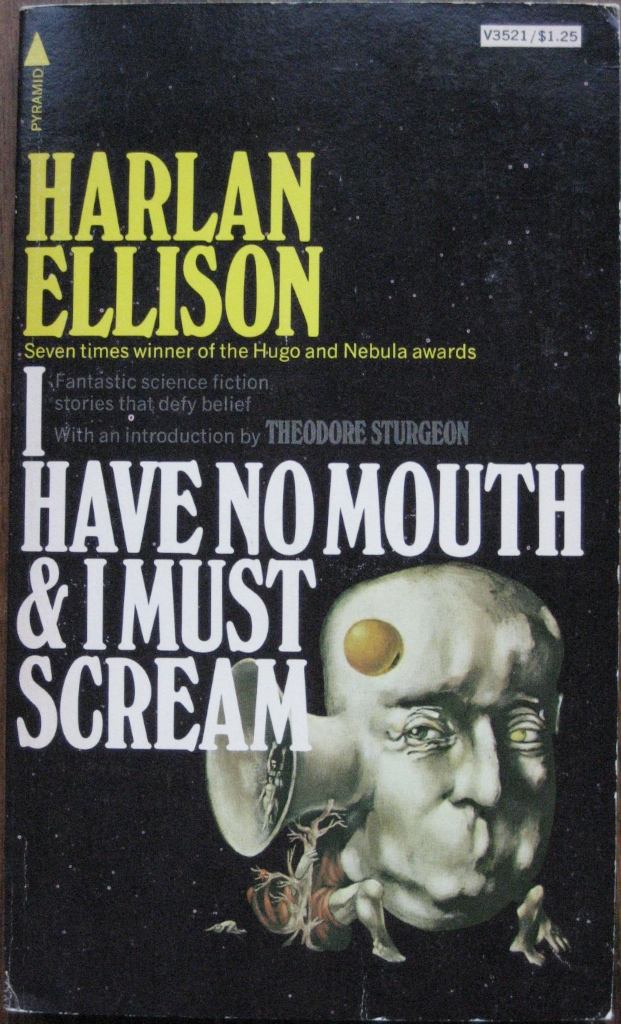
I Have No Mouth and I Must Scream Pyramid Books – 1976 (First published 1967)
This collection is decent. It only has 8 stories, and they’re all pretty good. The title story is about a group of people kept alive by a malevolent super computer. This is super bleak dystopian sci-fi. I liked it a lot. There’s lots of aliens in here and some stories about space-psychics and space-ants. While this kind of stuff may seem more sci-fi than the stuff I usually review, there is a darkness to much of it that shouldn’t be understated. Ellison seems to have been one of those writers who writes fantasy to make statements about reality. (His view on reality wasn’t too cheery.) Maybe the tropes here are a little different to my usual fare, but the themes are spot on. (Also, this is my blog and I’ll review all the god-damned sci-fi I want.)
The first story is the best. That final line. Brutal.
Deathbird Stories Dell – 1980 (First published 1975)
I wasn’t quite as impressed with this collection to be honest. Some of it is great, but I thought there was a lot of filler. The first story, “The Whimper of Whipped Dogs” was inspired by the murder of Kitty Genovese. It’s gritty as fuck but thoroughly effective. The other story that stood out as a horror story was “Bleeding Stones”, a tale about some church gargoyles coming to life and attacking mankind. It’s not very scary, but it is brutally violent. I enjoyed it. Some of the other stories in here were a little too trippy for me. I felt like I was missing the point of some of them entirely. What the hell is “At The Mouse Circus” about?
By the time I got to the end of this book, my patience for Ellison was wearing thin. (I read all three of these books in close succession.) This is unfortunate as the last 2 stories in here are probably the best ones. “Adrift Just Off the Islets of Langerhans: Latitude 38° 54′ N, Longitude 77° 00′ 13″ W” is a bizarre tale about the Wolfman going inside his own body with the help of Victor Frankenstein. It’s less silly and more complicated than it sounds. In “The Deathbird”, Ellison rewrites the story of the Garden of Eden and describes man’s final encounter with evil. This was a seriously impressive piece of writing.
I think Ellison was a fantastic writer. He wrote a lot though, and not everything he wrote was amazing. There’s no mass market “Best of” collection out there containing just the gold, but Subterranean Press put out an “Award Winning Stories of” in 2014, and I think I might read that next. (I don’t think I’ll bother writing about it on here though.) I wrote this post because Ellison was included in Stephen King’s Danse Macabre, but I reckon Stephen King only included him there because the two were friends. Ellison was great, and I’m sure his vicious style of writing had an impact on many horror writers, but the above are not books of horror stories. I don’t mean that as a deterrent. You should definitely read some Ellison if you haven’t already. Of the three I read, I think I’d recommend I Have No Mouth, and I Must Scream as the best starting point, but they all contain some pretty amazing stuff.
Ghost Story – Peter Straub Pocket Books – 1980(Originally published 1979)
I have heard a lot of good things about Peter Straub, and I knew that Ghost Story is considered to be one of his best books. It was the last book I read of the 10 discussed in Stephen King’s Danse Macabre, and it was also the last book of my summer vacation. (That might give you an idea of the backlog of posts I have.) I had high expectations for this book, and it did not disappoint.
This is a very long novel, but its influences are the short stories of Edgar Allan Poe, Ambrose Bierce, M.R. James, Arthur Machen, Nathaniel Hawthorne and Henry James. With the exception of Hawthorne, I have tracked down and read all of the supernatural fiction by these authors, so it’s not super surprising that I enjoyed this. (I read Hawthorne’s The Scarlet Letter and Twice told Tales years ago but none of his later short fiction. I’ll have to see if there is a dedicated collection of his ghost stories out there.) While this book wears its influences on its sleeve, it has in turn become very influential on modern horror. One of the stories in Ryan Harding’s Genital Grinder uses this book’s opening line as homage.
There’s a part in Stephen King’s Danse Macabre where King discusses how the unknown is perhaps the most potent element of horror. The scary thing behind the closed door is always scarier when that door remains closed. Regardless of how terrifying the menace actually is, by making itself known it loses some its power. (Sure it’s scary, but it’s teeth and claws could always be a little bit longer.) In short, the question is scarier than the answer.
I reckon the first half of Ghost Story is one of the greatest set-ups in all horror fiction. The mystery, atmosphere and tension are magnificent. What the hell is happening here? Why has this man kidnapped a child? Who or what is picking off the small group of old men in Milburn? What’s the unspeakable event that occurred between these old men and the mysterious Eva Galli in the past? How are the answers to these questions linked?
The problem with this book is that those questions have to be answered. As King notes, the answers are doomed to fall short of the horror of the questions themselves. The ending of this book is fine. The characters remain interesting, and there’s plenty of creepy bits, but for my money, the malevolent supernatural force at the heart of the story is just a little bit too complicated for the second half of the book to live up to the first.
Maybe that sounds like a jerk thing to say. There’s literally no way to keep this kind of tension consistent until the end of a story, so this critique isn’t really fair. At least Straub tried. Most writers wouldn’t be able to come anything close to what he has achieved in this book. There are some seriously creepy moments in here. Even thinking of one particularly skillful use of foreshadowing near the beginning of the book makes me shudder, months after finishing the novel.
Jesus she moved she can’t she’s dead.
I really enjoyed Ghost Story, and I recommend it to any fan of horror. Straub has written a bunch of other novels too, including two with Stephen King. I am entirely certain I’ll be reading more of him in the future.
The Bride of Christ and Other Fictions – Montague Summers Snuggly Books 2020
I have a collection of books by and about Montague Summers. A few years ago, somebody found a bunch of his writing that was long believed lost. It contained an unpublished collection of ghost stories that was finally put out last year. This collection was really, really cool. The publisher, Snuggly Books, announced that they had enough material for a second collection of unreleased fiction. It was to be titled The Bride of Christ. I ordered a copy as soon as it came out.
In his introduction to the text, Daniel Corrick notes that the pieces in this collection can be divided into four categories: the ghost stories, the Uranian pieces, the society pieces and the titular novella. I’m going to stick with these categories in my discussion too.
The ghost stories are very short little things. They’re not awful or unpleasant to read, but they’re not particularly memorable.
The Uranian pieces are mostly uninteresting. One of them, “The Parting of the Ways”, is ok. It’s a story about a lad falling in love with a lad who falls in love with a woman. It’s not a great story, but it is actually a story which is more than can be said about the other two Uranian “pieces” in here. I was going to say that it’s a bit odd that a self proclaimed Catholic priest would write stories about romantic affairs between teenage boys, but I guess that’s not really true at all.
The “society pieces” are boring garbage. Both are opening chapters to books that Summers never bothered to finish. These are boring stories about rich old British women trying to impress their friends. I read one, but couldn’t bring myself to finish the other. Pure crap.
The Bride of Christ, the longest piece in this book, appears at the start of the collection, but I was excited to read it, so I saved it for last. I was disappointed. It’s the story of a nun who falls in love with Jesus. The priest at her convent tells her this is not good. Just as the story seems to start, it ends. There is supposedly some debate over whether or not this work is complete. If this is the final product, it’s absolute shit. There’s simply not enough in here for it to be interesting. I’m giving Monty the benefit of the doubt and assuming it’s unfinished.
I understand why a publisher would choose to release two books of Summers’ fiction rather than trying to stick it all into one together, and as a collector of his work, I am pretty happy to own this collection of rarities. Honestly though, there isn’t going to be much of interest in this book to anyone other than Summers enthusiasts. I think taking the two ghost stories out of this one and adding them into Six Ghost Stories as an appendix would have made the best book. The leftovers aren’t really worth reading.
The Cormorant – Stephen Gregory Valancourt Books – 2013 (Originally published 1987)
This horror novel was reiussed by Valancourt books in 2013, so I knew it was going to be pretty good. It’s about a man who inherits a cormorant, a big dirty bird, from his uncle. I’ve done quite a few evil animal books this year, but I anticipated this one being quite a bit better. It won a Somerset Maugham Award, and I had seen it being compared to Poe’s writing. In ways it was classier than my standard fare, but it also contained more crass swearing and disturbing pervy bits than any of the horror novels about beetles or worms that I’ve read in 2020.
This is suspenseful, creepy, sometimes funny and breathtakingly dark. I’m not going to try any harder to convince you to read it. For the rest of this post, I am going to talk about the plot and give away big spoilers. If you haven’t read it already, fuck off and come back when you’re done.
The narrator repeatedly alludes to his previous career as a teacher, and although he claims to feel that he was never cut out for that job, his actions suggest otherwise. His final acts of vengeance against the cormorant prove that he is extremely efficient at teaching lessons.
The whole way through the book I was expecting him to turn violent against the bird. When he finally snaps, he does so with grace, determinacy and cunning. He hits the unruly bird on the wing with a fire poker, shoves it in a box and then gives it a golden shower. Take that, you filthy beast!
I have nothing else to say other than that the bathtub scene was weird and probably unnecessary and that the ending is unbearably grim. I really enjoyed The Cormorant, and I’ll definitely check out more of Gregory’s stuff when I get the chance.
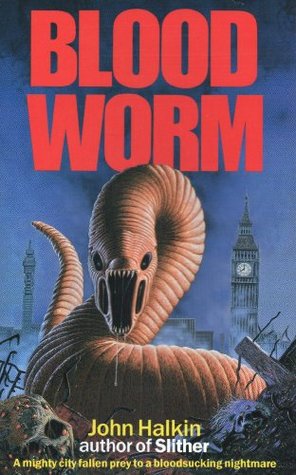
Earlier this year I read Slither (1980), Slime (1984) and Squelch (1985) by John Halkin. Although these books are about different characters and all take place in separate realities, they are regarded as a trilogy due to their titles and almost identical plots. Each book is about a wave of killer creepy crawlies (worms, jellyfish and butterflies respectively) wreaking havoc on Great Britain. These were not great books, but I found them mildly entertaining. Halkin also wrote Blood Worm, another horror novel about killer bugs, in 1987, and while it’s not considered part of the Slither series, it is frequently mentioned alongside it. I had to read it.
It was terrible.
A bunch of killer beetles start killing and eating people in London. The beetles are extremely dangerous, but the beetle grubs are far grosser. These grubs join together in huge numbers to create giant worms that feed on human flesh. Together, the beetles and blood worms seem to do more damage than the bugs in the Slither Trilogy books. They lay London almost entirely to waste. (I recently noted that the Slither Trilogy seemed like a rip off of James Herbert’s books, and the destruction of England’s capital city in Blood Worm makes it seem even more Herbertian.) Also, the main character in Blood Worm is an ex-soldier, not somebody was was involved in television. Aside from these 3 differences, this book is essentially the exact same as Slither, Slime and Squelch, just a bunch of uninteresting characters in unhappy marriages getting killed by bugs.
Blood Worm is a shit book. It’s uninspired drivel. Halkin wrote a few other horror novels, but they’re not about worms, so I’m not interested. One is called The Unholy, so maybe I’d read it to compare with this book, but I’m sure it’s absolute shit too.
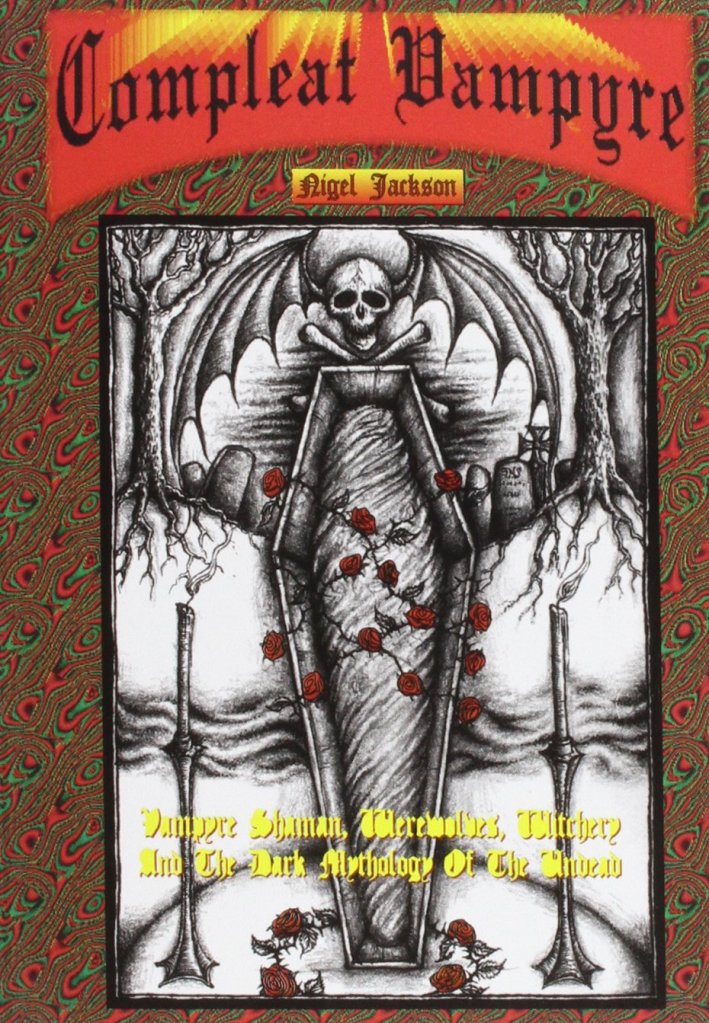
Compleat Vampyre: The Vampyre Shaman, Werewolves, Witchery & the Dark Mythology of the Undead Nigel Jackson Capall Bann – 1995
A few months ago I put out a call for occult book recommendations. I haven’t been as interested in occultism for the last year, and part of me thought that this was from overdoing it over the past few years. I was kindly recommended this book by a pal of mine. It looked pretty cool, so I decided to give it a go.
It’s rather dense, and despite its subject matter, I thought it was very dry. It’s only 180 pages, but it took me a month and a half to get through it. I didn’t take notes as I read through it either, so I don’t even remember much of what the author said in the first half of the book.
This seems like a thoroughly researched book, but the writing does not seem to be very critical. Most of the book is taken up with descriptions of vampires and werewolves from folklore, but the idea that these accounts might not be real is never really discussed. I’m not saying Nigel Jackson believed every word in this book, but he doesn’t do a very good job of clarifying which parts the reader is supposed to believe and which parts are just legends.
Ultimately though, this is presented as a book on occultism rather than one on folklore. Towards the end of the book, the author does give some instructions on how to shapeshift into a werewolf, but these instructions are pretty vague, and one would have to have a detailed knowledge of occultism and ceremonial magic to be able to pull them off.
The most interesting claim in the whole book is that the mysterious large cats seen throughout the English countryside (the ones discussed at length in The Goblin Universe by Ted Holiday) are actually transformed witches and wizards.
Honestly, I couldn’t give a bollocks. I have so little to say about this that I feel bad for wasting your time. I read the whole thing, but reading it felt like trying to paint water. I’d reread the same paragraph 3 times, but I was so uninterested that nothing would stick in my head. “Vampires, shadows, liminal… bleh bleh bleh.” Whatever. I’m not really qualified to judge a book like this. Maybe it’s great if you’re interested in this stuff. I certainly amn’t. I won’t say I’ll never read another occult book, but I doubt that I’ll ever get back into reading 2 a week like I was doing a few years ago.
I read Fahrenheit 451 and a few of Ray Bradbury’s short stories when I worked as an English tutor years ago, and while I enjoyed this stuff, I had Bradbury pegged as a dystopian science-fiction kinda guy. Then I noticed his name popping up in discussions of horror fiction, and I realised I had better take a closer look at his output.
I am really glad I did so. Ray Bradbury was an amazing writer, and he wrote some awesomely dark fiction.
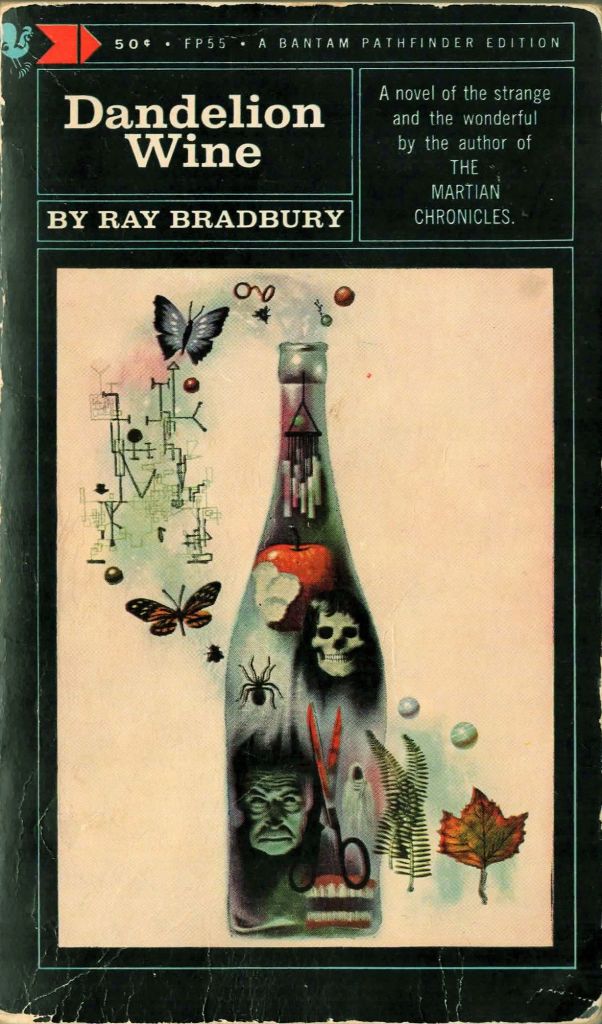
Dandelion Wine Bantam – 1968 (Originally published 1957)
Aside from two separate chapters about a serial killer and a witch, Dandelion Wine has nothing to do with horror. I am including it here because the characters in this book live in the same town as those from Bradbury’s considerably darker Something Wicked this Way Comes. Something Wicked is not a sequel, and you wouldn’t have to have read Dandelion Wine to enjoy it, but Dandelion Wine is a great book and it prepares the reader for the kind of dreamy fantasy that continues in Something Wicked.
Dandelion Wine is quite strange. It’s actually a bunch of short stories that Bradbury wrote and later worked together to form a novel about a young boy’s summertime. Much of it is clearly autobiographical, but there are peculiar parts about a happiness machine and the aforementioned witch that give the book a wonderous feeling. Can you remember dreaming about the summer holidays when you were a kid? Dandelion Wine is full of that majestic uncertainty and childish excitement. I don’t mean childish in a derogatory way here. Bradbury actually takes you back and reminds you of what it felt like.
If anything, this book is almost too sweet. Bradbury wrote it in the 1950s, and he was basing much of it on his own childhood in the 20s. It’s now a hundred years later, and with our pandemic, rising levels of extinction and catastrophic climate change, I don’t know if today’s children can be as full of optimism about their futures.
Still though, this is a beautifully written book, and I strongly recommend reading it before trying Something Wicked.
Something Wicked This Way Comes Bantam – 1969 (Originally published 1962)
This is the story of a strange carnival coming to town months after carnival season. To the book’s 13 year old protagonists, Jim Nightshade and William Halloway, nothing could seem more exciting, but when they hear the Carnival arrive in town in the middle of the night and sneak out of their houses to watch the tents erect themselves, they realise something strange is going on.
The boys discover a merry-go-round that can make a person older or younger, a salesman who has been turned into a wrinkled pipsqueak, and Mr. Dark, the remarkably sinister and aptly named carnival leader. Things get quite scary (especially the witch in the balloon scene, yikes!), and although Stephen King lists Something Wicked amongst horror novels in Danse Macabre, this is far more a work of dark fantasy than pure horror. Yes, there are horrific, scary things that happen in here, but there’s also a great deal of adventure and optimism going on.
Dandelion Wine is set during summer time, but Something Wicked is an autumn novel, taking place in the few days before Halloween. The two protagonists’ birthdays are approaching; they were both born within minutes of the 31st. The seasonal contrast between Dandelion Wine and Something Wicked is part of the reason I think you should read both novels. Contrast is a big thing in Something Wicked: the contrast between the two boys, one wild and dark, the other pale and reserved; the contrast of old and young, Will and his father, Jim’s childhood and the adult he wants to be; innocence and evil; hope and hopelessness… I’m not a professor, so I’m not going to discuss the significance of these contrasts, but I found it hard not to notice them as I was reading.
The writing on display in this book is top notch stuff. I planned to read again as soon as I had finished it.
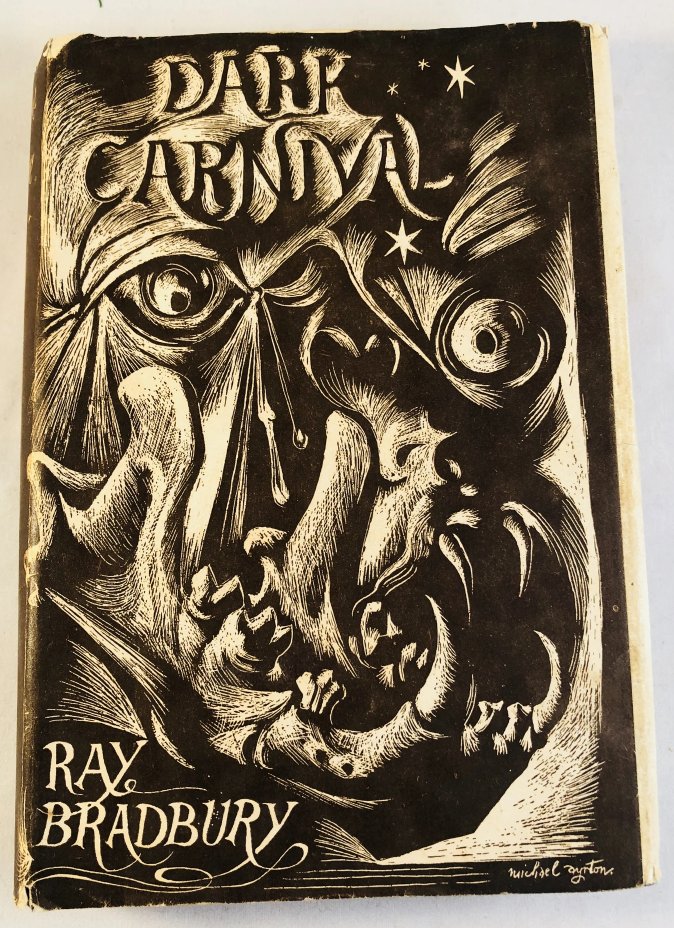
Dark Carnival Hamish Hamilton – 1948 (Originally published 1947)
When Ray Bradbury died, Stephen King released a statement saying, “Ray Bradbury wrote three great novels and three hundred great stories.” I had to include some of his stories in an overview of his work, but Bradbury wrote a lot, and I didn’t know where to start. I discovered that Dark Carnival, his first published collection of short stories, was originally put out by Arkham House, August Derleth’s publishing company. Arkham House specialised in horror and weird fiction, so this seemed like a natural starting point for somebody interested in Bradbury’s short horror fiction.
The original Arkham House edition of this book is extremely rare, and I was only able to track down a copy of the British edition, Unfortunately, this edition omits 7 stories: Interim, Jack in the Box, Reunion, The Coffin, The Maiden, The Night Sets and The Scythe.
The October Country Ballantine – 1956 (Originally published 1955)
In 1955, a second collection of Bradbury’s horror stories was released. The October Country contains 4 new tales and 15 of the stories from Dark Carnival (including 2 missing from the UK edition, The Scythe and Jack in the Box). Some of the stories carried over from Dark Carnival were edited or almost completely rewritten for this collection. These updated versions of the tales are the reason that Dark Carnival is rarely reprinted. Bradbury saw The October Country versions as definitive. (That being said, Gauntlet Press did get permission for a 2001 reprint of Dark Carnival that added a few more tales.)
I’m not going to separately discuss the stories in Dark Carnival and The October Country. To me, the two books are essentially just different editions of the same collection. It would be really nice if a publisher managed to collect all of the stories from all of the editions in one physical book.
It seems kind of pointless to write any more than a few sentences praising Ray Bradbury’s short stories. It’s pretty well established that he was one of the masters of this form of fiction. These stories are from early in his career, but they are undeniably brilliant. They’re creepy too, and some are suprisingly violent (The Smiling People). The Jar, The Small Assassin, The Dwarf, and The Man Upstairs were personal favourites, but the majority of the stories in these books are great.
How talented was death. How many expressions and manipulations of hand, face, body, no two alike. They stood like the naked pipes of a vast derelict calliope, their mouths cut into frantic vents. And now the great hand of mania descended upon all keys at once, and the long calliope screamed upon one hundred-throated, unending scream.
The Next in Line (1947)
Bradbury is one of the few writers I read whose skill with words actually amazes me. Seriously, if you like reading, get a copy of The October Country. This is the good stuff. I know that Bradbury wrote more scary tales, but I don’t think any of his later short story collections are as focused on horror as Dark Carnival or The October Country. Please correct me if I’m wrong; I would love another collection like these.
The Halloween Tree Bantam – 1974 (Originally published 1972)
An October overview of Ray Bradbury’s spooky books would be incomplete without The Halloween Tree. I didn’t realise that this book is actually a novel for children until after I started it. This is the story of a gang of kids whose Halloween night is turned upside down after one of their friends goes missing.
This is more a fantasy novel than a horror novel. It sees the boys flying through time on a kite made up of carnival posters and learning the history of Halloween. I thought the fantasy parts might be a bit too airy-fairy for adults and the historical parts a bit too dry for kids. I’m sure a certain type of nerdy older kid would really enjoy this, but I wasn’t hugely impressed.
Also, as an Irish person, I was a bit annoyed by two things. First off, Bradbury makes Samhain English. I’m pretty sure this is not accurate. Then he goes on to suggest that Ireland’s only influence on Halloween was the potato famine providing inspiration for beggar costumes. Piss off Ray Bradbury.
Honestly, you can probably skip The Halloween Tree. It’s fairly crummy.
With the exception of The Halloween Tree, I was extremely impressed with Bradbury’s work. Some of his short stories are far closer to “horror” than his novels, but these novels are something special. There’s definitely scariness here, but Bradbury presents his world through the eyes of children, and this combination makes these books feel very Halloweeny. This is crucial October reading. Pick up a Bradbury book right now.








 Nocturnal Revelries