Ghost Story – Peter Straub Pocket Books – 1980(Originally published 1979)
I have heard a lot of good things about Peter Straub, and I knew that Ghost Story is considered to be one of his best books. It was the last book I read of the 10 discussed in Stephen King’s Danse Macabre, and it was also the last book of my summer vacation. (That might give you an idea of the backlog of posts I have.) I had high expectations for this book, and it did not disappoint.
This is a very long novel, but its influences are the short stories of Edgar Allan Poe, Ambrose Bierce, M.R. James, Arthur Machen, Nathaniel Hawthorne and Henry James. With the exception of Hawthorne, I have tracked down and read all of the supernatural fiction by these authors, so it’s not super surprising that I enjoyed this. (I read Hawthorne’s The Scarlet Letter and Twice told Tales years ago but none of his later short fiction. I’ll have to see if there is a dedicated collection of his ghost stories out there.) While this book wears its influences on its sleeve, it has in turn become very influential on modern horror. One of the stories in Ryan Harding’s Genital Grinder uses this book’s opening line as homage.
There’s a part in Stephen King’s Danse Macabre where King discusses how the unknown is perhaps the most potent element of horror. The scary thing behind the closed door is always scarier when that door remains closed. Regardless of how terrifying the menace actually is, by making itself known it loses some its power. (Sure it’s scary, but it’s teeth and claws could always be a little bit longer.) In short, the question is scarier than the answer.
I reckon the first half of Ghost Story is one of the greatest set-ups in all horror fiction. The mystery, atmosphere and tension are magnificent. What the hell is happening here? Why has this man kidnapped a child? Who or what is picking off the small group of old men in Milburn? What’s the unspeakable event that occurred between these old men and the mysterious Eva Galli in the past? How are the answers to these questions linked?
The problem with this book is that those questions have to be answered. As King notes, the answers are doomed to fall short of the horror of the questions themselves. The ending of this book is fine. The characters remain interesting, and there’s plenty of creepy bits, but for my money, the malevolent supernatural force at the heart of the story is just a little bit too complicated for the second half of the book to live up to the first.
Maybe that sounds like a jerk thing to say. There’s literally no way to keep this kind of tension consistent until the end of a story, so this critique isn’t really fair. At least Straub tried. Most writers wouldn’t be able to come anything close to what he has achieved in this book. There are some seriously creepy moments in here. Even thinking of one particularly skillful use of foreshadowing near the beginning of the book makes me shudder, months after finishing the novel.
Jesus she moved she can’t she’s dead.
I really enjoyed Ghost Story, and I recommend it to any fan of horror. Straub has written a bunch of other novels too, including two with Stephen King. I am entirely certain I’ll be reading more of him in the future.
The Cormorant – Stephen Gregory Valancourt Books – 2013 (Originally published 1987)
This horror novel was reiussed by Valancourt books in 2013, so I knew it was going to be pretty good. It’s about a man who inherits a cormorant, a big dirty bird, from his uncle. I’ve done quite a few evil animal books this year, but I anticipated this one being quite a bit better. It won a Somerset Maugham Award, and I had seen it being compared to Poe’s writing. In ways it was classier than my standard fare, but it also contained more crass swearing and disturbing pervy bits than any of the horror novels about beetles or worms that I’ve read in 2020.
This is suspenseful, creepy, sometimes funny and breathtakingly dark. I’m not going to try any harder to convince you to read it. For the rest of this post, I am going to talk about the plot and give away big spoilers. If you haven’t read it already, fuck off and come back when you’re done.
The narrator repeatedly alludes to his previous career as a teacher, and although he claims to feel that he was never cut out for that job, his actions suggest otherwise. His final acts of vengeance against the cormorant prove that he is extremely efficient at teaching lessons.
The whole way through the book I was expecting him to turn violent against the bird. When he finally snaps, he does so with grace, determinacy and cunning. He hits the unruly bird on the wing with a fire poker, shoves it in a box and then gives it a golden shower. Take that, you filthy beast!
I have nothing else to say other than that the bathtub scene was weird and probably unnecessary and that the ending is unbearably grim. I really enjoyed The Cormorant, and I’ll definitely check out more of Gregory’s stuff when I get the chance.
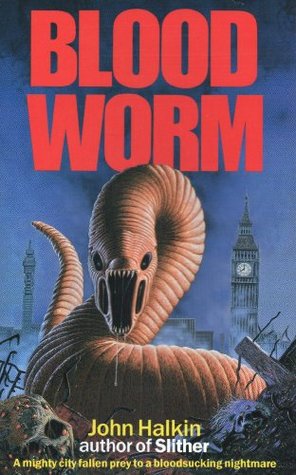
Earlier this year I read Slither (1980), Slime (1984) and Squelch (1985) by John Halkin. Although these books are about different characters and all take place in separate realities, they are regarded as a trilogy due to their titles and almost identical plots. Each book is about a wave of killer creepy crawlies (worms, jellyfish and butterflies respectively) wreaking havoc on Great Britain. These were not great books, but I found them mildly entertaining. Halkin also wrote Blood Worm, another horror novel about killer bugs, in 1987, and while it’s not considered part of the Slither series, it is frequently mentioned alongside it. I had to read it.
It was terrible.
A bunch of killer beetles start killing and eating people in London. The beetles are extremely dangerous, but the beetle grubs are far grosser. These grubs join together in huge numbers to create giant worms that feed on human flesh. Together, the beetles and blood worms seem to do more damage than the bugs in the Slither Trilogy books. They lay London almost entirely to waste. (I recently noted that the Slither Trilogy seemed like a rip off of James Herbert’s books, and the destruction of England’s capital city in Blood Worm makes it seem even more Herbertian.) Also, the main character in Blood Worm is an ex-soldier, not somebody was was involved in television. Aside from these 3 differences, this book is essentially the exact same as Slither, Slime and Squelch, just a bunch of uninteresting characters in unhappy marriages getting killed by bugs.
Blood Worm is a shit book. It’s uninspired drivel. Halkin wrote a few other horror novels, but they’re not about worms, so I’m not interested. One is called The Unholy, so maybe I’d read it to compare with this book, but I’m sure it’s absolute shit too.
A few months ago I read a book called The Worms by Al Sarrantonio on a whim. I really liked it, so I decided to read more of his stuff.
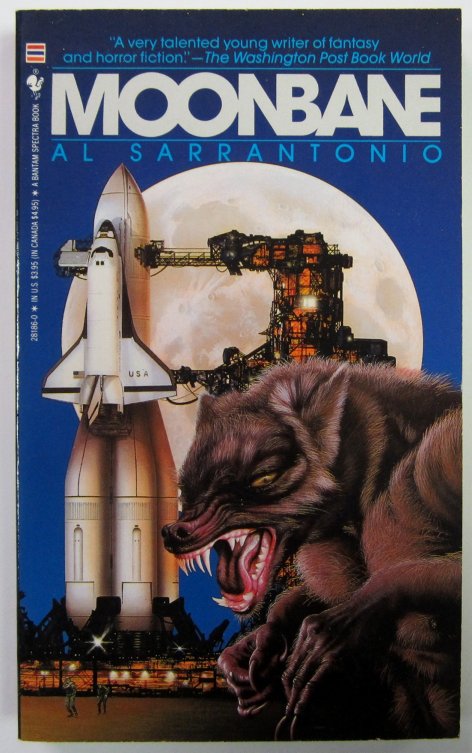
Moonbane Spectra – 1989
A bunch of evil werewolves from the moon land on Earth and start attacking humanuty, eating most but turning plenty of us into werewolves too. After witnessing the transformation of his son and death of his wife, a sensitive poet finds himself tagging along with a crew of scientists on their way to a military base to perform some kind of drastic rescue mission, the nature of which the scientists are hesitant to discuss. All I’ll say is that it involves a really big rocket and some REALLY big bombs.
Honestly, if you don’t want to read this after hearing that and seeing this book’s cover, you’re a lost cause. Rockets and moon-wolves. Cool!
Toybox Leisure Books – 2003 (Originally published 1999)
I had heard that Sarrantonio was a better short story writer than a novel writer, so I decided to check out his first story collection, Toybox. The person who told me that Sarrantonio’s stories were worth reading also mentioned a great likeness to the work of Ray Bradbury. Aside from Fahrenheit 451 and a couple of short stories, I hadn’t actually read anything by Bradbury when I started this. It often takes me a while to get through short story collections. I read one or two stories from different collections when I’m between novels. While I was dipping in and out of Toybox, one of the novels I read was Bradbury’s Something Wicked This Way Comes. This clarified for me what my friend had meant with his comparison. I soon thereafter read a couple of collections of Bradbury’s creepier stories, and this further confirmed my impressions. Sarrantonio’s short stories are very, very Bradburyian. Nearly all of them involve children, Halloween and carnivals. Some of the stories in this collection use almost identical premises to Bradbury tales. ‘Father Dear’, one of the stories in here is about a kid whose dad keeps him inside his house and lies to him about everything. There’s a Bradbury story called ‘Jack in the Box’ about a kid whose mom does almost the exact same thing. Whatever though, it’s hardly a bad thing to be compared to Ray Bradbury. (I’ve been loving the Ray recently.) I enjoyed Toybox plenty. ‘Pumpkin Head’ and ‘The Corn Dolly’ were probably my favourites in here, but it’s all pretty good.
Skeletons Bantam – 1992
This is an epic post apocalyptic novel in which the last remaining good guys on Earth are drawn together by dreams/psychic visions. (I mean epic in the literal sense here too.) It’s basically the same thing as Stephen King’s The Stand except the disease and bad guys in this book are the same thing. They’re skeletons. The skeletons of every human (and animal) that ever lived have risen from their graves and they are really angry with humanity.
There’s 4 narratives running throughout the book. The bulk of the story centers on a Cambodian politician stuck in Russia and an American girl who is unable to speak making their ways across their respective continents to meet eachother. The rest of the tale is told from the perspective of the risen Abraham Lincoln and Roger Garbage, a music industry cokehead who the skeletons keep alive for the purposes of arranging the biggest rock festival ever.
The novel is absurd, and there’s many little inconsistences and plot holes throughout the story, but there’s a scene in this book where the Beatles (in skeleton form) get back together to perform, so I found it pretty easy to ignore the problems and just go with it. I’m pretty sure this is supposed to be read for fun, so there’s no need to dissect it like a college professor. Although it’s about skeletons, the length and scope of the work make it more a fantasy than a horror novel, and while I enjoyed it well enough, it was probably my least favourite of the books I’ve read by Sarrantonio. (It’s not bad. I just really like short books at the moment.)
I can’t say that I was truly blown away by any of the books I’ve read by Al Sarrantonio, but I was entertained by all of them. They’re imaginative, fun and well written. I’ve read 4 of his books in the last 4 months, so I’ll give him a break for a while, but I look forward to reading more of his books in the future.
Brian Keene is a name I have seen popping up in horror conversations for a long time. I followed him on twitter and asked him which of his books I should check out first, he courteously responded suggesting The Complex and Ghoul.
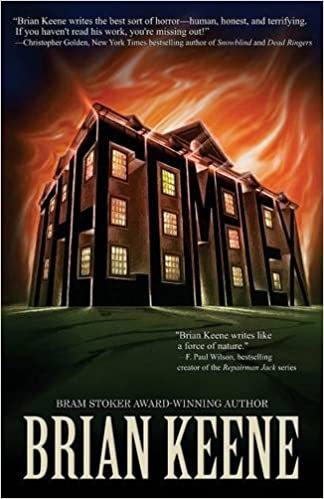
The Complex Deadite Press – 2016
Long term readers of this blog may have noticed that although I have reviewed countless books about witches, demons, aliens, werewolves, and vampires, I have not done a single book about zombies. I’m not interested in zombies. Night of the Living Dead is one of my favourite films, but even as a kid I thought that each sequel, clone and remake (apart from the 1990 one) was a bit less interesting than the original. The characters and settings change slightly, but the plot is always the same – a bunch of misfits are fighting to stay alive in a building surrounded by a horde of the approaching undead. It is a great concept, but I’ve already seen it 100 times. If you like that kind of thing, good for you, but it’s just not my cup of tea.
When Brian Keene recommended I read The Complex, I started it without reading the blurb. Guess what it’s about!
This is the story of a group of misfits fighting to stay alive in their apartment complex while a horde of bloodthirsty, deranged, naked freaks closes in on them. Perhaps these freaks don’t technically qualify as zombies, but they act an awful lot like them.
Ok, so I feel a bit awkward about this because Mr. Keene was polite to me, and I don’t want to be a jerk, but as soon as things got going I realised that this was exactly the kind of horror fiction that I avoid. I kept going with it though, and I reckon I enjoyed it about as much as I possibly could given the subject matter.
This is well written, action packed, easily digestible fiction. I can see why Mr. Keene would suggest it to a first time reader: it’s fun. I may think that I’m too cool to watch The Walking Dead, but I ripped through this zombie-esque novel in two sittings. It’s not my favourite novel ever, but it certainly wouldn’t put me off reading more books by Keene.
One thing that I did notice was that although Keene is woke enough to include a trans character in this novel, he was not woke enough to avoid fat-shaming the main antagonist of the story. Poor Tick-Tock’s weight is very much a part of what’s supposed to make him repulsive.
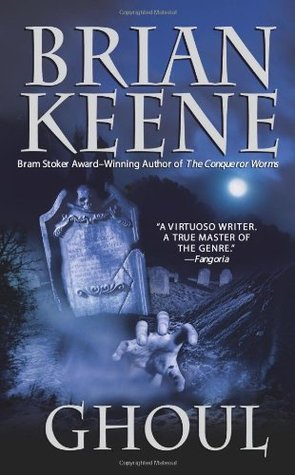
Ghoul Leisure Books – 2007
Three boys’ summer holidays are ruined by a corpse eating ghoul that lives in a cemetery. Sounds good, right? Honestly, this felt a bit like Stephen King ripping off Ray Bradbury. That might sound like a criticism, but I like when Stephen King rips off Ray Bradbury. (Think It.) It’s hard not to root for the protagonists when they’re children who like heavy metal. Ghoul was a fun read, but it wasn’t very scary. That being said, I was genuinely surprised at how grim the ending was. The “who’s the real monster?” question that runs through the book is pretty well answered in the final chapter.
In truth, neither The Complex nor Ghoul blew me away, but they were both enjoyable books. Despite my aversion to zombies, I reckon The Complex is the better novel. I thought it was a bit tighter. I’m planning to continue my series of of horror novels about worms with Brian Keene’s Earthworm Gods in the near future.
Rosemary’s Baby – Ira Levin Pan – 1974 (Originally published 1967)
I saw the movie version of Rosemary’s Baby a long time ago, and I knew that it was considered to be a faithful adaptation, so I wasn’t expecting many surprises when I got around to reading the book. While the book’s plot is pretty much identical to the movie, knowing how things were going to end only allowed me to further appreciate the way Levin structured his novel. There’s lots of seemingly irrelevant little things that happen throughout the story that end up having a big impact later on, and this novel is so masterfully written that it was still exciting to read knowing how it was going to end. The pacing and suspense at work here are awesome. This is thrilling stuff.
Maternal instinct is a primal and powerful thing, and Levin uses it to fuel this high tension nightmare. I remember reading a quote from Kurt Vonnegut about how good authors should be sadists and that a good protagonist must suffer if they are to relatable. I don’t know if Levin got this idea from Vonnegut, but he certainly believes in it. Rosemary is never presented in an even remotely negative light, but Levin forces her through devastating trauma.
I assume that most of my readers know how this story ends, but in case you don’t, I’m going to discuss that now, so read the book before you read the next paragraph.
I had a strange reaction to the climatic ending of this novel. All of Rosemary’s nightmares come true. She has given birth to the spawn of Satan, but that maternal instinct kicks in and she quickly comes to accept her child’s faults and commits to being a good mother to him. My personal response to this was relief. As a parent, I don’t want to read about any child being abandoned, abused or ignored, and while I don’t consider myself a Satanist, I am sympathetic to their cause. I also read most of this book with my kindle in one hand and my newborn daughter in the other. When Rosemary refers to her son as Andy Candy in the book’s final lines, I felt a sense of joy and relief.
Rosemary’s Baby works so well because 95% of the novel is entirely believable. The characterisation is great. A woman’s first pregnancy is an exciting but uncertain time, and it often happens around the same time that she moves into a new home. Apart from the Satan stuff, many, many people have very similar experiences to Rosemary. It’s really only in the last moments of the novel that Rosemary’s fears are confirmed and the supernatural establishes itself as a governing force in the story.
Son of Rosemary Onyx – 1998 (Originally published 1997)
Writing a sequel to Rosemary’s Baby had to have been a complicated process. It was impossible to continue the narrative in the same mundane world where most of the first novel takes place. Some of the events in the original novel, the Pope’s visit to New York for example, actually occurred. Setting the sequel in reality wouldn’t have worked. Readers can’t buy into neighbourly dining room conversations if they know the speakers are warlocks and witches. To deal with this issue Levin sets Son of Rosemary in a weird alternate universe.
In 1999, Rosemary wakes up from a coma after 20 something years. (She had been poisoned by the Satanists after planning to run away with her son.) The world she finds herself in is a strange place. It’s basically the late 1990s as they really were, except for the past few years, everyone on Earth has been idolising a guy named Andy. This Andy chap is being credited with bringing about world peace, and everyone really loves him. Rosemary quickly realises that this is her son, and the two have a high profile reunion on live TV.
The astute reader will quickly realise that Andy is the Antichrist prophecised in the Book of Revelation, but Andy swears to his mother that he has turned his back on evil and has dedicated his life to doing good. I started to see through his ploy once he tried to have sex with his mom.
Yep, a good chunk of this book is this Andy chap trying to get Rosemary to have sex with him.
Ok, I’ll imagine most of you have already read the book or decided not to read it based on what I’ve just told you. If you don’t fall into either of those categories, you might want to skip the next bit because I’m about to discuss the ending. I warn you though, this is a shit book that isn’t worth reading. A spoiler can’t make it much worse.
The ending of Son of Rosemary is perhaps the worst ending to a novel that I have ever read. After Andy has brought about the apocalypse and Rosemary is descending into Hell, she wakes up to discover that everything that happened over the course of the two novels was actually a dream. What the fuck? Ira Levin was a good writer. How the Hell did he think it was ok to end a book like that? Did he contract acute Alzheimer’s as he was concluding the book and revert back to grade 3 writing? It was all a dream? Piss off. If a 12 year old ended a story like that I’d kick them. Honestly, the ending to this was so bad that it actually made me like the original book less. Do not read this insane piece of garbage.
Stepford Wives Signet – 1994 (Originally published 1972)
Before reading the Rosemary books, I read Levin’s The Stepford Wives. This is another very famous book, but I had luckily avoided ever finding out what it was about. It’s a bit like Rosemary’s Baby in that both books finish with a shocking revelation for the female protagonist. It’s the kind of book that works better the less you know about it, so I’m not going to say much else other than that I really enjoyed it. It’s quick, exciting and creepy in a unique way. You should definitely read it if you haven’t already.
I don’t think any of Levin’s other books are horror novels, but Rosemary’s Baby and The Stepford Wives were so good that I fully intend on reading more his stuff in the future.
The House Next Door – Anne Rivers Siddons Simon & Schuster – 1978
Of all the books that Stephen King discusses in his Danse Macabre, Anne Rivers Siddons’ The House Next Door was the one I least wanted to read. The title is dull (there are several other novels with the same name), the cover is a picture of a house, and I had read that this novel was the only work of horror that the author ever wrote. I expected a boring attempt at a haunted house story. I thought I was going to read about chains rattling in the night and books flying off shelves of their own accord. I did not expect a masterfully written work of psychological terror that was almost impossible to put down.
God damn, this book was a good one.
A house is built on a plot of land beside a rich couple’s house in Georgia, USA. Bad stuff happens to everyone who lives in or even enters this place. I won’t ruin the story by revealing details, but I will say some of the unfortunate turns are utterly scandalous!
It was stupid of me to assume that this book wouldn’t be good because the author wasn’t a dedicated horror author. This is probably one of the book’s strengths. The stuff going on between the characters is great, and the story is well told. Also, Anne Rivers Siddons doesn’t use any of the tropes that a dedicated horror author might struggle to keep out of a haunted house book. One of the characters makes a joke about the house being built on ancient Indian burial ground, but that’s about it.
No, this is not vulnerable heroine tiptoeing through the attic by candlelight horror; it’s much more subtle and disturbing. The bad stuff that is going down here is just a few steps past seeming unfortunately coincidental. There’s no single instance that you could really claim was supernatural. Any one (or two or even three) of the events recounted could happen, but as the misfortune builds, so do our suspicions. There is something creepy about this house.
This book probably highlights the actual fears of upper middle class Americans in late 1970s: you find out in the opening pages that the characters in this book are willing to lose their friends rather than their reputations. There’s probably some deeper social commentary in here too, but I’m not overly concerned with that stuff. I read this for entertainment’s sake, and I was thoroughly entertained. This was an awesome book, and it had genuinely creepy moments. I can heartily recommend it to anyone looking for a good read.
I’m ashamed of myself. I have been writing about horror fiction on this blog since 2015, but this is the first time I will feature the work of Richard Matheson. Silly me. I have written about these books in the order that I read them. This order does not reflect their date of publication or their merits.
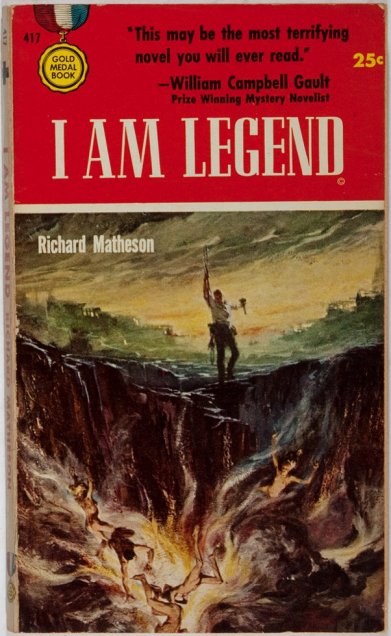
I Am Legend Gold Medal Books – 1954
I first read I Am Legend about 6 years ago. I remember absolutely loving it. I had seen the abominable Will Smith movie with the same title and had been terribly disappointed with that film’s optimistic ending. I could not say the same thing about the novel. I started this blog a year or so afterwards, and somehow never got around to reviewing the book. I read Shirley Jackson’s The Haunting of Hill House a few months back and decided immediately thereafter to read Matheson’s similarly titled Hell House. Just before doing so, I thought about revisiting I am Legend so that I could do a multi-book post on Matheson. I am extremely glad I did. I loved I am Legend the first time I read it, but I’m pretty sure I enjoyed it even more the second time around. I think it’s fair to say that this novel is one of my favourite books.
There was no sound now but that of his shoes and the now senseless singing of birds. Once I thought they sang because everything was right with the world, Robert Neville thought, I know now I was wrong. They sing because they’re feeble minded.
This is the violent, dark and crushingly bleak story of Robert Neville, the last man on a vampire ridden Earth. For a novel with so little hope, Matheson does an impressive job of pushing the disappointment. The dog! Oh Jesus, the dog! Come on Richard, why would you do that to your protagonist? Everything always gets worse. I don’t want to spoil how the book ends, but holy shit, that last paragraph, that last sentence, is phenomenal. This is what I want from a horror novel. It’s well written too, really enjoyable stuff. Both times I’ve read it, I’ve finished it in less than a day. Damn, this book is awesome. Seriously, if you’re into horror at all, you should really check this one out.
Hell House Viking Press – 1971
I don’t know much about the writing of Hell House, but I believe that it’s a fact that Shirley Jackson’s The Haunting of Hill House had a pretty big influence. The set up for both tales is almost identical – a scientist and two psychics are sent in to study a haunted house. While Jackson’s book relies on subtle, psychological terror, Matheson’s goes for an all-out onslaught of horror.
The title of this book is an apt one. This is a blasphemous, perverted, blood and guts, kinda haunted house. Matheson doesn’t shy away from getting gritty, but the pacing, characterisation and general decent standard of writing prevent this from feeling exploitative. The nastiness in here is effective too; this is quite a scary book.
Hell House is almost twice as long as I Am Legend, and I don’t think it packs quite as much of a punch, but its drawn out descent into Hell is effective in its own way. This is definitely worth reading if you like horror.
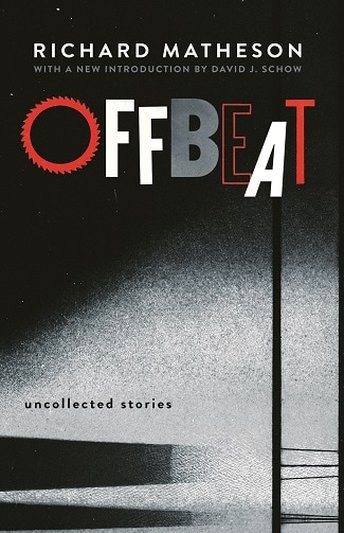
Offbeat Valancourt Books – 2017 (Originally published 2002)
Offbeat is a collection of Matheson’s stories that had not been previously collected in an anthology. Matheson wrote a lot, and these stories’ failure to be included in other collections was not due to their quality. (One of these tales is actually featured in Penguin’s The Best of Richard Matheson.) Still though, I was a bit underwhelmed by a few of the stories in the collection. The twist endings of a couple of them seemed very predictable. My favourites were ‘And Now I’m Waiting’, ‘Maybe You Remember Him’ and ‘Phonecall from Across the Street’. I didn’t enjoy this book quite as much as the novels I had read beforehand, but I certainly don’t regret reading it. If you were already a fan of Matheson, I reckon you’ll enjoy this.
The Best of Richard Matheson Penguin Classics – 2017
When I found out that Penguin had recently put out a “Best of Matheson” collection, I realised I had done things backwards. I should have read this first and Offbeat afterwards. That being said, it is a testament to the quality of the tales in Offbeat that I started reading another collection of Matheson’s stories directly after finishing that one. I didn’t know quite how prolific Matheson had been, and I didn’t know how well I already knew his work. He wrote a bunch of stories that turned into episodes of the Twilight Zone. I’ve never watched an episode of the The Twilight Zone, but I’m familiar with the plots of some of the episodes from the times the Simpsons parodied them. Also, this collection contains ‘Duel’. I remember watching the movie version of this with my dad when I was a kid. I had no idea it was based on a Matheson story.
Honestly, this collection is a much, much better place to start if you haven’t read any of Matheson’s short stories before. These stories are quality. There’s one near the end called ‘Mute’ that I particularly enjoyed. It’s not really a horror story, but it contains some pretty interesting insight on language. This Matheson was a smart guy.
The Shrinking Man Bantam Books – 1969 (Originally published 1956)
I had no great desire to read this book, but it was discussed at length in Stephen King’s Danse Macabre, so I thought I’d better read it and get it into this post. It’s the story of Scott, a man who gets hit by a radioactive wave that causes him to shrink exactly one seventh of an inch every day. I had this pegged as more of a science fiction novel than a horror novel, but, as Stephen King points out, there isn’t much science in here at all.
I actually want to talk about the science, or lack thereof, because it really annoyed me when I was reading this book. This chap doesn’t shrink a certain percentage of his body height every day. He shrinks the same amount every day. If you think about this, it’s pretty ridiculous. If a 6’4″ man shrinks 1 seventh of an inch in a day, he is losing approximately 0.2% of his overall height. If he keeps losing the same amount every day, after another 529 days, he will only be 2 sevenths of an inch tall. By the next day, he will have lost 50% of his height. By then he will be one seventh of an inch tall and will continue to lose 100% of his height in one day. This doesn’t make sense. I’m not a scientist, but I feel that I know enough about the basic laws of reality to state that this rate of shrinkage is a physical impossibility.
Ok, I am going to discuss the ending of the book, so skip to the next paragraph if you haven’t read it yet. The book ends with the protagonist entering a microscopic existence. It is a weird upbeat ending full of optimism. This doesn’t make sense. Ok, maybe it’s possible he was a teeny tiny little bit taller than 1 seventh of an inch and that it will take another day for him to completely shrink out of existence, but that isn’t what the book suggests. Matheson suggests that the protagonist will continue to shrink interminably. But he can’t keep shrinking at the same rate! This would only work if he had been shrinking a percentage of his height, not a fixed amount. Things can always get a little bit smaller, but they can not decrease their size by more then their size. The other option that Matheson had to end this novel was for Scott to find himself in some kind of opposites universe of anti-matter or something where he actually finds himself growing larger every day. Sure the science is ridiculous, but at least that would work mathematically (which is more than can be said for the ending as it stands).
Really, this is more of an adventure story than anything. While half of the novel describes the shrinking process and its unpleasant effects on Scott’s life, the other half details his struggles with a spider after getting locked in his cellar alone. The spider stuff is exciting, but the real horror lies in Scott trying to come to terms with his inevitable disappearance. My favourite part was when a pervert thinks the shrinker is a kid and tries to diddle him. It’s obviously a horrible, horrible thing to happen, but the dialogue was pretty funny.
Silence a moment. Then the man said. “Women. Who come into man’s life a breath from the sewer.” He belched. “A pox on the she.” He looked over at Scott. The car headed for a tree.
This book was fine, but it was definitely my least favourite of Matheson’s novels.
I Am Legend is absolutely crucial. You should definitely check out the Best of short story collection too. If you like those, check out the others listed above. Matheson has plenty of other books, but I reckon I’ll give it a while before I seek those out. (5 books by one author over the course of 3 months was a lot for me.) This guy had a huge effect on the horror genre, and it’s not surprising. These books are imaginative, well written and sometimes truly horrifying. Richard Matheson was a cool guy.
The Fog – James Herbert NEL – 1980 (First published 1975)
A poison cloud erupts from under the ground and causes the people who inhale it to go crazy. As it spreads it becomes more powerful, and it goes from driving a few isolated individuals to acts of sadistic violence to bringing the city of London to an apocalyptic hellscape.
Maybe that doesn’t sound like a particularly clever idea for a horror novel, but while reading it I was surprised at how clearly influential this book must have been within the horror genre. Every book by Harry Adam Knight, Simon Ian Childers and John Halkin I have read draws clear influence from this. I haven’t read Herbert’s The Rats yet, but I have a pretty song suspicion that this book combined with that one provided the blueprints for all of the horror fiction published by the aforementioned authors.
The Fog isn’t all that great though. The main problem is that it’s far too long. Harry Adam Knight’s The Fungus has a remarkably similar story, but being 100 pages shorter, it’s a more concise, enjoyable book.
The Fog is a novel driven by violence and destruction, but there’s complicated relationships too. I wasn’t terribly interested in them; the main characters in here are fairly dull. There’s also at least one overly graphic sex scene. This one wasn’t rapey or violent or anything, but it went on for ages. I didn’t see the point. I hate to sound like a prude, but I don’t really want this level of romantic detail in a novel about a cloud of maddening virus.
The sheer carnage in this book was pretty impressive. I hadn’t read anything by Herbert before this, and I was genuinely shocked at the brutality in here. This book came out in the mid 70s, but parts are as sickening as anything the “splatterpunks” put out a decade later. There’s one scene near the beginning of the book in which a crowd of schoolboys turn on two of their teachers. It involves a gang rape and garden shears. I sat dumbfounded after reading this part. I’ve made it sound bad, but I haven’t conveyed quite how sick it really is. I wouldn’t want to ruin it on you!
Also, although I wasn’t hugely impressd with the novel overall, it does include my favourite chapter of any novel ever. The poisonous fog affects people to different extents; some go on bloody killing sprees while others just hang themselves. One of those affected merely runs around his village kicking his neighbours up their bums. This part of the book is a seriously brilliant piece of writing. I laughed so hard. Genius.
Otherwise this was quite a clunky read. Herbert has the annoying habit of skipping ahead a bit of the story and then going immediately back to fill in the details. He seemed to think this was a cool narrative technique, but I found it annoying. Also the speed at which doctors in this book manage to create a vaccine is laughable, if not downright insulting, to anyone reading it in 2020.
The Fog is not a great book, and James Herbert is not a great writer. This isn’t without its charms though, and I’m planning to read Herbert’s Rats trilogy and The Spear in the future.
The Body Snatchers – Jack Finney Dell Books – 1955 (Originally serialised 1954)
I have known of the Invasion of the Body Snatchers movies and had an idea of what they were about for as long as I remember, but I have never actually seen either of them. I didn’t know they were based on a book until I saw this novel being discussed in Stephen King’s Danse Macabre, a history of horror. If you haven’t read The Body Snatchers already, let me tell you a bit about its history before you rush out to buy a copy. I wish somebody had told me this before I read the book.
The Body Snatchers was originally serialised in Colliers Magazine in 1954. The first whole edition came out in 1955. The movie, Invasion of the Body Snatchers came out in 1956. After this, reprints of the book bore the film’s title. In 1978 another film version was made, and Finney updated his novel to coincide with the release of the new movie and to make the book more appealing for a younger generation
The changes in the revised text, as far as I can tell, were minor. The revised version is actually set in the 70s, the place names are switched around a bit, and there’s a few paragraphs that are moved around/added/deleted. I didn’t conduct a detailed cross examination or anything like that. I was reading from the original text, but when I was preparing dinner, I switched to an audiobook version on youtube that turned out to be a reading of the revised text. I only noticed that the texts were different when I had to switch between the two and found myself searching for phrases from one that were different in the other. I looked online (very briefly) to see if anyone else had listed off the differences, but I found nothing. I think the story is basically the same in both.
I mentioned the two film versions, but there have actually been 4 Hollywood movies based on the book and countless others inspired by it. References to this story pop up everywhere, and I knew what to expect in general terms of plot. I had been surprised to see Stephen King list it as one of the most important works of horror. Influential sure, but horror? I thought this was science fiction. After reading this (and a few more of the books that King recommends in Danse Macabre) the utter silliness of the notion that literary science fiction is inherently separate from horror has become apparent. Even if you know what to expect, The Body Snatchers is a surprisingly creepy story.
So what’s going on in here? Well, the locals of a small American town have started noticing their relatives acting strange. They look the same, talk the same and largely act the same, but they’re clearly not the same. Things get worrisome when a couple find a surprisingly plain looking corpse in their house. Then weird vegetably pods start popping up in people’s cupboards, and it becomes apparent that these pods are the source of the bizarre uncooked bodies that are assuming the forms and minds of the villagers while discarding their souls. Weird and cool.
The only thing that disappointed me about this book was the ending. The story is horrendous; what’s happening is truly nightmarish, and Finney does a great job of making his readers feel the surmounting inevitability of the doom of all humankind. In the final chapters, when the protagonists are caught, you realise that there is no way out. This isn’t going to be pretty. Personally, I love a horror story with a bleak ending. As this tale draws to a close, it looks like the entire human race is going to get their souls torn out and their bodies drained of life. Hell yes. That’s the perfect ending for a horror novel. Unfortunately, the last few pages of his book actually describe the antagonists suddenly changing their mind and abandoning their mission, leaving the vast majority of humanity unmolested.
I felt swindled.
I thought that the ridiculously fortuitous turn of events at the end of the book might have been to please a 1950s’ audience, but then I remembered that Richard Matheson’s I am Legend, a novel with as bleak an ending as any, was also first published in 1954. Maybe Finney’s publisher insisted on a positive outcome. I might just be speculating, but the turn of events which leads to humanity being spared is so sudden, unexpected and quick that it made me think that Finney might originally have had different plans for ending this novel.
Even with the dumb ending, this was an enjoyable book. There are genuinely creepy moments, and its such an important work within the horror genre I’m glad to have read it.









 Nocturnal Revelries