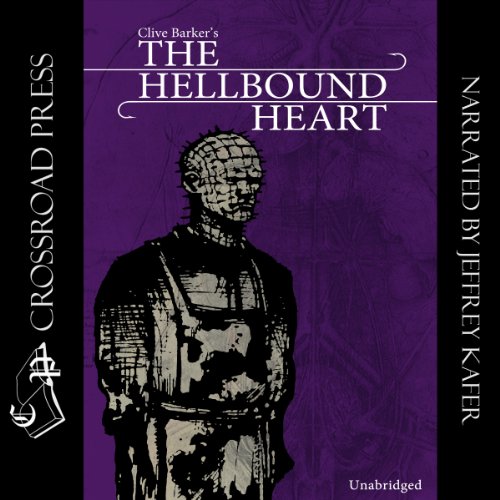
Clive Barker’s The Hellbound Heart

hellbound heart clive barker

The Hellbound Heart – Clive Barker
Crossroads Press – 2013 (First published 1986)

After years of eyeing the video box in my local videoshop after mass on Sundays, I finally saw Hellraiser on the Halloween night after I turned 19. After that much anticipation, I was inevitably a bit underwhelmed. I rewatched it in June this year, and I enjoyed it far more second time around. I had just finished Clive Barker’s Cabal, and I guess I was in a Barkery kinda mood. A few weeks later, over the course of on afternoon, I listened to an audiobook version The Hellbound Heart, the novella that Hellraiser is based on. (Crossroads Press produced two audiobook versions of The Hellbound Heart. One is narrated by Barker himself, but that one is abridged, so I went with the other one.)

In case you don’t know, this is the story of a man who summons a crew of S&M loving demons to his house. (They’re into the bad kind of S&M… the really bad kind.) Things don’t work out very well for this chap and his family. This is a horror classic, and I liked the book quite a lot. I read it so soon after seeing the movie that I was able to pick out their differences.

The main change is that Kirsty is Rory’s friend in the book whereas she is his daughter in the movie. I think the story works better when she’s his daughter. It’s harder to imagine the characters’ motivations when these two are just friends.

In the book, the Cenobytes are less threatening or maybe just a little more distracted than in the movie. When they first appear, they try to make sure Frank knows what he’s getting himself into before they work their magic on him. This is a bit confusing as when Kirsty summons them later on, they tell her that they can’t leave without taking the person who summoned them. Why does Frank get a chance to back out but Kirsty doesn’t?

In the book, the female cenobyte seems to be more of a group leader than Pinhead. She’s the engineer in the book, but that title goes to the weird wall monster in the film. Oh, and there’s no pet store or tramp in the book. Aside from these few differences, the book and movie are pretty much the same. If, like me, you enjoyed the movie, give the book a go. It’s fun to do both.

This is the third of Barker’s works to appear on this site in 2020. The Hellbound Heart (1986) came out right after the Books of Blood (1984 – 1985), and aside from it being slightly longer, it wouldn’t feel out of place with the tales in those collections. (I saw recently that there’s a Books of Blood TV series coming out in October.) I definitely liked The Hellbound Heart better than Cabal (1988) as it’s more horror than fantasy. I reckon I’ll read Barker’s The Damnation Game (1985) next.

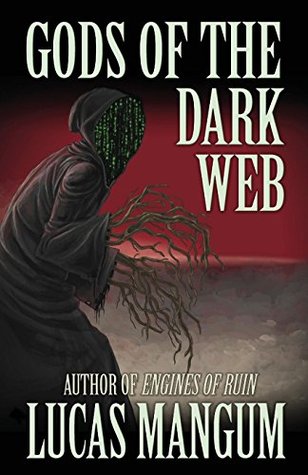
Gods of the Dark Web – Lucas Mangum

gods of the dark web lucas mangumGods of the Dark Web – Lucas Mangum
Deadite Press – 2018

For as long as I can remember, there has been horror stories about the dark web. It’s the perfect starting point for creepypastas, and I reckon that youtube clips listing its 10 creepiest videos and the likes are where most people first hear of it. The majority of internet users, including me, don’t really understand what the dark web is or how it works, but that’s not super important here. You won’t need a degree in computer programming to understand this book. Lucas Mangum’s Gods of the Dark Web is a novel about the dangers of messing with the deepest, darkest parts of the internet.

Two teenagers start mucking about on the dark web and then very bad things happen to them. While this premise could work as a realistic thriller, the trouble in this novel seems to be caused by the union of modern technology with some eldritch ancient evil. This supernatural stuff is never fully explained, but this was a strength of the book rather than a weakness. It’s one of those ‘scarier when you don’t understand’ situations.

There are some super violent scenes in here, and while this type of novel would be a bit underwhelming if there wasn’t some brutality, there is one scene in which a baby is murdered that was tough to bear. I read this book in the same room as my 3 week old daughter, and this perhaps made it more unpleasant than it would seem to other readers, but I reckon this scene will leave most people squirming. The genre and subject matter of the book call for taboos to be broken, but, as I mentioned in my review of the Splatterpunks Anthologies, I feel like killing babies is low hanging fruit. It’s close to the bottom of the barrel of shock tactics. Then again, in the context of the story, it doesn’t seem overly ridiculous. The antagonists of this novel need to be the lowest of the low for the story to work. I won’t say that this scene or any other scene in this novel is “too much”, but I would recommend that you not read this book if you don’t feel comfortable reading about horrendous, sadistic brutality.

Gods of the Dark Web is a short novel, and I don’t want to ruin the story, so I’ll say no more about the plot. I enjoyed this one quite a bit. It’s dark, gritty and surprisingly enjoyable. Check it out if you like dark, nasty horror.

This book is only a couple of years old, and Lucas Mangum is still an active writer. He has a patreon page where he has recently published a bunch of Gods of the Darkweb extension stories featuring characters from the novel. There’s something very apt about continuing this saga in this manner. You feel like your computer might turn against you while you’re reading. Mangum is not demanding payment for what he posts on his patreon page, and I salute him for his DIY approach. I suggest you give his writing a go.

Shirley Jackson – The Lottery, The Haunting of Hill House and We Have Always Lived in the Castle

A few months ago, I had decided to read some T.E.D. Klein, and I was trying to figure out where to start. I read on his wikipedia page that his story The Events at Poroth Farm “is notable for the insidious way in which the narrator’s responses to the works he is reading (including those of Charles Robert MaturinAnn Radcliffe“Monk” LewisSheridan Le FanuBram StokerAleister Crowley, and Shirley Jackson) are conflated with his impressions of the supernatural threat.” With the exception of Shirley Jackson, I had read and reviewed bits and pieces by all of these authors for this site. I used to teach high school English, so I had come across a few of Jackson’s short stories before, but I had never read any of her novels. I had heard that these novels were pretty great, so I decided to give Shirley a go.

Shirley lotteryThe Lottery: The Adventures of James Harris
Farrar, Straus and Company – 1949

But I started with The Lottery: The Adventures of James Harris (or The Lottery and Other Stories as it was later retitled). Many of these stories are short little glimpses into the lives of surprisingly normal characters, racist neighbours and jealous office workers, people it’s very easy to picture. This collection had very little supernatural horror in it, and it is very different to the stuff I usually post about, but I found it interesting and entertaining. It ends with the title story, The Lottery. This is probably the most horrifying tale in the collection, but it’s also one of the most famous short stories ever written. If you haven’t read it, go read it. I have a pdf of comprehension questions I can send you when you’re done.


haunting hill house shirley jacksonThe Haunting of Hill House
Viking – 1958

I knew that this book had a reputation as one of the greatest horror novels ever before I read it. I was not disappointed. This was great. It’s far longer than the stories I had read by Jackson previously, but the prose and plot are just as tight. The tightness isn’t stifling though. This is masterfully written stuff, but it’s still a page turner. There was one part that creeped me out really good. No spoilers, don’t worry. (You know that bit where she thinks she’s doing one thing but she’s actually doing something else? Yeah, that bit! SPOOKY!) Holy shit, this book was good. Prioritize it on your reading list.


we have always lived in the castle shirley jacksonWe Have Always Lived in the Castle
Viking – 1962

I waited 2 weeks after finshing Hill House to start on We Have Always Lived in the Castle. This one isn’t a horror novel in the same way as Hill House, but I reckon it’s probably the darker of these two books. It’s about a pair of sisters who live in a big house in a town where everyone hates them. This one was great too.

In general, Jackson’s narration is superb. She manages to transfer the thoughts from her characters’ heads onto the page without losing the nuances of their thought processes. The characters in her stories will say quirky little things that you will have found yourself thinking a million times but have probably never said out loud. This is partly what makes Merrikat from We Have Always Lived in the Castle such a fascinating character. The relatability of her thought process makes it really easy to forgive her malevolent sociopathy.

Shirley Jackson was an excellent writer, one of the best. I’ve read some awful crap recently, and I really enjoyed reading some top notch horror. Jackson’s novels have somewhat rejuvenated my interest in the genre. Also, now I won’t feel like a philistine when I start reading that story by T.E.D. Klein

Wurm and Garden – Matthew Costello

I reckon that my memories of 2020 will be bittersweet. The lockdown and subsequent interruptions to my life have been pretty annoying, but on the other hand, I have read a bunch of cool books about scary worms. The worm books I have read have been surprisingly varied in their style and stories, but Matthew Costello’s Wurm is the most ambitious by far.

wurm matthew costelloWurm – Matthew Costello
Crossroads Press – 2018 (Originally published 1991)

A deep sea expedition brings some extremely dangerous parasitic worms back to the surface. While this is happening, a psychic channeler starts getting messages from powerful alien entities telling him to commandeer a TV station. Do these events have anything to do with each other? After the freaks take to the airwaves, the worms attack New York City in the grossest, most violent ways imaginable.

wurm paperback matthew costelloA very cool paperback edition cover

I had read that this book was a bit overwritten, but I really enjoyed the whole thing. There’s definitely a few problems and plot-holes here – my question in the last paragraph isn’t rhetorical – but this is a super entertaining mix of sci-fi and horror. If you’re the kind of person who is willing to read a book with a wurmy face on the cover, I reckon you’ll have a good time with this one.

Reading this in 2020, I was quite glad that I hadn’t written it. The one black character is bad, and while not all of the bad guys are black, it does seems that this chap’s blackness is part of what makes him bad. I’m not saying that Matthew Costello is an evil bigot – he probably cringes at the offending sections now – but these bits have aged horribly. (There’s a good black guy in the sequel too, so let’s not cancel anyone just yet.)


garden matthew costello

Garden – Matthew Costello
Crossroads Press – 2018 (Originally published 1993)

Garden is a very short sequel, only a novella, and it doesn’t really feel like a separate book to Wurm. It’s more of an extended epilogue. It certainly wouldn’t be of much interest to anyone who hasn’t read Wurm.

It tidies things up a little bit and provides a slightly more satisfying ending to the story than Wurm manages. Remember those weird aliens that hatched out of peoples’ bodies in the TV studio? They’re back. There’s still not much offered in the way of an overall explanation for what has happened, and while things are wrapped up by the end, the means by which this wrapping up happened remain pretty unclear. There’s some kind of weird religious symbolism going on, something about sacrifice… I didn’t really want to think too hard by the time I was finishing up. Also, why the Hell was it called Garden?  I struggle to imagine a more boring title for a horror novel… Shoe?

Let’s be honest, the plot of Wurm and Garden is a mess and ultimately unimportant. These books provide plenty of thrills and mindless fun. They’d make a far better TV series than they would a movie. I would be happy to read more of Matthew Costello’s horror fiction in the future.

Both Wurm and Garden were recently published by Crossroads Press, a company that specialises in putting out digital versions of out-of-print horror. I have had to cut down on buying physical books for storage reasons, and I plan to buy a bunch more stuff from this awesome publisher. Seriously, check them out.

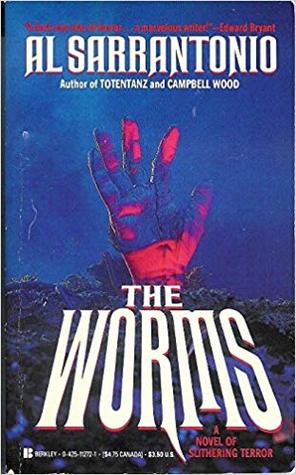
The Worms – Al Sarrantonio

the worms sarrantonioThe Worms – Al Sarrantonio

Berkley Books – 1988 (first published 1985)

You know what this blog needs? Yeah, that’s it! More horror novels about evil worms.

I didn’t know anything about this book when I started it apart from the fact that the author had written a series of books about Halloween. Most of the horror novels I’ve read about Halloween suck ass, so I didn’t have high hopes for a worm horror book written by a Halloween guy. I was quite surprised by The Worms though.

This is the story of toxic waste infused worm zombies taking over a small town. Anyone who gets bitten by these freaks turns into a worm themselves, and that’s only the beginning of their transformation. This book has loads of action and grossout moments, and I loved every page. By the end, the small town where the story is set has turned into a Boschean hellscape. This is entertaining stuff.

This might not be high literature, but it was a lot of fun. I wish I knew about books like this when I was a teenager. If you have older kids, encourage them to read this! As an adult, I fully intend on reading more Sarrantonio on the future; maybe I’ll even do his Halloween series this October.

This is a short review, but there’s not much left to be said. Sarrantonio’s The Worms is a slick little horror novel that makes good on its title’s promises. If you like fun horror novels, you should read this book.

I recently reviewed another book with a similar title. For the record, I personally enjoyed The Worms more than Worms.

Bernard Taylor’s Early Work – The Godsend, Sweetheart, Sweetheart, The Reaping, The Moorstone Sickness, and This Is Midnight

I’ve done a few author overview posts recently. Here’s one on Bernard Taylor’s early books:
the godsend bernard taylorThe Godsend
Avon Books – 1977 (First published 1976)

The Godsend is a well written book, and I had no desire to put it down once I started it, but I’m not sure that I can say I enjoyed it. It’s horrifying in parts. This is one of those creepy kids books that were so popular 40 years ago. 

I’m fine reading about torture and gore and all that stuff, but I find it very difficult to read about children suffering. I read The Voice of the Clown and Childgrave earlier this year, and after reading The Godsend, I’m ready to avoid this kind of book for a while. This one wasn’t quite as nasty as The Voice of the Clown, but it was just as humourless. It’s bleak and upsetting.

A couple end up with a baby they weren’t planning for and very bad things start happening. I don’t want to say much more about the plot because once the story gets going, there’s only one possible outcome. You’ll realise this as you’re reading it too, but the writing is so smooth that you’ll stick around for the descent.

Without ruining the plot, I can say that this is one of those books where the reader is left uncertain about what’s really happening with the events of the story. Is the narrator insane, or is there something genuinely supernatural going on? This is a trickier one to decide than most though. The plot events seem far too weird and severe to be coincidental, but there’s never any explanation offered. Also, the story is narrated by one of the characters living through these awful events, so it’s very likely that his trauma would be influencing his account. At one point the narrator seems to be on the verge of performing at act that no sane person could ever perform. If anyone else has read The Godsend and has thoughts on whether or not something spooky was going on, I’d love to hear from you.


sweetheart sweetheart bernard taylorSweetheart, Sweetheart
Valancourt Books – 2015 (First published 1977)

I think this might be my favourite book by Taylor. I remember a few months ago, I was thinking about the limitations of different forms of media. Books generally rely on atmosphere for their scares while movies can terrify their audiences with a well timed noise. I didn’t think that books could have the same effect. That was until I read about the protagonist of Sweetheart, Sweetheart sitting alone in a haunted house and suddenly hearing laughter. I’m aware that my description here doesn’t sound scary at all, but imagine how creepy that event could be in a well made horror film. Imagine how good the writing would have to be to make a text version of that scene equally as scary. Well, Bernard Taylor pulls it off. At its heart, this is a traditional ghost story, but let me assure you, this is an exceedingly well told traditional ghost story. This was a great book.


the reaping bernard taylorThe Reaping
Valancourt Books – 2019 (First published 1980)
I reviewed this a few months ago for another post. I really liked it.
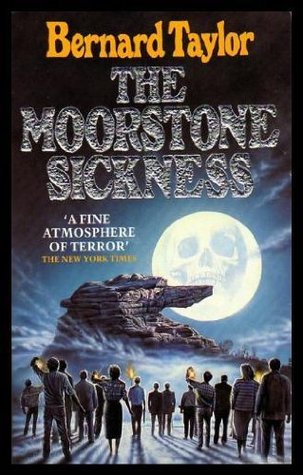
 

the moorstone sickness bernard taylorThe Moorstone Sickness
Grafton – 1990 (First published 1981)

I thought The Moorstone Sickness was pretty good. I read this a few weeks ago, and I can’t think of much else to say about it now. I read it in a single evening, and I thought it was quite similar to Get Out, the 2017 horror film. Taylor’s book features more occultism and less surgery/social commentary. I liked that movie Get Out right until the very end when it had a surprise happy ending. I don’t have the same complaint about The Moorstone Sickness. Taylor seems to be aware that horror should actually be horrifying.


this is midnight bernard taylorThis is Midnight: Stories
Valancourt Books – 2019 (First published 2017)

This is the only collection of Bernard Taylor’s short fiction. It’s pretty good. I can’t remember where it was, but I once saw Taylor being referred to as a British Stephen King. After reading some of his books, I can see some similarities between the two; they’re both very readable, but the tone of Taylor’s books always seems a bit more serious than King’s. There’s not much humour in Taylor’s novels. I can’t remember any of the stories in This Is Midnight being outright silly, but some of them are certainly more light-hearted than his novels. Ultimately, I reckon Taylor’s novels are better than his short stories, but these are still pretty enjoyable. I like the completeness of this collection too. This guy has been an author for 40+ years, and he’s only written 13 short stories. Although this collection was first published in 2017, I am including it in this post as many of the stories herein are from Taylor’s early days as a writer.


I enjoyed everything I’ve read by Bernard Taylor. On average, it took me a day and a half to finish each his novels, and that had nothing to do with their length. Once I started reading Taylor’s books, I never wanted to put them down. According to wikipedia, he has written 7 more novels that can be classified as Horror/Suspense. I’ve read 5 of his books in the last 4 months, so I’ll probably give him a break for a while, but I wouldn’t be surprised if he shows up here again. I’ll probably avoid the 5 books he wrote under the pseudonym Jess Foley though.

jess foley
I’m not trying to make fun of Taylor here. Fair play to him for writing these. They just seem… kinda different to the stuff I’ve read by him. Anyone know if they’re good?

Worms – James R. Montague

worms james montagueWorms – James R. Montague
Valancourt Books 2016 (First published 1979)

After my recent spate of reading books about killer worms, I decided to cut back on that kind of thing. There’s a surprising amount of horror novels on that topic, and while none of the ones I read disappointed me terribly, I decided that it wasn’t a field in which I needed to dig much further. I told myself that from thereon I should only read only the choiciest horror novels about worms. Valancourt books, those purveyors of arcane lore, decided to reissue Jame R. Montague’s contribution to the genre after it had remained out of print for almost 40 years, so I assumed it would be pretty good.

This was a fairly strange book. It’s about a henpecked husband who acts drastically and then seems to go mad with guilt. It starts off lighthearted and funny, proceeds into the realm of psychological horror, and ends with a bang of tromaesque nuclear worm horror. It’s not a long book either, so these changes were a bit jarring. I liked the first part a lot and probably would have enjoyed everything a bit more if the rest of the book had continued that way.

Still, this was a decent read. It’s short, entertaining and quite weird.

I knew that James R. Montague was a pseudonym for Christopher Wood when I was reading this book, but it wasn’t until I wrote it down a few minutes ago that I realised that the pseudonym is M.R. James backwards. Fuck, now I want to read this again to compare it to that author’s work. Apparently Christopher Wood wrote the screenplays for a couple of James Bond films and the novelisations for 2 others. Worms has very little in common with James Bond stories.


Canadian Psycho – Kelley Wilde’s The Suiting

the suiting - kelley wilde
The Suiting – Kelley Wilde
Tor – 1989 (First published 1988)

A few months ago, I was looking through the paperback horror section in my favourite thrift store and saw this book. I think my initial response was to roll my eyes. “A horror novel about a suit? Jesus, they must have been running out ideas by the end of the 80s.” I left the store empty handed, but by the time I was home, I was obsessed. “A book about a haunted suit? Yeah, that’d be different. It might be good. It couldn’t be worse than that book about evil trout that I read last year. I’ll give it a go. I want to read it. I need that book.” I went back the next day and bought it.

The book starts off with some lad getting fitted for a suit. Then he leaves the tailors in a hurry, puts his suit in a locker, and bumps into a gay lad who he has been avoiding. After a long, violent fight, the gay lad kills him. I don’t know why the gay lad’s sexuality is ever mentioned. It has nothing to do with anything else in the book. 

Another fellow finds the suit in the locker. He nicks it and then goes home to try it on. It doesn’t fit him. This chap is a dork. He collects coins and spends his Friday night’s with another loser talking about poetry. He’s in love with a girl from his office, but he’s too scared to do anything about it.

The suit possesses him. It teaches him how to speak French and convinces him to go to the gym. He hits the gym so hard that his body changes to fit the suit. He convinces his alcoholic boss to relapse so that he can take his job. This works. This part of the book was fairly interesting. The character’s sudden narcissism and preoccupation with fitness and luxury items reminded me of Patrick Bateman.  

Then he goes to Montreal on vacation. He takes some pictures and has some confusing hallucinations about dying and a woman. When he gets home he shows his loser friend the pictures. There follows a lengthy, confusing section where the friend tries to figure out the relationship between the different pictures. It turns out that the buildings in the pictures are from different eras. This part was not at all interesting or exciting, but it drags on for ages.

There’s some kind of mention of a curse, but it’s never really explained.

Then the protagonist starts meeting girls in bars. One of them fingers his arse. He likes it. The girl from his office that he fancied is murdered by her old boyfriend. Our hero later finds this boyfriend and stabs him in the face.

With 50 pages to go, I was starting to get worried that this book wasn’t going to tie up its loose ends. The protagonist seemed to be having some kind of breakdown that was interfering with the narrative. He throws the suit in a river but keeps part of it. Then he gets a new suit. Then he rapes and kills a small child and starts seeing ghosts in his apartment. Then he goes out and finds the gay lad who murdered the suit’s original owner and kills him. Then he jumps in front of a train.

At first, I thought the omission of explanatory details was intentional and that they’d be given by the end and the mystery would be wrapped up. By the end of the book, I realised that the lack of clarity and cohesion was just bad writing. A lot of the horror I read gets by without ever explaining the mystery, but this book is about an evil suit. It needs to be explained. I get the sense that the author was trying to walk the line between pulp horror and surrealism (I read an interview with him in which he compared this book to Roland Topor’s The Tenant, ha!), but The Suiting is too complicated for the former and too stupid for the latter. This is unfortunate, as I enjoyed big chunks of it, and it could have been much, much better. Kelly Wilde actually rewrote this book for a special 25th anniversary edition. I think it only came out as an e-book, but it has since been removed from Amazon. I won’t be reading the new version.

Kelley Wilde lived in Canada, but he is an American. Aside from the street names and the appendix of translations of French Canadian phrases at the end of the book, there’s nothing inherently Canadian about The Suiting.

There’s quite a few comparisons that can be made between this novel and Bret Easton Ellis’s American Psycho. They were written within a few years of eachother, and both deal with similarly unstable protagonists who are drawn to fancy suits. The reason that you’ve probably heard of American Psycho and not The Suiting is becase the latter is a heap of crap.

The next time I find a horror novel about something that sounds really stupid, I’ll know better and leave it on the shelf.


Haha. No, I won’t.


Cabal – Clive Barker

Although this is a post about a book by Clive Barker, I could start it off the exact same way I started my 2016 post on the books of Stephen King, discussing my weekly trips to the local video shop with my parents when I was a kid. The box of one video in the horror section fascinated me. It was called Nightbreed, and there was a picture on the side of the box of a fat, gross goblin-like creature with his face in his chest. Anything featuring this guy had to be a repulsive work of obscene horror. 

nightbreed fat monsterI wanted to see this movie so much.

After getting broadband internet when I was 17, I spent a few years downloading and watching all of those horror movies that had disturbed me in the video shop. I think I was mildly underwhelmed when I got around to Nightbreed. It’s so long ago now, that if you had asked me last week, I wouldn’t have had a clue as to what the movie was about, but I read Cabal, the novel it was based on, at the weekend, and I think some of it came back to me.

cabal clive barker
Cabal – Clive Barker
Harper Collins – 1989 (First published 1988)

I couldn’t remember the plot of the movie, but I was able to figure out who the bad guy was in the book almost instantly. I can’t be sure that this was my memories of the movie coming back or the fact that it’s kind of obvious. I looked back at the movie poster and trailer there to see if I might want to watch it again, but at 33, it seems considerably less appealing. I know the director’s cut has been released, but I doubt it’s much better. One of the characters still looks like he has the moon for a head. Still though, I’ve been listening to the soundtrack as I write this post, and Danny Elfman’s score is convincing me that the movie might be worth another look.

How about the book though? Well, I want to mention something else before talking about that. I moved apartment recently, and before handing over the keys to my old place, I had to scrub it clean and make it presentable. We had been there for 6 years, so you can imagine how much work that was. I decided to make the work a little easier by distracting my mind with an audiobook. I chose Cabal. I’ve been doing a lot of books on Audible recently, and I have been using the app’s speed-up feature to get through the books quickly.

I did not enjoy this book from the comfort of my armchair. I did not have a pillow against which to rest my weary head as I turned these pages. I did not sip gingerly from a hot cup of peppermint tea as this tale reached its climax. No, no, no. While I was listening to this book being narrated at almost double speed, I was huffing oven-cleaner fumes and shoveling half a decade’s worth of dust and grime from behind a fridge.  

Ok, enough of that. You didn’t come here for the banal horror of my life. I included that information to give you some context that might explain my opinions or lack thereof on this book.

Cabal was enjoyable enough. I’ve forgotten a lot of it already. It was pretty violent in parts. I’ve only ever read the Books of Blood before this, and Cabal definitely felt like the same author. There was some religious symbolism or analogy at the end that went over my head. I can’t recommend that you rush out and read this book, but if you’re looking for a weird adventure story to pass the time, you could probably do a lot worse. I bought a paper copy at a library book sale for a quarter years ago. I don’t regret my purchase at all. 

My post about The Books of Blood was very short too. I assure you, this is not because I don’t like Clive Barker’s writing. I do. Everything I’ve read by him has been enjoyable. I watched Hellraiser for the first time in years just last week, and I’m already planning another post on the Hellbound Heart and few of Barker’s shorter works in the near future.

The Nursery and Toy Cemetery – William W. Johnstone’s Insane Horror Novels

the nursery william wThe Nursery – William W. Johnstone
Zebra Books – 1983

“a Satan who is obsessed by anal sex” – this is part of the description of The Nursery given in Paperbacks from Hell. Well, after reading that, there was no way in Hell that I wasn’t going to track down this book. Fortunately, it completely lived up to the hype. This is perhaps the most insane horror novel I’ve ever read. The cover and title are fairly misleading. There is a nursery in the story, but it’s not super important to the plot. This book is more about violence, sex and Satanism… oh and vampires.

The Nursery is a tricky one to find though. At this stage, nearly all of William W. Johnstone’s horror novels have been released as e-books, but The Nursery has not yet been given this treatment. (I’ve ended up with two copies. If you wanna trade me something good, message me.) This shit is truly mental, but it’s damn entertaining. There’s another, more thorough, review of this book on Glorious Trash if you want more details before reading it

I wrote the above paragraphs about The Nursery roughly a year ago. After finishing that book, I had a hard time picking up another novel by Johnstone. While I did actually enjoy The Nursery, it’s a very intense novel, and reading it was a hectic experience.

Looking back at those paragraphs, I am amused to see that I described The Nursery as “perhaps the most insane horror novel I’ve ever read”. I finished reading Toy Cemetery a few weeks back, and I can say with certainty that it is definitely the most insane horror novel I’ve ever read.

toy cemetery - william wToy Cemetery – William W. Johnstone
Zebra Books – 1987

Toy Cemetery is essentially the same novel as The Nursery except this one has the added attraction of two armies of living toys. Yes, this is another novel about a Vietnam veteran returning to his home town only to find it overrun by Satanists. There’s more incest in this one, but it’s also extremely violent. There was one scene that starts off with a man taking his new girlfriend on vacation; after a few paragraphs, he is crushing her skull with the heel of his boot. Another noteworthy feature of this one is the fact that every single female character is evil. Honestly, there’s so many insane parts of this novel that I don’t feel capable of properly explaining how mental it is. By the end of the book, the honest,  honorable, Christian protagonist is stabbing his family to death in garbage dump. Grady Hendrix wrote an excellent review of this one a few years ago. I read his review right after finishing the novel, and actually being forced to think about what had happened in this novel after reading it was a very funny experience. Any attempt to summarize the events in this book will fall short of expressing how truly bizarre it is. It’s ridiculously flawed, misogynistic, and non-nonsensical, but I absolutely loved it.


It might take me a while, but I intend to read all of Johnstone’s horror novels. The phrase “Paperbacks from Hell” is now used to describe horror novels from the 70s, 80s and 90s, but I don’t think I’ve read any books that live up to that title as well as Johnstone’s. These are x-rated Goosebump books for weirdos. They’re brilliant (in an awful way). You need to check them out.