
 Book of Lies – Richard Metzger (Editor)
Disinformation – 2003
I can’t quite remember what put this book on my radar, but it was on my goodreads to-read list for a few years before I picked up a copy. Unabashedly taking its name from one of Aleister Crowley‘s books, this is a collection essays on Magick and the Occult, all written by modern authors. (Actually, I recently found a copy of Crowley’s Book of Lies at a library booksale for a cool 75 cents, so you can expect a review of that at some stage in the future.) The format (and choice of contributors) of this book reminded me a bit of the super edgy Apocalypse Culture series (although, in fairness, this book contains less paedophilia). I’ve been making my way through it since December, and although I have not read every single essay herein, I doubt I will get much further.
The book is divided into 8 sections, each dealing with a different aspect of occultism:
Section 1 is about the actual practice of Magick. Even though I had heard it during his infamous speech at DisinfoCon, I enjoyed Grant Morrison’s explanation of sigil charging through masturbation, I struggled through Mark Pesce’s piece, and I gave up about two paragraphs into Genesis P Orridge’s pile of rubbishy nonsense. Joe Coleman, the artist who did the covers for the Apocalypse Culture books, wrote a fairly cringeworthy prose poem on the magickalness of his own art. I barely even looked at the other essays in this section. All together, this part really sucked. The kind of magick being discussed here isn’t completely loopy stuff; it’s really just other forms of self motivation. If this kind of thing works for you, and I totally understand that it could, that’s awesome, but it isn’t for me.
Section 2 is about “Chemognosis”. I’m not a drug user, and I have no interest in ‘getting high’, so I skipped this section completely.
Section 3 is about magickal icons. There are several essays on Austin Osman Spare, Brion Gysin and William S. Burroughs. I once heard a poem by Brion Gysin that was so irritating that I decided to skip the essays about him. I don’t really care for Spare either, but I may come back to the essays on him if he ever catches my interest. I read Burroughs’ first 3 novels in my early twenties, and I used to think he was really cool because he had collaborated with Kurt Cobain, U2 and Ministry. (Coincidentally, I only recently realized that Ministry’s Psalm 69 song and album were allusions to Aleister Crowley’s Book of Lies.) That being said, William Burroughs was definitely full of shit, and I don’t really care about his forays into magick. There was another essay in here on Lovecraft’s influence on occultism, but it didn’t tell me anything I didn’t know already. This section ends with excerpts from two books. I don’t like excerpts, so I skipped them.
Section 4 is mostly about Aleister Crowley. The essays focusing on him were extremely boring. Donald Tyson’s essay on John Dee and the Enochian apocalypse was entertaining enough, but I can’t really remember what it was about and I’m only after reading it last week. Richard Metzger’s essay on Jack Parsons wasn’t horrible, but Jack’s wikipedia page is currently more informative.
Section 5 is titled Scarlet Women. There are three essays here, one on Marjorie Cameron, one on Ida Craddock, and one on Rosaleen Norton. They were ok. In a book that is 350 pages long, only 22 pages are about women. Out of the 40 essays in this book, one was written by a woman and three were written by Genesis P Orridge. I have seen this book being criticized for its very white guy perspective on occultism and magick, and while I certainly don’t want to read about sacred femininity and that kind of nonsense, I’d have to say this is a fair criticism.
Section 6, the section on secret societies, was probably my favourite. Twyman’s article on Hitler and the occult put me on the trail of a few interesting books, and P.R. Koenig’s accusations that the Ordo Templis Orientalis are a gang on spermchuggers was rather amusing. It pains me to admit it, but Boyd Rice’s very silly essay connecting Enoch’s Watchers, the Holy Grail, Dagon, Jesus Christ and Ea, Lord of the Depths is probably the best part of the entire book. The last essay in this section is rather long and it explains why wicca might not be as legitimate as some people think. I have never taken wicca seriously, so I didn’t care to finish that one.
Section 7 is quite short and not particularly interesting. It includes an interview with an aged Anton LaVey and an introductory essay about rock music’s links to the occult.
The final section is awful. There’s a big, boring, section on Julius Evola, the esoteric fascist. There are also 3 essays by Peter Lamborn Wilson/Hakim Bey. Wilson/Bey, for those of you who don’t know, is a rotten paedophile. He freely admits to and writes about wanting to have sex with children. I didn’t read what he had to say, and I really wish that he hadn’t been included in here. I am very glad that I bought a second hand copy of this book and thus avoided giving the publishers any money. Fuck that. Put that paedo in the oven. This section ends with a super cringy essay on “The Secret of the Gothic God of Darkness“. We’re dealing with seriously edgy stuff here.
Overall, Book of Lies was a bit disappointing. Some of the essays are on very interesting ideas, but in most cases, they barely scratch the surface. Then again, I bought my copy cheap, and it gave me the names of a few books that I will be checking out in the future. If you see a copy for less than a tenner and you want a nice book to leave beside the toilet, you could do worse than this.
 Paracelsus Magic into Science – Henry M. Pachter
 The Life and Doctrines of Paracelsus – Franz Hartmann
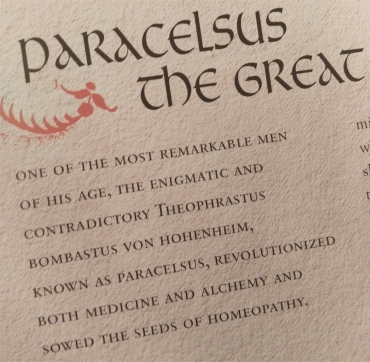 From
From  Paracelsus was Swiss born, but James Joyce thought so highly of him that he included him in a list of Irish heroes and heroines of antiquity in Ulysses.
 Nocturnal Revelries