You may not know this, but Tuesday is Canada Day. People in Canada get the day off work to clean their moose and harvest their maple syrup. I’ve done a few posts on Canadian stuff in the past (a Canadian ghost, a Canadian cult, Canadian mind control…), but the most infamous title of “Canadian” horror has long eluded me. I recently got my hands on it, and I thought this would be the perfect time to share it with you.
Otto Frederick’s Count Dracula’s Canadian Affair
Pageant Press – 1960
I don’t remember where I heard of this book, but on reading the title, I knew I had to track it down. A small amount of research on this book will show that it gained some of its infamy after appearing as number 3 in R.S. Hadji’s list of 13 Worst Stinkers of the Weird in the June 1983 edition of Twilight Zone magazine.
Count Dracula’s Canadian Affair is a lot harder to track down than some of the other titles on this list. This is likely because it was printed by Pageant Press, a vanity press. Vanity presses were companies that would print books at the expense of the author, so it is hard to imagine that more than a few thousand copies were ever printed. The author was a clerk for the airforce living in Ohio, and he had 2 kids and a wife, so I doubt he had enough money for a huge run of hardbacks.
There’s also something infinitely collectible about this book. It’s rare, it sounds peculiar, it’s infamously bad, and it’s set in Canada. What self-respecting Canadian connoisseur of horror fiction could sleep easily without a copy of this book on their shelf? I’m not Canadian, and I literally spent years trying to track down a copy. I’m not exaggerating. Years.
I found a copy online a few years back, but it was a little more than what I was willing to pay. It disappeared soon thereafter. A few months back another copy appeared, but it was twice the price of the previous copy. I bought it anyways. It is by far the most expensive book I’ve bought, but I had to have it. I simply had to.
I read it last week. It is indeed very shit.
A brother and sister and their uncle move to the Canadian wilderness where their father has been given some land. They make friends with some local lumberjacks and then spend a few months turning an old logging cabin into a lakeside home. Unfortunately, a weird man in a military uniform keeps sneaking into their house when the men are away and assaulting the girl. She doesn’t really put up any resistance. If this was a better book, it would describe how she wasn’t sure if these visits were real or a dream, but the author isn’t that competent, so it just seems like getting raped doesn’t really bother her. She manages to keep it a secret, but when the family’s horses go missing, the men realise something is up. It turns out that Dracula is living on an island in their lake, disguising himself as a soldier.
The book ends shortly after this. There are no details given on how Dracula made his way to Canada or where he goes after the settlers chase him away.
Otto Fredrick
I believe that this was the author’s only book. I’m not surprised. He was not a good writer. This is more a moderately boring adventure novel than a horror novel, and the addition of Dracula to the plot seems forced and bizarre. It’s pretty short though, and I read it in 2 sittings, so the frustration and disappointment didn’t really hit me until after it was over. The elements for a decent novel were all here, but this mostly felt rushed and poorly thought out. If you’re expecting the Trailer Park Boys but with vampires, you’re in for disappointment.
Was this objectively terrible book worth the ridiculous amount of money that I paid for it? Reading it was not a particularly exciting experience, but seeing my copy on my bookshelf is priceless. There’s another copy available on Ebay now. Go and buy it, you coward.
It’s funny. A few years ago I did a post on Barry Hammond’s Cold Front, referring to it as “Canada’s rarest horror paperback”. It was recently republished, so it has definitely lost this title. Count Dracula’s Canadian Affair isn’t a paperback or truly Canadian, but surely it is now the rarest work of Canadian horror fiction! Unfortunately, I find it hard to imagine this one ever getting republished. Happy Canada Day!
Last week, I was looking through a set of “Myth or Real” trading cards on archive.org. It featured bigfoot, mothman, and many of the popular cryptids, but there were also 2 cards on a mysterious character called the Mad Gasser of Mattoon. The cards looked cool, and I had never heard of this chap before, so I decided to do a little research.
So in 1944, the small town of Mattoon was terrorized by a weirdo with a cannister of gas. He was running around town spraying this stuff into people’s homes, making them cough, puke and pass out. Nobody died or suffered any lasting problems because of these attacks, but the residents of Mattoon were spooked. Many of the men in town were away, fighting in the second world war, and most of the Gasser’s victims were women. Rumours went around that Gasser was a large, warty ape with a gas gun. The source of this rather fantastic element to the story was added by the town’s local psychic. It was later hypothesized that the Gasser was able to evade police because he had teleportation device.
Over the course of 2 weeks, there were more than 20 attacks. While it is likely that some people did experience something out of the ordinary, it seems probable that the local media’s sensational coverage of the story riled the town’s populace up to an extent that people were looking for something to cough over. After two weeks with little to no progress on the case, local police said that any further victims wishing to report a gas attack would have to submit to medical testing to verify their story. This almost immediately put an end to the reports, and the entire case was soon written off as an example of mass hysteria. There was no Mad Gasser. It was all just the imaginings of some hysterical, lonely women.
Or was it?
The Mad Gasser of Mattoon: Dispelling the Hysteria – Scott Maruna
Swamp Gas Book Co. – 2003
In this 2003 book, the author, Scott Maruna, a chemistry teacher, argues that the hullaballoo around the Mad Gasser was not a case of mass hysteria. There actually was a mad person running around spraying gas into people’s windows. His name was Farley, and he was a closeted homosexual. He was an amateur chemist and apparently ended up in a mental asylum shortly after the gas attacks. His father was an influential person in Mattoon, and so it’s possible everything was covered up.
I have no way of knowing whether Maruna’s claims are true or not, but the book is well written and there’s nothing in here that seems like a huge stretch. Enough time has gone by now that we will never know for certain, but it may well have been Farley. It makes sense to me that a real creep started the panic in Mattoon and that the media blew it way out of proportion resulting in a town-wide state of panic. The claims that the Gasser was a transdimensional alien ape with a ray gun are certainly appealing, but maybe a little unlikely.
Maruna’s book is short (just over 100 pages), and I read it in one sitting. It seems like a fairly complete account of the Mad Gasser phenomenon, and aside from a few recently self-published attempts, there doesn’t seem to be any other books about the topic. Give this a read if you’re interested in the case. Physical copies are pretty hard to come by, but there’s a copy up on archive.org if you need it.
I normally post on Sundays, but I had a busier weekend than expected, so you’re getting this on a Tuesday. Sorry!
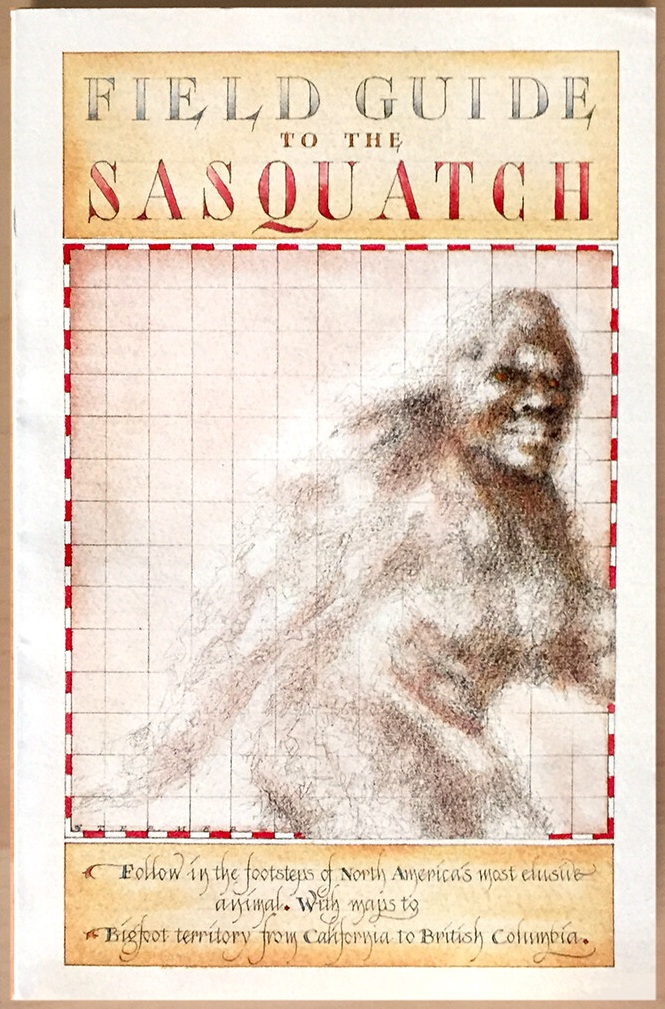
Sasquatch Books – 1992
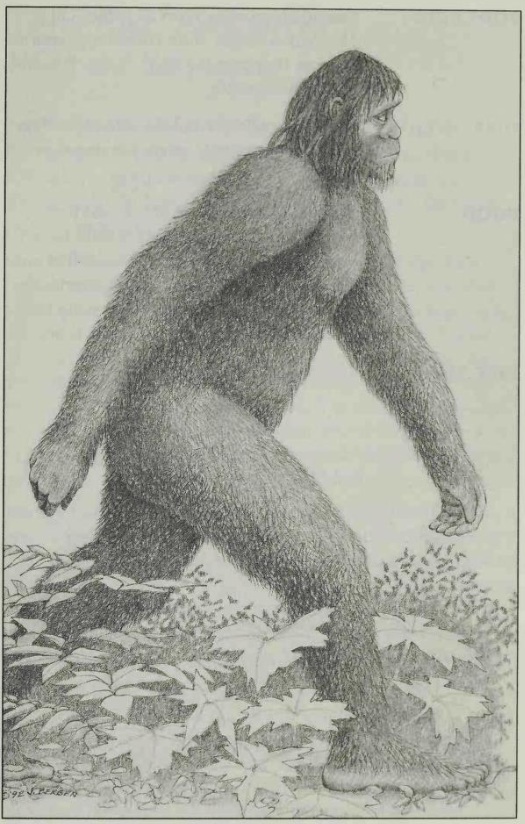
I’m planning a camping trip in the Pacific Northwest this summer, so I thought I’d read this Field Guide to the Sasquatch in the hopes of improving my chances of seeing a bigfoot. Unfortunately, this book contains little I haven’t encountered in greater detail before. It’s short and quite readable, but it was only when I sat down to write about it that I realised how incomplete it is. It contains the standard physical description of a sasquatch and lists a few places where they have been spotted, but the author assumes that sasquatch is a species of giant ape and gives no consideration to the idea that it might be a transdimensional entity. This text’s brevity and failure to consider the more fringe theories on the origins of sasquatch render it obsolete at this point. There’s not much point in reading this one.
This thing was written more than 30 years ago, and with every day that has passed, the likelihood of bigfoot’s existence has diminished. It’s disappointing, but I’m slowly coming to terms with the fact that I’ll probably never see one. I’m going into the woods in August though, so fingers crossed!
A few weeks ago, I was emailed a pdf of an academic paper on math. In 1992, Robert Birrell submitted his master’s thesis on the “analysis and construction of the small inverted retrosnub icosicosidodecahedron”. The small inverted retrosnub icosicosidodecahedron, a 3-d shape, and apparently it’s one of the more complicated uniform polyhedrons out there. Its complexity led to it being referred to as Yog-Sothoth, one of the Outer Gods of Lovecraft’s Cthulhu mythos.
Past, present, future, all are one in Yog-Sothoth.
So this Robert Birrell guy was clearly a nerd of the highest order, and for his Master’s thesis, he actually built one of these things. The essay I read is a description of how it was built. It does contain a section of the Lovecraftian origin of the shape’s name, but math isn’t my strong point, and most of the document went completely over my head. I wanted to do a blog post about Yog-Sothoth, but the paper I had read didn’t really give me enough material. Birrell has no internet presence that I could find, but I did find another nerd who had built a model of the small inverted retrosnub isohoohoo. I emailed him and asked if anything eldritch or bizarre occured during its construction, but he didn’t respond. (I want to make it very clear that when I use the word “nerd”, I do so with sincere respect. These are great men.)
I went looking for more Yog-Sothothery, but most of the books containing that name in the title are manuals for role playing games. I came across references to a grimoire named Liber Yog-Sothoth, but only a few copies were ever printed. The author, John Coughlin uploaded a pdf version of the central rite of the text, and that is freely available online. I read through it, and in honesty, it seemed as incomprehensible to me as the paper on geometry. The description of the rite is mostly limited to its script, and although I now know the basic steps of the ritual, I’m not really sure of the purpose behind it. The idea of summoning Yog-Sothoth is pretty cool, but what am I going to do with him when he shows up?
K’aem’nhi kh’rn K’aem’nhi kh’r K’aem’nhi kh’rmnu.
I was intrigued by this bizarre text, and I decided to further investigate the author. I found that he had written another book on Lovecraftian magic, and although physical copies are equally as scare, a pdf of this one, A Cthulhian Grimoire of Dream Work, was floating around online. I had to read it.
ACthulhian Grimoire of Dream Work
Waning Moon Publications – 2006
Last year, I read a grimoire called Gravelording. It was a bizarre book that described how a person would bring themselves closer to death so that they would have any easier time speaking to spirits in a graveyard. It was ludicrously silly, and it wasn’t until after finishing the book that I realised it was inspired by a novel written for children. The basic idea was that to communicate with dead people, you first have to almost kill yourself by starving yourself and going without sleep. I was reminded of this book when I started reading Coughlin’s ACthulhian Grimoire of Dream Work because Coughlin’s work gives almost the exact opposite advice.
The first section in the book outlines the Rite of Cthulhu. It’s pretty cool. I like the idea of shrieking “Cthulhu Fhtagn!” in a cave with my mates, but this rite is only supplementary to the rest of the book. The remainder is essentially a manual on how to induce lucid dreams. You could do the rite of Cthulhu if you wanted to try to point your dreams in a certain direction, but you could also skip it completely. In the next section, Coughlin advises the prospective dream voyager to tidy their room, drink some herbal tea, do a little stretching and to avoid television, caffeine and strenuous exercise before bedtime. This guy wants you to have a good night’s sleep! I was reading this just before going to bed too, so I was very appreciative of the author’s very good advice. I did a bit of snooping online about this guy, and he seems like a nice, good person. This suspicion was confirmed when I emailed him and received a prompt and polite reply.
I would have preferred to read something more heinous, but that says more about me than Coughlin. These books were not written for a mass audience, and from what I have seen, they actually contain fairly sensible advice. (Lucid dreaming, unlike gravelording, is a real thing.) Personally, I would prefer a book that explains the process of inducing horrible nightmares. I’ve had some pretty horrendous dreams before, but it would be kind of cool to be able to choose to dream about the great old ones destroying society and enslaving humanity.
Oh, and by the way, I recently appeared on the Bonversations Podcast. We talked about this blog, the Unabomber, Robert Anton Wilson and conspiracy theories. Give it a listen here.
Every now and again, I go back to Robert Anton Wilson. After reading his Illuminatus! Trilogy, I went on to theorize about his Sex Magicians. I then took a look at his Irish novel before returning a few years later to his autobiography. While the effects that Wilson’s writing had on the realms of conspiracy and modern occultism are vast, not all of his books are Nocturnal Revelries material. I recently read 2 of his books, Prometheus Rising and The Illuminati Papers.
Prometheus Rising
New Falcon – 1983
Prometheus Rising is basically a self-help book to show people how to untangle their neuroses and understand their own thinking. It’s largely based around Timothy Leary’s 8 circuit model of consciousness. This idea comes up in the first entry of Wilson’s Cosmic Trigger series, but he goes into more detail here. I’m not a psychologist or neurologist or anything, but this concept seems like a load of hoaky bullshit to me. The first few “circuits”, the ones involving survival, emotions and semantics, make some sense. These are definitely things that affect how people think, but by the time we get to the discussions of genetic memory and quantum consciousness in the 7th and 8th circuits, we are dealing with nonsense.
While the main premise behind the book isn’t remotely convincing, Wilson’s writing was entertaining enough to get me through to the end. One of Wilson’s big ideas, and I think he talks more about this in Quantum Psychology (which is essentially a sequel to Prometheus Rising), is the idea of reality tunnels. The fact that Robert Anton Wilson’s reality tunnel incorporated Leary’s 8 circuit model of consciousness doesn’t have much of an effect on how I view his other ideas. It works for him, but I don’t think it works for me. Maybe I just don’t understand it properly.
SMI²LE, another of Leary’s ideas, is also important in this book. SMI²LE stands for Space Migration, Intelligence squared and Life Extension. As Leary and Wilson saw things, these were the goals that humanity should be striving for. I found it painful to see how optimistic Wilson was in the early 1980s. Back then, these guys thought that humanity would currently be living on different planets, educated to the point that we’d be living in a work and war free utopia and that medicine would be bringing us to the edge of immortality. What’s actually happening in the world today? Social media has taken control of our thinking, and it’s promulgating anti-scientific and anti-humanitarian disinformation to an audience that is too complacent to spit out the shit they are being fed. The quality of human life in wealthy nations is actually deteriorating. The most powerful men in the world are narcissistic scum who care only for themselves, and the majority of people are happy about this. We’re completely fucked.
The Illuminati Papers
Ronin Publishing – 1990 (Originally published 1980)
I also read The Illuminatus Papers. This is a collection of interviews with Wilson and essays that are written from the perspective of characters in his Illuminatus! Trilogy. It’s far less focused than Prometheus Rising, but it contains many similar ideas. The 8 Circuit Model of Consciousness and SMI²LE both come up again. There’s also essays on Stanley Kubrick, Ezra Pound, Beethoven and Raymond Chandler and lots of poems. The most interesting parts of this book are the interviews with Conspiracy Digest magazine where Wilson discusses Crowley, Satanism and various conspiracies. Of the 12 books by Robert Anton Wilson that I have read, this one is the least important. I actually enjoyed reading it more than Prometheus Rising, but it doesn’t really add anything substantive to the the author’s big ideas.
Just last night, I found an interview that Robert Anton Wilson did with Nardwuar. I knew that they had talked, but I had never heard the interview before. It’s a good listen. I find that Bob’s interviews and lectures are a more entertaining way of learning about his ideas about the real world. I think I’ll read some more of his fiction next.
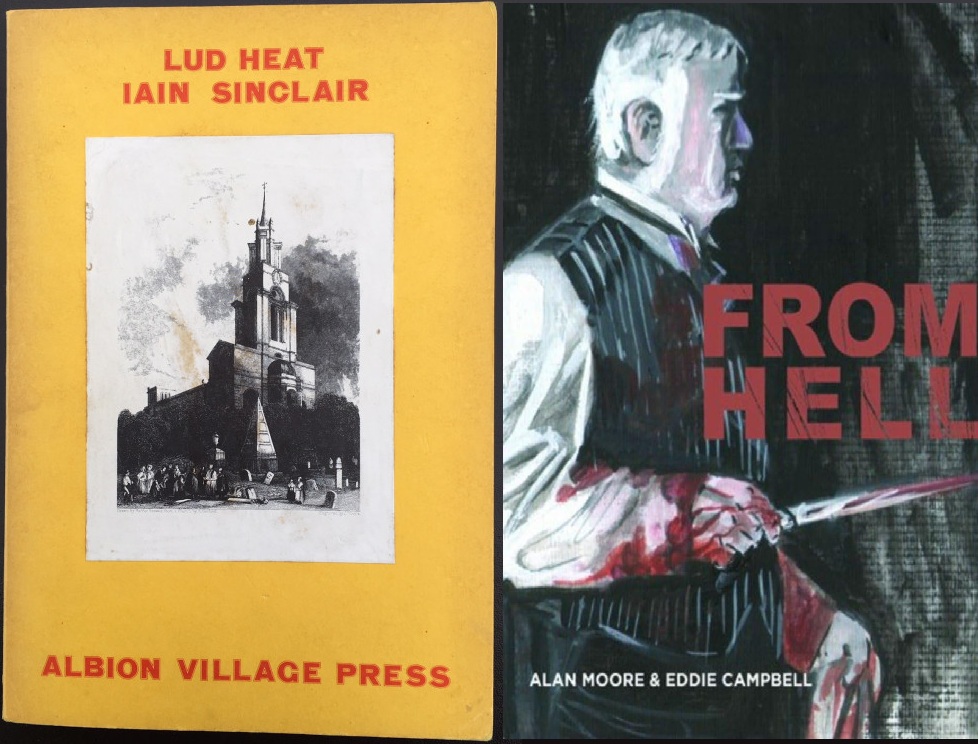
Sinclair’s Lud Heat (1975) and Moore’s From Hell (1999)
I first heard of Nicholas Hawksmoor when I read Alan Moore and Eddie Campbell’s From Hell, a graphic novel about the Jack the Ripper murders (more to come on that topic in the next few weeks!). Hawksmoor was an architect in the late 17th and early 18th centuries, and in Moore’s book, there are repeated references to the churches Hawksmoor designed in London. Moore suggests that the locations and designs of these churches bely their function as places of Christian worship. Hawksmoor was actually a Satanic pagan, and his churches were designed as talismans to serve in the great ritual of London city. The fact that Whitechapel, Jack the Ripper’s hunting ground, is situated between 2 of Hawksmoor’s churches is no coincidence.
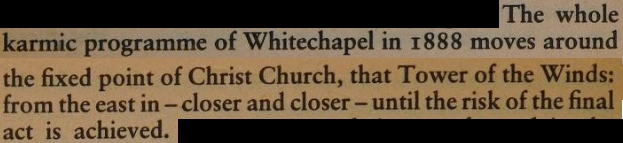
Quote from Sinclair’s Lud Heat
One of the major accomplishments of Moore’s meticulously researched work on From Hell is the synthesis of different conspiracies, characters and ideas from and about London in the late 1880s, and the notion of Hawksmoor’s churches being evil talismans originally comes from an author named Iain Sinclair. In 1975, he published a book of poetry called Lud Heat. The first section of the book is titled, Nicholas Hawksmoor, His Churches, and it’s here that Sinclair puts forth the idea that Hawksmoor deliberately infused his churches with sinister codes and symbols.
Quote from Sinclair’s Lud Heat
While there is no real evidence that Hawksmoor was a Satanist, he did incorporate obelisks, pyramids and other supposedly pagan symbols into his architecture. He was also extremely picky about the sites where his churches were to be built. When plotted on a map, they are said to form a pentagram, and Hawksmoor had them built in curious historical locations.
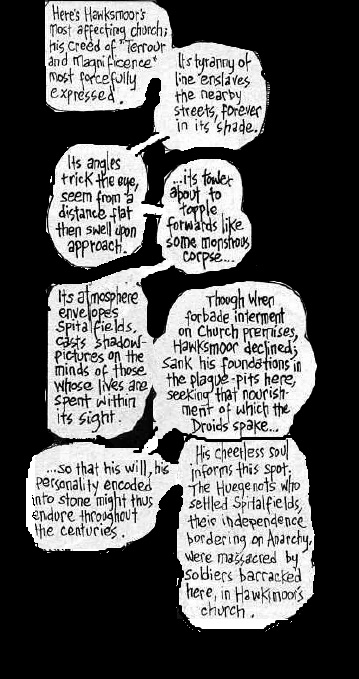
From Hell Chapter 4. Note the claim that the stone of the church will ensure the survival of Hawksmoor’s will.
Sinclair is a proponent of psychogeography. Psychogeography, as far as I understand it, is basically the process of walking around an area in an attempt to understand how its layout and architecture affect people. Alan Moore is friends with Sinclair and has openly acknowledged the influence of Sinclair’s ideas on From Hell. (Sinclair himself wrote a book about the ripper murders which I plan to read soon.)
Lud Heat is very much a poem about London. I’ve been to London a few times, but I don’t know the city well enough to really have a feel of what Sinclair is talking about. I also don’t care much for poetry, so while I read through his Hawksmoor poem, it didn’t really do much for me. This poem was published in 1975, and From Hell was finished roughly 20 years later, but halfway through this period, novelist Peter Ackroyd published Hawksmoor, another novel influenced by Sinclair’s ideas on Hawksmoor and psychogeography.
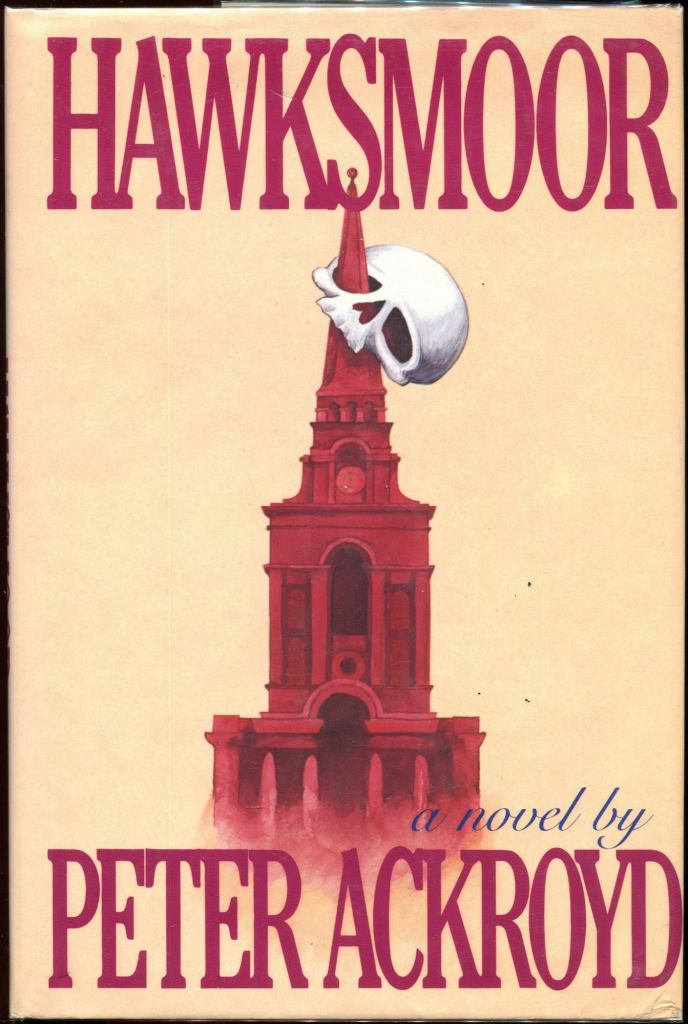
Harper and Row – 1985
Hawksmoor has 2 storylines. One deals with the trials and tribulations of Nicholas Dyer, a cantankerous architect who was initiated into a sinister cult as a child after his parents died of the plague. There’s a few minor discrepancies, but Dyer is clearly based on the real Hawksmoor. This is confusing because the second narrative takes place 200 years later and focuses on a homicide detective named Hawksmoor…
As Dyer’s churches are erected, he commits ritual murder at the site of each of these edifices to instill them with a malignant power. When the narrative switches to the present day, the reader witnesses Hawksmoor investigating similar recent murders that have occurred in the same locations as Dyer’s sacrifices. He is unable to solve these crimes, and the implication is that the sinister power that was imbued into each of the churches is still at work today. It’s not quite clear whether the recent deaths are to reinvigorate the churches with fresh sinister power or whether these crimes are just a grisly echo of evil “reverberating down the centuries”.
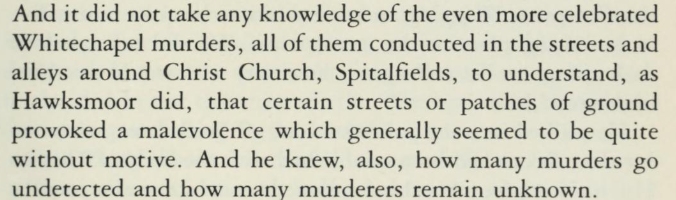
Quote from Ackroyd’s Hawksmoor (Remember that the Hawksmoor mentioned here is actually a police officer!)
Ackroyd only mentions the Whitechapel murders briefly his novel, but the notion that the design and locations of Dyer’s churches are responsible for violent deaths is central. Also, the fact that the murders in Ackroyd’s book are unsolvable does have an eerie parallel with the Jack the Ripper murders.
Ackroyd’s Hawksmoor is entertaining and at times quite funny, and while it’s more literary than what I usually read nowadays, I quite enjoyed it. I had been going through a bit of a lull with my reading material, and as I was reading this, it got me excited about books again. I have been meaning to read some books about Jack the Ripper for a while now, so I jumped at the chance to reread From Hell, and all of this talk of buildings being imbued with sinister powers caused me to revisit another old favourite.
Psychogeography seemed like quite a novel idea to me at first, but then I realised it was very similar to the mysterious science of megapolisomancy described in Fritz Leiber’s classic Our Lady of Darkness. Megapolisomancy: A New Science of Cities is a mysterious (and unfortunately ficitonal) book written by an even more mysterious character named Thibaut de Castries. De Castries believed that modern cities were dangerous places because of the materials used to construct their buildings. The layout and architecture of these buildings can drive people mad. De Castries claims that these pieces of architecture attract paramentals, bizarre entities that feed on human terror. A building designed in a particular way could be used to manipulate these entities into doing ones bidding.
Quote from Leiber’s Our Lady of Darkness
This is pretty much the exact idea that Sinclair, Ackroyd and Moore use in their respective books works involving Hawksmoor. Compare Thibaut’s thoughts there with the Sinclair’s description of Hawksmoor above. Note the emphasis on location, geometry and ritual.
De Castries dies before the events described in Our Lady of Darkness, but the effects of his work are felt long after he’s gone. Compare the following quote from Megapolisomancy with the events described in Ackroyd’s Hawksmoor and Moore’s From Hell. The buildings, these talismans of concrete are designed to house a lingering terror whose effects continue long into the future.
Quote from Leiber’s Our Lady of Darkness. De Castries probably doesn’t want to commit these “manipulations” to print because they involve ritual murders in the style of Hawksmoor!
In Our Lady of Darkness, the protagonist is terrorised by a paramental entity that had been coded onto the local architecture by an infernal work of neo-pythagorean meta-geometry (God, I love that phrase!). Ackroyd’s Hawksmoor leave rooms for a similar interpretation. The murders in From Hell are commited by a human of flesh and blood, but the murderer himself repeatedly refers to the influence of Hawksmoor’s churches on his heinous acts.
From Hell, Chapter 4 “magic… reverberating down the centuries”
Now at first I thought this was all a coincidence. Fritz Leiber’s first novel was first published before Sinclair, Ackroyd or Moore were born, and Our Lady of Darkness actually came out when Leiber was in his late 60s, 2 years after Sinclair’s Lud Heat had been published. Sinclair did not invent psychogeography, but the similarities between his ideas on Hawksmoor and Leiber’s megapolisomancy seem very specific. How would an old man have gotten wind of this new fangled version of psychogeography and put it into his novel? Now I can’t say for certain, but I’ve come across a potential explanation. Leiber was famous for popularizing the sword and sorcery genre along with English writer Michael Moorcock. These two authors were apparently good friends, and doubtlessly recommended books to each other. In 1995, Moorcock actually wrote an introduction to a new edition of Sinclair’s Lud Heat. He claims that he first met Sinclair as the author of Lud Heat, so it’s a long shot, but it’s not entirely impossible that Moorcock had read Lud Heat and suggested it to Leiber before Leiber wrote his first draft of Our Lady of Darkness. I know that Alan Moore is chummy with Moorcock, and Moorcock has also expressed praise for Ackroyd’s work, so it seems likely that Moorcock likely has some interest in their notion of psychogeography… It’s probably just a coincidence, but it’s fun to connect the dots.
I quite enjoyed writing this post. I’m going to have another post featuring From Hell in the near future. I generally avoid talking about graphic novels on here, but Moore is something of an authority on this stuff and I love him as an author and a person. It was funny reading through the appendix at the end of From Hell and seeing mention of my pal James Shelby Downard. Hawksmoor was initiated in freemasonry a few years before he died. I wonder what Downard would make of that!
I had originally planned a different post for this week, but I got about halfway through writing it and realised I needed to do more research. Luckily enough, I spent last Friday night reading Susan Hill’s novel, The Woman in Black.
Hamish Hamilton – 1983
I had seen the movie version with Daniel Radcliffe when it came out, but I had largely forgotten what it was about. (I do remember quite enjoying it though.)
A solicitor has to go and stay in the house of a recently deceased recluse in an attempt to find some important legal papers that had been in her possession. While he is staying in her isolated, desolate mansion, he starts to see an emaciated woman dressed entirely in black.
This is a good old fashioned ghost story, much in the style of M.R. James. At least one of the chapters is named after a story of his. I love this kind of fiction, especially when it’s done well, and this novel is just that. It starts off with the narrator’s family telling ghost stories on Christmas Eve. He leaves the room in a panic when it’s his turn, creating a blissful amount of tension. His tale is so terrifying that he can only tell it through writing, which is exactly what he proceeds to do. This is the kind of book that you want to read under a blanket. It’s very short too, and I find it hard to imagine reading it over more than a couple of sittings. I feel silly for not having read this classic sooner. If you haven’t read it, do so immediately.
Not much else needs to be said. This is an excellent ghost story. There was a novelisation of the sequel film that came out in 2014, but it’s supposed to be crap, so I have no interest.
I’m currently working on a few multi-book posts, and I realised yesterday that I had nothing prepared for this week’s post. I went through the archives looking for something short enough to get through in one day and found a curious pamphlet on the history of Satanism. I had no idea who Joseph McCabe, was, and I assumed this was going to be an evangelical tract, but it turns out that this McCabe guy was actually an important player in the rationalist and secularist movements of the early 20th century. Prior to writing texts like this, he was actually a Catholic priest, and so he has a pretty decent idea of what he’s talking about.
Haldeman-Julius – 1948
This deceptively dense text was written before the rise of the Church of Satan, and it presents a fairly unique historical perspective. The author doesn’t believe in Satan, but he does accept the notion of Satanic (yet mostly benign) witchcraft being fairly widespread throughout Europe during the Dark Ages. Here’s a chapter by chapter summary:
Chapter 1. How people started to believe in devils. First they came to believe in their own spirit and then the spirits of things. Then they imagined evil demons were responsible for things going wrong.
Chapter 2. How Satan went from a friend of God in the book of Job to a prince of demons. McCabe claims it was the due to the influence of Angra Mainyu, the destructive spirt of Zoroastrianism.
Chapter 3. During the Dark Ages, belief in the devil gave way to belief in vampires and werewolves. This chapter discusses incubi and succubi and the unlikely processes they use to impregnate sinners.
Chapter 4. McCabe believes that there was a witch cult as described by Margaret Murray but that it was more a revolt against Christianity than a cult dedicated to doing evil. Sure the witches used to hold orgies, but what harm is there in that?
Chapter 5. How the templars did actually bum each other and how the culprits involved in the Affair of the Poisons in the court of Louis XIV were sincere and genuine Satanists.
Chapter 6. Describes how people have come to see the freemasons as Satanists. Discusses the Taxil affair. Points out that communists are the modern day Satanists.
Joseph McCabe
Overall, the information in this book is not very accurate, but it offers an interesting insight into the way that people thought about the concept of Satanism before it became a codified system of belief. If you want to give it a read, it’s available to download here.
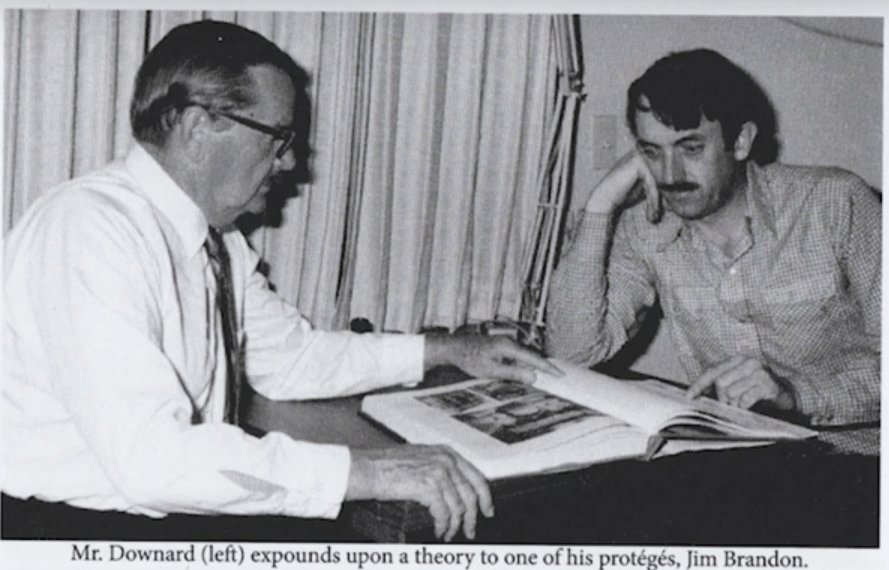
I first came across the name Jim Brandon when i was researching James Shelby Downard last year. Brandon was the guy who was interviewing Downard on the Sirius Rising recording that resulted in Robert Anton Wilson describing Downard’s ideas as the “the most absurd, the most incredible, the most ridiculous Illuminati theory of them all”. A little research on Brandon told me that wrote two books on Fortean phenomena, Weird America and The Rebirth of Pan but that most of his literary output was neo Nazi material that came out under the name William Grimstad.
Now I don’t have any interest in promoting the beliefs of neo-Nazis, but I do like reading weird stuff, and what I had read about Brandon sounded truly bizarre. After glancing through Weird America, I decided to skip it. It’s basically a list of places in America where Fortean phenomena have been witnessed. It might be useful as a reference book, but the thought of reading it cover to cover seemed pretty boring. I decided to focus instead on his The Rebirth of Pan. A book that claims that the great God Pan, a great and powerful Earth spirit is alive and dedicated to causing mischief in North America.
The Rebirth of Pan: Hidden Faces of the American Earth Spirt
Firebird Press – 1983
This is definitely among the weirdest books I have read. Its central claim, that science has become too rigid to meaningfully account for every known phenomena, is one I have encountered many times before, but the reasons given here to believe this claim are definitely more far-fetched than the usual stuff. I’ll give a brief summary of each chapter, or at least what I got out of each chapter.
Chapter 1 Bigfeet appear near horny people and menstruating. Aleister Crowley and Kenneth Grant point out that sex can be used to bring about bizarre magical entities. This would explain why we can’t catch bigfeet the way we catch other wild animals. Instead of luring our traps with meat, we should use a shagging couple.
Chapter 2 North America is covered in mounds. We don’t know who made these or how. Traditional archaeologists have suggested it was prehistoric Native Americans, but the author seems to believe that it was more likely a race of giants and a race of cannibal pygmies who were responsible.
Chapter 3 This chapter is a discussion of a bunch of artifacts that have shown up in America with text on them. Many claim these were from Native Americans, but others point out the similarities between this writing and Hebrew, Norse and Chinese. Most of these artifacts were dismissed as hoaxes, but author dismisses this notion because one hoax is unlikely but more than one is even more unlikely. This chapter is a bit confusing because Brandon includes both sides of the discussion, and it’s not until the end that he tells you what he actually thinks. He doesn’t think these artifacts come from native Americans or pre-Columbian visitors to North America. He thinks they’re from bigfoot. Now bigfoot here is a transdimensional entity, the kind encountered in The Psychic Sasquatch and some other book I’ve read recently that I can’t quite remember. (Maybe John Keel?) The writing on these artifacts is Norse, Chinese, and Latin, or some combination thereof. Whatever entity left these artifacts came from another time or dimension and they didn’t know which language the locals used, so they wrote in the one they were most familiar with. This is definitely the least unlikely possibility.
Chapter 4 Fossils that feature well preserved lifeforms may not be what scientists say they are. How do we know that these aren’t just rocks that are actually giving birth to these creatures? The author claims that idea that life comes from rocks is much better than the theory of evolution. Proof of this idea is found in the fact that bigfoot often makes piles of rocks and throws rocks at people to attack them. Weird stuff often happens near water, but more interestingly, weird stuff (tornadoes, bigfoot sightings, random explosions) frequently happen to trailer parks. The author suggests that this is probably because as metal containers, trailers are more likely to trap mysterious orgone energy, but it seems more likely to me that they’re more susceptible to tornado damage because they’re not anchored to the ground and more susceptible to bigfoot attacks because the people living in them are poor and probably uneducated (and hence more delicious to predators). It turns out that many of the strange structures and rocks dotted across America were made by Pan, the Earth spirit.
Chapter 5 More of the same, but this time he looks at how the measurements of some of these structures can be manipulated so that they relate to the measurements of the pyramids at Giza. Some of the structures he discusses here are from a book called Traditions of De Coo Dah by William Pidgeon, a book that has been accepted as a hoax for over a century. Brandon claims that the reason nobody has ever seen the monuments described by Pidgeon is that Pan caused the Earth to swallow them up in a reversal of the way he created many of the mysterious mounds previously discussed.
Chapter 6 Some numbers 23 and 33 are linked with countless weird events. Some names are too. Author lists off bad things that have happened in places called Lafayette or Fayette. These include cryptid sightings, the murders of presidents and prophets and more. He also points out that the Amityville murderer‘s name was Defeo (de-fay-oh), and Aleister Crowley’s mantra of, “do what thou wilt” translated into latin is, “fay que ce voudras”.
Chapter 7 The last chapter is basically a long conclusion that adds little to the author’s claims. It talks about symbolism and alchemy and Sirius. The nost intersting claim here is that some aliens, probably those from Orion, hate dogs because of the link between dogs and Sirius. The aliens from Sirius and Orion supposedly hate eachother according to some alien contactees. Bigfeet also hate dogs, so maybe they are aliens?
Appendices Only point of interest here is the suggestion that cattle mutialtions are done by bigfoot.
Overall, this book was a boring slog. It had some truly ridiculous ideas, but the reasoning is just too weak for it to be taken seriously at all. I love the idea of reading a book that references the works of Aleister Crowley, H.P. Lovecraft, Kenneth Grant, Edward Bulwer Lytton, Montague Summers, and Robert Anton Wilson, but there was no real cohesion to this jumbling mess. It’s not surprising that the author is a dumb piece of trash.
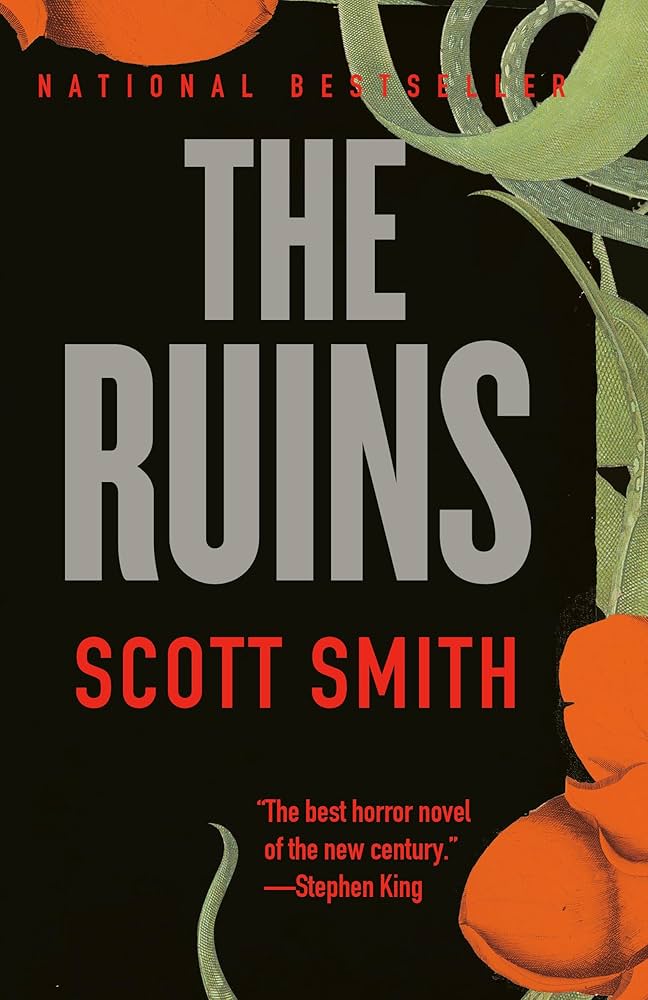
I read this on a whim recently, and though more modern than a lot of what appears on this blog, Scott Smith’s The Ruins was quite good.
Vintage – 2007 (First published 2006)
A bunch of young people go on vacation to Mexico and end up travelling into the jungle to see their friends who are supposedly working on an archaeological dig. When they get there, they get trapped on a hill that’s covered with an evil plant that won’t let them escape. Things get grizzly pretty quickly.
The plot is a bit silly, but this is well written, and there were a few genuinely scary moments. It really reminded me of The Troop by Nick Cutter. I just looked it up online, and apparently Cutter openly acknowledged that this book directly inspired his. Both books follow a small group’s nightmarish weekend on a remote and lethal location, and both feature the timeless combination of things that burrow inside people and sharp knives.
This kind of survival horror isn’t my favourite genre, but this was enjoyable. I am going to give Smith’s other, more famous, novel, A Simple Plan, a read soon.