The Beast of Jersey: A Satanic Rapist and Truly Horrible Person

Edward ‘Ted’ Paisnel was a serial rapist, and he committed his horrid deeds while dressed in a terrifying costume which included a rubber mask, a disgusting wig, nail studded wristbands and a nail studded trenchcoat. When police searched his home, they apparently found a black magic shrine dedicated to Gilles de Rais. Most of his victims were children. One of them had a mental disability. Ted Paisnel was as bad as any horror movie villain.
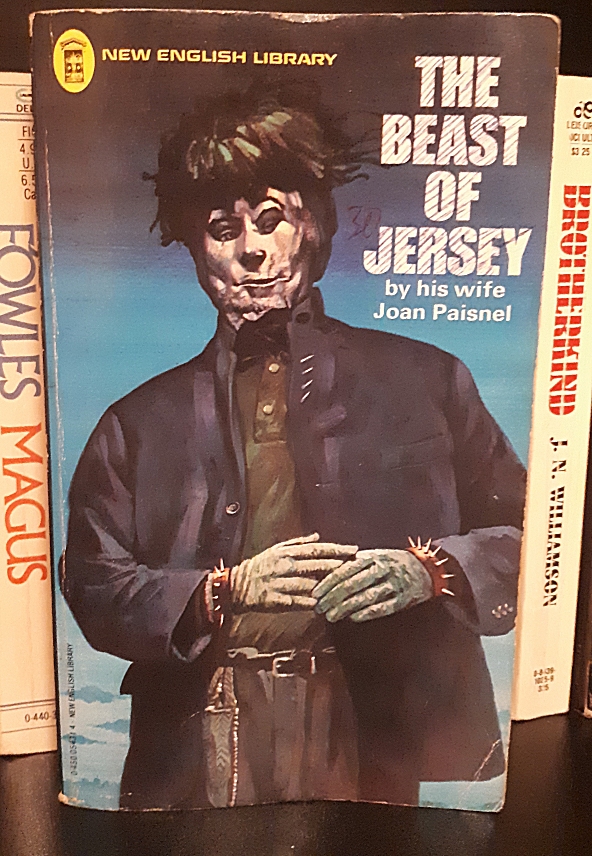
NEL – 1981 (First published 1973)

This book, The Beast of Jersey, was written by Ted’s wife. It’s a weird, exploitative, horrible piece of writing. She plays up the Satanic side of things, referencing witchcraft and Dennis Wheatley and including several chapters on Gilles de Rais without ever providing any solid evidence that Paisnel was seriously into that stuff. He supposedly had a few books on the topics, but surely that doesn’t mean a person is a Satanist. She goes so far as to suggest that the reason he got caught was because a car he stole contained a crucifix in the back seat and that this might have had an effect on his evil powers. Also, on top of accusing her husband of being a wizard, she also claims he was gay. This claim is based on the fact that he only raped his victims anally. She also alludes to the fact that he refused to sleep in the same room as her. I’m no expert on the psychology of rapists, but I’m pretty sure that anally raping a female does not make a person gay – it makes them an anal rapist.
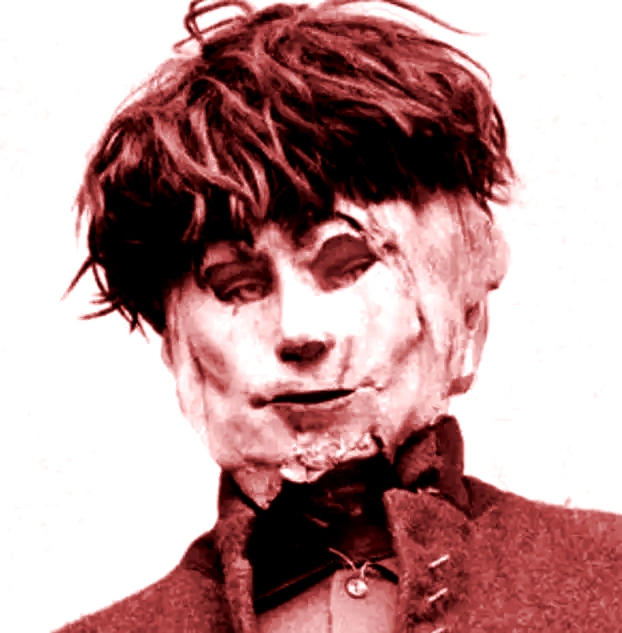
Paisnel’s actual mask

I have nothing but disdain for rapists and child molesters, but parts of Ted Paisnel’s story are a little bit funny. When he was caught by the police with his wacky costume in the back of a stolen car, he told the cops that he was going to an orgy. Also, there’s a part in the beginning of the book where Joan describes finding a story that Ted had written. It was about a child being pecked to death by a chicken. LOL. I wish I could read it. Apparently, he wore an eye-patch for months after watching True Grit because he wanted to be like John Wayne. What a freak.

There were some other interesting parts to the book that I hadn’t read anywhere else. During the second World War, Ted worked as a cobbler for the German forces that had invaded Jersey. He later claimed that the real nature of his work was as a midwife/pallbearer for the countless Russian sex slaves that the Germans had smuggled onto the island. Ted wasn’t clear about whether he had to murder their babies or just dispose of their corpses. It seems very unlikely that there is any truth to this story.

Ted’s wife ran a care home for orphans and children in need, and although Ted worked there regularly, he apparently never abused the kids there. I find that hard to believe. Joan spends a lot of time defending herself in the book, but I don’t trust her. Ted Paisnel was apparently one of three men on the island of Jersey who refused to be fingerprinted during the search for the sex maniac, and the police apparently chased him to his house on the night of one of the attacks. Joan knew about this, but didn’t put 2 and 2 together. Honestly, the fact that she even put her name to this horrible book is enough to make me suspicious of her. If my partner was the real-life cross between Michael Myers and Freddy Krueger, I’d move to another country and change my name, not try to profit from it. She seems to have been really good at being oblivious. You’d have to wonder about the poor kids who were in her care.

I don’t really buy any of the black magic/Gilles de Rais stuff in this book. It’s not necessary. Ted Paisnel was as horrible as a person can be. Reading the accounts of what he actually did was deeply upsetting. He seemed to relish the fear and discomfort of his victims. He was a sick piece of scum. He was let out of prison 10 years early and went to live on the Isle of Wight because he didn’t feel welcome on Jersey anymore. He died 3 years later of natural causes. Seems a real pity that he wasn’t given a taste of his own medicine by a disgruntled vigilante.

Burn in Hell, paedo scum

I had wanted to read this book for a long time, but copies online were too expensive. I came across a cheap copy on my holiday to Ireland last month. It included a Dublin Bus ticket from 1995 that the last reader had used as a bookmark. I generally prefer ebooks at this point, but I have to admit, it felt pretty cool to read a 40+ year old book that hasn’t been cracked in almost 30 years.

Peter Haining’s Anatomy of Witchcraft

T’sandem – 1974 (Originally published 1972)

I’ve read my fair share of books about the history and practice witchcraft. There’s a lot of them out there, and I’m generally more interested in the slightly trashy ones from the 60s and 70s that blur the line between fiction and reality. I don’t read much stuff like that anymore, but when I was reading about the Son of Sam killings last month, I discovered that David Berkowitz had sent an annotated copy of Peter Haining’s The Anatomy of Witchcraft to police officers who were investigating the case. I also deduced that this book was one of Maury Terry’s sources on the Satanic cults of California in the late 60s, so i thought I’d better give it a go.

Roughly half of the book is about white witchcraft/Wicca and that kind of stuff. I have little interest in this type of thing, but the rest of the book is about black magic and Satanism. It was entertaining enough. I’ve come across most of the information in here before, but some of it is presented in a slightly different light here. Haining basically splits the world up into different areas and then does chapters on the parts which contain the most witchery.

Haining isn’t known for being entirely reliable. He lists Dennis Wheatley as a source of much of his information, and he includes a lengthy letter from noted plagiarist Rollo Ahmed too. Other parts of the book are based on myths (the idea that Catherine De Medici was a Satanic witch), and others are thoroughly mixed up. Haining clearly has a bee in his bonnet about LSD, and at every given opportunity he tries to link it with Satanism. Parts of this book really reminded me of Satan Wants Me by Robert Irwin.

Joris Karl Huysmans wrote a novel called Là-bas, in which he describes a black mass. The main satanic character, one Canon Docre, is said to have been based on Joseph-Antoine Boullan, an occultist who was kicked out of the Catholic clergy. Boullan and Huysmans were friends until Boullan died (supposedly because of a magical attack) in 1893.

In Anatomy of Witchcraft, Peter Haining includes a rant from Huysmans that refers to Canon Docre as if he was a real person. I was very confused by this, as he wasn’t being very nice. Why would he shit-talk his dead friend? I did a bit of research though, and it turns out that he was actually referring to a Chaplain from Bruges named Louis Van Haecke. Von Haecke was said to have the cross tattooed on the soles of his feet so he could blaspheme whenever he walked, and it seems like Huysmans explicitly claimed he was the inspiration for Canon Docre elsewhere.

Haining claims that Huysmans wrote Là-Bas as a rejection of the horrors of Satanism. He also claims that Boullan crucified small children during black masses. It’s hard for me to believe that Huysmans, conscientious, reformed Catholic that he was, would be down to hang out with a person who crucified small children. It’s funny. I did a search for the name Boullan through my blog, and it turns out this is not the first post that I’ve written about his alleged misdeeds.

There’s a chapter in here on Satanism in California that discusses the links between Charles Manson, the Process, the Chingons and the mysterious Four Pi cult. I’m planning on writing a separate post on that stuff quite soon though, so I’ll leave it for now. Very curious indeed.

There was some other mildly interesting stuff in here. He discusses the Bernadette Hasler case and the Skoptci, a weird Russian sect who cut off their own dicks. I’ve defintely read about both cases before, but I can’t remember where. Also included in this book is a very questionable quote about voodoo.

Yikes.

Overall, this is a moderately entertaining read. It does not seem particularly reliable though, and I would do a bit of extra research before accepting anything in here as fact.

The Son of Sam a Satanic Assassin? Maury Terry’s The Ultimate Evil

Dolphin Books – 1987

The Ultimate Evil: An Investigation into America’s Most Dangerous Satanic Cult – Maury Terry

David Berkowitz, the Son of Sam, was a lunatic who shot and killed a bunch of innocent people. When he was arrested, he admitted to all of the killings. After the arrest, a reporter named Maury Terry started researching the murders and became convinced that David Berkowitz was actually involved with a Satanic cult and that he did not commit the murders alone.

While on his killing spree, the killer (at least one of them) sent letters to the police and the press referring to himself as “the son of Sam”. Berkowitz later claimed that Sam was an ancient demon that had possessed his neighbour’s dog. The neighbour’s name was Sam Carr. Terry became convinced that Sam Carr’s actual sons had been Berkowitz’s accomplices.

I’m no expert on this case, but that idea doesn’t seem absolutely unfeasible to me. Berkowitz was well known to the Carr family, and both sons died unnatural deaths shortly after Berkowitz was arrested. Some people who know lots about the case also believe that Berkowitz did not act alone, and it seems impossible to prove that the Carr brothers were not involved.

I knew that the claims in The Ultimate Evil were controversial before I read it, and I went in assuming that most of it was complete bullshit. I knew that there was a Netlix documentary series about it, and I thought that this series was going to be an exposé on how Terry’s ideas were all nonsense. There’s some stuff in the book (Terry’s decoding of the Son of Sam letters and the Roy Radin stuff) that seemed like utter nonsense as I was reading them, but some of it was actually quite convincing. When I watched the Netflix documentary, I expected it to provide refutations of these ideas, but it doesn’t.

Berkowitz started off claiming he acted alone, but he changed his story after spending a bit of time in prison. To this day he claims that he had accomplices. He doesn’t seem like a particularly reliable person though. He clearly enjoys attention, and the Satanic cult claims were probably the most efficient source of attention for an incarcerated murderer in the early 1980s. Both the book and the Netflix documentary series make it seem like Berkowitz was merely telling Terry exactly what he wanted to hear. This muddies the water, but it doesn’t actually discredit all of Terry’s evidence.

Much of what Terry says is clearly conjecture, but I don’t think the idea that Berkowitz had accomplices should be immediately disregarded. Those Carr brothers were definitely weirdoes. Both were scientologists, and one supposedly had a thing for murdering animals.

The Netflix documentary alludes to the fact that this book fed into the Satanic Panic of the 1980s, and it features clips of Maury Terry being interviewed alongside my old friend Phil Phillips. I wanted to be able to write-off Terry’s theory about the role of Satanism in the murders, but if you look at the letters, the killer(s) clearly had some interest in occultism. I don’t buy any of the “large, organised network of powerful Satanists” nonsense or any of the crap about the links between the Son of Sam and Charles Manson, but Berkowitz did seem to have some connections to occultism. Nevertheless, Terry’s efforts to bring attention to his work by jumping on the Satanic Panic bandwagon seem to have backfired. There’s a couple of parts where he mistakes Iron Maiden lyrics written on walls for Satanic prayers. When he’s trying to decode the letters he does the old “reading it backwards” trick, and at one point he even references James Blish’s Black Easter. So much of this book is dumb that he interesting parts seemed pretty uninteresting.

One of the main reasons I wanted to read this book was because I had read it contained information on the elusive Four Pi cult, an evil group of weirdos led by “The Great Chingon” that I previously came across in Ed Sanders’ The Family and Gavin Baddeley’s Lucifer Rising. The only information in here that Terry adds is that the group split up at the end of the 60s because some members were too horny. Rereading the passage in question, I realised that Terry’s source was actually Peter Haining’s The Anatomy of Witchcraft, a book which David Berkowitz annotated and sent to the Ward County Sheriff’s Department when they were investigating John Carr’s death. (Needless to say, I have already started reading that book for a future post!)

Quirk Books – 2021

I actually read the revised edition of The Ultimate Evil. It has a little bit extra on Roy Radin’s death and a few other things. Both editions of this book are extremely long, extremely detailed and ultimately extremely boring. The Netflix documentary is a much clearer way to understand Terry’s ideas. There’s really no need for anyone to slog through this unenjoyable mess (that does, admittedly, make a few good points.)

The Last Days of Christ the Vampire – J.G. Eccarius

III Publishing – 1990 (First published 1988)

I first heard of this book a long time ago. The title and extremely childish cover were alluring, but copies were always that little bit too expensive for something that was probably awful. None of the reviews I read made me want to splash out either. I got my hands on a cheap copy recently, and I was pretty excited to get going.

A quick glance through this blog will prove that I have read my share of terrible books. It’s quite a feat to truly disappoint me. In truth, I think that The Last Days of Christ the Vampire might deserve the title of the worst novel I have ever read.

This is anarchist fiction. I’m not an anarchist, but the fact that this book espouses anarchy is not what made me dislike it. The writing here is unreadably poor. It’s like J.G. Eccarius never once considered the fact that novels are supposed to be entertaining. There is a plot here, but the story is so poorly told that it made it very difficult to figure out what was going on. There’s no focus on any specific character, and cast of characters is huge. To make matters worse, some characters change their names throughout the story. The writing itself is bad, and the plot construction is pathetic. This book is unbearably boring.

So Jesus was actually a vampire, and he is still alive today. There are a gang of vampires (including Simon Magus and Aleister Crowley) who have a hand in controlling world affairs. Some MaximumRocknRoll reading punk-rockers decide to put an end to this, so they go to Jerusalem to go vampire hunting. This all ends in a massive attack against the Pentagon.

That summary makes this book sound pretty good. A barely competent writer could have made this into something enjoyable. Unfortunately, the above paragraph contains all of the interesting parts of the book. The author chooses to pass over everything cool about a vampire Jesus and spends his time trying to promote an incredibly naïve political agenda – there’s no chilling descriptions of Jesus drinking his victim’s blood, but there are many paragraphs about mailing anarchist zines. I bet the author wore a bumflap. The action sequences are excruciating. This is awful fiction. It stinks. I wanted to give up, but I forced myself to finish it. Piece of shit.

More Books about Charles Manson

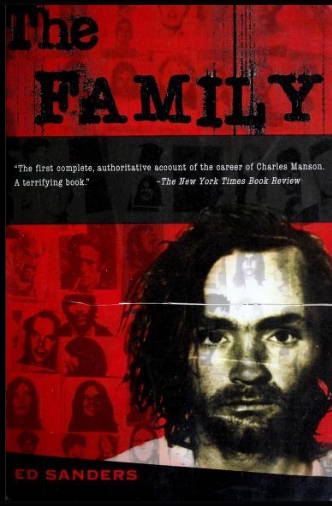
I read Ed Sander’s The Family a few weeks ago, and it reignited my interest in the Manson Family. Charles Manson and his followers were horrible people, and I have little sympathy for them, but there is something fascinating about how they lived and what they did. Here’s another 3 books about them.

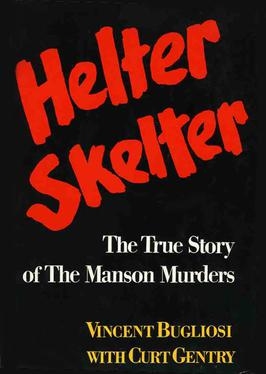
Helter Skelter – Vincent Bugliosi

W. W. Norton & Co- 1974

I have understood the story behind Helter Skelter for most of my life. A few months ago, I read Ed Sander’s The Family, and I learned a lot about Charles Manson and the Tate-La Bianca murders. Sanders does mention the Helter Skelter stuff in there, but his book is not limited to the crimes and their motives. When I posted about The Family, a friend recommended that I read Chaos by Tom O’Neill. I put a hold on the audiobook version from my local library and waited 6 weeks. After listening to the first 20 minutes, I paused it and started reading Helter Skelter.

Chaos reveals O Neill’s findings after 20 years of researching the Manson case. The first thing it claims is point out that the “official” story as presented in Helter Skelter is based on lies and that O’Neill can prove this claim. Knowing this going in, it was a bit hard to swallow some of the stuff in Helter Skelter. Charles Manson and his followers were clearly a danger to society, and I don’t think anyone really believes that they were innocent, but the story that Bugliosi puts together to get them convicted does seem a bit sketchy. Manson was a dangerous, paranoid, psychotic criminal, but the race-war as foretold by the Beatles and subsequent escape to the Hollow Earth story actually seems a bit too cohesive for Charlie. It seems much more likely that the murders were drugs or revenge related.

As a book, I found Helter Skelter a bit tedious. I had read The Family just a few weeks before and was familiar with the story, and Helter Skelter’s focus is mostly on the court case. It’s an important book in Manson history, but it’s clearly not entirely accurate.

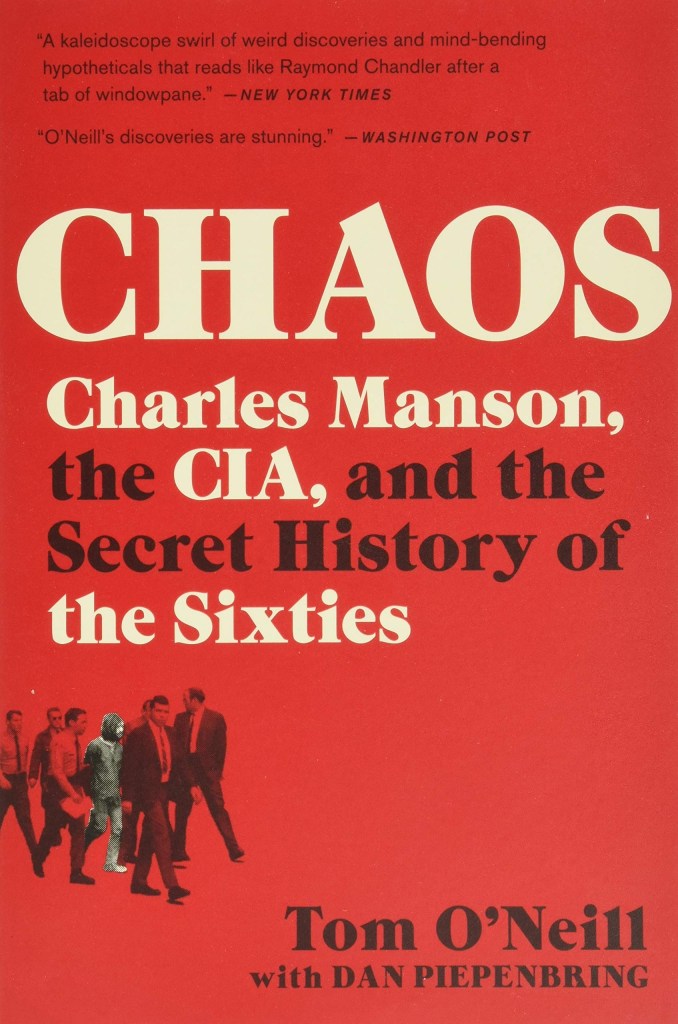
Chaos: Charles Manson, the CIA, and the Secret History of the Sixties – Tom O’Neill

Back Bay Books – 2020 (First published 2019)

Chaos is a very captivating read. Its main claim is that the narrative in Helter Skelter is inaccurate. O’Neill shows that the relationship between the Family and the Polanski household was far less tenuous than Bugliosi wanted it to appear. Apparently Bugliosi told O’Neill that the cops found a video at the murder scene of Roman Polanski being cuckholded. It is suggested that the Polanskis and their friends were involved in more naughtiness than has previously been reported.

This seems perfectly believable to me. It refutes the Helter Skelter story, but it does not exonerate anyone.

O’Neill’s research takes some shocking turns, and pretty soon he is linking the Manson murders with the MK-ULTRA and the JFK assassination. That probably makes it sound crazy, but it’s terrifyingly convincing. O’Neill’s research does not reach any tidy conclusions, but the evidence he provides convinced me that there was a lot more to the Manson story than was told in Helter Skelter. I don’t want to summarize the book or O’Neill’s findings, but he convinced me that the CIA were involved in some way. I strongly recommend that anyone with an interest in the Manson family or government deception read this book. I knew that American government agencies got up to some shady stuff, but I wasn’t aware of the reach of programs like COINTELPRO and Operation Chaos. The FBI sent a letter to Martin Luther King telling him to kill himself? What the fuck?

The Manson File – Nikolas Schreck

Amok Press – 1988

The other book that was recommended to me after finishing The Family was lil’ Niky Schreck’s The Manson File. A new, almost 1000 page edition of this book was published recently, but I was only able to get my hands on the 200 page, first edition from 1988. This was quite different to the other books on Manson I have read. It’s a collection of documents by and about Charles Manson that attempt to make him out as a misunderstood, outlaw rebel and all-round cool guy.

I have to be honest here. I am biased against Mr. Schreck. Provocation is pretty cool, but this guy has been known to cross the line into edge-lord territory. He appeared on white-power talk shows in the 80s. That was a long time ago, and based on his current bandmates, I doubt he is the most racist guy in the world, but when the queen of england died last year, he posted about how much he supports the monarchy. YUCK.

The Manson File has some interesting bits, but a lot of it is Manson’s own writing. I’ve listened to a lot of interviews with Manson, and he has a tendency to get lost in his own words. This gets worse without an interviewer to reign him in. The only piece that he wrote in here that I enjoyed was his letter to Ronald Reagan in which he told the former president to end the war on drugs and to invest that money into planting more trees. I am 100% behind this line of thinking. There’s also a letter he wrote in the mid-’70s to the Hollywood Star, a tabloid newspaper, spilling some Hollywood secrets. It’s in this letter that he claims that Jane Fonda had sex with a dog. He also claims that Roman Polanski funded his Hollywood movies with “money from dog and children movies”. One might write this off as slander, but it was written before it came out that Roman Polanski actually anally raped children and made movies of his wife being raped by other men. What a fucking piece of shit. I wish the Family had killed him instead of his wife.

A lot of the book is taken up with awful art, songs and poems by Manson, and there’s a cringey essay describing the similarities and nebulous links between the Family and The Process Church of the Final Judgement. It also features a couple of essays by James N. Mason, a neo-nazi, terrorist and convicted paedophile. In a completely expected turn of events, Mason, one of the worst people in the world, idolizes Charles Manson. The only other noteworthy part of this text is a picture of the contents of a package that Charlie sent to Nick Bougas, a contributor to this book. The package contained a book and a pair of Charlie’s dirty undies. As awful as Charles Manson was, he clearly had some redeeming qualities.

Given the fact that the new edition of The Manson File is 5 times longer, I am sure it’s a very different book. I get the sense that it contains more information on the inconsistences within Helter Skelter, but I won’t be sure until I read it. At this point, I have read more than 1200 pages about Charles Manson in the last 2 weeks, and I will probably wait a while before I seek out the new edition of Schreck’s work.

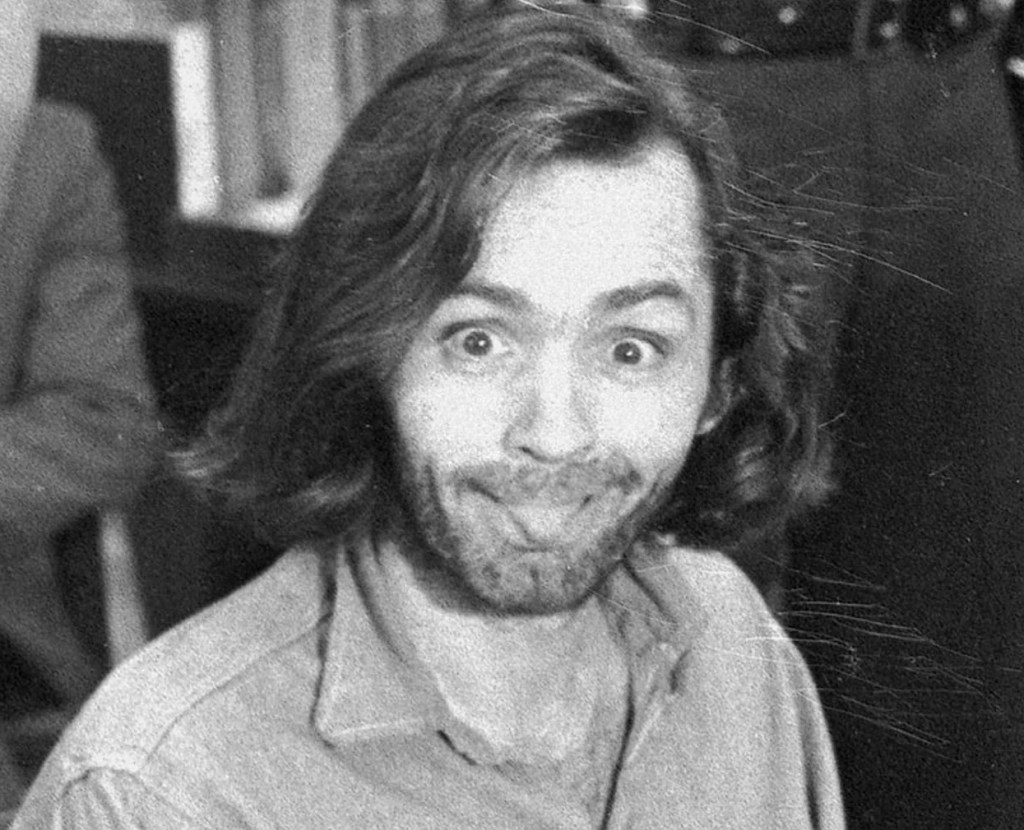
I’ve definitely spent too much time on Charles Manson recently. The acts he inspired were horrendous, but it’s hard not to find him entertaining. I think part of the appeal is that Charlie was one of the biggest losers to have ever lived. He had a traumatic, loveless childhood. He had no formal education. He was insane. Just as things started looking up for him, he fucked it all up beyond everyone’s expectations, potentially because he had become a test subject for CIA mind control experiments. His life was a an absolute disaster, but he always managed to keep a smile on his face.

What Happened to the Manson Family Snuff Films?

A few weeks ago, I reviewed a book about the history of the Process Church of the Final Judgement. That book describes the very tenuous links between the Process and the Manson Family and notes that these links were initially highlighted in the first edition of Ed Sanders’ The Family. The Process took Sanders to court and had the offending chapter of his book removed in subsequent editions. This is a bit ridiculous as they had interviewed Manson for an issue of their magazine that came out before Sanders’ book. They liked looking for attention, but it seemed to concern them when they actually got it. I had been planning to read Bugliosi’s Helter Skelter for years, but when I heard of Sanders’ book, it seemed far more appealing. While a lot of it wouldn’t hold up in court, it’s not supposed to. Sanders fully acknowledges that many of his sources were less than trustworthy. Part of its value lies in the way it preserves the rumours about the Family from a time when they were still an entity.

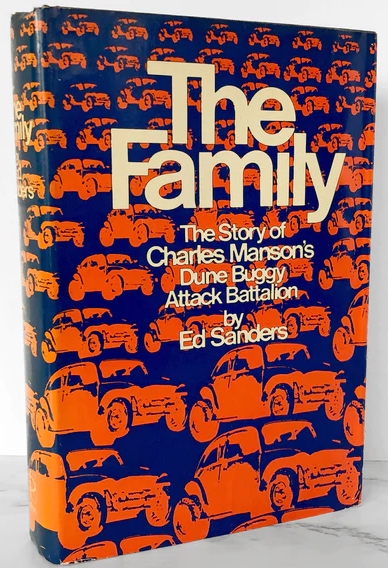
E.P. Dutton and Co. Ltd – 1973

The Family: The Story of Charles Manson’s Dune Buggy Attack Battalion

When I was an edgy teenager, I thought Charles Manson was pretty cool. I was 16 when I stenciled his face onto the front of my schoolbag. (LOL. I was an idiot.) All the bands I liked seemed to have songs or t-shirts about him, and I read a bunch of websites about the Family and watched all of Charlie’s interviews on youtube. I knew the basic story of Manson’s life, the Family, the murders and the whole Helter-Skelter thing. There was lots of interesting stuff in Sanders’ book that I didn’t know about already, but the biggest surprise was the claim that the Manson Family may have recorded snuff films.

Apparently the Family made quite a few home movies, some of them pornographic. It doesn’t seem like the footage has ever turned up, but it is known that Charlie’s gang had several cameras, including a TV camera they stole from an NBC station wagon. Far more concerning are the claims of one associate of the Family who claims to have seen three extremely disturbing films featuring Family members. He claims that these films were shown at night and involved animal torture and sacrifice. One of them featured a dog being tortured to death and then people having sex while covered in the dog’s blood. The person who made this claim did not explicitly say that the video was filmed by the Family but that it involved members of the Family. Sanders mentions reports of numerous occult rituals that were reported in that area at the time the Family were living there, and elsewhere in the book, he spends a great deal of time discussing the The Solar Lodge of the Ordo Templi Orientis, a bunch of Crowley freaks who were supposedly linked with the Family. Crowley used animal blood during some of his sex magic rituals at the Abbey of Thelema, so it’s not unbelievable that his followers would have done the same. (Apparently the source of his information about the cult activity was Arthur Lyons, author of Satan Wants You.) Another video featured a cat being blown up with fireworks, and the final and most gruesome video was of the corpse of a decapitated woman. Sanders claims that it was suggested to him that the Process may have been behind these appalling acts, but as Gavin Baddeley notes in Lucifer Rising, this doesn’t really make sense. The Process were always dog lovers, and their organization ultimately ended up as an animal shelter.

In the revised version of The Family that came out in 2002, Sanders notes that none of this footage has ever been found. Maybe I am wrong, but I don’t think the more innocent Manson Family home movies have shown up either. Do (or did) they exist? Does some weirdo have them? Are they buried in the desert in Death Valley?

The 2002 revised version of the text that omits nearly all mentions of the Process.

I was reading an article on The Reprobate recently that mentioned an advertisement that showed up in Variety Magazine in the 1980s offering hundreds of hours of footage of the Manson Family filmed between 1969 and 1973. This sounded intriguing, but it also included the movie rights to Robert Hendrickson’s 1973 documentary, Manson. The asking price was ridiculously high, and it didn’t seem like anyone took the mysterious seller up on their offer. I also saw mention of a documentary series from 2018 that was called Inside the Manson Cult: The Lost Tapes, but when I researched that, I found that the 100 hours of footage that was sifted through to make the show, “was discovered after British producer Simon Andreae traced the whereabouts of filmmaker Robert Hendrickson, who had been given exclusive access to the Manson cult 50 years ago.” It seems like Hendrickson was probably the seller in the Variety ad, and I doubt very much that his collection of Family footage contained any snuff films.

The difficulty with researching anything to do with the Manson Family is the sheer volume of information and discussion about them online. We’re talking about some of the most infamous crimes ever committed. Also, it turns out that Sanders’ book was the birthplace of the phrase “snuff film”, so that messes up google searches on this specific topic, and that’s rabbit hole that I don’t want to fall into. There was also an exploitation movie produced called Manson Family Movies (1984) that claimed to be found footage of the Tate-La Bianca murders. This film shows up a lot when you go looking for the real stuff. I’m not saying that it hasn’t been addressed countless times, but I didn’t actually see much discussion on the films, real or fake, that Sanders’ mentioned. If anyone has any further thoughts or information on them, I’d love to hear from you. (If you are in possession of the snuff footage, please don’t send it to me.)

Again, I’ve been familiar with the Manson story for most of life, but I’ve long had it categorized in my head as a crime story. I hadn’t really given much thought to the culty aspects of it. The Family was as culty as can be. While it doesn’t seem likely that there were any important links between the Family and the Process, both were certifiable doomsday cults. Like de Grimston, Charles Manson once claimed to be a scientologist and had a Christ/Satan thing going on. I think the big difference was that Robert de Grimston was a huckster and that Manson was violently insane. There’s other stuff in this book about the mysterious (and possibly fake) Four Pi cult, but I’ll do a separate post on them in the future. Also, while we’re (kinda) on the topic of Satanism: Bobby Beausoleil, the Family member who murdered Gary Hinman, starred in a movie with Satanist Anton LaVey, the guy who played Satan in a Roman Polanski movie. Some Family members later claimed that Sharon Tate’s murder was a copycat job to make it look like Hinman’s murderer was still on the loose so that Bobby could get out of jail. Small world. (Edit: Apparently LaVey had nothing to do with Rosemary’s Baby. Sorry. I read it in a book, but apparently that book was wrong.)

When I started the book, I googled Ed Sanders and saw a familiar face. It took me a few days to realise where I had seem him before. He was one of the guys in that video of William F. Buckley interviewing a drunk Jack Kerouac about hippies. I went on to listen to his band, The Fugs. Honestly, I wasn’t impressed by the first few songs I heard, but this one instantly became one of my favourite songs ever. Seriously, it’s genius. Ed Sanders is a pretty cool guy.

I was greatly entertained by this book, and while reading it and researching the Manson Family, I came across quite a few other books that I intend to read. I mentioned above that I used to think that Charles Manson was pretty cool. I actually find him more interesting now than I did back then, but I want to make it very clear that I now understand that he was a tragic, but horrible piece of walking garbage.

The Process Church of the Final Judgement: Misunderstood Prophets of Doom or Edgy Dorks

Love, Sex, Fear, Death: The Inside Story of the Process Church of the Final Judgement Timothy Wyllie
Feral House – 2009

I’ve long been meaning to look into the Process Church of the Final Judgement. I remember a big section on them in Gavin Baddeley’s Lucifer Rising, but they’ve popped up in loads of other books I’ve read too. This book, Timothy Wyllie’s Love, Sex, Fear, Death, is a first hand history of this mysterious and misunderstood group of devil worshippers.

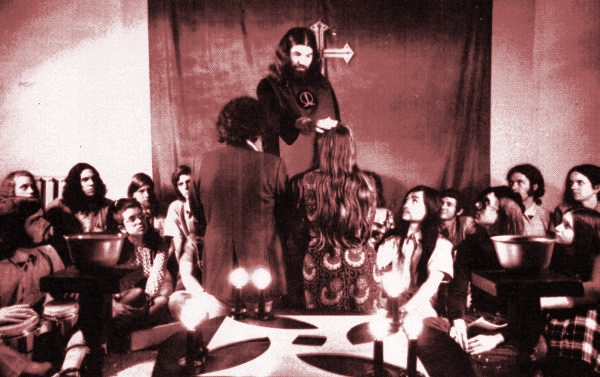
The Process was a British offshoot of scientology. Its leaders, self-styled Messiah, Robert de Grimston and his wife, Mary Ann Maclean, convinced a group of rich students to give up all their money and proselytize for the Church on the streets of London. It was a weird form of proselytization though. The young disciples wore long dark cloaks and sold creepy looking magazines about sex, fear and death. Their literature claimed that they worshipped both Jehovah, Satan and Lucifer, and they occasionally performed occult rituals and self flagellation for the public. It seemed like they put more effort into scaring people away than to luring them in.

This book is a collection of recollections and reminisces of former members of the church. “Church” here basically meaning a cult; it had the central authority figure(s), the need to give up all worldly possessions, thought reform, sexual grooming… it ticks all the “cult” boxes. Perhaps the most curious thing about the Process was that few of the members seem to have taken its religious teachings seriously. This may be due to the fact that these accounts were given decades after the group disbanded and the authors didn’t want to admit their gullibility, but most of them explicitly state that they were never convinced by de Grimston’s absurd theology.

At least they made it look cool.

It almost seems like most members of the Process were aware that the whole thing was nonsense, but they were having fun so they went with it. I wouldn’t say these accounts glamourise life in a cult, but they don’t generally describe it as intolerable. Most of the contributors seem to value the time they spent together. These were young people spending their twenties acting like the bad guys in a Dennis Wheatley novel. Some of them travelled the world with the cult and their reputation and weird looks got them a lot of attention. They hung around with celebrities and got invited to the Playboy Mansion. They had their own rock bands and TV shows too. Honestly, it seems to me like they all knew it was horseshit but kept going because it was fun.

If you walk around in dark capes saying that you worship Satan, it’s only a matter of time before you’ll find yourself in trouble, and the Process were no exception. After the Manson murders, people tried to draw links between the Process’s LA branch and the Manson family. This wasn’t helped when the Process interviewed Manson in their magazine a few years after the murders. A decade after they disbanded, people were still trying to pin the blame for murders on this gang of naïve edge-lords. (There’s a book on that specific topic that I plan to read soon.)

As silly as the Process were, this book is actually very interesting. Wyllie’s narration is so entertaining that I checked to see if he had written any other books. He has, but they are about psychically talking with angels and dolphins, so I will definitely not be reading them. There’s an entertaining video of him online in which he snorts ketamine to communicate with angels. He must be close to 80 in the clip. I don’t want to promote drug use, but if you’re going to get high, that’s the way to do it.

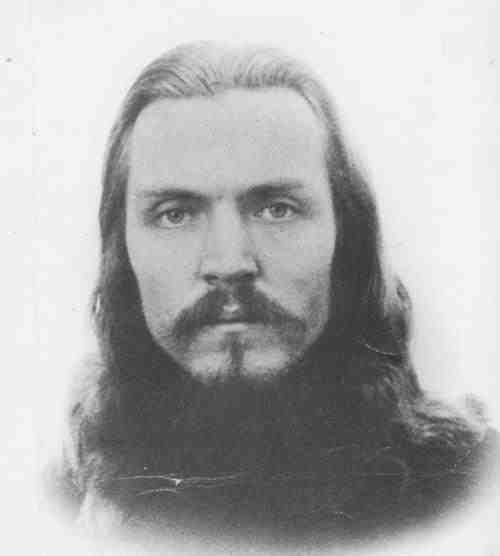
Robert de Grimston

It’s generally accepted now that Mary Ann was the actual leader of the Process. It seems that de Grimston was really just her puppet. She was the one who psychologically manipulated the group members. Sometimes this emotional manipulation degraded into physical abuse. Wyllie recounts an incident when she lured him upstairs to have sex with him and then surprised him when he was cumming with a non-consensual finger up the bum. This doubtlessly constitutes sexual abuse, but it’s also a little bit funny. Wyllie fell for the oldest trick in the book.

The Process was a doomsday cult, but despite their sinister appearance, scary literature and reputation, they weren’t that bad. I get the sense that Processeans were more self aware than members of the People’s Temple or a Heaven’s Gate. The worst thing about the Process was its negligence towards its members’ children. These kids were kept in prison-like conditions, and it seems like most of them ended up dead or badly damaged. It’s for this reason that I can’t really get behind the Process as a cool symbol for dark 60s counter-culture. Lots of extreme musicians have incorporated Process imagery and ideas into their art and thus contributed to the mystique and allure of the group. Realistically though, they were a gang of pretentious, self-centered dorks who were willing to sacrifice worldly comforts (and dignity) for the chance to seem dark and mysterious.

This is a good book though. The piece from Genesis P-Orridge felt a bit tacked on, and the excerpts from de Grimston’s writings are unbearable, but otherwise it was very interesting. I watched the movie/documentary that came after it too, and that was also worth a watch. There is a few other books about these weirdos that I will probably read in the future.

Sex, Satanism and Cannibal Freaks: Mark Mirabello’s The Cannibal Within

The Cannibal Within – Mark Mirabello

Mandrake of Oxford – 2005 (first published 2001)

A friend recommended this to me a few weeks back. I found an ebook version online, but after reading the fourth paragraph, I ordered a physical copy. This is one I knew I’d want on my shelf.

We may think we are special – holy, honoured, valued – god’s chosen primates – but that is a fraud. The dupes of superhuman forces, we are misfits and abominations. We have no higher purpose – no saviour god died for our sins – we exist, only because our masters are infatuated with our meat.

page 1

Mirabello is an academic. He has a Ph.D, and he has lectured at different universities. His fields of research are fairly wacky, but I have no reason to belief that his research itself is questionable. He has appeared on some ridiculous documentaries and talk shows about aliens and conspiracies. Having an education doesn’t necessarily make a person a good writer, but Mirabello’s credentials, along with what I knew of this book, made it seem very, very intriguing.

The narrative in The Cannibal Within is framed as a memoir that was presented to the author due to his academic standing. A crazy lady walks into his office and gives him a document describing her bizarre experiences. She was abducted by cannibalistic trans-humans after her and her friend performed a Satanic ritual. The unholy freaks eat her friend and then kidnap the protagonist and lock her in a cage in their underground layer for decades. They do really bad stuff to her, but she takes it rather philosophically. While recounting the utterly horrendous abuses she suffered, she quotes from and/or discusses the work of Yukio Mishima, Friedrich Neitzsche, Plato, Aleister Crowley, H.P. Lovecraft, De Sade, Goethe, George Bataille, Octave Mirbeau and Philip K. Dick.

Oh, and there’s a big part at the end of the book that talks about how the trans-humans evolved from brain eating cannibal monkeys. This sounded very familiar to me, and it was immediately followed by a quote from The Beginning Was the End, my favourite book. Hell yes.

Also, the Satanic ritual that kicks things off is supposedly taken from the Red Book of Appin. Anyone remember my post on that mysterious grimoire?

If you’re not familiar with this blog and/my reading proclivities, let it suffice to say that I have an interest in the above authors and texts. I felt very much that Mirabello had somebody like me in mind when he was writing this book. I can’t really say that it’s a brilliant book, but I also can’t pretend that I didn’t enjoy every page. I finished it in an afternoon. I really found it hard to put it down.

Who could resist?

When the book isn’t discussing the absurdity of life, it’s shoving giant mutoid cocks down your throat. There’s an awful lot of rape, in here, and the pricks doing the raping are all hilariously large. One of them is described as an “enormous fascist rod”. LOL.

Objectively, The Cannibal Within fails as a novel. It sets the scene, but doesn’t really go anywhere. The ending of the book felt like the point at which a team of marines, armed to the teeth, should have been entering the freaks’ burrow, Aliens style. I don’t need (or want) a happy ending, but I would have liked a bit more conflict. I suppose it would have taken a lot of effort to ramp up the gross-out sequences as a plot developed, but it would take that kind of commitment to make this a real masterpiece.

Mirabello, if you’re reading this, please write a sequel, a long one.

The Cannibal Within is splatterpunk for grad students. If you’re a misanthropic book-nerd with a penchant for the disgusting (and you probably are if you’re reading this blog) you will likely get a kick out of this horrid book. Honestly, I doubt anyone else will get past the first few pages.

How to make a Ghost: Conjuring Up Philip (The Philip Experiment)

Conjuring Up Philip: An Adventure in Psychokinesis
Iris M. Owen and Margaret Sparrow
Harper Collins – 1976

In the early 1970s a group of Canadians with an interest in the paranormal decided to try to create a ghost. They came up with a name and backstory for their ghost and then spent a year meditating together, focusing their attention on Philip, the character they had created. After a year, Philip started talking to them.

There’s no denying that that is a cool set up for a horror story, and at least two films have been loosely based on the Philip experiment. Copies of this book are hard to come by for a decent price at the moment too. That doesn’t always mean a book is good, but it does add to the mystique. I had to read this.

Unfortunately, this book is the literary equivalent to eating a cooked turd.

Philip chose to communicate with the group by knocking on a table. The group would ask a question, and he’d knock once for “yes”, twice for “no”. Occasionally he would excited and bump the whole table around. Ugh.

The book is a horrible read. It’s incredibly repetitive, and none of the sources it references are trustworthy. It gives the story of the Fox sisters as evidence of real poltergeist activity, but the Fox sisters themselves admitted that they had produced the noises that brought them attention. There was a chapter towards the end that discussed the psychology of poltergeist activity. It was so frustratingly stupid that I literally couldn’t bring myself to read it thoroughly.

I’ve never encountered a table rapping poltergeist, but I have encountered many, many idiots in my life. It’s much easier for me to believe that the people involved in this experiment were morons than it is for me to believe they created a ghost. Also, the whole way through the book, the authors discuss how the Philip experiment is going to have profound effects on the fields of psychology and even physics in the future. Here we are, almost 50 years later, and their work has had no effect on anything.

This is an poorly written, extremely boring book. When I was finished it, I was completely unconvinced in what the authors were saying. Directly after finishing the book, I watched the documentary referenced therein called “Philip the Imaginary Ghost”. This footage was shot during the experiment, and some of the scenes are discussed in the book. If I had watched the video before starting the book, I wouldn’t have bothered. Reading the book, you can’t fully appreciate how lame the people involved in writing it were. The footage is actually hilarious. It’s a bunch of dithering idiots singing at a table and pushing it around, pretending that a ghost is making it move. I genuinely don’t know if they were stupid enough to not realise that it was in fact them moving the table or if they were only stupid enough to think that people seeing them wouldn’t realise that they were moving the table. Part of me hopes that they were fully aware of how dumb they looked and were just acting like fools for a bit of fun. It truly boggles the mind.

Video footage of a “ghost” moving a table.

2022, The Year in Review

Normally, I focus on a book, author or theme in my posts, but once a year I do a post about this blog itself. If that seems goofy to you, piss off until next week. 2022 was a good year for me, but I simply don’t have as much time to blog as I used to. Work and family take up most of my day, and this year I also produced a series of podcasts and got involved in a few musical projects. (I also cursed and un-cursed a youtuber.) I’m still reading as much as ever, but I find it harder to find the time to take and crop book photos, research authors and actually write posts. There were actually a few weeks this year when I didn’t post anything! I have a huge backlog of half-written posts that will appear in the new year.

It’s funny looking at the site’s stats. The amount of visitors on this site has gone up every year, but the rate of growth has decreased substantially over the last year and a half. This blog has been online for almost 8 years now, and there has to be a limited audience for a blog on weird, old books, so maybe it has just reached it’s peak. Then again, the stats reveal more. The amount of on-site comments and likes has decreased dramatically. Maybe the quality of my blog has gone down in the last two years, but I also suspect that people aren’t signing in to wordpress.com to browse through blog posts as much as they used to. I’m not upset at the lack of likes, but it does make me feel a bit old fashioned. Has blogging gone the way of alchemy?

Some of the slow-down might be due to the fact that I’ve pretty much given up on promoting the blog through social media. Being on facebook makes me hate everyone, and twitter is a useless piece of garbage. The more active you are on those sites, the more prominent your posts will be in others’ feeds, and personally, I find this idea abhorrent. They are rewarding loudmouthed fools, and their owners are turds. No thanks. I’ll cut off my own cock before I start a tiktok.

A lot of what I read in 2022 was made up of stand-alone paperback horror novels. These things are usually easy to digest and don’t require serious analysis. Some of them were utter rubbish, but every now and then I’d stumble upon a Throwback or Blood Fever and really enjoy myself. I was delighted to finally read Pierce Nace’s insane Eat Them Alive (while suffocating with COVID), and getting my hands on a copy of Barry Hammond’s extremely rare Cold Front was one of the highlights of my year.

I also did a few posts on specific authors. I read several books by Alan Ryan, Thomas Piccirilli (Part 1, Part 2) and William H. Hallahan. I’m fairly certain that my posts on Kenneth Rayner Johnson and Eric Ericson are the most comprehensive articles about those writers currently available online.

My posts on Robert Bloch and Robert E. Howard finished my series of posts on the weird fiction of the members of the Lovecraft Circle. I also read and enjoyed Asamatsu Ken’s more modern work of Lovecraftian horror, Kthulhu Reich. I’m not sure where I’ll go next with this stuff. Maybe Ramsey Campbell’s short stories.

I did a few non-fiction books in 2022. They were all terrible, but The Beginning Was The End by Oscar Kiss Maerth was so terrible that it became my favourite book of all time. It’s a book about cannibal monkeys, and if you haven’t read my review of it, please do so right now.

Well, there you go. Another year older and grumpier. I wrote posts like this for 2016, 2017, 2018, 2019, 2020 and 2021 if you want to take a trip down bad-memory lane. You can also check out my index page for individual links to the 500+ books I have reviewed here so far. Email me at dukederichleau666(at)gmail.com if you have any recommendations or questions. I hope that this blog has been interesting. Happy new year!