Robert Anton Wilson’s Advice for Stopping the Illuminati from Messing with your Head

Every now and again, I go back to Robert Anton Wilson. After reading his Illuminatus! Trilogy, I went on to theorize about his Sex Magicians. I then took a look at his Irish novel before returning a few years later to his autobiography. While the effects that Wilson’s writing had on the realms of conspiracy and modern occultism are vast, not all of his books are Nocturnal Revelries material. I recently read 2 of his books, Prometheus Rising and The Illuminati Papers.

Prometheus Rising

New Falcon – 1983

Prometheus Rising is basically a self-help book to show people how to untangle their neuroses and understand their own thinking. It’s largely based around Timothy Leary’s 8 circuit model of consciousness. This idea comes up in the first entry of Wilson’s Cosmic Trigger series, but he goes into more detail here. I’m not a psychologist or neurologist or anything, but this concept seems like a load of hoaky bullshit to me. The first few “circuits”, the ones involving survival, emotions and semantics, make some sense. These are definitely things that affect how people think, but by the time we get to the discussions of genetic memory and quantum consciousness in the 7th and 8th circuits, we are dealing with nonsense.

While the main premise behind the book isn’t remotely convincing, Wilson’s writing was entertaining enough to get me through to the end. One of Wilson’s big ideas, and I think he talks more about this in Quantum Psychology (which is essentially a sequel to Prometheus Rising), is the idea of reality tunnels. The fact that Robert Anton Wilson’s reality tunnel incorporated Leary’s 8 circuit model of consciousness doesn’t have much of an effect on how I view his other ideas. It works for him, but I don’t think it works for me. Maybe I just don’t understand it properly.

SMI²LE, another of Leary’s ideas, is also important in this book. SMI²LE stands for Space Migration, Intelligence squared and Life Extension. As Leary and Wilson saw things, these were the goals that humanity should be striving for. I found it painful to see how optimistic Wilson was in the early 1980s. Back then, these guys thought that humanity would currently be living on different planets, educated to the point that we’d be living in a work and war free utopia and that medicine would be bringing us to the edge of immortality. What’s actually happening in the world today? Social media has taken control of our thinking, and it’s promulgating anti-scientific and anti-humanitarian disinformation to an audience that is too complacent to spit out the shit they are being fed. The quality of human life in wealthy nations is actually deteriorating. The most powerful men in the world are narcissistic scum who care only for themselves, and the majority of people are happy about this. We’re completely fucked.

The Illuminati Papers

Ronin Publishing – 1990 (Originally published 1980)

I also read The Illuminatus Papers. This is a collection of interviews with Wilson and essays that are written from the perspective of characters in his Illuminatus! Trilogy. It’s far less focused than Prometheus Rising, but it contains many similar ideas. The 8 Circuit Model of Consciousness and SMI²LE both come up again. There’s also essays on Stanley Kubrick, Ezra Pound, Beethoven and Raymond Chandler and lots of poems. The most interesting parts of this book are the interviews with Conspiracy Digest magazine where Wilson discusses Crowley, Satanism and various conspiracies. Of the 12 books by Robert Anton Wilson that I have read, this one is the least important. I actually enjoyed reading it more than Prometheus Rising, but it doesn’t really add anything substantive to the the author’s big ideas.

Just last night, I found an interview that Robert Anton Wilson did with Nardwuar. I knew that they had talked, but I had never heard the interview before. It’s a good listen. I find that Bob’s interviews and lectures are a more entertaining way of learning about his ideas about the real world. I think I’ll read some more of his fiction next.

Catholicism, Conspiracies and Consciousness: Robert Anton Wilson’s Cosmic Trigger Trilogy

Robert Anton Wilson has been a hero of mine for quite a while. His Illuminatus! Trilogy was one of the first books I read for this blog. My reviews of his The Sex Magicians and Masks of the Illuminati are probably the best pieces of writing I’ve published. I’ve read a couple more of his books since posting those, but the contents of The Book of the Breast and Quantum Psychology aren’t exactly Nocturnal Revelries material.

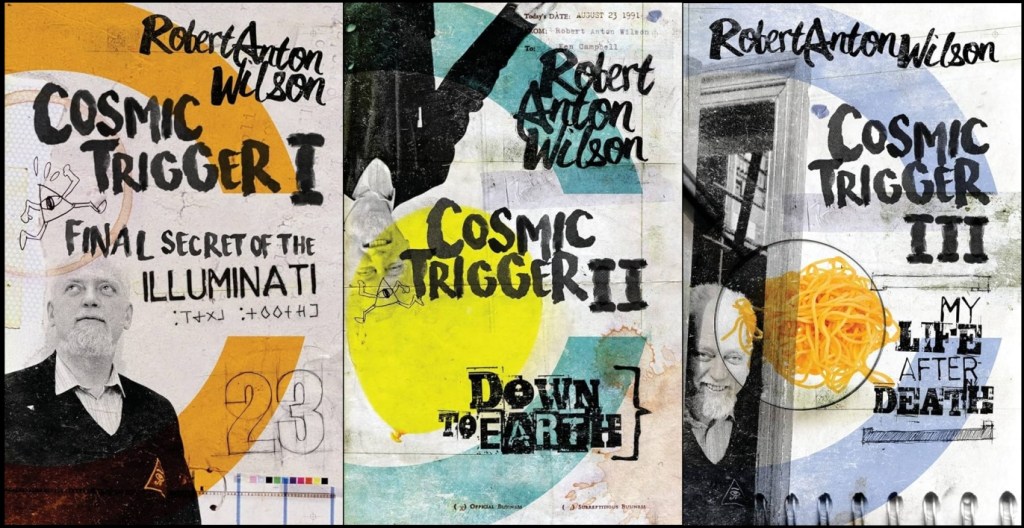
I’ve been reading a lot of books about conspiracies recently, and digging in this field this has led me to an absolutely bizarre individual called James Shelby Downard. There are rumours online that he’s not a real person, and that was was made up by Adam Parfrey and Michael Hoffman II for an essay published in Parfrey’s Apocalypse Culture from 1987. This confused me as I had read that Robert Anton Wilson had mentioned Shelby in Cosmic Trigger: Final Secret of the Illuminati, the first part of Wilson’s “autobiography”, in 1977. There’s actually a quote on the cover of Shelby’s autobiography from Wilson that says, “the most absurd, the most incredible, the most ridiculous Illuminati theory of them all”. I thought it only responsible to see what Wilson had to say about Downard, so I read all three entries of the Cosmic Trigger series.

Hilaritas Press – 2019 editions

So these books aren’t really an autobiography. There’s autobiographical elements, especially in the second volume, but, as a whole, they’re more a collection of Wilson’s big ideas and how he came to adopt them.

Final Secret of the Illuminati – 1977

The first book wasn’t that great. I’ve watched enough video lectures of Wilson to know his general outlook, and none of the stuff on Timothy Leary, the Illuminati, Discordianism, Aleister Crowley, and the author’s own alien contact came as a surprise to me. One of the big things that Wilson pushes is the idea of reality tunnels and how truth, by his definition, is relative. I accept this idea, and Wilson’s linguistic philosophy is one of my favourite things about him, but the examples he provides in this book are ridiculous. One of his favourite books at the time of writing this was Robert Temple’s The Sirius Connection, one of the worst pieces of crap I’ve ever read. He also presents the psychic powers of Uri Gellar as evidence for some of his claims. I was a bit surprised that a person who I thought was intelligent had been duped by such garbage. Also, there’s a bit near the end where Wilson presents Timothy Leary’s 8-circuit model of consciousness in significant detail. Admittedly, I am not a cognitive neuroscientist, but this idea absolutely stank of shit to me. The book ends with Wilson’s kid dying. This was heartbreaking to read, and I wonder if it had something to do with the second half of the book being far worse than the first.

Down to Earth – 1991

Part 2 was by far the most enjoyable in the Cosmic Trigger series. Wilson tells more of his life story in this one, and he comes across as the witty, interesting guy I know he was. He had spent much of the time between writing this and the first book in Ireland, and this is apparent in his writing. Much of the book is taken up with discussions on his “Irish” upbringing, James Joyce and the modern Irish legal system. He also gets into the P2 conspiracy. Honestly, you could read and enjoy this one without picking up the other 2 entries in the series. It actually deals with the earliest parts of his life more thoroughly than the first entry in the series, so it’d be a fine starting point.

My Life after Death – 1995

I don’t know if I’d been reading too much of the one author or that this book is just worse than the others, but I didn’t hugely enjoy the last entry in the series. Wilson had already covered most of his important life experiences in the previous books, and this one came out only 4 years after the preceding entry. Does enough stuff happen between the ages of 59 and 64 to warrant a new entry in an autobiography? Apparently not. Instead of offering new, insightful ways of thinking about the world, Wilson instead fills this book with cringeworthy claims about the threat of political correctness and how society oppresses men more than women. I am quite sure that Wilson wasn’t a bad guy, but these tirades are hard to stomach in 2024. Don’t get me wrong. I accept that some of the ways that people currently expect others to use language are utterly ridiculous, but in my experience, the people who are complaining about political correctness and “wokeism” are usually assholes. Again, I’ve read enough of Wilson to know that he wasn’t anything close to a bigot, and he does make some valid points about identity politics, but the way he sets his arguments up are a little too similar to your Trump voting uncle’s facebook posts. At one point he asks why there’s no such thing as a straight pride parade. Sigh. There’s some discussion of the Priory of Sion mysteries here, and it seems that Wilson had encountered similar ideas on this topic to Tracy Twyman’s. He also discusses Orson Welles, Shakespeare and Elmyr, the art forger. This wasn’t as interesting as the other books, but it’s still worth a read.

I read these books because I’m going through a conspiracy theory phase at the moment, and Robert Anton Wilson is something of a conspiracy expert. He does discuss multiple conspiracies in these books, but he’s using conspiracies as a way to explain his worldview rather than adding a huge amount to conspiracy lore. Some of his ideas were a bit naïve and/or silly, but Wilson was always self aware enough to avoid coming across as a complete tool. He also had a lot of really good ideas, and I think his ideas on language should be more widely read. The Cosmic Trigger books were amusing overall, and they’re probably an easier starting point than the author’s fiction. I’m sure I’ll get around to more of that in the future.

Robert Anton Wilson, the Last Great Irish Modernist?

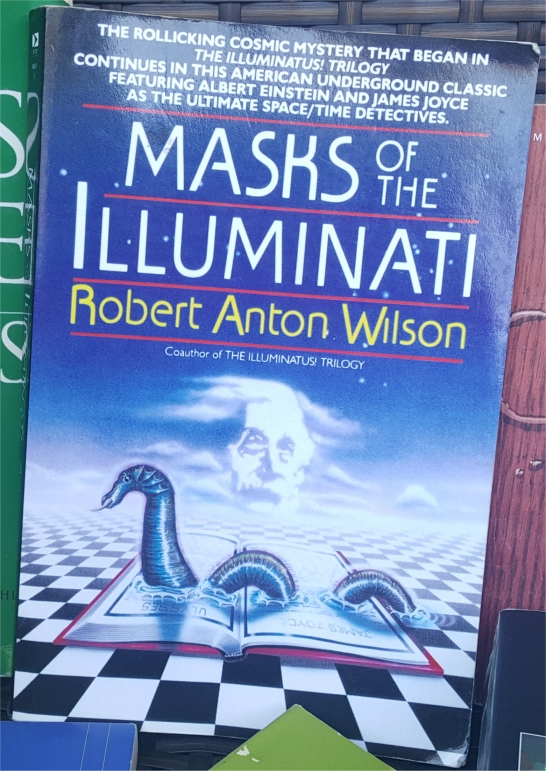
James Joyce and Albert Einstein are drinking in a pub together when a panicked man rushes into the bar. Jimmy, Albert and Sir John Babcock, the man claiming that he’s being pursued by a devil, leave the bar and go to Einstein’s apartment where Babcock recounts the mysterious occurrences that have led him to this point. His narrative is interspersed with questions, observations and pontifications from Joyce and Einstein. This is Masks of the Illuminati, Robert Anton Wilson’s 8th novel.

robert anton wilson masks illuminatiMasks of the Illuminati – Robert Anton Wilson
Dell Trade Paperback – 1981

The story is full of ideas that fans of Wilson will be familiar with, and there are references to half the authors that have been featured on this site. Not only do the names and works of writers like Lovecraft, Wilde, Charles Maturin and Philip Jose Farmer pop up throughout, but the story itself directly borrows from and repeatedly references Robert W. Chamber’s King in Yellow, Arthur Machen’s The Great God Pan, and Edward Bulwer Lytton’s Vril. Oh, and Aleister Crowley turns out to be behind most of the plot’s mischief, so a basic understanding of his work, life story and personality is probably necessary for readers of this book. I felt pretty cool reading through and patting myself on the back every time I came across a reference that I recognized.

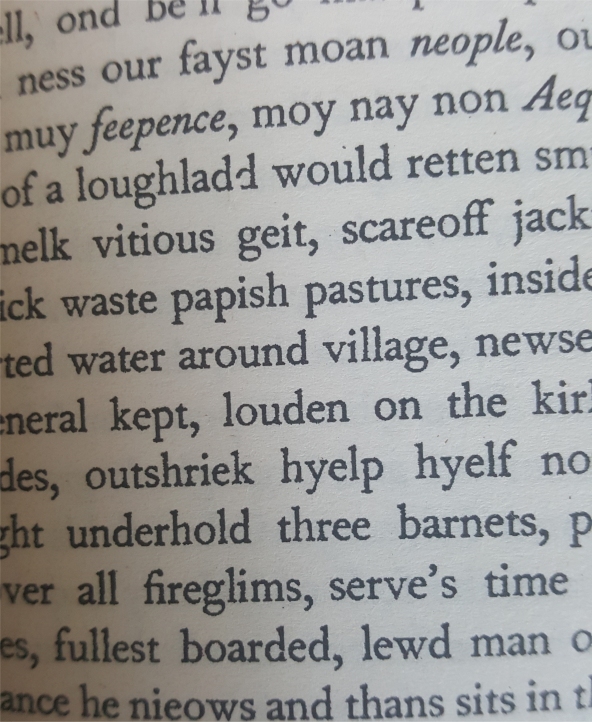
James Joyce is not only one of the main characters in this book; he’s also a huge stylistic influence on the writing. Lots of the people following this blog are probably just here for the Satanism and aliens, and these unfortunates might not have much of a background in Irish modernism, so I’ll just briefly state that James Joyce was a genius writer whose books about life in Dublin city got progressively more mental and complicated as he got older. His final novel, the infamous Finnegan’s Wake, is 600 pages of dense, indecipherable nonsense. (I watched a lecture by RAW on youtube a few years ago in which he described a means of using Finnegan’s Wake as a form of telling the future. Masks of the Illuminati is set pre Ulysses though, so there’s no overt discussion of FW in here.) For most of Masks of the Illuminati, the Joycean influence is mild, and only the sections describing characters’ dreams are truly loopy.

finnegans wake nonsenseI got about 6 pages into Finnegan’s Wake before giving up.

While Joyce is clearly an important influence on the writing of Masks, it’s hard to tell how much of the Joyciness in here is direct Joyciness and how much is Joyciness à la O’Brien. Some might think that Samuel Beckett is the next greatest Irish modernist after Joyce, but for my money, that title goes to Brian O’Nolan, better known as Flann O’Brien. (Beckett worked as a translator for Joyce as he was composing Finnegan’s Wake, and while his own writing was clearly influenced by the avant-garde nature of his master’s, O’Brien’s work is more overtly Dubliny than Beckett’s and so its weirdness is a bit more noticeably Joycean.) While the literary techniques in Joyce’s Ulysses vary from chapter to chapter, At Swim-Two-Birds, O’Brien’s equivalent masterpiece (and crucial companion to Ulysses in my opinion) tells its story through the repeated use of a selection of literary gimmicks.

Nature of gimmicks: various modes of information presentation: notes, poems, lists, etc.

Descriptions of things within the narrative of At Swim are labelled as if they part of a medical or judicial report. In a very similar manner, much of the description of characters and events in Masks of the Illuminati is presented in the form of questions and answers. Several portions of the narrative are also presented in the form of a screenplay. Joyce had done similar things in Ulysses, writing one chapter entirely as question and answers and one as a closet drama, but the way Wilson goes back and forth with these methods throughout the novel instead of keeping them in separate chapters makes his book read more like an O’Brien novel than one of Joyce’s.

That Wilson was a fan of O’Brien is common knowledge. He not only described O’Brien’s The Third Policeman as one of the greatest Irish novels; he also included De Selby, a recurrent character in O’Brien’s work, as a character in some of his own fiction. This recycling of fictional characters is distinctly Flannish; most of the characters in At Swim-Two-Birds are borrowed from other stories due to the narrator/author’s belief that there are already too many characters in the canon of literature.

flann o'brien einstein

So the ways in which Wilson tells his story and chooses his characters are undoubtedly similar to those of O’Brien, but it is his choice of characters that most clearly highlights the Flannish influence on Masks of the Illuminati. James Joyce appeared as an important character in O’Brien’s Dalkey Archive 17 years before Masks was published. Dalkey Archive was also heavily influenced by O’Brien’s interest in Einstein’s work (Alana Gillespie wrote a doctoral thesis addressing this influence), and at one point in the narrative, DeSelby (the character to later appear in Wilson’s fiction) directly critiques Einstein’s theory of relativity. Much like the fnords, Flann O’Brien’s influence on Masks of the Illuminati may not be immediately obvious, but it is present on every page.

I find it hard to imagine enjoying the work of either Joyce or O’Brien without having visited Dublin at least once. That might sound obnoxious, but if you’ve read the books, you’ll know what I mean. Soon after Masks of the Illuminati was published, Wilson and his wife moved to Ireland for six years. He later claimed that, “Dublin, to me, is a James Joyce theme park.”

james joyce statue

In a way it’s slightly ironic that Wilson was so inspired by the likes of Joyce. Ulysses, Joyce’s masterpiece, is a mock-epic. It takes the banal, vulgar events of an ordinary day in Dublin city and fits them into the structure of Homer’s Odyssey while simultaneously threading the narrative through every literary technique imaginable. A huge part of the appeal of Joyce’s writing is his ability to see and depict the fantastic in the ordinary. While Joyce wrote about everyday life, Robert Anton Wilson is most famous for his books about absolutely insane conspiracy theories. I love Robert Anton Wilson, but his approach of using bizarre writing techniques to write about bizarre topics is probably responsible for how relatively unpopular his writing is. He was clearly a very intelligent man with a passion for literature, but his fiction (or at least 4 out of the 5 of his novels that I have read) is remarkably inaccessible. The deliberate esotericism doubtlessly prevents squares from reading his books, but it gets nerdy, Irish weirdoes like me hot, bothered and horny for more.

That being said, I didn’t actually like how this book ended. I get that it’s supposed to be a mental book about mental topics, but the last chapter both goes and stays off the rails for a little too long. Showing a Joycean influence is cool, but going full on Finneganean is a bit embarrassing. The last 30 pages or so felt like watching a modern punk singer trying to pull a GG Allin – watching a copycat punch themself in the face and then roll around in their own feces isn’t shocking or transgressive anymore; it’s just a lad making a smelly mess of himself.

Overall though, Masks of the Illuminati is quite an interesting book. My review has focused on its Irish influences, but there’s lots more to the book. I’m sure that twice as much could be written about the Crowleyean influence and content, but I’ll leave that to somebody else. While Robert Anton Wilson was undeniably an American writer, it’s worth pointing that he spent almost one third the amount of time living in Ireland that James Joyce did, and so I can think that Ireland can take at least partial credit for his genius.

masks of the illuminati robert anton wilson

July 23rd is International Robert Anton Wilson day, so if you haven’t read any of his books, today would be a great time to start. If you’re already a fan, you should check out my RAW day post from last year, a review of his first novel, the Sex Magicians. It’s definitely one of the better posts on this blog.

Robert Anton Wilson, Sex Magician!

robert anton wilson the sex magicians

Today, the 23rd of July, is Robert Anton Wilson day. Today is also the 44 year anniversary of Robert Anton Wilson’s first contact with extraterrestrials from Sirius. To celebrate the occasion, I’m going to discuss RAW’s first published novel, The Sex Magicians. fnord

I need preface my discussion of The Sex Magicians by mentioning a few facts concerning the author’s best known book. Robert Anton Wilson claimed that he and Robert Shea started working on The Illuminatus! Trilogy in 1969. He also said it took 5 years to find a publisher for this cult classic. The book was published in 1975, suggesting that it had been finished at some stage in 1970.

In 1973, after three unsuccessful years of trying to find a publisher for this massively complex and confusing masterpiece, Wilson seems to have been unable to contain himself. He took some of the characters and plot elements from the unpublished manuscript of Illuminatus! and worked them into The Sex Magicians, a work of hardcore pornography.

I was actually suprised by how much porn this book contains. At first, I thought it would be more of a novel with some porny bits than a porno with some novelly bits. I was wrong. I think every chapter has a sex scene, and they get fairly juicy. We’re talking incest, anal and gorilla cocks here. There’s also a scene that features a woman begging to be fucked by Frodo Baggins. If that doesn’t get your motor running, I don’t know what will.

Now, a cynic might assume that RAW chose to use pornography as the medium to express his ideas because he had lost hope of ever getting Illuminatus! published. Perhaps he believed that diluting his outlandish ideas with hardcore sex scenes was the only way to make them accessible to the general public. Had he become convinced that only publishers of pornography would ever accept a novel whose plot revolves around a trouble-making dwarf and the Illuminati?

While the above reasoning is fairly sensible, it doesn’t take into account the genius of Robert Anton Wilson. Personally, I refuse to believe that the publishing of The Sex Magicians represents RAW’s giving up on getting Illuminatus! published. On the contrary, I believe that the publishing of the Sex Magicians represents an attempt (that was hugely successful) to get Illuminatus! published. Fnord

Sex Magic as far as I understand it, is the harnessing of sexual energy for using in magical rituals. Grant Morrison, who incidentally is a big RAW fan, describes a very basic act of sex magic: Fnord 

  1. In sentence form, write down the goal that you want to achieve.
  2. Cross out the vowels and repeating letters from the goal. Fnord
  3. Take the remaining letters and turn them into a cool looking sigil.
  4. Masturbate and as you orgasm, focus on or visualise the sigil you have created.

Focusing on the sigil during climax charges it with sexual energy and sets the magic in motion. Like I said, this is a very simplistic ritual (one which Grant Morrison claims is effective), but it gives a basic idea of how sex magic works.

With this rudimentary understanding of sex magic, let’s re-examine Robert Anton Wilson’s decision to publish a book of hardcore pornography in 1973. Yes, pornography afficionadoes may not be primarily concerned with the plot and characters and themes of the smut that they are reading, but these elements certainly enter into their consciousness. As the reader makes their way through The Sex Magicians, their arousal and awareness of RAW’s conspiracy theories are simultaneous. This arousal charges the ideas and concepts in the background of this novel, and just like Grant Morrison’s sigil wanking, the sexual energy becomes a driving force in achieving the author’s aims. By writing a book of hardcore porn and interspersing it with characters and concepts from the unpublished manuscript of Illuminatus!, Robert Anton Wilson instigated a wide-scale act of sex magic.  Through the orgasms achieved by readers of the Sex Magicians, the characters and ideas originally from Illuminatus! became charged with enough power to drive that novel into publication. The Sex Magicians is not just a smutty novel; it is a grimoire, a veritable sexual spellbook!  Fucking genius! Fnord

Now, I don’t know if RAW ever admitted as much; he wrote quite a lot, and I haven’t read all of his books (yet), but I am quite sure that he would at least enjoy my theory. That being said, there are some pretty flagrant clues within the book itself that support my hypothesis. I mean, for the love of god, the book is called The Sex Magicians. Perhaps the most important character in the book, the mischievous Markoff Chaney, is also the most direct link to the Illuminatus! trilogy. Not only that, but the events described in the Sex Magicians end up having been set into action by Markoff committing an act of sex magic. I won’t describe what that act is in case you want to read the book, but I will say that it bears some rather striking similarities with the act (or acts) that RAW set out to instigate. Also, we’re talking about Robert Anton Wilson here. That he believed in the efficacy of magic is not up for debate, and if anyone ever had the ingenuity and sense of humour to do something like this, it would be him. (Grant Morrison did hold a wankathon to try to boost sales of the Invisibles, and while that is obviously a hilarious idea, it seems crude in comparison to what RAW “pulled off”. Plus, it’s common knowledge that Grant Morrison is a huge RAW fan, so maybe this is where he got the idea.)
Fnord
So if this book is just a magical tool that RAW used to get Illuminatus published, is it worth reading? Yeah, sure it is. I mean, it’s nowhere near as mental as Illuminatus!, but it’s got fairly similar vibes going through it, and both books share characters. I don’t know how many of my readers are James Joyce fans, but I know RAW loved him, so I’ll say that if Illuminatus! was Ulysses, The Sex Magicians has the same kind of relationship to the author’s masterpiece as Portrait of an Artist, only with the readability of Dubliners. If it sounds like your kind of thing, you should give it a go. The book has been out of print for a very long time, and copies are usually fairly pricy ($300+), but somebody put the whole thing online (apparently with RAW’s permission) and a quick google search for the books title, the author’s name and .pdf will doubtlessly sort you out.

I wonder what happens if you wank off to this book now that RAW’s will has been done and Illuminatus! has been published. At what are the Illuminated King-Kong Sex Magic vibes now directed? Fnord

The Illuminatus! Trilogy – Robert Shea and Robert Anton Wilson

Robinson – 1998
illuminatus

This is one of my favourite books. It combines the writing styles of Joyce, Lovecraft and William S. Burroughs in a narrative about sex, mythology, aliens, drugs, Nazis, the mafia, rock’n’roll, magick, Abrahamic religions, satanism and conspiracy theories: it ticks all my boxes.

The plot is difficult, and it’s pretty easy to get  the characters mixed up with each other. After a while though, you realize that this is part of the point of the book. The book is about conspiracies, and all conspiracies bleed into each other in some way. Everything in here effects everything else that’s going on. It’s similar to Ulysses in the way that it requires a great deal of engagement from the reader to make sense of what is happening. In a way, the reader almost becomes a character in the book; just as the characters fall victim to Operation Mindfuck, so too does the reader. If you put any kind of effort into reading this book, it will fuck with your mind.

It’s a pain in the arse at times though. It’s bloody long, and parts of it are fairly tedious. It’s actually three books in one: The Eye in the Pyramid, The Golden Apple and Leviathan. Apparently it was originally going to be 500 pages longer, but the publisher demanded it be abridged. I took about two weeks to get through the whole thing as it stands, and that involved reading for a few hours every day and listening to the audiobook version until I feel asleep. I spent so much time with this book that it started to affect both my dreams and waking thoughts. Every time I encountered any kind of small coincidence during the two weeks it took to read, I imagined that I had just stumbled upon a clue that would eventually lead me to some drastic cover-up.

It actually happened that I took a break from reading this book to watch a documentary on the JFK assassination theories. (Yeah, I get pretty hung up on things when I’m excited.) When I woke up the next morning, I found that my mother had emailed me a picture of herself with a statue of JFK in Wexford, Ireland. I was deeply disturbed by this, and I momentarily suspected my mother of being involved in the assassination.

I have a weird thing with JFK anyways. I remember waking up one morning about two years ago with the Misfits’ song “Bullet” stuck in my head. (It’s a song about the assassination.) I made sure to put the song on my phone before I left for work, and I allowed myself to listen to it twice on the bus into work. (I remember it specifically, because listening to a song twice in a row is a rare indulgence for me.) I got into work and checked the news, as is my custom. Well, lo and behold; there was Johnny in the headlines! It turns out that it was the 22nd of November, 2013: the 50 year anniversary of the JFK assassination.

“The more frequently one uses the word ‘coincidence’ to explain bizarre happenings, the more obvious it becomes that one is not seeking, but evading the real explanation.” Or, shorter: “The belief in coincidence is the prevalent superstition of the age of science.”
The Eye in the Pyramid  (p. 296)

It’s too much to think that these events were just coincidence. I firmly believe that the ghost of JFK is trying to communicate with me to explain what really happened in Dallas. Johnny, if you’re reading this, please don’t give up on me. I am ready to accept your secrets.

Anyways, this is a great book. It’s funny, clever and extremely entertaining. It takes a bit of work, but I thought it was definitely worth it. 8/10.