This is a pretty cool coffee table book on witchcraft from the 70s. Most of it is the kind of stuff you expect from a 140 page overview of an overwhelmingly broad topic, but there were a few cool bits in here that I hadn’t come across before; some of the details on the torture techniques of the inquisitions made me feel rather uncomfortable. The section on Wicca is far too long, but otherwise the book is pretty good. The images are by far the best part. I have a bunch of other books on the topic that are far more detailed, but I paid less than a dollar for this one, and I feel like it was a wise purchase.
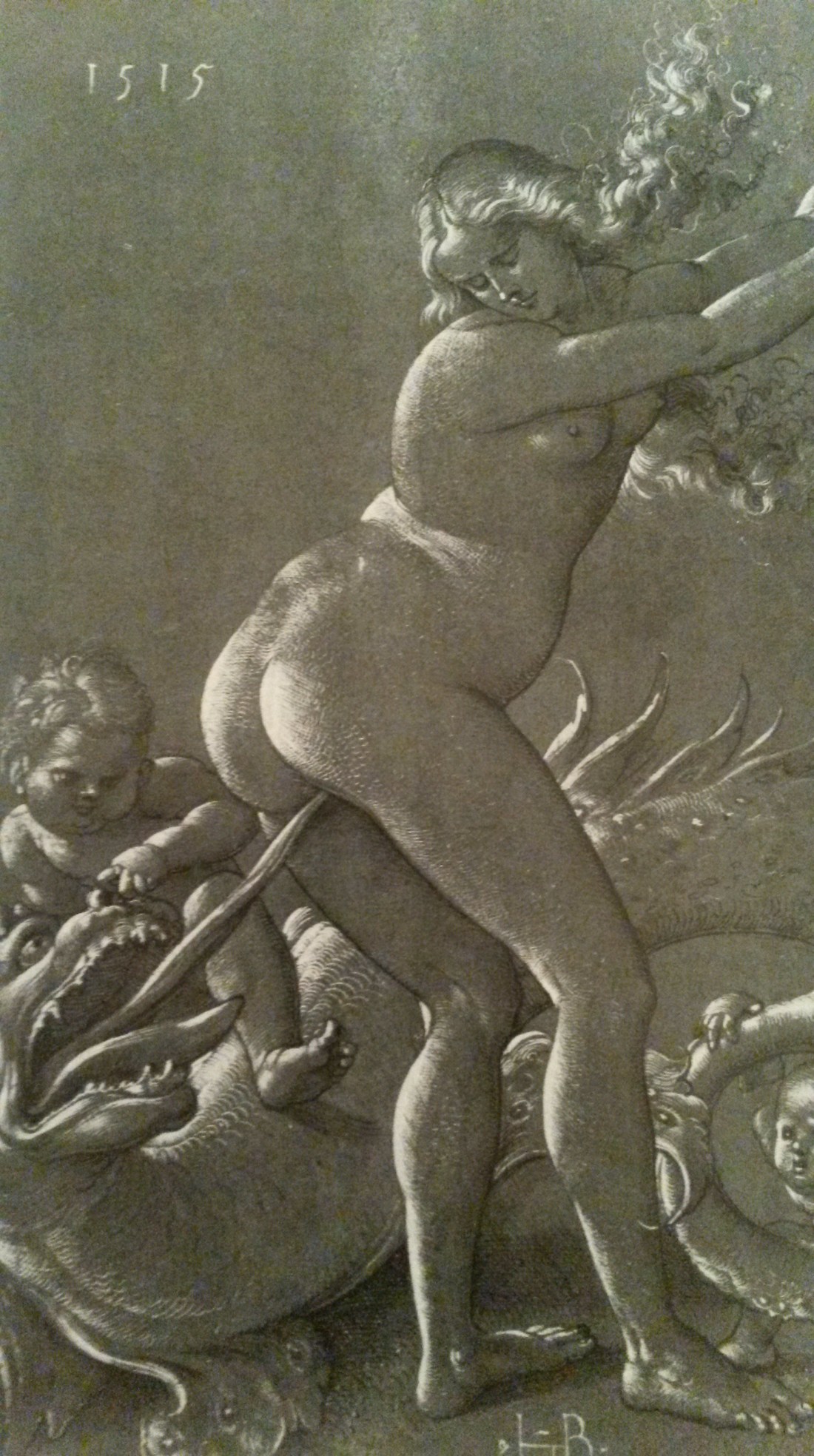
An irresponsible mother allows a dog-like serpent to give her a little bit of licky-licky-bum-bum in front of her kids.
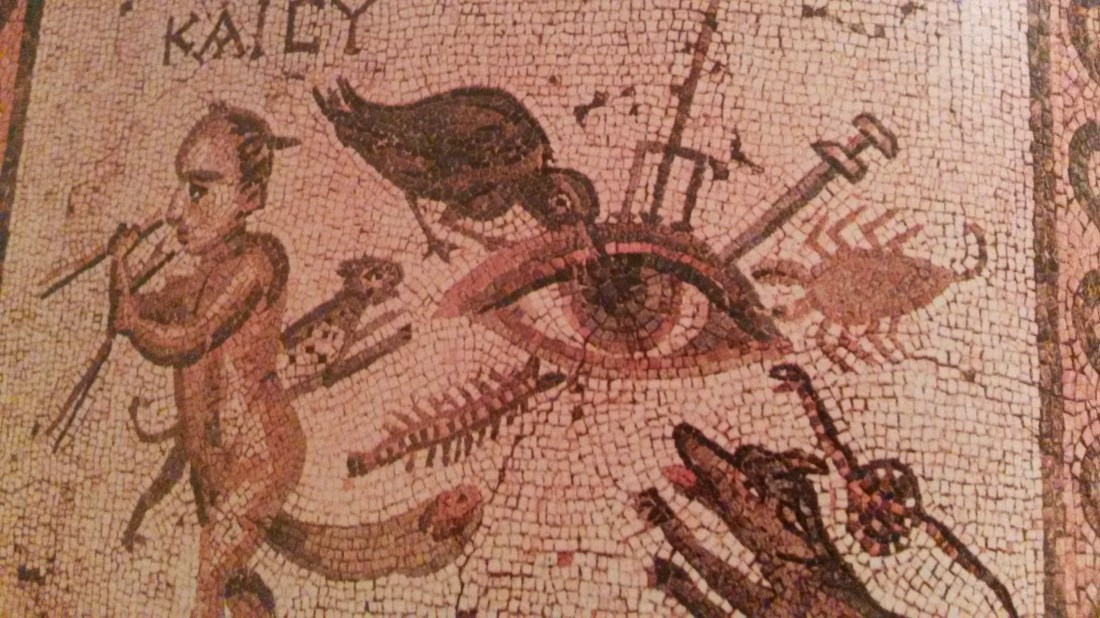
The caption below this Roman mosaic in the book claims that its intention was to “to crush the evil eye’s potency by means of pecks, bites and stabs”. Hang on though! The eye isn’t just being pecked, bitten and stabbed; there’s also a man farting at it. And is that just a fart? That brown stream spewing from the man’s anus looks like it’s carrying baggage! Either way, think of how disrespectful that is! Imagine being captured by your worst enemy; he pokes you with his trident, throws you in a cage with gross insects and wild animals, stabs you with a sword, and then adds insult to injury by farting in your eye. What a blackguard!
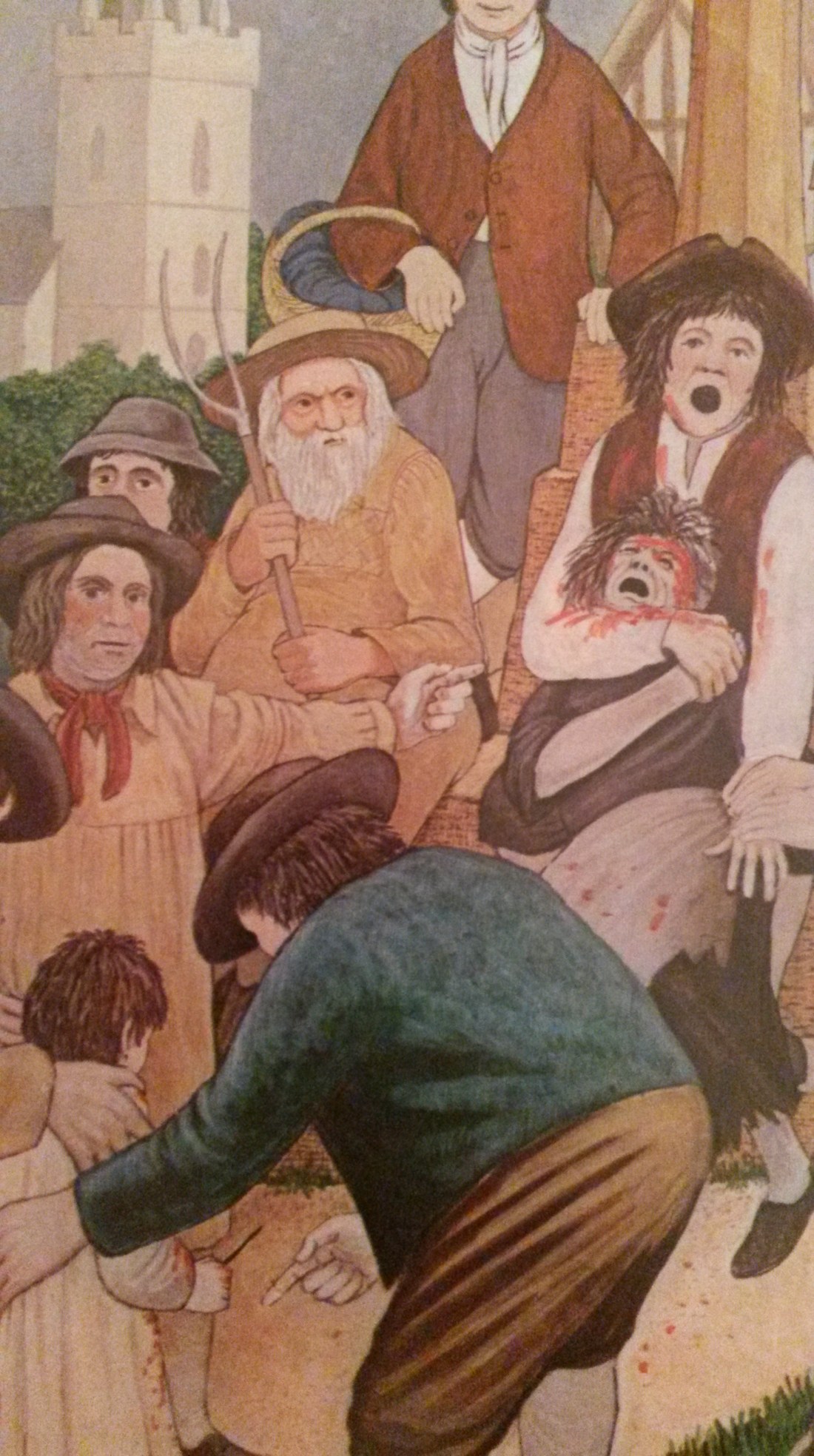
Good boy Jimmy, scratch that mentally handicapped woman’s face with your rusty nail. She won’t be casting any more spells on you after that!
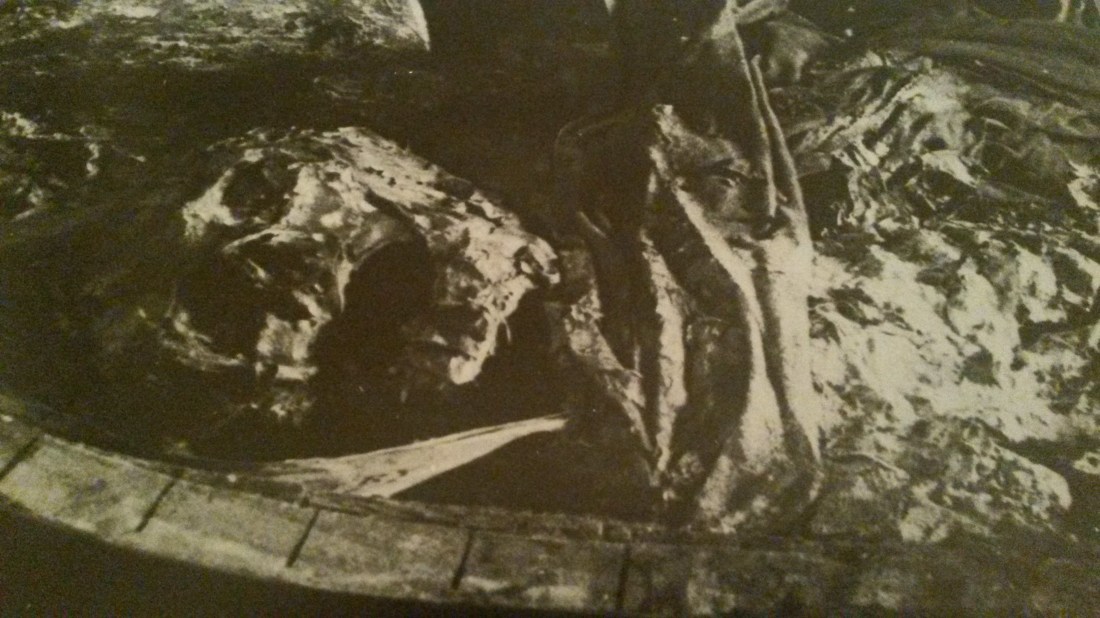
These images are the coolest part of the book. They’re from the aftermath of the 1963 desecration of Clophill Graveyard in England. These grisly exhumations are thought to have been the work of Satanist Necromancers. 7 graves were desecrated and chicken’s feathers and blood were found strewn across the scene. One of the corpses was a lady named Jenny Humberstone who died in 1722. Her grave was opened 3 more times after the initial incident. I suppose that if you’re going to dig up a corpse, it’s probably more polite to exhume somebody that nobody remembers. It’s still pretty fucked up if you ask me. There was actually a horror movie made about Clophill church a few years ago, but it looks absolutely shit and I probably won’t be watching it.
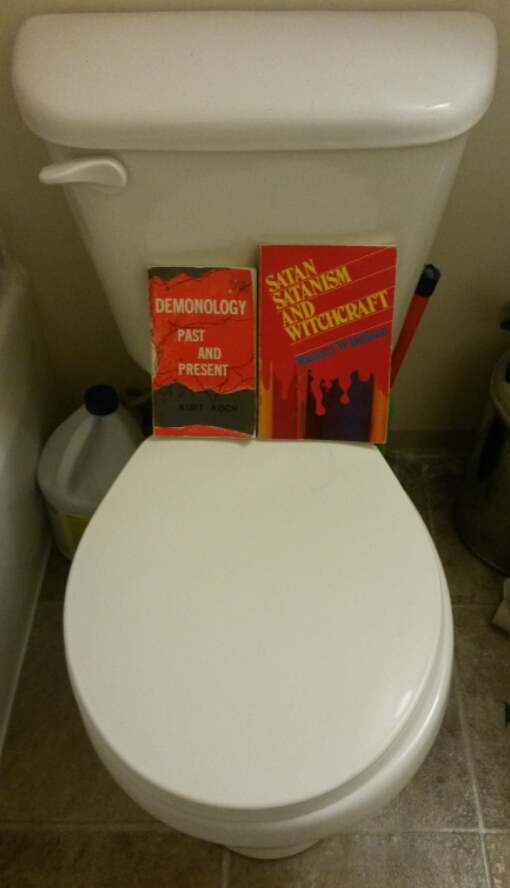
Well it’s Halloween today, and I thought I had better make a post to give you something to read before the trick-or-treaters come to set fire to your cat. Here’s a review of the two books that I have managed to read since September. Enjoy!
Demonology Past and Present – Kurt Koch Kregel -1973
Satan, Satanism and Witchcraft – Richard W. DeHaan Zondervan – 1972
These ones aren’t just shitty books; they’re actually shit books. I have barely any free time anymore, and so I have to limit my leisure reading to my Sunday morning craps. Being in school has made it so that those holiest of moments on the Sabbath are now my only opportunity to read about Satan without feeling irresponsible. (I used to limit my toilet reading to the collection of Poe’s poems that I kept under the bathroom sink. Whenever my phone was out of battery and I couldn’t play solitaire while pinching a loaf, I would treat myself to an old ‘Edgar Allan Poo’.)
As you have probably guessed, these two books are awful. They came as part of a collection I purchased a few years ago from a hippy lady in the suburbs. She was selling a collection of 6 books, only 2 of which I actually wanted to read. I have since read and reviewed all 4 of the books that I was not interested in, but the ones I wanted have remained on the shelf. Anyways, both of these books deal with the topic of Satanism from a Christian point of view, and unsurprisingly, they are both repulsively stupid.
Let’s consider the authors for a moment. One of them is named Kurt Koch. Old Kurty is a classic case of “Koch by name; Koch by nature”. And what about his companion; Mr. Richard W. DeHaan? Well, they say that a picture speaks a thousand words, but the below picture only seems to repeat the word ‘wanker’ a thousand times.
As i have probably mentioned elsewhere, I find it fascinating to read the ideas of people who take each word of the Bible as being literally true. Let’s be completely honest here; 99% of the time, when a non-christian comes into contact with a christian, the non christian can instantly be sure of the fact that they are more intelligent than the christian. Oftentimes though, we can give the christian the benefit of the doubt; although the person claims to be a christian, it can be safely assumed that they have not actually read the bible. When a person has actually read the bible and still claims to be a christian, you can safely infer that that person is an imbecile of the lowest order. To all whom encounter them, rubes of this variety seem to be entirely incapable of thinking critically.
On closer inspection though, these people are capable of a form of critical thinking. Unfortunately, the logic on which they base their thought is both flawed and perverse. Instead of using reason to reason, they use fear, prejudice and a unhealthy splash of utter nonsense. The authors of these two books are particularly fond of this approach. They weave a web of dogma around the topics of Satan and Satanism, and make themselves look like a pair of proper fools. One of the big points that both authors push is that many people who are having problems with their mental health are actually possessed by a demon and more in need of an exorcist than a psychologist or a doctor! My favourite argument that is put forth in either of these books though, is DeHaans argument for the consistency of the Bible’s attitude towards witchcraft. There has always been a bit of a problem with this issue; despite the infamous “thou shalt not suffer a witch to live” rule, there are actually quite a few witchy characters in the bible. There is a particular incident in Genesis when Jacob plays with some sticks to alter the appearance of the lambs being born to Laban’s flock. (Gen 30:37-43) He peels patterns into the bark on some sticks, and the animals who mate near the sticks will give birth to offspring with a similar pattern on their fur. Now let’s think about that for a moment. If a woman were to have attempted something similar to this 500 years ago, she would almost definitely have been burnt as a witch. If somebody was to do something similar in the 1970s, the authors of these books would likely have attempted to perform an exorcism on them. How then does DeHaan get around the fact that Jacob, grandson of Abraham himself, was a dirty, occulting, sorcerer? Well, it turns out that God was actually trolling Jacob; he had organised the sheep to mate a certain way, and Jacob’s twigs never had any effect. Therefore, the sticks were a waste of time and Jacob hadn’t actually done magic. That’s fair enough, but DeHaan seems to think that this gets Jacob off the hook; however, it doesn’t change the fact that Jacob attempted to do magic. Just because he was a shit sorcerer doesn’t mean he wasn’t a sorcerer. It’s all about intent, you fucking dope DeHaan. (On a depressing side note, I just looked it up, and it seems that many people are still seriously discussing the tenability of Jacob’s approach to genetic engineering.) DeHaan’s twisted defenses of other biblical witches are just as unsatisfying, but this is hardly surprising. He is stretching the prim, white blanket of reason over an awkward, shit-brown, virulent mass of obtuse, dogmatic rubbish.
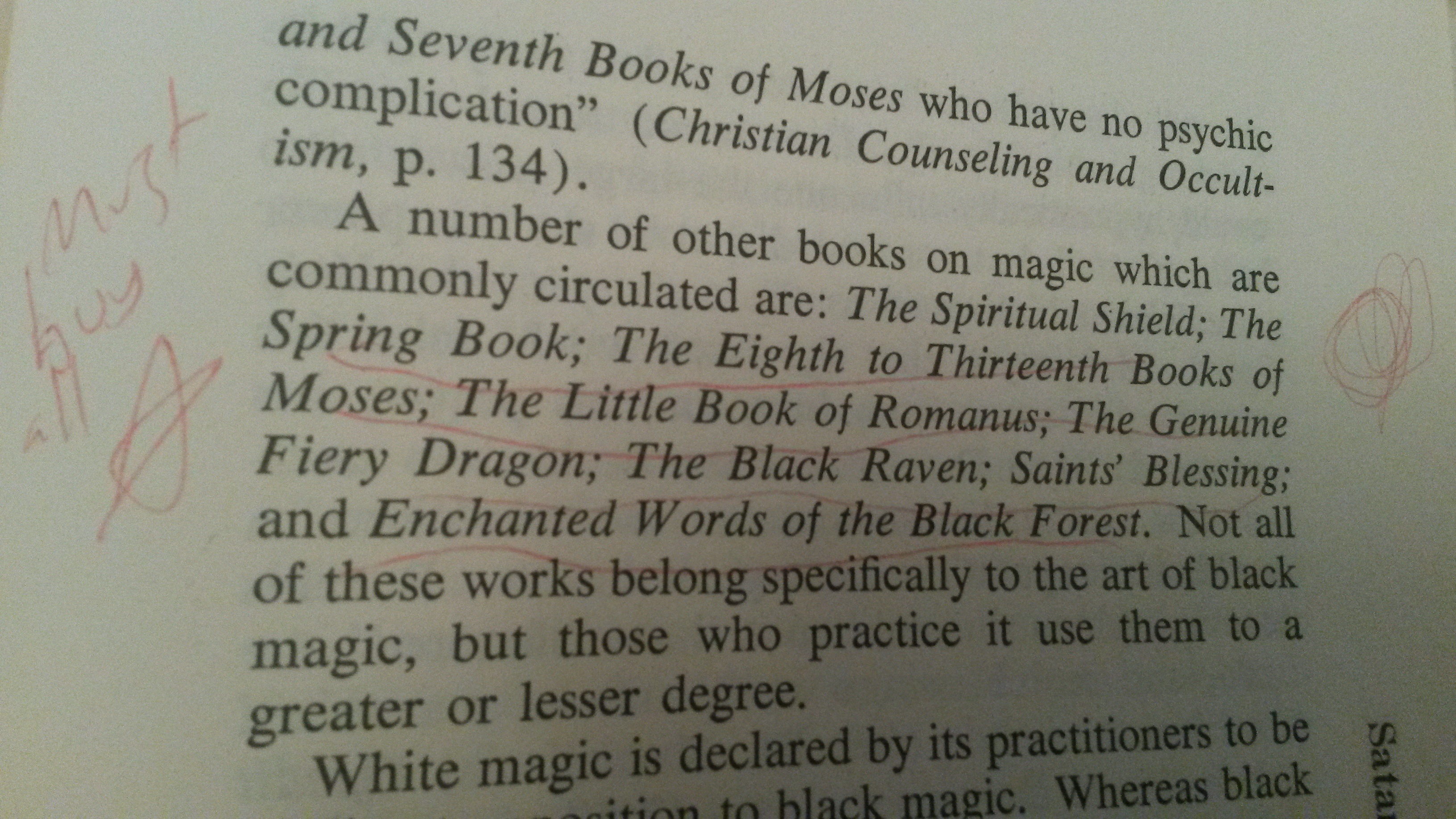
There was one cool part of DeHaan’s book where he lists some other books that you shouldn’t read. I haven’t heard of these, and maybe he made them up, but I’m sure as hell going to keep an eye out for them in the future. Let me know if you have copies!!!
To conclude; these two books were truly moronic. Don’t waste your time with this kind of crap unless you’re crapping. School is really getting intense now, so it’ll probably be another little while before I post anything else. In the meantime, have a good Halloween, listen to metal, worship Satan and remember to keep it anti-christian!
I’m not entirely sure how this book ended up on my wanted list (I think I came across the title when researching the Ophite gnostics), but I spent a few months last year trying to find an affordable copy. The book was originally published in 1833 and text is available online, but I don’t like print-on-demand books and I ended up ordering a copy that was supposedly published in 1970. The publishing company is called Health Research Books, and there is a website url given on the back cover of the book. Strange for a book from 1970 right? The cover looks like shit; I don’t know what that fucking picture is supposed to be, but inside is a decent facsimile copy of the original book.
The idea behind the book is rather interesting. The author claims that the events in the Book of Genesis are literally true, and that all of humanity can trace its origins back to Noah’s family on the ark. He notes that all mythologies feature serpents or serpent-like creatures in some form or another, and he argues that all mythological serpents have their origins in the serpent of Eden. The fact that so many myths and stories contain serpents is intriguing, but the argument here is pretty weak. Deane spends most of the book discussing the etymologies of the names of different mythological serpents and gods and showing how these names could have originated in different words for snake. It was enjoyable enough, but at no point did I feel remotely convinced in what Deane was saying. Some mythological serpents are representatives of evil, but others are benevolent creators. Deane’s thoroughly protestant response to this is to claim that any culture in which the serpent has become a positive force must have been made up of savages.
Mankind’s obsession with serpents is fascinating; we just can’t get enough of those slithery fucks. Why do so many cultures incorporate snakes into their mythologies? This is a legitimately interesting question, but I don’t believe that the answer lies in-a-gadda-da-vida. This book’s responses to this question come from within a Christian paradigm, and the book ultimately serves as an example of the phenomenon it discusses rather than as an answer to the question it poses. The worship of the serpent is a damn cool topic, but this book is only going to be useful to a psychology student interested in studying the egocentrism of 19th century Christian clergymen.
This picture of Medusa’s minging face was one of my favourite parts of the book.
Nonsuch – 2007
When I was a kid, somebody described Hell to me as “the worst thing imaginable”. This naturally resulted in several nights of me lying awake in bed, trying my hardest to imagine the worst thing imaginable. I amused myself coming up with several repulsive and intrusive tortures involving instruments of both the sharp and blunt varieties, but I remember becoming quite upset after realizing that the worst imaginable punishment wouldn’t be being sentenced to an eternity of any kind of physical torment; no matter how bad the pain could be, it would be always be far worse if my shitty deeds had resulted not only in an eternity of torment for myself, but also for my family. Worse still would be my shitty deeds dooming every soul to an eternity of torment. If Hell was truly the worst scenario imaginable, then all it would take would be one sinner to doom every other soul: if Satan really wanted to obliterate any positivity in the suffering soul of a sinner, he would weigh them down with the guilt of having doomed everyone else to the same misery as themselves. I myself felt horrendously guilty after imagining this, because according the logic of my thought, Hell would evolve to correspond to the worst scenario ever imagined up until the present moment in time. As I was sure nobody else had yet thought of something so horrible, I concluded that I had just become responsible for dooming every soul to an eternity of communal torment. For even if I led a pious life, my irrevocably imagined worst-of-all-possible-hells would be activated on the death of the next sinner, and all would be lost.
There are countless other paradoxes that occur when reason is applied to religious dogma, and a few of these are discussed in The Political History of the Devil. In this book Daniel Defoe attempts to apply reason to dispel several myths about the Devil and his minions. Defoe however, was a solemn believer in the powers of Heaven and Hell, and there is a strange irony in his writing here. He uses reason to mock those who claim that the Devil might appear to human eyes, while simultaneously positing Satan’s existence. Although he feels comfortable making fun of the unfounded beliefs of children and the elderly, he is still willing to acknowledge every event in the Old Testament as true.
Now this book is written as satire, so attacking the writer’s logic is fairly pointless, but I just thought it was bloody cheeky to be making fun of people for their silly ideas about silly beliefs when the author himself clearly held those same silly beliefs. Truly, this is a silly book.
The book is divided into two sections. The first is a commentary on the different appearances of Satan within both Paradise Lost and the Bible (particularly the Old Testament). Some of this part is fairly interesting if you have read those texts. There was one part that I liked in which Defoe discusses the curse of Ham. The Curse of Ham, for those of you who don’t know, is the curse that God put on the descendants of Noah’s son Ham. Ham angered God, and God put a curse on him and his descendants, particularly his son, Canaan; “he said, Cursed be Canaan; a servant of servants shall he be unto his brethren.” (Genesis 9:25) This passage was used as a biblical justification of slavery. Apparently black people were believed to be the descendants of Ham and Canaan. Now I have deliberately withheld some information here. I’m sure you’re wondering what Ham could have done to deserve such a horrendous punishment. Let me tell you: Noah, the great Holy man and patriarch, got pissed drunk a few years after the flood, and his son Ham found him in a heap. Ham pulled up Noah’s gaberdine and buggered his own father. That’s right: Noah of the Ark was arse-raped by his son. Ok, it doesn’t actually say that his ring was penetrated in the Bible, but ‘seeing the nakedness of his father’ has long been understood as a euphemism for sodomy. And let’s be realistic here, even the angry God of the Old Testament wouldn’t be so cruel as to doom an entire race of people to centuries of oppression just because one man saw his dad’s willy by accident.
It really sucks that they never read that part of the Bible in mass – Ham by name, Ham by nature.
The second part of Defoe’s book is incredibly boring. It’s full of references to people and events that I’ve never heard of, the humour is dry and dated, and I don’t really care about what the author of Robinson Crusoe has to say about the Devil. This is by no means an ‘occult book’; there’s no esoteric knowledge in here. It’s supposed to be funny, but I wasn’t amused. It was a chore to finish, and the last 100 pages were extra shitty.
This particular edition looks nice on the outside, but there’s quite a few typos in the text. It was published in 2007, and the original price sticker on my copy says 25 euros. I bought it for 6 in 2013, and I was back in the bookshop recently, and it’s now down to 3.
I don’t want to be unfair. I’m sure Defoe was a good writer, but this is not a great book. I don’t get the jokes, and I don’t care about what he’s saying. This is what I get for buying a book based on its cover. If I lost my copy, I wouldn’t spend the 3 euro for another. I’ll give this turd of a book a measly 2/10.
Through an unfortunate postal error, I ended up with two copies of this little gem. I came across the title in the bibliography of Richard Cavendish’s Black Arts, and I knew that I had to read it. I’m glad I did; it’s really not as trashy as it looks.
Rhodes seems convinced that the heretical Cathars have been almost entirely responsible for all varieties of Satanic worship since their untimely end in the early 14th century. He portrays the Cathars as neo-Gnostics who renounced the physical world and the Demiurge that had created it. The Cathars supposedly believed that the Catholic church was worshiping this evil creator God, and hence saw any inversion of Catholic ritual as a positive form of worship of the true God.
Rhodes maintains that most Satanism is rooted in Christian dualism. This basically means that devil worshipers only worship the devil because they think that God is the evil one, and anything that goes against this bad God’s wishes must therefore be good. And sure, what other reasons could a person have for turning to Satan? A few dolts aside, I doubt there’s many people who get involved in Satanism solely through their desire to do evil.
What’s interesting about Rhodes hypothesis is that he pinpoints a specific movement and tentatively links their practices with the charges brought against the Templars, witches, Sabbat attendees and dodgy French aristocrats. One of the less convincing, but very interesting arguments he makes is that the alleged homosexuality of the Templars and later heretics had its roots in the Cathar practice of ejaculating into anything other than vaginas. The Cathars preached that sex was evil because it brought forth more souls into the material world. Abstinence may have been their goal, but they were realists. They understood the physical need to ejaculate, and they supposedly preached that it was better to be a sodomite or an onanist than to risk reproducing. Apparently their homosexual compromise was to become institutionalized in later Satanic movements.
Well, at least he’s being creative.
If I were to judge this book by its cover, it would get a 10/10.
My biggest complaint about this book is that Rhodes presumes his reader has a solid understanding of all of the stuff he’s talking about. He introduces obscure characters and events from history and presumes that the reader is familiar with them. I would recommend checking out Huysman’s Là Bas and the wikipedia articles on the affair of the poisons and the Taxil hoax before picking this one up.
There are some really cool parts in here. I was particularly interested in the account of the mass of Saint-Sécaire. A mass “murderous in intention. The victim against whom its malevolence is directed is supposed to wither away and die of the mysterious St. Secaires sickness which no physician can cure.” Apparently there is no St. Secaire on record, and it seems rather uncertain where the origins of this legend come from. I’ve also come across mentions of this suspicious ceremony in Summer’s History of Witchcraft and Demonology, and apparently Aleister Crowley wrote a short story about it too.
I cannot deny that I laughed heartily when reading the details of the ancient and esoteric ‘ritual of the faggot’. The spell spoken during this ritual, which is used to gain control of another individual, contains the line; ” In the name of all demons, depart, faggot”. Imagine the accusations of hate-speech that could be made if a modern day magician was overheard attempting this ritual from inside their garage.
Doesn’t that make you want to read this book?
One final thing that I found very interesting was a biblical quotation on the title page book. It says:
‘Get thee abacko me owld scrat.’ Luke iv, 8 (dialect version)
The King James version of this line from Luke 4:8 is:“Get thee behind me, Satan”
I can’t find information on the dialect version mentioned in the text. I don’t know if it was an actual text, a joke, or something else. Either way, I would love to read more scripture in that dialect.
I would imagine that a more academic book on Satanic ritual would probably be quite dull. This one has a nice balance of objectivity and goat worship. Rhode’s claims aren’t all believable, but they are worth thinking about. He rarely discusses the rationality or morality of the practices and beliefs of the Satanists, and he tries neither to polish nor to tarnish their already squalid reputation. The links between some of the sections are a bit weak, and in honesty, the last chapter is extremely dry, but overall there is more good than bad. Plus, the 1964 edition is worth owning just for the cover! (I reckon the more-boring later version was redesigned to look like the Satanic Bible.) I’ll give it 7/10 and recommend this book to anyone interesting in Satanism.
I picked this one up from the bottom of the esoterica shelf in an out-of-the-way, used book store that mostly stocks old mystery novels. It had a picture of a man who is on fire on the front, and the heading on the back cover reads; ‘THE SPAWN OF LUCIFER…’ The most promising feature of all though, was the fact that when I started reading it, it was not yet listed on goodreads.com. Oh yes my friends, this kind of book is what it’s all about. It’s a collection of short accounts of the lives and atrocities of 25 of Satan’s most heinous disciples. Among the accused are Aleister Crowley, Rasputin, and John Dee, but many of the other names in here are a little less well-known.
The accounts given seem to be somewhat based in truth, but I suspect that they were mostly just patched together from urban legends, rumors, lies and complete fabrications. Some of the exaggerations are commonplace and believable, but others are downright silly. For instance; I have come across the mysterious figure of the Comte de St. Germain in several other books, and I was a little surprised to see him appear in this. Hitherto, I knew of his claims of being immortal, but that hardly seemed comparative to the cannibalistic orgies of the sadistic black magicians in this little collection. It all made sense however, when this book informed me that the Comte de St. Germain was actually “the Devil – in the guise of a gigantic werewolf.”
Most of the characters mentioned in here were definitely real people, but there are some accounts which are probably complete fabrications. There’s an interesting section on an evil priest named Raoul Hannah who lived in Belfast. He is supposed to have been involved in the slave trade, voodoo cults and human sacrifice. He is also apparently responsible for bringing the black mass to Ireland. According to the book, this Satanic St. Patrick’s rituals always culminated in “the sacrificial murder of an unknown African Negro”. Given this peculiar fact, I wonder how often he was able to celebrate this sacrament; there probably weren’t many “African Negroes” in Northern Ireland in the 1930s. Anyways, I was fairly excited to do a little research on this lad, but the passage ended with a note: In order to protect those whose families were quite innocently involved in the story of a man named “Raoul Hannah,” the real identities and the exact location of the town in the north of Ireland have been withheld.
I’ve searched online and can find no trace of this story. It’s a pity because it was one of the most interesting tales in here. I reckon it’s complete bullshit and that Peter Robson made it up to fill a few extra pages, but then again, there are only 3-4 sections in the book that I have not found some basis for. There’s a possibility that it is true and that Robson did just change the names. If you have any idea about where this story came from, please contact me and let me know.
(My hunch is that this is section is probably just a bio on Ian Paisley.)
There are other monstrous individuals in here whom I have not been able to track down. Two of the most diabolic, Raoul Plessy and Gustav Labahn, are probably fabrications of Robson’s. I would be happy enough to accept that these three suspicious entries were completely made up, but that would be to presume that they never existed only because they’re not mentioned online. In fact, there is one particularly horrific account in here that tells of a young girl named Bernadette Hasler being sadistically tortured by a religious order called “the Seekers of Mercy”. It seemed pretty bullshitty when I was reading it, but when I looked it up online I was disturbed to find an image of a teenage girl on the cover of a French crime magazine with the headline “Le Martyr de Bernadette torturée au mort au cours d’une séance exoricsme”. There’s also an article written in German that mentions the case, but I could find nothing in English. Now, I’m not taking two articles that I can’t read properly as evidence of Peter Robson’s account being accurate, but they have convinced me that it’s not complete bullshit. It’s weird to come across a story as disturbing as this without being able to find out more about it online. It makes me wonder about my dependence on the internet as a verifier of knowledge, and I am both simultaneously upset and excited to know that sometimes the truth isn’t out there.
Her arms were stretched out in the form of a cross, and she held black candles in her hands. A cloth with a cross embroidered on it was placed on her breasts, and the chalice was placed on her abdomen.Then a goat’s throat was cut, and the blood poured over the woman. Next, Boullan performed a ceremony over the woman which involved frequent kissing of her body and drinking the goat’s blood. During the whole disgusting performance, the unfrocked priest screamed out curses and threats
I would genuinely rather read that than an accurate portrayal of anyone.
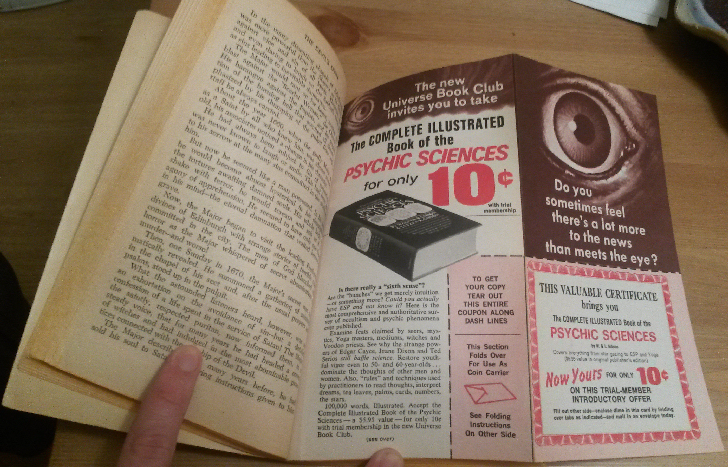
Also, there is a super cool fold-out advertisement in the center of the book. Only 10 cents for a copy of the Complete Illustrated Book of Psychic Sciences?!?!?!
I really enjoyed this little book. It’s trash to the Nth degree, but it doesn’t pretend to be anything else. Buy a copy and read it on the way to work. 8/10.
This book is a tricky one. Half of it’s great, half of it’s horrible. The sections on ritual magic, witchcraft and satanism are really interesting, but the book also contains comprehensive sections on numerology, cabala, tarot, astrology and alchemy. Personally speaking, when I buy a book on ‘the Black Arts’, I’m not really interested in reading about people playing with cards or counting the numbers in their names. I want blood rituals, human sacrifice and horrible acts of depravity. (Reading this book could be compared to going to a Slayer concert and then finding out that Tool are the opening band.) I’m going to largely ignore the parts that I didn’t like for this review; if you want to learn about tarot, fuck off and prance over to your nearest renaissance fair.
There’s some really interesting stuff in here about demons from Biblical Pseudepigrapha. I’m still only about halfway through the Christian Bible right now, but I’m really looking forward to finishing that and then reading the Books of Enoch, the Testaments of Solomon and the Life of Adam and Eve. There’s something particularly exciting about the idea of Jehovah being good mates with the demons back in the day – Yeeeeeeoweh and de lads!
One of my favourite things about the book is the fact that it reads more like a history book than a grimoire or set of instructions. A large amount of the information is utterly unbelievable, but Cavendish manages to reference his sources in such a way as to avoid any accusations of credulity that might be thrown at him. He politely leaves it up to the reader to decide what they think is bullshit and what’s legitimate, and this approach makes this kind of book far more interesting to read.
There’s a great bibliography and a ‘suggestions for further reading’ section at the back. I’ve already ordered quite a few of its sources, and I’ll hopefully get around to reviewing them here sometime soon. I’m going to pretend that I didn’t begrudgingly wade through 5 chapters of new-age shite and give this book a glorious 7.5/10.
In Dublin, the phrase ‘Hellfire Club’ is almost exclusively used to refer to the ruins of the hunting lodge on top of Montpelier Hill. Families walk up to these ruins on Sunday evenings after dinner, and everybody knows the legend of the Devil appearing there during a card game:
Some lads were up at the lodge, gettin’ locked, shaggin’ tarts and playin’ cards. One of of the lads drops his cards on the ground. He stoops over to pick them up and notices that the lad beside him has hooves for feet. He stands back up and the other lad (Satan) disappears in a flash of smoke.
That story scared the shit out of me when I was little. I had visited the lodge when I was a kid, but it wasn’t until 2 years ago that I got to go back.
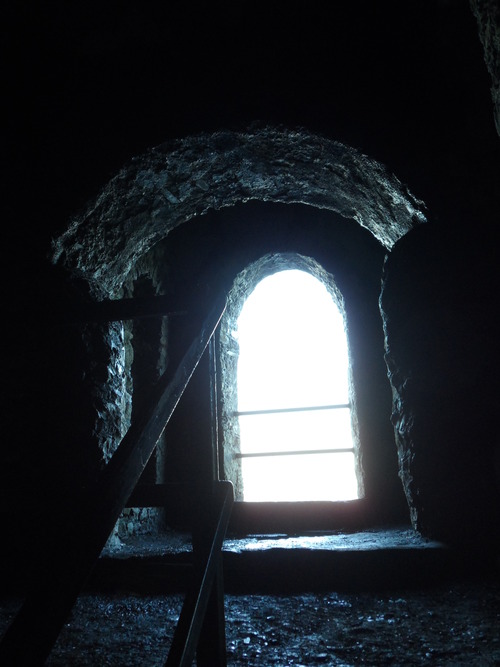
A view from inside.
The lodge was built over a pre-historic passage tomb.
Anyways, the original ‘Hellfire club’ was actually a group of 18th century English politicians. It was probably little more than an excuse to get drunk and talk lewdly, but it has literally become the stuff of legends. Several other clubs, including the one that met on top Montpelier hill, have inadvertently assumed the Hellfire moniker, and these groups are the subjects of the three books I am reviewing.
Blasphemers and Blackguards (The Irish Hellfire Clubs) – David Ryan Merrion – 2012
This book gives an account of the several different organizations that were founded by wealthy rakes in Ireland during the 18th century. The clubs consisted of upper-class individuals who were able to use their place in society to get away with murder. The Irish clubs don’t seem to have been involved in much satanism, but it’s not hard to see how a group of licentious and wealthy individuals of Protestant descendency could gain a diabolical reputation in a country that was mostly populated by poor Catholics. Besides, the crimes that some of these groups committed were far more reprehensible than the boudoir blasphemy of the real Hellfire Club.
This book is fairly academic: it’s properly researched and sourced, and I never felt like the author was bullshitting. Ryan gives a trustworthy account of the facts about these clubs, while also delineating and discussing the folklore that has developed around the Hellfire legend. I’m from Dublin and I thoroughly enjoyed reading this account of the city’s shadiest secret. 7.5/10
The Hellfire Club – Daniel P. Mannix
New English Library – 1970
This book focuses on the The Order of the Friars of St. Francis of Wycombe. While the Friars were not the original Hellfire Club, they were definitely the most infamous. This book is full of tales of blasphemy, debauchery and political upheaval. Even the less lurid parts of the book are fairly interesting. John Wilkes comes across as a particularly interesting character.
The big problem with this book is that it’s not properly sourced. Many of the events herein are undoubtedly based in fact, but there are episodes in this book that seem to be taken straight out of works of fiction. One such episode, which involves a baboon dressed as Satan, is almost definitely based on a scene from Charles Johnstone’s novel, Chrysal, or the Adventures of a Guinea. Chrysal was a satirical novel published between 1760 and 1765 that poked fun at the political leaders of the time. The novel is narrated by a golden coin that at one stage enters into the pocket of a Hellfire monk. Somehow, the experiences of this imaginary golden coin managed to transmigrate themselves into facts in Mannix’s supposedly historical account of the Club.
That being said, the subtitle of this book is “Orgies were their pleasure, politics their passtime”, and I wasn’t particularly surprised or disappointed to find that this book is a tad sensational. I’m giving it a 6.5/10 for its entertainment value.
Do What You Will (A History of Anti-Morality) – Geoffrey Ashe
W.H. Allen – 1974 This book has sections on Rabelais, John Dee, the Marquis De Sade and Aleister Crowley, but it’s really about the Hellfire Club. Dashwood’s club is again the focus, but this time the author is reasonable in his assertions. Ashe presents very similar information to Mannix, but he does so in a far less credulous manner. This book is definitely worth reading if you want a legitimate account of the Monks of Medenham.
The subtitle of this book is ‘A History of Anti-Morality’, but more than half of the book’s chapters are on the Hellfire Clubs. I obviously find the clubs fascinating, and I understand that their members played an important role in the politics of the 18th century, but I’m not convinced that they are the single most important anti-morality movement in the history of the world. I’m certain that I’m not the only person to notice this as recent editions of this book have actually been renamed ‘The Hellfire Clubs’. Basically, Ashe has arbitrarily chosen several groups and individuals, and assigned them an inordinate amount of moral accountability. It’s not that any of the material here is irrelevant, it’s the fact that so much has been left out. Compiling a history of anti-morality would be an outrageously difficult and lengthy procedure, and ultimately Ashe has failed in this task.
I was very interested to read a book that had consecutive chapters on the Hellfire Clubs and the Marquis De Sade. There are many parallels with Hellfire legends and the events in De Sade’s fiction. I have often wondered if the Divine Marquis had heard tales about the Brotherhood of Wycombe and taken inspiration from them. Think about it; he was a nobleman and a libertine, writing only a few years after the dissolution of Dashwood’s posse. I find it hard to believe that he had never heard of the friars taking young harlots into the sacrilegious abbey at Medenham or the Hellfire caves at Wycombe. I’ve done a little research to verify this link but I haven’t found anything to substantiate it. If anyone has any suggestions on where to look, I would love to hear from you!
Anyways, although I think that this book falls short on what it sets out to do, I did enjoy reading it. The stuff in here isn’t bad; there’s just not enough of it. That being said, there is an abundant amount of information on the Hellfire Clubs in here, and I would urge anyone who has any interest in this topic to get their hands on this one. I’m going to give this one a 6.5/10.
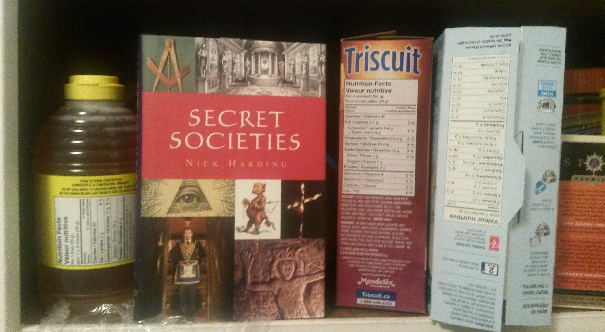
BONUS REVIEW Secret Societies – Nick Harding Chartwell Books Inc. – 2006
I’m not hugely interested in most secret societies. I inadvertently bought a copy of this book as part of a collection on satanism. It’s quite short and quite shit. It provides a little information on about 20 different secret societies, but doesn’t go into detail on any of them. I don’t really know why a person would buy a book like this. I suppose it would be quite good if you were taking a long flight and you needed something to halfheartedly glance at now and then. I am reviewing it as part of this post as it contains a section on Dashwood’s Hellfire Club. Let’s just give it a 4/10 and leave it at that.
This is a novel that deals with the occult, but it’s more than just an occult novel. There’s lots of Frenchistentialism and romance going on in here, but I’ll be straight with you; if you’re looking for a discussion on this novel’s place in the fin-de-siècle movement, you’d best look elsewhere.
The protagonist of the book divides his time researching Gilles de Rais, writing letters to a mystery woman and talking to his friends about bells. The bits about Gilles De Rais were very interesting. He was a horrible man. I’m planning to read and review the book that Bataille wrote on him soon. The other parts of this novel, although not as pertinent to this blog, were also quite entertaining. I enjoyed seeing the awkward love affair develop. The infamous depiction of a black mass was also fun, if slightly underwhelming.My copy of the novel is a ‘Dennis Wheatley Library of the Occult’ edition, and anyone who has read any of Wheatley’s black magic novels will be more than prepared for this only-slightly sordid scene of infernal blasphemy.
Perhaps the most intriguing aspect of this book is the fact that the most fantastic elements of the plot are supposedly based on real events. The most satanic of
all the book’s characters, the Canon Docre, was based on a real person! I’ve come across the story of the Black Magic war between Abbé Joseph-Antoine Boullan and Stanislas de Guaita in Colin Wilson’s The Occult and Richard Cavendish’s The Black Arts, but I’m still hungry for more information. If anyone has any suggestions on other texts that contain information on this rivalry, I would love to hear from you!
Overall, I’ll give this one a generous 8/10. It wasn’t as intense as I had expected but I did like the atmosphere and characters. I will probably read more of Huysmans’ books in the future.
The Vampire Bible – ???
Temple of the Vampire – 1989
The Satanic Bible – Anton Lavey Avon – 1969
I’ve just finished reading The Vampire Bible from the Temple of the Vampire. I’m going to talk a little about that and a little about the Satanic Bible. I want to get LaVey out of the way early on.
(The fonts and imagery are one of the sweetest things about this book.)
I am glad that I bought my copy of the Vampire Bible in a parking lot, off some dude from craigslist. I sure would feel like a dummy if I had given the person who wrote this tripe any of my money.
To join the Temple of the Vampire, you have to buy a copy of this book from them. I would hope that they also give you extra material to make sense of it, or maybe call you up to explain the crazy nonsense that’s included. The book doesn’t even include a definition of what they mean by ‘vampire’. The vampires described are non-violent vampires who don’t murder or drink blood. These vampires just float about in the astral realm, giving thanks to the undead gods and sucking life-force from their prey. It’s not very clear as to what effect this floating has on the vampire’s prey though, and the book specifically says that it doesn’t harm them. That sounds like a pathetic vampire to me.
The content is an awkward mix of instruction and fantasy. The book states that its contents are based in fantasy, yet it prohibits any kind of violence. If this is all fantasy, why shouldn’t I swally down the blood of my enemies? At least the Satanic Bible has some balls and tells you to ‘SMASH’ people that you don’t like. My favourite part of the entire book was the second item on the the list of things that suggest that you are in the presence of the Undead:
“2. Tingling sensations in the fingertips”
Perhaps the author has gotten mixed up. These vampires sound a lot like fairies to me.
(I haven’t read my copy of the Satanic Rituals yet and probably won’t ever get around to it. It has a nice pink cover though.)
The Vampire Bible is dumb. Like the Satanic Bible, it makes no effort to emulate the actual Bible in any way. Unlike the Satanic Bible, it’s not even remotely clever. I actually enjoyed reading the LaVey’s Bible. It’s camp and silly, but there is some actual reasoning behind it. You get the feeling that he actually believed in some of what he was writing. There’s not an ounce of reasoning behind anything written by Vlad, or whoever the fuck shat out the Vampire Bible. The ideas in the Satanic Bible are obviously not completely original, but I think that LaVey did a decent job of synthesizing them into an entertaining whole.
Coincidentally, perhaps my least favourite part of the Satanic Bible (apart from the silly Enochian bits) was the section on Psychic Vampires. It seemed like it was a metaphor for something that had happened in LaVey’s own private life that was too embarrassing to clarify but too upsetting for him to leave out completely. It’s funny looking back at that section now and reading the lines: Psychic vampires are individuals who drain others of their vital energy… They fill no useful purpose in our lives. Perhaps he was in contact with some of the members from the Temple of the Vampire! Well, actually… probably not; the Satanic Bible was written 20 years before the Temple was founded.
Anyways, to conclude, I’m giving the Vampire Bible a generous 3/10. It looks and sounds pretty cool as long as you don’t take the time to actually read it. It’s not nearly as spooky as it could have been. The Satanic Bible gets a 7/10 for being good hellish fun. Even if you don’t like the writing, this book is worth owning just for the sweet portrait of LaVey on the back.













 Nocturnal Revelries
