Sean Costello’s Horror Novels: The Cartoonist, Eden’s Eyes and Captain Quad

In honour of Canada Day next Saturday, here’s some books by a Canadian author. Exactly one year ago, I read a horror novel by Sean Costello. It was great. I discovered that Costello had written two other horror novels, so I decided to read those too. Doing so was an excellent decision. I greatly enjoyed all three of these books.

Pocket Books – 1990

The Cartoonist

Scott, a successful psychiatrist with a horrible secret, meets a strange patient at his hospital. This drooling geriatric can’t walk or speak, but he can draw. At first the drawings seem random and unconnected, but Scott soon realises this is not the case.

I really enjoyed this novel. It’s set in Canada, and at its core, it’s about a father trying to protect his little girl. Both the antagonist and protagonist are horribly flawed people, but it was difficult for me not to empathise with both of them, and parts of this novel really got to me. In the 3 days leading up to me reading this book, I read 3 other “paperback from hell”-esque novels (The Kill, Joyride, and The Scourge) , and I had enjoyed each one less than the one before it. I was expecting the same from this one, but it was way, way better. It’s not perfect (my friend Micah made some valid criticisms when he reviewed it), but I found it very entertaining.

Pocket Books – 1989

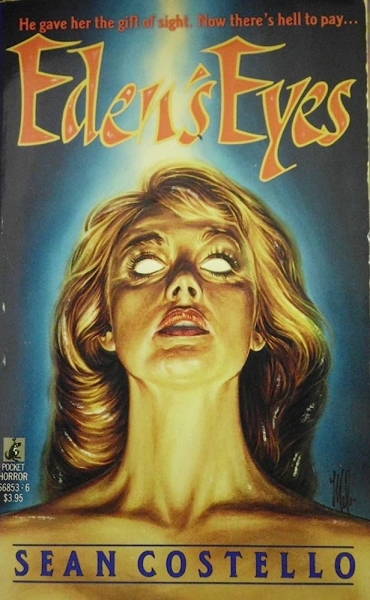
Eden’s Eyes

This book starts off with a father signing the consent forms to donate his recently deceased son’s organs. The eyes go to a blind author, the kidneys go to a sick child, and the heart goes to a homeless alcoholic. Unfortunately for everyone, the donor’s mother is not happy about the organ transplants, not happy at all.

That’s the basic premise of the book. That probably doesn’t make it sound like anything special, and in truth, it didn’t really feel like anything special for the first 50 or so pages. Then things started to get darker and weirder by the chapter. It ramps up and up and up, and the ending is bloody glorious. This is a slasher at heart, but the characters are interesting, and there’s weird supernatural elements that make it quite exciting.

I was so excited after the ending that I spent about 15 minutes trying to talk my wife into reading this one. (She wasn’t remotely interested.) Eden’s Eyes was a lot of fun to read.

Pocket Books – 1991

Captain Quad

I think this book may have the most off-putting title and cover of any horror novel ever. I didn’t want to read it, but I’m glad I did. It’s very dark, and I quite enjoyed it.

Peter Gardener is just about the greatest guy ever. He’s smart, athletic, handsome and kind. Unfortunately for him, he falls off his motorbike and breaks his neck. Being paralyzed from the neck down does two things to him. It gives him the opportunity to develop the ability to leave his body at will, and it also turns him into an evil psychopath.

That’s a horrible idea. It’s horrible because part of it is understandable. If I went from having the world in my pocket to losing the use of my body along with most of my relationships and dreams, I’m sure I’d become bitter. Hopefully not bitter enough to kill my mom, rape my ex, and shove an ice auger (basically a giant corkscrew) up an old friend’s anus, but definitely bitter.

Yes, this book gets very nasty. It was a bit like Eden’s Eyes in the way it transformed, fairly suddenly, from a gripping thriller to a gorefest.

Also like Eden’s Eyes, this one is about a person who develops psychic powers after going to a hospital. Sean Costello worked as an anesthesiologist, so this explains why sizeable parts of all three of these books take place in hospitals. The other books that came to mind when I was reading this were Trumbo’s Johnny Get Your Gun and Hallahan’s Keeper of the Children.

Captain Quad is unpleasant because Peter starts off as the good guy. He’s an extremely sympathetic character. You don’t want him to do the bad stuff he does, but it’s not too hard to understand why he does it. It’s difficult to read the book without imagining the same thing happening to yourself. I ride a bike to work every day, and the idea of getting hit by truck and paralysed is far more terrifying than a poltergeist. Honestly, the idea is almost a little too scary for a horror novel. I read these books to forget about my life, not to worry about it.

I really enjoyed these books, and I was really impressed with Costello’s writing. These are a step above a lot of the crap I read. Luckily for everyone, these three Canadian classics are now available as ebooks.

Lyle Blackburn’s Lizard Man: The True Story of the Bishopville Monster

Anomalist Books – 2013

Over the years I have done posts on books about some of the better known cryptids including the Jersey Devil, the Mothman and a few on Sasquatch. In truth, I never found any of these cases particularly convincing. I’ve read a few other books about the field of cryptozoology, but I hadn’t done any on specific cryptids in a long time. I recently did posts on books about the Pigman and the Goatman, and when I saw a book about the Lizardman, I decided it was only fair that I give him a chance too.

In the late 80s, some people in Bishopville, South Carolina, claimed to see a monster. Some cars in the area were damaged. The descriptions of the creature varied, but some claimed he was like a hairless sasquatch.

Like the author of Goatman, Lyle Blackburn does an excellent job documenting the Lizardman phenomena. The story is clear, and obviously well researched. Unfortunately, none of the accounts herein are remotely convincing.

Lizardman never hurt anyone. Nobody ever went missing. None of the sightings are particularly interesting. One witness later admitted he was lying. A few people claim they saw something they couldn’t explain. Their descriptions of the monster are so different that it’s hard to accept any of this. Lizardman doesn’t exist. At best he’s just a muddy sasquatch.

This is a decent book about a very silly topic.

There were a few points in the text where the author referenced the fact that he is a musician. I decided to see if he had any recordings on the internet. It turns out that he was a founding member of Solitude Aeturnus and played on their a bunch of their albums, including my personal favourite, Through the Darkest Hour from 1994. This dude played in an awesome heavy metal band and then started writing books about cryptids. Cool.

More Potato Famine Horror: Alan Ryan’s Cast A Cold Eye

I reviewed Alan Ryan’s The Kill and Dead White last winter. I was originally going to talk about Cast a Cold Eye in the same post as those two books, but I realised that that pair were set in the same village and shared characters, so I kept Cast a Cold Eye for later.

Sphere – 1986 (Originally published 1984)

Jack, a successful American author, goes to Ireland and rents a house so that he can research and write his new novel. He’s staying in Doolin, a little village on the west coast of the island, and shortly after arriving, he sees some old men pouring a bottle of blood into a fresh grave. Soon thereafter, he starts to see ghosts of victims of the potato famine.

Alright. Let’s stop there. More potato famine horror? I was not a fan of the last book I read within that very niche genre. Fortunately, Alan Ryan’s writing is far, far better than Ann Pilling’s, and the story here is more intriguing, even if it does also feature very skinny ghosts.

I want to make it clear that my disdain for potato famine horror isn’t because I’m offended by the author turning the suffering of an oppressed group of real people into entertainment. It’s more the fact that the potato famine is the only thing a lot of North Americans know about Ireland. This is like an Irish author writing a horror novel set in America about a hamburger monster or a story set in Australia about a zombie kangaroo. (I think the only other horror novel set in Ireland that I’ve read by a non-Irish author was Paul Huson’s The Keepsake. Thankfully that one had no hungry ghosts. It was about a stone that turns into a vampire. Cool!)

In fairness though, Ryan does a pretty good job of making it seem that he really likes Ireland, and I would be shocked if part of this story isn’t autobiographical. He has to have been there to write some of the things he writes. Trust me. He references tea 45 times throughout the 350 pages.

I was 23 when I left Ireland. I wasn’t planning on a long term move, but things ended up that way, and I still miss Ireland greatly. It’s strange going back. I’ve been gone for long enough that little things that I grew up with seem foreign. There’s moments when I feel like a tourist in my home country.

It was interesting reading this book. Some of the descriptions about the landscape were great. I tend to travel more in Ireland when I return now than I ever did when I lived there, and the only time I’ve visited Clare, the county where this book is set, was as a tourist. Ryan gets the countryside right.

At the same time though, there were definitely a few cringey bits. I didn’t like the author’s idea of “Irish time”. Granted, the buses in Dublin are shit, but I don’t think Irish people are less punctual than anyone else. Not everyone wears woolen jumpers either. Also, the parts where people would say “I am” instead of “yes” annoyed me.

Of the three books I’ve read by Ryan, this one is probably the best horror novel. Dead White is good, but clowns aren’t scary. Skinny little children running around at night are scary. This is, at its heart, a good old-fashioned ghost story. The ending was ok, but things didn’t come together quite as much as I was hoping for. I really enjoyed reading this book, but I think a large part of my enjoyment stemmed from the fact that I’m going to Ireland in a few weeks, and all of the talk of rainy days and cups of tea made me really excited. I will try to track down Ryan’s short stories in the future.

Want to Talk to Aliens? How to Contact Space People by Ted Owens

Saucerian Publication – 1969

How to Contact Space People – Ted Owens

I don’t remember when or where I heard of this book, but I found a pdf copy on my phone a few weeks ago, and the cover was so pathetic that I knew I’d have to read it. I assumed that image was an alien, but after finishing the book, I am not sure what it’s supposed to depict. The Saucer intelligences (“Si’s” from here onwards) discussed in this book have insect heads. Perhaps it’s a self portrait by the author.

Truly, this is one of the weirdest books I have read. It’s utterly mental, but the most exceptional aspect is the author’s elevated opinion of himself. He boasts as if he were a stupid 5 year old who doesn’t get to socialize much. It’s truly cringeworthy. I’m going to spend this post summarizing the text so that you don’t have to read it. If my summary seems illogical and full of non-sequiturs, that’s because it’s a summary of an awful piece of writing. I want to make sure I include the most interesting bits so that nobody else has to read this insane pile of shit.

The book starts off with an embarrassing collection of statements about author’s ability to forecast, start and influence the paths of storms. He is also able to summon UFOs, lightning and massive blackouts.

He claims his life changed after seeing a UFO. Soon thereafter, he discovered he could change the weather. He prevented many droughts and ecological problems by doing so. He easily convinced NASA and the CIA of his abilities.

He admits that he was kicked out of Texas for practicing medicine without a license. He was hypnotizing people.

He goes on to present a bunch more of the 181 accurate predictions that he made with the aid of extraterrestrial intelligence. Some of these stories are bizarre.

He recounts the story of a 400lb moldy-smelling monster attacking a girl and smashing her head. Si’s caused this to happen, but they are not bad. Even though their monster gave the girl a black eye and “kept banging her head on the side of the car”, it didn’t actually hurt her. This was just to get attention.

Some police officers shot at a flying saucer and the aliens then ruined their lives. This seems petty for all-knowing beings who want what’s best for us, but it turns out their technology, even though it can’t be harmed, automatically responds to negativity with negativity. This seems like a pretty serious design flaw.

There’s some more monster appearances and blackouts. The Si’s are dicks.

After 50 pages of evidence of the author’s trustworthiness and success, we get to the  5 pages that actually tell the reader how to contact space people. Basically all you have to do is imagine that you are talking to some little insects in a different dimension and you just tell them what to do. They will do what you ask 88% of the time, but there is a 12% chance “a time window” will make it impossible for them to act on our dimension. The aliens you deal with will be Tweeter and Twitter at the beginning but they may introduce you to their leader who is actually just an illusion.

Honestly, Owens’ instructions consist of 5 pages of telling the reader to make believe.

This picture is actually in the book.

The second section in book is an interview between Owens and a teenage boy. It’s agonizing. Only an idiot child could have tolerated talking to this man for long enough to conduct an interview.

Apparently Owens could heal people with broken skulls who doctors had given up on. He practically brought dead people back to life.

There’s an incredible section where he recounts manly deeds confronting “toughs” and threatening gangsters. He claims he could do so because of Si protection. Seriously, he talks about himself as if he’s Jean-Claude Van Damme. He can turn a hitman away with just an icy stare.

He then presents the boy with crayon drawings of the aliens. Unfortunately these pictures are not included in the book. I bet they were really good.

Owens claims he is the first human since Moses with the brain capacity to be in constant communication with the Si’s. This is where his boasting gets out of hand. This man comes across as an utterly abhorrent wanker.

“I became a hypnotist at 13, an expert on voodoo and juju when I was 10, and so forth. I mastered more than 20 professions through the years – not as a jack-of-all-trades, but I mastered these professions.”

He can move objects with his mind.

The Si’s killed 3 astronauts when they were angry with US government. Owens claims that the Si’s will allow the world to end if the American government does not start doing what they want by 1970.

Prayers work if they are directed at the Si’s. He says that the millions of Jews who died in the Holocaust were praying to wrong power. Yikes.

Bigfoots are the Si’s pets.

In the final section Owens starts discussing Oi’s as if he had already explained them. Oi’s are bad aliens who are not as smart as the Si’s.

The author is actually the cause of all hurricanes in the US.

A couple of pages before the end of the book PK man drops this bombshell:

Owens believes himself to be the only human who can prevent the end of the world. Si’s chose him to be the saviour. In the next few paragraphs he compares himself to Jesus.

Ted Owens claims he was a tough guy, master of all trades, psychic saviour of mankind. I reckon he was actually a deluded twat.

I also noticed that Owens claims responsibility for the strange path of Hurricane Inez in 1966:

This is interesting. When speaking of the trajectory of Hurricane Inez in Sympathy for the Devil: The True Story of The Process Church of the Final Judgment, Timothy Wylie claims, “The thing veered off course… It comes straight towards us and at the last moment it just starts to go down the coast. Of course, we felt validated because we’d meditated and we’d asked the beings to make sure it didn’t you know, hit us, so it was a major validation. Hurricane Inez really consolidated our belief.” Did Owen’s Si’s and the “beings” in contact with the Process work together? Were they the same beings? Were The Process also a bunch of idiots?

Ted Owens was cuckoo insane. Some people believed him though. Jefferey Mishlove wrote a book about how great he was in 2000. I couldn’t bring myself to read that book, but I watched a few of Jeff’s videos on youtube… jesus. I shouldn’t get surprised when I dig into this kinda stuff, but I do. What the Hell is wrong with people?

Revisiting the King in Yellow

I find writing about short story collections a bit intimidating. I’ll usually write a post here saying that the collection is ok and then quickly forget the stories until I read something else that reminds me of one of them. In some recent posts about short story collections, I have been including a table on the stories with a summary and/or my thoughts. I’m not sure if people are interested in these, but they help me remember.

I recently read Brian McNaughton’s Satan’s Surrogate. It’s not a particularly good book, but it’s full of allusions to other works of weird fiction, including Robert W. Chamber’s The King in Yellow. I read and reviewed that collection a few years ago, and although I knew I had enjoyed it, I couldn’t remember much about it other than the fact that it featured The King in Yellow, a non-existent book that was supposed to drive people mad. I also recalled that it had distinct sections and that only the first section dealt with the really weird stuff. I went back to read my post on it and discovered that I had included summaries on all of the stories in the book except the first four, the really interesting ones. (I also discovered that I had reviewed a second book by Robert W. Chambers that I had entirely forgotten about. I don’t know if I’m going senile or if I’ve just read too many books.)

A few weeks ago, I got sick. I actually vomited for the first time in maybe 20 years. I get a few colds every year, but I honestly cannot remember the last time I had a tummy bug. I didn’t realise that vomiting actually hurts and that I’m not capable of doing it quietly. Luckily enough, I vomited in the morning, before I had actually eaten anything, so it was just my cup of tea (and a single green bean from the night before) that came back up. Anyways, I was bedbound for a couple of days, and reading Satan’s Surrogate seemed like too much work. I wanted an audiobook, and I realised that I’d easily be able to find an audiobook copy of The King in Yellow. I only bothered with the first four stories, but I really enjoyed revisiting them.

The Repairer of Reputations

This is quite a complicated tale. It’s set in 1925 which was 25 years in the future at the time that it was written. It’s a little dystopian and involves the unveiling of government funded suicide booths, but it’s a horror story at its core. The narrator reads The King in Yellow while recovering from a head injury and ends up involving himself in a murderous conspiracy. His best friend is basically a professional blackmailer, and together they plan to seize control of the world. The plan doesn’t work out.

I read it and reread it, and wept and laughed and trembled with a horror which at times assails me yet. This is the thing that troubles me, for I cannot forget Carcosa where black stars hang in the heavens; where the shadows of men’s thoughts lengthen in the afternoon, when the twin suns sink into the lake of Hali; and my mind will bear for ever the memory of the Pallid Mask. I pray God will curse the writer, as the writer has cursed the world with this beautiful, stupendous creation, terrible in its simplicity, irresistible in its truth—a world which now trembles before the King in Yellow.

The narrator did suffer a brain injury, but his madness was certainly exacerbated by reading The King in Yellow. Vance, their hitman, also went insane after reading the book. It is not explicitly stated, but it seems to me that Chambers wanted his readers to believe that the legalisation of suicide was somehow influenced by the popularity of the awful tome.

The Mask

Two artists love the same girl. One of the guys reads The King in Yellow and then discovers a way to turn living creatures into statues. It is not explictly stated that his discovery was inspired by his reading. He starts off putting little creatures into his magic potion, but things get messy and the girl that everyone loves ends up in the puddle. I had completely forgotten the previous story, but I remembered what was going to happen at the end of this one quite soon after beginning it. It’s quite good, but The King in Yellow plays a fairly minor role. Characters from the play show up in the narrator’s fever dreams, but he has only ever flipped through its pages, so he ultimately retains his sanity.

 I thought, too, of The King in Yellow wrapt in the fantastic colors of his tattered mantle, and that bitter cry of Cassilda, “Not upon us, oh King, not upon us!” Feverishly I struggled to put it from me, but I saw the lake of Hali, thin and blank, without a ripple or wind to stir it, and I saw the towers of Carcosa behind the moon. Aldebaran, The Hyades, Alar, Hastur, glided through the cloud rifts which fluttered and flapped as they passed like the scolloped tatters of The King in Yellow.

In the Court of the Dragon

A lad gets bored during a church service, and he starts daydreaming about getting chased around town by the grumpy looking church organist. Part of the reason he is attending church is that he recently read The King in Yellow, and he finds the peaceful atmosphere in the church relieving. When he awakes from his daydream, he is transported to Carcosa and confronted by the Yellow King himself.

And now, far away, over leagues of tossing cloud-waves, I saw the moon dripping with spray; and beyond, the towers of Carcosa rose behind the moon.

Death and the awful abode of lost souls, whither my weakness long ago had sent him, had changed him for every other eye but mine. And now I heard his voice, rising, swelling, thundering through the flaring light, and as I fell, the radiance increasing, increasing, poured over me in waves of flame. Then I sank into the depths, and I heard the King in Yellow whispering to my soul: “It is a fearful thing to fall into the hands of the living God!”

The Yellow Sign

A painter is disturbed by a new watchman that has started working at the church opposite his house. This watchman’s face is so disgustingly ugly that it causes the painter to ruin the picture he is painting. The model who is posing for him falls in love with him, but she is haunted by strange dreams of the painter in a glass coffin. She gives him a strange piece of black jewelry as a gift. When the painter hurts his hands and can’t paint, the model hangs around his house. She finds a copy of The King in Yellow even though the painter did not own a copy because his friend, the narrator of The Repairer of Reputations, had gone mad after reading it. It is never explained how the book got into his house. Maybe the creepy watchman put it there.

I had always refused to listen to any description of it, and indeed, nobody ever ventured to discuss the second part aloud, so I had absolutely no knowledge of what those leaves might reveal. I stared at the poisonous mottled binding as I would at a snake.

Both the painter and his model end up reading the book. Soon thereafter, their dreams come true. The disgusting watchman breaks into their home and tries to steal the onyx clasp. Nobody survives. When the narrator realises what is happening he says,”I knew that the King in Yellow had opened his tattered mantle and there was only God to cry to now.”, but apparently the original text read,

I knew that the King in Yellow had opened his tattered mantle and there was only Christ to cry to now.

Apparently the publisher changed this so it wouldn’t offend Christian readers.

There are other stories in the collection, but none of them deal with The King in Yellow or Carcosa, and I’ve discussed them already. I think The Yellow Sign is probably my favourite out of these 4 stories. All four contain small references to other stories in this collection, but each tale works by itself. The references to The King in Yellow are maddeningly sparse, and you’ll want to read all four of these stories to get all the details. I reckon it’s what Chambers doesn’t say about this strange text that makes it so appealing. From what little he reveals, I have deduced that the play is about a shabbily dressed King who creeps out two Carcosian ladies called Cassilda and Camila.

Camilla: You, sir, should unmask.

Stranger: Indeed?

Cassilda: Indeed it’s time. We all have laid aside disguise but you.

Stranger: I wear no mask.

Camilla: (Terrified, aside to Cassilda.) No mask? No mask!

The King in Yellow, Act I, Scene 2.

 I thought, too, of the King in Yellow wrapped in the fantastic colours of his tattered mantle, and that bitter cry of Cassilda, “Not upon us, oh King, not upon us!”

I remembered Camilla’s agonized scream and the awful words echoing through the dim streets of Carcosa. They were the last lines in the first act,

What the Hell is that creep up to?

I know I mentioned it before, but there is something embarrassingly exciting about a creepy book that doesn’t exist. One of the characters in Satan’s Surrogate actually attempts to write a play with a similar title, but he isn’t successful. I quite enjoyed rereading these 4 stories by Chambers. Nothing else I’ve read by him comes close to them, but their atmosphere and allusions to the maddening and mysterious Yellow King are enough to ensure that Chambers is remembered as a master of weird fiction.

What the Hell is a Goatman?

Self Published – 2014

Goatman: Flesh or Folklore? – J. Nathan Couch

Honestly, I had never heard of Goatman before seeing this book, and I was surprised to find that it’s not just something the author made up. Goatman is an American urban legend. He’s a half-man, half-goat freak that kills teenagers when they are making out in their cars. Some believe he was a genetic experiment gone wrong, but others believe that he was a dude who was wrongfully executed. His head popped off when he was hung, so he replaced it with a goat’s head and set out for revenge. Pretty cool.

This is obviously just a story that has no basis in reality. Nobody has ever had any proof that such a creature exists, and all sightings of such a creature have been sketchy and unbelievable. Despite this, J. Nathan Couch wrote a book that questions if such a creature could be real.

Things get ridiculous pretty quickly. The author questions if Goatman could be a satyr, a descendant of the Greek God Pan. Couch acknowledges that this seems unlikely, but he rolls with it anyway. In a way, I admire the author’s approach in this book. He leaves no stone unturned. He examines every piece of evidence and considers all possibilities. It’s still pretty silly though. In books about Bigfoot, there is nearly always a discussion on the possibility that the Bigfoot sighted was just a bear, a far more realistic scenario. In this book, there’s discussions on possibility that the Goatman was just a Bigfoot. Goatman can even talk in a few of the encounters described. Surely nobody actually believes in this?

Ultimately, Couch admits that Goatman is almost definitely just an urban legend. He claims that the stories may have originated from a real lad who used to travel around America with some goats. Even this seems pretty unlikely to be honest.

This book was clearly well researched, and while Couch discusses crazy ideas and unbelievable witness accounts, he doesn’t blindly accept them or present them as factual. This is a pretty good book on the Goatman phenomena. The problem is that the Goatman phenomena is really dumb (maybe a little less dumb than Pigman, but dumb nonetheless).

Brian McNaughton’s Satan Series: Satan’s Love Child, Satan’s Mistress, Satan’s Seductress and Satan’s Surrogate

Don’t deny it. Those covers are one the coolest things you’ve ever seen.

I remember seeing the covers of these books and immediately looking them up to buy them. This would have been 7 or 8 years ago. At that point, there were no copies available for less than 10 dollars, so I decided to wait. I just checked, and the cheapest available copy of Satan’s Surrogate available at the moment is just less than 300 dollars. Thanks a lot Paperbacks From Hell!

Star Edition 1981

Satan’s Love Child (1977)

A reporter for a small town newspaper discovers the horrendously mutilated corpse of a reclusive old man in a town that has recently been overrun by weird, taciturn hippies. Around the same time, the reporter figures out that her husband has been cheating on her, partly because he hates his weird stepdaughter.

As a horror novel, Satan’s Love Child is pretty mediocre. On the plus side, it has plenty of Satanism, a weird monster, a reanimated corpse, and even a few mentions of Yog-Sothoth. Unfortunately, the characters are transparent and don’t really act the way normal people would, even when they’re not under the influence of witchcraft. It’s not perfect, but I enjoyed it.

This was originally published as porn though. The author was initially asked to write a rip off of The Omen and then forced to insert graphic sex scenes before it was published. There’s only 3 or 4 sex scenes, but they’re full on hardcore porn. Honestly, I skimmed through these bits. They don’t add anything important to the book. There is a lengthy anal rape scene towards the end of the book that I wasn’t sure about. Was that bit supposed to be sexy or horrible? It came across as horrible.

Star Edition 1981

Satan’s Mistress (1978)

A dead wizard is reincarnated through incestuous rituals and then attempts to summon the Old Ones discussed in the fiction of H.P. Lovecraft after sexually assaulting some teenagers.

This book is trash, but it’s quite entertaining. I knew it was supposed to be Lovecraftian horror, but I didn’t realise quite how Lovecraftian. Lovecraft plays a similar role here as he does in Robert Bloch’s Strange Eons, not as a mere author of pulp fiction but as a prophet.

Despite the titles, this book has absolutely nothing to do with Satan’s Love Child. While the cover here is equally as sexy as its unrelated predecessor, the gratuitous sex scenes are absent. There is a similar unpleasantness running through the books. McNaughton wasn’t a happy ending kind of guy.

Star Edition 1981, Carlyle Edition 1980

Satan’s Seductress (1979)

Satan’s Seductress is a direct sequel to Satan’s Mistress. Its cast is almost entirely made up of characters who survived Satan’s Mistress. It’s more of the same. The evil wizard and his mistress are searching for the Necronomicon, and they are prepared to do some pretty horrendous stuff to get it.

This is not a great book, but it contains knife-wielding cultists, reanimated corpses, portals to other dimensions and eldritch tomes of forbidden mystery. This is precisely the kind of trash that I want to read after a hard day at work.

Carlyle Edition 1982

Satan’s Surrogate (1982)

While there is not much point in reading Satan’s Seductress if you haven’t read Satan’s Mistress, Satan’s Surrogate, like Satan’s Love Child is entirely separate, standalone novel. The plot has similarities with Mistress, and it’s similar in tone to the other books, but it’s far more complicated. Honestly, I found it a little disappointing. The story is too busy. There’s a lot of characters, and they’re largely uninteresting. There’s also a lot of plot elements, probably too much really. It has vampirism, wizards, alternate dimensions, cannibalism and references to Robert W. Chambers, Arthur Machen and H.P. Lovecraft, but it has a weird folklore thing running through it too. It wasn’t a total pain to read, but I never looked forward to sitting down with at night. This is particularly disappointing, as I paid more for my copy of this book than I did for any of the others mentioned here. As far as I know there was only one edition published under this title, so this is is the hardest to find of the Satan series.

I realise that I said very little about the plots of these books. That’s not laziness. There’s really not very much to say. These books are trash. The reason they are hard to find is because they look so damn cool.

The first editions of Satan’s Love Child, Satan’s Mistress and Satan’s Seductress all had the same face on them.

The sexy covers pictured at the top of the post appeared on the Star editions between 1980 and 1981. Satan’s Surrogate came out in 1982, and it never got a sexy cover. When it came out, it seems that Carlyle put out new editions of the earlier books with new covers. I have not been able to find an image of the cover of Satan’s Love Child from this run. I am not sure it even exists. That book is more pornographic than the others, so it might have been left out. Then again, the other books are numbered, so it seems unlikely that they left out #1.

If anyone has a copy of the Satan’s Love Child from this run, please scan it and let me see!

All editions of these books are pretty scarce at this point, but the sexy Star ones are the hardest to find. Fortunately, Wildside rereleased the original texts with their original names in the early 2000s. These are all available as ebooks on amazon for a few dollars. The first book in the series won’t include the gratuitous sex, but I doubt that will affect anyone’s enjoyment much. I thought about getting the new (actually old) editions too and comparing the texts to the Satan versions, but the books aren’t actually good enough to warrant doing that.

  • Satan’s Love Child is now Gemini Rising 
  • Satan’s Mistress is now Downward to Darkness 
  • Satan’s Seductress is now Worse Things Waiting 
  • Satan’s Surrogate is now The House Across the Way 

Honestly, these books are alright, but you’ll probably never end up with the full collection. Get the ebooks and save your money. Getting my hands on the full set of Star editions took more time than it did money, but they have only become scarcer since then. I have copies of a few of McNaughton’s short story collections too. I may get to them at some stage, but I’m in no rush.

Lee Brickley’s British Cryptids: Bigfoot, Werewolves and the Pig-Man

Blimey chaps! To celebrate the king’s coronation, we’re ‘avin’ a gander at two books from me mate, Lee Brickley, a paranormal researcher from England, innit?

Independently published – 2021

On the Hunt for the British Bigfoot

I don’t think Sasquatch exists. The Pacific Northwest has some of the biggest forests in the world, but people go into these forests every day, and everyone has had a camera on their phones for at least 10 years now. There’s no proof, and the likelihood of proof showing up becomes less and less likely every day. I sincerely hope I am wrong about this, but I doubt we’ll ever find Bigfoot.

Lee Brickley is a paranormal researcher from England. He wrote a book about the British Bigfoot. He claims this creature lives in Cannock Chase. Cannock Chase is a 26 square mile forest in the West Midlands of England. This book recounts several incidents that Brickley and others had with the beast.

Most of these incidents happened within a couple of years of each other, and nearly all of them happened at night. One witness literally claims that the beast looked like “some huge bloke in a monkey costume”, and when Brickley saw the beast himself, a feeling of awe overtook him and he forgot to take out his camera to take a picture… sure.

Brickley claims that he has a frozen footprint in his freezer and that a sample he found in the forest was taken by a shady government agency too.

This is one of the least convincing books I have ever read. I understand that an author choosing to write about topics like this shouldn’t get too wrapped up in pandering to sceptics, but there has to be more evidence than this. It really seems like that author’s motivation for writing this book was his desire to write a book about an English bigfoot. He doesn’t seem to have been concerned with making what he says believable.

Again, Cannock Chase covers 26 square miles. The Rocky Mountains, where Sasquatch is supposed to reside, cover well over 38,000 square miles. If you’re going to try to show that there’s a Bigfoot in the former, you’re going to need something more convincing than an Elvis impersonator claiming he saw a hairy face in his window.

Yam Yam Books – 2013

UFOs, Werewolves & the Pig-man

This book was writen a few years before the Bigfoot one. It’s a more general look at the reports of odd disturbances at Cannock Chase. It’s easier to accept some of what’s written here as the reported incidents being discussed occurred over a much longer time frame, and they’re not all the about the same thing. None of them are particularly convincing, but they seem less like lies than the Bigfoot claims.

This book features aliens, giant cats and snakes, ghosts, werewolves, demons and underground government tunnels. It almost reads like a proposal for a season of a shitty British version of the X-Files.

“This shit’s about to get really weird.”

Lee Brickley

The above is actually a quote from the book that introduces its most intriguing section, the chapter on the Pig-Man of Cannock Chase. Apparently some twisted scientists during the Second World War were messing with genetic engineering and got a woman pregnant with sperm that had been riddled with pig DNA. She didn’t show any signs of pregnancy for a while, but a year and a half later she gave birth to a half-man, half-pig creature and abandoned her job and family to live with her mutant offspring in the woods. She supposedly died a few years later, but the pig man lived on. The author heard this story from a waiter in a local restaurant.

There is far space in the book given to the pigman’s background story than there is on his sightings. One of the three people who claim to have seen the pigman was a teenager. He claims he was out at night when a naked man who looked a bit like a pig started chasing him. It was probably just Prince Andrew.

Again, nothing in this book was remotely convincing. The author seems to have written it for people who are willing to completely suspend critical thought. I’m sure these books were fun to write, but I honestly can’t imagine anyone taking them seriously.

Which of Thomas Harris’s Hannibal Lector books are worth reading?

I was very young when I found out who Hannibal lector was. I had heard that The Silence of the Lambs was the ultimate sicko film. I remember staring at the vhs box in the video shop after mass when I was kid, wondering what the butterfly had to do with lambs. I asked my very Catholic parents, and while they wouldn’t give any details about the sexual-pervert, Buffalo Bill, they didn’t have a problem telling me all about the cannibalistic doctor. I would have been in my early teens when I finally saw it, and I spent the next 10 years quoting it to my friends. It’s one of my favourite movies..

About a year ago, I started reading a bunch of books that have been made into movies. These were just comfort reading, nothing to do with this blog, but then I realised that I should read The Silence of the Lambs and the other Hannibal Lector books.

I read Red Dragon (1981) last May, and I loved every page of it. I honestly can’t think of another book that sucked me in as much as this one. I had seen the movie version once when I was a teenager, but I didn’t remember much of it. Francis Dolarhyde is perhaps the creepiest character in any of Harris’s novels. This book was absolutely brilliant.

The Silence of Lambs (1988) was also excellent, but I was so familiar with the film version that it didn’t seem quite as tense as Red Dragon. I find it hard to imagine somebody reading my blog who hasn’t seen the movie, but if you’re in that position read the book first. (The movie version is obviously excellent too.)

It seems like common knowledge that Red Dragon and The Silence of the Lambs are masterpieces of suspense. Opinions on Hannibal (1999), the third book in the series, are more varied. It’s a bit more gory, and the ending is contraversial. I was warned by a pal to avoid it completely. I didn’t, and I actually quite enjoyed it, but it’s definitely not as good as its predecessors. The titular character doesn’t show up until a quarter of the way through the book, and he plays a very different role here than he does in the first two books. Before he shows up, the reader is introduced to Mason Verger, a mutilated child-rapist with a whole bunch of money and power. What follows is a bit of a Varney the Vampire situation in which the original bad guy turns into the hero. I suppose Hannibal isn’t really the antagonist in either Red Dragon or The Silence of the Lambs, but he is definitely very, very bad. In Hannibal, we’re completely rooting for him.

The ending is silly. It’s not believable. I think the ending to the movie version was a far better idea.

If you’ve read and enjoyed Red Dragon and The Silence of the Lambs, I’d say you will probably enjoy Hannibal. It’s not as good as those books, but it’s still quite entertaining.

While opinions on Hannibal were varied, it seemed that Hannibal Rising (2006), the fourth and final entry in the series, was universally hated. Harris supposedly only wrote it because Dino De Laurentis wanted to make a prequel movie and threatened to get somebody else to write it when Harris refused. I was warned to avoid this one, but I’m not a quitter.

Honestly, it wasn’t that bad. It’s over 300 pages long, and I finished it in 2 days. I found teenage Hannibal hunting down the Nazis who ate his baby sister enjoyable. It’s a prequel, so there’s no chance of any big surprises, and it doesn’t come close to the suspense of the first two books. Also, it humanizes Hannibal too much. He’s very clearly the good guy here. All that aside, this is still an entertaining thriller. I was never bored. It felt a bit like fan-fiction written by the original author.

Red Dragon and The Silence of the Lambs are as popular as they are for a reason. They are two of the most enjoyable books I have ever read. They’re deeply unsettling and hugely exciting. If you haven’t already, I command you to read them. Hannibal and Hannibal Rising are not as good, probably even unnecessary. In saying that, I still had a good time reading them.

“Hannibal the Cannibal” though? I only thought about this on the way home from work the other day, but that is the cheesiest name for a villain imaginable. Realistically, what are the chances that a person named Hannibal would actually end up as a devourer of human flesh?

What Happened to the Manson Family Snuff Films?

A few weeks ago, I reviewed a book about the history of the Process Church of the Final Judgement. That book describes the very tenuous links between the Process and the Manson Family and notes that these links were initially highlighted in the first edition of Ed Sanders’ The Family. The Process took Sanders to court and had the offending chapter of his book removed in subsequent editions. This is a bit ridiculous as they had interviewed Manson for an issue of their magazine that came out before Sanders’ book. They liked looking for attention, but it seemed to concern them when they actually got it. I had been planning to read Bugliosi’s Helter Skelter for years, but when I heard of Sanders’ book, it seemed far more appealing. While a lot of it wouldn’t hold up in court, it’s not supposed to. Sanders fully acknowledges that many of his sources were less than trustworthy. Part of its value lies in the way it preserves the rumours about the Family from a time when they were still an entity.

E.P. Dutton and Co. Ltd – 1973

The Family: The Story of Charles Manson’s Dune Buggy Attack Battalion

When I was an edgy teenager, I thought Charles Manson was pretty cool. I was 16 when I stenciled his face onto the front of my schoolbag. (LOL. I was an idiot.) All the bands I liked seemed to have songs or t-shirts about him, and I read a bunch of websites about the Family and watched all of Charlie’s interviews on youtube. I knew the basic story of Manson’s life, the Family, the murders and the whole Helter-Skelter thing. There was lots of interesting stuff in Sanders’ book that I didn’t know about already, but the biggest surprise was the claim that the Manson Family may have recorded snuff films.

Apparently the Family made quite a few home movies, some of them pornographic. It doesn’t seem like the footage has ever turned up, but it is known that Charlie’s gang had several cameras, including a TV camera they stole from an NBC station wagon. Far more concerning are the claims of one associate of the Family who claims to have seen three extremely disturbing films featuring Family members. He claims that these films were shown at night and involved animal torture and sacrifice. One of them featured a dog being tortured to death and then people having sex while covered in the dog’s blood. The person who made this claim did not explicitly say that the video was filmed by the Family but that it involved members of the Family. Sanders mentions reports of numerous occult rituals that were reported in that area at the time the Family were living there, and elsewhere in the book, he spends a great deal of time discussing the The Solar Lodge of the Ordo Templi Orientis, a bunch of Crowley freaks who were supposedly linked with the Family. Crowley used animal blood during some of his sex magic rituals at the Abbey of Thelema, so it’s not unbelievable that his followers would have done the same. (Apparently the source of his information about the cult activity was Arthur Lyons, author of Satan Wants You.) Another video featured a cat being blown up with fireworks, and the final and most gruesome video was of the corpse of a decapitated woman. Sanders claims that it was suggested to him that the Process may have been behind these appalling acts, but as Gavin Baddeley notes in Lucifer Rising, this doesn’t really make sense. The Process were always dog lovers, and their organization ultimately ended up as an animal shelter.

In the revised version of The Family that came out in 2002, Sanders notes that none of this footage has ever been found. Maybe I am wrong, but I don’t think the more innocent Manson Family home movies have shown up either. Do (or did) they exist? Does some weirdo have them? Are they buried in the desert in Death Valley?

The 2002 revised version of the text that omits nearly all mentions of the Process.

I was reading an article on The Reprobate recently that mentioned an advertisement that showed up in Variety Magazine in the 1980s offering hundreds of hours of footage of the Manson Family filmed between 1969 and 1973. This sounded intriguing, but it also included the movie rights to Robert Hendrickson’s 1973 documentary, Manson. The asking price was ridiculously high, and it didn’t seem like anyone took the mysterious seller up on their offer. I also saw mention of a documentary series from 2018 that was called Inside the Manson Cult: The Lost Tapes, but when I researched that, I found that the 100 hours of footage that was sifted through to make the show, “was discovered after British producer Simon Andreae traced the whereabouts of filmmaker Robert Hendrickson, who had been given exclusive access to the Manson cult 50 years ago.” It seems like Hendrickson was probably the seller in the Variety ad, and I doubt very much that his collection of Family footage contained any snuff films.

The difficulty with researching anything to do with the Manson Family is the sheer volume of information and discussion about them online. We’re talking about some of the most infamous crimes ever committed. Also, it turns out that Sanders’ book was the birthplace of the phrase “snuff film”, so that messes up google searches on this specific topic, and that’s rabbit hole that I don’t want to fall into. There was also an exploitation movie produced called Manson Family Movies (1984) that claimed to be found footage of the Tate-La Bianca murders. This film shows up a lot when you go looking for the real stuff. I’m not saying that it hasn’t been addressed countless times, but I didn’t actually see much discussion on the films, real or fake, that Sanders’ mentioned. If anyone has any further thoughts or information on them, I’d love to hear from you. (If you are in possession of the snuff footage, please don’t send it to me.)

Again, I’ve been familiar with the Manson story for most of life, but I’ve long had it categorized in my head as a crime story. I hadn’t really given much thought to the culty aspects of it. The Family was as culty as can be. While it doesn’t seem likely that there were any important links between the Family and the Process, both were certifiable doomsday cults. Like de Grimston, Charles Manson once claimed to be a scientologist and had a Christ/Satan thing going on. I think the big difference was that Robert de Grimston was a huckster and that Manson was violently insane. There’s other stuff in this book about the mysterious (and possibly fake) Four Pi cult, but I’ll do a separate post on them in the future. Also, while we’re (kinda) on the topic of Satanism: Bobby Beausoleil, the Family member who murdered Gary Hinman, starred in a movie with Satanist Anton LaVey, the guy who played Satan in a Roman Polanski movie. Some Family members later claimed that Sharon Tate’s murder was a copycat job to make it look like Hinman’s murderer was still on the loose so that Bobby could get out of jail. Small world. (Edit: Apparently LaVey had nothing to do with Rosemary’s Baby. Sorry. I read it in a book, but apparently that book was wrong.)

When I started the book, I googled Ed Sanders and saw a familiar face. It took me a few days to realise where I had seem him before. He was one of the guys in that video of William F. Buckley interviewing a drunk Jack Kerouac about hippies. I went on to listen to his band, The Fugs. Honestly, I wasn’t impressed by the first few songs I heard, but this one instantly became one of my favourite songs ever. Seriously, it’s genius. Ed Sanders is a pretty cool guy.

I was greatly entertained by this book, and while reading it and researching the Manson Family, I came across quite a few other books that I intend to read. I mentioned above that I used to think that Charles Manson was pretty cool. I actually find him more interesting now than I did back then, but I want to make it very clear that I now understand that he was a tragic, but horrible piece of walking garbage.