Charles Platt’s The Gas

The Gas – Charles Platt
Savoy Books – 1980 (Originally published 1970)

A poisonous gas that drives people insane wafts around England leaving the country in chaos. Yes, this book has the exact same plot as James Herbert’s The Fog. When I read The Fog last year, I was surprised by how extreme some of the scenes were, but that book barely compares to the lurid chaos of The Gas. The gas in The Fog makes people violent, but the gas in The Gas makes them horny and violent.

The first two chapters read like regular porn. A guy picks up a hitchhiker with big boobs and proceeds to ride her. In chapter 3, a policeman wanks off his dog. By the end of the book, the reader is covered in shit, piss, vomit, blood and animal remains.

The Gas is an exercise in extremity, an author seeing how far he can push things. I’ve read other books that may outdo it in certain respects, but you get to a point where a few extra turds or rape scenes don’t really make a difference. I’ve previously discussed how I’m not hugely interested in reading books by authors who are solely trying to push the envelope, but The Gas was first published in 1970. Authors today can self publish pretty much anything. Getting this kind of filth printed 50 years ago seems far more impressive.

Actually, when a new edition of The Gas was put out in 1980, 3000 copies were seized from the publishers by the British government. Something about this makes it a very alluring text. That cover too… Irresistible.

The Gas was recently republished by Centipede Press as part of their Vintage Horrors series. I think it’s generally classified as sci-fi because of its author’s later works, but the violence is so extreme here that describing it as “horror” isn’t much of a stretch. The edition I read contained a foreword from Phillip José Farmer. The only book I’ve read by Farmer was also a work of erotic sci-fi horror.

The Gas is an extreme and horrifying book with an interesting publication history, but it’s a curiosity rather than a great novel. Give it a read though; you might as well.

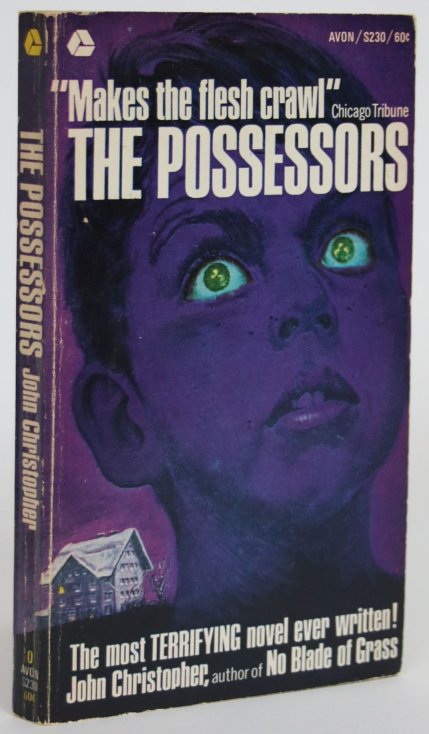
The Possessors – John Christopher

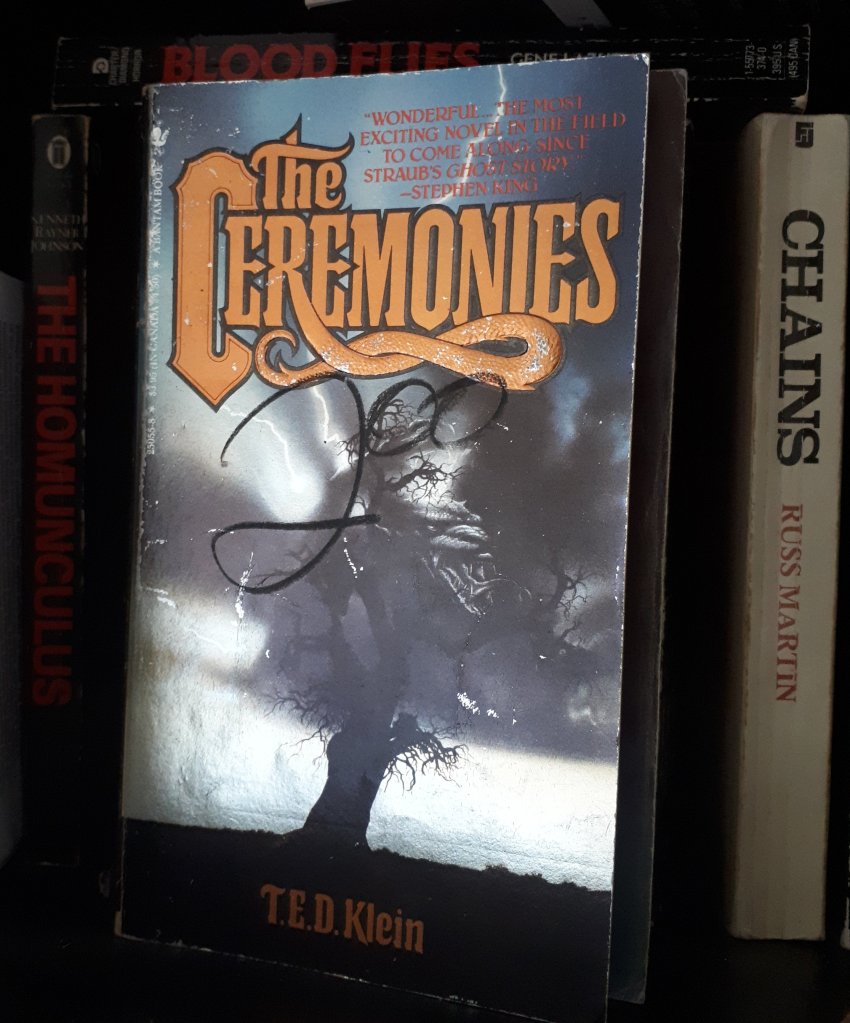
I recently read T.E.D. Klein’s The Ceremonies, a horror novel that centers around a college instructor who is preparing a course on horror fiction. I have already read and reviewed most of the books that he discusses, but there were a few he mentioned that I had never heard of. This book, John Christopher’s The Possessors, was one of them.

The Possessors – John Christopher
Avon – 1966 (Originally published 1964)

An alien lifeform kills a child and possesses his body at a mountain cabin in Switzerland. The kid then starts possessing all of the other guests at the cabin. An infected person only has to touch your skin for a few minutes to pass on the infection. I’m using infection and possession in the same way here. You get fingered and turn into a cold alien.

This is basically Night of the Living Dead but with zombies that touch you up instead of eating you. It was published 3 years before that movie came out too, and I wouldn’t be at all surprised if Romero read this before shooting his film. The plot of The Possessors is pretty straightforward, and the story is predictable to an extent, but that didn’t bother me too much. It was the long-windedness of the writing that let me down.

There’s so much character building, and so little of it matters to the story. Maybe it’s supposed to help create tension, but it bored me. There’s an alcoholic character who is clearly destined to get possessed. She’s obviously a weak link who will jeopardize everything for everyone, and we know she’s going to get done away with. Despite this, Christopher provides details about her summer holidays as a girl and the names and fates of all her brothers and sisters and cousins and pets.

I think this is generally classified as science fiction rather than horror. Maybe that’s why I hadn’t heard of it. It’s quite similar to The Body Snatchers in both its premise and awkward classification status.

The Possessors wasn’t great. It’s a decent idea, but the pacing is just too slow. I think it would have been a much more exciting read if it were 30 pages shorter.

T.E.D. Klein’s The Ceremonies and Dark Gods

At this stage, T.E.D. Klein is probably more famous for what he hasn’t written than what he has written. He put out a novel in 1984 and a collection of novellas in 1985. Both were well received, but he hasn’t released anything to speak of since before I was born. He’s not dead. He didn’t suffer a debilitating brain injury. He hasn’t been kidnapped. He just has writer’s block.

Despite his minimal output, Klein is considered by many to be one of the greatest horror writers of the latter 20th century. It was high time I checked him out.

The first thing I read by Klein was his story The Events at Poroth Farm. It’s about an academic who rents a room in the countryside during the summer to help him prepare for a course he’s going to be teaching on gothic horror. Some creepy parasite gets into his landlord’s cat, and things get nasty for everyone. I enjoyed the story plenty. Klein went on to expand this tale into a novel called The Ceremonies. After reading The Events at Poroth Farm, I deliberately waited half a year to move on to the novel, and although I saw certain parts coming, I feel like I put enough distance between the two stories to let them both really shine.

The Ceremonies
Bantam – 1985 (Originally published 1984)

The Ceremonies is awesome. I’ve read reviews that say it’s bloated and that the short story is better, but the people who wrote those reviews are wrong. This is 555 pages of deadly.

This time, the parasite isn’t just after the academic. It’s out to destroy the world. There’s a brilliant mix of folk and cosmic horror at play here. The writing is great too. The characters are all likeable in their own quirky ways, and some of the sequences here are genuinely creepy.

The fact that one of the central characters is a horror fiction nerd made this book especially enjoyable, and I reckon The Ceremonies will be the most influential book on my to-read this year. To my great shame, there’s a few books mentioned in here that I haven’t yet read. I think I’ll do a separate post on “The Ceremonies Reading List” after I get through those. The only text that I would recommend you read before reading this one would be Arthur Machen’s The White People. That particular story is referenced quite a few times in here.

Honestly, I loved this book. It was exactly what I needed in my life when I started reading it.


Dark Gods
Bantam – 1986 (Originally published 1985)

This is Klein’s second book, but 3 out of its four stories had been published before The Ceremonies came out. These four novellas are of the highest caliber. The stories are masterfully crafted, and the writing goes down real smooth. I have seen this described as “literary horror”, and while it is certainly very classy stuff, it’s also very, very readable. Aside from Lovecraftian themes, this has nothing to do with that other book with the same title.

Petey is the story of a housewarming party that turns sour when somebody busts out a deck of old tarot cards. I have seen a few people claim this is the weakest tale in the collection, but I really liked it.

Children of the Kingdom
This is almost like a modern sequel to Bulwer Lytton’s Vril. I thought it was great.

The Black Man with a Horn
I knew that this was supposed to be a tale of the Cthulhu Mythos, but I assumed that meant it had Lovecraftian elements. No. This is very much a continuation of Lovecraft’s work. It was awesome. It was a few weeks after finishing this story that I read all of the Cthulhu Mythos fiction of Frank Belknap Long. Not only was Franky the model for the narrator of this story, but this tale has some striking similarities to Long’s novel The Horror From the Hills.

Nadelman’s God
This story features heavy metal, blasphemy, an S&M club and a murderous golem made out of garbage and broken glass. If that doesn’t make you want to read it, I genuinely don’t know what you’re doing reading this blog. Go away.

I don’t think I have a favourite story from Dark Gods. They’re all really well written, and there’s horrifying moments in each. I thoroughly enjoyed this book.

Both The Ceremonies and Dark Gods are essential reading for horror fans. T.E.D, Klein is a masterful writer, but he needs to get the finger out.

Black Harvest – Ann Cheetham (Ann Pilling)

Black Harvest – Ann Cheetham
Armada – 1983


“A novel about a haunted house in Ireland? Yes. I will read that.”

Those were my thoughts when I first heard of Ann Pilling’s Black Harvest. After looking it up, I discovered that it was the first in a series of five “young adult” novels. I’m afraid of commitment, so I don’t really like series, and I’m also a grown man, so I don’t read YA. When I skimmed the reviews on goodreads, I noticed that several mention that this is very scary for a book aimed at teenagers, so I decided to give it a go.

This is not just a horror story set in Ireland. This is supernatural story about the horrors of the Irish Potato Famine.

The worst year of the Irish Potato Famine was 1847. That’s long enough ago that not even my great grandparents would have been directly affected by it. Intergenerational trauma is a real thing, but the Great Hunger of 170 years ago never caused me any suffering until last week when I picked up this book.

Jesus Christ, this was a pile of shit.

I usually get through 2 books a week. This piece of crap is less than 200 pages, and it took me 8 days to finish it. The writing is excruciating. I struggled to read more than a chapter each night. Wretched stuff.

A family decides to spend their holiday in a cottage in the Irish countryside. When they arrive, their baby sister won’t stop crying, and the kids all feel hungry. Every piece of food they bring into their cottage rots immediately. When the kids go outside, they see very skinny ghosts eating muck and trying to trade dead babies for food. Their mom goes crazy and abandons them.

It turns out the house is haunted because some famine victims are buried under it. The kids exhume their corpses, and the skinny ghosts go away.

At the end of the book, the author notes that when she was commissioned to write this novel she was “uneasy about horror novels. Horror was a genre [she] associated with “pulp”, with cheap, overblown writing where the author stands on tiptoe throughout to achieve ghastly effects. [She] associated it with mutants and ectoplasm, a world in which [she] had no interest.” In other words, she didn’t have any understanding of horror whatsoever, but she was convinced that she could do better than the hacks who wrote within that pathetic genre. She then goes on to say, “I decided that any spine-chilling story I might attempt would have to be rooted in reality. In The Great Hunger I found it”

So The Great Hunger is actually a non fiction book about the Irish Potato Famine. Let’s step back and think about what Ann Pilling has chosen to do here:

In Black Harvest, the author takes the suffering of poor Irish people and turns it into the main attraction at her “spine-chilling” fun fair. The events the kids witness in this story actually happened to real people. More than a million people died because they didn’t have enough to eat, and Ann Pilling decided to use their suffering to give her teenage readers a quick scare.

To Pilling, horror is uninteresting because it’s not rooted in reality. Personally, I enjoy reading horror because it is not reality. Reality is way more fucked up than any fiction. Frankenstein isn’t really horrifying. What the Catholic church did to children is horrifying. I don’t mind reading a story about a monster killing a kid, but I absolutely do not want to read a story about a priest doing the same thing. That’s not entertaining. It’s real, and it’s horribly depressing.

Maybe Pilling meant well, but this book fails on every level. I will not be reading the other books in the series. If you find a copy of this book, avenge Skibbereen by tearing it up and recycling the paper.

Things Have Gotten Worse Since We Last Spoke – Eric LaRocca

I joined twitter to network with other book nerds and find out about cool horror novels. When the people I follow post about non book stuff, I often want to make fun of them. Dorks. If I follow you on twitter and you’re reading this, it’s probably you I’m talking about. Dial it back a notch, you little geek. To the people who just exclusively post about sick books, thank you.

Things Have Gotten Worse Since We Last Spoke – Eric LaRocca
Weirdpunk Books – 2021


A while back, I saw somebody tweet about this book. I usually ignore stuff about new releases, but this cover grabbed me. I actually clicked on the link for a closer look. I saw somebody else post about the book soon thereafter. It popped up again a little while later. There seemed to be a lot of hype building around this one, and my curiosity got the better of me. I decided to read it.

This is the story of two women who start a relationship over the internet in the early 2000s. Theirs is not a sexual relationship, and it would be a stretch to describe it as romantic. It’s a kind of consensual master/slave type thing. Zoe, the master, gets Agnes, the slave, to do some pretty messed up stuff, and Agnes doesn’t really make things any better. She seems like a real idiot to be honest.

I don’t want to give any more details away in case you read this, but it does get quite gross. This isn’t the kind of horror novel I’d recommend to my mom.

The story is presented through emails and chat logs, and this format reminded me of the interactions I used to have online during the early 2000s. My familiarity with internet perverts probably lessened the effect of the book for me. Aside from a note at the very beginning of the text that states that one of the characters is now dead, there’s nothing here that proves the characters are actually doing the things they say they’re doing. If I were to dig through my old MSN chat logs, I am sure I would find stuff equally as fucked up. Seriously, can you remember 2000s era internet? A/S/L?

The story was entertaining, but I found it a bit hard to believe that Agnes would accept the terms of the relationship so quickly. We’re talking lifelong dedication after a few days of chatting and a bit of money. I suppose I find it hard to imagine what life was like for a lonely lesbian 20 years ago. It was probably tough, but I doubt many of them were as desperate as this. There are a lot of sickos out there though. Who knows?

This is a very short book; it felt more like a short story than a novella to me, but I enjoyed it while I was reading it. I’d consider reading more LaRocca in the future.

The Light at the End – John Skipp and Craig Spector

The Light at the End – John Skipp and Craig Spector
Bantam – 1986


Last Thursday, I was sitting in bed after a stressful day’s work, trying to read a dense Thomas Ligotti story. I read the first paragraph about 3 times then gave up. I like Ligotti, but he’s not easy reading. I needed something a little less demanding. I flicked through my kindle and settled on The Light at the End by John Skipp and Craig Spector. Part of the reason I chose this one was that I thought it was a short novel, maybe 180 pages. Also, I knew that this book is often heralded as the first splatterpunk novel. The splatterpunk I’ve read has all been pretty straight forward, so this seemed like a good choice.

First off, it’s not short. Paper copies of this book run to almost 400 pages. I was a bit annoyed when I realised this, but I was already invested, so I plowed through.

Otherwise, this was pretty much what I expected; vampires in New York. There’s lots of violence and dated/cringey pop culture references. (There’s a section in which one of the characters paraphrases a scene in The Shining.) I think that I would have enjoyed this book a lot more if I had been younger when I was reading it.

Also, while I’m sure that the authors did not intend this book to be homophobic, there’s something about the nonchalant way that the characters make fun of their gay friend that will probably rub a lot of modern readers the wrong way. The guy who is getting made fun of is one of the good guys, and everyone actually likes him, but he is repeatedly called a faggot by his coworkers. He’s not integral to the plot and clearly only included for comic relief, and this made the playful abuse he suffers a bit uncomfortable to read. This book was written in the 80s though, and it ultimately depicts the gay characters as likeable, useful members of society, so I don’t think it’s time to retroactively cancel Skipp and Spector.

So, yes. This book reads like it was written for 1980s teenagers. It’s a bit dumb and quite dated. However, I think I already mentioned that I only read this because I needed something easy to digest before bed, and I have to admit, this did the trick. It’s pretty much exactly what I was looking for. I had previously read Skipp and Spector’s The Scream, and I reckon that The Light at the End is actually a better book. Yeah, there’s still too many characters, but this one has a more focused story line. I’m not going to rush out to read more Skipp and Spector collaborations, but I’m definitely not going to write off the ones I already have on my shelf/kindle.

Thomas Ligotti’s Songs of a Dead Dreamer and Grimscribe

Songs of a Dead Dreamer and Grimscribe
Penguin Classics – 2015


Although most of Thomas Ligotti’s fiction has already appeared on this blog, I only recently read his two first, and probably most famous, short story collections. Songs of a Dead Dreamer was originally published in 1985, and Grimscribe: His Lives and Works came out in 1991, but they were first packaged together, along with some stuff from Noctuary and Teatro Grottesco, as The Nightmare Factory in 1996. It wasn’t until after True Detective made Ligotti a household name that Penguin decided to reissue his first two collections under their Penguin Classics series. I believe Ligotti is one of only 10 authors to live to see their books published as a Penguin Classic. This is definitely more high-brow than a lot of the crap I write about on here.

I’ve written about Ligotti so many times here that I don’t have too much to say about the writing here. I suppose I learned that Ligotti didn’t start propounding his pessimistic outlook on life at a late stage in his career. It was there from the beginning.

“the revelation that nothing ever known has ended in glory; that all which ends does so in exhaustion, in confusion and debris.”

Vastarien

Again, I was impressed with the nightmarish quality imbued in Ligotti’s prose The word nightmare is often used as a synonym for scary or unpleasant, but these stories actually possess a bizarre dream-like quality. Obvious details are omitted, and stuff that shouldn’t become weird becomes very weird. It’s unnerving and disorientating, and I love it.

“To see the world drown in oceans of agony is the only vision which now brings me any relief from my madness”

Masquerade of a Dead Sword

While I waited a week or so after finishing Songs of a Dead Dreamer to move on to Grimscribe, this felt like one long book to me. I can’t really think of way to distinguish the tone or quality of the two collections. I think I enjoyed the stories in Grimscribe more, but I’m almost certain that this was due to the fact that by the time I started on the Grimscribe tales, I had figured out that I had been reading the book wrong. Let me explain. I love Ligotti’s fiction, but I have to be in a fairly specific mood to really enjoy his writing. It’s dense and at times tedious, and reading some of these stories at night just made me want to fall asleep. As I started on Grimscribe, I worked out a system where I would read Ligotti on my lunch break at work and then read a trashy splatterpunk novel before bedtime. It was perfect.

I definitely prefered the more straight forward stories collected here. Vastarien, Dr. Locrian’s Asylum, The Last Feast of Harlequin, The Night School and The Coccoons were some of my favourites, but there were plenty of others that I really, really liked. Ligotti is one of the few authors whose books I have read more than once, and I’m sure the stories in this collection will stand multiple readings too. I feel like I might enjoy some of them even more a second time around. I’ll tell you what; in a few years, I’ll go back and read through both Songs of a Dead Dreamer and Grimscribe more carefully and write more in depth posts about them then.

The last time I saw my friends before Covid hit, I was chatting to one of my buddies about Ligotti’s books and he told me that he had recently acquired “the one with Drake on the cover”. Given the likeness, I am surprised nobody has done this before:


The Published Works of Robert Marasco

Burnt Offerings
Delacorte Press – 1973

Robert Marasco is best remembered for this horror novel. I enjoyed it. It’s about a family who get a deal on a summer home. The only catch is that it’s a vampire house. It’s not a house full of vampires; it is a vampire. I found the book very easy to read. I felt like I figured out what was going on a bit too early though, and there weren’t really any surprises. Reading through it, I became convinced that this had a big influence on Stephen King’s The Shining. (It has a whole big thing about the father losing his mind and turning violent against the family.) Turns out that King is indeed a big fan of the book.

This book is influential and pretty easy to read. Burnt Offerings not absolutely amazing, but it was good enough to convince me to read more Marasco.

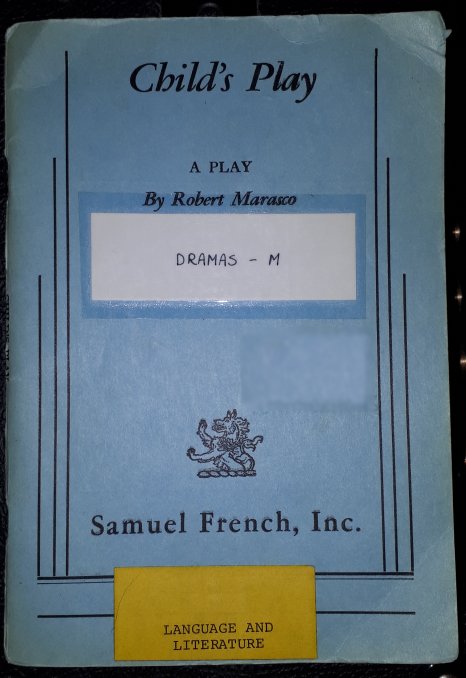
Child’s Play
Samuel French, Inc. – 1970

Child’s Play, originally titled The Dark, was written several years before Burnt Offerings. No, it doesn’t feature a doll named Chucky. It is the only play of Marasco’s that was ever produced. (He finished writing another one called Our Sally before he died, but the script has never been published as far as I can tell.) Child’s Play was well received though, and a movie version was made in 1972. Marasco was a teacher at the time he wrote this, and it shows.

The students of an all boys Catholic school start committing acts of brutal violence against each other. The consensus online seems to be that this violence is being caused by demonic possession, but this is never explicitly confirmed in the play. One boy is crucified in the school’s chapel and a teacher gets a sudden desire to self harm, so there might well be something satanic going on. I guess different productions of the play can give more or less emphasis to the potentially supernatural element here.

While all this is happening, two of the teachers are getting on eachother’s nerves. One is a strict, unpleasant man. The other is an amiable fellow who is loved by the students. This rivalry is what the play is really about, and if the supernatural element were to be replaced with drugs or gang conflict or some more typical school problem, the play could remain largely the same.

Reading a play isn’t ideal, but I can imagine Child’s Play working really well as a performance. It was fine.

Parlor Games
Delacorte Press – 1979

This isn’t a horror novel. I guess it’s a thriller. I enjoyed it up until the end. I think Marasco was a pretty good writer, but I’m not sure about his books. He tells his stories well, but the stories are kinda dumb. As with Burnt Offerings, I felt like he gave away the big secret of the plot way too early.

I don’t think the above review is going to convince anyone to read the book, so I might as well summarize the plot for you. This is the story of a man who kills his girlfriends so he can have sex with his sister. Now that you know that, do you really want to read it?

I went all in on Marasco and read everything that he had published. I wasn’t really blown away with any of his books, but looking back, I have to admit that I enjoyed them all when I was reading them even if they don’t hold up to serious analysis. If you’re stuck for something to read, you could do a lot worse than one of Marasco’s novels. Not bad. Not great. Satisfactorily entertaining

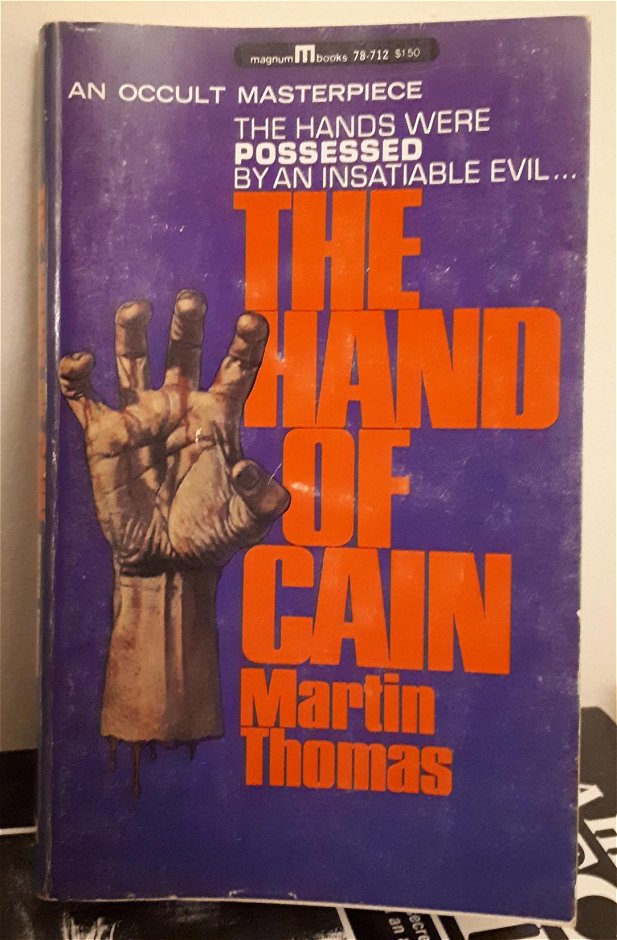
Martin Thomas’s The Hand of Cain

The Hand of Cain – Martin Thomas
Magnum Books – 1967 (Originally published 1966)

When I see “An Occult Masterpiece” with a severed hand on its cover on sale for less than the price of a cup of coffee, I buy that shit.

I’m just going to summarize this one as I don’t have much to say about it. It is pretty much exactly what I expected.

Matthew, a triplet, has a thing for his brother Alan’s fiancee. He gets into a fight with Alan and kills him. Their dad, Virgil, sees the murder taking place, but covers it up as he is a famous surgeon and doesn’t want the scandal of a murder to harm his reputation. He is so unemotional and practical in the moments after he sees one of his sons killing the other that I almost gave up on the book. I was soon glad I didn’t.

A few weeks later, Timothy, the good remaining triplet, is involved in a tragic accident and gets his hands chopped off. His dad drives him home from the scene of the accident and prepares to operate. When Matthew, the bad triplet, gets home, his dad drugs him, chops off his hands and then sews them onto the good son. I almost cheered at this part. Sick!

Matthew is pretty bummed out that his dad cut off his hands, but if he says or does anything about it, his dad will out him as a murderer.

One night, he is moping around a nightclub when he meets an Indian dwarf who offers to curse his family for £200. After smoking a “reefer” with Swami Barham Lal Sivasan. Matthew passes out and wakes up in his car wondering if it was all a dream.

Soon thereafter, Timothy rapes and murders his dead brother Alan’s old girlfriend, the one Matthew liked. After killing her, he smashes her head with a rock. Then he kills a drunk man for puking on him. Then he kills a child for scratching his car. Are his brother’s transplanted hands to blame or is it the curse? Timothy soon gets sloppy and Matthew sees him dumping one of the bodies.

When the Swami comes to Matthew to demand payment, Matthew decides to blackmail Timothy to get the money. He takes glee in the idea that Timothy will be paying for his own doom. Timothy, who has since raped and killed another girl, doesn’t want to pay up, so the brothers get into a fight. Matthew uses a broken glass to turn Tim’s face into a pile of mush while Tim is choking him to death. One again, Virgil walks in to see one of his sons dying at the hands of his brother. He’s pretty pissed off at this point, so he gets an ax and uses it to chop off his remaining child’s hands. After Tim has his hands chopped off for the second time, he bleeds to death beside the brother he just strangled.

Grim.

I have absolutely no regrets about buying and reading this book. It was old fashioned in some regards. Women exist here solely to be preyed upon, and Indians exist to collect bus fares or curse people. It was definitely a bit nastier and exploitative than I expected, absolute trash really but definitely worth the 3 dollars I paid for it.

Spawn – Shaun Hutson

Sometimes a cover is so good that you have to read the book.

Spawn – Shaun Hutson
Leisure Books – 1988 (First published 1983)

I read Chainsaw Terror last year, and I knew that Shaun Hutson isn’t really known for writing hi-brow literature, but I have to admit, I was appalled at this book.

I generally like to know as little as possible about a book before I read it, and so aside from knowing that this book would probably include a mean baby, I had no idea what it was actually about. I’m going to provide a summary next, so if you’re like me, you might want to read the novel before continuing with this post. If, however, you have a sense of decency, you might be better off with my brief synopsis.

Harold Pierce, a badly traumatised and developmentally challenged burn victim gets a job in a hospital. He is assigned the role of loading the hospital’s aborted fetuses into a furnace. The fetuses remind Harold of his baby brother who died in a fire that he started, and so instead of burning them he sneaks them out of the hospital and buries them. This is gross-out horror, but so far the story is merely tragic. The whole aborted fetuses motif is immediately repugnant, but there’s no malice at play so far. Harold is damaged; he’s not evil.

Then there’s a big storm. A bolt of lightning knocks down a powerline right beside where the fetuses are buried, and the electricity from the lightning and the power cables is sent directly into the shallow grave. The electricity burns the earth and grass around the grave, but it somehow manages to bring the fetuses back to life. It also gives them psychic powers and a thirst for blood.

Yep.

Honestly, I was actually impressed with the plot. Hutson clearly did not give a shit. “Hmmmm, I need some way to reanimate these rotten abortions so they can kill a bunch of people… Voodoo? Nah, too ethnic… Scientific experiment gone wrong? Far too complicated… Fuck it. A bolt of lightning. That’ll do.”

Oh, and there’s a serial killer on the loose too. You spend the whole novel wondering how he’s going to fit in with the vampire abortions, but they barely interact. I reckon the murderer bit was only included so that Hutson could have some gory scenes at the beginning of the book. The killer is also a victim of neglect and child abuse.

I’ve read plenty of repugnant splatterpunk horror fiction, but this one is distasteful in a special way. Some gross-out horror is tough to get through because the authors seem like they’re trying hard to be super offensive, but Spawn is such a puerile mess that at times I got the sense that Hutson might not have even realised he was being offensive. Writing fiction about abortions seems like a hazardous venture for any writer, and I can’t imagine any sensible adult with any kind of stance on the abortion debate actually wanting to read a novel about aborted fetuses. Couple this with the fact that the two main characters are disfigured, developmentally challenged, traumatized victims of abuse. The whole thing is in very poor taste. The saving grace of the book is that there is clearly no message to it. Hutson is not trying to force his views on anyone.

Unfortunately though, the book is actually pretty fuckin’ shit. I found myself skimming large chunks of it. The characters are so flat that I wasn’t able to give a damn about them, and the suspenseful scenes were formulaic and uninteresting. The book is 288 pages long, and I reckon a good third of it could have been edited out

All that being said, I was entertained by this piece of deplorable, degenerate trash, and I am entirely certain that I will read more of Shaun Hutson’s work in the future. I know he wrote a sequel to this just a few years ago, but I probably won’t bother with that one.

Another great cover. W.H. Allen, 1983