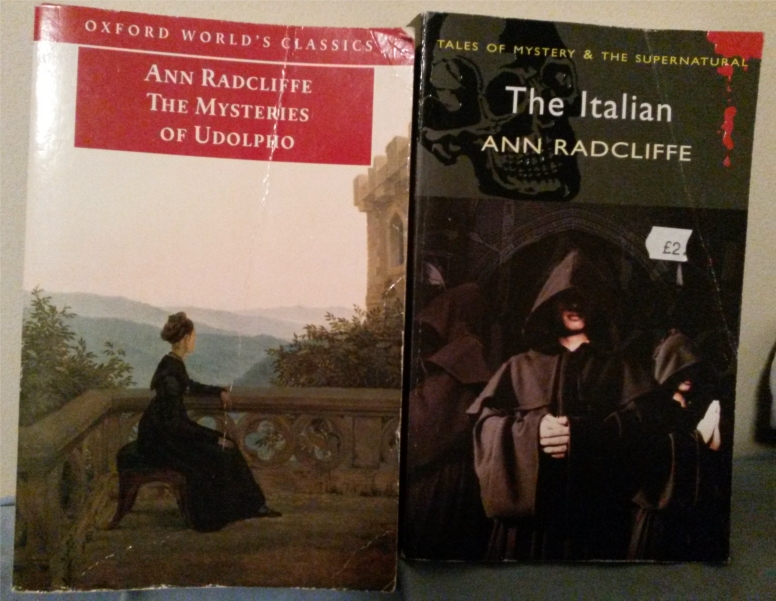
Mrs. Radcliffe’s Novels

ann-radcliffe-novels

I don’t have much to say on these books that hasn’t been said before. Ann Radcliffe didn’t invent the Gothic novel, but she drastically improved it. Books like Castle of Otranto and Vathek are fun, but they’re both quite silly. Radcliffe’s novels came a few decades later, and while they’re still fairly silly, they contain interesting characters and plausible stories.

Radcliffe is famous for making the literary distinction between terror and horror. Terror, according to Radcliffe, is the fear caused by uncertainty; it’s the not knowing what’s making the slithering noises in your bedroom wardrobe. Horror is the climactic reaction to actually seeing the warty green skin and blood soaked fangs of the monster as it lunges towards you. Radcliffe claimed that terror was a far more effective method of thrilling an audience, and she masterfully weaves her tales so that they keep both her readers and characters guessing until the very end.

Her books contain all the secret passages, mysterious chambers, fiendish villains and innocent virgins that you’d expect, but unlike their Gothic predecessors, the plots of her books are not driven by supernatural forces. The strange muffled noises and shadows darting hither and thither are all eventually explained as the stories unfold. The threat of horror is never realized, but it is this very threat that creates the sense of terror that runs through these books. Radcliffe does suspense exceedingly well.

The Italian – Ann Radcliffe
Wordsworth – 2011 (Originally published 1797)
I read The Italian two weeks ago. It came out just a year after Lewis’s The Monk, and one could draw comparisons to the relationship between these two books and the relationship between The Castle of Otranto and The Old English Baron. While both books contain evil monks and the Inquistion, The Italian is more a response to The Monk than a rewrite, and it is definitely better book than the Old English Baron.

My copy is another Wordsworth Tales of Mystery and the Supernatural edition (I fucking love these books!), but I took most of this one in from the librivox audio version. The Librivox version is based on the first edition of the book (containing 33 chapters), but the Wordsworth version is the second edition (34 chapters). For the second edition, Radcliffe rewrote parts to make it seem that Ellena’s sweet singing voice was more attractive to Vivaldi than her body. The 5th chapter of second edition, in which Vivaldi visits Bianchi’s corpse, is also a new addition. If you only own the first edition and want to read this 3 page addition, you can do so here. There may be other very minor differences, but I got through the book going back and forth between the two editions, and it didn’t cause any confusion.

While I agree that terror can be far more effective than horror, I don’t think that horror needs to be abandoned completely. I certainly enjoyed this book, but I preferred the Monk. Radcliffe’s book doesn’t need the supernatural to make it work, but it does need the introduction of a new character at a very late stage in the plot, definitely a bit of a Deus Ex Machina. It is definitely worth a read though. Schedoni is a real cool guy.

The Mysteries of Udolpho – Ann Radcliffe
Oxford – 1998 (Originally published 1794)
The Mysteries of Udolpho is Radcliffe’s most famous book. I read it 3 years ago, but I remember really enjoying it. I had started a new job a few months previous, and I was starting to realize that I could get away with spending most of the day reading online. The night before, I would email myself a pdf file of the book I wanted to read, renaming it to something like “contract-agreement.pdf” so that the boss wouldn’t be able to give me any grief if he checked my browsing history. I had begun with a few short stories, and I only started on this one to see if I could get away with it. It’s more than 600 pages, and I finished it in a week. (I worked in that office for another year, and I managed to read a further 66 books at work in that time.) Reading Udolpho, you can see where writers like Lewis, De Sade and Le Fanu (especially in Uncle Silas) got many of their ideas. I really liked this book.

Apparently Jane Austen did too. Her novel Northanger Abbey is referred to as a parody of Radcliffe’s works. It’s the tale of 17 year old Catherine, an avid Radcliffe fan. Catherine goes through life imagining herself the heroine of one of Radcliffe’s novels. I waited until after I had read The Italian to read this one, but it really only makes direct reference to Udolpho.

norrthanger-abbey
Northanger Abbey – Jane Austen
Penguin – 1994 (First published 1817)
I wasn’t expecting much from this, and to tell the truth, I didn’t get much either. It’s a cute little romance that has stuff to say on femininity and feminism, but I’ll let you look elsewhere for that. My favourite parts were undoubtedly the sections where the protagonist is imagining that she’s the character in one of the books she has been reading. I also listened to two audiobook collections of Stephen King’s short stories last week, and I found that I was becoming suspicious of nearly everything around me. I therefore found Catherine’s plight very relatable.

The real reason I wanted to read this book was its connection to Montague Summers. At an early stage in the novel, Catherine’s friend promises that she will give her a small collection of books. Those books are:

Castle of Wolfenbach,
Clermont,
Mysterious Warnings,
Necromancer of the Black Forest,
Midnight Bell,
Orphan of the Rhine,
Horrid Mysteries

For years it was presumed that Austen had made these titles up herself, but Montague Summers, the absolute legend, actually rummaged through libraries until he found copies of each text. They have all been republished, and I intend to buy, read and review copies as soon as I am a wealthy man.

To conclude, Ann Radcliffe was very cool. Her books, though imperfect, were hugely influential and remain thoroughly enjoyable. They’d be perfect for taking on a lazy holiday, and I’ll definitely be keeping an eye out for her other novels. Jane Austen, on the other hand, was fairly boring, and I probably won’t be reading any of her other novels in the foreseeable future.

A Feast of Blood – Varney the Vampyre

coverVarney the Vampyre – James Malcolm Rymer (or maybe Thomas Preskett Prest)
Wordsworth Books – 2010 (Originally serialized from 1845-1847)

I haven’t posted much in the last month because I have been spending my time slogging through this immensely long book. At 1166 pages of very small print, this is undoubtedly the longest novel I have ever read. ‘Novel’ however, maybe isn’t quite the right word to describe this tome; it’s a series of different stories about the eponymous hero that were originally serialised in pamphlet form over the course of several years. Think of it like this: if Stoker’s Dracula can be turned into 2 hour movie, Varney would take a 5 season TV show to do it justice. Just as the book is long, this review is fairly hefty too, so pour yourself a cup of blood before you sit down to read it. If you haven’t read the book, you might want to skip over the sections in red. I say this not because those sections contain devastating spoilers (they don’t), but because they deal with issues that are so perplexing that they may scare you away from ever reading the book.
battyLook at the girth of this thing! It may be thicker than 4 of the other books in this series put together, but it was no more expensive. (Note: Varney is actually not the kind of vampire that can turn into a bat)

The writing is of a pretty decent standard, although there is quite a lot of recapitulation. This may have been included to keep readers up to date with the story if they had missed the last edition (kinda like the Victorian version of “Previously on the X-Files…), but I have read elsewhere that the author was paid by the word, so maybe it was just to take up space. Either way, coherence doesn’t seem to have been a priority, and throughout the tale there are characters that appear without reason and disappear without a trace. Varney himself has several suggested back stories that conflict with the account of his life that he gives at the end of the book, but more on that later. Also, with the exception of Varney himself, nearly all of the dramatis personae are interchangeable stock characters. I lost track of how many pleasant young men named Charles appear throughout the story.


The cover of the Wordsworth edition really blows in comparison to the original.

If you check out the librivox audiobook version (I would recommend that you alternate between a hard copy and these mp3s. Doing so allowed me to get through a few chapters every time I had to cook, tidy up or walk anywhere recently.), you’ll notice that Librivox credits Thomas Preskett Prest as the author instead of James Malcolm Rymer. It seems that nobody really knows who wrote the book. Prest took the credit for more than 100 years, but research that I have read ABOUT suggests that the writing style is actually closer to Rymer’s other writings than Prest’s. Also, minor publishing discrepancies in the text correspond to  Rymer’s bankruptcy, suggesting that he was in fact the author. That being said, Rymer and Prest are known to have worked for the same publisher and are believed to have collaborated on other works, so it’s not unlikely that they both contributed to this one. (Apparently Rymer was less than 4 foot tall.)
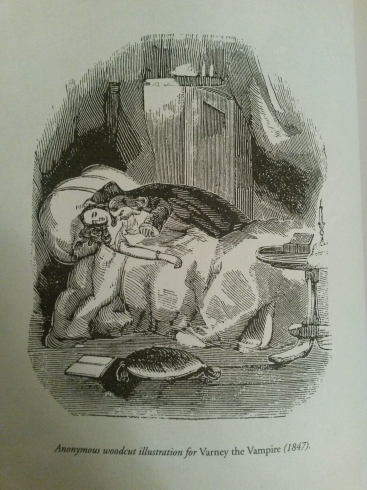
varneysucksDrinking her blood, straight from the tit.

The book is split into 3 volumes of roughly 400 pages each. (This division seems to have been based on the length of the book rather than by the contents of the volumes.) This edition ends with Chapter 220, but if you were to count the amount of chapters that the book contains, you would notice that there are actually 237. How could this be? Well, Chapters 41-43 don’t exist, Chapter 171 is followed by Chapter 162, and Chapters 195, 210, 197, 118, and 199 appear in that order. These mistakes have been faithfully carried over from the original pamphlets. (The chapter numbering in the audiobook version has been corrected. This was a little frustrating as I went back and forth between that and the text, although if it had retained the original numbers, the playlist of mp3 files would have been completely shagged.) Also, each chapter has a short title, but the titles rarely refer to anything that actually happens within that chapter. The chapter might be titled; “The events in the Parson’s office”, and it would be about a pair of young lovers having a picnic by the seaside. Arbitrary volume and chapter numbers aside, the book can be divided into 11 distinct stories. The first of which takes up the entire first half of the book while the 4th is less than 20 pages. 

hammeredThis poor chap was mistaken for a vampyre. He’s fucked now.

The first section, the events at Bannerworth Hall, is by far the longest and most enjoyable part of the book. The characters here, although they could be lifted directly out of 100 other Victorian novels, at least get to be part of the story for long enough that the reader remembers them. These characters play a smaller role in the second section of the book, and they are only mentioned 2-3 times in the final 400 pages. Their story is never satisfactorily cleared up, and I kept hoping that they would pop up or that the events that were occurring would somehow end up explaining what had happened to them. It seems that the initial followers of the story may have felt the same way;  in one of the final episodes, the author takes pains to clarify that the Bannerworths have all died. I wouldn’t be surprised if this brief allusion served as a response to those readers who had inquired if the Bannerworths were ever going to make a comeback. These loveable characters, we are pleased to find out, have not met with an unsavory end though; it’s just that the events towards the end of the book take place at a much later period of time. As we are soon to see, this epic tale takes place over the course of several centuries.

Here’s a few questions I have regarding the trials and tribulations of the Bannerworth family.

Is Varney the man in the portrait?
There is a portrait in Flora’s bedroom of Runnagate Bannerworth, an ancestor of the family. When the family realises that the vampyre looks exactly like the man in the portrait, they go to exhume Runnagate’s corpse from their family tomb. By the time they get to the tomb,  not only has Runnagate’s name has mysteriously changed to Marmaduke, but his corpse has also disappeared. This is particularly confusing because Marmaduke Bannerworth is also the name of Flora’s father, a confirmed associate of Varney’s. (Plus, one of the initial explanations of Varney’s vampyrism is that he was a suicide victim. Flora’s father also committed suicide. Could Varney be her father? Probably not, but why the similarities?)

Runnagate is said to be 90 years dead, and Marmaduke’s coffin reveals that he was buried in 1640, thereby dating the events at Bannerworth Hall to 1730. Varney is a vampyre though, so these dates don’t really exclude the possibility that he is the man in the portrait. Indeed the fact that Runnagate/Marmaduke’s corpse is not in the coffin suggest very strongly that Varney is their ancestor.

Varney later admits that he is a distant relation of the Bannerworths and that he was also a friend of their father. He claims that he had seen the portrait when he was friends with their father and deliberately tried to look like it in order to scare the family. This explanation however, does not account for the missing corpse from the tomb.

Much later on, in a different episode, Varney explains that he became a vampyre after crossing Oliver Cromwell after the death of Charles 1st. (This means that he didn’t become a vampyre until at least 1649, almost a decade after the death of Runnagate/Marmaduke Bannerworth.) He also explains that at this time he was living in London and known as Mortimer. (This is also bizarre as Varney is later to be hung by a different nasty man named Mortimer.)

In the 225th chapter (Chapter 208 in the book) Varney claims that he remembers “being hunted through the streets of London in the reign of Henry the Fourth.” Henry the 4th died of leprosy in 1413, meaning that if Varney is telling the truth, he was at least 235 years old when he became a vampyre. There is a gap of 1000 pages between the accounts of Runnagate’s portait and Mortimer’s contretemps with Cromwell, so we can forgive the author for a discrepancy of 9 years, but Varney’s account of being chased during the 1400s is placed only 12 pages apart from his encounter with Cromwell.

By his own account, Varney is not the man in the portait in Flora’s bedroom, but do we really believe him? All of his origin stories can’t be true, and he’s never exactly made out to be a particularly honest individual. While he explained that he had deliberately tried to make himself look like Runnagate/Marmaduke Bannerworth, he never explained where the body of said individual was or how it escaped from its coffin. Also, it should be remembered that Runnagate/Marmaduke’s coffin not only contained no corpse, but neither did it contain any signs of ever containing a decomposing body. If Varney is not Runnagate/Marmaduke, Runnagate/Marmaduke is still likely to be a vampyre.

varney-red
What happens to George Bannerworth?
He appears as the weakling younger brother in the first few chapters of the book, but soon disappears, never to be mentioned again. We are given enough information about his timidity to presume that this will be an issue for him at some stage, but he never gets a chance to shine. Lil bitch.

What happens to Dr. Chillingsworth?
The last we hear from him, he goes to London in search of Varney. We know that something happens to him afterwards that convinces him of the existence of vampyres. A note written by him appears in one of the final chapters of the book explaining so, the appearance of which left me with a genuine feeling of excitement. Varney does end up in London for a while in one of the later episodes; did they meet there? I had a theory that Chillingsworth was the mysterious stranger who follows Varney to Anderbury and gets murdered in the ice-pit, but he actually appears elsewhere afterwards, so it can’t have been him.

Who the fuck was the Hungarian Nobleman and what did he want?
Just as Varney starts to warm to the Bannerworths, a strange Hungarian nobleman shows up in the village in search of him. We find out that he is willing to pay a high price to find Varney, but he himself becomes suspected of being a vampyre and gets run out of town before Varney is found. There is no explanation given as to why he is looking for Varney, and no more is said about him after he is chased from the town. In one of the final episodes, Varney attends a vampyre initiation ceremony with several of his kin. One asks if he knew the Bannerworths, and he responds; “I did. You came to see me, I think, at an inn.” That is the extent of the conversation that appears 475 pages after the last mention of this character. Ahhh, sweet closure at last!

Who the shitting fuck was murdered in the ice-pit?
Towards the end of the first episode, Varney disappears. (The transition between the first and second episode is the only transition between episodes that carries over characters.) Soon thereafter, two strangers show up in a town a few miles distant from Bannerworth Hall. One of them, we know, has to be Varney, but the identity of the other is never made clear.

I think it was the Hungarian Nobleman. He’s the only character from the first section that’s unaccounted for. He had been confirmed as a vampyre and fled for safety without having achieved his goal of speaking to Varney. We know that he had been looking for Varney, but we were not sure of his motives. When Dr. Chillingsworth is mugged, we are inclined to give Varney the benefit of the doubt as he has seemingly made his peace with the Bannerworths, but if it wasn’t Varney, it has to have been the Hungarian Nobleman; he’s the only other bad guy alive at this stage! When it turns out that both of the mysterious strangers are vampyres, it only makes sense that one of them is the Hungarian.

However, when these two vamps meet near the end of the book, not a word is said about the fact that one of them has stabbed the other in the throat and thrown his corpse into an ice-pit. In fairness though, after the victim of this crime was revived by the moon, he snuck into the murderer’s bedroom and stole his jewels. Maybe they just decided to let bygones be bygones… Who knows? 

What happened to the Quaker whom Admiral Bell kicked up the hole?
Perhaps the greatest mystery of all. This storyline gets a considerable build up, but it’s never resolved.
booBleh!

There are, of course, plenty of other plot holes in the remainder of the book, but the cast of characters and plotlines in the later episodes are not nearly as memorable or complicated. Most of the episodes follow the formula of Varney trying to marry a beautiful young woman only to be foiled right before the marriage ceremony. (There are at least 4 chapter titles that include the phrase ‘the wedding morning’.) The middle episodes start to feel cartoonish in their repetitiveness, but the final two episodes end the book on a slightly more existential note. The penultimate episode has Varney playing the role of a hero rather than a villain, but the lack of satisfaction he receives from acting so convinces him to kill himself. His suicide attempt is thwarted by a pair of altruistic brothers, and when he is brought back to life, he gets super pissed off. He decides that if he can’t feel happiness that he will make sure that those around him don’t feel it either, and he gives what is perhaps the finest villainous speech that I have ever read. I’m going to include it here in its entirety, because unfortunately, I doubt that many people will actually make it far enough into the book to get to enjoy this exquisite piece of misanthropic bile:

“Since death is denied to me, I will henceforward shake off all human sympathies. Since I am compelled to be that which I am, I will not be that and likewise suffer all the pangs of doing deeds at which a better nature that was within me revolted. No, I will from this time be the bane of all that is good and great and beautiful. If I am forced to wander upon the earth, a thing to be abhorred and accursed among men, I will perform my mission to the very letter as well as the spirit, and henceforth adieu all regrets, adieu all feeling — all memory of goodness — of charity to human nature, for I will be a dread and a desolation! Since blood is to be my only sustenance, and since death is denied to me, I will have abundance of it — I will revel in it, and no spark of human pity shall find a home in this once racked and tortured bosom. Fate, I thee defy!”

Holy fuck, that is pure heavy metal.

varney-wakesVarney arises!

Whether or not Varney is actually a vampyre isn’t determined until you’re well into the story, and the first 750 pages of the book contain only 2 short instances of vampyric activity. Things get bloodier in the second half as the stories come to focus on Varney and his exploits. He oscillates between being a decent lad and a murderous villain, so much so that I was genuinely surprised at the violent acts he would sometimes suddenly commit. Although the latter episodes are definitely more gory, far more people are stabbed or shot than are drained of their blood; this is more of an adventure novel than a horror story. That being said, there are a few chapters set in moonlit churchyards and charnel houses to which you can stroke your Gothic boner. So much of what we have come to expect from a vampyre story comes directly from this book, and you’ll find a million other reviews discussing how it’s the source of many of our modern ‘Vampire tropes’. Why then, does everyone give that credit to Dracula? Well, Dracula is much scarier, Bram Stoker took all of the best bits from Varney, twisted them around a bit, and shaped them into a far superior book.

diebitchAnd fucking stay dead!

Montague Summers described Varney the Vampyre as being “far ghostlier than” and “a very serious rival to” Dracula. The book was out of print when he wrote that though, so that might have just been him trying to be the cool guy who liked the less popular work. I definitely wouldn’t go as far as Monty in this case, but I did really enjoy this book. I mean, it’s deeply flawed, but if you take it for what it is, i.e., complete trash, it’s d_____d enjoyable. It’s exceedingly obvious that the author/authors were making it up as they went along, and a lot of it doesn’t stand up to scrutinous examination, but if you like stories about graveyards, ghouls, chivalrous gentlemen, foul mouthed sailors, bloody murders,  and heaving bosoms, this will entertain you greatly. I fucking loved it, and it has me looking forward to reading more of the Penny Dreadfuls that have come out in the Wordsworth Tales of Mystery and the Supernatural series. I have Wagner the Werewolf by Reynolds on my shelf, and I know they have also put out The String of Pearls, the other work by Rymer and Prest.

 

Vampires and Vampirism – Montague Summers

Image2
Dover – 2005 (Originally published as The Vampire: His Kith and Kin in 1929)
This is Montague Summers‘ first book on Vampires, and as much as I love the author, I have to admit that this was a rather dry read. I actually started this book to make sure that I would understand references that I might have encountered in another book I’ve been reading; Varney the Vampyre. As it turns out, that book is referenced in this book, but it contains very few references to vampire lore. (Varney is fucking DEADLY though. Expect to see it reviewed here in a few weeks.) Anyway, there’s 5 chapters in Summers’ book, and I’m going to go through each one.

1.The Origins of the Vampire
Here Summers explains several of the different elements that may have created and/or fed into the vampire legend. It includes copious stories of the reanimated dead, ghosts, premature burials and a huge section on incorruptible corpses. Apparently, there’s two ways that a corpse can remain incorrupt; the person has to have been either really good or really bad.

This chapter also includes a frustratingly multilingual section on necrophilia and necrosadism. Unfortunately the more lurid details are only given in French or Ancient Greek. I’m not joking; whenever Monty wants to give some really grisly details, he’ll switch languages. My French is poor, but it was good enough know that I was missing out on the best bits, particularly the story about the Garcon who said. “Que voulez-vous, chacun a ses passions. Moi le cadavre, c’est la mienne!”

(I have found an online version of the text, and I’ve just spent 10 minutes pasting those bits into google translate. It was worth it; my necrosadistic desires have now been satiated.)

2. Generation of the Vampire
This is all about how vampires become vampires. It mostly deals with excommunication from the church. Montague Summers knew a lot about the history of the church, and he wants to make sure that his readers are aware of this. Pretty boring stuff to be honest.

3. Traits and Practice of Vampirism
There’s a lot about suicide in this chapter, including some fascinating stuff on Russian suicide cults. Apparently one group of these fucking lunatics built a huge building with no doors or windows that was only accessible from a trap door in the roof. They’d jump in through the trap door and then they’d starve to death. Imagine the stench, the anxiety, the shame and the regret that these people had to endure until their dying moments.

4. The Vampire in Ancient Countries
I was expecting this section to be a bit boring, but it was actually quite interesting. It’s about the different types of vampiric ghouls that have cropped up around the world through history. I think that the sequel to this book, The Vampire in Lore and Legend (1929), takes up where this chapter leaves off.

5.The Vampire in Literature
This section was definitely the most disappointing, disappointing because I expected it to be the most interesting. This is just a bunch of summaries of different plays based on John Polidori’s story, The Vampyre. The summaries given are so detailed that I skipped through most of them; I didn’t want to ruin the stories in case I ever come across the original texts. Not only does this chapter contain the summaries of these plays; it also contains extensive lists of their cast members. This chapter is full of boring information, but it says very little.

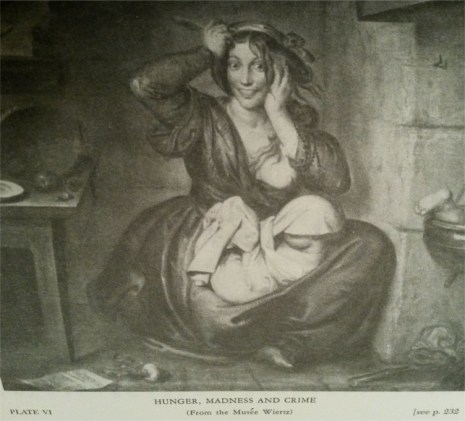
Image1The pictures in this book are bizarre. I don’t remember why this mad woman is in there.
Overall, this is a decently interesting read even if it does get dry as fuck at times. There’s 5 chapters, and the way they’re structured seems a bit arbitrary, particularly the first 3. However, the worst thing about this book is that it’s full of quotes in different languages but contains no translations. If you really wanted to get the most out of this, you’d need to speak Ancient Greek, Latin, French and German. This is a bit different to the author’s books on witchcraft too. It serves more as an explanation as to how the Vampire legend developed than it does as proof of the Vampire’s existence. Monty never denies that vampires exist, but he doesn’t spend much time trying to convince you that they do.  As mentioned above, he wrote another book on vampires, but I reckon it’ll be a while before I get around to that one.

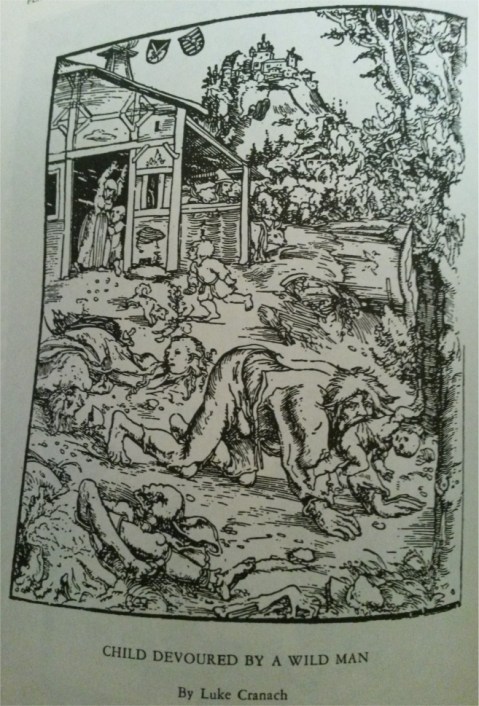
Image3Clearly a case of Lycanthropy rather than Vampirism, but a cool picture nonetheless. Could this be the instance spoken of by the great one?
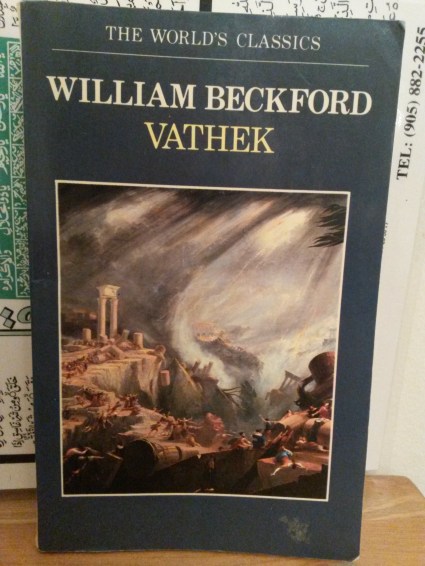
Vathek – William Beckford

20160802_230226
Oxford University Press – 1983 (Originally published in 1786)

This Gothic classic is the story of the Caliph Vathek and his series of poor life choices. Vathek is led astray by an evil giaour’s promises of more wealth and power. (‘Giaour’ is old Turkish slang for a non-Muslim. The reader pretty soon realises that the Giaour in question is actually some kind of evil spirit.) This is basically an 18th century English writer’s attempt to write an Islamic version of the Faust legend. Ahhhh, remember the good old days when appropriating culture was still considered a bit of a laugh?

Beckford was only 21 when he wrote Vathek, and he claimed it only took 3 days to complete. The story itself is quite good, but the characters are rather flat, and I think that it would have benefited from some development. Beckford later wrote the Episodes of Vathek (not included in this edition), which are additions to this text, but as far as I understand, they are side stories about very minor characters and don’t add anything to the central plot.

20160802_230201
Vathek and the Giaour

You can pick up a copy of Vathek for dirt cheap, or download the audiobook for free.  As far as Gothic classics go, this closer in its scope to The Castle of Otranto than Melmoth the Wanderer; it’s worth a read, but don’t expect too much.

Word on the street is that William Beckford was a shrub rocketeer.

(Most of) The Short Stories of Ambrose Bierce

bierce
The Collected Writings of Ambrose Bierce
Citadel Press – 1994 (Originally Published in 1946)

I bought this book for 2-3 stories in 2012, and only got around to reading it cover to cover within the last 6 months. This ‘collected works’ is not a ‘complete works’ as I had hoped for when I bought it. (There was a 12 volume edition of his works printed about 100 years ago, but I don’t know how complete that is either.) I found the first collection of short stories in here to be the least enjoyable by far. I spent more time getting through that first 100 pages than all of the rest put together. I found that all of the short story collections, aside from Negligible Tales, are available on Librivox as audiobooks, and so I loaded these onto my phone and listened to them whilst cooking dinner every day.

Bierce was a rather interesting man. I first heard of him in the third From Dusk Till Dawn movie. (The third film was way better than the second one, but nowhere near as good as the first. I haven’t watched the TV series.) I’ve also had to teach his short stories to high-school students on a few different occasions. There’s an essay in the introduction to this book that makes him out as a very cranky man, but I didn’t really get that impression from his stories. He definitely had a dark sense of humour, and he could be very, very funny. His wife and children all died before him, and at age 72 he moved to Mexico by himself and disappeared. In one of his last letters to his family, he wrote “Goodbye — if you hear of my being stood up against a Mexican stone wall and shot to rags please know that I think that a pretty good way to depart this life. It beats old age, disease, or falling down the cellar stairs. To be a Gringo in Mexico — ah, that is euthanasia!”
Ambrose Bierce was fucking cool.

I looked online for a comprehensive list of his short stories, but every list that I found omitted a bunch or contained the names of poems, essay and fables. In this post I have listed all of the stories in the editions of the texts that I read. (I will also list all of other known independent stories/collections at the bottom.)

Ambrose_Bierce

In the Midst of Life (Tales of Soldiers and Civilians)
(“A Horseman in the Sky”, “An Occurrence at Owl Creek Bridge”, “Chickamauga”, “A Son of the Gods”, “One of the Missing”, “Killed at Resaca”, “The Affair at Coulter’s Notch”, “The Coup de Grâce”, “Parker Adderson, Philosopher”, “An Affair of Outposts”, “The Story of A Conscience”, “One Kind of Officer”, “One Officer, One Man”, “George Thurston”, “The Mocking-Bird”, “The Man Out of the Nose”, “An Adventure at Brownville”, “The Famous Gilson Bequest”, “The Applicant”, “A Watcher by the Dead”, “The Man and the Snake”, “A Holy Terror”, “The Suitable Surroundings”, “The Boarded Window”, “A Lady from Redhorse”, “The Eyes of the Panther”)

This collection is split into two sections. The first is Tales of Soldiers. Although this contains some of Bierce’s more popular stories (An Occurrence at Owl Creek Ridge, Chickamauga…), it’s by far the hardest section to get through. Some of these stories are really dull, and almost every one of them features a twist ending. That said, this collection contains George Thurston, one of my all time favourite stories. (Imagine Hemingway crossed with Monty Python.)

The second section, Tales of Civilians, is where things get more interesting. I think it’s appropriate to refer to Bierce’s work as ‘weird fiction’, but it’s not quite weird in the same way that Lovecraft is weird. His stories often deal with the supernatural, but they’re rarely scary.

Different editions of this collection contain different stories.

Can Such Things Be?
(“The death of Halpin Frayser”, “The secret of Macarger’s Gulch”, “One summer night”, “The moonlit road”, “A diagnosis of death”, “Moxon’s master”, “A tough tussle”, “One of twins”, “The haunted valley”, “A jug of sirup”, “Staley Fleming’s hallucination”, “A resumed identity”, “A baby tramp”, “The night-doings at “Deadman’s””, “Beyond the wall”, “A psychological shipwreck”, “The middle toe of the right foot”, “John Mortonson’s funeral”, “The realm of the unreal”, “John Bartine’s watch”, “The damned thing”, “Haïta the shepherd”, “An inhabitant of Carcosa”, “The Stranger”)

These are best of Bierce’s darker, spookier tales. Again, none of these stories are terribly scary. It feels like they were written to make you think rather than to make you scream. I liked this collection though. This is the one you want if you’re a fan of Robert W. Chambers or the first season of True Detective. (See Haïta the Shepherd and An Inhabitant of Carcosa)

Different editions of this collection contain different stories.

Negligible Tales
(“A Bottomless Grave”, “Jupiter Doke, Brigadier-General”, “The Widower Turmore”, “The City of the Gone Away”, “The Major’s Tale”, “Curried Cow”, “, “A Revolt of the Gods”, “The Baptism of Dobsho”, “The Race at Left Bower”, “The Failure of Hope & Wandel”, “Perry Chumly’s Eclipse”, “A Providential Intimation”, “Mr. Swiddler’s Flip-Flap”, “The Little Story”)

Fairly negligible alright. There’s a few funny ones, a few very weird ones, and one (Jupiter Doke) that I don’t get at all. City of the Gone Away is definitely worth a read.


The Parenticide Club
(“My Favourite Murder”, “Oil of Dog”, “An Imperfect Conflagration”, “The Hypnotist”)

Without doubt, my favourite section/collection. These four tales are narrated by individuals who have killed their parents (and others). There’s a thoroughly enjoyable nastiness to these characters. The third story, An Imperfect Conflagration, contains what may be the single greatest opening line in the canon of English literature. Here is a text version, and here is an audiobook version. These stories are not scary in the least, but they are truly vile. Do yourself a favour and read them. Honestly. This is the good stuff.


The Monk and the Hangman’s Daughter
This is a novella. Apparently it’s Bierce’s retelling of a German Gothic novel. I didn’t know that when I read it back in early 2012. To tell the truth, it wasn’t shit or good enough to remember.


The following collections were not included in the book pictured above.

Present at a Hanging
(“Present at a Hanging”, “A Cold Greeting”, “A Wireless Message”, “An Arrest”, “A Man with Two Lives”, “Three and One are One”, “A Baffled Ambuscade”, “Two Military Executions”, “The Isle of Pines”, “A Fruitless Assignment”, “A Vine on a House”, “At Old Man Eckert’s”, “The Spook House”, “The Other Lodgers”, “The Thing at Nolan”, “The Difficulty of Crossing a Field”, “An Unfinished Race”, “Charles Ashmore’s Trail”, “Science to the Front”)

This collection is pretty good. The stories are mostly standard ghosty Bierce. Not hugely memorable, but still fun. The Librivox version was perfect for my bus ride into school. Link to Audiobook version here.


Bodies of the Dead
(“That of Granny Magone”, “A Ligh Sleeper”, “The Mystery of John Farquharson”, “Dead and ‘Gone'”, “A Cold Night”, “A Creature of Habit” )

This is quite similar to Present at a Hanging. These stories are all very short and about corpses. The first tale, That of Granny Magone, is very obviously an earlier draft of The Boarded Window. I found this collection in an online edition of Can Such Things Be? that also includes most of Present at a Hanging.


The Ocean Wave
(“A Shipwreckollection”, “The Captain of “The Camel””, “The Man Overboard”, “A Cargo of Cat”)

This is a short collection of stories about lads on a ship. Not great. Link here.


The Fourth Estate
(“Mr. Masthead, Journalist”, “Why I Am Not Editing “The Stinger””, “Corrupting the Press”, “The Bubble Reputation”)

Another collection of stories on a particular topic. This time it’s journalism. I read these stories out of order because I didn’t know there was a sequence. They didn’t make much sense to me at the time, and they weren’t interesting enough to reread. Link here.


I’ve spent a lot of time reading Bierce recently, and while I really enjoyed some of it, a lot of it I could have done without. There are collections out there of just his ghost stories, so  if you’re interested in checking him out, I’d recommend picking one of those up and downloading the audiobook version of the Parenticide Club. If you are a fan, the book that I have is actually pretty good. All of his good stories are in there, and anything else you can find online if you really want it. I didn’t review his fables or the Devil’s Dictionary because I haven’t read them start to finish, but they are hilarious. They’re the kind of thing that you’ll flick through for a chuckle now and then.

I did not read or review The Land Beyond the Blow, The Fiend’s Delight, or Cobwebs from an Empty SkullAlso, I have seen several references to a story named “The Time the Moon Fought Back” from 1911, but I can’t find it anywhere. I don’t know whether it really exists or not. Some lists of Bierce’s short stories contain one or more of the following: Hazen’s brigade, The Ingenious Patriot, Tale of the Sphinx, Revenge, and Visions of the Night. These are not short stories; they are fables, poems or essays. If you notice that I have missed any actual short stories, or know where I can read “The Time the Moon Fought Back“, please let me know.


Happy Birthday to the Marquis De Sade!

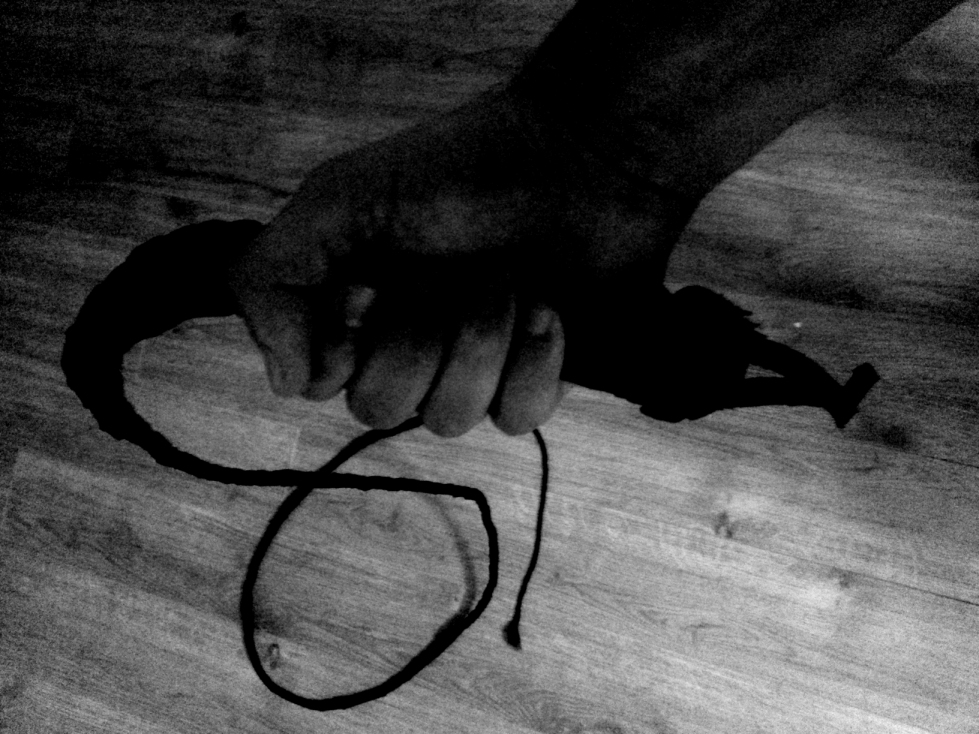
hand
I’ve been meaning to do a post on the Marquis De Sade since I started this blog, and what better day to do it than his 276th birthday! De Sade’s life was as interesting as his books, and it’s hard to know where to start with him. I have an awful lot to say about the lad, and I’m sure this won’t be my only post on his work.

Trigger Warnings: Rape, Murder, Blasphemy, Bestiality, Rape

(You said Rape twice…)

sodom
The 120 Days of Sodom & Other Writings – Marquis De Sade
Grove Press – 1987

My introduction to De Sade’s writing was 120 Days of Sodom. It is, without a doubt, the vilest book that I have ever read.  It’s a bit like the GG Allin of literature; it’s fucking horrendous, but it’s kind of cool that somebody did it. This book is so far ahead of its competition in terms of offensiveness, that any attempt to outdo it would seem petty.
It’s a fairly long book, and it’s very formulaic in some ways. I read it over a few days, and it really got to me. This is one of the very few books that has actually given me nightmares. (Imagine drifting off to the land of Nod only to find yourself being forced to attend a ‘blood-orgy’ in a subterranean vault. Yes, a ‘blood-orgy’; I distinctly remember that phrase from the dream.) As it so happens, this is also one of the very few books that has actually made laugh so hard that tears ran down my face. There is one part in which a man “fucks a goat from behind while being flogged; the goat conceives and gives birth to a monster. Monster though it be, he embuggers it.” Now THAT’S comedy! “Monster though it be” HAHAHAHAHA!!! The man is having sex with his own mutant offspring! LOL!!! 

When introducing one of the characters, a lady named Thérèse, De Sade notes;
“Her ass was peppered with wounds, and her buttocks were so prodigiously slack one could have furled the skin around a walking stick; the hole in this splendid ass resembled the crater of a volcano what for width and for aroma the pit of a privy; in all her life, Thérèse declared, she had never once wiped her ass, whence she had positive proof that the shit of her infancy yet clung there”
Some people view him as a philosopher, some ill-informed individuals imagine him as a sexual-revolutionary, but I think that De Sade has to be interpreted as a comedian with an extremely childish sense of humour. I can imagine him, sitting in his prison cell, chuckling away to his heart’s content as he wrote down the most vulgar, repulsive things he could imagine. The man had nothing to lose, and his writing gave him an opportunity to lash out at those who landed him in prison. His mother in law had had him jailed for abusing a prostitute, and if you read between the lines in books that he wrote in jail, all you’ll see is the phrase “You think that was bad? I’ll show you bad!”
Petulant, but truly hilarious.

justine
Justine, Philosophy in the Bedroom, and Other Writings – Marquis De Sade
Grove Weidenfeld – 1990

Next up is Philosophy in the Bedroom/Boudoir. I actually read the Penguin Classics version of this one, but I own the Grove Press edition. This takes the form of a dialogue between a young girl and a group of libertines who attempt to convince her to abandon her morality. It’s been a few years since I read it, but I remember this being very, very funny. The blasphemies in here are priceless; I recall some of the characters attempting to shout out phrases such as “Christ be triple-fucked” as they reach their orgasms. There is a long and boring section towards the end that discusses 18th century French politics, but it’s not essential to the plot, and you can just skip over it. This one isn’t quite as repulsive as 120 Days, but it does get pretty nasty.

I have also read the Oxford’s World’s Classics edition of The Misfortunes of Virtue. The Misfortunes of Virtue, written in 1787, is probably De Sade’s most palatable book. It’s still full of rape and misery, but it makes its point without getting too disgusting. It’s about a virtuous young woman who does her best to stay good. Every time she fails to take the opportunity to do something bad, something horrendous happens to her. It’s a fairly depressing text. Four years after publishing this one, De Sade decided it wasn’t horrible enough, so he rewrote it with extra rape and pooing, and renamed it Justine. 6 years after this, he rewrote it again, making it even more repulsive. Unfortunately, the final, 1797, version has never been published in English. The text in my Grove edition is the second version, but I haven’t got around to reading it yet.

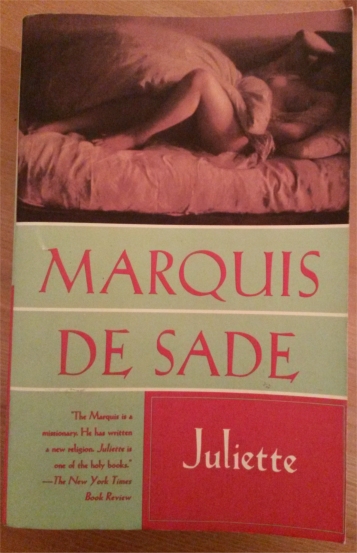
juliette
Juliette – Marquis De Sade
Grove Press – Not sure of year of publication (This edition lists a website though)

Although I own a copy, I have not yet read Juliette. Juliette is the companion book to Justine. While Justine was a little Goody-Two-Shoes, her sister Juliette was a bad girl who reaped the rewards of evil. I’m sure Juliette is a hoot, but it’s 1200 pages long, and although I have enjoyed his other works, De Sade’s books aren’t easy reads. 1200 pages of horrendous rape and murder seems like quite a commitment at the moment.

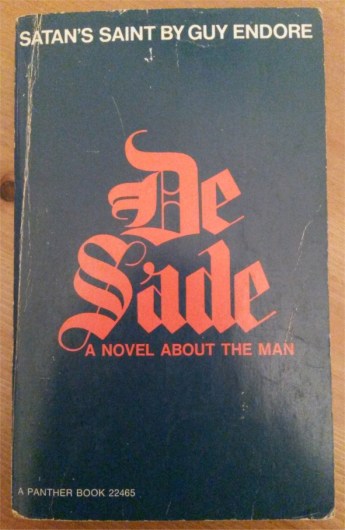
I just got this in the post the other day. It’s a novel about the Marquis from the 1960s. I’m sure it’s trash, but what a great title!
satansaint

Everyone has heard of De Sade, but not many people have actually read his books. He was a funny chap, but he was also a pathetic loser in a lot of ways. His anti-moral philosophies seem to have been a major influence on several forms of modern Satanism, and while I understand his point of view and agree with much of what he as to say about religion, I think that most of what he has to say is very shitty. Shitty, but sadly realistic. Anyways, that’s enough for tonight. If you want to discuss De Sadean/Sadistic philosophy, please give me a shout.

Happy Birthday Donatien Alphonse François!

*Although this post appears to have been posted on the 3rd of June, it was actually written and posted on the 2nd. De Sade was born on June 2nd, 1740.

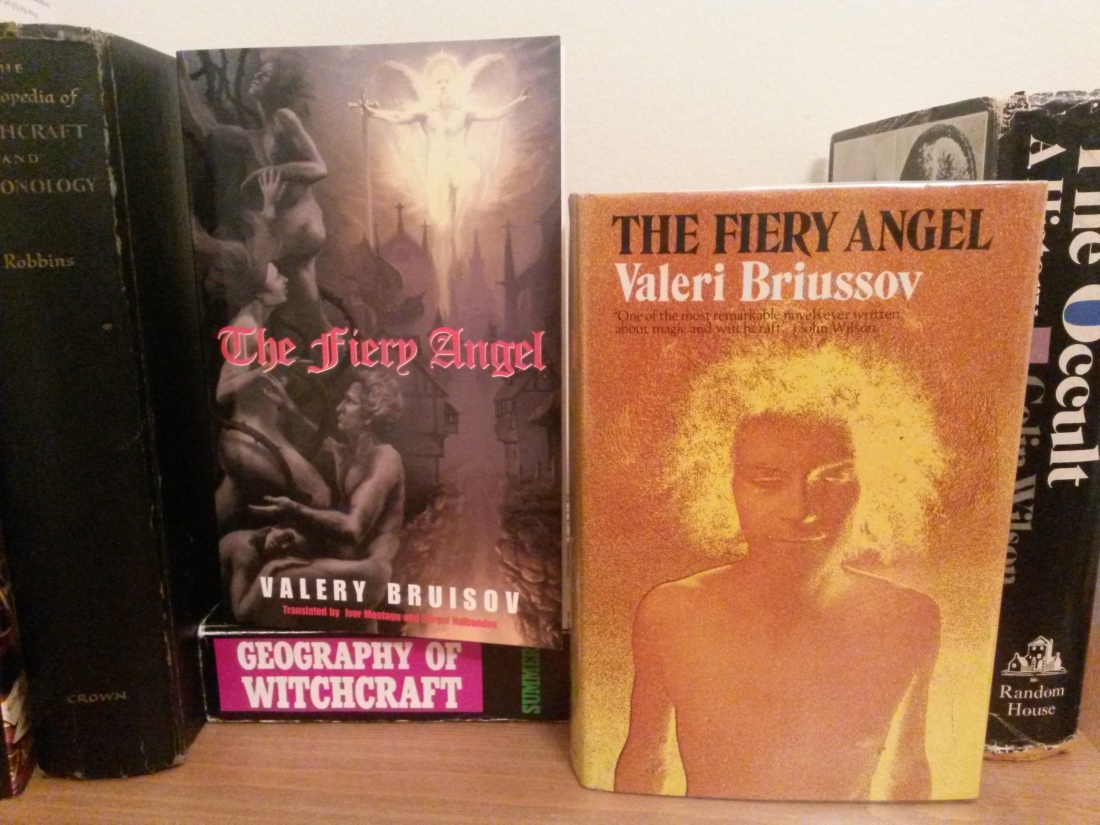
The Fiery Angel – Valery Bryusov

20160325_000821

Neville Spearman – 1975 (Valeri Briussov)
Dedalus – 2005 (Valery Bruisov)

I came across the title of this book when I was reading Colin Wilson’s The Occult two years ago, and from his description, I knew that I’d have to read it at some stage. I spent a while trying to track down a copy at a decent price, and when I found one, it spent a few months lying on the shelf before I got around to reading it. When I finally got around to it, I was met with an unpleasant surprise. Some of the pages were entirely blank. See the below video for details:


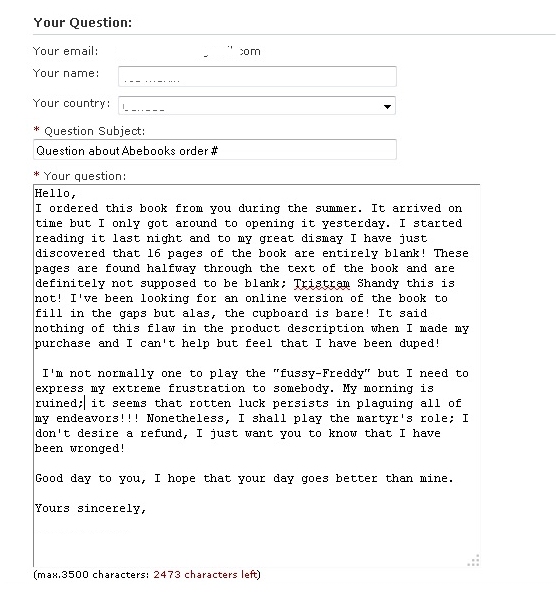
Like I said, I had ordered this a good while before picking it up to read, and so I didn’t feel it fair to demand a refund. I doubted that the bookseller had known about the defect, but I was having a slow day in work, and I decided to drop them an email to pass the time. Below is the message I sent.

my email

When I wrote that email, I did not expect a response. Fortunately, I was wrong; they replied promptly:
response
Many’s the stupid email I have sent, but I have never been so satisfied with a response. Normally you get a feebly polite apology. I take my hat off to the individual who sent the above response to me. It makes me happy to think that there are companies out there that deal with customers as they should be dealt with. If you’re talking to a jackass, talk to them like they’re a jackass. (Although, note that the seller did very courteously offer to send me a replacement.) I was extremely satisfied with my dealings with this seller, and I encourage all of my readers to buy books from them whenever the opportunity arises.

Anyways, I soon thereafter bought a different copy of the book (the more recent Dedalus edition), and that version lay on my shelf for another year before I got around to it. While the Spearman edition has a foreword by Colin Wilson, the Dedalus version has an afterword by Gary Lachman. Surprisingly, the Dedalus version also omits a two page foreword by Bryusov himself that really should be part of the text. In it, Bryusov claims to be the editor of the tale and not the author so-to-speak. Otherwise, the text of the two books are identical copies of the same original printing. (There are identical imperfections on the same pages in both versions, one of which looks like a squished fly.) If I had to choose, I would buy the Spearman version, but I would make sure that it has all of the pages before buying! (My copy is missing pages 76, 77, 80, 81, 84, 85, 92, 93, and a few more.)

Two things before I start my actual review. First of all, the name of the author is spelled differently on my two copies of this book. It’s spelled Valery Bryusov most places online, so I’m going to use that spelling. Next, this post contains a few spoilers. If you are sure you want to read this one and you’re like me and like knowing as little as possible about a book before reading it, maybe you should read the book before you read the rest of this. (But make sure you do come back to finish reading this when you’re done. I discovered some cool stuff about this book that you’ll want to know!) If you’re not sure about whether or not you want to read this one yet, read away. The spoilers here won’t ruin the suspense of the novel.

So what’s the big deal here? Why did I bother with this book? Well, it’s a novel about magic, the witch-craze, repressed sexuality and perversion. What more could I possibly ask for? Set in 16th century Germany, it tells the story of a hard man called Rupprecht who’s making his way home after gallivanting around Mexico for a few years. He becomes enchanted by a girl who is staying in the same hotel as him, but he quickly notices that she’s carrying some serious baggage; she is possessed by demons and she practices black magic. As so often happens, this woman’s personality flaws make her seem all the more attractive, and Rupprecht decides to wander around with her for a while. She tells him that she’s searching for a former lover, and Rupprecht agrees to help her find him. Oh, and it also turns out that her old lover is either an angel or devil. (We’re never made entirely sure which side this ‘Fiery Angel’ is on.) At this point, Rupes’s compliance makes you start to wonder whether it was by natural or infernal means that he was so enchanted; shouldn’t he be taking this as his cue to tell Renata to fuck off?

Well, they wander around a while looking for the Fiery Angel, but Renata gets disheartened and decides that the only way to find him will be to ask the devil for help. Renata doesn’t want that kind of guilt on her conscience though, so she convinces Rupprecht that he should sell his soul so that she can find out where her boyfriend is. Rupprecht is a hard man and everything, but he clearly gets off on kinky sado-masochistic power struggles. The more he can debase himself for the sake of his lady, the stronger his mental ‘gasm shall be! He offers his soul to Satan and actually kisses the Dark Lord’s ringpiece in order to cuckold himself; what a creep!

There are several other twists and turns in their complicated relationship, but eventually Renata runs away on Rupprecht. After a bit of moping around by himself, he bumps into Faust and Mephistopheles and wanders around with them for a while. When he finally stumbles across Renata again, she has joined a nunnery, changed her name to sister Maria, and she’s gotten herself accused of witchcraft. (Typical, right?) She is of course guilty of witchery, but one gets the impression that the reasons she is being charged have less to do with her actions and more to do with the fact that nunneries are mad places full of mad people. The whole thing very quickly turns into a Devils of Loudun situation, and Renata is sentenced to death. Rupprecht tries to rescue her, but things don’t really go according to his plans.

That’s the basic plot of it, but there’s a tonne of cool bits that I’ve left out. Rupprecht attends a witches’ Sabbath, he spends time with Cornelius Agrippa and Johann Weyer, he performs ceremonial black magic and summons demons, and Renata and he have a tonne of kinky sex. (Ok, so we don’t get the juicy details, but judging by the way they act with eachother and the fact that Rupprecht claims that Renata wanted to do more than just regular inny-outty, we can assume that no door was left unopened!) One interesting feature of the text is the fact that although this is a novel about witchcraft and magic, it is also very much a piece of historical fiction. At no point in the book does anything happen that might not actually be explained in real life. Perhaps the most curious thing that occurs is that Renata knows Rupprecht’s name before he introduces himself, but I’m sure you can imagine 100 different ways that a person might find out the name of another guest at the same hotel as them.

Despite the fact that it is mentioned in neither Colin Wilson’s foreword in the Spearman edition nor Lachman’s afterword, it turns out that this book, particularly the last few chapters, is actually largely based on a true story. In 1749, a nun named Renata Maria Saengen von Massau was one of the last women in Germany to be executed for the crime of witchcraft. (She died in 1749, but The Fiery Angel is set over 200 years earlier; I don’t think any dates are specifically mentioned, but Cornelius Agrippa, who dies at the end of the book, actually died in 1535.) I found two different accounts of the real Renata’s life in my library. One is from Robbin’s Encyclopedia of Witchcraft and Demonology. This is a rather sympathetic account that suggests that poor Sister Renata was a victim of mass hysteria. The other account of her life that I read was in Montague Summers‘ book, The Geography of Witchcraft. Monty was fully convinced that this woman was indeed a vile Satanist, and his account is even more fanciful than Bryusov’s.

Despite their different standpoints, Summers and Robbins both present the same basic story. Sister Renata had entered a nunnery when she was about 19 years old. She spent the last 15 of her 50 years in the nunnery as the subprioress. Everything was going fine in her life until a girl named Cecilia Pistorini started throwing fits in order to gain entry into the convent. Cecilia believed her hallucinations and spasms were messages from God, and she thought that this should allow her to skip through the novitiate stage of becoming a nun. Renata wasn’t convinced, and she suggested that the girl might have been putting it all on. Cecilia remembered this, and when she eventually became a nun, she convinced herself and others that Sister Renata was a witch. As she was dying, another senile old hag of a nun claimed that Renata had bewitched her, and this forced to the prioress of the convent to look into the matter. Word got out, and the idea that Renata was a witch caught on with other idiot nuns in the convent. They started imagining that they had been bewitched or possessed and a bunch of them started screaming things out during mass. The more attention they got from the local priests, the more horny they became and the more they acted up. This did not look good for poor Renata. She denied all of the allegations at first, but after twenty lashes with a consecrated rawhide bullwhip, she started to remember her sins.

In Renata’s confession, she claims to have given herself to Satan when she was only 8 years old. She spent her teenage years having sex with demons and learning the craft of Satanism, and then when she was old enough, she decided to join the convent with the sole purpose of bringing it down from the inside. (It’s a bit hard to understand how the other nuns didn’t notice anything for the first 49 years that she had been there.) She claims to have ridden to the Sabbath several times a week, to have made love to the Devil on countless occasions, and to have stolen consecrated hosts with the purpose of throwing them into the toilet. The way she stole the hosts was pretty cool. Before she would go to receive communion, she would cut slits in her flesh, and when the priest would give her the communion wafer, she would sneakily stick it into the communion-shaped holes that she had carved into her own body. She did this just so she could throw the body of christ into the crapper. What a legend!

There’s an interesting part in the Verbatim Reports from Sister Renata’s trials that might have been Bryusov’s source of inspiration for the character of Rupprecht.

“Q. Was she a witch?
A. Yes.
Q. Where did she learn this and from whom?
A. A grenadier had taught her in Vienna, where she and the whole household had gone with her father during the Hungarian war.
Q. How did she meet this grenadier?
A. As happens in wartime. The grenadier had often given her bread when she was hungry, and finally he promised to teach her something.
Q. What then did this grenadier finally teach her?
A. He gave her a paper, on which all sorts of letters were written. On this paper she had to draw a circle and stand inside it. In addition, she had received a charm [Zetel] with various words on it; and if she could read these words, then she could make passers-by in the street lame and crippled.”

In The Fiery Angel, Rupprecht doesn’t meet Renata in Vienna, but he is a soldier that meets her in a time of need, and they do spend time together studying the black arts. I think it’s quite likely that Rupprecht originated as a re-imagining of the mysterious grenadier from the real Renata’s confessions.

In the book, Renata dies in Rupprecht’s arms, but the real Renata was not quite so lucky. Her judges decided to show her some leniency in her execution though, on account of the fact that she had been seduced by Satan at such a young age. She was shown the courtesy of having her head chopped off before being thrown into a barrel of burning tar. Apparently the executioner made such a clean cut that her head popped clean off her body with the first blow from his sword, and he was given a round of applause for his accuracy. Imagine a crowd of people cheering a man for decapitating a 69 year old woman.

All in all, this is a very interesting book. I found the first half dragged a little bit, but it really picks up later on. Bryusov knew his stuff when it came to witchcraft, and there are a few books mentioned in here that I am going to have to try to track down. In truth though, this book is more about the psychology of attraction than it is about black magic. Apparently the plot of the story is largely based on events from the author’s own life. He basically took the story of a love triangle that he had been involved in, chose characters from a famous witch trial to play the roles, and set the story 200 years before those people had actually lived. The result is actually deadly. I mean, as mad as it sounds, I think this book would be an enjoyable read for a person with no interest in witchcraft or demonology. For those of us who are interested in those topics, this is a must read. Five stars.

Happy Birthday Edgar Allan Poe!

2015-12-29 23.14.10
(Card made by my wonderfully creative wife)

Were he still alive, Edgar Allan Poe would be 207 today. If you haven’t read all of his stories, stop wasting your time on my dumb blog and check them out. It would be rather difficult for me to overstate how much I love Poe. Teaching English, I’ve had to read the Tell-Tale Heart, the Cask of Amontillado, and Masque of the Red Death more times than I can count, and I still get excited every time I get the opportunity to go back to them. There’s so many other great tales though. The Black CatThe Imp of the Perverse, and Fall of the House of Usher are some of my other favourites, but he wrote plenty more that are equally as brilliant.

2015-12-29 23.13.18
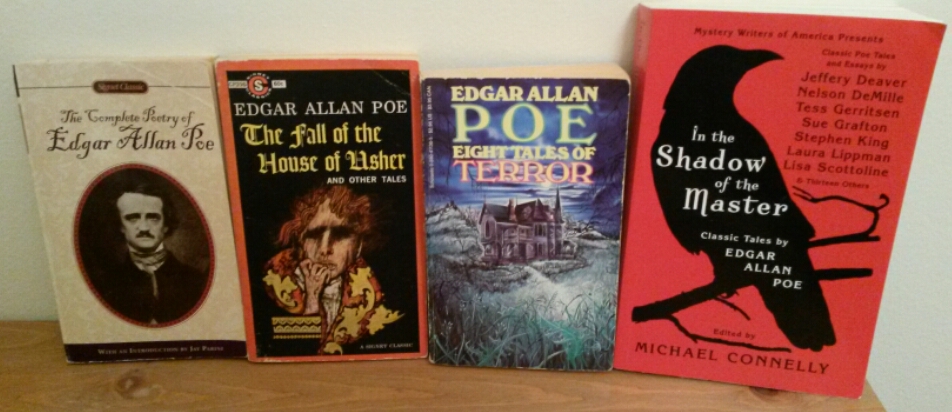
The pictured books are just some cheap collections I’ve picked up in the last few years. There are countless editions of Poe’s works out there, and I can’t recommend any in particular. (I will say, as I have said before, that the Complete Poetry Collection is a handy one for taking into the bathroom on a slow Sunday morning.) When I get rich, I’m going to buy a hardback edition of his collected works for my fine mahogany bookshelves. I’d also love a copy of Tales of Mystery and Imagination with the illustrations by Harry Clarke, but I guess shitty thrift store collections and the internet will have to suffice until I hit the big time. Anyways, Happy Birthday Edgar!!!

And just so ye know; I’m right in the middle of the busiest part of my course at the moment, and this blog might get a little slow for the next month or so, but don’t fret; it won’t be long until I get to put down the textbooks and take up some quaint and curious volumes of forgotten lore!

Here is just some of the utter garbage that I’ve picked up recently:2016-01-13 22.56.47

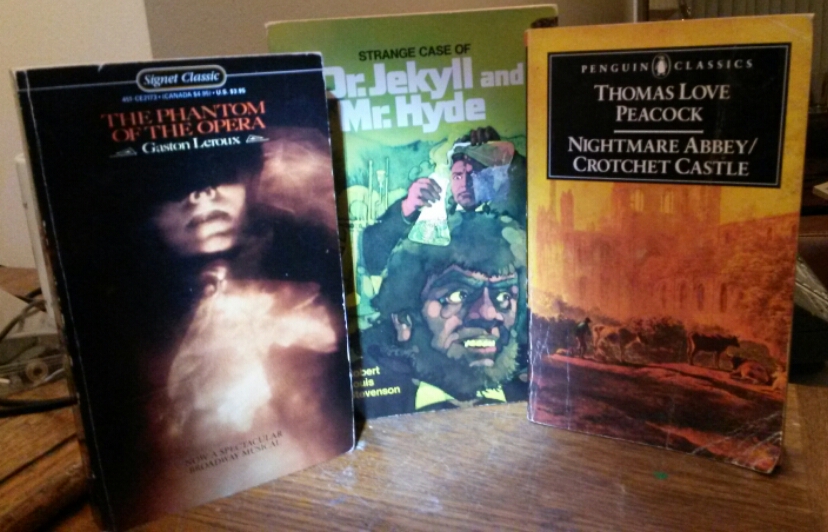
The Phantom of the Opera, Dr. Jekyll and Mr. Hyde, and Nightmare Abbey

2015-09-01 21.38.12

I recently started back at university, and I won’t have much time for reading or blogging for the next year. Still though, I’ll try to get a few posts up whenever I get the chance. Here are three books that weren’t as good as I hoped they would be.

The Phantom of the Opera – Gaston Leroux
Signet Classics – 1987

This one was actually pretty good for most of the book. I just felt that the ending was a let down. I read it a good while ago, and I have actually forgotten how it ended. I could look it up for the sake of this blog post, but I don’t think that my fragile heart could bear to go through that disappointment again.
Although the characters in here are annoyingly see-through, I think that the biggest problem for this book is living up to the reputation that Hollywood has created for it. The Phantom of the Opera, as an archetypal villain, is in the same league as Dracula or Frankenstein. Unfortunately the book that he comes from is not nearly as good as those of his rivals. It’s still fun though, and I probably enjoyed this the most out of any of the three turds.

Dr. Jekyll and Mr. Hyde – Robert Louis Stevenson
Golden Press – 1978

I had a cool Jekyll and Hyde board game when I was a kid, and I grew up imagining that the book would be as much fun as that game. Unfortunately, it isn’t. It basically tells the same story twice: once from the point of view of Jekyll and once from the point of view of Hyde. The plot is framed around a twist, but  I can’t imagine that there are many readers who don’t already know who’s who of this tale. This was another book that I read on a plane, so maybe it’s better than I remember. Still though, I’m not going to reread it.

Nightmare Abbey – Thomas Love Peacock
Penguin Classics – 1986
This one isn’t all that bad; it was just quite a bit different to what I expected. It’s often included in lists of classic Gothic literature, and while it is fairly morbid, it’s just not that spooky. Not a lot happens in it either; it’s mostly dialogue. It’s not an all-together bad read though; I definitely got a few laughs out of it. My edition also includes another novel by the same author. I probably won’t bother. Much of the inspiration  for that terrible Gothic film by Ken Russell came from this.

There you go faithful readers; three turds in the bowl. I’m sure this post has been even more disappointing than any of the books reviewed. Que sera, sera.

Zanoni – Edward Bulwer-Lytton

2015-08-27 20.54.58
P.F. Collier – 1892

Last year, I ordered a set of books by Edward Bulwer-Lytton. It’s a 9 volume set of his most popular works. All the books are double-paged, and each volume contains a few different works.  I have a pretty big reading list, and it took a few months to get around to any of these battered old tomes, but almost as soon as I started reading, I knew this set had been a wise purchase. If you find a cheap copy of these books, buy them immediately. I spent about three times the cost of the books on the postage, but it was still worth it. (UPS are a dirty shower of thieving bastards!)

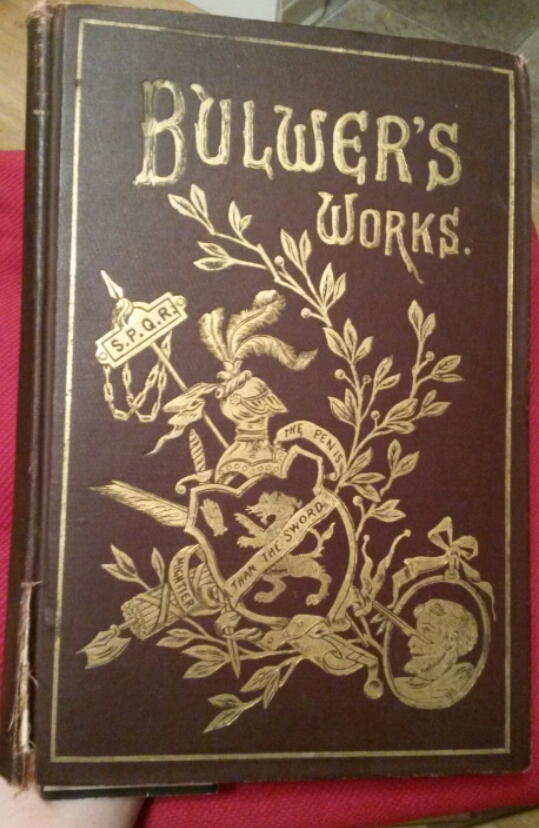
2015-08-27 20.52.31A pretty cool cover. N.b. the fasces and the obscenity.

20150814_013506LOL

These books were published in 1892, and it shows. The spines are all cracked and the binding is falling apart. I had to sit down at a desk and carefully turn each page so as not to cause further damage. Now one might think that this would have been detrimental to my enjoyment of these texts, but that couldn’t be further from the truth. I felt so cool, patiently leafing through the pages and inhaling their aged musk. One can only imagine my delight on finding that the text that I started reading was about a ciphered manuscript given to the author by a mysterious Rosicrucian whom he had met in an esoteric bookshop. All my dreams were coming true at once!

2015-08-27 20.51.35The frontispiece of Zanoni. It depicts Gaeto Pisani and his daughter, Viola. (I think.)

The manuscript tells the tale of Zanoni, an immortal sorcerer and member of an extremely exclusive secret society consisting of only two people. He tries his best to help out a pair of young lovers, but he fails miserably and ends up making their lives incredibly difficult. The youngfella thinks that Zanoni is really cool, and tries his best to be like him. Zanoni is fairly chuffed, and invites him to join his club. Unfortunately for everyone, Glyndon, the young man,  doesn’t get past the initiation ritual for the order, and ends up spending the rest of his days getting stalked by a particularly nasty entity called ‘the dweller of the threshold’.

Lytton was a hugely popular writer in the 19th century, and apparently the theosophists were big fans of his. Helena Blavatsky introduced a version of the dweller of the threshold into her teachings. She described it as an extension of one’s astral body that results from the remnants of past lives. Other occultists have appropriated the dweller in other equally silly ways. Van Morrison, everyone’s favourite adept of easy-listening, had an interest in the occult at some stage, and he used one of these bastardized versions of the dweller for the topic of one of his songs. Before I go any further, I want to declare my extreme and utter hatred for Van Morrison. I remember being a kid and having the tape of Van the man’s greatest hits playing in the car every fucking time my parents took me on a drive. I didn’t know what it was called, but I referred to it as ‘sweaty music’ because that’s how it made me feel. I actually listened to his song a few times before I wrote this review, and it made me want to vomit and shit diarrhea at the same time. Anyways, the lyrics to Morrison’s song are about some kind of benevolent source of spiritual inspiration. Bollocks to that. In Lyttons book, the dweller is a seriously nasty piece of work:

Its form was veiled as the face, but the outline was that of a female; yet it moved not as move even the ghosts that simulate the living. It seemed rather to crawl as some vast misshapen reptile; and pausing, at length it cowered beside the table which held the mystic volume, and again fixed its eyes through the filmy veil on the rash invoker. All fancies, the most grotesque, of monk or painter in the early North, would have failed to give to the visage of imp or fiend that aspect of deadly malignity which spoke to the shuddering nature in those eyes alone. All else so dark,—shrouded, veiled and larva-like. But that burning glare so intense, so livid, yet so living, had in it something that was almost HUMAN in its passion of hate and mockery,—something that served to show that the shadowy Horror was not all a spirit, but partook of matter enough, at least, to make it more deadly and fearful an enemy to material forms. As, clinging with the grasp of agony to the wall,—his hair erect, his eyeballs starting, he still gazed back upon that appalling gaze,—the Image spoke to him: his soul rather than his ear comprehended the words it said.

“Thou hast entered the immeasurable region. I am the Dweller of the Threshold. What wouldst thou with me?”

Deadly, isn’t she?

I won’t say much more about the plot, as I don’t want to ruin the story on you. Being honest though, this is not a great book. There are some fairly big flaws here; it seems a bit like the author was making up the plot as he went along, and the detailed parts on the French revolution are neither interesting nor particularly relevant. Some editions use the subtitle; ‘A Rosicrucian tale’, and this is fairly apt: there’s probably a lot of symbolic and esoteric meaning between the lines that will only become apparent to patient students of hermeneutics, but I’m not really concerned with that shit. This is an old book about wizards, spirits, demons, and babes with heaving bosoms, and I thought it was deadly.