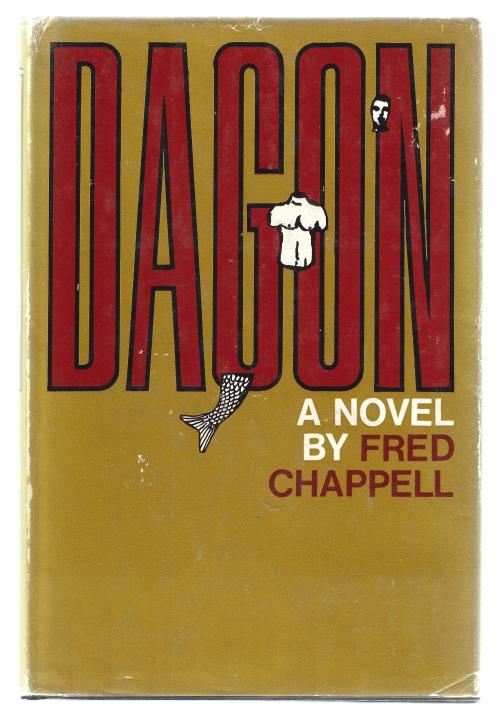
Fred Chappell’s Dagon

Harcourt, Brace & World, Inc. – 1968

I’ve wanted to read Fred Chappell’s Dagon for years. I knew it was one of the more esteemed Lovecraftian novels and that it was written by a writer who wasn’t specifically a horror guy.  I went into the book thinking that Fred Chappell was a noir fiction writer, but apparently I made that up. He was actually a poetry and literature kind of chap. Dagon confirms this. It’s definitely a bit deeper than tentacle monsters.

This book is categorized as Southern Gothic. I read some books by Faulkner and O’Connor when I was younger, and I mostly remember them being sad, sweaty, claustrophobic things. Chappell’s Dagon definitely contains those elements, but it starts off like half of August Derleth’s Lovecraftian stories: an academic inherits a farm that contains sinister and disturbing secrets. This one has bloody chains in the attic and a family of hideously ugly freaks living in a shack on the edge of the property. There’s also a pile of seemingly indecipherable documents containing references to Cthulhu and Yog-Sothoth that seemingly drive the reader insane.

From here on, I’m going to discuss how the book ends, so if you haven’t read it, go and do so before continuing with this post. The book is not a masterpiece, but it was thoroughly unpleasant, and I quite enjoyed reading it.

So after the protagonist reads some of the weird letters in his house, he falls in love with a freakishly ugly young woman and murders his wife. He then spends the rest of the book drinking himself to death and getting tortured by the ugly mutant. After being held down and tattooed in front of a bunch of people, he is thrown in a hole and dies.

My immediate response on finishing the book was that I loved it. I really enjoy when horror novels end horribly. I kept thinking about this one after finishing it though, and in retrospect, it doesn’t make a lot of sense. Why did the main character kill his wife? They had an argument, but murdering her was a bit excessive. Why was the girl so ugly? Her face is described as fishlike, but are we to believe her ancestors hailed from Innsmouth or was she just minging? Why does the author passively let her destroy him? Who are the people that she involves in his torture? Are they in a cult? Why are the Lovecraftian deities mentioned? Nothing supernatural happens here.

As somebody who mostly reads trashy fiction, it unnerved me to have so many unanswered questions at the end of a book, but none of these issues actually bothered me when I was reading. Things generally do seem more horrific when they don’t make sense, and I think that the omission of these explanations was intentional.

The combination of Lovecraftian horror and Southern Gothic doesn’t really work. (Although it worked a Hell of a lot better here than in Lovecraft Country!) The genres are just a little too far removed from each other to mesh cohesively, but Chappell’s effort to do so was about as successful as we could realistically hope it to be. It’s not a perfect book, but I enjoyed reading it and i am still thinking about it a week later.

I’ve been hitting the fiction hard recently. I read 4 novels this week, and I wasn’t sure which to post first. There’s lots of cool stuff coming up in the next few weeks, so check back regularly!
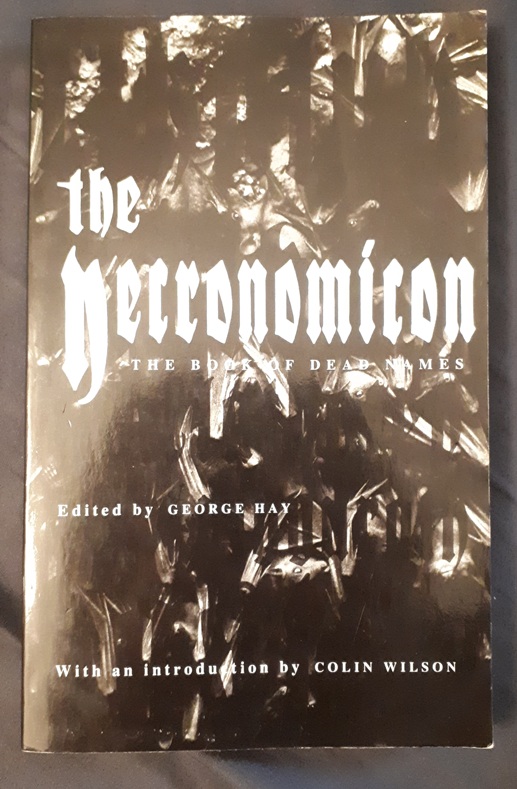
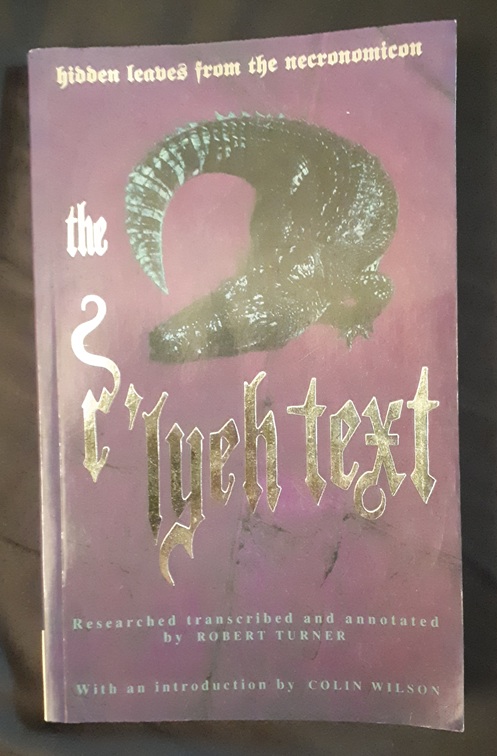
More Necronomicons: The Book of Dead Names, The R’lyeh Text and Al Azif

Exactly 10 years ago, I reviewed the Simon Necronomicon. While that is probably the most famous hoax Necronomicon, there have been others.

Earlier in the year, while I was researching Alan Moore for my posts on Nicholas Hawksmoor and Jack The Ripper, I came across a review he had written of The R’lyeh Text that made me want to read it. After a bit of searching, I realised that The R’lyleh Text was a sequel to a 1978 version of the Necronomicon that’s usually referred to as the Hay Necronomicon after its editor, George Hay.

The Necronomicon: The Book of Dead Names

Skoob – 1996 (Originally published 1978)

Colin Wilson’s book on the occult was one of the first I read in the topic, and while it led me to countless other books and resulted in the creation of this blog, I’ve never bothered to read any of his other works. Actually, my low opinion on Wilson got me in trouble with another historian of the occult a few years ago. Wilson wrote the introduction to this Necronomicon and reading it did not change my opinion of him. He was well read, but full of shit. This introduction is considerably longer than the actual text that it is introducing.

The text of the Necronomicon here is supposedly taken from a ciphered manuscript that had been in the possession of John Dee. It was decoded with a computer program. Wilson presents the claim that Lovecraft’s father had been a freemason and occultist and had somehow acquired a copy of this manuscript and either told his son about it before he went insane or left a copy lying around their home.

The story is obviously bullshit, and the text it presents isn’t particularly interesting. I love Lovecraftian prose and black magic, but these aren’t entertaining if they’re not sincere. None of the rituals in here are things that anyone is going to do. It’s not even like reading a Lovecraftian story where the verbose ramblings add to the suspense. I knew this book was a hoax when I started it, and it felt truly underwhelming reading it.

There’s three essays included after the grimoire part to flesh the book out, but none of them were particularly interesting. One of them was by Angela Carter. I recently read and quite enjoyed her The Bloody Chamber.

The R’lyeh Text: Hidden Leaves from the Necronomicon

Skoob – 1995

While the Hay Necronomicon went through a few editions, its sequel, The R’lyeh Text, only went through one. This has made it harder to come by at a reasonable price. Let me warn you my friends, don’t spend a lot on this if you’re thinking of buying a copy. It’s boring crap.

There’s another lengthy introduction from Colin Wilson. This one chirps on about Edgar Cayce and Atlantis, the Sirius Mystery, Kenneth Grant, Aleister Crowley, the Marquis De Sade and the Piri Reis maps, all in an attempt to prove that Lovecraft’s mythos stories were based in fact. I was astounded at how boring this introduction was given my interest in the topics it covers. Again though. this may have had something to do with the fact that I knew the book was a hoax and that Wilson was literally bullshitting. I think it may also have had something to do with the fact that Wilson’s writing is a bit dull.

The grimoire text here is the remainder of the text that was published in the Hay Necronomicon, and it is even less interesting. There’s a few essays included too. One of them discusses the Red Book of Appin, and another has put me on the trail of a book about a talking mongoose, but neither was interesting enough to save The R’lyeh Text.

Truly, I was quite disappointed by these books. If you’re going to make a fake Necronomicon, you should to overdo it. Throw mystery and mythology to the wind and include brutally violent rituals of heinous, tentacled evil. Nobody is ever going to believe it, so at least make it fun.

Al Azif – Abdul Alhazred

Owlswick – 1973

The Hay Necronomicon includes a section on a different version of the Necronomicon that had been published in 1973, the Owlswick Necronomicon. (Hay’s book does not make reference to the Simon Necronomicon even though version had come out a year before Hay’s.) The Owlswick Necronomicon is a hoax book that contains a short introductory essay by Lovecraft biographer L. Sprague De Camp in which he claims to have been sold a dodgy manuscript from the Middle East that killed whoever tried to translate it. It’s supposedly written in Duriac, a non-existent language, and it’s actually just a bunch of scribbles. It’s the kind of book that’s just going to take up space on your shelf after a couple of moments of initial amusement.

I’m really thinking of doing a Lovecraft re-read next year. This crap has me longing for the good stuff.

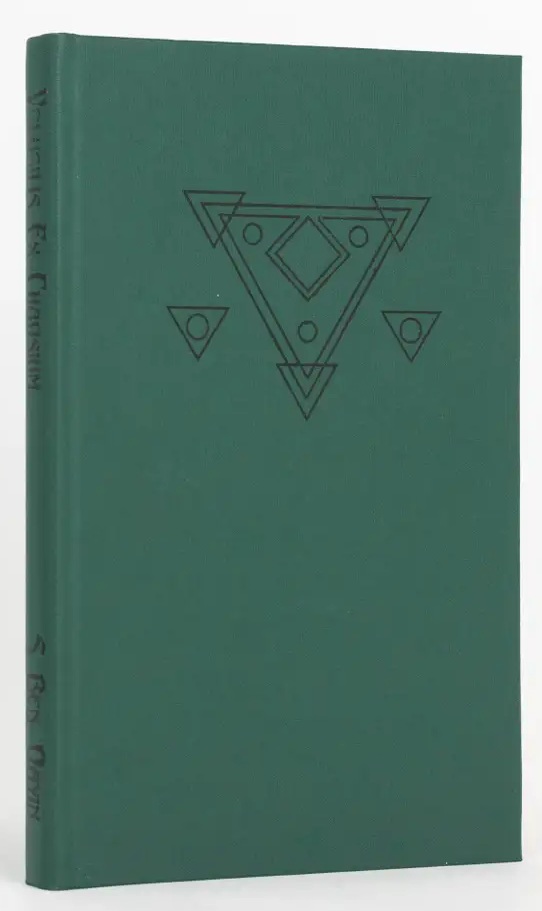
VOLUBILIS EX CHAOSIUM: A Grimoire of the Black Magic of the Old Ones by S. Ben Qayin

Dark Harvest Occult Publishers – 2011

I didn’t finish my novel on time for this week’s post, so I rapidly consumed another book of Lovecraftian black magic. This one was written by a guy called S. Ben Qayin. I was going to read a different book by this author a few years ago, but I saw that he was involved with the becomealivinggod twats, so I didn’t bother. When I saw this fairly short Lovecraftian grimoire earlier on, I couldn’t resist.

I’ve read a lot of grimoires, and I’ve often claimed that I enjoy the more sinister ones. I once read a grimoire about killing yourself in a graveyard, another that describes how to make a giant bell with a human corpse as the clangy bit, and another that instructs the magician to make a giant sausage packed with festering human flesh. Of course, the more sinister these things get, the less likely they are to be taken seriously by anyone. Some of these books seem like they were written to entertain the reader more than to instruct them, and that’s definitely the feeling I got from Volubilis Ex Chaosium.

Ok, so aside from a little self mutilation, but there’s nothing all that sinister about this book. You wouldn’t have to be a completely evil psychopath to follow the rituals herein, but you would have to be fairly silly. There’s a few prayers to Cthulhu and Nyarlathotep, but despite S. Ben Qayin’s best efforts to convince us otherwise, we all know that these are fictional characters. This book is basically just fan-fiction. I am obviously a fan of Lovecraft, so I was reasonably entertained, and if I found a very cheap copy of this book, I would gladly keep it on my coffee table to make guests feel uncomfortable, but I can’t imagine anyone taking actually staying up late at night to go and do blood rituals to Yog-Sothoth in a forest. If I’m wrong and you do that kind of thing, I’d love to chat with you.

All things considered, I quite enjoyed the 45 minutes it took me to read this. I was sitting in my car, drinking coffee and eating a coconut donut at the time. I may go back and read more S. Ben Qayin in the future. It’s 5 years since I wrapped up my big Lovecraft reread (Part 1, Part 2, Part 3, Part 4, Part 5), and reading this grimoire made me want to do another. I might stick with a greatest hits collection this time around.

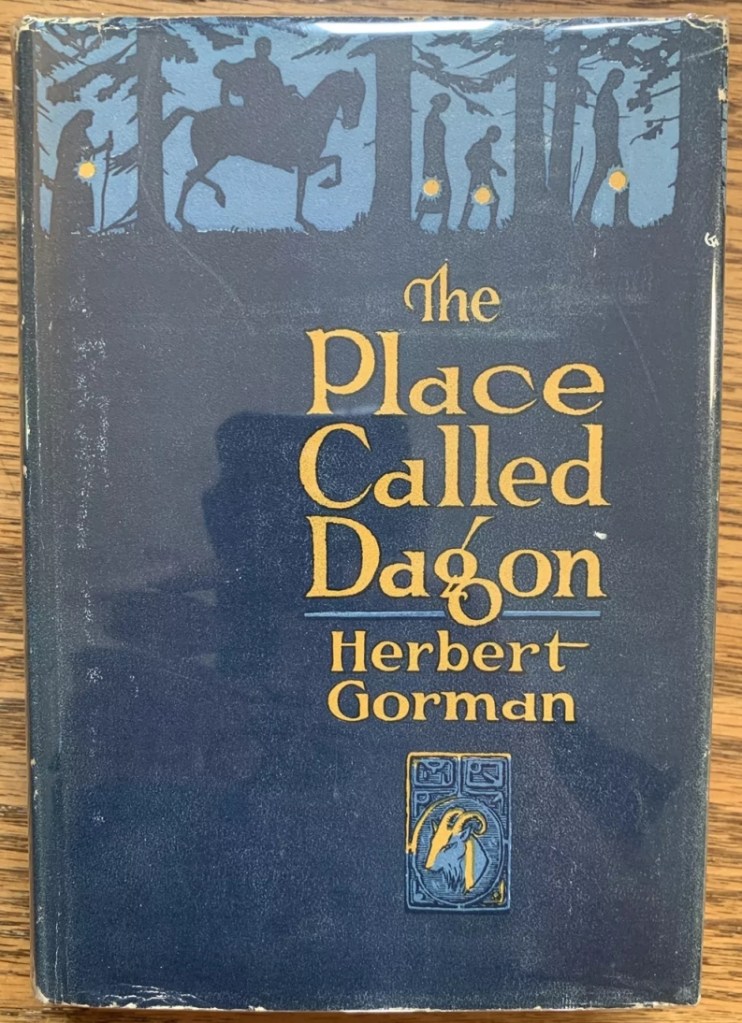
Herbert Gorman’s The Place Called Dagon

Sorry for not posting last week. I’ve been travelling, and I haven’t had much time to sit down and blog.

I read Herbert Gorman’s The Place Called Dagon a few weeks ago. I had read somewhere that it had influenced Lovecraft, and its title made it seem like the influence would be pretty direct. I enjoyed the book, and while it did feel very similar to some of Lovecraft’s tales, it wasn’t really what I expected.

George H. Doran Company – 1927

A doctor moves to a remote town in New England. He’s largely shunned by the locals. Things start to change when he is called to the home of the local eccentric who has just shot himself in the foot. This lad is a weirdo, but his wife is a total babe. One thing leads to another, and it’s not long until the doctor finds himself at a Satanic coven’s ritual sacrifice.

This is actually a pretty straight forward folk horror story, but the setting and tone is very similar to some of Lovecraft’s work. I was a bit surprised because when I think of what stands out about Lovecraftian horror, I tend to think of the cosmic side of things, strange and terrible gods that are oblivious to the suffering of humanity, but the evil in Gorman’s book is actually quite prosaic. There’s definite Dunwich vibes, but no real Yog Sothothery. The Dagon referred to in the book’s title is literally a place too. There’s no fish Gods involved.

I quite enjoyed this one. I went back and took a look to see what Lovecraft actually said about it. All I could find was a brief mention in his essay on Supernatural Horror in Literature. I remember reading Stephen King’s Danse Macabre, a book about horror fiction, a few years ago and then going back and reading all of the books it mentioned. I did the same thing after reading T.E.D. Klein’s The Ceremonies. I’m a bit surprised that I haven’t gone through Lovecraft’s essay in more detail and then hunted down the books mentioned therein. I’m just glancing through it now and seeing a lot of familiar names. Maybe I’ll get going on that soon.

Math, Dreams, Magic, all are one in Yog-Sothoth!

A few weeks ago, I was emailed a pdf of an academic paper on math. In 1992, Robert Birrell submitted his master’s thesis on the “analysis and construction of the small inverted retrosnub icosicosidodecahedron”. The small inverted retrosnub icosicosidodecahedron, a 3-d shape, and apparently it’s one of the more complicated uniform polyhedrons out there. Its complexity led to it being referred to as Yog-Sothoth, one of the Outer Gods of Lovecraft’s Cthulhu mythos.

Past, present, future, all are one in Yog-Sothoth.

So this Robert Birrell guy was clearly a nerd of the highest order, and for his Master’s thesis, he actually built one of these things. The essay I read is a description of how it was built. It does contain a section of the Lovecraftian origin of the shape’s name, but math isn’t my strong point, and most of the document went completely over my head. I wanted to do a blog post about Yog-Sothoth, but the paper I had read didn’t really give me enough material. Birrell has no internet presence that I could find, but I did find another nerd who had built a model of the small inverted retrosnub isohoohoo. I emailed him and asked if anything eldritch or bizarre occured during its construction, but he didn’t respond. (I want to make it very clear that when I use the word “nerd”, I do so with sincere respect. These are great men.)

I went looking for more Yog-Sothothery, but most of the books containing that name in the title are manuals for role playing games. I came across references to a grimoire named Liber Yog-Sothoth, but only a few copies were ever printed. The author, John Coughlin uploaded a pdf version of the central rite of the text, and that is freely available online. I read through it, and in honesty, it seemed as incomprehensible to me as the paper on geometry. The description of the rite is mostly limited to its script, and although I now know the basic steps of the ritual, I’m not really sure of the purpose behind it. The idea of summoning Yog-Sothoth is pretty cool, but what am I going to do with him when he shows up?

K’aem’nhi kh’rn K’aem’nhi kh’r K’aem’nhi kh’rmnu.

I was intrigued by this bizarre text, and I decided to further investigate the author. I found that he had written another book on Lovecraftian magic, and although physical copies are equally as scare, a pdf of this one, A Cthulhian Grimoire of Dream Work, was floating around online. I had to read it.

A Cthulhian Grimoire of Dream Work

Waning Moon Publications – 2006

Last year, I read a grimoire called Gravelording. It was a bizarre book that described how a person would bring themselves closer to death so that they would have any easier time speaking to spirits in a graveyard. It was ludicrously silly, and it wasn’t until after finishing the book that I realised it was inspired by a novel written for children. The basic idea was that to communicate with dead people, you first have to almost kill yourself by starving yourself and going without sleep. I was reminded of this book when I started reading Coughlin’s A Cthulhian Grimoire of Dream Work because Coughlin’s work gives almost the exact opposite advice.

The first section in the book outlines the Rite of Cthulhu. It’s pretty cool. I like the idea of shrieking “Cthulhu Fhtagn!” in a cave with my mates, but this rite is only supplementary to the rest of the book. The remainder is essentially a manual on how to induce lucid dreams. You could do the rite of Cthulhu if you wanted to try to point your dreams in a certain direction, but you could also skip it completely. In the next section, Coughlin advises the prospective dream voyager to tidy their room, drink some herbal tea, do a little stretching and to avoid television, caffeine and strenuous exercise before bedtime. This guy wants you to have a good night’s sleep! I was reading this just before going to bed too, so I was very appreciative of the author’s very good advice. I did a bit of snooping online about this guy, and he seems like a nice, good person. This suspicion was confirmed when I emailed him and received a prompt and polite reply.

I would have preferred to read something more heinous, but that says more about me than Coughlin. These books were not written for a mass audience, and from what I have seen, they actually contain fairly sensible advice. (Lucid dreaming, unlike gravelording, is a real thing.) Personally, I would prefer a book that explains the process of inducing horrible nightmares. I’ve had some pretty horrendous dreams before, but it would be kind of cool to be able to choose to dream about the great old ones destroying society and enslaving humanity.

Oh, and by the way, I recently appeared on the Bonversations Podcast. We talked about this blog, the Unabomber, Robert Anton Wilson and conspiracy theories. Give it a listen here.

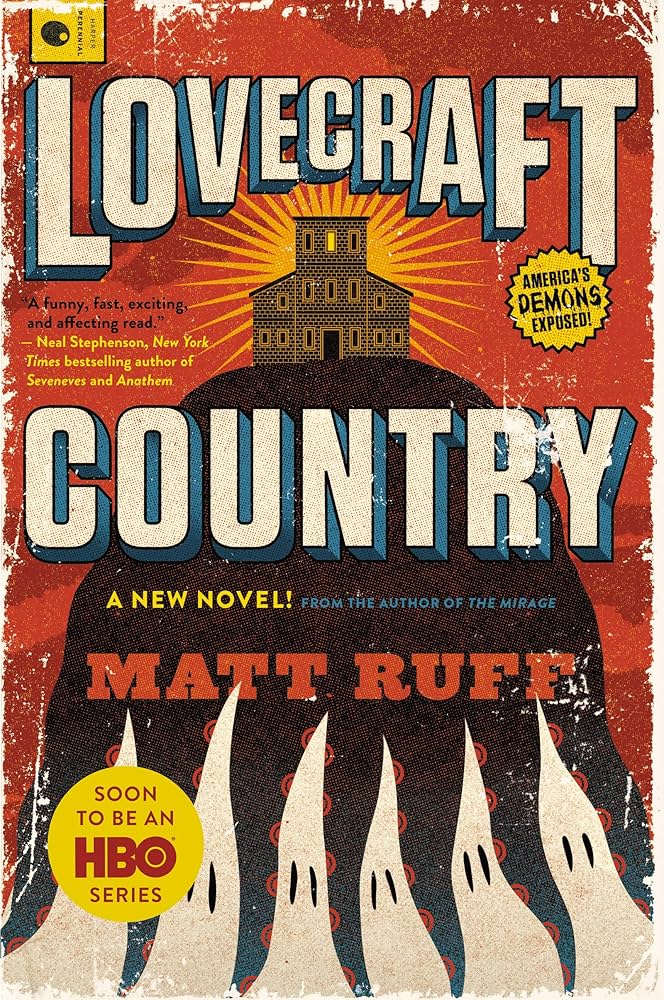
Matt Ruff’s Lovecraft Country

Lovecraft Country is an excellent title for a novel. Initially I assumed it was going to be Fear and Loathing in Las Vegas but with Cthulhu, the nightmarish diary of a drug user as they passed through Innsmouth and Arkham, not being able to distinguish between hallucinations and genuine sinister apparitions. That would have been awesome, but that’s not what this is.

Lovecraft Country – Matt Ruff

Harper – 2017 (First published 2016)

This is a novel that features Lovecraftian entities, but the horror it focuses on is actually that of American racism. First off, let me clarify immediately, that I am not an “anti-woke” asshole who disregards things because they mention race. I understand that racism was and continues to be a huge problem, especially in America. If you disagree with that sentiment, go stick a knife up your shitter. My complaint is not that racism shouldn’t be addressed; it’s that this is not a good way to do it. To me, the appeal of Lovecraft’s cosmic horror lies in its villains’ complete apathy towards human life. In Lovecraft’s best stories, there’s no bad guy who hates people because they were mean to him. He was writing about entities who see human life as nothing more than a mistake. We are slime to the Great Old Ones. What does Cthulhu care for the tribulations of man? To write a story that focuses on race against that backdrop seems absurd. If the world is soon to repopulated with a species of humanoid beetles, why should we care about the immediate suffering of one particular group of people?

In actuality, the Lovecraftian influence on this novel seems to come more from Lovecraft’s fantasy stories than his horror. The amount of Shoggothery in here is minimal. I kept hoping that really bad stuff was going to start happening to everyone, but it didn’t. This novel did not deliver the Lovecraftian horror that I am a fan of. If you want Lovecraftian horror with a black protagonist, I would recommend Victor LaValle’s The Ballad of Black Tom instead.

I hummed and hawed for a month after finishing Lovecraft Country, trying to figure out if I was going to read The Destroyer of Worlds, the book’s sequel. I eventually decided not to bother. I read that Ruff claimed that the first novel is a better book, and as I found this one quite boring, I decided not to bother with its sequel. I’m not going to bother with the TV show either.

The other thing is that the author is a white man. I’m certainly not of the opinion that an author should only write about characters of their own race, but this is very much a novel about the hardships endured by black people in the 1950s. While I thought that Ruff dealt with the topic in a sensitive manner, I am a white guy, so my opinion isn’t that important here. I guess a cast and crew of mostly black people worked on the TV adaptation though, so it’s probably ok. Personally, I wouldn’t touch this kind of thing with a 10 foot pole in my own fiction. I’d be afraid of being accused of virtue signaling or insensitivity. Ruff, at least in my opinion, manages to walk that fine line successfully, but it seems like the effort required in doing so made it much more difficult to deliver the promises made by the book’s title.

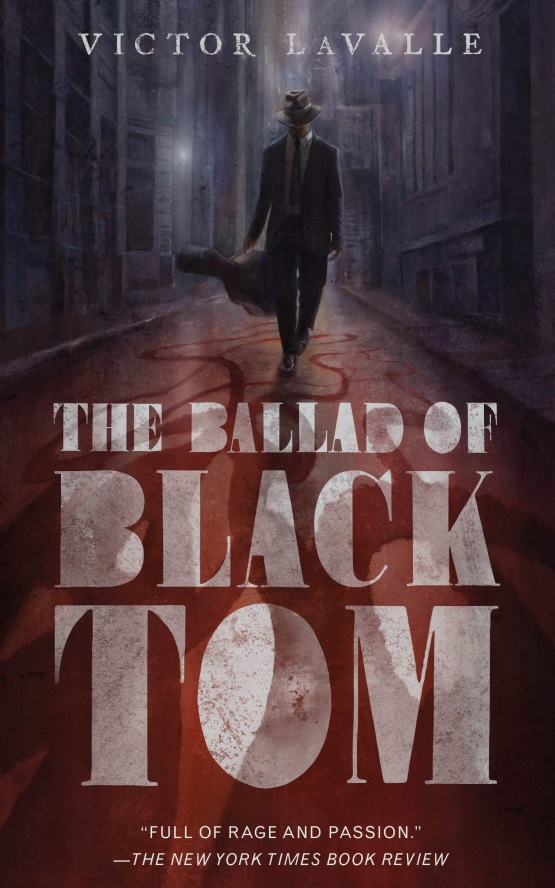
Victor LaValle’s The Ballad of Black Tom

The Horror at Red Hook is probably H.P. Lovecraft‘s most racist story. Sure, there are dodgy cats and demeaning comments in other tales, but Red Hook is as much a rant on how disgusting Howard found immigrants as it is a horror story. It’s not even a particularly good story, relying on the threat of black magic rather than the cosmic horror which fuels Lovecraft’s more effective nightmares.

A detective, Malone, goes insane after investigating Robert Suydam, a black magician who has been cavorting with the immigrant scum of Red Hook, a slum in New York. The story involves much of the usual Lovecraft stuff, subterranean vaults, reanimation and a protagonist who loses his mind… It’s pretty forgettable, but it comes up frequently as an example of Lovecraft’s hateful views. It’s bad, but it pales in comparison to his poem, “On the Creation of …”.

I have been planning to read something by Victor LaValle for a while, and when I found an audiobook version of his retelling of Red Hook, I snatched it. It’s been a while since I read anything Lovecraftian, and this novella won a Shirley Jackson award.

The Ballad of Black Tom – Victor LaValle

Tor – 2016

In this version of the story, Suydam enlists the help of Black Tom, a hustler turned guitar player. Tom becomes the main character, and the black magic of the original story is replaced with Cthulhu cult stuff that we’ve all come to expect (and desire) from a modern Lovecraftian tale.

LaValle takes an infamously racist story and gives it a black protagonist. While it does deal with the discrimination this character faces because of his race, the story never feels preachy or overly didactic.

In truth, there’s nothing hugely revolutionary about this tale, but it delivered pretty much everything I wanted. I was entertained from start to finish, and it made me want to read more Lovecraftian stuff and also more by Victor LaValle. Check it out if you can.

Also, I didn’t realise this until after I made the post, but last week’s post on the Zodiac Killer was actually my 500th blog post on this site. That’s a lot of books.

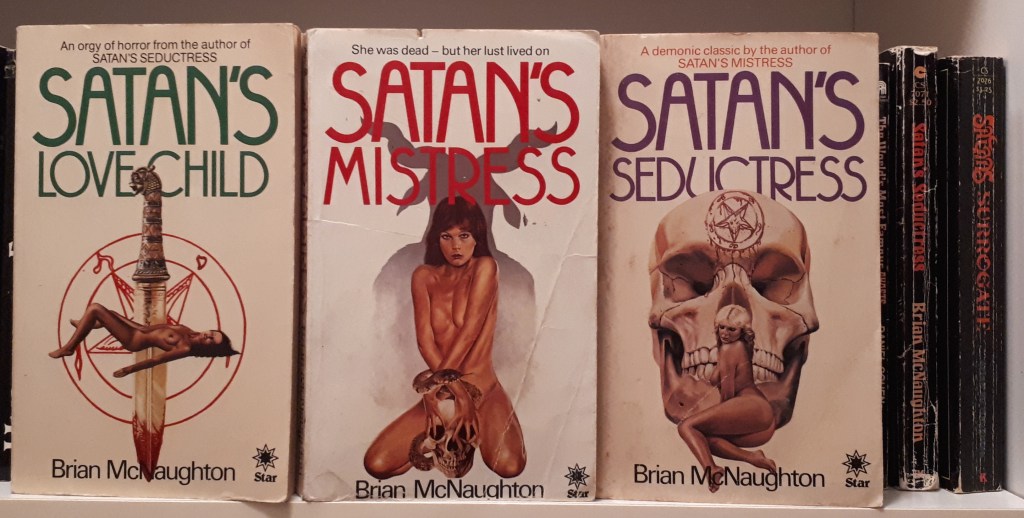
Brian McNaughton’s Satan Series: Satan’s Love Child, Satan’s Mistress, Satan’s Seductress and Satan’s Surrogate

Don’t deny it. Those covers are one the coolest things you’ve ever seen.

I remember seeing the covers of these books and immediately looking them up to buy them. This would have been 7 or 8 years ago. At that point, there were no copies available for less than 10 dollars, so I decided to wait. I just checked, and the cheapest available copy of Satan’s Surrogate available at the moment is just less than 300 dollars. Thanks a lot Paperbacks From Hell!

Star Edition 1981

Satan’s Love Child (1977)

A reporter for a small town newspaper discovers the horrendously mutilated corpse of a reclusive old man in a town that has recently been overrun by weird, taciturn hippies. Around the same time, the reporter figures out that her husband has been cheating on her, partly because he hates his weird stepdaughter.

As a horror novel, Satan’s Love Child is pretty mediocre. On the plus side, it has plenty of Satanism, a weird monster, a reanimated corpse, and even a few mentions of Yog-Sothoth. Unfortunately, the characters are transparent and don’t really act the way normal people would, even when they’re not under the influence of witchcraft. It’s not perfect, but I enjoyed it.

This was originally published as porn though. The author was initially asked to write a rip off of The Omen and then forced to insert graphic sex scenes before it was published. There’s only 3 or 4 sex scenes, but they’re full on hardcore porn. Honestly, I skimmed through these bits. They don’t add anything important to the book. There is a lengthy anal rape scene towards the end of the book that I wasn’t sure about. Was that bit supposed to be sexy or horrible? It came across as horrible.

Star Edition 1981

Satan’s Mistress (1978)

A dead wizard is reincarnated through incestuous rituals and then attempts to summon the Old Ones discussed in the fiction of H.P. Lovecraft after sexually assaulting some teenagers.

This book is trash, but it’s quite entertaining. I knew it was supposed to be Lovecraftian horror, but I didn’t realise quite how Lovecraftian. Lovecraft plays a similar role here as he does in Robert Bloch’s Strange Eons, not as a mere author of pulp fiction but as a prophet.

Despite the titles, this book has absolutely nothing to do with Satan’s Love Child. While the cover here is equally as sexy as its unrelated predecessor, the gratuitous sex scenes are absent. There is a similar unpleasantness running through the books. McNaughton wasn’t a happy ending kind of guy.

Star Edition 1981, Carlyle Edition 1980

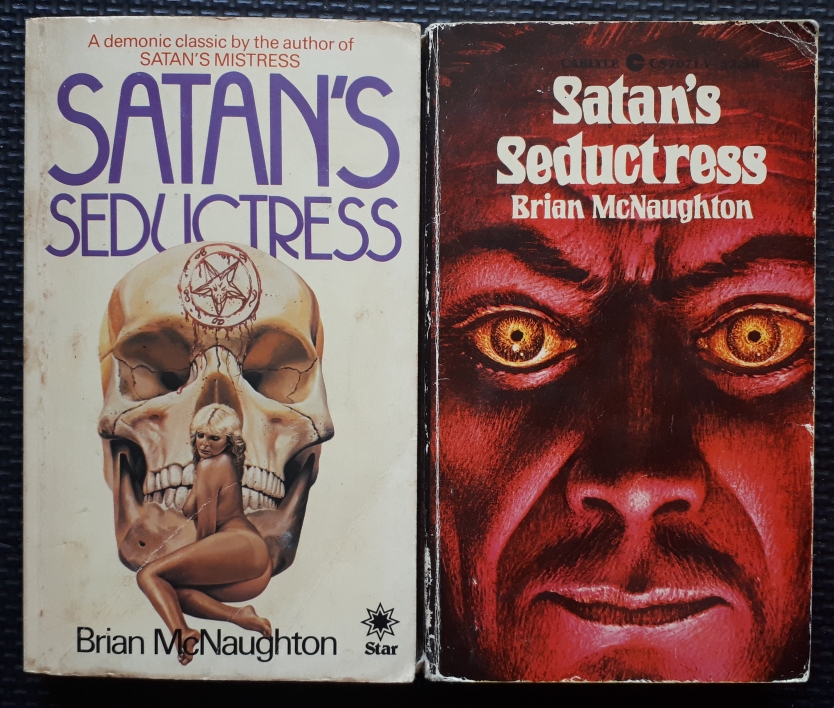
Satan’s Seductress (1979)

Satan’s Seductress is a direct sequel to Satan’s Mistress. Its cast is almost entirely made up of characters who survived Satan’s Mistress. It’s more of the same. The evil wizard and his mistress are searching for the Necronomicon, and they are prepared to do some pretty horrendous stuff to get it.

This is not a great book, but it contains knife-wielding cultists, reanimated corpses, portals to other dimensions and eldritch tomes of forbidden mystery. This is precisely the kind of trash that I want to read after a hard day at work.

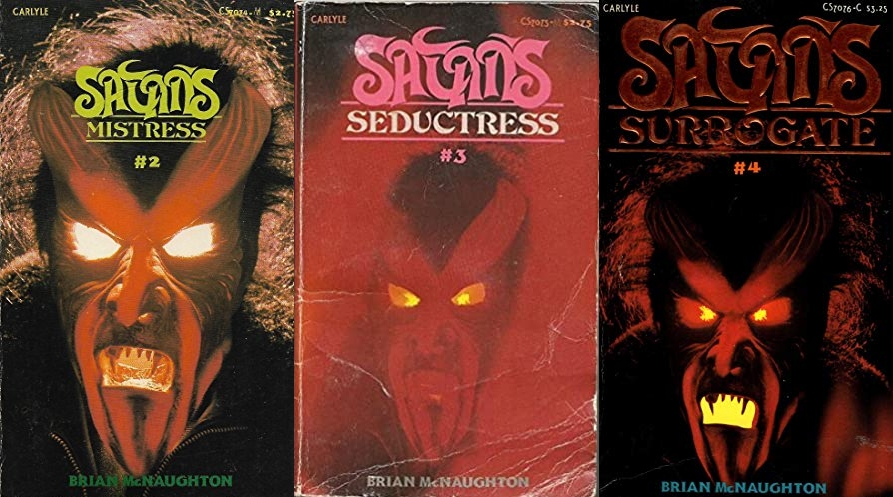
Carlyle Edition 1982

Satan’s Surrogate (1982)

While there is not much point in reading Satan’s Seductress if you haven’t read Satan’s Mistress, Satan’s Surrogate, like Satan’s Love Child is entirely separate, standalone novel. The plot has similarities with Mistress, and it’s similar in tone to the other books, but it’s far more complicated. Honestly, I found it a little disappointing. The story is too busy. There’s a lot of characters, and they’re largely uninteresting. There’s also a lot of plot elements, probably too much really. It has vampirism, wizards, alternate dimensions, cannibalism and references to Robert W. Chambers, Arthur Machen and H.P. Lovecraft, but it has a weird folklore thing running through it too. It wasn’t a total pain to read, but I never looked forward to sitting down with at night. This is particularly disappointing, as I paid more for my copy of this book than I did for any of the others mentioned here. As far as I know there was only one edition published under this title, so this is is the hardest to find of the Satan series.

I realise that I said very little about the plots of these books. That’s not laziness. There’s really not very much to say. These books are trash. The reason they are hard to find is because they look so damn cool.

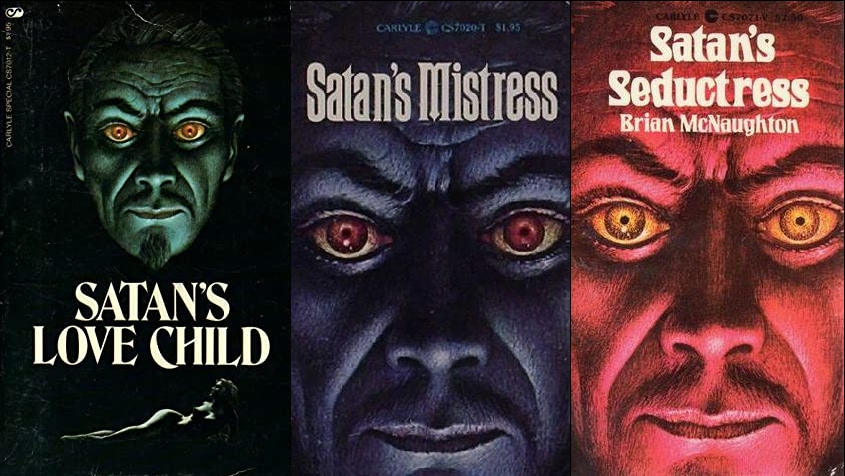
The first editions of Satan’s Love Child, Satan’s Mistress and Satan’s Seductress all had the same face on them.

The sexy covers pictured at the top of the post appeared on the Star editions between 1980 and 1981. Satan’s Surrogate came out in 1982, and it never got a sexy cover. When it came out, it seems that Carlyle put out new editions of the earlier books with new covers. I have not been able to find an image of the cover of Satan’s Love Child from this run. I am not sure it even exists. That book is more pornographic than the others, so it might have been left out. Then again, the other books are numbered, so it seems unlikely that they left out #1.

If anyone has a copy of the Satan’s Love Child from this run, please scan it and let me see!

All editions of these books are pretty scarce at this point, but the sexy Star ones are the hardest to find. Fortunately, Wildside rereleased the original texts with their original names in the early 2000s. These are all available as ebooks on amazon for a few dollars. The first book in the series won’t include the gratuitous sex, but I doubt that will affect anyone’s enjoyment much. I thought about getting the new (actually old) editions too and comparing the texts to the Satan versions, but the books aren’t actually good enough to warrant doing that.

  • Satan’s Love Child is now Gemini Rising 
  • Satan’s Mistress is now Downward to Darkness 
  • Satan’s Seductress is now Worse Things Waiting 
  • Satan’s Surrogate is now The House Across the Way 

Honestly, these books are alright, but you’ll probably never end up with the full collection. Get the ebooks and save your money. Getting my hands on the full set of Star editions took more time than it did money, but they have only become scarcer since then. I have copies of a few of McNaughton’s short story collections too. I may get to them at some stage, but I’m in no rush.

Robert E. Howard’s Cthulhu Mythos and Horror Fiction

The Horror Stories of Robert E. Howard

Del Ray – 2008

I have long wanted to read Robert E. Howard’s Cthulhu fiction. On April 15th, 2015, I added Nameless Cults: The  Complete Cthulhu Mythos Fiction of Robert E. Howard to my goodreads to-read list. I knew Howard had created Conan The Barbarian, and while I hadn’t read any of Howard’s stories, I had seen and loved the 1982 Conan movie. I assumed the rest of Howard’s fiction would be similar. Unfortunately, the Nameless Cults collection has been out of print for a long time, and copies are fairly expensive. Also, I have read a few books put out by Chaosium, and while the contents are usually pretty good, the presentation is quite bad. I didn’t want to spend lots of money on a book that would probably be crap. Fortunately, Del Ray books also published an extensive collection called The Horror Stories of Robert E. Howard.

This book is 523 pages long, and it includes 40 stories and 20 poems. As far as I understand, it is not a best of collection. These are all (or at least most) of Howard’s horror stories. I haven’t read his other stuff, but I would be surprised if at least some of his other stories didn’t have elements of horror. The 40 stories in here were enough for me though. I don’t have any desire to read more Robert E. Howard. This collection does not include all of the stories in Nameless Cults, but the ones it leaves out are mostly “collaborations” that were published long after Howard’s death. The prospect of reading a story that Robert E. Howard left for somebody else to finish does not seem at all appealing to me.

Honestly, a lot of this book is absolute crap. Howard was a hack. He wrote whatever would sell, pumping out horror, fantasy, adventure, sword and sorcery and westerns. There’s some good stuff in here, but at least half of this book was a chore to read. Anyone writing as much as Howard did was bound to get lucky now and then. A 200 page Robert E. Howard’s Best Horror Fiction collection would have been far, far more enjoyable.

I read this book because it seemed to contain Howard’s Cthulhu mythos fiction. The stories in here that are considered part of the Cthulhu canon are of mixed quality. The Fire of Asshurbanipal and The Black Stone were pretty good. Howard’s main contribution to the mythos seems to have been De Junzt’s Unaussprechlichen Kulten (Unspeakable Cults), a book of heinous black magic. Howard references this book in several of his stories, and Lovecraft went on to borrow it for a few of his.

Aside from the Cthulhu stuff, I quite liked Pigeons from Hell, Casonetto’s Last Song and Old Garfield’s Heart. The Dwellers under the Tomb was probably my favourite story in the collection:

“Spawn of the black pits of madness and eternal night! Crawling obscenities seething in the slime of the earth’s unguessed deeps–the ultimate horror of retrogression–the nadir of human degeneration–good God, their ancestors were men!”

The Dwellers under the Tomb

Robert E. Howard’s writing seems fairly notorious for the unfortunate way with which it deals with race. I’ve come across similar approaches with Lovecraft, Wheatley and others, but the tale in this collection called Black Canaan may well have the highest n-word count of any story I’ve read. I don’t know if Howard was a truly hateful person, but some of these tales are very likely to offend the modern reader.

There was definitely some decent stuff in here, but a lot of it felt like uninspired, poorly written garbage that was only put on paper so the author could pay his rent. After reading 40 of his stories, I have absolutely no interest in reading anything else by Robert E. Howard. I skimmed through his poems, and I had even less interest in them. I’m not a poetry kind of guy.

As I read the stories in this collection, I kept a spreadsheet with my thoughts or a brief synopsis on each one. I am including that spreadsheet here for my own reference, but it may be of mild interest to some of my readers:

TitleSynopsis/Thoughts
In the Forest of Villefèretraveler meets werewolf in forest. cuts off head
A Song of the Werewolf Folkpoem
Wolfsheadsequel to forest of villefere, man who fought w.wolf ends up in africa at a party in a castle. Is now a werewolf.
Up, John Kane!poem
Remembrancepoem
The Dream Snakemad old man dreams of being trapped inside a house on a hill because there is a mean snake outside.
Sea Cursea pair of scoundrels rape and kill a young girl. Her witch aunt curses them, and they die at sea.
The Moor Ghostpoem
Moon Mockerypoem
The Little Peoplean unruly sister goes walking on the moors at night to be attacked by a group of elfish fairies. She is saved by a mystery disappearing druid.
Dead Man’s Hatepoem
The Tavernpoem
Rattle of Bonessolomon kane story. Goes to an inn, but his accomplice turns on him then innkeep turns on accomplice, then magician’s skeleton turns on innkeep.
The Fear That Followspoem
The Spirit of Tom Molyneauxboxing story. Coach shows boxer picture of his fave boxer and helps him come back and in fight. Bad story.
Casonetto’s Last Songa devil worshipping singer sends a cursed record to the man who gave evidence at the court case that got him executed.
The Touch of Deathman sleeps in room with corpse. When candle goes out, he touches a pair of rubber gloves hanging from shelf and dies of shock.
Out of the Deepan evil mermaid pretends to be a sailor’s corpse and starts killing a bunch of people. Same place as in Sea Curse
A Legend of Faring Townpoem
Restless Waterspirate sells his niece to an older gent, kills her fiancee so he can make the sale. The dead lad shows up in a window and gives him a heart attack
The Shadow of the Beastfairly racist. A black lad shoots a white man and promises to kill his sister. He hides in an abandonded house that is haunted by a gorilla. He dies. Wtf.
The Dead Slaver’s Talepoem
Dermod’s Baneawful ghost story set in ireland. A bad ghost pretends to be a good ghost to kill a guy, but the good ghost saves the guy.
The Hills of the Deadsolomon kane story. Solomon goes to the jungle and kills an entire tribe of vampires with a witchdoctor. Awful.
Dig Me No GraveCthulhu cultist sells his soul for 250 of life. Time is up. A weirdo appears in his death parlour. Ok.
The Song of a Mad Minstrelpoem
The Children of the Nightman hanging out with mates briefly discuss horror fiction. Then one takes an axe off the wall and accidentally hits another lad in head. This causes him to go back in time to a time where the picts, small little goblin people had attacked his warrior clan. He is pure blooded, so he kills them violently. He awakes and tries to kill his mate who has slanted eyes. violent, racist and bad. Not really cthulu mythos.
Musingspoem
The Black Stonething in hungary. Pretty Good
The Thing on the RoofLad wants copy of de junzt to find about mummy’s jewel. He takes jewel so monster kills him.
The Dweller in Dark Valleypoem
The Horror from the Mounda man digs into an indian burial ground despite his neighbours warnings. A black vampire comes out and tries to kill him.
A Dull Sound as of Knockingpoem
People of the Darkman follows his rival into a cave to kill him but gets hit on the head and remembers a past life in which he did the same thing but he was conan. A race of goblins inherit the cave and him and his rival fight them. Then he comes back to modern day and shoots the degenerate ancestor of the goblins before they kill his rival and his girlfriend.
Delenda EstHannibal the historic figure, comes back in ghost form to tell a pirate of a mutinous shipmate. Shit.
The Cairn on the HeadlandAwful story set in ireland. A FOOL uncovers the grave where odin was buried after fighting irish army
Worms of the Earthbran mak morn witnesses a pict die, so he summons the worms of the earth, gross mutants, to kidnap the Roman soldier who killed him. P. good.
The Symbolpoem
The Valley of the LostDeadly story. Cowboy gets stuck in pet cemetary cave with enemies corpse. Finds snake peoples’ lair underneath. sees their history. Comes out and dynamites entrance, then shoots himself in head.   Harsh story. Cool
The Hoofed ThingCREEPY OLD NEIGHBOUR BREEDS WEIRD BLOOD THIRSTY LIFEFORM IN HIS BEDROOM. Eats him and then man kills it with a sword.
The Noseless Horrortwo lads visit their friend who has found a mummy. He also has an indian servant with no nose. The mummy is actually a lad the master killed. It comes back to life and kills him. The indian is blamed until they figure out what happened.
The Dwellers Under the TombEnjoyable story about lads who go into a tomb that leads to series of caves inhabited by degenerate murderous dog people. Last few paragraphs are delish.
An Open Windowpoem
The House of Arabua warrior goes to land of dead to find out who cursed him. Lots of babylonian mythology – absu and tiamat. Kinda interesting.
The Man on the GroundBiercish western about a cowboy realising he’s a ghost
Old Garfield’s HeartListened to audiobook version while going to sleep. Old man doesn’t age. Has a heart from a native american witch doctor. They cut it out of his body and it still beats. Not bad story. Weird
Kelly the Conjure-Manreally just a character sketch
Black Canaanstory about a black guy who tries to start a rebellion of blacks against whites by voodoo. Turns men into frog creatures in a swamp. Half of the text is just the n-word. No audiobook version of this one on youtube, LOL
To a Womanpoem
One Who Comes at Eventidepoem
The Haunter of the Ringa vampire’s dodgy ring turns a wife into a murderer
Pigeons from Hell2 wanderers go to sleep in abandon house. One dies. Second looks guilty of murder. Sheriff comes and believes him. P. good.
The Dead RememberCowboy murders black couple. Woman curses him. Ghost shows up and hidden gun explodes killing him.
The Fire of AsshurbanipalLads break into a tomb in middle east in search of a jewel. they find it but its guarded by a demon, kin of cthulhu and yog sothoth. Pretty good.
Fragmentpoem
Which Will Scarcely Be Understoodpoem
Golnor the Apeincomplete fragment about an really stupid, ugly freak
Spectres in the Darkcouldn’t be bothered reading this properly. 2 crimes, ghosts?
The Housea genius poet lived in a weird house. Mystery unsolved by the end.
Untitled Fragmentvery briefly mentions von junzt’s book. Not interesting. 2 explorers about to dig up egyptian site. Nothing happens.

Well, there we go. I think I have got around to all of the main members of the “Lovecraft circle” now. I have written posts on the Cthulhu mythos fiction of Robert E. Howard, Clark Ashton Smith, August Derleth, Robert Bloch, Donald Wandrei, Frank Belknap Long, and Henry Kuttner. I know that Lovecraft corresponded with lots of other people (Fritz Leiber, James Blish…), but the guys listed above were the main ones, right? I was fairly thorough with most of them, but I think I may take another look at Clark Ashton Smith. I’m sure I’ll get around to the second generation of mythos writers at some stage in the future too.

Robert Bloch’s Contributions to the Cthulhu Mythos

A few years ago, I decided to read all of the Cthulhu Mythos fiction written by the Lovecraft Circle. I did posts on August Derleth, Henry Kuttner, Donald Wandrei, Frank Belknap Long and Clark Ashton Smith. The plan was to move on to Robert Bloch and then to finish with Robert E. Howard.

Before starting on Robert Bloch’s mythos tales, I decided that I should first read his best known work and its sequels. I enjoyed the first Psycho book, but I hated its sequels so much that I decided to hold off on reading Bloch again. I waited about a year and then started on Mysteries of the Worm, a collection of Bloch’s Cthulhu Mythos stories.

The Mysteries of the Worm

Chaosium – 2000 (First, shorter, version published in 1981)

The first two stories were run of the mill Lovecraftian pastiches, nothing special. The next story, The Shambler from the Stars was deadly. This is the story in which Bloch bases the protagonist on Lovecraft and then kills him off, a favour Lovecraft repaid in his The Haunter of the Dark. I really liked this one. It reminded me of that Frank Belknap Long story where he kills off a fictional Lovecraft. Murder seems to have been the highest form of flattery with these guys.

The standard of most of the stories is pretty decent. There’s a bunch towards the middle of the book that incorporate Bloch’s fascination with Ancient Egypt. I found these a bit tedious, but that was probably because I read all of them in one sitting.

I really liked the longer stories towards the end of the collection. Black Bargain, Notebook Found in a Deserted House, Terror in Cut-Throat Cove, and The Shadow from the Steeple, a sequel to Lovecraft’s The Haunter of the Dark, were all great. These were written more recently than the others, and they feel a lot less like somebody simply trying to write like Lovecraft. Based on the quality of these stories, I would be willing to read more Bloch in the future.

I’ve long known that Lovecraft and Bloch were penpals, but I didn’t realise Bloch was only a teenager at the time of their correspondence. It’s pretty cool that Lovecraft was so encouraging to some pesky kid that kept writing to him.

Strange Eons

Pinnacle Books – 1979 (Originally published 1978)

The premise of this novel is that Lovecraft’s stories were true, and the Old Ones are about to destroy the world. This book will be an absolute waste of time for anyone who isn’t familiar with Lovecraft’s best known stories. It’s pretty silly, but I enjoyed it in a mindless way. There are entities and characters who reappear in Lovecraft’s work, but Lovecraft never tried to codify his mythos. Bloch does. Strange Eons features elements from The Call of Cthulhu, The Rats in the Walls, the Shadow over Innsmouth, Cold Air, Pickman’s Model and several more. I read through it, enjoying the references but deliberately not spending too much time thinking if they worked to create a cohesive whole. This is clearly a homage to Bloch’s old mentor, and I don’t think he meant for anyone to take it too seriously. At one point it discusses the history of the Haunter of the Dark, the story in which Lovecraft kills off a fictionalized version of the author.

This is mastubatory, fanboy trash, but it was entertaining enough. I liked it just fine.

Ok. I guess I’ll start on Robert E. Howard soon.