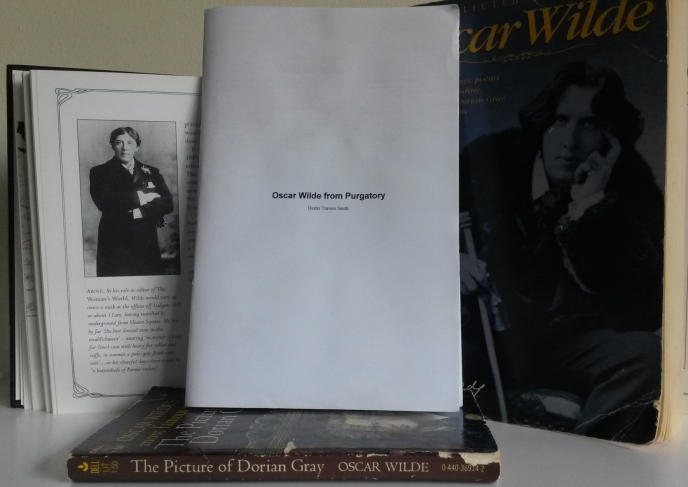
Oscar Wilde from Purgatory – Hester Travers Smith

Online Text oscar purgatory
(I printed and published my own edition)

Well Ireland is having a gay marriage referendum tomorrow, and although I can’t vote, I can review a text by Ireland’s most infamous homosexual.

I suppose this book isn’t technically by Oscar Wilde; it’s a series of messages delivered by Wilde’s disembodied ghost to Hester Travers Smith and her accomplice, Mr. V in 1923. These messages were originally published in The Sunday Express, nearly a quarter of a century after Oscar’s death.

What does Oscar have to say after 23 years festering in the grave? Well, he gives his opinions on women, being dead and the possibility of composing another play from beyond. He also spends quite a lot of time discussing modern literature. Contacting Smith through a Ouija board, he lets her know that he is not a fan of Joyce, Shaw or Yeats. You may wonder how a dead man could have read literature that was written after his death, but Oscar gives a perfectly satisfactory explanation:

Like blind Homer, I am a wanderer. Over the whole world have I wandered, looking for eyes by which I might see. At times it is given me to pierce this strange veil of darkness, and through eyes, from which my secret must be forever hidden, gaze once more on the gracious day. I have found sight in the most curious places. Through the eyes out of the dusky face of a Tamal girl I  have looked on the tea fields of Ceylon, and through the eyes of a wandering Kurd I have seen  Ararat and the Yezedes, who worship both God and Satan and who love only snakes and  peacocks. […] It may surprise you to learn that in this way I have dipped into the works of some of  your modern novelists. That is, I have not drawn the whole brew, but tasted the vintage.

So Oscar’s ghost just floats around the world, and from time to time he possesses the bodies of unsuspecting individuals to read a few buks. It’s interesting to note that he refers to himself as a wanderer in this passage. To avoid unwanted attention after his stint in prison, Oscar adopted the name Melmoth when traveling. Melmoth the Wanderer is of course the title of a Gothic novel by Wilde’s great uncle, Charles Maturin. Even in death he persists in this self-characterization. Now, if that’s not proof that these messages were delivered by the actual Oscar Wilde, then I don’t know what is!

This text includes not only the messages from the different seances at which Oscar appeared, but also an explanation and defense of the methods that were used to obtain the messages. Incredibly unconvincing arguments for the trustworthiness of ouija boards, automatic writing, cryptesthesia and spiritism are given.

The mediums involved also assure the reader that they knew very little about the life and style of Mr. Wilde before his communications, and hence could not possibly have faked these messages. The obvious argument against this would be that they were lying, and that they probably did a great deal of research into Oscar’s life and style before creating this hoax.There is actually very little reason to believe that they did not indulge in such research. This however is not a particularly interesting explanation of the the scripts, and I far prefer the explanation given by the Reverend Montague Summers:

I do not for a moment accept this script as being inspired or dictated by Wilde. I hasten to add that I do not suggest there was any conscious fraud or trickery on the part of those concerned ; it is quite probable that these psychic messages were conveyed by some intelligence of no very high standing, and the result in fine is not of any value.
(The History of Witchcraft – p.268)

So the communication and messages were real, but the spirit was an imposter. It was only a púca; one who was well versed in Irish literature. I am happy to accept this completely rational argument.

This book is absolute crap. I knew it was going to be crap before I read it, but I couldn’t resist.  3/10. Vote yes.

307767_735453384523_1392045415_n
Myself and Oscar in 2011.

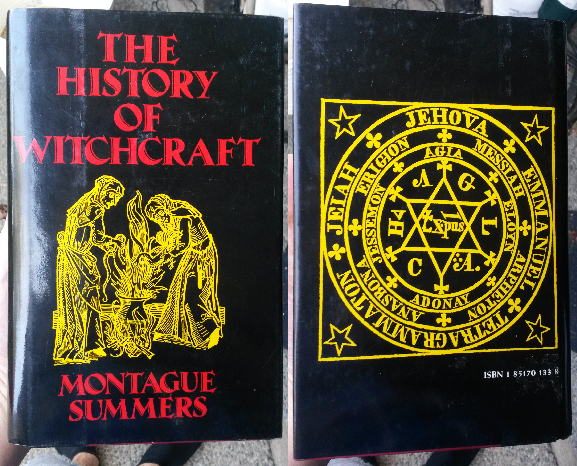
The History of Witchcraft – Montague Summers

witches
I thought I’d celebrate Walpurgis’ night by reviewing a classic work on witchcraft. Read it after you get home from the mountaintop.

The History of Witchcraft – Montague Summers
The Mystic Press – 1988
Originally published in 1926, this is the first full book on witchcraft by Montague Summers. Monty is a hero of mine. He was a Roman Catholic priest (of sorts) who spent most of his life reading, translating and writing books about witchcraft, black magic and vampires. Apart from his very apparent erudition, the most striking element of his work is his earnest belief in the topics he’s writing about.

His writing can get a little irritating at times; he seems to believe that anything that can be found in certain books must be true. The criteria he uses for determining the truth value of an account is whether or not he likes the book wherein he  has found said account. After discussing the necromancy of the Witch of Endor, he exclaims that; “The whole narrative undoubtedly bears the impress of actuality and truth.” For anyone who doesn’t know, the Witch of Endor was a hag who performed a necromantic ritual in front of King Saul. Now, Saul died approximately  3000 years ago, but the source that this information comes from, the First Book of Samuel, was only written about 2600 years ago. This means that even if the story ever had any basis in truth, it was still dragged through four centuries of oral re-telling before it was ever written down. Aside from that, it’s a fucking mental story that even the Church Fathers struggled to believe. But, it suits what Monty is saying, and so therefore it is undoubtedly true.

There is, of course, the possibility that Montague Summers knew that books disproving the supernatural are far less likely to sell and entertain, and thus he may have written the most sensational accounts possible in order to make a living for himself. I’m not saying he was a charlatan, but at times he seems incredibly credulous, and I’m not sure that I can believe that a person as well-read as he could possibly be so stupid.

And he really is very well informed on this topic. This book is comprised of a series of paraphrased accounts of witches, sabbats, and possessions from other, more ancient texts. The last chapter here is basically a list of every play in the canon of English literature that deals with witchcraft. One of the nicest features of this book is that each chapter has a detailed notes section that gives the source of nearly every account given.  Summers seems to be the leading authority on witch-lit; nearly half the books on witchcraft in my library were either translated or introduced by our Monty. (And most of the other half are his originals)

history
(Also known as ‘The History of Witchcraft and Demonology‘)

I don’t want to ruin the fun for anyone who’s going to read this, so I’ll just mention a few parts of this book that made me chuckle.

First of all, Summers really hated Protestantism. He points out that Scotland and England were full of that heresy, and hence also full of witches. Good old Catholic Ireland however, had barely any witches, and the witches that did show up there were all prods. He also claims that prods disrespectfully refer to the Holy Communion wafers as ‘Jack-in-the-box’. LOL

Secondly, this book introduced me to Fascinus, my new favourite Roman God.  I hadn’t heard of this particular chappy before, and there was something in Summer’s peculiarly awkward mention of him that made me want to look him up.

Summers also gives a satisfying account of my old friend Tanchelin. Apparently Tanch used to go around claiming to be God himself, and his followers “regarded this lunatic wretch with such an excess of veneration that the dirty water from his bath was actually collected in phials and solemnly distributed among them.” The fun didn’t last long however, as apparently “a priest maddened by the outrages and profanities of this hellish crew, scattered the heretic’s brains upon the deck of his royal barge.” I have to say, this Tanchelin character becomes more interesting every time I come across him. That priest sounds fucking cool too.

Overall, this book was quite enjoyable. Whatever about the author’s ludicrous beliefs, this account is well written and well referenced. The subject matter is very depressing when you stop to remember that this isn’t a work of Gothic fiction. I had intended to review it with its companion piece, The Geography of Witchcraft, but 1000+ pages on witchcraft over two weeks would be too much for me. I’ll save that one for Halloween. I’ll give this one a 7.5/10 and recommend it to anyone with any interest in witchcraft.

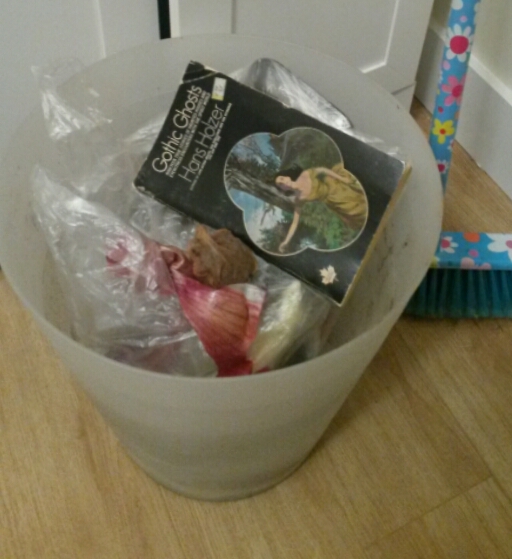
Gothic Ghosts – Hans Holzer

Pocket Books – 1972
2015-04-28 00.28.59

This book is absolutely terrible. It’s a collection of about 20 ghost stories, all of which are supposedly true. There are no sources given, and all of the stories follow the same formula. The following could be substituted for any of the included accounts:

Marjory, an art student, always knew that she had occult powers, but she never realized the full extent of her ESP until she moved into the old house on Pooey Street.

Number 15, Pooey street was a Victorian mansion. It was beautiful on the outside and luxurious on the inside, but there was a catch! Upon entering the mansion, any individual possessing any variety of paranormal sensitivity would feel a rumbling in their guts and immediately thereafter, they would void the soupy contents of their bowels into their britches.

Marjory was able to adapt to this sticky state of affairs by constantly wearing an adult diaper. The house was cheap and spacious, and Marjory was a poor student in desperate need of a studio for her art. A smelly bum and a dose of nappy-rash was a small price to pay for such a perfect home. Marjory soon adapted to life in the old house, and things seemed to be going swimmingly for her. That was until she saw the figure on the stairs!

One night, she awoke from her slumber and arose to fetch a glass of water from the kitchen. She drearily walked out of the bedroom and turned to walk down the hall. There, on the stairs in front of her, floated a ghastly specter! A full body it was not; only a repulsive, mouthless face that stared menacingly at Marjory who was now frozen stiff at the top of the steps. The face had two hairy cheeks and a singular brown eye that seemed to be winking horribly at Marjory. Marjory wondered if it was the ghost of a cyclops who had died of conjunctivitis and mumps, as the gaping eye was smeared with a rotten brown crust and the cheeks were rotund and fleshy. A small trunk-like appendage arose from under the eye and sprayed Marjory with a rancid milky ectoplasm. That was when Marjory fainted and fell down the stairs.

She awoke in the hospital days later. She had suffered severe brain damage and was never able to walk again. It just goes to show that an old ghost never learns new tricks!

Obviously I got a bit carried away when writing that. If the book was full of stories of that caliber, I’d be giving it a solid 10/10. No, this book is nowhere near entertaining. It’s basically the same stupid story of a dead scullery maid looking for attention, told twenty times over.

I can’t remember how this piece of trash found its way into my book collection. I either picked it up at a library sale for 50 cents, or perhaps the ‘Gothic Ghost’ of Hans Holzer planted it in my collection in order to have it reviewed. Sorry Hans, this is fucking terrible. I’m giving your shitty book a 1/10.

WAS HITLER A SATANIST? – The Occult Roots of Nazism, They Used Dark Forces and Theozoology

nazi
Well it’s Hitler’s birthday, so here’s a post about occult Nazism. I’m going to review three books:

The Occult Roots of Nazism – Nicholas Goodrick-Clarke
NYU Press – 1992

They Used Dark Forces – Dennis Wheatley
Hutchinson & Co. Ltd (I think) – 1964

Theozoology – Jorg Lanz Von Liebenfelz
Europa House (PDF version) – 2004

The Occult Roots of Nazism
First off, The Occult Roots of Nazism is a pretty serious book. It’s well researched and well written. It’s very academic though, and it’s interesting in a historical way rather than a spooky way. To tell the truth, my main reason for buying this book was because Danzig owns a copy.

It turns out that some of the Nazi party’s beliefs had their roots in odd theosophical mysticism. The Nazis’ notion of Aryan supremacy might have been affected by some weird old men’s nutty ideas about Atlantis. I can accept that the Nazi’s ideas were affected by these nutty ideas, but it’s certainly not fair to blame the Holocaust solely on the  fantasies of a few occultists. In fairness though, the author never suggests any such thing; this really isn’t a bullshitty book. Goodrick-Clarke goes into a huge amount of detail to support his claims, and a lot of this book is very boring. I’d imagine it to have been a very difficult book to write, and I respect the author’s self restraint and ability to stick with the dry facts. The temptation to exaggerate would definitely have gotten the better of me.

The occultism herein is mostly quite boring to be honest. It’s mostly new-agey garbage; runes, theosophy and that kind of nonsense. If you’re hoping for accusations of Satanic pacts, this book will disappoint. The stuff about Von Liebenfelz is quite interesting, but we’ll get to that later on.

Overall I’ll give this book a 6/10. It’s good, but it’s not entirely to my tastes. If you’re a history student writing about this kind of stuff, this would be an extremely useful resource, but if you’re a gobshite like me who likes reading stupid books about the devil, this might not be entirely satisfying.

They Used Dark Forces
I hadn’t yet read They Used Dark Forces when I came up with the idea for this post, but I had read Goodrick-Clarke’s book. I thought it would be a fun to contrast Goodrick-Clarke’s very academic work with a trashy Dennis Wheatley novel. To my disappointment, They Used Dark Forces is actually a very well researched piece of historical fiction, with only a little gratuitous black magic thrown in for fun. But what I found most disappointing was the fact that the ‘They’ in the title doesn’t refer to the Nazis. It’s actually the novel’s protagonist, Gregory Sallust, and his mate Malacou that do be using the dark forces herein.

I love Dennis Wheatley novels, and you can be sure that this isn’t going to be the last of his works reviewed on this blog, but I have to admit, this book wasn’t great. At least one third of it is just a factual account of different events and characters of the second world war. Wheatley was actually involved in the war, and he clearly knows what he’s talking about, but I don’t read his novels for history lessons.

This book portrays Hitler as having an interest in the occult, but the only real satanist in the novel is actually a Jew. Wheatley doesn’t seem particularly anti-Semitic in any of his other works that I have read, and he never suggests that all Jews are Satanists in this book, but it did strike me as a little insensitive to villainize the only Jewish character in a narrative that largely unfolds in a concentration camp. I wasn’t particularly offended by his representation of the Jews; I was just disappointed that he didn’t use this book as an opportunity to make up silly stories about Hitler being a wizard.

Although not overtly anti-Semitic, the book does contain some good old-fashioned homophobia and misogyny. The most evil of all the books characters, Herr Obergruppenführer Grauber, is a fat homosexual who has a kinky bdsm room in his apartment, and there’s a particularly hilarious instance when a character expresses his attraction to a young woman by saying, “If I’d been ten years younger I’d have taken her off you and smacked her bottom myself.” I don’t think that Wheatley’s lack of cultural sensitivity detracts from his work; I find it hilarious. I only mention it as a warning to any nerds who are considering reading this work who might get upset.

So what about the dark forces? Well there’s lots of numerology, astrology and palm-reading in here, but there’s only one truly diabolic act in the whole book. This despicable blasphemy occurs early on too, and I was left waiting for more for the remainder of the book. The single atrocity committed is particularly nasty though, and it really seems out of place in terms of the characters involved and the general tone of the novel. There’s a brief reprisal of diabolism later on when Malacou suggests the performance of another ritual in honor of the Dark Lord. Gregory’s response to this suggestion is utterly priceless; “You filthy Satanist. Get to hell where you belong.” Good man, Gregory. That’ll surely teach him the error of this ways.

In general, this book was disappointing. Wheatley’s novels are fun, but they’re absolute trash. If I’m going to read trash, I need it to be at least 50% satanic. This novel was only 15% satanic, so the highest rating I can give it is 5/10. Read it if you like Wheatley, but don’t use it at a starting point to get into this writing.

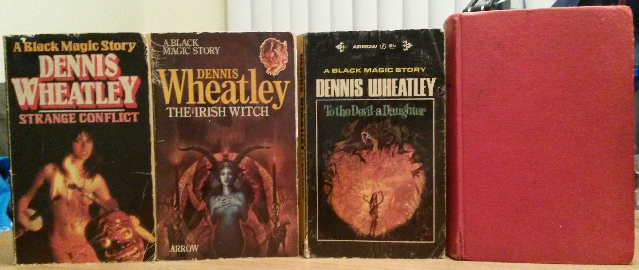
To add insult to injury, my copy of the book doesn’t even a cool cover. Dennis Wheatley novels usually have awesome covers, and most other editions of this book have cool satanic swasticas on their covers. I got a lame plain red hardback version.coverswheatley
Spot the dud.

Theozoology, or The Science of the Sodomite Apelings and the Divine Electron
(An introduction to the most ancient and modern philosophy and a  justification of the monarchy and the nobility.)
theo.jpg

Well aside from having the greatest title of any book in the history of the world, this is also one of the funniest books that I have ever read. I usually only review books that I own, but the only copies of this that I have found have been printed versions of the .pdf version that I found online that some jackass is selling online for ridiculous money. I’m happy to stick with an electronic copy anyways, as I don’t want to be giving money to anybody who takes this nonsense seriously enough to translate and publish it.

I first heard of this book in Goodrick-Clarke’s book and had to track it down. Jorg Lanz Von Liebenfelz was cuckoo. In this book, he argues that a race of bizarre, homosexual ape-monsters have been fucking things up for the Aryan God-race since the beginning of time. Pretty much everything bad that has happened has been caused entirely by these malicious monkey-men. You might think that sounds unlikely, but Lanz uses the Bible to provide evidence for his claims, so he was almost definitely right.

I read this about a year ago, and I can’t honestly remember the specific arguments that Lanzy puts forth. I don’t think that matters though, they’re far too silly to discuss. I’m going to just copy a few quotations in here so you get a general idea of how amusing this book can be.
Lanz gives an interesting account of the origins of crucifixion:
The “crucifixion” consisted of binding wild and unruly Sodomite monsters to poles in order to be able to copulate with them without danger. (cf. Job XL.24 Thren. V, 13). On the other hand, however, people were bound to such poles in order to have them sodomized by lascivious apelings. This was the torture to which early Christians were put (pastor Hermae III,2) and that was also the torture of Jesus.
So originally, regular people used to tie the apelings up to bum them, and they’d also tie up criminals to let them get bummed by the apelings.

There’s more details on Jesus’ ordeal later on; “Christ was to be outraged by the Sodomite hobgoblins. If he consented to this willingly and if he was overcome by temptation, then his whole mission would have been dashed.” Poor Jesus – nailed to a cross and then expected to resist the temptation of getting bummed by a hobgoblin. That’s rough.

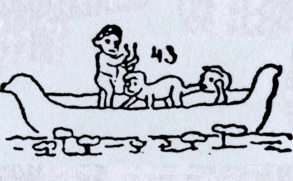
I’m not entirely sure why, but this diagram and its description made me laugh until I was in tears.
Untitled
an image from Pompeii shows us three such ugly hobgoblins travelling on a barge.
Von Liebenfelz thought that both this image and the phrase ‘ugly hobgoblins’ were appropriate to use in a ‘scientific study’ that would justify the supremacy of the Aryan race. It looks like it was drawn by a toddler. What the fuck Lanz?

Apparently people took this seriously though. It’s difficult to understand how; this book is illogical, offensive, confused and yet hilarious. It’s too mad to rate. Read it for a laugh; it’s no good for anything else.

The Devil’s Own – Peter Robson

Ace Books – 1969
devil

I picked this one up from the bottom of the esoterica shelf in an out-of-the-way, used book store that mostly stocks old mystery novels. It had a picture of a man who is on fire on the front, and the heading on the back cover reads; ‘THE SPAWN OF LUCIFER…’ The most promising feature of all though, was the fact that when I started reading it, it was not yet listed on goodreads.com. Oh yes my friends, this kind of book is what it’s all about. It’s a collection of short accounts of the lives and atrocities of 25 of Satan’s most heinous disciples. Among the accused are Aleister Crowley, Rasputin, and John Dee, but many of the other names in here are a little less well-known.

The accounts given seem to be somewhat based in truth, but I suspect that they were mostly just patched together from urban legends, rumors, lies and complete fabrications. Some of the exaggerations are commonplace and believable, but others are downright silly. For instance; I have come across the mysterious figure of the Comte de St. Germain in several other books, and I was a little surprised to see him appear in this. Hitherto, I knew of his claims of being immortal, but that hardly seemed comparative to the cannibalistic orgies of the sadistic black magicians in this little collection. It all made sense however, when this book informed me that the Comte de St. Germain was actually “the Devil – in the guise of a gigantic werewolf.”

Most of the characters mentioned in here were definitely real people, but there are some accounts which are probably complete fabrications. There’s an interesting section on an evil priest named Raoul Hannah who lived in Belfast. He is supposed to have been involved in the slave trade, voodoo cults and human sacrifice. He is also apparently responsible for bringing the black mass to Ireland. According to the book,  this Satanic St. Patrick’s rituals always culminated in “the sacrificial murder of an unknown African Negro”. Given this peculiar fact, I wonder how often he was able to celebrate this sacrament; there probably weren’t many “African Negroes” in Northern Ireland in the 1930s. Anyways, I was fairly excited to do a little research on this lad, but the passage ended with a note:
In order to protect those whose families were quite innocently involved in the story of a man named “Raoul Hannah,” the real identities and the exact location of the town in the north of Ireland have been withheld.
I’ve searched online and can find no trace of this story. It’s a pity because it was one of the most interesting tales in here. I reckon it’s complete bullshit and that Peter Robson made it up to fill a few extra pages, but then again, there are only 3-4 sections in the book that I have not found some basis for. There’s a possibility that it is true and that Robson did just change the names. If you have any idea about where this story came from, please contact me and let me know.
(My hunch is that this is section is probably just a bio on Ian Paisley.)

There are other monstrous individuals in here whom I have not been able to track down. Two of the most diabolic, Raoul Plessy and Gustav Labahn, are probably fabrications of Robson’s. I would be happy enough to accept that these three suspicious entries were completely made up, but that would be to presume that they never existed only because they’re not mentioned online. In fact, there is one particularly horrific account in here that tells of a young girl named Bernadette Hasler being sadistically tortured by a religious order called “the Seekers of Mercy”. It seemed pretty bullshitty when I was reading it, but when I looked it up online I was disturbed to find an image of a teenage girl on the cover of a French crime magazine with the headline “Le Martyr de Bernadette torturée au mort au cours d’une séance exoricsme”. There’s also an article written in German that mentions the case, but I could find nothing in English. Now, I’m not taking two articles that I can’t read properly as evidence of Peter Robson’s account being accurate, but they have convinced me that it’s not complete bullshit. It’s weird to come across a story as disturbing as this without being able to find out more about it online. It makes me wonder about my dependence on the internet as a verifier of knowledge, and I am both simultaneously upset and excited to know that sometimes the truth isn’t out there.

There are other cool parts in this book. I liked the section on Abbé Boulan. I’ve already mentioned my interest in finding a reasonable account of this character, but as was to be expected, the account herein is fairly dubious. There are some glorious passages though:

Her arms were stretched out in the form of a cross, and she held black candles in her hands. A cloth with a cross embroidered on it was placed on her breasts, and the chalice was placed on her abdomen.Then a goat’s throat was cut, and the blood poured over the woman. Next, Boullan performed a ceremony over the woman which involved frequent kissing of her body and drinking  the goat’s blood. During the whole disgusting performance, the unfrocked priest screamed out curses and threats

I would genuinely rather read that than an accurate portrayal of anyone.

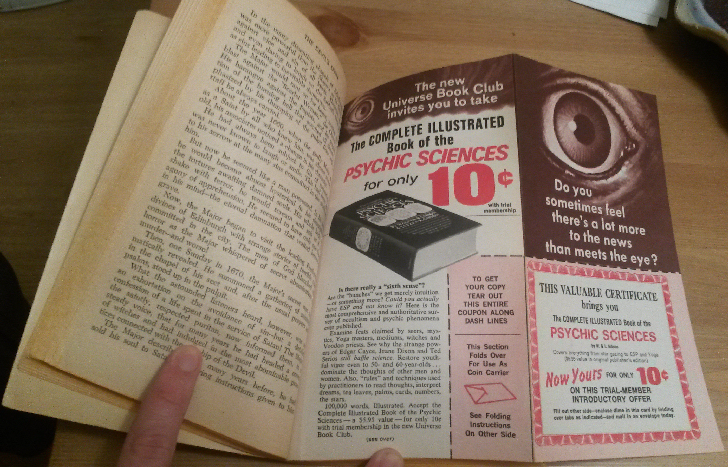
Also, there is a super cool fold-out advertisement in the center of the book.
psyOnly 10 cents for a copy of the Complete Illustrated Book of Psychic Sciences?!?!?!

I really enjoyed this little book. It’s trash to the Nth degree, but it doesn’t pretend to be anything else. Buy a copy and read it on the way to work. 8/10.

The Black Arts – Richard Cavendish

Picador – 1972

blackarts

This book is a tricky one. Half of it’s great, half of it’s horrible. The sections on ritual magic, witchcraft and satanism are really interesting, but the book also contains comprehensive sections on numerology, cabala, tarot, astrology and alchemy. Personally speaking, when I buy a book on ‘the Black Arts’, I’m not really interested in reading about people playing with cards or counting the numbers in their names. I want blood rituals, human sacrifice and horrible acts of depravity. (Reading this book could be compared to going to a Slayer concert and then finding out that Tool are the opening band.) I’m going to largely ignore the parts that I didn’t like for this review; if you want to learn about tarot, fuck off and prance over to your nearest renaissance fair.

There’s some really interesting stuff  in here about demons from Biblical Pseudepigrapha. I’m still only about halfway through the Christian Bible right now, but I’m really looking forward to finishing that and then reading the Books of Enoch, the Testaments of Solomon and the Life of Adam and Eve. There’s something particularly exciting about the idea of Jehovah being good mates with the demons back in the day – Yeeeeeeoweh and de lads!

One of my favourite things about the book is the fact that it reads more like a history book  than a grimoire or set of instructions. A large amount of the information is utterly unbelievable, but Cavendish manages to reference his sources in such a way as to avoid any accusations of credulity that might be thrown at him. He politely leaves it up to the reader to decide what they think is bullshit and what’s legitimate, and this approach makes this kind of book far more interesting to read.

There’s a great bibliography and a ‘suggestions for further reading’ section at the back. I’ve already ordered quite a few of its sources, and I’ll hopefully get around to reviewing them here sometime soon. I’m going to pretend that I didn’t begrudgingly wade through 5 chapters of new-age shite and give this book a glorious 7.5/10.

Down There (Là-bas/The Damned) – J.K. Huysmans

Sphere Books – 1974
down there

This is a novel that deals with the occult, but it’s more than just an occult novel. There’s lots of Frenchistentialism and romance going on in here, but I’ll be straight with you; if you’re looking for a discussion on this novel’s place in the fin-de-siècle movement, you’d best look elsewhere.

The protagonist of the book divides his time researching Gilles de Rais, writing letters to a mystery woman and talking to his friends about bells. The bits about Gilles De Rais were very interesting. He was a horrible man. I’m planning to read and review the book that Bataille wrote on him soon. The other parts of this novel, although not as pertinent to this blog, were also quite entertaining. I enjoyed seeing the awkward love affair develop. The infamous depiction of a black mass was also fun, if slightly underwhelming.My copy of the novel is a ‘Dennis Wheatley Library of the Occult’ edition, and anyone who has read any of Wheatley’s black magic novels will be more than prepared for this only-slightly sordid scene of infernal blasphemy.

Perhaps the most intriguing aspect of this book is the fact that the most fantastic elements of the plot are supposedly based on real events. The most satanic of
all the book’s characters, the Canon Docre, was based on a real person! I’ve come across the story of the Black Magic war between Abbé Joseph-Antoine Boullan and Stanislas de Guaita in  Colin Wilson’s The Occult and Richard Cavendish’s The Black Arts, but I’m still hungry for more information. If anyone has any suggestions on other texts that contain information on this rivalry, I would love to hear from you!

Overall, I’ll give this one a generous 8/10. It wasn’t as intense as I had expected but I did like the atmosphere and characters. I will probably read more of Huysmans’ books in the future.

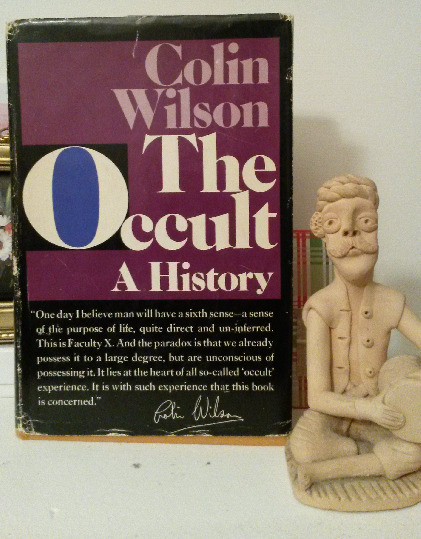
The Occult A History – Colin Wilson

Random House – 1971
occult
The title, ‘The Occult A History’, is a little misleading. A more accurate name might be ‘A ridiculous theory based on an unquestioning and incredibly naive consideration of the History of the Occult’. Colin Wilson comes across as frustratingly credulous. The following might be a typical paragraph in this book:

Tom was able to communicate with the leader of the great race of flying ape-dogs on the planet Durthyanus. Tom was a patient in mental hospital who was spoon-fed mush by a nurse and needed his nap-nap changed twice a day, but there is no reason not to believe that he had strong powers of interplanetary telepathy; most people who possess such gifts are actually completely untrustworthy.

That’s barely even an exaggeration! I understand that people who write books on the occult are often going to be more ‘open-minded’ than the average individual, but Colin Wilson comes across as a chump. The book is definitely well researched though. Wilson uses lots of interesting sources and I got loads of ideas for other books to read from this one. This book is actually quite an enjoyable read if you don’t waste too much time getting upset over the author’s ridiculous methods of reasoning. I really liked the chapters on Cagliostro and werewolves, but I couldn’t bring myself to finish the final chapter in which the author discusses ‘Faculty x’ in detail. ‘Faculty x’ is basically a 6th sense type thing that Wilson believed human beings were about to discover/develop. Well, this book was written more than 40 years ago and from what I can tell, we’re yet to x.

Sometimes I feel that I put too much faith in the authors of books on the occult. I’m not sure that people intelligent enough to make their living as writers could possibly believe the wacky crap that ends up getting published. I reckon that authors are spewing out this silly garbage just to increase their sales. It makes sense that a writer like Wilson would inject a little craziness into an otherwise reasonable historical account; books on the fantastic just aren’t as enjoyable when they’re logical. I mean it’s not likely that anybody would ever pay money for a book that sets out to disprove the validity of moleomancy.

gurd

(Wise words from Gurdjeff on the back cover.) This book is dumb but mostly fun. Read it, but don’t bother with the last chapter. 6.5/10

The Satanic Bible and The Vampire Bible

The Vampire Bible – ???
Temple of the Vampire – 1989

The Satanic Bible – Anton Lavey
Avon – 1969

I’ve just finished reading The Vampire Bible from the Temple of the Vampire. I’m going to talk a little about that and a little about the Satanic Bible. I want to get LaVey out of the way early on.

1
(The fonts and imagery are one of the sweetest things about this book.)


I am glad that I bought my copy of the Vampire Bible in a parking lot, off some dude from craigslist. I sure would feel like a dummy if I had given the person who wrote this tripe any of my money.

To join the Temple of the Vampire, you have to buy a copy of this book from them. I would hope that they also give you extra material to make sense of it, or maybe call you up to explain the crazy nonsense that’s included. The book doesn’t even include a definition of what they mean by ‘vampire’. The vampires described are non-violent vampires who don’t murder or drink blood. These vampires just float about in the astral realm, giving thanks to the undead gods and sucking life-force from their prey. It’s not very clear as to what effect this floating has on the vampire’s prey though, and the book specifically says that it doesn’t harm them. That sounds like a pathetic vampire to me.

The content is an awkward mix of instruction and fantasy. The book states that its contents are based in fantasy, yet it prohibits any kind of violence. If this is all fantasy, why shouldn’t I swally down the blood of my enemies? At least the Satanic Bible has some balls and tells you to ‘SMASH’ people that you don’t like. My favourite part of the entire book was the second item on the the list of things that suggest that you are in the presence of the Undead:
“2. Tingling sensations in the fingertips”
Perhaps the author has gotten mixed up. These vampires sound a lot like fairies to me.

2(I haven’t read my copy of the Satanic Rituals yet and probably won’t ever get around to it. It has a nice pink cover though.)


The Vampire Bible is dumb. Like the Satanic Bible, it makes no effort to emulate the actual Bible in any way. Unlike the Satanic Bible, it’s not even remotely clever. I actually enjoyed reading the LaVey’s Bible. It’s camp and silly, but there is some actual reasoning behind it. You get the feeling that he actually believed in some of what he was writing. There’s not an ounce of reasoning behind anything written by Vlad, or whoever the fuck shat out the Vampire Bible. The ideas in the Satanic Bible are obviously not completely original, but I think that LaVey did a decent job of synthesizing them into an entertaining whole.

Coincidentally, perhaps my least favourite part of the Satanic Bible (apart from the silly Enochian bits) was the section on Psychic Vampires. It seemed like it was a metaphor for something that had happened in LaVey’s own private life that was too embarrassing to clarify but too upsetting for him to leave out completely. It’s funny looking back at that section now and reading the lines: Psychic vampires are individuals who drain others of their vital energy… They fill no useful purpose in our lives. Perhaps he was in contact with some of the members from the Temple of the Vampire! Well, actually… probably not; the Satanic Bible was written 20 years before the Temple was founded.

Anyways, to conclude, I’m giving the Vampire Bible a generous 3/10. It looks and sounds pretty cool as long as you don’t take the time to actually read it. It’s not nearly as spooky as it could have been. The Satanic Bible gets a 7/10 for being good hellish fun. Even if you don’t like the writing, this book is worth owning just for the sweet portrait of LaVey on the back.

3

What a charmer!