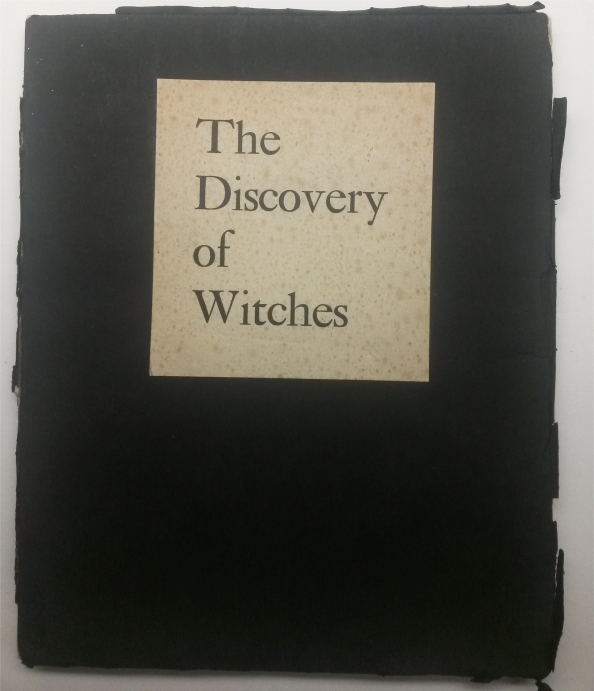
The Discovery of Witches – Matthew Hopkins and Montague Summers

buk
Cayme Press – 1928

This is a cool one.  This pamphlet contains Matthew Hopkin’s treatise on witchcraft from 1647 and an essay about Hopkins by my hero, Montague Summers. Hopkins, for those of you who don’t know, was England’s self proclaimed Witchfinder General. From 1644 until 1647, he traveled from village to village, trying and torturing those unfortunates accused of witchcraft. England was going through a civil war, and the state of political turmoil made it possible for Hopkins to assume authority and roam about as he pleased, burning bitches and getting money. It is believed that he was responsible for the deaths of 300 people. (This works out at as more than half of the total number of witches killed in England from 1400-1700.) The story goes that he stole the Devil’s list of names from Lucifer himself, and that’s how he knew where to look and who to interrogate. There was a movie made about him in 1968 that featured Vincent Price in the title role, and many heavy metal bands have written songs about him. I think he was a pretty neat guy.

Image1
The essay is fairly interesting. Summers gets upset over the fact that people presume that burning at the stake was the standard method by which witches were executed in England. Although many witches were burned alive in Scotland and on the continent, most English witches were actually hung. Those few that were burned were usually being burned for other, additional offences. Summers deems Hopkins a humbug, a quack and a mountebank largely on the basis that Hopkins was not familiar with the classic literary works on witchcraft. The fact that he claimed to be an authority without having first poring over the literature really seemed to grate on Monty. (Summers was enormously erudite and is responsible for many of the existent translations of these works with which Hopkins was not acquainted.)

hopkins
(Image From Robbins’ Encyclopedia of Witchcraft and Demonology)

Hopkins’ pamphlet takes the form of a dialogue between himself and a person who is not convinced of the legitimacy of his work. He explains how he began his witch hunt, the nature of witchcraft and the different methods of ‘examining’ a witch. These different forms of examination were really just different varieties of sadistic torture. Hopkins was a notorious witch-pricker. He and his accomplices, John Stearne and Goody Phillips, would spend hours sticking needles into women’s flesh. If they found a spot that would not bleed, this was taken as proof of diabolic interference. (The Devil always left his mark somewhere on his servants’ bodies, and the spot where he left this mark would not shed blood.) The only real problem with this method is that there is a finite amount of blood inside a human body, and the more pricks you give a person, the more likely the next prick will prove bloodless. In fairness to Hopkins though, pricking was only a preliminary method of testing. If the results weren’t conclusive, the witch would be ducked.

Remember that amazing scene in Monty Python and the Holy Grail in which the crowd decide to throw an alleged witch into the pond to see if she floats? (Watch it again and notice how they inaccurately claim that witches should be burned!) Well, a good game of sinky-floaty was also a favourite pass-time of Hopkins.

Image3
I’d allow her to swim in my pond any day.

Summers describes how before the witches would be thrown into the pond, they would have their thumbs tied to the feet on the opposite sides of their body so that their limbs would be making the sign of the cross. The reason that witches were dunked in this manner was not to see whether or not they were made of wood; it was because water, which is in some way divine by its nature, would not accept a servant of Satan into its bosom. This method of trying a witch always seemed particularly bizarre to me, but apparently the practice of dunking occurred in some parts of Europe up until the late 19th century.

Can you think of anyone else who floated on water though? Hmmmmmmmm? I wonder what his excuse was…

Other suspected witches were either ‘watched’ or ‘walked’. Watching a witch involved placing the crone in a room with a small chink or hole in the door until she either made a confession or something else occurred to prove her guilt. She would be forced to sit in an awkward position, and tied up if she refused to remain still. The watchers would keep an eye out for spiders or small flies that slipped into the room through the fissure in the door. If they were unable to squash these bugs, this would be taken as proof that they were actually the accused’s familiar spirits come to relieve their master in her hour of suffering. An elusive midge could provide interrogators with enough evidence to send a witch to the tree. Watching sessions could last days, and the witches were starved throughout.

‘Walking’ was when witches were deprived of sleep and energy by being forced to stay up all night, running back and forth in a small room. Ándale, ándale! Arriba, arriba!

Imagej2
Hopkins also provides an entertaining list of the names of all the witches’ familiars that he encountered. He claims that these wicked spirits have “names which no mortall could invent”, and while Ilemauzar, Pyewackett, Jarmara, Jeso, Holt, Saoke, Griezzel, Wynoe, Panu, and Mrit are all quite unusual sounding, Pecke in the Crowne, Vinegar-Tom, Jockey, Sugar, Newes, Littleman, Prettyman, Dainty, and  Greedigut all sound very much like they were invented by a mortall, and that’s not to mention Elizabeth, Collyn and Sandy. Best of all though, one witch claimed her familiar was named Jesus. (Summers gets hot and bothered over this, claiming that “to name the Sanctissimum Nomen would be to banish the familiars and dissolve the enchantment.”)

After a few years, local authorities became suspicious of Hopkins, and he was forced into early retirement. There are stories that he himself was ducked, but there is no evidence to believe that this actually  happened. He died from tuberculosis in his late 20s. (Vincent Price was 56 when he played him in the movie.)

This book is fairly old. I had been keeping an eye out for an affordable copy for quite a while before I found this one, and all things considered, it’s in pretty good condition for what I paid for it. The cover and spine are in rough shape, the pages are yellowed and the edges worn, but I’ve been able to figure out that before I purchased this copy, it had probably remained unread since its publication. Several of the pages are bound together on the wrong side, making the book impossible to read without either tearing them apart or using a very small camera to slip between the pages to photograph them. Maybe there is a specific word for this kind of printing error, but I am unaware of it. Check out the video below to see exactly what I mean.

I read Hopkin’s pamphlet online a long time ago, and Summer’s essay is interesting but not exactly mind-blowing. As a whole though, this book is fucking cool, and the extra effort I had to put into reading it made it all the more enjoyable. It’s Walpurgisnacht tonight too, so turn the tables on Hopkins and make it your business to go forth, make love to the devil, ride to the Sabbath, and hang a witch-hunter.
The Fiery Angel – Valery Bryusov

20160325_000821

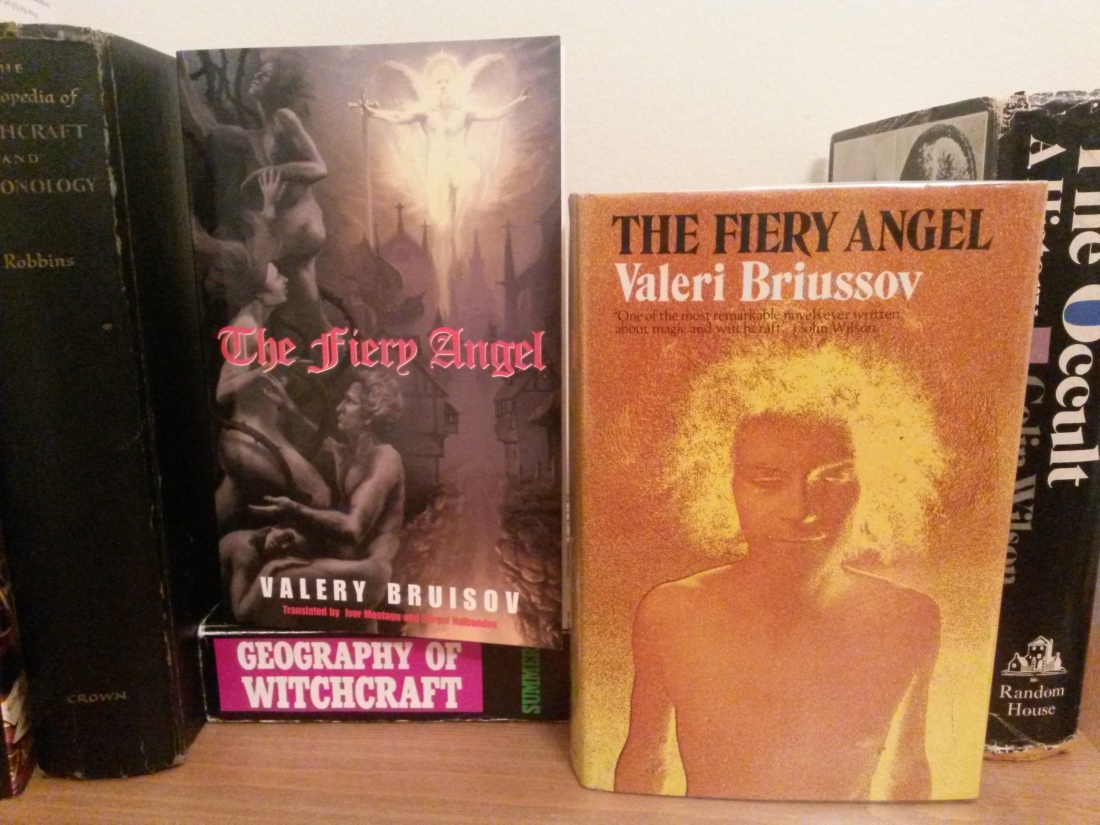
Neville Spearman – 1975 (Valeri Briussov)
Dedalus – 2005 (Valery Bruisov)

I came across the title of this book when I was reading Colin Wilson’s The Occult two years ago, and from his description, I knew that I’d have to read it at some stage. I spent a while trying to track down a copy at a decent price, and when I found one, it spent a few months lying on the shelf before I got around to reading it. When I finally got around to it, I was met with an unpleasant surprise. Some of the pages were entirely blank. See the below video for details:


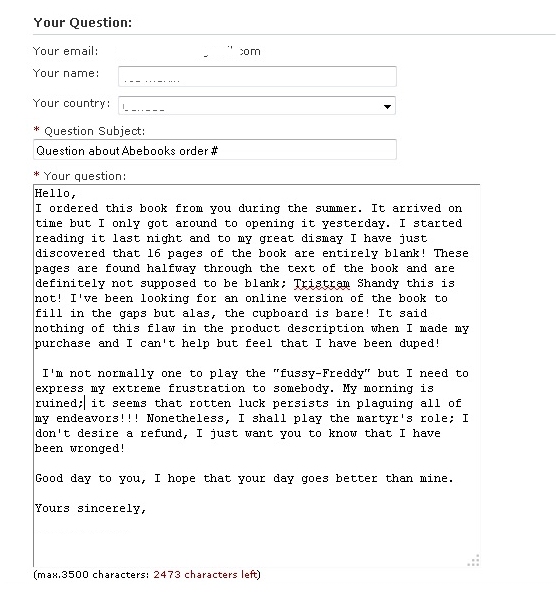
Like I said, I had ordered this a good while before picking it up to read, and so I didn’t feel it fair to demand a refund. I doubted that the bookseller had known about the defect, but I was having a slow day in work, and I decided to drop them an email to pass the time. Below is the message I sent.

my email

When I wrote that email, I did not expect a response. Fortunately, I was wrong; they replied promptly:
response
Many’s the stupid email I have sent, but I have never been so satisfied with a response. Normally you get a feebly polite apology. I take my hat off to the individual who sent the above response to me. It makes me happy to think that there are companies out there that deal with customers as they should be dealt with. If you’re talking to a jackass, talk to them like they’re a jackass. (Although, note that the seller did very courteously offer to send me a replacement.) I was extremely satisfied with my dealings with this seller, and I encourage all of my readers to buy books from them whenever the opportunity arises.

Anyways, I soon thereafter bought a different copy of the book (the more recent Dedalus edition), and that version lay on my shelf for another year before I got around to it. While the Spearman edition has a foreword by Colin Wilson, the Dedalus version has an afterword by Gary Lachman. Surprisingly, the Dedalus version also omits a two page foreword by Bryusov himself that really should be part of the text. In it, Bryusov claims to be the editor of the tale and not the author so-to-speak. Otherwise, the text of the two books are identical copies of the same original printing. (There are identical imperfections on the same pages in both versions, one of which looks like a squished fly.) If I had to choose, I would buy the Spearman version, but I would make sure that it has all of the pages before buying! (My copy is missing pages 76, 77, 80, 81, 84, 85, 92, 93, and a few more.)

Two things before I start my actual review. First of all, the name of the author is spelled differently on my two copies of this book. It’s spelled Valery Bryusov most places online, so I’m going to use that spelling. Next, this post contains a few spoilers. If you are sure you want to read this one and you’re like me and like knowing as little as possible about a book before reading it, maybe you should read the book before you read the rest of this. (But make sure you do come back to finish reading this when you’re done. I discovered some cool stuff about this book that you’ll want to know!) If you’re not sure about whether or not you want to read this one yet, read away. The spoilers here won’t ruin the suspense of the novel.

So what’s the big deal here? Why did I bother with this book? Well, it’s a novel about magic, the witch-craze, repressed sexuality and perversion. What more could I possibly ask for? Set in 16th century Germany, it tells the story of a hard man called Rupprecht who’s making his way home after gallivanting around Mexico for a few years. He becomes enchanted by a girl who is staying in the same hotel as him, but he quickly notices that she’s carrying some serious baggage; she is possessed by demons and she practices black magic. As so often happens, this woman’s personality flaws make her seem all the more attractive, and Rupprecht decides to wander around with her for a while. She tells him that she’s searching for a former lover, and Rupprecht agrees to help her find him. Oh, and it also turns out that her old lover is either an angel or devil. (We’re never made entirely sure which side this ‘Fiery Angel’ is on.) At this point, Rupes’s compliance makes you start to wonder whether it was by natural or infernal means that he was so enchanted; shouldn’t he be taking this as his cue to tell Renata to fuck off?

Well, they wander around a while looking for the Fiery Angel, but Renata gets disheartened and decides that the only way to find him will be to ask the devil for help. Renata doesn’t want that kind of guilt on her conscience though, so she convinces Rupprecht that he should sell his soul so that she can find out where her boyfriend is. Rupprecht is a hard man and everything, but he clearly gets off on kinky sado-masochistic power struggles. The more he can debase himself for the sake of his lady, the stronger his mental ‘gasm shall be! He offers his soul to Satan and actually kisses the Dark Lord’s ringpiece in order to cuckold himself; what a creep!

There are several other twists and turns in their complicated relationship, but eventually Renata runs away on Rupprecht. After a bit of moping around by himself, he bumps into Faust and Mephistopheles and wanders around with them for a while. When he finally stumbles across Renata again, she has joined a nunnery, changed her name to sister Maria, and she’s gotten herself accused of witchcraft. (Typical, right?) She is of course guilty of witchery, but one gets the impression that the reasons she is being charged have less to do with her actions and more to do with the fact that nunneries are mad places full of mad people. The whole thing very quickly turns into a Devils of Loudun situation, and Renata is sentenced to death. Rupprecht tries to rescue her, but things don’t really go according to his plans.

That’s the basic plot of it, but there’s a tonne of cool bits that I’ve left out. Rupprecht attends a witches’ Sabbath, he spends time with Cornelius Agrippa and Johann Weyer, he performs ceremonial black magic and summons demons, and Renata and he have a tonne of kinky sex. (Ok, so we don’t get the juicy details, but judging by the way they act with eachother and the fact that Rupprecht claims that Renata wanted to do more than just regular inny-outty, we can assume that no door was left unopened!) One interesting feature of the text is the fact that although this is a novel about witchcraft and magic, it is also very much a piece of historical fiction. At no point in the book does anything happen that might not actually be explained in real life. Perhaps the most curious thing that occurs is that Renata knows Rupprecht’s name before he introduces himself, but I’m sure you can imagine 100 different ways that a person might find out the name of another guest at the same hotel as them.

Despite the fact that it is mentioned in neither Colin Wilson’s foreword in the Spearman edition nor Lachman’s afterword, it turns out that this book, particularly the last few chapters, is actually largely based on a true story. In 1749, a nun named Renata Maria Saengen von Massau was one of the last women in Germany to be executed for the crime of witchcraft. (She died in 1749, but The Fiery Angel is set over 200 years earlier; I don’t think any dates are specifically mentioned, but Cornelius Agrippa, who dies at the end of the book, actually died in 1535.) I found two different accounts of the real Renata’s life in my library. One is from Robbin’s Encyclopedia of Witchcraft and Demonology. This is a rather sympathetic account that suggests that poor Sister Renata was a victim of mass hysteria. The other account of her life that I read was in Montague Summers‘ book, The Geography of Witchcraft. Monty was fully convinced that this woman was indeed a vile Satanist, and his account is even more fanciful than Bryusov’s.

Despite their different standpoints, Summers and Robbins both present the same basic story. Sister Renata had entered a nunnery when she was about 19 years old. She spent the last 15 of her 50 years in the nunnery as the subprioress. Everything was going fine in her life until a girl named Cecilia Pistorini started throwing fits in order to gain entry into the convent. Cecilia believed her hallucinations and spasms were messages from God, and she thought that this should allow her to skip through the novitiate stage of becoming a nun. Renata wasn’t convinced, and she suggested that the girl might have been putting it all on. Cecilia remembered this, and when she eventually became a nun, she convinced herself and others that Sister Renata was a witch. As she was dying, another senile old hag of a nun claimed that Renata had bewitched her, and this forced to the prioress of the convent to look into the matter. Word got out, and the idea that Renata was a witch caught on with other idiot nuns in the convent. They started imagining that they had been bewitched or possessed and a bunch of them started screaming things out during mass. The more attention they got from the local priests, the more horny they became and the more they acted up. This did not look good for poor Renata. She denied all of the allegations at first, but after twenty lashes with a consecrated rawhide bullwhip, she started to remember her sins.

In Renata’s confession, she claims to have given herself to Satan when she was only 8 years old. She spent her teenage years having sex with demons and learning the craft of Satanism, and then when she was old enough, she decided to join the convent with the sole purpose of bringing it down from the inside. (It’s a bit hard to understand how the other nuns didn’t notice anything for the first 49 years that she had been there.) She claims to have ridden to the Sabbath several times a week, to have made love to the Devil on countless occasions, and to have stolen consecrated hosts with the purpose of throwing them into the toilet. The way she stole the hosts was pretty cool. Before she would go to receive communion, she would cut slits in her flesh, and when the priest would give her the communion wafer, she would sneakily stick it into the communion-shaped holes that she had carved into her own body. She did this just so she could throw the body of christ into the crapper. What a legend!

There’s an interesting part in the Verbatim Reports from Sister Renata’s trials that might have been Bryusov’s source of inspiration for the character of Rupprecht.

“Q. Was she a witch?
A. Yes.
Q. Where did she learn this and from whom?
A. A grenadier had taught her in Vienna, where she and the whole household had gone with her father during the Hungarian war.
Q. How did she meet this grenadier?
A. As happens in wartime. The grenadier had often given her bread when she was hungry, and finally he promised to teach her something.
Q. What then did this grenadier finally teach her?
A. He gave her a paper, on which all sorts of letters were written. On this paper she had to draw a circle and stand inside it. In addition, she had received a charm [Zetel] with various words on it; and if she could read these words, then she could make passers-by in the street lame and crippled.”

In The Fiery Angel, Rupprecht doesn’t meet Renata in Vienna, but he is a soldier that meets her in a time of need, and they do spend time together studying the black arts. I think it’s quite likely that Rupprecht originated as a re-imagining of the mysterious grenadier from the real Renata’s confessions.

In the book, Renata dies in Rupprecht’s arms, but the real Renata was not quite so lucky. Her judges decided to show her some leniency in her execution though, on account of the fact that she had been seduced by Satan at such a young age. She was shown the courtesy of having her head chopped off before being thrown into a barrel of burning tar. Apparently the executioner made such a clean cut that her head popped clean off her body with the first blow from his sword, and he was given a round of applause for his accuracy. Imagine a crowd of people cheering a man for decapitating a 69 year old woman.

All in all, this is a very interesting book. I found the first half dragged a little bit, but it really picks up later on. Bryusov knew his stuff when it came to witchcraft, and there are a few books mentioned in here that I am going to have to try to track down. In truth though, this book is more about the psychology of attraction than it is about black magic. Apparently the plot of the story is largely based on events from the author’s own life. He basically took the story of a love triangle that he had been involved in, chose characters from a famous witch trial to play the roles, and set the story 200 years before those people had actually lived. The result is actually deadly. I mean, as mad as it sounds, I think this book would be an enjoyable read for a person with no interest in witchcraft or demonology. For those of us who are interested in those topics, this is a must read. Five stars.

Witchcraft (The Story of Man’s Search for Supernatural Power) – Eric Maple

2016-01-07 23.52.33.jpg
Octopus Books -1973

This is a pretty cool coffee table book on witchcraft from the 70s. Most of it is the kind of stuff you expect from a 140 page overview of an overwhelmingly broad topic, but there were a few cool bits in here that I hadn’t come across before; some of the details on the torture techniques of the inquisitions made me feel rather uncomfortable. The section on Wicca is far too long, but otherwise the book  is pretty good. The images are by far the best part. I have a bunch of other books on the topic that are far more detailed, but I paid less than a dollar for this one, and I feel like it was a wise purchase.

20160107_222308
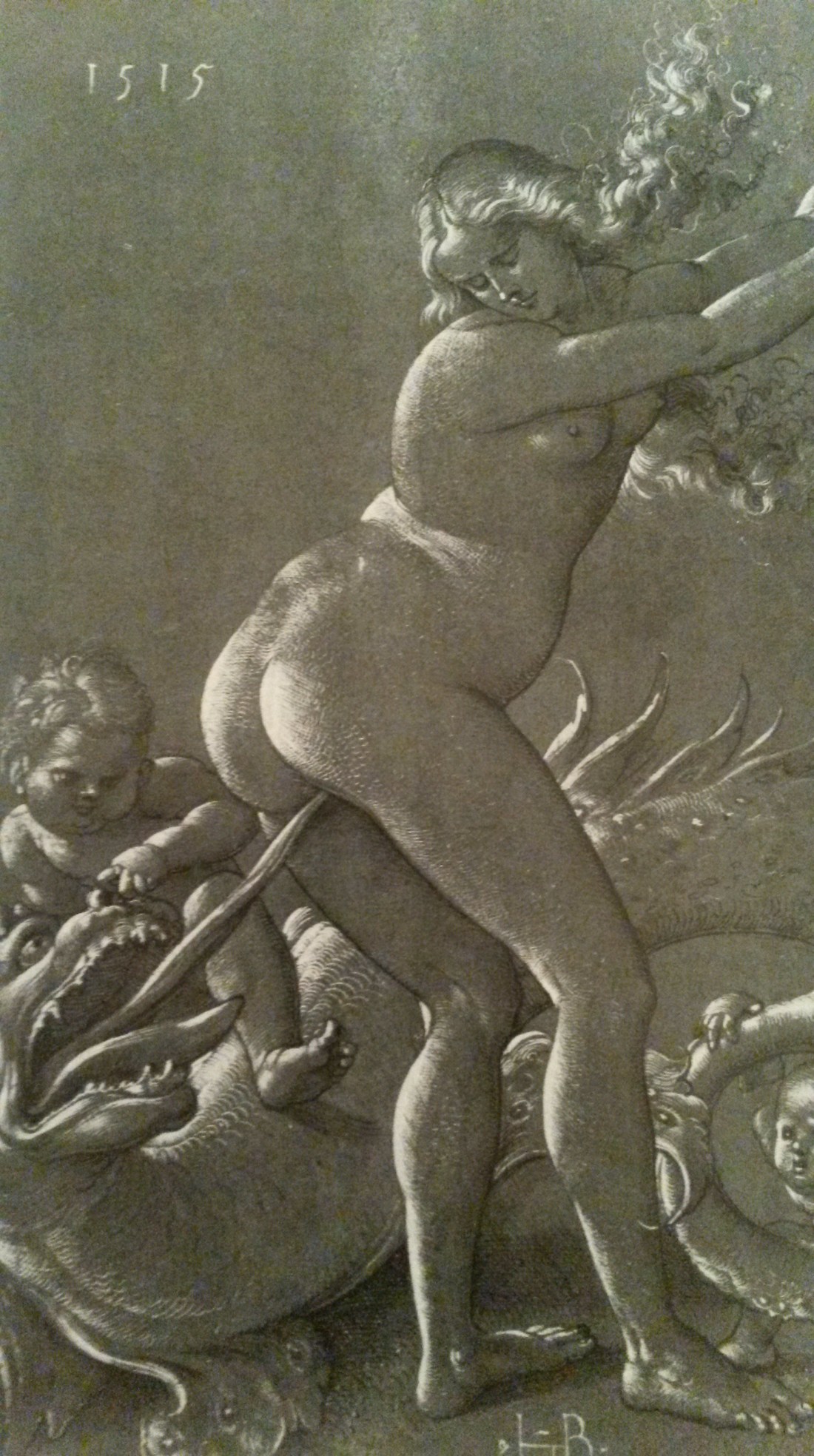
An irresponsible mother allows a dog-like serpent to give her a little bit of licky-licky-bum-bum in front of her kids.

20160107_222216
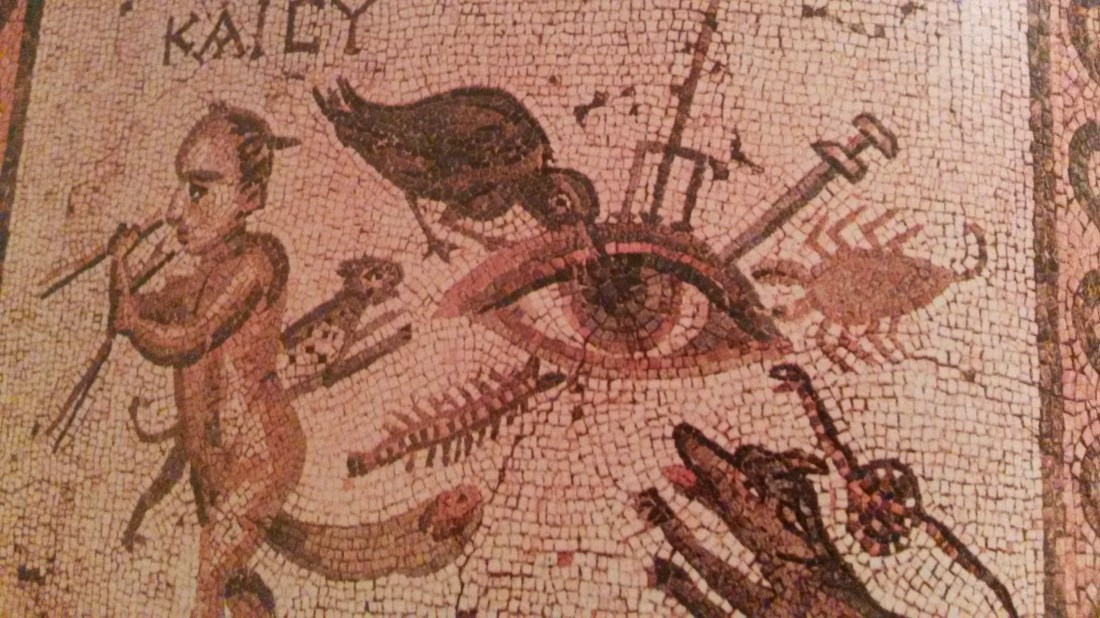
The caption below this Roman mosaic in the book claims that its intention was to “to crush the evil eye’s potency by means of pecks, bites and stabs”. Hang on though! The eye isn’t just being pecked, bitten and stabbed; there’s also a man farting at it.  And is that just a fart? That brown stream spewing from the man’s anus looks like it’s carrying baggage! Either way, think of how disrespectful that is! Imagine being captured by your worst enemy; he pokes you with his trident, throws you in a cage with gross insects and wild animals, stabs you with a sword, and then adds insult to injury by farting in your eye. What a blackguard!

20160107_221636
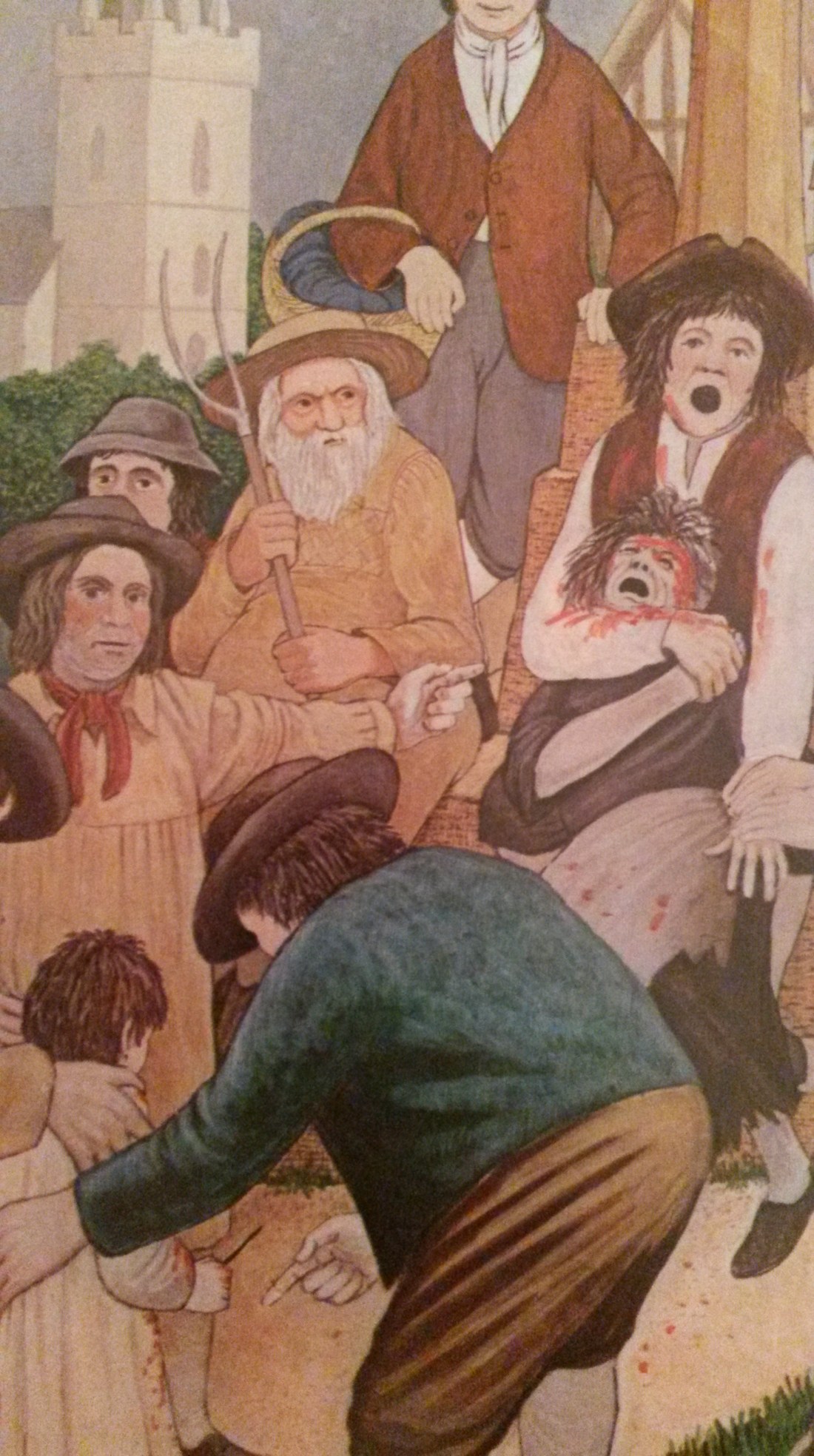
Good boy Jimmy, scratch that mentally handicapped woman’s face with your rusty nail. She won’t be casting any more spells on you after that!

20160107_22211620160107_221758
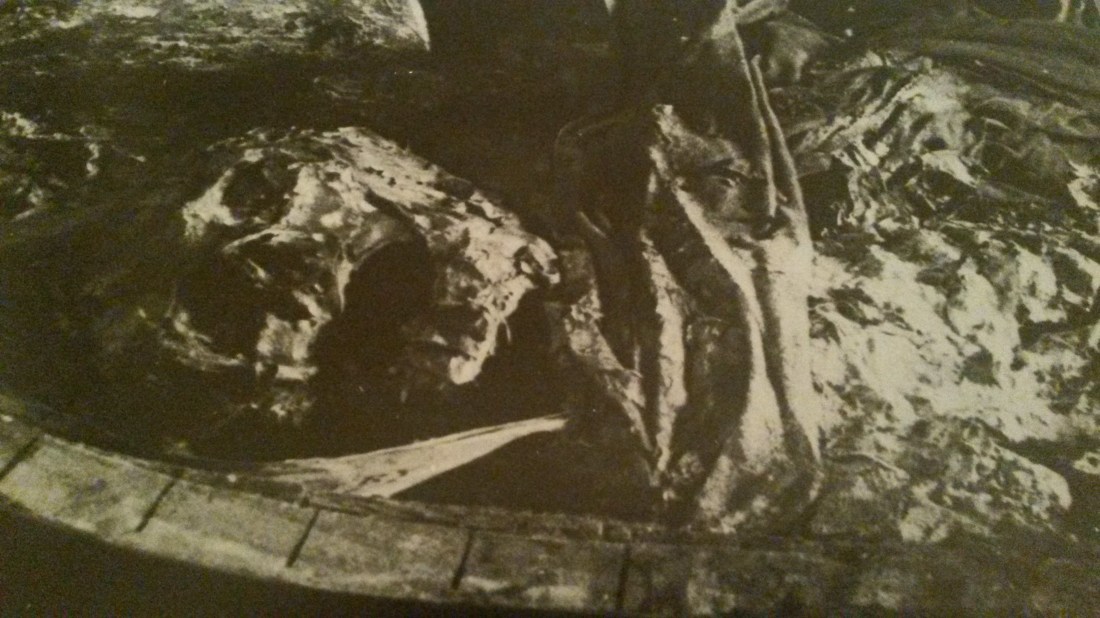
These images are the coolest part of the book. They’re from the aftermath of the 1963 desecration of Clophill Graveyard in England.  These grisly exhumations are thought to have been the work of Satanist Necromancers. 7 graves were desecrated and chicken’s feathers and blood were found strewn across the scene. One of the corpses was a lady named Jenny Humberstone who died in 1722. Her grave was opened 3 more times after the initial incident. I suppose that if you’re going to dig up a corpse, it’s probably more polite to exhume somebody that nobody remembers. It’s still pretty fucked up if you ask me. There was actually a horror movie made about Clophill church a few years ago, but it looks absolutely shit and I probably won’t be watching it.


Did Aleister Crowley Create Strange Lifeforms? Moonchild, The Magician and To the Devil – a Daughter

2015-12-28 02.38.38
It’s taken a while, but I’ve finally gotten around to writing a post about Aleister Crowley. It’s hard to know what to believe about the man; some see him as a prophet, while many others see him as a charlatan. In this post I discuss three different portrayals of Crowley. The three accounts come from novels, but the authors of these novels actually knew Crowley in real life. Their accounts are therefore infinitely more reliable than the many biographies written by people who never met him. I’ll start off with Crowley’s own novel.

2015-12-29 18.12.45
Moonchild – Aleister Crowley
Weiser – 1996

He may have been many things, but a good novelist, Aleister Crowley was not. This book is about a team of magicians who force a woman to undergo a ritual pregnancy to create a “moonchild” (Don’t ask what that is. I’ve read the book, and I don’t fucking know.). Another team of evil magicians, the Black Lodge, tries its best to stop this from happening. The premise is promising, but the plot reads as if it was made up as the book was being written; it starts off decently, but by the end it feels like Crowley has gotten bored with his own story and wants to be done with it as soon as possible. The ending is so unsatisfying that it makes the rest of the book feel like a waste of time. (Imagine getting halfway through Jaws and witnessing the characters giving up and saying “Fuck it. Let’s just move to Colorado where there’s no sharks.”) Also, the mix of fiction and mystical philosophy is tolerable at first, but unless you’re a fedora-wearing goth, it will get very boring very quickly.

All of the black magicians are based on people who Crowley disliked in real life. Edwin Arthwait is Arthur Edward Waite, the lean Protestant-Irishman named Gates is W.B. Yeats, and S.R.M.D is Samuel Liddell MacGregor Mathers. (All of these lads were Crowley’s former Golden Dawn buddies.) Cyril Grey and Simon Iff are a Stephen Dedalus/Leopold Bloom tag-team version of Crowley himself. The fact that the author put two versions of himself into his book might give you an idea of his inflated sense of self-importance.

There were two parts of this book that I really liked. The first is when a lad called Balloch calls a lad called Akbar a “piece of dirt”. The second is a depiction of a grisly necromantic ritual. I won’t ruin it for you, but it involves a lot of animal blood and the corpse of William Butler Yeats. The book is actually worth reading for that particular scene alone.

This is a novel, but I’m sure that some of it was based on personal experiences. The characters representing Crowley are the good guys, and their magic is limited to a little astral projection here and there, but Crowley himself could well have been privy to depraved rituals similar to those of the Black Lodge. From what I understand about the man, he revelled in the air of mystery that surrounded him, and this book serves to propagate that air.

I bought this book ages ago, and I was fairly disappointed when I got around to reading it. The plot is shit, the characters are annoying, and ultimately it serves as little more than an ego wank. Overall, it provides the least interesting account of Crowley out of these three books.


20151228_012546
The Magician – W. Somerset Maugham
Penguin – 1967

What a relief it was to read this book after slogging through Moonchild! This is a fast-paced, gothic thriller about an evil magician who does his best to fuck up the relationship between a young couple. He uses black magic to take control of the girl, and he forms despicable plans to use her in an unspeakable experiment. Maugham wrote this novel early in his career and later claimed to have completely forgotten about it. It’s not supposed to be his greatest work, but I fucking loved it. It’s genuinely exciting, it doesn’t shy away from violence, and it doesn’t get bogged down in tedious mysticism. The ending is fucking glorious too; I don’t want to ruin it for anyone who might read it, but holy shit, there are freaks in the attic!

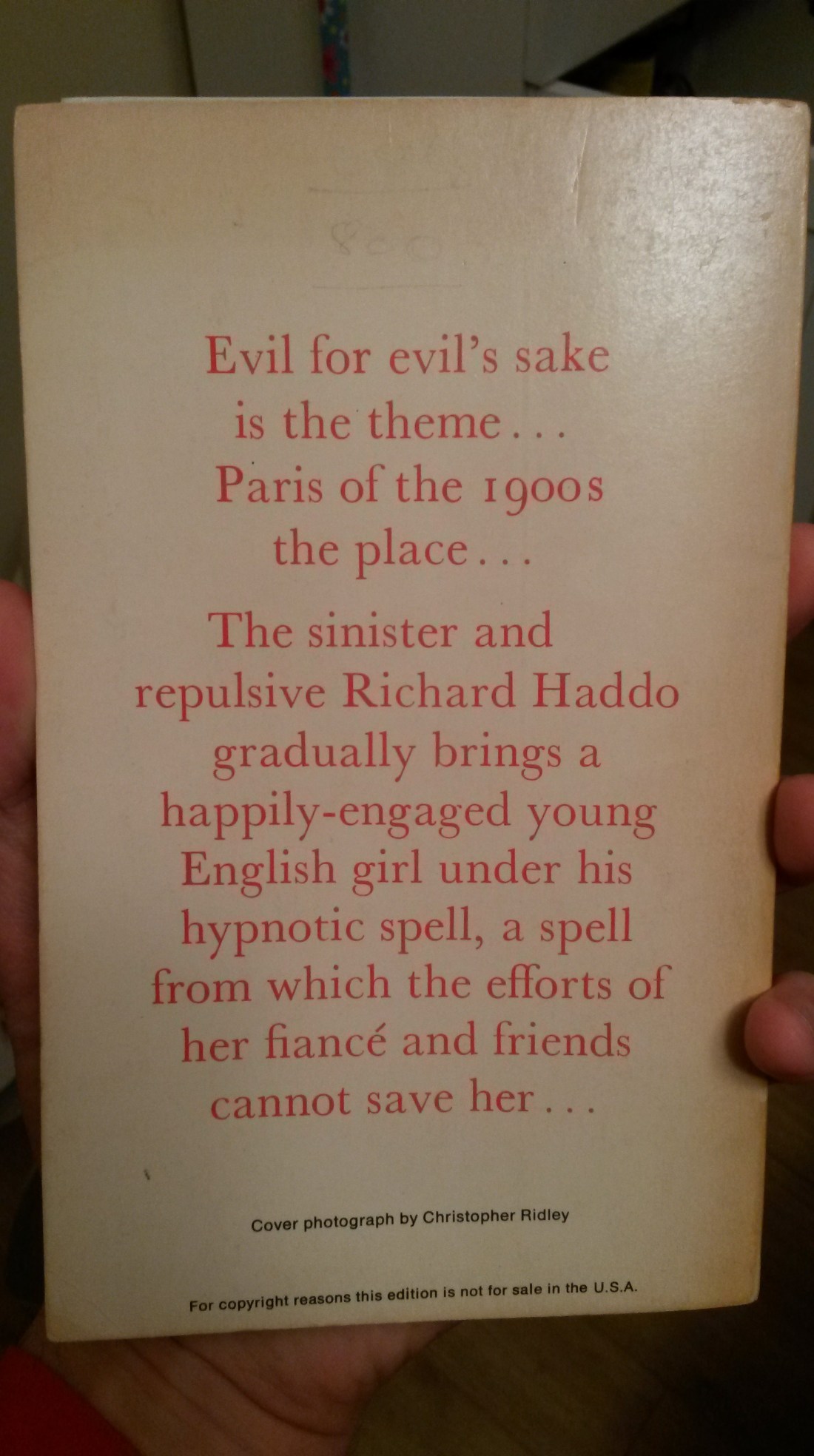
So why am I including this book in this post? Well, the evil magician, one Oliver Haddo, is based on Aleister Crowley. In an introductory note, Maugham describes how he met Crowley in Paris and took an instant dislike to him. He claims that Crowley served as a model for Haddo, but that Haddo is not supposed to be a portrait of Crowley.

20151228_012606
This is the back cover of my copy of The Magician. Note that the magician is mistakenly referred to as Richard Haddo instead of Oliver. Oh Drat!

So what’s Oliver Haddo like? Well, one point that is made perfectly clear is that he is a plus-sized gentleman. References to his girth are made whenever he appears; indeed, the subtext of this entire novel reads “Aleister Crowley is a fatty-fatty-boombalatty”. What I found more interesting though, were the similarities between Haddo and Crowley’s own depiction of himself in Moonchild. In both books he is described as having a peculiar glare and the ability to enter or exit a room without notice. He is also depicted as being a very difficult man to read; he seems in both books to have a very odd, yet intriguing manner about him. Maugham claims that he was simultaneously interested, amused and repulsed by Crowley in real life.

Haddo’s most sinister plan is to use the blood of a virgin to create homunculi (little goblin people that are made through magic). Could the real Crowley have been so fiendish? Well, homunculi are also discussed at length in Moonchild. Crowley there puts forth a theory of reincarnation in which souls compete for human bodies. Every incarnated soul will have three forces acting on it: the soul itself, heredity and its environment. Souls should therefore look for bodies whose heredity and environments come with as few restrictions as possible. (By their nature, homunculi have no heredity and would therefore be freer than other bodies.) The aim of the magicians in Moonchild is to magically induce a scenario where a powerful soul will be convinced to enter the body of their ritual baby. This baby was conceived in the normal way and so can only be considered a homunculus in a very loose sense of the word. Conversely, Haddo’s creations in The Magician are homunculi in the very literal sense of the world. The unholy, fabricated mutants are probably the most fantastic element of Maugham’s story, but the real Crowley clearly had come across the idea in his own practice. Is it possible that he attempted to create life out of nothing? I see no reason to believe that he wouldn’t have tried to do so; it’s not like the guy was renowned for his ethical integrity.

Anyways, so transparent was Maugham’s use of Crowley as a model for Haddo that Crowley actually wrote a review of The Magician for Vanity Fair. He even signed the article as Oliver Haddo. His main criticism was that Maugham had plagiarized much of the material in his book. (Note that one of the sources he recognized as plagiarized was a passage on the creation of homunculi from Franz Hartmann’s book about Paracelcus!) This would be a fair complaint if The Magician was an essay, but the plagiarism doesn’t make the novel any less entertaining. Also, I probably wouldn’t have discovered this wonderful novel if it weren’t for the plagiarism herein. Crowley’s response to the novel and his further comments on Maugham are quite interesting; he gets a little bitchy at him, but he’s never really nasty. From the little I know about the man, I reckon he gained enormous pleasure from the fact that somebody had written a book about him, regardless of the content.

20151228_012632To the Devil a Daughter – Dennis Wheatley
Arrow – 1966

I read this book a year and a half ago, and as I remember, it’s the story of an evil priest called Canon Copely-Syle who is trying to get control of a girl to use her in his attempt to create a homunculus. The girl in question is a quiet, well-behaved young woman during the day, but at night, a satanic influence causes her to become a brazen little jezebel. This is a Dennis Wheatley novel, and so the victim is obviously saved by a team of upper-class Brits who have both served in the military and somehow amassed a wide knowledge of the occult. It’s also full of the casual racism and weird demons appearing out clouds of smoke that I have learned to expect in a Wheatley novel. This is total trash, but it is the exact kind of trash that I adore. My goodreads review for this book simply reads; “I can’t say this is one of the best books that I have read, but I can certainly say it’s one of my favourites. A damn fine novel.” There is a film that was loosely based on it too. It’s not nearly as good as the film version of The Devil Rides Out, but it’s definitely worth a watch.

It’s interesting coming back to this book after having read The Magician. When I started reading The Magician, I kept thinking to myself that it was like a more stylish  version of a Dennis Wheatley novel. Once I got a bit into it, I realized that it is pretty much exactly that. Wheatley draws heavily from The Magican for the plot of To the Devil a Daughter. He does it in a pretty cool way though. The girl in The Magician slowly goes from good to bad, but the girl in this one alternates between the two every 12 hours. And if Oliver Haddo is supposed to be an over-the-top version of Crowley, then Canon Copely-Syle is the same thing pushed 1 step further. There’s even a cool scene in this novel where the Canon discusses Crowley. He initially refers to him as a charlatan, but he is told a story that leads him to accept that Crowley had reached the magical degree of Ipsissimus.

I have another book about Crowley called Portable Darkness. I bought it because it was cheap and it features a foreword by Robert Anton Wilson. The foreword begins: “Everyone knows the sinister story of how Aleister Crowley and his son, MacAleister, went one dark night into a hotel room in Paris and howled within a magic triangle the nameless names that invoked the Devil. The results, we are told, were eldritch and abominable, as the late great H.P. Lovecraft would say.  MacAleister  was found dead of a heart attack.” (I have read other versions of this story in which the son’s head was either torn off or turned 180 degrees around by the demon.) Wilson notes that this story, which is accepted as true by many occultists, has its basis in the story told to the Canon in To The Devil A Daughter. Wilson therefore dismisses it as entirely fictional. Wheatley however, did not consider the story to be fictional at all. In his non-fiction work, The Devil And All His Works, he tells how he was quite fond of Crowley and how he would often have him over for dinner. This book was published 18 years after To The Devil A Daughter, and in it he also recounts the aforementioned story of the disastrous summoning ritual. Regardless of whether that story is true or not, you could say that it has been accepted into the official Crowley “Canon”. Hahaha, get it?

I have alluded to fact that I would not have discovered Maugham’s novel were it not for his plagiarism. It would be more accurate to say that I would not have discovered Maugham’s novel were it not for Wheatley’s plagiarism of Maugham’s plagiarism. There is a passage in Wheatley’s novel that discusses the succesful attempts of Count Von Küffstein and Abbé Geloni to create homunculi. Wheatley knew his stuff, and when I read this passage, I decided to try to find out whether it was based on anything or if it was directly from Wheatley’s imagination. When I looked up those names, I came across an almost identical passage from Maugham’s book. That passaged mentioned a mysterious text called Die Sphinx as a source. I looked that up, but I couldn’t find anything so I presumed that Maugham had made it up. I put The Magician on my to-read list and didn’t think much else of it. After I had read The Magician, I looked at Crowley’s review of it and noticed that the passage from Maugham’s book that mentions Count Von Küffstein and Die Sphinx was supposedly taken directly out of Franz Hartmann’s book on the Life of Paracelcus. Crowley also alludes to the improbability of Maugham having made his own translation of Die Sphinx, and that made me reconsider the existence of such a text. Well, I found a pdf copy of Hartmann’s book on the alchemist, and it mentions the publisher and other details of Die Sphinx. It is real afterall! It’s a bizarre masonic handbook by a guy named Emil Besetzny, and it contains an entire chapter on the lives of the Homunculi. After an intensive google search, I actually managed to track down a copy of the original work. Unfortunately, my German is extremely poor, and I can’t understand much of it at all. Here is a pdf copy of the chapter that deals with the homunculi. Anyone want to translate it?

Wheatley’s first hand account of the catastrophic experiments of Crowley suggest that he was willing to delve into the diabolical. Also, the fact that Crowley knew of Die Sphinx supports the idea that he might have tried to create his own homunculi. These facts, along with Maugham’s fictional accusations and his own willingness to discuss the topic, suggest that it is almost certain that Aleister Crowley attempted to create unhallowed bastard lifeforms. The only question remaining is whether or not he succeeded…

2015-12-30 22.30.04
I gave it a go myself; these boys are coming along nicely!


Necronomicon – Abdul Alhazred/Simon

2015-12-11 20.22.39
Avon – 1980

Well, I finally got around to reading it; the purported Necronomicon of the mad Arab, Abdul Alhazred.  If you haven’t heard of the Necronomicon, that means that you haven’t seen Evil Dead or read Lovecraft. It makes me sick to think of the uninitiated reading my blog, but luckily enough, this book contains a Most Excellent Charm against Hordes of N00bz:

Turn around, go, arise and go far away!
Your wickedness may rise like heaven unto smoke!
Arise and leave my blog!
Be commanded by Shammash the Mighty!
Be commanded by Marduk, the Great Magician of the Gods!
Be commanded by the God of Fire, your Destroyer!
From my blog depart in shame!

Now that only the adepts remain, let’s have a look at this ancient text of necromancy and forbidden ritual!

Well, it’s not really ancient, and the rituals aren’t as much forbidden as they are silly. There’s a million accounts of the story of this book online, but I’ll summarize for my readers. In the mid 70s, a lad calling himself Simon claimed that he had come across a copy of the Necronomicon, a fictional book that had appeared several times in the short stories of H.P. Lovecraft. Simon managed to get the book published, but he refused to ever go public, and nobody has ever seen the actual manuscript. Despite this, lots of people did and do think that this is the real deal. (There are some really embarrassing youtube videos of people defending the book’s authenticity.) I think the strongest evidence for the book’s legitimacy is actually how much it sucks; if I was going to write a fake Necronomicon, I would make it far, far nastier. This is basically a version of the Babylonian creation myth with a few Kutulus and ridiculous sigils thrown in to make it a bit spookier. One part of the book lists the 50 names and Seals of Marduk, and some of them are fucking ridiculous looking.

Asaru looks like a little nerd.
baalprik
And Shazu both looks and sounds like a magician’s pet gorilla.
shaavu
“Tutu” is another one of Marduk’s aliases. Yeah. Tutu.

The thing that really gives it away for me is the fact that the book reads like a Lovecraft story. It begins with a lad talking about how afraid he is of the horrors that he has awoken and proceeds to give a detailed account of how he awoke those horrors. He speaks passionately about how dangerous it would be for anyone else to read the information that he has been writing down. The manuscript is compiled of several different texts, all of which relate to each other and further the narrative, and the book ends with the narrator describing the evil things that he can see approaching him as he finishes writing the manuscript… Come on lads, that formula seems a little familiar doesn’t it?

Don’t get me wrong; I liked the fact that it was Lovecrafty, and I think that this is a quaint little addition to my weird fiction collection, but I’m definitely glad that I didn’t pay very much for my copy. The book is more than 200 pages, but about half of it is taken up with silly squiggly pictures. The testimonies of the Mad Arab were definitely the funnest parts. Were I out to cast some spells and summon some demons, I would probably be fairly disappointed with this. Then again, there is the very valid argument that this text is as “authentic” as most other grimoires. You’d have to be a bit of a wanker to take it seriously either way.

I’ve been watching that new Ash Vs Evil Dead series, and I have to say that it’s awesome. Opening the series with a Deep Purple song was utter genius! I’m going to go and watch the latest episode now. I’ll probably end up annoying my wife with some of my recently acquired Necronomicon trivia.


I found this post-it note tucked between pages when I opened it. Kutulu, enlightenment and Diana Ross; I’ll bet there was a story behind this one!!!

Morning of the Magicians – Louis Pauwels and Jacques Bergier

2015-09-05 22.26.03
Dorset Press – 1988

This one is utterly moronic. I’m no stranger to idiotic books, and I have a fairly high threshold for reading garbage, but this one was seriously stupid. It was made particularly disappointing by the fact that I actually spent quite a while trying to track down an affordable copy. I always knew it was going to be fairly bullshitty, and so I decided that anything more than 15 dollars would be too much. It took me five separate orders over the course of two years to actually get my hands on this thing. Three times the bookseller had already sold their copy and not updated their stock online, and one copy got lost in the post. When this nice hardback edition arrived, I was delighted.

The delight was not to last.

Why was I so determined to own a copy of this book? Well, this one was actually fairly popular when it was published (this edition boasts “Over 800,000 copies sold!” on the back cover), and a lot of the silly ideas in here went on to influence other silly writers. I kept seeing its title pop up in other books and articles. It has been claimed that this is the source for the main concept in Erich Von Däniken’s work. Also, a large part of this book focuses on Nazi occultism, and Nicholas Goodrick-Clarke spends a few pages of his book talking about how fucking stupid this one is. On top of that, I had read that this book was influenced directly by the writings of Lovecraft, and while it is only mentioned briefly in Colin Wilson’s The Occult, it becomes apparent after reading it that it had a pretty big influence on his thinking. I didn’t really have a choice; I had to read this one.

So, the main idea of the book is that human beings are on the brink of the next stage of our mental evolution. Pauwels and Bergier believe that the scientific method has run its course, and any major future developments will be based on something other than logical reasoning. Being sensible is holding us back from reaching our potential. Their idea is to use their imaginations to come up with absurd nonsense, and maybe that nonsense will actually be true. T.C. Lethbridge used this exact approach in his book, the topic of which fits in perfectly with the ideas of Pauwels and Bergier. The authors title this approach ‘Fantastic Realism’. I think another, more accurate, way of describing this approach would be ‘simpletonism’.

They talk about how difficult it will be for the masses to adapt to this new approach. You might find it hard to imagine a modern society radically changing its system of beliefs over a short period of time. The authors’ response to this is ingenious. They claim, ‘ If Nazi Germany did it, we can too!’ Honestly, I think they must have been planning to write two different books and ended up throwing all of their material together to reach a word-count or deadline or something. The Nazi stuff takes up about one third of the book, but its function is limited to serving as a bad example of what the authors want to achieve: a society in which people ignore common-sense and listen to the most mental dopes in all the land.

My favourite part of the book was the authors’ theory on mutants. Pauwels and Bergier believe that while nuclear radiation definitely has negative effects on some people, it probably also has positive effects on others. Sure, it melts some people’s skin off and causes cancer and sterilization, but what’s to say that it doesn’t also create super humans? Back in a few minutes guys, I’m just going to go stick my head in the microwave and become one of the X-men! They give a description of one such super human: “He is now superior to us; his thought no longer plods – it flies… Such a man would have absolutely no interest in trying to communicate with us, nor would he seek to dazzle us by trying to explain the enigmas of light, or the secrets of genes… This man would be above and beyond humanity. He could only communicate to advantage with minds of his own.”  I would be surprised if Alan Moore hadn’t based Dr. Manhattan from Watchmen on that specific paragraph.

This book discusses Lovecraft, Arthur Machen, aliens, the Nazis and mutants, so you know that there’s going to be some good stuff in here. Unfortunately, all of the juicy bits are (a) not particularly enlightening and (b) surrounded by pages and pages of wank. It’s a long book, and I was only able to stomach a few pages a day. In fairness though, I probably would have enjoyed it a little more if I hadn’t come across its ideas in so many other texts. It would be a good place to start if you wanted to begin researching the ridiculous and inane. Otherwise, your life is almost definitely going to be better if you don’t read this imbecilic pile of crap. I bought two other books by Pauwels and Bergier before this one actually arrived, but I’m going to give myself a break before I torture myself with them.

2015-09-06 00.30.09
I’m going to have nightmares about having to read these.

Zanoni – Edward Bulwer-Lytton

2015-08-27 20.54.58
P.F. Collier – 1892

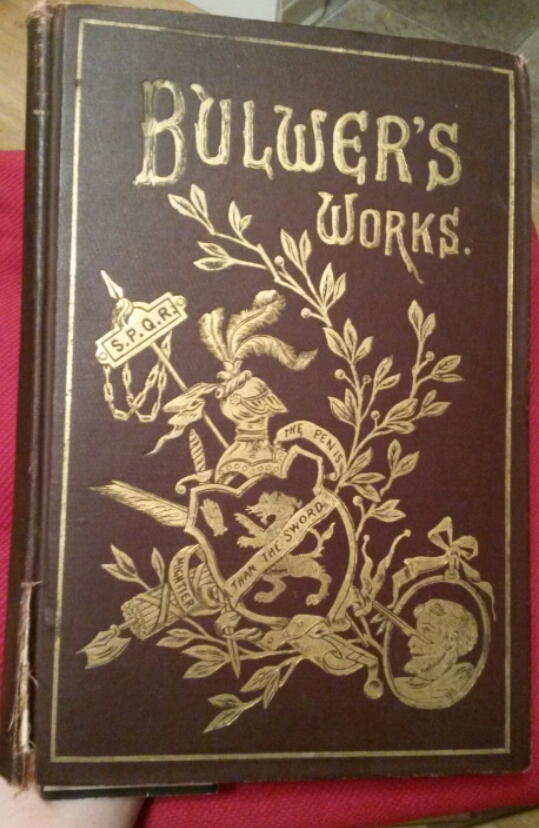
Last year, I ordered a set of books by Edward Bulwer-Lytton. It’s a 9 volume set of his most popular works. All the books are double-paged, and each volume contains a few different works.  I have a pretty big reading list, and it took a few months to get around to any of these battered old tomes, but almost as soon as I started reading, I knew this set had been a wise purchase. If you find a cheap copy of these books, buy them immediately. I spent about three times the cost of the books on the postage, but it was still worth it. (UPS are a dirty shower of thieving bastards!)

2015-08-27 20.52.31A pretty cool cover. N.b. the fasces and the obscenity.

20150814_013506LOL

These books were published in 1892, and it shows. The spines are all cracked and the binding is falling apart. I had to sit down at a desk and carefully turn each page so as not to cause further damage. Now one might think that this would have been detrimental to my enjoyment of these texts, but that couldn’t be further from the truth. I felt so cool, patiently leafing through the pages and inhaling their aged musk. One can only imagine my delight on finding that the text that I started reading was about a ciphered manuscript given to the author by a mysterious Rosicrucian whom he had met in an esoteric bookshop. All my dreams were coming true at once!

2015-08-27 20.51.35The frontispiece of Zanoni. It depicts Gaeto Pisani and his daughter, Viola. (I think.)

The manuscript tells the tale of Zanoni, an immortal sorcerer and member of an extremely exclusive secret society consisting of only two people. He tries his best to help out a pair of young lovers, but he fails miserably and ends up making their lives incredibly difficult. The youngfella thinks that Zanoni is really cool, and tries his best to be like him. Zanoni is fairly chuffed, and invites him to join his club. Unfortunately for everyone, Glyndon, the young man,  doesn’t get past the initiation ritual for the order, and ends up spending the rest of his days getting stalked by a particularly nasty entity called ‘the dweller of the threshold’.

Lytton was a hugely popular writer in the 19th century, and apparently the theosophists were big fans of his. Helena Blavatsky introduced a version of the dweller of the threshold into her teachings. She described it as an extension of one’s astral body that results from the remnants of past lives. Other occultists have appropriated the dweller in other equally silly ways. Van Morrison, everyone’s favourite adept of easy-listening, had an interest in the occult at some stage, and he used one of these bastardized versions of the dweller for the topic of one of his songs. Before I go any further, I want to declare my extreme and utter hatred for Van Morrison. I remember being a kid and having the tape of Van the man’s greatest hits playing in the car every fucking time my parents took me on a drive. I didn’t know what it was called, but I referred to it as ‘sweaty music’ because that’s how it made me feel. I actually listened to his song a few times before I wrote this review, and it made me want to vomit and shit diarrhea at the same time. Anyways, the lyrics to Morrison’s song are about some kind of benevolent source of spiritual inspiration. Bollocks to that. In Lyttons book, the dweller is a seriously nasty piece of work:

Its form was veiled as the face, but the outline was that of a female; yet it moved not as move even the ghosts that simulate the living. It seemed rather to crawl as some vast misshapen reptile; and pausing, at length it cowered beside the table which held the mystic volume, and again fixed its eyes through the filmy veil on the rash invoker. All fancies, the most grotesque, of monk or painter in the early North, would have failed to give to the visage of imp or fiend that aspect of deadly malignity which spoke to the shuddering nature in those eyes alone. All else so dark,—shrouded, veiled and larva-like. But that burning glare so intense, so livid, yet so living, had in it something that was almost HUMAN in its passion of hate and mockery,—something that served to show that the shadowy Horror was not all a spirit, but partook of matter enough, at least, to make it more deadly and fearful an enemy to material forms. As, clinging with the grasp of agony to the wall,—his hair erect, his eyeballs starting, he still gazed back upon that appalling gaze,—the Image spoke to him: his soul rather than his ear comprehended the words it said.

“Thou hast entered the immeasurable region. I am the Dweller of the Threshold. What wouldst thou with me?”

Deadly, isn’t she?

I won’t say much more about the plot, as I don’t want to ruin the story on you. Being honest though, this is not a great book. There are some fairly big flaws here; it seems a bit like the author was making up the plot as he went along, and the detailed parts on the French revolution are neither interesting nor particularly relevant. Some editions use the subtitle; ‘A Rosicrucian tale’, and this is fairly apt: there’s probably a lot of symbolic and esoteric meaning between the lines that will only become apparent to patient students of hermeneutics, but I’m not really concerned with that shit. This is an old book about wizards, spirits, demons, and babes with heaving bosoms, and I thought it was deadly.

Elvis Presley Speaks – Hans Holzer

elvis
New English Library – 1981

This book was not my first encounter with the work of Hans Holzer. Some of you may remember my review of Gothic Ghosts. If you have read that review, you will probably wonder why I bothered to read another book by this chump. (If you haven’t read that review, I strongly suggest that you do. It’s one of my personal favourites.) Well, after reading that utter piece of shit, I needed somewhere to direct my hate, and so I did a google image search for the author. An image of this book appeared, and I simply could not help myself. I bought a copy immediately.

This is a book about a woman named Dorothy who believes that the spirit of Elvis Presley exists in an Astral realm between earth and heaven. This realm is peopled by souls awaiting reincarnation, and it is managed by a mysterious bearded figure named Matthew. (My first guess was that it was the gospelly Matthew, but this is neither confirmed nor denied in the book.) The astral residents spend their days going to school, attending jam sessions and sometimes making contact with the living.

Elvis descends from the astral realm and appears to this woman for two reasons.
1. They have been soul mates in many previous lives, but because of some heavenly error, they ended up apart in their most recent incarnations. (Dorothy was a housewife from New Jersey; Elvis was the king of rock and roll.) This separation was partly to blame for the untimely death of Elvis. After death, Elvis’s soul realizes what he has been missing and decides to spend all of his time watching over this woman.
2. Elvis wants Dorothy to contact the famous parapsychologist, Dr. Hans Holzer so that he can send a message to the world. His message is that there is existence after death and that dead souls can get quite lonely.

So what is the ghost of Elvis like? Well, he’s a weird creep. He gets annoyed about impersonators, worries about his family and tries to ruin a woman’s marriage. At one point he climbs on top of Dorothy when she is in bed with her husband and asks her if she wants to “fool around”. There’s not much insight into Elvis’s character here that wouldn’t be available in other biographies or interviews. Let’s remember that Elvis is one of the most famous people to ever walk the earth, and it would probably be a challenge for Elvis himself to give any additional insight on his character. Given that, I have to say that Dorothy Sherry’s portrait of the king is incredibly underwhelming.

This is a very poorly written book. It’s mostly repetition, and Holzer has no interviewing skills whatsoever. As soon as Elvis starts answering any of his questions, Holzer will immediately interrupt him with another unrelated question. I don’t know if Dorothy Sherry even existed, but if she did, I wonder how much of this book is based on her own subjective experiences and lies and how much is based on Holzer’s personal agenda. It seems a bit odd that Elvis Presley, the most famous entertainer in the world, would come back to substantiate personally the claims of a fiddeldy-dee parapsychologist. I got the impression that Dorothy was being led on by a manipulative cadger, anxious to profit from the unfortunate woman’s mental instability.

Obviously the book is completely stupid and unbelievable, but the most annoying thing about it is Holzer’s sense of self importance. He mentions several times that Elvis had read many of his books and that Elvis wanted Holzer to deal with this case personally. The book is about  a famous musician, and Holzer can’t help but announce that he too is a professional musician. At one point in the book he offers to write music for new Elvis songs. Later Dorothy recounts a vision of a past life in ancient Egypt. In this life she was a slave, but she was able to alleviate the misery of servitude by basking in the glory of a noble and intelligent teacher figure. This teacher was none-other than an early incarnation of Hans Holzer himself. Why did Holzer include this vision in a book about  the ghost of Elvis?

Hans Holzer, you are an arsehole.

This book is shite. Pure shite. I found myself questioning my own intelligence when I was reading it. In the hours that it took me to read this garbage, I could have tidied my bedroom or gone for a walk. Sometimes I justify reading stupid books to myself by viewing the activity as an exercise in critical thinking. This book provided no such exercise. The critical thinking involved in the reading of this book was limited to my evaluation and immediate repudiation of the book’s subtitle, “The astonishing evidence of spiritual contact with Elvis from beyond the grave”. This book is scraping the bottom of the barrel, and the only good that can come from reading it is the contrast of quality that you will immediately notice in whatever book you read after it. I doubt that I will be reviewing anything this bad for quite a while.

The Worship of the Serpent – The Rev. John Bathurst Deane

worship serpent
Health Research Books – ?

I’m not entirely sure how this book ended up on my wanted list (I think I came across the title when researching the Ophite gnostics), but I spent a few months last year trying to find an affordable copy.  The book was originally published in 1833 and text is available online, but I don’t like print-on-demand books and I ended up ordering a copy that was supposedly published in 1970. The publishing company is called Health Research Books, and there is a website url given on the back cover of the book. Strange for a book from 1970 right? The cover looks like shit; I don’t know what that fucking picture is supposed to be, but inside is a decent facsimile copy of the original book.

The idea behind the book is rather interesting. The author claims that the events in the Book of Genesis are literally true, and that all of humanity can trace its origins back to Noah’s family on the ark. He notes that all mythologies feature serpents or serpent-like creatures in some form or another, and he argues that all mythological serpents have their origins in the serpent of Eden. The fact that so many myths and stories contain serpents is intriguing, but the argument here is pretty weak. Deane spends most of the book discussing the etymologies of the names of different mythological serpents and gods and showing how these names could have originated in different words for snake. It was enjoyable enough, but at no point did I feel remotely convinced in what Deane was saying. Some mythological serpents are representatives of evil, but others are benevolent creators. Deane’s thoroughly protestant response to this is to claim that any culture in which the serpent has become a positive force must have been made up of savages.

Mankind’s obsession with serpents is fascinating; we just can’t get enough of those slithery fucks. Why do so many cultures incorporate snakes into their mythologies? This is a legitimately interesting question, but I don’t believe that the answer lies in-a-gadda-da-vida. This book’s responses to this question come from within a Christian paradigm, and the book ultimately serves as an example of the phenomenon it discusses rather than as an answer to the question it poses. The worship of the serpent  is a damn cool topic, but this book is only going to be useful to a psychology student interested in studying the egocentrism of 19th century Christian clergymen.

This picture of Medusa’s minging face was one of my favourite parts of the book.mingin

Transcendental Magic, Its Doctrine and Ritual – Eliphas Levi

2015-07-06 20.53.53
Senate – 1995

This book is a load of bollocks. I’ve seen it mentioned in other books, and I thought that I should check it out. In fairness, I was probably underwhelmed because I have come across these ideas in so many other books (Although they were bollocks in those books too.) There is a story that the secrets disclosed herein were once the private knowledge of a secret society to which Levi belonged*, but I think it would be unfair to blame anyone other than Levi for this stinking garbage heap of nonsense. Levi links the usual ancient traditions together and adds a bunch of his own bullshit into the mix to create a completely incoherent mess of esoteric diarrhea.

This is actually two books in one. The first is a book on the dogma of magic, the second is a book on the rituals. The chapters in each book correspond to each other, and if I were to read it again, I would read the corresponding chapters in pairs. I am almost definitely not going to read this book again though. The first ten chapters in each text are on numbers. For example, the second chapter is on the number two. For this chapter, Levi thinks of all the things that exist in pairs, and occults them. Cain and Abel represent the Yin and the Yang. Yin is the Angel Lucifer, but Yang is the Angel Michael. Yin depends on Yang, so death (Lucifer) depends on life (Michael). Death is a penis, but it is also life, therefore a penis is actually a vagina. Now this is of course corroborated by the two pillars of the temple of Solomon: they enclose the tree of life and the tree of knowledge, duhh! It’s all so obvious!

So each book starts off with ten chapters of that kind of crap. It’s only after the number chapters that Levi gets into necromancy and witchcraft. Those chapters are alright. There are some fucked up rituals described in detail. My favourite is the ritual that requires the necromancer to somehow put themselves in a position whereby they are assisting a priest in the celebration of mass on Christmas Eve. They must help the priest until the host is consecrated and then  interrupt the ceremony by yelling ‘LET THE DEAD RISE FROM THEIR TOMBS!” After this they run from the church to the graveyard, continually screaming. Wouldn’t it be amazing to see that happening? Levi also gives detailed instructions on the steps you need to take to become master of the Gnomes of the earth. Yep, this is all fairly pragmatic stuff…

The translator, A.E. Waite, provides lots of footnotes, most of which criticize Levi’s nonsense in a manner so harsh that one would wonder why he bothered with it at all.  Waite, who wasn’t exactly the most rational man in the world, describes Levi’s ideas as ‘fantastic’, ‘without authority’, ‘idle nonsense’, ‘incredibly bad’ and ‘made up out of his own head’. I also own his translation of Levi’s History of Magic, a book that I now doubt I will ever read.

The illustrations are cool though. The Sabbatic goat on the cover is quite deadly, and there’s a fair few images in here that I’ve seen elsewhere.  That’s the thing about this book; it has been used as a source for lots of other books that explain its contents far more clearly than it does itself (I would recommend Cavendish’s The Black Arts to anyone who’s interested.)

I was also delighted to find a brief reference to the tarte Bourbonnaise of Panurge. The Borbonesa tart is a dessert mentioned in Gargantua and Pantagruel. It is a “filthy and slovenly compound, made of store of garlic, of assafoetida, of castoreum, of dogs’ turds very warm, which he steeped, tempered, and liquefied in the corrupt matter of pocky boils and pestiferous botches” This is Rabelais’ description, not Levi’s. Levi only mentions the tart in comparison to the smell that might emerge from one of the potions described in the chapter on charms and philtres.

If you want to read a mess of mystical bullshit about the astral plane and tarot cards, then this is the book for you. Otherwise, skip to the chapters on necromancy, witchcraft and the Sabbath, and leave it at that.

*My source for that information was Wade Baskin’s Dictionary of Satanism, so it’s almost definitely untrue.

Please share the below image, and let’s hope somebody takes the challenge!

necromancer challenge