It’s roughly a decade since I first reviewed a book by Whitley Strieber. I hadn’t been into this stuff very long, and I was shocked at how stupid the book was. I read the next book in his series about getting diddled by aliens a few months later, and a couple of years after that I managed to make it through the third book. Although I’ve had the 4th entry in the series on my shelf for years, I’ve never been able to convince myself to open it. What I had read of Strieber made him seem an unbearable twat, a boring, self centered gobshite.
I knew from the outset that he had been an author of horror novels, but his alien books were so cumbersome that I had no desire to read his fiction until. It was only when I became more interested in paperback horror a few years later and discovered that some of his horror novels seemed to be held in high regard that I decided to give his fiction a chance. He wrote 4 horror novels before switching to fantasy in the mid 80s. (It was a few years later that he moved on to “non-fiction” about aliens.) Over the last 8 months, I have read 3 of his 4 early horror novels. The one I didn’t read, The Hunger, seems to be considered one of the better ones, but it has sequels, so I am saving it for a separate post.
Avon – 1988 (Originally published 1978)
The Wolfen
I read this a few months ago and didn’t bother taking notes. It’s about a pair of detectives trying to solve a series of grisly murders committed by superwolves (not werewolves). It wasn’t utterly amazing or anything, but it was competently written and definitely of a higher standard than a lot of the paperback horror boom. I quite enjoyed it.
Grafton – 1988 (Originally published 1983)
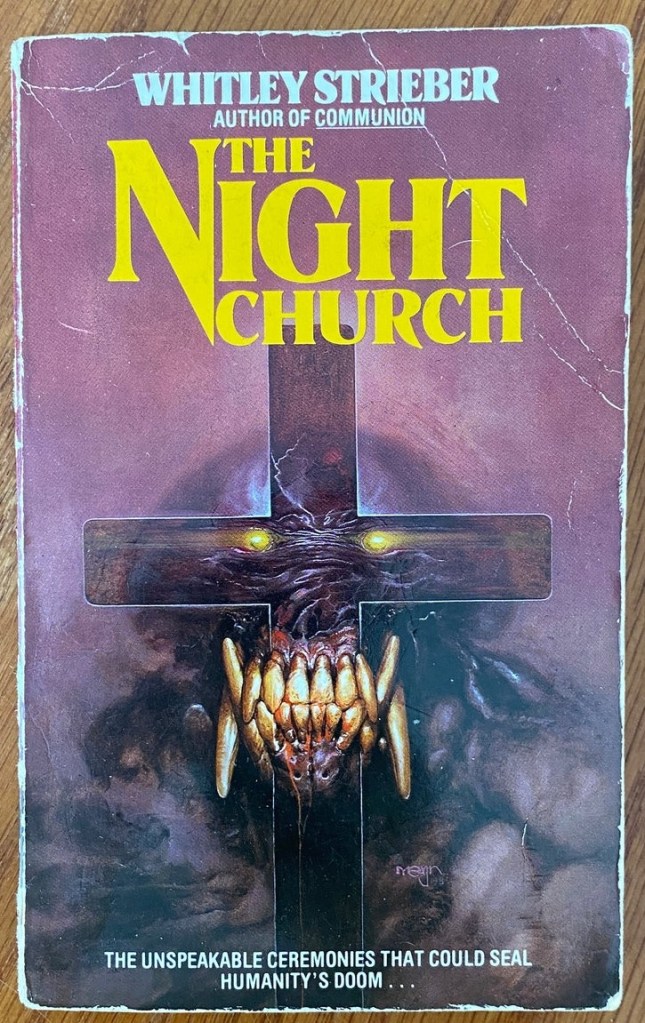
The Night Church
I was expecting to enjoy this one more as it deals with Satanists rather than werewolves. The different covers are really too. Look at the one above! Unfortunately, the story is boring. A young couple falls in love only to discover that they have been bred to breed the Antichrist. I read this a few months after reading all of the The Omen novelizations, and maybe the similarity to those is what made this seem underwhelming. After finishing this, I waited roughly 6 months until I could convince myself to read another book by Strieber.
Granada – 1983 (Originally published 1982)
Black Magic
I bought a copy of this book after seeing the cover online years ago. Unfortunately, this is a spy novel with only a touch of occultism. The plot is complicated and involves 4 different story lines. There’s the good guy, the evil, gay, psychic Iranian teenager and then 2 Russian communist generals who hate eachother. They’re all working against each other, and I didn’t care about any of them. This was boring crap, and I was very relieved to finish it.
The Wolfen was pretty good, but The Night Church and Black Magic were a waste of my time. I do plan to read The Hunger in the future as I’ve heard it’s one of his better efforts. I doubt I will ever return to Strieber’s non-fiction.
Sorry for not posting last week. I’ve been travelling, and I haven’t had much time to sit down and blog.
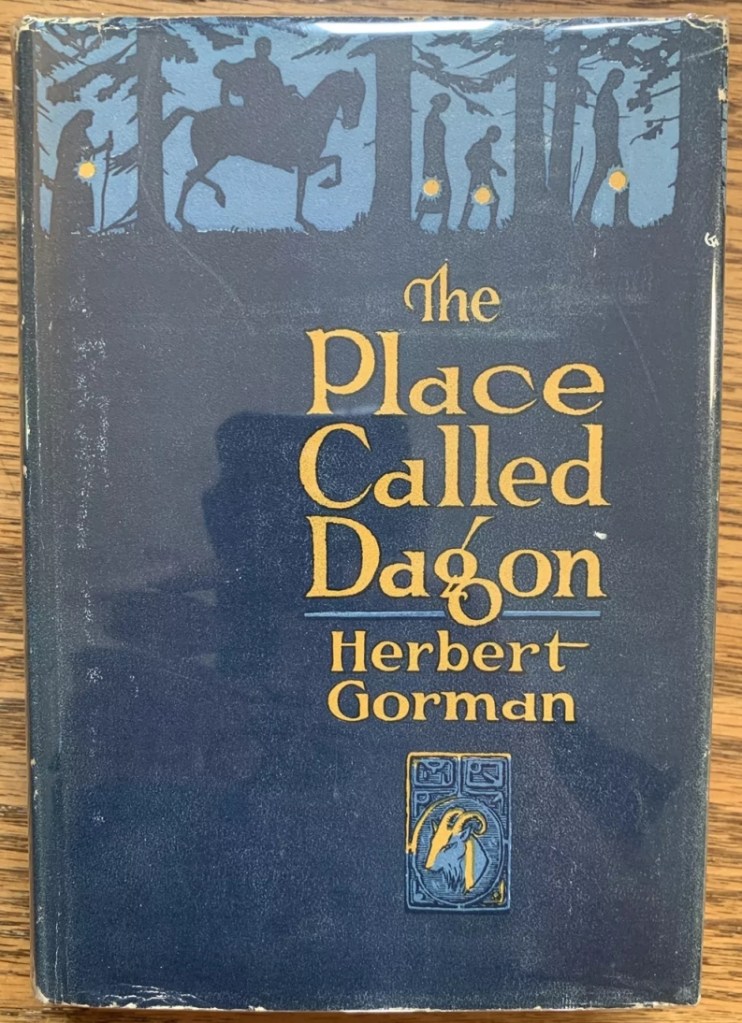
I read Herbert Gorman’s The Place Called Dagon a few weeks ago. I had read somewhere that it had influenced Lovecraft, and its title made it seem like the influence would be pretty direct. I enjoyed the book, and while it did feel very similar to some of Lovecraft’s tales, it wasn’t really what I expected.
George H. Doran Company – 1927
A doctor moves to a remote town in New England. He’s largely shunned by the locals. Things start to change when he is called to the home of the local eccentric who has just shot himself in the foot. This lad is a weirdo, but his wife is a total babe. One thing leads to another, and it’s not long until the doctor finds himself at a Satanic coven’s ritual sacrifice.
This is actually a pretty straight forward folk horror story, but the setting and tone is very similar to some of Lovecraft’s work. I was a bit surprised because when I think of what stands out about Lovecraftian horror, I tend to think of the cosmic side of things, strange and terrible gods that are oblivious to the suffering of humanity, but the evil in Gorman’s book is actually quite prosaic. There’s definite Dunwich vibes, but no real Yog Sothothery. The Dagon referred to in the book’s title is literally a place too. There’s no fish Gods involved.
I quite enjoyed this one. I went back and took a look to see what Lovecraft actually said about it. All I could find was a brief mention in his essay on Supernatural Horror in Literature. I remember reading Stephen King’s Danse Macabre, a book about horror fiction, a few years ago and then going back and reading all of the books it mentioned. I did the same thing after reading T.E.D. Klein’s The Ceremonies. I’m a bit surprised that I haven’t gone through Lovecraft’s essay in more detail and then hunted down the books mentioned therein. I’m just glancing through it now and seeing a lot of familiar names. Maybe I’ll get going on that soon.
Sinclair’s Lud Heat (1975) and Moore’s From Hell (1999)
I first heard of Nicholas Hawksmoor when I read Alan Moore and Eddie Campbell’s From Hell, a graphic novel about the Jack the Ripper murders (more to come on that topic in the next few weeks!). Hawksmoor was an architect in the late 17th and early 18th centuries, and in Moore’s book, there are repeated references to the churches Hawksmoor designed in London. Moore suggests that the locations and designs of these churches bely their function as places of Christian worship. Hawksmoor was actually a Satanic pagan, and his churches were designed as talismans to serve in the great ritual of London city. The fact that Whitechapel, Jack the Ripper’s hunting ground, is situated between 2 of Hawksmoor’s churches is no coincidence.
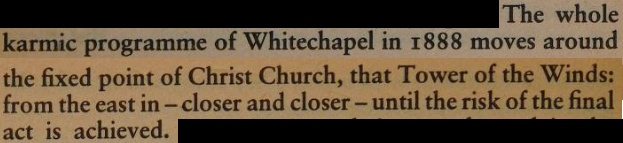
Quote from Sinclair’s Lud Heat
One of the major accomplishments of Moore’s meticulously researched work on From Hell is the synthesis of different conspiracies, characters and ideas from and about London in the late 1880s, and the notion of Hawksmoor’s churches being evil talismans originally comes from an author named Iain Sinclair. In 1975, he published a book of poetry called Lud Heat. The first section of the book is titled, Nicholas Hawksmoor, His Churches, and it’s here that Sinclair puts forth the idea that Hawksmoor deliberately infused his churches with sinister codes and symbols.
Quote from Sinclair’s Lud Heat
While there is no real evidence that Hawksmoor was a Satanist, he did incorporate obelisks, pyramids and other supposedly pagan symbols into his architecture. He was also extremely picky about the sites where his churches were to be built. When plotted on a map, they are said to form a pentagram, and Hawksmoor had them built in curious historical locations.
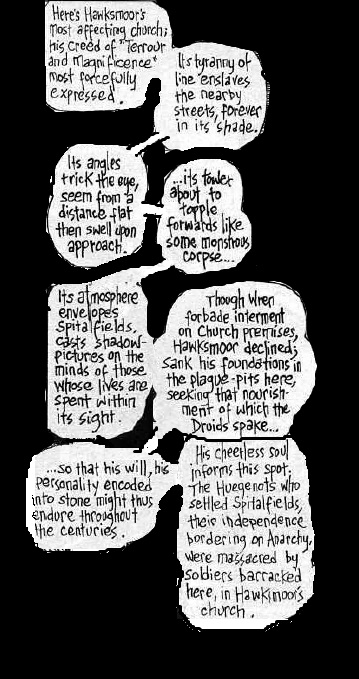
From Hell Chapter 4. Note the claim that the stone of the church will ensure the survival of Hawksmoor’s will.
Sinclair is a proponent of psychogeography. Psychogeography, as far as I understand it, is basically the process of walking around an area in an attempt to understand how its layout and architecture affect people. Alan Moore is friends with Sinclair and has openly acknowledged the influence of Sinclair’s ideas on From Hell. (Sinclair himself wrote a book about the ripper murders which I plan to read soon.)
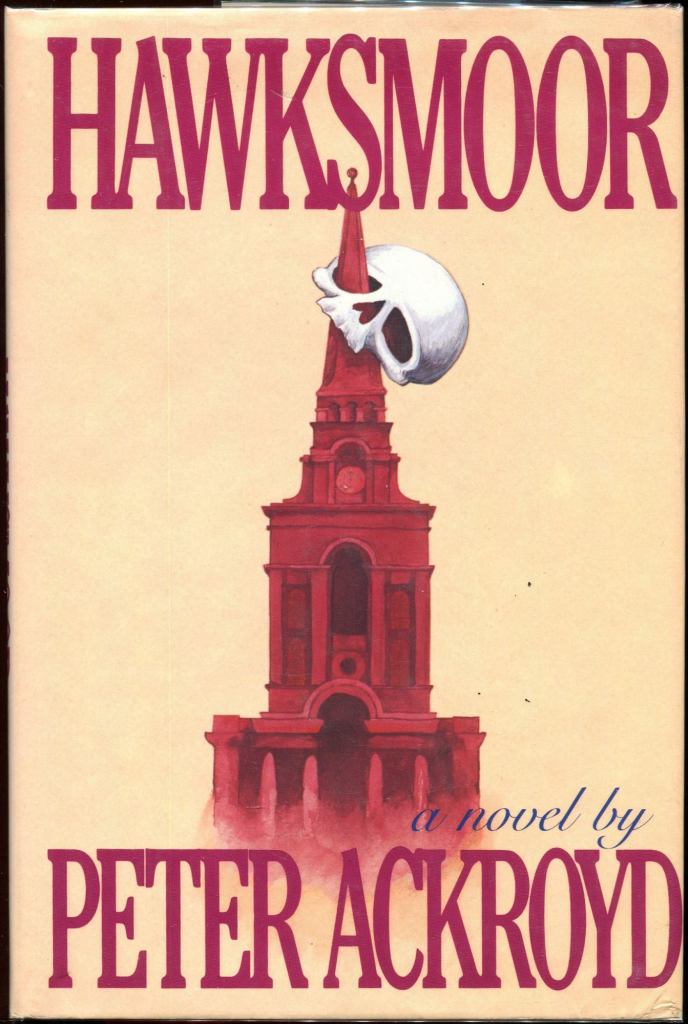
Lud Heat is very much a poem about London. I’ve been to London a few times, but I don’t know the city well enough to really have a feel of what Sinclair is talking about. I also don’t care much for poetry, so while I read through his Hawksmoor poem, it didn’t really do much for me. This poem was published in 1975, and From Hell was finished roughly 20 years later, but halfway through this period, novelist Peter Ackroyd published Hawksmoor, another novel influenced by Sinclair’s ideas on Hawksmoor and psychogeography.
Harper and Row – 1985
Hawksmoor has 2 storylines. One deals with the trials and tribulations of Nicholas Dyer, a cantankerous architect who was initiated into a sinister cult as a child after his parents died of the plague. There’s a few minor discrepancies, but Dyer is clearly based on the real Hawksmoor. This is confusing because the second narrative takes place 200 years later and focuses on a homicide detective named Hawksmoor…
As Dyer’s churches are erected, he commits ritual murder at the site of each of these edifices to instill them with a malignant power. When the narrative switches to the present day, the reader witnesses Hawksmoor investigating similar recent murders that have occurred in the same locations as Dyer’s sacrifices. He is unable to solve these crimes, and the implication is that the sinister power that was imbued into each of the churches is still at work today. It’s not quite clear whether the recent deaths are to reinvigorate the churches with fresh sinister power or whether these crimes are just a grisly echo of evil “reverberating down the centuries”.
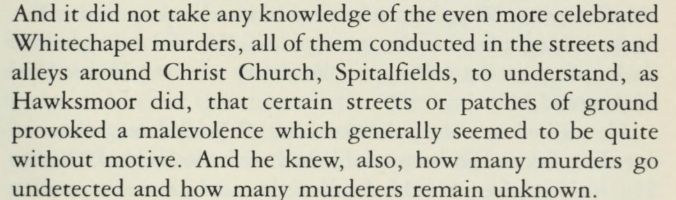
Quote from Ackroyd’s Hawksmoor (Remember that the Hawksmoor mentioned here is actually a police officer!)
Ackroyd only mentions the Whitechapel murders briefly his novel, but the notion that the design and locations of Dyer’s churches are responsible for violent deaths is central. Also, the fact that the murders in Ackroyd’s book are unsolvable does have an eerie parallel with the Jack the Ripper murders.
Ackroyd’s Hawksmoor is entertaining and at times quite funny, and while it’s more literary than what I usually read nowadays, I quite enjoyed it. I had been going through a bit of a lull with my reading material, and as I was reading this, it got me excited about books again. I have been meaning to read some books about Jack the Ripper for a while now, so I jumped at the chance to reread From Hell, and all of this talk of buildings being imbued with sinister powers caused me to revisit another old favourite.
Psychogeography seemed like quite a novel idea to me at first, but then I realised it was very similar to the mysterious science of megapolisomancy described in Fritz Leiber’s classic Our Lady of Darkness. Megapolisomancy: A New Science of Cities is a mysterious (and unfortunately ficitonal) book written by an even more mysterious character named Thibaut de Castries. De Castries believed that modern cities were dangerous places because of the materials used to construct their buildings. The layout and architecture of these buildings can drive people mad. De Castries claims that these pieces of architecture attract paramentals, bizarre entities that feed on human terror. A building designed in a particular way could be used to manipulate these entities into doing ones bidding.
Quote from Leiber’s Our Lady of Darkness
This is pretty much the exact idea that Sinclair, Ackroyd and Moore use in their respective books works involving Hawksmoor. Compare Thibaut’s thoughts there with the Sinclair’s description of Hawksmoor above. Note the emphasis on location, geometry and ritual.
De Castries dies before the events described in Our Lady of Darkness, but the effects of his work are felt long after he’s gone. Compare the following quote from Megapolisomancy with the events described in Ackroyd’s Hawksmoor and Moore’s From Hell. The buildings, these talismans of concrete are designed to house a lingering terror whose effects continue long into the future.
Quote from Leiber’s Our Lady of Darkness. De Castries probably doesn’t want to commit these “manipulations” to print because they involve ritual murders in the style of Hawksmoor!
In Our Lady of Darkness, the protagonist is terrorised by a paramental entity that had been coded onto the local architecture by an infernal work of neo-pythagorean meta-geometry (God, I love that phrase!). Ackroyd’s Hawksmoor leave rooms for a similar interpretation. The murders in From Hell are commited by a human of flesh and blood, but the murderer himself repeatedly refers to the influence of Hawksmoor’s churches on his heinous acts.
From Hell, Chapter 4 “magic… reverberating down the centuries”
Now at first I thought this was all a coincidence. Fritz Leiber’s first novel was first published before Sinclair, Ackroyd or Moore were born, and Our Lady of Darkness actually came out when Leiber was in his late 60s, 2 years after Sinclair’s Lud Heat had been published. Sinclair did not invent psychogeography, but the similarities between his ideas on Hawksmoor and Leiber’s megapolisomancy seem very specific. How would an old man have gotten wind of this new fangled version of psychogeography and put it into his novel? Now I can’t say for certain, but I’ve come across a potential explanation. Leiber was famous for popularizing the sword and sorcery genre along with English writer Michael Moorcock. These two authors were apparently good friends, and doubtlessly recommended books to each other. In 1995, Moorcock actually wrote an introduction to a new edition of Sinclair’s Lud Heat. He claims that he first met Sinclair as the author of Lud Heat, so it’s a long shot, but it’s not entirely impossible that Moorcock had read Lud Heat and suggested it to Leiber before Leiber wrote his first draft of Our Lady of Darkness. I know that Alan Moore is chummy with Moorcock, and Moorcock has also expressed praise for Ackroyd’s work, so it seems likely that Moorcock likely has some interest in their notion of psychogeography… It’s probably just a coincidence, but it’s fun to connect the dots.
I quite enjoyed writing this post. I’m going to have another post featuring From Hell in the near future. I generally avoid talking about graphic novels on here, but Moore is something of an authority on this stuff and I love him as an author and a person. It was funny reading through the appendix at the end of From Hell and seeing mention of my pal James Shelby Downard. Hawksmoor was initiated in freemasonry a few years before he died. I wonder what Downard would make of that!
I’m currently working on a few multi-book posts, and I realised yesterday that I had nothing prepared for this week’s post. I went through the archives looking for something short enough to get through in one day and found a curious pamphlet on the history of Satanism. I had no idea who Joseph McCabe, was, and I assumed this was going to be an evangelical tract, but it turns out that this McCabe guy was actually an important player in the rationalist and secularist movements of the early 20th century. Prior to writing texts like this, he was actually a Catholic priest, and so he has a pretty decent idea of what he’s talking about.
Haldeman-Julius – 1948
This deceptively dense text was written before the rise of the Church of Satan, and it presents a fairly unique historical perspective. The author doesn’t believe in Satan, but he does accept the notion of Satanic (yet mostly benign) witchcraft being fairly widespread throughout Europe during the Dark Ages. Here’s a chapter by chapter summary:
Chapter 1. How people started to believe in devils. First they came to believe in their own spirit and then the spirits of things. Then they imagined evil demons were responsible for things going wrong.
Chapter 2. How Satan went from a friend of God in the book of Job to a prince of demons. McCabe claims it was the due to the influence of Angra Mainyu, the destructive spirt of Zoroastrianism.
Chapter 3. During the Dark Ages, belief in the devil gave way to belief in vampires and werewolves. This chapter discusses incubi and succubi and the unlikely processes they use to impregnate sinners.
Chapter 4. McCabe believes that there was a witch cult as described by Margaret Murray but that it was more a revolt against Christianity than a cult dedicated to doing evil. Sure the witches used to hold orgies, but what harm is there in that?
Chapter 5. How the templars did actually bum each other and how the culprits involved in the Affair of the Poisons in the court of Louis XIV were sincere and genuine Satanists.
Chapter 6. Describes how people have come to see the freemasons as Satanists. Discusses the Taxil affair. Points out that communists are the modern day Satanists.
Joseph McCabe
Overall, the information in this book is not very accurate, but it offers an interesting insight into the way that people thought about the concept of Satanism before it became a codified system of belief. If you want to give it a read, it’s available to download here.
I’m not huge into novelisations. I’ve read the first 2 Halloween novels, the Jaws sequels and Teddy, but those books, or at least certain books in those series are known for being considerably different to the movie versions. I decided to check out the Omen novels as I knew that these ended up in a different timeline to the film series.
The Omen – David Seltzer
Signet – 1976
The novelisation of the first Omen film was actually written by the same guy who wrote the screenplay for the movie. It has probably been 20 years since I saw the movie, but I had a pretty clear idea of what was going to happen. A baby adopted by the US ambassador to Britain is the Antichrist, and he and his followers are going to fuck up anyone who figures this out. The only way to stop him is to stab him with a set of 7 magic daggers. Knowing what was going to happen didn’t stop me from enjoying this book. It was exciting and atmospheric, and it’s in no way surprising that the movie version was so successful.
Damien Omen II – Joseph Howard
Futura – 1990 (first published 1978)
I haven’t seen the second movie, and after reading its novelization, I have absolutely no desire to do so. It’s basically the exact same plot as the first one, but this time Damien is a young teenager. This movie and book were clearly made to make money. There is nothing of interest here.
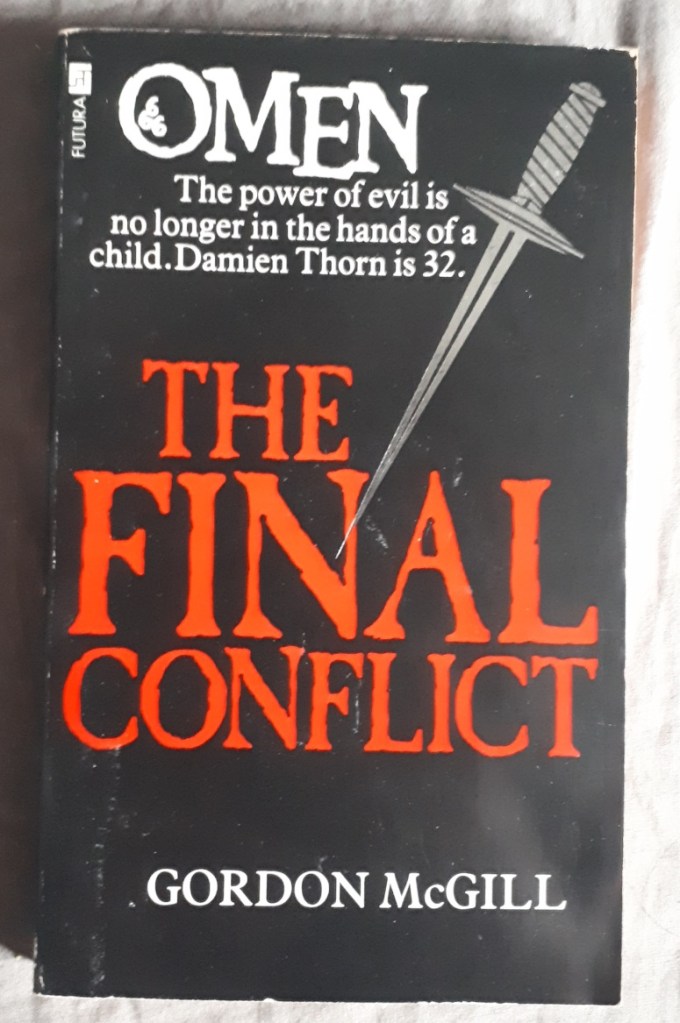
The Omen: The Final Conflict – Gordon McGill
Futura – 1983 (first published 1980)
The third book is a little different. Damien is an adult here, and he has become head of the Thorn Corporation, a huge multinational corporation. He is wealthy and powerful and about to bring about the end of the world. He gets close, but then Jesus shows up unannounced and ruins his plans. There is a scene near the end of the book when he surprises his date by anally raping her. This seems inconsequential at the time, but it’s important in the next book.
Omen IV: Armageddon 2000 – Gordon McGill
Futura – 1983
So the 4th Omen novel has nothing to do with the 4th Omen movie. It was written as a direct sequel to the 3rd movie, but it was never produced. Damien is dead in this one, but because he was only stabbed with one of the 7 daggers, the reign of the Antichrist was not prevented, and his power was passed down to his son. “His son?”, I hear you say, “but Damien didn’t have a son!” Well, this is where the anal rape from the last book comes into play. It turns out that he actually got his girlfriend anally pregnant when he came up her ass, and nine months later she shat out an evil baby. Literally. This evil bum-baby is now a teenager, and he plays with his father’s corpse in an attempt to blow up the world. He comes pretty close.
Omen V: The Abomination – Gordon McGill
Futura – 1985
The 5th book is also by McGill and was also never produced. It’s more of the same. Junior is still intent on destroying the world, but a reporter figures out what he is doing and tries to stop him. By the time I got to this book I had had enough.
With the exception of the first book, this series was repetitive garbage. All the novels are about 200 pages, and there’s so many characters that it’s hard to care about any of them. Also, given the fact that the Antichrist’s aim is to bring around the end of the world, there’s not much tension in the 2nd, 3rd or 4th book. You know the end isn’t going to come in that book, and by the time you get to the 5th, you’ll be looking forward to all of these asshole characters dying. I watched the prequel movie that came out last year, and I quite liked it, but I have no desire to go back and watch any of the other movies now.
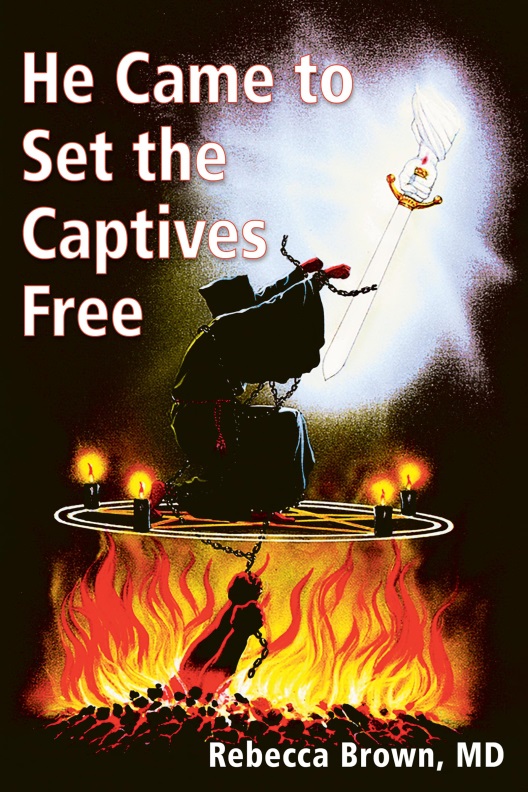
I’ve read a fair few Satanic Panic texts. They’re all pretty ridiculous, from the Devil’s rhymes in Michelle Remembers to the creepy illustrations in Don’t Take Me Back, Mommy to the cattle mutilation claims in Jay’s Journal. Those are all pretty silly, but none of those books are quite as ludicrous as Rebecca Brown’s He Came to Set the Captives Free. This is not a novel, but it has werewolves.
Just a bit of background before I start the summary. Rebecca Brown, the author, was actually a doctor, but her doctor’s license was revoked after she started telling cancer patients that they were possessed by demons. She told these patients that she was the only doctor who could help them as she would share their satanic illness. Sharing an illness apparently necessitates sharing treatment too, so Rebecca started giving her patients and herself opioids, and she became badly addicted to painkillers. After this a fellow doctor diagnosed her with schizophrenia. This is all a matter of public record. In fact, if you’re interested, here is the actual documentation detailing the loss of her medical license.
Ok, now that we have established that Rebecca Brown was actually a mad person, let’s look at the contents of her book about spiritual warfare.
Chapter 1. Rebecca is a nurse with a muscular disease. One day, a pastor is brought to her emergency room. He has been tortured and crucified. Rebecca discovers there is a coven of Satanists nearby and one of the head nurses is doing their work at her hospital. This witch convinces sick people to die so they can be reincarnated, but she’s actually summoning demons to take their souls. She sends demons to attack Rebecca. They make her so sick she has to stop working. She almost dies.
Chapter 2. Elaine, another woman, was born with a hair lip. Her mom couldn’t afford surgery, but a nurse at the hospital offered to pay for it in exchange for a vial of the baby’s blood. A high priestess of The Brotherhood, a satanic cult, drank the baby’s blood and in doing so allowed demons into the baby. Elaine grew up with extra strength and magical powers which she used to beat up a footballer player and a lesbian.
Chapter 3. Elaine meets a girl at church camp who introduces her to the Brotherhood. She goes to a camp with a bunch of other psychic teens, and there she is forced to join the Brotherhood. She finds out that they sacrifice humans and this scares her, so armed guards beat her and lock her in a dark room. When she still refuses to join, a witch summons a scary demon to threaten her. This does the trick. She joins the cult and a different demon goes into her body.
Chapter 4. As a member of the Brotherhood, Elaine is given ninja training. She is told that there are 1000 members of the cult in her city. She starts to summon demons by herself. They are physical monsters. One demon, Mann-chan, possesses her and takes control of her life. Elaine gets her demons to beat up another woman. Then she meets Satan. The actual Satan appears as a man and they hang out. Later he shows up in front of Elaine and 1000 other people to stab a baby to death and take out its heart. Then Satan fucks Elaine. This deformed, cleft-palate loner is so important that the devil, the 2nd most powerful entity in the universe shows up to coach her in his evil ways.
Chapter 5. Elaine becomes a high priestess, and her and the most powerful witches get together in meetings that are guarded by literal werewolves. Even though demons possess her body, Elaine will not involve herself in sacrifices. As punishment for this stubbornness, Satan gives her cancer 4 times.
With a click of her fingers Elaine can turn a cat into a rabbit and back again. She later stands in front of a gun that’a fired 6 times, but some demons stop the bullets from hitting her. She is sent to kill a family who are bringing satanists to Christ, but a host of angels form an impenetrable barrier around this family’s house. These angels ask Elaine to come to Jesus.
Chapter 6. Satan chooses Elaine as his bride so she can mother his son. She gets more power and uses her mind to a woman into a wall so hard that the woman’s body literally goes into the wall. Elaine makes friends with most of the famous (but here nameless) rockstars of the day, every one of them a servant of Satan.
Chapter 7. This chapter is an insane rant about how demons torture each other and molest children in front of their parents and how werewolves, zombies and vampires are all real.
Chaper 8. This section is all about human sacrifices. These are performed on Halloween, a holiday that the author traces back to the Druids in England. Elaine and her friends torture a hitchhiker, make him wear a crown of thorns, whip him and then crucify him. When he’s on the cross the high priest does a wee on him and then the congregation shit in their hands and throw it at him. Then they stick a spike into his head and Satan appears. Then they have an orgy and eat the dead man’s shitty flesh.
Chapter 9. Some demons beat Elaine up. The devil orders her to infiltrate and destroy a church, but when she goes into the church, she is almost immediately converted.
Chapter 10. Elaine gets sick and meets Rebecca, the Christian doctor, in the hospital. They make friends but Elaine throws a Bible at Rebecca when she is prescribed reading the Bible.
Chapter 11. While in the hospital Elaine realises that some of the doctors are satanists who are trying to kill her. Even though she is now a Christian, she uses her demons to beat one so badly he can no longer work, and she astrally projects herself into another doctors apartment and unplugs his fridge to annoy him. The good doctor speaks to god, and he tells her that Elaine is a satanist.
Chapter 12. Elaine and Rebecca move in together. Man-chann and another demon possess Elaine. Satan comes in person to threaten Rebecca. (Keep in mind that in the real world, Rebecca actually lost her medical license because she was caught shooting up with Elaine.)
Chapter 13. Elaine is possessed by demon and tries to kill Rebecca, but Rebecca makes a Jesus-forcefield and Elaine can’t touch her. As a result, Elaine tries to hang herself and cut herself. Eventually she goes into a coma. Rebecca exorcises her by reading the bible. The next day Rebecca comes home to find Elaine blue faced on the couch strangling herself with a belt. Later Elaine is possessed by a woman named Sally who tries to stab Rebecca to death. Elaine again tries to strangle Rebecca. A sexy guardian angel appears to Rebecca. Some demons and satanists using astral projection attack Rebecca and Elaine, but some angels pick them up and carry them to their car. They go to a church and have a 10 hour exorcism.
The rest of the book is less focused on the story of Elaine and Rebecca. The remaining chapters contain the following useful information for concerned Christians:
Demons are passed from one person to another through sexual intercourse. Incest within a family and any participation in homosexuality always leads to demonic infestation. Board games, cartoon, rock music, meditation are all satanic. Getting raped is a guaranteed way to get possessed by a demon. Being a vegetarian is satanic. Christians are god’s servants and Jesus owns them. Satanists are infiltrating and destroying most local churches with great effect. Most illnesses and depression are caused by demons. If your dad rapes you when you are a child, a demon will possess you. Demons, satanists’ astral projections, were-wolves, vampires and violent satanists are the most dangerous threats to Christians.
In these final chapters, the author also describes a conversation she had with a actual werewolf that she met on a road at night. The werewolf is about to kill her, but she tells him that she believes in Jesus and then the werewolf runs away. She tells of a warlock coming to her house and giving her cat an evil spirit too. (Apparently satanists repeatedly try to murder her pets.) She also tells a story about a “negro couple” called “The Blacks” whose 4 year old daughter was skinned alive in front of them by satanists.
There’s a lot going on in this book, but I think that the important points to remember are that the authors of this book claim to have met with Satan, one of them had sex with Satan, and they both met werewolves. In reality, one of these women lost her job because she was injecting opioids into herself, her co-author, and her co-author’s mentally disabled child. So while it’s quite possible that Elaine and Rebecca saw the things they are describing, the fact is that they most likely witnessed these events while rolling around on Elaine’s apartment floor high on Demerol.
There’s no evidence for any of the claims made in this book, and it has been denounced as garbage by many Christian organizations. Unsurprisingly, there’s no record of any of the multiple assaults, kidnappings and murders detailed herein, and vampire sightings are still pretty rare. I suppose I shouldn’t be surprised, but it is genuinely astounding that anyone could write something like this and expect people to believe it. I’m amused by the idea of these 2 junkie lunatics believing that that they’re so important that the devil, the adversary of the creator of the universe, would drop into their kitchen to visit them. It’s cuckoo-crazy nonsense. Unfortunately though, plenty of people did and do believe this crap. This book is still in print after almost 40 years, and it’s available from all big bookstores. The author went on to have a successful career as a preacher. She’s dead now though. May she burn in Hell eternally!
Backward masking, in case you don’t know, is when a musician thinks of an evil satanic thing to say, and then somehow writes and records a seemingly unrelated song lyric that when reversed gives this evil message. The story goes that if you play Stairway to Heaven backwards, it says “my sweet satan”. There’s a part of Judas Priest’s cover of Better by You that apparently sounds like an order to, “Do it!” when played backwards. This message apparently caused a couple of teenagers to make a suicide pact in 1985. One of Ozzy’s songs apparently tells the listener to get their gun.
It’s hard for me to understand how somebody like Ozzy Osbourne would have the intelligence to write a lyric that could run both ways. Don’t get me wrong, I like Ozzy but he’s no Weird Al. (Not only did Weird Al write an entire song of palindromes he also put backwards messages into 2 of his songs.)
So this idea suggests that a bunch of drugged up 70s rockstars were far smarter than they really were, but it also suggests that the fans of this music were so smart that their brains could decode these hidden messages. Seriously, if our brains are smart enough to subconsciously extract backwards words that are intermixed with guitars and drums, wouldn’t we be able to listen to something backwards and then be able to figure out what it said? What kind of evolutionary function would this serve? Here, take the backwards masking challenge!
There’s no sense in digging into this issue too much. The very notion of stadium rock bands attempting to get their fans to kill themselves is ludicrous enough to dismiss this as nonsense. You’d have to be a real moron to take this crap seriously.
Unfortunately, only the first chapter really deals with the backward masking stuff. The explanation given is half-hearted stupid rubbish. The rest of the book is a more general screed on the dangers of rock. This book was actually written before the Judas Priest/Ozzy suicide pact. I watched the Dream Deceivers documentary years ago. It’s truly depressing stuff, and this book probably exacerbated the trauma of the families who were devastated by that tragedy.
Looking through the list of bands at the end of this book is pretty amusing. Bob Larson’s Book of Rock had a very similar list if I remember correctly. They’re mostly inane soft rock groups being painted as depraved Satanists. I’m quite sure that this kind of scaremongering provided the blueprint for bands like Venom and Mercyful Fate. Those guys must have seen this and thought, “That’s a great idea!”
This book was a stupid pile of crap. Keep listening to heavy metal and worshipping the Devil.
When I saw the cover of this book, I knew I’d have to read it. I picked it up a few months ago, but it opens with a quote from another book called Missa Niger: La Messe Noire, and when I looked that book up, I decided to do it before starting on Blood Circle. I read it and wrote a post about Missa Niger, but shortly before publishing it I discovered something intriguing and had to go back to read Blood Circle too.
Sphere Books – 1990
Blood Circle is a nasty horror novel. That cover is not misleading. It’s brutal, sadistic and bloody.
Andrea, a teenage girl, goes to pick some herbs at night, but when she’s out, she runs into a Satanic ceremony where a virgin is being deflowered. Andrea, also a virgin, gets very horny and starts masturbating. Later on in life, she becomes very successful, but the guy who she saw performing the satanic ceremony goes on a killing spree. One thing leads to another and it becomes apparent that they’re going to be reunited pretty quickly. If I go into much more detail, I’ll ruin the story, but I can say that this is extremely nasty stuff. There’s really disgusting parts of this book. Somebody shits on a cross, somebody else fucks their own child, and several people are slowly skinned alive. I was genuinely a bit surprised at how damned unpleasant this book was.
I really dislike when authors use song lyrics as part of their writing. I don’t mean when they use a lyric as an opening for a chapter, although that does suck. I mean when they actually put the words of the song that the character is listening to into their text. It’s such a lame thing to do, and whenever I see it, I assume it’s because the author was listening to that song at the time. Stephen King does this quite often. It’s embarrassing and unnecessary. Bernard King chooses to do this with one of his characters. He has him listening to Vigilante by a band called Magnum. I hadn’t heard this song before, so I checked it out. Terrible. King describes this as “good strong music” and as having a “powerful sound”. Haha. It’s pure shit.
Blood Circle is pretty good. The author clearly had a good idea of what he was talking about. I liked that the ending wasn’t happy, and there were a few plot twists that actually surprised me. The writing was alright, but the book is only 300 pages and it took me a week to finish. It wasn’t one of those “I can’t wait for the next chapter” kind of novels. I’d say you’ll probably enjoy it if you are a sadistic, satanic pervert.
Ok, so let’s get back to this interesting Missa Niger book that’s quoted at the beginning of Blood Circle. Bernard King also thanks the author, one Aubrey Melech, for allowing him to quote from that book and for helping in his research. He follows this with a brief note about how some of the events described in Blood Circle may actually be happening.
Sut Anubis Books – 1986
Missa Niger: La Messe Noire, A True and Factual account of the principal ritual of Satanic worship The Black Mass – Aubrey Melech
This book claims to be the actual script for a black mass. A mere 500 copies were published in 1986, and at that time, the only other printed version of a Black Mass had appeared in Anton LaVey’s The Satanic Rituals. Melech acknowledges this in Missa Niger but claims that his text is more authentic.
From King’s Blood Circle
In truth, there’s not much in here that I haven’t come across many times before. This is a fairly tame rendition of the black mass. It includes blasphemy and desecration of the Host, but it steers clear of human sacrifice. I suppose the one feature that stood out to me was the inclusion of an altar girl. A kid attends the mass, pisses in a cup and then the priest splashes the audience with the wee. Honestly, if I was conducting an infernal ritual, I’d leave this part out.
This is also a very short book. It’s about 70 pages long, but most of these are taken up with the Latin version of the mass with the English translation on the opposite page. It’s the kind of thing you’d easily read in one sitting.
In the introduction, the author claims that he is publishing this text for scholarly purposes and not for people to use. I can’t believe that anyone would be that naïve, but on closer research it seems that his motivation to put this out may have been even more sinister. There are people out there who believe he did it purely to make money!
Bernard King/Aubrey Melech
A Satanic internet nerd (and I mean that with sincere respect and admiration) compared the two texts and wrote a detailed analysis of them. They are supposedly so similar that it seems probable that they either came from the same document or that Melech plagiarized LaVey’s text. This guy goes on to claim that Missa Niger was created and published by Melech (who is just a pseudonym for Bernard King) to coincide with the release of Angel Heart, the movie version of William Hjortsberg’s Falling Angel, a novel about Satanist that features scenes of a Black Mass. He believes that King created the text at the behest of Alan Parker, the film’s director. In The Lure of the Sinister, The Unnatural History of Satanism, the author, Gareth Medway, claims that Bernard King is Aubrey Melech. He says that he confronted King about this and that King said Melech was a Satanic friend, but apparently other people confirmed to Medway that King and Melech were the same person. Medway notes that King is an Odinist rather than a Satanist and suggests that the publishing of the Missa Niger text wasn’t an entirely sincere undertaking. This idea is bolstered by the other books that King put out. Most of his novels are mythological fantasy stuff and his non-fiction books are all about Runes. I was a little disappointed by this. I had hoped that Bernard King was a devout Satanist using his books to spread a doctrine of evil.
I enjoyed reading both of these books, but my favourite part of writing this post was reading the stuff on the Synagoga Satanae website from 2002. I genuinely miss the days of angelfire websites. I only hope that people will be looking back on my website in 20 years time.
I’ve been doing a lot of non-fiction recently, so here’s a couple of novels about the Devil:
Falling Angel
Warner Books – 1986 (First published 1978)
Falling Angel is a classic. There’s at least 70 editions of the book, and it was turned into a big Hollywood movie in the 80s with Robert DeNiro and Mickey Rourke. I’ve had a copy on my bookshelf for a long time, but I only sat down to read it recently. It was great. I had seen the movie years ago, and I had an idea where it was going, but I still found the book very suspenseful and very enjoyable.
Harry Angel is a private detective who has been hired to find a missing popstar named Johnny Favourite. The guy who hired him is a rich weirdo named Louis Ciphre. Harry finds himself in a world of murder, voodoo and Satanism pretty quickly.
It’s more of a hard-boiled detective novel with supernatural elements than a straight horror novel, but that’s what makes it so great. There’s lots of suspense, and I got through it in a couple of sittings. It’s a really fun book to read. It made me realise exactly what Richard Jaccoma was going for when he wrote his werewolf novels. (The first of those books came out a year after Angel Heart, the movie version of Fallen Angel, and I doubt this was a coincidence.)
If you haven’t read Falling Angel, you should.
Angel’s Inferno
No Exit Press – 2020
More than 30 years after Falling Angel was published, Hjortsberg started work on a sequel. He finished Angel’s Inferno shortly before he died in 2017. It wasn’t published until 2020.
It wasn’t great. It starts where the last book left off, and the main character is now on the run. He heads to Paris and buys a lot of expensive clothes and eats some fancy food while plotting revenge. The characters and their interactions are enjoyable enough, but the suspense and mystery of the first book is almost entirely absent. The plot is modelled on that of the first book too, but the twist ending here was just a bit too ridiculous for my taste. This book was far longer too. It wasn’t absolutely horrible to read, but it pales in comparison to Falling Angel. I’m glad I didn’t spend 40+ years waiting in anticipation for this.
I bought this at a thrift store a long ago, and it wasn’t until after that I saw that Valancourt Books had reissued it in 2014. That fact together with the old cover art made it seem promising. Soon after picking it up, I read Stephen King shit-talking Frank De Felitta in Danse Macabre, and I knew that this isn’t Frank’s most popular book, so I left it on the backburner for a few years. In the meantime I got a copy of Valancourt’s audiobook version, and just before Christmas I decided I needed to read a book about Satan to get me through the holidays.
This is a story about a church that has been taken over by the Devil. Whenever a priest enters the church, the Devil enters the priest and makes him do horrible things. I was quite surprised by the level of depraved blasphemy featured in here. There’s all kinds of necrophilia and bestiality. There’s even a cool bit where two gay goats come into the church and sodomise each other on the altar. It’s a bit like the artwork on war metal records.
Unfortunately, a Jesuit priest comes to exorcise the church. He allows 2 Harvard parapsychologists to monitor the exorcism. The Devil shows up and starts to fuck with them, but eventually the Pope shows up and saves the day.
Ok, technically, I have just spoiled the ending for you, but it doesn’t seem to me that anything could make that ending any worse. The fucking Pope? The only good thing about the book is the unholy depravity it contains, and de Felitta has to go and ruin that by giving it a “Catholicism saves the day” ending. This would have been such a satisfying book if the Pope had shown up at the end only to become possessed by Satan.
A lot of the novel is taken up with the boring relationship between the parapsychologists. This part sucked. Neither of them are interesting. I want satanic homogoats defiling the house of Christ, not two boring dweebs who get turned on by looking under each other’s chakras.
Overall, this book was quite bad. There’s a few entertaining passages, but it’s mostly quite boring. It took me ages to finish it.
Valancourt – 2014
Now, I mentioned above that I had an audiobook version of the book. Unfortunately this was one of the worst audiobook experiences I have ever had, and I had to get through most of it with the physical book. The narrator, for some reason only known to himself, chose to give the Jesuit character a “Scottish” accent despite the fact that the character is from Boston. This is weird, but it’s made excruciating by the fact that the narrator is not capable of speaking with a Scottish accent. He sounds like an Iranian pirate with a mouthful of kiwis pretending to be Shrek. Honestly, it’s shocking how poor it is. I couldn’t make out what he was trying to say half the time. There’s an Italian character in here too, and that accent was almost identical. The narrator seems to be capable of two voices: regular and foreign. Bizarrely, the Pope character doesn’t get an accent even though it is explicitly stated that he is Sicilian. The only reason I think it was a Scottish accent that this guy was putting on is that the character’s name is Eamon Malcom. I am assuming the narrator recognised Malcolm as a Scottish name from reading Macbeth in school. Eamon is an Irish name, but if I thought for one second that even a single person in the world thought that I sounded like this twat narrator, I’d kill myself.
Seriously, if you’re going to be a narrator, don’t put on accents unless you can actually do them properly. Even then, don’t do them. It’s the equivalent of a cashier at a supermarket attempting to juggle your groceries while scanning them. It probably won’t work, and even if it does, it won’t make anything better. Just do your job and read the fucking book properly.
Frank de Felitta’s most popular book is Audrey Rose. (This is made apparent by the fact that that title takes up as much space the cover of Golgotha Falls as its own title.) I won’t say I’ll never read it, but I have no desire to do so at the moment. He has another one called The Entity that sounds a bit more interesting. Maybe someday.











 Nocturnal Revelries