Love, Sex, Fear, Death: The Inside Story of the Process Church of the Final Judgement Timothy Wyllie Feral House – 2009
I’ve long been meaning to look into the Process Church of the Final Judgement. I remember a big section on them in Gavin Baddeley’s Lucifer Rising, but they’ve popped up in loads of other books I’ve read too. This book, Timothy Wyllie’s Love, Sex, Fear, Death, is a first hand history of this mysterious and misunderstood group of devil worshippers.
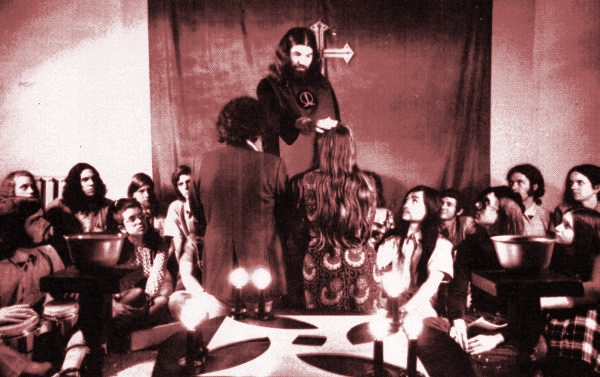
The Process was a British offshoot of scientology. Its leaders, self-styled Messiah, Robert de Grimston and his wife, Mary Ann Maclean, convinced a group of rich students to give up all their money and proselytize for the Church on the streets of London. It was a weird form of proselytization though. The young disciples wore long dark cloaks and sold creepy looking magazines about sex, fear and death. Their literature claimed that they worshipped both Jehovah, Satan and Lucifer, and they occasionally performed occult rituals and self flagellation for the public. It seemed like they put more effort into scaring people away than to luring them in.
This book is a collection of recollections and reminisces of former members of the church. “Church” here basically meaning a cult; it had the central authority figure(s), the need to give up all worldly possessions, thought reform, sexual grooming… it ticks all the “cult” boxes. Perhaps the most curious thing about the Process was that few of the members seem to have taken its religious teachings seriously. This may be due to the fact that these accounts were given decades after the group disbanded and the authors didn’t want to admit their gullibility, but most of them explicitly state that they were never convinced by de Grimston’s absurd theology.
At least they made it look cool.
It almost seems like most members of the Process were aware that the whole thing was nonsense, but they were having fun so they went with it. I wouldn’t say these accounts glamourise life in a cult, but they don’t generally describe it as intolerable. Most of the contributors seem to value the time they spent together. These were young people spending their twenties acting like the bad guys in a Dennis Wheatley novel. Some of them travelled the world with the cult and their reputation and weird looks got them a lot of attention. They hung around with celebrities and got invited to the Playboy Mansion. They had their own rock bands and TV shows too. Honestly, it seems to me like they all knew it was horseshit but kept going because it was fun.
If you walk around in dark capes saying that you worship Satan, it’s only a matter of time before you’ll find yourself in trouble, and the Process were no exception. After the Manson murders, people tried to draw links between the Process’s LA branch and the Manson family. This wasn’t helped when the Process interviewed Manson in their magazine a few years after the murders. A decade after they disbanded, people were still trying to pin the blame for murders on this gang of naïve edge-lords. (There’s a book on that specific topic that I plan to read soon.)
As silly as the Process were, this book is actually very interesting. Wyllie’s narration is so entertaining that I checked to see if he had written any other books. He has, but they are about psychically talking with angels and dolphins, so I will definitely not be reading them. There’s an entertaining video of him online in which he snorts ketamine to communicate with angels. He must be close to 80 in the clip. I don’t want to promote drug use, but if you’re going to get high, that’s the way to do it.
Robert de Grimston
It’s generally accepted now that Mary Ann was the actual leader of the Process. It seems that de Grimston was really just her puppet. She was the one who psychologically manipulated the group members. Sometimes this emotional manipulation degraded into physical abuse. Wyllie recounts an incident when she lured him upstairs to have sex with him and then surprised him when he was cumming with a non-consensual finger up the bum. This doubtlessly constitutes sexual abuse, but it’s also a little bit funny. Wyllie fell for the oldest trick in the book.
The Process was a doomsday cult, but despite their sinister appearance, scary literature and reputation, they weren’t that bad. I get the sense that Processeans were more self aware than members of the People’s Temple or a Heaven’s Gate. The worst thing about the Process was its negligence towards its members’ children. These kids were kept in prison-like conditions, and it seems like most of them ended up dead or badly damaged. It’s for this reason that I can’t really get behind the Process as a cool symbol for dark 60s counter-culture. Lots of extreme musicians have incorporated Process imagery and ideas into their art and thus contributed to the mystique and allure of the group. Realistically though, they were a gang of pretentious, self-centered dorks who were willing to sacrifice worldly comforts (and dignity) for the chance to seem dark and mysterious.
This is a good book though. The piece from Genesis P-Orridge felt a bit tacked on, and the excerpts from de Grimston’s writings are unbearable, but otherwise it was very interesting. I watched the movie/documentary that came after it too, and that was also worth a watch. There is a few other books about these weirdos that I will probably read in the future.
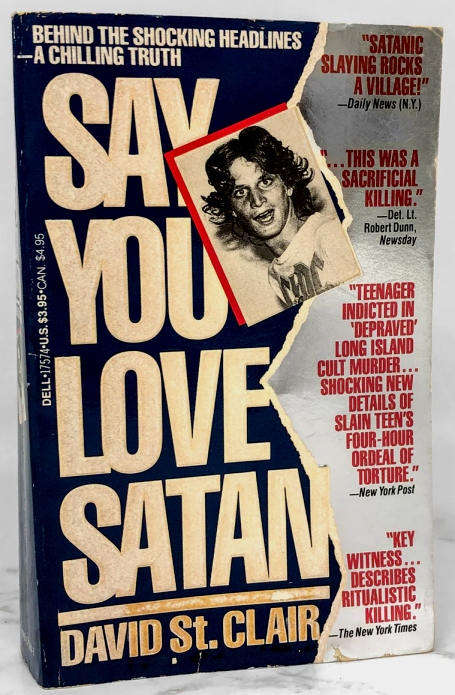
I can’t remember the first time I heard of Ricky Kasso, but I remember watching My Sweet Satan, a short movie roughly based on his last weeks alive, when I was teenager. This book, David St. Clair’s Say You Love Satan, has been on my goodreads to-read list since October 2016, and I was mistakenly under the impression it was the definitive version of the Kasso story. It only took a couple of pages for me to realise that this could not be the case.
I plan to focus on the book rather than the events it describes, but a bit of background on Ricky Kasso is probably necessary.
In 1984, Ricky Kasso, a homeless, mentally unstable, drug addicted, 17 year old, murdered Gary Lauwers, one of his friends, while tripping on hallucinogens in Northport, New York. His pal had stolen drugs from him a few weeks previously. Events like this, while certainly tragic, aren’t particularly rare, but Ricky Kasso was a fan of heavy metal and a self-professed Satanist. He had also previously been arrested for grave-robbing. While it seems that his tastes in music and his interest in the occult had little to do with the actual murder, he apparently ordered his victim to “Say you love Satan” while he was stabbing him in the face. Ricky killed himself a few days after being arrested for the murder. The media latched onto the satanic elements of the story and ran wild with them. Before long, people believed that the city of Northport was home to a coven of sadistic Satanists who had murdered Gary Lauwers as a sacrifice to the Devil.
It’s a fascinating story, and 3 years after it occurred, David St. Clair published this book. Say You Love Satan became, as far as I can tell, the most popular version of the Kasso story. Unfortunately, it’s a very, very shit version of the story. I haven’t read many true crime books, but the story here is presented as a novel, and it’s awful. St. Clair describes lengthy conversations that he wasn’t privy to, and he very clearly had absolutely zero insight into what these kids were like. It’s painful. Page 266 of this book contains some of the worst writing I have ever encountered.
The response from the teenage girl on discovering that her boyfriend has participated in a murder is quite funny, but the awful joke about the child’s corpse at the end is my favourite. How did this nonsense get published?
While this book is sensational, exploitative garbage, it’s not particularly accusatory. St. Clair makes it very clear that he doesn’t approve of heavy metal and occultism, but he also gives the details of Kasso’s unhappy upbringing and drug use, and he doesn’t give any consideration to the idea that there was a satanic cult operating in Northport. Still, the parts where he made fun of Judas Priest’s lyrics made me wince. He also interweaves lyrics from Ozzy Osbourne’s Bark at the Moon into the murder scene. This guy was a real weiner.
Not a fan of Priest or Ozzy
I did a bit of research of David St. Clair. It turns out he was a self-proclaimed psychic, and he also wrote a few other novels that were supposedly about real cases of Satanic possession. Most of his other books looked like trash, but I did actually order one based on its awesome cover art. I’ll review it here in a few months.
I also watched The Acid King, a recent documentary on Ricky Kasso, and everyone in that documentary hates St. Clair’s book. I get it. The people interviewed in that film knew the characters involved, and they have every right to be annoyed that David St. Clair didn’t do a better job of telling their friends’ story. I thought that he had made some scenes up for shock effect, particularly the part where they visit the Amityville haunted house to perform a ritual, but apparently that really happened. Ultimately, both the book and the documentary tell a very similar story. My complaint isn’t that that the author took too many liberties with his characters; it’s that he was an absolutely terrible writer. Apparently, parts of the book were plagiarized too. None of this should have surprised me. A few years ago, I read a book of essays on the Satanic Panic of the 1980s, and there’s an essay in there that contains much of what I discovered while reading Say You Love Satan.
This book is poorly written, but I have other reasons not to like it. I was a heavy metal teenager, and many of my friends are still heavy metal satanists. I’m also a parent, and both the murderer and his victim in this book were children. I knew how this book was going to end, but because the story is basically being novelized, I couldn’t help but root for the characters. A kid goes to library to take out books about witchcraft after listening to Black Sabbath with his friends? I want to give that kid a high five, not read about him murdering his friend and then killing himself. This is an extremely sad story, and the saddest parts really happened. Reading this book was a huge bummer.
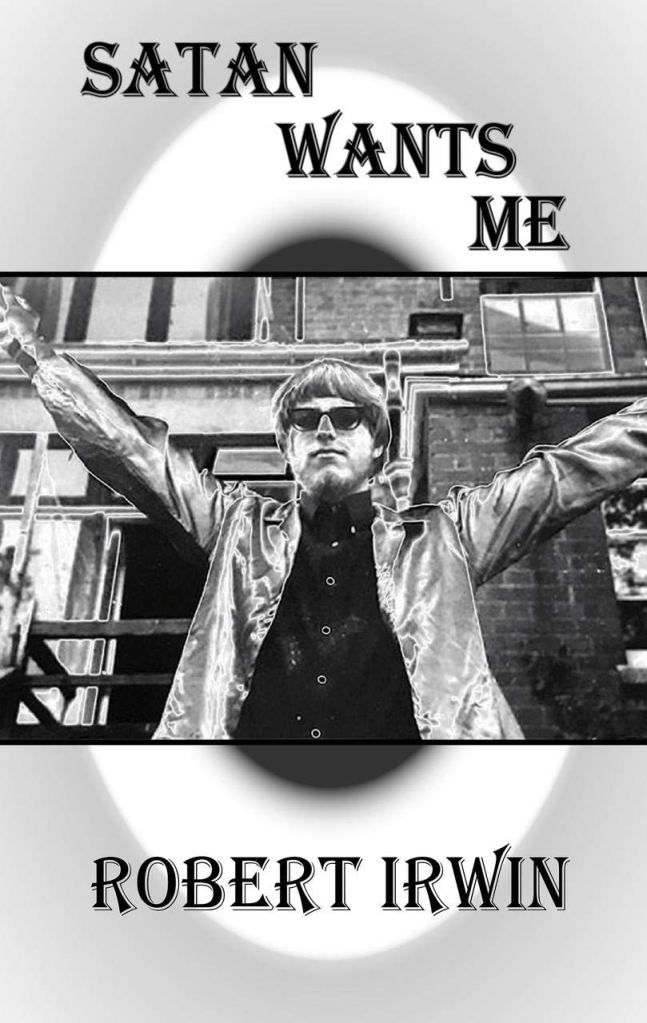
Satan Wants Me – Robert Irwin Dedalus – 2019 (Originally published 1999)
I kept a diary from the time I was 14 until I was 17. Reading back over it now is excruciating. When I started reading Satan Wants Me, an occult novel in the form of a diary, I felt the same embarrassment for the narrator that I do for myself whenever I read my own old journals. The self-absorbed tone of a diary keeper is spot on.
At first I couldn’t figure out whether this was because Robert Irwin was a skilled writer who understood his character or if he was actually transcribing his own diaries. Some of it is really cringey, but in retrospect, I’m sure this was intentional. You’re supposed to think the narrator here is a bit of a wanker.
Peter is a hippy, an occultist and a PhD Candidate. The book starts off when one of the leaders of an occult order he has joined instructs him to keep a diary. The year is 1967, and Peter is mostly occupied with drugs, sex and rock’n’roll (in that order). He joined the occult order so that he could see a demon, but that doesn’t work out immediately.
Somebody recommended this book to me, and I picked it up knowing nothing about it at all. I ended up spending a large portion of the novel wondering what kind of a book it was going to be. A lot of novels about occultism veer into horror, and the ones that don’t are likely metaphorical wishy washy crap. This book seemed neither. As the novel progresses, the protagonist becomes more and more convinced of the efficacy of magic, but nothing actually happens that couldn’t be explained away by a sceptic. I quite admired this aspect of the novel. I feel like Robert Irwin understood what he was writing about.
Interwoven into the story are a bunch of different aspects of occult history. This novel manages to pull off what Eric Ericson’s The Master of the Temple fails to do. A person who knows nothing of the occult will learn from this book without getting too bored. The Satanism is important to the story, but it’s not overbearing.
This is a book about Satanism, sex, hallucinogenic drugs and rock music. I don’t know how it took me so long to check it out. I read it when I was on holidays, and it seemed to take me ages to get through it, but I thought it was pretty good. It only occurred to me as I was editing this post that I have also reviewed a book called Satan Wants You. That one was crap, as I recall.
Mysterious humanoids are roaming our earth, and a diabolical plan of deception, delusion, and destruction has already commenced.
UFOs Satanic Terror – Basil Tyson
Horizon – 1977
I ordered a copy of this book immediately after discovering its existence. I knew that there was no way it could live up to its title, but I needed to have a copy of it on my bookshelf regardless.
The basic idea here is that aliens are actually just servants of the Devil who have been sent to Earth to lead people away from Christianity. The book doesn’t really give any sensible explanation of this theory though. It’s more of a “we don’t understand this, so it must be the Devil” deal.
The one remarkable thing about this book is the way it highlights the narrowness of the author’s worldview. I don’t believe in extraterrestials visiting Earth, but Basil Tyson’s arguments against this narrative are more ridiculous than the narrative itself. He uses passages from the Old Testament to explain events that were supposedly happening the the 20th century. Basil Tyson really comes across as a frightened, confused fool.
After spending much of the book discussing how occultism is dangerous, Tyson claims to be a psychic himself. This is part of the reason he knows so much about the UFO phenomenon. He claims that several demons have appeared to him over the course of his life, one was disguised as his mom. He talked to these demons, and he was even brave enough to laugh at one who was not particularly scary. A tough lad was our Basil.
Basil Tyson was a crazy man, and this is a crazy book. Unfortunately, it’s actually quite a boring read. If you’re into this kind of thing, Bob Larson’s UFOs and the Alien Agenda is a more entertaining piece of garbage on the exact same topic.
The Satanic Orgy – Edmund Blackmoor Tiburon Books – 1974
When I first saw this cover, I thought it was a modern book designed to look old. No. Edmund Blackmoor’s The Satanic Orgy is actually a real work of occult pornography from 1974.
A young couple’s wedding night is ruined when Ralph, the prudish husband, prematurely ejaculates on his wife Rena’s bush. It turns out that this only happened because a satanic witch has put a curse on him. Ralph is the mayor of Garden City, and when he gets back from his honeymoon, the Satanic witch drugs and seduces him and records it. This part was pretty good. She makes sure to degrade him thoroughly, eventually making him wank himself off into the toilet bowl. She then shows the video of their encounter to his wife and gets Warren, her gangster friend, to rape Rena while she’s in shock. The witch also makes a video of this. She then uses these video tapes to blackmail the mayor into allowing Warren to open up a bunch of casinos and brothels in his town.
Ralph and Rena stick together, and now that they’ve seen eachother fucking other people, they open up to eachother and their relationship dramatically improves. Unfortunately, Warren, the guy who raped Rena, decides he wants to rape her again, so he kidnaps her, gang-rapes her with his buddies and then turns her into a prostitute. Gang rape is not at all funny, but this scene was made rather humourous by a gay gangster who kept trying to suck his friends’ dicks while they were busy having a rape. The kidnapping and raping of the mayor’s wife are deemed too much by a higher ranking satanist, and the mayor and his wife are reunited and live happily ever after. The Satanic witch who caused all the trouble is then demoted and impregnated by Satan.
The focus of this story is sex, not Satanism. Sure, there are satanists in here, but the only orgy that occurs seems like a pretty regular orgy to me. The few mentions of anything to do with occultism or witchcraft serve solely to induce more fuck scenes. Whoever wrote this might well have limited their research to a single viewing of Rosemary’s Baby.
According to Kenneth R. Johnson’s article on science-fiction pornography in the July 1977 editon of Science Fiction Collector, this book was originally published as The Witch’s Spell by Gunthar James. I have not been able to verify this, but given my experiences with this kind of stuff, I don’t doubt it’s true.
Alternate version
I got my copy of this in a lot of other works of occult porno. I never enjoy this stuff as much I think I’m going to when I see the covers, but it’s really hard for me to resist. I’ve been researching old porn a bit recently, and a lot of it is very seedy. Human beings are filthy animals.
Children of the Black Sabbath – Anne Hébert Crown Publishers – 1977 (Originally published as Les Enfants du Sabbat in 1975)
This book is about a daughter of Satan who becomes a nun and wreaks havoc in her convent. The title sounds like a heavy metal tribute act. Anne Hébert is a respected author, but she wrote in French, and there’s very few reviews of the English translation of this book. Also, it was recently reissued by Centipede Press, one of the coolest publishers out there. I had to read this.
At first I wasn’t sure if Sister Julie, the protagonist, was actually possessed or if she was just mental. The Devil is here though. There is real wickedness at play, and some very nasty things occur. Sister Julie is from a long line of witches, and without spoiling the story, I will say that she performs a pretty blasphemous miracle by the end of the book.
Hébert was an award winning French Canadian author. There’s unannounced perspective changes and flashbacks in here, and you have to pay attention when you’re reading it. (This isn’t a problem though. There’s plenty going on to hold your attention.) Even though it’s a translation, this book felt more literary than a lot of the horror fiction I review here.
The cover of this 1978 edition is pretty nice.
I’m not really sure what the message of the book is. I might be biased, but I thought the head nun and priest of the convent come across as more dislikable than the daughter of Satan who is working towards their ruin. Sister Julie is not a standard hero figure though. The source of her powers seems to be the incestuous rape and neglect she suffered as a child. The suffering she has endures makes it hard not to want to see her succeed in her endevours, but she also lashes out at people who don’t deserve it. The book doesn’t seem to come firmly down on the side of god or Satan.
This was atmospheric, tense, dark fiction. You should read it.
I remember coming across these in Paperbacks from Hell and immediately writing them off because 7 books seemed like a big commitment and an initial search showed them to be fairly scarce. I took a closer look a few months later and realised I’d have to read them.
Like many of the books featured in Paperbacks from Hell, these titles are very tricky to track down, but these particular books were already scarce when PFH came out. These are erotic novels, and they feature a specific kink. I found a link on Will Errickson’s blog, and it might have something to do with why these books are so hard to find. This webpage is a list of JR Parz’s favourite erotic mind control novels, and it has been online for well over 20 years. The Martin books have been listed at the top of it since it was first posted. Erotic mind control seems like a fairly specific kink, and I’d imagine that the erotic mind control online community is pretty closely knit. Yep, I would be willing to bet that more of the copies of Martin’s books still in existence are sitting shelves of mind control perverts than on the shelves of regular horror fans.
There’s a paragraph on these books in Paperbacks From Hell and an essay inSatanic Panic: Pop-Cultural Paranoia in the 1980s about how Martin’s novels reflect the early 1980’s fear of Satanism, but neither of these sources offer any information on Russell W. Martin, the mysterious pervert who wrote these strange books. The internet isn’t much better. The only online source on Martin I could find was his ISFDB page. That page says he was born in 1933 and that his full name is Russell White Martin, but it also says he cowrote a book about space and drew some pictures for a 1992 science fiction novel called A Fire Upon the Deep. I got hold of both of these books, and I can confirm that the space book was written by a different Russ Martin, and the art in A Fire Upon the Deep was created by Elissa Mitchell. I don’t know if we can believe the other information from ISFDB either.
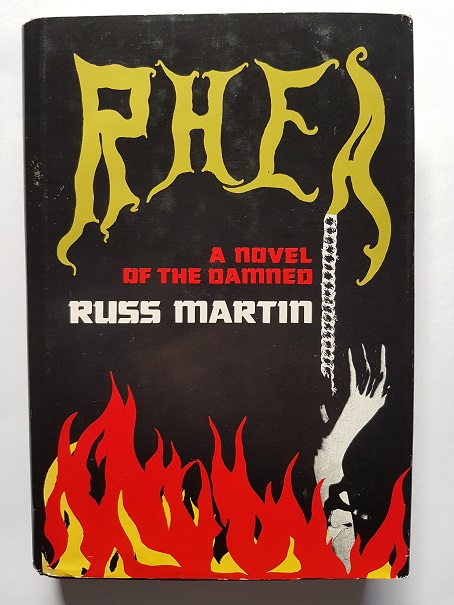
The only reliable information I could find on Martin is on the inside cover of my copy of Chains. Chains is the UK version of Rhea. This information is not included in the Playboy edition of Rhea, published one year later.
I emailed the college he used to work at, but they are yet to respond.
In Paperbacks from Hell, Grady Hendrix claims that Martin wrote 7 novels about the Satanic Organization, but that’s not true, and anyone who has read these books will understand why (details below). Also, Alison Natasi omits Rhea and Candy Sterling from the bibliography to her essay. This might be because one was written in the 70s and the other doesn’t quite fit in with the theme of the essay, but it might also be because Candy Sterling is almost impossible to get hold of. Apart from JR Parz, I am not convinced that I know of anyone who has actually read all 7 of these books.
Hard to find, rarely read, trashy novels about horny Satanists? Hell yes.
Due to the relative scarcity of these books, I am providing summaries of each. If you’re actually planning on reading these, maybe skip to the last 2 paragraphs and then come back once you’re done. (I wrote these reviews as I was reading the books, so I end up answering some of the questions I ask later on in the post.)
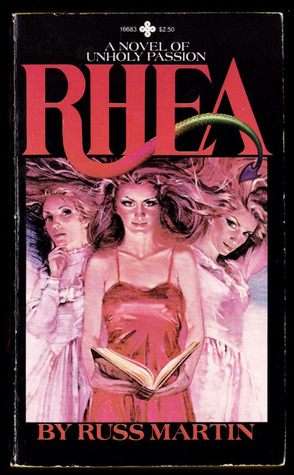
A girl born in the 1700s spends her birthday money on a mysterious old book called Liber de Malo from the back of a merchant’s van. She is a gifted child, and at 5 years of age uses her schooling in Latin to summon a demon. Once she hits puberty, she starts using demons to help her gain complete sexual subordination from anyone she fancies. She does this for about 200 years and then meets Phillip Stafford, a wealthy movie executive.
She gains control over this Phillip guy, but things start to get really nasty once his wife finds out. Philip hires a private detective to figure out Rhea’s game, and it’s through his sleuthing that many of the details of Rhea’s past lives are revealed. The chapters are not in chronological order, and each one offers the perspective of a different character. I was very impressed with how well the plot was crafted. This is sexy, satanic horror fiction, but Russ Martin put some serious work into organising this story.
This isn’t porn though, even if it was published by Playboy. The characters have lots of sex, but there’s barely any graphic sex scenes. The most lurid scene appears towards the end of the novel, and it is anything but sexy.
Parts of the book are scary too. Rhea is proper bad. She’s not just mean and selfish. She’s evil.
Honestly, I was really surprised by how much I liked this one. I don’t know why it hasn’t been reissued since 1980. It felt like a proper gothic novel.
The Desecration of Susan Browning Playboy Paperbacks – 1981
An up-and-coming film maker rescues a woman named Wanda Carmichael from getting raped. Turns out that Wanda’s in league with the devil, and she decides she wants the lad who saved her, so she puts a mind control spell on him. Susan, his wife, isn’t too pleased, so one of Wanda’s associates puts a love spell on her too. Both Susan and her husband are drawn towards people they absolutely hate by an insurmountable force of evil. Susan finds some reprieve when she meets Al Crabbe, a handsome priest who stows her away in a convent, but even he can’t stop the Devil’s powers. The novel ends with a mass gathering of Devil worshippers gathering for a Satanic baptism. Instead of being anointed with holy water, the baby, and probably Antichrist, is anointed with blood from a fresh castration wound. Fr. Crabbe sneaks into this ritual, and although he doesn’t manage to save Susan, he does wreck the party and make off with the baby. The novel ends with Fr. Crabbe looking at the baby and questioning his faith.
The Desecration of Susan Browning wasn’t as impressive a novel as Rhea in terms of plotting but it was still an enjoyable read. There’s less exposition here. While Rhea told the story of how the titular character fell in league with the devil, there’s not as much backstory to Wanda Carmichael. We don’t find out exactly how she has gotten to where she is today. While Rhea felt like a gothic mystery, The Desecration of Susan Browning is more of a thriller.
One of the few things we do find out about the novel’s antagonist is that she is a trans woman. This trashy horror novel was written in 1981, so this isn’t dealt with in particularly a sensitive manner.
There’s also a scene where a Satanist refers to Jesus as a “suckass”. LOL.
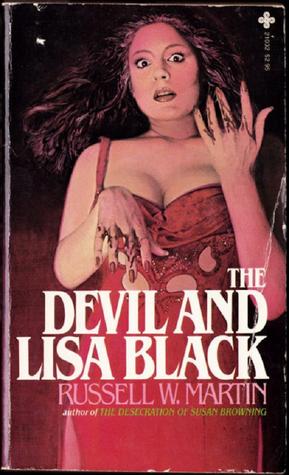
The Devil and Lisa Black Playboy Press – 1982
I’ve seen this described as both a sequel and prequel to Susan Browning, but I think the more appropriate way to describe this book would be as an appendix to its predecessor. Lisa Black is a minor character in The Desecration of Susan Browning. She’s an informant who has had a curse put on her that makes her think she’s hideously ugly. She’s an intriguing character, and if I hadn’t known she that she was going to show up again in a different book, I would have wondered why Martin introduced her.
About half of The Devil and Lisa Black is taken up with Lisa’s backstory. It’s pretty much what I’ve come to expect at this point. A beautiful young girl is bewitched and drawn into a circle of horny Satanists.
The other half of this book deals with Al Crabbe (the priest from the last book). He has abandoned the priesthood and is still looking after the baby he kidnapped from the Satanists (the baby whose high ranking Satanist mom was designated male at birth). Al’s luck takes a turn for the better, and he very quickly ends up with a high paying job, a nice house and several attractive sex slaves, one of whom is Lisa Black. Things get a bit weird for him after he starts seeing the ghosts of Susan Browning. I didn’t expect a happy ending from this one, and I didn’t get one.
It’s a bit of an odd book. The two strands share one character, but Lisa doesn’t really do much in the Al Crabbe part of the story. I mentioned above that I was impressed with how Martin strung the different threads of Rhea together into a cohesive whole and that I thought The Desecration of Susan Browning fell a little short of its predecessor. After reading The Devil and Lisa Black, I think that Russ Martin may have originally intended the the Lisa Black parts of this novel to be part of The Desecration of Susan Browning. They all take place before the events in that book, and they would make her inclusion there more understandable. I wouldn’t be surprised at all if Martin’s publisher had convinced him to cut that stuff out and put it into another novel. I reckon the Al Crabbe stuff here was added on to fill up space.
While this is definitely the worst novel so far, it might also have been the sexiest. I’m pretty sure there’s more boobs in this one anyways. It also contains the greatest line in sleaze fiction history:
This is the first of Martin’s books to be published by Tor.
While the 3 previous books featured relatively small cabals of Satanists, the Satanists in The Possession of Jessica Young are part of an international network referred to as The Organization. The Organization aims to bring about the reign of Satan on Earth. One of the highest ranking members in the Organization is a guy called Stephen Abbott. Part of his job is seeking out psychics who may somehow obstruct the Organization. The exact nature of how these psychics will do this is never really addressed.
Jessica Young is young and beautiful. She’s also the most powerful psychic the Organization have ever come across. She can kill people without touching them. At first Stephen Abbott does the ol’ mind control spell on her and gets her to kill her own family. Unfortunately for Abbott, her powers are so strong that she breaks the spell herself. Abbott is left with little choice but to lobotomise her. The lobotomy scene is pretty degrading and gross.
This book felt distinctly more mean spirited than its predecessors. This is less a novel about dashed hopes. It’s more a novel about suffering. Jessica has already killed her family by the time the book begins, and we’ve already come to understand that Martin’s books end in a worse place than where they began. Sure, the bad guys are Satanists and Jessica is psychic, but the occultism that kept Rhea exciting is entirely gone. This felt more like a book written for dudes who like the idea of having complete control over a woman. There’s a slight reprieve of misery at the very end of the book, but it doesn’t make up for what’s happened.
I don’t know. Maybe I’m just reading through these too quickly and I’m getting a bit tired of them, but I didn’t really enjoy this one very much.
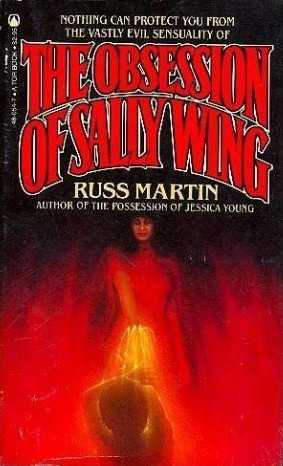
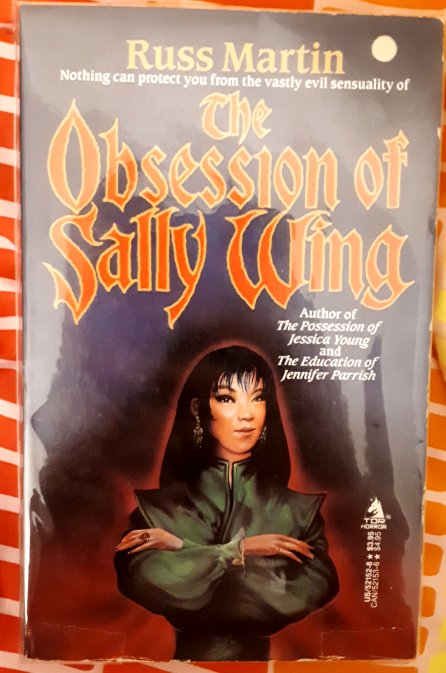
The Obsession of Sally Wing Tor – 1983/1988*
This is a direct sequel to The Possession of Jessica Young. Half the book won’t make sense unless you’ve read that book beforehand.
The plot is a bit of a mess at this stage.
Jessica Young was lobotomised at the end of the last novel, but her soul fled into her sisters body and took over. Her sister is obsessed by Stephen Abbott (the main man from the Organization), so this is tricky business. If Jessica gives her sister any control over her own body, she will turn themself in for a chance to see her loverboy. Half the novel tells the story of Jessica trying to gain access to Stephen Abbott, but when she gets close enough to kill him, she changes her mind and has a brief affair with him.
The other half of the novel is about a former child prostitute named Sally Wing. The Organization turns her into a vampire, and she kills a bunch of children. After she kills a child that the Organization had turned into an adult, the Organization loses its patience and has Sally raped and murdered. The Sally Wing part of the story has absolutely no overlap with the Jessica young part.
Sally feeds on fear rather than blood, and there’s one part where she does a really good job at scaring a little girl that I did not enjoy reading.
I was pretty surprised with how this one ended. There’s no revenge, but Jessica Young is not dead or evil yet.
*(I’m not sure about the publication date of the second version pictured above. Will Errickson and ISFDB say it’s from 1988, but my copy says first edition on the inside cover. This is extra confusing as it also lists The Education of Jennifer Parrish in the “Other titles by this author” section. That book wasn’t published until 1984 though… Probably just an error.)
The Education of Jennifer Parrish Tor – 1984*
*(This cover is from 1988. I don’t know if there was ever a different cover for this one. There were alternate covers for the other 2 Tor novels.)
Like The Obsession of Sally Wing, this book has two almost entirely separate storylines. This is the third book dealing with the saga of Jessica Young and Stephen Abbott. It also introduces a brand new scenario and cast of characters.
Jennifer Parrish, a teenager, tries to kill a rapist, so she’s forced into a military-style boarding school that’s owned by the Satanic Organization. Why would Satanists run a school? Well, when a high ranking Satanist gets old, they visit the school, pick out an attractive student and then forcibly trade bodies with them. The procedure doesn’t initially work on Jennifer because she’s a virgin, but the Organization figures out a way to remedy this.
Stephen Abbott’s failure to subdue Jessica Young by the end of the previous book has got him in big trouble with the Organization. He is told that if he doesn’t get her under his control, he will be obsessed by a sadistic woman that he hates. He manages to have sex with Jessica at least once more, but despite his pleas, she runs away and allows him to become obsessed.
Jennifer Parrish dies, but she only took up half a book. Jessica Young escapes, and her tormentor from the first book in this trilogy is in a far worse position than her. Martin doesn’t tell us where Jessica is going to go or what she’s going to do next, and Abbott is obsessed, but Jessica has the power to cancel an obsession, so although the ending to this book is tidier than its predecessors, it does not rule out a continuation of the story. Unfortunately, no further books in this series were ever published.
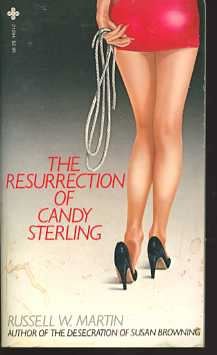
The Resurrection of Candy Sterling Playboy Press – 1982
This is by far the hardest Russ Martin novel to find. Some of the others go for ridiculous prices, but I have never even seen a copy of this for sale online. I left it till last because I taught it was written last, but it turns out that this was actually published 2 months after The Devil and Lisa Black. This was Martin’s last novel on Playboy Press, and this publisher shut down shortly after it was released, so there were probably fewer copies of this printed than the others.
If you are reading Martin’ books due to an interest in Satanism in literature, you can skip this one. This deals with a cult, but nothing Satanic. Let me tell you, it’s easier to stomach sadism if the perpetrator is supposed to be a worshipper of evil. Having normal people perform acts of brutal sexual violence makes it much nastier.
Candy Sterling is a stupid prostitute. I don’t mean to imply that prostitutes are stupid. Candy is both a prostitute and an imbecile. She joins a cult led by a mysterious figure known as “The Prophet”. This Prophet guy convinces rich people to give him all their money and then spend the rest of their lives working on his farm or, if they are beautiful teenage girls, working in his mansion.
This is where the commonality with Martin’s other books shines through. The Prophet has absolute control over his followers. They will do anything he tells them to. Candy is mugged while in his service, but she refuses to give his money to the mugger even after he brutally assaults her. The mugger is so impressed with her fortitude that he joins the cult himself. (His reasoning here is never fully explained.)
Soon enough, Candy and her mugger are married and given the special job of murdering apostates of the cult. It quickly becomes apparent that Candy is the more unstable of the two when she tortures a family of rape victims to death. She later leads her husband back to the the scene of this murder and then shoots him in the head while he is performing cunnilingus on her.
Honestly, if sexual violence isn’t your thing, avoid this book. It was surprisingly extreme.
Having read Martin’s other novels, there’s something disquieting about the focus on brainwashing and power relations in here. You don’t write 7 erotic novels heavily featuring the same kind of kink if you’re not into that kink yourself. But Candy Sterling is not the kind of story you should be wanking too. This is a grim read, and the sincerity of the eroticism made me feel a bit dirty. Even JR Parz gave this one a negative review.
Ok, so if you haven’t been paying attention, let me sum up the sequence of these books. Rhea and The Resurrection of Candy Sterling are standalone texts. The Desecration of Susan Browning and The Devil and Lisa Black are a pair. The Possession of Jessica Young, The Obsession of Sandy Wing, and The Education of Jennifer Parrish are the first three books in an unfinished series.
These are novels about Satanists and black magicians, but most of the occult rituals occur behind closed doors. The Satanism on display is of the trashy horror novel variety. The essay in Satanic Panic about these novels is probably a better place to look if you want some commentary on how they reflect the social values of when they were written. I read them for enjoyment, and they got the job done. Rhea was definitely the best; if you’re going to read any of them, make it that one. The others are varying degrees of ok, definitely not worth the prices that some sellers are asking for them.
Phew, I think this might be the longest post I’ve written. I hope it was entertaining/elucidating. If anyone has any information about Russ Martin, please leave a comment or email me.
Satan Wants You – Arthur Lyons Mayflower – 1972 (First published 1970)
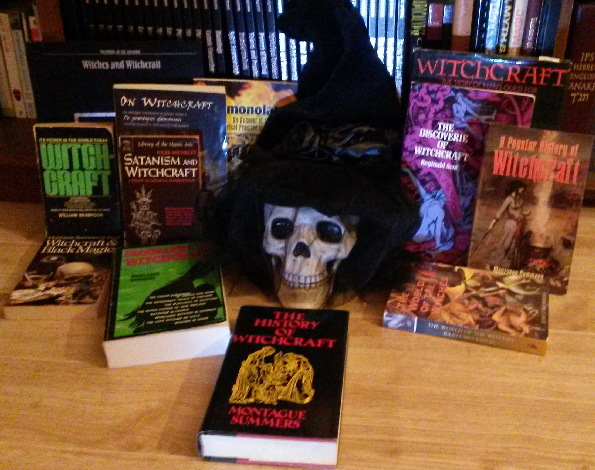
I’ve probably read enough books about the history of witchcraft and Satanism, but this book is called Satan Wants You, and it has a naked babe drinking out of a human skull on the cover.
The first part of the book is the history of the Devil, witchcraft and the Black Mass. This was fine, but I don’t think I learned anything that I didn’t know already.
The second part of the book is a sociological analysis of Satanism. This book was written during the late 1960s, and Satanism back then was quite different to what it is today. The Church of Satan had only been operating for a few years, and none of the other Satanic groups discussed here are mentioned by name. I assume the approach of sociology has also changed quite a bit since this book was written. Honestly, the latter half of this book is outdated and extremely dull.
Satan Wants You is only 170 pages long, but it’s so boring that it took me a couple of weeks to force myself through it. It would be of interest to a person researching what people in the late 60s/early 70s thought about Satanism, but there are plenty of more accurate and/or more entertaining books on the same topic.
As I was writing this post, I started to wonder how many books on this subject I’ve read. I looked through my index page and realised it was more than I remembered.
These are just some of the books that I have read that cover very similar material to Satan Wants You. Check my index page for links to my reviews of these books.
The Devil in Love – Jacques Cazotte Heinemann – 1925 (Originally published as Le Diable Amoureux in 1772)
Jacques Cazotte was a rich French lad who may have been a psychic member of the Illuminati. (He was definitely a freemason, and it is claimed that he prophesized the coming of the French Revolution at a dinner party in 1788.) His head was cut off in 1792.
Oh, and twenty years before he died, he wrote an occult romance called Le Diable Amoureux. There have been several translations of this work into English, and while the earlier ones had a bunch of different titles, most of the versions that are currently available are published as The Devil in Love. I read the 1925 edition, a reprint of the 1793 translation. (Here is a great article that goes into more detail on the different editions of this text, and here is a pdf of the text I read.)
Don Alvaro, a stupid Spanish lad, meets a Jafar type character named Soberano who has power over demons, and Alvaro immediately wants to get in on the action. Soberano tells him that it takes years of training to control demons, but Alvaro summons Beelzebub on his first go. Beelzebub shows up in the form of a minging camel, but he turns into Biondetta, a sexy babe, when Alvaro grimaces.
This image is from a different edition of the book to the one I read.
The rest of the book is basically Biondetta getting Alvaro to fall in love with her. There’s a slow power transfer, and towards the end Alvaro is set to start doing her bidding rather than the other way around.
The story is very straight forward, and it felt pretty familiar to me. This is a very short work too, and the version I read is an old translation of an older book. Maybe some of the charm got lost in translation. The Devil in Love is an interesting little curiosity, but there’s not that much too it. It’s the kind of book that would make a better music video than a movie.
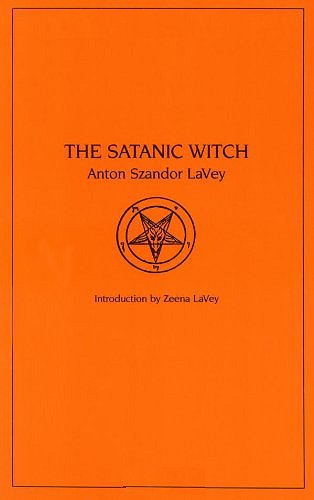
Anton LaVey – The Satanic Witch Feral House – 1989 (Originally published at The Compleat Witch in 1971)
I read the Satanic Bible in January 2014. I originally bought a copy to leave on my coffee table when guests were over as a joke. When I read it, I was amused by much of it but never took it too seriously.
I’ve changed quite a bit since 2014. I got married, became a father and got a real job. I suppose I’ve grown up. I don’t think of myself as a particularly good person, and I think it is everyone’s responsibility to prioritise their own well being, but I have no time for anyone who fails to see the importance of treating others with patience and kindness. I have also spent more than a sensible amount of time posting in “satanic” message groups on facebook over the last few years, and almost every Satanist I have encountered has been an utter imbecile.
The world has changed since 2014 too, almost definitely for the worst. I know that politicians have always been awful, but the political leaders and decisions of the last few years have largely been horrible. A philosophy based on greed and hedonism seems the exact opposite of what the world needs right now.
All of these factors have led me to the conclusion that The Church of Satan and its followers are a gang of dorks. Despite this, I decided to read Anton La Vey’s The Satanic Witch. This book’s cover boasts that it is designed for “women cunning and crafty enough to employ the working formulas within, which instantly surpass the entire catalogue of self help tomes and new age idiocies.” Bullshit. It’s designed for insecure losers who don’t value their individuality.
I had heard that this was embarrassing nonsense, but I wasn’t quite prepared for how stupid it truly is. The 1989 edition begins with an introduction by Zeena LaVey, the author’s daughter. Zeena claims that she became a Satanic Witch at the age of 3 and discusses how she learned that sex could be used as a tool while she was still a child. She talks about looking at her father’s porno magazines as a kid and how she got pregnant when she was 13, two years after she first read The Satanic Witch. These details are provided in attempt to depict Zeena as sexually liberated, but their real effect is to make Anton look like a seriously shitty parent. How are we supposed to take his book of advice for “women who want more control over their lives” seriously when he was such an atrociously irresponsible father? Even a shit father probably cares more about his kid than a stranger, and if LaVey couldn’t prevent his child from getting raped and impregnated at 13, how will he be able to do anything for anyone else? (I know that you shouldn’t blame a rape victim’s parents for their being attacked, but I think its different when the parent is giving their child access to pornography and books on sexual manipulation.)
I managed to get through the first few chapters of ridiculously outdated mysogonistic nonsense, but I gave up when I got to the “LaVey Personality Synthesizer”. LaVey sets out a range of people and shows which type of partner these folks will be compatible with. He writes as if he was an expert psychologist, but we all know he was just a baldy wanker.
I was going to try to paraphrase the sections of the book that I got through, but it’s too excruciating. There’s no sense to any of this utter hogswash. The only thing this pathetic pile of shit will teach anyone is what kind of women dorky little fuckboys like the author are attracted to.
Part of my reason for tryjng to read this pile of crap was that I had heard of a book called The Satanic Warlock that is essentially an updated version of this book intended for the incel crowd. I am still curious about reading this one even though I am sure it’s even worse than The Satanic Witch. Part of my motivation to review The Satanic Warlock is to write a mean spirited review that will hopefully hurt the feelings of the author and his readers, but as Anton LaVey is dead, I have no such impetus to delve any further into his work.
This is the first book of non-fiction that I have discussed this year, and it was a real stinker. If anyone has any recommendations for occult/Fortean/weird non-fiction books that don’t absolutely suck, please send them my way!





















 Nocturnal Revelries