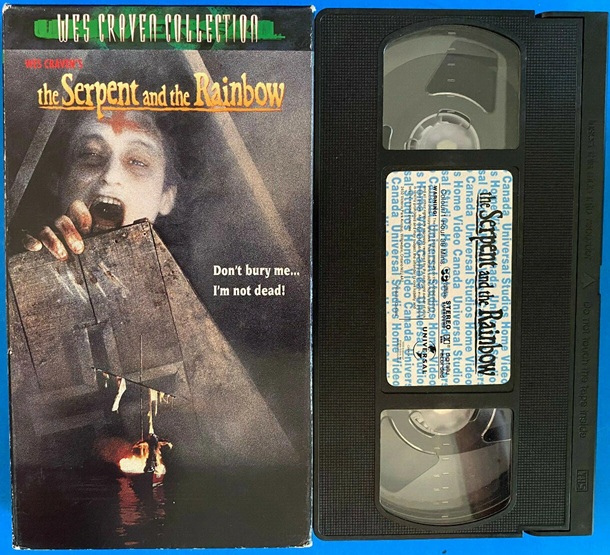
I saw the cover for the VHS of The Serpent and the Rainbow at the video shop after mass when I was a kid. I’ve mentioned before how I would become hung up on the covers of these 18+ rated forbidden films that it seemed I would never see. It stayed with me, and as soon as I could, downloaded and watched the movie. The only thing I remember about the film is that I thought it was shit, so it’s not surprising that I never bothered tracking down the book.
I don’t know why, but it popped into my head the other day, and it took me just a few minutes to locate a copy of the book. I knew that the author was an academic, and the book was somehow related to zombies and voodoo, but I didn’t really know what to expect.
Simon & Schuster – 1985
The book starts off like an adventure novel, the author describing some his experiences in the jungle of south America as a student. This stuff is quite impressive and made me jealous. I never got to travel through the jungle for credits during my time in university. The main adventure begins when he approached by some weirdo academics who tell him about Haitian voodoo and their desire to acquire the elusive poison that is used to turn people into zombies. There had long been claims that people in Haiti were dying and being buried, only to return to their families years later with little to no memory of the intervening time period. The locals attributed this to voodoo, but the academics believed it was being done with a potent chemical.
Davis goes to Haiti to track this stuff down, and he meets a bunch of colourful characters. He helps one of these weirdoes dig up the corpse of a child and then they mix parts of that decaying infant into a potion with bits and pieces of some minging animals.
After a bit of research, Davis realises that it’s the inclusion of a pufferfish in this mixture that’s responsible for the apparent reanimation of corpses. The poison in pufferfish is known to temporarily paralyze in small enough doses, and it is not completely out of the range of possibility that this poison, along with continued doses of other drugs could result in the kind of zombification that had been reported in Haiti.
From what I have read online, Davis’s claims were not well received by the scientifific community. Very little of the pufferfish poison was actually found in the samples of the zombie potion that Davis acquired. There has been debate on this since, but the fishier element (excuse the pun) to me is the notion of zombification. I can’t find any footage online of actual zombification. I’m not expert on Haiti, but I know that it’s had more than its share of troubles. I find it very easy to understand how stories from a place like this could become twisted and exaggerated. Maybe I’m totally wrong about this, but it seems to me that the entire Haitian zombie phenomena is probably bullshit.
The worst part of this book was that it reminded me of John Russo’s absolutely terrible Voodoo Dawn novel that I read a few weeks ago. I’ve read a few other novels about voodoo (Strange Conflict by Dennis Wheatley and Frank Lauria’s Doctor Orient novels come to mind), but I have to say, the only truly enjoyable book I’ve read that really featured voodoo was Hjortsberg’s Falling Angel.
I bought The Wicker Man on DVD about 20 years ago. I can’t have watched it more than twice, but the ending of the film has stuck with me since. I was looking for a book to read recently when I came across David Pinner’s The Ritual, the novel that inspired The Wicker Man.
Ritual – David Pinner
New Authors – 19967
From what I have read, it seems as though the movie people bought the rights to Pinner’s novel, but had to change so much of it that he didn’t get mentioned in the credits of the movie. The plot is very similar.
A policeman ends up in remote village investigating the death of a child. The locals are uncooperative weirdoes and at least some of them practice witchcraft. The memorable scene in the movie where the sergeant humps the wall is taken directly from the book. There’s definitely a similar mood and cast of characters in both Ritual and The Wicker Man, but the ending to the book is quite different and falls far short of the horror of the film. Overall, it’s really more of a mystery featuring elements of the occult than a true horror novel. There’s a little more humour in it too. I quite enjoyed reading it.
The Wicker Man – Robin Hardy and Anthony Shaffer
Crown Publishers – 1978
I was going to post about Ritual last week, but then I read that the novelisation of The Wicker Man was held in high regard, so I decided to read that too. It was published a few years after the movie came out, and it offers a slightly different version of the story. As I mentioned, I’d seen the film before, but aside from the wall humping and the climax, I couldn’t remember too much. I’ve reviewed quite a few novelisations on here before, but I’ve never felt the desire to go back and watch the films after reading the books before. That was not the case here. I finished the book after dinner yesterday and sat down to watch the movie version maybe 20 minutes later. I wasn’t aware, but there are multiple cuts of the Wickerman out there. I found a version streaming on Kanopy (an awesome library streaming service) that was significantly longer than the version in Amazon. I watched the director’s cut, and to be honest, it wasn’t great. Some of the scenes are transferred from an old reel that looks like garbage in comparison to most of the film, and none of these scenes add anything of much worth to the story. Apparently there is a longer cut in existence now, but I have no interest in watching it. I reckon the short version is totally fine.
It was interesting watching the director’s cut right after finishing the novelisation though. Some very short scenes included in that cut of the movie are explained more clearly in the book, and there are a few little scenes in the book that weren’t included in the movie at all. Sergeant Howie is given more background, and there are a few extra characters. Overall, I quite enjoyed reading this novelisation. If you like the movie, the book is worth a read. The movie is great too. The director’s cut is bloated, and even the original might be a little slow to get going, but the scene when Howie realises what’s in store for him makes it all worth while. I love it.
The Loathsome Lambton Worm – Anthony Shaffer
While I was researching this post, I discovered that the screenwriter of the film had actually written an outline for a sequel to The Wicker Man with the same cast of characters. Anyone who has seen the movie or read the book will understand why that would be difficult, and the resultant screenplay is actually less coherent than you’d expect. It was called The Loathsome Lambton Worm. The brilliance of The Wicker Man is that it’s a horror movie that doesn’t rely on supernatural scares or gore to horrify. The efficacy of the islanders’ rituals is inconsequential to the plot. The proposed sequel includes decaptitions, magic spells, witches riding around broomsticks and a fire breathing dragon. It also features Sergeant Howie doing things that go against everything the audience has been told about him. The proposed sequel is pure crap, and I am more surprised that anyone ever took the time to write it out than the fact that it wasn’t made. Nobody could read it and think it was a good idea even at a time when the bar for sequels was pretty low. The treatment for this awful sequel was published in the revised edition of Alan Brown’s Inside the Wicker Man. I didn’t bother reading the rest of this book because I a bit sick of The Wicker Man at this point. I might go back and watch the Nicolas Cage version in a few years.
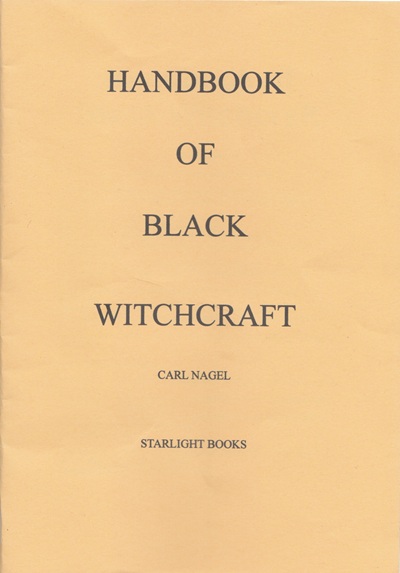
I had originally planned to post about a different book today, but I realised I needed to do some more research to do it justice, so I sought out a ridiculous pamphlet of black magic. I found one by my old pal, Carl Nagel. It starts off with a depiction of a badass Satanic human sacrifice, but then it turns out that the author is only describing this scene to say that it’s not true witchcraft. Obviously, this was quite disappointing. I was hoping this would be a grimoire of cool satanic murder rituals.
In the next section, we learn that “Black witchcraft” is “older than the centuries”. I assumed that meant it was prehistoric, but we find out in the next paragraph that it was born in the middle ages, so I’m assuming that Nagel originally meant to say that it was older than “some centuries”.
This is followed by a description of how witches used to be initiated into their covens, but Nagel then acknowledges that the readers of his work won’t have any friends, so he tells them how to initiate themself into a coven of one. They basically light a few candles and think of witchy stuff.
The guts of the pamphlet (about 5 pages) consists of a handful of silly spells. It’s the usual crap: how to attract lovers, how to make a voodoo doll, how to make a rival impotent… There’s really nothing unique or original here.
This is another instance where I find it hard to imagine a person stupid enough to take this shite seriously. When I refer to this as shite, I mean it. This book is smelly, smelly poopoo from a dirty bumhole. Carl Nagel actually has quite a few publications too, and I am very curious as to what his threshold of success is. How many copies of his last book does he need to sell to convince him to write more? Surely there can’t be more than 2 or 3 imbeciles alive who would pay for this heinously soiled adult diaper.
This has been on my radar for years, but a cover like that will make finding a book difficult regardless of its contents. I assumed it was going to be kitschy trash, and never considered paying more than a few dollars for a copy. Luckily for everyone, Dr. Jerrold Coe, the guy who runs the fantastic Paperbacks of the Gods blog uploaded a copy of How to Become a Sensuous Witch to archive.org.
I was very pleased to read this for free, but its contents lived up to my expectations. This is drivel. It’s mostly a collection of recipes for a woman to cook when she’s having a lover over for dinner. Some are given witchy names (Samhain Soup, Satan’s Steak…) but most are just normal recipes (green bean salad, cauliflower curry…) and some are just gross:
Aside from recipes, there’s a few spells and rituals included. Most of these involve muttering inane rhymes, but there was a couple that involve ingesting period blood and piss. (You mix both into salad dressing or something to mask the taste.)
One section I found amusing was the chapter on “Getting Rid of a Freddy”. This chapter gives you some recipes to use when you want to scare a man away. One of them involves giving him some damp biscuits. It’s a bit bizarre.
This book is definitely of its era. It advises the prospective witch to feed her man dessert but not to take it herself because she should want to be skinny. I feel like most modern witches would probably not appreciate that advice.
There’s little of interest to a real student of the occult in here, but this is an interesting little book because of what it tells about the time when it was published. Occultism and witchcraft were becoming sexy, and women were being encouraged to be promiscuous, but self empowerment still took the form of learning how to cook for a man and keeping thin. It’s nice that the book is now available to look through online, because it’s certainly not worth paying collectors prices for.
Go back and take a look at the cover there. Look at her grip on that candle. Hell yeah.
I find reading about Salem Witch Trials a generally unpleasant experience. When I read Arthur Miller’s The Crucible years ago, I felt a horrible combination of claustrophobia, frustration and rage. I’m assume that my readers have a general background of what happened, but if you’re unaware, about 300 years ago, some stupid, bored teenagers in Salem made up stories about their neighbours being witches, and a bunch of innocent people were executed. I’ve had Cotton Mather’s On Witchcraft (Wonders of the Invisible World) on my shelf for a decade, and even though it’s short, I’ve put off reading it until now.
Cotton Mather – On Witchcraft (Wonders of the Invisible World)
Dorset – 1991 (Originally published 1693)
Cotton Mather was a Puritan minister at the time of the witch trials. I had thought he was a Matthew Hopkins, Witchfinder, figure, but his role in the witch trials was minimal. I think he sent a few letters to the judges or something and then wrote this book as a defence of the court proceedings, assuming the guilt of the witches. It’s an extremely boring book, and I managed to get through it by downloading the audiobook version and forcing myself to listen to it every night for a week while I cleaned my kitchen. This Cotton Mather guy was a stupid asshole, but people seemed to value his opinion because he knew the Bible. He was basically a 17th century Jordan Peterson.
I’ve read about the Salem trials elsewhere, and there’s very little in the narrative of the book that was new to me. The most interesting thing here is what Mather’s writing tells us about how he thinks. Either he’s terrified and/or he wants his audience to be terrified. This was written in 1692. British colonies in America were still very new, and the Puritans were still adapting to their new environment. They had exiled themselves from the iniquity of Catholicism and Anglicanism, and they took the Bible seriously. Half of this book is Biblical references, and these references are not limited to the Gospels. Mather’s audience believed that God had a special interest in their daily affairs. It’s a genuinely chilling prospect to imagine yourself in their position, truly believing that the Devil himself was present and trying to destroy their community. Still, it’s pretty hard to forgive people who were stupid enough to condemn 20+ others to death on the testimony of some hysterical teenagers and jealous farmers.
Wonders of the Invisible World is an extremely important primary source for historians, but it’s generally a pretty dull read. I know that The Crucible isn’t entirely historically accurate, but it does a more entertaining job of telling the same story.
I’ve read my fair share of books about the history and practice witchcraft. There’s a lot of them out there, and I’m generally more interested in the slightly trashy ones from the 60s and 70s that blur the line between fiction and reality. I don’t read much stuff like that anymore, but when I was reading about the Son of Sam killings last month, I discovered that David Berkowitz had sent an annotated copy of Peter Haining’s The Anatomy of Witchcraft to police officers who were investigating the case. I also deduced that this book was one of Maury Terry’s sources on the Satanic cults of California in the late 60s, so i thought I’d better give it a go.
Roughly half of the book is about white witchcraft/Wicca and that kind of stuff. I have little interest in this type of thing, but the rest of the book is about black magic and Satanism. It was entertaining enough. I’ve come across most of the information in here before, but some of it is presented in a slightly different light here. Haining basically splits the world up into different areas and then does chapters on the parts which contain the most witchery.
Haining isn’t known for being entirely reliable. He lists Dennis Wheatley as a source of much of his information, and he includes a lengthy letter from noted plagiarist Rollo Ahmed too. Other parts of the book are based on myths (the idea that Catherine De Medici was a Satanic witch), and others are thoroughly mixed up. Haining clearly has a bee in his bonnet about LSD, and at every given opportunity he tries to link it with Satanism. Parts of this book really reminded me of Satan Wants Me by Robert Irwin.
Joris Karl Huysmans wrote a novel called Là-bas, in which he describes a black mass. The main satanic character, one Canon Docre, is said to have been based on Joseph-Antoine Boullan, an occultist who was kicked out of the Catholic clergy. Boullan and Huysmans were friends until Boullan died (supposedly because of a magical attack) in 1893.
In Anatomy of Witchcraft, Peter Haining includes a rant from Huysmans that refers to Canon Docre as if he was a real person. I was very confused by this, as he wasn’t being very nice. Why would he shit-talk his dead friend? I did a bit of research though, and it turns out that he was actually referring to a Chaplain from Bruges named Louis Van Haecke. Von Haecke was said to have the cross tattooed on the soles of his feet so he could blaspheme whenever he walked, and it seems like Huysmans explicitly claimed he was the inspiration for Canon Docre elsewhere.
Haining claims that Huysmans wrote Là-Bas as a rejection of the horrors of Satanism. He also claims that Boullan crucified small children during black masses. It’s hard for me to believe that Huysmans, conscientious, reformed Catholic that he was, would be down to hang out with a person who crucified small children. It’s funny. I did a search for the name Boullan through my blog, and it turns out this is not the first post that I’ve written about his alleged misdeeds.
There’s a chapter in here on Satanism in California that discusses the links between Charles Manson, the Process, the Chingons and the mysterious Four Pi cult. I’m planning on writing a separate post on that stuff quite soon though, so I’ll leave it for now. Very curious indeed.
There was some other mildly interesting stuff in here. He discusses the Bernadette Hasler case and the Skoptci, a weird Russian sect who cut off their own dicks. I’ve defintely read about both cases before, but I can’t remember where. Also included in this book is a very questionable quote about voodoo.
Yikes.
Overall, this is a moderately entertaining read. It does not seem particularly reliable though, and I would do a bit of extra research before accepting anything in here as fact.
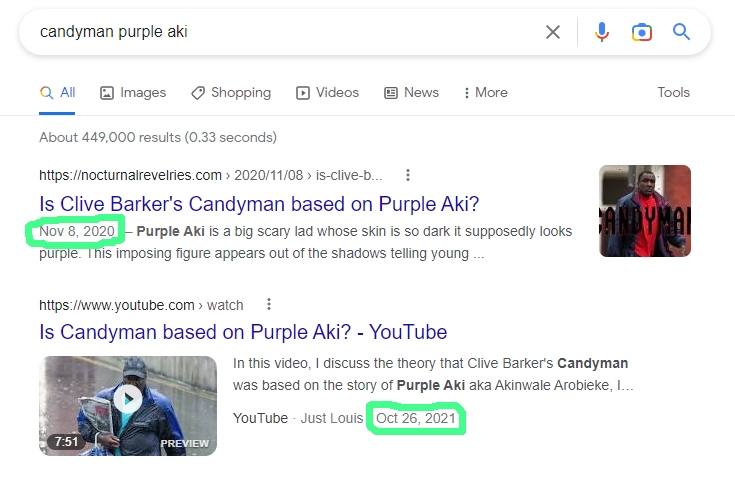
On Halloween night, my wife and I watched the 2021 Candyman movie. We had thought it was a remake rather than a sequel, and my wife had never seen the original film. Afterwards, I was explaining some stuff about the original movie when I mentioned that I had written a blog post on the Candyman a few years ago. I googled the title of that article so that I could show her, and when I saw the results, I was a little surprised to see a youtube video with almost the exact same title as my article.
Note the dates.
My blog has been referenced in books, podcasts, other blogs and youtube videos before, and I am always happy to find out that what I write here is of interest to others. I don’t expect MLA citations or anything like that, but it seems like common decency for content creators to give credit where credit is due. My article was not the first time that Candyman and Purple Aki were mentioned together, but it is definitely the most comprehensive account of their relationship online. If you look back on it, you will notice that I was fairly meticulous about providing links to all of my sources. The youtube video I found was created a year after my blog post went up, and its description references “the theory that Clive Barker’s Candyman was based on the story of Purple Aki”. Now I did not come up with that theory, but I think it’s very safe to assume that anyone researching that theory in 2021 would definitely have come across my work on it. As I watched the video, I was taken back by how much the narrator sounded like me. Yes, he too is Irish, but the phrases he used also sounded remarkably like my own. I checked my blog post, and I discovered that he had basically just read out chunks of my article and presented them as his own research.
Not cool.
I left a comment on the original video, but the coward deleted it. I decided to put a curse on him. I thought the most apt punishment would be to send the Candyman after him. First off, I entered a trance state and did some free-writing. The result was a short-story about this stupid idiot getting his comeuppance. It’s a rather unpleasant piece of writing, so I’ll just link to a pdf so that my more sensitive readers don’t have to upset themselves. I here presentLouis meets the Candyman.
Next, I converted the text file into a sound and played around with it a bit. I also created a short video with scenes from the original Candyman movie and some extremely potent images. The writing (or noise thereof) and imagery is really to just charge the curse with emotion. The catalyst for the summoning comes from the plagiarist himself. In the Candyman movies, the murderous Candyman is summoned when somebody says his name 5 times while looking in a mirror. Well, I went through the dirty thief’s video and discovered, much to my delight, that he names Candyman exactly 5 times. I isolated those 5 utterances and mixed them into the video, which is embedded below. This blog post is itself the mirror, reflecting Louis’s lowly deeds. By playing this video, the victim says Candyman 5 times in a “mirror” and thus seals his own death warrant.
I am entirely confident that this will lead to that dirty, little thief getting his muscles squeezed good and hard. Annoying rat voice on him too. Stupid dork.
Right, I’ll be back to posting about books from next week. Had to get this out of my system.
EDIT: After publishing this blog post, I sent it to the intended victim. He was cool about it and listed my blog post as his source of information. I’m not sure if I can stop the curse at this point, but I take back all of the mean things I said about him.
I really enjoyed Our Lady of Darkness (both times I read it), and I felt like it was time to revisit Fritz Leiber. Conjure Wife was first published in 1949. It’s the story of a college professor who discovers that his wife has been practicing witchcraft behind his back. He thinks this is a shameful load of nonsense, so he tells her to stop. Shortly after this, he realises that her magic has been protecting him from the spells of the other witches. It turns out that his wife isn’t the only witch on campus. Actually, most women are really witches.
Now, the title ‘witch’ don’t apply to all women,
but all women have a little witch in ’em
Fritz Leiber
It’s a pretty simple premise, but Leiber makes it work really well. The conflict is mainly psychological, occurring in the protagonist’s head. I read somebody comment that the novel’s description of women isn’t “generous”, but I don’t agree. The tension in the book, and there’s loads of it, is largely created by the unwillingness of the male protagonist to believe what is happening to him. He’s an idiot. The women are running the show here. This book is only demeaning to women if you think of witchcraft as a bad thing.
While some of the magic in here is rather fantastic, a lot of it is the kind of stuff that I don’t entirely disbelieve in. It seems to me that Leiber had a very clear understanding of the nature of magic.
Fritz Leiber was a cool guy. I read somebody describe him as the link between Lovecraft and Philip K. Dick, and apparently he corresponded with both. That itself is enough to impress me, but the books I’ve read by him are awesome too. I’ve heard that his short stories are some of his best work, so I’ll probably look at them next. I don’t know if there’s a specific collection that I should go for. Part of me wants to just read the horror ones, but I’m sure that’s dumb. Let me know if you have any recommendations.
ONE: The Grimoire of the Golden Toad – Andrew Chumbley Xoanon – 2000
The first bit of this book tells how to kill a toad and let his body rot a certain way so that you can find the magical bone within that will allow you to summon Satan in the form of a horse. If you get on pony Satan’s back, he can carry you around the world in seconds.
The next part is a bunch of hokey poems. I understand that language can change people’s perceptions and that it can set the tone for magic, but this stuff sounds pretty silly when you’re reading it off a computer screen before going to bed on a Monday night. There was one cool line, “For the Devil’s Master am I, am I; the Devil’s Master am I” Parts in this section suggest that the practitioner is actually seeking control over humans rather than animals. I think the intention is actually just to gain self control. This reads as if it was co-authored by Severus Snape and Jordan Peterson.
The poetry section is followed by a weird fantasy story that was unbearable to read. My patience for this kind of crap is non existent at this point.
Magical bones from a toad? I wonder how many poor little toads were killed by the freaks who are into this crap. Chumbley wrote another, I think more academic, book about this topic that is probably far more interesting. I’m not going to read shit like this anymore.
I usually just review books, but this is my blog, and many of the books I review are on occult phenomena, so I think it’s appropriate to discuss my own occult activities here.
About a year ago, I moved into a new apartment. I lived there comfortably for about two weeks, but then my upstairs neighbour started making a lot of noise, blasting music way past my bed time. I asked him to turn it down, and he was polite about it, but then it happened again a few days later. A pattern started to emerge, and our relationship quickly soured. Things got so unpleasant that when my teething baby would cry at night, this douchebag would get out of bed and turn on his stereo.
I’m not going to give out any more specifics, but I can say with absolute certainty that my neighbour was the dickhead in this situation. If you’ve ever had a similar experience, I’m sure you’ll understand. (If you’ve ever been the unapologetic noisy neighbour, find yourself a bridge and jump off it, shithead.)
The noise really got to me, but the arrogance and entitlement were the worst. Living under that prick made me miserable. I would happily have blasted him with some of the crap I listen to, but I have small kids, and for their sakes I didn’t want to escalate the situation. What got me through the year was the knowledge that we’d be moving again this summer. Even though I knew the situation was only temporary, the tension started to affect other aspects of my life.
I write for my blog every week, but I rarely do any creative writing. I’ve been meaning to do more, and I read somewhere that a good creative writing exercise is to just sit down and start typing. I decided to give this a go a few weeks ago. I immediately produced an extremely unpleasant piece of writing about what I’d like to do to my upstairs neighbour. It’s grim and certainly not for public consumption, but I liked parts of it, so I saved it with the plan to share it with some close friends after we moved away. (If some accident befell Dingdong before we moved out, the document would certainly have incriminated me.)
Knowing that we were going to move, I regularly fantasized about the few days at the end of our tenancy when the window for revenge would be open. I planned a bit of a dance party for the night before we left. I considered blasting some brutal power-violence or death metal, but I decided that repetitive, bass-heavy techno would travel better through our ceiling. I tried finding the perfect song to blare on repeat, but I couldn’t make up my mind, so I decided to make my own.
I think it turned out pretty well.
As much as I wanted to blast this at the cunt, it just didn’t seem harsh enough. This utter bastard deserved a lot worse than a couple of minutes of confusion/mild irritation. I decided to put a curse on him instead.
Hey, remember that piece of writing I mentioned? I figured out how to use it. I only had to alter it a little bit to turn it into the text of a curse. Here is a heavily redacted version. (I’ve moved out, and I have no intention of ever having any contact with that dickhead again, but posting the full text would still be a poor idea.)
I imported the unredacted version of the above text file into Audacity, a sound editing program, as raw data. Doing this basically turns any file on your computer into noise. I then found an image of my neighbour on google images and did the same thing to that. (The image atop this post isn’t actually him.) I then reduced the playback speed of the sound of the image so that it was closer to the length of the sound of the text and panned the sounds of the image and text to opposite sides. Next, I stretched them both again and amplified the sound to make it more audible.
This was the noise through which I would wreak vengeance, but magic doesn’t have to be minimalist, so I imported this sound into FL Studio and heaped a bunch of effects on it to make it sound sick. I also added a recording that I made of the actual noise coming from upstairs. This ingredient charged my baneful magic with real emotional power. It’s also satisfying to think of my enemy directly suffering from his own wrongdoing.
Poppets (“voodoo dolls”) have been used by witches for millennia. The idea is that you make a doll that looks like the person you want to affect, then you do things to it and hope that this has an effect on the real person. It is common practice to place a lock of the victims hair, a toenail clipping, or something that belonged to them inside the poppet. Some magicians use photographs. These elements are believed to strengthen the link between doll and victim, thus making the sympathetic magic more powerful. A series of incantations are uttered over the doll, and these are what activate the link.
The sound that I have created works in a similar way to a poppet, but I know it will be more effective. It contains an image of my victim, and this image is being forced to become one with the textual incantation. The image of his arrogant face and my vision of his suffering will literally become one. The malefecarum is being charged by the audio recording of my victim’s transgressions, made while I was in a frenzy of the blackest hatred. The basic magical theory here is sound (excuse the pun), but I have more reasons to believe it will be effective.
This is the sound of his doom.
Magic doesn’t work if the practitioner doesn’t believe in it. Magic, as far as I understand it, is not supernatural, and magical acts don’t depend on chance or luck or the fairies; they depend on the will of the magician. I don’t believe my neighbour will suffer because I want it to happen and I’ve read too many books about Aleister Crowley. I know my neighbour will suffer because I will him to suffer. I am the magician, and I control my black magic. My poppet isn’t going to lie in the back of my victim’s chimney or under his porch. It’s going after him.
We moved out a few days ago, but we were able to keep the keys to our old place so that we could clean it before the new tenants arrive. I repeatedly played my spell whenever I could hear my enemy upstairs. I didn’t play it loud enough so that he could complain about it, but it was definitely loud enough for him to hear.
Then at the end, I did play it loud. I accompanied the noise with some ritualistic psychodrama. I filmed the whole thing, but I’m only going to share the final segment where I accompany the noise with the thin, dissonant whine of my blasphemous flute. (Flutes are the favoured instrument of Azathoth, the Nuclear Chaos, so I thought this would be apt.)
That’s a wizard hat not a klan hood. My neighbour was white, and fuck the KKK.
I have no doubt whatsoever that he heard me, but as he had seen me moving my furniture out on the previous day, he probably thought that I was just being petty and noisy for the sake of it. Little does he know that the noise I played was heralding his ruination.
I’ll be checking the papers for his obituary daily.










 Nocturnal Revelries