Please Don’t Finger Me: Maurice Renard’s The Hands of Orlac

I don’t remember how The Hands of Orlac ended up on my to-read list, but I’ve wanted to read it for years. Although it was a popular novel in France, and a few movie versions have been made, copies of the English translations were hard to come by (up until very recently).The first translation came out in 1929, but a second translation by Iain White was published in 1981. A new one by D.H. Bernhardt came out more recently, and that one is widely available as an ebook. I read White’s translation.

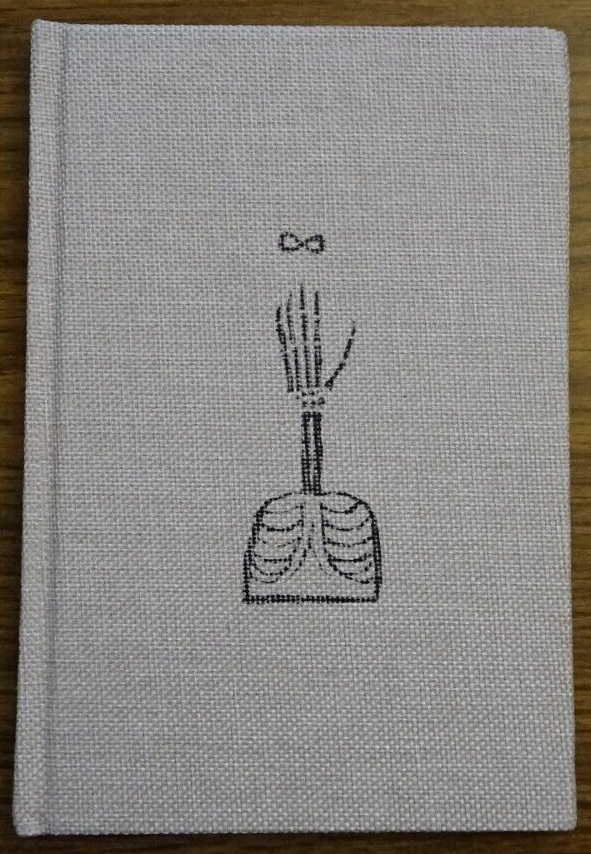
Souvenir Press – 1981 (first published 1920)

So a famous pianist is hurt in a train accident. When his wife shows up at the wreckage, she sees a ghost hovering near her bloodied and unconscious husband. A doctor manages to save him, but his hands are all messed up. Stuff starts to go missing from their house and bloody daggers keep showing up.

Reading this novel was a chore. It took me 2 weeks to get through the first hundred pages. The main character is the pianist’s annoying wife, and for every paragraph of plot there are 3 pages of her emotions. Maybe the translation had something to do with it, but I found this book to be unbearably overwritten. I rarely managed more than a couple of pages before turning the lights off to go to sleep. I wanted to give up, but forced myself to power through the last 20 pages over a couple of evenings last week.

There’s a few mysterious things happening in the book, but none of them are interesting except the suggestion that a decapitated murderer has been revived and that he has started to kill again. At this point my interest was piqued, but a few pages later it turns out there is another, far less cool, explanation. By the end of the book, everything has been explained rationally.

I hate it when that happens.

I don’t know. Maybe mystery fans will enjoy this, but I thought it was crap. If you want to read a better book about evil hand transplants, I would suggest Martin Thomas’s The Hand of Cain.

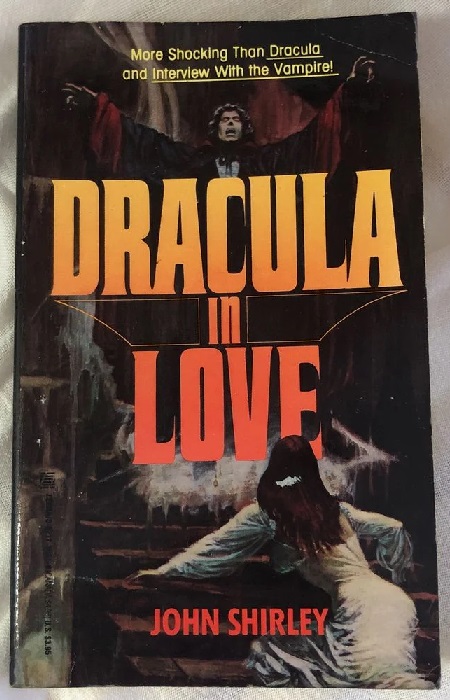
Vlad the Impaler’s Demon Cock: John Shirley’s Dracula in Love

I can’t remember the last time I enjoyed a novel less than I enjoyed Dracula in Love. I started it during the hectic last week of my summer holidays and finished it over a nasty bout of jetlag, and I’m sure these circumstances had something to do with me struggling to get through more than a few paragraphs at a time. Also, I got through a fair bit of the text with an audiobook from Encyclopocalypse. I love when publishers put out old books like this as audiobooks, but the narrator did silly voices for each character, and that really annoyed me. To be honest, a lot of things have been annoying me recently.

Zebra – 1990 (First published 1979)

Lucifer visits Dracula’s son (His name is Vlad Horescu. Sounds a lot like that guy who wrote that other book on Dracula, doesn’t it?) and asks him to help trapping the King of the Vampires. Dracula rapes a few women with his demon cock and inspires rape waves wherever he goes. It turns out he only got back in touch with his son because Vlad Junior is high up in a computer company and is capable of hijacking software that will give Dracula enough influence over the economy and politics of Brazil that he will be able to become an Emperor there. His plan is foiled when he is sucked into Lucifer’s giant vagina.

On the plus side, this is gory and gross and features sentient genitalia. Unfortunately though, the plot is confusing, the characters are unlikeable, and the whole thing is overwritten. I have a high tolerance for crap, but I really had to force myself to get through this one. In fairness, the author was only 18 when it was written, so maybe his other books are better. It’ll be a while before i get around to them.

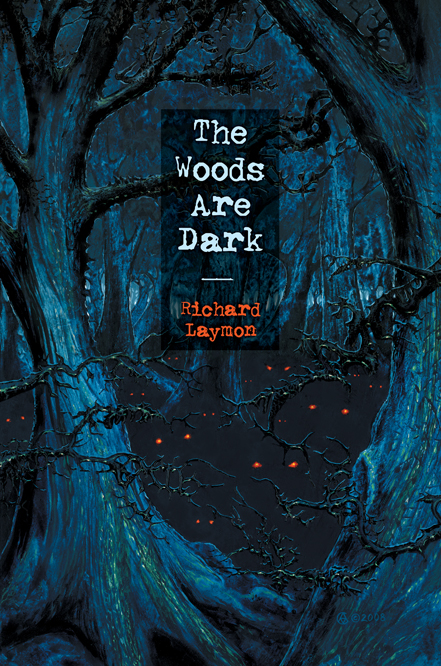
Richard Laymon’s The Wood Are Dark: A Trashy, Tit-filled, Cannibalistic Nightmare

In 2019, I read Flesh by Richard Laymon and quite enjoyed it. 2 years later, I read The Cellar. I didn’t like that one, and I’ve steered clear of Laymon since. Recently a friend suggested that I check out The Woods Are Dark. I had read that the first edition of this book had been heavily censored, and I was very pleased to find a copy of the unedited version that Laymon’s daughter had published after her father’s death.

Cemetery Dance – 2008 (First published 1981)

After a freak throws a severed hand into their car, two young females are kidnapped in small town and tied to a tree in a clearing in a nearby forest. There they meet a family of 4 who have met with a similar fate. The kidnappers promptly run away, and it turns out that they were just serving dinner to a tribe of cannibals called the Krulls. Luckily, one of the kidnappers starts to feel guilty because he has fallen in love with one of the girls he kidnapped, so he comes back to save her. He manages to set everybody free, but then the Krulls arrive and things get ugly.

The best part about this book is Lander Dills, the father of the family of 4. The former English teacher goes mad and starts behaving just as poorly as one of the Krulls. His thought process is outlined in one of the crudest lines ever put to paper: “An eye for an eye. A tooth for a tooth. A rape for a rape.” The only difference between Lander and the savages is that he quotes Shakespeare while raping and skinning his victims. Apparently this guy’s escapades were the parts that were cut from the first edition. Without him, the book would be very dull.

One of the girls who was kidnapped by the hillbillies manages not only to forgive her kidnapper when he comes back to rescue her, but she actually has consensual sex with him hours later and cries at the thought of not being able to spend the rest of her life with him shortly thereafter. Very realistic.

In truth, I was a little shocked at the level of brutality on display in this book. There’s gang-rapes, and cocks being bitten off aplenty. Also, this is a Richard Laymon book, so there is a lot of tit talk. I did a search through an ebook version of the book, and without counting tits, boobs or nipples, the word ‘breast’ appears 58 times. The Woods are Dark is pure trash, but it was relatively entertaining. I’ll probably read more of the Booby man’s stuff in the future.

Who is Harry Angel? William Hjortsberg’s Falling Angel and Angel’s Inferno

I’ve been doing a lot of non-fiction recently, so here’s a couple of novels about the Devil:

Falling Angel

Warner Books – 1986 (First published 1978)

Falling Angel is a classic. There’s at least 70 editions of the book, and it was turned into a big Hollywood movie in the 80s with Robert DeNiro and Mickey Rourke. I’ve had a copy on my bookshelf for a long time, but I only sat down to read it recently. It was great. I had seen the movie years ago, and I had an idea where it was going, but I still found the book very suspenseful and very enjoyable.

Harry Angel is a private detective who has been hired to find a missing popstar named Johnny Favourite. The guy who hired him is a rich weirdo named Louis Ciphre. Harry finds himself in a world of murder, voodoo and Satanism pretty quickly.

It’s more of a hard-boiled detective novel with supernatural elements than a straight horror novel, but that’s what makes it so great. There’s lots of suspense, and I got through it in a couple of sittings. It’s a really fun book to read. It made me realise exactly what Richard Jaccoma was going for when he wrote his werewolf novels. (The first of those books came out a year after Angel Heart, the movie version of Fallen Angel, and I doubt this was a coincidence.)

If you haven’t read Falling Angel, you should.

Angel’s Inferno

No Exit Press – 2020

More than 30 years after Falling Angel was published, Hjortsberg started work on a sequel. He finished Angel’s Inferno shortly before he died in 2017. It wasn’t published until 2020.

It wasn’t great. It starts where the last book left off, and the main character is now on the run. He heads to Paris and buys a lot of expensive clothes and eats some fancy food while plotting revenge. The characters and their interactions are enjoyable enough, but the suspense and mystery of the first book is almost entirely absent. The plot is modelled on that of the first book too, but the twist ending here was just a bit too ridiculous for my taste. This book was far longer too. It wasn’t absolutely horrible to read, but it pales in comparison to Falling Angel. I’m glad I didn’t spend 40+ years waiting in anticipation for this.

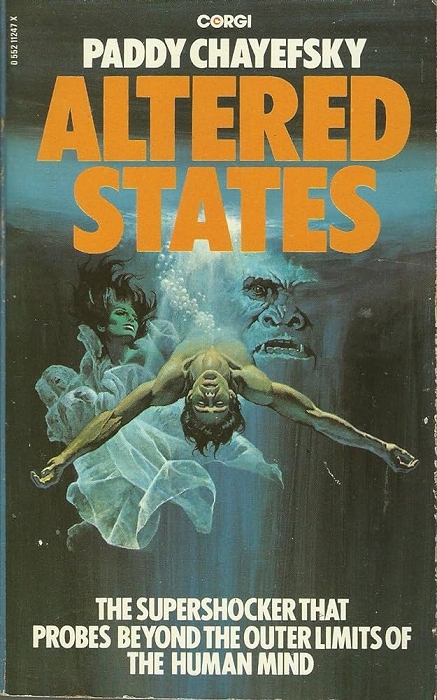
Paddy Chayefsky’s Altered States

Corgi – 1980 (Originally published 1978)

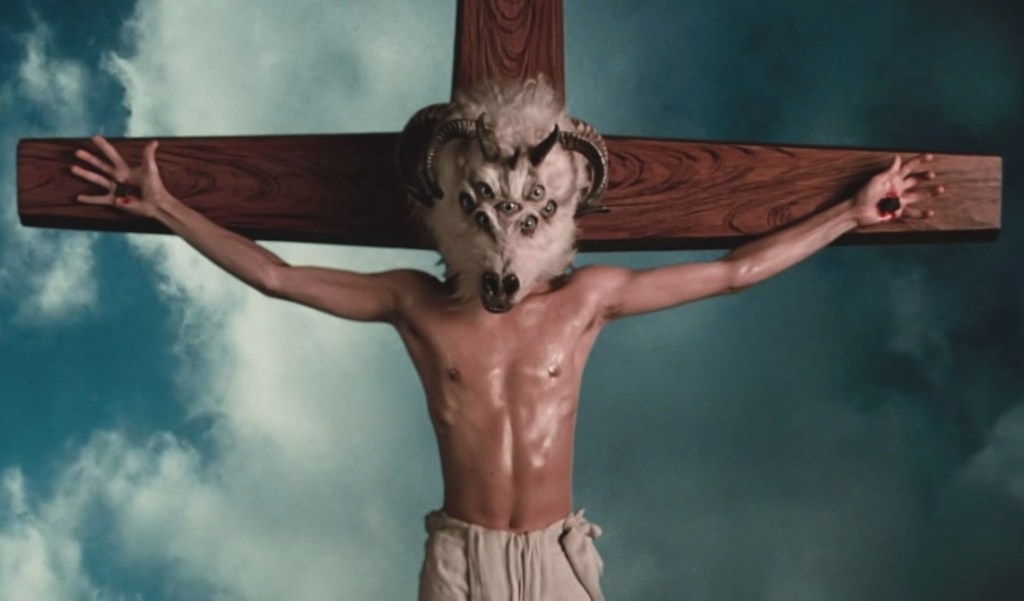
When I saw Altered States in my early 20s, I was blown away. It was a big budget Hollywood movie about a scientist who took psychadelics until he turned into a monkey. I also realised it was the source of the “my heart is being touched by Christ” sample from that Ministry song and the cover of Godflesh’s first album. Cool!

A friend told me that the movie had been based on a real set of experiments that had been performed in the 60s, but I wasn’t sure of what these experiments actually entailed. I hadn’t thought about this for years, but I was recently reading a book by Robert Anton Wilson that mentioned John C. Lily and his sensory deprivation tank experiments, and I realised these were what Altered States was based on. John C. Lily did write some books on his experiments, but I think they focus on using the tanks to speak to dolphins as opposed to turning into an ape, so I decided to read the horror novel instead.

It’s at least 15 years since I saw the movie, but as far as I can remember, the book is pretty close to the film. I read that there was conflict between the author, Paddy Chayefsky, and Ken Russell, the director, on the set of the movie. Chayefsky got so mad that he had his names removed from the credits of the movie.

The book is pretty good. The main character is such a dickhead that I was rooting for him to die the whole way through. The author uses a lot of technical jargon for effect, but all the multisyllabic words in the dictionary don’t change the fact that this is a book about a man who gets so high that he turns into a giant slug. I was going to write a more detailed plot synopsis, but there’s really no need.

The visuals from the movie make it a more memorable version. If you’ve seen that and really enjoyed it, give the book a go.

Devoured by Vermin: The Brutal Horror of James Herbert’s Rats Series

One night, when I was 11 or 12 years old, my parents left me downstairs in front of the TV. I didn’t concern myself with what they were doing because I had the opportunity to potentially see some boobs on the tv. I switched on to MTV, and to my great delight, I found a show that was basically a compilation of videos that MTV wouldn’t play during the day. I remember it had Come to Daddy by Aphex Twin and that black and white, sexy Wicked Game video. This was incredible. This was the best stuff I had ever seen. The next video that came on was for a song called “Devoured by Vermin” by a band named Cannibal Corpse. I’m assuming most of the people who read my blog what death metal is, but as a child growing up in 1990s Ireland, I did not. The “heaviest” music I had ever heard at that point had probably been the Red Hot Chili Peppers or something similar. This video was the most disgusting, depraved thing I had ever seen. It didn’t make sense to me. Why would a person make those noises? This wasn’t singing! This wasn’t music! This was evil. This was sick. I hated it. I remember going out with my friends the next day and telling all about it.

too much for 12 year old me

A few years later, I started getting interested in classic rock. Then I moved on and got some White Zombie and Korn cds. I liked that stuff, but I kept thinking back to that Cannibal Corpse song I had heard. My musical tastes were getting heavier, but I would never listen to that crap. It was just too much.

Then I got the internet. I spent about a month downloading the video for Devoured by Vermin off of Kazaa. I showed it to one of my best friends, and he was repulsed. I showed it to my cousin. She hated it. Their response was exactly what mine had been. Seeing this, I started to enjoy it. Part of it was seeing how people reacted, but another part of it was googling the band and reading their lyrics. Good grief! I very quickly became a fan of death metal.

Ok, but this is a book blog, why am I harping on about this music video?

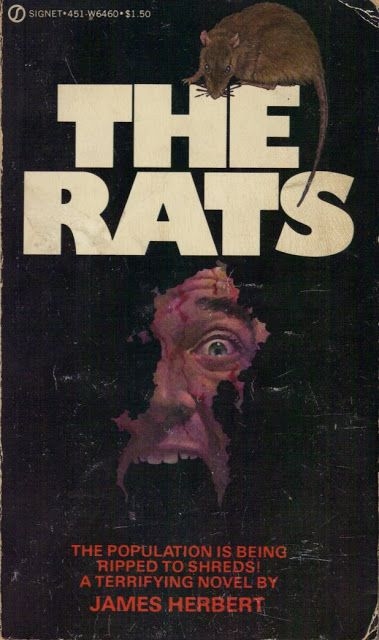
Well, recently, I read James Herbert’s The Rats, a super influential horror novel from 1974 about a bunch of rats that attack London and start eating people. It only took a couple of chapters to realise that this book was the inspiration for the death metal song that got me hooked.

Ruthless gnawing vermin, feed
Cleaning off my bones while I breathe
Stenching greasy rodents, swarm
My body is losing its form

– Cannibal Corpse

While I can’t find anything online stating that the book was the inspiration for these lyrics, it is well known that Alex Webster, bassist and lyricist for the band is a huge horror fan, and the words to the song could be describing several of the scenes in this infamous book.

The Rats

Signet – 1975 (First published 1974)

Like the song it inspired, this book is not subtle. It’s extremely violent to the point. I had read Herbert’s The Fog before, and while I enjoyed parts of it, I felt it dragged a little bit. The Rats is less than 200 pages, and they’re all good. There’s no surprises with this book. It’s exactly what you think it’s going to be. Go read it if you haven’t already.

Lair

New American Library – 1979

Lair is a very predictable sequel. It’s 4 years after the first rat attack, and the rats have migrated to a nature reserve outside of London. None of the characters from the first book appear except for the rats. It’s so derivative of the first novel that I’d call it pointless if it didn’t contain the scene in which a priest is seen vomiting into an open grave where a bunch of mutant rats are eating the corpse of an old woman. Total redemption! While I definitely enjoyed Lair, it’s easily the worst book in the series.

Domain

New English Library – 1996 (First published 1983)

Domain is a much more ambitious book than its predecessors. Not only are the rats back, but 5 nuclear bombs have also fallen on London for totally separate reasons. This is a post apocalyptic disaster novel where the protagonists have to be as wary of other humans as they do with the hideous, mutated, blood thirsty rodents that are trying to eat everything. This is highly enjoyable trash. I read these books in quick succession, and I was surprised by how much I enjoyed reading this one.

The City

Pan Books – 1994

The final entry in the series is a comic book called The City. I really enjoyed it, but it feels more like a separate work that was inspired by the trilogy of novels rather than a continuation of the story. The rats here are no longer just eating the humans; they have now become our masters. It’s horrendously bleak, and the art is cool. Definitely read this one if you get a chance.

This series, particularly the first book, is both infamous and influential in the field of horror literature, so I don’t feel pressed to say too much more about it. I’ve mentioned a few times when reading other horror novels about killer animals that I assumed they were rip-offs of Herbert’s work. I can now confirm that most the “animal attacks” books by John Halkin, Simon Ian Childer, Harry Adam Knight, David Anne and Nick Sharman that I have read are all knock-offs of The Rats. I feel like I’ve read a lot of these silly animal books in the last few years, and I’m planning on giving this particular genre a break for a while. It took me about 4 years to get around to The Rats after finishing Herbert’s The Fog, but I don’t think I’ll wait that long before returning to his work. I had a lot of fun reading these books.

IRA vs. Gilles de Rais: Shaun Hutson’s Renegades

Sphere – 1991

Happy Saint Patrick’s day. I’ve read a few horror novels set in Ireland over the years, but I’ve been saving Shaun Hutson’s Renegades for a special occasion. I bought this book a few years ago because the back of it mentioned Irish terrorism, ultra violence and Gilles de Rais. I was looking for something to read the other day when I took it down for another glance. Again I was intrigued by the blurb on the back, but when I saw the author’s portrait on the inside I started to read immediately. Holy shit, look at that bad-ass!

A dissident group of terrorists shoot up a political meeting in Belfast with the aim of stopping peace talks. They are being paid to do so by an English arms dealer who has been profiting from the conflict. Sean Doyle, an English counter terrorism operative with a very Irish name is sent in to Ireland to kill the bad guys.

This would be a fairly straightforward mission only the arms dealer has also recently come into possession of an evil stained glass window inhabited by an evil demon summoned by Gilles de Rais.

There is a supernatural element here, but this is 95% a crime novel. There’s occasional scary bits, but apart from the last few chapters, these ALL turn out to be “oh it was just a dream” sequences. This was written by the author of Chainsaw Terror though, so the whole book is ludicrously violent. Every bullet wound, and there are lots of them, is described in detail.

This book, which is mostly set in Ireland, was written by an English author in the early 90s. I was a little apprehensive starting out. I certainly don’t want to condone everything that the IRA did during the troubles, but let’s remember that they were fighting a foreign force that had stolen their land and oppressed their people. Fortunately, Hutson doesn’t take sides. Everyone is a piece of shit in this book, but it’s the Brits causing all the trouble here.

There’s a few scenes where the Gardai (Irish police) show up and pull their guns on the bad guys. In reality, regular Irish police officers have never had guns.

The protagonist, Doyle, is an unrepentant bad-ass. He quotes heavy metal lyrics, bangs hot babes, kills anything he doesn’t like and generally doesn’t give a fuck. He has long hair, and he’s covered in scars. He’s supposedly based on the author. Scroll up and take another look at that cool motherfucker. Hell yeah! Hutson wrote a few other novels featuring sean Doyle as a protagonist, but I’m not going to seek them out. (I felt similar about his sequel to Spawn.) I don’t think the other Sean Doyle books have any supernatural elements.

Looking back, the supernatural element in Renegades is actually pretty unnecessary to the plot. The lore of Gilles de Rais is briefly summarized, but the demon that appears in this book is a bog standard evil spirit. It kills, eats or possesses everyone in sight. I’m glad it was there though. (If you like trashy novels about Gilles de Rais, I recommend Philip José Farmer’s Image of the Beast.)

Renegades is pure trash, but I really enjoyed it. May you have a snake-free Saint Patrick’s day. If you’re interested, I’ve written about quite a few other books set in Ireland, about Ireland or by Irish authors over the years.

Killer Cats: Nick Sharman’s The Cats and Berton Roueché’s Feral

Miaow.

Nick Sharman’s The Cats

NEL – 1977

I’ve had this one for ages, but a few years ago I read another book by the author that wasn’t very good, and I assumed this would be pretty bad too. When it comes to “animals attack” horror, there comes a point where you know what to expect.

Nothing about this book was unexpected. It was like that book about killer bunnies I read a few months ago except this one was about killer cats, and it didn’t have a plot twist. The Cats is actually very, very similar to any of the three books in John Halkin’s Squelch trilogy. I haven’t read it yet, but I assume all of those books are basically rip-offs of James Herbert‘s The Rats. I’m not just saying that because of the line on the cover of The Cats either. There’s something very formulaic and British about all of these books, and The Rats predates them all. I’ve been holding off on that one because it’s part of a trilogy. I’ll get to it someday.

A science experiment gone wrong leads to an army of cats attacking London and killing everyone in sight. My favourite part was when the president of the USA comes over to England and pours a bottle of acid down a cat’s throat. This book is truly ridiculous. It’s not particularly bad or hard to read, but it’s also not a good book at all.

The above didn’t seem sufficient for a post of its own, so I read another book about killer pussies.

Berton Roueché’s Feral.

Pocket Books – 1975 (First published 1974)

A young couple moves into an old house in a remote neighbourhood on Long Island, but their peace is shattered when they discover that the woods behind their new home is filled with angry, feral cats with a taste for blood. Imagine Jaws but with cats instead of a shark.

It’s also very similar to The Pack by David Fisher. It’s a warning to summer people not to abandon their house pets after their vacation.

The ending turns into a bloodbath, but it never gets as silly as Sharman’s The Cats. Once the humans start shooting, the kitties never stand a chance. There’s fewer characters in here too, and they’re far more believable. Make no mistake, this is a horror novel about evil puddy tats, but Feral is well written and so short that I really enjoyed it.

I saw that there was a retitled edition of Feral that came out a year after it was first released that was also named The Cats. Herbert’s The Rats was released at the same time as Feral, and it seems that somebody decided to give Feral‘s rerelease a similar name to capitalise on the other book’s success. I haven’t yet read The Rats, but I doubt that Feral is very similar. Either way, it seems like a sign that both of this week’s books tried to ride the coattails of Herbert’s infamous novel. I better take a look at those rat novels soon. I’m sure there’s more horror novels about cats out there, but I’m in no rush to read any more. Cats make my hands itchy.

Jack Cady’s The Well

Arbor House – 1980


John Tracker is hired to demolish his estranged family’s seemingly abandoned mansion. Before tearing it down, he pays a visit and realises it’s still inhabited. Oh, and the house is filled with mazes and booby traps designed to catch the Devil. After a while in the house, it becomes apparent that those traps may have fulfilled their purpose. The Well feels a bit like a Kafka writing a gothic version of Home Alone. The writing is good enough to anchor the story in coherency, but the house of the Trackers is two steps removed from reality. The Well is nightmarish in the most literal sense. It reads just like a bad dream.

Cover detail

It’s a fairly interesting idea for a book, and there were chilling passages and ideas, but the characters were too boring for this to be a great novel. The main guy comes from a weirdo family, but his only character traits are being strong and successful. These aren’t really endearing qualities. I would have liked him a lot more if he was a food vendor who was on the run for rescuing a kidnapping victim from a drug cartel. Give him a speech impediment or a gimpy leg or something… The basic story wouldn’t require huge changes for a change like this, and it might make the reader actually give a damn about the protagonist’s fate.

This isn’t a long book, but it feels dense. I could only manage a few pages before bed each night. A lot of the chapters start with a few paragraphs about dead members of the Tracker family. These were interesting as a literary technique, but didn’t add much to the main narrative. I definitely got the sense that Cady was a capable writer, but I felt like he would have been better off making his characters likeable than trying to be Faulkner. The Well comes close to being really, really good, but it’s exactly how close it comes to greatness that makes it feel so underwhelming. Still though, it’s a lot better than some of the crap I’ve had on here.

David Case: The Third Grave, The Cell and Fengriffen

I’ve slowly made my way through 3 David Case books over the last 2 years. I read his novel, The Third Grave, in a day, but then I started on his short stories, and they were so good that I decided to pace myself. Pretty much everything I read by him was extremely enjoyable. His horror is weird, dark and scary, but it’s also well written. I actually don’t have much to say about Case’s books other than that I loved them. This post is more a collection of notes for my own personal reference rather than a detailed review. Read all of these books if you get the chance.

Arkham House – 1981

The Third Grave

The Third Grave had been on my to-read list for a long time when I got around to it. It was a very entertaining mystery about a man’s quest for immortality. It has zombies and mummies. It starts off in Egypt, but most of the story takes place in a small village in England. There’s some fairly predictable turns, but I enjoyed it overall. This originally came out on Arkham House, but it was recently republished by Valancourt Books.

Valancourt also put out 2 collections of Case’s short stories. The stories in The Cell are linked by a werewolf theme. They’re not strictly about werewolves, but there are wolves or dangerous wolf-like creatures in all of them. I was really impressed with the standard of writing in this collection. Every story was enjoyable.

Valancourt – 2015

The Cell & other Transmorphic Tales

The Cell
This a werewolf story told in first person. The narrator has a cell in the downstairs of his house where locks himself on full moons. (I think I read a similar story by Elizabeth Massie.) The narrator is such a piece of trash, so nasty about his wife and women. LOL. Excellent character development. Very Poe-ish in ways. I loved this story.

Strange Roots
Quirky story about a scientist obsessed with researching werewolf DNA. Well crafted, humourous story.

Amoung the Wolves
Awesome story about a series of horrible murders. Eugenics murderer who kills after getting caught in a bear trap aand axing off own leg to escape from wolves. Horrid but good.

Cross to Bear
Delivery to missionary in Africa who doesn’t listen to the natives’ warnings about jaguar-men

The Hunter
A novella about 2 old hunting friends who get involved in a murder mystery in the English country side. Pretty good.

Valancourt – 2015

Fengriffen & other Gothic Tales

Fengriffen is a collection of Case’s gothic stories. Again, I really enjoyed this book.

Fengriffen
Very gothic story about a cursed manor. The rich guy is a real piece of trash. Excellent. I love this stuff.

Anachrona
Short story about some lads meeting a robot. Not a painful read or anything, but quite different to the other stories here.

Foreign Bride
Another very gothicy story about a rich man and his female companions.

Dead End
This one is pretty long, but very enjoyable. A lad who works in a museum goes on a trip to South America to research some weird creature sighting. Meets a famous scientist over there who is clearly up to something shady. Far more similar to the stories in the other collection, but has a element of genetic engineering that makes it Frankensteiny and therefore gothic?

The above collections were put out by Valancourt in 2015. Collections with similar titles were released in the past, but they contain different stories. The 1969 collection called The Cell: Three Tales of Horror contains ‘The Cell’, ‘The Hunter’, and ‘Dead End’. The 1971 collection called Fengriffen and other Stories contains ‘Fengriffen’, ‘Strange Roots’, and ‘Among the Wolves’. I’d recommend reading the Valancourt versions just because they contain all of these stories and more. I have my eye on a few other books by Case that I’ll hopefully get around to in the future.