Le Fanu’s Short Stories – Madam Crowl’s Ghost and In a Glass Darkly

2015-07-07 16.49.31
Sheridan Le Fanu – Madam Crowl’s Ghost & Other Stories / In A Glass Darkly
Wordsworth Editions – 2006 and 2008

Here are two collections of short stories from one of my favourite writers. I would recommend the Oxford edition of In A Glass Darkly, as that one contains nice notes at the back. Wordsworth editions are bare bones and rarely contain annotation. They are cheap however, and I own quite a few of them.

In A Glass Darkly is the better of the two collections. It’s been a few years since I read it, but I distinctly remember the joy I felt when the evil monkey appeared the first story. It’s also great because it contains lesbian vampires in a vampire story that predates Dracula. I think my favourite story in here is the novella: The Room in Le Dragon Volant. It’s not as spooky as the others, but I really like Le Fanu’s writing

Madam Crowl’s Ghost is a nice collection of ghost stories compiled by none other than M.R James. I read this one more recently, but I read the first two stories on a transatlantic flight and didn’t end up enjoying them as much as I would have were I to read them on the couch at midnight with a cup of peppermint tea. The stories in here are collected from different sources, and the quality and tone varies quite a bit. Some are great though, and most of them are set in Ireland. You can imagine my sheer delight on finding a story in here about a man from my hometown who shares my name. I loved this book, but the other collection is probably a better place to start if you haven’t read Le Fanu before.

Maldoror and Poems – Le Comte de Lautrémont

Maldoror

Penguin – 1978
The full title of this work is “Les Chants de Maldoror”, and it is supposedly a collection of “songs”  written by an extremely nasty individual. Imagine all of the bad guys of gothic literature rolled into one and you’ll get an idea of what Maldoror is like as a person. He’s equal parts Manfred and Melmoth, but he also has a little Dracula and Curval in him too. He hates man, god and almost everything else. Sounds pretty cool right? Well some of it definitely is. The parts where he recounts his crimes and insults god are  damn sweet. He isn’t just a little bit naughty either; he’s full on evil. He boasts about brutally torturing people and he’s a bit rapey too. I’m surprised more metal bands haven’t used the name Maldoror. I can only find one black metal band from Italy with the name, and they look absolutely shit.

This wasn’t a book that I rushed through. I enjoyed the protagonist’s horribly nihilistic outlook, but I read the book in July, and it felt wrong to sit down with it when the sun was shining. I had to wait until the hour of 12 before delving into this hateful work of misanthropy. Also, the prose is quite dense, and it was a bit of a chore to get through. Some of the sentences are ridiculously long (the narrator comments on this himself), and there’s no underlying plot to the book, so it can be difficult to follow.

Nobody knows much about Le Comte de Lautrémont, but his real name was Isidore Ducasse, and he died at 24, only a few years after this book was written. I would imagine that parts of this book are autobiographical and reflect the author’s outlook. There are brief incidents in the text where a hitherto unknown character appears and is treated as if he has been part of the story all along. These parts struck me as probably having meaning to the author alone; perhaps they are masked accounts of his own experiences. That’s one of the difficulties with surrealist writing though; the author is under no obligation to explain himself.

And this book is quite surreal. There are some truly mental parts in it. Some of them are entertaining; I particularly enjoyed Maldoror’s dalliance with a shark, but many are confusing and are made downright unenjoyable by frustratingly convoluted prose. This confusion is not accidental though, and the difficulties facing the reader of this book are undoubtedly deliberate. One of the opening lines of the book reads; “It is not right that everyone should read the pages that follow; only a few will be able to savour this bitter fruit with impunity.” Maldoror does not want his readers to enjoy these songs; he wants them to suffer. This is basically a deliberately discordant black metal album in the form of a book.

I wanted to like this book more than I did. It’s a cool idea; I just don’t think it was executed as well as it could have been. In saying that though, this is a translation, so maybe the fault lies with Paul Knight. Then again, maybe I just didn’t get it. This is definitely a book that you have to ‘get’ to enjoy. It’s surrealist fiction, so a load of it is utter bollocks that makes no sense. I would say that the grisly parts make it worth reading, they’re gross, funny and metal as fuck, but don’t expect to enjoy the whole thing. If you find yourself having a great time while reading this book, you are definitely doing it wrong.

This edition also contains Lautrémont’s poetry. Apparently he had gotten all of this negativity out when he wrote Maldoror, and his poems are supposed to focus on more positive things. I didn’t read them. I probably never will. The edition that I am reviewing also has a deadly cover. It’s from part of this painting by Anton Wiertz.wiertzL’Inhumation précipitée

The Collected Ghost Stories of M.R. James

Wordsworth Books – 20072015-04-29 20.24.35

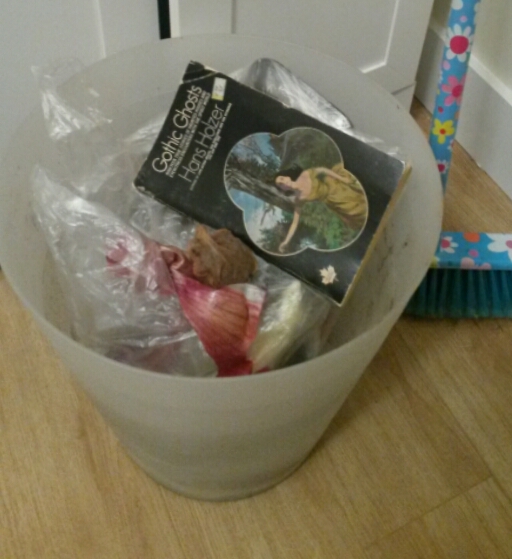
I recently reviewed Hans Holzer’s Gothic Ghosts. It was an absolutely atrocious piece of garbage, but in retrospect, I think that one of the reasons that book seemed so shitty to me was the fact that I had been reading it on my commute into work each morning while simultaneously spending my evenings reading the ghost stories of M.R. James. Holzer is shit at best, but in comparison to James, he is the shit of a shit.

Ironically, James’s ghost stories, while hugely entertaining and infinitely better than Holzer’s tripe, are also quite formulaic. They’re nearly all about elderly, educated, asexual gentlemen who find some kind of ancient artifact whilst on a vacation in a rural town. This ancient whistle, book, photograph, map, key, dollhouse or manuscript will prove to be haunted, and terror will ensue. That might seem unenjoyably predictable, but it’s the atmosphere and sense of impending doom that make these stories so entertaining. You know from the start that something fucked is going to happen; it’s the build up that allows the ghouls to get right in under your skin. I found audiobook versions of some of the stories on youtube, and listened to them whilst lying in bed.  While doing so I took great precautions to avoid the icy grasp of any skeletal hands that may have been reaching up from underneath my bed. I kept my arms, legs and head safely under the blanket.

These stories are magnificent. The Tractate Middoth, A View from a Hill, A Warning to the Curious, and Wailing Well might be my favourites, but most of the stories in here are top notch. There are a few stinkers; Two Doctors is crap, and The Story of a Disappearance and Appearance, although it does contain a chilling nightmare sequence, is fairly disappointing. The book I am reviewing here is the Collected Ghost Stories, not the Complete Ghost Stories. James wrote 4 other ghost stories that are not included in this publication. They are:
The Experiment
The Malice of Inanimate Objects
A Vignette
The Fenstanton Witch
They’re not James’s best, but they’re all worth reading if you like the stories in this book. A quick google search will sort you out.

I don’t want to spend too much time discussing James or his tales, as there is an abundance of information on both him and his writing online. I really enjoyed the BBC documentary on his life, and the M.R. James Podcast is good for additional information on each of the tales.

I’ve already mentioned that the cover of this book is fairly shit, but the real disappointment with this edition is the lack of notes. James was an exceptionally well-read individual, and he makes reference to many peculiar characters, events and texts. It would be really nice if the book included short explanations of these obscure references. I’m not sure if other publisher’s editions have notes sections either, but I know that the Wordsworth Series are crap for this kind of thing. I read the Oxford edition of Le Fanu’s In a Glass Darkly, which had extensive helpful notes, but the Wordsworth edition that I bought has none. (Incidentally, M.R. James was a huge fan of Le Fanu.) Also, it bears repeating that this is not the complete collection of his ghost stories. I don’t know which is the best edition of James’s tales, but I know for sure that this isn’t it.

Either way, this gets an 8.5/10. It’s an extremely enjoyable read, and one that I will surely come back to in the future.

Gothic Ghosts – Hans Holzer

Pocket Books – 1972
2015-04-28 00.28.59

This book is absolutely terrible. It’s a collection of about 20 ghost stories, all of which are supposedly true. There are no sources given, and all of the stories follow the same formula. The following could be substituted for any of the included accounts:

Marjory, an art student, always knew that she had occult powers, but she never realized the full extent of her ESP until she moved into the old house on Pooey Street.

Number 15, Pooey street was a Victorian mansion. It was beautiful on the outside and luxurious on the inside, but there was a catch! Upon entering the mansion, any individual possessing any variety of paranormal sensitivity would feel a rumbling in their guts and immediately thereafter, they would void the soupy contents of their bowels into their britches.

Marjory was able to adapt to this sticky state of affairs by constantly wearing an adult diaper. The house was cheap and spacious, and Marjory was a poor student in desperate need of a studio for her art. A smelly bum and a dose of nappy-rash was a small price to pay for such a perfect home. Marjory soon adapted to life in the old house, and things seemed to be going swimmingly for her. That was until she saw the figure on the stairs!

One night, she awoke from her slumber and arose to fetch a glass of water from the kitchen. She drearily walked out of the bedroom and turned to walk down the hall. There, on the stairs in front of her, floated a ghastly specter! A full body it was not; only a repulsive, mouthless face that stared menacingly at Marjory who was now frozen stiff at the top of the steps. The face had two hairy cheeks and a singular brown eye that seemed to be winking horribly at Marjory. Marjory wondered if it was the ghost of a cyclops who had died of conjunctivitis and mumps, as the gaping eye was smeared with a rotten brown crust and the cheeks were rotund and fleshy. A small trunk-like appendage arose from under the eye and sprayed Marjory with a rancid milky ectoplasm. That was when Marjory fainted and fell down the stairs.

She awoke in the hospital days later. She had suffered severe brain damage and was never able to walk again. It just goes to show that an old ghost never learns new tricks!

Obviously I got a bit carried away when writing that. If the book was full of stories of that caliber, I’d be giving it a solid 10/10. No, this book is nowhere near entertaining. It’s basically the same stupid story of a dead scullery maid looking for attention, told twenty times over.

I can’t remember how this piece of trash found its way into my book collection. I either picked it up at a library sale for 50 cents, or perhaps the ‘Gothic Ghost’ of Hans Holzer planted it in my collection in order to have it reviewed. Sorry Hans, this is fucking terrible. I’m giving your shitty book a 1/10.

The Irish Gothic – Uncle Silas, The Picture of Dorian Gray and Dracula

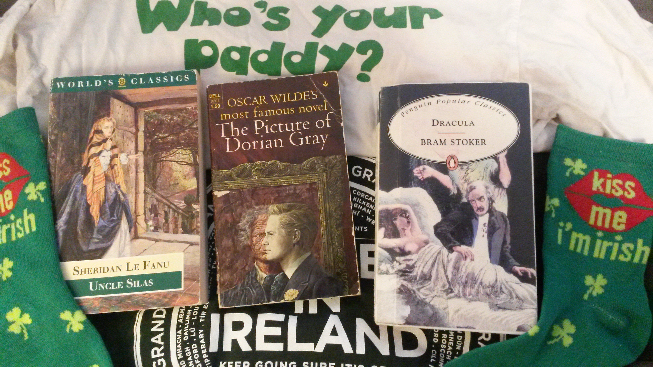
irish gothic Well it’s Saint Patrick’s day on Tuesday, and what better way to celebrate Irishness than to review some classic Gothic Literature from the Emerald Isle. I won’t go into too much detail as all three of these novels are absolute classics, and I expect anyone who is following this blog to have read them all.

The Picture of Dorian Gray – Oscar Wilde
Dell – 1978

dorian
Dorian looking a bit scaldy.

This novel is great. It’s been a long time since I read it though. Either way, I won’t hear a word said against our Oscar. It’s a pity he didn’t write more novels. 7.5/10

Uncle Silas – Sheridan Le Fanu
Oxford – 1981
silas
Howiye Maud?

This is one of my favourite books of all time. It’s standard Gothic fare really; a young girl loses her parent and she has to go live in creepy uncle’s house. The chapter in which Maud, the protagonist, encounters her repulsive governess for the first time had me shitting in my britches. The way that creepy bitch comes down the hill is absolutely CHILLING.

My edition of the novel is nicely annotated, and there is one note that I found particularly amusing. “414 a clumsy old press: in Ireland and Scotland, press = cupboard” Visiting my in-laws would be so much easier if I could get that printed on a t-shirt.

Anyways, this book is magnificent. If you like Jane Eyre or The Mysteries of Udolpho, then this is the book for you. If that doesn’t sound like your thing, then sorry, but we can’t be friends.

Dracula – Bram Stoker
Penguin – 1994
dracula
Nice ‘tache Drac. (Sweet diddys too!)

Well, this is obviously one of the greatest novels ever written. This was also one of the first books that I read after graduating from university. I had just spent four years reading books that had been selected by other people, and to have the freedom to choose a book according to my own tastes was tremendous. I remember actually looking forward to going to bed at night, just so I could get stuck into this absolute masterpiece.

I’ve always had an interest in ghosts and monsters: I grew up watching Ghostbusters and reading Goosebumps, and I’ve always preferred horror films to any other genre. I was expecting to enjoy this book, but I was not expecting to be frightened. Well, I was; there are parts of this book that are damned scary. There’s nothing in here that I hadn’t seen in a hundred movies; but reading Dracula, I realized that all of those movies had used this book as a template to produce their scares. I was spooked good and proper when the lads start to go missing on the boat as the count is lurking in the shadows. Pure deadly.

There’s also some weird sexiness to this novel. That’s not just something that Hollywood added to make the film versions more successful. There’s a lot of heaving breasts in here. Mina and Lucy sound like absolute babes. The count is a kinky one too, check this out:
With his left hand he held both Mrs. Harker’s hands, keeping them away with her arms at full tension; his right hand gripped her by the back of the neck, forcing her face down on his bosom. Her white nightdress was smeared with blood, and a thin stream trickled down the man’s bare breast which was shown by his torn-open dress. The attitude of the two had a terrible resemblance to a child forcing a kitten’s nose into a saucer of milk to compel it to drink.
Dracula! She’s a married woman, ye dirty bowsy!!! And you’d think he’d be satisfied with those lovely vampire wenches he keeps in his castle. I’ll tell ye now, if I was a single man I’d have no bleedin’ bother lettin’ them have a little suck, wha?

Anyways, I’ll give this a perfect 10/10. If you haven’t read this book, you have no reason to be wasting your time reading this blog.

There are other fantastic works of Gothic fiction to have emerged from Ireland. Charles Maturin’s Melmoth the Wanderer might seem like a glaring omission from this post, but I have a plan to review that later on in conjunction with another book. I’m also planning to review more of Le Fanu’s works in the near future.

I think it’s rather interesting to note that all three of the authors reviewed in this post were Dublin protestants. (Maturin, who was incidentally Oscar Wilde’s great-uncle, was also a Church of Ireland clergyman.) These three books were also written within 50 years of each other. You’d wonder what the Church of Ireland were putting in their non-transubstantial eucharist to get their congregation to be such creeps. I’ve read that Dracula represents Stoker’s alienation from the largely Catholic Ireland, but I reckon it was just dodgy proddy communion wafers.

These books are all savage. Fuck going to the parade this St. Patrick’s day; read one of these smashers instead.

The Monk – Matthew Lewis

Wordsworth Books – 2009
monk
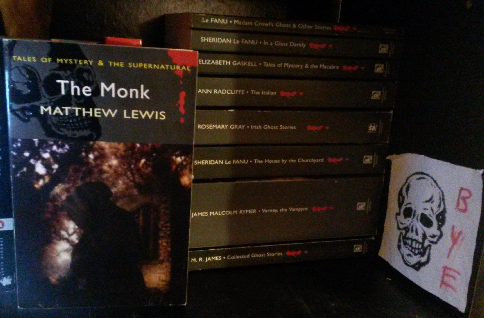
I enjoy collecting books, but I’m not in a position to buy nice editions of every book that I want. If the price difference isn’t huge, I’ll go with the hardback edition, but with some books, particularly science fiction, I actually prefer mass-market paperback editions.

I have a particular fondness for ghost stories and gothic horror, and I have hence amounted a small collection of the Wordsworth series of ‘Tales of Mystery and Supernatural Horror’. These books are usually less than $5, and although they aren’t usually annotated as nicely as Penguin or Oxford editions, they do the trick. My biggest gripe with this series is the pathetic cover art on some of the books, especially this one and Collected Ghost Stories by M. R. James. Yes, there are cool blood splotches and shiny 3D skulls, but the actual cover images are horribly pixelated; they look like they were thrown together in mspaint.

Anyways, this is one of my favourite books. I love it. There’s plenty of poems and subplots to keep it interesting, along with lots of juicy boldness: bitta shaggin’, a dirty aul priest, the divil floatin’ about…fuckin’ savage. The Bleeding Nun is also very cool. I don’t want to ruin anything on you if you haven’t read the book, but I’ll just admit that I was genuinely surprised when I got to the scene where Matilda unveils herself. I can’t even remember if she was supposed to be good looking or not, but that whole scenario of her in the monastery got me… excited. This book was written by a 19 year old male, and there is definitely an undercurrent of misguided horniess throughout. Apparently the Marquis De Sade was a fan; there’s definitely parts in here that that old gentleman would enjoy.

I won’t talk about this one too much though; there’s a million other reviews of this one online. The book itself is a classic, and if you’re at all interested in gothic horror, you have to read this. 9/10

The 2011 film version with Vincent Cassel is pretty good. It’s definitely worth a watch if you enjoyed the book.

(A parody of The Monk was published in 1798. It’s ingeniously titled ‘The New Monk‘, and apparently it’s even bolder than Lewis’s work. Valancourt have an edition out at the moment that I’ve been thinking about buying. They also have a nice looking edition of the original, with an introduction from Stephen King.)

The Castle of Otranto and The Old English Baron

The Castle of Otranto – Horace Walpole
Collier Books – 1963 (Originally published 1764)

The Old English Baron – Clara Reeves
Oxford – 2008 (Originally published 1778)

castle

For such an influential piece of literature, the Castle of Otranto is really quite silly. It’s not a particularly well written book, but it’s responsible for introducing many of the most common motifs of Gothic fiction. I have found it quite difficult to review this book without comparing it to the far superior novels that were influenced by it.
That’s not to say that this is not an enjoyable book though. It’s too short to get boring; you’ll finish it in an afternoon. The characters and plot are a little flat in comparison to later Gothic novels, but there are enough skeletons and ghosts in here to keep the reader interested. If you like Gothic fiction at all, you should check this one out.

The other book I’m reviewing in this post is The Old English Baron by Clara Reeve. For those of you who don’t know, this book is basically a reworking of the Castle of Otranto with all of the supernatural elements removed. In Reeve’s own words:

This Story is the literary offspring of The Castle of Otranto, written upon the same plan, with a design to unite the most attractive and interesting circumstances of the ancient Romance and modern Novel, at the same time it assumes a character and manner of its own, that differs from both; it is distinguished by the appellation of a Gothic Story, being a picture of Gothic times and manners.

If you can imagine somebody remaking the Exorcist, but leaving out all of the scenes that feature anything to do with possession, then you might just be able to fathom quite how lame this book is. I read it a while back and all I can remember is the irritatingly well-mannered characters incessantly bursting into tears. If you haven’t read this novel and intend on doing so despite my poor review, please keep a red pen handy and underline every instance that a character begins to cry. I would love to know the sum total but I can’t imagine I will ever reread this pile of crap.

The Castle of Otranto is an enjoyable little romp. Read it after your tea on a Sunday.
7/10


The Old English Baron (Fuck, even the name is annoying!) is a turd in a diaper. 2/10