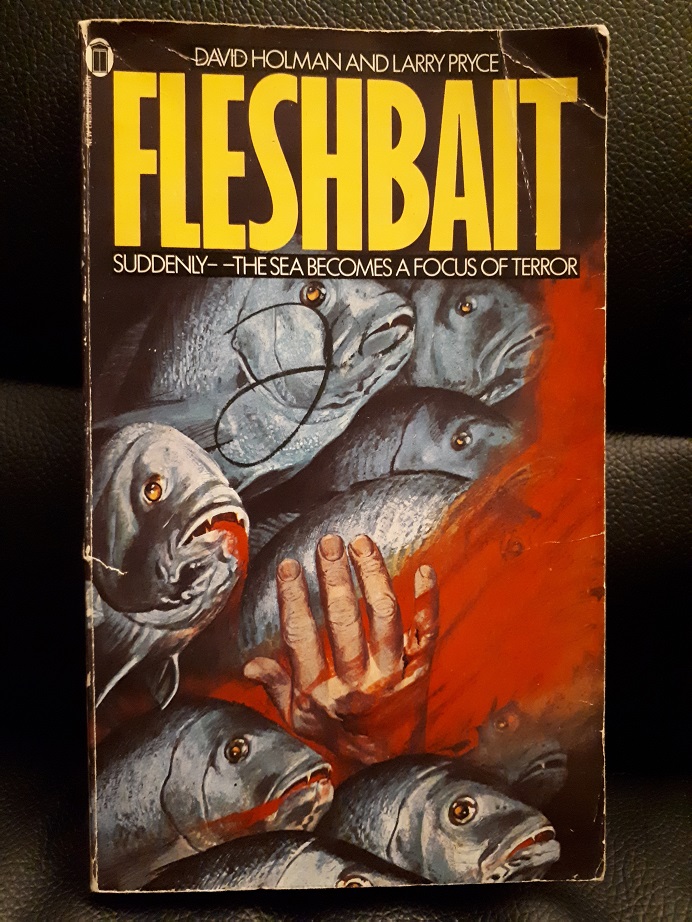
Fleshbait – David Holman and Larry Pryce

fleshbait holman pryce.jpg
Fleshbait – David Holman and Larry Pryce
New English Library – 1979

There was a period a few decades ago when animal horror was the big thing. Authors would pick any living creature, imagine them having murderous tendencies and a book would soon emerge. Harmless creatures such as dogs, cats, rats, slugs and crabs all had their turns at turning nasty. This type of horror isn’t hugely appealing to me, but I was in a bookstore the other day and found a short book about what looked like killer fish for 2 dollars. I thought I might as well give it a go.

One of the many problems with this truly awful book is that the first identifiable group of killers is a swarm of trout.

There are two reasons why I find trout amusing. Can you remember when you and your friends were teenagers and you would collectively fixate on a word or phrase? In my school this happened several times. The boys in my 4th year classroom decided as a whole that the word “girth” was hilarious. We’d mutter it under our breaths when the business studies teacher turned his back, or we’d write “Adam has a girthy one”on the inside of Adam’s copy book. Another time, somebody realised that a boy in the year below us had bulbous eyes and a fishy looking mouth. When he dyed his hair different colours, he sealed his own coffin. From that moment on, he became known as ‘Rainbow Trout’. For the interests of mischief, we dropped the Rainbow part of the phrase when in class, but the phrases ‘trout’ and sometimes even ‘brown trout’ were forevermore heard echoing through the classrooms and corridors of my alma mater.

The second reason that the word trout brings me mirth is a text message my sister sent me a few years ago. She was on holiday with a less than responsible friend, and on one occasion, my sister returned to their hotel room only to discover this friend engaged in an act of passion on the veranda. I believe the exact phrasing of her later report to me was, “I walked in and there was a lad on the floor licking her trout.” To this day the memory of that text never fails to bring me a chuckle.

Keeping these points in mind, the reader will understand how I found it difficult to take seriously the horror of a swarm of malevolent trout.

There’s more than trout to this book though. After a bunch of nuclear waste leaks into the sea, any fish that encounter it begin to mutate. They quickly evolve larger brains, vocal apparatus, telepathic abilities and a thirst for revenge against the humans that have hunted them for thousands of years.

A scientist, still reeling (haha) over the suspicious death of his best friend, finds himself in charge of the campaign against the killer fish.

After a particularly nasty fish attack, he calls a press conference, but the only person to speak at this conference is an insane woman.

When the scientist discovers that his friend actually committed suicide because he was gay for him, he recklessly dives into the most contaminated part of the sea and discovers a slab of rock that’s covered with mutilated human bodies that the fish have put on display in much the same way that fishermen display pictures of their catches on the walls of their offices.

This grisly grotto turns out to be a radioactive hub that is charging the local sea life with mutating radiation. After it is blown up, everybody assumes that the problem is solved.

This illusion is shattered when a big gang of fish assemble near a railway that passes by the ocean front. When a train containing the scientist and his team passes by this little stretch, these fish point their arses inland and flip their flippers. This causes a tsunami that knocks the train off the tracks.

Haha, this book was such a piece of crap. I just looked back through the animal horror section in Paperbacks from Hell and saw that it does get a brief mention there. Of all the books I’ve read that were featured in there, this is definitely the worst. The authors try to fit too many ideas into a very short text, and the antagonists aren’t scary at all. This book is shite.

The Compost Bin – A Short Story

20190617_203412.jpg

The world is in trouble. We’ve all known this for a long time, but conservation efforts are no longer only made by bearded liberals. Here in my country, we have state mandated recycling programs. In the basement of my apartment building, we have separate bins to sort our used cans, bottles, paper, and even old clothes. My favourite bin though, and the subject of this tale is the compost bin for our food waste.

I was overjoyed when I first saw it there. I like the idea of saving the planet, and food in the garbage often stank up my apartment, especially during the summer when it’s hot. A big grin could be seen stretching my lips on my return journeys from the basement after the compost bin showed up. It was the satisfied smile of a man playing his part for the environment.

About 2 months after this big brown bin appeared, something very special happened.

It was an exceedingly hot day, and the bowl I used to collect my food scraps was emitting an unpleasant odor. It contained the carcass of a rotisserie chicken and half a withered red onion. This fine feast was topped with some rancid yoghurt that should have been thrown out months before. When I found the yogh-cartons at the back of my fridge, I emptied their contents on top of the chicken skeleton and proceeded to rinse out the cartons so that they too could be recycled. As I carried the bowl of compost downstairs, its powerful stench waves assaulted my nostrils.

The air around the larger compost bin downstairs was worse. Every breath within a 5 meter radius of it tasted like a mouthful of hot, rank soup. After the slow process of emptying my bowl and all of its slimy contents, I was starting to feel nauseous. I hacked the phlegm from the back of my throat and voided my rheum into the compost bin.
I walked away feeling upbeat and refreshed. On my way up the stairs, I wondered about the fate of the phlegm and spittle I had left atop the stinking pile of rot. Slowly but surely, it would become an indistinguishable part of the slurry, its molecules mixing with those of the chicken carcass, and those hybrid molecules would go on to mix with the remains of the vegan curry that I had earlier smelled cooking in my neighbour’s apartment. After the mixing would come decay, but after sufficient rotting had ensued, the compost would be spread on a farm, and crops would be grown from it. My loogie might go on to become part of a carrot, and due to my faith in the cyclical nature of the universe, I felt it fairly likely that I should be the man to eat that very carrot.

What a reward! I had become an active participant in the circle of life. From thereon, it was a rare occurrence for me to take out the compost without leaving a little of myself in the mix. Mostly it would be a little spit or a large crispy snot, freshly picked, but sometimes I would go further and merrily give a a handful of toenail clippings.

I quickly became fixated on giving myself to the task, and little would be emitted from my body that would not end up in the brown bin downstairs. My compost bowl that I used leave on my microwave could often be seen housing a mushy tissue or a piece of skin picked from my foot. Once every few months, it would cater to the needs of my freshly clipped hair, both cranial and pubic. I once gave it my beard trimmings, but they were a nuisance to get out of the end of the bowl after mixing with the sickening sooly that lurked there.

Now every man has his limits, and while I am a dedicated conservationist, I also have my dignity. I refrained from ever putting my feces into the compost bin, not for any moral reason, but because doing so should properly stink out my kitchen. Yes, I refrained from doing so, but I can’t lie and say I never thought about it. In truth, it became a fantasy of mine, and you can only imagine my mirth when my stars aligned and there was a plumbing failure in my apartment building that took away our running water and prevented the toilets from flushing.

I was lucky. My toilet was clean and flushed when the failure occurred, so my house was not immediately effected. The landlord hired a portapotty for my neighbours and I, but it was not sufficient defense against the army of bowels in need of evacuation in our building, and this facility was quickly rendered unusable by a veritable mountain of dung that peaked well above the toilet lid. Only a contortionist would have been able to use it without making a repulsive mess of themselves.

I resolved to stay at home and to satiate my need in an environmentally friendly manner. I squatted above a large sheet of butchers’ paper (folded twice to protect my carpet) and squeezed out a hard lump of blackened gick. The process was made painful but rather tidy by the fact that I hadn’t drank anything in a couple of days on account of the lack of running water in the building. The painful mass of hideous scum that I produced was truly a labour of love.

It took but two crisp wipes with some more butcher’s paper to tidy myself up, and after doing so I placed my little parcel into my compost bowl and took it straight down to the basement. Dropping off my dropping was like seeing off an emigrant child at the airport. It was hard to say goodbye, but it was also exciting to think of the prospects of that small part of me to which I was bidding adieu. My pellet was fresh and ready to fertilise.

The plumbing was soon fixed, but I had developed a taste for leaving different parts of myself in the compost bin. I became obsessed with spreading my DNA. The more I gave, the more likely it would be that somebody of great importance might some day ingest a small part of me. I found momentary satisfaction by donating my collection of the baby teeth of my childhood, but I could feel the urge growing. My mantra became, “To live, I must give.”

One day, while preparing an offering of my toenails, I dug a little too deep and ended up with a small slice of flesh under the blade of my clippers. It caused great pain, but the agony was outweighed by the ecstasy of knowing that this tiny slice of flesh would go on to give life. I couldn’t stop myself from digging a little deeper under the next nail, and a little deeper on the next.

In the ensuing weeks I read several books on the anatomy of the human being. Using these books as a I guide, I plotted a map of the least essential parts of the human body, and over the following months I used this map to guide my trusty nail-clippers to the parts of my person that could be slowly excavated without serious risk to my survival. As time went on and I became accustomed to the pain, I began to use a pair of scissors to remove larger chunks of useless flesh, starting with my earlobes and moving on to larger, more sensitive unnecessaries. I’m not stupid though, and I have refrained from removing anything that could prevent me from making my nightly trips to the compost bin to present my offerings. Acquiring sustenance has become more difficult though, and recently I have been having all of my food delivered. I leave the money on the doorstep and collect the food only when I am sure there is nobody in sight. There is very little left of my face, and my skull is showing through several parts of my head. I fear that anyone who sees me might fail to understand why I’m doing what I’m doing. No, the layman might not be capable of appreciating the generous and spiritual nature of my sacrifice.

I feel now though that the final stage of my gift to the world is approaching. After I finish typing this manuscript, I shall take a knife and dice my flesh, leaving sufficient strands of skin and muscle to hold me together for my final journey. This slicing will be no act of masochism but a carefully planned act that should speed up decomposition. At this stage you will have guessed my destination, but do not, gentle reader, deny me the pleasure of announcing my plans. Yes. Oh yes, yes, yes. Tonight, I shall undress, wait until the coast is clear and then walk down to that big brown compost bin for the final time. With glee I shall climb inside that reverse womb and continue my journey towards rejuvenation and rebirth. Death is an illusion. I shall become life itself.

The Doctor Orient Series, Books 5-8

doctor orient
I published a post on the first 4 Doctor Orient novels at the beginning of last year. If you’re not familiar with this series, you might want to read that post before reading this one.

the priestess frank lauriaThe Priestess – Frank Lauria
Bantam Books – 1978

This one sees the Doctor getting involved in a voodoo cult in Florida while he’s on the run from a government agency. Owen Orient is alone in this book; his friends from the previous novels are entirely absent here. This is pretty much what you’d expect, lots of sexy ladies, cocaine and snakes. Pretty good. The previous owner of my copy seems to have been very knowledgeable on the subject of Cuban witchcraft; my book is filled with notes on Lecumi.

seth papers frank lauriaThe Seth Papers – Frank Lauria
Ballantine Books – 1979

The Seth Papers is both the shortest Doctor Orient novel and the only epistolary novel in the series. I quite enjoyed the book, but it’s based around a rather strange idea. It’s about an Italian neofascist secret society that is attempting to retrieve the mythological Hand of Seth to take control of the Vatican. It was published in 1979, a good 2 years before the general public was made aware of P2, the Italian neofascist secret society that close ties with the Vatican and the Mafia. Did Frank Lauria come up with a plot that resembled reality by coincidence? If not, how did he know about this strange secret society? How did he publish a book about it and live? Those P2 lads hung a lad from a bridge for less!

blue limbo frank lauriaBlue Limbo – Frank Lauria
Frog, Ltd. – 2001 (Originally published 1991)

Doctor Orient’s 1991 return sees him in Jamaica battling another High Priest of Voodoo. As usual, the plot involves the main character falling for an evil woman and getting himself into serious trouble. There’s a nuclear submarine, some zombies, a psychic albino and some Cuban agents thrown into the mix too. The plot of this one was overly complicated. There was also a character who only spoke in rhymes. That really pissed me off. It didn’t make him sound mystical or profound; it made him sound like an annoying little cunt. This was my least favourite entry in the series.

frank lauria demon pope
Demon Pope – Frank Lauria
Rothco Press – 2014

More than 2 decades after his last outing, the doctor returns to New York. Unfortunately for him, he gets involved with a group of Satanic immortal Nazi clones who are have stolen the Spear of Destiny and are planning to use it to take control of the Vatican.

Unlike other occult detectives, Doctor Orient is a powerful psychic, and at times throughout the series, this gives him opportunities to solve impossible problems. He’ll topple over a candlestick into a curtain, causing a distraction that allows him escape from a guarded room. He can also talk to people on the astral plane, and this allows him to track his friends and enemies down without GPS. The first Orient novel was published in 1970, and he uses these powers throughout all of his adventures. In Demon Pope, a novel published 44 years into Owen Orient’s career as a hero, he acquires a new skill. Now he is able to transform into a panther. Honestly, this was a bit hard to swallow.

Demon Pope is a bit of a mess to be honest. It’s very unclear as to why the stuff that is happening is happening. There’s a part at the beginning where a teenage girl is sacrificed that is never explained. Also, the text is full of typos. You’d have thought that somebody at Rothco Press would have read over Frank’s manuscript before printing it. That being said, this was still a fairly enjoyable read.

doctor orient complete The Complete Collection

The first 6 Doctor Orient novels were published in the 70s. After The Seth Papers, Doctor Orient kept his head down for over a decade. After returning in 1991’s Blue Limbo, he would take another two decades off before coming back for Demon Pope. Why such long waits? I’ve actually discovered the answer to this seldom asked question. In 1982, Doctor Orient made a brief appearance in comic book form. He was given several pages in both editions of Steve Englehart’s 1983 Scorpio Rose comics. This was supposed to have at least one more part, but the series was cancelled because it wasn’t very popular. The 3rd edition of Scorpio Rose was eventually published in a collection of Englehart’s work, but this did not contain a 3rd installment of Doctor Orient’s adventures.

scorpio rose doctor orient

So what happens in the Doctor Orient comics? Not as much as I’d have liked – they’re really short. The Doctor exorcises a young girl and ends up going back in time to fight with a Nazi called Von Speer. Sound familiar? It will to anyone who has read Demon Pope. It seems as though Demon Pope is the novelisation of the story Frank Lauria wrote or at least started writing in the early 80s for the Orient comics. While Demon Pope wasn’t published until 2014, Lauria had actually come up with the plot for it only a few years after finishing The Seth Papers.


Well, that’s that. It took me more than 3 years to collect and read the entire Doctor Orient series, but now it’s done. It’s a bit of  push to classify these as horror novels; they’d be more accurately described as adventure books about occult phenomena. While Doctor Orient probably isn’t the greatest Occult Detective out there, these novels were very entertaining, and if there’s ever another published, you know I’ll be reading it. As of now, Raga Six (#2) was my favourite. I’ve also reviewed Frank Lauria’s The Foundling if you’re interested.

The Devil’s Grimoire – Moribus Mortlock

the devil's grimoire - moribus mortlock.jpgThe Devil’s Grimoire: A System of Psychic Attack – Moribus Mortlock
Winter Tempest Books – 2013

Has somebody done something to annoy you recently? Want to retaliate but you’re too much of a pussy to take action? Have you suffered a severe brain injury that has rendered you a clinical moron? If your answer to all 3 of these questions is ‘yes’ then I have the book for you!

Moribus Matlock’s The Devil’s Grimoire is a simple guide to solving your petty grievances through the art of demonaltry. This short book lists off the names of 36 demons, the incantations for summoning them and some situations that might warrant doing so. It’s pretty basic stuff, not much to really discuss.

There was one demon, a certain Malvader, whose description gave me pause for thought, “An obsessive rape demon with a curved appendage nearly as large as his torso who viciously and without cessation attacks your enemy in every orifice.” The indefinite article ‘an’ suggests that there is in fact more than one obsessive rape demon. Yikes!

I will give ol’ Mortibus some credit for having noisy neighbours 1st on his list of potential victims. There are few things in the world that irritate me as much (and as frequently) as rude people assuming that nobody minds having to listen to their shit music. Noisy neighbours are heinously annoying, but what about those inconsiderate cunts who play loud music on the bus or train? That my friends is the very height of rudeness. Those individuals deserve a visit from our old pal, Malvader.

Nazi Poltergeists – Michael Falconer Anderson’s The Unholy

the unholy - michael falconer anderson.jpg


Roughly a year ago, I read and reviewed Michael falconer Anderson’s Blood Rite. It was an exceptionally dry, unimaginative, style-less piece of trash. If you had asked me then about the likelihood of me reading another book by the same author, I would have said it was extremely slim. But this was only because I didn’t realise that Michael Falconer Anderson had also written a horror novel whose cover featured a skull with swastikas for eyeballs.

A train crashes on its way into a small English town because its driver suddenly becomes convinced that he’s actually driving a train full of unfortunates to a concentration camp. A mysterious box belonging to the train’s most suspicious passenger is lost in the crash, and soon thereafter a troop of supernatural Nazis (they’re half ghost and half zombie) start killing, raping and possessing the locals. A newspaper editor and his psychic friend deduce that these horrible occurrences are due to the presence of some terrible talisman of power.

The major selling point of The Unholy is obviously its cover, but one glance at such will spoil the central mystery of the book for the astute reader. Once the protagonists realise who and what they’re dealing with, they have no choice but to find and destroy the most sacred relic of the Reich.

Preventing them from doing so is the mysterious occultist David Preese, a character clearly based on Aleister Crowley.  Another character describes him thus, “You may remember about five years ago the newspapers were calling him “The Beast”. He’s involved in all kinds of things. He’s even started his own religion – the Priests of the Aryan Dawn. It’s some kind of mixture of old Indian religions and Teutonic myths…” Preese is soon thereafter depicted performing a sex magic ritual with two teenagers. He later turns out to have been the mysterious individual who lost the box during the train crash.

This book is quite bad – much like Blood Rite, the actual writing is like eating a sandwich with no filling. The plot of The Unholy however, is far, far more interesting. It’s like a mixture of Emmerdale, Evil Dead and Downfall. It only took a few days to read, and I actually quite enjoyed it. Shall I seek out and read Michael Falconer Anderson’s other horror novels? I might.

One interesting feature of this book is how it deals with the Holocaust. I doubt very much that this would find a major publisher today. Nazis are clearly presented in an evil light, but the victims of the Holocaust are also made part of the horror. At one point the protagonist watches as the Nazis gun down a herd of people into a pit. That stuff actually happened, and it’s scarier than any ghost stories. It feels a bit cheap for an author of horror fiction to exploit it.

The crazy thing about this novel is that I discovered it existed after buying it. I was glancing through my search history on abebooks when I saw a book that I didn’t recognise. I had ordered it a year previously, but it never arrived, and I had totally forgotten ever buying it. This has never happened before. I found a pdf copy online though, so at least I didn’t have to buy it again.

Wiccan Sex-Magic – Inga Steddinger

wiccan sex-magic inga steddinger.jpgWiccan Sex-Magic – Inga Steddinger
Runa Raven – 1999

The image that pops in my head when I hear the word Wicca is of a middle-aged white woman with a nose ring and a well stocked spice-rack. It’s that flowery witch bullshit for Rennaisance fair geeks, right? Well, apparently there’s more too it.

In an introduction by Stephen E Flowers, it is made clear that the word Wiccan in the title of this book means “that of the sorcerer”, so the title really means “Sex Magic of the Sorcerer”. I assume this is pointed out early on so that people know that this work isn’t tying itself to the Mommy-with-a-moon-tattoo sect of witches that we all think of when we hear the word Wiccan.

Gerald Gardner, the father of Wicca, was friends with Aleister Crowley, and while Gardner’s Wiccan tradition did involve the use of sex in its practice, it seems that many Wiccans today shy away from the kinky stuff, at least publically. This book goes the other way and embraces it.

The main idea here is that sex magic is effective because when performed correctly it corresponds with the actions of the Gods of Norse Mythology as told in the Eddas. It’s all about power. There’s always a submissive and dominant, and this power imbalance and the flow of power it entails ensure that the rituals are highly charged. When the magician gives his girlfriend a passionate rimjob, he is worshipping her as the fearless Warrior Gröd worshipped the Goddess Holfurnbjorn. By becoming an avatar of the hero in this manner, he activates that hero’s powers. I’m being a bit silly here, but I’m confident that I’ve made the idea clear.

It wasn’t just the intro to this book that reminded me of Stephen E. Flowers; it’s also full of talk about bondage and birching. When I reviewed Carnal Alchemy, the book on Sado-Magical techniques that Flowers wrote with his wife, I noted that it had a  self-aggrandizing “We do S&M. We’re magicians. We’re so cool” vibe to it. Wiccan Sex Magic is similar. Then again, I suppose that most magicians are bound to bring their other interests into their practice, and if Inga Steddinger wants to incorporate her love of going to orgies and having her bum slapped into her magical practice, good for her.

This is a short review, but Steddinger’s book is only about 40 pages long. I have some cool stuff lined up for the next few weeks, so check in again soon.


Teatro Grottesco – Thomas Ligotti

teatro grotessco thomas ligotti.jpgTeatro Grottesco – Thomas Ligotti
Virgin Books – 2008 (First published 2006)

This collection of short stories makes most of the horror fiction I’ve read seem like a children’s cartoon. This isn’t bump in the night stuff; it’s black, oily, suffocating horror. It is the second book that I have ever read that actually gave me nightmares.

Nightmares are interesting things. While they always contain some kind of unpleasant element, they also have to be similar enough to our day to day lives to actually disturb us, and it’s this fact that gives this Teatro Grottesco a truly nightmarish quality.

This collection is truly weird weird-fiction, but while the scenarios it describes all contain an element of the fantastic, their reality is never far enough from our own to void the message they deliver. And there is a message in these tales. Ligotti is a philosopher as well as a fiction writer, and it is his takes on reality that make these stories truly horrifying. This will come as no surprise to anyone who has read his The Conspiracy against the Human Raceone of the most pessimistic books in existence. I read and enjoyed that one a few years ago, but my one complaint was that although the arguments therein are convincing, they didn’t hugely influence the way I was feeling when I read them. I was able to brush them off as somebody else’s bad attitude. For me, it was far more effective coming across these ideas in fictional narratives than in a treatise of philosophy. The final tale in this collection, The Shadow, The Darkness, is one of the most profoundly articulate discussions of the futility of human existence that I have encountered. It made me feel quite bad when reading it. Indeed, the horror of Ligotti’s prose is more directed at its reader than at its characters.

The characters in these tales are very strange. They appear more as shadows than as distinguishable individuals. They’re all artists or managers of boarding houses. The narrator of any one tale in this collection could be the narrator of any of the others. This might seem like a criticism to somebody who hasn’t read the book, but I strongly suspect that it was intentional. One of the key ideas throughout this collection is that the self is an illusion. Human minds and souls aren’t real; they are a symptom of the sickness of reality, and the attempt to distinguish between one person and another is a pathetic exercise in futility. In one of the tales, a character describes himself thus:

“My body – a tumor that was once delivered from the body of another tumor, a lump of disease that is always boiling with its own disease. And my mind – another disease, the disease of a disease. Everywhere my mind sees the disease of other minds and other bodies, these other organisms that are only other diseases, an absolute nightmare of the organism.”

Get the idea? What difference does it make who is narrating the story if every living thing is just a drastically diseased and deluded tumor? This book is horrible – horrible but also absolutely deadly.

Shout out to my mother in law for buying me this for Christmas. It’s probably my favourite book that I’ve read this year – I really, really liked this one. It’s also the third of Ligotti’s books that I’ve read, and from what I can see online, most of his books are fairly difficult to come by. This is unfortunate because he’s a brilliant writer. I’ve seen a bunch of stuff that talks about how Ligotti is like a modern Lovecraft, but I find his writing more similar to that of Samuel Beckett than to any horror writer I’ve read. (I think the similarity lies in how both writers present human relationships – maybe I’ll write an essay about this some day.) Anyways, I am going to try to find a copy of the Penguin edition of Ligotti’s first two books and review it in the very near future. This is the kind of horror I want to read.

The Black Grimoire – Angel Zialor

black grimoire angel zialor
The Black Grimoire – Angel Zialor
Starlight Books – 2008

I told myself I’d stop doing it, but I realised a few days ago that the multibook post I had planned for today wasn’t going to be finished on time. I have hence reviewed yet another independently published grimoire that I found on the internet. These things are often short, and they’re usually handicapped enough to poke some serious fun at. The only downside is having to come to terms with the fact that I am wasting my time reading such shit.

This little pamphlet is awful muck. It’s clearly just a bunch of spells, rituals and prayers that the author, Angel Zialor, stole from other sources. Although the author describes the contents of this book as diabolic, much of it is made up of Christian prayers. Angel Zialor is a clueless moron.

I have two examples from this text that further demonstrate that last point. The first is a ritual of Sumerian Money magic that instructs the magician to urinate into a jar and say to it, “Salty liquid from within me, I demand that you bring me wealth.” I’m not making this up. Angel Zialor is literally instructing her readers to speak to a jar of their own piss. This sounds like the kind of thing a severely deranged mental patient might do, not a powerful magician. I wonder if there’s an equivalent ritual in which the practitioner must demand a plate of their shit to deliver them a lover. “Smelly brown paste from within me, I demand that you bring me my one true love.” That would be no more ridiculous.

As mentioned already, the spells or rituals in The Black Grimoire seem like they have been taken from other books. With the exception of one, I wasn’t bothered tracking down the original sources. This piece of shit book doesn’t warrant that level of research. The one ritual that I did look up was “The Spell of Hatred”, a spell to cause harm to your enemies. This spell is a paraphrased version of the Barabbas Spell featured in Paul Huson’s 1970 book, Mastering Witchcraft. There’s a few minor differences between the Spell of Hatred and the Barabbas prayer, but the content is almost identical. The most noticeable change is that instead of using sard stone as an ingredient, Zialor opts for a small piece of sardine. This makes things sound pretty funny later on when instead of evoking the “Queen of Sard” as in the original Barabbas spell, Zialor’s version calls for the “sardine Queen”.

sardine queen

The publisher of this nonsense, Starlight Publishing, has an amazing website. It’s worth a look for the utterly awful cover art they use on their books. I was not surprised to see that they have also published stuff by my old friend, Marcus T. Bottomley.

Ugh, enough of this shit. I apologise for presenting my readers with a work of such low caliber.

Crawling Chaos Magic – Lovecraft’s Legacy, Part 3

pseudonomicon phil hine.jpgThe Pseudonomicon – Phil Hine
New Falcon Publications – 2007 (Originally published in 1994)

I’ve read quite a few books of Lovecraftian occultism at this stage, and this was the best one yet. It’s a book of chaos magic. Chaos magic, as far as I understand it, is a very open form of magic. It is to free verse as goetia is to writing sonnets. The focus here is on results rather than rules and rituals.

While other books of Lovecraftian magic attempt to mix Lovecraft’s mythos with traditional forms of occultism, the Pseudonomicon encourages experimentation. A true Cthulhu druid should follow their intuition rather than the steps of a ritual. This disregard for traditional sequence fits in with Lovecraft’s tendency to use non-Euclidean mathematics as a method of evoking a weird atmosphere in his tales.

cthulhu.jpg

From the perspective of the layman, the behaviour that this book describes and encourages will seem ridiculous, and a skeptic might fairly describe this as a book on how to pretend that a collection of fantastic stories by a dead lad are based in reality. Neither view would be incorrect, but so what?

The book acknowledges that reading it might lead one to madness, and anyone who takes its advice and smears themselves in shit while dancing around a graveyard at night might well be seen as insane. On the other hand, who am I to act as though my take on reality is any more accurate than that of the Cemetery Scat Man. The more I think about it, the more I believe that what a person perceives IS their reality. If the Pooey Ghoul believes his actions are allowing him to speak to the Great Old Ones, I can’t disagree. Reality, existence and their links to perception are too inherently unknowable for anyone to assume that their take on these concepts is any more sensible than another’s.

This book does get pretty weird. In an appendix near the end, the author describes his experience of being possessed by Tsathoggua, Clark Ashton Smith‘s giant toad god who features in Lovecraft’s Whisperer in the Darkness. Cool.

This book does a pretty good job of balancing the Mythos stuff with a practical way of incorporating it into magical workings. If i was ever going to practice magic, i think i’d go for something like this.

haunter of the dark lovecraft.jpg
The Haunter of the Dark – H.P. Lovecraft

Wordsworth – 2011

This is the second and biggest entry of the Wordsworth Lovecraft editions. It contains the following stories:
Celephaïs, Herbert West – Reanimator, Pickman’s Model, Polaris, The Cats of Ulthar, The Colour Out of Space, The Doom That Came to Sarnath, The Dream-Quest of Unknown Kadath, The Dreams in the Witch House, The Haunter of the Dark, The History of the Necronomicon, The Horror at Red Hook, The Other Gods, The Shadow out of Time, The Shadow Over Innsmouth, The Shunned House, The Silver Key, The Statement of Randolph Carter, The Strange High House in the Mist, The Thing on the Doorstep, The Unnamable, the essay Supernatural Horror in Literature and Fungi from Yuggoth, a collection of weird sonnets.

The items listed in blue are not contained in the Penguin editions of Lovecraft’s work. I’m not going to say much about this collection other than that I really enjoyed reading most of these stories again. The Thing on the Doorstep and The Dreams in the Witch House are so deadly. Also, I’m pretty sure The Shadow Over Innsmouth is tied with Whisperer in Darkness as my favourite Lovecraft story. I’m not mad about all of the Dream Cycle stuff, but parts of it (The Other Gods) are awesome.

At this stage I’ve finished rereading all of the stories that Lovecraft wrote by/for himself that were included in the Penguin editions. It has been very enjoyable, and I feel that I’m now in a much better position to understand a lot of the occult texts that are based on his works. I can now sensibly distinguish a Shoggoth, Yuggoth and Yog-Sothoth. I still have one more entry in the Wordsworth series to read, but that one is comprised of collaborations that Lovecraft worked on. I’m quite excited about that as I’ve only read one of the stories it contains before. After I review that, I’m going to do a post on all of the stories that are not collected in the Wordsworth series. Both posts will also include an obscure work of Lovecraftian occultism. Stay tuned.

Edit: For convenience sake, I’m including the links to all of the posts in this series for anyone who’s interested. (Part 1, Part 2, Part 3, Part 4, Part 5)

Man Into Wolf: An Anthropological Interpretation of Sadism, Masochism and Lycanthropy – Robert Eisler

man into wolf eislerMan Into Wolf: An Anthropological Interpretation of Sadism, Masochism and Lycanthropy
Robert Eisler
Spring Books – 1951

While this book may not look as interesting as the stuff I reviewed in last week’s post, it is more original, more suited to this blog and infinitely more interesting. Don’t let that pale blue cover fool you; this is mental.

The collective unconsciousness, as far as I understand it, is a postulated pool of ancestral memories to which each human being has limited access.  This theory is supposed to explain some of the strange ways in which we act. For example, it suggests that modern humans are afraid of the dark because a part of our unconscious mind remembers our distant ancestors being attacked by wild animals in the dark of night. I see the reasoning behind the idea, but I think it’s mostly understood to be pseudoscience at this stage.

Why the discussion of outdated psychology? Well, the theory of the collective unconsciousness is central to the claims of Man into Wolf by Robert Eisler, a 1948 lecture that was turned into a book. I can’t remember where I first read about this strange text, but I remember spending a lot of time tracking down an affordable copy. (This was during the stage of my life when I preferred physical books to digital copies.) Once I found a copy, it lay on my shelf for 5 years.

man into wolf sadism masochism lycanthropy eisler

Eisler claims that human beings originally lived in a Rousseauian state of harmony. Our primitive ancestors were pygmys that lived in small tribes, eating only fruits and vegetables, having sex with everyone and generally having a great time.

Unfortunately, these peaceful tribes were very vulnerable to attacks from predators, and early humans were often attacked and killed by wolves and lions. Eisler claims that in order to defend themselves from these attacks, the primitive humans started to emulate the behavior of the wolves. They started wearing wolf skins and began to eat meat themselves. This is where things started to go wrong for us. This was the real fall from grace behind the Genesis story. Once we developed a taste for blood, when we became wolf men, we started attacking other tribes and stealing their women. We thus created war and expelled ourselves from the garden of Eden.

As naive as this theory sounds, parts of it are true. The diets of large apes are largely vegetarian, and early humans were the same. Ancient hunters and warriors from around the world also wore the skins of wolves in an attempt to harness their predatory powers. Despite the inclusion of these historical truths, Eisler’s narrative remains unconvincing.

He claims that our ancestor’s change of diet and wolf skin clothes are to blame for recent acts of sadism, masochism and lycanthropy. The sadist and lycanthrope are responding to the desires of the wolf man that remain in our collective unconscious. By whipping or eating their sex partner, they are responding to the desire to inflict suffering on their peaceful vegetarian ancestors.

The masochist harbours, at a deep unconscious level, the memories of the peaceful pygmies who looked on as the savage wolf-skin clad warriors invaded their territory and raped and kidnapped any viable mates. While they may fear the sadist’s brutality, they are also drawn to it. They know that they may win approval if they submit to the wolfman’s every desire. It’s no coincidence that the most famous work of masochism is titled Venus in Furs!

Eisler concludes this work with a call to return to the peaceful ways of our ancestors. He claims that if men had always been murderous savages, we would have no chance for redemption, but since our ancient ancestors were peace loving monkey-men that changed only due to extreme conditions, we can, through massive social change, return to our former state of harmony.

The central idea of this lecture is utterly ridiculous. Fortunately the text of the lecture makes up only a small portion of this book. The rest consists of detailed notes and appendices. After perusing these, the reader will be forced to admit that while Eisler’s argument is unconvincing, his book was at least well researched. While I’m not sure that I’ll ever read the lecture again, I will be keeping this book for the information it contains on De Sade, Masoch, mass murderers, ancient blood rituals, perverts and werewolves.