No, your eyes are not deceiving you. You have seen that cover show up on this blog before. Valancourt books used that artwork on their 2019 edition of Thomas Page’s The Spirit. (If you’ve seen the original artwork for that one you’ll understand why.) Two books sharing the same cover is not unheard if in the world of paperback horror, but Cold Front is an anomaly. This book is so rare that there was recently a thread on reddit about whether it still exists or not. There’s lots of rare horror paperbacks, but copies of The Voice of the Clown, Eat Them Alive, Chainsaw Terror and the Halloween novelisation are out there; they’re just really expensive. Cold Front is different. There are 5-6 known copies in existence. The rest of the scant information about this book online suggests that it is a lost classic, a surprisingly well written nightmare that has almost disappeared.
Adding to the allure is the fact that the book is supposed to be extremely Canadian. I have no proof of this, but as far as I know, Cold Front was only ever available in Canada, hence its rarity. Now I don’t know about you, but there’s little in the world that excites me more than a mysterious, rare, horror paperback, smothered in maple syrup. I had to read this one.
As I write this, there is actually a copy of Cold Front for sale on ebay for $3000. I didn’t pay quite that much, but I had to make a bunch of calls, barter with strange Canucks and then travel across the Great White North to procure a copy. The whole process took 4 months, but last week, I finally got my hands on one of the last remaining copies of this bizarre little book.
Cold Front is only 150 pages long. The first two thirds are entertaining but largely predictable. Three low-lifes kill their boss after a night of drinking. They stash his corpse and his cash box into their car and drive away into a storm. When they wake up the next morning, they find themselves broken down in the middle of nowhere and then notice that the body is missing from the trunk of their car. Concerned and cold, they walk until they find a cabin with a smoking chimney. When they enter they find a beautiful, half naked woman alone.
And that is where the predictable part of this story ends. As the tagline on the back cover says, “You might pity the girl, trapped in a snowbound cabin in the Canadian wilderness with three savage fugitives from the law. But you would be wrong.” I won’t give any spoilers, but I will say that the last 50 or so pages of this book are mental. This changes from a gritty crime novel to a blood-soaked, supernatural nightmare.
I can confirm that most of the stuff you’ve read about this novel is true. Cold Front is a fast paced, well written, absolutely bonkers, horror novel. It is a great shame that more people haven’t had the chance to read it.
This book is infamously rare, but unlike some rare paperback horror novels, this one is rare (at least in part) because of its reputation as being a good book. I couldn’t help but wonder why it has not been republished. The fact that Valancourt books used its cover for another book proves that Cold Front was on their radar at some point. They confirmed this in a different thread on reddit about the book, where they stated that “The art for The Spirit was not available to use and there were no plans for Cold Front to be reissued. We purchased the rights for the Cold Front art.” How would they know that there were no plans for Cold Front to be reissued if they hadn’t looked into reissuing it at some point? It seems fairly safe to assume that Hammond turned them down.
Why would an author do this? Well, this is pure speculation, but I have a theory. Barry Hammond is still active in the world of Canadian literature. He’s currently the poetry editor for On Spec, “the Canadian magazine of the fantastic”. Canada has changed quite a lot since Cold Front was published in 1982, particularly with how people think about the experiences and representation of the Indigenous and First Peoples of Canada. One of the main characters in this book is an Indigenous Canadian and a violent alcoholic. There are another two Indigenous characters who come across no better, and none of this is contextualized by addressing the horrible shit that Indigenous people in Canada would have lived through at the time when this book was written. This wouldn’t go down well today. In fairness, Hammond has to have been a fairly young man when he wrote this, and in 1982, most Canadians supposedly didn’t know about the utterly abhorrent shit that their government was doing to First Nations peoples. Again, this is pure speculation, but if Hammond is the type of guy he seems to be (and remember, he’s the poetry editor for a literary magazine), I reckon he’s happy enough to let this book remain obscure and mysterious. If this is the case, that’s actually pretty cool (and very Canadian) of him.
There are some heinous racial slurs used at one point, but the characters in this novel are definitely the kind of guys who would use racial slurs. The swearing throughout is generally delightful. I think it’s the second chapter that opens up with the phrase, “Holy Cock!” All this profanity made the book feel a bit like a Trailer Park Boys Halloween special. I mean that in a positive way.
Cold Front is definitely of its era, but if you’re able to look past its faults, it’s very entertaining. It’s only 150 pages, so I got through it in a couple of sittings. If you ever find a copy of this bizarre Canadian masterpiece, read it immediately.
Eat Them Alive is one of the most notorious works of horror fiction. This notoriety is due to three factors, its content, its unattainability, and the identity of its author.
“But now I’ve got something to live for – because I love watching a man being eaten by a monster! Maybe it’s a substitute for my lost virility, but I know it’s a joy I never thought I’d feel again!”
First off, this is a book about a castrated psychopath who trains an army of giant, flesh-hungry praying mantises to torture and eat his enemies alive. It is bizarrely hateful and violent. The plot sounds ridiculous, but more ridiculous still is the execution. The writing is shockingly poor. We’ve all seen things described as “so bad it’s good”, but this book takes that to another level. Eat Them Alive is so bad it’s phenomenal. The cheer childishness of the protagonist’s motivation is almost profound. He loves watching men being eaten by monsters. Seriously, he really, really loves that. This fact, like a lot of statements in this book, is repeated numerous times throughout the text. The extremely formulaic nature of the mantis attacks would get boring if the book was any longer. As it stands, there are 4 almost identical scenes of entire families being eaten alive. This book reminded me of the music of Mortician. We’re talking unflinching brutality with very little variation – songs/chapters exclusively about people being chopped up and eaten. It takes no talent to make stuff like this, but the fact that somebody sat down and put their effort into creating something so heinous is admirable in itself.
“God, I love the sight of a woman being eaten. I’m a firecracker, just watching. I’m buoyed up, halfway to the sky. But I’ll be twice as high when I see Slayer eat Pete. God, I can hardly wait!”
Affordable copies of this book have been extremely rare for several years, but it went through at least 3 printings, and there are usually plenty of copies available. The last time i checked, I found more than 30 copies for sale online, but the lowest price was about 130 dollars. It took me about 4 years of searching to find one I could afford. Paperback editions from Manor House and NEL came out in 1977. There’s a star on the Manor House cover that says “For the first time in paperback”, but I don’t think it ever came out as a hardcover. The edition I have is a “2 for 1” job that also includes Fleshbait. (I actually reviewed Fleshbait a few years ago. It doesn’t compare to Eat Them Alive.) My edition does not include a date, but Fleshbait came out in 1979, so it can’t have been earlier than that. A German translation was published in 2019, but it hasn’t been reprinted in English for a good 50 years.
LOL
Part of the allure of Eat Them Alive comes from the fact that it was written by an old lady. It seems likely that Pierce Nace was actually Evelyn Pierce Nace, a writer who dabbled in different genres and had articles printed in men’s magazines throughout the 1950s by dropping her first name. Evelyn would have been about 70 when Eat Them Alive came out. How fucking cool is that? I was doubtful at first, but there does seem to be evidence for this. She wrote more than 40 novels, and some of them were horror. She also wrote some sex manuals, and she seems like the kind of person who would have given any genre a shot. It makes sense that an author like this might have been asked to write a giant insects novel in 1977. Nace’s unfamiliarity with the animal-attacks sub-genre of horror is likely what resulted in Eat Them Alive being the most bizarre work of depravity ever published.
God, the killing of these guys is better than any of the killings I ever watched before or ever will again! I’m tall, I’m happy, I’m warm, I’m wonderful! I wish I had a hundred old enemies to murder like this!
Eat Them Alive is not a good book, but it’s a true curiousity, and I found it very enjoyable. If you have any interest in mindless, ultraviolent trash, you should try to find a copy. Some lad has actually uploaded a self made audiobook version onto youtube. I probably would have gone with this if I had known it was there.
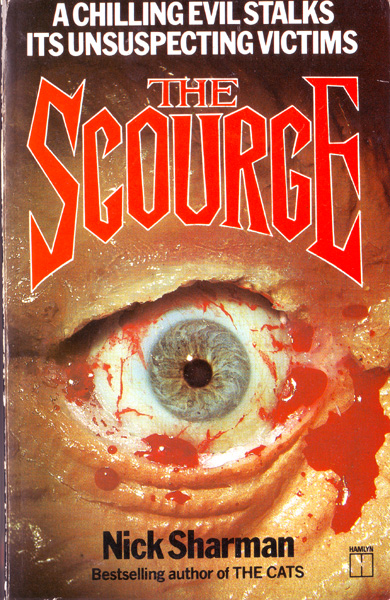
I had no idea what this book was going to be about, but that cover is sick as hell.
A private detective almost dies in a mysterious car crash, and he soon finds himself investigating a bunch of people who have been hallucinating themselves to death. It turns out they did something to anger the owner of a pharmaceutical company. This wealthy chemist makes a drug that lets him control his victims’ minds telepathically.
Maybe it was all the Russ Martin novels I read last year, but I am pretty damn sick of novels about telepathic mind control. It’s lame. If I had any idea that that’s what this book was about, I wouldn’t have read it. This would have been a far better book if it had been about a bloody eyeball.
I had a few other books by Nick Sharman lined up, but I’m in no rush to get to them now. The Scourge wasn’t absolutely terrible, but if it weren’t for that cool cover, it would be absolutely forgetable. I really don’t want to waste any more of my time discussing it. Good night.
The fact that a book is hard to find is often enough to make me want to read it. This was the case with Joyride. I knew affordable copies are scarce, and I think I had even seen people mention it fondly. When I saw a copy the other day, I jumped at the chance to read it.
I didn’t like it.
A group of teenagers decide to party in a cemetery. Unbeknownst to them, the man who works at the graveyard is a hideously mutilated psychopath. As the teens start spreading out, he starts picking them off, dismembering one with a scythe, setting fire to another, and decapitating another with a chainsaw. Once the killing starts, there’s not many directions the story can go, and the rest of the book is rather underwhelming.
There’s a backstory given to the murderer, and while it explains his inability to regulate his saliva output, I felt like it passed over a few of the transitional stages between high-school loser and outright murderous ghoul.
This is a “slasher”, and although I hadn’t ever thought about it much before, Joyride convinced me that I don’t like slashers very much. It reminded me a little bit of David Robbin’s dreadful Hell- O-Ween. Joyride was a little bit better than that piece of shit, but the only real tension here comes from not knowing how the next teenager is going to be murdered. At least it’s short, and I was able to finish it in 2 sittings. If it had been any longer, I probably would have hated it.
To be honest, I chose to read this book because it’s only 166 pages long. It’s not good.
Some lizards on a nuclear testing site get big and start rampaging through New Mexico, eating everybody in their path. A reptile-expert from the local college is brought out to assess the situation. She falls in love with an ex-colleague, and they have a lot of sex. The lizards really go nuts at a fair, and the authorities’ first attempts to kill them fail. Eventually the scientist comes up with a way to kill them, and everything looks like it’s going to work out until the last page of the novel.
There are some gory scenes, but nothing memorable. Two of the characters are frequently banging eachother, but the reader is never invited to share the experience. One of the shaggers is a Native American, and although the inclusion of a mixed race couple might have seemed progressive in 1981, the interactions between this couple would not fly today. I think at one point the woman tells the man to go back to his wigwam.
This was one of the most predictable, unimaginative books I have ever read. It felt like reading a practice run for a novel, like it was written just so the author could get a feel for sticking 150+ pages of words together. This was Kathryn Ptacek’s first novel, so maybe her others are better. It’s not surprising she used a pseudonym for this one. The plot here is on autopilot, and the only surprising thing about this book is that it found a publisher. It really seems like anyone with enough time to type out a manuscript could have had a book published in the 80s
I’m not a huge fan of animal horror, and this book did nothing to change my opinion. It was pretty shit, but I didn’t absolutely hate it.
I read The Festering, my first Guy N. Smith novel, a few weeks ago, and I greatly enjoyed it. I picked it because of its cover, and I decided that the next of Smith’s books I would read would be one of his more esteemed works. I chose The Slime Beast as I knew that the illustrious Centipede Press had reissued this one in a fine hardback edition.
A cranky professor takes his assistant and niece out to a muddy beach to look for treasure. During an excavation, they uncover a sleeping monster that smells so vile that they puke all over each other. Later that night, the monster comes alive and starts to kill people.
The plot doesn’t really make sense. The characters don’t act like people at all. They decide to sleep in an abandoned shack for several nights in a row when there is a bloodthirsty monster on the prowl. There’s reasons given for their behaviour, but none of them hold up. Mr. Smith clearly didn’t give much of a shit for plotting. He just wanted to get to the slimy bits. This was a relief to be honest.
This is not a good book, but I found it very entertaining. I liked the emphasis on the monster’s stink. Every time he shows up, his rotten stench makes people throw up. There’s not much else to say about this book. It’s 144 pages of pure garbage. It’s pretty great though. I wholeheartedly recommend that you find a copy and read it immediately.
This book starts off with a man smashing his wife’s face in with a fire poker after he gets home from work. In fairness, he only does so in self defense, and a local police officer lets him out of jail after the cop’s daughter turns up dead at the site of another brutal murder. The first half of the book deals with these lads slowly figuring out that the town of Broughton is plagued with a virus that is turning its women into crazed savages with an insatiable lust for men’s blood.
It was the second book in a row that I read that featured a woman name Arlene suddenly going mad and trying to murder her husband. When I started it, I wasn’t expecting it to be any good, but I ended up really liking it. My biggest complaint was that it feels as if the author was going for that Stephen King thing of making the town itself the protagonist. The problem is that Blood Fever is only 188 pages, less than half the length of Salem’s Lot. There’s too many characters and not enough character development to make them distinguishable. Aside from that, the writing is decent. I mean, this is trash, but its fast paced and interesting enough. I was a bit surprised to see on goodreads that this is Shelley Hyde’s only novel. I was not surprised when some further research showed that Shelley Hyde was actually a pseudonym of Kit Reed, an award winning author of some 30 novels.
Really, it’s baffling that this book doesn’t have more of a cult following. It features a group of feminists who lose their minds, take over a ranch and brutally murder any men who come within sniffing distance. Seriously. How has this masterpiece remained in obscurity for so long? Blood Fever should be mandatory reading for all university students taking gender studies classes.
I liked this book a lot. You should track a copy down and read it.
I’m sure menopause is uncomfortable for a lot of women, but Arlene has it worse than most. There’s a lump growing on her spine, and it’s making life very uncomfortable. When it’s x-rayed, her doctors are horrified to see a bone structure developing inside it.
Written in 1987, Mark Manley’s Throwback is a hugely enjoyable work of trashy horror. It’s fast paced, competently written, and it features a gang of dog-fucking punk-rockers attempting to rape a woman with a giant bloodthirsty rat growing out of her back. Seriously, what else could you ask for?
Yes, when Arlene’s hideous boil finally pops, the head, arms and torso of a giant carniverous rodent emerge and begin to subsume Arlene’s body and soul. Arlene is what her backwoods ancestors called a ‘Throwback’. Her DNA contains patterns from a far earlier form of life, and those strains are becoming dominant. Arlene somehow maintains a psychic link with her daughter, Sharon, and Sharon has to do her best to end her mom’s killing spree.
I don’t know what else to say about this one. That’s the beauty of this kind of book though. You’re not supposed to have much to say. It makes promise on the cover and delivers in the text. It was a lot of fun. If you’re not already looking for a copy after reading this review, I doubt we have much in common. This is pure trash, but it’s exactly the kind of book that I want to read right now. Short, weird and gross. Perfect.
Guy N. Smith wrote a lot of books, and I wasn’t sure of which one to read first. I didn’t want to commit to any of his series to begin with, so I looked at his standalone novels. I chose 1989’s The Festering as my starting point as it had the mingingest cover. I can honestly say that this novel is now one of my favourite books ever.
A couple move to the English countryside to escape urban life. Their plumbing is dodgy, so they have well dug in their garden. Unfortunately, an ancient, diseased corpse was buried there, and the lads who dig the well end up contracting the disease.
This disease causes you to grow disgusting boils all over and to leak stinking pus and slime from every orifice. It also increases sexual and aggressive urges. Those who get sick end up going on violent rampages and end up as a rancid puddle of noisome muck.
“it was surely a demented diseased stranger, some cancerous monstrosity bent on a final depravity before whatever was eating away his body claimed him for its own.”
I loved this book. It was really horrible.
It was written in 1989, and it’s hard not to think that the AIDS crisis had something to do with the plot. The Festering Death is directly compared to AIDS twice within the text. This seems rather insensitive now, but I think everyone reading this book in 2022 will understand how uncertainty about the symptoms and contagiousness of a disease can be used as an effective means to create tension. Also, the symptoms of the disease in the book are nothing like those of AIDS.
I also know that it’s not really fair to judge an author based on the tendencies of their characters, but the misogyny on display in this book is hard ignore. The men throw out phrases like “fucking little whore”, “poxy cow”, “poxy bitch” and my personal favourite, “a filthy slag offering her body for a pittance on a street corner.” This is real classy stuff.
“sores that pulsed even after life had deserted the wretched body, spreading and feeding on the dead flesh with revolting rapidity and cancerous lust.”
I liked the simplicity of the horror at work here. The focus is on how pus filled boils are really gross. This focus is utterly relentless. The boils are disgusting, and they smell really awful. Seriously, the horrible scummy slime inside these weeping sores is both vile and rancid. Ewwww, stink!
The Festering is as trashy as they come, but it was exactly what I needed. I shall be reading more Guy N. Smith in the future.
Kenneth Rayner Johnson was an occult scholar, an alchemist, and a writer of trashy horror paperbacks. Despite the fact that he was obviously a super interesting individual, there’s barely any information about him online. The search for this information is hugely complicated by the fact that there are several authors called Ken Johnson who write about occulty/Biblical stuff and a different Kenneth R. Johnson who is an expert on science-fiction pornography. Goodreads is currently attributing half of Kenneth Rayner Johnson’s books to these other authors. I have spent the last 6 months piecing together as much accurate information about this lad as I could find, and I am excited to share these findings with the world. Kenneth Rayner Johnson worked as a journalist in the 60s. He lived most of his life in the UK, but spent some time in Canada (I wish I knew where!) Most of his books were published in the late 70s/early 80s. These books are a curious mix of B-movie novelisations, bizarre works of occultism and paperback horror novels. I did not manage to read all of his books, but I got through the important ones.
Let’s start with the novels.
The Succubus NEL 1980
First published in 1977, The Succubus, as far as I can know, was Johnson’s first original novel. I only figured out that it was largely based on a true story when I was halfway through it. In the 70s, an American woman kidnapped a Mormon, chained him to her bed and repeatedly raped him. When the story hit the news, it sent the media into a frenzy of sensationalism. This actually happened, and there’s even a critically acclaimed documentary movie about it.
Kenneth Rayner Johnson took the story of “The Manacled Mormon” and threw in a rapist demon. It’s an entertaining read, but I felt very let down by the ending.
The book starts at the court case. Candice Maltman is found not guilty by reason of insanity and is sentenced to a stay in a fancy madhouse. She is very clearly still in love with Troy Valens, the dude she raped. Troy runs out of the courtroom and straight to his friends house. When he goes to bed that night, he is visited by a ghostly woman who gives him a good ride. She comes back for a shag every night after this. At first he thinks she is just a crazy sex fiend, but then he realises she’s a ghost or something. As this is happening, Candice is acting very strangely at the mental asylum. Her brainwaves are all over the place, and it seems like she’s asleep when she’s awake and awake when she’s asleep.
This part of the book was really enjoyable. There was lots of sex and supernatural suspense. It is hinted that Candice had made some forays into occultism before abducting Troy, and I was assuming that she had summoned some kind of demon that was helping her astrally rape him or something. This would have been great. Unfortunately this is not what’s actually happening.
Next paragraph contains spoilers. Skip it if you’re planning to read the book.
Actually, the evil spirit that is raping is actually the demon Lillith. The idiot who previously lived in the apartment where Troy is staying had summoned her years ago and never banished her. He was never able to see her because the numerical value of the letters in his name are different to the numerical values of the letters in “Lillith”. Troy and Lillith’s numerical values are the same so he can see her. Somehow, and this is absolutely never explained, Lillith has also been hiding in Candice’s body, even though she is miles away in a mental hospital and has never entered the room that Lillith has been trapped in for years. Fucking stupid. It doesn’t make any sense. The whole time you’re waiting for some kind of explanation for the initial kidnapping, but that part is purely incidental to the succubus stuff. This is a book about a man who gets raped by two entirely separate females that eventually become the same female for absolutely no reason.
Kenneth Rayner Johnson was pretty heavily into the occult as far as I can tell, and he references plenty of books that I’ve reviewed on here. Seabrook, Summers, Sinistrari, Maple… but well researched as he may be, I am not sure about the veracity of some of his claims.
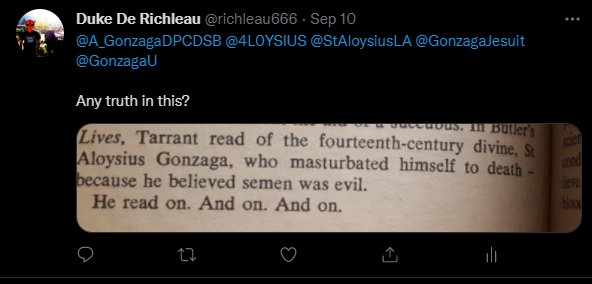
There is one part where Johnson claims that Saint Aloysius Gonzaga masturbated himself to death. I love reading about Saints and Popes who have done messed up stuff, and I had to check this out. I’m pretty sure that Ken just made this one up. He references Butler’s Lives of the Saints as his source for this information, but I checked a couple of editions of that book and neither mentioned death by wanking. They actually claim that Saint Gonzaga died of a disease he contracted while tending to sick people. He is believed (by some) to have lived his entire life without committing a mortal sin, and he’s known for his devotion to chastity. I’m always down to trash Christianity, and I think it’s hilarious if Kenneth Rayner Johnson was being deliberately offensive here, but I am also very, very intrigued. Are there any other sources that claim that Saint Gonzaga died from wanking? I can’t find any online, so I asked the experts. I still haven’t gotten a response.
Like I said, I really enjoyed most of this book. It’s just the ending that’s absolutely shit and stupid.
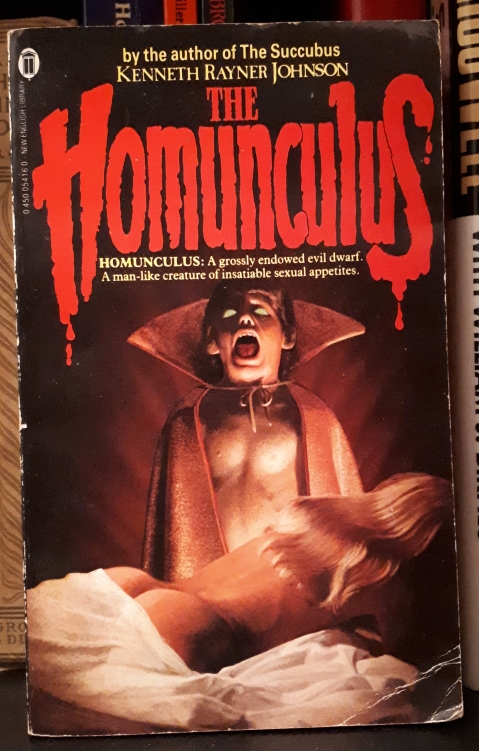
The Homunculus NEL – 1982
I have wanted to read this novel ever since coming across it while working on my lengthy post about Aleister Crowley’s attempt to make a homunculus. There’s not much info about Johnson’s The Homunculus online, but the cover is a thing of beauty. Look at it there. Fantastic.
There’s a weird cult called Supra Obscurans in London, and it’s led by a 9 year old homunculus with a massive cock. He plans to take over the world by impregnating a bunch of English women with his demon spawn. Things are going well for this lil’ pipsqueak until he kidnaps the girlfriend of a hologram scientist.
The story for this one was pure shit, and the characters were flat and uninteresting. The Homunculus is not a good novel.
I’ve read a quite a bit about creating a homunculus, and Kenneth Rayner Johnson obviously did too. Aside from the cover, the coolest thing about this book is the fact that the author clearly had a serious interest in the occult. Each chapter begins with a quote, and while most of these are from Nostradamus or The Bible, there were some from Crowley’s Book of the Law, Maugham’s The Magician and Kenneth Grant’s The Magical Revival (apparently Grant and Johnson were buddies). Johnson also repeatedly references Paracelsus. Reading through these bits made me feel like a knowledgeable wizard, but they didn’t save the book from being shit.
The novel ends on Glastonbury Tor, the place where Anthony Roberts would mysteriously die 7 years after its publication. I mention this because I believe I read something about a link between Johnson and Roberts a long time ago, but I can’t remember where I read it. They would have been working in the same circles at roughly the same time, so they may well have known each other.
Johnson apparently intended to release a third “Satanic” novel, but this never happened. His next and final major work of fiction was quite different.
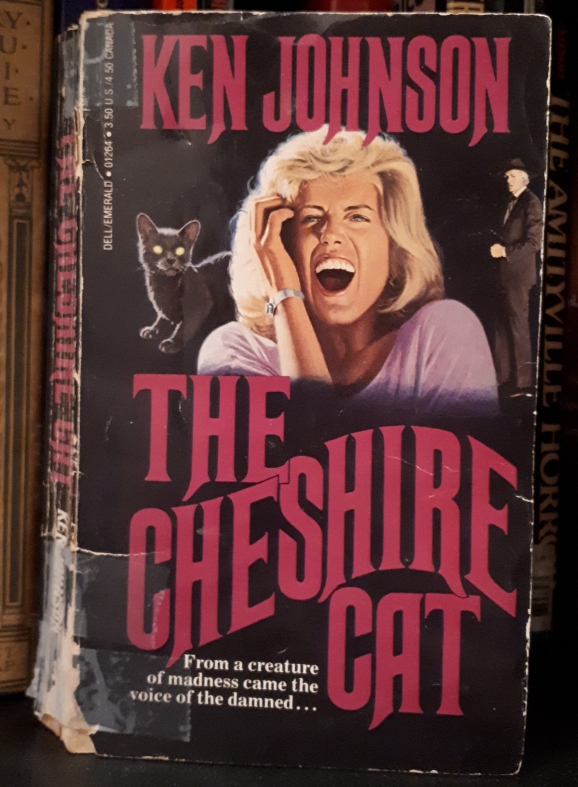
The Cheshire Cat Dell – 1983
Allison, a photographer, dumps her rockstar boyfriend when she’s 8 months pregnant and moves to some small town in Wales for a bit of a holiday before the baby is born. The manager of the hotel she’s staying is the leader of a Theosophist cult, and most of the people staying at the hotel are mothers and daughters who belong to this cult.
One of the guys who helps take care of this gang of little girls is an epileptic named Trevor Lewis. He makes friends with Allison. The only other guest at the hotel is a professor who is often seen arguing with the hotel manager.
It turns out that the entire neighbourhood is haunted by the ghost of Lewis Carroll, the guy who wrote Alice in Wonderland. Despite what some of his naïve fans claim, Lewis Carroll was undoubtedly a dodgy paedophile in real life, and I was a bit apprehensive that a fictional portrayal of him would try to make him out to be a good person. This book does no such thing. He’s not just a paedophile here; he’s also a psychopath. He’s the creepiest paedophile ghost with a speech impediment since Stephen King’s Library Policeman.
I actually really enjoyed reading this book, but I only finished it 10 minutes before writing this, and there’s so many things about it that didn’t make sense. There’s the whole spiritualism/theosophy thing going on, and while the haunting part kinda fits in with that, Charles “the paedophile” Dodgson doesn’t really come across as a Mahatma or Master of Wisdom here. The Cheshire Cat, which briefly appears a couple of times, is also referred to as a Guardian at the Threshold. It’s implied that some of the creatures from Alice in Wonderland are coming to life, but that side of things is never fleshed out.
There’s another part where Allison stumbles across a house with a pair of ugly women and a screaming baby in a cottage in the woods. This seemed like that scene with the Duchess and the pig from Alice in Wonderland, but it doesn’t add anything to the story apart from confusion.
Perhaps the most confusing part of the book is the Trevor Lewis character. A big deal is made out of the fact that this guy has epilepsy, and this is something that the real Lewis Carroll suffered from. Look at his name too. I think there’s even a part where it’s suggested that Trevor has a mild stutter, just like Lewis Carroll. I kept expecting him to be Carroll’s great-grandson or maybe possessed by Carroll or something.
I really liked the fact that this book attempts to sully Lewis Carroll’s reputation. The pacing is good too. Lots of stuff happens in these 330 pages. Aside from that, this book is quite ridiculous. It doesn’t make much sense at all.
The only other original fiction written by Johnson that I know of was a short story called ‘Pelican’ that was included in the Summer 1995 edition of Terminal Frights magazine. I have not been able to find a copy of this. Please contact me if you have one or if you know of any other fiction written by Johnson.
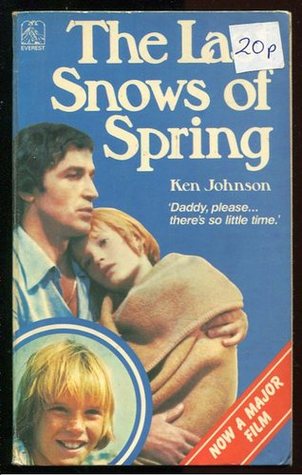
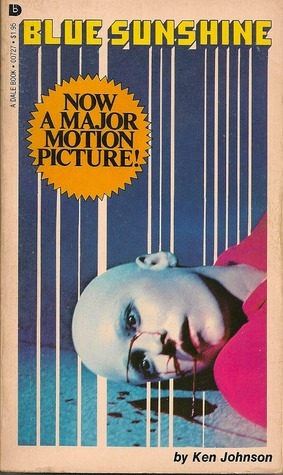
Before writing his own original novels, Johnson wrote 3 novelisations. The first of these was for a 1973 Italian movie called The Last Snows of Spring. It’s about a neglected 10 year old kid who dies of leukemia. The tagline of the book reads “Daddy, there’s so little time.” There is a 0% chance of me ever reading this book. Jesus Christ. As far as I can tell, the book came out 2 years after the movie. Johnson also did a novelisation of Blue Sunshine (1977), a horror movie about LSD that turns people in murderers. I didn’t feel any great desire to track this one down.
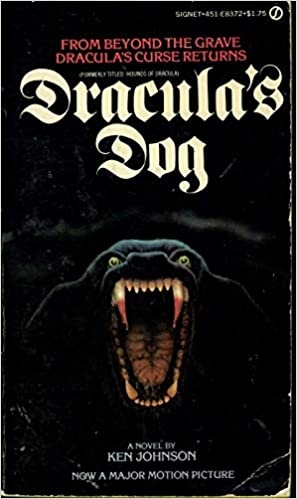
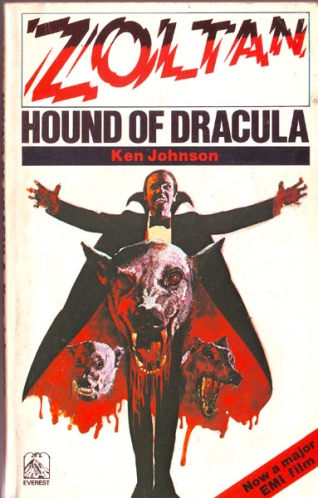
In fact, the only novelisation by Johnson that I bothered with was Zoltan, Hound of Dracula from 1977. It actually seems to be the best known of all Johnson’s books. There was 3 separate editions of this book, all with different names. (It also goes by Dracula’s Dog and just Hounds of Dracula.) It’s about Dracula’s dog, so I had to read it.
SignetEverestNEL
All three editions of this novel contain text that reads “now a motion picture” on their covers. This would suggest that the movie was based on the book, but that’s not true. Both the movie and the novel were based on Frank Ray Perilli’s screenplay. It seems as though film companys thought it would help novel sales if people believed the book was so good a movie was made of it. (The same trick was also performed on the covers of Johnson’s other novelisations.)
This book is a piece of crap to be honest, but I enjoyed it well enough. It’s short, and too silly to get upset over. Some Romanian soliders unearth the Dracula family’s tomb, but they burn all of the vampires inside except for the servant vampire and his dog. These two loyal servants are left in an awkard position: they no longer have a master as all the Dracula family are gone.
Or are they?
No. It turns out that Dracula’s great-great-great-great-grandson moved to America and changed his name to Drake. The vampire and vampire dog head across the Atlantic to find him. When they arrive, they discover that their future master (who is not a vampire) is camping with his family. They really want this guy to tell them what to do, so they try to make him a vampire too. Their plans are complicated when a Romanian military officer comes over and tells Drake about the trouble he is in. The way in which the American man accepts the fact that an evil dog is trying to make him a vampire is pretty funny. He doesn’t get surprised or ask any questions. It seems like a perfectly natural course of events for him.
I finished the book in one sitting, and I was reasonably entertained. I thought about watching the movie version for comparison’s sake, but after skimming through it I decided not to. I don’t mind wasting 3 hours of my time reading through an awful novel, but I will be damned if I waste an hour and a half on a shitty movie. (This always happens to me. I should probably watch the movies before reading the novelisations in future.)
Part of what makes Johnson such an alluring person is that he was not just a fiction writer. He also published several peculiar books on occult phenomenon.
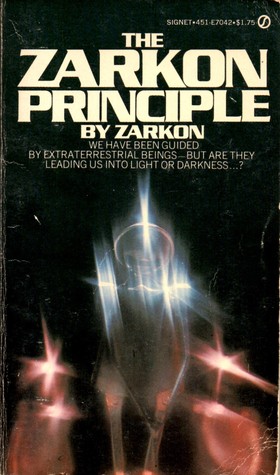
In 1975 a mysterious book called The Zarkon Principle appeared. It was written by a myterious weirdo named Zarkon, and it presented information about ancient aliens and predictions for the future. I haven’t read the book, but from what I have read about it, it seems that most of its predictions did not come true. It seems pretty similar to some other books that I have read, that whole fantastic-realism movement that I can’t stomach anymore.
In 1996, a new version of The Zarkon Principle was put out by Creation Books. It was retitled Armageddon 2000. This book confirmed that Zarkon was actually Kenneth Rayner Johnson.
Armageddon 2000 claimed that the world was dying and would definitely die soon.
It also claimed that ancient civilisations knew a lot and had very surprising technology. Many of these civilisations had stories featuring gods travelling in eggs. These eggmen were probably aliens who came to earth. Ancient religious texts say we come from clay. We probably do; ever hear of primordial soup? Who told us these clay stories? Aliens.
I could not bring myself to finish this book. Like the original Zarkon book, this one is full of predictions. Now, 26 years after it was published, few of these predicitons have come true.
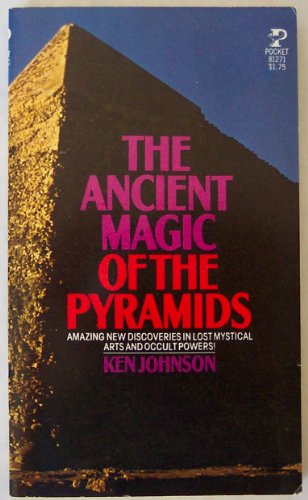
Johnson published The Ancient Magic of the Pyramids in 1977. He also edited Robert Scrutton’s pair of 1979 books on the lost conintent of Atland (The Other Atlantis and Secrets of Lost Atland) and Scrutton’s 1982 The Message of the Masters. These all seem like pseudo-sciencey nonsense, so I didn’t try to track any of them down.
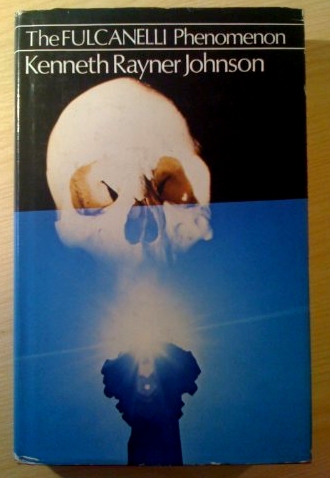
TheFulcanelliPhenomenon Spearman – 1980
Of all Johnsons books, this is probably the most sought after. I think it’s a pretty important book in the field of Fulcanelli research, and despite my disdain for alchemy, I was mildly intrigued.
As far as I know, nobody has ever turned lead into gold, and alchemy’s greatest achievement was when Paracelcus made a goblin in a pooey bottle. Fulcanelli was some French dude who wrote two books about the alchemical symbolism inherent in gothic architecture. He is best known for appearing in Pauwel and Bergier’s very stupid Morning of the Magicians. There’s a bunch of stupid stories about this lad. Apparently he went missing for 30 years and then showed up looking younger than he did when he was last seen. He also took one of his students to a magic castle in Spain where they travelled back in time and Fulcanelli changed his gender overnight. Nobody really knows who this lad was, and I, for one, don’t care. Johnson’s book is half the history of alchemy, half the legend of Fulcanelli. The author is clearly very passionate about this stuff, but this wasn’t enough to keep me interested, and I ended up skimming huge sections of this book.
My favourite thing about this book was the helpful list of Johnson’s other books included before the text. I tried contacting the people mentioned in the thank-you section here to see if I could track Johnson down, but none of the people on facebook with the same names as his thanks-yous responded.
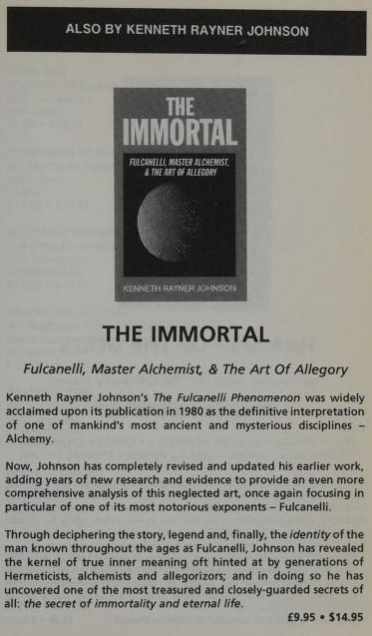
Creation Books planned to release an updated version of The Fucanelli Phenomenon called The Immortal in 1996, but from what I can tell, it was never actually published.
According to Greenmantle magazine, Johnson also ghost wrote the autobiography of Lady Dowding, a wealthy theosophist, and animal rights activist. There are two autobiographies of Dowding, Beauty: Not the Beast An Autobiography (1980) and The Psychic Life of Muriel, Lady Dowding: An Autobiography (1982), but these might well be the same book with different titles. I can’t pretend I have any interest in reading them in any case.
Aside from these books, Johnson wrote articles for several occult magazines including The Hermetic Journal, Rapid Eye, and Greenmantle. He also contributed articles to the legendary encyclopedia of occultism, Man, Myth and Magic and other occult themed collections. He worked as a journalist from the 60s, so I’m sure there’s lot more of his writing out there. In Zoltan he introduces a chapter with a quote from an interview he did with Christopher Lee. I’d love to read that one!
In truth, none of Johnson’s books were good enough to cement his reputation as an amazing writer. The novels I read were all enjoyable at points, but they were all pretty silly too. His non-fiction is outdated, and I found it unbearable to read. Regardless of this, I still think Kenneth Rayner Johnson was a pretty cool guy. I spent a lot time trying to track him down while I was working on this post, but after emailing an old publisher of his, I discovered that Ken Johnson died of cancer in 2011. Once I knew he was dead, I googled his obituary and found an article about him in an old edition of Greenmantle. That article provided me with some of the biographical details I’ve included here and the only picture of Mr. Johnson on the internet:








 Nocturnal Revelries