The House on the Borderland – William Hope Hodgson
house on the borderland william hope hodgson.jpgThe House on the Borderland – William Hope Hodgson
1908

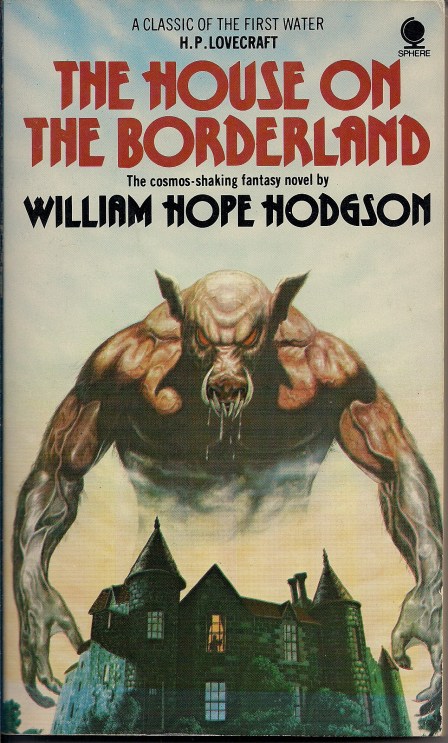
It’s coming close to the end of the year, and I have spent 2019 reading some absolute garbage. After reading and reviewing Fritz Leiber’s awesome Our Lady of Darkness last week, I really wanted to read another cool book. I’ve been meaning to read William Hope Hodgson’s The House on the Borderland for a couple of years, and when I found a free audiobook version last Sunday, I decided the time was right.

This was a very enjoyable piece of weird fiction. It’s about a strange man who lives in an old house in Ireland that seems to exist on the border of different dimensions. I spent the first half of the novel thinking it was basically just Night of the Living Dead with interdimensional pig-mutants instead of zombies, but the second half of the book has more in common with 2001: A Space Odyssey. (I just read Will Errickson’s review of this book and saw that he also made a 2001 comparison. Will, I swear this was coincidence!) There’s little wonder that H.P. Lovecraft was a big fan of this novel; there’s some very definite “the universe doesn’t care about you” vibes throughout.

I read William Hope Hodgson’s Carnacki the Ghost Finder stories a little under two years ago, and while I enjoyed them, I seem to remember them being a good deal more straight forward than this. One of those stories also includes evil pigs, and a couple of them are set in Ireland too. I reckon I enjoyed The House on the Borderland more, and I’m planning to read more by Hodgson in the future.

The only problem with reading good books, especially popular ones, is that I find myself at a loss for things to say when reviewing them. This one is cool, short and available for free in multiple formats. You might as well check it out.

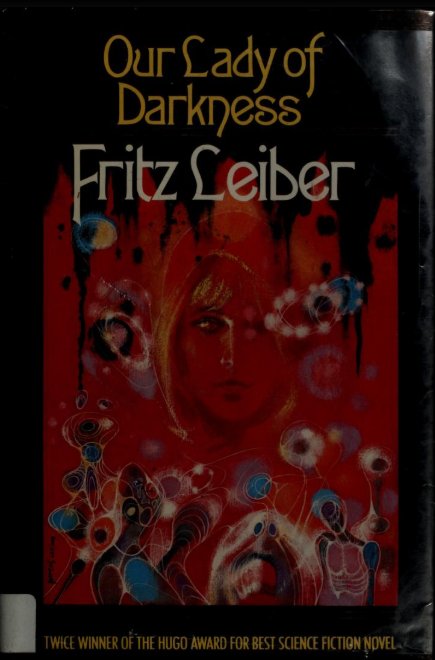
Our Lady of Darkness – Fritz Leiber

fritz leiber our lady darknessOur Lady of Darkness – Fritz Leiber
Berkley Publishing – 1977

A recovering alcoholic reads a weird book about evil architecture and a notebook belonging to Clark Ashton Smith and then begins to see weird stuff through his binoculars. That’s the premise of Our Lady of Darkness by Fritz Leiber. The protagonist is also an author of weird fiction, and repeatedly references Lovecraft, M.R. James and Bierce. I really enjoyed this book, and reading it has made me want to check out more stuff by Leiber.

I didn’t know anything about the author when I started reading Our Lady of Darkness, but I only got a few chapters into this book before I realised that the main character is supposed to be him. Leiber’s name was Fritz, and the character’s name is Franz. They  have the same job, and I can’t put my finger on it exactly, but there was something about the sections on the protagonist’s wife and her death that had me convinced that Leiber was writing from experience. Sure enough, he lapsed into alcoholism after the death of his own wife, and this is obviously a largely autobiographical work. Although this novel contains some fantastic elements, this autobiographical stuff keeps it grounded and makes the weirdness all the more discomforting.

And the weirdness here is quite weird. The antagonist of the book is Thibaut de Castries, the author of Megapolisomancy: A New Science of Cities, a book about the supernatural power of large cities and their buildings. I found this idea quite Ballardian, not in the sense that Ballard was also fascinated with architecture but in the pairing of two seemingly disparate concepts. (De Castries links occult forces with architecture in a similar way to how Ballard links sex and car crashes.) It was cool to come across an idea as strange as this in a fantasy/horror novel.

I don’t have a huge amount else to say about this book. It’s a classic of weird fiction, and you should read it if you haven’t already.  An earlier version of the story was published as The Pale Brown Thing in Magazine of Fantasy and Science Fiction, and I read yesterday that Leiber considered this an alternative telling of the same tale rather than just an earlier draft. Swan River Press published an edition of this version in 2016, but it’s long sold out. It would be cool if somebody could upload scans of the original printing to the internet. I’d be delighted to read another version of this story.

Daughters of the Devil – Charles LeFebure
daughters of the devil lefebure.jpgDaughters of the Devil – Charles LeFebure
1971 – Ace Books

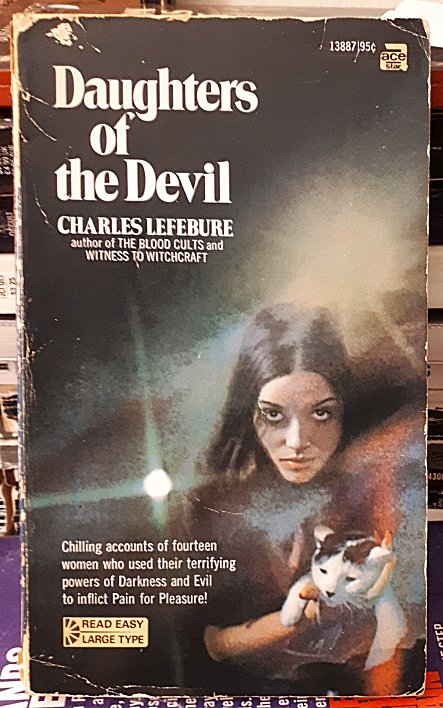
The blurb on the back of this book describes its contents as “true stories of unparalleled sadistic erotica”. The front cover claims that it contains “Chilling accounts of fourteen women who used their terrifying powers of Darkness and Evil to inflict Pain for Pleasure!” It’s called Daughters of the Devil, for Christ’s sake. Can you imagine my delight when I found a copy of it for 5 dollars?

I mean, realistically, the book was shit, and I had known exactly what to expect. A few years ago, I read a book called The Devil’s Own by Peter Robson, and I had the feeling that this would be very similar. I just checked my copy of that book, and unsurprisingly, it was put out by the same publisher, Ace Books. After rereading my review of that book, I’m surprised at how similar it is to Daughters of the Devil. Charles LeFebure wrote two other books for Ace, Blood Cults and Witness to Witchcraft, and I reckon it’s safe to assume they’re the same kind of crap.

The chilling accounts in here are very sensational, and rarely convincing. Some of them are about real people, but I can’t find any evidence for the others. (This was my same complaint when I read The Devil’s Own.) When I googled some of the names in here, the only result I found was somebody else who had read this book complaining about the same lack of evidence.

I’m going to briefly describe each of the accounts in here in case anyone is interested.

  1. A girl gets involved in a Satanic cult. They have orgies and sacrifice a fetus during a black mass. This account references Crowley, H.T.F. Rhodes and the Abbé Guiborg’s Black Mass. It wasn’t believable, but it was a pretty good start to the book.
  2. Carletta Pantucci and her Daughters of Isis were a weird cult of lesbians that bred babies that they intended to raise as virgin cultists. They told the future by bloodletting women’s groins.
  3. There was a weird convent where nuns were crucified and whipped by a perverted priest and made to watch him fuck their Mother Superior. This was all done in the name of Christ.
  4. Caroline Langley, a one time friend of Aleister Crowley, commits acts of black magic, sometimes to kill people. I can find no evidence of Crowley ever knowing a Caroline Langley.
  5. A six month old curséd baby poisons a boy with witchcraft and the boy’s hand is amputated.
  6. Obango, the “Ga witch” from Ghana, bled ate and killed victims, 15 of whom were related to her. Ga witches have sex with animals.
  7. Annie Palmer, the rich voodoo priestess decapitated some of her slaves and raped others with snakes. (This one has some basis in fact.)
  8. Gdoma, an ugly Asian witch, coerces young people into sexing each-other up. LeFebure claims she’s very evil, but she doesn’t sound that bad really.
  9. Some Mexican woman ran a sex school for children in her house. She killed two abusive husbands.
  10. Caterina Sforza, a real Renaissance woman, is here described as ,’the most wicked woman of all time’.
  11. A Chinese child sex-slave grows up to start her own brothel in which random johns are taken to the secret rooms downstairs and tortured to death. The events in this story allow for no possible way that anyone could ever discover what had happened – there could be no evidence – but somehow the author is able to tell the tale. The lady died without any trial or case against her. It’s a cool story even if it’s completely fabricated.
  12. I got a bit into this one before I realised that I had actually heard it, or at least a version of it, before. It’s the story of Edward Arthur Wilson, the mysterious Brother XII, and his Madame Zee. Plenty of the details listed here are entirely false, but Lefebure’s fabrications don’t actually make the story any more interesting than it really is. I have another book on Brother XII that I have been meaning to read for a long time. I’ll definitely come back to Lefebure’s account when I get around to that one.
  13. Charlotte Gilbert leads a cult that worships cats and ritually sacrifices dogs because they are cat’s natural enemies. Her cult is a breakaway of the Glastonbury Essenes, a real order that supposedly worships aliens.
  14. The last account is of Catherine Deshayes (La Voisin), the abortionist and satanist involved in the Affair of the Poisons. This is the sensational account you’d expect.


Most of these stories contain little truth, and none of them are erotic. There is a fair bit of sadism though. This book is made up of descriptions of horrible women that probably never existed. The titles of this author’s other books sound very good, but they’re surely of the same quality. I’ll buy them if I ever see them for very cheap, but I wouldn’t be bothered hunting them down.

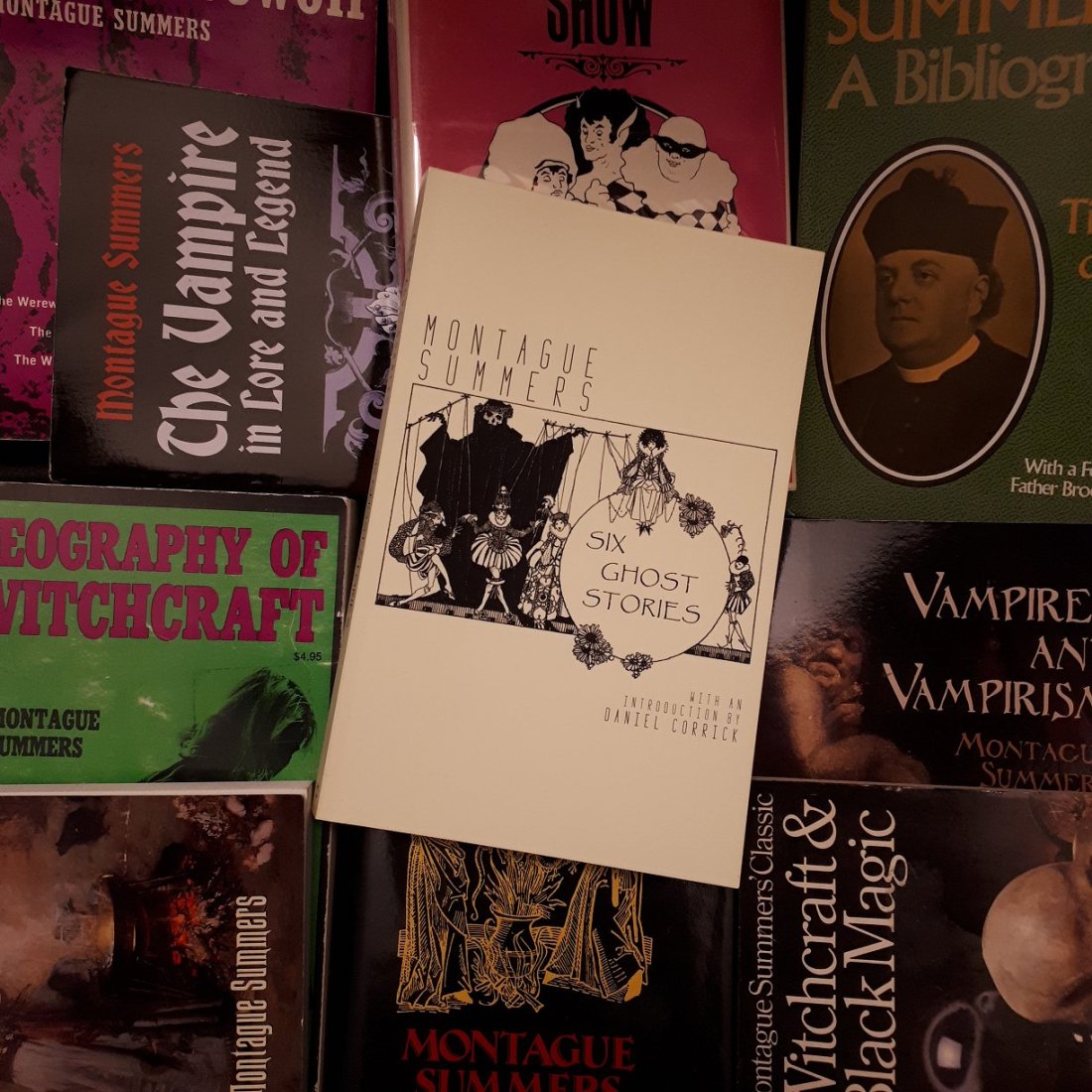
Six Ghost Stories – Montague Summers


summers six ghost stories.jpgSix Ghost Stories – Montague Summers
Snuggly Books – 2019

A few months ago, I got an email from my pal Sandy Robertson telling me that Snuggly Books were going to release a collection of short fiction by Montague Summers. I have long been aware that Monty had written a collection of short stories, but I knew that only a couple of these stories had ever actually been published and that it was difficult to find affordable copies of the books wherein these tales were collected. I’m a big fan and collector of the occult-related non-fiction books written and translated by Monty, and I am also a big fan of short horror fiction, so you will believe that I was very excited to hear that Monty’s ghost stories were finally being published. I ordered this collection for my birthday and read it last week.

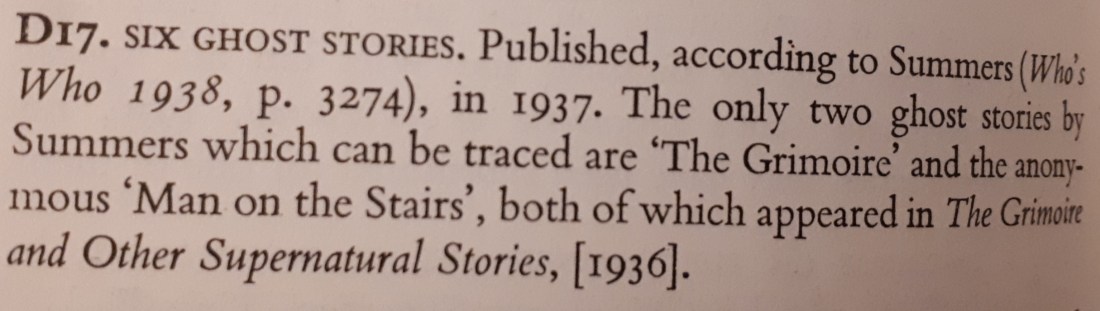
20191130_224224This is the note from Timothy d’Arch Smith’s bibliography of Summers where I first read of these fabled fables.

These six stories lived up to my expectations. They are mostly about people who some acquire some kind of peculiar haunted object that brings about visions and specters. The obvious comparison to make is to M.R. James, who apparently had the chance to read and commend these tales. Incidentally, Montague Summers, the man, has always reminded me of the characters in James’s tales.

The writing in here isn’t what you might expect if you have only read Summers’ books on witchcraft. There’s some very long sentences, but Monty seems self-aware when he’s being verbose, and this comes across as charming rather than tedious. My biggest criticism is probably that the tone of some of these stories remains too light-hearted for too long. Everything will be going fine and dandy for all of the characters, and then a ghost will jump out and scare a person to death right at the very end of the story.

My favourite tale in here was The Grimoire. This one has been previously published in different texts, and it’s not hard to see why it was chosen above the others. It’s the story of a bibliophile whose local dealer procures him an aged book of sinister black magic. When the collector translates a passage from this heinous tome, scary things start happening. (I can’t help but wonder if Sam Raimi read this tale before writing Evil Dead.) This one was particularly cool because it feels like Summers, an expert on books about black magic, could be the narrator.

While not all terribly original, these stories are competent, fun and generally pretty satisfying. I read one each night after my family had gone to bed, sipping a cup of peppermint tea and hearing the cold November breeze blowing through the willow trees our garden. It was great. I suggest you enjoy these tales in a similar manner.

These stories are entertaining in and of themselves, but there’s something very exciting about reading a collection of tales that were believed to be lost for more than half a century. Summers’ old manuscripts went missing shortly after he died in 1948, and they were only unearthed a few years ago. Snuggly Books put out this collection in October (I think this is the only book from 2019 that I’ll have reviewed in 2019.), and they are planning to put out a second volume of Summers’ fiction early next year. This collection will include a novella titled The Bride of Christ. Sign me up!

Secret Magic Spells of the Romany Gypsies and Fascination – A Feast of Finbarr

I was pretty lazy with reading this week, so here’s a post on two more awful magical pamphlets from Finbarr Publications, publisher of the worst magical texts ever printed.

secret magic spells of the romany gypsiesSecret Magic Spells of the Romany Gypsies – C. McGiolla Cathain & M. McGrath
Finbarr -1993

Secret Magic Spells of the Romany Gypsies purports to be a collection of authentic gypsy spells for love, money and revenge. It’s a load of shit. All of the spells in here look something like this:

For this spell, all you need is a green candle and a picture of your true love. First, thoroughly rub the tip of the candle against your anus. Then Light the candle and let some of the wax drip on the photograph while uttering the following incantation;

“Tweedly diddly fiddly dum,
Fiddeldy diddeldy widdeldy wee,
Boomboom bumbum bambam bum
So mote it be”

You will marry your true love within a month.

The spells take up roughly half of the text. The rest is made up of anecdotes of these spells being used succesfully. I’ve noticed a similar approach in quite a few other books from Finbarr publications, but the stories in here are particularly unconvincing. One of the characters is referred to only as “B.S.”. I can’t shake the feeling that this was the authors cryptically confessing to feeding their audience complete and utter bullshit.


fascination master count de leonFascination – Master Count de Leon
Finbarr – 2015

Fascination is the shortest pamphlet I’ve read from Finbarr, and it’s probably the most absurd. The actual text is barely 7 pages long. The first 5 of these pages are spent praising Adolph Hitler, and the last 2 describe a ritual that you can use to become more like Adolph. The ritual consists of wagging your dick at your reflection in a mirror while muttering your own name exactly 99 times. Seriously. I’m not even joking. That’s all this book contains. It suggests that Hitler himself performed this ritual.

This is obviously a noteworthy magical offering, but I don’t feel much need to comment any further on it. If you think I’ve exaggerated about its contents, read it for yourself – the text is easy to find online.

The Black Books of Elverum

the black books of elverum.jpgThe Black Books of Elverum – Mary Rustad
Galde Press – 1999

In the 1970s, Mary Rustad, a lady in Norway, was looking through the farmhouse that she had recently moved into. This house had belonged to her family for centuries, and it was filled with old junk. She found two curious books in a box in the attic. When she opened them, she realised that they were books of magic spells, compiled or collected by her ancestors. The books supposedly date from the late 1700s/early 1800s, and research proved that several of Mary’s ancestors had been involved in a witchcraft trial in the 1600s. It seems as though witchcraft ran in her family. These books were the real deal, forgotten grimoires of black magic. The Black Books of Elverum is a translation of these two handwritten grimoires.

lucifer elverum.jpgThis cool picture of Lucifer is included, but I don’t think it’s from the actual grimoires.
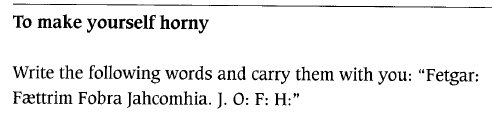
The spells in here seem pretty silly. Some are appeals to Jesus, others are appeals to demons, but some are just recipes or instructions that don’t have any spiritual element. (The ones on how to abort a fetus basically just tell the woman to drink a bunch of poison.) These books offer insight into the fears, customs and beliefs of Norwegian farmers, and I reckon they’re of more interest to historians than they are to occultists. Who needs a spell to make themselves horny in an age when viagra and internet porn are so readily available?

spell to make yourself horny.jpg(Just in case your wifi is down)

Some of the spells in here are very specific. There are two to be used against a thief who leaves his turd behind him after he has carried out a burglary. This is really convenient when you want to send the Devil out after the miscreant who shit on your carpet and nicked your telly.

There’s instructions on how to find witches in here. The curious are to go to a church on certain nights during the year and to wait near the church bells. Witches are apparently quite fond of gnawing church bells with their teeth, and will take any opportunity to do so. I had never heard of this before, but when I looked it up, I found a book that claims that this odd belief was also held in parts of Sweden. Witches were supposed to bite off bits of church bells to use in their potions. Jesus, I hope they had a good dentist.

This was a pretty cool book. It’s presented well, and the material is very interesting. It contains scans of original texts, and there’s an appendix recounting the 1625 court case against Ingeborg Økset, Rustad’s ancestor. The whole thing is pretty short too, so it doesn’t take long to get through. If you’re interested in Norwegian folk magic, you should definitely read this book.

The Devil on Lammas Night – Susan Howatch

susan howatch the devil on lammas night.jpgThe Devil on Lammas Night -Susan Howatch
Ace Star -1970

A millionaire’s wife and his daughter, Nicola, are seduced by Tristan Poole, the charismatic and mysterious leader of “The Society for the Propagation of Nature Foods”. This society is actually a Satanic cult posing as a harmless group of new-agers, and Poole’s motives for seducing Nicola and her step-mom are less than gentlemanly. Oh, and to complicate matters further, Poole is living in Nicola’s ex-boyfriend’s house.

Things play out pretty much as you would expect.

This is primarily a romance novel. The Satanic antagonist’s main motivation is money, and while there is plenty of black magic in here, the story could still work if this element was switched with something else. That being said, I quite enjoyed the little bits of occultism sprinkled throughout. Howatch seems to have done her homework; the rituals here are documented, and the demons listed are all of the Solomnic tradition. There’s a part where a character shies away from explicitly describing the Osculum Infame and another bit where the author claims that the Satanist performed “unprintable” acts to his communion Eucharist. I knew that witches are supposed to kiss the devil’s shitterhole before reading this book, so I was able to fill in the blanks to the first omission by myself, but I can’t remember what unprintable acts are supposed to be performed on a Satanic Eucharist. Does the celebrant cum on them or rub them against his bumhole or something?

I’m not going to rush out to read Susan Howatch’s other books, but this one was fine.

Doll Magic – Basil LaCroix

doll magic basil crouch.jpg
Doll Magic – Basil Crouch

Finbarr – 2005

Ok, so I know that last week I said I was going to cut back on posting, and I know that one of the reasons for this cutback was the shockingly low standard of the stuff I’ve reviewed recently, but old habits die hard, so here is a post on an abhorrently stupid pamphlet on doll magic by the incredibly stupid occultist, liar and probable child predator, Basil Crouch. Crouch’s The Hallowed Genie deals with a similar topic, but Doll Magic is shorter than that book and therefore a bit less stupid.

Here’s a brief summary:

Basil spent his childhood travelling around with a circus. He used magic to help a girl whose skull had been fractured. 20 years later, this girl’s mother bequeathed Basil a pair of crudely made magical dolls and a text on how to use them.

Basil gives very basic instructions on how to make a doll – you can basically just tape 2 sticks together and stick a tennis ball on top of one. That’ll do. Then you put energy from your head into this doll, and it will do magic. The magic only works if you are willing to clear your house of stuff you no longer need. Hoarders can’t do magic. The Law of Attraction is real, but it doesn’t work if what you want is bad for you. Has this last paragraph seemed illogical and silly? The section of Doll Magic that it’s paraphrasing certainly is.

The next parts describes how to make a doll that will help you make decisions and talk to dead people and another that will help you contact the gods of voodoo when you need money. The spell you say for the money is, “Money and honey I need, Money and honey with speed, Money and honey I plead, Money and honey give me indeed”. This is bound to be effective.

The last part of the book describes how to make a doll that will cure you of any ailment or disability. You make the doll and then tell it stories about what you would do if you weren’t sick. The doll will help you believe these stories and then you won’t be sick. It really works. One guy was in a wheelchair for 20 years, but then he tried this and he could walk again!

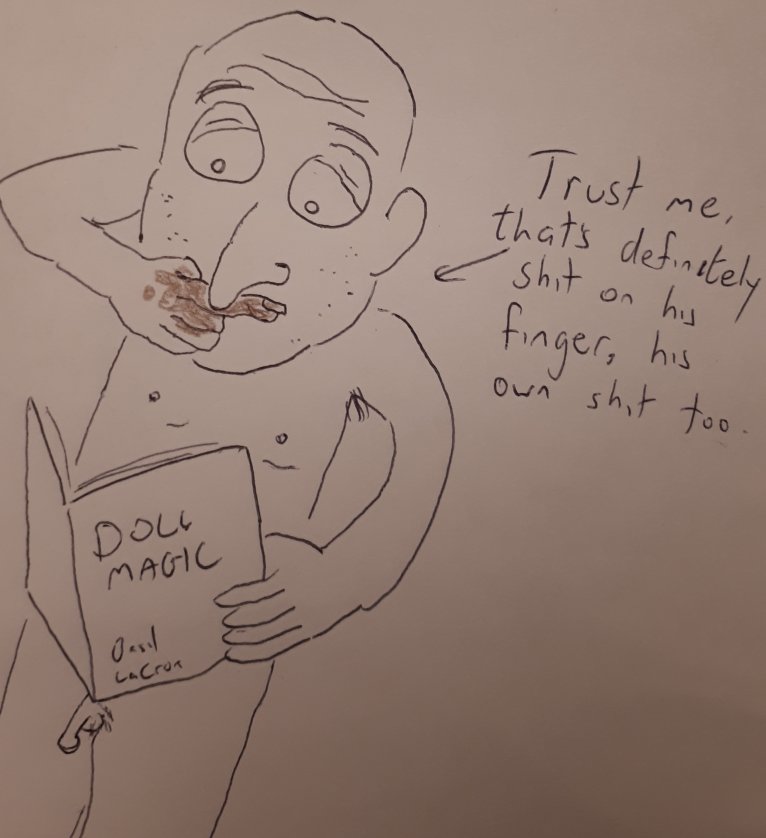
There’s not much to say about this pamphlet. If you ever come across a copy, use it for shitter-paper. Usually I spend more time and effort on my posts, but I only decided to do this one a bit before it was due, so it had to be on something very short and awful. You’d have to be a real pinhead to take this rubbish seriously, and I have drawn a picture of such an individual in an attempt to redeem myself for making my readers aware that this pile of stinking garbage exists. Ladies, gentlemen and everyone in between, I give you the scholar of Crouch:

basil lacroix crouch

Hell-O-Ween and The Manse

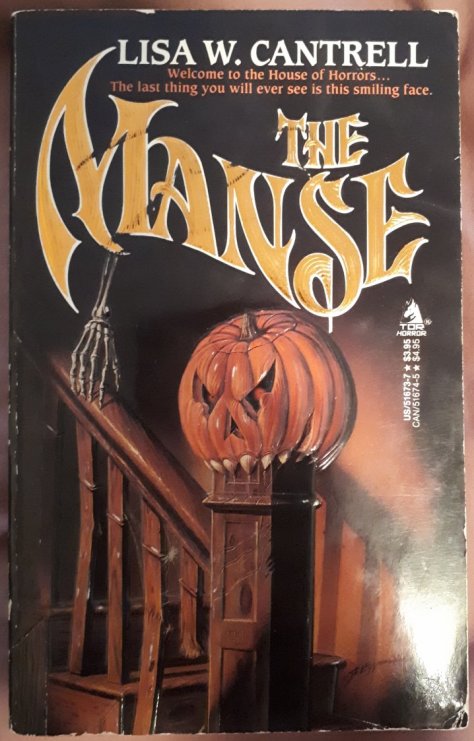
hell-o-ween the manse halloweenHappy Halloween. To celebrate my favourite holiday, I’m reviewing two Halloween horror novels that have pumpkins on their covers.
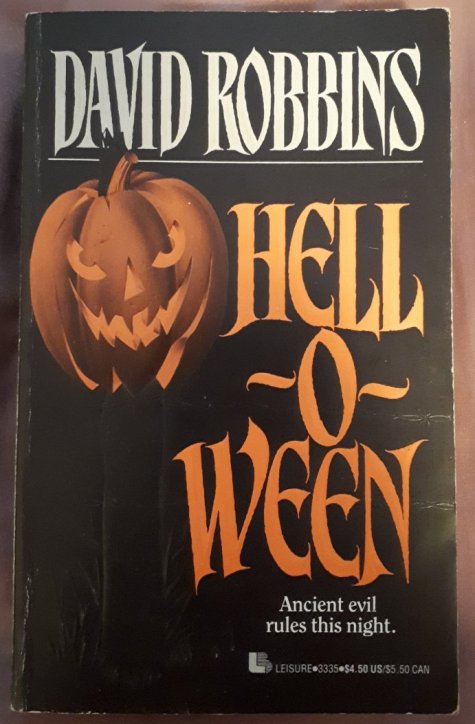
david robbins hell-o-weenHell-O-Ween – David Robbins
Leisure Books – 1992

Hell-O-Ween is a remarkably awful book. It starts off with the line; “Yo dweeb, are you ready to go monster hunting?”, and what follows is pretty much what you’d expect. This is an overwritten Goosebumps book with a little violence and a few (gross) mentions of sex thrown in. The following sentence appears n page 23: “She’d neck heavy and let a guy play finger tag with her box, but she refused to go all the way.” This isn’t a line of dialogue either; it’s the narrator’s voice. Finger tag with her box? Jesus.

Hell-O-ween is the story of a nerd, two sluts, 3 jocks (2 bad and 1 good), a geeky girl and a beautiful virgin. These painfully stock characters decide to explore a system of caves on Halloween night. There is a huge picture of an angry demon right at the entrance to the cave, and the astute reader will figure out exactly how the story is going to end after about 10 pages.

Very little happens in here that you wouldn’t expect. Perhaps the most interesting part was a lengthy passage in which one of the jock characters admits to his friend that he started selling cocaine in defiance of his liberal father. I’m sure the author was making a point here, but I can’t figure out what it was. Was it that liberals are irresponsible and can’t raise kids, or was it that non-liberals are piece-of-shit drug dealers? I sincerely don’t know.

This was a gruelling read that I regretted starting almost immediately. Do yourself a favour and give this one a miss.

the manse lisa wThe Manse – Lisa W. Cantrell
TOR – 1987

The Manse won a Stoker award for best 1st novel in 1987. Kathe Koja’s excellent The Cipher won this same award a few years later, so I was expecting a fairly high standard from this book.

I was disappointed, terribly disappointed. This is shockingly dull garbage. It’s the painfully boring story of a haunted house that becomes extra haunted on Halloween night. Actually, Will Errickson reviewed The Manse years ago, and said all of the things I feel like saying about this book. Read his review if you’re still interested. I don’t need to say anything more. Cantrell wrote a sequel, but I’m not going to waste my time on it. The Manse was a shitty, shitty pile of trash. It was poo in a baby’s diaper. Stay away!


Both of the books I reviewed for this post absolutely sucked. Actually, pretty much all of the books I reviewed this month absolutely sucked. This week marks a milestone for this blog, and I have a bit of an announcement about that.

For the last year, I have published (at least) one post per week. I have read some great books in the process, but I have also forced myself to read some utter crap to maintain the steady stream of reviews. After some consideration, I have decided that continuing at this pace isn’t really beneficial to me or to this blog. Look at some of the shit I’ve reviewed in the last year.


Sensible adults don’t read books like these.

Nobody cares about this nonsense, especially me. With this in mind, I want to let you know that I am going to cut back on posts for the next while. I’m going to be focusing on quality rather than quantity for a bit. This probably means 2 posts a month rather than the 5 you’ve been getting for the last year, but at least the newer posts will more than just “This book is pooey farty bumbum.” I want this blog to be something that I enjoy doing rather than something I feel obliged to do.

Have a safe and happy Halloween. Check out my previous Halloween posts while you’re here.

The Splatterpunks Anthologies: Extreme Horror and Over the Edge

splatterpunks extreme horror over the edge sammon.jpg
Splatterpunks: Extreme Horror – Paul M. Sammon (Ed.)
Xanadu – 1990

The first Splatterpunks anthology was published in 1990. It’s a collection of extremely violent stories, most of which had previously been published elsewhere. Some of the stories are quite enjoyable and some are fairly shit. The most remarkable feature of this collection is the editor’s attempt to delineate Splatterpunk as a separate entity from regular horror fiction.

Every review I have read of this collection has commented on the fact that most of the authors included herein reject the splatterpunk label. Sammon himself acknowledges this fact several times throughout his introductory notes. Let’s face it. Splatterpunk was never a revolutionary literary movement; it was a label created by David Schow to describe a small group of his writer friends who were writing gory stories. The authors in this anthology repeatedly refuse the splatterpunk label because it’s too limiting, and they feel that it would only apply to a small portion of their output. If we’re calling writers Splatterpunks because they’ve written a couple of gross-out stories, surely Stephen King fits the bill too. His story Survivor Type is easily as extreme as most of the stuff in this anthology. (My point is not that King should be included here; it’s that the editor’s posturing is ridiculous. In the next anthology he goes on to claim that Bret Easton Ellis, a writer who is parodied in this collection, is actually a Splatterpunk too.)

The book includes a lengthy epilogue that I was unable to finish. Paul Sammon’s attempts to make Splatterpunk seem like a really important cultural phenomenon were genuinely embarrassing to read. I was going to include a quote from the introduction here, but after rereading the first few lines of it, I found myself cringing too hard to continue. He literally compares his authors to Burroughs, De Sade and Baudelaire in the second sentence of this book. Some stories in here were decent, but I had forgotten most of them only two weeks after finishing the collection.

 
Splatterpunks: Over the Edge – Paul M. Sammon (Ed.)
Tor – 1995

The second Splatterpunks collection came out 5 years later, and this book is far, far worse than its predecessor. Actually, I really liked some of the stories in here, but there’s way more in this one, and some of them are absolute shit.

The really dislikeable part of this one wasn’t the awful stories or even Paul Sammon’s embarrassing introductions; it was the non-fiction pieces. Aside from Sammon’s bullshit, the only non-fiction piece in the first collection was an essay on ultra violent films. I watched most of the movies it mentions when I was a teenager, so I actually quite enjoyed reading this piece. Although it was about movies, it didn’t feel hugely out of place in a collection of ultra-violent stories. There’s an article in Spatterpunks II by Martin Amis on the movies of Brian De Palma. Martin Amis is not a horror author, and while De Palma has done a few horror films, those aren’t the movies being discussed in the essay. Sure, some of De Palma’s movies are violent, but they don’t compare to the other stuff in these collections. There is absolutely no reason for this essay to be in this collection other than having a famous author’s name on its cover. Fuck off Martin Amis.

There’s also an interview in here with Anton LaVey, the founder of the Church of Satan. My favourite pastime is reading about Satanic occult orders, but I skipped this section after about 2 pages. It was excruciating. Not only does LaVey come across as an embarrassing dildo, but the interview is performed by Jim Goad. Jim Goad, for those of you who don’t know, is just about the edgiest edge-lord in town. He beats women and believes that white people are oppressed. He also published a magazine in the 90s that included pages of rape jokes. When it was first published in this same magazine, the LaVey interview was followed with an interview with David Duke, former Grand Wizard of the Ku Klux Klan. Together, LaVey and Goad are unbearable. Again, this piece has absolutely nothing to do with horror, and can only have been included because Sammon saw it as edgy and in-your-face. (There’s also a particulary embarrassing “rant” from Goad’s wife. I actually felt sorry her after reading it. Total loser.)

And I think this edginess is the big problem with these collections. Times have changed in the last 30 years, and being edgy isn’t cool any more. Pushing the boundaries of taste isn’t a difficult task, and today’s teenagers throw about the phrase ‘edgelord’ with derision. These kids have grown up with the internet. By the time was I was finished school, I had seen video footage of executions, extreme S&M and tonnes of stuff that’s worse than the stories in this book. (Can you guys remember rotten.com?)  I don’t think it’s possible to make literary gore as shocking as what kids see on their phones every day. Brutal violence is fine and dandy when it’s used for effect, but it’s rarely interesting when it’s presented as the main attraction.

A lot of this crap is boring and predictable. Think about it:

How can you make a murder more offensive? Hmmmm, make the victim more innocent and vulnerable. Who are the most innocent and vulnerable members of society? Well, women are certainly more vulnerable than men, and there’s plenty of women dying in these books, but children are more vulnerable than women! Oh wait, one of these stories is about a child dying in a car accident. Yeah, but babies are more innocent than children. Sammon’s got you covered fam; one of these stories features a baby being sexually abused. Ok, hang on! Fetuses! Fetuses are even more vulnerable than babies! They’re the most innocent and vulnerable of all! But no author would ever have the balls to write about somebody killing fetuses, would they? Actually, yeah. quite a few of these stories involve people killing fetuses. A lot of Splatterpunk seems to involve this kind of punching down, and as I am no longer 13 years old, I have no interest in this kind of crap. I far prefer gore, brutality and violence when it’s directed at somebody who deserves it.

Also, just to amp up the cringe factor, Paul Sammon filled the last few pages of this book with a list of bands that he likes. I did the same thing with my homework journal when I was 15.

All this being said, there were some great stories in the second collection. Gorman Bechard’s Pig was deadly, and I quite liked the weird ones by Petoud and Koja. There are a few duds in here for sure, but just as it was with the first collection, this book would be far more enjoyable if it was just a collection of stories with no bullshit in between. Give me gore and brutality, but don’t try to make it seem clever when it isn’t.