Holy Blood, Holy Grail

holy-blood-holy-grailHoly Blood, Holy Grail – Michael Baigent, Richard Leigh and Henry Lincoln

Dell – 1983 (First published 1982)

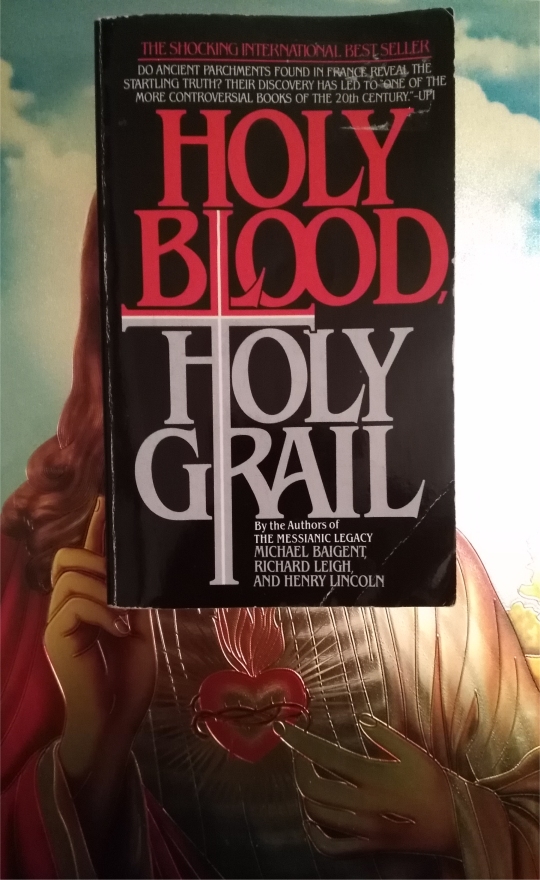
I finally bit the bullet and read Holy Blood, Holy Grail. This very stupid pile of shit is perhaps best known today as the blueprint for Dan Brown’s the Da Vinci Code, but it was a best-seller on its release and has had a huge effect on the formulation and popularization of conspiracy theories ever since. I never expected it to be any good, but I thought that I should read it to familiarize myself with modern grail lore before beginning some of the more dubious texts on that subject.

The main idea here, and we’ve all heard this one before, is that Jesus had a kid. The authors claim that Jesus was actually married to Mary Magdalen and that this pair had a child. Personally, I see absolutely no reason for the historical Jesus to have remained celibate. We don’t know where he was or what he was doing during his 20s. What do most people do in their 20s? They go out and ride whatever they can get their hands on. It would have been weird if Jesus was a virgin. I don’t need the evidence in this book to convince me that he might have had kids. I would be more interested in sensible reasons to believe that he didn’t. And less than 50 pages of this 450+ page book are actually spent discussing the evidence for a horny Jesus. The other 400 pages are taken up with the authors making complete idiots out of themselves.

So one of the authors, I can’t remember which one, read a book on his holidays one year in the early 70s. This book was about Berenger Sauniere, a priest in the south of France who had suddenly became rich in the late 1800s. There were all kinds of rumours about Berenger having found treasure of some kind, and the lad reading the book thought this was pretty interesting and decided to do some research on the mystery of the priest’s wealth. He went over to France and started looking for clues. While he was over there, somebody gave him an anonymous tip-off that there was a dossier of curious documents in a library in Paris that might contain information pertaining to this mystery. Sure enough, he goes to the library and there, in this dossier, are a bunch of cool documents that keep mentioning a weird sounding secret society. Convinced that he’s onto something big, the lad makes some photocopies, goes back to England and starts mashing his pieces of the puzzle together. A few weeks later he gets another call from his anonymous informant who tells him that a few more very interesting documents seem to have shown up in the secret dossier in the library. Our boy is on the next ferry over to France, and what do ye know, when he gets to the library, the dossier is looking thicker. This happens a few times over the next few years, and by the end, his friends and he have managed to piece together the peculiar history of the Priory of Sion, a mysterious secret society that has links to the Merovingian and Carolingian Dynasties of Medieval France, the Knights of the Round Table, the Cathars, the Knights Templar, the Rosicrucians and the Freemasons.

The authors use all the evidence from the secret dossier and a generous dollop of imagination to argue that the Priory of Sion is a secret society devoted to protecting the bloodline of Jesus Christ in the hopes that they will someday be able to reinstate his descendants as the rightful rulers of civilization.

The problem here is that the Priory of Sion is completely fake. It was made up by Pierre La Plantard, a dodgy Frenchman who believed that he was the descendant of some medieval French Kings. Him and his friends had been the ones putting the documents into the secret dossier all along. The whole thing was a load of absolute bollocks. Now, Pierre’s claim was that he was of Merovingian descent, but the authors of Holy Blood, Holy Grail were claiming that he was the direct descendant of Jesus Christ. He got a bit embarrassed about this and renounced the book. His mates that were involved the hoax came forth and acknowledged that they made up the whole thing. (As far as I can tell, the authors’ response to this was to maintain that their claims were true and to claim that La Plantard was lying about having lied.)

pierre-le-plantardPierre La Plantard (AKA Pierre Christ)

I knew that the Priory of Sion was made up before I read this book, and that made it a fairly excruciating experience. The ‘evidence’ presented in here is taken from novels, legends, the bible and hearsay, and the authors’ reasoning is absolutely infuriating. You’ll see their approach criticized in any review of this book; it really is terrible. It made me recall that of the protagonists in Eco’s Foucault’s Pendulum. (And I would find it very surprising if that novel, written in 1988, was not written partly in response to this book and how it had been received.) Leigh, Lincoln and Baigent accept any tangential idea that pops into their heads as long as it can not be immediately disproved. I have adopted a similar approach below to prove that Adolf Hitler was a descendant of Count Dracula:

Transylvania was under Austrian Hapsburg Rule between 1699 and 1867. This would have meant that things and people from Transylvania would sometimes have found their way back to Austria.

Count Dracula, Transylvania’s most infamous resident, although made famous in an 1897 novel, was actually based on a real person, Vlad the Impaler. Vampyrism is probably not a supernatural condition but some kind of hereditary disease, and so Vlad’s descendants would also have been vampires if he was one, which he probably was.

Did the bloodline of Dracula find its way into Braunau am Inn, the birthplace of Hitler?

Well that would explain a lot. We know that Hitler’s mother was born of peasant stock and had a thing for older men. (Hitlers dad was 23 years her senior.) Would she have been able to resist the charms of a tall, dark stranger with a mysterious foreign accent? I think not. If Vlad, or one of his descendants, had shown up on her doorstep, she would have let them drain her right then and there. Ok, I know at this point our argument might seem a bit tenuous, but if we continue with this line of reasoning, a lot of things begin to make a lot of sense.

Ok, so Hitler’s mother was definitely drained by a vampire, thus becoming a vampire herself. She got pregnant with a vampire baby. She tried to pass it off as her employer’s, but this baby had dark hair, like his real father.

Hitler was certainly responsible for a lot of bloodshed. Think about it dummy: Vampires love blood! Was his body ever found? No; he flew off into the night!

At this stage, anyone with an ounce of sense will agree that Hitler is a vampire and probably still alive. It would be utterly ridiculous to claim otherwise.

I did that in about 10 minutes, and I reckon it’s probably more entertaining  and no less sensible than the work of Leigh, Baigent and Lincoln.

Holy Blood, Holy Grail is a pile of shit, freshly emitted from a large hairy anus. At least the Da Vinci Code was superficially entertaining. This is just embarrassing. I wouldn’t recommend it.

This post marks two years of this blog. I’m going to become a dad at some stage in the next month, so things on here might be a bit slow for a while. Make sure you like the facebook page for future updates. Thanks for all the interest.

Illuminati Confirmed! – New World Order (The Ancient Plan of Secret Societies) – William T. Still

nwoNew World Order (The Ancient Plan of Secret Societies) – William T. Still
1990 – Huntington House Publishers

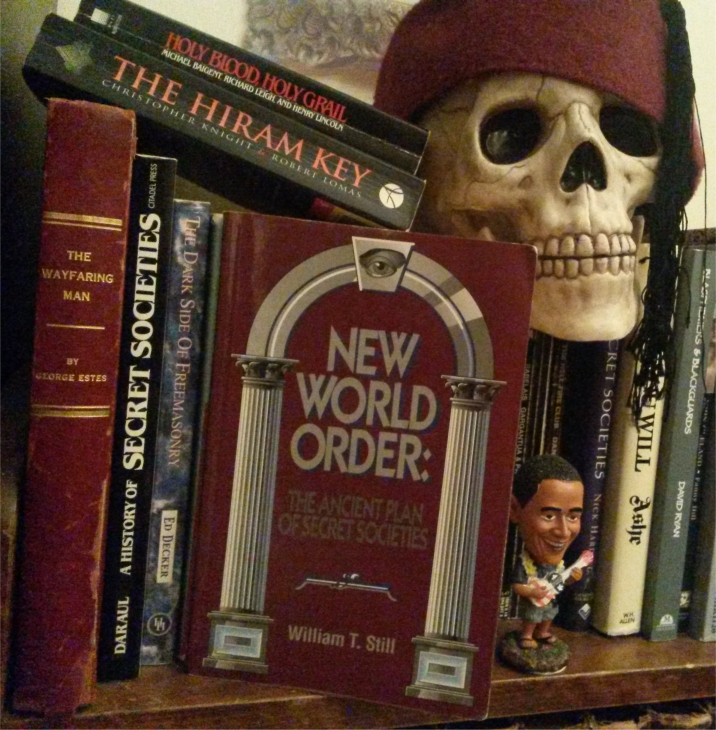
After a very boring introductory chapter, this book contains about 70 pages of tolerably silly conspiracies, but then it gets very, very boring. Just from the cover, I expected something similar to  Ed Decker’s Dark Side of Freemasonry, and I wasn’t far off. This is a book of conspiracies from the point of view of a conservative Christian author.

As far as these things go, it was fairly well researched. William T. Still is clearly a nutjob, but he’s competent enough to provide his references. The book contains nothing I haven’t come across before, but it was novel to see how the author managed to link the Atlantean origins of secret societies, William Shakespeare’s true identity, and the Freemason’s involvement with the Jack the Ripper murders. Still is the kind of wacko that Umberto Eco was making fun of in Foucault’s Pendulum.

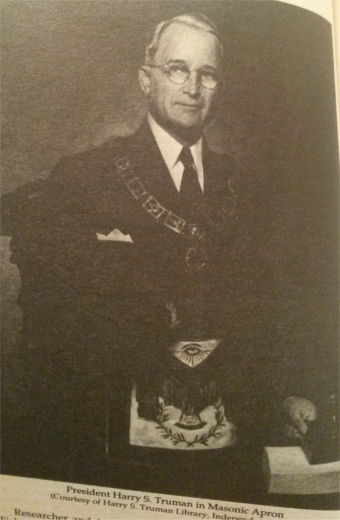
truman
The central idea behind the book is that the Illuminati is a Luciferian/Satanic cult dedicated to exterminating religion, taking over the world, and bringing about the reign of the Antichrist. If America doesn’t adopt conservative politics and good old-fashioned family values, the country is going to allow itself to be taken control of by a small group of the super-wealthy who don’t care about anyone but themselves. The scary thing about this book is that you know that the people who read it and have taken it seriously are the exact same people who are going to vote for Donald Trump.

The Illuminati has recently reentered the public consciousness. Nearly every teenager in North America has seen the ‘Illuminati Confirmed’ memes. Why now? Maybe it’s because the idea of a small, faceless group of the super wealthy being in charge of America is actually less frightening than the faces of the small group of the super wealthy that clearly are running the country.

I WANT TO BELIEVE – Alien Encounters and The UFO Phenomenon

cool-ufo
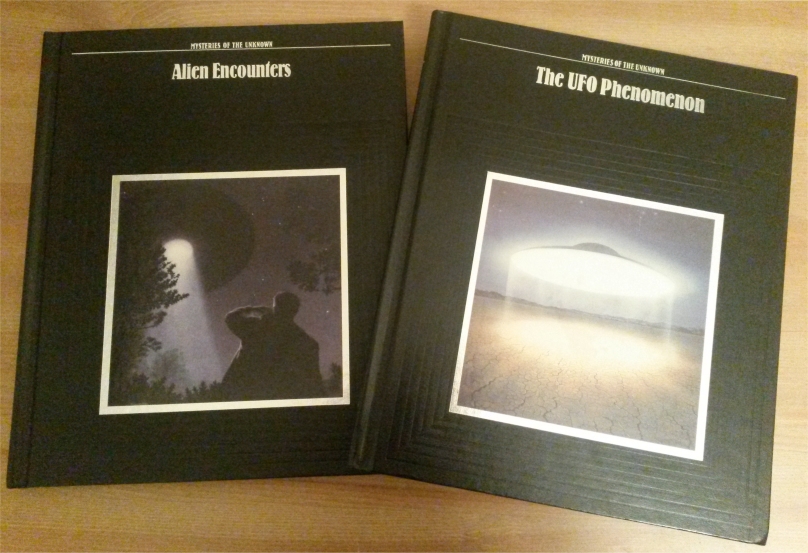
A little over a year ago I did a post on three books from the Time Life Mysteries of the Unknown series. I decided to come back to the series and to read both of its books on aliens. The UFO Phenomenon was published first, and Alien Encounters repeats quite a lot of the same information, but there is a slight distinction in the subject matter. The UFO Phenomenon deals fairly specifically with… UFOs, while Alien Encounters looks more at abductions and contact. I was again impressed by the quality of this series. These books are lovely; they look and feel great, and they are surprisingly in depth. If you can find a complete set for a reasonable price, make sure to pick it up.

covers
UFOs exist. There have definitely been, and presumabably still are, things in the sky that have not been identified. That these objects harbour alien beings from other planets is far less certain. I try to keep an open mind about this kind of stuff. I have no problem believing in the likelihood that there is life on other planets, but the idea that those lifeforms could reach Earth is too much for me to accept. My knowledge of space travel is extremely limited, but I understand that the closest planets that could possibly support life are simply too far away for their inhabitants to ever bother coming here.

The UFO book was cool; I have read lots of other books about ancient alien theories and specific alien encounters, but I didn’t know much about the history of UFOs. It was interesting to see how the flying saucer turned an American cultural icon

billy-meier
I sometimes ponder over how modern technology has affected the acceptability of evidence of alien life on/around Earth. Nearly everyone has constant access to a camera these days, and there is no excuse not to document the spacecraft that are abducting us. At the same time, any form of digital media is susceptible to quick, easy and convincing editing. Not only that, but our skies are now so full of drones and other human made machines that we soon won’t bother to question what’s in the sky… This indifference will leave us vulnerable to external threats… In fact, the more I think about it, the more likely it seems that the aliens deliberately gave our governments their technology in an attempt to lead us into this complacency. We’re falling into their trap! Fuck it. All eyes to the skies!

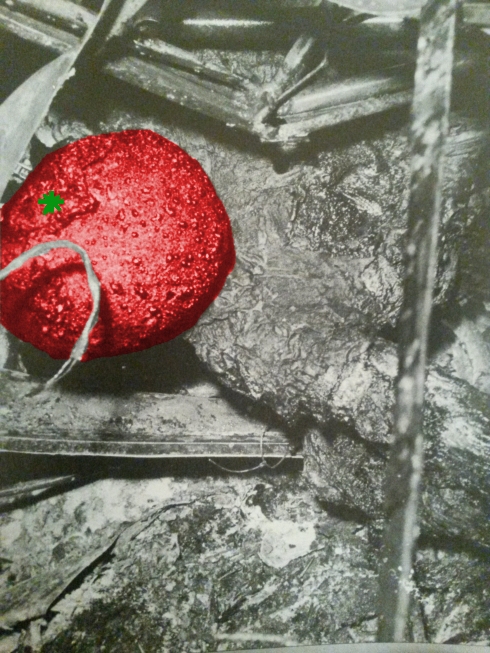
tomatoman
The above picture is of a famous alien corpse known as Tomato Man. (I have digitally enhanced it for full effect.) The original photo looks like a burned pile of rubbish to me. Some people have wondered how the glasses frames right underneath the alien’s shoulder got mixed up in the debris of an crashed spaceship.

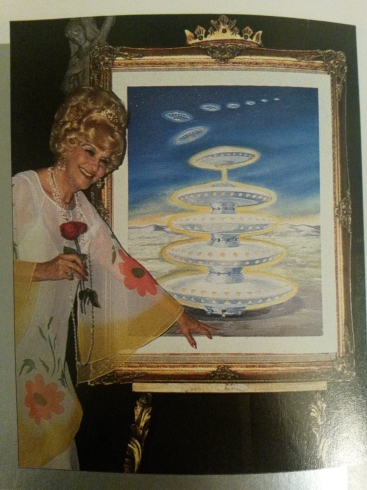
One of most fascinating things about UFOs and aliens are the people that worship them. One particular group, the Unarians, pop up a few times in these books. I had seen some bizarre videos about the Unarius Academy of Science on youtube years ago, and their appearance here convinced me to research them further. It turns out that they don’t believe in imagination. All imagined thoughts are actually memories of past lives. All science fiction is true. Star Wars is real.

The Unarians were led by a lady named Ruth Norman who claimed to be the latest reincarnation of the entity who had previously lived as the Archangel Uriel, Isis, Peter the Great, queen Elizabeth the first, Johannes Kepler, Buddha, Zoroaster, Emperor Charlemagne, Quetzalcoatl, the Dalai Lama, King Arthur and many other aliens and mythical characters. Ruth preached that the space brothers (friendly aliens) were going to descend to Earth and teach us their ways, but she died before this happened.

urielUriel, the Legend.

There’s a decent documentary on the Unarians called Children of the Stars that can be viewed here. It doesn’t criticize or question their beliefs; it merely presents them. The documentary goes on a bit too long, but it’s worth watching just to see how mental these people are. Here is the trailer if you are only a little interested, and if you’re super interested, here is Jello Biafra’s documentary on the same group of people.
There’s definitely similarities with the Church of Scientology (although the Unarians deny that they are a religious organization), but unlike L. Ron Hubbard, Uriel genuinely seems to believe her own nonsense. I think she was pretty cool.

rael
This silly looking gobshite also appears in the book. I noticed his interesting necklace and decided to google him. When an image popped up of the same lad in a white suit, I realized that I had seen him before. His name is Claude Vorilhon, but he calls himself Raël, and he claims to be the messenger of the Elohim (alien creators of humanity).

He appeared on the Late Late Show when I was a kid. I remember being very unimpressed by him talking about how Jesus had been an alien. (My, how the times have changed!) The interview stuck in my head, and I’ve only recently thought of looking him up, but I didn’t know his name. Once I discovered his name, I did another quick search and I found footage from one of his earlier appearances on the same show! Normally I dislike when talkshow hosts needlessly talk down to their ‘weirdo’ guests, but I have to say, Gaybo’s swarminess is actually pretty funny here. Apparently Raël wasn’t too upset by it anyway; he went on to appear on the same show two more times. (Unfortunately those episodes are not currently online.)

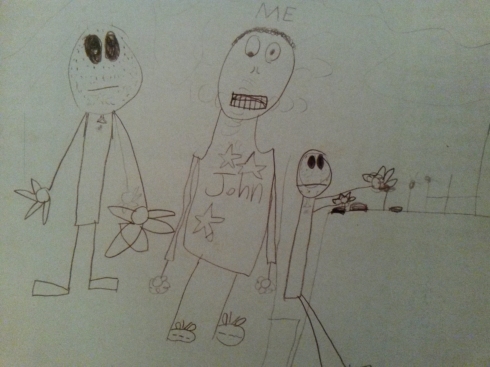
proof-of-alien-existenceA 5 year old drew this, and some people took it as evidence that aliens abducted him.
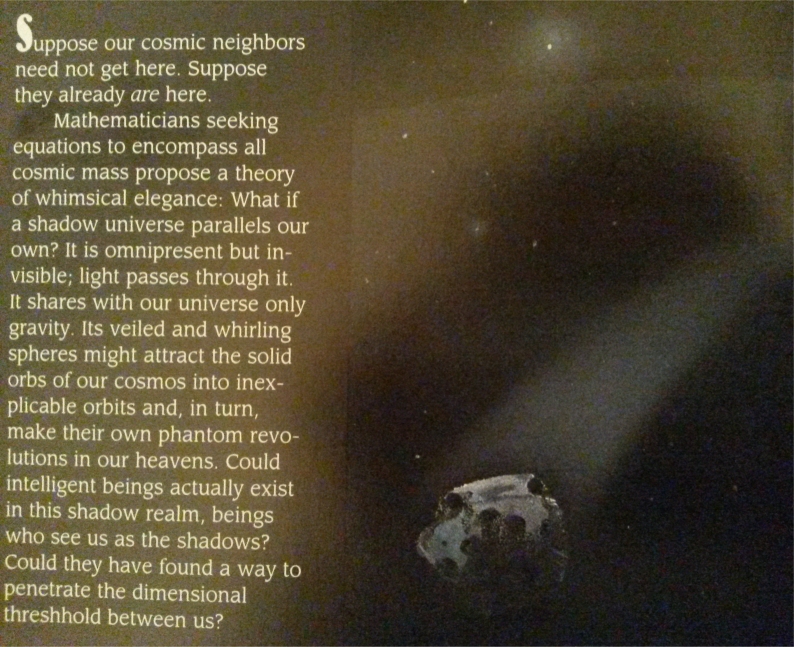
Reading these books, I wondered how often they were consulted by the writers of the X-Files. The Mysteries of the Unknown series were released between 1987 and 1991. The first episode of the X-Files was written in 1992. I find it hard to believe that some of the ideas for the show weren’t lifted directly from these pages. Just reading over the titles in the series, I’m able to think of specific episodes that refer to the content of nearly each book. In saying that, each of these books presents a fairly comprehensive overview of its topic, and if the X-Files writers weren’t taking their ideas from here, they were certainly getting them from more specific texts on the same topics. All of the mythology episodes (at least up to season 6) could easily have stemmed from the ideas in the two books I have just reviewed. We’re talking alien abductions, disinformation, alien human hybrids, implants, government conspiracies… all that great X-Filesy stuff.

Also, speaking of influencing hit TV series; check this out. There’s a small section at the end of The UFO Phenomenon that called to a mind a more recent science fiction show:
strangerthingsStranger Things, anyone?

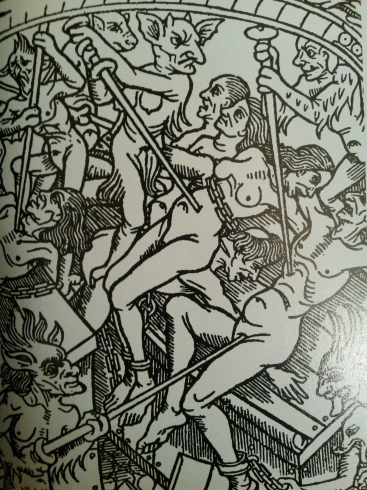
I’ll leave you with this. It’s an image of some unfortunates being tormented by demons. It was included in a section on the book proposing that aliens could be the modern equivalent to demons. The similarity being drawn here is that aliens, like demons, have been known to probe their victims. Check out the demon in the bottom left corner. Observe his calm demeanour.

bold“In and out, I’ll lance her clout, Hi-Ho! Hi-Ho! Hi-Ho! Hi-Ho!”
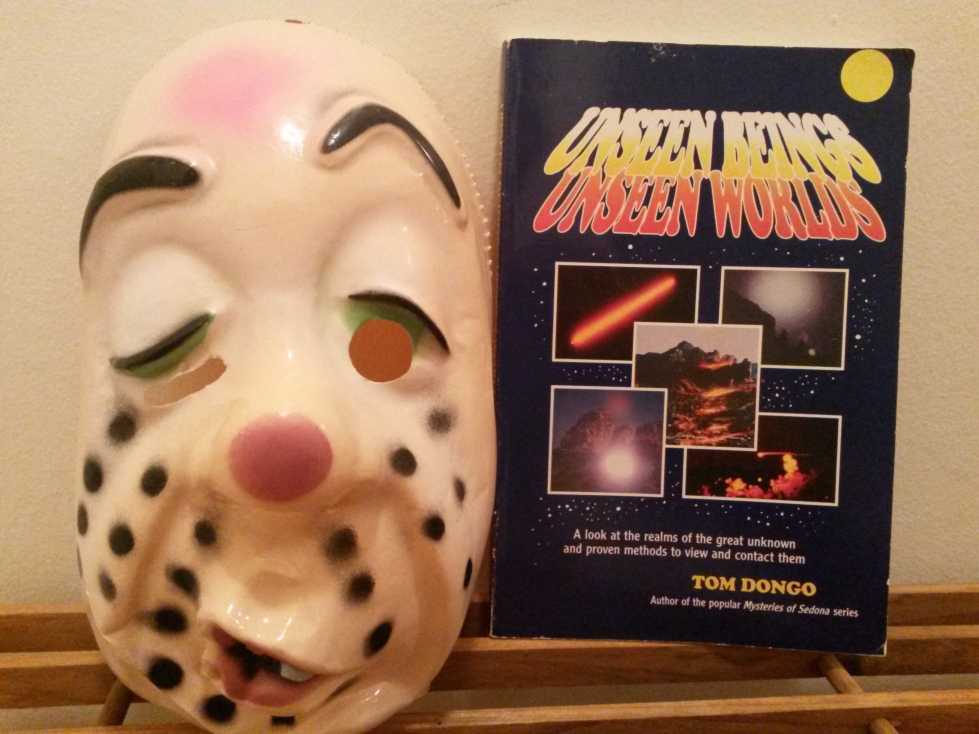
Unseen Beings, Unseen Worlds – Tom Dongo

1Hummingbird Publishing – 1994

This is a real piece of work. Somewhere in the introduction or the first chapter, Tom Dongo claims to be an extremely skeptical individual who is unwilling to accept anything that he hasn’t been able to prove to himself. He then goes on to write a book about his personal experiences with remote-viewing, aliens, the astral plane, demons, telepathy, reptilians, ghosts, channeling, and banshees. One has to wonder what counts as proof in his mind.

I’ve read lots of books about stupid topics that were written by what seemed to be relatively intelligent authors. (I would have imagined that the sillier the topic, the smarter the author would have to be to convince a publisher to put out their work.) Take Preparing for Contact as an example. It is utterly stupid, but the author managed to sculpt all of that stupid into an impressively cohesive whole. Psychic Discoveries Behind the Iron Curtain is a truly moronic nightmare, but the authors had clearly done a huge amount of scholarly research. Unseen Beings, Unseen Worlds lacks any traces of cohesion or intelligence. The author is an ignorant, arrogant fool of a man who has absolutely no ability to make sense. This is proof that anyone can write a book; it’s just a bunch of ridiculous ideas that popped into the head of a stupid weirdo.

2Ned Flanders… Wait, sorry, I mean Tom Dongo

Mr. Diddleyongo is of the opinion that many cases of mental illness are actually just cases of possession. He believes wholeheartedly in leprechauns. He claims that he can leave his body and travel around the universe. He often talks to spirits from different planets and dimensions. The man is a fucking imbecile.

Imbecile he may be, but stupidity isn’t a crime; the really irritating thing about Tom is the way that he talks about himself. He’s a know-it-all plonker. But, this isn’t really a book about the paranormal; it’s a book about Tom Dongo’s imagination. The ironic, and perhaps most infuriating, thing about this piece of rubbish is that the second chapter begins with the sentence; “I think I have read or am aware of just about every paranormal, esoteric, spiritual, and metaphysical book in print and many that are out of print.” The arrogance of that statement really put me in a foul mood when I read it. I would imagine that Tom’s reading was probably limited to whatever books were on the paranormal shelf in his local library.

I was going to go on and talk more trash about Tom Dongo, but after some consideration, I have concluded that he probably has some kind of mental impairment, and so it’s not really fair to make fun of him. I don’t think that a healthy, normal person would be willing to publish anything this cringe-worthy and idiotic.

3My copy is signed by the author too! Aren’t you jealous?


Foucault’s Pendulum – Umberto Eco

fp
Ballantine – 1990 (Originally published in Italian in 1988)

Most of the books that I review here are either too shit or too enjoyable to be clever. This one however, while it is rather enjoyable, is a rather astute piece of writing.

The plot is surprisingly simple. I’ll outline it in a way that won’t ruin the story for you: 3 book nerds, for a laugh, decide to patch together a ridiculous conspiracy theory. After a short while, they, and others, start to take their conspiracy too seriously and things get fairly messed up. That’s it. But if that’s the whole story, why is the book 500+ pages long? Well, Eco goes into detail, a LOT of detail, on the conspiracy that his characters are creating.

While the book is filled with interesting facts from what must have been an absolutely enormous amount of research, it’s not so much the conspiracies that are of interest as it is the psychology and biology of conspiracies and arcane ‘knowledge’. To put it another way, this is not a book about conspiracy theories in the same way that the Da Vinci Code is; this is a book about how conspiracy theories work. (Eco, when asked if he had read the Da Vinci Code, claimed that Dan Brown was one of the characters in this book.) While this book will satisfy readers of conspiracy fiction by mixing and matching their favourite secret societies and magicians, it will also force that reader to contemplate how silly most conspiracies really are. The way Eco engages with conspiracies only to end up making fun of them is really tactful. He never denies that they’re fun and interesting, indeed he would have had to have been a severe masochist to have thought that and written this book, but ultimately, he gives very little credence to any of them. Ah Umberto, a man after my own heart!

I really enjoyed this book. The subject matter is precisely the kind of crap that I like reading about, and the characters were great too. It does get a little heavy on the details at times, and I’d recommend having a decent understanding of who the Rosicrucians, Gnostics, and Templars were before you start. If you do decide to read it and feel like you’re getting bogged down in the details of the eclipse that occurred during the 14th birthday party of the blind translator of a coded manuscript detailing the fate of an obscure heretical sect from Southern France, you can probably just skim through those paragraphs without missing out on crucial plot details.

The book opens with the narrator snooping around the National Conservatory of Arts and Crafts in Paris. He has an appointment at midnight under the Foucault Pendulum housed therein, and he is trying to find a place to hide where he will not be noticed by the security guards as they are closing up. When I discovered that my University also houses a Foucault Pendulum, I determined to recreate that scene to the best of my ability.

I waited until the 23rd of June, the same day that the book’s narrator goes to see the pendulum in the Conservatoire. Unfortunately, I found it very difficult to sneak effectively, as there were very few people around to be suspicious of me. Regardless of this, I surreptitiously tip-toed into the building, constantly casting glances behind me in the hopes that I was being trailed. When I got to the pendulum, Disaster! Somebody else was standing there looking at it. I contemplated asking if he was there for the same reason as myself, but in the interests of my own personal safety (and dignity), I decided against doing so. I pretended that I wasn’t interested in the pendulum; I walked straight by it, exited the building, and bought a cup of coffee in a nearby cafe. I waited maybe 10 minutes and returned. The coast was clear, so I took the following video and ran for it.

I fear they may have seen me leave the campus. I am in hiding now, but I know that they will find me eventually. All I can do is wait. I might as well sit here and look out the window at the willow tree in the garden outside.

It’s so beautiful.


Edgar Cayce on Atlantis – Edgar Evans Cayce

20160509_204712Warner Books – 1968

This is one of the stupidest, shittest books that I have ever read. I started reading it in February, but school got busy and I gave up on it. Things have eased up a bit recently, and I saw this piece of garbage lying on my shelf, mocking me and boasting to my other books that it been victorious in clogging my bullshit filter. “No!”, I said, “I shall not be defeated!” I picked up the book with renewed vigor, and forced myself to wade through 170 pages of handicap.

Edgar Cayce was a lad from America who claimed he was a psychic. I watched a shite documentary on him once, and I wasn’t very impressed. He would pretend to be asleep and then diagnose people’s diseases. He also gave people information about their past lives and that kind of crap. Somehow, I have amassed a small collection of books about him, but after reading this one, I imagine it will be quite a while until I read any more of them.

20160509_204445.jpgMy Cayce Collection

God, even thinking about explaining what this book is about is making me feel embarrassed. Reflecting on the fact that I knowingly spent several hours of my life reading a book by an idiot about an idiot for a bunch of idiots is making me think that I ought to find a new hobby.

So the idea here is that 12,000+ years ago, Atlantis was an island inhabited by spirits. The spirits wanted to interact with the physical stuff on the island, so they entered into living bodies. Or maybe they created the bodies; I can’t quite remember. Either way, these living bodies were not quite human; some had animal parts. Then, after a bit, some of the weird creatures turned greedy and a split occurred. Half of them remained sound, but half of them turned bad. The bad ones were called the ‘Sons of Belial’, and the good ones were called …something else; I’ll be fucked if I’m reopening the book to find out. So the two factions went at each other, and Atlantis was destroyed. The lads took off, probably in their nuclear powered flying machines, and a bunch of them ended up in Egypt.

When they got to Egypt, there were so many Atlanteans that the Egyptians didn’t know what to do. Somebody came up with the idea of bringing back RaTa. Now, RaTa, for those of you who weren’t aware, was a high priest who had been banished from Egypt. Anyways, RaTa was a bit of a genius too, and he managed to help the Atlanteans assimilate into Egyptian culture. This is how probably how the Egyptians learned about pyramid power and all of that shit. Oh yeah, I forgot to mention; RaTa, the diplomat, outcast, high-priest and all round hero of the story, was actually a previous incarnation of Edgar Cayce himself.  I can’t remember if the book ever mentions why he had been banished from Egypt. I personally suspect that it was for molesting young boys.

This book is a piece of dirt, fouling up my bookshelf. I started off reading it on the toilet, but I found that it gave me constipation. I’ll never read it again. Edgar Cayce was a stupid bastard.

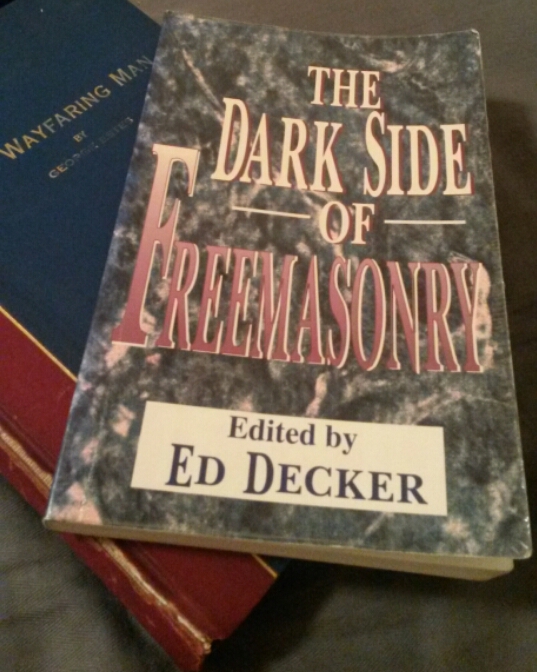
The Dark Side of Freemasonry – Ed Decker

Huntington House Publishers – 1994

About 20 years ago, a bunch of evangelical christians met up somewhere in the backwards part of the southern US and had a symposium on the evils of Freemasonry. Most of the attendees were former masons, mormons and muslims; the kind of people who jump ship at the drop of a hat. This book collects the speeches that they gave. A lot of it is the kind of thing you’d expect (“Freemasons worship the Devil!” stuff). Other chapters are outright ludicrous (Freemasons are trying to destroy the US education system!), and one of them is a fairly interesting account of famous occultists and their links and opinions on masonry.

2015-12-05 00.37.24
(If anyone can fill me in on the relevance of ‘The Wayfaring Man’ within Masonic ritual, it would be greatly appreciated. I own the above copy of a book with that title by George Estes. It was published in 1922, and it’s very definitely a Masonic text. I don’t want to read it until I have some context.)

I’m not a Freemason, and I don’t feel any great desire to defend Masonry, but most of this book is silly nonsense. Several of the papers claim that most Freemasons aren’t aware of the occult influence on their organisation because they never bother to read the literature. I’m not interested in refuting this claim, but I found it hilarious to see christians criticising others for blindly accepting dogma without having read the literature.  Have you seen that awesome video of christians reading passages from the Bible for the first time and being repulsed?

2015-12-05 00.36.42
Whoever owned this book before me took it pretty seriously. They seemed to have been upset by this image of Baphomet. Also pictured is the bookmark that was hidden inside when I bought the book. I looked it up, and the christian bookstore it came from has shut down. Yipeeee!

Yeah, this book was crap. I only read it because I don’t want to get into anything too interesting while I’m in school. It came with the two books from my last blog post, and I promise it will be the last christian book that I review for a while. I got a great haul of books off craigslist the other day, and I’m hoping to read a few of those over the christmas break. Oh, and before I forget to mention it, I’ve created a facebook page so that people without a wordpress account can stay updated on this blog. The link is here and also in the menu in the top right. Give it a like if you’re so inclined.

12308258_1662418554034197_3015533422428968948_n
The X-Files Haul
A guy was selling most of his book collection on craigslist, and I nabbed these absolute classics for a measly 8 bucks. I had to take three buses to get out to meet him in front of a drugstore in the middle of nowhere, but it was totally worth the opportunity to pretend I was Mulder meeting up with some shady character to obtain esoteric information.

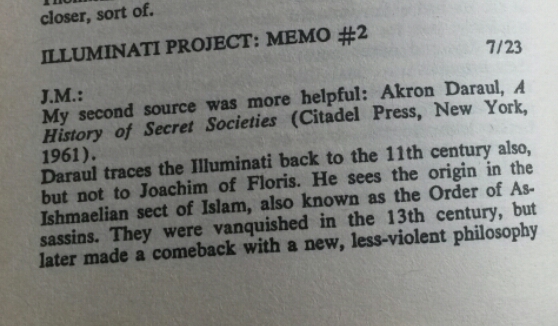
A History of Secret Societies – Arkon Daraul

2015-08-12 21.21.10
Citadel – 1997

I’m not really interested in secret societies. There’s a few interesting ones, but they’re mostly pretty boring. A few months ago,  I saw this book for sale on craigslist for fairly cheap. I wasn’t really bothered, but I was reading the Illuminatus! Trilogy at the time, and when I saw it mentioned therein and recalled the craigslist ad, I took it as a sign that I should buy it. (Coincidences don’t exist.)

2015-08-10 18.34.14
Why I bought this piece of trash. Note the misspelling of the author’s name.

I decided to read the book because I am currently reading Zanoni by Bulwer Lytton, and as that book is about Rosicrucians, I thought this would complement it well. It’s certainly as fantastic; in fact, there are more references in Lytton’s work than there are here. Arkon Daraul is full of shit.

This book is garbage. It doesn’t seem reliable at all. Daraul’s choices of which secret societies to discuss are completely arbitrary. There is a lengthy chapter on peacock worshippers in modern England, but there’s no chapter on the freemasons. Admittedly, I was relieved that I didn’t have to read the same crap about freemasons that I have already read in 10 other books, but it did seem a little odd that the most famous secret society of all were barely mentioned in this “historical account”. Also, Daraul doesn’t really bother to distinguish between secret societies and cults.

I don’t really have much else to say on this book. It was crap. The cover (Is that Satan?) makes it look way better than it is. There were some interesting parts, but there are lots of other books on the same topic that are much better. I reviewed a shitty little book on this kind of crap before that covered more ground and was way less bullshitty.
Don’t bother reading this one.

prayer
The best part about this book was this prayer leaflet that the previous owner had left in it.

WAS HITLER A SATANIST? – The Occult Roots of Nazism, They Used Dark Forces and Theozoology

nazi
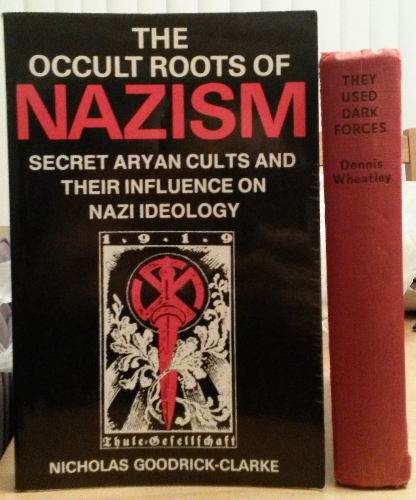
Well it’s Hitler’s birthday, so here’s a post about occult Nazism. I’m going to review three books:

The Occult Roots of Nazism – Nicholas Goodrick-Clarke
NYU Press – 1992

They Used Dark Forces – Dennis Wheatley
Hutchinson & Co. Ltd (I think) – 1964

Theozoology – Jorg Lanz Von Liebenfelz
Europa House (PDF version) – 2004

The Occult Roots of Nazism
First off, The Occult Roots of Nazism is a pretty serious book. It’s well researched and well written. It’s very academic though, and it’s interesting in a historical way rather than a spooky way. To tell the truth, my main reason for buying this book was because Danzig owns a copy.

It turns out that some of the Nazi party’s beliefs had their roots in odd theosophical mysticism. The Nazis’ notion of Aryan supremacy might have been affected by some weird old men’s nutty ideas about Atlantis. I can accept that the Nazi’s ideas were affected by these nutty ideas, but it’s certainly not fair to blame the Holocaust solely on the  fantasies of a few occultists. In fairness though, the author never suggests any such thing; this really isn’t a bullshitty book. Goodrick-Clarke goes into a huge amount of detail to support his claims, and a lot of this book is very boring. I’d imagine it to have been a very difficult book to write, and I respect the author’s self restraint and ability to stick with the dry facts. The temptation to exaggerate would definitely have gotten the better of me.

The occultism herein is mostly quite boring to be honest. It’s mostly new-agey garbage; runes, theosophy and that kind of nonsense. If you’re hoping for accusations of Satanic pacts, this book will disappoint. The stuff about Von Liebenfelz is quite interesting, but we’ll get to that later on.

Overall I’ll give this book a 6/10. It’s good, but it’s not entirely to my tastes. If you’re a history student writing about this kind of stuff, this would be an extremely useful resource, but if you’re a gobshite like me who likes reading stupid books about the devil, this might not be entirely satisfying.

They Used Dark Forces
I hadn’t yet read They Used Dark Forces when I came up with the idea for this post, but I had read Goodrick-Clarke’s book. I thought it would be a fun to contrast Goodrick-Clarke’s very academic work with a trashy Dennis Wheatley novel. To my disappointment, They Used Dark Forces is actually a very well researched piece of historical fiction, with only a little gratuitous black magic thrown in for fun. But what I found most disappointing was the fact that the ‘They’ in the title doesn’t refer to the Nazis. It’s actually the novel’s protagonist, Gregory Sallust, and his mate Malacou that do be using the dark forces herein.

I love Dennis Wheatley novels, and you can be sure that this isn’t going to be the last of his works reviewed on this blog, but I have to admit, this book wasn’t great. At least one third of it is just a factual account of different events and characters of the second world war. Wheatley was actually involved in the war, and he clearly knows what he’s talking about, but I don’t read his novels for history lessons.

This book portrays Hitler as having an interest in the occult, but the only real satanist in the novel is actually a Jew. Wheatley doesn’t seem particularly anti-Semitic in any of his other works that I have read, and he never suggests that all Jews are Satanists in this book, but it did strike me as a little insensitive to villainize the only Jewish character in a narrative that largely unfolds in a concentration camp. I wasn’t particularly offended by his representation of the Jews; I was just disappointed that he didn’t use this book as an opportunity to make up silly stories about Hitler being a wizard.

Although not overtly anti-Semitic, the book does contain some good old-fashioned homophobia and misogyny. The most evil of all the books characters, Herr Obergruppenführer Grauber, is a fat homosexual who has a kinky bdsm room in his apartment, and there’s a particularly hilarious instance when a character expresses his attraction to a young woman by saying, “If I’d been ten years younger I’d have taken her off you and smacked her bottom myself.” I don’t think that Wheatley’s lack of cultural sensitivity detracts from his work; I find it hilarious. I only mention it as a warning to any nerds who are considering reading this work who might get upset.

So what about the dark forces? Well there’s lots of numerology, astrology and palm-reading in here, but there’s only one truly diabolic act in the whole book. This despicable blasphemy occurs early on too, and I was left waiting for more for the remainder of the book. The single atrocity committed is particularly nasty though, and it really seems out of place in terms of the characters involved and the general tone of the novel. There’s a brief reprisal of diabolism later on when Malacou suggests the performance of another ritual in honor of the Dark Lord. Gregory’s response to this suggestion is utterly priceless; “You filthy Satanist. Get to hell where you belong.” Good man, Gregory. That’ll surely teach him the error of this ways.

In general, this book was disappointing. Wheatley’s novels are fun, but they’re absolute trash. If I’m going to read trash, I need it to be at least 50% satanic. This novel was only 15% satanic, so the highest rating I can give it is 5/10. Read it if you like Wheatley, but don’t use it at a starting point to get into this writing.

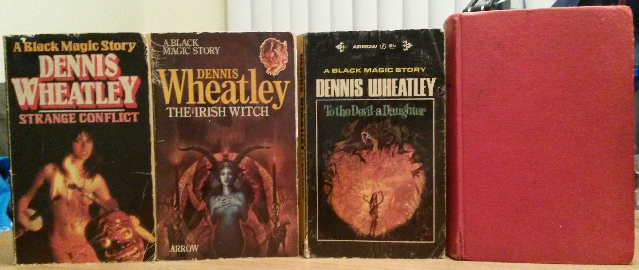
To add insult to injury, my copy of the book doesn’t even a cool cover. Dennis Wheatley novels usually have awesome covers, and most other editions of this book have cool satanic swasticas on their covers. I got a lame plain red hardback version.coverswheatley
Spot the dud.

Theozoology, or The Science of the Sodomite Apelings and the Divine Electron
(An introduction to the most ancient and modern philosophy and a  justification of the monarchy and the nobility.)
theo.jpg

Well aside from having the greatest title of any book in the history of the world, this is also one of the funniest books that I have ever read. I usually only review books that I own, but the only copies of this that I have found have been printed versions of the .pdf version that I found online that some jackass is selling online for ridiculous money. I’m happy to stick with an electronic copy anyways, as I don’t want to be giving money to anybody who takes this nonsense seriously enough to translate and publish it.

I first heard of this book in Goodrick-Clarke’s book and had to track it down. Jorg Lanz Von Liebenfelz was cuckoo. In this book, he argues that a race of bizarre, homosexual ape-monsters have been fucking things up for the Aryan God-race since the beginning of time. Pretty much everything bad that has happened has been caused entirely by these malicious monkey-men. You might think that sounds unlikely, but Lanz uses the Bible to provide evidence for his claims, so he was almost definitely right.

I read this about a year ago, and I can’t honestly remember the specific arguments that Lanzy puts forth. I don’t think that matters though, they’re far too silly to discuss. I’m going to just copy a few quotations in here so you get a general idea of how amusing this book can be.
Lanz gives an interesting account of the origins of crucifixion:
The “crucifixion” consisted of binding wild and unruly Sodomite monsters to poles in order to be able to copulate with them without danger. (cf. Job XL.24 Thren. V, 13). On the other hand, however, people were bound to such poles in order to have them sodomized by lascivious apelings. This was the torture to which early Christians were put (pastor Hermae III,2) and that was also the torture of Jesus.
So originally, regular people used to tie the apelings up to bum them, and they’d also tie up criminals to let them get bummed by the apelings.

There’s more details on Jesus’ ordeal later on; “Christ was to be outraged by the Sodomite hobgoblins. If he consented to this willingly and if he was overcome by temptation, then his whole mission would have been dashed.” Poor Jesus – nailed to a cross and then expected to resist the temptation of getting bummed by a hobgoblin. That’s rough.

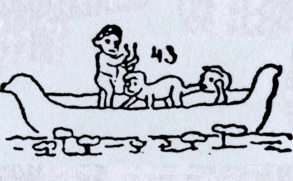
I’m not entirely sure why, but this diagram and its description made me laugh until I was in tears.
Untitled
an image from Pompeii shows us three such ugly hobgoblins travelling on a barge.
Von Liebenfelz thought that both this image and the phrase ‘ugly hobgoblins’ were appropriate to use in a ‘scientific study’ that would justify the supremacy of the Aryan race. It looks like it was drawn by a toddler. What the fuck Lanz?

Apparently people took this seriously though. It’s difficult to understand how; this book is illogical, offensive, confused and yet hilarious. It’s too mad to rate. Read it for a laugh; it’s no good for anything else.

The Da Vinci Code – Dan Brown

Doubleday – 2003
code
Perhaps the single most important text in all occult literature?
Definitely. Here’s a little code for you to solve. For proof of this book’s brilliance, check the publication date of this post.

I actually read the Da Vinci Code last year. It wasn’t as bad as I expected; it’s very easy to read, and it got me through 2 quiet days at work. I quite enjoyed the first half of it, but it starts to get fairly repetitive towards the end when everything is turning out to be some kind of stupid code. It’s pretty cool to talk about how much this book sucks, so I won’t bother. I’ll just give it a 3.5/10.