Robert E. Howard’s Cthulhu Mythos and Horror Fiction

The Horror Stories of Robert E. Howard

Del Ray – 2008

I have long wanted to read Robert E. Howard’s Cthulhu fiction. On April 15th, 2015, I added Nameless Cults: The  Complete Cthulhu Mythos Fiction of Robert E. Howard to my goodreads to-read list. I knew Howard had created Conan The Barbarian, and while I hadn’t read any of Howard’s stories, I had seen and loved the 1982 Conan movie. I assumed the rest of Howard’s fiction would be similar. Unfortunately, the Nameless Cults collection has been out of print for a long time, and copies are fairly expensive. Also, I have read a few books put out by Chaosium, and while the contents are usually pretty good, the presentation is quite bad. I didn’t want to spend lots of money on a book that would probably be crap. Fortunately, Del Ray books also published an extensive collection called The Horror Stories of Robert E. Howard.

This book is 523 pages long, and it includes 40 stories and 20 poems. As far as I understand, it is not a best of collection. These are all (or at least most) of Howard’s horror stories. I haven’t read his other stuff, but I would be surprised if at least some of his other stories didn’t have elements of horror. The 40 stories in here were enough for me though. I don’t have any desire to read more Robert E. Howard. This collection does not include all of the stories in Nameless Cults, but the ones it leaves out are mostly “collaborations” that were published long after Howard’s death. The prospect of reading a story that Robert E. Howard left for somebody else to finish does not seem at all appealing to me.

Honestly, a lot of this book is absolute crap. Howard was a hack. He wrote whatever would sell, pumping out horror, fantasy, adventure, sword and sorcery and westerns. There’s some good stuff in here, but at least half of this book was a chore to read. Anyone writing as much as Howard did was bound to get lucky now and then. A 200 page Robert E. Howard’s Best Horror Fiction collection would have been far, far more enjoyable.

I read this book because it seemed to contain Howard’s Cthulhu mythos fiction. The stories in here that are considered part of the Cthulhu canon are of mixed quality. The Fire of Asshurbanipal and The Black Stone were pretty good. Howard’s main contribution to the mythos seems to have been De Junzt’s Unaussprechlichen Kulten (Unspeakable Cults), a book of heinous black magic. Howard references this book in several of his stories, and Lovecraft went on to borrow it for a few of his.

Aside from the Cthulhu stuff, I quite liked Pigeons from Hell, Casonetto’s Last Song and Old Garfield’s Heart. The Dwellers under the Tomb was probably my favourite story in the collection:

“Spawn of the black pits of madness and eternal night! Crawling obscenities seething in the slime of the earth’s unguessed deeps–the ultimate horror of retrogression–the nadir of human degeneration–good God, their ancestors were men!”

The Dwellers under the Tomb

Robert E. Howard’s writing seems fairly notorious for the unfortunate way with which it deals with race. I’ve come across similar approaches with Lovecraft, Wheatley and others, but the tale in this collection called Black Canaan may well have the highest n-word count of any story I’ve read. I don’t know if Howard was a truly hateful person, but some of these tales are very likely to offend the modern reader.

There was definitely some decent stuff in here, but a lot of it felt like uninspired, poorly written garbage that was only put on paper so the author could pay his rent. After reading 40 of his stories, I have absolutely no interest in reading anything else by Robert E. Howard. I skimmed through his poems, and I had even less interest in them. I’m not a poetry kind of guy.

As I read the stories in this collection, I kept a spreadsheet with my thoughts or a brief synopsis on each one. I am including that spreadsheet here for my own reference, but it may be of mild interest to some of my readers:

TitleSynopsis/Thoughts
In the Forest of Villefèretraveler meets werewolf in forest. cuts off head
A Song of the Werewolf Folkpoem
Wolfsheadsequel to forest of villefere, man who fought w.wolf ends up in africa at a party in a castle. Is now a werewolf.
Up, John Kane!poem
Remembrancepoem
The Dream Snakemad old man dreams of being trapped inside a house on a hill because there is a mean snake outside.
Sea Cursea pair of scoundrels rape and kill a young girl. Her witch aunt curses them, and they die at sea.
The Moor Ghostpoem
Moon Mockerypoem
The Little Peoplean unruly sister goes walking on the moors at night to be attacked by a group of elfish fairies. She is saved by a mystery disappearing druid.
Dead Man’s Hatepoem
The Tavernpoem
Rattle of Bonessolomon kane story. Goes to an inn, but his accomplice turns on him then innkeep turns on accomplice, then magician’s skeleton turns on innkeep.
The Fear That Followspoem
The Spirit of Tom Molyneauxboxing story. Coach shows boxer picture of his fave boxer and helps him come back and in fight. Bad story.
Casonetto’s Last Songa devil worshipping singer sends a cursed record to the man who gave evidence at the court case that got him executed.
The Touch of Deathman sleeps in room with corpse. When candle goes out, he touches a pair of rubber gloves hanging from shelf and dies of shock.
Out of the Deepan evil mermaid pretends to be a sailor’s corpse and starts killing a bunch of people. Same place as in Sea Curse
A Legend of Faring Townpoem
Restless Waterspirate sells his niece to an older gent, kills her fiancee so he can make the sale. The dead lad shows up in a window and gives him a heart attack
The Shadow of the Beastfairly racist. A black lad shoots a white man and promises to kill his sister. He hides in an abandonded house that is haunted by a gorilla. He dies. Wtf.
The Dead Slaver’s Talepoem
Dermod’s Baneawful ghost story set in ireland. A bad ghost pretends to be a good ghost to kill a guy, but the good ghost saves the guy.
The Hills of the Deadsolomon kane story. Solomon goes to the jungle and kills an entire tribe of vampires with a witchdoctor. Awful.
Dig Me No GraveCthulhu cultist sells his soul for 250 of life. Time is up. A weirdo appears in his death parlour. Ok.
The Song of a Mad Minstrelpoem
The Children of the Nightman hanging out with mates briefly discuss horror fiction. Then one takes an axe off the wall and accidentally hits another lad in head. This causes him to go back in time to a time where the picts, small little goblin people had attacked his warrior clan. He is pure blooded, so he kills them violently. He awakes and tries to kill his mate who has slanted eyes. violent, racist and bad. Not really cthulu mythos.
Musingspoem
The Black Stonething in hungary. Pretty Good
The Thing on the RoofLad wants copy of de junzt to find about mummy’s jewel. He takes jewel so monster kills him.
The Dweller in Dark Valleypoem
The Horror from the Mounda man digs into an indian burial ground despite his neighbours warnings. A black vampire comes out and tries to kill him.
A Dull Sound as of Knockingpoem
People of the Darkman follows his rival into a cave to kill him but gets hit on the head and remembers a past life in which he did the same thing but he was conan. A race of goblins inherit the cave and him and his rival fight them. Then he comes back to modern day and shoots the degenerate ancestor of the goblins before they kill his rival and his girlfriend.
Delenda EstHannibal the historic figure, comes back in ghost form to tell a pirate of a mutinous shipmate. Shit.
The Cairn on the HeadlandAwful story set in ireland. A FOOL uncovers the grave where odin was buried after fighting irish army
Worms of the Earthbran mak morn witnesses a pict die, so he summons the worms of the earth, gross mutants, to kidnap the Roman soldier who killed him. P. good.
The Symbolpoem
The Valley of the LostDeadly story. Cowboy gets stuck in pet cemetary cave with enemies corpse. Finds snake peoples’ lair underneath. sees their history. Comes out and dynamites entrance, then shoots himself in head.   Harsh story. Cool
The Hoofed ThingCREEPY OLD NEIGHBOUR BREEDS WEIRD BLOOD THIRSTY LIFEFORM IN HIS BEDROOM. Eats him and then man kills it with a sword.
The Noseless Horrortwo lads visit their friend who has found a mummy. He also has an indian servant with no nose. The mummy is actually a lad the master killed. It comes back to life and kills him. The indian is blamed until they figure out what happened.
The Dwellers Under the TombEnjoyable story about lads who go into a tomb that leads to series of caves inhabited by degenerate murderous dog people. Last few paragraphs are delish.
An Open Windowpoem
The House of Arabua warrior goes to land of dead to find out who cursed him. Lots of babylonian mythology – absu and tiamat. Kinda interesting.
The Man on the GroundBiercish western about a cowboy realising he’s a ghost
Old Garfield’s HeartListened to audiobook version while going to sleep. Old man doesn’t age. Has a heart from a native american witch doctor. They cut it out of his body and it still beats. Not bad story. Weird
Kelly the Conjure-Manreally just a character sketch
Black Canaanstory about a black guy who tries to start a rebellion of blacks against whites by voodoo. Turns men into frog creatures in a swamp. Half of the text is just the n-word. No audiobook version of this one on youtube, LOL
To a Womanpoem
One Who Comes at Eventidepoem
The Haunter of the Ringa vampire’s dodgy ring turns a wife into a murderer
Pigeons from Hell2 wanderers go to sleep in abandon house. One dies. Second looks guilty of murder. Sheriff comes and believes him. P. good.
The Dead RememberCowboy murders black couple. Woman curses him. Ghost shows up and hidden gun explodes killing him.
The Fire of AsshurbanipalLads break into a tomb in middle east in search of a jewel. they find it but its guarded by a demon, kin of cthulhu and yog sothoth. Pretty good.
Fragmentpoem
Which Will Scarcely Be Understoodpoem
Golnor the Apeincomplete fragment about an really stupid, ugly freak
Spectres in the Darkcouldn’t be bothered reading this properly. 2 crimes, ghosts?
The Housea genius poet lived in a weird house. Mystery unsolved by the end.
Untitled Fragmentvery briefly mentions von junzt’s book. Not interesting. 2 explorers about to dig up egyptian site. Nothing happens.

Well, there we go. I think I have got around to all of the main members of the “Lovecraft circle” now. I have written posts on the Cthulhu mythos fiction of Robert E. Howard, Clark Ashton Smith, August Derleth, Robert Bloch, Donald Wandrei, Frank Belknap Long, and Henry Kuttner. I know that Lovecraft corresponded with lots of other people (Fritz Leiber, James Blish…), but the guys listed above were the main ones, right? I was fairly thorough with most of them, but I think I may take another look at Clark Ashton Smith. I’m sure I’ll get around to the second generation of mythos writers at some stage in the future too.
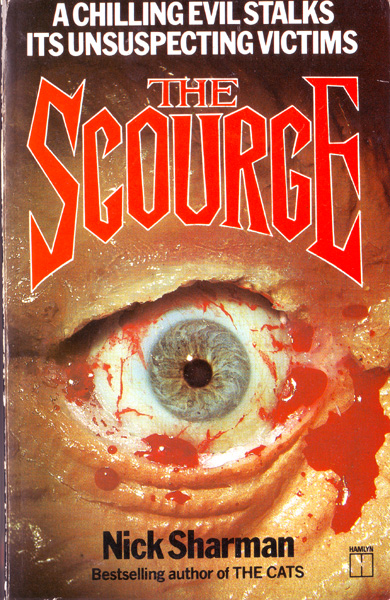
Nick Sharman’s The Scourge

The Scourge – Nick Sharman

Hamlyn -1980

I had no idea what this book was going to be about, but that cover is sick as hell.

A private detective almost dies in a mysterious car crash, and he soon finds himself investigating a bunch of people who have been hallucinating themselves to death. It turns out they did something to anger the owner of a pharmaceutical company. This wealthy chemist makes a drug that lets him control his victims’ minds telepathically.

Maybe it was all the Russ Martin novels I read last year, but I am pretty damn sick of novels about telepathic mind control. It’s lame. If I had any idea that that’s what this book was about, I wouldn’t have read it. This would have been a far better book if it had been about a bloody eyeball.

I had a few other books by Nick Sharman lined up, but I’m in no rush to get to them now. The Scourge wasn’t absolutely terrible, but if it weren’t for that cool cover, it would be absolutely forgetable. I really don’t want to waste any more of my time discussing it. Good night.

Fritz Leiber’s Conjure Wife

Conjure Wife – Fritz Leiber

Penguin – 1969 (Originally published 1949)

I really enjoyed Our Lady of Darkness (both times I read it), and I felt like it was time to revisit Fritz Leiber. Conjure Wife was first published in 1949. It’s the story of a college professor who discovers that his wife has been practicing witchcraft behind his back. He thinks this is a shameful load of nonsense, so he tells her to stop. Shortly after this, he realises that her magic has been protecting him from the spells of the other witches. It turns out that his wife isn’t the only witch on campus. Actually, most women are really witches.

Now, the title ‘witch’ don’t apply to all women,

but all women have a little witch in ’em

Fritz Leiber

It’s a pretty simple premise, but Leiber makes it work really well. The conflict is mainly psychological, occurring in the protagonist’s head. I read somebody comment that the novel’s description of women isn’t “generous”, but I don’t agree. The tension in the book, and there’s loads of it, is largely created by the unwillingness of the male protagonist to believe what is happening to him. He’s an idiot. The women are running the show here. This book is only demeaning to women if you think of witchcraft as a bad thing.

While some of the magic in here is rather fantastic, a lot of it is the kind of stuff that I don’t entirely disbelieve in. It seems to me that Leiber had a very clear understanding of the nature of magic.

Fritz Leiber was a cool guy. I read somebody describe him as the link between Lovecraft and Philip K. Dick, and apparently he corresponded with both. That itself is enough to impress me, but the books I’ve read by him are awesome too. I’ve heard that his short stories are some of his best work, so I’ll probably look at them next. I don’t know if there’s a specific collection that I should go for. Part of me wants to just read the horror ones, but I’m sure that’s dumb. Let me know if you have any recommendations.

Joyride – Stephen Crye

Joyride – Stephen Crye

Pinnacle – 1983

The fact that a book is hard to find is often enough to make me want to read it. This was the case with Joyride. I knew affordable copies are scarce, and I think I had even seen people mention it fondly. When I saw a copy the other day, I jumped at the chance to read it.

I didn’t like it.

A group of teenagers decide to party in a cemetery. Unbeknownst to them, the man who works at the graveyard is a hideously mutilated psychopath. As the teens start spreading out, he starts picking them off, dismembering one with a scythe, setting fire to another, and decapitating another with a chainsaw. Once the killing starts, there’s not many directions the story can go, and the rest of the book is rather underwhelming.

There’s a backstory given to the murderer, and while it explains his inability to regulate his saliva output, I felt like it passed over a few of the transitional stages between high-school loser and outright murderous ghoul.

This is a “slasher”, and although I hadn’t ever thought about it much before, Joyride convinced me that I don’t like slashers very much. It reminded me a little bit of David Robbin’s dreadful Hell- O-Ween. Joyride was a little bit better than that piece of shit, but the only real tension here comes from not knowing how the next teenager is going to be murdered. At least it’s short, and I was able to finish it in 2 sittings. If it had been any longer, I probably would have hated it.

Gila! – Les Simons

Gila! – Les Simons (Kathryn Ptacek)

Signet – 1981

To be honest, I chose to read this book because it’s only 166 pages long. It’s not good.

Some lizards on a nuclear testing site get big and start rampaging through New Mexico, eating everybody in their path. A reptile-expert from the local college is brought out to assess the situation. She falls in love with an ex-colleague, and they have a lot of sex. The lizards really go nuts at a fair, and the authorities’ first attempts to kill them fail. Eventually the scientist comes up with a way to kill them, and everything looks like it’s going to work out until the last page of the novel.

There are some gory scenes, but nothing memorable. Two of the characters are frequently banging eachother, but the reader is never invited to share the experience. One of the shaggers is a Native American, and although the inclusion of a mixed race couple might have seemed progressive in 1981, the interactions between this couple would not fly today. I think at one point the woman tells the man to go back to his wigwam.

This was one of the most predictable, unimaginative books I have ever read. It felt like reading a practice run for a novel, like it was written just so the author could get a feel for sticking 150+ pages of words together. This was Kathryn Ptacek’s first novel, so maybe her others are better. It’s not surprising she used a pseudonym for this one. The plot here is on autopilot, and the only surprising thing about this book is that it found a publisher. It really seems like anyone with enough time to type out a manuscript could have had a book published in the 80s

I’m not a huge fan of animal horror, and this book did nothing to change my opinion. It was pretty shit, but I didn’t absolutely hate it.

The Slime Beast – Guy N. Smith

Guy N. Smith – The Slime Beast

Harper Collins – 1989 (Originally published 1974)

I read The Festering, my first Guy N. Smith novel, a few weeks ago, and I greatly enjoyed it. I picked it because of its cover, and I decided that the next of Smith’s books I would read would be one of his more esteemed works. I chose The Slime Beast as I knew that the illustrious Centipede Press had reissued this one in a fine hardback edition.

A cranky professor takes his assistant and niece out to a muddy beach to look for treasure. During an excavation, they uncover a sleeping monster that smells so vile that they puke all over each other. Later that night, the monster comes alive and starts to kill people.

The plot doesn’t really make sense. The characters don’t act like people at all. They decide to sleep in an abandoned shack for several nights in a row when there is a bloodthirsty monster on the prowl. There’s reasons given for their behaviour, but none of them hold up. Mr. Smith clearly didn’t give much of a shit for plotting. He just wanted to get to the slimy bits. This was a relief to be honest.

This is not a good book, but I found it very entertaining. I liked the emphasis on the monster’s stink. Every time he shows up, his rotten stench makes people throw up. There’s not much else to say about this book. It’s 144 pages of pure garbage. It’s pretty great though. I wholeheartedly recommend that you find a copy and read it immediately.

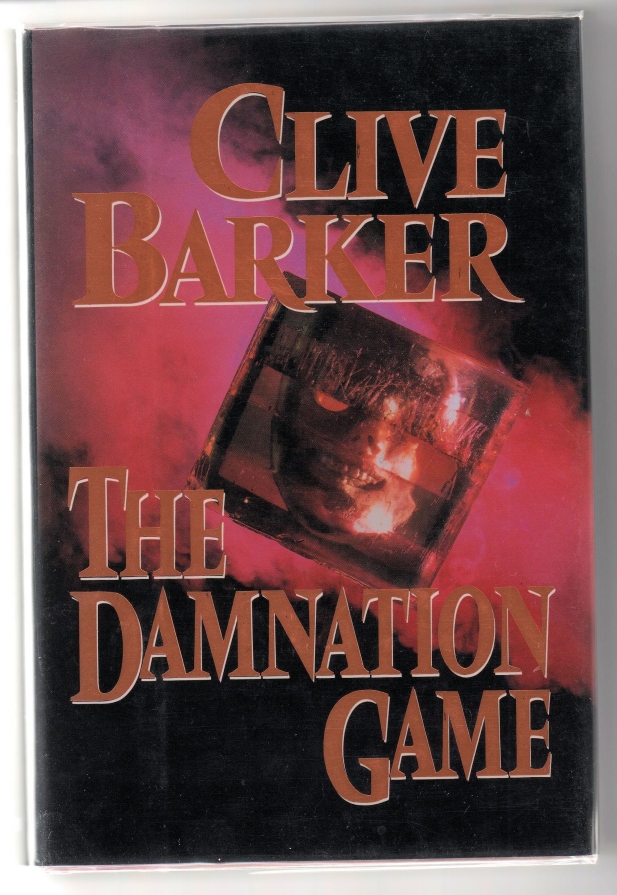
The Damnation Game – Clive Barker

The Damnation Game

Putnam – 1987 (Originally published 1985)
I had been meaning to read The Damnation Game for years, but I kept putting it off. While some of Clive Barker’s books are extremely long, the ones I had read were fairly unpleasant affairs (in the best way possible), and I didn’t feel ready for 370 pages of Barker’s nightmares.

While this novel is lengthy, it took me less than 4 days to finish. I couldn’t put the thing down. It was really, really good.

I’m not entirely convinced the plot made a whole lot of sense, but the writing and characters were so intriguing that it works as a novel. The basic premise is that Marty Strauss, a prisoner gets let out of jail early so he can work as a security guard for a reclusive millionaire. It seems too good to be true, but then Strauss finds out that the millionaire is being hunted by a lad who can resurrect the dead and bring peoples’ nightmares to life. I won’t give out any more plot details, but I will say that I don’t think the mysteries at work in the story are ever fully solved. Maybe they are and I’m too stupid to have figured them out.

The violence is as grisly as anything in The Books of Blood, and the tone of the book is pitch fucking black. You know that part in 1984 where O’Brien describes the vision of the future as a boot stomping on a human face forever? It’s surely one of the most profoundly bleak statements in all of literature. Well, at one point in The Damnation Game, Barker defines the “definitive human portrait” in a manner equally as bleak and slightly more disgusting. I was going to quote it here, but I think it’s better that you read the book for yourself.

I’ve been told that this is the only straight horror novel Barker has written. I don’t know if I’ll enjoy his later fantasy stuff as much, but I’ll probably give it a go. (I wasn’t super impressed with Cabal a few years ago.) I feel like this novel, The Books of Blood and The Hellbound Heart are all thematically and stylistically similar, but the formula and execution is so good that each one should be mandatory reading. Clive Barker is fucking cool.

The Dead of Night – The Ghost Stories of Oliver Onions

The Dead of Night: The Ghost Stories of Oliver Onions

Wordsworth – 2010

I originally planned to just read Widdershins, Oliver Onion’s most famous collection of ghost stories, but after finishing that collection (it’s available online), I decided to read the Wordsworth anthology of his collected ghost stories. This collection is almost 700 pages long, and it contains Widdershins (1911), Ghosts in Daylight (1924) and The Painted Face (1929), all three of the collections of ghost stories that Onions put out in his lifetime, along with a few other bits and pieces. I read Widdershins and wrote the following paragraphs almost a year ago, but I only read the remainder of Onion’s ghost stories over the last couple of months. I had mixed feelings.

I had seen collections of Oliver Onion’s ghost stories around for years, but it wasn’t until I came across his name being mentioned in T.E.D. Klein’s The Ceremonies that I decided to read him. I read Widdershins, probably his most famous collection of ghost stories first.

The first story in here, The Beckoning Fair One, seems to be Onion’s most famous work. It’s a story about a man who falls in love with a ghost and goes mad. It’s very good.

The other stories are all of a decent standard, but there was a couple that I felt like I had read before. There’s one where two guys visit a house and later find that that house has long been abandoned. I’m pretty sure Count Stenbock wrote one along the same lines. Also, there’s one where the protagonists find out that they themselves are the ghosts.

The writing here was surprisingly good. I had Onions pegged as a pulpy writer, but these are finely crafted stories that rely on terror and suspense rather than bumps in the night. I wasn’t sure if I was going to read any more of Onion’s stuff after this collection, but I think I’ll probably give the rest of his stuff a go in the future

The Painted Face collection (originally published in 1929) is made up of only 3 stories. The titular tale, a lengthy novella is pretty good, quite literary. I liked The Master of the House, a tale about a weird werewolf man. The other story in here, The Rosewood Door was pretty standard Onions. Overall, I liked these tales as much as anything in Widdershins, and unlike Widdershins, there are no duds here.

Ghosts in Daylight contains all of the stories I really disliked. I sometimes take notes into an excel spreadsheet when I am reading a short story collection, and I’ll share what I jotted down while reading the stories from this one:

Story Comments
The Woman in the Wayboring story about a priest who meets a boy who met a ghost of a woman who was engaged to his brother in a field.
The Ascending Dream3 men from different ages dream a dream that causes them to leave their sweethearts. BORING
The Honey in the Walla girl owns a big house but has no money. She fancies a guy, so she dresses up a ghost. Nobody cares.
Dear Dryadvery boring story about a tree that 3 generations of people do stuff in front of a tree.
The Real Peoplea “comic” story about an author whose characters come to life. BORING.

If you’ve ever watched that movie From Dusk till Dawn, you probably remember that scene in the strip club with Selma Hayek dancing with the snake. I love pretty much everything about that scene, including the music. The song playing is ‘After Dark’ by Tito and Tarantula, who actually appear as the band playing in the film. Tarantism, the album that song is from is great, but I haven’t listened to it for years. A few weeks ago, I was reading through this Oliver Onions collection, and I started reading a story called “The Smile of Karen”. It’s about a jealous husband who gets upset when he sees his wife smiling. As I was reading it, I remembered that there’s a song on Tarantism called ‘Smiling Karen‘. I went back and listened to it, and sure enough, it’s about a man who finds his wife has been cheating on him, so he kills her. I emailed Tito to see if this was just a coincidence, but he hasn’t responded yet. The story was good though, one of my faves.

The other stories in here are of varying quality. I quite liked The Rope in the Rafters, a story about a disfigured soldier visiting a haunted castle, and Resurrection in Bronze was an interesting look at creative mania, but the rest were fairly shit.

Oliver Onions wrote some excellent ghost stories. He wrote some fairly dull ones too. I do appreciate the comprehensive nature of this collection, but, in truth, a greatest hits anthology would be far more entertaining. I was going to read Onion’s novel, The Hand of Cornelius Voyt, but I probably won’t now.

Tom Piccirilli’s Horror Novels: A Choir of Ill Children, Hexes and The Night Class

I read a few of Tom Piccirilli’s noir novellas (The Nobody, All You Despise, You’d Better Watch Out and Loss) and I absolutely loved them. These dark, nasty books were superbly written. Unfortunately, Piccirilli died a few years ago, and maybe I’m wrong about this, but it almost seems like he’s being forgotten already. His books are not forgettable, but there’s not a huge amount of discussion of his work online. His personal website has been down for a few years now too. Maybe there’s a hidden Piccirilli cult somewhere, and I haven’t been looking in the right places, but my point here is that I think that Piccirilli’s writing should be better known than it is. I loved his crime fiction, so I thought that I had better check out some of his horror too. I read 3 novels for this post.

A Choir of Ill Children

Bantam Spectra – 2006 (Originally published 2003)
This was quite good. It’s about a psychic weirdo who lives in a mansion in a small town with his conjoined triplet brothers and their partner. There’s a bunch of witches and other freaks living in their town too. It was quite literate for a horror novel. There’s narrative shifts and symbolism and lots of that kind of thing. Piccirilli seems to have been a writer’s writer. The inside cover is absolutely full of quotes from other horror authors saying how great this book is. Even Thomas Ligotti sings its praise. I had a very bad cold when I read it though, and it was heavier than what I needed at the time.

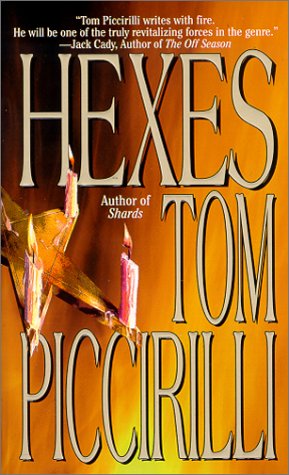
Hexes

Leisure Books – 1999
I like Piccirilli, and I sometimes enjoy occult horror, but this one didn’t really do it for me. A black magician returns to his hometown because his best friend has been locked up in a mental asylum for digging up a corpse and showing it to a kid. Lots of people are going missing, and everyone in town is scared. Demons show up, and things get worse and worse. It sounds like a good story, and parts of it were quite creepy, but it didn’t really work. Piccirilli doesn’t really go in for much exposition, and the reader is left with a lot to figure out for themselves. This is fine in a crime novel, but when goetia, telekinesis and a potentially unreliable narrator are involved, it gets quite confusing. Also, I felt a bit like some of the occultism parts were a bit gratuitous. There’s one scene in which the protagonist beats up the naked ghost of Aleister Crowley. I’m all for fiction about Aleister Crowley being abused, but aside from that ridiculous scene, this book is dark, slow-burning atmospheric horror. Again, this is clearly well written. Piccirilli is good at what he’s good at, but I felt that the plot here just didn’t come together as neatly as I had hoped.

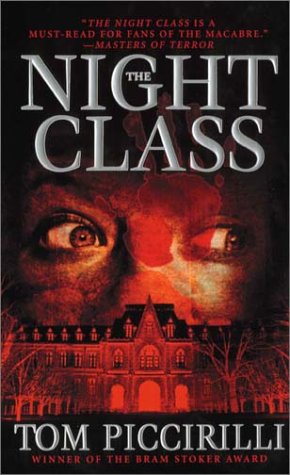
The Night Class

Leisure Books – 2002 (Originally published 2001)
I wasn’t super impressed by either of the above novels, but I wanted to give Piccirilli another go. I chose this book because it won a Bram Stoker award for Best Novel in 2002, so I assumed it would be pretty good.

It starts off with a college student sitting through an uncomfortable philosophy lecture. I spent 4 years sitting through philosophy lectures, so I was immediately able to empathise. This kid gets pissed off by his lecturer, so he goes home. When he gets there, he answers his ringing telephone to be greeted by silence. We then find out that a girl was brutally murdered in his bed while he was on Christmas vacation.

Ok, at this point, I was very much enjoying the book. We’re set up for a murder-mystery. Unfortunately, Piccirilli throws in the following elements, for no discernible reason, and things getting very confusing.

  • Caleb suffers from stigmata.
  • Caleb’s older sister killed herself and Caleb is haunted by her ghost.
  • Caleb’s girlfriend comes from an incest family, and her nephews and nieces are hydrocephalic.
  • There’s a mysterious love interest that goes nowhere and adds little to the story.
  • Nobody pays any attention to the bloodstains on Caleb’s bedroom wall.
  • Caleb’s friend Fruggy Fred is a hippy radio host who sleeps a lot. There are several brief allusions to this guy, but he never actually shows up, and Piccirilli doesn’t give the reader any reason to care about him. Unfortunately, he becomes an important character at the end.
  • The faculty of the unversity have sex with the students and kill them (and/or fail them) if they refuse. Are they demons or vampires or just jerks?

Honestly, I really wanted to like this one, but it was a mess. Maybe I’m really stupid and didn’t understand it.

Of the three novels I read, A Choir of Ill Children was the best. It was a good novel, but can’t honestly say I enjoyed it a whole bunch. I far prefer Piccirilli’s writing when it’s concrete and clear. I don’t need my horror to be tidy and entirely cohesive, but the tropes that he uses in these novels (inbred freaks, demons, stigmata…) don’t mix well with the literary, existential horror he’s pushing. These books were more confusing than scary. I’ll very likely read more Piccirilli in the future, but I might stick to his crime stuff for a while.

Some of Your Blood by Theodore Sturgeon

Some of Your Blood – Theodore Sturgeon

Ballantine – 1966 (Originally published 1961)

I can’t remember why I tracked down a copy of this book, but I did.

Some of Your Blood starts off with a soldier named George Smith being sent to a mental hospital for attacking one of his superiors who read his mail. It is not immediately clear what the letter said, but George’s background is recounted, and it’s hard not to feel bad for the guy. The rest of the book is about George’s doctors trying to decide what to do about him.

This is generally classified as a horror novel, but there are no supernatural elements to it. I was expecting somebody to get bitten by a Dracula for the first third of the book, but things didn’t seem to be heading that way. I would have gotten impatient if the story wasn’t set up the way it is. Sturgeon does a really good job of dropping just enough loose ends to keep things exciting. Also, I quite enjoyed the references to Psychopathia Sexualis.

I’m not going to be able to say much more about the story without giving away the (already kind of obvious) ending. I knew nothing about the book when I read it, and I reckon it will be more enjoyable for people in this situation. While this is not a supernatural horror novel, it is a dark, violent and probably disturbing book. It’s pretty short too. I liked it. Give it a go.