The Divine Rite of King

When I as a kid, my parents would sometimes take me to the videoshop after mass on a Sunday and we’d rent two cassettes: a cartoon for the kids and a movie for my parents. As I got a little older, I found myself drawn to the wall over by the sales counter. This was where the horror films were stacked. I distinctly remember being fascinated by the video boxes of Return of the Living Dead III, Ghoulies, and The Howling II. There was one similarity shared by several of the other boxes; it was a man’s name, Stephen King. I remember the mildly titillating feeling of dread that came from looking at the boxes of Children of the Corn, Tommyknockers, It and Graveyard Shift. The covers made these movies look horribly disturbing. I mean, these looked like the kind of films that were supposed to make you mentally sick if you watched them. But underneath my revulsion there was an intense curiosity. I wanted to see those films badly.

My parents had seen a few of the better movies that had been made from King’s work. I remembering pestering them for every plot detail of the Shining  and Misery.  It was probably soon after that that my mam allowed me to read The Moving Finger, a short story from Nightmares and Dreamscapes. It was a bit like the Goosebumps books that I absolutely adored at the time, but this was for grownups. I thought Stephen King was super cool.

I’m the eldest of my siblings, and my parents were a bit stricter with me than they were with my sisters. When one of my teachers told my parents that students should spend 3 hours studying every day, my mam took that to heart. I was never locked in  room or anything, but I was expected to spend several hours a day on my schoolwork. It wasn’t worth fighting over, so I just stayed in the front room of our house by myself, pretending to study for a few hours every day. I can’t remember/don’t want to admit how I spent all of those hours, but there was a bookshelf in that room, and sometimes reading novels seemed like a better idea than reading textbooks. There were only four books on that shelf that looked remotely appealing, and I got through all of them. ‘What books were they?’, I hear you say. They were Roddy Doyle’s excellent Barrytown Trilogy and Bag of Bones by Stephen King.

bagofbonesBag of Bones (1998)
I read this about 15 years ago and can’t remember much about it. I believe I enjoyed it at the time. Anything beat studying.

theshiningThe Shining (1977)
I read this one a little over 5 years ago, and I absolutely loved it. At one point, I actually had to put the book down to take a breather and calm myself (I believe it was right after Danny went into room 237). I had seen Kubrick’s film several times before reading the book, and I reckon it’s better to do the film/book combo in that order.

nightmaresanddreamscapesNightmares & Dreamscapes (1993)
While my first experience with this short story collection was probably 20 years ago, I only got around to reading it cover to cover in 2014. (Well, I’ve never technically read it cover to cover to be honest; I read it in my old office job from a pdf file saved in my google drive). Some stories were great. My favourites were Popsy, Crouch End (a pastiche of Lovecraft), and Night Flier, the movie version of which is laughably bad. Dedication is weird and gross but definitely worth a read. I enjoyed this book, but I don’t think it was quite as good as King’s earlier short story collections.

nightshiftNight Shift (1978)
In October, I took a seasonal job in a powder factory. The work required a lot of standing still, and I was allowed to do it with headphones in. I decided to download some audiobooks to get me through the long dusty days, but I was fairly disappointed in the selection offered by illegal fire-sharing sites. Also, choosing the right audiobook to listen to at work is tricky; the book needs to be interesting enough to keep your mind occupied, but it also has to be light enough that you don’t have to take notes to keep up with the plot. My problems were all solved when I found a big torrent of Stephen King’s audiobooks. His writing is very straightforward, and it takes barely any effort to soak it in. Also, his short stories are about vampires, aliens, mutant rats, and men that turn into slime. If that doesn’t sound enticing to you, get the fuck off my blog and go listen to your Coldplay cds, you stupid fucking barrel of shit.
This is the first collection of short fiction that King published, and some of the stories are  great. Children of the Corn is maybe my favourite. The written text is so much better than the utterly shit movie version that came out in 1984. Graveyard Shift and The Mangler were both great too, but I haven’t watched their movie adaptations. One for the road and Jerusalem’s Lot both expand on the material from Salem’s Lot (reviewed below), and Night Surf is a brief glance at the idea that would become The Stand (also reviewed below). Not everything in here is brilliant, but I really like the fact that King is willing to take any silly idea that comes into his head and turn it into a story. The man has a brilliant imagination.

skeletoncrewSkeleton Crew (1985)
I think I stole a copy of this book from my Granddad’s house when I was 21. I remember taking it to France with me and reading most of The Mist on a plane. Frank Darabont’s version of the Mist is one of my favourite movies and one of the few times that I think a film improved on the book. I read another few stories after that, but lost the book soon thereafter. I started going through the remaining tales as soon as I finished Night Shift last month, and this one picks up right where that one left off.
Survivor Type is fantastic. I laughed heartily as I listened to it. I guessed what was going to happen only a little bit into the story, but I didn’t think King would have the guts to write a story like that. I was wrong. Stephen King definitely has the guts to write a story like that. This collection was thoroughly enjoyable.

4pastFour Past Midnight (1990)
I had found that Stephen King’s fiction was the perfect way to pass the time in work, but I had run out of short story collections. I read that Four Past Midnight was a collection of novellas, but I had never actually seen a physical copy of the book before I started listening to it.  It turns out that some of these “novellas” are longer than some of King’s most celebrated novels. Why were they released in a collection rather than individually? I reckon it was something to do with the fact they’re not exactly his most brilliant work.

The Langoliers
This is a weird one. It’s about a plane that flies into another dimension. The audiobook version is narrated by Willem Dafoe, and I really enjoyed it, but in retrospect, it doesn’t make much sense at all.
Secret Window, Secret Garden
This, in my opinion, was the worst story in this collection. The twist ending is apparent from the very beginning.
The Library Policeman
This was my favourite. It’s weird as fuck.
“Come with me, Ssson. I’m the Library Polissse Man”
The Sun Dog
A boy’s camera offers a glimpse into another reality. It’s an interesting concept I guess, entertaining enough.

I enjoyed Four Past Midnight, but I really doubt anyone would ever have heard of it if it wasn’t written by Mr. King. It would not be a good starting point for anyone interested in sampling his works.

salemslotSalem’s Lot (1975)
About 8 years ago, I stayed up late two nights in a row to watch the 1979 movie version of Salem’s Lot. I was unimpressed. I decided to give the book a chance right after finishing Four Past Midnight. I’m really glad that I did; it’s a very entertaining vampire story set in modern America. I’d strongly recommend that you read it if you haven’t.

thestandThe Stand: Complete and Uncut (1990)
By the time I started on the Stand, I had read/listened to nothing other than Stephen King books for almost two months. I’ll be honest, that was probably a bad idea. At 1153 pages, the uncut version of the Stand is King’s longest book. I never got bored when I was reading it; it is very entertaining, but towards the end, I started to really look forward to reading other books.

King takes his time setting the story up, but it all winds down fairly quickly. There’s three books in the stand. The first ends the world with a super plague, the second details how the two factions of survivors organize themselves, and the final book describes the conflict (or lack thereof) between the two groups. The concept is cool, but the pacing is silly. Given the overall plot of the book, the section on the plague wiping out most of humanity is too long. For the first few hundred pages, the Stand is a fairly straightforward disaster novel that describes a calamity that is in no way unrealistic. Then, after 99.6% of human beings have been wiped out, we find out that the survivors have been left with mild telepathic abilities, and the book quickly turns into a religious parable about the forces of good and evil. It’s already already very, very long, but I felt a bit cheated when the conflict that the previous 1100 pages had been leading to was literally prevented by the hand of God. I mean, come on Stephen; you could have got another 5000+ pages if the two sides had actually gone to war! I wouldn’t be surprised if the Stand had originally been even more epic in its scope and that King only realized that he wouldn’t be able all fit everything into one book after he had already written 700 pages. He has acknowledged that The Lord of the Rings was an inspiration for this work, but King’s fellowship only sets out for their Mordor (Las Vegas) in the third book of the Stand. If he had really used Tolkien’s trilogy as a model, the Stand would probably have lasted 5000-6000 pages.

The religious undertones of the book also irked me a little. I thought Randall Flag was fucking cool, and I definitely would have joined his side. Also, while several of King’s works feature a “Magical Negro”, Mother Abigail serves as a particularly cringeworthy example of this trope. King is definitely not a racist, but some of his writing depicts a slightly dated worldview.

All that being said, the Stand is filled with cool characters and awesome scenes, and I enjoyed reading it. Stephen King has acknowledged that he considers his work to be trash (good trash specifically), and I, for one, am not above reading trash. I fucking love trash, and I loved Trash.

I’ve enjoyed every Stephen King book that I’ve read, but right now, I am looking forward to reading something else. I didn’t know if I was going to review his books on this blog when I started binging on him in October, but the more that I think about it, the more I think that he deserves to be here. If you like horror, you’ve already read this guy. His books are spooky, gross, and seriously entertaining. I’m going to give it a few months, but I’ll definitely be reading more Stephen King in the future. Aside from his fiction, he also seems like a cool guy; he hates Donald Trump and he’s into AC/DC.

kingStephen King, I salute you!

Gutted – Lytton’s The Haunted and the Haunters

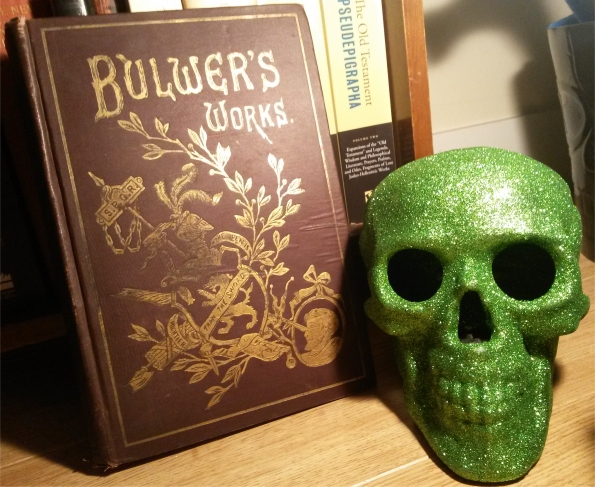
bulwer-green-skull
The Haunted and the Haunters; or, The House and the Brain – Lord Lytton 
Originally published – 1859

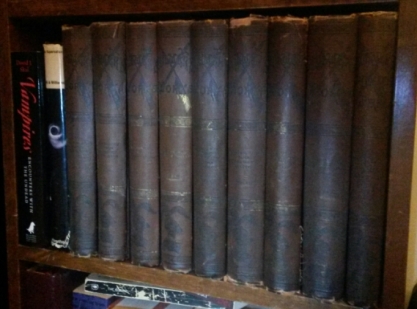
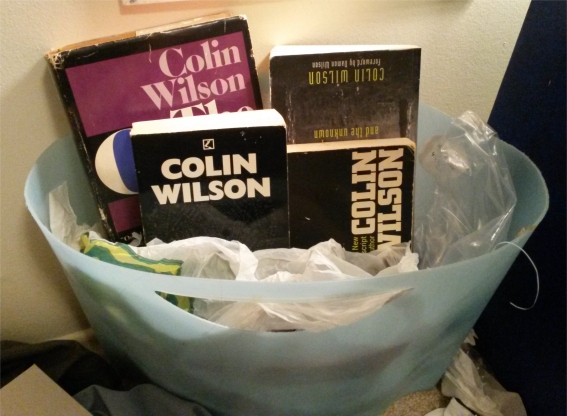
A few years ago, I read about the books of Edward Bulwer Lytton in Colin Wilson’s The Occult. Discovering that this Lytton lad was supposed to be friends with Eliphas Levi and that his books were about wizards, ghosts, and secret societies, I quickly put him on my to-read list. A few months after doing so, I saw his name in Nicholas Goodrick Clarke’s The Occult Roots of Nazism. Combining what I already knew about Lytton with the fact that one of his works had apparently inspired a bizarre conspiracy theory about subterranean, black magic Nazis, I knew that I had to make acquiring his books a priority.

2015-08-27 20.54.58

The four texts that Wilson specifically named were Zanoni,  A Strange Story, The Coming Race, and The Haunted and the Haunters. I found audiobook versions of the latter two on librivox, downloaded them and stuck them on my phone. The mp3 of The Haunted and The Haunters was only an hour and 10 minutes long, and I listened to it at work the other day.

It was a little disappointing to be honest. A lad hears about a haunted house and decides to spend the night there. He sees some ghosts, and a few days later he discovers a secret room containing a peculiar device that essentially functions as a ghost machine. He breaks the ghost machine, and then everyone lives happily ever after.

This is a ghost story, but it’s not remotely spooky. During the most climactic scenes, the narrator makes a point of telling the reader that he is not afraid, and it’s very hard to feel scared for a person who seems to understand the situation better than you. The chap comes across as a know-it-all wanker to be honest; I’d take a terrified Jamesian protagonist over this gobshite any day.

Lytton’s use of fiction to present his ideas about the supernatural may have been novel at the time this was published, but I found it rather trite. He goes over the old “nothing is really supernatural because supernatural means impossible and nothing is impossible” argument. Just because science can’t yet explain ghosts, ESP, clairvoyance and all that good stuff, there’s no reason to believe that it won’t some day be able to. This is a fair point to make, but it doesn’t have much bearing on whether or not these things actually exist.

The story comes to a very abrupt end. After enduring the night in the house, the lads find a chest of drawers in a secret room. In this chest is a portrait of another lad who the narrator seems to have seen before and a weird, home-made, magic compass that has been cursed. Once this strange device is destroyed, everything is grand. That’s it. End of story.

Fairly shit, all things considered.

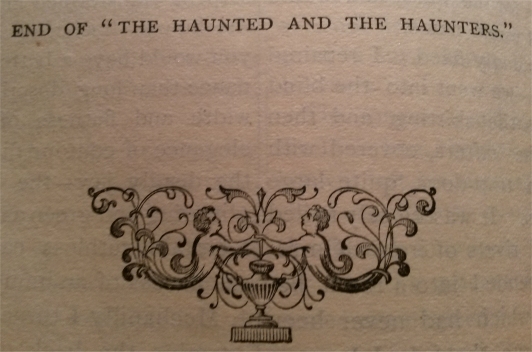
the-endIs that really the end though?

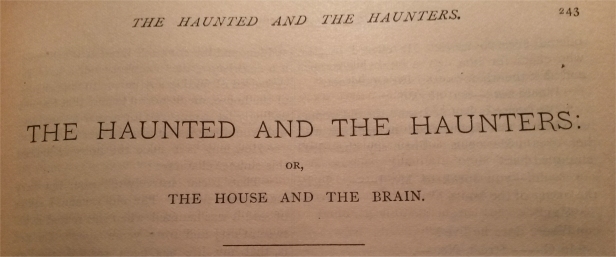
This story was originally published as “The Haunted and the Haunters; or, The House and the Brain” in the July-December 1859 edition of Blackwood’s Magazine. I find it quite strange that an original publication would feature two titles. Subsequent appearances of the tale have often been published under one title or the other.  I have read that the “House and Brain” title usually denotes an abridged version of the story, but I have read the exact same thing about the “Haunter and Haunted” title. Perhaps the different titles were once used to denote the different versions of the story, but at this stage, neither title can be trusted to signify the abridgment.

haunted-house-brainMy copy of the text has both titles, but it’s the abridged version.
If you have any sense and want to make sure that you’re reading the full version, the last paragraph of the original version of the story starts with the phrase;
“So ends this strange story, which I ask no one to believe.”

The first line of the final paragraph in the SHITTY-BUM abridged version reads;
We found no more. Mr. J—— burnt the tablet and its anathema.
If there is one thing that I simply can not abide, it’s an abridged book. If this is the ending of the tale you are reading, look elsewhere for satisfaction!

The abridgment absolutely guts the story. The haunting in the original features a creepier ghost, a slightly more gruesome description of the death of the narrator’s dog, several other minor edits, and most importantly: a tense confrontation between the narrator and the wizard responsible for bewitching the house. The complete version is by no means a brilliant piece of literature, but it is at least somewhat coherent, and it’s far more enjoyable than the shortened piece of drek. Imagine reading a version of the Shining in which all references to Jack Torrence’s family have been cut out and you’ll get a sense of the shitness of the abridged version of this tale.

Luckily, the unabridged version is widely available on the web (It’s on page 244 of the edition of Blackwood’s Magazine that I’ve already linked to.). An article from the July 1938 edition of the Theosophical Forum suggests that Bulwer cut parts out of this tale to use in his novel, A Strange Story.  That novel was published in 1862, three years after The Haunted and the Haunters. I haven’t read A Strange Story yet, and it may be a while before I get around to it, but I’ll read over Haunted/Haunters again when I do to see how the ideas were transferred between the two.

As I have already mentioned, I first heard about Lytton in Colin Wilson’s The Occult. I decided to read back over the relevant passages in that book to see if there was anything pertaining to this particular story. Wilson quotes the entire description of the curious portrait that is found near the cursed saucer to give an example of what he thinks a black magician should look like. He then says, “And when he later added a new ending to the story, Lytton extended this sketch into a full-length portrait of a man who seems to be a combination of the Wandering Jew and the Count de Saint-Germain.” Colin Wilson, author extraordinaire and expert on the occult, seems to have believed that the original version of this story was the short version. Wilson also lists Lytton’s first name as Henry in the index to the book when his name was actually Edward (His elder brother was named Henry.) Colin Wilson, it seems, was not very thorough in his research.

rubbishGood riddance to this pile of unlettered garbage.
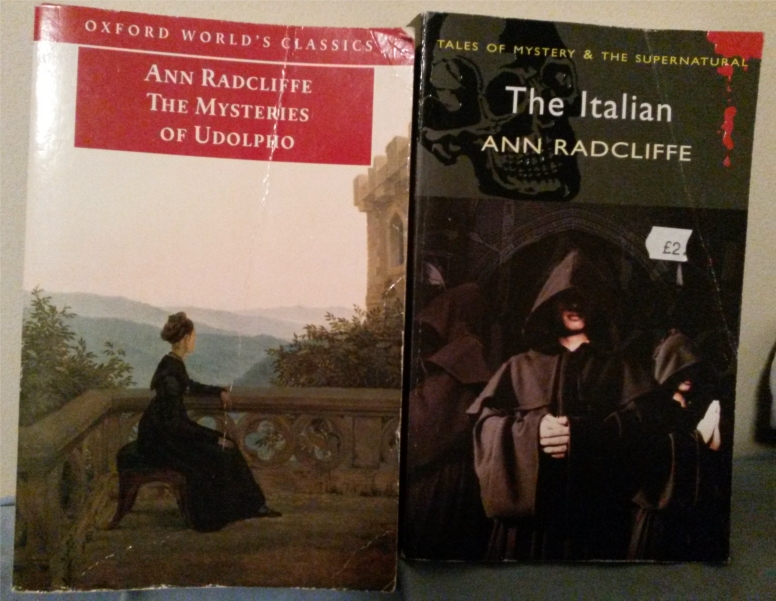


Mrs. Radcliffe’s Novels

ann-radcliffe-novels

I don’t have much to say on these books that hasn’t been said before. Ann Radcliffe didn’t invent the Gothic novel, but she drastically improved it. Books like Castle of Otranto and Vathek are fun, but they’re both quite silly. Radcliffe’s novels came a few decades later, and while they’re still fairly silly, they contain interesting characters and plausible stories.

Radcliffe is famous for making the literary distinction between terror and horror. Terror, according to Radcliffe, is the fear caused by uncertainty; it’s the not knowing what’s making the slithering noises in your bedroom wardrobe. Horror is the climactic reaction to actually seeing the warty green skin and blood soaked fangs of the monster as it lunges towards you. Radcliffe claimed that terror was a far more effective method of thrilling an audience, and she masterfully weaves her tales so that they keep both her readers and characters guessing until the very end.

Her books contain all the secret passages, mysterious chambers, fiendish villains and innocent virgins that you’d expect, but unlike their Gothic predecessors, the plots of her books are not driven by supernatural forces. The strange muffled noises and shadows darting hither and thither are all eventually explained as the stories unfold. The threat of horror is never realized, but it is this very threat that creates the sense of terror that runs through these books. Radcliffe does suspense exceedingly well.

The Italian – Ann Radcliffe
Wordsworth – 2011 (Originally published 1797)
I read The Italian two weeks ago. It came out just a year after Lewis’s The Monk, and one could draw comparisons to the relationship between these two books and the relationship between The Castle of Otranto and The Old English Baron. While both books contain evil monks and the Inquistion, The Italian is more a response to The Monk than a rewrite, and it is definitely better book than the Old English Baron.

My copy is another Wordsworth Tales of Mystery and the Supernatural edition (I fucking love these books!), but I took most of this one in from the librivox audio version. The Librivox version is based on the first edition of the book (containing 33 chapters), but the Wordsworth version is the second edition (34 chapters). For the second edition, Radcliffe rewrote parts to make it seem that Ellena’s sweet singing voice was more attractive to Vivaldi than her body. The 5th chapter of second edition, in which Vivaldi visits Bianchi’s corpse, is also a new addition. If you only own the first edition and want to read this 3 page addition, you can do so here. There may be other very minor differences, but I got through the book going back and forth between the two editions, and it didn’t cause any confusion.

While I agree that terror can be far more effective than horror, I don’t think that horror needs to be abandoned completely. I certainly enjoyed this book, but I preferred the Monk. Radcliffe’s book doesn’t need the supernatural to make it work, but it does need the introduction of a new character at a very late stage in the plot, definitely a bit of a Deus Ex Machina. It is definitely worth a read though. Schedoni is a real cool guy.

The Mysteries of Udolpho – Ann Radcliffe
Oxford – 1998 (Originally published 1794)
The Mysteries of Udolpho is Radcliffe’s most famous book. I read it 3 years ago, but I remember really enjoying it. I had started a new job a few months previous, and I was starting to realize that I could get away with spending most of the day reading online. The night before, I would email myself a pdf file of the book I wanted to read, renaming it to something like “contract-agreement.pdf” so that the boss wouldn’t be able to give me any grief if he checked my browsing history. I had begun with a few short stories, and I only started on this one to see if I could get away with it. It’s more than 600 pages, and I finished it in a week. (I worked in that office for another year, and I managed to read a further 66 books at work in that time.) Reading Udolpho, you can see where writers like Lewis, De Sade and Le Fanu (especially in Uncle Silas) got many of their ideas. I really liked this book.

Apparently Jane Austen did too. Her novel Northanger Abbey is referred to as a parody of Radcliffe’s works. It’s the tale of 17 year old Catherine, an avid Radcliffe fan. Catherine goes through life imagining herself the heroine of one of Radcliffe’s novels. I waited until after I had read The Italian to read this one, but it really only makes direct reference to Udolpho.

norrthanger-abbey
Northanger Abbey – Jane Austen
Penguin – 1994 (First published 1817)
I wasn’t expecting much from this, and to tell the truth, I didn’t get much either. It’s a cute little romance that has stuff to say on femininity and feminism, but I’ll let you look elsewhere for that. My favourite parts were undoubtedly the sections where the protagonist is imagining that she’s the character in one of the books she has been reading. I also listened to two audiobook collections of Stephen King’s short stories last week, and I found that I was becoming suspicious of nearly everything around me. I therefore found Catherine’s plight very relatable.

The real reason I wanted to read this book was its connection to Montague Summers. At an early stage in the novel, Catherine’s friend promises that she will give her a small collection of books. Those books are:

Castle of Wolfenbach,
Clermont,
Mysterious Warnings,
Necromancer of the Black Forest,
Midnight Bell,
Orphan of the Rhine,
Horrid Mysteries

For years it was presumed that Austen had made these titles up herself, but Montague Summers, the absolute legend, actually rummaged through libraries until he found copies of each text. They have all been republished, and I intend to buy, read and review copies as soon as I am a wealthy man.

To conclude, Ann Radcliffe was very cool. Her books, though imperfect, were hugely influential and remain thoroughly enjoyable. They’d be perfect for taking on a lazy holiday, and I’ll definitely be keeping an eye out for her other novels. Jane Austen, on the other hand, was fairly boring, and I probably won’t be reading any of her other novels in the foreseeable future.

A Feast of Blood – Varney the Vampyre

coverVarney the Vampyre – James Malcolm Rymer (or maybe Thomas Preskett Prest)
Wordsworth Books – 2010 (Originally serialized from 1845-1847)

I haven’t posted much in the last month because I have been spending my time slogging through this immensely long book. At 1166 pages of very small print, this is undoubtedly the longest novel I have ever read. ‘Novel’ however, maybe isn’t quite the right word to describe this tome; it’s a series of different stories about the eponymous hero that were originally serialised in pamphlet form over the course of several years. Think of it like this: if Stoker’s Dracula can be turned into 2 hour movie, Varney would take a 5 season TV show to do it justice. Just as the book is long, this review is fairly hefty too, so pour yourself a cup of blood before you sit down to read it. If you haven’t read the book, you might want to skip over the sections in red. I say this not because those sections contain devastating spoilers (they don’t), but because they deal with issues that are so perplexing that they may scare you away from ever reading the book.
battyLook at the girth of this thing! It may be thicker than 4 of the other books in this series put together, but it was no more expensive. (Note: Varney is actually not the kind of vampire that can turn into a bat)

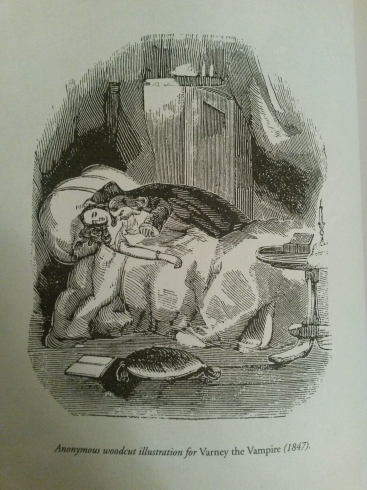
The writing is of a pretty decent standard, although there is quite a lot of recapitulation. This may have been included to keep readers up to date with the story if they had missed the last edition (kinda like the Victorian version of “Previously on the X-Files…), but I have read elsewhere that the author was paid by the word, so maybe it was just to take up space. Either way, coherence doesn’t seem to have been a priority, and throughout the tale there are characters that appear without reason and disappear without a trace. Varney himself has several suggested back stories that conflict with the account of his life that he gives at the end of the book, but more on that later. Also, with the exception of Varney himself, nearly all of the dramatis personae are interchangeable stock characters. I lost track of how many pleasant young men named Charles appear throughout the story.


The cover of the Wordsworth edition really blows in comparison to the original.

If you check out the librivox audiobook version (I would recommend that you alternate between a hard copy and these mp3s. Doing so allowed me to get through a few chapters every time I had to cook, tidy up or walk anywhere recently.), you’ll notice that Librivox credits Thomas Preskett Prest as the author instead of James Malcolm Rymer. It seems that nobody really knows who wrote the book. Prest took the credit for more than 100 years, but research that I have read ABOUT suggests that the writing style is actually closer to Rymer’s other writings than Prest’s. Also, minor publishing discrepancies in the text correspond to  Rymer’s bankruptcy, suggesting that he was in fact the author. That being said, Rymer and Prest are known to have worked for the same publisher and are believed to have collaborated on other works, so it’s not unlikely that they both contributed to this one. (Apparently Rymer was less than 4 foot tall.)

varneysucksDrinking her blood, straight from the tit.

The book is split into 3 volumes of roughly 400 pages each. (This division seems to have been based on the length of the book rather than by the contents of the volumes.) This edition ends with Chapter 220, but if you were to count the amount of chapters that the book contains, you would notice that there are actually 237. How could this be? Well, Chapters 41-43 don’t exist, Chapter 171 is followed by Chapter 162, and Chapters 195, 210, 197, 118, and 199 appear in that order. These mistakes have been faithfully carried over from the original pamphlets. (The chapter numbering in the audiobook version has been corrected. This was a little frustrating as I went back and forth between that and the text, although if it had retained the original numbers, the playlist of mp3 files would have been completely shagged.) Also, each chapter has a short title, but the titles rarely refer to anything that actually happens within that chapter. The chapter might be titled; “The events in the Parson’s office”, and it would be about a pair of young lovers having a picnic by the seaside. Arbitrary volume and chapter numbers aside, the book can be divided into 11 distinct stories. The first of which takes up the entire first half of the book while the 4th is less than 20 pages. 

hammeredThis poor chap was mistaken for a vampyre. He’s fucked now.
The first section, the events at Bannerworth Hall, is by far the longest and most enjoyable part of the book. The characters here, although they could be lifted directly out of 100 other Victorian novels, at least get to be part of the story for long enough that the reader remembers them. These characters play a smaller role in the second section of the book, and they are only mentioned 2-3 times in the final 400 pages. Their story is never satisfactorily cleared up, and I kept hoping that they would pop up or that the events that were occurring would somehow end up explaining what had happened to them. It seems that the initial followers of the story may have felt the same way;  in one of the final episodes, the author takes pains to clarify that the Bannerworths have all died. I wouldn’t be surprised if this brief allusion served as a response to those readers who had inquired if the Bannerworths were ever going to make a comeback. These loveable characters, we are pleased to find out, have not met with an unsavory end though; it’s just that the events towards the end of the book take place at a much later period of time. As we are soon to see, this epic tale takes place over the course of several centuries.

Here’s a few questions I have regarding the trials and tribulations of the Bannerworth family.

Is Varney the man in the portrait?
There is a portrait in Flora’s bedroom of Runnagate Bannerworth, an ancestor of the family. When the family realises that the vampyre looks exactly like the man in the portrait, they go to exhume Runnagate’s corpse from their family tomb. By the time they get to the tomb,  not only has Runnagate’s name has mysteriously changed to Marmaduke, but his corpse has also disappeared. This is particularly confusing because Marmaduke Bannerworth is also the name of Flora’s father, a confirmed associate of Varney’s. (Plus, one of the initial explanations of Varney’s vampyrism is that he was a suicide victim. Flora’s father also committed suicide. Could Varney be her father? Probably not, but why the similarities?)

Runnagate is said to be 90 years dead, and Marmaduke’s coffin reveals that he was buried in 1640, thereby dating the events at Bannerworth Hall to 1730. Varney is a vampyre though, so these dates don’t really exclude the possibility that he is the man in the portrait. Indeed the fact that Runnagate/Marmaduke’s corpse is not in the coffin suggest very strongly that Varney is their ancestor.

Varney later admits that he is a distant relation of the Bannerworths and that he was also a friend of their father. He claims that he had seen the portrait when he was friends with their father and deliberately tried to look like it in order to scare the family. This explanation however, does not account for the missing corpse from the tomb.

Much later on, in a different episode, Varney explains that he became a vampyre after crossing Oliver Cromwell after the death of Charles 1st. (This means that he didn’t become a vampyre until at least 1649, almost a decade after the death of Runnagate/Marmaduke Bannerworth.) He also explains that at this time he was living in London and known as Mortimer. (This is also bizarre as Varney is later to be hung by a different nasty man named Mortimer.)

In the 225th chapter (Chapter 208 in the book) Varney claims that he remembers “being hunted through the streets of London in the reign of Henry the Fourth.” Henry the 4th died of leprosy in 1413, meaning that if Varney is telling the truth, he was at least 235 years old when he became a vampyre. There is a gap of 1000 pages between the accounts of Runnagate’s portait and Mortimer’s contretemps with Cromwell, so we can forgive the author for a discrepancy of 9 years, but Varney’s account of being chased during the 1400s is placed only 12 pages apart from his encounter with Cromwell.

By his own account, Varney is not the man in the portait in Flora’s bedroom, but do we really believe him? All of his origin stories can’t be true, and he’s never exactly made out to be a particularly honest individual. While he explained that he had deliberately tried to make himself look like Runnagate/Marmaduke Bannerworth, he never explained where the body of said individual was or how it escaped from its coffin. Also, it should be remembered that Runnagate/Marmaduke’s coffin not only contained no corpse, but neither did it contain any signs of ever containing a decomposing body. If Varney is not Runnagate/Marmaduke, Runnagate/Marmaduke is still likely to be a vampyre.

varney-red
What happens to George Bannerworth?
He appears as the weakling younger brother in the first few chapters of the book, but soon disappears, never to be mentioned again. We are given enough information about his timidity to presume that this will be an issue for him at some stage, but he never gets a chance to shine. Lil bitch.

What happens to Dr. Chillingsworth?
The last we hear from him, he goes to London in search of Varney. We know that something happens to him afterwards that convinces him of the existence of vampyres. A note written by him appears in one of the final chapters of the book explaining so, the appearance of which left me with a genuine feeling of excitement. Varney does end up in London for a while in one of the later episodes; did they meet there? I had a theory that Chillingsworth was the mysterious stranger who follows Varney to Anderbury and gets murdered in the ice-pit, but he actually appears elsewhere afterwards, so it can’t have been him.

Who the fuck was the Hungarian Nobleman and what did he want?
Just as Varney starts to warm to the Bannerworths, a strange Hungarian nobleman shows up in the village in search of him. We find out that he is willing to pay a high price to find Varney, but he himself becomes suspected of being a vampyre and gets run out of town before Varney is found. There is no explanation given as to why he is looking for Varney, and no more is said about him after he is chased from the town. In one of the final episodes, Varney attends a vampyre initiation ceremony with several of his kin. One asks if he knew the Bannerworths, and he responds; “I did. You came to see me, I think, at an inn.” That is the extent of the conversation that appears 475 pages after the last mention of this character. Ahhh, sweet closure at last!

Who the shitting fuck was murdered in the ice-pit?
Towards the end of the first episode, Varney disappears. (The transition between the first and second episode is the only transition between episodes that carries over characters.) Soon thereafter, two strangers show up in a town a few miles distant from Bannerworth Hall. One of them, we know, has to be Varney, but the identity of the other is never made clear.

I think it was the Hungarian Nobleman. He’s the only character from the first section that’s unaccounted for. He had been confirmed as a vampyre and fled for safety without having achieved his goal of speaking to Varney. We know that he had been looking for Varney, but we were not sure of his motives. When Dr. Chillingsworth is mugged, we are inclined to give Varney the benefit of the doubt as he has seemingly made his peace with the Bannerworths, but if it wasn’t Varney, it has to have been the Hungarian Nobleman; he’s the only other bad guy alive at this stage! When it turns out that both of the mysterious strangers are vampyres, it only makes sense that one of them is the Hungarian.

However, when these two vamps meet near the end of the book, not a word is said about the fact that one of them has stabbed the other in the throat and thrown his corpse into an ice-pit. In fairness though, after the victim of this crime was revived by the moon, he snuck into the murderer’s bedroom and stole his jewels. Maybe they just decided to let bygones be bygones… Who knows? 

What happened to the Quaker whom Admiral Bell kicked up the hole?
Perhaps the greatest mystery of all. This storyline gets a considerable build up, but it’s never resolved.

booBleh!

There are, of course, plenty of other plot holes in the remainder of the book, but the cast of characters and plotlines in the later episodes are not nearly as memorable or complicated. Most of the episodes follow the formula of Varney trying to marry a beautiful young woman only to be foiled right before the marriage ceremony. (There are at least 4 chapter titles that include the phrase ‘the wedding morning’.) The middle episodes start to feel cartoonish in their repetitiveness, but the final two episodes end the book on a slightly more existential note. The penultimate episode has Varney playing the role of a hero rather than a villain, but the lack of satisfaction he receives from acting so convinces him to kill himself. His suicide attempt is thwarted by a pair of altruistic brothers, and when he is brought back to life, he gets super pissed off. He decides that if he can’t feel happiness that he will make sure that those around him don’t feel it either, and he gives what is perhaps the finest villainous speech that I have ever read. I’m going to include it here in its entirety, because unfortunately, I doubt that many people will actually make it far enough into the book to get to enjoy this exquisite piece of misanthropic bile:

“Since death is denied to me, I will henceforward shake off all human sympathies. Since I am compelled to be that which I am, I will not be that and likewise suffer all the pangs of doing deeds at which a better nature that was within me revolted. No, I will from this time be the bane of all that is good and great and beautiful. If I am forced to wander upon the earth, a thing to be abhorred and accursed among men, I will perform my mission to the very letter as well as the spirit, and henceforth adieu all regrets, adieu all feeling — all memory of goodness — of charity to human nature, for I will be a dread and a desolation! Since blood is to be my only sustenance, and since death is denied to me, I will have abundance of it — I will revel in it, and no spark of human pity shall find a home in this once racked and tortured bosom. Fate, I thee defy!”

Holy fuck, that is pure heavy metal.

varney-wakesVarney arises!

Whether or not Varney is actually a vampyre isn’t determined until you’re well into the story, and the first 750 pages of the book contain only 2 short instances of vampyric activity. Things get bloodier in the second half as the stories come to focus on Varney and his exploits. He oscillates between being a decent lad and a murderous villain, so much so that I was genuinely surprised at the violent acts he would sometimes suddenly commit. Although the latter episodes are definitely more gory, far more people are stabbed or shot than are drained of their blood; this is more of an adventure novel than a horror story. That being said, there are a few chapters set in moonlit churchyards and charnel houses to which you can stroke your Gothic boner. So much of what we have come to expect from a vampyre story comes directly from this book, and you’ll find a million other reviews discussing how it’s the source of many of our modern ‘Vampire tropes’. Why then, does everyone give that credit to Dracula? Well, Dracula is much scarier, Bram Stoker took all of the best bits from Varney, twisted them around a bit, and shaped them into a far superior book.

diebitchAnd fucking stay dead!

Montague Summers described Varney the Vampyre as being “far ghostlier than” and “a very serious rival to” Dracula. The book was out of print when he wrote that though, so that might have just been him trying to be the cool guy who liked the less popular work. I definitely wouldn’t go as far as Monty in this case, but I did really enjoy this book. I mean, it’s deeply flawed, but if you take it for what it is, i.e., complete trash, it’s d_____d enjoyable. It’s exceedingly obvious that the author/authors were making it up as they went along, and a lot of it doesn’t stand up to scrutinous examination, but if you like stories about graveyards, ghouls, chivalrous gentlemen, foul mouthed sailors, bloody murders,  and heaving bosoms, this will entertain you greatly. I fucking loved it, and it has me looking forward to reading more of the Penny Dreadfuls that have come out in the Wordsworth Tales of Mystery and the Supernatural series. I have Wagner the Werewolf by Reynolds on my shelf, and I know they have also put out The String of Pearls, the other work by Rymer and Prest.


The King in Yellow – Robert W. Chambers

2016-07-30 17.39.14.jpg
Wordsworth Editions – 2010 (Originally published in 1895)

This is the first time that I’ve reviewed a single book of short stories. Usually I wait until I’ve read everything (or at least all of the good stuff) by an author of short fiction, but this is a little different. (I do own a copy of the Complete Weird Tales of Chambers, but I haven’t got around to it yet.) The King in Yellow was one of Chamber’s earliest works, and it remains his best known; he spent most of the rest of his career writing popular romance novels, but nobody remembers them. Some of the tales in this book managed to induce a lingering discomfort (I read most of them just before going to bed and afterwards lay awake, thinking of the sinister King, sitting on his throne in his tattered yellow rags.), and overall, this book is pretty neat. If you haven’t read it and you’re wondering why it sounds familiar, it might be because elements of it were borrowed for the first season of True Detective.

So this is a collection of 10 short stories, only the first 4 of which really refer to the Yellow King. I’ll get to that later though, for now I’ll just explain the  others:

5. The Demoiselle d’Ys is a ghost story. It’s not scary, but it’s enjoyable (and not dissimilar to the stories of M.R. James).
6. The Prophet’s Paradise is really just a short series of of prose-poems. It was a bit arty for my liking.
7. The Street of the Four Winds doesn’t deal with the supernatural, but it is quite creepy.

After the above, all elements of the horrific, weird or creepy completely disappear.

8. The Street of the First Shell is confusing, dull, and not worth the effort that it requires.
9. The Street of Our Lady of the Fields is the romantic tale of an innocent young man who moves from one continent to another and falls madly in love with a rambunctious young woman. Needless to say, I was almost in tears by the end. This was beautiful.
10. Rue Barrée is a less interesting and ultimately less satisfying version of the previous tale.

Ok, let’s rewind to the best bit. The first 4 tales all revolve around an obscure book of horror and despair. (You might already see why I enjoyed this.) The King in Yellow is a two act play that drives its readers insane. Unfortunately for everyone concerned, it’s a very difficult book to avoid, and if you do start reading it, it seems impossible to put down. (It’s a bit like those modern horror movies where the people who watch the video get killed.) Just to clarify here; it’s the characters in Chambers’ stories that get to read the play, not his readers. He never gives an outline of the plot of the play, but each story begins with a short quote from it. The lack of details make it all the more intriguing, and although I am aware that it does not actually exist, I have spent a more than reasonable amount of time in the last week trying to figure out ways to get my hands on a copy. How fucking cool is the idea of a book that either possesses you or drives you mad? 10/10, would read. The snippets that Chambers does include drive me wild too. Check out the poem that introduces the first story:

Along the shore the cloud waves break,
The twin suns sink beneath the lake,
The shadows lengthen
In Carcosa.

Strange is the night where black stars rise,
And strange moons circle through the skies
But stranger still is
Lost Carcosa.

Songs that the Hyades shall sing,
Where flap the tatters of the King,
Must die unheard in
Dim Carcosa.

Song of my soul, my voice is dead;
Die thou, unsung, as tears unshed
Shall dry and die in
Lost Carcosa.

Absolutely deadly. Does Carcosa sound familiar? That might have something to do with the fact that it was first mentioned in An Inhabitant of Carcosa by Ambrose Bierce. Chambers borrowed other elements Bierce’s fiction, and elements of his own fiction were in turn borrowed by Lovecraft.

I really liked 7 out of the 10 stories in here, but it would really make more sense if the book was called ‘The King in Yellow and some other stuff”. The stories at the beginning are totally different to the ones near the end, and if you like weird tales exclusively, you won’t be missing out if you don’t bother with the last few. I would advise anyone who is going to read this to save the best for last; read the last 3 stories first, then move on to the 5th, 6th and 7th, and finish with the first 4.

As a final suggestion:
If you have read this book and haven’t seen the first season of True Detective, watch it now. If you’ve seen True Detective but haven’t read this, read it now.  If you haven’t read this nor seen True Detective, get your act together.

(Most of) The Short Stories of Ambrose Bierce

bierce
The Collected Writings of Ambrose Bierce
Citadel Press – 1994 (Originally Published in 1946)

I bought this book for 2-3 stories in 2012, and only got around to reading it cover to cover within the last 6 months. This ‘collected works’ is not a ‘complete works’ as I had hoped for when I bought it. (There was a 12 volume edition of his works printed about 100 years ago, but I don’t know how complete that is either.) I found the first collection of short stories in here to be the least enjoyable by far. I spent more time getting through that first 100 pages than all of the rest put together. I found that all of the short story collections, aside from Negligible Tales, are available on Librivox as audiobooks, and so I loaded these onto my phone and listened to them whilst cooking dinner every day.

Bierce was a rather interesting man. I first heard of him in the third From Dusk Till Dawn movie. (The third film was way better than the second one, but nowhere near as good as the first. I haven’t watched the TV series.) I’ve also had to teach his short stories to high-school students on a few different occasions. There’s an essay in the introduction to this book that makes him out as a very cranky man, but I didn’t really get that impression from his stories. He definitely had a dark sense of humour, and he could be very, very funny. His wife and children all died before him, and at age 72 he moved to Mexico by himself and disappeared. In one of his last letters to his family, he wrote “Goodbye — if you hear of my being stood up against a Mexican stone wall and shot to rags please know that I think that a pretty good way to depart this life. It beats old age, disease, or falling down the cellar stairs. To be a Gringo in Mexico — ah, that is euthanasia!”
Ambrose Bierce was fucking cool.

I looked online for a comprehensive list of his short stories, but every list that I found omitted a bunch or contained the names of poems, essay and fables. In this post I have listed all of the stories in the editions of the texts that I read. (I will also list all of other known independent stories/collections at the bottom.)

Ambrose_Bierce

In the Midst of Life (Tales of Soldiers and Civilians)
(“A Horseman in the Sky”, “An Occurrence at Owl Creek Bridge”, “Chickamauga”, “A Son of the Gods”, “One of the Missing”, “Killed at Resaca”, “The Affair at Coulter’s Notch”, “The Coup de Grâce”, “Parker Adderson, Philosopher”, “An Affair of Outposts”, “The Story of A Conscience”, “One Kind of Officer”, “One Officer, One Man”, “George Thurston”, “The Mocking-Bird”, “The Man Out of the Nose”, “An Adventure at Brownville”, “The Famous Gilson Bequest”, “The Applicant”, “A Watcher by the Dead”, “The Man and the Snake”, “A Holy Terror”, “The Suitable Surroundings”, “The Boarded Window”, “A Lady from Redhorse”, “The Eyes of the Panther”)

This collection is split into two sections. The first is Tales of Soldiers. Although this contains some of Bierce’s more popular stories (An Occurrence at Owl Creek Ridge, Chickamauga…), it’s by far the hardest section to get through. Some of these stories are really dull, and almost every one of them features a twist ending. That said, this collection contains George Thurston, one of my all time favourite stories. (Imagine Hemingway crossed with Monty Python.)

The second section, Tales of Civilians, is where things get more interesting. I think it’s appropriate to refer to Bierce’s work as ‘weird fiction’, but it’s not quite weird in the same way that Lovecraft is weird. His stories often deal with the supernatural, but they’re rarely scary.

Different editions of this collection contain different stories.

Can Such Things Be?
(“The death of Halpin Frayser”, “The secret of Macarger’s Gulch”, “One summer night”, “The moonlit road”, “A diagnosis of death”, “Moxon’s master”, “A tough tussle”, “One of twins”, “The haunted valley”, “A jug of sirup”, “Staley Fleming’s hallucination”, “A resumed identity”, “A baby tramp”, “The night-doings at “Deadman’s””, “Beyond the wall”, “A psychological shipwreck”, “The middle toe of the right foot”, “John Mortonson’s funeral”, “The realm of the unreal”, “John Bartine’s watch”, “The damned thing”, “Haïta the shepherd”, “An inhabitant of Carcosa”, “The Stranger”)

These are best of Bierce’s darker, spookier tales. Again, none of these stories are terribly scary. It feels like they were written to make you think rather than to make you scream. I liked this collection though. This is the one you want if you’re a fan of Robert W. Chambers or the first season of True Detective. (See Haïta the Shepherd and An Inhabitant of Carcosa)

Different editions of this collection contain different stories.

Negligible Tales
(“A Bottomless Grave”, “Jupiter Doke, Brigadier-General”, “The Widower Turmore”, “The City of the Gone Away”, “The Major’s Tale”, “Curried Cow”, “, “A Revolt of the Gods”, “The Baptism of Dobsho”, “The Race at Left Bower”, “The Failure of Hope & Wandel”, “Perry Chumly’s Eclipse”, “A Providential Intimation”, “Mr. Swiddler’s Flip-Flap”, “The Little Story”)

Fairly negligible alright. There’s a few funny ones, a few very weird ones, and one (Jupiter Doke) that I don’t get at all. City of the Gone Away is definitely worth a read.


The Parenticide Club
(“My Favourite Murder”, “Oil of Dog”, “An Imperfect Conflagration”, “The Hypnotist”)

Without doubt, my favourite section/collection. These four tales are narrated by individuals who have killed their parents (and others). There’s a thoroughly enjoyable nastiness to these characters. The third story, An Imperfect Conflagration, contains what may be the single greatest opening line in the canon of English literature. Here is a text version, and here is an audiobook version. These stories are not scary in the least, but they are truly vile. Do yourself a favour and read them. Honestly. This is the good stuff.


The Monk and the Hangman’s Daughter
This is a novella. Apparently it’s Bierce’s retelling of a German Gothic novel. I didn’t know that when I read it back in early 2012. To tell the truth, it wasn’t shit or good enough to remember.


The following collections were not included in the book pictured above.

Present at a Hanging
(“Present at a Hanging”, “A Cold Greeting”, “A Wireless Message”, “An Arrest”, “A Man with Two Lives”, “Three and One are One”, “A Baffled Ambuscade”, “Two Military Executions”, “The Isle of Pines”, “A Fruitless Assignment”, “A Vine on a House”, “At Old Man Eckert’s”, “The Spook House”, “The Other Lodgers”, “The Thing at Nolan”, “The Difficulty of Crossing a Field”, “An Unfinished Race”, “Charles Ashmore’s Trail”, “Science to the Front”)

This collection is pretty good. The stories are mostly standard ghosty Bierce. Not hugely memorable, but still fun. The Librivox version was perfect for my bus ride into school. Link to Audiobook version here.


Bodies of the Dead
(“That of Granny Magone”, “A Ligh Sleeper”, “The Mystery of John Farquharson”, “Dead and ‘Gone'”, “A Cold Night”, “A Creature of Habit” )

This is quite similar to Present at a Hanging. These stories are all very short and about corpses. The first tale, That of Granny Magone, is very obviously an earlier draft of The Boarded Window. I found this collection in an online edition of Can Such Things Be? that also includes most of Present at a Hanging.


The Ocean Wave
(“A Shipwreckollection”, “The Captain of “The Camel””, “The Man Overboard”, “A Cargo of Cat”)

This is a short collection of stories about lads on a ship. Not great. Link here.


The Fourth Estate
(“Mr. Masthead, Journalist”, “Why I Am Not Editing “The Stinger””, “Corrupting the Press”, “The Bubble Reputation”)

Another collection of stories on a particular topic. This time it’s journalism. I read these stories out of order because I didn’t know there was a sequence. They didn’t make much sense to me at the time, and they weren’t interesting enough to reread. Link here.


I’ve spent a lot of time reading Bierce recently, and while I really enjoyed some of it, a lot of it I could have done without. There are collections out there of just his ghost stories, so  if you’re interested in checking him out, I’d recommend picking one of those up and downloading the audiobook version of the Parenticide Club. If you are a fan, the book that I have is actually pretty good. All of his good stories are in there, and anything else you can find online if you really want it. I didn’t review his fables or the Devil’s Dictionary because I haven’t read them start to finish, but they are hilarious. They’re the kind of thing that you’ll flick through for a chuckle now and then.

I did not read or review The Land Beyond the Blow, The Fiend’s Delight, or Cobwebs from an Empty SkullAlso, I have seen several references to a story named “The Time the Moon Fought Back” from 1911, but I can’t find it anywhere. I don’t know whether it really exists or not. Some lists of Bierce’s short stories contain one or more of the following: Hazen’s brigade, The Ingenious Patriot, Tale of the Sphinx, Revenge, and Visions of the Night. These are not short stories; they are fables, poems or essays. If you notice that I have missed any actual short stories, or know where I can read “The Time the Moon Fought Back“, please let me know.


Who is the Duke De Richleau? The Devil Rides Out, Strange Conflict and Gateway to Hell

It may come as surprise to some of you, but I am neither French nor a Duke. Le Duc De Richleau is the hero in a collection of 11 novels by Dennis Wheatley. For all of the philistines reading my blog, Wheatley was a prolific author of trashy adventure novels. Most of his books were spy novels, but he was also a self proclaimed expert on the occult, and some of his books, 2 of which I have already reviewed, deal with black magic. The Duke De Richleau series contains 3 Black Magic novels, including The Devil Rides Out, perhaps Wheatley’s most famous book.


20160605_232803
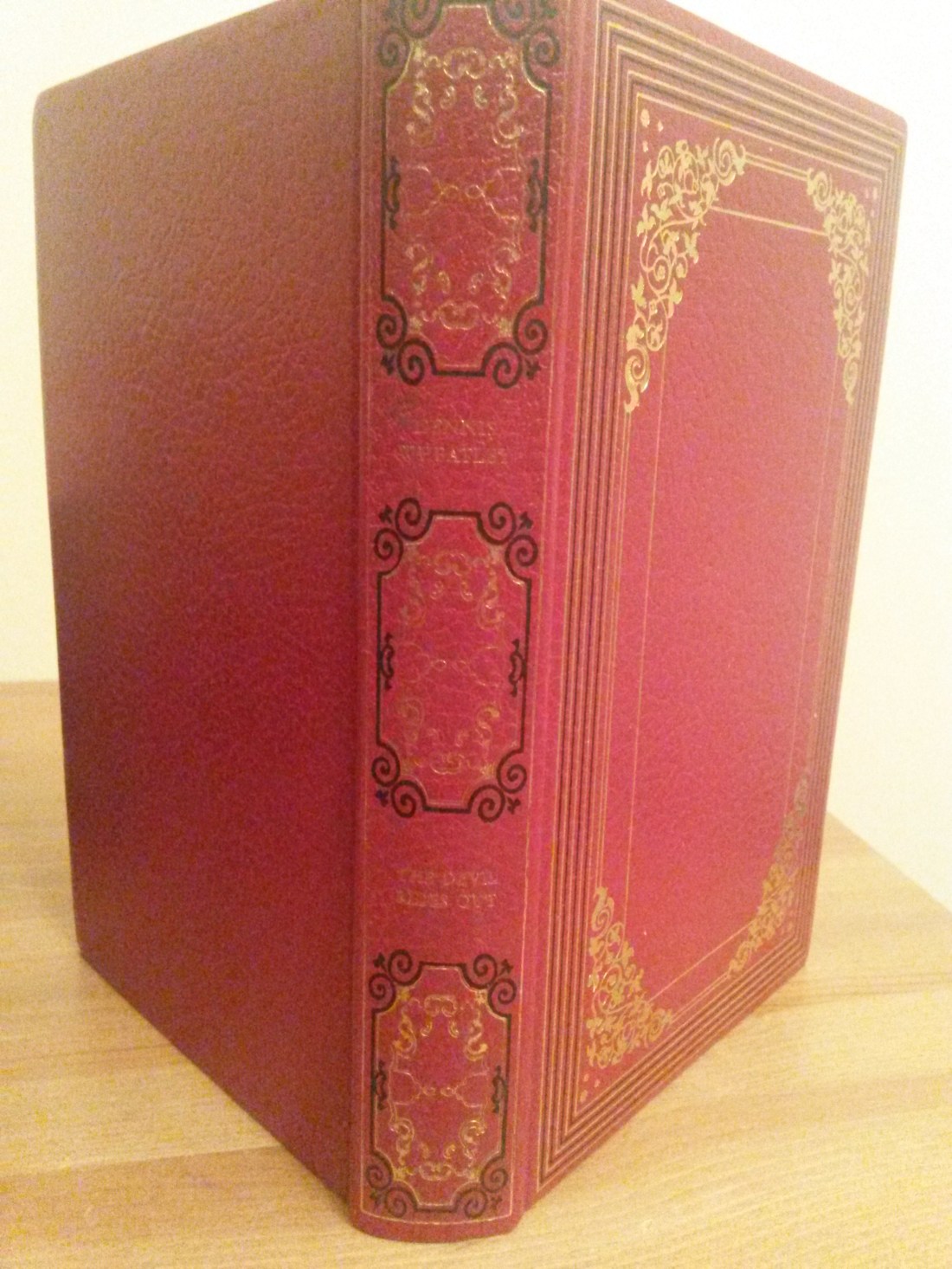
The Devil Rides Out
Hutchinson and Co – 1972 (Originally published 1934)
It’s been a long time since I read this one, but I remember it well enough to know that you don’t need an in-depth review to decide whether or not you should read it. This book is about Satanists, pentagrams, rituals, goats, spells, and demons. If you know that much and don’t want to read this, you’re a piece of shit. This is definitely one of the best places to start if you haven’t read any Wheatley before. The movie is deadly too, but for the love of Satan, read the book first.
2016-06-05 23.32.5920160605_232906
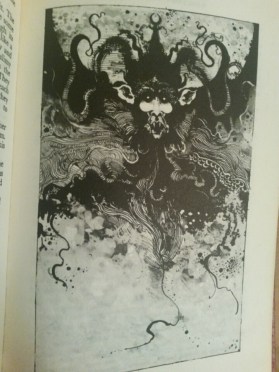
My copy of Devil Rides Out is a fancy hardback reissue. Some of these have illustrations.


20160605_232704
Strange Conflict
Arrow – 1981 (Originally published 1941)
Unlike the other two books in this post, I read this one last week, so it’s still fairly fresh in my memory. This was an enjoyable entry to the series, but it’s a pretty bad book. It sees the Duke and his mates being hired to discover how Nazi U-Boats have been successfully figuring out the trade routes of English ships. Using astral-projection, the Duke figures out that the Nazis are getting their info from an evil Voodoo priest in Haiti. Ok; Voodoo Nazis, sounds great right? Well yeah, that is super cool, but let’s just think about the idea of using astral projection as a means of espionage for a moment. Astral projection gives the Duke the ability to leave his body and go anywhere in the world. The book starts off with him sitting in his apartment in London as the city is being bombed to shit. WHY THE FUCK DID HE WAIT 2 YEARS TO START SPIRIT-SPYING? Why did he not volunteer to start sleep-creeping the Nazis as soon as they entered Poland? Also, out of the Duke’s team of friends, 3 out of the 5 are able to astrally project themselves. If 60% of people can do so, why the fuck were the British government so fucking slow to organize a full-on Astral attack on Germany? It doesn’t make any sense.

Anyways, as soon as they figure out that the bad guy is in Haiti, they decide to head over to kill him in his sleep. I have mentioned elsewhere that Wheatley was not one to be concerned with cultural or political sensitivity, and a trip to Haiti provides several lolworthy examples. This was written in 1941, so the author’s use of the term Jap is excusable, but referring to the “Jap” character as a “dirty little yellow rat” might be a bit much for the modern reader. Failing that, the description of the Haitian natives is sure to offend:
“Those coloured bums have just no powers of organisation at all and it’s like one big tropical slum. If it weren’t for the climate and the masses of fruit that can be had just for the plucking the whole darned lot of them would have starved to death long ago… The niggers live in little more than tents made from tying a few banana palms together.”  There’s another thoroughly unpleasant passage describing the parents of a missing teenager whose corpse has just been found in the hospital; “The man and woman were Mulattoes… The woman was a characterless bag of fat which appeared to have been poured into the good-quality silk dress that restrained her ample figure”.
He also refers to one of the black characters as a “wooglie”, although I’m not entirely sure whether or not that’s a racial slur. (My guess is that it probably is.) To top it all off, the book ends in an amazing proclamation on the superiority of the Anglo-Saxon race.

2016-06-05 23.31.59
Mr Wheatley, you charmer!

I’ve mentioned elsewhere that I don’t mind reading racist books as long as I’m not giving money to the author. In this case, the author is long dead, and I buy these books second hand. However, the most recent editions of Wheatley’s novels have been abridged, and the horrible racism and misogyny have been removed. This is utterly infuriating. It’s not that the publishers want to prevent the spread of racist ideas; it’s that they want to make Wheatley more palatable to the tumblr generation. Fuck that; if you buy a book about Nazi devil-worshippers but get offended by fictional characters’ racism, you need to kill yourself immediately. Yes, Wheatley was a shit, but if you can’t read a book by a person that you might not like in real life, you’re a stupid fucking loser. If you come across something in a book that makes you uncomfortable, think critically and learn from the experience. Censorship of literature is immoral, and anyone who begs to differ can go and help themselves to a hearty swig of bleach.

The rest of this book is standard Wheatley fare; chases, rituals, beautiful but enchanted young women, demons, the works… The ending involves a bit of the old deus ex machina, and I got the feeling that ol’ Dennis might have been making it up as he went along. I wouldn’t recommend this one as a starting point for his work, but it’s worth a read if you like this kind of garbage.

20160605_232625
Gateway to Hell
Arrow – 1974 (Originally published 1970)

I don’t remember much about this one to be honest. It definitely wasn’t as good as Devil Rides Out, but I gave it 5/5 stars on goodreads, so it was obviously thoroughly enjoyable. More diddies on the cover too; can’t go wrong like.

Overall, Wheatley’s writing is bad (He admitted so himself), his plots are silly, and a lot of his ideas are liable to trigger you into oblivion, but I really love his books. There’s something comic-booky about them, and I like to treat myself to one in between heavier stuff. These are just the Black Magic novels from the Duke De Richleau series, and I’ll probably review the others at some stage too.

Arthur Machen and Algernon Blackwood – Weird Fiction from the Golden Dawn

2016-05-06 19.05.55

The Three Imposters and other stories – Vol. 1 of the Best Weird Tales of Arthur Machen
The White People and other stories – Vol. 2 of the Best Weird Tales of Arthur Machen
The Terror and other stories – Vol. 3 of the Best Weird Tales of Arthur Machen
Chaosium Publishing

It’s very rare that I would read a book of short stories in the same way that I would read a novel. I usually have a book or two of short stories on the go that I’ll dip in and out of when I’m between other texts. It can take an awfully long time to get through a book in this manner, but it stops me from getting bored of the author’s style. (The Collected Stories of M.R. James, for example, took me about 7 months to finish, but I got through another 35 full texts in that same period.) In this particular case, the collection of short stories was broken up over three books, and I interspersed other collections between each of these volumes. It has hence taken me about 4 years to get through Chaosium’s collected weird tales of Arthur Machen, and I can’t honestly say that I remember much about the first ones that I read other than that I absolutely adored them.

Much like Penguin’s editions of Lovecraft’s stories, the first volume of this collection contains the best material. I took a copy of it out of the library after reading about Machen online, and I enjoyed it immensely. These creepy stories about freaks, weird experiments and dark forces are top notch stuff. I’ve already linked to my posts on James and Lovecraft, and I feel that Machen, at his best, occupies the middle-ground between these two authors. Every story in here was deadly. You should buy and read this book.

The second volume has some good stuff, but some of it is lame. This book contains the Angels of Mons stuff. During the first World War, Machen wrote a story about some angels appearing on a battlefield at Mons. The story was published in a newspaper, and many people, including some of the soldiers who had been in that battle, took it to be a factual account. It’s kind of cool that this happened, but the story isn’t that great. The Red Hand and The White People are the highlights in this volume. Maybe take this one out of the library, or read those two stories online instead.

The third volume is plop. There were a few stories that seem promising at the beginning, but these either teeter off into incoherence or abruptly turn to shit. Changes was worth reading for the hideous, yellow-faced goblin-child, and Out of the Picture was entertaining if quite silly, but the rest of the stories in here are garbage. The title story is actually the uncut version of a story that appears in the second version, and it’s a drawn-out piece of trash. Speaking of what is contained in this volume, S.T. Joshi claims; “None of these works add anything to Machen’s overall reputation as a horror writer.” I agree. Joshi afterwards mentions other works of Machen’s which were too poor to be included here. Those stories must be the literary equivalent of sniffing a shit-stained pair of britches. Don’t bother with this one unless you’re a completist. It’s not an enjoyable read.

Machen also wrote a novel called The Hill of Dreams. I haven’t read that yet, but it’s supposed to be good. I’ll get around to it someday.

2016-05-06 20.39.05

Ancient Sorceries and Other Weird Stories – Algernon Blackwood
Penguin – 2002

I took this book out of the library right after finishing the first volume in the above Machen collection. I read it straight through without breaks, and while I thoroughly enjoyed most of it, by the end I was getting burnt out on short stories. It has been a long time since I read this book, but I seem to remember the individual stories from this one better than those from the first Machen collection. There’s 9 stories in here, and they are all quite different. The weird in ‘Weird Fiction’ is a tricky thing to pin down, but I found that Blackwood’s stories are weirder (in the common sense of the word weird) than those of Machen or Lovecraft. That being said, this is the only collection of Blackwood’s that I have read, and maybe his other work is different. I would love to hear from anyone who has any recommendations on Blackwood’s other stuff. The layout of this book is nice; it has an almost identical format to the Penguin editions of Lovecraft (an introduction by Joshi and a small article and set of notes for each story). I would recommend picking this one up.

Both Machen and Blackwood were members of the magical order of the Golden Dawn along with W.B. Yeats and Aleister Crowley. Whatever though. I’m not going to get into that. If you’re interested, you can find out more about their involvement in this magical order online.

Happy Birthday Edgar Allan Poe!

2015-12-29 23.14.10
(Card made by my wonderfully creative wife)

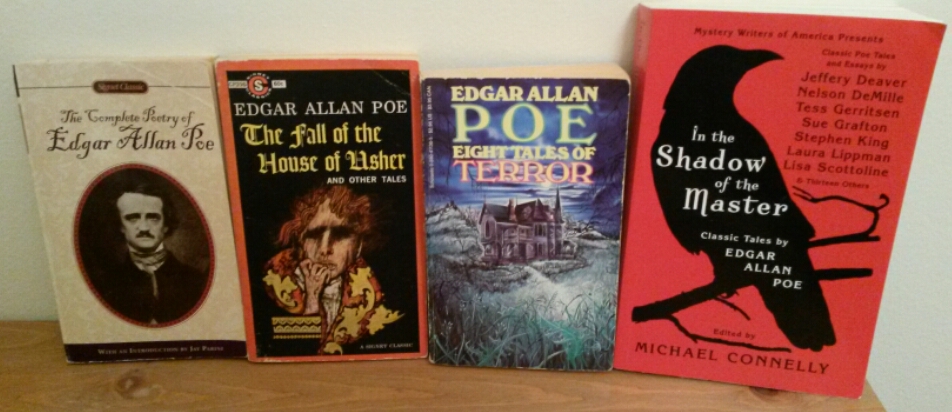
Were he still alive, Edgar Allan Poe would be 207 today. If you haven’t read all of his stories, stop wasting your time on my dumb blog and check them out. It would be rather difficult for me to overstate how much I love Poe. Teaching English, I’ve had to read the Tell-Tale Heart, the Cask of Amontillado, and Masque of the Red Death more times than I can count, and I still get excited every time I get the opportunity to go back to them. There’s so many other great tales though. The Black CatThe Imp of the Perverse, and Fall of the House of Usher are some of my other favourites, but he wrote plenty more that are equally as brilliant.

2015-12-29 23.13.18
The pictured books are just some cheap collections I’ve picked up in the last few years. There are countless editions of Poe’s works out there, and I can’t recommend any in particular. (I will say, as I have said before, that the Complete Poetry Collection is a handy one for taking into the bathroom on a slow Sunday morning.) When I get rich, I’m going to buy a hardback edition of his collected works for my fine mahogany bookshelves. I’d also love a copy of Tales of Mystery and Imagination with the illustrations by Harry Clarke, but I guess shitty thrift store collections and the internet will have to suffice until I hit the big time. Anyways, Happy Birthday Edgar!!!

And just so ye know; I’m right in the middle of the busiest part of my course at the moment, and this blog might get a little slow for the next month or so, but don’t fret; it won’t be long until I get to put down the textbooks and take up some quaint and curious volumes of forgotten lore!

Here is just some of the utter garbage that I’ve picked up recently:2016-01-13 22.56.47

7 Footprints to Satan – A. Merritt

20160105_214024
Orbit/Futura – 1974

About a year ago, I was in a second-hand book-store when I came across a little black book titled 7 Footprints to Satan. It looked fucking deadly, but it was 30 dollars and I thought that was a bit much to spend on a book I hadn’t heard of. I came home and found a copy online for less than a tenner. The seller provided no image, and I presumed the cover would be the same as the one I had seen in the shop. Can you can imagine my absolute joy when the package arrived and I first saw the above cover?

Look at that thing! It’s some kind of snakey, arachnid alien holding some jewels, a bloody heart, and a hot drink. Book covers do not get much better than that! Now a person who has not read it might presume that the entity on the cover is the Satan referred to in the title of the book, but a person who has read it will have absolutely no fucking idea of what that thing is supposed to be. I doubt that the artist who drew the spiderbaby had actually read the book. Unfortunately, the story didn’t quite live up to the cover, but the cover lives up to itself even after having finished the story. Just looking at it now makes me want to read the book again even though I know how little they have to do with each other. Take a moment there to scroll back up and really soak that image in. Fucking deadly.

So, the book starts off with a lad being kidnapped by a bunch of weirdos who manage to convince the police that he’s a mental patient. They take him to a mansion owned by a chap who claims he is Satan, and that’s where the fun begins. Satan runs a weird culty mafia thing, and he forces his followers to gamble with him on his 7 footprints game. Like all good cult leaders, Satan is a massively tall freak with an enormous head who can’t be killed by bullets. He knows everything about everyone, and he has a seemingly infinite amount of power and wealth. It’s never made definitively clear whether or not he’s really the Devil, but every time that you think that he’s actually just a fat Chinese drug dealer who picked a cool name for himself, something weird happens that suggests he at least has some connection with the archfiend. It wouldn’t be accurate to describe this as supernatural horror, but it does feature individuals with superhuman strength,  doppelgängers, and even telepathy.

It also features plenty of casual racism, but this seems to have been a trend in early 20th century horror. I’m sure that there were plenty of racist authors outside of the horror genre in that era, but I think that the ways in which race is presented within the texts written to frighten people is quite telling of the real fears of the readers of the day. (Maybe some day I’ll write a blog post, if not a master’s dissertation, on that topic.) Some of the stuff in here is pretty rough; there’s a passage that reads:
There was a Hebraic delegation of a half-dozen on their way home to the Bronx, a belated stenographer who at once began operations with a lipstick, three rabbit-faced young ‘sheiks’, an Italian woman with four restless children, a dignified old gentleman who viewed their movements with suspicion, a dumb-looking black…
Pretty good right? Within the space of a single sentence he’s managed to be nasty about three different ethnicities. At another stage, he refers to a black guy as an ‘ape-faced monstrosity’, and at the point when Satan admits to having killed his daughters, the protagonist has an Ah-Hah! moment and explains that Satan must be Chinese. Oh! and there’s also a scene featuring the most offensive stereotype of all! In the second chapter, Officer Mooney appears. He’s a New York cop with a ridiculous Irish accent that is made visible in the text; “Sure,lad. Ye’re in no danger, I’m tellin ye. Would ye want a taxi, Doctor?’ (Admittedly, that accent is entirely accurate.) The thing is though, that I wouldn’t even call this is a racist book; it would be more accurate to call it a book with some racist parts, and that’s actually worse when you think about it. The racist parts don’t add anything to the story. I’m not saying that it would be excusable if the racism were a motivational force in the plot, but that would at least give an understanding of the author’s purpose. As it stands, it looks like Merritt was just throwing his bigotry in for a laugh. As I’ve said before, I wouldn’t pay for a book that contained that kind of nastiness if I thought the author was going to get any of my money, but my copy is second-hand and the author died 70+ years ago.

I read this in two sittings, and I had a dream about being stuck in Satan’s mansion after reading it. It definitely wasn’t what I was expecting, but I enjoyed it. Merritt wrote some other books with equally cool titles, and I doubt that this is the last book of his that will appear on this blog.