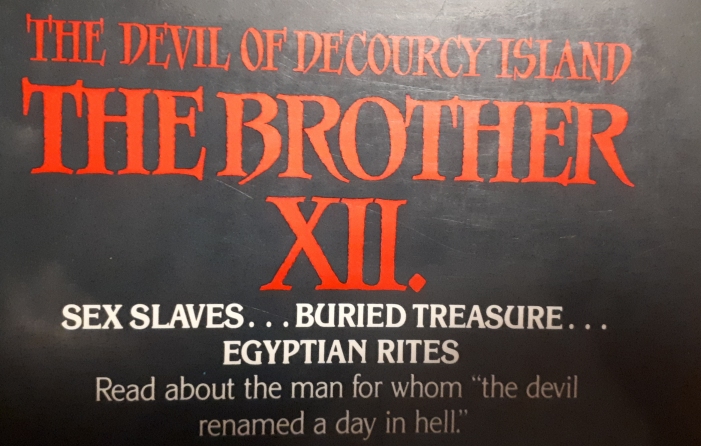
The Devil of DeCourcy Island: The Brother XII. – Ron MacIsaac, Donald Clark and Charles Lillard Porcépic Books – 1989
In the 1920s, a weirdo calling himself Brother XII started a commune for his religious order on Vancouver Island. His cult, the Aquarian Foundation, was a variant of theosophy, and it was mainly made up of old rich stupid people. As time went on, things got awkward at the commune, especially after Brother XII started taking his new girlfriends back with him and telling his followers that these women were reincarnations of Egyptian goddesses. One of these women was quite mean to the people living in the commune. The Aquarians started to suspect that their religious leader might have been taking advantage of them. He was living in a big house with his mistress, and they were living in shacks. They tried to take him to court, but when the court date came around, Brother XII was missing. He had sailed away with as much of their money as he could fit into his boat. Nobody really knows where he went afterwards, but some believe he died in Europe a few years later.
Making the story seem more interesting than it really is.
That’s more or less what happened. It’s a moderately interesting story. Nothing about it seems particularly far-fetched. This is story told in the first half of The Devil of DeCourcy Island by MacIsaac, Clark and Lillard. The book’s narration is horrendous, and it constantly goes back and forward in time. I think this might have been done to create suspense, but it fails. It just makes reading the narrative confusing.
The writing is terrible, but the real problem with this book is that the second half serves as a rebuttal to the first half. The authors spend the final 60 pages showing how parts of the story they’ve just told are slightly inaccurate. There’s no major contradictions that I could pick out though; they’re all little fecky things. It struck me as odd that they would structure the book in such an awful manner. Surely the logical approach would be to simply write a single, accurate account of what they knew about the Aquarian Foundation? I reckon the authors did what they did because the interesting version of a truthful story of Brother XII would only take up 60 or so pages.
The first half of this book is poorly structured. The second half is unbearably boring. I had hoped to read about some weird occult rituals, but it was mostly about how different witnesses reported different amounts of money being taken. I’m not going to rule out reading more books on Brother XII in the future, but I’m not going to go searching them out either.
I am a fan of both occult lore and biscuits, so I knew I had to find and read this promising book. When I looked it up, I found that the author had written 3 occult novels, and not being a coward, I determined to track down and read all of them. It only took 5 years.
The Sorcerer
NEL – 1978 This book starts off with a scientist realising, much to his dismay, that the orgy he is attending is actually a sex magic ritual being performed by a coven of witches. He’s even more annoyed when he realises the ritual is serving as his initiation into the coven.
The coven leader, a man with scarred face named Frazer, takes a shine to the new lad and renames him Thomas. Frazer is a shifty dude, and although his followers respect him, this respect is borne out of fear. Thomas hates him straight away. It turns out Frazer is on the quest for immortality, and he is willing to sacrifice anything to achieve it. He’s a real scummer. The plot from this point is fairly predictable
I had read a few comments online that suggested that the main thing that set Ericson’s writing apart from the writers of other occult thrillers was his knowledge of ceremonial magic. His theory of magic falls in line with much of what I have read of the topic, but the potency of the magic in this book is pretty fantastic stuff. We’ve got festering zombies, soul transference, astral executions and a poo spell. This is fiction though, and if it were more realistic, the book would suck. Also, in order to figure out his magical powers, Thomas has sex with all of the women in the coven multiple times. Cool.
The fact that the protagonist is a scientist made things more interesting. He kept trying to rationalise what was happening and trying to use scientific reasoning to enhance his magical abilities. He failed at the former, but succeeded in the latter. I don’t know if that was supposed to make a point.
This book is only 224 pages long, but it took me 9 days to finish. I didn’t dread reading it, but I didn’t look forward to it either, and I only ever managed a few chapters at a time. It was alright.
Master of the Temple
1983- NEL When I look up of a book or series of books and find that there’s little to no information about them online, I get intrigued. Aside from a few brief goodreads reviews, I wasn’t able to find anything about Eric Ericson’s books. Might they be forgotten esoteric masterpieces?
No. The reason that nobody talks about these books is that they’re boring as shit. Honestly, Master of the Temple is one of the worst novels I have ever read. It’s so, so fucking terrible. I’m going to summarise the plot here to save you the trouble of reading this utter hog’s shit.
Jonathan is a sales manager for a company that makes biscuits. He’s also a member of The Masters of the Temple, a secret society of sex magicians. The first part of the book describes his business trips around Europe. He’ll meet up with a biscuit distributor, do a little business and then sneak off for a bit to visit the local lodge of The Masters. There he will have sex with a beautiful woman with large breasts. Unfortunately for Jonathan, his boss, a lad called Braithwaite, is always on his case. Jonathan performs a magical ritual to summon the demon Abaddon to deal with his pesky boss, and poor old Braithwaite ends up in hospital with a horrid stomach condition.
With Braithwaite out of the way, Jonathan is promoted and ends up touring the United States trying to increase the biscuit company’s American presence. Things go pretty much the same way that they did in Europe, but the women here have even bigger tits. He meets one with an enormous rack and falls in love.
When he gets back to England, his aunt calls him and tells him that she’s sick. This triggers a flashback to when he was thirteen and his aunt gave him a blowjob. It turns out that she spent 5 years sexually molesting him. This was a bit of a weird turn, but things soon got weirder still.
Braithwaite, the lad he cursed, jumps out a window and kills himself, so Jonathan goes to his old boss’s secretary’s house and repeatedly rapes her until she goes insane.
Some other members of his order find out about this, so they kick Jonathan out of their clubhouse. Jonathan is so upset by this that he drives his car into a wall and kills himself.
My concern here is that I have made this book sound more interesting than it actually is. It’s nowhere near as interesting as I’ve just made it sound.
Here are some problems:
While the above story is fiction, most of this book is not. I’d say at least half of the book is an account of the history of Western esotericism. No thanks. I’ve read that stuff before.
Sex magic is seriously cringey. I far preferred the biscuit salesman stuff to the extended scenes of Jonathan holding in his cum. Gross. There’s one part where he’s having sex with a prostitute where he says to himself, “I who am a perfect king to the people entrusted to me by god, I who am by God’s command their shepherd, Have never tarried, never rested.” It was a bit like that scene in American Psycho where Bateman is looking in the mirror at his own muscles when he’s fucking a prostitute, only lamer. Honestly, when you think about the arrogance of people who are into this stuff, it’s mortifyingly embarrassing. Human beings are animated filth, and cumming is like shitting and pissing; it feels good because our bodies need to do it. To think that holding in your gip for a while brings you closer to god is downright silly.
Unlike in The Sorcerer, the magic in here is fairly realistic. There’s no astral projection or people getting hit with blue lightning. There’s rituals, and these rituals seem to have effects, but a sceptic could put these effects down to coincidence.
The main character is a preppy fucking douchebag. The gargoyle on the cover of this book should be replaced with a picture of a red-haired twat wearing a scarf.
There is not a single female character in this book whose breasts are not described. The main character of this book is a biscuit salesman, but not a single biscuit is described. I am a fan of tits, but I am also a fan biscuits, and this ratio was fucked up. He should have whipped out a packet of jammie dodgers while he was getting a wank off the old Finnish crone in the sauna. That would have made that scene much more entertaining.
It’s sooooooo fucking long.
Seriously, Master of the Temple is a horrid pile of brown, brown scat from a rotten shitter. Avoid it at all costs.
The Woman Who Slept with Demons
NEL – 1980 After finishing Master of the Temple, I waited a few months before starting on The Woman who Slept with Demons. It has a far cooler title, but I assumed it was going to be terrible. Honestly, I was pleasantly surprised by this one. It wasn’t a great novel, but it was only a novel. It thankfully doesn’t include a lengthy history of western occultism.
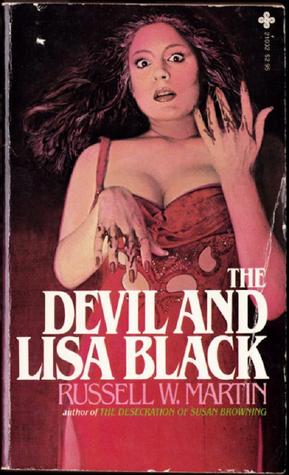
Andrew, a promiscuous veterinarian stops to help a woman whose car has broken down. Her name is Bianca, and she asks him to drop her off in some field in the country side. He does so, but after he drives off, he gets worried about her, so he heads back to make sure she can get home ok. When he gets to where he had dropped her off, he finds her having sex with a demon. The demon beats him up. Soon thereafter, Bianca sucks Andrew’s dick and by doing so makes him her slave. She also gains psychic control over him, and he can only get hard for her. This aspect of the book was very similar to Russ Martin’s satanic mind control books.
It turns out that Bianca is one of “the Apart”. The Apart are basically people who have been given powers by demons. With these powers comes a general disregard for decency and societal norms. The rest of the book follows Andrew’s descent into a dark world filled with violence, debauchery, child abuse, rape, incest, flaccid penises and sexy fat women. One scene involves an Egyptian pervert being brutally stomped to death by two horny hags who have been tied up and possessed by a demon. When he’s dead, they grab Andrew and have a threesome in the Egyptian’s viscera.
This book is far trashier than either of Ericson’s other novels, and I found this made it far more tolerable. None of these books are clever, but at least The Woman who Slept with Demons seems to realise this. The occultism on display here is of the far less believable kind, and this makes the book far more enjoyable. I disliked Master of the Temple so much that I’m not sure how much I feel about this book was relief and how much was actual enjoyment. It was decent enough though. This is definitely the best out of the three.
Ericson wrote a history of Witchcraft too, but I don’t feel any desire to track that one down.
I did a post on a few books by Tom Piccirilli earlier this year, and despite ending that post saying I would avoid his horror fiction for a while, I recently read two more of his spookier books, Pentacle and A Lower Deep.
Pentacle
1995 – Pirate Writings Pub This is a collection of 7 short stories about a wandering wizard and his familiar spirit, Self. Self is pretty much just a small, sassier version of the Necromancer that follows him around, licking him when he gets hurt and attacking the people who inflict his injuries.
The Necromancer and Self stay at an abandoned hotel, go to a blues concert, visit a mental asylum, an art gallery and a native reservation. They come across demons, ghosts and witches in all of these places, and they rarely make friends. A lot of hexes are thrown about.
Speaking of hexes, I found Piccirilli’s novel Hexes a bit challenging when I read it, but I think it might make more sense if I had read it after this one. While Pentacle is not a sequel or prequel to Hexes, it is set in the same universe. Some of it is set in the same town, and both books feature Panecraft Asylum. They’re both from relatively early in Piccirilli’s writing career, and it seems a bit like he was trying to establish his equivalent of Arkham. I haven’t read it, but another of Piccirilli’s stories is also set in Panecraft.
The writing is very dark, and it reminded me of Clive Barker with its focus of blood and pain. It’s a bit more occulty though. It references a lot of real occult texts and authorities, and a lot of these stories feature real figures from the history of witchcraft. Matthew Hopkins has somehow come back to run the insane asylum. There’s a recipe for disaster.
Overall, I enjoyed this more than the other horror stuff I’ve read by Piccirilli. The writing isn’t super clear, but the short story form makes it easier for me to get through a plot without knowing exactly what’s going on.
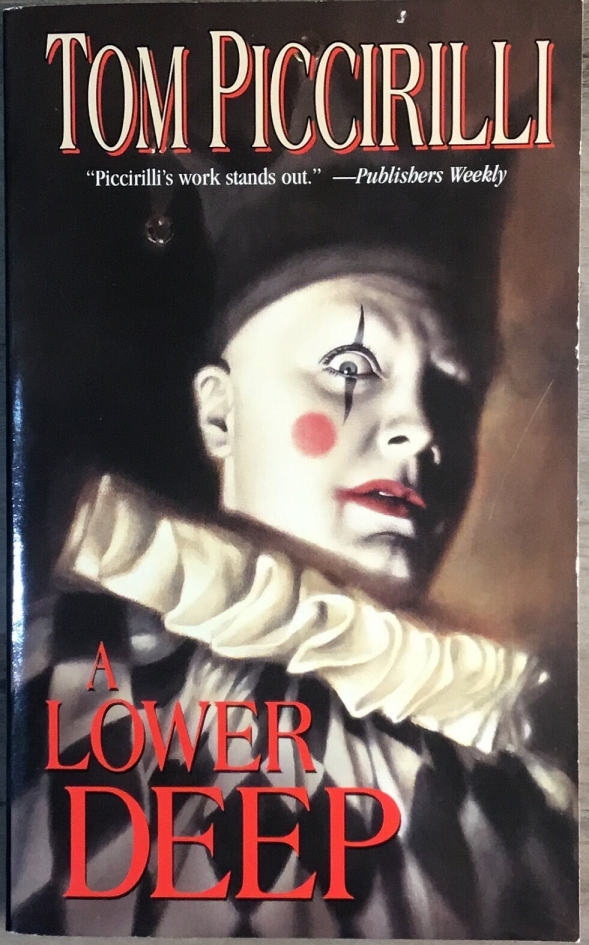
A Lower Deep
2001 – Leisure Books
A Lower Deep is basically a novel sized continuation of the stories in Pentacle. This time the Necromancer’s old friend tries to get him to resurrect Christ so they can bring about Armageddon and storm into heaven. (Yes. The protagonist remains unnamed here. Oooooooh, so edgy!) I hated this book so much that I find it hard to believe that I wrote the above paragraphs. I’ve wanted to write positively about Piccirilli’s books for years, but in truth, his horror novels are crap. This book is boring, contrived shite. If you don’t have an interest in the Bible, this will be very confusing. There’s lots of references to the Book of Revelation, the prophet Elijah and the nephilim. Yuck.
This is really a work of fantasy rather than horror. There’s lots of blood and occultism, but nothing scary happens, and I hated every page. Self, the protagonist’s familiar is supposed to add comic relief, but I found him horribly disruptive to the novel’s tone. A one point during the beginning of the apocalypse, he starts speaking with a Jamaican accent. Sigh…
The brevity of the stories in Pentacle is what made them bearable. A Lower Deep is a short novel, but it’s still far, far too long. Honestly, it’s terrible. Avoid it.
I am probably done with Piccirilli. I gave him more than a fair chance, but his horror novels just didn’t do it for me.
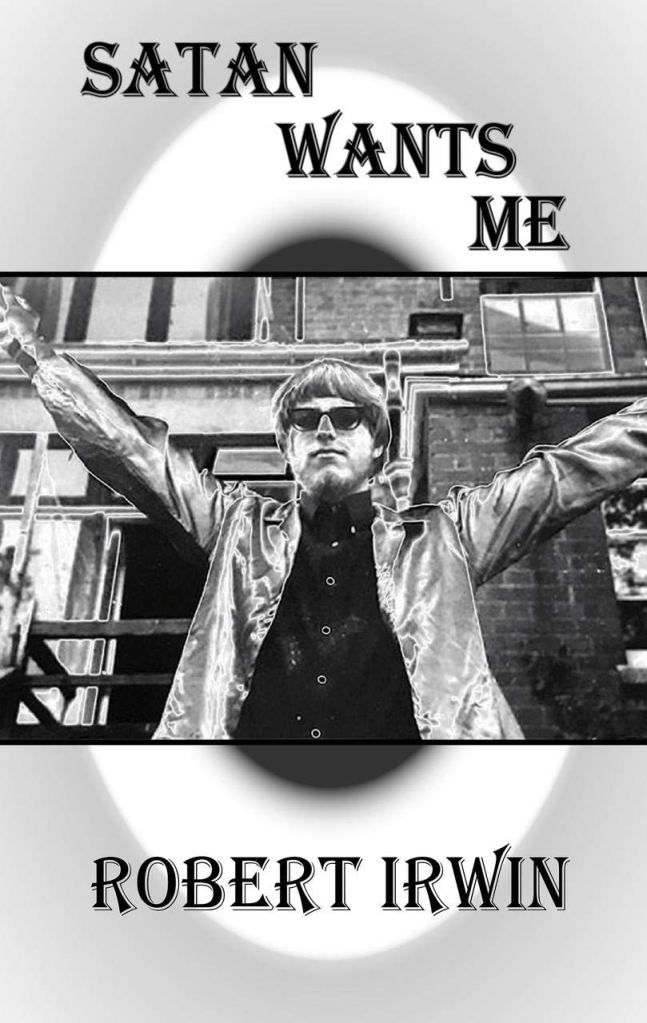
Satan Wants Me – Robert Irwin Dedalus – 2019 (Originally published 1999)
I kept a diary from the time I was 14 until I was 17. Reading back over it now is excruciating. When I started reading Satan Wants Me, an occult novel in the form of a diary, I felt the same embarrassment for the narrator that I do for myself whenever I read my own old journals. The self-absorbed tone of a diary keeper is spot on.
At first I couldn’t figure out whether this was because Robert Irwin was a skilled writer who understood his character or if he was actually transcribing his own diaries. Some of it is really cringey, but in retrospect, I’m sure this was intentional. You’re supposed to think the narrator here is a bit of a wanker.
Peter is a hippy, an occultist and a PhD Candidate. The book starts off when one of the leaders of an occult order he has joined instructs him to keep a diary. The year is 1967, and Peter is mostly occupied with drugs, sex and rock’n’roll (in that order). He joined the occult order so that he could see a demon, but that doesn’t work out immediately.
Somebody recommended this book to me, and I picked it up knowing nothing about it at all. I ended up spending a large portion of the novel wondering what kind of a book it was going to be. A lot of novels about occultism veer into horror, and the ones that don’t are likely metaphorical wishy washy crap. This book seemed neither. As the novel progresses, the protagonist becomes more and more convinced of the efficacy of magic, but nothing actually happens that couldn’t be explained away by a sceptic. I quite admired this aspect of the novel. I feel like Robert Irwin understood what he was writing about.
Interwoven into the story are a bunch of different aspects of occult history. This novel manages to pull off what Eric Ericson’s The Master of the Temple fails to do. A person who knows nothing of the occult will learn from this book without getting too bored. The Satanism is important to the story, but it’s not overbearing.
This is a book about Satanism, sex, hallucinogenic drugs and rock music. I don’t know how it took me so long to check it out. I read it when I was on holidays, and it seemed to take me ages to get through it, but I thought it was pretty good. It only occurred to me as I was editing this post that I have also reviewed a book called Satan Wants You. That one was crap, as I recall.
I really enjoyed Our Lady of Darkness (both times I read it), and I felt like it was time to revisit Fritz Leiber. Conjure Wife was first published in 1949. It’s the story of a college professor who discovers that his wife has been practicing witchcraft behind his back. He thinks this is a shameful load of nonsense, so he tells her to stop. Shortly after this, he realises that her magic has been protecting him from the spells of the other witches. It turns out that his wife isn’t the only witch on campus. Actually, most women are really witches.
Now, the title ‘witch’ don’t apply to all women,
but all women have a little witch in ’em
Fritz Leiber
It’s a pretty simple premise, but Leiber makes it work really well. The conflict is mainly psychological, occurring in the protagonist’s head. I read somebody comment that the novel’s description of women isn’t “generous”, but I don’t agree. The tension in the book, and there’s loads of it, is largely created by the unwillingness of the male protagonist to believe what is happening to him. He’s an idiot. The women are running the show here. This book is only demeaning to women if you think of witchcraft as a bad thing.
While some of the magic in here is rather fantastic, a lot of it is the kind of stuff that I don’t entirely disbelieve in. It seems to me that Leiber had a very clear understanding of the nature of magic.
Fritz Leiber was a cool guy. I read somebody describe him as the link between Lovecraft and Philip K. Dick, and apparently he corresponded with both. That itself is enough to impress me, but the books I’ve read by him are awesome too. I’ve heard that his short stories are some of his best work, so I’ll probably look at them next. I don’t know if there’s a specific collection that I should go for. Part of me wants to just read the horror ones, but I’m sure that’s dumb. Let me know if you have any recommendations.
William H. Hallahan was a popular writer during the 70s and 80s. He mainly wrote spy and mystery novels, but he also wrote 3 occult thrillers, one of which, The Search for Joseph Tully, is considered a classic of horror fiction. I had to give him a read.
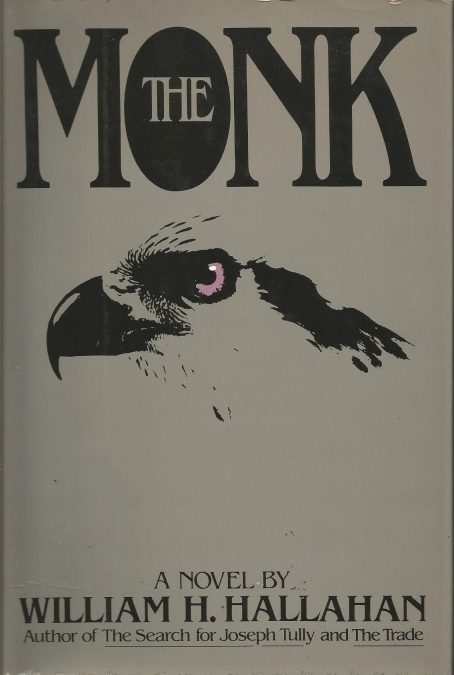
The Monk Avon Books – 1983
I enjoyed reading The Monk, but it always felt a bit silly.
This novel starts off with the fall of Satan. It’s pretty much the Paradise Lost version of events, but here the angel Timothy helps Satan at the beginning of his rebellion. Timmy backs out when he realises what he’s doing, but God is seriously pissed with him. As punishment, God sends Tim down to Earth to end the suffering mankind. To do so, he must find a baby with a purple aura and prevent Satan from killing it. He wanders for millennia as a Salathiel or Melmoth type figure, but Satan always beats him to the babies.
It’s a quite a buy-in. You wouldn’t have to be religious to understand what’s doing on, but it might make more sense if you are. Also, this is heavy stuff to use as the backdrop for a thriller novel. Readers want an entertaining page-turner to read on the train to work, but this book opens up with the ultimate battle between good and evil. I was totally fine with this, but it did strike me that setting the book up this way made for an inevitable ending. Satan can’t win. He can score a victory here and there, but it’s not going to work if all Hell breaks loose. Sure, some writers would do that, but I had read The Search Joseph Tully before this, and I knew that Hallahan’s writing would be too subtle for that kind of thing.
Ok, so the basic premise is a bit silly, but I really enjoyed the rest of the book. It starts off in Country Clare in Ireland, and the main character is called Brendan Davitt. He has a purple aura, but a magic monk disguised him when he was a baby. Now he lives in New York, but the disguise on his aura is wearing off. Satan and Timothy are racing to find him. Satan is aided by his hawk and some weird golem, demon things. Timothy has a big dog to help him.
The story is exciting, and the characters are fun. The Monk isn’t a great book, but it’s entertaining.
Keeper of the Children Avon Books – 1979 (Originally published 1978)
This was another flawed yet enjoyable read.
A 14 year old girl runs away from home and joins a cult run by an Tibetan monk. Her father tries to get her back, but the monk seems to exerting some kind of mind control over the kids in his gang. He doesn’t molest them or anything. He just gets them to beg on the streets and then takes the money. They are given food, clean clothes and a safe place to sleep at night.
The dad gets pretty annoyed by this, and he meets up with some of the parents of the other kids in the group. Before they can do anything, a scarecrow comes to life and kills one of them. Then some cats kill another. Then a shop mannequin kills another.
Dad realises that the monk is possessing these inanimate objects and getting them to kill for him, so dad goes to a yoga retreat centre to learn how to do the same. The difficulty is that it normally takes a lifetime of meditation to achieve this kind of power, but dad only has 2 weeks.
I won’t reveal anything else because I don’t want to spoil the book for those of you who want to read it, but I will confirm that this book does indeed contain an axe-wielding teddy bear.
My first problem with the book is the premise. The girl is 14 years old when she runs away from home to join the cult. This book was written in the late 70s, but surely it would have been illegal then for a man to live with a bunch of children without their parents’ permission.
The monk has the power to animate objects and move them around, but he decides to use his powers to get a gang of kids to beg for coins for him. Surely a man with his skills would find a more convenient way to make money.
When the Dad finds out that his girl has been kidnapped, he goes to work before trying to fix the problem. He never once approaches the monk or tries to talk to him. He goes to a yoga guru and learns to meditate while his little girl is living with a creep. If somebody kidnapped my child and I had no recourse to legal action, I would immediately try to physically assault that person. I’m not saying that to sound tough. It’s not a good idea, but I can’t imagine acting otherwise. There’s just no way any loving parent would have the patience of the father in this book.
Ok, so the set up is fairly silly. The next part that sucks is when he is learning to meditate. I have read so much crap on astral projection and telekinesis that I balk whenever I come across this kind of nonsense. In this book the protagonist learns how to master these powers in just a few days. It’s lame and unbelievable.
This book would have been far more satisfying and realistic if the dad won a fight against the evil teddy and then used the teddy’s axe to brutally dismember the evil monk.
Reading back on what I’ve written here, I realise that it sounds like I didn’t like this book. I did enjoy reading it though. It is a stupid book, but it was easy to read, and it’s less than 200 pages.
The Search for Joseph Tully Avon Books – 1977 (First published 1974)
I have to be honest. I read this book in September, and I didn’t bother to write about it after finishing it. I’ve since forgotten most of what happens in here. I remember a death near the beginning, a weird monk lad and a lot of bad weather. It was obviously good though. I gave it 5 out of 5 on goodreads, and I enjoyed it enough to convince me to read Hallahan’s other books. I’m pretty sure this is considered to be Hallahan’s best horror (or occult) novel, and it is definitely where I would recommend starting if you haven’t read him already. Maybe I’ll come back to this one in the future.
Wiliam H. Hallahan was a talented writer. I might even read his non-horror fiction when I grow up.
7 years ago, I published my first book review on Nocturnal Revelries. Since then, I have made 360ish other posts and reviewed more than 500 books. During the 2018-2021 period, I posted at least one review per week. By the end of last year, I was getting a bit frustrated with the weekly deadline, and in January 2022, I decided to slow things down a small bit. I’m still reading lots, and I have a ton of future posts planned, but I’m not going to force myself to waste my time reading stuff I’m not interested in just to have something to post on Sundays. This has been pretty good for me. I’ve been working on a few other projects (music, creative writing, and a very dodgy podcast), and I’ll probably use some of these projects for future posts.
Sometimes I get a bit frustrated at the lack of traffic this site actually sees. I work for months on some posts, and it’s usually the posts that I throw together quickly that search engines seem to favour. I’ve tried looking into search engine optimisation and boosting my social media presence to gain traffic, but I lose interest in that stuff very quickly. I’d rather just read a book.
I was going to do a “weirdest books I’ve reviewed” list for this post, but as I looked back over the stuff I’ve written about, I realised there were simply too many to choose from. I’ve done best of posts for every year since 2016, and they might be a good place to look for the most interesting books, but the best place to see the entire range of books I’ve posted about is on the index page. I had a good look over those while writing this post, and it brought back a lot of good memories. Nocturnal Revelries may not be the most popular blog in the world, but I’m damned proud of it, and I reckon there’s another few years left in it still. Thanks to everyone who checks in occasionally. I really hope it’s enjoyable/informative.
Kenneth Rayner Johnson was an occult scholar, an alchemist, and a writer of trashy horror paperbacks. Despite the fact that he was obviously a super interesting individual, there’s barely any information about him online. The search for this information is hugely complicated by the fact that there are several authors called Ken Johnson who write about occulty/Biblical stuff and a different Kenneth R. Johnson who is an expert on science-fiction pornography. Goodreads is currently attributing half of Kenneth Rayner Johnson’s books to these other authors. I have spent the last 6 months piecing together as much accurate information about this lad as I could find, and I am excited to share these findings with the world. Kenneth Rayner Johnson worked as a journalist in the 60s. He lived most of his life in the UK, but spent some time in Canada (I wish I knew where!) Most of his books were published in the late 70s/early 80s. These books are a curious mix of B-movie novelisations, bizarre works of occultism and paperback horror novels. I did not manage to read all of his books, but I got through the important ones.
Let’s start with the novels.
The Succubus NEL 1980
First published in 1977, The Succubus, as far as I can know, was Johnson’s first original novel. I only figured out that it was largely based on a true story when I was halfway through it. In the 70s, an American woman kidnapped a Mormon, chained him to her bed and repeatedly raped him. When the story hit the news, it sent the media into a frenzy of sensationalism. This actually happened, and there’s even a critically acclaimed documentary movie about it.
Kenneth Rayner Johnson took the story of “The Manacled Mormon” and threw in a rapist demon. It’s an entertaining read, but I felt very let down by the ending.
The book starts at the court case. Candice Maltman is found not guilty by reason of insanity and is sentenced to a stay in a fancy madhouse. She is very clearly still in love with Troy Valens, the dude she raped. Troy runs out of the courtroom and straight to his friends house. When he goes to bed that night, he is visited by a ghostly woman who gives him a good ride. She comes back for a shag every night after this. At first he thinks she is just a crazy sex fiend, but then he realises she’s a ghost or something. As this is happening, Candice is acting very strangely at the mental asylum. Her brainwaves are all over the place, and it seems like she’s asleep when she’s awake and awake when she’s asleep.
This part of the book was really enjoyable. There was lots of sex and supernatural suspense. It is hinted that Candice had made some forays into occultism before abducting Troy, and I was assuming that she had summoned some kind of demon that was helping her astrally rape him or something. This would have been great. Unfortunately this is not what’s actually happening.
Next paragraph contains spoilers. Skip it if you’re planning to read the book.
Actually, the evil spirit that is raping is actually the demon Lillith. The idiot who previously lived in the apartment where Troy is staying had summoned her years ago and never banished her. He was never able to see her because the numerical value of the letters in his name are different to the numerical values of the letters in “Lillith”. Troy and Lillith’s numerical values are the same so he can see her. Somehow, and this is absolutely never explained, Lillith has also been hiding in Candice’s body, even though she is miles away in a mental hospital and has never entered the room that Lillith has been trapped in for years. Fucking stupid. It doesn’t make any sense. The whole time you’re waiting for some kind of explanation for the initial kidnapping, but that part is purely incidental to the succubus stuff. This is a book about a man who gets raped by two entirely separate females that eventually become the same female for absolutely no reason.
Kenneth Rayner Johnson was pretty heavily into the occult as far as I can tell, and he references plenty of books that I’ve reviewed on here. Seabrook, Summers, Sinistrari, Maple… but well researched as he may be, I am not sure about the veracity of some of his claims.
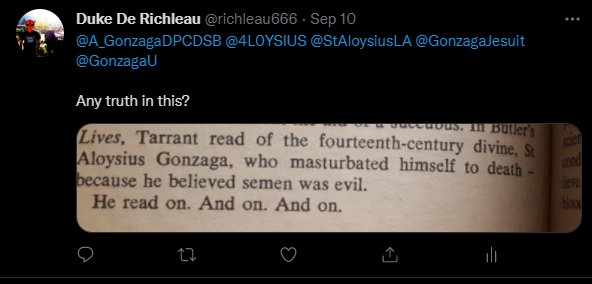
There is one part where Johnson claims that Saint Aloysius Gonzaga masturbated himself to death. I love reading about Saints and Popes who have done messed up stuff, and I had to check this out. I’m pretty sure that Ken just made this one up. He references Butler’s Lives of the Saints as his source for this information, but I checked a couple of editions of that book and neither mentioned death by wanking. They actually claim that Saint Gonzaga died of a disease he contracted while tending to sick people. He is believed (by some) to have lived his entire life without committing a mortal sin, and he’s known for his devotion to chastity. I’m always down to trash Christianity, and I think it’s hilarious if Kenneth Rayner Johnson was being deliberately offensive here, but I am also very, very intrigued. Are there any other sources that claim that Saint Gonzaga died from wanking? I can’t find any online, so I asked the experts. I still haven’t gotten a response.
Like I said, I really enjoyed most of this book. It’s just the ending that’s absolutely shit and stupid.
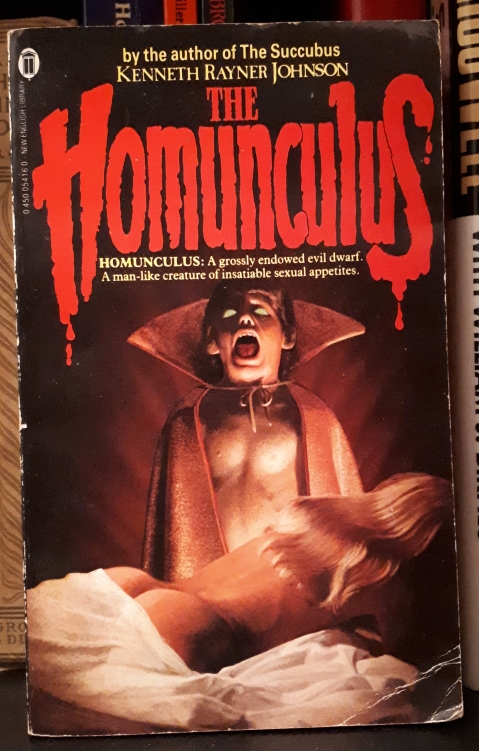
The Homunculus NEL – 1982
I have wanted to read this novel ever since coming across it while working on my lengthy post about Aleister Crowley’s attempt to make a homunculus. There’s not much info about Johnson’s The Homunculus online, but the cover is a thing of beauty. Look at it there. Fantastic.
There’s a weird cult called Supra Obscurans in London, and it’s led by a 9 year old homunculus with a massive cock. He plans to take over the world by impregnating a bunch of English women with his demon spawn. Things are going well for this lil’ pipsqueak until he kidnaps the girlfriend of a hologram scientist.
The story for this one was pure shit, and the characters were flat and uninteresting. The Homunculus is not a good novel.
I’ve read a quite a bit about creating a homunculus, and Kenneth Rayner Johnson obviously did too. Aside from the cover, the coolest thing about this book is the fact that the author clearly had a serious interest in the occult. Each chapter begins with a quote, and while most of these are from Nostradamus or The Bible, there were some from Crowley’s Book of the Law, Maugham’s The Magician and Kenneth Grant’s The Magical Revival (apparently Grant and Johnson were buddies). Johnson also repeatedly references Paracelsus. Reading through these bits made me feel like a knowledgeable wizard, but they didn’t save the book from being shit.
The novel ends on Glastonbury Tor, the place where Anthony Roberts would mysteriously die 7 years after its publication. I mention this because I believe I read something about a link between Johnson and Roberts a long time ago, but I can’t remember where I read it. They would have been working in the same circles at roughly the same time, so they may well have known each other.
Johnson apparently intended to release a third “Satanic” novel, but this never happened. His next and final major work of fiction was quite different.
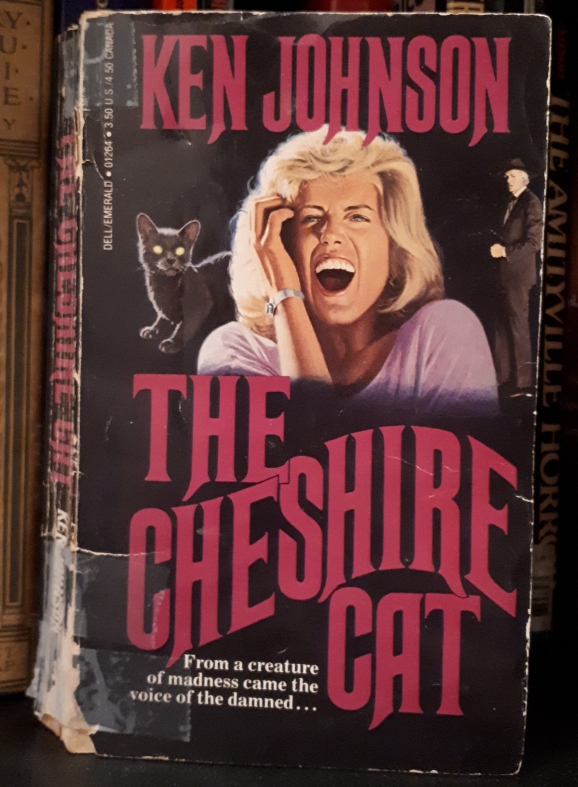
The Cheshire Cat Dell – 1983
Allison, a photographer, dumps her rockstar boyfriend when she’s 8 months pregnant and moves to some small town in Wales for a bit of a holiday before the baby is born. The manager of the hotel she’s staying is the leader of a Theosophist cult, and most of the people staying at the hotel are mothers and daughters who belong to this cult.
One of the guys who helps take care of this gang of little girls is an epileptic named Trevor Lewis. He makes friends with Allison. The only other guest at the hotel is a professor who is often seen arguing with the hotel manager.
It turns out that the entire neighbourhood is haunted by the ghost of Lewis Carroll, the guy who wrote Alice in Wonderland. Despite what some of his naïve fans claim, Lewis Carroll was undoubtedly a dodgy paedophile in real life, and I was a bit apprehensive that a fictional portrayal of him would try to make him out to be a good person. This book does no such thing. He’s not just a paedophile here; he’s also a psychopath. He’s the creepiest paedophile ghost with a speech impediment since Stephen King’s Library Policeman.
I actually really enjoyed reading this book, but I only finished it 10 minutes before writing this, and there’s so many things about it that didn’t make sense. There’s the whole spiritualism/theosophy thing going on, and while the haunting part kinda fits in with that, Charles “the paedophile” Dodgson doesn’t really come across as a Mahatma or Master of Wisdom here. The Cheshire Cat, which briefly appears a couple of times, is also referred to as a Guardian at the Threshold. It’s implied that some of the creatures from Alice in Wonderland are coming to life, but that side of things is never fleshed out.
There’s another part where Allison stumbles across a house with a pair of ugly women and a screaming baby in a cottage in the woods. This seemed like that scene with the Duchess and the pig from Alice in Wonderland, but it doesn’t add anything to the story apart from confusion.
Perhaps the most confusing part of the book is the Trevor Lewis character. A big deal is made out of the fact that this guy has epilepsy, and this is something that the real Lewis Carroll suffered from. Look at his name too. I think there’s even a part where it’s suggested that Trevor has a mild stutter, just like Lewis Carroll. I kept expecting him to be Carroll’s great-grandson or maybe possessed by Carroll or something.
I really liked the fact that this book attempts to sully Lewis Carroll’s reputation. The pacing is good too. Lots of stuff happens in these 330 pages. Aside from that, this book is quite ridiculous. It doesn’t make much sense at all.
The only other original fiction written by Johnson that I know of was a short story called ‘Pelican’ that was included in the Summer 1995 edition of Terminal Frights magazine. I have not been able to find a copy of this. Please contact me if you have one or if you know of any other fiction written by Johnson.
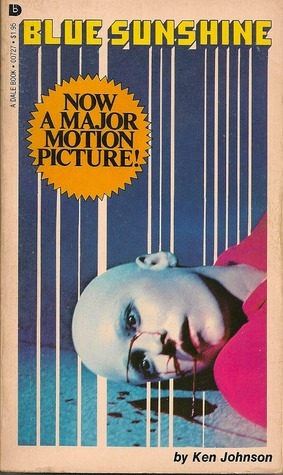
Before writing his own original novels, Johnson wrote 3 novelisations. The first of these was for a 1973 Italian movie called The Last Snows of Spring. It’s about a neglected 10 year old kid who dies of leukemia. The tagline of the book reads “Daddy, there’s so little time.” There is a 0% chance of me ever reading this book. Jesus Christ. As far as I can tell, the book came out 2 years after the movie. Johnson also did a novelisation of Blue Sunshine (1977), a horror movie about LSD that turns people in murderers. I didn’t feel any great desire to track this one down.
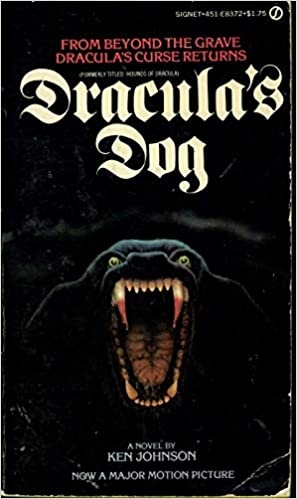
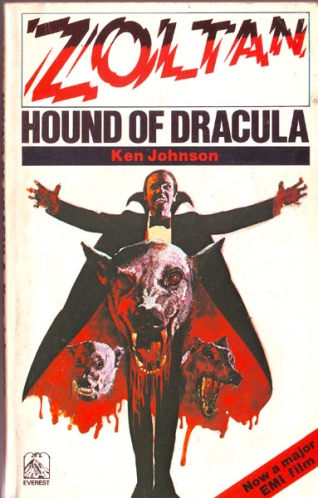
In fact, the only novelisation by Johnson that I bothered with was Zoltan, Hound of Dracula from 1977. It actually seems to be the best known of all Johnson’s books. There was 3 separate editions of this book, all with different names. (It also goes by Dracula’s Dog and just Hounds of Dracula.) It’s about Dracula’s dog, so I had to read it.
SignetEverestNEL
All three editions of this novel contain text that reads “now a motion picture” on their covers. This would suggest that the movie was based on the book, but that’s not true. Both the movie and the novel were based on Frank Ray Perilli’s screenplay. It seems as though film companys thought it would help novel sales if people believed the book was so good a movie was made of it. (The same trick was also performed on the covers of Johnson’s other novelisations.)
This book is a piece of crap to be honest, but I enjoyed it well enough. It’s short, and too silly to get upset over. Some Romanian soliders unearth the Dracula family’s tomb, but they burn all of the vampires inside except for the servant vampire and his dog. These two loyal servants are left in an awkard position: they no longer have a master as all the Dracula family are gone.
Or are they?
No. It turns out that Dracula’s great-great-great-great-grandson moved to America and changed his name to Drake. The vampire and vampire dog head across the Atlantic to find him. When they arrive, they discover that their future master (who is not a vampire) is camping with his family. They really want this guy to tell them what to do, so they try to make him a vampire too. Their plans are complicated when a Romanian military officer comes over and tells Drake about the trouble he is in. The way in which the American man accepts the fact that an evil dog is trying to make him a vampire is pretty funny. He doesn’t get surprised or ask any questions. It seems like a perfectly natural course of events for him.
I finished the book in one sitting, and I was reasonably entertained. I thought about watching the movie version for comparison’s sake, but after skimming through it I decided not to. I don’t mind wasting 3 hours of my time reading through an awful novel, but I will be damned if I waste an hour and a half on a shitty movie. (This always happens to me. I should probably watch the movies before reading the novelisations in future.)
Part of what makes Johnson such an alluring person is that he was not just a fiction writer. He also published several peculiar books on occult phenomenon.
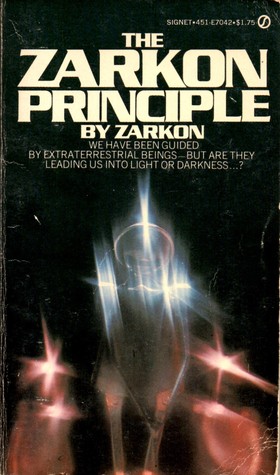
In 1975 a mysterious book called The Zarkon Principle appeared. It was written by a myterious weirdo named Zarkon, and it presented information about ancient aliens and predictions for the future. I haven’t read the book, but from what I have read about it, it seems that most of its predictions did not come true. It seems pretty similar to some other books that I have read, that whole fantastic-realism movement that I can’t stomach anymore.
In 1996, a new version of The Zarkon Principle was put out by Creation Books. It was retitled Armageddon 2000. This book confirmed that Zarkon was actually Kenneth Rayner Johnson.
Armageddon 2000 claimed that the world was dying and would definitely die soon.
It also claimed that ancient civilisations knew a lot and had very surprising technology. Many of these civilisations had stories featuring gods travelling in eggs. These eggmen were probably aliens who came to earth. Ancient religious texts say we come from clay. We probably do; ever hear of primordial soup? Who told us these clay stories? Aliens.
I could not bring myself to finish this book. Like the original Zarkon book, this one is full of predictions. Now, 26 years after it was published, few of these predicitons have come true.
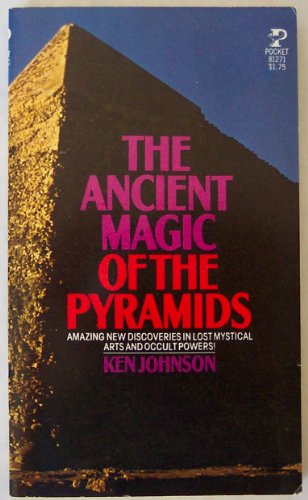
Johnson published The Ancient Magic of the Pyramids in 1977. He also edited Robert Scrutton’s pair of 1979 books on the lost conintent of Atland (The Other Atlantis and Secrets of Lost Atland) and Scrutton’s 1982 The Message of the Masters. These all seem like pseudo-sciencey nonsense, so I didn’t try to track any of them down.
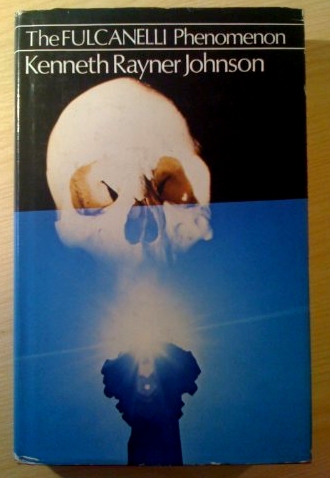
TheFulcanelliPhenomenon Spearman – 1980
Of all Johnsons books, this is probably the most sought after. I think it’s a pretty important book in the field of Fulcanelli research, and despite my disdain for alchemy, I was mildly intrigued.
As far as I know, nobody has ever turned lead into gold, and alchemy’s greatest achievement was when Paracelcus made a goblin in a pooey bottle. Fulcanelli was some French dude who wrote two books about the alchemical symbolism inherent in gothic architecture. He is best known for appearing in Pauwel and Bergier’s very stupid Morning of the Magicians. There’s a bunch of stupid stories about this lad. Apparently he went missing for 30 years and then showed up looking younger than he did when he was last seen. He also took one of his students to a magic castle in Spain where they travelled back in time and Fulcanelli changed his gender overnight. Nobody really knows who this lad was, and I, for one, don’t care. Johnson’s book is half the history of alchemy, half the legend of Fulcanelli. The author is clearly very passionate about this stuff, but this wasn’t enough to keep me interested, and I ended up skimming huge sections of this book.
My favourite thing about this book was the helpful list of Johnson’s other books included before the text. I tried contacting the people mentioned in the thank-you section here to see if I could track Johnson down, but none of the people on facebook with the same names as his thanks-yous responded.
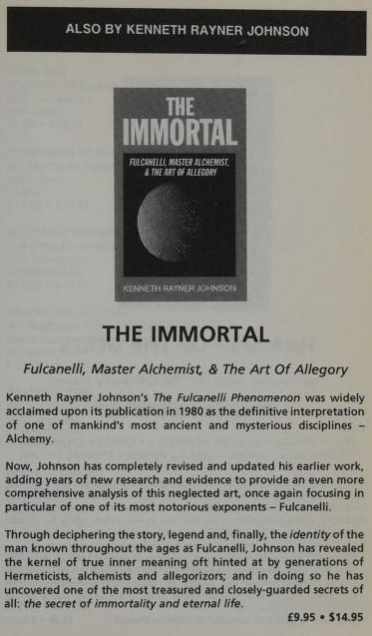
Creation Books planned to release an updated version of The Fucanelli Phenomenon called The Immortal in 1996, but from what I can tell, it was never actually published.
According to Greenmantle magazine, Johnson also ghost wrote the autobiography of Lady Dowding, a wealthy theosophist, and animal rights activist. There are two autobiographies of Dowding, Beauty: Not the Beast An Autobiography (1980) and The Psychic Life of Muriel, Lady Dowding: An Autobiography (1982), but these might well be the same book with different titles. I can’t pretend I have any interest in reading them in any case.
Aside from these books, Johnson wrote articles for several occult magazines including The Hermetic Journal, Rapid Eye, and Greenmantle. He also contributed articles to the legendary encyclopedia of occultism, Man, Myth and Magic and other occult themed collections. He worked as a journalist from the 60s, so I’m sure there’s lot more of his writing out there. In Zoltan he introduces a chapter with a quote from an interview he did with Christopher Lee. I’d love to read that one!
In truth, none of Johnson’s books were good enough to cement his reputation as an amazing writer. The novels I read were all enjoyable at points, but they were all pretty silly too. His non-fiction is outdated, and I found it unbearable to read. Regardless of this, I still think Kenneth Rayner Johnson was a pretty cool guy. I spent a lot time trying to track him down while I was working on this post, but after emailing an old publisher of his, I discovered that Ken Johnson died of cancer in 2011. Once I knew he was dead, I googled his obituary and found an article about him in an old edition of Greenmantle. That article provided me with some of the biographical details I’ve included here and the only picture of Mr. Johnson on the internet:
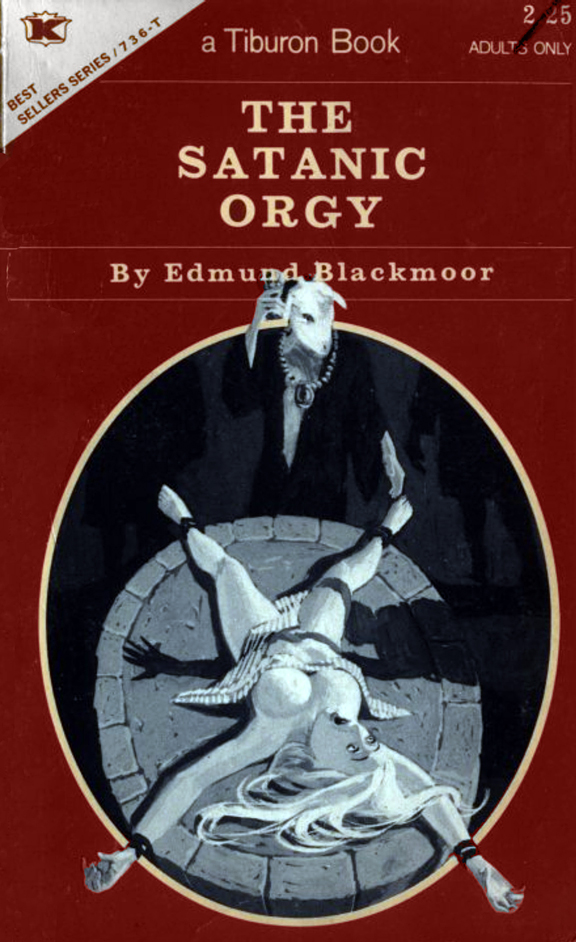
The Satanic Orgy – Edmund Blackmoor Tiburon Books – 1974
When I first saw this cover, I thought it was a modern book designed to look old. No. Edmund Blackmoor’s The Satanic Orgy is actually a real work of occult pornography from 1974.
A young couple’s wedding night is ruined when Ralph, the prudish husband, prematurely ejaculates on his wife Rena’s bush. It turns out that this only happened because a satanic witch has put a curse on him. Ralph is the mayor of Garden City, and when he gets back from his honeymoon, the Satanic witch drugs and seduces him and records it. This part was pretty good. She makes sure to degrade him thoroughly, eventually making him wank himself off into the toilet bowl. She then shows the video of their encounter to his wife and gets Warren, her gangster friend, to rape Rena while she’s in shock. The witch also makes a video of this. She then uses these video tapes to blackmail the mayor into allowing Warren to open up a bunch of casinos and brothels in his town.
Ralph and Rena stick together, and now that they’ve seen eachother fucking other people, they open up to eachother and their relationship dramatically improves. Unfortunately, Warren, the guy who raped Rena, decides he wants to rape her again, so he kidnaps her, gang-rapes her with his buddies and then turns her into a prostitute. Gang rape is not at all funny, but this scene was made rather humourous by a gay gangster who kept trying to suck his friends’ dicks while they were busy having a rape. The kidnapping and raping of the mayor’s wife are deemed too much by a higher ranking satanist, and the mayor and his wife are reunited and live happily ever after. The Satanic witch who caused all the trouble is then demoted and impregnated by Satan.
The focus of this story is sex, not Satanism. Sure, there are satanists in here, but the only orgy that occurs seems like a pretty regular orgy to me. The few mentions of anything to do with occultism or witchcraft serve solely to induce more fuck scenes. Whoever wrote this might well have limited their research to a single viewing of Rosemary’s Baby.
According to Kenneth R. Johnson’s article on science-fiction pornography in the July 1977 editon of Science Fiction Collector, this book was originally published as The Witch’s Spell by Gunthar James. I have not been able to verify this, but given my experiences with this kind of stuff, I don’t doubt it’s true.
Alternate version
I got my copy of this in a lot of other works of occult porno. I never enjoy this stuff as much I think I’m going to when I see the covers, but it’s really hard for me to resist. I’ve been researching old porn a bit recently, and a lot of it is very seedy. Human beings are filthy animals.
2021 was an eventful year for me. I had a lot less free time than in years previous, and I wasn’t able to put as much effort into this blog. I published my lowest amount of posts since 2017, and those that I did publish were generally a bit shorter than what I used to put out. Sorry dear readers. It’s been hard juggling a family, a full time job, a nervous breakdown and a blog about creepy books.
When I started doing annual review posts, I used to link to my 10 favourite posts of the year. I stopped doing that for a few years because I was finding it difficult to limit myself to 10 posts, but this year 10 noteworthy posts almost seems like a stretch.
Looking back at this list, it becomes apparent that I actually preferred writing non-book-review posts this year. My favourite post, the one about the neighbour, is my favourite because it felt properly creative. I love books and still enjoy reading as much as ever, but I’m a bit bored reading horror novels and feeling like I have to churn out a review by the end of the week. It has been feeling more like an obligation than a hobby recently .
I’m not giving up, but I’m going to think about ways to make the blog more interesting for me to keep. I’m not entirely sure how this will work. I might try a few more opinion pieces on the horror genre or occult phenomena. I was mostly reading for pleasure this year, and I found it hard to stick to any kind of research, but that might change next year. Whatever I decide to write about, it will almost definitely involve books.
Also, I didn’t publish any fiction this year, but I have been working on some recently. I’m going to try harder at this.
Anyways, here’s a bunch of books I read this year. If you want to read my reviews of them (or any one of the other 500 or so books I’ve written about), you can find links to each review on my index page.
I only did a handful of non fiction books this year, and they were all terrible. When I have 40 minutes to myself a day, I don’t want to spend it reading stupid nonsense.
More 2021 reads. Some good, some very bad.
Well that does it for 2021. It was a shit year really, but I still got through more than 80 books. I wrote posts like this for 2016, 2017, 2018, 2019, and 2020 if you’re interested. If you have any recommendations or questions, you can leave a comment, message me on twitter, or email me at dukederichleau666gmail.com.
Thanks for reading. I hope it has been somewhat interesting/entertaining. Happy new year.







































 Nocturnal Revelries