Keep Politics out of Satanism!

Organized Satanism’s tendency to align itself with political movements is lame. Satanism should be about the celebration of evil and the performance of heinous deeds of malevolence. Dorky satanists’ attempts to politicise their movements are pathetic.

I know there are countless Satanic sects, but the two biggest groups of organized Satanists are the Church of Satan and the Satanic Temple, and both have ridiculous links to politics.

The Church of Satan

The Church of Satan is all about individualism. You don’t need to adhere to any specific lifestyle or political belief system to become a member. That being said, the philosophy behind this “religion” is based on the writings of Ayn Rand, and it’s largely about maximising one’s own power at the expense of others. This focus has attracted countless right wing wankers. LaVey, the organization’s founder, fraternized with James Madole and several other neo-fascists. In the 80s, several members of the Church of Satan appeared on Race and Reason, a talk show hosted by Neo-Nazi Tom Metzger. Now, I know that a few members of an organization being Nazis doesn’t make every member of that organization a Nazi, but one of the guys I’m talking about was later asked to become the organization’s leader. I don’t actually believe that every member of the Church of Satan is a white supremacist, but I do believe that most of the members get a kick out of their religion’s nebulous connections with neo-fascism. They’re Satanists for fuck’s sake; they love being associated with scary stuff. (CoS’s links with right wing scum are well documented elsewhere. Google it if you want more information.)

A CoS Edgelord Clown

I don’t think that the Church of Satan is a hate-group or anything like that. I just think its members are nerdy virgins who were bullied at school and spend the rest of their lives trying to seem dangerous. They’re too wimpy to actually do anything, so they just flirt with Nazi imagery on their tumblr blogs. Lame.

The Satanic Temple

By now, I think the Satanic Temple (TST) probably has more members than the Church of Satan. This organization promotes progressive ideas of social justice and that kind of thing, and I think a lot of stuff that TST does is kinda cool. I just dislike its members as individuals, and I think the whole thing of Satan being the good guy is silly.

Satanism, regardless of what brand, has to be a little bit naughty. It’s named after Satan, the adversary of God. Satan doesn’t follow the rules. He’s not supposed to do the right thing. If not the antagonist, he is at very least a trickster. Inviting Satan to the battle against conservative Christians is fair game, but what about invoking him to protect Muslim refugees in the USA?

I am NOT saying that I disagree with welcoming and protecting Muslim refugees. Islam is an Abrahamic religion, and the Shaitan (an evil spirit) tempts Adam in the story of the Garden of Eden as told in the Quran. Somehow I don’t think many Muslims are going to feel comforted when greeted with the following image:

Satnic Solidarity with the Muslim community in North America

I didn’t make that image myself. I found it in a TST facebook discussion group a few years ago. Check out the replacement of the star with the pentagram. Is that blasphemous? Some well-meaning Satanist was making these images to share online. Here’s another one:

Satanic Solidarity with the Jewish community

The name Satan comes from a Hebrew word meaning accuser. Satan first appears as a specific entity in the Torah, and he plays an important role in the beliefs and sacred texts of Judaism. Some fucking idiot has placed an upside-down pentagram, the symbol of Satan, inside the star of David. How fucking oblivious can you be?

Of course, this isn’t the first time that somebody decided to mix Satanic imagery with Jewish symbolism. Here’s an image from the July 1938 edition of Der Stürmer, the Nazi tabloid.

This kind of hateful nonsense even predates the Nazis. During the medieval period Christian leaders put a lot of effort into linking Satan to the Jewish people. I have no doubt that the individual who posted the Satanic Solidarity images meant well, but Jesus Christ, what an ignorant fucking imbecile.

I made the following image myself and posted it in the same thread as the two above. I was kicked out that facebook group shortly after.

Clearly the coolest of the 3

No. Making Satan the good guy is dumb.

the act of taking or using things from a culture that is not your own, especially without showing that you understand or respect this culture

Cambridge

the unacknowledged or inappropriate adoption of the customs, practices, ideas, etc. of one people or society by members of another and typically more dominant people or society

Oxford Languages

the adoption or co-opting, usually without acknowledgment, of cultural identity markers associated with or originating in minority communities by people or communities with a relatively privileged status.

Dictionary.com

Cultural appropriation is a favourite topic of some modern progressives. Regardless of how problematic you think it is, I’m sure you’ll agree that all three of the above definitions of cultural appropriation apply to the Satanic Temple’s adoption of Satan as a symbol for progressive values. Oh the irony! Satan is a character, a force and a symbol from Jewish and Christian belief systems that has been willfully misunderstood and transformed into a force of benevolence by a bunch of geeks wearing black nail varnish. There are obviously more Christians than these progressive Satanists, but the language used to describe the appropriators as being “relatively privileged” or “typically dominant” doesn’t really create a contradiction. TST looks edgy on the surface, but its values are actually pretty close to those of the majority of people living in the Western World. Their beliefs are (thankfully) dominant here at this point. The benevolent Satan of TST is an abhorrent corruption of the evil Satan of the Abrahamic religions.

I want to reiterate that I think that some of what TST does is actually pretty cool. I just think a lot of its members are clueless weiners. The above images are just one example of the kind of wishy-washy, goody-two-shoes nonsense that I witnessed in TST facebook groups before deactivating my account. (I want to make it very clear that I definitely prefer these harmless geeks to the nasty little rape glorifiers of the Church of Satan.)

Surprise, surpise!

Satanism is inherently dumb, and any attempts to codify it are bound to turn out lame. A true Satanist serves Satan; they shouldn’t try to tame the Dark Lord and have him spout their political dogma or make excuses for it. The only viable form of Satanism is the performance of atrocious deeds of unspeakable evil. Snarl at the moon, abuse yourself, spit blasphemous obscenities in the faces of believers and revel in your acts of unholy destruction (preferably all at once), but please keep your political beliefs for lunchtime conversations at work like a normal person.

Rosemary’s Baby and Son of Rosemary – Ira Levin

Rosemary’s Baby – Ira Levin
Pan – 1974 (Originally published 1967
)

I saw the movie version of Rosemary’s Baby a long time ago, and I knew that it was considered to be a faithful adaptation, so I wasn’t expecting many surprises when I got around to reading the book. While the book’s plot is pretty much identical to the movie, knowing how things were going to end only allowed me to further appreciate the way Levin structured his novel. There’s lots of seemingly irrelevant little things that happen throughout the story that end up having a big impact later on, and this novel is so masterfully written that it was still exciting to read knowing how it was going to end. The pacing and suspense at work here are awesome. This is thrilling stuff.

Maternal instinct is a primal and powerful thing, and Levin uses it to fuel this high tension nightmare. I remember reading a quote from Kurt Vonnegut about how good authors should be sadists and that a good protagonist must suffer if they are to relatable. I don’t know if Levin got this idea from Vonnegut, but he certainly believes in it. Rosemary is never presented in an even remotely negative light, but Levin forces her through devastating trauma.

I assume that most of my readers know how this story ends, but in case you don’t, I’m going to discuss that now, so read the book before you read the next paragraph.

I had a strange reaction to the climatic ending of this novel. All of Rosemary’s nightmares come true. She has given birth to the spawn of Satan, but that maternal instinct kicks in and she quickly comes to accept her child’s faults and commits to being a good mother to him. My personal response to this was relief. As a parent, I don’t want to read about any child being abandoned, abused or ignored, and while I don’t consider myself a Satanist, I am sympathetic to their cause. I also read most of this book with my kindle in one hand and my newborn daughter in the other. When Rosemary refers to her son as Andy Candy in the book’s final lines, I felt a sense of joy and relief.

Rosemary’s Baby works so well because 95% of the novel is entirely believable. The characterisation is great. A woman’s first pregnancy is an exciting but uncertain time, and it often happens around the same time that she moves into a new home. Apart from the Satan stuff, many, many people have very similar experiences to Rosemary. It’s really only in the last moments of the novel that Rosemary’s fears are confirmed and the supernatural establishes itself as a governing force in the story.

Son of Rosemary
Onyx – 1998 (Originally published 1997)


Writing a sequel to Rosemary’s Baby had to have been a complicated process. It was impossible to continue the narrative in the same mundane world where most of the first novel takes place. Some of the events in the original novel, the Pope’s visit to New York for example, actually occurred. Setting the sequel in reality wouldn’t have worked. Readers can’t buy into neighbourly dining room conversations if they know the speakers are warlocks and witches. To deal with this issue Levin sets Son of Rosemary in a weird alternate universe.

In 1999, Rosemary wakes up from a coma after 20 something years. (She had been poisoned by the Satanists after planning to run away with her son.) The world she finds herself in is a strange place. It’s basically the late 1990s as they really were, except for the past few years, everyone on Earth has been idolising a guy named Andy. This Andy chap is being credited with bringing about world peace, and everyone really loves him. Rosemary quickly realises that this is her son, and the two have a high profile reunion on live TV.

The astute reader will quickly realise that Andy is the Antichrist prophecised in the Book of Revelation, but Andy swears to his mother that he has turned his back on evil and has dedicated his life to doing good. I started to see through his ploy once he tried to have sex with his mom.

Yep, a good chunk of this book is this Andy chap trying to get Rosemary to have sex with him.

Ok, I’ll imagine most of you have already read the book or decided not to read it based on what I’ve just told you. If you don’t fall into either of those categories, you might want to skip the next bit because I’m about to discuss the ending. I warn you though, this is a shit book that isn’t worth reading. A spoiler can’t make it much worse.

The ending of Son of Rosemary is perhaps the worst ending to a novel that I have ever read. After Andy has brought about the apocalypse and Rosemary is descending into Hell, she wakes up to discover that everything that happened over the course of the two novels was actually a dream. What the fuck? Ira Levin was a good writer. How the Hell did he think it was ok to end a book like that? Did he contract acute Alzheimer’s as he was concluding the book and revert back to grade 3 writing? It was all a dream? Piss off. If a 12 year old ended a story like that I’d kick them. Honestly, the ending to this was so bad that it actually made me like the original book less. Do not read this insane piece of garbage.

Stepford Wives
Signet – 1994 (Originally published 1972)


Before reading the Rosemary books, I read Levin’s The Stepford Wives. This is another very famous book, but I had luckily avoided ever finding out what it was about. It’s a bit like Rosemary’s Baby in that both books finish with a shocking revelation for the female protagonist. It’s the kind of book that works better the less you know about it, so I’m not going to say much else other than that I really enjoyed it. It’s quick, exciting and creepy in a unique way. You should definitely read it if you haven’t already.

I don’t think any of Levin’s other books are horror novels, but Rosemary’s Baby and The Stepford Wives were so good that I fully intend on reading more his stuff in the future.

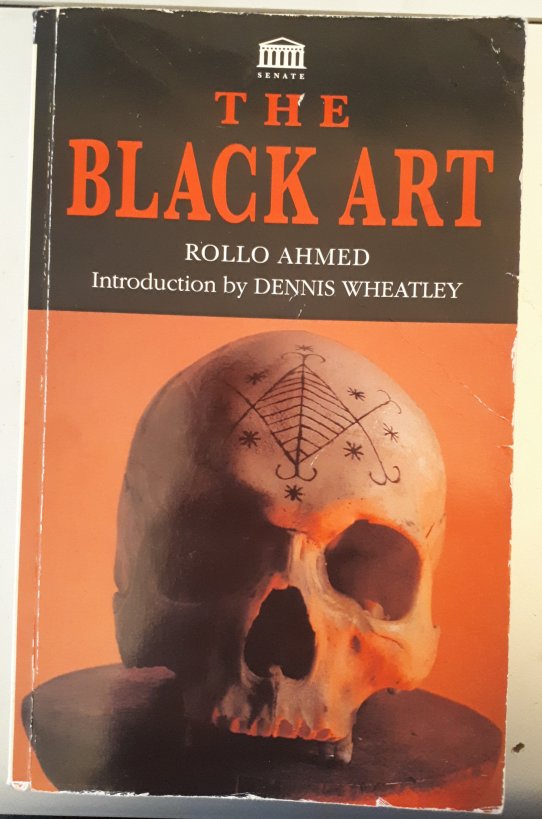
The Black Art: Rollo Ahmed’s Plagiarism of Montague Summers


The Black Art – Rollo Ahmed
Senate – 1994 (Originally published 1936)


In 1935, right after The Devil Rides Out was published, Dennis Wheatley’s publisher asked him to write a non fiction book about the occult. Wheatley claims he was too busy at the time (he did eventually publish one in 1971), but he recommended that his publisher get in touch with his yoga teacher, a peculiar character named Rollo Ahmed. Rollo Ahmed claimed to be an Egyptian expert on the occult, but he was actually from Guyana, and while he certainly knew a bit about the occult, much of this knowledge was probably acquired as a means to make his business seem more legitimate. Ahmed, you see, was a conman. He told stupid people he would counter black magic curses that had been put on them for money. He also told old women that spirits had instructed them to loan him a bunch of money. He was arrested and charged for doing this kind of thing on at least 3 occasions, and he served at least one month’s imprisonment with hard labour.

rollo-ahmedMr. Ahmed

I bought a copy of Ahmed’s book on black magic more than 5 years ago. It cost me one Canadian cent. I started reading it at the beginning of May this year, but it was so boring that it took me 3 months to get through its 280 pages. I finished 30 other books in the same period, forcing myself to read a few pages of this trash when I was between novels. This book is the reason that this blog has seen so little non-fiction in 2020.

But did this book really suck, or have I just read too much of this kind of crap to get any enjoyment from it? Maybe it was a little bit of both.

This is supposed to be an overview of the history and practice of black magic. Ahmed did a good bit of research for this book, but he doesn’t provide any sources for most of what he is saying. This book might be of interest to individuals who are researching what people believed about black magic in the 1930s, but I wouldn’t want to rely on it as an accurate historical account.

There’s 21 chapters in here. Some are specific to time frames (pre-history, the dark ages, modernity…), some are specific to areas (India, China, Greece, Rome…), and some are specific to occult phenomena (werewolves and vampires, necromancy, alchemy…). There’s no organisational principle behind this structure, and the chapters themselves are often just lists of descriptions of practices that Ahmed either took from other texts or made up himself. I’ve come across a lot of these stories and descriptions in other books, and the stuff that was new to me wasn’t terribly interesting. Around the same time that I bought this book, I reviewed the similarly titled The Black Arts by Richard Cavendish. That book covered much of the same information that’s presented here, and Cavendish managed to cite his sources. I’m not saying that you should go out and read that one either, but it was probably better than this pile of garbage.

blackartsSimilar title, cover and contents

Another obvious point of comparison here is Montague Summers’ work. Summers and Ahmed moved in the same circles, and they both were acquaintances of Dennis Wheatley and Aleister Crowley. Despite his apparent credulity, Summers’ books are the measuring stick against which all other 1930s occult histories should be compared. In the course of my research for this post, I discovered evidence that strongly suggests that Ahmed plagiarized Summers when he was writing The Black Arts.

For me, the most interesting part of this book was the chapter on the magic of Great Britain and Ireland. There is an account given of a vampire priest in Ireland that sparked my curiosity, perhaps because this is one of the only parts of the book where Ahmed cites his source. He claims that he read the story in the October 1925 edition of The Occult Review, an old occult periodical. I was intrigued by this and decided to consult the source material. It turns out that the October 1925 edition of The Occult Review contains no such story. R.S. Breene’s ‘An Irish Vampire‘ article was actually published a month later in the November edition. Big deal, anyone could make that mistake, even an expert. Well, it turns out that an expert did make that mistake. In his 1929 book, The Vampire in Europe, the Reverend Montague Summers quotes Breene’s article in full, but he mistakenly cites it as coming from the October edition of The Occult Review, 7 years before Rollo Ahmed makes the exact same mistake in his book. Coincidence? No way. It’s been a long time since I read any non-fiction by Summers, but I would be surprised if further research didn’t show more instances of Ahmed plagiarizing his work. (Here is a scan of the original story for anyone interested in the Irish priest turning into a vampire.)

montague-summers-vampire-booksSummers’ Vampire books were later retitled. I own both, but have only read the first one.

Dennis Wheatley knew both Summers and Ahmed, and there are multiple theories about characters from Wheatley’s books being based on these men. I have written several times about the Canon Copely Syle from To the Devil – A Daughter and how this character is clearly a mix of Summers and Crowley, but some people have pointed out that the evil Canon has a frightening Egyptian manservant who is probably based on Ahmed. If this is so, I reckon Wheatley understood the relative importance of both men to the annals of occult history.

to the devil - a daughter“a manservant of a type that one would hardly have expected to find in an Essex village. He wore a red fez and was robed in a white burnoose. His skin was very dark, but only his thick lips suggested Negro blood; and C. B. put him down at once as an Egyptian.” – This description (presumably based on Ahmed) might seem a bit racist today, but by Wheatley’s standards it’s really not bad.

I want to include a quick note on my sources here so that I don’t seem like a hypocrite. The biographical details I’ve included are from Chris Josiffe’s articles on Rollo Ahmed in Fortean Times 316 and 317 (July and August 2014). The stuff about Ahmed’s influence on Wheatley’s characters are from this article on Wheatley’s site. All of my other sources are self evident.

I’ve been reading and reviewing books on the occult for a long time now, and my interest seems to have waned a bit recently. I believe that this is largely due to wasting my time reading so many awful piles of boring nonsense written by idiots. The Black Art wasn’t as bad as some of the shit I’ve read, but it contained little that I haven’t come across before. I ask you, my dear readers, can any of you recommend me occult/Fortean non-fiction books that are strange, interesting and preferably widely available? I’m happy to read about Black Masses and alien abductions, but I’d like a new slant on things. Maybe a Black Mass performed by aliens?  Please leave a comment, tweet me or email me if you can think of anything that would fit on this site. (Remember, you can skim through my index page to see what has already been reviewed here.) Thanks!

The Nursery and Toy Cemetery – William W. Johnstone’s Insane Horror Novels

the nursery william wThe Nursery – William W. Johnstone
Zebra Books – 1983

“a Satan who is obsessed by anal sex” – this is part of the description of The Nursery given in Paperbacks from Hell. Well, after reading that, there was no way in Hell that I wasn’t going to track down this book. Fortunately, it completely lived up to the hype. This is perhaps the most insane horror novel I’ve ever read. The cover and title are fairly misleading. There is a nursery in the story, but it’s not super important to the plot. This book is more about violence, sex and Satanism… oh and vampires.

The Nursery is a tricky one to find though. At this stage, nearly all of William W. Johnstone’s horror novels have been released as e-books, but The Nursery has not yet been given this treatment. (I’ve ended up with two copies. If you wanna trade me something good, message me.) This shit is truly mental, but it’s damn entertaining. There’s another, more thorough, review of this book on Glorious Trash if you want more details before reading it

I wrote the above paragraphs about The Nursery roughly a year ago. After finishing that book, I had a hard time picking up another novel by Johnstone. While I did actually enjoy The Nursery, it’s a very intense novel, and reading it was a hectic experience.

Looking back at those paragraphs, I am amused to see that I described The Nursery as “perhaps the most insane horror novel I’ve ever read”. I finished reading Toy Cemetery a few weeks back, and I can say with certainty that it is definitely the most insane horror novel I’ve ever read.

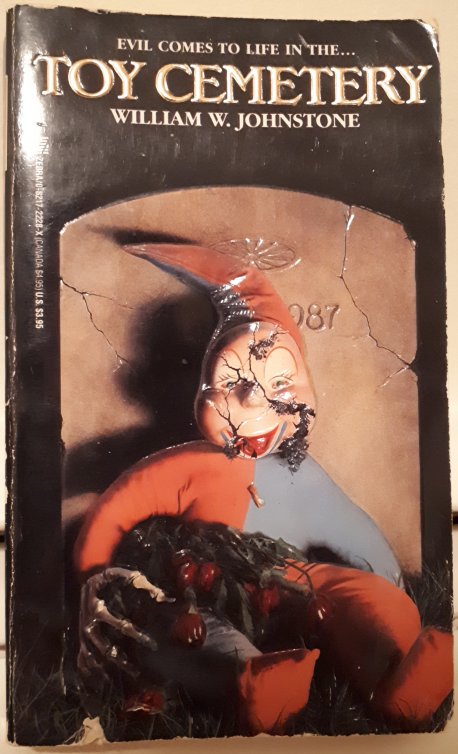
toy cemetery - william wToy Cemetery – William W. Johnstone
Zebra Books – 1987

Toy Cemetery is essentially the same novel as The Nursery except this one has the added attraction of two armies of living toys. Yes, this is another novel about a Vietnam veteran returning to his home town only to find it overrun by Satanists. There’s more incest in this one, but it’s also extremely violent. There was one scene that starts off with a man taking his new girlfriend on vacation; after a few paragraphs, he is crushing her skull with the heel of his boot. Another noteworthy feature of this one is the fact that every single female character is evil. Honestly, there’s so many insane parts of this novel that I don’t feel capable of properly explaining how mental it is. By the end of the book, the honest,  honorable, Christian protagonist is stabbing his family to death in garbage dump. Grady Hendrix wrote an excellent review of this one a few years ago. I read his review right after finishing the novel, and actually being forced to think about what had happened in this novel after reading it was a very funny experience. Any attempt to summarize the events in this book will fall short of expressing how truly bizarre it is. It’s ridiculously flawed, misogynistic, and non-nonsensical, but I absolutely loved it.


It might take me a while, but I intend to read all of Johnstone’s horror novels. The phrase “Paperbacks from Hell” is now used to describe horror novels from the 70s, 80s and 90s, but I don’t think I’ve read any books that live up to that title as well as Johnstone’s. These are x-rated Goosebump books for weirdos. They’re brilliant (in an awful way). You need to check them out.

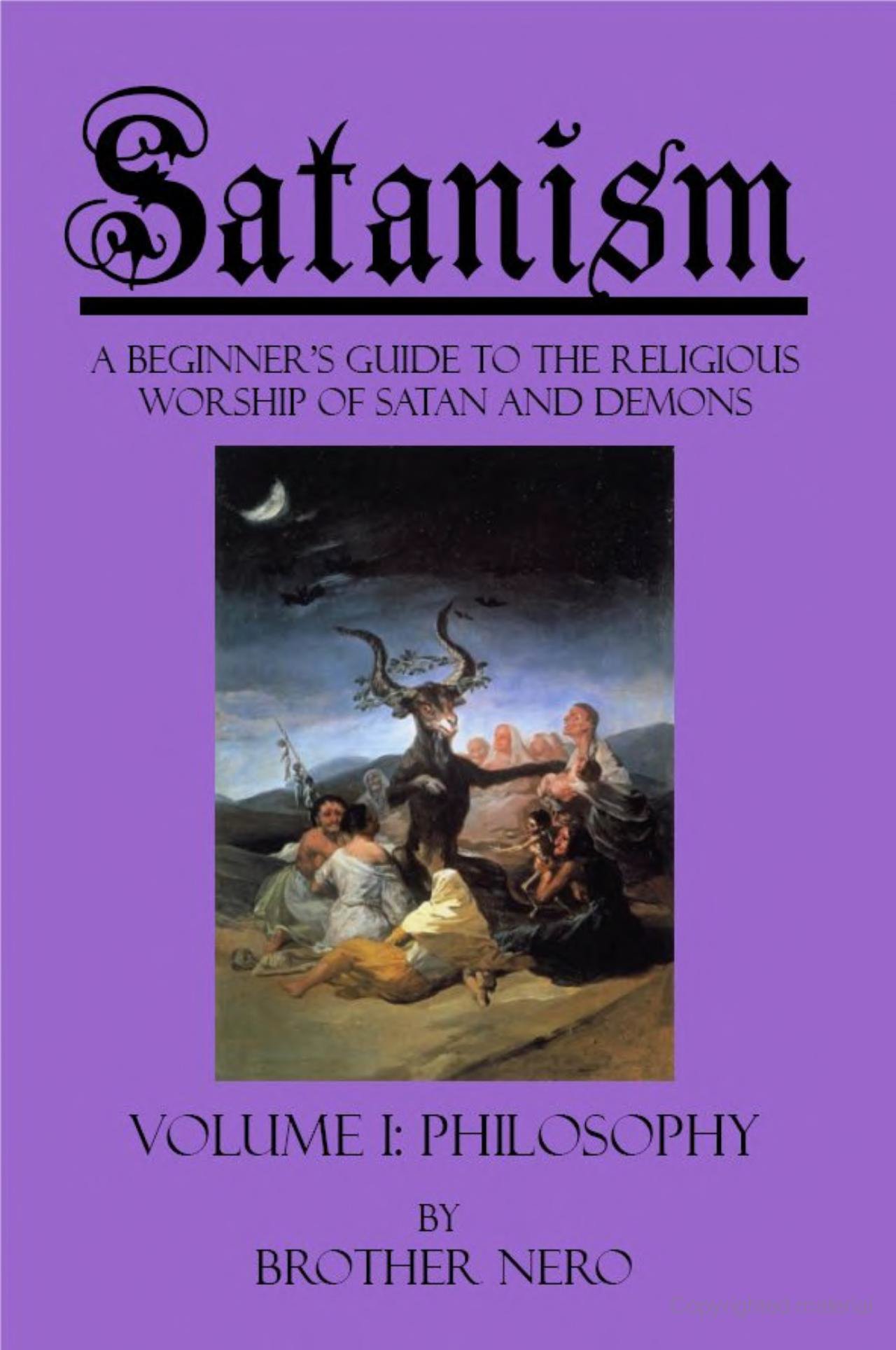
Satanism – Brother Nero’s Guide to Life

satanism brother neroSatanism: A Beginner’s Guide to the Religious Worship of Satan and his Demons
Brother Nero
Devil’s Mark Publishing – 2010

This is a book about being a Satanist. This isn’t the friendly, progressive, atheistic Satanism that’s in vogue these days though. No, the author of this book, Brother Nero, is an actual Devil worshipper. He believes that the Devil and demons are real and that you can talk to them. This book is an explanation of his Satanic belief system.

Brother Nemo basically believes that Christians have got things the wrong way around and that the Devil is the good guy and that God is the bad guy. He accepts much of what the Bible describes as accurate, but he questions how biblical stories are interpreted. Most of his ideas are fairly similar to Christianity though, and he’s a proud “traditionalist.” He thinks abortion is wrong because you shouldn’t kill any being that contains the blood of Satan. He claims a real satanist wouldn’t get an abortion even if she had been raped because it’s not the child’s fault the mom got raped. Fuck. I can’t imagine Christians or Satanists wanting this loser on their side.

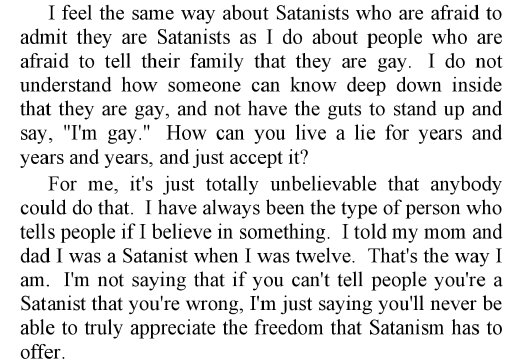
At one point he gets really mad with people who hide their satanism from their employers. If you feel comfortable sharing your religious beliefs with your employer, that’s great, but I’m sure most adults will be able to come up with several perfectly sensible reasons for keeping that information private.

Nero continues this rant with these tasty little paragraphs:

words of a dumb satanist
He later argues that gay marriage is ok, so I don’t even think this guy is genuinely homophobic. He’s just really naive. He must lead a remarkably sheltered life. Come on Nemo, you really don’t understand why people might hide the fact that they’re gay? I guess they’re just not as brave as twelve year old you.

The reason I downloaded this book was because I saw it referred to as “Satanism for Parents” somewhere, and while I have no interest in being a Satanic parent, I thought this sounded like a laugh. There’s actually only one chapter in here specifically for parents, but holy shit, it is spectacular. The author admits that he doesn’t have any kids (no surprises there), but he presents himself as an authority on the subject anyways. He encourages homeschooling kids and teaching tarot cards when they are learning their ABCs. His complete and obvious cluelessness about the mental development of children is actually comforting –  it’s a relief to think that this guy probably hasn’t spent much time around kids.

There follows a chapter about why teenage satanists should always make sure they have a responsible adult, like the author, in their satanic covens. Each teenage coven should have an adult, like Nero, so that he can guide them on their satanic journeys. A previous chapter of this book included instructions on writing pacts in your own blood, so God knows what kind of guidance the author would give in person. In this section, he acknowledges that parents will probably worry about their kids hanging out with an older dude because the media will have convinced these parents that satanists are paedophiles. The author is so blind that he doesn’t realise that most parents would be far more afraid of an adult who writes books about wanting to hang around with kids than a satanist who minds their own business. This is one of several instances in this book of the author showing a complete lack of common sense.

Oh, one last thing from the parenting section: Nemo claims that adoption is ok, but it’s better if the kid’s biological parents are satanic because their satanic blood means the kid will more likely be psychic. It’s at this point in the book that the author mentions that he believes that there is actually a Satanic race and that it would be good to keep the bloodline pure. Holy shit.

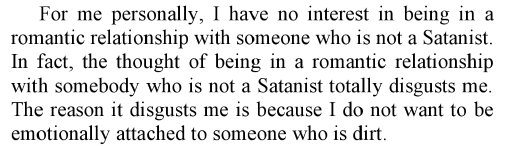
dirtAnother gem

Eventually, the writing became too much for me. This ‘book’ is just a collection of rants from a bitter, lonely weirdo. It reads like a stupid, unlikable teenager’s journal. It’s genuinely embarrassing. You’d feel sorry for the guy if he didn’t come across as such an obnoxious, arrogant cunt. At around the halfway mark, I decided I was just going to skim the rest of this awful nonsense. What I saw made me glad of my decision.

Towards the end of the book, there’s a chapter on sacrificing animals. The author claims that animal sacrifice is ok because people used to do it in the past, and the gods are the same now as they were then, so it’s still appropriate. He also points out that animals are from the wild anyways, so they’re used to brutality. I closed the book after he started describing how he kills small animals.

I like reading violent, gory, creepy books about horrible freaks, but this isn’t a novel. These are the beliefs of a lad who thinks that teenagers should want to hang out with him so that he can teach them about the correct way to cut themselves and sacrifice small animals. Brother Nemo spends a lot of time on the internet, and he is doubtlessly going to google his name and see this post at some stage, so I’ll end it with a little message for him:

Get psychiatric help bro. You’re not well.

Secrets of the Satanic Executioners – Ambrose Hunter

The quality of the books I have been reading has improved in the last few months. I am no longer taking the bus to work, so I have less time to read, and I am therefore less inclined to waste my time reading garbage. With the recent lockdown, I’ve had a little more time, and the pipes of bizarre and stupid occultism have been calling me. I here present one of the stupidest, most bizarre books about Satanism that I have ever encountered, Ambrose Bertram Hunter’s Secrets of the Satanic Executioners.

secrets of the satanic executioners ambrose hunterSecrets of the Satanic Executioners: Medieval Maleficia (2nd Edtion)

Ambrose Hunter
Lulu – 2007

During the Middle Ages, there was a satanic cabal of free thinking militant demonologist executioners. These chaps roamed about Europe killing people for money. They believed in freedom, self worth and science, and they hated oppression and tyranny.

Fast forward a few centuries, and a German lad named Adolf Hitler discovered this satanic philosophy. He hated it. Nazism was actually an attempt to crush all those who accepted this type of independent thinking. In fact, it wasn’t until the surviving members of the order of Satanic Executioners got wind of Hitler’s opposition to their outlook that they discreetly joined the war on the side of the allies. They were so effective that the Nazis actually tried to adopt some of their techniques to fight back, but things didn’t work out for the Nazis, and the Satanic Executioners helped win the Second World War.

hitler satanicWhat?

This story is obviously not true, but that’s not really important. Historical accuracy isn’t necessary for a book to be entertaining. The problem here is the total lack of cohesion. None of this makes sense. The definition of Satanism that the author is working with is never given, and I don’t really know what he means by it. He first describes the Satanic executioners running around killing people for money, but he follows this by crediting them with developing modern science and killing Nazis. Are they good or bad? Are they theistic or atheistic Satanists? How were they still in existence in the 20th century?

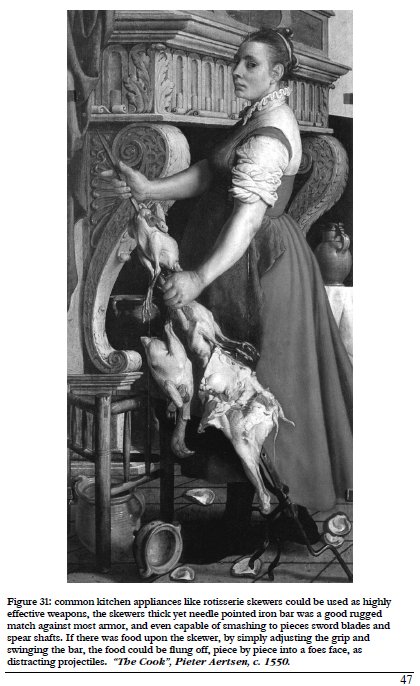
After a thoroughly confusing introduction, the author proceeds to describe the Satanic Executioners’ weapons and methods of fighting. I’ve read books about killing people before, and this wasn’t very good in comparison. There’s silly long descriptions of fighting techniques that are of no use to anyone. If you’re reaching for a book like this to teach you how to scrap, I guarantee you are going to get your hole kicked when the time comes to fight. The stuff on medieval weapons was interesting, but I am sure there are far better books on the topic than this. There’s one cool bit where the author describes using a meat skewer to attack enemies. He notes that if the skewer is laden with chunks of meat, these tasty morsels can be used as missiles before the skewer is driven into the heart of the enemy.

meat skewer satanic weapon

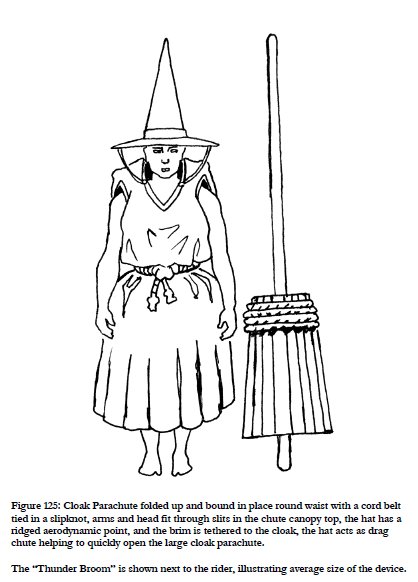
There’s also a bit where ol’ Ambrose explains the origins of the notion of witches riding around on broomsticks. This actually comes from the one of the hazing rituals for new recruits into the order of Satanic Executioners. The order had jetpack broomsticks that initiates would have to try to ride through the sky in order to join the gang. The Executioners also had paragliders in the shape of devil wings that allowed them to soar towards their targets in terrifying fashion.

thunder broom“the hat has a ridged aerodynamic point”
There’s another part where the author describes how the Executioners would hide in graves to help them avoid detection. Maybe this is where part of the vampire myth originates…

The last part of the book is a confused discussion of the occultism supposedly utilized by the Executioners. There’s a bunch of nonsense about numerology, magical squares, cabalah and tarot symbolism. BORING. Despite the supposedly Satanic nature of this text, some of the rituals that the author describes include prayers to God. This is pure shit.

This book is so ridiculous that I wouldn’t be surprised to find that it’s actually a joke. The formatting is awful, it’s full of typos, and the cover is hideous. The text is about 250 pages long, but I’d say 150 of those are taken up with silly pictures that have little bearing on what the author is discussing. If The Secrets of the Satanic Executioners is a actually joke, I’m sure I look like a complete fool. If Ambrose Hunter thought that this text was convincing, I genuinely pity him.

Kill for Satan – Bryan Smith

42304587._SY475_.jpg

Kill for Satan – Bryan Smith

Grindhouse Press – 2018

I saw the cover of this book roughly a year ago and knew I’d have to read it. It’s about a bunch of people killing a bunch of other people. Oh, and they’re doing so for Satan.

Kill for Satan only came out in 2018, and it features a lot of pop culture references that made me realise how little modern horror I actually read. I was a bit bothered by the repeated allusions to one of the character’s Cradle of Filth tshirt (Jesus Christ, that band are shit.), but I liked the part when one of the characters is researching Satanism and discovers “modern so-called “Satanic” groups that don’t actually believe in the existence of any demonic evil entity ” who “use Satan as a provocative and subversive means of delivering progressive messages. They are social activists, not true devotees of the dark path.” Haha, I wonder who he’s reading about.

Really though, aside from all of the killing for Satan, there’s not much else going on in this book. It reminded me of a more straightforward version of William Johnstone’s The Nursery. In a way that’s a good thing; Johnstone’s book was a mess, but I found the plot of Kill for Satan to be a bit underwhelming.

Bryan Smith seems to specialise in Splatterpunk, and this book, like some of the others within that genre, was just a bit too straightforward for me to really enjoy. Kill for Satan felt a bit more like reading the screenplay for an extended death metal music video than it did a novel. Smith’s writing is decent – I was never bored, but personally, I would have enjoyed a bit more plot/character development – maybe a little less killing and a little more Satan.

There is one particularly memorable scene in which a mother says to her child, “I’m sorry, sweetie. I do love you. But I love Satan more.” Yikes. You can probably guess what happens next. If this sounds good to you, if you’re looking for a straight up bloodbath of mindless, brutal violence, this book will not disappoint.


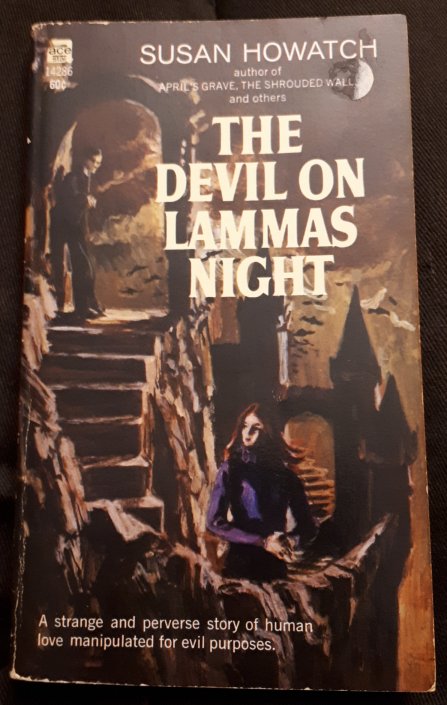
The Devil on Lammas Night – Susan Howatch

susan howatch the devil on lammas night.jpgThe Devil on Lammas Night -Susan Howatch
Ace Star -1970

A millionaire’s wife and his daughter, Nicola, are seduced by Tristan Poole, the charismatic and mysterious leader of “The Society for the Propagation of Nature Foods”. This society is actually a Satanic cult posing as a harmless group of new-agers, and Poole’s motives for seducing Nicola and her step-mom are less than gentlemanly. Oh, and to complicate matters further, Poole is living in Nicola’s ex-boyfriend’s house.

Things play out pretty much as you would expect.

This is primarily a romance novel. The Satanic antagonist’s main motivation is money, and while there is plenty of black magic in here, the story could still work if this element was switched with something else. That being said, I quite enjoyed the little bits of occultism sprinkled throughout. Howatch seems to have done her homework; the rituals here are documented, and the demons listed are all of the Solomnic tradition. There’s a part where a character shies away from explicitly describing the Osculum Infame and another bit where the author claims that the Satanist performed “unprintable” acts to his communion Eucharist. I knew that witches are supposed to kiss the devil’s shitterhole before reading this book, so I was able to fill in the blanks to the first omission by myself, but I can’t remember what unprintable acts are supposed to be performed on a Satanic Eucharist. Does the celebrant cum on them or rub them against his bumhole or something?

I’m not going to rush out to read Susan Howatch’s other books, but this one was fine.

Satanic Panic: Pop Cultural Paranoia in the 1980s – Edited by Kier-La Janisse & Paul Corupe
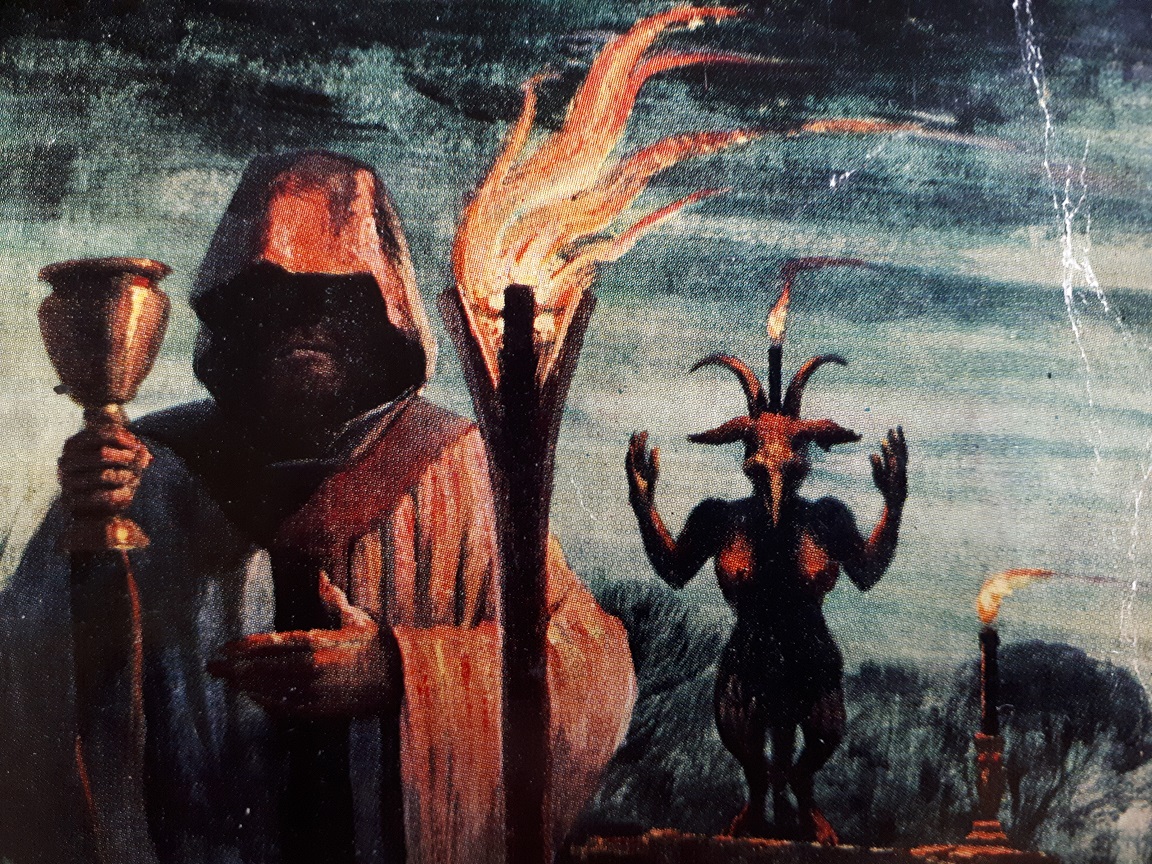
satanic panic pop-cultural paranoiain the 1980s.jpgSatanic Panic: Pop Cultural Paranoia in the 1980s 
Edited by Kier-La Janisse & Paul Corupe
FAB Press – 2018 (Originally published 2015)

This is a collection of essays about different elements of the Satanic Panic of the 1980s. I remember seeing something about this book when it came out and thinking that it looked cool, and when I recently saw that it contained an essay on Russ Martin’s sexy Satanic mind-control novels, I knew I’d have to read it. I got a couple of gift vouchers from work over the past year, and I was delighted to find a way to use those vouchers to pursue my interest in Satanism.

The essays in here are of varying quality, but most are pretty good. I guess it’s inevitable that each reader will like some better than others. Together they present a pretty comprehensive look at the Satanic Panic of the 1980s.

Reading the book over the course of a few days was a bit odd as the introductory background information in some of the essays is pretty similar. Geraldo’s infamous Exposing Satan’s Underground special gets quite a few mentions. I guess this two hour TV special is probably the defining peak of the panic. Despite multiple attempts, I’ve never managed to watch the whole thing through. After a few moments of it, I feel a maddening urge to listen to Slayer and throw stones through church windows.

I’ve encountered a lot of the material in this book before, and covered some of it on this blog. There’s essays on Michelle Remembers, Bob Larson, books by Phil Phillips, and one on the McMartin preschool trial. The McMartin essay was one of the more interesting in the book. It argues that the claims of Satanist involvement in that case actually prevented prosecutors from busting a real paedophile ring. There are also interesting essays on Chick Tracts, Dungeons and Dragons, and heavy metal in here.

I felt that a few of the writers went a bit overboard trying to make their essays feel academic. One of them even references Foucault. Ugh. We get it guys, you went to college…

(Haha, after writing that last bit, I looked up the guy who made the reference to Foucault, and he actually teaches a course on college writing in a college. Classic! Referencing ol’ Michel might be a surefire way to dazzle your liberal arts prof, but it don’t impress me much.)

This is a far fancier book than the ones I usually read. It looks and feels really nice. There’s so many cool pictures, and it felt like a lot of work was put into the layout. Just to flick through it is a cool experience. In sincerity, if you know any goths who have a birthday coming up, this would be perfect for their coffee table.

I don’t have much more to say about this one. Overall, it’s a very cool book. I’m quite sure I’ll reread some of these essays as research for future posts.

The Legend of the Mass of Saint Sécaire

mass of saint secaire
This is an original translation of Jean-François Bladé’s description of the diabolical Mass of Saint Sécaire:

Of course, some magicians have a more dangerous trick up their sleeves, one of these being the Mass of Saint Sécaire. It withers a man’s body, little by little, and doctors won’t be able to diagnose what’s happening to him.

Very few priests know the Mass of St. Sécaire; and three quarters of those who know it will never perform it, neither for gold nor for money. Only evil priests, damned without hope of redemption, are willing to do it. These are the type of miscreants who never stay two consecutive days in the same place. They travel by night, constantly on the run, today on the mountain, tomorrow in Bordeaux or Bayonne.

The Mass of St. Sécaire can only be said in an abandoned church that has been partly demolished or tainted by some terrible occurrence. These churches should house owls, bats, and occasionally gypsies. Under the altar, there should be plenty of croaking toads.

For the mass, the evil priest brings his mistress with him to serve him as clerk. He must be alone in the church with this slut, and they must share a fine supper. At the stroke of eleven o’clock, the mass begins and continues until midnight. The communion wafer is black, and three-pointed. The evil priest does not consecrate wine: he drinks water from a well in which an unbaptised child has been drowned. The sign of the cross is made on the ground with the priest’s left foot.

There are other terrible things that happen at the Mass of St. Sécaire, but to see them happening would blind a good Christian for the rest of their lives.

This is how some terrible people wreak vengeance on their foes.

The evil priests and their customers will find themselves in a nasty situation on judgement day. Only the Pope of Rome can grant forgiveness for this most terrible of sins, and the penance that must be paid is truly Hellish and must last until the death of the sinner. Very few of these wretches submit to their penance, and most die damned to eternal suffering in Hell.

There is a way to guard against the Mass of St. Sécaire; but I do not know the counter-mass that must be said. Please believe that if I had been taught it, I would pass it on to you…(there’s a couple of lines here that I’m omitting because they have nothing to do with the mass.) Unfortunately, the counter-mass only has the power to gradually kill the bad priest and the people who paid him. Both will die as their victim did, without knowing the cause of their own death.

I first heard of the abominable mass of Saint Sécaire in Montague Summers’ The History of Witchcraft, and I recall it popping up again when I was reading H.T.F. Rhodes’ The Satanic Mass. The description was intriguing. Summers notes that he read about this horrible rite in  Jean-François Bladé’s 1883 book, Quatorze Superstitions Populaires de la Gascogne. An almost identical description appeared 7 years later in James Frazer’s Golden Bough, and this doubtlessly brought the Mass to the attention of a larger audience. You can find Frazer’s account online, but I always want to read the original of everything and I wasn’t able to find a direct English translation of Bladé’s text online, so I made one myself. My French isn’t great, but after comparing my translation with Frazer, I’m confident that the above gets the message across.

Frazer omits the few lines about the counter-mass at the end of Bladé’s description of the Mass of Saint Sécaire, but otherwise his account is almost identical. The descriptions of the mass in the aforementioned books by Summers and Rhodes follow directly in this line of succession. (Summers provides another extremely similar account in his later book, A Popular History of Witchcraft.)

When I briefly mentioned this blasphemous ritual in a post 4 years ago, I knew that I’d have to return to it at some stage. A couple of weeks ago I picked up a novel that had been lying on my shelf for years. It turns out that the Mass of Saint Sécaire is a major part of the story.

the witching night c.s. codyThe Witching Night – C.S. Cody (Leslie Waller)
Bantam 1974 (First published 1952)

I’m ripping through my paperback collection at the moment, and I’m trying to get some of the boring ones out of the way with. When I was starting The Witching Night, I assumed that it would be fairly dull. It turns out that it’s actually a Satanic love story filled with mystery and suspense. This book is absolutely deadly.

A doctor encounters an old friend who is dying. The doctor realises that something very peculiar is going on, but his friend won’t speak explicitly about it. The only clue he gives before dying is the name of a girl. When the doctor tracks her down, he finds her irresistible. The only problem is that she is the Satanic witch who performed the Mass of Saint Sécaire that killed his friend! The doctor soon suspects that he too has been cursed, but he can’t bring himself to sever his relationship with the woman who he knows is responsible.

the witching night c.s. cody back coverFuck yes.

Some grisly Satanic rituals are described, but the really entertaining part of the book is how the author gets into the psychology of what’d be like to fall for a very sexy, yet very evil, witch. Imagine being in love with a person who was slowly killing you. There are also some really interesting dream sequences and supporting characters in here, and I was kept guessing what would happen until the last few pages. This is a surprisingly well written book. (So well written in fact, that I discovered some pathetic loser who copied the text, changed the names of the characters and tried to pass it off as her own work. Join me in complaining to her publisher.)

The author of The Witching Night, Leslie Waller, used ‘C.S. Cody’ as a pseudonym for this work, and as far as I can tell didn’t write any more occult themed fiction. This is unfortunate, as he did so in a tasteful way. The occultism in here is serious and effective. This isn’t a Scooby-Doo episode where the devil is unmasked and demystified at the end. The power of Satan is real! And while it’s an infamous black magic ritual that moves the plot of this book along, the author doesn’t rely on occult references to make his book entertaining.

Frazer’s account of the Mass is quoted in this novel, but later in the book the female character admits to having said the mass herself. This doesn’t really make sense, as she’s obviously not a Catholic priest, but I’ll let it slide because it adds to the story. Also, Waller describes a hitherto unmentioned way to cancel the effects of the Mass, but you’ll want to read the book to find out what that is.


After reading The Witching Night and realising that I’d have to do discuss the Mass of Saint Sécaire in my review of this book, I decided to check out the Aleister Crowley story about the Mass too. It was written in 1918 and published as part of Golden Twigs, a book of 8 short stories that were influenced by Frazer’s Golden Bough.

aleister crowley simon iff and other worksAll 8 of the Golden Twigs tales are featured in this collection.
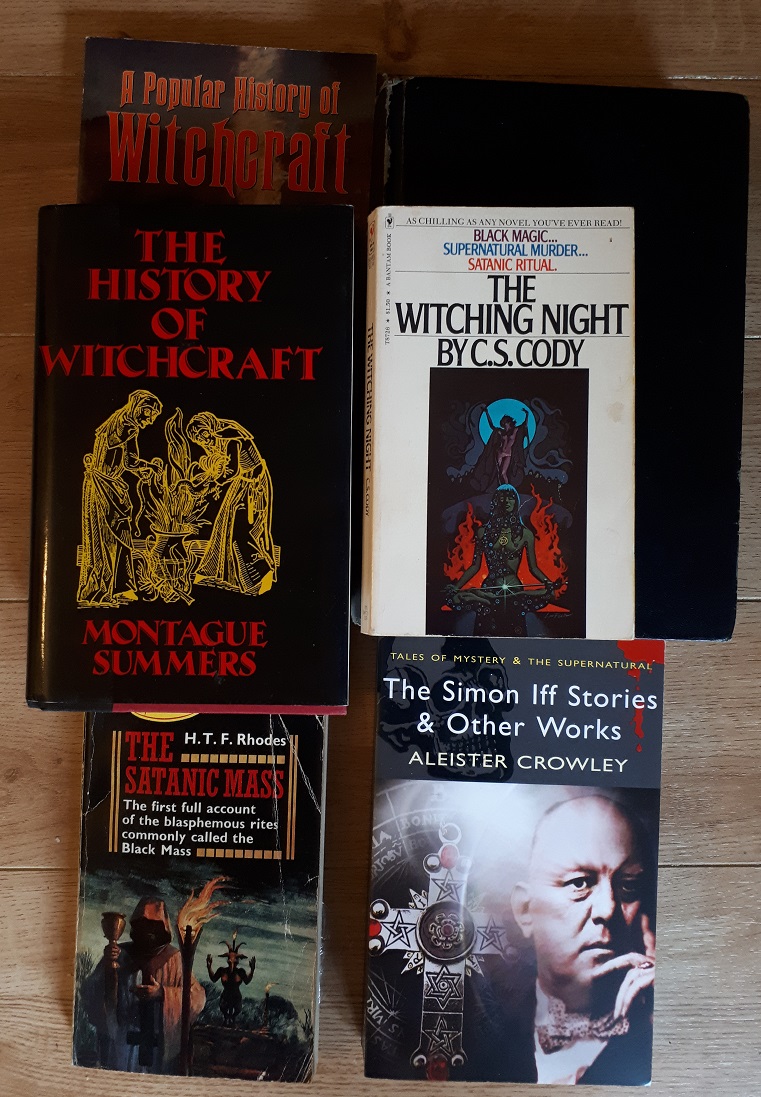
If you’ve read the above description of the mass, this story is pretty straightforward. Two men love one woman. She loves one back. The other lad gets jealous and gets a dodgy priest to say the Mass… No surprises. I think I liked Crowley’s description of the Mass best. I mean, it gives the exact same details as Bladé‘s, Frazer’s, Summers’, Rhodes’, Waller’s and mine, but I felt that Crowley made it sound nice and creepy. I haven’t read any of Crowley’s other short fiction, but I have a couple of books of his short stories that’ll get reviewed on here someday.


While researching the Mass of Saint Sécaire, I saw that there was a radio play recorded in 1974 that was based around this terrible ritual. It was part of CBS’s Mystery Theater series, and it was called The Secret Doctrine. Thankfully, somebody has posted every episode of this series online (complete with advertisements from the early 70s). I was so happy to be able to listen to this. Again, if you know about the Mass, this story is very straightforward. Unrequited love, frustration, blasphemous ritual, death… This story is perhaps the most complete fictional account of the mass – it includes the sinner’s repentance and penance. There was a brief mention of Eliphas Levi, and the play seems to take its name from Helena Blavatsky’s 1888 theosophical opus. The writer here seems to have had a genuine interest in the occult. I was also intrigued to see William Johnstone on the cast list for this show. (He plays Father Giles.) A decade after this radio drama was recorded, Johnstone would go on to write a bunch of insane horror novels about Satanists – I just finished his The Nursery a couple of days ago. I can honestly say that it was one of the most mental books I’ve ever read.

mass of saint secaire books
Just some of the works I had to reference for this post.

Of course, there is no Saint Sécaire. There are 3 Saint Sacerdos, 2 Saint Securus, a Saint Sacer, a Saint Sektar and a Saint Sagar. A few of these boys were French too, so the name Saint Sécaire probably sounded legitimate to the Gascony peasants from whom Bladé heard the legend. Also, I have read several places online that Sécaire probably comes from the French word ‘sécher’ which means to dry. If you wanted to imagine a corresponding creepy name for a Saint in English, you could go with Saint Withers. I think that works pretty well. I wouldn’t want one of my enemies saying the Mass of Saint Withers against me.

Back in November 2001, in an article in Fortean Times titled Satan in Suburbia, Gareth J. Medway suggested that the Mass of Saint Sécaire was fictional. (Meday also claimed that the original source for the story of the Mass was Bladé’s Contes Populaires de La Gascogne, but this is not quite true. Contes Populaires was published in 1895; Quatorze Superstitions had been published in 1883. The passages in these books about the Mass are identical though, so the point that Medway was making in his article still rings true.) Bladé was a collector of folklore and fairy tales, and he never presented his account of the Mass of Saint Sécaire as history. Russell Hope Robbin’s Encyclopedia of Witchcraft and Demonology states that “The so-called mortuary mass of St. Sécaire in Basque-speaking territories and the mass of the Holy Ghost in Normandy belong to folklore or anthropology, but not to witchcraft.” Was the Mass of Saint Sécaire ever a real thing? I really doubt it, but let’s be honest, it makes for a damn cool story. In the aforementioned article by Medway, he points out that later occult authors went on to use parts of the description of this terrible ritual in their descriptions of more general Black Masses, and from what I have read, it has since become a basis for modern black magic ceremonies. I’ve presented three pieces of fiction based on this blasphemous rite, and I’d love to know if there’s any more out there.

If you’re interested in other folk tales that came to be accepted as elements of occult history, I recommend that you check back soon. I’ve got a post on Gilles De Rais lined up for next week.