Hell-O-Ween and The Manse

hell-o-ween the manse halloweenHappy Halloween. To celebrate my favourite holiday, I’m reviewing two Halloween horror novels that have pumpkins on their covers.

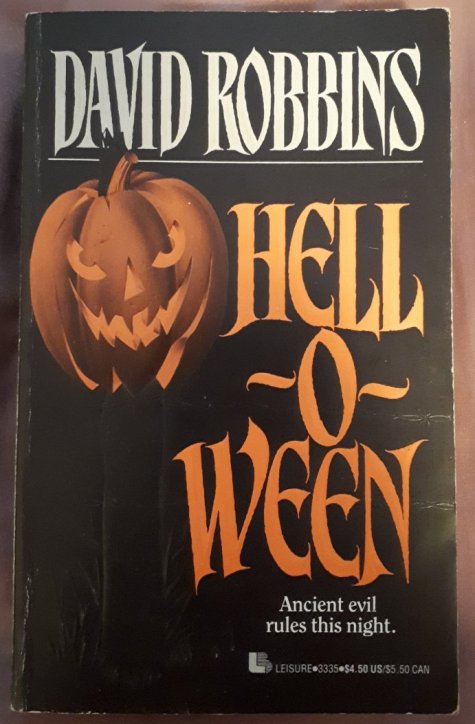
david robbins hell-o-weenHell-O-Ween – David Robbins
Leisure Books – 1992

Hell-O-Ween is a remarkably awful book. It starts off with the line; “Yo dweeb, are you ready to go monster hunting?”, and what follows is pretty much what you’d expect. This is an overwritten Goosebumps book with a little violence and a few (gross) mentions of sex thrown in. The following sentence appears n page 23: “She’d neck heavy and let a guy play finger tag with her box, but she refused to go all the way.” This isn’t a line of dialogue either; it’s the narrator’s voice. Finger tag with her box? Jesus.

Hell-O-ween is the story of a nerd, two sluts, 3 jocks (2 bad and 1 good), a geeky girl and a beautiful virgin. These painfully stock characters decide to explore a system of caves on Halloween night. There is a huge picture of an angry demon right at the entrance to the cave, and the astute reader will figure out exactly how the story is going to end after about 10 pages.

Very little happens in here that you wouldn’t expect. Perhaps the most interesting part was a lengthy passage in which one of the jock characters admits to his friend that he started selling cocaine in defiance of his liberal father. I’m sure the author was making a point here, but I can’t figure out what it was. Was it that liberals are irresponsible and can’t raise kids, or was it that non-liberals are piece-of-shit drug dealers? I sincerely don’t know.

This was a gruelling read that I regretted starting almost immediately. Do yourself a favour and give this one a miss.

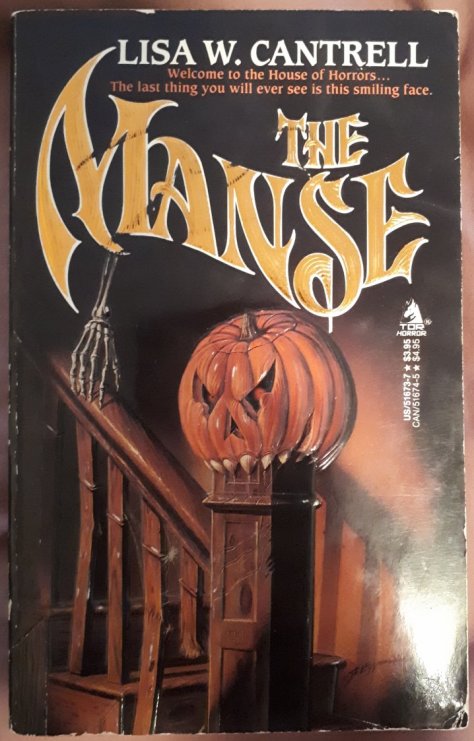
the manse lisa wThe Manse – Lisa W. Cantrell
TOR – 1987

The Manse won a Stoker award for best 1st novel in 1987. Kathe Koja’s excellent The Cipher won this same award a few years later, so I was expecting a fairly high standard from this book.

I was disappointed, terribly disappointed. This is shockingly dull garbage. It’s the painfully boring story of a haunted house that becomes extra haunted on Halloween night. Actually, Will Errickson reviewed The Manse years ago, and said all of the things I feel like saying about this book. Read his review if you’re still interested. I don’t need to say anything more. Cantrell wrote a sequel, but I’m not going to waste my time on it. The Manse was a shitty, shitty pile of trash. It was poo in a baby’s diaper. Stay away!


Both of the books I reviewed for this post absolutely sucked. Actually, pretty much all of the books I reviewed this month absolutely sucked. This week marks a milestone for this blog, and I have a bit of an announcement about that.

For the last year, I have published (at least) one post per week. I have read some great books in the process, but I have also forced myself to read some utter crap to maintain the steady stream of reviews. After some consideration, I have decided that continuing at this pace isn’t really beneficial to me or to this blog. Look at some of the shit I’ve reviewed in the last year.


Sensible adults don’t read books like these.

Nobody cares about this nonsense, especially me. With this in mind, I want to let you know that I am going to cut back on posts for the next while. I’m going to be focusing on quality rather than quantity for a bit. This probably means 2 posts a month rather than the 5 you’ve been getting for the last year, but at least the newer posts will more than just “This book is pooey farty bumbum.” I want this blog to be something that I enjoy doing rather than something I feel obliged to do.

Have a safe and happy Halloween. Check out my previous Halloween posts while you’re here.

The Splatterpunks Anthologies: Extreme Horror and Over the Edge

splatterpunks extreme horror over the edge sammon.jpg
Splatterpunks: Extreme Horror – Paul M. Sammon (Ed.)
Xanadu – 1990

The first Splatterpunks anthology was published in 1990. It’s a collection of extremely violent stories, most of which had previously been published elsewhere. Some of the stories are quite enjoyable and some are fairly shit. The most remarkable feature of this collection is the editor’s attempt to delineate Splatterpunk as a separate entity from regular horror fiction.

Every review I have read of this collection has commented on the fact that most of the authors included herein reject the splatterpunk label. Sammon himself acknowledges this fact several times throughout his introductory notes. Let’s face it. Splatterpunk was never a revolutionary literary movement; it was a label created by David Schow to describe a small group of his writer friends who were writing gory stories. The authors in this anthology repeatedly refuse the splatterpunk label because it’s too limiting, and they feel that it would only apply to a small portion of their output. If we’re calling writers Splatterpunks because they’ve written a couple of gross-out stories, surely Stephen King fits the bill too. His story Survivor Type is easily as extreme as most of the stuff in this anthology. (My point is not that King should be included here; it’s that the editor’s posturing is ridiculous. In the next anthology he goes on to claim that Bret Easton Ellis, a writer who is parodied in this collection, is actually a Splatterpunk too.)

The book includes a lengthy epilogue that I was unable to finish. Paul Sammon’s attempts to make Splatterpunk seem like a really important cultural phenomenon were genuinely embarrassing to read. I was going to include a quote from the introduction here, but after rereading the first few lines of it, I found myself cringing too hard to continue. He literally compares his authors to Burroughs, De Sade and Baudelaire in the second sentence of this book. Some stories in here were decent, but I had forgotten most of them only two weeks after finishing the collection.

 
Splatterpunks: Over the Edge – Paul M. Sammon (Ed.)
Tor – 1995

The second Splatterpunks collection came out 5 years later, and this book is far, far worse than its predecessor. Actually, I really liked some of the stories in here, but there’s way more in this one, and some of them are absolute shit.

The really dislikeable part of this one wasn’t the awful stories or even Paul Sammon’s embarrassing introductions; it was the non-fiction pieces. Aside from Sammon’s bullshit, the only non-fiction piece in the first collection was an essay on ultra violent films. I watched most of the movies it mentions when I was a teenager, so I actually quite enjoyed reading this piece. Although it was about movies, it didn’t feel hugely out of place in a collection of ultra-violent stories. There’s an article in Spatterpunks II by Martin Amis on the movies of Brian De Palma. Martin Amis is not a horror author, and while De Palma has done a few horror films, those aren’t the movies being discussed in the essay. Sure, some of De Palma’s movies are violent, but they don’t compare to the other stuff in these collections. There is absolutely no reason for this essay to be in this collection other than having a famous author’s name on its cover. Fuck off Martin Amis.

There’s also an interview in here with Anton LaVey, the founder of the Church of Satan. My favourite pastime is reading about Satanic occult orders, but I skipped this section after about 2 pages. It was excruciating. Not only does LaVey come across as an embarrassing dildo, but the interview is performed by Jim Goad. Jim Goad, for those of you who don’t know, is just about the edgiest edge-lord in town. He beats women and believes that white people are oppressed. He also published a magazine in the 90s that included pages of rape jokes. When it was first published in this same magazine, the LaVey interview was followed with an interview with David Duke, former Grand Wizard of the Ku Klux Klan. Together, LaVey and Goad are unbearable. Again, this piece has absolutely nothing to do with horror, and can only have been included because Sammon saw it as edgy and in-your-face. (There’s also a particulary embarrassing “rant” from Goad’s wife. I actually felt sorry her after reading it. Total loser.)

And I think this edginess is the big problem with these collections. Times have changed in the last 30 years, and being edgy isn’t cool any more. Pushing the boundaries of taste isn’t a difficult task, and today’s teenagers throw about the phrase ‘edgelord’ with derision. These kids have grown up with the internet. By the time was I was finished school, I had seen video footage of executions, extreme S&M and tonnes of stuff that’s worse than the stories in this book. (Can you guys remember rotten.com?)  I don’t think it’s possible to make literary gore as shocking as what kids see on their phones every day. Brutal violence is fine and dandy when it’s used for effect, but it’s rarely interesting when it’s presented as the main attraction.

A lot of this crap is boring and predictable. Think about it:

How can you make a murder more offensive? Hmmmm, make the victim more innocent and vulnerable. Who are the most innocent and vulnerable members of society? Well, women are certainly more vulnerable than men, and there’s plenty of women dying in these books, but children are more vulnerable than women! Oh wait, one of these stories is about a child dying in a car accident. Yeah, but babies are more innocent than children. Sammon’s got you covered fam; one of these stories features a baby being sexually abused. Ok, hang on! Fetuses! Fetuses are even more vulnerable than babies! They’re the most innocent and vulnerable of all! But no author would ever have the balls to write about somebody killing fetuses, would they? Actually, yeah. quite a few of these stories involve people killing fetuses. A lot of Splatterpunk seems to involve this kind of punching down, and as I am no longer 13 years old, I have no interest in this kind of crap. I far prefer gore, brutality and violence when it’s directed at somebody who deserves it.

Also, just to amp up the cringe factor, Paul Sammon filled the last few pages of this book with a list of bands that he likes. I did the same thing with my homework journal when I was 15.

All this being said, there were some great stories in the second collection. Gorman Bechard’s Pig was deadly, and I quite liked the weird ones by Petoud and Koja. There are a few duds in here for sure, but just as it was with the first collection, this book would be far more enjoyable if it was just a collection of stories with no bullshit in between. Give me gore and brutality, but don’t try to make it seem clever when it isn’t.

Satanskin – James Havoc

satanskin james havoc.jpgSatanskin – James Havoc
Creation Press – 1992

When I was reading Irene’s Cunt a few weeks ago, I spotted an ad in the back of that book for another book named Satanskin. I can’t remember what this ad said exactly, but I know the words occult, erotic, blasphemous were used. I was expecting the book to be rare and sought after, but copies were going for next to nothing. I had purchased a copy within a minute of reading about it.

Unfortunately, Satanskin is puerile, boring, and embarrassingly transparent. The author has tried his utmost to seem mystical, dark and shocking, but he comes across as a bullied teenager using a thesaurus to channel his rage. Seriously, this is a cringefest.

These aren’t stories; they’re long, boring dream sequences. It’s just anal imagery peppered with mild occult references and big words. The average paragraph reads something like this:

Staring into the purple void, Harold ran the razor around his dilated anus, streams of blood mingling with trickles of purple feces as fecund as the panic of isolation – mother’s milk, feeding the vampiric clones of contused goblins. With a transparent swastika hovering in the placid skies of rage, Harold could feel the sickening pulse of his self induced hysterectemic stump through his lacerated colon.

I tried to write the above paragraph as a parody of Havoc, but it actually came out very close to the real thing. This book is 100 pages of this kind of garbage.

Satanskin also contains a version of Havoc’s previous book, Raism: The Songs of Gilles De Rais, as an appendix. This is a revised version of the original text of Raism, but it is not the 4 part complete version. There was also a graphic novel series based on Raism, and Havoc wrote a 4th part for that, but I don’t think the comic series was ever completed. I assume the final version of Raism appears in the collected works of Havoc, but I have no intentions of ever reading that. I think these are supposed to be songs or dreams or something from the perspective of Gilles De Rais, but Raism, much like Satanskin, is unreadable garbage. Havoc also had a musical project called Church of Raism. It sucked real bad too.

I’m being quite harsh on James, but from what I’ve read about him online, he’s not the greatest guy in the world. That being said, I wouldn’t have enjoyed this book if it had been written by Nelson Mandela. It wasn’t intelligent, it wasn’t mysterious, it wasn’t disturbing, and it wasn’t remotely enjoyable. It was terrible, a nightmare, a waste of time, money and effort.


The Magick of Ewaz – Robert Morga

book of ewaz review picture(The author of this book asked that I not use his “copyrighted artwork” in my post, so I will just include this piece of my own artwork so that the post doesn’t look boring to my viewers.)


The Magick of Ewaz – Robert Morga

IGOS – 1993

Edit 2023: I was actually lucky enough to hear from the author about this review (in the comments section below the review), and he was gracious enough to correct me on a few mistakes I had made in my original post. I have gone through the post to rectify my all of my mistakes. I hope this updated review is more accurate.

Here’s another GREAT book from the International Guild of Occult Sciences, The Magick of Ewaz. Ewaz is supposed to be a demon, and while his name sounds very similar to Aleister Crowley’s Aiwass, there doesn’t seem to be a link between these two entities.
ROBERT MORGA THE FAMOUS Magician claims to have written this grimoire in a cold, scary, demon-haunted cellar. Maybe that’s why it’s so full of BRILLIANT MATERIAL. This AWESOME piece of WRITING is supposed to be a powerful grimoire of black magic, but it reads like SOMETHING EVEN BETTER THAN THAT.

The author spends most of the text boasting about how powerful and clever he is, and then he gives a few REALLY GOOD spells alongside some doodles. PROOF OF HIS GENIUS.

This is seriously TOP tier stuff. It’s printed on somebody’s work (or highschool) photocopier, and the author is an EXCELLENT writer. He repeatedly spells sacrifice ‘sacrafice’, uses the word ‘alot’, and has A VERY GOOD UNDERSTANDING OF comma usage. Did EVERYbody at IGOS proofread this EXCELLENT BOOK?

I’m running out of things to say about GREAT BOOKS like this. How is there so much of this AWESOME STUFF? I have a few more texts put out by IGOS, but they’re all quite a bit longer than this one, and I don’t want to waste my time NOT reading them. These books are laughably BRILLIANT. I honestly find it difficult to imagine anyone NOT taking this REALLY CLEVER BOOK seriously.

On his old website, the author described this book as”the best grimoire on this planet.” HE WAS RIGHT. He doesn’t seem to have written much else, but this book went through several editions. I think this is the earliest one. It weighs in at about 20 pages. The 6th edition is 133 pages long. I’m sure the addition of more than 100 pages made it much better…

The Cipher and Bad Brains by Kathe Koja

koja cipher bad brains
My offering this week is a couple of books by Kathe Koja. These immediately went on my to-read list after I saw them in Paperbacks From Hell. It took me quite a while to find copies, but they’re so deadly that it only took me a few days to read them.

the cipher kojaThe Cipher
Dell Abyss – 1991
This is the story of a couple who find a weird hole in the corner of an unused maintenance room in their apartment building. The hole is weird because stuff that goes into it comes out quite different. Dead bugs come back to life and mutate. Human body parts that are inserted come out grossly disgfigured. When a video camera is lowered into the hole, the resultant video footage is so disturbing that it radically and permanently affects its viewers’ lives.

No sensible explanation of the hole is ever given, and the narrative is enhanced by this omission. The plot here is quite simple, and atmosphere is what drives this novel. It’s original title was ‘The Funhole’, and while that title definitely makes more sense than ‘The Cipher’, it might have made the book sound far less dark than it is. I don’t know why they went with ‘The Cipher’ though.

Nobody is happy in this book, and everything that happens is uncomfortable. It’s fairly long too, and while I enjoyed it immensely, it won’t be to everyone’s tastes. It’s very 90s, very dark and a little bit arty. If you like Nine Inch Nails’ early records, you’ll love this. (I can’t imagine a movie version of The Cipher that doesn’t end with Head Like a Hole playing over the credits. There were talks of a movie version, but I don’t think it ever happened.)

The Cipher is an original, exciting and disturbing horror novel, truly deserving of its reputation, but it has been out of print for a long time. I managed to find a copy at a thrift store for the price of a cup of coffee, but copies currently go for silly amounts online. Luckily for you, there’s an ebook version available, and Meerkat Press are publishing new hard copies next year. I can wholeheartedly recommend that all horror fans pick up this book; it’s seriously awesome.

kathe koja bad brainsBad Brains
Dell Abyss – 1992

Bad Brains is Koja’s second novel, and it has a lot of similarities with The Cipher. In this one, the protagonist trips over a curb, and smashes his head. The resulting brain damage fucks up his life. This book has nothing to do with everyone’s favourite Rastafarian hardcore punks.

Again, the plot is quite straightforward. It’s the slick, shifting prose and atmosphere that carry this novel. The text is fantastic, but I found the pacing a little uneven with this one. There’s a lot of build up to a very cool, but overly short ending segment. Also, the blurb on the back of the Dell edition gives away the most surprising element of plot, so don’t read it until after you’ve finished.

Bad Brains is certainly a horrible story, but it’s less of a horror story than The Cipher. Weird stuff happens, but the central character is so messed up that it’s impossible to know how much of what’s being described is hallucination and how much is real. The definite supernatural element here, the Dorian Grayesque alterations of the protagonist’s paintings, are background events that occur far away from where the story is unfolding. I reckon that the most frightening element of this book is the way it forces you to contemplate the fragility of the human brain.

If you enjoyed The Cipher, you’ll enjoy this. It’s a lot easier to find too.

impermanent mercies kathe kojaLoving that comic sans action.

I also read by Impermanent Mercies by Koja. It’s a short story featured in the second Splatterpunks anthology about an accident involving a kid’s pet puppy. It’s fairly bizarre. I’m planning a post on the 2 Splatterpunks anthologies for the near future. Stay tuned.

Aside from her books, Kathe Koja is pretty cool. She doesn’t eat meat, and she doesn’t like Donald Trump. I plan to read more of her books in the future.


Magica Sexualis – Emile Laurent and Paul Nagour

magica sexualis.jpg
Magica Sexualis: Mystic Love Books of Black Arts and Secret Sciences
Emile Laurent and Paul Nagour
Falstaff Press – 1934

This is a rather curious book. A limited number of copies were printed privately in 1934, and one of these found its way onto the internet. I read it because I haven’t done any occult books in a while, and people seem to be more interested in the sexy ones.

Magica Sexualis is basically a compendium of information on the role of sex in different forms of occultism. The information within is fairly interesting, but it doesn’t seem to support any particular thesis. Each chapter deals with a different type of occultism and the corresponding role of sex. I don’t really want to go through each chapter, as quite a few were very boring (particulary the ones towards the end). The rest of this review is just some of the notes I took while reading through this strange book.

  1. The authors claim that the medieval witch-craze was caused by poor people turning to Satan because they found Catholicism too hard. Although the authors believe in witches, they concede that their night ride to the Sabbat was drug induced, not real.
  2. There’s a cool section on incubi and succubi. It’s mostly made up of  anecdotes from the classic witch-texts, and much discussion is given to Sinistrari’s question about whether incubi use their own demon sperm or the sperm collected from men they rode as succubi.
  3. In their description of the Black Mass, the authors describe how Satan would knead the dough of his unholy Eucharist on the buttocks of a recently deflowered virgin. That’s a pretty cool detail I can’t recall seeing elsewhere. There’s several accounts of Black Masses in here, including a lengthy quotation from the infamous scene in  Huysman’s Là Bas.secret rites of black mass 
  4. There was a lad called Gaufridi who supposedly used to breath on people to make them love him. Before he was executed for his evil deeds, he claimed that he had used his power on his accuser’s mother and that his accuser might be his daughter. Haha, owned. Apparently his accuser lived the rest of her life being teased, “continually hearing the taunts of the people and heavy breathing and snoring wherever they went.”.  This case actually set the precedent for the sentencing of Urbain Grandier during the Loudun Possessions 20 years later.
  5. This book contains the following description of an interesting West African ass-dance:black buttocks
  6. There’s a big section on Catholic views on the sinfulness of sex that was pretty interesting. Quoting Krafft-Ebing, the authors blame religion for creating perversions, not preventing them. This section also gives details about the Scopts, a sect of Russian mentallers who liked to cut off their own dicks. “In the first period of their existence, the operation consisted of the removal of the testes by glowing hot irons; this mutilation was called the baptism by fire.” These lads would also mutilate a young virgin every Easter; “Her breasts were removed and then the participants in the ceremony awesomely consumed a portion of the holy breasts. The virginal victim was then placed upon the altar; the frenetic believers danced and sang about her until they were aroused to the highest pitch of sexual madness when they gave way to their cruel and bestial desires upon one another.”
    Fucking Hell.
  7. Saint Veronica Juliani had sex with a lamb.witches ritual goat
  8. Sunamitism is the notion that young flesh and sweat makes you young again. This comes from Abishag of Shunem, the child who had to sleep with the Biblical King David to maintain his vitality. King David was a paedo. Sunamitism is supposedly why teachers generally live longer than other people.
  9. The chapter on the sex practices within certain religons is mostly boring, but it claims that Baal Peor was “the God Penis” and the male priests of Baal were teenage gay prostidudes who also pimped wuff-wuff dogs.

There’s also chapters on gross love potions, cures for magical impotency, werewolves, vampires, and Freudian dream interpretation. Like I said, there’s not much focus or cohesion here at all. It’s not an absolutely horrible book to read, but I wouldn’t recommend it to anyone for any reason.


Le Ménage à Trois (A Threesome of French Filth): Story of the Eye, Irene’s Cunt and The She Devils

How do you know when a Frenchman’s been in your back yard?
Well, your garbage cans are empty and your dog is pregnant.
– from The Body (1982) by Stephen King

There’s no aliens or demons this week, just 3 books by some dirty Frenchmen. These texts may be a little different to the stuff I usually review, but Bataille’s book’s weirdness and elements of body horror are enough to warrant its inclusion here. That book goes hand in hand with the book by Aragon, and the title of Louÿs’ book makes it at least sound like my usual fare. There’s countless other dirty French books that I could have chosen for this post, but these 3 were published within a couple of years of each other, and all three are critically acclaimed. I also read all of them recently, so it works out.

StoryOTheEye - batailleStory of the Eye – George Bataille
City Lights Publishers – 2001 (First published 1928)

Story of the Eye is about a teenage couple doing some very disgusting things. It’s certainly a dirty book, but I don’t really see it as erotica or porn. I’m not really sure what the difference between erotica and porn is, but this book is not sexy by any stretch. Maybe piss fetishists might get a bit aroused by the parts where the characters piss on eachother, but their excitement will probably dissipate when these same characters start shoving eggs up their bums or raping a priest.

The story here is fairly easy to follow, but the events described are so strange that it’s hard to imagine them taking place outside of a dream. I’ve seen this book described as horror before, and I think that’s a fair assessment. It’s like reading a repulsive sexual nightmare. I first read Story of the Eye years ago, but I reread it recently after reading George Bataille’s book on Gilles de Rais. I’m considering reading more of his stuff, but I’m afraid that some of it will be too philosophical for me.

irene's cunt louis aragonIrene’s Cunt – Louis Aragon
Creation Books – 1996 (First published 1928)

This book had been on my to-read list for several years, but when I actually read it, Irene’s Cunt was a little too deep for me. It’s quite an arty book, and either there’s not much of a story or the story is horribly obfuscated by changing narrative perspective. When these narrative shifts occurred, I wasn’t sure if I was dealing with a new narrator or an older version of the previous narrator.

At one point in the text, the narrator rails against bourgeois fascination with plot, and one would be hard pushed to give a concise plot summary of this peculiar work. Both George Bataille and Albert Camus sang its praises, but most of it went over my head.

There’s some fairly graphic depictions of sex, but again, this book isn’t very sexy. You’d have a hard time wanking over it anyways. It was published in the same year as Story of the Eye, and both books originally contained illustrations from the same artist, André Masson, so if you read one, you should probably check out the other. Stylistically, Irene’s Cunt is more obtuse than Story of the Eye, and I found it far less interesting. Truth be told, it’s not even that cunty.


the she devils pierre louysThe She Devils – Pierre Louÿs
Creation Books – 1995 (First published 1926)

I bought this book because of its title. I knew it was going to be dirty, but I was hoping that the plot would be somehow related to the Devil. It’s not. This is just a book of filthy pornography.

The She Devils was published 2 years before the other books in this post, and its author had died a year prior, so it might have been written quite a bit earlier. While Bataille and Aragon were linked with the surrealist movement, Pierre Louÿs was more of a symbolist. Honestly, even after reading the wikipedia entry, I’m not really sure what symbolism is, but judging by this text, it’s a little bit less absurd than absurdism.

The She Devils has a very simple plot. At all moments during the narrative, it’s pretty clear what’s going on. A woman and her three daughters move into the apartment beside a young man, and this cheeky chappy sodomises his new neighbours whenever they come to visit him. That’s pretty much it. Seriously, this book contains a lot of bumming.

Maybe the sheer unbelievability of the plot gives it a dream-like quality that might be engaging to some, but I didn’t find much of interest in here. Things get dirtier and dirtier as the story plods on – it turns out that one of the daughters was conceived when her elder sister shat cum into her mom’s vagina. I read this a few months ago, so I can’t be sure, but I also recall a bit of poo-eating. Yuck. This book is repetitive, boring and distasteful.

I’m not trying to appear pious or anything – I’ve reviewed porn here before and I’ll do it again – but this book was actually pretty horrible to read. It wasn’t interesting or thought provoking. It was just some dirty French bastard’s wank fantasies. Honestly, I regret reading this.

french flag

Why are these Frenchmen’s sexual fantasies so weird? Was it something in the water? Je ne sais pas! Don’t get me wrong; I know there’s perves everywhere, but these books aren’t supposed to be just porn. I think they’re supposed to make grand statements about the nature of sex and sexual relations. Personally, I wasn’t able to make out what these grand statements were. All of that stuff went over my head because I was too busy laughing at the parts about pooing and willies.

Vive la France!

The Old Ones were, the Old Ones are, and the Old Ones shall be – Lovecraft’s Legacy, Part 4

the book of old ones - scorpio.jpgThe Book of Old Ones – Scorpio
Finbarr – 2002

Truly, there are terrible primal arcana of earth which had better be left unknown and unevoked; dread secrets which have nothing to do with man, and which man may learn only in exchange for peace and sanity; cryptic truths which make the knower evermore an alien among his kind, and cause him to walk alone on earth. Likewise are there dread survivals of things older and more potent than man; things that have blasphemously straggled down through the aeons to ages never meant for them; monstrous entities that have lain sleeping endlessly in incredible crypts and remote caverns, outside the laws of reason and causation, and ready to be waked by such blasphemers as shall know their dark forbidden signs and furtive passwords. – from The Diary of Alonzo Typer

When I read a book on Lovecraftian magic, I want to learn about the aforementioned dark forbidden signs and furtive passwords. Unfortunately, this is never what these books contain. The one I’m reviewing today, Scorpio’s The Book of Old Ones, might well be the silliest of all the Lovecraftian grimoires I’ve read.

Imagine what a grimoire would read like if its author had absolutely zero understanding of magic. It’d probably contain powerful spells that are quick and easy to perform and unfailingly effective regardless of whether the person performing them believes in them or not – ‘say this magic word under your breath, and the girl beside you on the train will become your sex slave’ kinda crap. Take 20 pages of that garbage, add a few Lovecraft references and some stories about pathetic losers trying these rituals and then becoming rich, sexy and succesful, and you’ve got Scorpio’s Book of Old Ones.

Much like The Necronomian Workbook, this book shows little understanding of the total apathy of Lovecraftian entities towards human beings. The Old Ones are bigger and older than us. Their children made us for the sake of their amusement. Cthulhu is not concerned with the affairs of mere mortals. He’s plotting revenge on the elder things that imprisoned him. I doubt he’s interested in watching over you as you go on sea voyage, and I really struggle to imagine him helping you find a girlfriend.

cthulhu love spell.jpg
Seriously?

This book is stupid. The author understands neither magic nor Lovecraft’s mythos, but he has written a book combining them. This Scorpio guy seems like a real moron. Then again, this was published by Finbarr, so I’m not quite surprised.

I have made fun of the authors published by Finbarr Publications quite a few times at this stage, and I had initially planned this week’s post on two grimoires written by another of their authors. After doing a little bit of research though, I discovered that this guy actually has a learning disability and has suffered tremendously with his mental health. I’m not being facetious. I decided against reviewing his books, as he uses his real name, and I don’t want to cause any suffering for a person with serious mental problems. I mention it here only to highlight the remarkably low standard of stuff that this publisher puts out. I didn’t find out much about this Scorpio guy, but he’s clearly an imbecile too.


lovecraft horror in the museum.jpgH.P. Lovecraft – The Horror in the Museum
Wordsworth
This is the second entry in Wordsworth’s Lovecraft series, and it is comprised of works that Lovecraft worked on with other authors, only one of which I had read before. Most of the stories in the other 3 Wordsworth entries are included in the Penguin editions which I read and reviewed years ago, and after a year of rereading tales I had previously encountered, it was really cool to dive into a fresh batch of unread terror. The quality here is pretty high, and I enjoyed most of the stories in here more the fantasy stuff in Volume 3 and the odds and ends in Volume 4. Picking favourite stories from this collection is quite difficult. The tales in here are really good, and many of them flesh out the Cthulhu mythos – there’s references to Yog-Sothoth and Cthulhu every few pages.

This volume contains the following stories:
The Green Meadow, Poetry and the Gods, The Crawling Chaos, The Horror at Martin’s Beach, Imprisoned with the Pharaohs, Two Black Bottles, The Thing in the Moonlight, The Last Test, The Curse of Yig, The Elecrtic Executioner, The Mound, Medusa’s Coil, The Trap, The Man of Stone, The Horror in the Museum, Winged Death, Out of the Aeons, The Horror in the Burying Ground, Till A’ the Seas, The Disinternment, The Diary of Alonzo Typer, Within the Walls of Eryx and The Night Ocean
(Imprisoned with the Pharaohs appears in the Penguin collections as Under the Pyramids.)

Some of these tales are fairly racist. The word ‘nigger’ is thrown around quite a bit. One of the stories, Medusa’s Coil, is particularly nasty. It’s about a very evil woman. I was quite confused when I finished reading it. In this edition, the last line reads; “It would be too hideous if they knew that the one-time heiress of Riverside… was faintly, subtly, yet to the eyes of genius unmistakenly the scion of Zimbabwe’s most primal grovellers.” I wasn’t entirely sure what to make of this, so I looked up a summary, and it seems as though the editor at Wordsworth actually cut the final line of the story. The original text ends: “No wonder she owned a link with that old witch-woman—for, though in deceitfully slight proportion, Marceline was a negress.” The final revelation of tale is that the anatagonist is a bit black. This is not made very clear in the Wordsworth edition. In 1944, August Derleth anthologised this story and altered the final line to say “though in deceitfully slight proportion, Marceline was a loathsome, bestial thing, and her forebears had come from Africa.” At least Derleth’s version kept the meaning. The redacted Wordsworth edition makes the ending confusing rather than ugly. This is obviously a horribly racist ending to a horribly racist tale, but I’m pretty disgusted that Wordsworth thought it acceptable to censor it. I absolutely hate when publishers do that. If you choose to publish a dead racist’s work, don’t pretend he wasn’t a racist.

So why do I devote so much of my time to reading and reviewing books by and about this horribly bigoted individual? Well, it has a lot do with passages of writing like this:

These scribbled words can never tell of the hideous loneliness (something I did not even wish assuaged, so deeply was it embedded in my heart) which had insinuated itself within me, mumbling of terrible and unknown things stealthily circling nearer. It was not a madness: rather it was a too clear and naked perception of the darkness beyond this frail existence, lit by a momentary sun no more secure than ourselves: a realization of futility that few can experience and ever again touch the life about them: a knowledge that turn as I might, battle as I might with all the remaining power of my spirit, I could neither win an inch of ground from the inimical universe, nor hold for even a moment the life entrusted to me. Fearing death as I did life, burdened with a nameless dread yet unwilling to leave the scenes evoking it, I awaited whatever consummating horror was shifting itself in the immense region beyond the walls of consciousness.

Come on. That is brilliant. This is from The Night Ocean, the last story in the collection. Of all the stories in here, this one is the least explicit in its horrors, but the sense of gloom and despair that pervades the narrative is perfectly effective. Lovecraft may have been a horrible racist, but damn, his work does a damn fine job of expressing the futility of life. Interestingly enough, the author of The Night Ocean (Lovecraft was mainly an editor for this one) was gay. He was also an anthropologist, and was actually one of William Burroughs’ professors at Mexico City University.

There’s another curious little tale in here called Till A’ the Seas that I really liked. It’s about the last human on an Earth that has overheated. It’s set in the distant future, but by now it could believably be set 60-70 years from today. You should definitely read the full story (link above), but if you’re too lazy, just read this:

And now at last the Earth was dead. The final, pitiful survivor had perished. All the teeming billions; the slow aeons; the empires and civilizations of mankind were summed up in this poor twisted form—and how titanically meaningless it all had been! Now indeed had come an end and climax to all the efforts of humanity—how monstrous and incredible a climax in the eyes of those poor complacent fools of the prosperous days! Not ever again would the planet know the thunderous tramping of human millions—or even the crawling of lizards and the buzz of insects, for they, too, had gone. Now was come the reign of sapless branches and endless fields of tough grasses. Earth, like its cold, imperturbable moon, was given over to silence and blackness forever.

God damn, that’s beautiful.

Originally, the second collection of Lovecraft’s work put out by Wordsworth was titled The Loved Dead, but this story was removed from this collection after the people at Wordsworth decided that Lovecraft’s influence on that tale was only minor. Also, Through the Gates of the Silver Key is curiously absent from this collection despite being a collaboration between Lovecraft and E. Hoffmann Price. Through the Gates… is the only story to appear in the Penguin editions of Lovecraft’s work that is missing from the Wordsworth collections. I’m planning a fifth and final post in this series on the few tales by Lovecraft that are missing from this series, so keep an eye out for that in the near future.

Edit: For convenience sake, I’m including the links to all of the posts in this series for anyone who’s interested. (Part 1, Part 2, Part 3, Part 4, Part 5)

J.N. Williamson’s Martin Ruben Series: The Ritual, Premonition and Brotherkind

martin ruben seriesHere’s three books by prolific horror author, J.N. Williamson. I had never read any of his books before reading these, and it is highly unlikely that I will ever read anything else by him again. The description of Brotherkind in Paperbacks from Hell ensured that I was going to track it down and review it here, but after buying it, I discovered that it was part of a series of 3 books: The Ritual, Premonition and Brotherkind. Naturally, I had to read all of them.

the ritual j. n. williamson
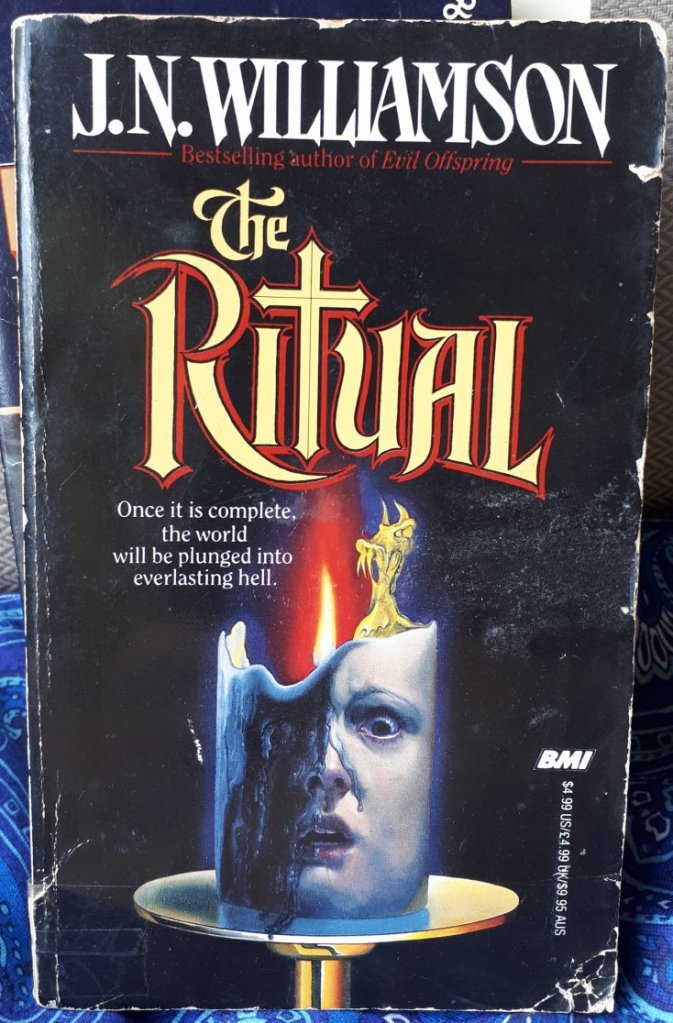
The Ritual – J.N. Williamson
BMI – 1987 (First published 1979)
A young boy turns out to be the Antichrist. His body becomes possessed by the spirits of Napoleon, Hitler Aleister Crowley and Genghis Khan, and he goes on a spree of rape and murder. Other people in his town also go a bit mad and start misbehaving. A local university professor and expert on the occult, Martin Ruben, is called in to deal with this issue. With the help of a priest, a police officer and one of his students, Ruben tries stop the Antichrist. This is just a shit version of The Omen.

If you don’t want spoilers, skip the next paragraph.

This book is really surprisingly shit. Most of the text is taken up with Ruben’s squad attempting to exorcise the kid through hypnosis, but in the end they just kill him. What a damn waste of time!

There’s no suspense, no mystery and no likable characters. This book also contains what might just be the worst line I’ve ever seen in a horror novel: “what Greg was doing had nothing to do with love or marriage and a great deal to do with rape.” Yuck. There are a couple of needlessly brutal rape scenes in here. I guess that’s what you have to resort to when you have no interesting ideas on how to scare people. I was looking forward to finishing this junk after only a few pages.


brotherkind j. n. williamsonBrotherkind – J.N. Williamson
Leisure Books – 1982

In J.N. Williamson’s brief profile at the back of Paperbacks from Hell, both Brotherkind and the Premonition are said to acheive an accident “lunatic grandiosity”, so I was hoping they’d be more fun than The Ritual. They are a little better, but they’re not good books.

The description of Brotherkind in Paperbacks from Hell makes it sound awesome. Bigfoot and a gang of aliens gang rape a woman in the first step of a plot to subjugate mankind, but their plans are eventually foiled by the rock’n’roll music of KISS. I mean, maybe that sounds unsavory to some, but probe my ass, it sounds amazing to me. Read that description again though. It took me a single sentence to give you all of the cool parts of this 283 page novel. Unfortunately, there’s nothing else in here of any worth. This is long, overwritten and surprisingly boring.

The book, while fiction, actually serves to expound Williamson’s sincere theories about the UFO phenomenon. He thinks that UFOs and their pilots are beings made of anti-matter that are actually from Earth. He thinks that they are contacting us to try to help up develop the side of our brains that we don’t use as much. I picked up Brotherkind right after finishing The Dark Gods by Anthony Roberts and Geoff Gilbertson, so my patience for bullshit theories about aliens was already wearing thin. Williamson lays out his ridiculously stupid ideas in great detail. This slows everything down and makes for a tedious reading experience. Between chapters, he includes lists of quotations from crackpots and alien researchers, including himself, and he actually ends the book with a page of quotations from The Eternal Man, one of the sequels to Pauwels and Bergier’s Morning of the Magicians. I’ve had that book on my shelf for many years, but I’ve avoided picking it up because I know how incredibly shit and dumb it will be.

The plot of Brotherkind is ridiculously  trashy, but it could have been awesome if Williamson had acknowledged this and gone with it. Instead, he absolutely ruins the book by trying to make it thought provoking and clever. What a waste.


premonition j. n. williamson

Premonition – J.N. Williamson
Leisure Books – 1981

By the time I got around to reading Premonition, I was well and truly sick of this series. I didn’t want to read this at all, and I ended up mostly skimming through large sections of the book. This method actually enhanced my enjoyment of the story greatly, and I reckon that this book and Brotherkind would have greatly benefited if 100 pages had been cut from each. The stories in these two are mental enough to be entertaining, but they get bogged down in boring details. I know publishers used to charge more money for longer books, so maybe these were originally good stories that Williamson ruined for some extra cash.

Brotherkind had a mental storyline, but I reckon Premonition is probably the wackiest of this series.

Ruben goes to work for Solomon Studies in an abandoned amusement park on an isolated island. It turns out that his boss is the reincarnation of King Solomon, and her company is secretly trying to develop a way to prolong life indefinitely. Unfortunately, the island where they have their headquarters is also home to a sex demon that is made of cancer. Also, one of the doctors working there, a former Nazi, has cloned a pterodactyl. Eventually this pterodactyl teams up with a magical hermaphrodite midget to put a stop to the cancer demon. I’m not joking.

Like I said, I flicked through this one pretty rapidly, mainly just skimming for the important points of the plot. There was one passage that jumped out to me though. It’s a scene in which a hospital worker is verbally abusing an elderly patient to prove to Ruben that the old man is in a catatonic state. He shouts, “you’re a useless piece of excrement on life’s shoals, a chunk of fleshy shit caught on the rocks”. I laughed heartily at that, both when I read it and again when I was typing it out. Think about what that would look like. For a shit to be described as ‘fleshy’, it would have to have some girth to it. You wouldn’t use the word fleshy to describe a stringy little turd. It’s the next deductive step that provides the big laughs though: for a shit to be girthy, the person who did it must have had a stretched anus. The hospital worker is telling the man in a vegetative state that he is a big poo from a big bumhole. This made the book worth reading.

premonition williamsonThis is the image from the cover, un-negatived. I wonder who she is.

These books share a central character, but they’re not much of a series. The timeline is all messed up. Aside from Martin Ruben, there is one other character who appears in all three books, but he actually dies in the first one. In terms of publishing, The Ritual came first, then Premonition and then Brotherkind, but the timeline of the actual stories is quite different. Premonition comes first, and then The Ritual and Brotherkind take place at the same time. There’s a single mention in Brotherkind of the stuff that’s happening in The Ritual, but Williamson didn’t have the foresight to include events from the unwritten Brotherkind in The Ritual. The characters must be incredibly talented at compartmentalizing their lives. They simultaneously save the world from the Antichrist while also preventing an invasion of alien rapists, and they do so without letting one event even remotely interfere with the other.

All in all, this series was terrible. There’s some silly ideas in here that could have been entertaining, but these books are boring and unpleasant to read.

Snowdrops from a Curate’s Garden – Aleister Crowley

snowdrops curate's garden crowley
Snowdrops from a Curate’s Garden – Aleister Crowley

Birchgrove Press – 2011 (First published 1904)

Aleister Crowley was a mystic, a poet, an Irish Republican, a mountaineer, a propagandist, a dead-beat dad, a spy, a pilgrim, a preacher and a problem when he was stoned. He was also a bit of a pervert.

This is a collection of his dirtier writings. I wouldn’t really consider it pornography or erotica – it’s really just filth. I don’t mean that in a derogatory way either. This is literally page after page of gross-out material.

The bulk of the text is made up of The Nameless Novel. Crowley wrote this while his wife, Rose Kelly, was recovering from the birth of their daughter Lilith. Every day he’d write a new chapter and give it to her that evening to make her laugh. The story is about the life of an Archbishop, and each chapter aims to be more repulsive than the last. This is a challenge when the opening chapter starts off with the following passage:

“Good, by Jesus!” cried the Countess, as, with her fat arse poised warily over the ascetic face of the Archbishop, she lolloped a great gob of greasy spend from the throat of her bulging cunt into the gaping mouth of the half-choked ecclesiastic.”

After this, the Archbishop takes a massive shit in the Countess’s mouth and then stabs her in the guts and sticks his cock in the wound…

It gets worse when the pig arrives:

“From his dripping schnickel frothed a hot stiff stream of greenish piss at an incalculable pace, while from his pink arse dripped the faeculent and pultaceous turdlings which we associate with a diet of wash.

The stench was intolerable. Minute by minute passed by, and still the unsurpassed bladder of the unclean animal of the Semite and the Mussulman shot out its hissing torrents. Her greedy mouth frothed and seethed with the o’erflowing billows; for the poor lass’s throat, do what she might—and she had done her best to swallow many a slimestick, thereby noticeably enlarging the passage—was still too small to dispose of the formidable current of urine with which her too complaisant lover now furnished her. Her merkin too dripped over the odd ends of the champion stool. “The gospel hall is full” whispered the Archbishop. “They will have to hold an overflow meeting in the arsehole.”

Sure enough, the delicate-minded girl now turned her attention to the part in question. By her incomparable gift of suction, which years of practice and not a little natural aptitude had bestowed upon her rectum, she absorbed the bulk of the faeces; while any unconsidered trifles stuck in her abundant and curly pubic hair.”

Yep. You’ve just read about a pig filling both ends of a woman’s body with shit. And guess what folks – it gets worse again! When the Archbishop’s gay lover dies, things get quite nasty indeed:

“I flung myself upon the dear corpse; I buggered him night and day, entirely surpassing—for I was now come to my strength—the childish efforts upon the queenly butter-boat of E…..d’s debauched ruler. As the work of putrefaction proceeded—and the stench was awful, for S…y’s little leaven had pervaded his whole lump—I rammed my arse-wedge frantically into his holes as they formed, as if in the insane hope of damming the damage of damned death’s fell flood. Indeed for a week or so I did more than this. The patient actually gained weight. But time tells on the strongest. In the second week I kept barely level: in the third he steadily lost ground: in the fourth he fell to pieces under me: in the fifth I sedulously and conscientiously buggered the pieces one by one: but it was no good. Steven Jimson was (in the immortal word of Poe) a nearly liquid mass of loathsome, of detestable putrescence. Do not think for a moment that my affection was shaken by so slight a circumstance! But I assure you—nay! I swear it to you upon this holy Relic! (he produced a piece of the True Touch-her-home, with the Magdalen’s clap-juice sticking to it still, and reverently kissed it)—that there was not one ounce of that body of love that could reasonably be firky-toodled any more. As long as anything that could be called Viscosity was inherent in the mass, I jounced it like a man. But this soon ceased: I reluctantly withdrew. Yet such was my love for my darling that I buggered a hole clean through his tombstone, and for six months I never left the hallowed spot.”

There’s other parts about fucking the Queen and a woman with an extendable, elastic clitoris. Things get worse and worse until the Archbishop describes the sadistic blood orgy at his father’s secret island full of negro slaves in the West Indies. I’m not going to quote that section here. I am quite sure that the whole point of this book is to be gross and offensive, but this particular section will probably be a little bit too much for most modern readers, even as a deliberately offensive joke.

After The Nameless Novel, there’s a few short stories and a bunch of dirty poems that were added on to provide enough material for a book. These are largely about eating poo and buggery. Some of them are quite funny. Here’s a nameless song:

Bugger me gently. Bertie! My arse is rather sore:
Tinkety – tunkety – tinkety – funk! I haven’t been long a whore.
Mash the shit into gravy! Make me slimy and slick!
Tinkety – tunkety – tinkety – tunkety! That’s what does the trick!

Bugger me gently. Bertie! My arse is rather tight.
Tinkers – tunkety – tinkety – tunk! We’ll ram each other all night!
Bugger me gently, Bertie or I’ll blow off your balls with a fart!
Tinkety – tunkety – tinkety – tunkety! Softly now, dear heart!

Oh Bertie, I’m in heaven! I see the golden walls!
Tinkety – tunkety – tinkety – tunkety! Shove it up to the balls!
Jesus is waiting for me with the Holy Ghost up his bum:
Tinkety – tunkety – tinkety – tunk! You bloody sod, you’ve come!

Honestly, of all the stuff I’ve read by Crowley, I found this the most enjoyable. I’ll take childish toilet humour over cabalistic mysticism every time.