The Voice of the Clown – Brenda Brown Canary

the voice of the clown - brenda brown canaryThe Voice of the Clown – Brenda Brown Canary
Avon Books – 1982


After 
Paperbacks from Hell came out, quite a few of the books featured therein became hard to find. I made a list of the ones that I needed to read (most of which included the word Satan in the title) and tried to forget about the rest. After a bit of hunting, I managed to get my hands on copies of all of my first picks. I ordered some online, found others in thrift stores, and downloaded pdfs of others. Now, two years later,  I have read and reviewed 20 of the books featured in Paperbacks in Hell. Some were really good (The Cipher, The Tribe), and others were truly terrible (Brotherkind, The Manse). 

At this stage, the demand for many of these novels has diminished slightly, and books that were 300 hundred dollars are now available for 50 or 60. I check other blogs and discuss books with other nerds on twitter, and I noticed that the ‘paperback from Hell’ that is most frequently mentioned because of its scarcity is Brenda Brown Canary’s The Voice of the Clown

This title had escaped my notice when I first read Paperbacks from Hell, but I googled it after seeing it mentioned a few times and discovered the reason for its scarcity. Grady Hendrix has apparently claimed that this is the one book that actually lived up to the ‘from Hell’ title and that it is the only book to ever make his jaw drop. I was enticed, but after seeing the prices that it goes for online, I decided not to get too interested as I would never pay that much for a book.

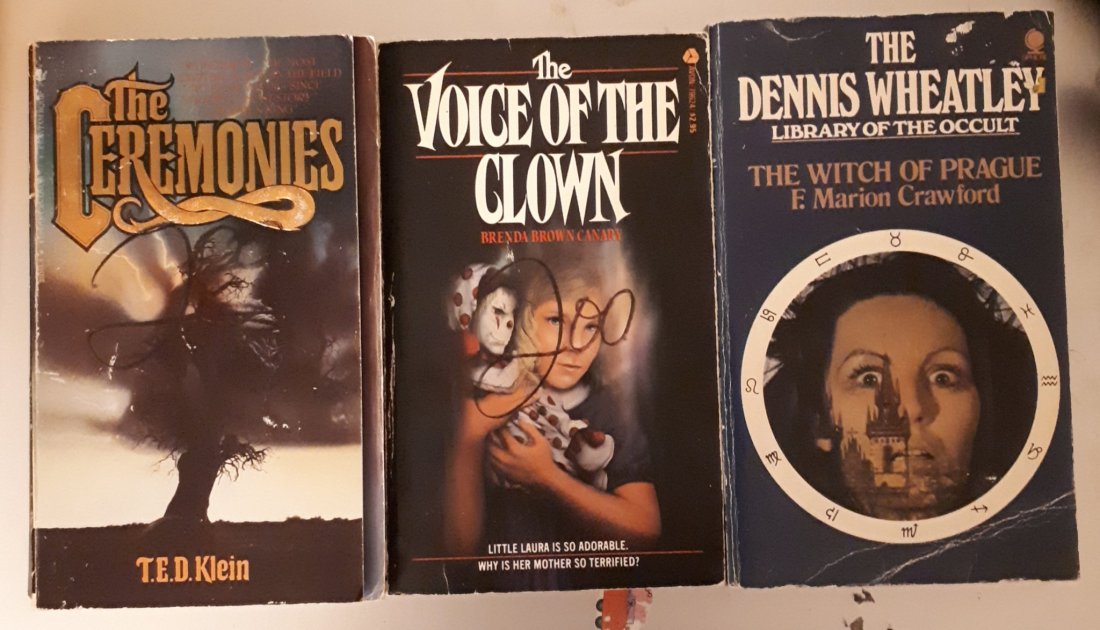
A few weeks ago, I went to one of my favourite local bookshops. It’s super cheap, and has the biggest selection of paperbacks in my city, but it’s entirely disorganized, and over the course of several visits, I’ve cleaned out most of the horror novels. This time, I spent a good half hour without finding anything, but I didn’t want to walk by the owner of the shop without buying anything, so I continued my search. Then I discovered a copy of T.E.D. Klein’s The Ceremonies, a book I’ve wanted to read for a while, and with renewed vigour I turned to a bookcase that I hadn’t yet searched through. There are three rows of paperbacks on every shelf, and it was at the back row of the bottom shelf that I found a copy of The Voice of the Clown with 2.00 written on the cover.

I started to shake. This was the Holy Grail of collectible horror paperbacks. I grabbed another horror novel and sandwiched the Clown between that and The Ceremonies to make it less conspicuous. I had to get out of there before another collector saw what I had and a fight broke out. Like a thief in the night, I tiptoed to the counter, put my books down and smiled at the old lady. I assumed that she was going to recognise what I had in my hand, but she just smiled back and charged me 9 dollars for the three novels. I got out of there as quickly as I could, expecting to hear sirens behind me once somebody realised the daylight robbery I had just committed. 
IMG_20200216_083533

When I got home, I was elated. I tried to convey my excitement to my wife, but she didn’t seem to care. My reading list is fairly lengthy, but it was only a few weeks before I gave in to temptation and bumped this novel to the front of my list.

Then I sat down and read it.


Jesus Christ. This was an unrelenting nightmare.

T.J. unknowingly gets his girlfriend Molly pregnant and then moves away. Then he knocks up a different girl, Kate, and marries her even though he only loves Molly. After giving birth, Molly kills herself. A few years later, T.J. and Kate have another kid. Unfortunately for them, Laura, the new baby, is the reincarnation of Molly, T.J.’s old girlfriend.

Laura really, really, really hates her mom, but she doesn’t fully understand why yet. She REALLY loves her dad though, in a way that seems weird right from the beginning. When her dad gets her mom pregnant again, she becomes very unhappy.

For the most part, the reincarnation business is the only supernatural element in this book. This is not what I was expecting from the cheesy cover. The horror is not of evil spirits or of psychic powers. It is the horror of trauma, suicide, domestic abuse, and misery.

Laura is not only jealous; she is also a manipulative, sadistic psychopath. The story is also told from her point of view, a fact that makes this book all the more disturbing. The reader starts off on her side, but I started to sympathise with her mother pretty quickly. Laura does everything she can to upset Kate, a woman who may not be the best mother in the world but who hasn’t actually done anything unforgivable. I don’t want to give away details, but some of Laura’s actions were so upsetting that they caused me to put the book down and consider whether or not I actually wanted to finish it.

I’ve seen other reviews of this book where people said that The Voice of the Clown isn’t as scary as it’s made out to be and that it gets bogged down with character development, but I found the build up to be really effective. Also, I honestly doubt that those naysaying reviewers have kids of their own. I have a little girl, and my wife and I have another kid on the way, and reading about a child’s mission to destroy her family by any means was deeply upsetting for me. I can read gore all day and won’t be bothered, but reading about a jealous child’s well thought out plans to torment a helpless baby and its mother was utterly horrendous. This novel struck a nerve.

This is a miserable, bleak, unpleasant book to read. While there are some supernatural elements, it’s really more horrible than horror. That being said, I reckon that was the point. Brenda Brown Canary must have sat down and really thought hard on to how write the most horrible book ever. I don’t think something as unpleasant as this could happen by accident. I know that Valancourt Books have tried to get in touch with her to reprint this as part of their Paperbacks from Hell reissues line, but that she has yet to respond. I wonder how she feels about this book now. Was it written during a dark time in her life that she would rather forget? I hope I’m wrong, but I find it difficult to imagine a person who loves their life writing a book like this. It’s relentlessly unpleasant, and it gets worse and worse as it goes on.

All that being said, I think it is a good book. This is a methodically written novel of terror, real, unpleasant terror. I’ve written before of times when books have obsessed me. In all other cases, the obsession reached its peak before reading the book. I would get fixated on a rare horror novel and spend hours seeking out information about it before finding/ordering a copy. Reading it would be the climax. In this case, my interest was really sparked after finishing the novel. I’ve found myself picking it up since finishing it, staring at the cover and feeling an unpleasant discomfort. Part of me wants to get rid of my copy to have it out of my house, but the masochist in me wants to keep it in case I want to punish myself again in a few years. If you can get a copy of this thing and you’re not faint of heart, pick it up and jump into the nightmare.

Count Stanislaus Eric Stenbock’s Tales of Death and Decadent Poetry

I first read about Count Stenbock on the Snuggly Books website when I was buying their collection of Montagues Summer’s ghost stories. I saw the cover of Stenbock’s Studies of Death and became intrigued. I checked and saw that first edition copies of this book go for 10,000 dollars. I had to read it.

stenbock studies of death
When I looked up Stenbock, I saw that David Tibet, Thomas Ligotti collaborator and the musician behind Current 93, had recently put out a collection of Stenbock’s work that contained all of the stories in Studies of Death along with lots of other stuff. This collection didn’t cost much more, and I decided to buy it.

OF KINGS AND THINGS STENBOCKOf Kings and Things: Strange Tales and Decadent Poems
Count Eric Stanislaus Stenbock
Strange Attractor – 2018

Studies of Death is actually very short, and you could easily read through it in an afternoon. The stories are glum, dreary things. I enjoyed them well enough. One of the tales is about a vampire, but the others don’t really have much of the supernatural about them. I quite liked these stories, but I am very, very glad I opted for the anthology rather than just this collection.

The other tales contained in Of Kings and Things are great, and they convinced me that Stenbock was actually an interesting writer rather than just a melancholy weirdo. ‘The Other Side’ is one of the only other pieces of writing that was ever published during Stenbock’s life, and it’s a very dreamy tale of a young man becoming a werewolf. It’s really cool. There’s other stories about a voyage to Hell, a princess who pays to see a young man mauled by lions, and a monk who attends black masses and satanic ritual sacrifices. There’s also a ghost story in the form of a play. ‘The King’s Bastard’ and ‘A Secret Kept’ are very similar to the kind of stuff in Studies of Death.  All the fiction in here is worth reading, but there’s one particularly creepy story about a fella who allows himself to be cuckolded by his gay lover (his boyfriend fucks his wife), and then he falls in love with the resultant child. Yuck.

Stenbock was a real freak. There’s a story that he used to carry a wooden puppet around with him, telling people that it was his son. He was also gay. I don’t mean to insinuate that gayness is weird or abnormal, but let’s be realistic; in the late 19th century it was largely considered so. Stenbock’s writing, although never explicitly detailing acts of homosexuality, is pretty gay. Read it and you’ll see what I mean – lots of beautiful men and forbidden love. I think he deserves more credit for writing like this during that period of history. It’s a pity that he isn’t better remembered.

The physical book is lovely – it looks and feels nice, and a great deal of effort has clearly been put into it. It’s not expensive either, so if you’re mildly interested in Stenbock or a big fan of his, I can wholeheartedly recommend picking up a copy of Of Kings and Things. I’m glad I did.


Stenbock was primarily a poet, and of the 4 of his books that were published during his lifetime, 3 of them were books of poetry. Copies of the original editions of these books are now ridiculously rare. David Tibet estimates that there are 4-6 copies of each in existence. Luckily, many of these poems are included in Of Kings and Things. I was on David Tibet’s website a few weeks back and saw that he was offering free pdf copies of the collected poems of Stenbock. This collection contains all of the poems from the Count’s 3 books of poetry. I decided to give it a read before publishing this post.

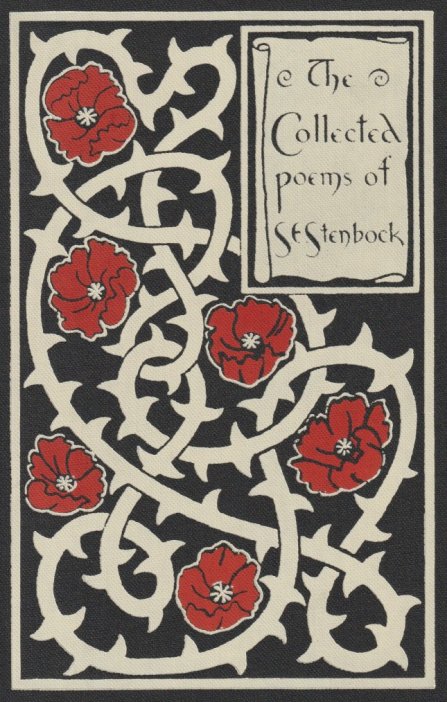
collected poems stenbock
The Collected Poems of S.E. Stenbock –  Count Stanislaus Eric Stenbock
Durto Press – 2001

I have very little interest in poetry. Honestly, I just don’t get it. My opinions on this lad’s poems aren’t going to be profound. I thought they were very moody and sad and dramatic – lots of crying and love and blood. If Stenbock was a teenager in the early 2000s, he would have worn lots of eyeliner and shirts with black and purple stripes. I’m too much of a bonehead to tell if his poems are good not. I far preferred his stories.

A History of Chainsaw Terror (Come the Night) by Nick Blake (Shaun Hutson)

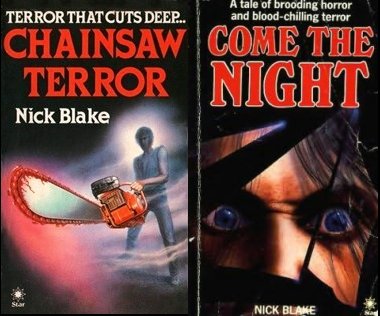
I have spent the last few months obsessing over the infamous Chainsaw Terror, but finding a copy seemed impossible. A few weeks ago, I read a review that made doing so significantly easier. There’s quite a few reviews of this novel online already, but I am far more interested in the story behind this book than the story in it. In this post, I want to present the most comprehensive account of the publishing of Chainsaw Terror/Come the Night to date.

chainsaw terror come the night nick blake hutson

In 1984, Shaun Hutson agreed to write a novelisation of the Texas Chainsaw Massacre. Star, his publishing company failed to get the novelisation rights for the movie, but they encouraged Shaun to write a chainsaw novel anyways. Who doesn’t love a bit of chainsaw violence?

Shaun spent a few weeks (either 15 or 20 days) writing a manuscript titled Chainsaw Terror. A week after sending it in to his publisher, he got a call telling him that parts of it had to be cut out. The extent of these cuts varies depending on Shaun Hutson’s mood. He has claimed it was 20 pages, 25 pages and 30 pages during different interviews.

Apparently Bookwise, the biggest book retailer in England, had banned the book from their stores because of the word ‘chainsaw’ in the title. (By Hutson’s own account, other retailers, including W.H. Smith did not have a problem with the book’s title, but Hutson later claimed that the novel was “banned outright.”) The cut manuscript was retitled and all future copies were published as Come the Night.

Ok, so the small number of copies of the first printing of book that were originally sent to and sold by non-Bookwise vendors were titled Chainsaw Terror, and these are the ones that we see going for 300+ dollars on ebay today. The reason that copies of Chainsaw Terror go for so much money is that the people buying them believe that they include the 20-30 pages that were cut from the original manuscript.

But Chainsaw Terror and Come the Night are the same book. Yes, they are the exact same. Come the Night is not shorter, and it’s not less graphic. It’s literally the exact same. (Somebody made this claim on a forum in 2017, but Olly C’s review confirmed it with certainty.) All of those people who review their copy of Chainsaw Terror online and gloat smugly about how weak Come the Night must be compared to the sheer brutality of Chainsaw Terror are fools.

So who is responsible for all of the confusion over the different editions of this book? I’m pretty sure it’s Shaun Hutson. I’ve already pointed to a few instances where he has contradicted himself on elements of  the story, but most confusing of all is the following quote which is currently found on Hutson’s own website:

“…CHAINSAW TERROR and COME THE NIGHT are both the same book. CHAINSAW TERROR was originally published in the US but was banned over here by W.H. Smith because it had ‘chainsaw’ in the title. It was then re-released (heavily cut) as ‘Come The Night’. Actually, make that very heavily cut…”

Ok, so the first sentence and the last sentence of that quote directly contradict each other. Which part are we supposed to believe Shaun? Not only that, but in this quote, Hutson is claiming that it was W.H. Smith that banned the book while he has elsewhere stated that “W.H. Smith who were more conservative in their views [than Bookwise] didn’t have a problem with CHAINSAW TERROR even though they’d later go on to ban my own novel DEADHEAD in 1994.”

According to Hutson, the cuts were demanded just days after he submitted the original manuscript, but while Chainsaw Terror came out in March 1984, Come the Night was only published in December 1985, almost two years later. If Hutson’s claim that “It [Chainsaw Terror] was then re-released (heavily cut) as ‘Come The Night'” was true, this would mean that there are three different versions of the story: the original manuscript, the cut version (Chainsaw Terror) and the cut-cut version (Come the Night). But if Come the Night is a “very heavily cut” re-release of Chainsaw Terror, how is it that every known copy of both books is 173 pages long? Hutson’s claims are full of holes.

I don’t know how deliberate it was, but I can’t help but think that the author has consciously obfuscated the publication details of Chainsaw Terror to add to its infamy. In pointing this out, I want to clarify that I have nothing but respect for Hutson if this is truly the case. Nothing gets my juices flowing better than the mystique of a banned and unattainable horror novel. I’d do the same thing if I was in that position.

I pieced together the above account from different interviews and reviews, and while I’m sure it’s not completely accurate, I think it’s at least the most complete version of the story of the publication of Chainsaw Terror online. (Hutson’s contradictory accounts make it very difficult to suss out who was actually responsible for the title change and where the copies of Chainsaw Terror in circulation were actually sold – was it W.H. Smiths or the United States?) If anyone has any further information on either of these books, I’d be happy to know about it. Shaun Hutson, baby, give me a call and let’s talk.

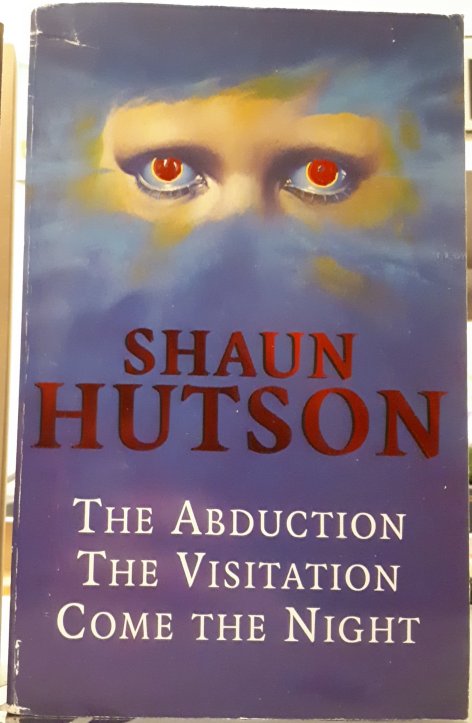
hutson come the night abduction visitation
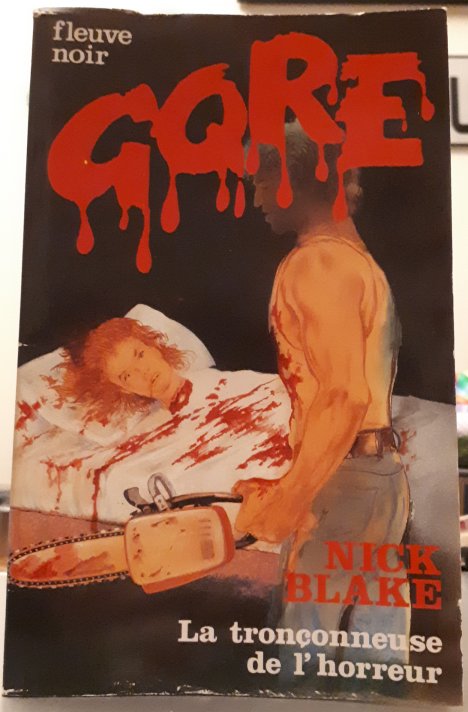
Just to clarify another point; while paperback versions of Chainsaw Terror and Come the Night are both fairly scarce at this stage, the entire text of Come the Night (and hence Chainsaw Terror) was rereleased as part of a collection of three novels by Hutson that is still widely available. I bought a copy for less than two dollars a few weeks ago. There was also a French edition called La Tronconneuse de l’Horreur put out in 1985. I actually bought a copy of this before I knew that Come the Night was the same as the published version of Chainsaw Terror. I had planned to learn French rather than paying 300 quid for a copy of the English version, but I don’t have to any more. I don’t regret my purchase though, as I think the cover of this version is the single greatest cover art in the history of horror fiction.

La Tronçonneuse de l'Horreur - nick blakeI can verify that the text is the same as the English version. It’s cut too. Still though, look at that cover!
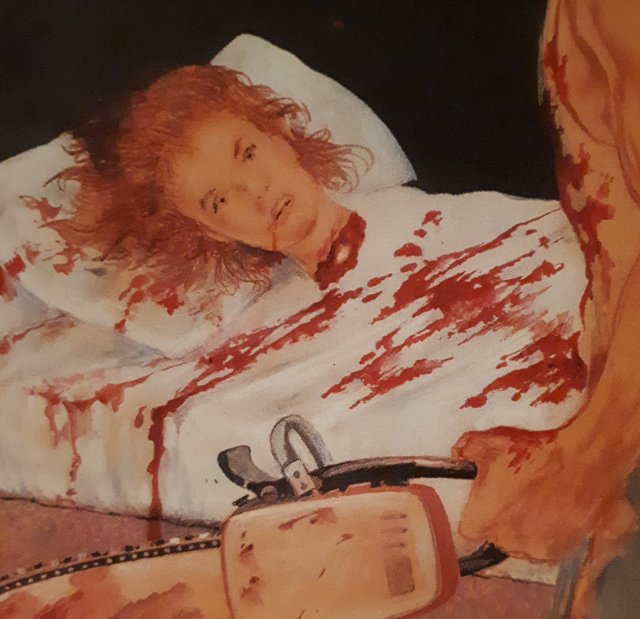
Ok, as for the actual plot of Chainsaw Terror… It’s pretty much what you’d expect: an incel cuts up a bunch of prostitutes with a chainsaw. It shames me to say this, but I thought it was quite enjoyable. Everything is pushed a few steps further than is sensible. There’s some nice touches – whenever somebody is cut up, they always seem to shit or piss themselves. Also, the chainsaw maniac has the weird (yet admittedly sensible) habit of taking off all of his clothes before he dismembers his victims.

There is one part of the book where the killer is about to ram a drill into a prostitute’s eyeball where the text cuts off with an ellipsis. When the next paragraph starts, she is dead. I assume this is the scene of one of the infamous cuts. There’s also a tense scene where the killer is left alone with two small children. Nothing happens, but in a later interview, Hutson mentioned that “Killing kids in print is always a tricky area” directly after mentioning the ban on Chainsaw Terror, leading me to believe that the that the killer may have returned to those kids in the original manuscript. Hutson has also mentioned the omission of a scene involving chainsaw rape, but the published versions do actually contain a scene that I thought suggested as much. In truth, none of these omitted scenes would have made a huge difference to the final product. As it stands, the published manuscript is plenty violent and gross. (There are rumours of a pdf copy of the uncut manuscript of Chainsaw Terror that was being sent around the internet years ago, but I doubt we’ll ever see it again.)

In conclusion then, finding a copy of Chainsaw Terror is actually pretty easy despite all the nonsense that has been written about it online. The omnibus containing two other Hutson novels is the way to go my friends – you don’t need to spend 300 dollars. As of today, the 2nd of February 2020, there are more than 50 copies available online for less than 20 dollars, many costing less than half that. The book is enjoyable in a very direct, horrible way too, and I recommend you check it out if you’re at all into violent, mindless horror novels.

severed head decapitated by chainsaw

Oh, and if elusive and weird paperback horror is your thing, make sure you check back here soon. I’ll be posting a review of The Voice of the Clown, a real rarity, by the end of the month.


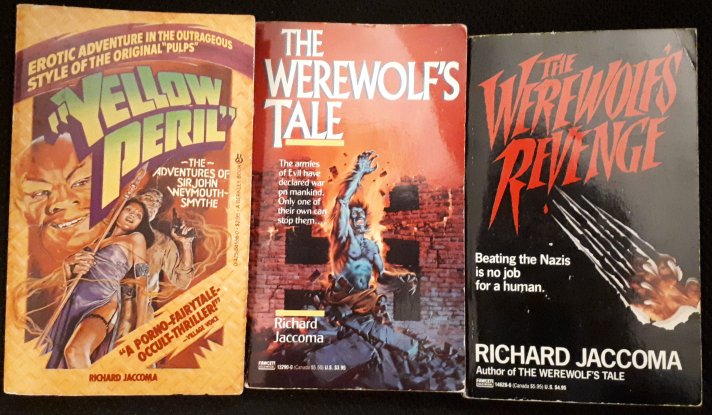
Richard Jaccoma’s Occult Adventure Trilogy – Yellow Peril, The Werewolf’s Tale and The Werewolf’s Revenge –

richard jaccoma werewolf's taleThe Werewolf’s Tale – Richard Jaccoma
Fawcett Gold Medal – 1988

“This book is quite awful. It’s about a New York detective who turns into a werewolf while investigating a team of vampires, a Nazi occultist from Atlantis and the mummy of an Egyptian black magician. There’s a few references to Lovecraftian entities, and the werewolf detective has sex with a lot of women. This might have worked as a series of comic books, but there’s too much stuff going on for this to function as a cohesive novel.”

I wrote the above paragraph in August, right after finishing The Werewolf’s Tale. Looking back, I think I might have been overly harsh. I had just finished reading Bari Wood’s excellent The Tribe, and that novel had enough in common with this one to make Jaccoma’s book seem awful in comparison. They’re very different books, but they’re set in the same place and both feature Rabbis as important characters, and I reckon these similarities made the shift from grim thriller to ludicrous adventure novel seem extra jarring.

richard jaccoma werewolf's revengeThe Werewolf’s Revenge – Richard Jaccoma
Fawcett Gold Medal – 1991

By the time I got around to reading the sequel, The Werewolf’s Revenge, I found it much easier to enjoy Jaccoma’s supernatural parody of noir fiction. The events in here are even more sensational than the first novel, but I knew what to expect by this point and was able to enjoy the ride.

Honestly, it’s only been a few months since I read The Werewolf’s Revenge, but I can’t say that I remember much about the plot. It’s more of the same crap. It features all the characters from the first novel (the Atlantean sorcerer, the evil Egyptian mummy, the sexy Jewish vampire, the sexy Nazi werewolf…) but this one also features Jacques De Molay of Knight’s Templar fame, along with some Satyrs and other mythical beasts. Oh yeah, and at one point, one of the characters finds the Necronomicon. While I can’t remember the precise details of the complicated plot, I do remember enjoying it far more than I had expected. It’s not high literature, but it’s not unbearable.

Things got a bit uncomfortable for me when a character called John Weymouth-Smythe appears in the story. I recognised that name from somewhere. It turned out to be from the inside cover of the paperback I was holding. Aside from the two Werewolf books I’ve just reviewed, Richard Jaccoma had only written one other novel, the dubiously titled “Yellow Peril” The Adventures of Sir John Weymouth-Smythe. It quickly became apparent that while Yellow Peril and The Werewolf’s Tale are unrelated works, The Werewolf’s Revenge is actually a linking sequel to both novels. I had been looking forward to finishing the pair of Werewolf novels and being done with Richard Jaccoma, but when I saw Yellow Peril being described as an erotic occult adventure about a secret agent fighting satanic Nazis, I knew that I was going to have to complete the trilogy. It was quite annoying though because it was actually written way before both of the books I had already read, and I hate reading a series out of sequence.

richard jaccoma yellow perilYellow Peril: The Adventures of Sir John Weymouth-Smythe – Richard Jaccoma
Berkley Books – 1980 (First published in 1978)

Ok, it’s currently 2020, so let’s just address the obvious racism straight away. This is clearly an outdated piece of writing that crosses all kinds of boundaries that don’t need to be crossed. Richard Jaccoma actually apologizes for the racist attitudes of the book’s characters in a short preface, but this apology falls short of what we’d expect today. While it is the characters in the book who voice racist opinions, the author was ultimately marketing these ideas as entertainment, regardless of whether he believed in them himself. This book was written 42 years ago though, and I don’t think that Richard Jaccoma was intentionally being a horrible person. The guy went on to write 2 books about a Nazi-hunting werewolf, and it’s actually the Jewish and Chinese characters in this book who actually turn out to be good, so I reckon he’s probably not a bigoted hatemonger.

Racism aside, is Yellow Peril any good? It’s pretty much the same thing as the Werewolf books, but here the narrator is British rather than American. He doesn’t have any super powers, but he works alongside the head of the Golden Dawn, a crew of Satanic Nazi paedophiles, a horde of Yetis and some very strange Asian occultists. The conflict in this novel is driven by the quest for the Spear of Destiny, and yes, I mean the version of the Spear of Destiny written about by Trevor Ravenscroft. The narrator is a bit of an idiot, and the story itself is pretty dumb, but it wasn’t absolutely horrible to read.

Richard Jaccoma used to work as the managing editor for Screw Magazine, a pornographic weekly newspaper, and he wrote the screenplay for a 1977 porno called Punk Rock. Yellow Peril advertises itself as “A porno-fairytale-occult-thriller” on the cover, but I felt like it actually had less sex than the Werewolf books. I skimmed over the sex-scenes, as I wanted to get through this quickly, but I couldn’t help but notice that one of these scenes contains a lengthy description of the protagonist anally raping an evil Nazi. As soon as he finishes raping her, another Nazi, who has been peeping on them, cums all over the rapists back.

richard jaccoma werewolf trilogy
I’ll just leave it at that. The fact that these books aren’t hugely popular isn’t really surprising.

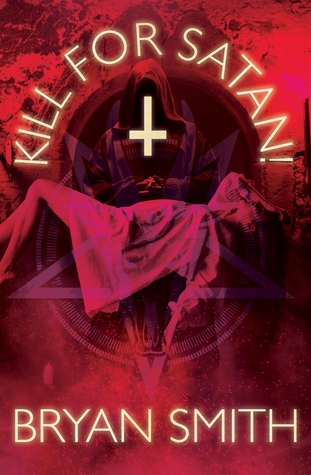
Kill for Satan – Bryan Smith

42304587._SY475_.jpg

Kill for Satan – Bryan Smith

Grindhouse Press – 2018

I saw the cover of this book roughly a year ago and knew I’d have to read it. It’s about a bunch of people killing a bunch of other people. Oh, and they’re doing so for Satan.

Kill for Satan only came out in 2018, and it features a lot of pop culture references that made me realise how little modern horror I actually read. I was a bit bothered by the repeated allusions to one of the character’s Cradle of Filth tshirt (Jesus Christ, that band are shit.), but I liked the part when one of the characters is researching Satanism and discovers “modern so-called “Satanic” groups that don’t actually believe in the existence of any demonic evil entity ” who “use Satan as a provocative and subversive means of delivering progressive messages. They are social activists, not true devotees of the dark path.” Haha, I wonder who he’s reading about.

Really though, aside from all of the killing for Satan, there’s not much else going on in this book. It reminded me of a more straightforward version of William Johnstone’s The Nursery. In a way that’s a good thing; Johnstone’s book was a mess, but I found the plot of Kill for Satan to be a bit underwhelming.

Bryan Smith seems to specialise in Splatterpunk, and this book, like some of the others within that genre, was just a bit too straightforward for me to really enjoy. Kill for Satan felt a bit more like reading the screenplay for an extended death metal music video than it did a novel. Smith’s writing is decent – I was never bored, but personally, I would have enjoyed a bit more plot/character development – maybe a little less killing and a little more Satan.

There is one particularly memorable scene in which a mother says to her child, “I’m sorry, sweetie. I do love you. But I love Satan more.” Yikes. You can probably guess what happens next. If this sounds good to you, if you’re looking for a straight up bloodbath of mindless, brutal violence, this book will not disappoint.


My Work Is Not Yet Done – Thomas Ligotti

My Work is Not Yet Done ligotti.jpgMy Work is Not Yet Done – Thomas Ligotti
2002 – Virgin

I read a lot of books, but in truth, there are relatively few authors whose books I savour. I actually hold off on reading Thomas Ligotti because I don’t want the day to come when I have already read all of his books. His low opinion of humanity is both tragically hilarious and brutal, and while I don’t necessarily share the outlook of the narrators of his stories, I find his pessimism the perfect vehicle for horror. The message that our existence has no worth is perhaps the most disturbing idea that an author can offer to 21st century humans.

My Work Is Not Yet Done is a novella and two short stories. All of these tales are about workers’ lives as part of a corporation. There’s a very Kafkaesque vibe running throughout, but Ligotti covers the bureaucratic angst with layers of supernatural horror and misanthropy and turns it into something far darker. The first act of the eponymous novella portrays a man who decides to go on a killing spree in his office after he’s unfairly dismissed from his job. I know Stephen King found himself in hot water for writing a novel about a school shooting, so I was impressed that Ligotti had done something so extreme. I won’t tell you what happens later on in the story, but I will say that it’s actually far worse than what you’d expect.

I know full well the misery of working for a company that you hate, and while I’ve only spent a little over a year working in an “office job”, I spent enough of that year fantasizing about murdering my boss to have thoroughly enjoyed this book.

Little things about the book stuck out to me. Characters have stupid names – coworkers are named Sherry, Terry, Mary, and Perry, and detectives are named Black and White. Also, the purpose of the corporations that these characters work is barely discussed – the nature of the work that the characters engage in is almost entirely passed over. Why does Ligotti omit these details? Why doesn’t he put more effort into naming his characters? Because that stuff doesn’t matter. Human beings are entirely interchangeable. You are no different to the people you hate the most. What corporations actually do doesn’t make any difference to their workers. Nothing fucking matters. Every living thing is going to die without having made any noticeable difference in the universe, a universe in which every single atom will eventually decay.

Oh, I forgot to mention that this is the first post of 2020. Happy New Year everyone!

“Generally speaking: Expect nothing but nightmarish obscenities to be born when human heads come together in intercourse.

More generally speaking: Whatever is born will ultimately grow into a nightmarish obscenity – in the grand scheme of things.”

There’s moody nuggets like this sprinkled throughout the book, but the closing lines of My Work Is Not Yet Done sum it all up. I don’t want to quote those here as it might ruin the effect when you do get around to reading it, but fuck me, they’re perfect. Please believe me when I say that this is a novella worth reading.

I’ve also reviewed Ligotti’s Teatro Grottesco and The Conspiracy Against the Human Race if you’re interested. I read Noctuary years ago too, but I haven’t reviewed that one properly yet. There’s a copy of the Penguin edition of Songs of a Dead Dreamer and Grimscribe on my shelf, but I’m waiting for a special occasion to allow myself the luxury of reading it.

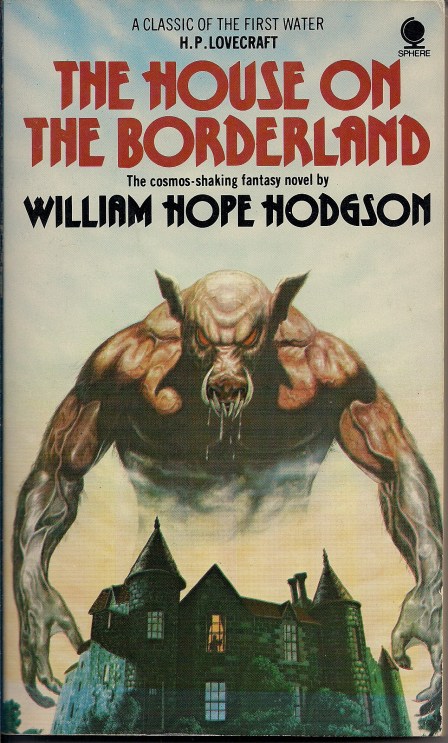
The House on the Borderland – William Hope Hodgson
house on the borderland william hope hodgson.jpgThe House on the Borderland – William Hope Hodgson
1908

It’s coming close to the end of the year, and I have spent 2019 reading some absolute garbage. After reading and reviewing Fritz Leiber’s awesome Our Lady of Darkness last week, I really wanted to read another cool book. I’ve been meaning to read William Hope Hodgson’s The House on the Borderland for a couple of years, and when I found a free audiobook version last Sunday, I decided the time was right.

This was a very enjoyable piece of weird fiction. It’s about a strange man who lives in an old house in Ireland that seems to exist on the border of different dimensions. I spent the first half of the novel thinking it was basically just Night of the Living Dead with interdimensional pig-mutants instead of zombies, but the second half of the book has more in common with 2001: A Space Odyssey. (I just read Will Errickson’s review of this book and saw that he also made a 2001 comparison. Will, I swear this was coincidence!) There’s little wonder that H.P. Lovecraft was a big fan of this novel; there’s some very definite “the universe doesn’t care about you” vibes throughout.

I read William Hope Hodgson’s Carnacki the Ghost Finder stories a little under two years ago, and while I enjoyed them, I seem to remember them being a good deal more straight forward than this. One of those stories also includes evil pigs, and a couple of them are set in Ireland too. I reckon I enjoyed The House on the Borderland more, and I’m planning to read more by Hodgson in the future.

The only problem with reading good books, especially popular ones, is that I find myself at a loss for things to say when reviewing them. This one is cool, short and available for free in multiple formats. You might as well check it out.

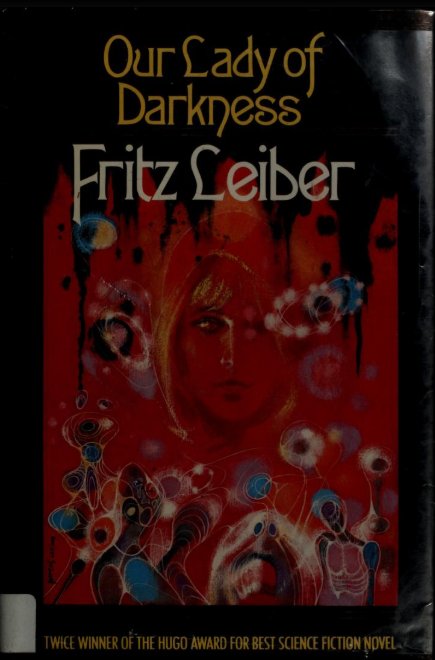
Our Lady of Darkness – Fritz Leiber

fritz leiber our lady darknessOur Lady of Darkness – Fritz Leiber
Berkley Publishing – 1977

A recovering alcoholic reads a weird book about evil architecture and a notebook belonging to Clark Ashton Smith and then begins to see weird stuff through his binoculars. That’s the premise of Our Lady of Darkness by Fritz Leiber. The protagonist is also an author of weird fiction, and repeatedly references Lovecraft, M.R. James and Bierce. I really enjoyed this book, and reading it has made me want to check out more stuff by Leiber.

I didn’t know anything about the author when I started reading Our Lady of Darkness, but I only got a few chapters into this book before I realised that the main character is supposed to be him. Leiber’s name was Fritz, and the character’s name is Franz. They  have the same job, and I can’t put my finger on it exactly, but there was something about the sections on the protagonist’s wife and her death that had me convinced that Leiber was writing from experience. Sure enough, he lapsed into alcoholism after the death of his own wife, and this is obviously a largely autobiographical work. Although this novel contains some fantastic elements, this autobiographical stuff keeps it grounded and makes the weirdness all the more discomforting.

And the weirdness here is quite weird. The antagonist of the book is Thibaut de Castries, the author of Megapolisomancy: A New Science of Cities, a book about the supernatural power of large cities and their buildings. I found this idea quite Ballardian, not in the sense that Ballard was also fascinated with architecture but in the pairing of two seemingly disparate concepts. (De Castries links occult forces with architecture in a similar way to how Ballard links sex and car crashes.) It was cool to come across an idea as strange as this in a fantasy/horror novel.

I don’t have a huge amount else to say about this book. It’s a classic of weird fiction, and you should read it if you haven’t already.  An earlier version of the story was published as The Pale Brown Thing in Magazine of Fantasy and Science Fiction, and I read yesterday that Leiber considered this an alternative telling of the same tale rather than just an earlier draft. Swan River Press published an edition of this version in 2016, but it’s long sold out. It would be cool if somebody could upload scans of the original printing to the internet. I’d be delighted to read another version of this story.

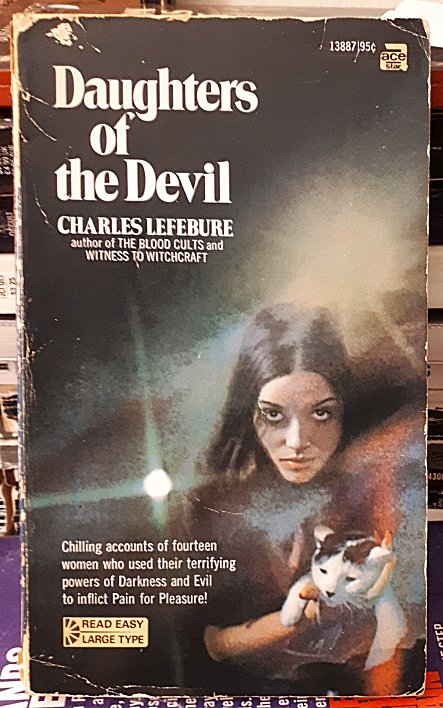
Daughters of the Devil – Charles LeFebure
daughters of the devil lefebure.jpgDaughters of the Devil – Charles LeFebure
1971 – Ace Books

The blurb on the back of this book describes its contents as “true stories of unparalleled sadistic erotica”. The front cover claims that it contains “Chilling accounts of fourteen women who used their terrifying powers of Darkness and Evil to inflict Pain for Pleasure!” It’s called Daughters of the Devil, for Christ’s sake. Can you imagine my delight when I found a copy of it for 5 dollars?

I mean, realistically, the book was shit, and I had known exactly what to expect. A few years ago, I read a book called The Devil’s Own by Peter Robson, and I had the feeling that this would be very similar. I just checked my copy of that book, and unsurprisingly, it was put out by the same publisher, Ace Books. After rereading my review of that book, I’m surprised at how similar it is to Daughters of the Devil. Charles LeFebure wrote two other books for Ace, Blood Cults and Witness to Witchcraft, and I reckon it’s safe to assume they’re the same kind of crap.

The chilling accounts in here are very sensational, and rarely convincing. Some of them are about real people, but I can’t find any evidence for the others. (This was my same complaint when I read The Devil’s Own.) When I googled some of the names in here, the only result I found was somebody else who had read this book complaining about the same lack of evidence.

I’m going to briefly describe each of the accounts in here in case anyone is interested.

  1. A girl gets involved in a Satanic cult. They have orgies and sacrifice a fetus during a black mass. This account references Crowley, H.T.F. Rhodes and the Abbé Guiborg’s Black Mass. It wasn’t believable, but it was a pretty good start to the book.
  2. Carletta Pantucci and her Daughters of Isis were a weird cult of lesbians that bred babies that they intended to raise as virgin cultists. They told the future by bloodletting women’s groins.
  3. There was a weird convent where nuns were crucified and whipped by a perverted priest and made to watch him fuck their Mother Superior. This was all done in the name of Christ.
  4. Caroline Langley, a one time friend of Aleister Crowley, commits acts of black magic, sometimes to kill people. I can find no evidence of Crowley ever knowing a Caroline Langley.
  5. A six month old curséd baby poisons a boy with witchcraft and the boy’s hand is amputated.
  6. Obango, the “Ga witch” from Ghana, bled ate and killed victims, 15 of whom were related to her. Ga witches have sex with animals.
  7. Annie Palmer, the rich voodoo priestess decapitated some of her slaves and raped others with snakes. (This one has some basis in fact.)
  8. Gdoma, an ugly Asian witch, coerces young people into sexing each-other up. LeFebure claims she’s very evil, but she doesn’t sound that bad really.
  9. Some Mexican woman ran a sex school for children in her house. She killed two abusive husbands.
  10. Caterina Sforza, a real Renaissance woman, is here described as ,’the most wicked woman of all time’.
  11. A Chinese child sex-slave grows up to start her own brothel in which random johns are taken to the secret rooms downstairs and tortured to death. The events in this story allow for no possible way that anyone could ever discover what had happened – there could be no evidence – but somehow the author is able to tell the tale. The lady died without any trial or case against her. It’s a cool story even if it’s completely fabricated.
  12. I got a bit into this one before I realised that I had actually heard it, or at least a version of it, before. It’s the story of Edward Arthur Wilson, the mysterious Brother XII, and his Madame Zee. Plenty of the details listed here are entirely false, but Lefebure’s fabrications don’t actually make the story any more interesting than it really is. I have another book on Brother XII that I have been meaning to read for a long time. I’ll definitely come back to Lefebure’s account when I get around to that one.
  13. Charlotte Gilbert leads a cult that worships cats and ritually sacrifices dogs because they are cat’s natural enemies. Her cult is a breakaway of the Glastonbury Essenes, a real order that supposedly worships aliens.
  14. The last account is of Catherine Deshayes (La Voisin), the abortionist and satanist involved in the Affair of the Poisons. This is the sensational account you’d expect.


Most of these stories contain little truth, and none of them are erotic. There is a fair bit of sadism though. This book is made up of descriptions of horrible women that probably never existed. The titles of this author’s other books sound very good, but they’re surely of the same quality. I’ll buy them if I ever see them for very cheap, but I wouldn’t be bothered hunting them down.

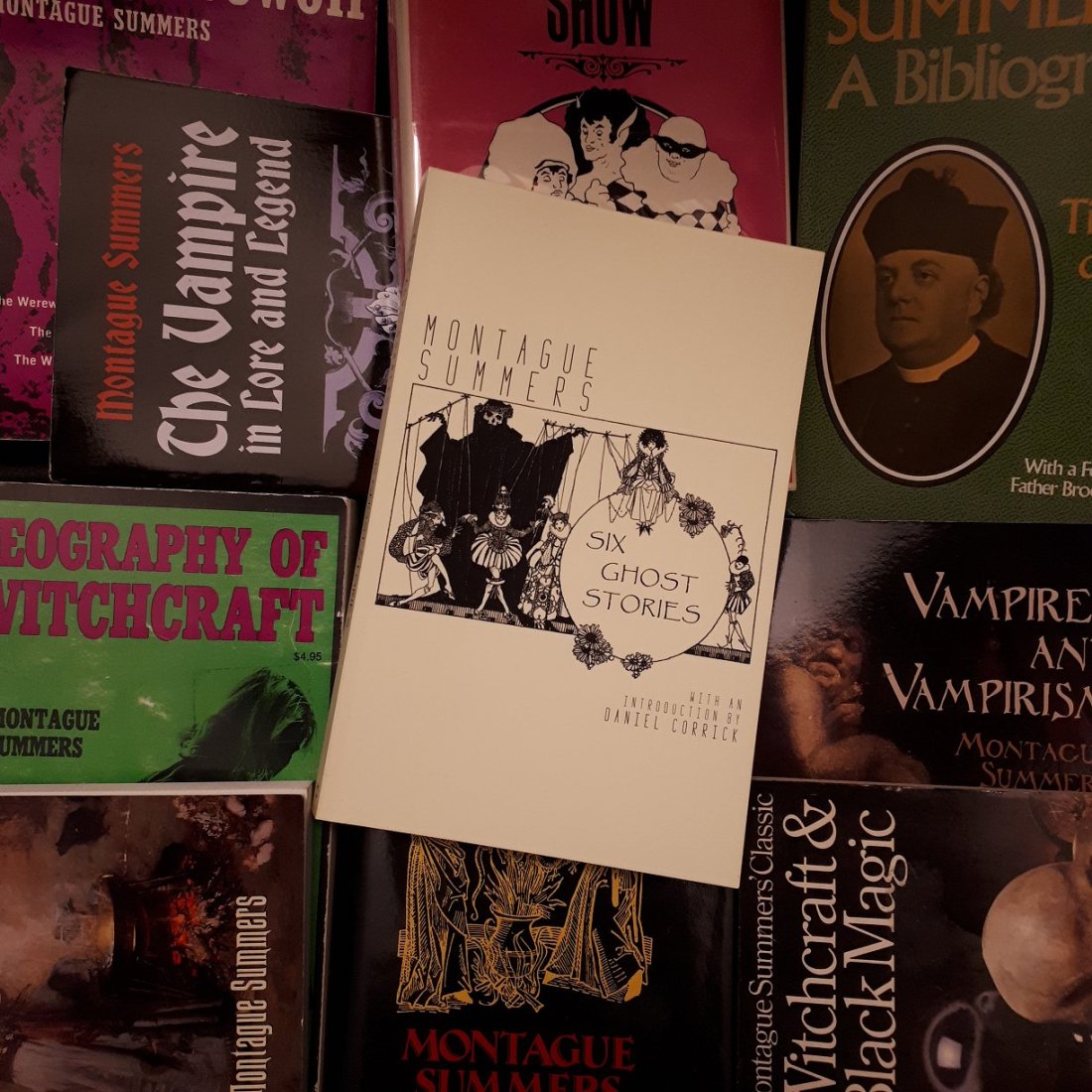
Six Ghost Stories – Montague Summers


summers six ghost stories.jpgSix Ghost Stories – Montague Summers
Snuggly Books – 2019

A few months ago, I got an email from my pal Sandy Robertson telling me that Snuggly Books were going to release a collection of short fiction by Montague Summers. I have long been aware that Monty had written a collection of short stories, but I knew that only a couple of these stories had ever actually been published and that it was difficult to find affordable copies of the books wherein these tales were collected. I’m a big fan and collector of the occult-related non-fiction books written and translated by Monty, and I am also a big fan of short horror fiction, so you will believe that I was very excited to hear that Monty’s ghost stories were finally being published. I ordered this collection for my birthday and read it last week.

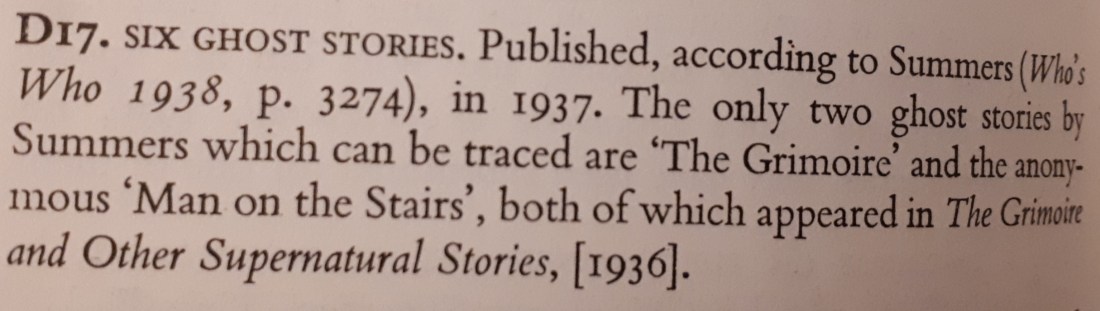
20191130_224224This is the note from Timothy d’Arch Smith’s bibliography of Summers where I first read of these fabled fables.

These six stories lived up to my expectations. They are mostly about people who some acquire some kind of peculiar haunted object that brings about visions and specters. The obvious comparison to make is to M.R. James, who apparently had the chance to read and commend these tales. Incidentally, Montague Summers, the man, has always reminded me of the characters in James’s tales.

The writing in here isn’t what you might expect if you have only read Summers’ books on witchcraft. There’s some very long sentences, but Monty seems self-aware when he’s being verbose, and this comes across as charming rather than tedious. My biggest criticism is probably that the tone of some of these stories remains too light-hearted for too long. Everything will be going fine and dandy for all of the characters, and then a ghost will jump out and scare a person to death right at the very end of the story.

My favourite tale in here was The Grimoire. This one has been previously published in different texts, and it’s not hard to see why it was chosen above the others. It’s the story of a bibliophile whose local dealer procures him an aged book of sinister black magic. When the collector translates a passage from this heinous tome, scary things start happening. (I can’t help but wonder if Sam Raimi read this tale before writing Evil Dead.) This one was particularly cool because it feels like Summers, an expert on books about black magic, could be the narrator.

While not all terribly original, these stories are competent, fun and generally pretty satisfying. I read one each night after my family had gone to bed, sipping a cup of peppermint tea and hearing the cold November breeze blowing through the willow trees our garden. It was great. I suggest you enjoy these tales in a similar manner.

These stories are entertaining in and of themselves, but there’s something very exciting about reading a collection of tales that were believed to be lost for more than half a century. Summers’ old manuscripts went missing shortly after he died in 1948, and they were only unearthed a few years ago. Snuggly Books put out this collection in October (I think this is the only book from 2019 that I’ll have reviewed in 2019.), and they are planning to put out a second volume of Summers’ fiction early next year. This collection will include a novella titled The Bride of Christ. Sign me up!