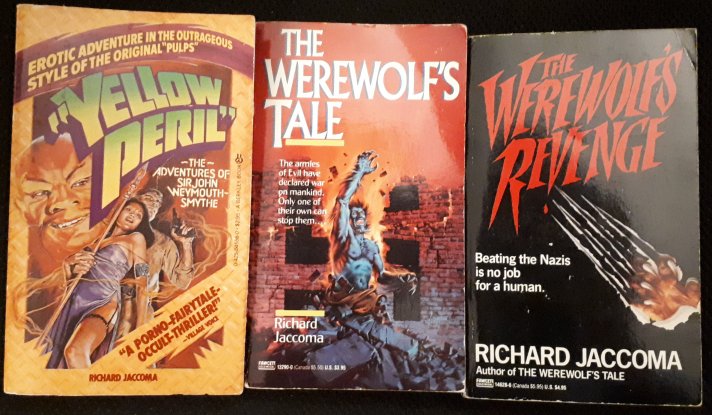
Richard Jaccoma’s Occult Adventure Trilogy – Yellow Peril, The Werewolf’s Tale and The Werewolf’s Revenge –

richard jaccoma werewolf's taleThe Werewolf’s Tale – Richard Jaccoma
Fawcett Gold Medal – 1988

“This book is quite awful. It’s about a New York detective who turns into a werewolf while investigating a team of vampires, a Nazi occultist from Atlantis and the mummy of an Egyptian black magician. There’s a few references to Lovecraftian entities, and the werewolf detective has sex with a lot of women. This might have worked as a series of comic books, but there’s too much stuff going on for this to function as a cohesive novel.”

I wrote the above paragraph in August, right after finishing The Werewolf’s Tale. Looking back, I think I might have been overly harsh. I had just finished reading Bari Wood’s excellent The Tribe, and that novel had enough in common with this one to make Jaccoma’s book seem awful in comparison. They’re very different books, but they’re set in the same place and both feature Rabbis as important characters, and I reckon these similarities made the shift from grim thriller to ludicrous adventure novel seem extra jarring.

richard jaccoma werewolf's revengeThe Werewolf’s Revenge – Richard Jaccoma
Fawcett Gold Medal – 1991

By the time I got around to reading the sequel, The Werewolf’s Revenge, I found it much easier to enjoy Jaccoma’s supernatural parody of noir fiction. The events in here are even more sensational than the first novel, but I knew what to expect by this point and was able to enjoy the ride.

Honestly, it’s only been a few months since I read The Werewolf’s Revenge, but I can’t say that I remember much about the plot. It’s more of the same crap. It features all the characters from the first novel (the Atlantean sorcerer, the evil Egyptian mummy, the sexy Jewish vampire, the sexy Nazi werewolf…) but this one also features Jacques De Molay of Knight’s Templar fame, along with some Satyrs and other mythical beasts. Oh yeah, and at one point, one of the characters finds the Necronomicon. While I can’t remember the precise details of the complicated plot, I do remember enjoying it far more than I had expected. It’s not high literature, but it’s not unbearable.

Things got a bit uncomfortable for me when a character called John Weymouth-Smythe appears in the story. I recognised that name from somewhere. It turned out to be from the inside cover of the paperback I was holding. Aside from the two Werewolf books I’ve just reviewed, Richard Jaccoma had only written one other novel, the dubiously titled “Yellow Peril” The Adventures of Sir John Weymouth-Smythe. It quickly became apparent that while Yellow Peril and The Werewolf’s Tale are unrelated works, The Werewolf’s Revenge is actually a linking sequel to both novels. I had been looking forward to finishing the pair of Werewolf novels and being done with Richard Jaccoma, but when I saw Yellow Peril being described as an erotic occult adventure about a secret agent fighting satanic Nazis, I knew that I was going to have to complete the trilogy. It was quite annoying though because it was actually written way before both of the books I had already read, and I hate reading a series out of sequence.

richard jaccoma yellow perilYellow Peril: The Adventures of Sir John Weymouth-Smythe – Richard Jaccoma
Berkley Books – 1980 (First published in 1978)

Ok, it’s currently 2020, so let’s just address the obvious racism straight away. This is clearly an outdated piece of writing that crosses all kinds of boundaries that don’t need to be crossed. Richard Jaccoma actually apologizes for the racist attitudes of the book’s characters in a short preface, but this apology falls short of what we’d expect today. While it is the characters in the book who voice racist opinions, the author was ultimately marketing these ideas as entertainment, regardless of whether he believed in them himself. This book was written 42 years ago though, and I don’t think that Richard Jaccoma was intentionally being a horrible person. The guy went on to write 2 books about a Nazi-hunting werewolf, and it’s actually the Jewish and Chinese characters in this book who actually turn out to be good, so I reckon he’s probably not a bigoted hatemonger.

Racism aside, is Yellow Peril any good? It’s pretty much the same thing as the Werewolf books, but here the narrator is British rather than American. He doesn’t have any super powers, but he works alongside the head of the Golden Dawn, a crew of Satanic Nazi paedophiles, a horde of Yetis and some very strange Asian occultists. The conflict in this novel is driven by the quest for the Spear of Destiny, and yes, I mean the version of the Spear of Destiny written about by Trevor Ravenscroft. The narrator is a bit of an idiot, and the story itself is pretty dumb, but it wasn’t absolutely horrible to read.

Richard Jaccoma used to work as the managing editor for Screw Magazine, a pornographic weekly newspaper, and he wrote the screenplay for a 1977 porno called Punk Rock. Yellow Peril advertises itself as “A porno-fairytale-occult-thriller” on the cover, but I felt like it actually had less sex than the Werewolf books. I skimmed over the sex-scenes, as I wanted to get through this quickly, but I couldn’t help but notice that one of these scenes contains a lengthy description of the protagonist anally raping an evil Nazi. As soon as he finishes raping her, another Nazi, who has been peeping on them, cums all over the rapists back.

richard jaccoma werewolf trilogy
I’ll just leave it at that. The fact that these books aren’t hugely popular isn’t really surprising.

An Interview with Garrett Boatman, Author of Stage Fright

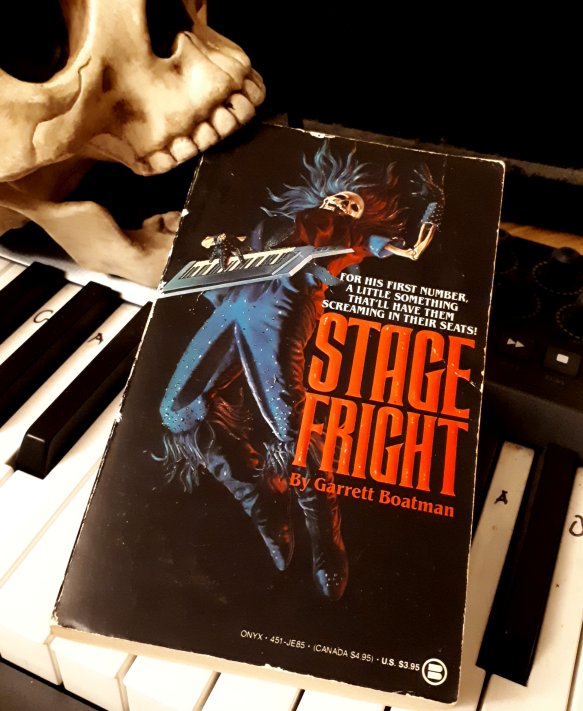
It will come as no surprise to anyone who has ever read this blog that I sometimes get obsessed with certain books. A few years ago, I first saw the cover of Garrett Boatman’s Stage Fright, and its heavy metal skeleton assured me that I would some day read it. A few months later, the cover of Stage Fright was featured in Grady Hendrix’s Paperbacks from Hell, and copies suddenly became scarce and expensive. It was already an obscure book that I couldn’t find much information about online, and this combined with its sudden scarcity made it all the more desirable.
stage fright boatman.jpg
This time two years ago, I was scouring the internet for an affordable copy of Stage Fright, all the time kicking myself for not having bought one when they were going for 10 dollars (including postage). I’m not exaggerating; I was literally searching bookfinder and ebay every few hours. At one point, I was planning a trip to the United States to buy a copy from some dude in Washington, but he sold it before I could go through with this. I also spent hours searching for Garrett Boatman on social media to see if he had any copies left, but I couldn’t find any traces of him online. I presumed he was either dead or that ‘Garrett Boatman’ had been an alias. Fortunately, I eventually found a copy online for about 35 dollars and snapped it up. 35 dollars is too much to pay for a tattered old horror paperback, but after a bit of reasoning I convinced myself that it would be worth paying that much just to free up the time I had been spending looking for this damned book.

When I got around to reading it, Stage Fright did not disappoint. It was a bloody mishmash of horror and sci-fi. I rated it 5 out of 5 on goodreads and wrote a glowing review. In writing that review I came upon Joe Kenney’s review that noted a curious feature of the book. The inside cover of Stage Fright makes reference to a book by Garrett Boatman titled Death Dream. This was peculiar for two reasons. First off, the description of Death Dream lines up with the plot of Stage Fright, and secondly, there was no record of a book called Death Dream ever being published. Here was a mystery.
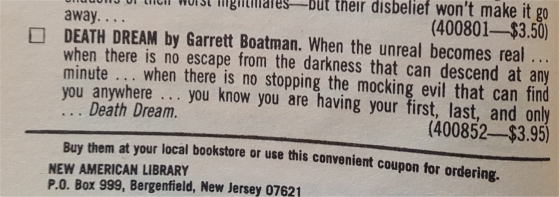
death dream garrett boatman

I had purchased, read and reviewed Stage Fright, so I set my sights on some other curious books and moved on. I briefly considered selling my copy, but I decided to hang on to it because it’s so cool. I had spent a long time obsessing over this book, and it’s one of the jewels of my collection.

Can you imagine my surprise and delight when Garrett Boatman came out of hiding and posted a comment on my blog’s facebook page? Here was the hitherto believed dead author of one of my favourite novels sending me a message! Might this be my chance to get the answers to all of the questions I had about this most curious volume?

Yes. It was. It turns out that Garrett Boatman is actually a really nice, patient and accommodating guy. He very graciously responded to my questions and has allowed me to publish those responses here. I’m absolutely delighted to be able to share this interview of sorts with you.

garrett boatman.jpgMr. Boatman

First off, can you tell me the story of writing Stage Fright? Where, when and how did you do it? How did you get it published once it was written?

In the 1950s, researchers at Tulane University discovered a protein antibody called taraxein in the blood of schizophrenics that caused schizophrenic behavior when injected in monkeys. Administered to inmate volunteers from the Louisiana State Penitentiary, taraxein produced schizophrenic episodes that lasted up to half an hour, presumably until the body’s defense mechanisms defeated the invading substance. Hmm, I thought. From the blood of schizophrenics. Now there’s an idea.

Two other elements went into the inspiration for Stage Fright. Growing up I watched a lot of Creature Features and especially enjoyed stories about mad scientists like Frankenstein, Nemo, Jekyll, Morbius from Forbidden Planet.

The third piece was my idea for a new type of performing art. I remember thinking when I was a boy walking in the Georgia woods wouldn’t it be great if I could make up music in my head and hear it playing in the air. As an adult I loved movies—especially horror, science fiction and fantasy. But making a movie takes money, a director, actors… I thought wouldn’t it be great if there was a technology that could record my dreams. I’d always been interested in dreams, especially nightmares which I enjoy. In controlling them and watching how they play out. I’d recorded my best dreams for years in my notebooks. In fact some of the dreams or schizophrenic sequences in Stage Fright derive from my dreams. Anyway, I came across articles on how dreams or thoughts might be recorded in Psychology Today and other publications, as well as how different parts of the brain processes different sensory input and came up with the dreamatron, a combination synthesizer-neural transmitter device. Edison had his “flickers.” I had my dreamies.

Stage Fright was my second novel. The original title was Death Dream. I wrote it long-hand, then typed it up on a second-hand IBM Selectric. I was unagented. I called New American Library because Signet published Stephen King. I asked to speak to an editor and got one, Matt Sartwell. He asked what I had. I told him about taraxein and my idea for a new media for performing arts. He asked me to send the manuscript and I signed a contract a couple months later. The book was originally intended for NAL’s science fiction imprint Ace with a print run of 90,000 copies, but NAL had recently launched a horror imprint, Onyx Books, and editor-in-chief John Silbersack decided to publish Stage Fright under the Onyx imprint with a print run of 70,000 copies. The new title was also John’s idea. And so it goes.

What can you tell me about the amazing cover art? The artist is uncredited in the book as far as I can see.

I have no information about the cover artist. He or she is not credited in Stage Fright. Paperbacks from Hell lists the cover artist as “unknown.” When I was shown the artwork for Stage Fright, the colors were circus bright. The skeleton’s face was white, hair blond, vest red. I think the pants were blue. The boots were buckskin. I said the colors should be darker. Silbersack agreed. When I got the mockup, I was pleasantly surprised. The art department did a great job.

What about this Paperbacks from Hell business? Did you know your book was going to be featured? If not, how did you find out about it?

No, I didn’t know. I’d been working on a dark-fantasy for the past few years, doing more writing than reading (which for me is a hardship since I’m a voracious reader), and when I finished editing the last volume in November, I ran a search keywords my name and Stage Fright and was thrilled to come up with hits on Nocturnal Revelries, Too Much Horror Fiction, Glorious Trash, Goodreads. It was the link from your review of my book on your post “One for the Rockers“ that sent me to Paperbacks from Hell.

(Ohhhhhh man, knowing this makes me so happy. I feel like I’ve played a small role in horror fiction history!)

How did it make you feel to find out that your book had been not just featured in Paperbacks from Hell but also included on its cover? That book won awards and has had a pretty big influence on the horror market in recent years. Do you accept the title of ‘Paperback from Hell’ for your book?

I write from that dark subterranean platform where the three tracks of science fiction, fantasy and horror meet. There was a time when my editor at NAL joked maybe I would be the King of Technohorror. So if the shoe fits…

But yes, I was tickled pink. Ordered a copy right away. Grady Hendrix must have good taste: he’s using the face from my cover for his Facebook image. Check it out. But really, Stage Fright is more than that. I am very interested in social evolution and how new technologies impact social evolution. I plan to further explore how my dream technology might help shape social evolution. Movies, cell phones, virtual reality all have an impact. If I can throw some frights in along the way, even better.

A couple of years ago, right after PfH came out, a lot of the books featured therein became highly sought after. I remember a time when the cheapest copy of Stage Fright available online was $300. Prices have dropped considerably since the big PfH boom, but copies of Stage Fright still don’t come cheap. Do you find that annoying or flattering?

Neither, I just shake my head in amazement. But I’m glad horror is back. Can I get a Hell Yeah?

Hell yeah, brother! Haha, so what are you plans for the future? Tell me about the new stuff you’re writing/have written.

Night’s Plutonian Shore is a doppelgänger novel, “creatures of the id” as Dr. Morbius called them in Forbidden Planet. One of my favorite tropes. Experimenting with psychotronic generators—similar to what the ancient Egyptians called “Wands of Horus,” a group of students accidentally produce doppelgängers. Survival instinct compels these creatures to murder their originals. My protagonist has a conscious and draws the line at murder; his double does not.

In The Clocks of Midnight, Rick and Fergi, having survived encounters with their doppelgängers, have relocated from New Jersey to Memphis, Tennessee. At the site of a multiple-vehicular accident, a dead man wakes to tell Rick, now an EMT, “The feeding has begun.” In Montreal, a shadow creature attacks two-hundred-year-old horologist Reginaldo da Silva, priest of the Goddess and guardian of the mandala that binds the Watchers to the Abyss. In the days of Enoch, the Watchers, sent to keep an eye on man, abandoned their task and cohabitated with humans, producing monstrous offspring, the Nephilim. The true Samhain, when the Pleiades stand at the zenith at the stroke of midnight and the veil between worlds is thinnest, approaches. And when the Goddess, posing as a vendor in a flea market, sells Rick a crystal that channels the energy of the stars, his life is catapulted into a confrontation with an ancient evil, one of the Grigori, a Watcher who escaped God’s avenging angels in the world’s youth and whose mission is to open the gates of the Pleiades and usher in a new reign of terror.

In The Mirror of Eternity, EMT Rick Scott arrives at the scene of a fire and finds an apartment block vanished, replaced by a warehouse dating to the time of paddle wheelers ablaze, and standing before the inferno, two antique horse-drawn pump wagons and firemen in peaked leather helmets and old-fashioned uniforms. Time is flowing back toward the singularity of the creation. Though he wants no part of magic or the Goddess or Her priest Reginaldo da Silva, he needs answers and, using a vintage 1934 Omega RAF pilot’s watch the ancient horologist has modified with complications created on the astral plane, travels back to 1583 to consult with John Dee and Giordano Bruno and to face demons and gods and in the process become what he never wanted.

The trilogy follows Rick’s reluctant journey from initiate to adept. His arc mirrors the alchemical stages of nigredo to albedo to rubedo.

These books will be available soon, and since this interview was first published, Mr. Boatman has confirmed that Stage Fright is going be rereleased as part of  Valancourt’s Paperbacks From Hell series.  (YES! I’ve been smiling since I found out yesterday!) I hope this information was as interesting for you as it was to me. You can find more information about Garrett Boatman and his books on his new website, https://www.garrettboatmanauthor.com/

Thank you Garrett!

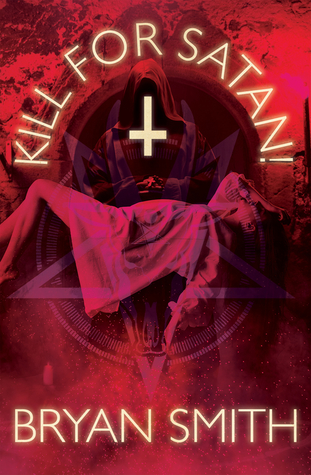
Kill for Satan – Bryan Smith

42304587._SY475_.jpg

Kill for Satan – Bryan Smith

Grindhouse Press – 2018

I saw the cover of this book roughly a year ago and knew I’d have to read it. It’s about a bunch of people killing a bunch of other people. Oh, and they’re doing so for Satan.

Kill for Satan only came out in 2018, and it features a lot of pop culture references that made me realise how little modern horror I actually read. I was a bit bothered by the repeated allusions to one of the character’s Cradle of Filth tshirt (Jesus Christ, that band are shit.), but I liked the part when one of the characters is researching Satanism and discovers “modern so-called “Satanic” groups that don’t actually believe in the existence of any demonic evil entity ” who “use Satan as a provocative and subversive means of delivering progressive messages. They are social activists, not true devotees of the dark path.” Haha, I wonder who he’s reading about.

Really though, aside from all of the killing for Satan, there’s not much else going on in this book. It reminded me of a more straightforward version of William Johnstone’s The Nursery. In a way that’s a good thing; Johnstone’s book was a mess, but I found the plot of Kill for Satan to be a bit underwhelming.

Bryan Smith seems to specialise in Splatterpunk, and this book, like some of the others within that genre, was just a bit too straightforward for me to really enjoy. Kill for Satan felt a bit more like reading the screenplay for an extended death metal music video than it did a novel. Smith’s writing is decent – I was never bored, but personally, I would have enjoyed a bit more plot/character development – maybe a little less killing and a little more Satan.

There is one particularly memorable scene in which a mother says to her child, “I’m sorry, sweetie. I do love you. But I love Satan more.” Yikes. You can probably guess what happens next. If this sounds good to you, if you’re looking for a straight up bloodbath of mindless, brutal violence, this book will not disappoint.


My Work Is Not Yet Done – Thomas Ligotti

My Work is Not Yet Done ligotti.jpgMy Work is Not Yet Done – Thomas Ligotti
2002 – Virgin

I read a lot of books, but in truth, there are relatively few authors whose books I savour. I actually hold off on reading Thomas Ligotti because I don’t want the day to come when I have already read all of his books. His low opinion of humanity is both tragically hilarious and brutal, and while I don’t necessarily share the outlook of the narrators of his stories, I find his pessimism the perfect vehicle for horror. The message that our existence has no worth is perhaps the most disturbing idea that an author can offer to 21st century humans.

My Work Is Not Yet Done is a novella and two short stories. All of these tales are about workers’ lives as part of a corporation. There’s a very Kafkaesque vibe running throughout, but Ligotti covers the bureaucratic angst with layers of supernatural horror and misanthropy and turns it into something far darker. The first act of the eponymous novella portrays a man who decides to go on a killing spree in his office after he’s unfairly dismissed from his job. I know Stephen King found himself in hot water for writing a novel about a school shooting, so I was impressed that Ligotti had done something so extreme. I won’t tell you what happens later on in the story, but I will say that it’s actually far worse than what you’d expect.

I know full well the misery of working for a company that you hate, and while I’ve only spent a little over a year working in an “office job”, I spent enough of that year fantasizing about murdering my boss to have thoroughly enjoyed this book.

Little things about the book stuck out to me. Characters have stupid names – coworkers are named Sherry, Terry, Mary, and Perry, and detectives are named Black and White. Also, the purpose of the corporations that these characters work is barely discussed – the nature of the work that the characters engage in is almost entirely passed over. Why does Ligotti omit these details? Why doesn’t he put more effort into naming his characters? Because that stuff doesn’t matter. Human beings are entirely interchangeable. You are no different to the people you hate the most. What corporations actually do doesn’t make any difference to their workers. Nothing fucking matters. Every living thing is going to die without having made any noticeable difference in the universe, a universe in which every single atom will eventually decay.

Oh, I forgot to mention that this is the first post of 2020. Happy New Year everyone!

“Generally speaking: Expect nothing but nightmarish obscenities to be born when human heads come together in intercourse.

More generally speaking: Whatever is born will ultimately grow into a nightmarish obscenity – in the grand scheme of things.”

There’s moody nuggets like this sprinkled throughout the book, but the closing lines of My Work Is Not Yet Done sum it all up. I don’t want to quote those here as it might ruin the effect when you do get around to reading it, but fuck me, they’re perfect. Please believe me when I say that this is a novella worth reading.

I’ve also reviewed Ligotti’s Teatro Grottesco and The Conspiracy Against the Human Race if you’re interested. I read Noctuary years ago too, but I haven’t reviewed that one properly yet. There’s a copy of the Penguin edition of Songs of a Dead Dreamer and Grimscribe on my shelf, but I’m waiting for a special occasion to allow myself the luxury of reading it.

2019, The Year in Review

2019 was the busiest year yet for this blog. There were more posts, words, books and traffic than ever before. (I know I said the same thing last year, but I’ve outdone myself again.) I put a lot of effort in this year, and almost all of my reading was dedicated to this blog. I only managed to read 4 non horror/occult books over the whole year. If you haven’t been paying attention, this post will guide you through what I covered in 2019.

I read some really cool novels this year. I was so excited to find a cheap copy of Kathe Koja’s The Cipher in a thrift store, and I’m happy to report that it lived up to its reputation. I posted about Edward Lee’s The Bighead right at the beginning of the year, and it was an extremely gross, funny and enjoyable read.  My copy of C.S. Cody’s The Witching Night had been on my shelf for years, but I loved it when I got around to reading it this summer. Bari Wood’s The Tribe also blew me away. There’s no wonder that it was recently rereleased. Flesh by Richard Laymon may not have been a brilliant novel, but I really enjoyed it. I ended the year reading two classics of weird fiction, Fritz Leiber’s Our Lady of Darkness and William Hope Hodgson’s The House on the Borderland. Both of these books were awesome.

I did a few short story collections this year too. I was delighted to get my hands on Montague Summer’s long forgotten Ghost Stories. I also really enjoyed rereading Lovecraft’s stuff. (Part 1, Part 2, Part 3 and Part 4.) In May, I reviewed Teatro Grottesco by Thomas Ligotti. I absolutely adored that book, and I was surprised to see how much traffic that post got. (I also just finished his My Work is Not Yet Done, so expect to see more Ligotti here soon.) In October, I did a lengthy post on the two Splatterpunks anthologies from the 90s. The stories in these were of varying quality, but they did put me onto some cool writers. I actually thought that I had reviewed more short story collections than this when I started writing this paragraph, but that’s because I have spent the last few weeks working through Clive Barker’s Books of Blood. I haven’t finished all 6 yet, so it’ll be another while before they show up here. (Barker is one of the authors that Splatterpunks convinced me to check out.)

Of course, this blog isn’t just about fiction, and this year, I got into some very weird esoteric books indeed. The one I was most excited about was Geoff Gilbertson and Anthony Robert’s The Dark Gods. Jesus, that book was mental. (I’m also happy to report that a pdf copy has been uploaded to the internet since my post was published, so you won’t have to go through what I went through to read this very rare and very odd book.) I was also proud to present a review of Robert Eisler’s Man into Wolf, a very peculiar book on lycanthropy. Dr. Alexander James McIvor-Tyndall’s (pre-Nazi) swastika adorned Ghosts: A Message from the Illuminati was another interesting book to track down and read. Allen H. Greenfield’s books on UFOnauts and the secret rituals of the Men in Black are amoungst the strangest I have ever read. I read three (1, 2, 3) dumb books on sex magic over the course of the year, and George Bataille’s book on Gilles De Rais was a very depressing look at that dirty satanist paedophile. On top of H.P.’s fiction, the aforementioned Lovecraft posts all deal with Lovecraftian grimoires too.

I also read a bunch of utterly idiotic grimoires that were written by morons. Highlights include Fascination by Master Count de Leon, The Black Grimoire by Angel Zialor and Secrets of the Black Temple by the Red Spider. This shit was DUMB.

Finally, I reviewed a little bit of porn in 2019. Satan was a Lesbian and The She-Devils did not live up to their titles, but Ann L. Probe’s Alien Sex series was exactly as good as you’d expect.

We’re soon to enter the twenties, and while this post only looks at the books I’ve reviewed in 2019, this blog has been around for half a decade now. If you’re interested in looking back, you can check my yearly review posts for 2018, 2017, and 2016. (I didn’t do one for my first year.) You can also look through my site’s index for a complete list of the 300+ books that have been reviewed here over the past 5 years. If you enjoy this blog, please share it with like-minded people. You can get updates on twitter or facebook, and I’m always happy to get recommendations for my next review.

I hope you have a great new year!

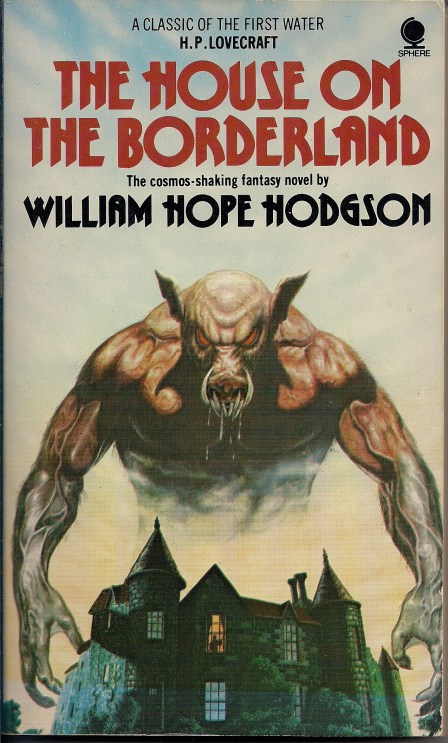
The House on the Borderland – William Hope Hodgson

house on the borderland william hope hodgson.jpgThe House on the Borderland – William Hope Hodgson
1908

It’s coming close to the end of the year, and I have spent 2019 reading some absolute garbage. After reading and reviewing Fritz Leiber’s awesome Our Lady of Darkness last week, I really wanted to read another cool book. I’ve been meaning to read William Hope Hodgson’s The House on the Borderland for a couple of years, and when I found a free audiobook version last Sunday, I decided the time was right.

This was a very enjoyable piece of weird fiction. It’s about a strange man who lives in an old house in Ireland that seems to exist on the border of different dimensions. I spent the first half of the novel thinking it was basically just Night of the Living Dead with interdimensional pig-mutants instead of zombies, but the second half of the book has more in common with 2001: A Space Odyssey. (I just read Will Errickson’s review of this book and saw that he also made a 2001 comparison. Will, I swear this was coincidence!) There’s little wonder that H.P. Lovecraft was a big fan of this novel; there’s some very definite “the universe doesn’t care about you” vibes throughout.

I read William Hope Hodgson’s Carnacki the Ghost Finder stories a little under two years ago, and while I enjoyed them, I seem to remember them being a good deal more straight forward than this. One of those stories also includes evil pigs, and a couple of them are set in Ireland too. I reckon I enjoyed The House on the Borderland more, and I’m planning to read more by Hodgson in the future.

The only problem with reading good books, especially popular ones, is that I find myself at a loss for things to say when reviewing them. This one is cool, short and available for free in multiple formats. You might as well check it out.

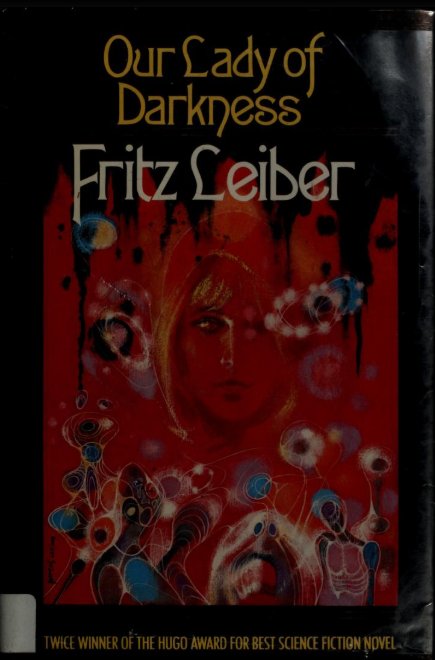
Our Lady of Darkness – Fritz Leiber

fritz leiber our lady darknessOur Lady of Darkness – Fritz Leiber
Berkley Publishing – 1977

A recovering alcoholic reads a weird book about evil architecture and a notebook belonging to Clark Ashton Smith and then begins to see weird stuff through his binoculars. That’s the premise of Our Lady of Darkness by Fritz Leiber. The protagonist is also an author of weird fiction, and repeatedly references Lovecraft, M.R. James and Bierce. I really enjoyed this book, and reading it has made me want to check out more stuff by Leiber.

I didn’t know anything about the author when I started reading Our Lady of Darkness, but I only got a few chapters into this book before I realised that the main character is supposed to be him. Leiber’s name was Fritz, and the character’s name is Franz. They  have the same job, and I can’t put my finger on it exactly, but there was something about the sections on the protagonist’s wife and her death that had me convinced that Leiber was writing from experience. Sure enough, he lapsed into alcoholism after the death of his own wife, and this is obviously a largely autobiographical work. Although this novel contains some fantastic elements, this autobiographical stuff keeps it grounded and makes the weirdness all the more discomforting.

And the weirdness here is quite weird. The antagonist of the book is Thibaut de Castries, the author of Megapolisomancy: A New Science of Cities, a book about the supernatural power of large cities and their buildings. I found this idea quite Ballardian, not in the sense that Ballard was also fascinated with architecture but in the pairing of two seemingly disparate concepts. (De Castries links occult forces with architecture in a similar way to how Ballard links sex and car crashes.) It was cool to come across an idea as strange as this in a fantasy/horror novel.

I don’t have a huge amount else to say about this book. It’s a classic of weird fiction, and you should read it if you haven’t already.  An earlier version of the story was published as The Pale Brown Thing in Magazine of Fantasy and Science Fiction, and I read yesterday that Leiber considered this an alternative telling of the same tale rather than just an earlier draft. Swan River Press published an edition of this version in 2016, but it’s long sold out. It would be cool if somebody could upload scans of the original printing to the internet. I’d be delighted to read another version of this story.

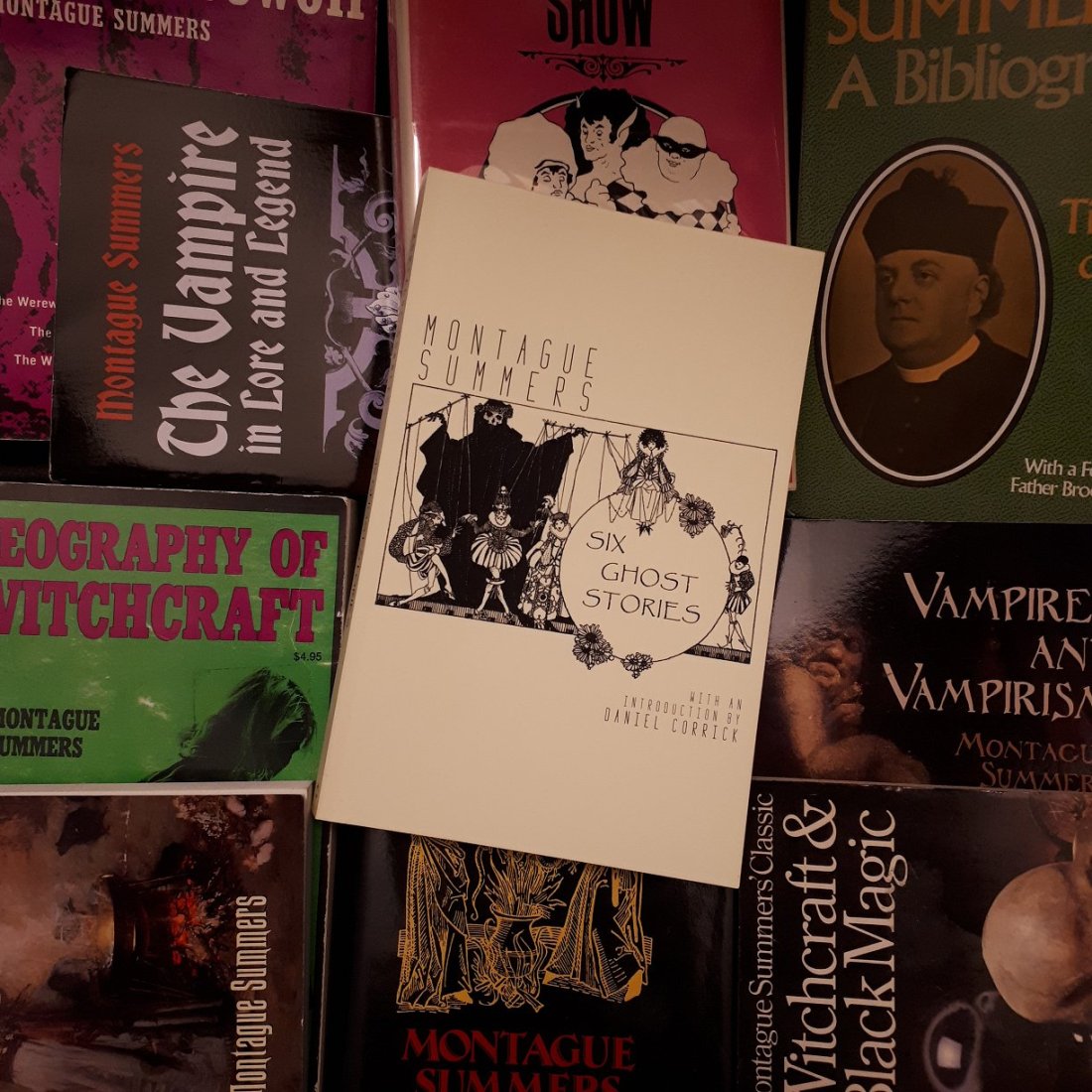
Six Ghost Stories – Montague Summers


summers six ghost stories.jpgSix Ghost Stories – Montague Summers
Snuggly Books – 2019

A few months ago, I got an email from my pal Sandy Robertson telling me that Snuggly Books were going to release a collection of short fiction by Montague Summers. I have long been aware that Monty had written a collection of short stories, but I knew that only a couple of these stories had ever actually been published and that it was difficult to find affordable copies of the books wherein these tales were collected. I’m a big fan and collector of the occult-related non-fiction books written and translated by Monty, and I am also a big fan of short horror fiction, so you will believe that I was very excited to hear that Monty’s ghost stories were finally being published. I ordered this collection for my birthday and read it last week.

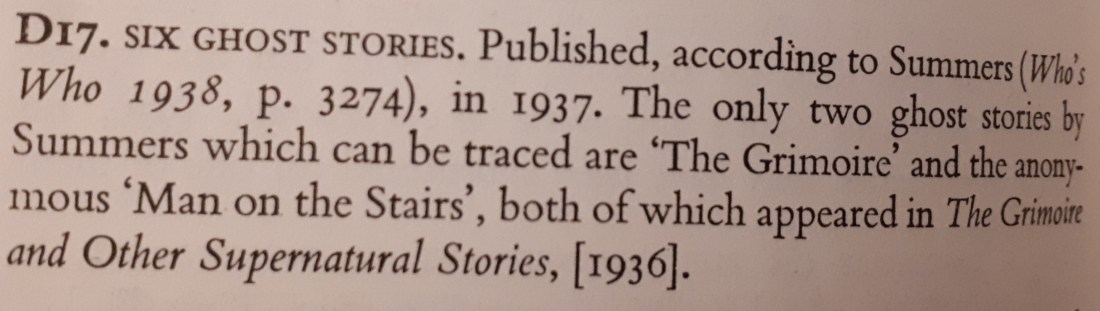
20191130_224224This is the note from Timothy d’Arch Smith’s bibliography of Summers where I first read of these fabled fables.

These six stories lived up to my expectations. They are mostly about people who some acquire some kind of peculiar haunted object that brings about visions and specters. The obvious comparison to make is to M.R. James, who apparently had the chance to read and commend these tales. Incidentally, Montague Summers, the man, has always reminded me of the characters in James’s tales.

The writing in here isn’t what you might expect if you have only read Summers’ books on witchcraft. There’s some very long sentences, but Monty seems self-aware when he’s being verbose, and this comes across as charming rather than tedious. My biggest criticism is probably that the tone of some of these stories remains too light-hearted for too long. Everything will be going fine and dandy for all of the characters, and then a ghost will jump out and scare a person to death right at the very end of the story.

My favourite tale in here was The Grimoire. This one has been previously published in different texts, and it’s not hard to see why it was chosen above the others. It’s the story of a bibliophile whose local dealer procures him an aged book of sinister black magic. When the collector translates a passage from this heinous tome, scary things start happening. (I can’t help but wonder if Sam Raimi read this tale before writing Evil Dead.) This one was particularly cool because it feels like Summers, an expert on books about black magic, could be the narrator.

While not all terribly original, these stories are competent, fun and generally pretty satisfying. I read one each night after my family had gone to bed, sipping a cup of peppermint tea and hearing the cold November breeze blowing through the willow trees our garden. It was great. I suggest you enjoy these tales in a similar manner.

These stories are entertaining in and of themselves, but there’s something very exciting about reading a collection of tales that were believed to be lost for more than half a century. Summers’ old manuscripts went missing shortly after he died in 1948, and they were only unearthed a few years ago. Snuggly Books put out this collection in October (I think this is the only book from 2019 that I’ll have reviewed in 2019.), and they are planning to put out a second volume of Summers’ fiction early next year. This collection will include a novella titled The Bride of Christ. Sign me up!

The Devil on Lammas Night – Susan Howatch

susan howatch the devil on lammas night.jpgThe Devil on Lammas Night -Susan Howatch
Ace Star -1970

A millionaire’s wife and his daughter, Nicola, are seduced by Tristan Poole, the charismatic and mysterious leader of “The Society for the Propagation of Nature Foods”. This society is actually a Satanic cult posing as a harmless group of new-agers, and Poole’s motives for seducing Nicola and her step-mom are less than gentlemanly. Oh, and to complicate matters further, Poole is living in Nicola’s ex-boyfriend’s house.

Things play out pretty much as you would expect.

This is primarily a romance novel. The Satanic antagonist’s main motivation is money, and while there is plenty of black magic in here, the story could still work if this element was switched with something else. That being said, I quite enjoyed the little bits of occultism sprinkled throughout. Howatch seems to have done her homework; the rituals here are documented, and the demons listed are all of the Solomnic tradition. There’s a part where a character shies away from explicitly describing the Osculum Infame and another bit where the author claims that the Satanist performed “unprintable” acts to his communion Eucharist. I knew that witches are supposed to kiss the devil’s shitterhole before reading this book, so I was able to fill in the blanks to the first omission by myself, but I can’t remember what unprintable acts are supposed to be performed on a Satanic Eucharist. Does the celebrant cum on them or rub them against his bumhole or something?

I’m not going to rush out to read Susan Howatch’s other books, but this one was fine.

Hell-O-Ween and The Manse

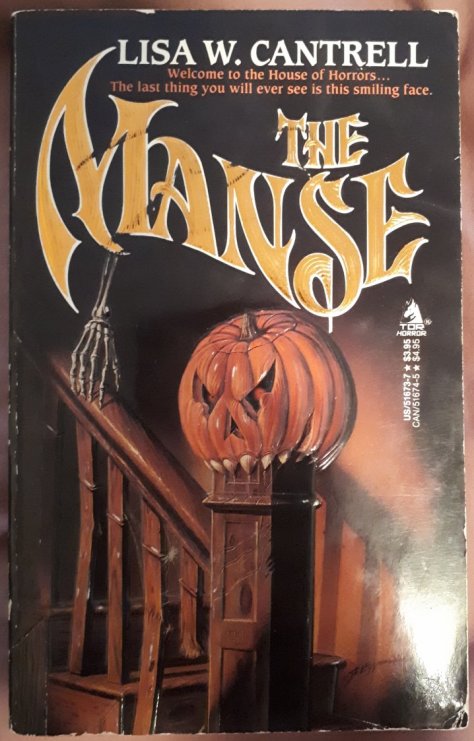
hell-o-ween the manse halloweenHappy Halloween. To celebrate my favourite holiday, I’m reviewing two Halloween horror novels that have pumpkins on their covers.
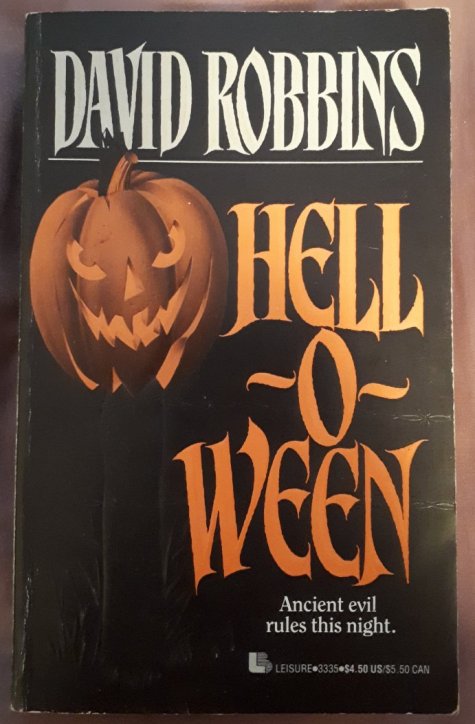
david robbins hell-o-weenHell-O-Ween – David Robbins
Leisure Books – 1992

Hell-O-Ween is a remarkably awful book. It starts off with the line; “Yo dweeb, are you ready to go monster hunting?”, and what follows is pretty much what you’d expect. This is an overwritten Goosebumps book with a little violence and a few (gross) mentions of sex thrown in. The following sentence appears n page 23: “She’d neck heavy and let a guy play finger tag with her box, but she refused to go all the way.” This isn’t a line of dialogue either; it’s the narrator’s voice. Finger tag with her box? Jesus.

Hell-O-ween is the story of a nerd, two sluts, 3 jocks (2 bad and 1 good), a geeky girl and a beautiful virgin. These painfully stock characters decide to explore a system of caves on Halloween night. There is a huge picture of an angry demon right at the entrance to the cave, and the astute reader will figure out exactly how the story is going to end after about 10 pages.

Very little happens in here that you wouldn’t expect. Perhaps the most interesting part was a lengthy passage in which one of the jock characters admits to his friend that he started selling cocaine in defiance of his liberal father. I’m sure the author was making a point here, but I can’t figure out what it was. Was it that liberals are irresponsible and can’t raise kids, or was it that non-liberals are piece-of-shit drug dealers? I sincerely don’t know.

This was a gruelling read that I regretted starting almost immediately. Do yourself a favour and give this one a miss.

the manse lisa wThe Manse – Lisa W. Cantrell
TOR – 1987

The Manse won a Stoker award for best 1st novel in 1987. Kathe Koja’s excellent The Cipher won this same award a few years later, so I was expecting a fairly high standard from this book.

I was disappointed, terribly disappointed. This is shockingly dull garbage. It’s the painfully boring story of a haunted house that becomes extra haunted on Halloween night. Actually, Will Errickson reviewed The Manse years ago, and said all of the things I feel like saying about this book. Read his review if you’re still interested. I don’t need to say anything more. Cantrell wrote a sequel, but I’m not going to waste my time on it. The Manse was a shitty, shitty pile of trash. It was poo in a baby’s diaper. Stay away!


Both of the books I reviewed for this post absolutely sucked. Actually, pretty much all of the books I reviewed this month absolutely sucked. This week marks a milestone for this blog, and I have a bit of an announcement about that.

For the last year, I have published (at least) one post per week. I have read some great books in the process, but I have also forced myself to read some utter crap to maintain the steady stream of reviews. After some consideration, I have decided that continuing at this pace isn’t really beneficial to me or to this blog. Look at some of the shit I’ve reviewed in the last year.


Sensible adults don’t read books like these.

Nobody cares about this nonsense, especially me. With this in mind, I want to let you know that I am going to cut back on posts for the next while. I’m going to be focusing on quality rather than quantity for a bit. This probably means 2 posts a month rather than the 5 you’ve been getting for the last year, but at least the newer posts will more than just “This book is pooey farty bumbum.” I want this blog to be something that I enjoy doing rather than something I feel obliged to do.

Have a safe and happy Halloween. Check out my previous Halloween posts while you’re here.