Witchcraft (The Story of Man’s Search for Supernatural Power) – Eric Maple

2016-01-07 23.52.33.jpg
Octopus Books -1973

This is a pretty cool coffee table book on witchcraft from the 70s. Most of it is the kind of stuff you expect from a 140 page overview of an overwhelmingly broad topic, but there were a few cool bits in here that I hadn’t come across before; some of the details on the torture techniques of the inquisitions made me feel rather uncomfortable. The section on Wicca is far too long, but otherwise the book  is pretty good. The images are by far the best part. I have a bunch of other books on the topic that are far more detailed, but I paid less than a dollar for this one, and I feel like it was a wise purchase.

20160107_222308
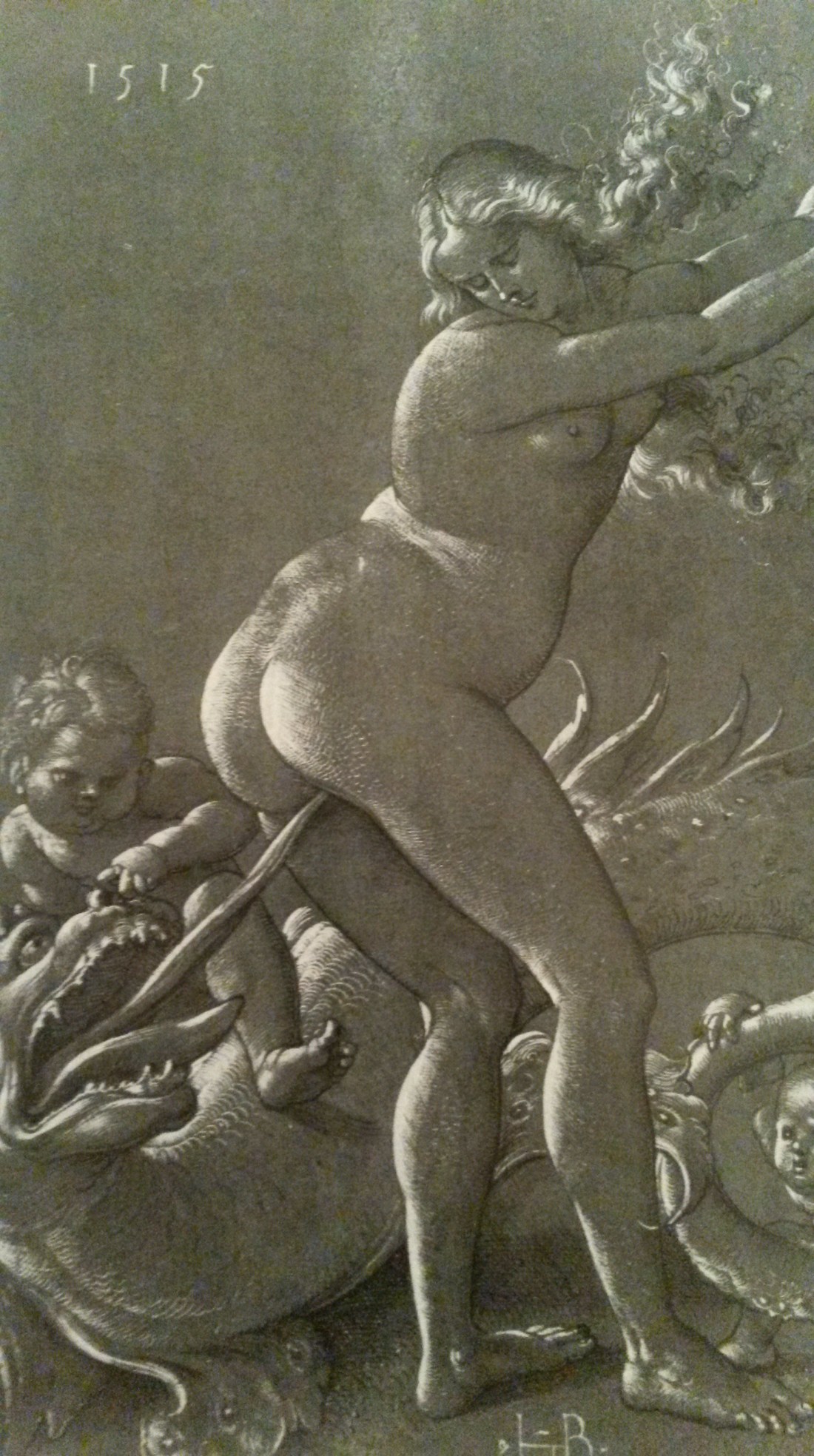
An irresponsible mother allows a dog-like serpent to give her a little bit of licky-licky-bum-bum in front of her kids.

20160107_222216
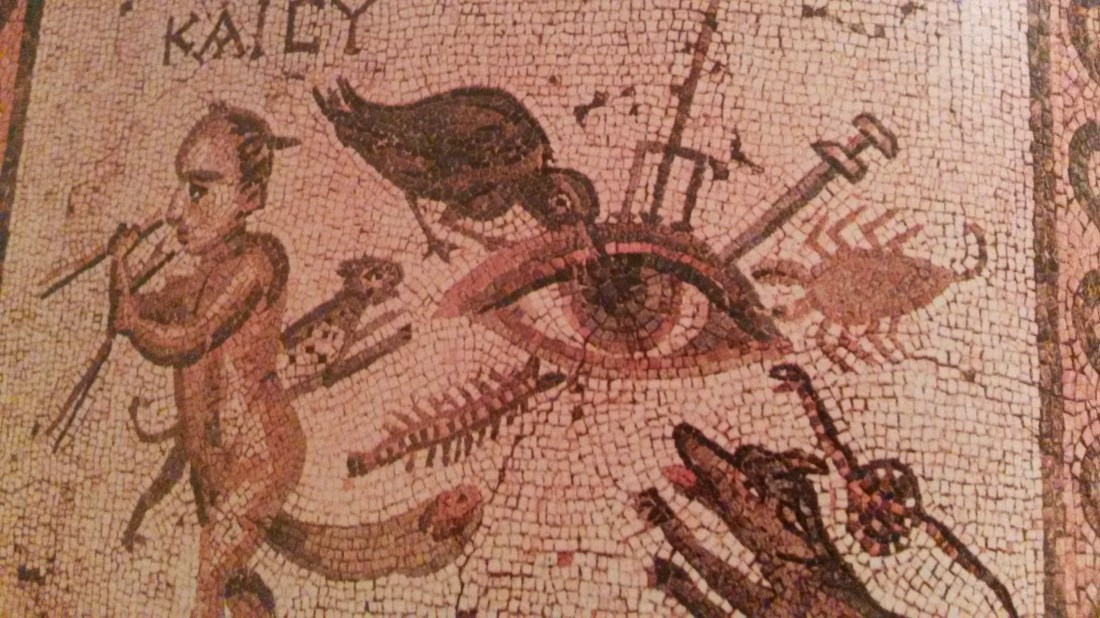
The caption below this Roman mosaic in the book claims that its intention was to “to crush the evil eye’s potency by means of pecks, bites and stabs”. Hang on though! The eye isn’t just being pecked, bitten and stabbed; there’s also a man farting at it.  And is that just a fart? That brown stream spewing from the man’s anus looks like it’s carrying baggage! Either way, think of how disrespectful that is! Imagine being captured by your worst enemy; he pokes you with his trident, throws you in a cage with gross insects and wild animals, stabs you with a sword, and then adds insult to injury by farting in your eye. What a blackguard!

20160107_221636
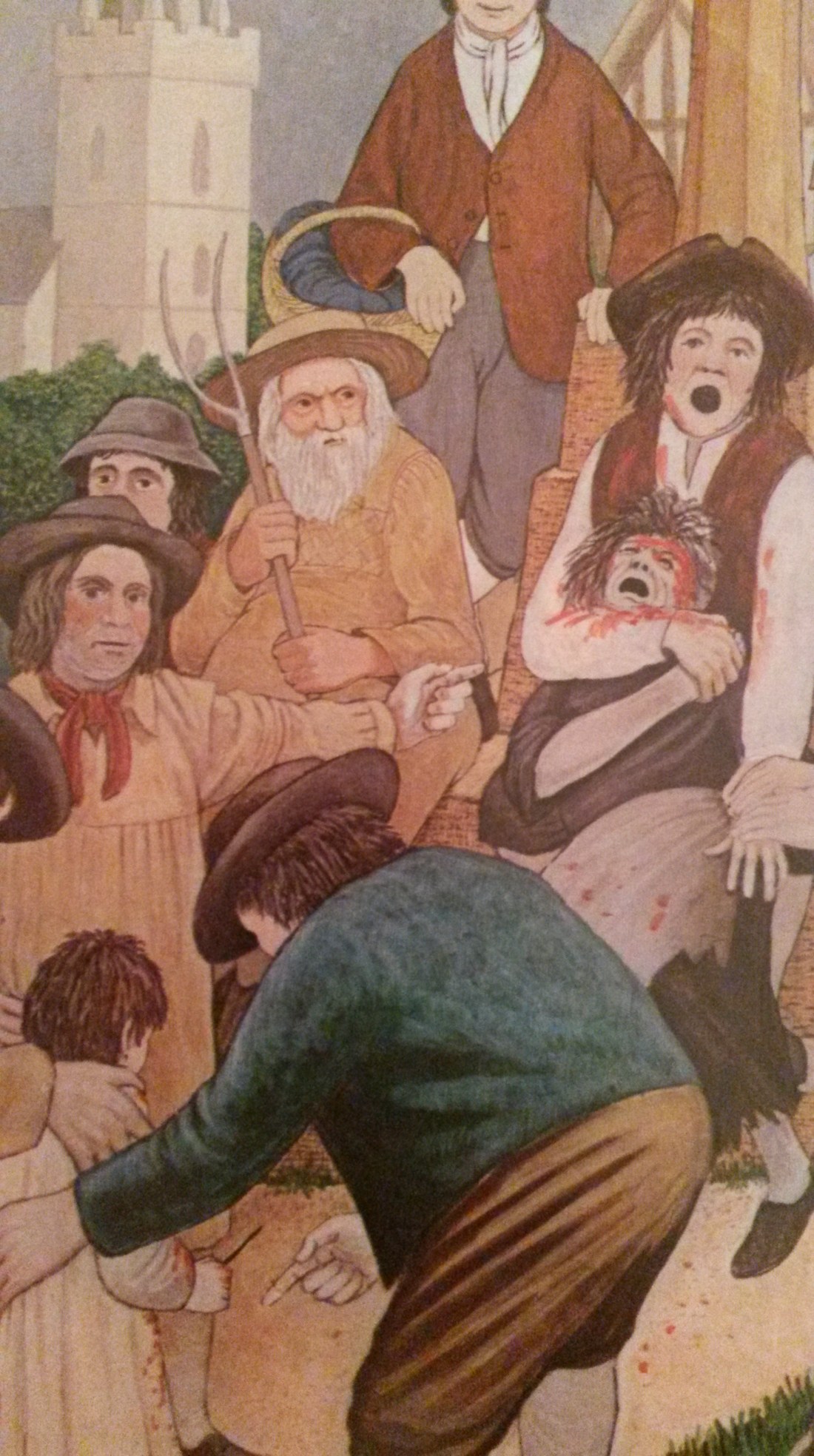
Good boy Jimmy, scratch that mentally handicapped woman’s face with your rusty nail. She won’t be casting any more spells on you after that!

20160107_22211620160107_221758
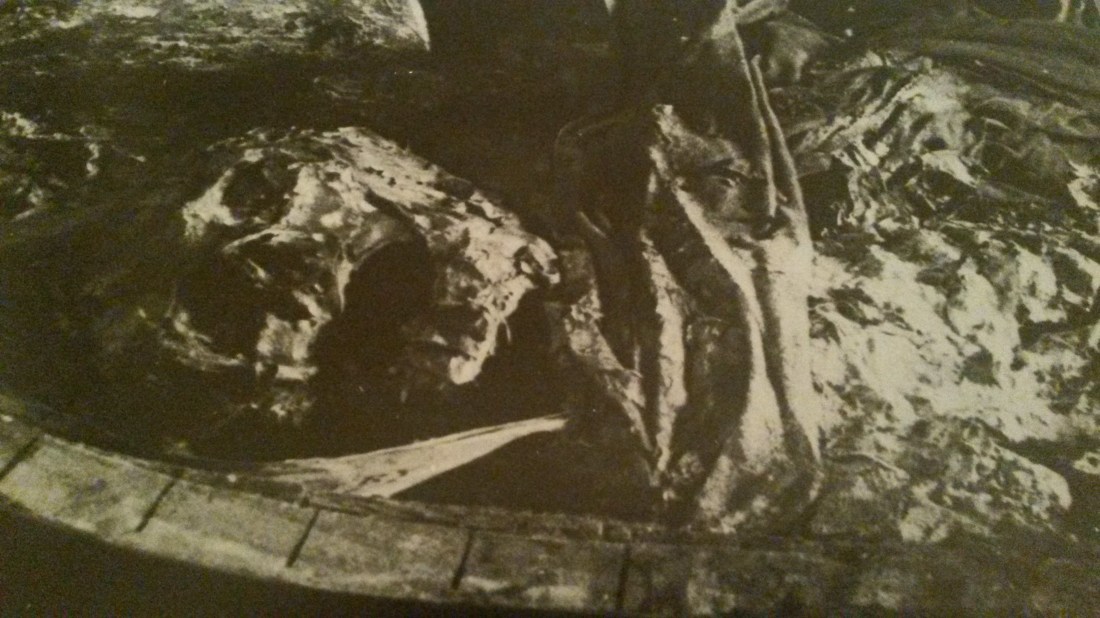
These images are the coolest part of the book. They’re from the aftermath of the 1963 desecration of Clophill Graveyard in England.  These grisly exhumations are thought to have been the work of Satanist Necromancers. 7 graves were desecrated and chicken’s feathers and blood were found strewn across the scene. One of the corpses was a lady named Jenny Humberstone who died in 1722. Her grave was opened 3 more times after the initial incident. I suppose that if you’re going to dig up a corpse, it’s probably more polite to exhume somebody that nobody remembers. It’s still pretty fucked up if you ask me. There was actually a horror movie made about Clophill church a few years ago, but it looks absolutely shit and I probably won’t be watching it.


Necronomicon – Abdul Alhazred/Simon

2015-12-11 20.22.39
Avon – 1980

Well, I finally got around to reading it; the purported Necronomicon of the mad Arab, Abdul Alhazred.  If you haven’t heard of the Necronomicon, that means that you haven’t seen Evil Dead or read Lovecraft. It makes me sick to think of the uninitiated reading my blog, but luckily enough, this book contains a Most Excellent Charm against Hordes of N00bz:

Turn around, go, arise and go far away!
Your wickedness may rise like heaven unto smoke!
Arise and leave my blog!
Be commanded by Shammash the Mighty!
Be commanded by Marduk, the Great Magician of the Gods!
Be commanded by the God of Fire, your Destroyer!
From my blog depart in shame!

Now that only the adepts remain, let’s have a look at this ancient text of necromancy and forbidden ritual!

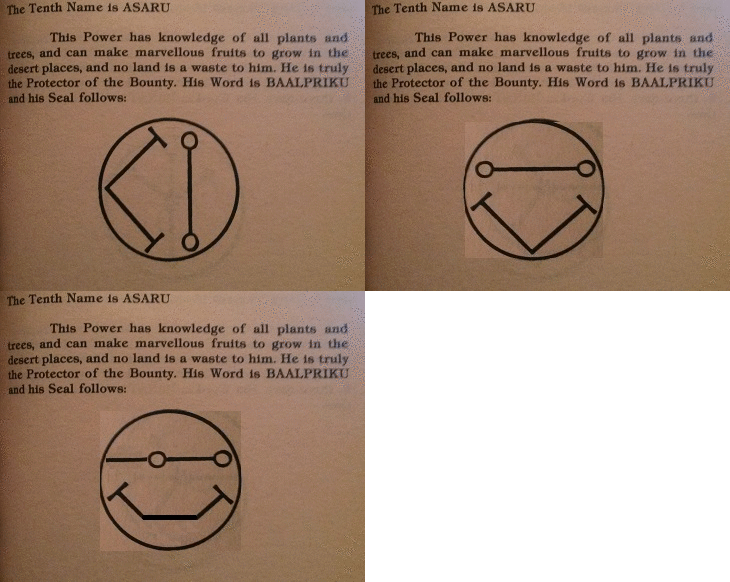
Well, it’s not really ancient, and the rituals aren’t as much forbidden as they are silly. There’s a million accounts of the story of this book online, but I’ll summarize for my readers. In the mid 70s, a lad calling himself Simon claimed that he had come across a copy of the Necronomicon, a fictional book that had appeared several times in the short stories of H.P. Lovecraft. Simon managed to get the book published, but he refused to ever go public, and nobody has ever seen the actual manuscript. Despite this, lots of people did and do think that this is the real deal. (There are some really embarrassing youtube videos of people defending the book’s authenticity.) I think the strongest evidence for the book’s legitimacy is actually how much it sucks; if I was going to write a fake Necronomicon, I would make it far, far nastier. This is basically a version of the Babylonian creation myth with a few Kutulus and ridiculous sigils thrown in to make it a bit spookier. One part of the book lists the 50 names and Seals of Marduk, and some of them are fucking ridiculous looking.

Asaru looks like a little nerd.
baalprik
And Shazu both looks and sounds like a magician’s pet gorilla.
shaavu
“Tutu” is another one of Marduk’s aliases. Yeah. Tutu.

The thing that really gives it away for me is the fact that the book reads like a Lovecraft story. It begins with a lad talking about how afraid he is of the horrors that he has awoken and proceeds to give a detailed account of how he awoke those horrors. He speaks passionately about how dangerous it would be for anyone else to read the information that he has been writing down. The manuscript is compiled of several different texts, all of which relate to each other and further the narrative, and the book ends with the narrator describing the evil things that he can see approaching him as he finishes writing the manuscript… Come on lads, that formula seems a little familiar doesn’t it?

Don’t get me wrong; I liked the fact that it was Lovecrafty, and I think that this is a quaint little addition to my weird fiction collection, but I’m definitely glad that I didn’t pay very much for my copy. The book is more than 200 pages, but about half of it is taken up with silly squiggly pictures. The testimonies of the Mad Arab were definitely the funnest parts. Were I out to cast some spells and summon some demons, I would probably be fairly disappointed with this. Then again, there is the very valid argument that this text is as “authentic” as most other grimoires. You’d have to be a bit of a wanker to take it seriously either way.

I’ve been watching that new Ash Vs Evil Dead series, and I have to say that it’s awesome. Opening the series with a Deep Purple song was utter genius! I’m going to go and watch the latest episode now. I’ll probably end up annoying my wife with some of my recently acquired Necronomicon trivia.


I found this post-it note tucked between pages when I opened it. Kutulu, enlightenment and Diana Ross; I’ll bet there was a story behind this one!!!

Morning of the Magicians – Louis Pauwels and Jacques Bergier

2015-09-05 22.26.03
Dorset Press – 1988

This one is utterly moronic. I’m no stranger to idiotic books, and I have a fairly high threshold for reading garbage, but this one was seriously stupid. It was made particularly disappointing by the fact that I actually spent quite a while trying to track down an affordable copy. I always knew it was going to be fairly bullshitty, and so I decided that anything more than 15 dollars would be too much. It took me five separate orders over the course of two years to actually get my hands on this thing. Three times the bookseller had already sold their copy and not updated their stock online, and one copy got lost in the post. When this nice hardback edition arrived, I was delighted.

The delight was not to last.

Why was I so determined to own a copy of this book? Well, this one was actually fairly popular when it was published (this edition boasts “Over 800,000 copies sold!” on the back cover), and a lot of the silly ideas in here went on to influence other silly writers. I kept seeing its title pop up in other books and articles. It has been claimed that this is the source for the main concept in Erich Von Däniken’s work. Also, a large part of this book focuses on Nazi occultism, and Nicholas Goodrick-Clarke spends a few pages of his book talking about how fucking stupid this one is. On top of that, I had read that this book was influenced directly by the writings of Lovecraft, and while it is only mentioned briefly in Colin Wilson’s The Occult, it becomes apparent after reading it that it had a pretty big influence on his thinking. I didn’t really have a choice; I had to read this one.

So, the main idea of the book is that human beings are on the brink of the next stage of our mental evolution. Pauwels and Bergier believe that the scientific method has run its course, and any major future developments will be based on something other than logical reasoning. Being sensible is holding us back from reaching our potential. Their idea is to use their imaginations to come up with absurd nonsense, and maybe that nonsense will actually be true. T.C. Lethbridge used this exact approach in his book, the topic of which fits in perfectly with the ideas of Pauwels and Bergier. The authors title this approach ‘Fantastic Realism’. I think another, more accurate, way of describing this approach would be ‘simpletonism’.

They talk about how difficult it will be for the masses to adapt to this new approach. You might find it hard to imagine a modern society radically changing its system of beliefs over a short period of time. The authors’ response to this is ingenious. They claim, ‘ If Nazi Germany did it, we can too!’ Honestly, I think they must have been planning to write two different books and ended up throwing all of their material together to reach a word-count or deadline or something. The Nazi stuff takes up about one third of the book, but its function is limited to serving as a bad example of what the authors want to achieve: a society in which people ignore common-sense and listen to the most mental dopes in all the land.

My favourite part of the book was the authors’ theory on mutants. Pauwels and Bergier believe that while nuclear radiation definitely has negative effects on some people, it probably also has positive effects on others. Sure, it melts some people’s skin off and causes cancer and sterilization, but what’s to say that it doesn’t also create super humans? Back in a few minutes guys, I’m just going to go stick my head in the microwave and become one of the X-men! They give a description of one such super human: “He is now superior to us; his thought no longer plods – it flies… Such a man would have absolutely no interest in trying to communicate with us, nor would he seek to dazzle us by trying to explain the enigmas of light, or the secrets of genes… This man would be above and beyond humanity. He could only communicate to advantage with minds of his own.”  I would be surprised if Alan Moore hadn’t based Dr. Manhattan from Watchmen on that specific paragraph.

This book discusses Lovecraft, Arthur Machen, aliens, the Nazis and mutants, so you know that there’s going to be some good stuff in here. Unfortunately, all of the juicy bits are (a) not particularly enlightening and (b) surrounded by pages and pages of wank. It’s a long book, and I was only able to stomach a few pages a day. In fairness though, I probably would have enjoyed it a little more if I hadn’t come across its ideas in so many other texts. It would be a good place to start if you wanted to begin researching the ridiculous and inane. Otherwise, your life is almost definitely going to be better if you don’t read this imbecilic pile of crap. I bought two other books by Pauwels and Bergier before this one actually arrived, but I’m going to give myself a break before I torture myself with them.

2015-09-06 00.30.09
I’m going to have nightmares about having to read these.

Zanoni – Edward Bulwer-Lytton

2015-08-27 20.54.58
P.F. Collier – 1892

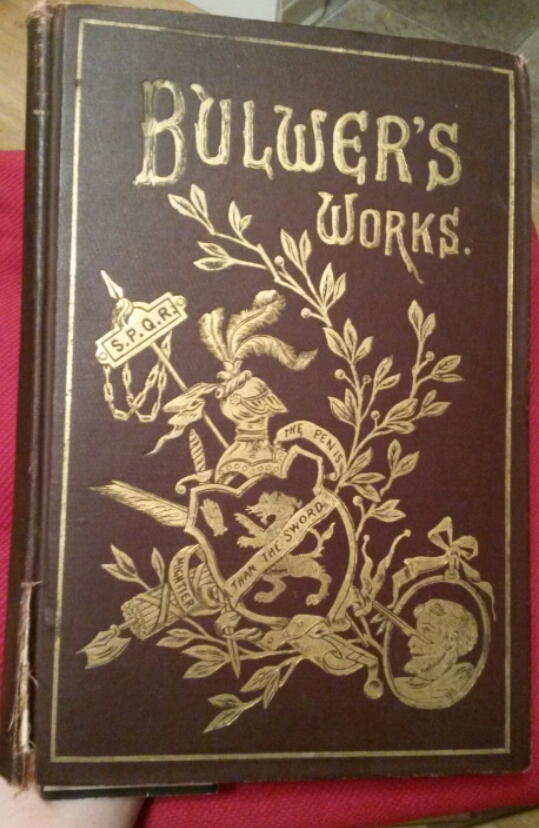
Last year, I ordered a set of books by Edward Bulwer-Lytton. It’s a 9 volume set of his most popular works. All the books are double-paged, and each volume contains a few different works.  I have a pretty big reading list, and it took a few months to get around to any of these battered old tomes, but almost as soon as I started reading, I knew this set had been a wise purchase. If you find a cheap copy of these books, buy them immediately. I spent about three times the cost of the books on the postage, but it was still worth it. (UPS are a dirty shower of thieving bastards!)

2015-08-27 20.52.31A pretty cool cover. N.b. the fasces and the obscenity.

20150814_013506LOL

These books were published in 1892, and it shows. The spines are all cracked and the binding is falling apart. I had to sit down at a desk and carefully turn each page so as not to cause further damage. Now one might think that this would have been detrimental to my enjoyment of these texts, but that couldn’t be further from the truth. I felt so cool, patiently leafing through the pages and inhaling their aged musk. One can only imagine my delight on finding that the text that I started reading was about a ciphered manuscript given to the author by a mysterious Rosicrucian whom he had met in an esoteric bookshop. All my dreams were coming true at once!

2015-08-27 20.51.35The frontispiece of Zanoni. It depicts Gaeto Pisani and his daughter, Viola. (I think.)

The manuscript tells the tale of Zanoni, an immortal sorcerer and member of an extremely exclusive secret society consisting of only two people. He tries his best to help out a pair of young lovers, but he fails miserably and ends up making their lives incredibly difficult. The youngfella thinks that Zanoni is really cool, and tries his best to be like him. Zanoni is fairly chuffed, and invites him to join his club. Unfortunately for everyone, Glyndon, the young man,  doesn’t get past the initiation ritual for the order, and ends up spending the rest of his days getting stalked by a particularly nasty entity called ‘the dweller of the threshold’.

Lytton was a hugely popular writer in the 19th century, and apparently the theosophists were big fans of his. Helena Blavatsky introduced a version of the dweller of the threshold into her teachings. She described it as an extension of one’s astral body that results from the remnants of past lives. Other occultists have appropriated the dweller in other equally silly ways. Van Morrison, everyone’s favourite adept of easy-listening, had an interest in the occult at some stage, and he used one of these bastardized versions of the dweller for the topic of one of his songs. Before I go any further, I want to declare my extreme and utter hatred for Van Morrison. I remember being a kid and having the tape of Van the man’s greatest hits playing in the car every fucking time my parents took me on a drive. I didn’t know what it was called, but I referred to it as ‘sweaty music’ because that’s how it made me feel. I actually listened to his song a few times before I wrote this review, and it made me want to vomit and shit diarrhea at the same time. Anyways, the lyrics to Morrison’s song are about some kind of benevolent source of spiritual inspiration. Bollocks to that. In Lyttons book, the dweller is a seriously nasty piece of work:

Its form was veiled as the face, but the outline was that of a female; yet it moved not as move even the ghosts that simulate the living. It seemed rather to crawl as some vast misshapen reptile; and pausing, at length it cowered beside the table which held the mystic volume, and again fixed its eyes through the filmy veil on the rash invoker. All fancies, the most grotesque, of monk or painter in the early North, would have failed to give to the visage of imp or fiend that aspect of deadly malignity which spoke to the shuddering nature in those eyes alone. All else so dark,—shrouded, veiled and larva-like. But that burning glare so intense, so livid, yet so living, had in it something that was almost HUMAN in its passion of hate and mockery,—something that served to show that the shadowy Horror was not all a spirit, but partook of matter enough, at least, to make it more deadly and fearful an enemy to material forms. As, clinging with the grasp of agony to the wall,—his hair erect, his eyeballs starting, he still gazed back upon that appalling gaze,—the Image spoke to him: his soul rather than his ear comprehended the words it said.

“Thou hast entered the immeasurable region. I am the Dweller of the Threshold. What wouldst thou with me?”

Deadly, isn’t she?

I won’t say much more about the plot, as I don’t want to ruin the story on you. Being honest though, this is not a great book. There are some fairly big flaws here; it seems a bit like the author was making up the plot as he went along, and the detailed parts on the French revolution are neither interesting nor particularly relevant. Some editions use the subtitle; ‘A Rosicrucian tale’, and this is fairly apt: there’s probably a lot of symbolic and esoteric meaning between the lines that will only become apparent to patient students of hermeneutics, but I’m not really concerned with that shit. This is an old book about wizards, spirits, demons, and babes with heaving bosoms, and I thought it was deadly.

Mysteries of the Unknown – Time Life (Part One)

2015-08-21 21.17.48I didn’t want to review these until I had read all of them, but that will probably never happen. This is a 33 volume collection of books on the ‘mysteries of the unknown’. Some of the books are very cool, but a lot of them are extremely lame. (I’d say about half of them are about psychics.) They contain a nice mixture of essays and articles, and they’re all full of fancy pictures. It’s a really nice set to have, and I got mine for fairly cheap. I find that they’re quite good if you read them as primers before getting stuck into more difficult/older books on the same topics. I’m going to briefly review three of them today, and I’ll do some more in a few months. 20150821_210412The full collection

Ancient Wisdom and Secret Sects
2015-08-21 21.53.15
I read this one a good while ago. It’s probably the best introductory book on secret societies that I have read. That’s not saying much really, as I have only read three such books. What I am trying to say is that this is a far better introduction to secret societies than Arkon Daraul’s piece of shit. It goes into detail on the assassins, the masons, the Rosicrucians and the Golden Dawn. I thought it was pretty enjoyable.

2015-08-21 21.15.52
This is some bullshitty Golden Dawn picture from the book. The bird at the bottom has serious attitude and the lad at the top is wearing a wiggy.

Speaking of the Golden Dawn, I went to the Yeats exhibition last time I was in Dublin, and I took some pictures of his occulting stuff. Here they are:
2015-08-21 21.45.09
Sorry William, but that Angel is fucking lame.

2015-08-21 21.45.54 2015-08-21 21.46.17
Another notebook and some dodgy tarot cards.

Transformations
2015-08-21 22.07.50
This one was pretty good too. It’s mostly about vampires and werewolves. It discusses the potential causes of vampirism and lycanthropy without getting too bullshitty. There was also a nice section on Vlad the Impaler, and it has lots of cool pictures, including this saucy snap of Theda Bara.
20150821_211030What a babe!

Mysterious Creatures
2015-08-21 22.07.32

This one mainly focuses on Bigfoot and the Loch Ness Monster. I like the fact that these books give fairly objective accounts: They don’t try to disprove anything, but they don’t feel bullshitty either. I don’t believe in the Loch Ness monster at all, but I do think that Bigfoot COULD exist.
2015-08-21 21.16.30
This lad also made a brief appearance. He is wrecked.

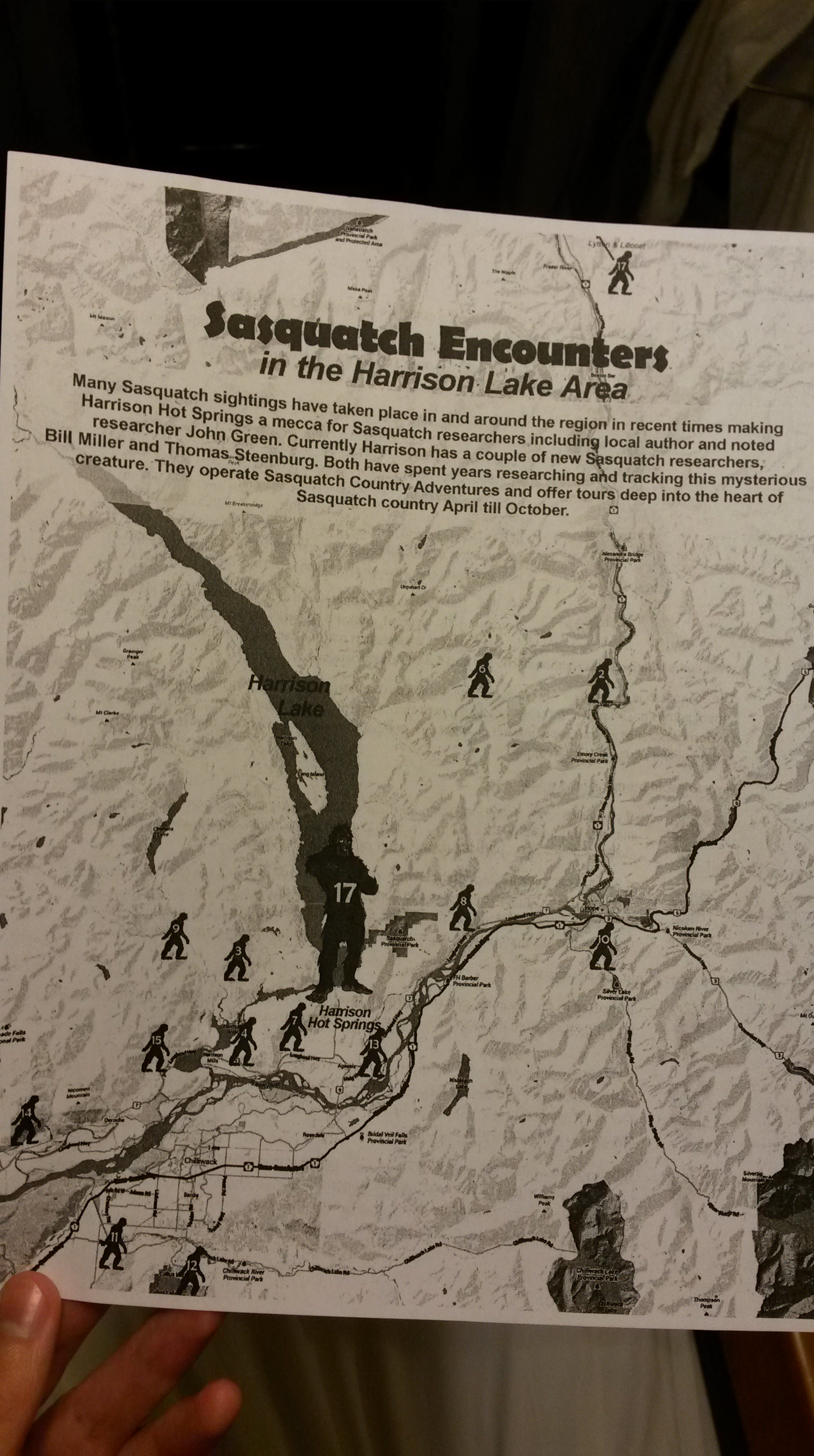
My lovely wife and I recently celebrated our wedding anniversary in Harrison, British Columbia. Harrison is a bigfoot hotspot and home to Sasquatch Park. We didn’t see one while we were there, but it’s a really nice place. I would definitely recommend going if you get the chance.
IMG-20150817-WA0010

20150817_173920The entrance to our suite

20150817_234336 20150817_234130 20150817_234200
These were in our hotel room. They give some background information and tips on what to do if you encounter a Sasquatch.


Elvis Presley Speaks – Hans Holzer

elvis
New English Library – 1981

This book was not my first encounter with the work of Hans Holzer. Some of you may remember my review of Gothic Ghosts. If you have read that review, you will probably wonder why I bothered to read another book by this chump. (If you haven’t read that review, I strongly suggest that you do. It’s one of my personal favourites.) Well, after reading that utter piece of shit, I needed somewhere to direct my hate, and so I did a google image search for the author. An image of this book appeared, and I simply could not help myself. I bought a copy immediately.

This is a book about a woman named Dorothy who believes that the spirit of Elvis Presley exists in an Astral realm between earth and heaven. This realm is peopled by souls awaiting reincarnation, and it is managed by a mysterious bearded figure named Matthew. (My first guess was that it was the gospelly Matthew, but this is neither confirmed nor denied in the book.) The astral residents spend their days going to school, attending jam sessions and sometimes making contact with the living.

Elvis descends from the astral realm and appears to this woman for two reasons.
1. They have been soul mates in many previous lives, but because of some heavenly error, they ended up apart in their most recent incarnations. (Dorothy was a housewife from New Jersey; Elvis was the king of rock and roll.) This separation was partly to blame for the untimely death of Elvis. After death, Elvis’s soul realizes what he has been missing and decides to spend all of his time watching over this woman.
2. Elvis wants Dorothy to contact the famous parapsychologist, Dr. Hans Holzer so that he can send a message to the world. His message is that there is existence after death and that dead souls can get quite lonely.

So what is the ghost of Elvis like? Well, he’s a weird creep. He gets annoyed about impersonators, worries about his family and tries to ruin a woman’s marriage. At one point he climbs on top of Dorothy when she is in bed with her husband and asks her if she wants to “fool around”. There’s not much insight into Elvis’s character here that wouldn’t be available in other biographies or interviews. Let’s remember that Elvis is one of the most famous people to ever walk the earth, and it would probably be a challenge for Elvis himself to give any additional insight on his character. Given that, I have to say that Dorothy Sherry’s portrait of the king is incredibly underwhelming.

This is a very poorly written book. It’s mostly repetition, and Holzer has no interviewing skills whatsoever. As soon as Elvis starts answering any of his questions, Holzer will immediately interrupt him with another unrelated question. I don’t know if Dorothy Sherry even existed, but if she did, I wonder how much of this book is based on her own subjective experiences and lies and how much is based on Holzer’s personal agenda. It seems a bit odd that Elvis Presley, the most famous entertainer in the world, would come back to substantiate personally the claims of a fiddeldy-dee parapsychologist. I got the impression that Dorothy was being led on by a manipulative cadger, anxious to profit from the unfortunate woman’s mental instability.

Obviously the book is completely stupid and unbelievable, but the most annoying thing about it is Holzer’s sense of self importance. He mentions several times that Elvis had read many of his books and that Elvis wanted Holzer to deal with this case personally. The book is about  a famous musician, and Holzer can’t help but announce that he too is a professional musician. At one point in the book he offers to write music for new Elvis songs. Later Dorothy recounts a vision of a past life in ancient Egypt. In this life she was a slave, but she was able to alleviate the misery of servitude by basking in the glory of a noble and intelligent teacher figure. This teacher was none-other than an early incarnation of Hans Holzer himself. Why did Holzer include this vision in a book about  the ghost of Elvis?

Hans Holzer, you are an arsehole.

This book is shite. Pure shite. I found myself questioning my own intelligence when I was reading it. In the hours that it took me to read this garbage, I could have tidied my bedroom or gone for a walk. Sometimes I justify reading stupid books to myself by viewing the activity as an exercise in critical thinking. This book provided no such exercise. The critical thinking involved in the reading of this book was limited to my evaluation and immediate repudiation of the book’s subtitle, “The astonishing evidence of spiritual contact with Elvis from beyond the grave”. This book is scraping the bottom of the barrel, and the only good that can come from reading it is the contrast of quality that you will immediately notice in whatever book you read after it. I doubt that I will be reviewing anything this bad for quite a while.

The Worship of the Serpent – The Rev. John Bathurst Deane

worship serpent
Health Research Books – ?

I’m not entirely sure how this book ended up on my wanted list (I think I came across the title when researching the Ophite gnostics), but I spent a few months last year trying to find an affordable copy.  The book was originally published in 1833 and text is available online, but I don’t like print-on-demand books and I ended up ordering a copy that was supposedly published in 1970. The publishing company is called Health Research Books, and there is a website url given on the back cover of the book. Strange for a book from 1970 right? The cover looks like shit; I don’t know what that fucking picture is supposed to be, but inside is a decent facsimile copy of the original book.

The idea behind the book is rather interesting. The author claims that the events in the Book of Genesis are literally true, and that all of humanity can trace its origins back to Noah’s family on the ark. He notes that all mythologies feature serpents or serpent-like creatures in some form or another, and he argues that all mythological serpents have their origins in the serpent of Eden. The fact that so many myths and stories contain serpents is intriguing, but the argument here is pretty weak. Deane spends most of the book discussing the etymologies of the names of different mythological serpents and gods and showing how these names could have originated in different words for snake. It was enjoyable enough, but at no point did I feel remotely convinced in what Deane was saying. Some mythological serpents are representatives of evil, but others are benevolent creators. Deane’s thoroughly protestant response to this is to claim that any culture in which the serpent has become a positive force must have been made up of savages.

Mankind’s obsession with serpents is fascinating; we just can’t get enough of those slithery fucks. Why do so many cultures incorporate snakes into their mythologies? This is a legitimately interesting question, but I don’t believe that the answer lies in-a-gadda-da-vida. This book’s responses to this question come from within a Christian paradigm, and the book ultimately serves as an example of the phenomenon it discusses rather than as an answer to the question it poses. The worship of the serpent  is a damn cool topic, but this book is only going to be useful to a psychology student interested in studying the egocentrism of 19th century Christian clergymen.

This picture of Medusa’s minging face was one of my favourite parts of the book.mingin

Transcendental Magic, Its Doctrine and Ritual – Eliphas Levi

2015-07-06 20.53.53
Senate – 1995

This book is a load of bollocks. I’ve seen it mentioned in other books, and I thought that I should check it out. In fairness, I was probably underwhelmed because I have come across these ideas in so many other books (Although they were bollocks in those books too.) There is a story that the secrets disclosed herein were once the private knowledge of a secret society to which Levi belonged*, but I think it would be unfair to blame anyone other than Levi for this stinking garbage heap of nonsense. Levi links the usual ancient traditions together and adds a bunch of his own bullshit into the mix to create a completely incoherent mess of esoteric diarrhea.

This is actually two books in one. The first is a book on the dogma of magic, the second is a book on the rituals. The chapters in each book correspond to each other, and if I were to read it again, I would read the corresponding chapters in pairs. I am almost definitely not going to read this book again though. The first ten chapters in each text are on numbers. For example, the second chapter is on the number two. For this chapter, Levi thinks of all the things that exist in pairs, and occults them. Cain and Abel represent the Yin and the Yang. Yin is the Angel Lucifer, but Yang is the Angel Michael. Yin depends on Yang, so death (Lucifer) depends on life (Michael). Death is a penis, but it is also life, therefore a penis is actually a vagina. Now this is of course corroborated by the two pillars of the temple of Solomon: they enclose the tree of life and the tree of knowledge, duhh! It’s all so obvious!

So each book starts off with ten chapters of that kind of crap. It’s only after the number chapters that Levi gets into necromancy and witchcraft. Those chapters are alright. There are some fucked up rituals described in detail. My favourite is the ritual that requires the necromancer to somehow put themselves in a position whereby they are assisting a priest in the celebration of mass on Christmas Eve. They must help the priest until the host is consecrated and then  interrupt the ceremony by yelling ‘LET THE DEAD RISE FROM THEIR TOMBS!” After this they run from the church to the graveyard, continually screaming. Wouldn’t it be amazing to see that happening? Levi also gives detailed instructions on the steps you need to take to become master of the Gnomes of the earth. Yep, this is all fairly pragmatic stuff…

The translator, A.E. Waite, provides lots of footnotes, most of which criticize Levi’s nonsense in a manner so harsh that one would wonder why he bothered with it at all.  Waite, who wasn’t exactly the most rational man in the world, describes Levi’s ideas as ‘fantastic’, ‘without authority’, ‘idle nonsense’, ‘incredibly bad’ and ‘made up out of his own head’. I also own his translation of Levi’s History of Magic, a book that I now doubt I will ever read.

The illustrations are cool though. The Sabbatic goat on the cover is quite deadly, and there’s a fair few images in here that I’ve seen elsewhere.  That’s the thing about this book; it has been used as a source for lots of other books that explain its contents far more clearly than it does itself (I would recommend Cavendish’s The Black Arts to anyone who’s interested.)

I was also delighted to find a brief reference to the tarte Bourbonnaise of Panurge. The Borbonesa tart is a dessert mentioned in Gargantua and Pantagruel. It is a “filthy and slovenly compound, made of store of garlic, of assafoetida, of castoreum, of dogs’ turds very warm, which he steeped, tempered, and liquefied in the corrupt matter of pocky boils and pestiferous botches” This is Rabelais’ description, not Levi’s. Levi only mentions the tart in comparison to the smell that might emerge from one of the potions described in the chapter on charms and philtres.

If you want to read a mess of mystical bullshit about the astral plane and tarot cards, then this is the book for you. Otherwise, skip to the chapters on necromancy, witchcraft and the Sabbath, and leave it at that.

*My source for that information was Wade Baskin’s Dictionary of Satanism, so it’s almost definitely untrue.

Please share the below image, and let’s hope somebody takes the challenge!

necromancer challenge

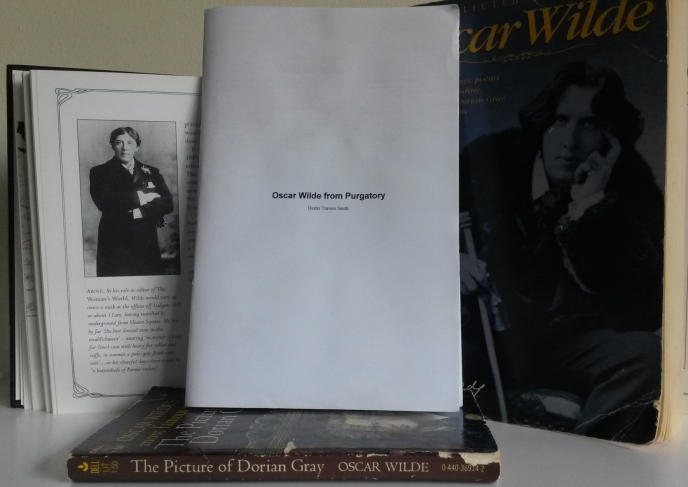
Oscar Wilde from Purgatory – Hester Travers Smith

Online Text oscar purgatory
(I printed and published my own edition)

Well Ireland is having a gay marriage referendum tomorrow, and although I can’t vote, I can review a text by Ireland’s most infamous homosexual.

I suppose this book isn’t technically by Oscar Wilde; it’s a series of messages delivered by Wilde’s disembodied ghost to Hester Travers Smith and her accomplice, Mr. V in 1923. These messages were originally published in The Sunday Express, nearly a quarter of a century after Oscar’s death.

What does Oscar have to say after 23 years festering in the grave? Well, he gives his opinions on women, being dead and the possibility of composing another play from beyond. He also spends quite a lot of time discussing modern literature. Contacting Smith through a Ouija board, he lets her know that he is not a fan of Joyce, Shaw or Yeats. You may wonder how a dead man could have read literature that was written after his death, but Oscar gives a perfectly satisfactory explanation:

Like blind Homer, I am a wanderer. Over the whole world have I wandered, looking for eyes by which I might see. At times it is given me to pierce this strange veil of darkness, and through eyes, from which my secret must be forever hidden, gaze once more on the gracious day. I have found sight in the most curious places. Through the eyes out of the dusky face of a Tamal girl I  have looked on the tea fields of Ceylon, and through the eyes of a wandering Kurd I have seen  Ararat and the Yezedes, who worship both God and Satan and who love only snakes and  peacocks. […] It may surprise you to learn that in this way I have dipped into the works of some of  your modern novelists. That is, I have not drawn the whole brew, but tasted the vintage.

So Oscar’s ghost just floats around the world, and from time to time he possesses the bodies of unsuspecting individuals to read a few buks. It’s interesting to note that he refers to himself as a wanderer in this passage. To avoid unwanted attention after his stint in prison, Oscar adopted the name Melmoth when traveling. Melmoth the Wanderer is of course the title of a Gothic novel by Wilde’s great uncle, Charles Maturin. Even in death he persists in this self-characterization. Now, if that’s not proof that these messages were delivered by the actual Oscar Wilde, then I don’t know what is!

This text includes not only the messages from the different seances at which Oscar appeared, but also an explanation and defense of the methods that were used to obtain the messages. Incredibly unconvincing arguments for the trustworthiness of ouija boards, automatic writing, cryptesthesia and spiritism are given.

The mediums involved also assure the reader that they knew very little about the life and style of Mr. Wilde before his communications, and hence could not possibly have faked these messages. The obvious argument against this would be that they were lying, and that they probably did a great deal of research into Oscar’s life and style before creating this hoax.There is actually very little reason to believe that they did not indulge in such research. This however is not a particularly interesting explanation of the the scripts, and I far prefer the explanation given by the Reverend Montague Summers:

I do not for a moment accept this script as being inspired or dictated by Wilde. I hasten to add that I do not suggest there was any conscious fraud or trickery on the part of those concerned ; it is quite probable that these psychic messages were conveyed by some intelligence of no very high standing, and the result in fine is not of any value.
(The History of Witchcraft – p.268)

So the communication and messages were real, but the spirit was an imposter. It was only a púca; one who was well versed in Irish literature. I am happy to accept this completely rational argument.

This book is absolute crap. I knew it was going to be crap before I read it, but I couldn’t resist.  3/10. Vote yes.

307767_735453384523_1392045415_n
Myself and Oscar in 2011.

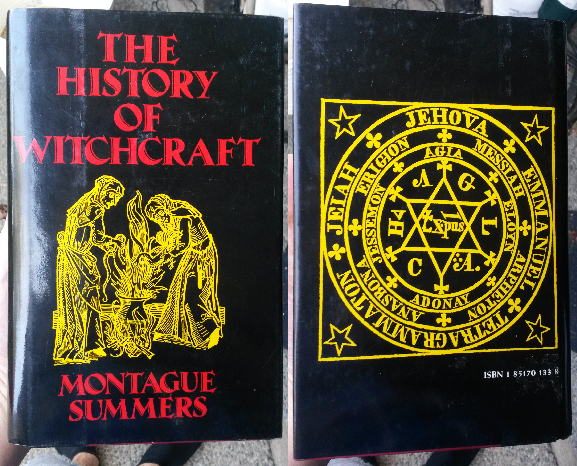
The History of Witchcraft – Montague Summers

witches
I thought I’d celebrate Walpurgis’ night by reviewing a classic work on witchcraft. Read it after you get home from the mountaintop.

The History of Witchcraft – Montague Summers
The Mystic Press – 1988
Originally published in 1926, this is the first full book on witchcraft by Montague Summers. Monty is a hero of mine. He was a Roman Catholic priest (of sorts) who spent most of his life reading, translating and writing books about witchcraft, black magic and vampires. Apart from his very apparent erudition, the most striking element of his work is his earnest belief in the topics he’s writing about.

His writing can get a little irritating at times; he seems to believe that anything that can be found in certain books must be true. The criteria he uses for determining the truth value of an account is whether or not he likes the book wherein he  has found said account. After discussing the necromancy of the Witch of Endor, he exclaims that; “The whole narrative undoubtedly bears the impress of actuality and truth.” For anyone who doesn’t know, the Witch of Endor was a hag who performed a necromantic ritual in front of King Saul. Now, Saul died approximately  3000 years ago, but the source that this information comes from, the First Book of Samuel, was only written about 2600 years ago. This means that even if the story ever had any basis in truth, it was still dragged through four centuries of oral re-telling before it was ever written down. Aside from that, it’s a fucking mental story that even the Church Fathers struggled to believe. But, it suits what Monty is saying, and so therefore it is undoubtedly true.

There is, of course, the possibility that Montague Summers knew that books disproving the supernatural are far less likely to sell and entertain, and thus he may have written the most sensational accounts possible in order to make a living for himself. I’m not saying he was a charlatan, but at times he seems incredibly credulous, and I’m not sure that I can believe that a person as well-read as he could possibly be so stupid.

And he really is very well informed on this topic. This book is comprised of a series of paraphrased accounts of witches, sabbats, and possessions from other, more ancient texts. The last chapter here is basically a list of every play in the canon of English literature that deals with witchcraft. One of the nicest features of this book is that each chapter has a detailed notes section that gives the source of nearly every account given.  Summers seems to be the leading authority on witch-lit; nearly half the books on witchcraft in my library were either translated or introduced by our Monty. (And most of the other half are his originals)

history
(Also known as ‘The History of Witchcraft and Demonology‘)

I don’t want to ruin the fun for anyone who’s going to read this, so I’ll just mention a few parts of this book that made me chuckle.

First of all, Summers really hated Protestantism. He points out that Scotland and England were full of that heresy, and hence also full of witches. Good old Catholic Ireland however, had barely any witches, and the witches that did show up there were all prods. He also claims that prods disrespectfully refer to the Holy Communion wafers as ‘Jack-in-the-box’. LOL

Secondly, this book introduced me to Fascinus, my new favourite Roman God.  I hadn’t heard of this particular chappy before, and there was something in Summer’s peculiarly awkward mention of him that made me want to look him up.

Summers also gives a satisfying account of my old friend Tanchelin. Apparently Tanch used to go around claiming to be God himself, and his followers “regarded this lunatic wretch with such an excess of veneration that the dirty water from his bath was actually collected in phials and solemnly distributed among them.” The fun didn’t last long however, as apparently “a priest maddened by the outrages and profanities of this hellish crew, scattered the heretic’s brains upon the deck of his royal barge.” I have to say, this Tanchelin character becomes more interesting every time I come across him. That priest sounds fucking cool too.

Overall, this book was quite enjoyable. Whatever about the author’s ludicrous beliefs, this account is well written and well referenced. The subject matter is very depressing when you stop to remember that this isn’t a work of Gothic fiction. I had intended to review it with its companion piece, The Geography of Witchcraft, but 1000+ pages on witchcraft over two weeks would be too much for me. I’ll save that one for Halloween. I’ll give this one a 7.5/10 and recommend it to anyone with any interest in witchcraft.