Psychopathia Sexualis – Dr. Richard Von Krafft-Ebing

krafft-ebing psychopathia sexualisPsychopathia Sexualis – Dr. Richard Von Krafft-Ebing
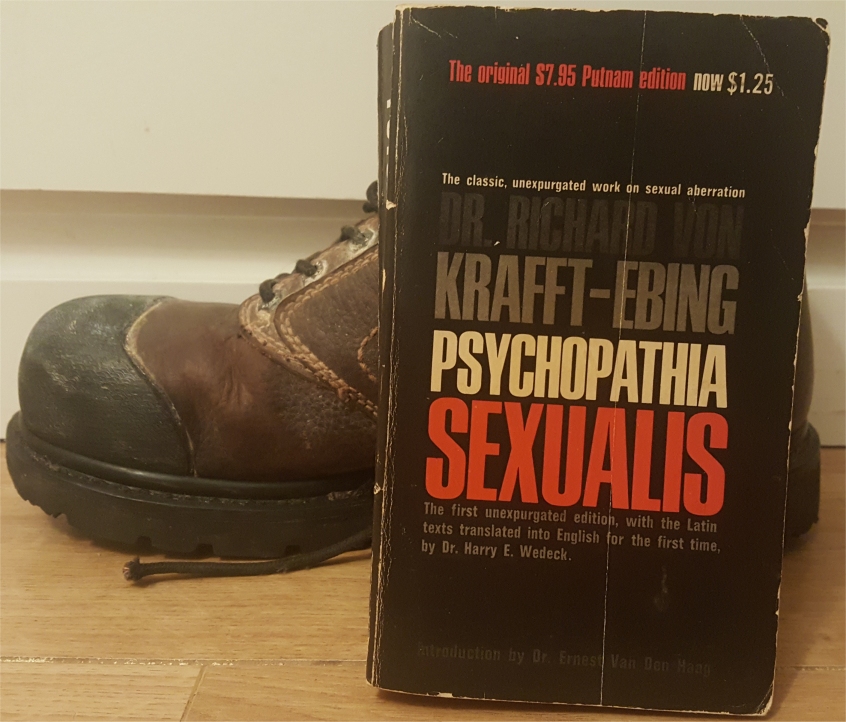
Putnam – 1965 (First published 1896)

Psychopathia Sexualis is an early work of psychiatry that catalogs every sexual deviancy known to the author, from exhibitionism to trampling to necrophilia. All of the really lurid parts were originally printed in Latin so that uneducated people wouldn’t be able to read them, but this translation is all English. thank goodness. Most of the theoretical writing went right over my head, and what little of it I did understand was rather outdated. I focused my attention on the 200+ case studies on the lives of different perverts.

Some of these cases were shocking, some were hilarious, but most of them were rather sad. The sad ones were either about people who were clearly suffering from severe mental illnesses or people whose harmless kinks and preferences had landed them in prisons, insane asylums or graves. Many of these “perversions” would be considered fairly normal today. By Kraft Ebbing’s standard, pretty much anything other than regular sex counts as unnatural.

When I was a teenager, my friends and I tried to outdo each other by downloading the grossest porn imaginable to each other’s desktops – I have seen videos of people engaging in truly bizarre acts of sexual perversion. I have also read the Marquis De Sade and quite a few other gross books, so there weren’t many perversions in Psychopathia Sexualis that I had never heard of before. Some cases, however, are interesting enough to warrant recounting here:

Case 33 – A man would pay a prostitute to put on a fancy dress and lie down. Then, after looking at her through the keyhole of the door for a while, he would run into the room and do a poo on her expensive frock.

Case 77 – The case of a Minister who would visit a brothel, take the shoe of a prostitute, violently smush it against his cock and then rub the resulting ejaculate into his own armpits. After this, he’d borrow the shoe for a few days and “always, at the appointed time, returned it with thanks.” This courteous gentleman was hurting nobody! Smush and smear on, my good sir!

Case 114 – In an attempt to overcome his fear of sexual intercourse with his wife, a man who developed a fetish for female shoes at an early age was advised by his doctor to “hang a shoe up over his bed and look at it fixedly during coitus, at the same time imagining his wife to be a shoe.” This remedy worked a treat, and along with allowing him to make love to his wife at least once a week, it also cured his epilepsy.

Case 203 – A flasher who, in a public house, “rapped his exposed penis on the window so that the children and servant girls in the kitchen were forced to see it.”
“Tis some visitor,” they muttered, “tapping at our chamber door
— Only this and nothing more.”

Case 211 – a chronic masturbator with the filthy habits of drawing lewd cartoons, cross-dressing and dipping his dick into the pails at his parent’s milk store overcame his impotence by exposing his penis in public.

Case 222 – A man masturbated so much that he went impotent. The only way he could achieve sexual satisfaction was to “pick up a living bird by the bill and swing it around in the air. The sight of the tortured animal provoked erection and when the flapping wing touched his penis, ejaculation would ensue with enormous sexual lust.”

Case 229 – The farmers in a small provincial town noticed that many of their chickens were being raped to death. A 30 year old man of high social position was found to be responsible. “To the question of the judge, as to the reason for such an act, the accused said that his genitals were so small that coitus with women was impossible. Medical examination showed that actually the genitals were extremely small.”

There’s lots more, and many are far darker. There’s cannibals, necrophiles, mutilators, “girl prickers”, murderous rapists, paedophiles and a man who tried to impregnate his daughter with the messiah. This is not a funny book. In fact, it was so depressing that I only ever read a few pages at a time. It took me almost a year and a half to get from cover to cover. It’s a pretty good source for insight into the depraved depths of human sexuality, and countless horrible music acts have based works on this book, notably Clandestine Blaze and Whitehouse.

krafft-ebing psychopathia sexualis backThese are a few of my favorite things…

This book had been on my to-read list for years. It sounded interesting, but I don’t think I would have ever got around to actively seeking a copy out. I was fortunate enough to find one in a stack of books that the local university library was giving away for free. Sometimes you get lucky.

The Cannibals of Candyland – Carlton Mellick III

the cannibals of candyland carlton mellickThe Cannibals of Candyland – Carlton Mellick III
Avant Punk – 2009
At some stage in the not-so-distant past, a tribe of paedophagists (cannibals with a taste for kids) that used candy to catch its prey was separated from the rest of the human race. Somehow, they very quickly evolved candy hands to make hunting small children easier. Now their entire bodies are covered in candy, and they live in a giant cave under the sewers, only surfacing to snatch kids away for dinner. This book is the story of Franklin – a man whose siblings were eaten by these cannibals – and his quest for revenge.

I was looking for books in a thrift store a few days ago, and I found this on the bottom shelf of the horror section. Recently, I’ve been expanding my horizons with some rather trashy horror fiction, and when I saw this priced at a cool 3 dollars, I thought I might as well take things one step further. I had seen mentions of Bizarro fiction before reading this book, but I had never given it any attention. (Bizarro fiction is a niche underground genre of literature that a quick google search will help you understand.)

Maybe the rest of this Bizarro stuff is absolute crap, but this book was pretty good. I have an interest in gross, offensive art, but I don’t have much time for offensiveness just for offensiveness’ sake. It takes no skill or intelligence to string together a bunch of obscenities. Likewise, I don’t mind zany, off-the-wall art, but I quite dislike zaniness for zaniness’ sake. (When I was 17, I went to a house party where my friend’s friends were sitting in a circle playing the “random game”, a game in which players took turns saying “random” things – “Cheese, huh huh”. The idea that people would feel comfortable acting that way makes me feel nauseous to this very day.) While The Cannibals of Candyland was both thoroughly repulsive and rather strange, it didn’t feel forced. Once the admittedly ridiculous premise of the story is accepted, the whole thing is pleasantly cohesive. The book is filled with revolting gore and uncomfortably bizarre sex scenes, but these facets are being used to tell a surprisingly relatable story. Also, the book is nice and short; it never gets boring.

I don’t know how many Bizarro novels will really fit in on this blog, but this one was definitely horrible enough to warrant its inclusion. I enjoyed reading it, and I like the seemingly DIY nature of the Bizarro movement. I reckon I’ll be reading (and probably reviewing) more of this kind of stuff in the future.

One for the Rockers – Shelia Bristow Garner’s Night Music, Garrett Boatman’s Stage Fright and Frank Lauria’s The Foundling

horror rock
Heavy metal has a long history of borrowing elements from the realm of horror fiction. Anthrax wrote Among the Living about Stephen King’s The Stand, Iron Maiden have Phantom of the Opera, Moonchild and lots of other songs about literature, Metallica did Call of Kutulu and The Thing that Should not Be about Lovecraft’s work (their Ride the Lightning album also got its name from The Stand), and Reverend Bizarre were clearly big Dennis Wheatley fans, penning songs titled They Used Dark Forces and The Devil Rides Out. (This list is far from exhaustive; I’m limiting my examples to books I have reviewed on this site.) Its pummeling cacophony, sludgy riffs, piercing shrieks and gutteral growls make heavy metal sound like the events in a horror novel, and it’s not at all surprising that several authors have tried to switch things around by writing horror stories involving heavy rock music. (I’ve previously reviewed Ghoul, an awesome novel about an evil rock band, and Shock Rock, an anthology of rock’n’roll themed short fiction.) This post looks at three more horror novels that have chanced their arm wrestling the rock monster.

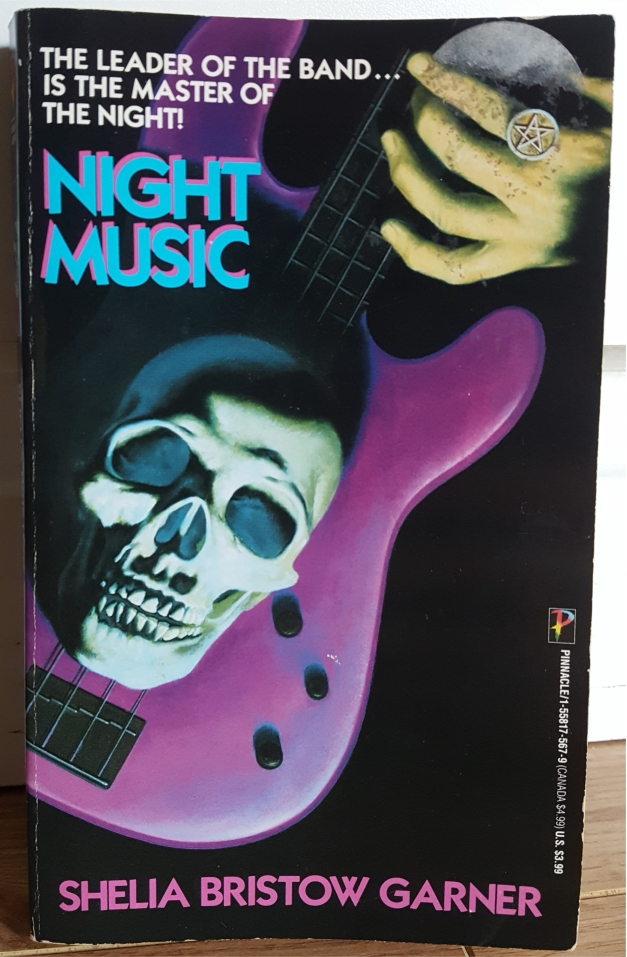
night music shelia bristow garnerNight Music – Sheila Bristow Garner

Pinnacle – 1992

This was an awful book. It’s about Kitty, a boring, plain-jane nurse, who falls in love with Michael, the singer in Fiasco, a shitty covers band. Soon after Kitty and Michael meet, a new guitarist joins the band, brainwashes Michael with a combination of hypnosis and rohypnol and then initiates him into a satanic cult. As Michael gets deeper and deeper into Satanism, his relationship with Kitty falls apart.

The characters are frustratingly flat – the good guys are good, and the bad guys are bad. Also, the members of Fiasco, the band, are suspiciously familiar – Michael leads, and David, he plays keys. Freddy’s cool but rude, and Jocko, well, he’s a party-dude.

The Satanism in here is never explained. To Sheila Bristow Garner, Satanists are just people who cut out other people’s hearts to worship the Devil. She assumes that her readers think so too. I was hoping that the horror in here would be of the supernatural variety because of cool skull on the cover, but I was sorely disappointed. The Satanic character is a good musician, and while he wouldn’t be the first character to receive his musical prowess from Satan, the book never explicitly suggests this. The most horrifying thing about this book is how dull it is. The main characters are so bland that I spent most of the book hoping that they would die horribly. This book is the literary equivalent of eating a stale cheese sandwich when you’re not hungry. Reading it feels like sitting on a train beside a person who has just farted. As soon as you realise what’s going on, you just want it to be over.

shelia bristow garnerThe author

This isn’t a horror novel. It’s a shitty romantic thriller that mentions Satanism. (There’s a surprising amount of loving, tender, consensual sex in here.) The rock ‘n’ roll element is limited to a few mentions of the blues-rock covers that the band perform. Everything about this book was disappointing. The cover art is by far the best part, and it doesn’t have much to do with the story. Look carefully and you’ll see that it pictures a bass guitar. The bassist in Fiasco is one of the least important characters in the story. He is never involved in any of the Satanic activity, yet the hand on the bass guitar is wearing a pentagram ring! Bullshit.


the foundling frank lauria
The Foundling – Frank Lauria

I quite liked Frank Lauria’s Doctor Orient series, and the cover of this book is an image of a devil-child playing an electric guitar. I had to read it.

I had read a rather unenthusiastic review of The Foundling before sitting down with the book, but it really wasn’t that bad. Sure, there’s only 4 or 5 real horror moments throughout, but I found the characters interesting enough to keep things afloat. This is the story of a retired rock-star and his wife adopting a preteen girl in an attempt to save their failing marriage. Unfortunately, the girl is sex-crazed, evil and magic. Whenever somebody annoys her, they end up dying horribly. The fact that the girl is evil is established early on, but the surprising reason for her evilness is only revealed towards the end. (Skip to the next paragraph if you’re planning to read this book.) It turns out that she is evil because she was brought up as part of the Manson family. That’s right. Not content with ripping off Carrie and the Omen, Frank Lauria decided to throw in a bit of Helter Skelter too. Surprised? It doesn’t make much sense in the context of the book either.

As far as rock’n’roll content is concerned, there’s not much to say. The dad character produces an album in the family’s basement, and the little girl writes a song, but that’s pretty much it. The rock’n’roll could be entirely removed from the story with just a few changes. Frank Lauria has played in a band, and the first Doctor Orient book features rock’n’roll mind control, so I guess he just likes it.

This was a quick read. It’s nothing special, but it was enjoyable enough.


stage fright garrett boatman
Stage Fright – Garret Boatman
I have been planning this post since the beginning of 2017, but tracking down this book delayed things considerably. I knew on seeing the cover that I would some day read it, but at that time copies were going for about 20 dollars, just a little more than what I feel comfortable paying for a trashy paperback. After being included on the cover of Paperbacks from Hell, this book became very difficult to find, and I had to spend a ludicrous amount of time and effort tracking down an affordable copy. I am delighted to announce that it was worth it.

This book is just as deadly as the cover would have you believe. While not really about a keyboard playing skeleton rocker, Stage Fright is a gory, slimy, slab of entertaining sci-fi horror. The instrument on the front cover is presumably the controller to a Dreamatron, a machine that allows its user to project their imagination into the dreams of an audience. Isidore Stark, the world’s most famous Dreamatron artist, decides to ingest the blood of schizophrenics to enhance his dreamscapes, but this leads to him losing control of his mind and the machine, and the results are very, very bloody. Characters from classic horror movies, the paintings of Bosch, and the books of Tolkien and Lovecraft show up in the “dreamies”. There are certain discrepancies to the story (how does the dream machine actually work?), but it’s pretty easy to let this stuff slide when you’re being confronted with flesh mazes and grotesque monsters tearing people’s limbs off. While this book isn’t about music, its intensity made it feel far more rock’n’roll than either of the other two books reviewed in this post.

I’ve only found one other full review of Stage Fright online. It’s quite a bit more critical than this one, but I suspect that Joe Kenney hadn’t slogged through two very mediocre (boring) rock novels directly beforehand. He is correct in claiming that some of the characters are overdeveloped and that the book is probably longer than it should be. Stage Fright is pure trash, but I prefer pure trash to diluted trash.

Joe Kenney also, very perceptively, notes that the inside cover of Stage Fright advertises another novel by Boatman Garrett called Death Dream. No such novel was ever published, and Kenney suggests that Death Dream might actually have been the original title for Stage Fright. This could explain the fact that the cover and title don’t have much to do with the plot of the novel; Death Dream would be more appropriate for this story.
death dream garrett boatmanDoes this then mean that Onyx had originally commissioned this cover art for an actual novel about a keyboard playing skeleton that was never published? Is there a manuscript of the real Stage Fright in some forgotten archive? We’ll probably never know.


I have reviewed these books in the order I read them. If I had ordered them by ranking, they’d be in the same position, Stage Fright being the best, Night Music being the shittest. Despite their incredible cover art, none of these books are really about rock music. My search for the perfect blend of horror and metal continues. Fortunately, I have these two books lying on my shelf for later.
the scream and kill riff

Black Sun – Nicholas Goodrick-Clarke

black sun nicholas goodrick-clarke
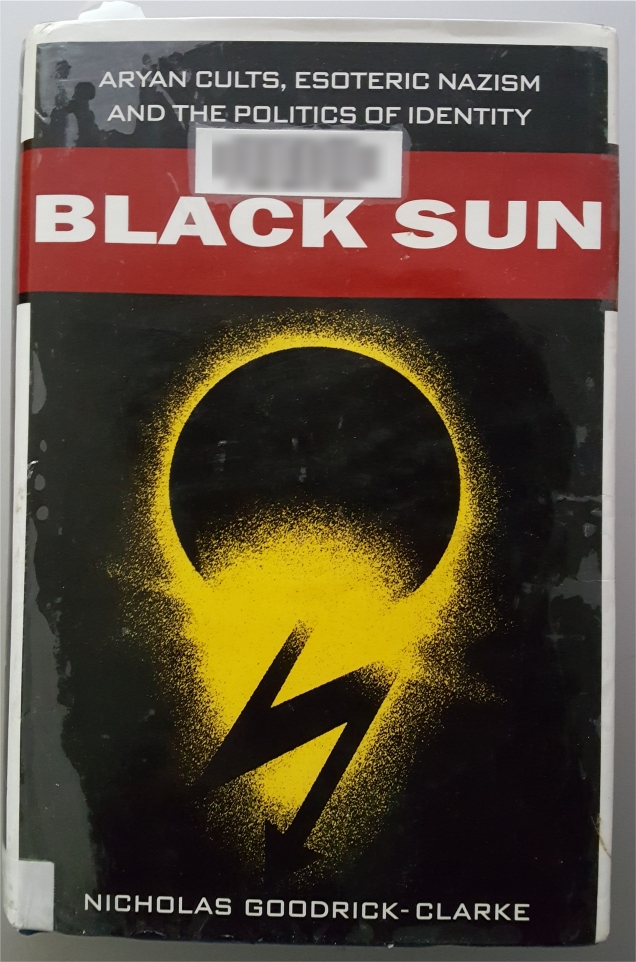
Black Sun (Aryan Cults, Esoteric Nazism and the Politics of Identity) – Nicholas Goodrick-Clarke
New York University Press – 2002
Nicholas Goodrick-Clarke’s The Occult Roots of Nazism was one of the first books I reviewed on this blog. It was a good book, but I remember being mildly disappointed with the type of occultism I was encountering in it. I had read stuff on the internet about Satanic Nazis and Hitler’s UFO fleet, but this book was about Theosophy and Runes. The author had written a book about the actual Occult roots of Nazism and confined the silly conspiracies that developed after the war to a short discussion at the end of the book.

Black Sun, published 17 years after The Occult Roots of Nazism, is the same author’s account of the neo-Nazi conspiracies and ideologies that arose after WWII. They are mind-bogglingly insane. Featuring folks who think Hitler was a manifestation of God, groups who think that “the Jews” are an evil alien race that have willfully displaced the real Hebrews (who are actually the Aryans), and more flying saucers than you can shake a stick at, this book is overflowing with insanity.

esoteric hitlerism serranoThis dude has Swasti-chakras on his ass.

Unlike many of the books about insane topics that are reviewed on this site, Black Sun is actually a well written and researched piece of work. Goodrick-Clarke explains the theories; he does not espouse them. Another crucial difference between this book and most of the others I review is that the ideas contained in here are not just bizarre; they are vile, hateful and extremely dangerous. While the material is off-the-wall and genuinely fascinating, this book will probably leave you feeling worried and uncomfortable. After a detailed look at various racist organizations and the ways in which these groups rationalize and manifest their hate, the book ends with this chilling sentence:

From the retrospective viewpoint of a potential authoritarian future in 2020 or
2030, these Aryan cults and esoteric Nazism may be documented as early
symptoms of major divisive changes in our present-day Western democracies.

donald trump

I try not to get overly political on this blog, and I know that lots of Trump supporters will probably roll their eyes at this allusion, but here is a video of one of the hate groups described in Black Sun campaigning for Trump’s election. I don’t believe that all Trump supporters are neo-Nazis, but the amount of neo-Nazis that support the current president of the United States should be concerning to everyone. If this book had been written 15 years later, it doubtlessly would have had a chapter on the alt-right and the Cult of Kek.

I’m planning another post that will discuss some of the specific issues that come up in this book, so I’ll leave this post quite short. Black Sun is definitely one of the best non-fiction books I’ve reviewed, and I don’t need to pick it apart like I normally do. I strongly recommend reading it for yourself. I was fascinated to read about the lengths that neo-Nazis have to go through to rationalize their hate. Hating a person because you believe that they’re the descendant of an evil satanic alien is far sillier than hating them because you’re not used to how they look and speak and because you’re afraid that they might take your stuff. If you’re going to be a racist piece of shit, at least be honest with yourself.

Breakthrough – Whitley Strieber

Picture this:
You enjoyed last night’s chili so much that you had two large bowls. Now it’s the morning after and you’re straddling the toilet, aware that an eruption of Vesuvian proportions is imminent. Whooosh! The intensity of the shitflow is equal parts relieving and violent – it takes about 6 seconds for your anus to dispel what took you 20 minutes to eat only hours earlier.

Now imagine a gigantic ass shitting with that intensity for a prolonged period of time. Somehow the being this ass belongs to has an infinite reservoir of rancid, hot, soupy crap feeding the flow of their disgustingly stretched and overworked anus. Their high pressure fountain of fluid feces is pointed directly at your mouth. Try as you might to avoid them, the diarrheic rapids find their way into your maw, rebounding against the back of your throat and sending squirts of wet shit out each of your nostrils. You are drowning in dysentery, yet you remain alive.

That’s what reading this book feels like.

breakthrough - whitley strieber

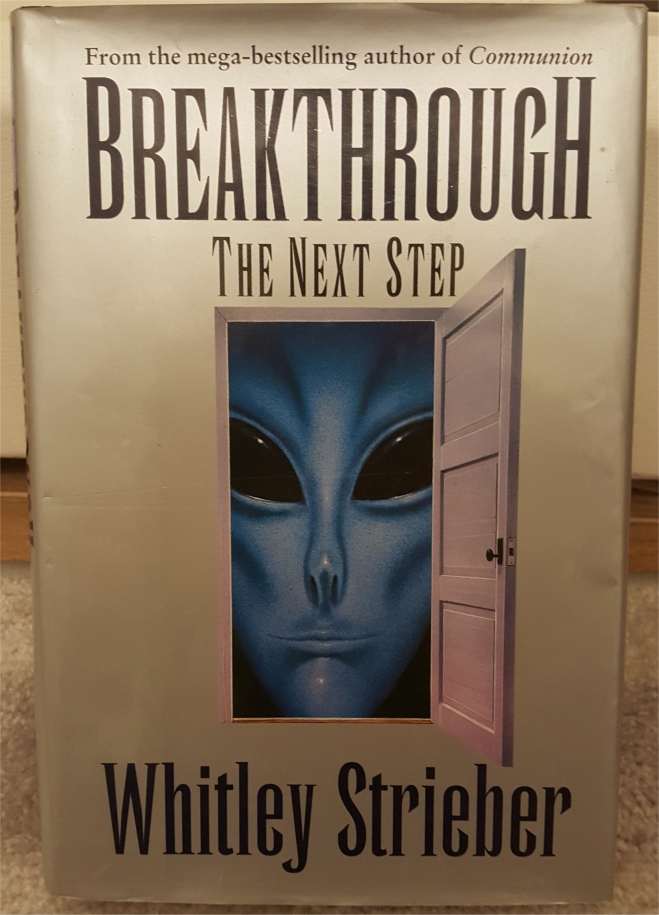
Breakthrough (The Next Step) – Whitley Strieber
Harper Collins – 1995
I reviewed the second entry in Strieber’s visitors series only 3 months after reviewing the first, but it took me almost 2 and a half years to pluck up the courage to move on to Breakthrough, the 3rd entry in the series. By no means did I think that Communion was a good book, but Transformation was definitely worse, and I knew that any further forays into Strieber’s silly nonsense would prove to be absolutely terrible. I was right.

This book really is difficult to read. Strieber included his most interesting abduction experiences in Communion, and Breakthrough is just the continued coming to terms with having had aliens probe his rotten shitbag that Whitley started in Transformation. There’s very little alien activity being described in here; it’s nearly all speculation on the nature of the relationship that Strieber thinks the aliens want to have with us. He thinks they want to open our eyes to new levels of consciousness and understanding. This is getting closer and closer to that new-agey garbage in books like You Are Becoming a Galactic Human.

Highlights of this book included the description of the smelly goblin that lived in Strieber’s house for a month, Strieber’s astral voyage to the literal Garden of Eden, and the sin spiders that appeared above his bed. I really doubt that Strieber believes his own bullshit. These are just bad dreams he had or ideas he came up with on the toilet. At one stage he describes an experience in which he and a friend drive through an alternate dimension, an idea that I am certain he plagiarized from Mrs. Todd’s Shortcut, a short story by Stephen King. (If you’re interested in this comparison, the incident occurs in Chapter 11, page 139 in my edition, and King’s story is in Skeleton Crew.) Strieber puts little effort or care into making his story believable because his audience is mostly made up of low-grade-imbeciles.

All in all, this is a remarkably atrocious book.

whitley strieber visitors
I have The Secret School, the 4th book in Strieber’s visitors series, but after this, I don’t know if I’ll ever read it. This series is terrible, awful rubbish.

Bob Larson’s Book of Rock

bob larson book of rockLarson’s Book of Rock – Bob Larson
Tyndale House – 1987

I don’t think anyone gives a shit anymore, but pop music was a scary thing in the 80s.  Sure, conservative/religious types had been upset by Elvis and the Beatles before, but MTV and the popularization of music videos made it harder for parents to avoid the boldness that was popping up in the pop music of the day. While Lou Reed’s make-up and naughty lyrics might have been able to slip under some parents’ radars in the 70s, Twisted Sister’s music videos weren’t quite as subtle.

Bob Larson, evangelical preacher, talk show host, exorcist extraordinaire and all-round obnoxious cunt, was concerned. As a young man, his experiences playing guitar led him to become convinced that rock music could be used as a tool of destruction and evil. Larson’s Book of Rock is his 5th book on the subject. Written as a self help guide for good church-going parents of the 80s who were upset by their child’s interest in popular music, The Book of Rock offers insight into how this music can fill an impressionable youth’s head with homosexuality, violence, occultism, satanism, Eastern Mysticism and the desire to do drugs and alcohol.

bob larson ugly faceTwat.

Larson clearly has no concept of art or expression, and he seemed to view the music industry as a state institution that owed the general public respectable output. I suppose this attitude towards the music industry is probably confusing for people who have grown up with internet access. There would have been fewer sources of new music available to young people at the time when this book was being written, and the music industry probably looked like a unified whole to a person whose sole source of new music was MTV. The idea that people wrote songs to express how they were feeling never seems to have struck Larson. He views music as a means to tell other people how to think and how to act.

Most of his complaints about specific songs and artists are ridiculous. I don’t know much about Madonna or Cyndi Lauper, but I noticed quite a few untruths and mistakes in his depiction and description of heavy metal bands. On page 53 he mentions Rulan Danzig from Sam Hain, a rock band that got their name from the “Luciferian Lord of the Dead”. He presumably means Glenn Danzig from Samhain, the band that got their name from a traditional Gaelic harvest festival. He says of Anthrax, “Onstage, they dress in a sinister array of biker gear.” Anthrax are famous for introducing bermuda shorts into heavy metal attire. Here they are onstage in 1987, the year this book was written, looking far more like geeks on their way to the beach than a troop of bikers. He refers to Tony Iommi as the one-time lead singer of Black Sabbath. I suppose that could be true (Iommi is Sabbath’s guitarist and the only permanent member of the band), but I couldn’t find any evidence of it. At one point he mentions King Diamond’s ‘Metal Forces’ album. Metal Forces was actually a magazine that featured King on the front cover, not a King Diamond album.

0fb7d4bb5e1c67f123d110cc7afe1bacAnyone who would complain about something as cool as this deserves to be shot.

Judas Priest are one of my very favourite bands, so I was pretty excited when I came to the section on them in this book. After reading Larson’s description of Rob Halford’s habit of baring his ass on stage, I realised that I had heard of this book before. This is the book that Nardwuar was quoting from in his interview with Halford. One can only wonder about the kind of vitriol that Larson would have spewed about the Metal God if he had known that he was gay.

Most of Larson’s claims and the evidence he provides for them are pure nonsense, but his idea that listening to Heavy Metal leads youths away from Christ might well have something to it. I stopped going to mass a few months after buying my first Slayer album. It’s hard to tell if it was the heavy metal that led me away from the church or if it was the realization that Christianity is dumb that led me towards anti-Christian music, but there was definitely some correlation. Either way, any person who writes a book warning parents to prevent their children from listening to Judas Priest, Black Sabbath, Metallica, Anthrax, Slayer, Venom, Mercyful Fate, Dio, Deep Purple, Iron Maiden, Scorpions, Twisted Sister and WASP deserves to be swiftly executed. Heavy metal is one of the few things that makes life worth living.

In fairness to Larson, he does repeatedly point out that a parent’s relationship with their child has more influence on the child’s mind than their tastes in music. I would have thought that this would be obvious to any parent, but this book was obviously written for idiots. I’m quite serious about that – regardless of Larson’s own intelligence, his writing makes it entirely apparent that he was very deliberately and consciously writing for morons. His condescending, know-it-all attitude is embarrassing. There’s one chapter explaining in embarrassing detail why children like loud music and another where he scolds his braindead imbecile readers for listening to country songs about sex and booze and having the audacity to complain about their kids’ Madonna records. The only people who could stomach this nonsense would have to be lowest-of-the-low, seriously stupid rubes.

bob larson is a virgin Seriously, what a damn virgin.

I first encountered Bob Larson in a video of him interviewing Satanists in the 80s. Vice have done a documentary on him, and there’s loads of videos online showing him to be a con-man and a crook. He has a youtube channel that is updated quite frequently. I have another one of his books lined up to read soon.

Spawn of the Devil (Inpenetrable) – A Quaint and Curious Volume of Forgotten Porn

The most exciting part of Francis King’s Sexuality, Magic and Perversion was doubtlessly a passage towards the end of the book where King is discussing how magic has been portrayed in works of pornography. He points out that most of the occult-themed porn that had appeared at the time that he was writing his book had been written by people who had no real knowledge of occultism. He mentions one exception to the rule, referring to a book titled Inpenetrable (the spelling mistake is neither mine nor King’s), a pornographic novel that features the Order of the Golden Dawn invoking demons, worshipping Satan, and indulging in buggery, rape and psychic murder. According to King, the author of this intriguing text actually seemed to have had a decent amount of occult insight.

francis king on inpenetrable
After reading this passage, I had to find the book it’s describing.

In a footnote, King claims to have traced 3 separate printings of this intriguing book. One printing credits a Joel Harris as the author, one credits an Aristotle Levi, and the last seems to have completely withheld the author’s name. King points out that the text in all three editions was produced by photo-lithography, suggesting that all three derived from a previous edition that he has never seen. He also believes that the texts he had seen were published in 1970 or 1971.

I spent a few days trying track down a copy of Inpenetrable, but I could only find one other reference to it. Ellic Howe briefly alludes to it in the penultimate paragraph of his 1972 book The Magicians of the Golden Dawn. He claims that this peculiar work of pornography had recently been brought to his attention by a friend. Judging by the details Howe gives (or lack thereof) and the year that his book was published (the year after Sexuality, Magic and Perversion), I’d be surprised if Howe’s friend hadn’t been Francis King. Howe provides no extra clues about the origin of this peculiar text.
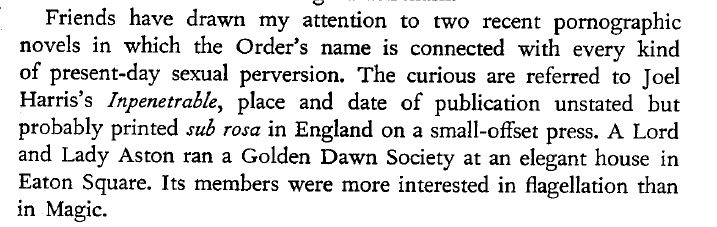
ellic howe inpenetrable
The title of the book, Inpenetrable, didn’t yield any other results, so I decided to search up the name/s of the author. “Joel Harris” led to a dead end, but there are a few, scant mentions of Aristotle Levi online. It seemed as if this guy wrote two other books, Spawn of the Devil and In the Devil’s Power, but there was no other mention of Inpenetrable anywhere. It turns out though, that Spawn of the Devil was translated into Danish and published as I Djævlens Magt, which translates as “In the Devil’s Power” – the two titles were a result of my browser’s automatic translator. There was only one book. Spawn of the Devil (and its translation) came out as part of the Svea Book series, a pornographic series that was published in Denmark in the late 60s and early 70s by a porn company called Nordisk Bladcentral. Some sources credit the work of this Aristotle Levi to a woman named Erica Schoeb, but Erica holds the copyright for all of the books in the Svea series, so it seems likely that she was the series editor or publisher rather than the actual author of any of its texts.

After several hours of searching with these clues, I found an index of science-fiction pornography that gives the following summary of Spawn of the Devil; “Maureen Graille, a seventeenth century witch, is reincarnated in the present.” Bingo! King had mentioned “Maureen Graille, the heroine of the book” in his brief discussion of Inpenetrable. I realised that Spawn of the Devil and Inpenetrable could potentially be two entries in the same series, but judging by the genre I was dealing with, I assumed it more likely that they were just different titles for the same work.

Ok, so I hadn’t been able to find a copy of Inpenetrable, would Spawn of the Devil prove any easier to track down? Like I said, there were very few (maybe 5) mentions of Aristotle Levi or his work online. I don’t want to give away my book-finding techniques to my competitors, but I’ll say that after quite a bit of searching, wrangling, infiltrating strange facebook groups and google-translating, I managed to obtain a single copy of Spawn of the Devil from a dusty, second-hand bookshop somewhere in the Middle-East.

spawn of the devil - aristotle levi
Spawn of the Devil – Aristotle Levi

Svea Book – 1969

Let’s start off with the physical book itself. There’s a few scratches on the cover, but nothing you wouldn’t expect on a book published in 1969. There’s no cover image or blurb on the back. There’s nothing inside other than the story itself – no details on the author or advertisements for other books.

The text is peppered with typos, but the standard of the writing is pretty good. I imagine that the writer probably wrote other, less smutty, books under a different name. In fact, some of the sex scenes in this book seem so sudden and unnecessary that I would be surprised if the author hadn’t originally had loftier aims for this work. This might well have been intended as an occult thriller that was a little too sexy for respectable publishing houses. Maybe after a few refusals, the author took his manuscript to a smut house and was told that instead of being too sexy, the text wasn’t sexy enough. Perhaps he cried into his typewriter as he reedited his manuscript and filled it with “hot cock-sticks”, “quivering quims” and “tight little shitholes” as a last resort to get it published. I’ve read other occult based porn in which the standard procedure was one sex scene per chapter, but this isn’t quite the same. Spawn of the Devil frontloads the smut – once the story gets going, the sex takes a backseat. There’s a few chapters towards the end with barely any riding at all.

And some of the sex scenes are absolutely ludicrous. I’m by no means an expert on literary pornography, and I know that different people get off on different things, but many of the sex acts described in here come across as vulgar and hilarious rather than titillating and sexy. I can’t deny the fact that I greatly enjoy vulgarity though, and I will admit that the following two page description of a disgusting incestuous liaison made me laugh so hard that I cried.
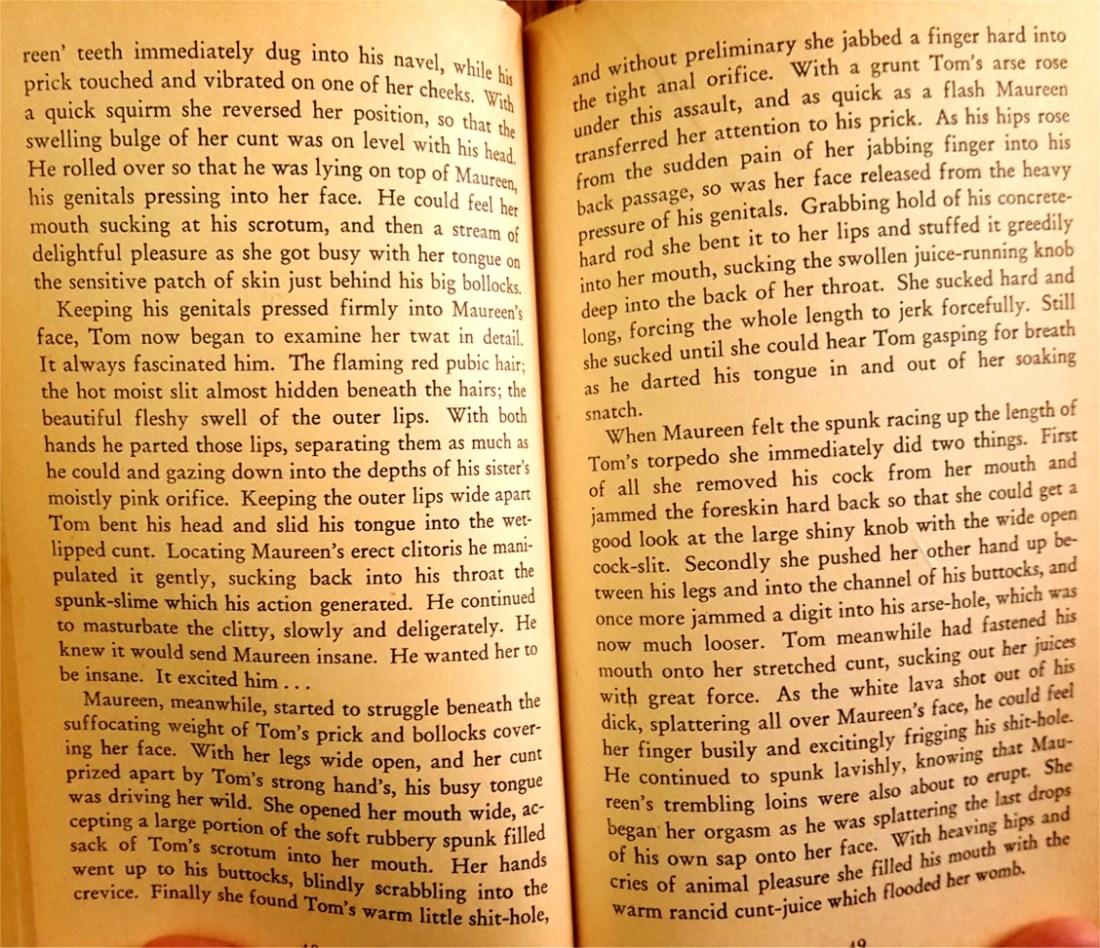
spawn of devil erotica
Please read both pages (higher res image here). It gets better and better. LOL.

Looking back, one of the main reasons I wanted to read this book was Francis King’s assessment of the author as a knowledgeable student of the occult. The occultism herein is largely of the Dennis Wheatley variety, but, like Mr. Wheatley, Mr. Levi clearly has a basic understanding of what he’s greatly exaggerating.

spawn devil inside coverI presume the pseudonym is a mix of the Greek fella and Eliphas Levi.

This book is super rare. If you plan on hunting down a copy, good luck to you. If you’re not pushed, here’s a summary of the story:

The story starts off with Maureen, a witch, observing an orgy in the forest. She isn’t partaking, just watching. When she leaves, she is apprehended by an angry mob of villagers who presume she had just finished up early and was heading home. The mob go on to capture all of the revelers.

All of the revelers are burned at the stake along with Maureen and her husband, Tom. Just before they are set alight, Maureen promises Tom that they will live again.

300 years later, a pair of twins that regularly have been having sex with each other since they were children both feel a sudden urge to go and dig a hole in a certain part of their village. They discover a strange ring. The sister, who is named Maureen, puts it on.

Soon thereafter, Maureen is having lunch in a fancy restaurant. By chance, she meets a lady called Celia Aston. It turns out that Celia is one of the leading members of a magical secret society called the Golden Dawn. She invites Maureen and her brother Tom to her house where she shows them her magical book collection and introduces them to her husband.

Maureen gets it into her head that she wants to be in Celia’s position. To put a curse on Celia, Maureen and Tom perform a gruesome black-magic sex ritual:
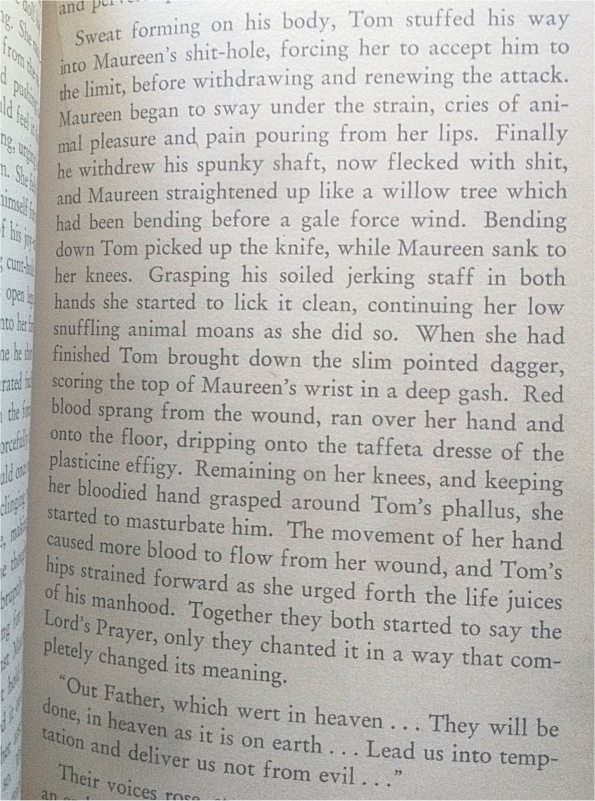
sex ritual curse
Yuck, but also Hahahaha.

The ritual is successful and Celia dies soon thereafter. Using mind control, Maureen convinces Celia’s grieving husband to marry her within a matter of months.

Later on, during a Golden Dawn orgy, Maureen manages to summon a spirit. It’s either Pan or Satan, or maybe both. Only Maureen and a crucified prostitute that Maureen had hired for the occasion actually see the spirit. The prostitute goes insane afterwards. While this is all happening, one of the other members of the Golden Dawn, a lady named Nona, simultaneously gets raped and senses that Maureen is a bad apple.

After this night of black magic and debauchery, Nona and her boyfriend visit a very powerful old witch named Kyleen to see if anything can be done about Maureen. They don’t know it, but Maureen was actually watching them do this by means of black magic.

Maureen summons the spirit of Pan to kill all three of them. She is successful in doing so, but unfortunately for her, Kyleen had been able to do some summoning of her own. Shortly afterwards, Maureen and Tom are killed when their ship sinks during a cruise. Just before they die, Maureen reassures Tom that they will meet again.

The book ends in the future. In the year 2236, a set of twins are born, a boy and a girl.

Spawn of the Devil isn’t the greatest occult-thriller in my collection, but it’s nowhere near the worst. Its combination of black magic and silly synonyms for genitalia pleased me immensely, and I can’t imagine a book more appropriate for this blog. Moreover, the process of reading about it in King’s book, researching it, tracking it down, waiting to see if it would ever actually arrive, and then reading and reviewing it a few months later has been rather exciting. When I started this blog and began reading books by people like Montague Summers, Timothy D’Arch Smith and even Francis King himself, I was jealous of the depths of their research and of the discoveries they had made in the realms of occult literature. It may not seem like a big deal to most people, but I found it immensely satisfying to solve part of a mystery posed by one of these individuals 47 years ago.
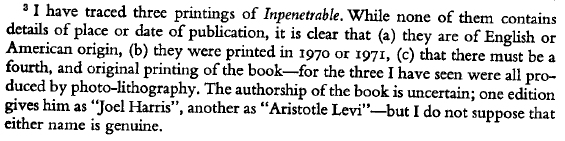
francis king inpenetrable footnote

Inpenetrable was first published by Nordisk Bladcentral as as Spawn of the Devil, a novel by Aristotle Levi. Unfortunately, I can’t claim to know who Aristotle Levi (or Joel Harris) was. My reading suggests that he probably wrote other books (under a different name) in the late 60s/early 70s. He clearly had an interest in the occult. His repeated use of the word bollocks means that he was almost definitely British. This book was published in Copenhagen and translated into Danish, so it is possible that he had some other link to Denmark. Does this description sound familiar to anyone? I wonder if there’s anybody alive today who knows his true identity. If anyone has any further information on Aristotle Levi, Joel Harris, Inpenetrable or Spawn of the Devil, please, please, please, leave a comment or email me to let me know.


Sexuality, Magic and Perversion – Francis King

This post was originally intended for Saint Valentine’s day, but I made some startling discoveries whilst writing it and had to postpone its publication until things were sorted out.

sex magic and perversion francis kingSexuality, Magic and Perversion – Francis King
Citadel Press – 1974 (Originally published 1971)

I hadn’t read anything by King when I bought this book based on its title alone (I’ve since reviewed his Secret Rituals of the O.T.O.), and I was expecting something rather trashy when I made the purchase. This book, however, isn’t very trashy at all. It’s a relatively sensible overview of how sex has been used in magical practice throughout history. It’s pretty good.

I didn’t follow some of the stuff on tantricism at the beginning, but the chapters on the more modern occultists were very interesting. I’ve seen Charles Leadbeater’s name come up in loads of books that discuss Theosophy, but I didn’t know he was a dirty, boy-touching bastard until I read this one. The stuff on Crowley was entertaining too. Apparently ol’ Aleister liked getting bummed as crowds of his friends watched.
aleister crowley bugger

Sexuality, Magic and Perversion was insightful, well researched and it made me want to read more books. The writing was neither overly academic nor flagrant nonsense. I’m looking forward to reading more of Francis King’s work in the future.

Yes, this post is considerably shorter than my regular output, but don’t be dismayed. I’ve held back on the really interesting discovery that I made whilst reading this book. Said discovery is so exciting that I’m giving it its own separate post. (I’ll post it tomorrow!) If you’re at all interested in Sexuality, Magic and Perversion (the book) and/or sexuality, magic, perversion and the activities these concepts entail, I guarantee, you’ll want to read what’s coming up next.


The Books of Richard Bachman

Richard Bachman was an American fiction writer who died in 1985. His books were quite dystopian and unpleasant. From what I can figure out, he was a friend of Stephen King – both authors repeatedly reference each other in their works, and Stephen King wrote introductions to several posthumous editions of Bachman’s books. I’m a big Stephen King fan, so I decided to spend a few months reading every book that Bachman wrote. I’m reviewing them here in the order that I read them, not the order that they were published.

bachman rageRage – 1977
This is the only book by this author that’s out of print. It’s about a kid killing two of his teachers and then taking his class hostage. While being held hostage, the students start opening up and sharing their deepest secrets with eachother. I found it pretty hard to swallow the idea of the kids bonding in a situation like this. At the end, they gang up on a boy (not the shooter) and brutally attack him.

The shooter had a messed up home life, but it wasn’t nearly messed up enough to justify his behaviour. None of the victims in this novel deserve what they get. There’s no satisfaction when they die. School shootings have become a far more frequent occurence since this book was published too, and some actual school shooters’ lockers have been found to contain this book. I didn’t like this one much.


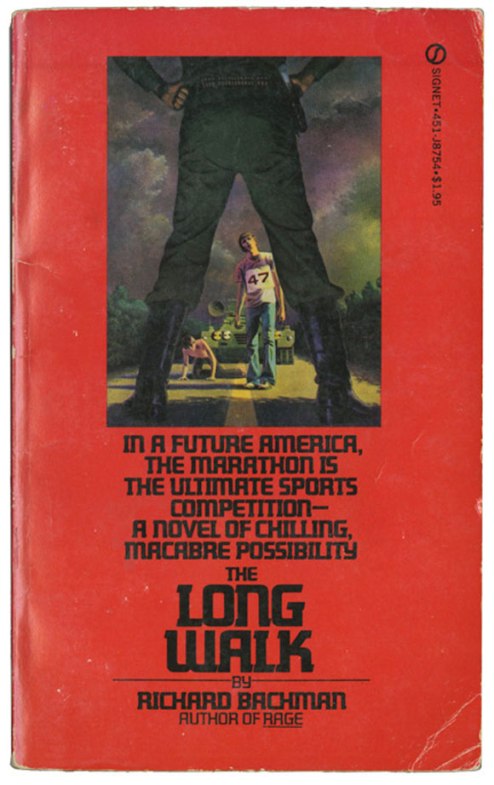
long walk bachmanThe Long Walk – 1979
This is the story of 100 teenagers in a competition to see who can walk the furthest without stopping. If they stop, they are shot dead. An interesting idea for a story, but it’s not an enjoyable read. A few months ago, I complained about how Henry James used frustrating language to make his readers feel the frustration that his characters are going through. In a similar way, Richard Bachman wrote a gruelling book about a gruelling experience. Like the road the characters are walking, this book goes on and on. While reading it, I kept wishing that it was a short story – it’s a straightforward concept that can only end one way, perfect for that format – but a short story wouldn’t bring out the true horror, the monotonous, inevitable, tortuous misery of the Long Walk.

I kept hoping that the walk would reach a point where the walkers started dropping off quickly, but that doesn’t really happen. The concept is quite brilliant in that way – the further the walkers go and the fewer of them that are alive, the better each individual’s chances become, spurring them on to continue. It’s a really clever, yet absolutely horrible, idea. The book is succesful in making the reader feel uncomfortable – for a book set on the open road, it’s strangely claustrophobic – but I can’t really say I enjoyed the journey. It reminded me of sitting through the 5th hour of a 10 hour flight. A rotten book that will make you feel lousy.


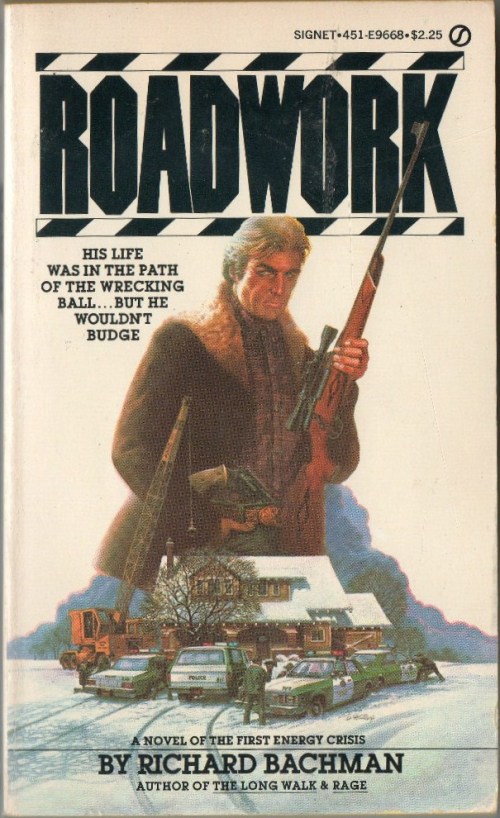
bachman roadworkRoadwork – 1981
I’m still not sure if this was a good book. While its ending is only marginally less obvious than The Long Walk, I found getting to that point to be more entertaining. (There’s only one potential destination for the characters in both novels, but the protagonist of Roadwork has several potential ways of getting there.) This is the story of a man’s life falling apart. It was clearly written by a person who was upset. No real surprises, but entertaining all the same.


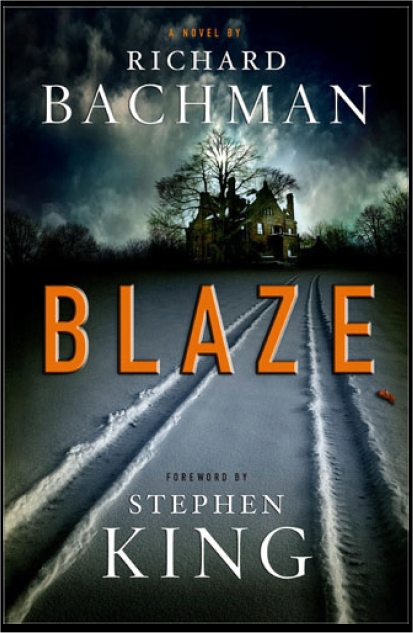
bachman blazeBlaze – 2006
Rage, The Long Walk, Roadwork and The Running Man used to be published together as a collection called The Bachman Books. I can’t remember why, but I took a break from that collection after Roadwork and read this 2007 book. Blaze was written in the 70s and revised for publication 30+ years later. Essentially the author has taken the 2 main characters from a famous Steinbeck’s Of Mice and Men and put them into very different circumstances. Instead of ranch workers, they’re now small time criminals, and once George is murdered, Lenny (or Blaze, as he’s called here) comes up with a plan to make a million dollars. If you’re familiar with Steinbeck’s work, you’ll have an idea of how things are going to end here, but that doesn’t ruin this story. There is only the slightest hint of supernatural activity towards the end of the novel, and I think it’s quite a push to describe this as a ghost story. It’s not a bad read though.


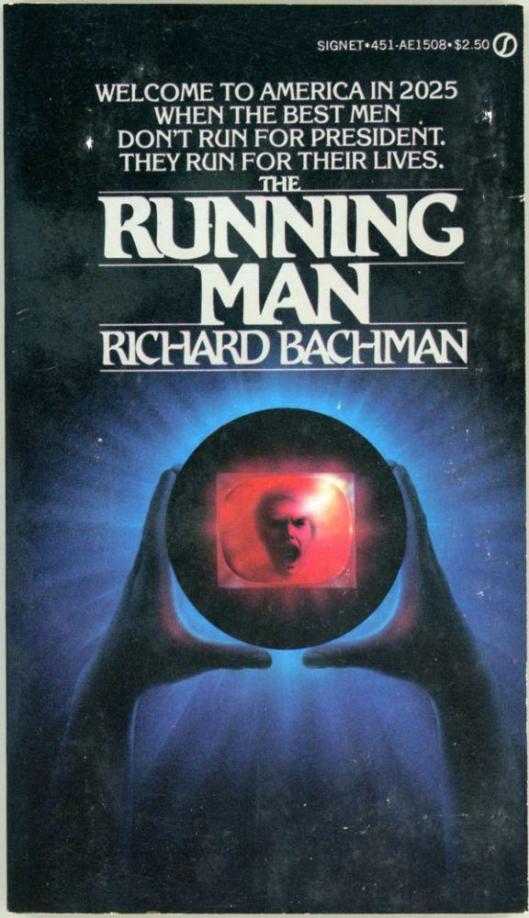
bachman running manThe Running Man – 1982
Honestly, this felt like a much improved version of the Long Walk. It’s the same basic idea (a government that kills people for entertainment), but this one has more of a futuristic, sci-fi vibe to it. Again, there’s only a few ways this story could possibly end, and by the time you get to the last quarter of the book, there is absolutely no question of where this is going. The chapters are numbered backwards too, and the whole countdown thing is pretty cool. I tried watching the movie, but I only got 40 mins into it before giving up.


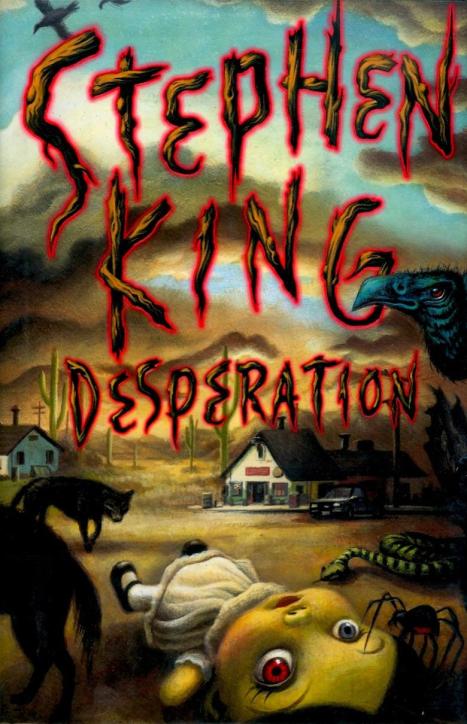
stephen king desperationDesperation – 1996
Ok, so I know you’re probably surprised to see a Stephen King novel in this post, but let me explain. In 1994, Richard Bachman’s widow found a manuscript of an unpublished novel called The Regulators in her cellar. I don’t know exactly how it happened, but somehow the manuscript managed to find its way into the hands of Stephen King. There is a brief reference to the Overlook Hotel (from King’s The Shining) in The Regulators, and King has name-dropped Bachman in several of his works since Bachman’s death, so I assume the two authors had become friends at a literary party or writing convention or something in the 80s. If Bachman’s wife or agent had stayed in touch with King, they might well have sent the manuscript to him to help get it published – by the mid 90s, King was the most popular author in the world. Before exerting his influence to have the book published, King seems to have decided to pay homage to his fallen comrade by writing a companion text to Bachman’s unpublished novel.

This post is about Bachman’s books though, so I’ll explain that in more detail in reference to his text later. As for King’s book, this is definitely one of his less brilliant novels. The concept is decent, the story is super gory, and there are some genuinely creepy ideas in here, but I reckon this would have worked better as a novella. At 700+ pages, Desperation is needlessly long. It’s also surprisingly religious. King was going through some difficult stuff in his life and used writing this book to work things out for himself. There’s a lot of discussion about the nature of God. This book has weird sex things, underground monsters, blood and guts, but it’s actually quite shit.

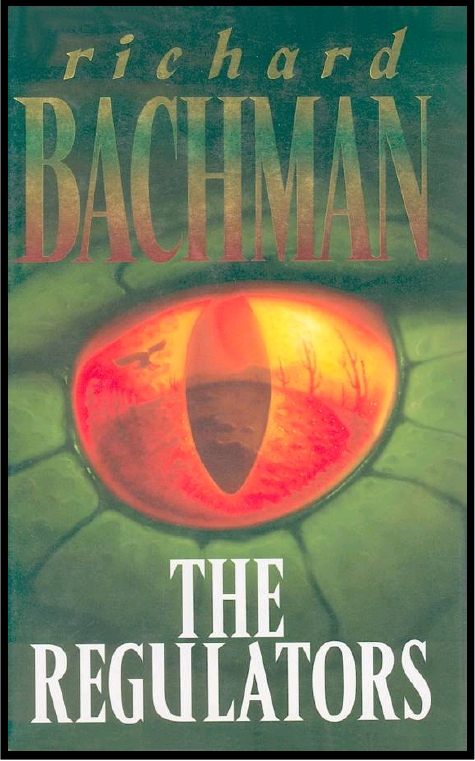
bachman the regulatorsThe Regulators – 1996
This book features the same characters as Stephen King’s novel Desperation, but instead of them fighting against the demonic Tak in a ghost town filled with corpses and scorpions, they get to battle him without leaving their neighbourhood. The Regulators is set in an alternate universe where the characters from Desperation are neighbours rather than drifters in the desert. Realistically though, most of the characters share only a name with their counterpart in Desperation. (David and Ralph Carver switch places as father and son.) Tak, the antagonist, is quite different too.

The Regulators was fairly shit, but I don’t think I noticed how shit it was until I was finished. It was exactly like a Goosebumps book for grown-ups. The plot was quite dumb. If a person was determined to finish all of Bachman’s books, I would suggest reading King’s Desperation before The Regulators. I know that sounds a bit strange given that The Regulators has to have been written before Desperation, but let me explain: The Regulators is quite short, and I think that Desperation’s mammoth size was King’s attempt to flesh out Bachman’s concept without editing the original text. Both books are shit though, so you’d be better off just leaving them alone.


bachman thinnerThinner – 1984
Out of all of Bachman’s books, Thinner was the one that I wanted to read most, so I saved it for last. Somehow my friend Damo and I managed to rent a VHS copy of the movie version when we were kids, and while I remembered very little of the plot, I knew that this one was going to be a fairly straightforward horror story. Reading through a story that I had seen in a movie almost 20 years previously was a bit strange. I’d realise what was going to happen just before the book revealed it.

A fat man gets cursed by a gypsy and starts losing weight. The story is quite Bachmany in its inevitability – horror stories about curses can’t have happy endings. From the very beginning, you know that the protagonist is either going to waste away to nothing or have the curse lifted only to suffer an even more miserable death. The drawn out misery of the first two thirds of the book reminded me of The Long Walk. Things definitely pick up towards the end, but I think that this would have been more enjoyable as a short story than as a novel.

There’s a reference to Stephen King in here too, strengthening my belief that the two authors were friends.

richard bachmanThe only known photograph of Bachman

Well, that’s it for Richard Bachman. Apparently his wife still has some unpublished manuscripts, so it’s possible that another one will come out in the future. In honesty though, I’m happy enough waiting. These books weren’t anything special. Bachman’s friend, Stephen King, writes more enjoyable books.

Robert Anton Wilson, the Last Great Irish Modernist?

James Joyce and Albert Einstein are drinking in a pub together when a panicked man rushes into the bar. Jimmy, Albert and Sir John Babcock, the man claiming that he’s being pursued by a devil, leave the bar and go to Einstein’s apartment where Babcock recounts the mysterious occurrences that have led him to this point. His narrative is interspersed with questions, observations and pontifications from Joyce and Einstein. This is Masks of the Illuminati, Robert Anton Wilson’s 8th novel.

robert anton wilson masks illuminatiMasks of the Illuminati – Robert Anton Wilson
Dell Trade Paperback – 1981

The story is full of ideas that fans of Wilson will be familiar with, and there are references to half the authors that have been featured on this site. Not only do the names and works of writers like Lovecraft, Wilde, Charles Maturin and Philip Jose Farmer pop up throughout, but the story itself directly borrows from and repeatedly references Robert W. Chamber’s King in Yellow, Arthur Machen’s The Great God Pan, and Edward Bulwer Lytton’s Vril. Oh, and Aleister Crowley turns out to be behind most of the plot’s mischief, so a basic understanding of his work, life story and personality is probably necessary for readers of this book. I felt pretty cool reading through and patting myself on the back every time I came across a reference that I recognized.

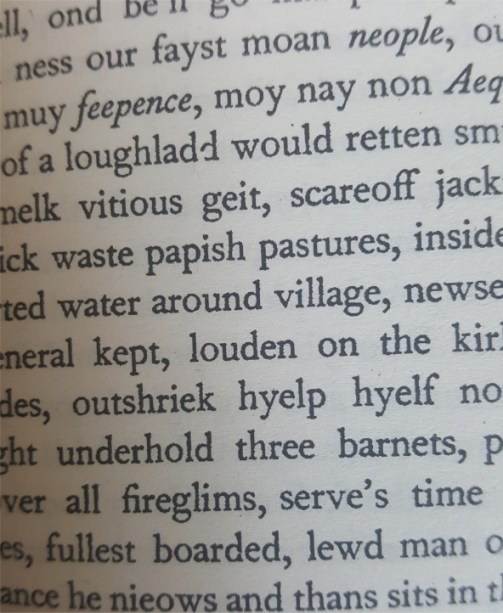
James Joyce is not only one of the main characters in this book; he’s also a huge stylistic influence on the writing. Lots of the people following this blog are probably just here for the Satanism and aliens, and these unfortunates might not have much of a background in Irish modernism, so I’ll just briefly state that James Joyce was a genius writer whose books about life in Dublin city got progressively more mental and complicated as he got older. His final novel, the infamous Finnegan’s Wake, is 600 pages of dense, indecipherable nonsense. (I watched a lecture by RAW on youtube a few years ago in which he described a means of using Finnegan’s Wake as a form of telling the future. Masks of the Illuminati is set pre Ulysses though, so there’s no overt discussion of FW in here.) For most of Masks of the Illuminati, the Joycean influence is mild, and only the sections describing characters’ dreams are truly loopy.

finnegans wake nonsenseI got about 6 pages into Finnegan’s Wake before giving up.
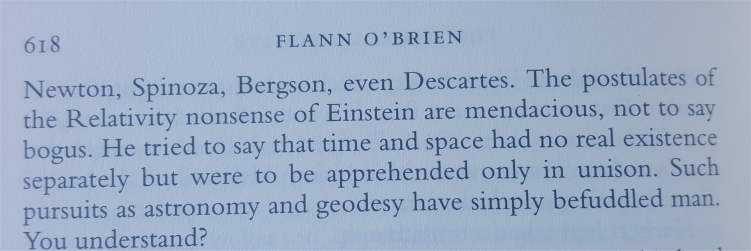
While Joyce is clearly an important influence on the writing of Masks, it’s hard to tell how much of the Joyciness in here is direct Joyciness and how much is Joyciness à la O’Brien. Some might think that Samuel Beckett is the next greatest Irish modernist after Joyce, but for my money, that title goes to Brian O’Nolan, better known as Flann O’Brien. (Beckett worked as a translator for Joyce as he was composing Finnegan’s Wake, and while his own writing was clearly influenced by the avant-garde nature of his master’s, O’Brien’s work is more overtly Dubliny than Beckett’s and so its weirdness is a bit more noticeably Joycean.) While the literary techniques in Joyce’s Ulysses vary from chapter to chapter, At Swim-Two-Birds, O’Brien’s equivalent masterpiece (and crucial companion to Ulysses in my opinion) tells its story through the repeated use of a selection of literary gimmicks.

Nature of gimmicks: various modes of information presentation: notes, poems, lists, etc.

Descriptions of things within the narrative of At Swim are labelled as if they part of a medical or judicial report. In a very similar manner, much of the description of characters and events in Masks of the Illuminati is presented in the form of questions and answers. Several portions of the narrative are also presented in the form of a screenplay. Joyce had done similar things in Ulysses, writing one chapter entirely as question and answers and one as a closet drama, but the way Wilson goes back and forth with these methods throughout the novel instead of keeping them in separate chapters makes his book read more like an O’Brien novel than one of Joyce’s.

That Wilson was a fan of O’Brien is common knowledge. He not only described O’Brien’s The Third Policeman as one of the greatest Irish novels; he also included De Selby, a recurrent character in O’Brien’s work, as a character in some of his own fiction. This recycling of fictional characters is distinctly Flannish; most of the characters in At Swim-Two-Birds are borrowed from other stories due to the narrator/author’s belief that there are already too many characters in the canon of literature.

flann o'brien einstein

So the ways in which Wilson tells his story and chooses his characters are undoubtedly similar to those of O’Brien, but it is his choice of characters that most clearly highlights the Flannish influence on Masks of the Illuminati. James Joyce appeared as an important character in O’Brien’s Dalkey Archive 17 years before Masks was published. Dalkey Archive was also heavily influenced by O’Brien’s interest in Einstein’s work (Alana Gillespie wrote a doctoral thesis addressing this influence), and at one point in the narrative, DeSelby (the character to later appear in Wilson’s fiction) directly critiques Einstein’s theory of relativity. Much like the fnords, Flann O’Brien’s influence on Masks of the Illuminati may not be immediately obvious, but it is present on every page.

I find it hard to imagine enjoying the work of either Joyce or O’Brien without having visited Dublin at least once. That might sound obnoxious, but if you’ve read the books, you’ll know what I mean. Soon after Masks of the Illuminati was published, Wilson and his wife moved to Ireland for six years. He later claimed that, “Dublin, to me, is a James Joyce theme park.”

james joyce statue

In a way it’s slightly ironic that Wilson was so inspired by the likes of Joyce. Ulysses, Joyce’s masterpiece, is a mock-epic. It takes the banal, vulgar events of an ordinary day in Dublin city and fits them into the structure of Homer’s Odyssey while simultaneously threading the narrative through every literary technique imaginable. A huge part of the appeal of Joyce’s writing is his ability to see and depict the fantastic in the ordinary. While Joyce wrote about everyday life, Robert Anton Wilson is most famous for his books about absolutely insane conspiracy theories. I love Robert Anton Wilson, but his approach of using bizarre writing techniques to write about bizarre topics is probably responsible for how relatively unpopular his writing is. He was clearly a very intelligent man with a passion for literature, but his fiction (or at least 4 out of the 5 of his novels that I have read) is remarkably inaccessible. The deliberate esotericism doubtlessly prevents squares from reading his books, but it gets nerdy, Irish weirdoes like me hot, bothered and horny for more.

That being said, I didn’t actually like how this book ended. I get that it’s supposed to be a mental book about mental topics, but the last chapter both goes and stays off the rails for a little too long. Showing a Joycean influence is cool, but going full on Finneganean is a bit embarrassing. The last 30 pages or so felt like watching a modern punk singer trying to pull a GG Allin – watching a copycat punch themself in the face and then roll around in their own feces isn’t shocking or transgressive anymore; it’s just a lad making a smelly mess of himself.

Overall though, Masks of the Illuminati is quite an interesting book. My review has focused on its Irish influences, but there’s lots more to the book. I’m sure that twice as much could be written about the Crowleyean influence and content, but I’ll leave that to somebody else. While Robert Anton Wilson was undeniably an American writer, it’s worth pointing that he spent almost one third the amount of time living in Ireland that James Joyce did, and so I can think that Ireland can take at least partial credit for his genius.

masks of the illuminati robert anton wilson

July 23rd is International Robert Anton Wilson day, so if you haven’t read any of his books, today would be a great time to start. If you’re already a fan, you should check out my RAW day post from last year, a review of his first novel, the Sex Magicians. It’s definitely one of the better posts on this blog.