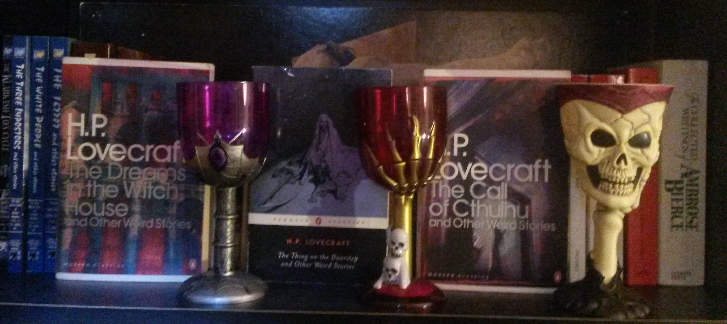
Call of Cthulhu and Other Weird Stories – Penguin – 2002
The Thing on the Doorstep and Other Weird Stories – Penguin – 2001 Dreams in the Witch House and Other Weird Stories – Penguin – 2005
These are the only Lovecraft books that I own. I’m interested in buying more, but I don’t want to spend a bunch of money on a book if it only contains one story that isn’t included in these. I would love to hear from anyone who could recommend other collections that are worth buying for somebody who already has the penguin editions.
I’m not going to waste much time talking about how great the stories are. There’s not much I can say that hasn’t been said a million times before. These collections are nice though. I liked Joshi’s introductions and notes. Dreams in the Witch House and Other Weird Stories is definitely the weakest of the three, but I still really enjoyed it. That one contains more fantasy stories than the other two, and while the fantasy stories were pretty great, I definitely prefer the darker stuff.
Lovecraft is one of my favourite writers. I remember going to a LAN party when I was 16 years old, and one of the guys there shared a folder of .txt files that were stories by ‘a cool horror writer who influenced Metallica and Quake’. No further persuasion was necessary.
Apart from his wordiness (which I completely adore), the main complaint that people seem to have about Lovecraft is that he was a nasty racist. Well, I don’t want to to defend him; the fact that he lived in a different time and place doesn’t justify his shitty opinions. However, I don’t feel the need to disregard his entire body of work because it contains a few parts that I don’t agree with. In honesty, I thought some of the racist parts were pretty funny. To clarify: I don’t think racism is funny; I think Howard’s delusions of grandeur are funny. (He wasn’t exactly a fine specimen of humanity himself.) Anyways, I don’t really care if an author of fiction is an asshole in real life; I read lots of books by people who I would absolutely hate if I were to meet them. Lewis Carroll was a paedo, Dennis Wheatley was a loyalist, Montague Summers was a boy-toucher, and I certainly don’t read the Marquis De Sade because he was a nice bloke. It helps that these lads are all dead though. I wouldn’t buy something if I knew that my money would go to a shitty racist.
It’s a shame that I spent so much time discussing what it is only a minor point in Lovecraft’s writing. The positive aspects of his work more than make up for some of his unpleasant ideas. The atmospheres that he creates within these tales are unique and genuinely exhilarating. If you haven’t read Lovecraft before, I would recommend any of these three collections as an introduction. The worst of these stories are pretty good, and the best of them are the best stories that I have read. 9.5/10
I picked this one up from the bottom of the esoterica shelf in an out-of-the-way, used book store that mostly stocks old mystery novels. It had a picture of a man who is on fire on the front, and the heading on the back cover reads; ‘THE SPAWN OF LUCIFER…’ The most promising feature of all though, was the fact that when I started reading it, it was not yet listed on goodreads.com. Oh yes my friends, this kind of book is what it’s all about. It’s a collection of short accounts of the lives and atrocities of 25 of Satan’s most heinous disciples. Among the accused are Aleister Crowley, Rasputin, and John Dee, but many of the other names in here are a little less well-known.
The accounts given seem to be somewhat based in truth, but I suspect that they were mostly just patched together from urban legends, rumors, lies and complete fabrications. Some of the exaggerations are commonplace and believable, but others are downright silly. For instance; I have come across the mysterious figure of the Comte de St. Germain in several other books, and I was a little surprised to see him appear in this. Hitherto, I knew of his claims of being immortal, but that hardly seemed comparative to the cannibalistic orgies of the sadistic black magicians in this little collection. It all made sense however, when this book informed me that the Comte de St. Germain was actually “the Devil – in the guise of a gigantic werewolf.”
Most of the characters mentioned in here were definitely real people, but there are some accounts which are probably complete fabrications. There’s an interesting section on an evil priest named Raoul Hannah who lived in Belfast. He is supposed to have been involved in the slave trade, voodoo cults and human sacrifice. He is also apparently responsible for bringing the black mass to Ireland. According to the book, this Satanic St. Patrick’s rituals always culminated in “the sacrificial murder of an unknown African Negro”. Given this peculiar fact, I wonder how often he was able to celebrate this sacrament; there probably weren’t many “African Negroes” in Northern Ireland in the 1930s. Anyways, I was fairly excited to do a little research on this lad, but the passage ended with a note: In order to protect those whose families were quite innocently involved in the story of a man named “Raoul Hannah,” the real identities and the exact location of the town in the north of Ireland have been withheld.
I’ve searched online and can find no trace of this story. It’s a pity because it was one of the most interesting tales in here. I reckon it’s complete bullshit and that Peter Robson made it up to fill a few extra pages, but then again, there are only 3-4 sections in the book that I have not found some basis for. There’s a possibility that it is true and that Robson did just change the names. If you have any idea about where this story came from, please contact me and let me know.
(My hunch is that this is section is probably just a bio on Ian Paisley.)
There are other monstrous individuals in here whom I have not been able to track down. Two of the most diabolic, Raoul Plessy and Gustav Labahn, are probably fabrications of Robson’s. I would be happy enough to accept that these three suspicious entries were completely made up, but that would be to presume that they never existed only because they’re not mentioned online. In fact, there is one particularly horrific account in here that tells of a young girl named Bernadette Hasler being sadistically tortured by a religious order called “the Seekers of Mercy”. It seemed pretty bullshitty when I was reading it, but when I looked it up online I was disturbed to find an image of a teenage girl on the cover of a French crime magazine with the headline “Le Martyr de Bernadette torturée au mort au cours d’une séance exoricsme”. There’s also an article written in German that mentions the case, but I could find nothing in English. Now, I’m not taking two articles that I can’t read properly as evidence of Peter Robson’s account being accurate, but they have convinced me that it’s not complete bullshit. It’s weird to come across a story as disturbing as this without being able to find out more about it online. It makes me wonder about my dependence on the internet as a verifier of knowledge, and I am both simultaneously upset and excited to know that sometimes the truth isn’t out there.
Her arms were stretched out in the form of a cross, and she held black candles in her hands. A cloth with a cross embroidered on it was placed on her breasts, and the chalice was placed on her abdomen.Then a goat’s throat was cut, and the blood poured over the woman. Next, Boullan performed a ceremony over the woman which involved frequent kissing of her body and drinking the goat’s blood. During the whole disgusting performance, the unfrocked priest screamed out curses and threats
I would genuinely rather read that than an accurate portrayal of anyone.
Also, there is a super cool fold-out advertisement in the center of the book. Only 10 cents for a copy of the Complete Illustrated Book of Psychic Sciences?!?!?!
I really enjoyed this little book. It’s trash to the Nth degree, but it doesn’t pretend to be anything else. Buy a copy and read it on the way to work. 8/10.
This is one of my favourite books. It combines the writing styles of Joyce, Lovecraft and William S. Burroughs in a narrative about sex, mythology, aliens, drugs, Nazis, the mafia, rock’n’roll, magick, Abrahamic religions, satanism and conspiracy theories: it ticks all my boxes.
The plot is difficult, and it’s pretty easy to get the characters mixed up with each other. After a while though, you realize that this is part of the point of the book. The book is about conspiracies, and all conspiracies bleed into each other in some way. Everything in here effects everything else that’s going on. It’s similar to Ulysses in the way that it requires a great deal of engagement from the reader to make sense of what is happening. In a way, the reader almost becomes a character in the book; just as the characters fall victim to Operation Mindfuck, so too does the reader. If you put any kind of effort into reading this book, it will fuck with your mind.
It’s a pain in the arse at times though. It’s bloody long, and parts of it are fairly tedious. It’s actually three books in one: The Eye in the Pyramid, The Golden Apple and Leviathan. Apparently it was originally going to be 500 pages longer, but the publisher demanded it be abridged. I took about two weeks to get through the whole thing as it stands, and that involved reading for a few hours every day and listening to the audiobook version until I feel asleep. I spent so much time with this book that it started to affect both my dreams and waking thoughts. Every time I encountered any kind of small coincidence during the two weeks it took to read, I imagined that I had just stumbled upon a clue that would eventually lead me to some drastic cover-up.
It actually happened that I took a break from reading this book to watch a documentary on the JFK assassination theories. (Yeah, I get pretty hung up on things when I’m excited.) When I woke up the next morning, I found that my mother had emailed me a picture of herself with a statue of JFK in Wexford, Ireland. I was deeply disturbed by this, and I momentarily suspected my mother of being involved in the assassination.
I have a weird thing with JFK anyways. I remember waking up one morning about two years ago with the Misfits’ song “Bullet” stuck in my head. (It’s a song about the assassination.) I made sure to put the song on my phone before I left for work, and I allowed myself to listen to it twice on the bus into work. (I remember it specifically, because listening to a song twice in a row is a rare indulgence for me.) I got into work and checked the news, as is my custom. Well, lo and behold; there was Johnny in the headlines! It turns out that it was the 22nd of November, 2013: the 50 year anniversary of the JFK assassination.
“The more frequently one uses the word ‘coincidence’ to explain bizarre happenings, the more obvious it becomes that one is not seeking, but evading the real explanation.” Or, shorter: “The belief in coincidence is the prevalent superstition of the age of science.”
The Eye in the Pyramid (p. 296)
It’s too much to think that these events were just coincidence. I firmly believe that the ghost of JFK is trying to communicate with me to explain what really happened in Dallas. Johnny, if you’re reading this, please don’t give up on me. I am ready to accept your secrets.
Anyways, this is a great book. It’s funny, clever and extremely entertaining. It takes a bit of work, but I thought it was definitely worth it. 8/10.
TAN – 1986
Imagine a father brutally torturing his daughter from the time she was 9 years old. Alongside physical torture, he doesn’t allow her to sleep or eat. When he does allow her to eat, he forces her to eat scabs, vomit and shit. As she grows older he hits her in the head and encourages her to cut herself. Her health is constantly poor, but the man keeps up his routine of abuse and degradation until her death.
Can you imagine any possible excuse for this kind of abhorrent behaviour? Could you be friendly if you met a person who admitted to committing such deeds? Would you be willing to worship that individual? Would you be comfortable to describe that person as the source of all goodness in the universe?
Well, if you’re Catholic then you should be answering ‘yes’ to all of the above questions. The Catholic church openly acknowledges that God put Saint Margaret Mary Alacoque through the aforementioned ordeals. St. Margaret Mary lived from 1647-1690, but she was only canonized in 1920. The credibility of her autobiography, in which she admits to eating both diarrhea and vomit, was affirmed by Pope Pius XI in 1928.
It genuinely puzzles me when I try to understand how any organization can retain credibility when one of its figureheads is a self-admitted poo-eater. I am not making this up: It happened once, when I was tending a patient who was suffering from dysentery, I was overcome by a feeling of nausea; but He gave me so severe a reprimand, that I felt urged to repair this fault…. (“The Saint then performed an act so repulsive to nature that not only would no one have advised it, but no one would even have permitted it.” Words taken from Life of St. Margaret Mary, Visitation Library, Rose lands, Walmer, page 81) He then said to me: “Thou art indeed foolish to act thus!” [p83-84]
(The margin notes in my copy of the text refer to the vomit/turd feasts as “heroic actions”.)
It wasn’t even a healthy log of shit either; it was runny dysentery. This woman ate da poo-poo. She put turd in her mouth. A bona fide gick-licker is a Saint of the Catholic church. If you are a Catholic, you have to acknowledge that Catholic Popes are God’s representatives on Earth and are therefore infallible on issues of faith and morals. Therefore, if you are a Catholic, you have to acknowledge that Pope Benedict XV was correct in canonizing a soupy-scat-sucker.
Anyways, this book is Saint Margaret Mary’s own account of her miserable life. It’s genuinely one of the most disturbing books that I have ever read. Parts of it are like reading De Sade; it’s full of horrendous acts of torture and humiliating debasement. But it’s not the coprophagia or horrendous violence that make this such an upsetting read; De Sade used shit and blood to promote vice, but Margaret Mary is trying to use them to promote virtue. Personally speaking, I am not inspired to live a better life after reading the autobiography of a woman who mistook trots for treats. Neitzsche described Christianity as being anti-nature, as going against life itself; and this book is the perfect proof of this. This is exactly how not to live your life: Margaret Mary is literally the worst role model a person could have. She claims to have undergone the suffering for God’s sake, but I really think it was more for her own depraved satisfaction. If I was a Christian and I thought that God was actually pleased by the behaviour of this disgusting pervert, then I would seriously consider swapping sides; there’s no way Satan could be the bad guy if God was such a monstrous jerk.
I don’t think God or Satan had much to do with this case though. Margaret Mary was a kinky masochist, and nobody else deserves any of the blame. This woman was severely mentally deranged. I bound this miserable and criminal body with knotted cords, which I drew so tightly that I had difficulty in breathing and eating. I left these cords so long that they were buried in the flesh that grew over them, and I could not extract them without great violence and excessive pain. I did the same with little chains which I fastened around my arms and which, on being taken off, tore away pieces of the flesh. There are schools named after the person that wrote that. What kind of a horrible, irresponsible person would send their child to such a place?
The horniness of our love-starved saint isn’t just apparent in the aforementioned bondage scene; there’s an underlying current of eroticism throughout the whole book. This woman never got laid, and she probably never masturbated. I’m not a psychologist, but I am sure that the complete repression of a human’s sex drive could manifest itself in bizarre ways. Well, some of MM’s hallucinations (or visions) are rather steamy. At one point she imagines Jesus showing her a cross and saying, “Behold the bed of my chaste spouses on which I shall make thee taste all the delights of My pure love.” Note the forceful language that Jesus is using here. He’s not just allowing her to sample the delights; he’s making her taste them. He’s obviously the Dom in their kinky S&M relationship. He continues; “Little by little these flowers will drop off, and nothing will remain but the thorns, which are hidden because of thy weakness. Nevertheless, thou shalt feel the pricks of these thorns so keenly that thou wilt need all the strength of My love to bear the pain.” Unsurprisingly Jesus’s pillowtalk proves to be effective. Margaret Mary finds him simply irrestible; “These words delighted me, as I thought I should never find enough suffering, humiliations or contempt to quench the burning thirst I had for them, and that I could never experience greater suffering than that which I felt at not suffering enough; for my love for Him gave me no respite day or night.” Now I’m not into S&M, but even I felt a bit warm after reading that!
This is the most upsetting book that I have ever read. In a frustratingly unintentional manner, it highlights one of the most disgusting problems with Christianity: it’s a perverse and unnatural religion that values misery and suffering. Instead of inspiring pity or reverence, this book inspired repulsion and anger in me. The woman who wrote this book had severe mental health problems; if she were alive today she would undoubtedly be locked up in a mental instution. However, this mentally-disturbed, masochistic, deiphilic coprophage is recoginized as a saint of the Catholic church. I don’t think it is presumptuous to assume that part of a saint’s role is to be a role model. If you’re a Catholic, please read this book and think about whether or not you can accept Saint Margaret Mary as a role model. Ask yourself how you would feel if your daughter, sister, wife or mother started eating turds in the name of Jesus. Every time you put money into a church collection, you are funding an organization that condones this kind of filth. Think about the brown, soiled lips and the shitty fetid breath of Saint Margaret Mary next time you are receiving holy communion.
Corpus Christi.
I’m not going to give this a mark out of 10. It’s terribly written, and the content is either very boring or very gross. I enjoyed reading it, but I also hated reading it. I suppose it would be most accurate to say that I enjoyed hating it. Any person that could possibly enjoy this as a work of inspirational literature would have to be a sadistic sexual deviant. If you’re interested in giving this a read, make sure to buy a second hand copy or just read it online. Always avoid giving money to Christian publishers.
Well it’s Saint Patrick’s day on Tuesday, and what better way to celebrate Irishness than to review some classic Gothic Literature from the Emerald Isle. I won’t go into too much detail as all three of these novels are absolute classics, and I expect anyone who is following this blog to have read them all.
The Picture of Dorian Gray – Oscar Wilde
Dell – 1978
Dorian looking a bit scaldy.
This novel is great. It’s been a long time since I read it though. Either way, I won’t hear a word said against our Oscar. It’s a pity he didn’t write more novels. 7.5/10
This is one of my favourite books of all time. It’s standard Gothic fare really; a young girl loses her parent and she has to go live in creepy uncle’s house. The chapter in which Maud, the protagonist, encounters her repulsive governess for the first time had me shitting in my britches. The way that creepy bitch comes down the hill is absolutely CHILLING.
My edition of the novel is nicely annotated, and there is one note that I found particularly amusing. “414 a clumsy old press: in Ireland and Scotland, press = cupboard” Visiting my in-laws would be so much easier if I could get that printed on a t-shirt.
Anyways, this book is magnificent. If you like Jane Eyre or The Mysteries of Udolpho, then this is the book for you. If that doesn’t sound like your thing, then sorry, but we can’t be friends.
Well, this is obviously one of the greatest novels ever written. This was also one of the first books that I read after graduating from university. I had just spent four years reading books that had been selected by other people, and to have the freedom to choose a book according to my own tastes was tremendous. I remember actually looking forward to going to bed at night, just so I could get stuck into this absolute masterpiece.
I’ve always had an interest in ghosts and monsters: I grew up watching Ghostbusters and reading Goosebumps, and I’ve always preferred horror films to any other genre. I was expecting to enjoy this book, but I was not expecting to be frightened. Well, I was; there are parts of this book that are damned scary. There’s nothing in here that I hadn’t seen in a hundred movies; but reading Dracula, I realized that all of those movies had used this book as a template to produce their scares. I was spooked good and proper when the lads start to go missing on the boat as the count is lurking in the shadows. Pure deadly.
There’s also some weird sexiness to this novel. That’s not just something that Hollywood added to make the film versions more successful. There’s a lot of heaving breasts in here. Mina and Lucy sound like absolute babes. The count is a kinky one too, check this out: With his left hand he held both Mrs. Harker’s hands, keeping them away with her arms at full tension; his right hand gripped her by the back of the neck, forcing her face down on his bosom. Her white nightdress was smeared with blood, and a thin stream trickled down the man’s bare breast which was shown by his torn-open dress. The attitude of the two had a terrible resemblance to a child forcing a kitten’s nose into a saucer of milk to compel it to drink. Dracula! She’s a married woman, ye dirty bowsy!!! And you’d think he’d be satisfied with those lovely vampire wenches he keeps in his castle. I’ll tell ye now, if I was a single man I’d have no bleedin’ bother lettin’ them have a little suck, wha?
Anyways, I’ll give this a perfect 10/10. If you haven’t read this book, you have no reason to be wasting your time reading this blog.
There are other fantastic works of Gothic fiction to have emerged from Ireland. Charles Maturin’s Melmoth the Wanderer might seem like a glaring omission from this post, but I have a plan to review that later on in conjunction with another book. I’m also planning to review more of Le Fanu’s works in the near future.
I think it’s rather interesting to note that all three of the authors reviewed in this post were Dublin protestants. (Maturin, who was incidentally Oscar Wilde’s great-uncle, was also a Church of Ireland clergyman.) These three books were also written within 50 years of each other. You’d wonder what the Church of Ireland were putting in their non-transubstantial eucharist to get their congregation to be such creeps. I’ve read that Dracula represents Stoker’s alienation from the largely Catholic Ireland, but I reckon it was just dodgy proddy communion wafers.
These books are all savage. Fuck going to the parade this St. Patrick’s day; read one of these smashers instead.
Panther Books – 1977
This is a book that is as much about human nature as it is about demonic possession. Huxley isn’t just giving an account of the weird and depressing shit that happened in Loudun; he’s also trying to give a psychological/sociological explanation of its causes. This is not a ‘spooky’ book, but it is genuinely frightening. I find it absolutely terrifying to think about how incredibly stupid and unfair people have been to each other. I also think that it would be completely naive to presume that humans, as a species, are beyond making the kind of mistakes that are made by the characters in this book.
The historical narrative reads like a novel, but it never seems dubious or sensational. As far as I can remember, there’s never any suggestion that Huxley believes that anyone was actually possessed or involved in sorcery. There is however, a horrendously tense atmosphere created by the inevitability of Grandier’s execution. This book evoked the same feelings of claustrophobia and confusion that I felt whilst reading The Crucible by Arthur Miller.
In honesty though, some passages are rather boring: Things get quite dull towards the end of the third chapter, and the chapter about Surin is an absolute chore to read.
Overall, this is definitely more intellectual and insightful than most historical accounts of events involving demonic possession. Huxley manages to squeeze his insight into the text without detracting too much from the storytelling. This book is definitely worth a read. 7/10.
The 1971 film ‘The Devils‘ is based on this book, and it’s worth a watch. Oliver Reed is great in it.
Wordsworth Books – 2009
I enjoy collecting books, but I’m not in a position to buy nice editions of every book that I want. If the price difference isn’t huge, I’ll go with the hardback edition, but with some books, particularly science fiction, I actually prefer mass-market paperback editions.
I have a particular fondness for ghost stories and gothic horror, and I have hence amounted a small collection of the Wordsworth series of ‘Tales of Mystery and Supernatural Horror’. These books are usually less than $5, and although they aren’t usually annotated as nicely as Penguin or Oxford editions, they do the trick. My biggest gripe with this series is the pathetic cover art on some of the books, especially this one and Collected Ghost Stories by M. R. James. Yes, there are cool blood splotches and shiny 3D skulls, but the actual cover images are horribly pixelated; they look like they were thrown together in mspaint.
Anyways, this is one of my favourite books. I love it. There’s plenty of poems and subplots to keep it interesting, along with lots of juicy boldness: bitta shaggin’, a dirty aul priest, the divil floatin’ about…fuckin’ savage. The Bleeding Nun is also very cool. I don’t want to ruin anything on you if you haven’t read the book, but I’ll just admit that I was genuinely surprised when I got to the scene where Matilda unveils herself. I can’t even remember if she was supposed to be good looking or not, but that whole scenario of her in the monastery got me… excited. This book was written by a 19 year old male, and there is definitely an undercurrent of misguided horniess throughout. Apparently the Marquis De Sade was a fan; there’s definitely parts in here that that old gentleman would enjoy.
I won’t talk about this one too much though; there’s a million other reviews of this one online. The book itself is a classic, and if you’re at all interested in gothic horror, you have to read this. 9/10
The 2011 film version with Vincent Cassel is pretty good. It’s definitely worth a watch if you enjoyed the book.
(A parody of The Monk was published in 1798. It’s ingeniously titled ‘The New Monk‘, and apparently it’s even bolder than Lewis’s work. Valancourt have an edition out at the moment that I’ve been thinking about buying. They also have a nice looking edition of the original, with an introduction from Stephen King.)
I love books about witchcraft and demonology. I also love books from/about Ireland. I’m sure you can imagine my excitement on finding this little beauty. I actually read the book online, but managed to pick up a copy online for a reasonable price.
This edition is lovely. It’s a nice hardback, with lovely typeset and a very interesting cover. The image on the cover is from a painting by Richard Dadd called “The Fairy Feller’s Master-Stroke”. It’s not particularly Irish or witchy, but it’s cool all the same. Look it up on google there and have a gander. I really like it.
The contents of this book are pretty good too. Unlike a lot of European countries, Ireland never really had much of a problem with witches. It’s hard to know whether that was due to the fact that’s it’s an island and hence relatively isolated, or whether it was because the country had enough problems with the bleedin’ Brits during the witchcraze and didn’t have time to be getting upset over such silly nonsense. It could also be that the deeply superstitious Irish peasantry had been holding on to some ancient pagan traditions, and had never come to see witchcraft as an inherently negative thing. It was very probably due to these and a combination of other reasons that Ireland wasn’t much affected by the witchcraze of the middle ages.
Some parts in this book are great. I really liked the part on Alice Kyteler. TG4 did a great documentary on her that’s up on youtube. The house she lived in is now an inn, and I swear that the next time I’m in Ireland, I’m going to try to pay it a visit.
There’s a few aul stories in here about fairies and lads cheating the divil and that kind of craic. I enjoy reading that stuff immensely, but this might not be the book for you if you’re looking for pure, nasty witchcraft. That said, there are some grim incidents recounted in here. There’s one story about a woman who goes mad and kills her elderly neighbour:
One of the witnesses deposed that he met the accused on the road on the morning of the murder. She had a statue in her hand, and repeated three times: “I have the old witch killed: I got power from the Blessed Virgin to kill her. She came to me at 3 o’clock yesterday, and told me to kill her, or I would be plagued with rats and mice.”
The most chilling thing about that story is that it’s actually from 1911.
Overall, this is an enjoyable little book. A lot of it’s taken up with folktales that seem unlikely to have had any basis in truth, but there are a few sinister and curious accounts of what were doubtlessly real events. Seymour isn’t out to scare anyone and definitely comes across as critical of the witch craze. (Montague Summers, he is not.) Irish Witchcraft and Demonology is a decent attempt to compile the history of witchcraft in an almost witch-less country. It’s short, interesting and definitely worth a read. 8/10
Getting back to the cover illustration, check this lad out!
Howiye Paddy!
This book is a tricky one. Half of it’s great, half of it’s horrible. The sections on ritual magic, witchcraft and satanism are really interesting, but the book also contains comprehensive sections on numerology, cabala, tarot, astrology and alchemy. Personally speaking, when I buy a book on ‘the Black Arts’, I’m not really interested in reading about people playing with cards or counting the numbers in their names. I want blood rituals, human sacrifice and horrible acts of depravity. (Reading this book could be compared to going to a Slayer concert and then finding out that Tool are the opening band.) I’m going to largely ignore the parts that I didn’t like for this review; if you want to learn about tarot, fuck off and prance over to your nearest renaissance fair.
There’s some really interesting stuff in here about demons from Biblical Pseudepigrapha. I’m still only about halfway through the Christian Bible right now, but I’m really looking forward to finishing that and then reading the Books of Enoch, the Testaments of Solomon and the Life of Adam and Eve. There’s something particularly exciting about the idea of Jehovah being good mates with the demons back in the day – Yeeeeeeoweh and de lads!
One of my favourite things about the book is the fact that it reads more like a history book than a grimoire or set of instructions. A large amount of the information is utterly unbelievable, but Cavendish manages to reference his sources in such a way as to avoid any accusations of credulity that might be thrown at him. He politely leaves it up to the reader to decide what they think is bullshit and what’s legitimate, and this approach makes this kind of book far more interesting to read.
There’s a great bibliography and a ‘suggestions for further reading’ section at the back. I’ve already ordered quite a few of its sources, and I’ll hopefully get around to reviewing them here sometime soon. I’m going to pretend that I didn’t begrudgingly wade through 5 chapters of new-age shite and give this book a glorious 7.5/10.
In Dublin, the phrase ‘Hellfire Club’ is almost exclusively used to refer to the ruins of the hunting lodge on top of Montpelier Hill. Families walk up to these ruins on Sunday evenings after dinner, and everybody knows the legend of the Devil appearing there during a card game:
Some lads were up at the lodge, gettin’ locked, shaggin’ tarts and playin’ cards. One of of the lads drops his cards on the ground. He stoops over to pick them up and notices that the lad beside him has hooves for feet. He stands back up and the other lad (Satan) disappears in a flash of smoke.
That story scared the shit out of me when I was little. I had visited the lodge when I was a kid, but it wasn’t until 2 years ago that I got to go back.
A view from inside.
The lodge was built over a pre-historic passage tomb.
Anyways, the original ‘Hellfire club’ was actually a group of 18th century English politicians. It was probably little more than an excuse to get drunk and talk lewdly, but it has literally become the stuff of legends. Several other clubs, including the one that met on top Montpelier hill, have inadvertently assumed the Hellfire moniker, and these groups are the subjects of the three books I am reviewing.
Blasphemers and Blackguards (The Irish Hellfire Clubs) – David Ryan Merrion – 2012
This book gives an account of the several different organizations that were founded by wealthy rakes in Ireland during the 18th century. The clubs consisted of upper-class individuals who were able to use their place in society to get away with murder. The Irish clubs don’t seem to have been involved in much satanism, but it’s not hard to see how a group of licentious and wealthy individuals of Protestant descendency could gain a diabolical reputation in a country that was mostly populated by poor Catholics. Besides, the crimes that some of these groups committed were far more reprehensible than the boudoir blasphemy of the real Hellfire Club.
This book is fairly academic: it’s properly researched and sourced, and I never felt like the author was bullshitting. Ryan gives a trustworthy account of the facts about these clubs, while also delineating and discussing the folklore that has developed around the Hellfire legend. I’m from Dublin and I thoroughly enjoyed reading this account of the city’s shadiest secret. 7.5/10
The Hellfire Club – Daniel P. Mannix
New English Library – 1970
This book focuses on the The Order of the Friars of St. Francis of Wycombe. While the Friars were not the original Hellfire Club, they were definitely the most infamous. This book is full of tales of blasphemy, debauchery and political upheaval. Even the less lurid parts of the book are fairly interesting. John Wilkes comes across as a particularly interesting character.
The big problem with this book is that it’s not properly sourced. Many of the events herein are undoubtedly based in fact, but there are episodes in this book that seem to be taken straight out of works of fiction. One such episode, which involves a baboon dressed as Satan, is almost definitely based on a scene from Charles Johnstone’s novel, Chrysal, or the Adventures of a Guinea. Chrysal was a satirical novel published between 1760 and 1765 that poked fun at the political leaders of the time. The novel is narrated by a golden coin that at one stage enters into the pocket of a Hellfire monk. Somehow, the experiences of this imaginary golden coin managed to transmigrate themselves into facts in Mannix’s supposedly historical account of the Club.
That being said, the subtitle of this book is “Orgies were their pleasure, politics their passtime”, and I wasn’t particularly surprised or disappointed to find that this book is a tad sensational. I’m giving it a 6.5/10 for its entertainment value.
Do What You Will (A History of Anti-Morality) – Geoffrey Ashe
W.H. Allen – 1974 This book has sections on Rabelais, John Dee, the Marquis De Sade and Aleister Crowley, but it’s really about the Hellfire Club. Dashwood’s club is again the focus, but this time the author is reasonable in his assertions. Ashe presents very similar information to Mannix, but he does so in a far less credulous manner. This book is definitely worth reading if you want a legitimate account of the Monks of Medenham.
The subtitle of this book is ‘A History of Anti-Morality’, but more than half of the book’s chapters are on the Hellfire Clubs. I obviously find the clubs fascinating, and I understand that their members played an important role in the politics of the 18th century, but I’m not convinced that they are the single most important anti-morality movement in the history of the world. I’m certain that I’m not the only person to notice this as recent editions of this book have actually been renamed ‘The Hellfire Clubs’. Basically, Ashe has arbitrarily chosen several groups and individuals, and assigned them an inordinate amount of moral accountability. It’s not that any of the material here is irrelevant, it’s the fact that so much has been left out. Compiling a history of anti-morality would be an outrageously difficult and lengthy procedure, and ultimately Ashe has failed in this task.
I was very interested to read a book that had consecutive chapters on the Hellfire Clubs and the Marquis De Sade. There are many parallels with Hellfire legends and the events in De Sade’s fiction. I have often wondered if the Divine Marquis had heard tales about the Brotherhood of Wycombe and taken inspiration from them. Think about it; he was a nobleman and a libertine, writing only a few years after the dissolution of Dashwood’s posse. I find it hard to believe that he had never heard of the friars taking young harlots into the sacrilegious abbey at Medenham or the Hellfire caves at Wycombe. I’ve done a little research to verify this link but I haven’t found anything to substantiate it. If anyone has any suggestions on where to look, I would love to hear from you!
Anyways, although I think that this book falls short on what it sets out to do, I did enjoy reading it. The stuff in here isn’t bad; there’s just not enough of it. That being said, there is an abundant amount of information on the Hellfire Clubs in here, and I would urge anyone who has any interest in this topic to get their hands on this one. I’m going to give this one a 6.5/10.
BONUS REVIEW Secret Societies – Nick Harding Chartwell Books Inc. – 2006
I’m not hugely interested in most secret societies. I inadvertently bought a copy of this book as part of a collection on satanism. It’s quite short and quite shit. It provides a little information on about 20 different secret societies, but doesn’t go into detail on any of them. I don’t really know why a person would buy a book like this. I suppose it would be quite good if you were taking a long flight and you needed something to halfheartedly glance at now and then. I am reviewing it as part of this post as it contains a section on Dashwood’s Hellfire Club. Let’s just give it a 4/10 and leave it at that.