The Discovery of Witches – Matthew Hopkins and Montague Summers

buk
Cayme Press – 1928

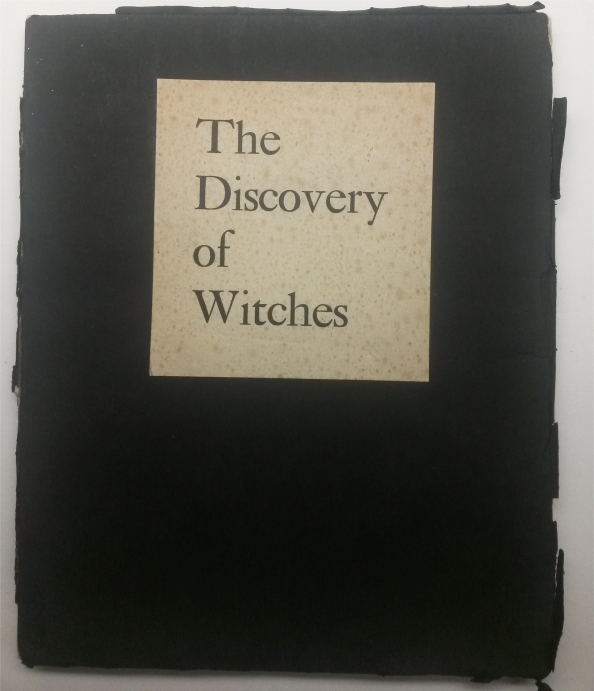
This is a cool one.  This pamphlet contains Matthew Hopkin’s treatise on witchcraft from 1647 and an essay about Hopkins by my hero, Montague Summers. Hopkins, for those of you who don’t know, was England’s self proclaimed Witchfinder General. From 1644 until 1647, he traveled from village to village, trying and torturing those unfortunates accused of witchcraft. England was going through a civil war, and the state of political turmoil made it possible for Hopkins to assume authority and roam about as he pleased, burning bitches and getting money. It is believed that he was responsible for the deaths of 300 people. (This works out at as more than half of the total number of witches killed in England from 1400-1700.) The story goes that he stole the Devil’s list of names from Lucifer himself, and that’s how he knew where to look and who to interrogate. There was a movie made about him in 1968 that featured Vincent Price in the title role, and many heavy metal bands have written songs about him. I think he was a pretty neat guy.

Image1
The essay is fairly interesting. Summers gets upset over the fact that people presume that burning at the stake was the standard method by which witches were executed in England. Although many witches were burned alive in Scotland and on the continent, most English witches were actually hung. Those few that were burned were usually being burned for other, additional offences. Summers deems Hopkins a humbug, a quack and a mountebank largely on the basis that Hopkins was not familiar with the classic literary works on witchcraft. The fact that he claimed to be an authority without having first poring over the literature really seemed to grate on Monty. (Summers was enormously erudite and is responsible for many of the existent translations of these works with which Hopkins was not acquainted.)

hopkins
(Image From Robbins’ Encyclopedia of Witchcraft and Demonology)

Hopkins’ pamphlet takes the form of a dialogue between himself and a person who is not convinced of the legitimacy of his work. He explains how he began his witch hunt, the nature of witchcraft and the different methods of ‘examining’ a witch. These different forms of examination were really just different varieties of sadistic torture. Hopkins was a notorious witch-pricker. He and his accomplices, John Stearne and Goody Phillips, would spend hours sticking needles into women’s flesh. If they found a spot that would not bleed, this was taken as proof of diabolic interference. (The Devil always left his mark somewhere on his servants’ bodies, and the spot where he left this mark would not shed blood.) The only real problem with this method is that there is a finite amount of blood inside a human body, and the more pricks you give a person, the more likely the next prick will prove bloodless. In fairness to Hopkins though, pricking was only a preliminary method of testing. If the results weren’t conclusive, the witch would be ducked.

Remember that amazing scene in Monty Python and the Holy Grail in which the crowd decide to throw an alleged witch into the pond to see if she floats? (Watch it again and notice how they inaccurately claim that witches should be burned!) Well, a good game of sinky-floaty was also a favourite pass-time of Hopkins.

Image3
I’d allow her to swim in my pond any day.

Summers describes how before the witches would be thrown into the pond, they would have their thumbs tied to the feet on the opposite sides of their body so that their limbs would be making the sign of the cross. The reason that witches were dunked in this manner was not to see whether or not they were made of wood; it was because water, which is in some way divine by its nature, would not accept a servant of Satan into its bosom. This method of trying a witch always seemed particularly bizarre to me, but apparently the practice of dunking occurred in some parts of Europe up until the late 19th century.

Can you think of anyone else who floated on water though? Hmmmmmmmm? I wonder what his excuse was…

Other suspected witches were either ‘watched’ or ‘walked’. Watching a witch involved placing the crone in a room with a small chink or hole in the door until she either made a confession or something else occurred to prove her guilt. She would be forced to sit in an awkward position, and tied up if she refused to remain still. The watchers would keep an eye out for spiders or small flies that slipped into the room through the fissure in the door. If they were unable to squash these bugs, this would be taken as proof that they were actually the accused’s familiar spirits come to relieve their master in her hour of suffering. An elusive midge could provide interrogators with enough evidence to send a witch to the tree. Watching sessions could last days, and the witches were starved throughout.

‘Walking’ was when witches were deprived of sleep and energy by being forced to stay up all night, running back and forth in a small room. Ándale, ándale! Arriba, arriba!

Imagej2
Hopkins also provides an entertaining list of the names of all the witches’ familiars that he encountered. He claims that these wicked spirits have “names which no mortall could invent”, and while Ilemauzar, Pyewackett, Jarmara, Jeso, Holt, Saoke, Griezzel, Wynoe, Panu, and Mrit are all quite unusual sounding, Pecke in the Crowne, Vinegar-Tom, Jockey, Sugar, Newes, Littleman, Prettyman, Dainty, and  Greedigut all sound very much like they were invented by a mortall, and that’s not to mention Elizabeth, Collyn and Sandy. Best of all though, one witch claimed her familiar was named Jesus. (Summers gets hot and bothered over this, claiming that “to name the Sanctissimum Nomen would be to banish the familiars and dissolve the enchantment.”)

After a few years, local authorities became suspicious of Hopkins, and he was forced into early retirement. There are stories that he himself was ducked, but there is no evidence to believe that this actually  happened. He died from tuberculosis in his late 20s. (Vincent Price was 56 when he played him in the movie.)

This book is fairly old. I had been keeping an eye out for an affordable copy for quite a while before I found this one, and all things considered, it’s in pretty good condition for what I paid for it. The cover and spine are in rough shape, the pages are yellowed and the edges worn, but I’ve been able to figure out that before I purchased this copy, it had probably remained unread since its publication. Several of the pages are bound together on the wrong side, making the book impossible to read without either tearing them apart or using a very small camera to slip between the pages to photograph them. Maybe there is a specific word for this kind of printing error, but I am unaware of it. Check out the video below to see exactly what I mean.

I read Hopkin’s pamphlet online a long time ago, and Summer’s essay is interesting but not exactly mind-blowing. As a whole though, this book is fucking cool, and the extra effort I had to put into reading it made it all the more enjoyable. It’s Walpurgisnacht tonight too, so turn the tables on Hopkins and make it your business to go forth, make love to the devil, ride to the Sabbath, and hang a witch-hunter.

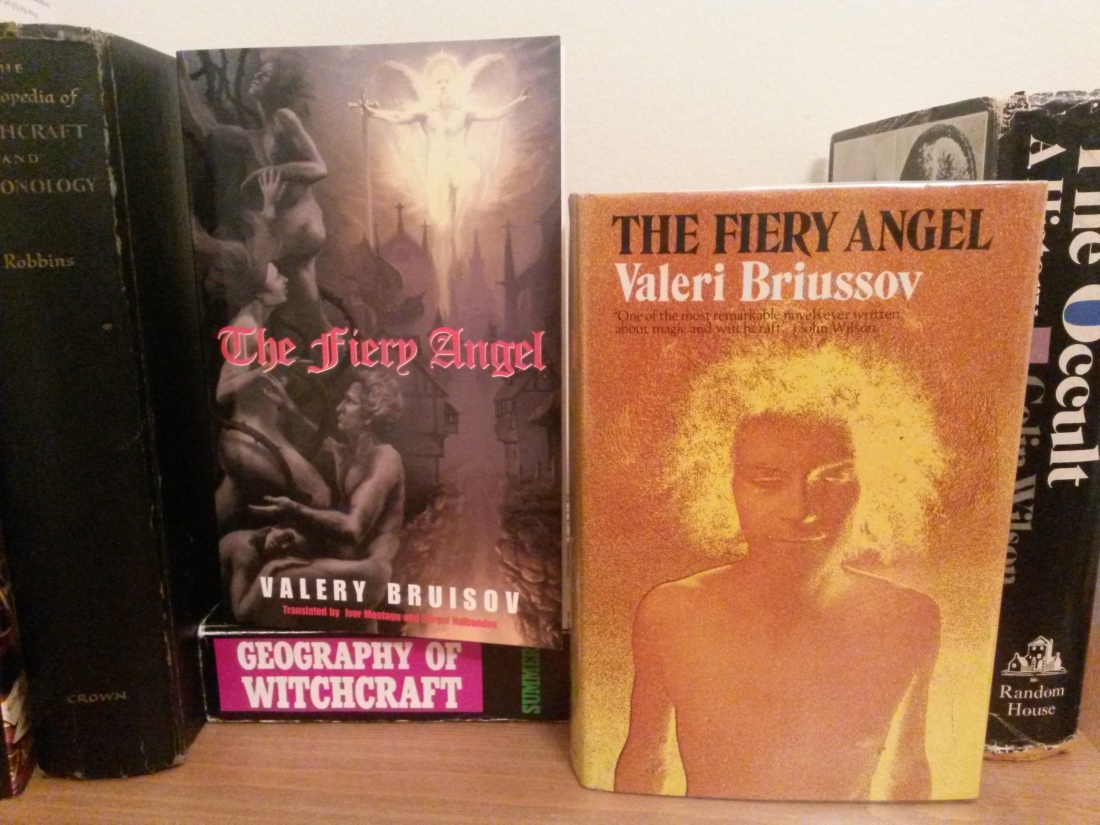
The Fiery Angel – Valery Bryusov

20160325_000821

Neville Spearman – 1975 (Valeri Briussov)
Dedalus – 2005 (Valery Bruisov)

I came across the title of this book when I was reading Colin Wilson’s The Occult two years ago, and from his description, I knew that I’d have to read it at some stage. I spent a while trying to track down a copy at a decent price, and when I found one, it spent a few months lying on the shelf before I got around to reading it. When I finally got around to it, I was met with an unpleasant surprise. Some of the pages were entirely blank. See the below video for details:


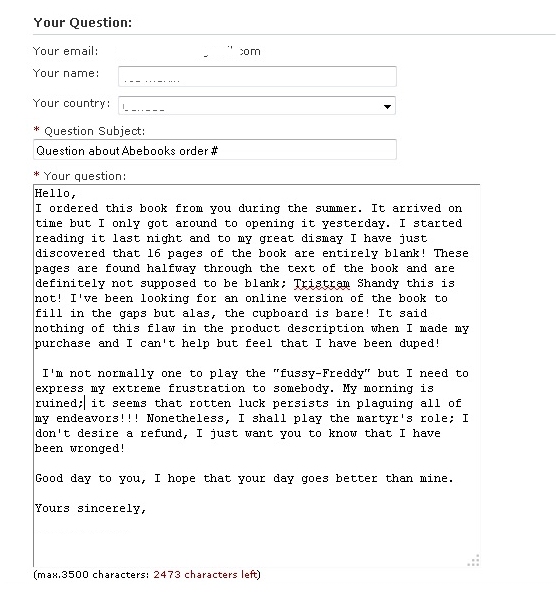
Like I said, I had ordered this a good while before picking it up to read, and so I didn’t feel it fair to demand a refund. I doubted that the bookseller had known about the defect, but I was having a slow day in work, and I decided to drop them an email to pass the time. Below is the message I sent.

my email

When I wrote that email, I did not expect a response. Fortunately, I was wrong; they replied promptly:
response
Many’s the stupid email I have sent, but I have never been so satisfied with a response. Normally you get a feebly polite apology. I take my hat off to the individual who sent the above response to me. It makes me happy to think that there are companies out there that deal with customers as they should be dealt with. If you’re talking to a jackass, talk to them like they’re a jackass. (Although, note that the seller did very courteously offer to send me a replacement.) I was extremely satisfied with my dealings with this seller, and I encourage all of my readers to buy books from them whenever the opportunity arises.

Anyways, I soon thereafter bought a different copy of the book (the more recent Dedalus edition), and that version lay on my shelf for another year before I got around to it. While the Spearman edition has a foreword by Colin Wilson, the Dedalus version has an afterword by Gary Lachman. Surprisingly, the Dedalus version also omits a two page foreword by Bryusov himself that really should be part of the text. In it, Bryusov claims to be the editor of the tale and not the author so-to-speak. Otherwise, the text of the two books are identical copies of the same original printing. (There are identical imperfections on the same pages in both versions, one of which looks like a squished fly.) If I had to choose, I would buy the Spearman version, but I would make sure that it has all of the pages before buying! (My copy is missing pages 76, 77, 80, 81, 84, 85, 92, 93, and a few more.)

Two things before I start my actual review. First of all, the name of the author is spelled differently on my two copies of this book. It’s spelled Valery Bryusov most places online, so I’m going to use that spelling. Next, this post contains a few spoilers. If you are sure you want to read this one and you’re like me and like knowing as little as possible about a book before reading it, maybe you should read the book before you read the rest of this. (But make sure you do come back to finish reading this when you’re done. I discovered some cool stuff about this book that you’ll want to know!) If you’re not sure about whether or not you want to read this one yet, read away. The spoilers here won’t ruin the suspense of the novel.

So what’s the big deal here? Why did I bother with this book? Well, it’s a novel about magic, the witch-craze, repressed sexuality and perversion. What more could I possibly ask for? Set in 16th century Germany, it tells the story of a hard man called Rupprecht who’s making his way home after gallivanting around Mexico for a few years. He becomes enchanted by a girl who is staying in the same hotel as him, but he quickly notices that she’s carrying some serious baggage; she is possessed by demons and she practices black magic. As so often happens, this woman’s personality flaws make her seem all the more attractive, and Rupprecht decides to wander around with her for a while. She tells him that she’s searching for a former lover, and Rupprecht agrees to help her find him. Oh, and it also turns out that her old lover is either an angel or devil. (We’re never made entirely sure which side this ‘Fiery Angel’ is on.) At this point, Rupes’s compliance makes you start to wonder whether it was by natural or infernal means that he was so enchanted; shouldn’t he be taking this as his cue to tell Renata to fuck off?

Well, they wander around a while looking for the Fiery Angel, but Renata gets disheartened and decides that the only way to find him will be to ask the devil for help. Renata doesn’t want that kind of guilt on her conscience though, so she convinces Rupprecht that he should sell his soul so that she can find out where her boyfriend is. Rupprecht is a hard man and everything, but he clearly gets off on kinky sado-masochistic power struggles. The more he can debase himself for the sake of his lady, the stronger his mental ‘gasm shall be! He offers his soul to Satan and actually kisses the Dark Lord’s ringpiece in order to cuckold himself; what a creep!

There are several other twists and turns in their complicated relationship, but eventually Renata runs away on Rupprecht. After a bit of moping around by himself, he bumps into Faust and Mephistopheles and wanders around with them for a while. When he finally stumbles across Renata again, she has joined a nunnery, changed her name to sister Maria, and she’s gotten herself accused of witchcraft. (Typical, right?) She is of course guilty of witchery, but one gets the impression that the reasons she is being charged have less to do with her actions and more to do with the fact that nunneries are mad places full of mad people. The whole thing very quickly turns into a Devils of Loudun situation, and Renata is sentenced to death. Rupprecht tries to rescue her, but things don’t really go according to his plans.

That’s the basic plot of it, but there’s a tonne of cool bits that I’ve left out. Rupprecht attends a witches’ Sabbath, he spends time with Cornelius Agrippa and Johann Weyer, he performs ceremonial black magic and summons demons, and Renata and he have a tonne of kinky sex. (Ok, so we don’t get the juicy details, but judging by the way they act with eachother and the fact that Rupprecht claims that Renata wanted to do more than just regular inny-outty, we can assume that no door was left unopened!) One interesting feature of the text is the fact that although this is a novel about witchcraft and magic, it is also very much a piece of historical fiction. At no point in the book does anything happen that might not actually be explained in real life. Perhaps the most curious thing that occurs is that Renata knows Rupprecht’s name before he introduces himself, but I’m sure you can imagine 100 different ways that a person might find out the name of another guest at the same hotel as them.

Despite the fact that it is mentioned in neither Colin Wilson’s foreword in the Spearman edition nor Lachman’s afterword, it turns out that this book, particularly the last few chapters, is actually largely based on a true story. In 1749, a nun named Renata Maria Saengen von Massau was one of the last women in Germany to be executed for the crime of witchcraft. (She died in 1749, but The Fiery Angel is set over 200 years earlier; I don’t think any dates are specifically mentioned, but Cornelius Agrippa, who dies at the end of the book, actually died in 1535.) I found two different accounts of the real Renata’s life in my library. One is from Robbin’s Encyclopedia of Witchcraft and Demonology. This is a rather sympathetic account that suggests that poor Sister Renata was a victim of mass hysteria. The other account of her life that I read was in Montague Summers‘ book, The Geography of Witchcraft. Monty was fully convinced that this woman was indeed a vile Satanist, and his account is even more fanciful than Bryusov’s.

Despite their different standpoints, Summers and Robbins both present the same basic story. Sister Renata had entered a nunnery when she was about 19 years old. She spent the last 15 of her 50 years in the nunnery as the subprioress. Everything was going fine in her life until a girl named Cecilia Pistorini started throwing fits in order to gain entry into the convent. Cecilia believed her hallucinations and spasms were messages from God, and she thought that this should allow her to skip through the novitiate stage of becoming a nun. Renata wasn’t convinced, and she suggested that the girl might have been putting it all on. Cecilia remembered this, and when she eventually became a nun, she convinced herself and others that Sister Renata was a witch. As she was dying, another senile old hag of a nun claimed that Renata had bewitched her, and this forced to the prioress of the convent to look into the matter. Word got out, and the idea that Renata was a witch caught on with other idiot nuns in the convent. They started imagining that they had been bewitched or possessed and a bunch of them started screaming things out during mass. The more attention they got from the local priests, the more horny they became and the more they acted up. This did not look good for poor Renata. She denied all of the allegations at first, but after twenty lashes with a consecrated rawhide bullwhip, she started to remember her sins.

In Renata’s confession, she claims to have given herself to Satan when she was only 8 years old. She spent her teenage years having sex with demons and learning the craft of Satanism, and then when she was old enough, she decided to join the convent with the sole purpose of bringing it down from the inside. (It’s a bit hard to understand how the other nuns didn’t notice anything for the first 49 years that she had been there.) She claims to have ridden to the Sabbath several times a week, to have made love to the Devil on countless occasions, and to have stolen consecrated hosts with the purpose of throwing them into the toilet. The way she stole the hosts was pretty cool. Before she would go to receive communion, she would cut slits in her flesh, and when the priest would give her the communion wafer, she would sneakily stick it into the communion-shaped holes that she had carved into her own body. She did this just so she could throw the body of christ into the crapper. What a legend!

There’s an interesting part in the Verbatim Reports from Sister Renata’s trials that might have been Bryusov’s source of inspiration for the character of Rupprecht.

“Q. Was she a witch?
A. Yes.
Q. Where did she learn this and from whom?
A. A grenadier had taught her in Vienna, where she and the whole household had gone with her father during the Hungarian war.
Q. How did she meet this grenadier?
A. As happens in wartime. The grenadier had often given her bread when she was hungry, and finally he promised to teach her something.
Q. What then did this grenadier finally teach her?
A. He gave her a paper, on which all sorts of letters were written. On this paper she had to draw a circle and stand inside it. In addition, she had received a charm [Zetel] with various words on it; and if she could read these words, then she could make passers-by in the street lame and crippled.”

In The Fiery Angel, Rupprecht doesn’t meet Renata in Vienna, but he is a soldier that meets her in a time of need, and they do spend time together studying the black arts. I think it’s quite likely that Rupprecht originated as a re-imagining of the mysterious grenadier from the real Renata’s confessions.

In the book, Renata dies in Rupprecht’s arms, but the real Renata was not quite so lucky. Her judges decided to show her some leniency in her execution though, on account of the fact that she had been seduced by Satan at such a young age. She was shown the courtesy of having her head chopped off before being thrown into a barrel of burning tar. Apparently the executioner made such a clean cut that her head popped clean off her body with the first blow from his sword, and he was given a round of applause for his accuracy. Imagine a crowd of people cheering a man for decapitating a 69 year old woman.

All in all, this is a very interesting book. I found the first half dragged a little bit, but it really picks up later on. Bryusov knew his stuff when it came to witchcraft, and there are a few books mentioned in here that I am going to have to try to track down. In truth though, this book is more about the psychology of attraction than it is about black magic. Apparently the plot of the story is largely based on events from the author’s own life. He basically took the story of a love triangle that he had been involved in, chose characters from a famous witch trial to play the roles, and set the story 200 years before those people had actually lived. The result is actually deadly. I mean, as mad as it sounds, I think this book would be an enjoyable read for a person with no interest in witchcraft or demonology. For those of us who are interested in those topics, this is a must read. Five stars.

Michelle Remembers – Michelle Smith and Lawrence Pazder

michelle remembers ross bay
Congdon and Lattes – 1980
I have been horrendously busy with school and haven’t had the opportunity to update this blog, but I feel that this post will make up for my absence. I’m reviewing a Satanic classic; Michelle Remembers. Packed full of horrendous scenes of murder, enemas, cannibalism, and perverse diabolic rituals, this is the book that kicked off the satanic ritual abuse panic of the 80s. It tells the story of Michelle, a woman from Victoria BC who at the age of 27 began to uncover repressed memories of Satanic abuse that she had suffered 22 years earlier. It’s a fascinating piece of writing for several different reasons, and I have quite a lot to say about it.

So, the basic premise of the book is that as a child, this woman, Michelle, suffered such horrendous abuse at the hands of a coven of Satanists that she entirely repressed all memories relating to it. When she becomes an adult, she has a nightmare and goes to tell her psychiatrist about it. The pair become convinced that the nightmare means something, and through a kind of self-induced hypnosis that is never properly explained, Michelle summons forth her 5 year old self who proceeds to give a first hand account of the part of Michelle’s life that she herself was completely unaware of.

michelle smith lawrence pazderA real pair of plonkers. Take a good minute there to really look into the eyes of that utter imbecile. That common, stupid-looking woman believed that Jesus Christ and Lucifer personally did battle over her soul.

According to the child version of Michelle, her mother started taking Michelle to Satanic rituals when she was very small. At one of the first ceremonies, Michelle is anally fingered and frigged and forced to watch her mother engage in an orgy. Michelle gets upset when she sees a woman between her mother’s legs, so she hits her mother’s licker with a bottle. Everyone else in the room sees this happening and joins in on the fun. The saucy lesbian is stabbed to death in front of the child while she is still underneath the woman that she has been pleasuring. Not the worst way to go, I guess…

After Michelle has rudely attacked her lover, the mother abandons her naughty child and leaves her with the Satanists. I’ll be honest here; they’re not very good babysitters. They fill Michelle’s bumhole with water and then make her squirt-squirrel her sphincter’s plentiful bounty onto a Bible. They bury her alive. They kill a bunch of cute kittens in front of her. They cut up quite a few dead babies and mash some of them into Michelle’s face. They rape the child and make a snake go into her fanny. They introduce her to another child, allow them to make friends, and then they cut the other child’s head off and tell Michelle to put the body back together like a jigsaw puzzle. They bury her alive again, this time in a grave with a bunch of live cats. They make her eat part of a burnt corpse. They also cut two holes in her scalp and try to sew on a pair of horns onto her head.  All in all, they’re not very nice to her.

Child abuse is literally the least funny thing in the world, and I would not jest about these events if they had ever actually happened.  Michelle Smith you see, is a lying piece of trash who made up the whole thing.

An internet search will provide you with countless reasons to believe that this book is absolute nonsense, but I’ll just mention a few of the more salient points. Michelle Smith’s real name was Michelle Proby. Lawrence Pazder’s real name was Lawrence Pazder. Why did Michelle use a fake name if Pazder was using his real one? Well, it was probably to hide some of the evidence that proves that she was full of shit. Michelle had two sisters you see, one older and one younger, and neither of them are ever mentioned in the book, nor have they ever corroborated her story. Michelle’s father claimed that he could personally discredit every sentence in the book. He said, “It was the worst pack of lies a little girl could ever make up. The book took me four months to read, and I cried all the time. I kept saying to myself: ‘Dear God, how could anyone do this to their dead mother?’” He said of his late wife, “There never was a woman on this earth who worked harder for her daughters. There was no hanky panky or devil-worshipping.” He also said that he took Michelle to church every Sunday despite the fact that Michelle claims never to have had a religious upbringing.

One of the first memories Michelle unveils is of one of the Satanists, a man named Malachi, putting her into a corpse infested car and driving it into a wall. The Satanist was trying to make it look as if the corpse had died in the crash (whereas in “reality” this was the corpse of the woman whom Michelle attacked for sucking on her mother’s juicy pussy.) Victoria is a small city; a car crash in Victoria in the 1950s would definitely have made it into the local papers. Surprisingly enough though, no account of any such incident was ever published. Could it be that it never happened? Yes. Definitely.

Michelle was supposed to have been satanically, ritually abused over the course of about a year. One of the rituals she describes is said to have lasted between 80-90 days. Somebody had the good sense to check the attendance records at the school Michelle was supposed to be attending at the time. Guess what; Michelle Proby never missed any significant amount of time from school. Either the teachers were in on the Satanism or Michelle was full of shit.

In some of my favourite parts of the book, Michelle describes how she is taken to Ross Bay Cemetery and buried alive in an old grave. She describes the woman who is with her pulling the top off the grave and lowering her down into the earth. The only problem with this is that the lids of the graves in that cemetery are solid fucking rock and far too heavy for a single person to lift. If Michelle is truly stupid enough to believe that this nonsense happened, I really hope her delusions are vivid and terrifying. I hope she could smell the corpse.

Michelle imagining herself in her rightful place. Hopefully she is underground at this stage.

The other claims about Victoria are pretty silly too. She describes how all of the many  Satanists cut off the middle finger from their left hand. You’d think that this trend might be noticed in a small city of 50,000 people. Also, surely somebody noticed all of the dead babies that were going missing. It seems like somebody is smushing up a dead baby every ten minutes in this crazy book.  The authors’ only textual evidence of the Satanic problem in Victoria comes from a newspaper article called Witchcraft in Victoria from 1977. The article is about a series of claims from a drug addicted, delusional,  evangelical christian named Len Olsen who was eventually sued for his lies. Here is a cool video featuring the guy about whom he made the slanderous claims.

Are Michelle’s claims really that outlandish? It is possible that a dangerous cult was operating in Victoria at the time; after all, there are sickos everywhere. Well, if Michelle had only told that part of the story, I really doubt that people would have gotten as worked up about this book. The thing is, Michelle goes on to claim that Lucifer himself begins to attend the rituals that she is privy to. We are not talking some meddlesome demon here, we are talking Prince of Hell, the Arch-Fiend, Satan, THE DEVIL HIMSELF. Michelle ‘the imbecile’ Smith wants us to believe that the Fallen Angel Lucifer took the time to travel from Hell to Victoria to participate in a ritual in which he would personally rough up a 5 year old girl.

Not only that, but Michelle is only able to escape because Mary, the virgin mother of Christ, and Jesus Christ of Nazareth, the only son of god, show up to save her. This, stupid, under-achieving, plain little fart of a woman wants people to believe that Christ and Lucifer came to earth to personally do battle for her soul. Jesus and Mary, who couldn’t bother their holes coming down to stop the holocaust, decided that they had better travel to earth to come to the aid of an ugly little cur with no personality.

2016-02-29 21.50.00See the blur behind the flame? The fools who wrote this book would have you believe that that is the virgin Mary.

Now, if I was going to write a book to inspire moral panic and public outrage, I would do a little research to make my claims seem believable, but Michelle and Lawrence decided not to bother. It shows. Michelle’s description of satanism is unfounded, illogical and incredibly silly. The rituals of the cartoony ‘satanists’ in this book make absolutely no sense; the basic idea behind them seems to be ‘do whatever is wrong’. This is very clearly the satanism of a person who knows absolutely nothing of the subject. A Dennis Wheately novel, this is not. Perhaps the worst part of the book is the persistent rhyming speech that Michelle attributes to Satan. According to her, the Dark Lord can only speak in rhyming couplets. His chapter-long speeches are truly excruciating to get through. I think one of them reads;

My name is Satan, my Kingdom is Hell,
I will hurt your arm, oh little Michelle,
Swear allegiance to me, and poop on this book,
for if you say no,  your ass I shall fuck.

Ok, so I obviously wrote that. But I have just read back over some of the actual rhymes in the book, and I have to say that mine is far less silly. Why would the Devil be limited to speak in rhymes? That doesn’t make any sense Michelle, you stupid piece of garbage.

These are Michelle’s drawings of the Devil. Depending on his moods, he would either take the form of an owl with a tail, a fraggle, or a two-legged lizard dog

At several points, Pazder actually refers to the perpetrators here as members of the Church of Satan. Apparently Anton Lavey threatened him with legal action to get him to withdraw these claims, but they’re still in my copy of the book.
michelle remembers front cover
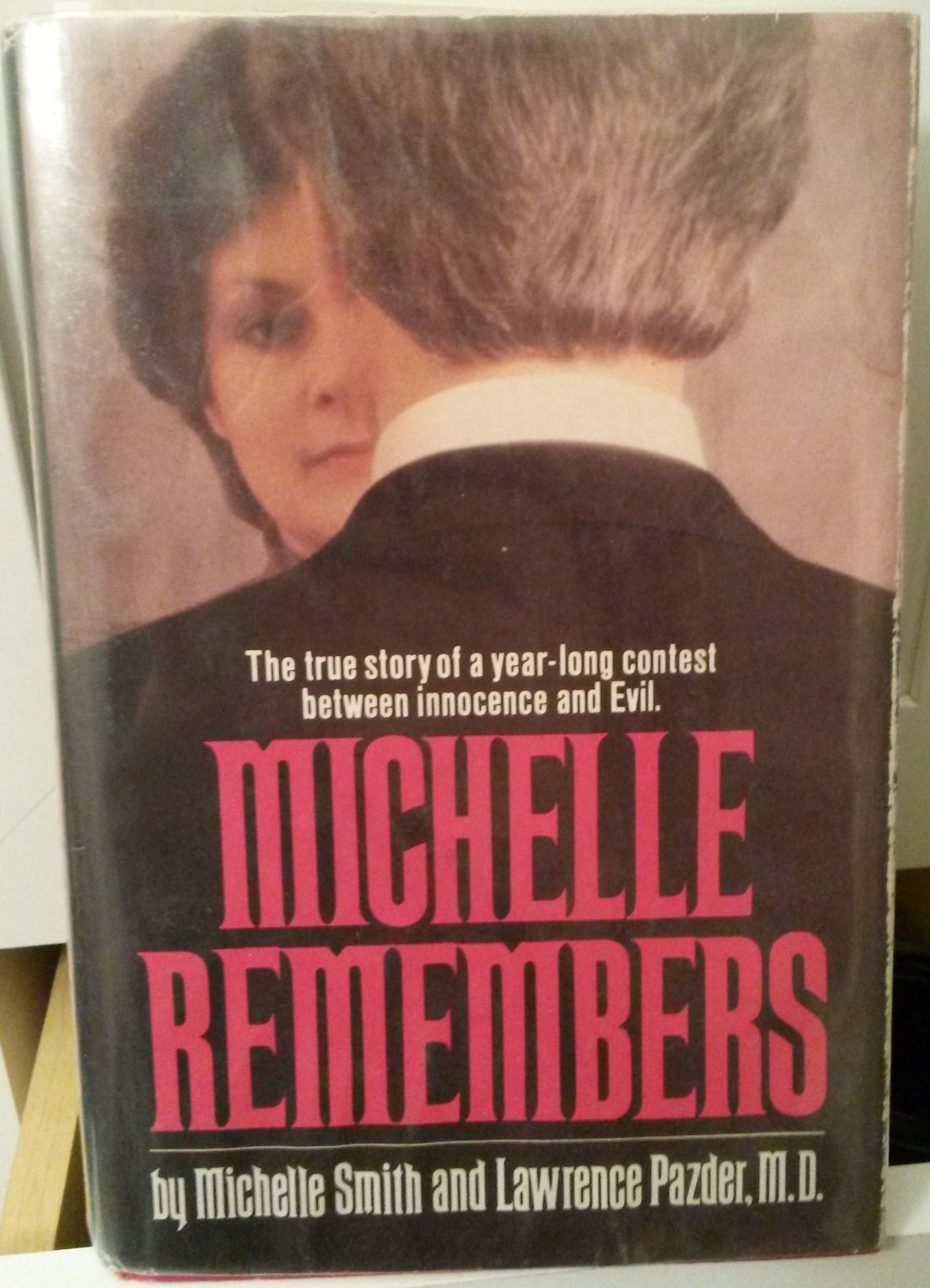
Doesn’t the cover of this edition make it look less like a book about satanic rituals and more like a romance novel about a really boring woman who falls in love with her psychiatrist and tries to give him everything he wants even if it means sacrificing her own dignity? Well, actually…

One of the odd features of this book is that although it was written by the protagonists, it is told in the third person. The narrative perspective makes the book feel like a novel and thus makes it a more tolerable read, but it also adds a lair of buttock-clenching cringiness. Pazder is first introduced in the text as “A handsome man in his early forties,…warm, manly, soft-spoken”, and when Michelle first appears, she is described as “A pretty young woman of twenty-seven, with a  heart-shaped face, a delicate mouth, and bountiful brown curls”. Now either they wrote those descriptions of themselves, or they wrote those descriptions of each other. Anyone who would talk of themselves in that manner is a cunt, and anyone who would write about another person in that manner is looking for the shag.

As the narrative unfolds, Michelle and Lawrence get closer and closer. She goes to see him more and more frequently, and he starts holding her hands and maintaining physical contact with her during their sessions. Michelle grows distant from her husband, and Lawrence starts holding things back from his wife. The authors try to present their blossoming relationship as something pure, positive, and misunderstood, but in reality, these two degenerates were beginning a depraved affair that centered on Michelle’s repulsive sexual fantasies.  Pazder would sit on the couch with one arm around Michelle as she spewed forth her disgusting fantasies about paedophilia, scat-play, and sadomasochism. I am not even exaggerating; that is literally what happened between the two of them. Michelle Pazder was an unhinged sexual deviant, and Lawrence Pazder, a man posing as a psychiatrist, took advantage of the patient in his care for the satiation of his own vile desires. His leading questions and her dependency and desire to please lead to their corrupt bond becoming stronger and stronger. Although it is not mentioned in the text, the pair eventually defied the catholic faith of which they were once so proud by divorcing their spouses and marrying each other. Imagine the sex talk on their wedding night. Ewwwwwwwwww.

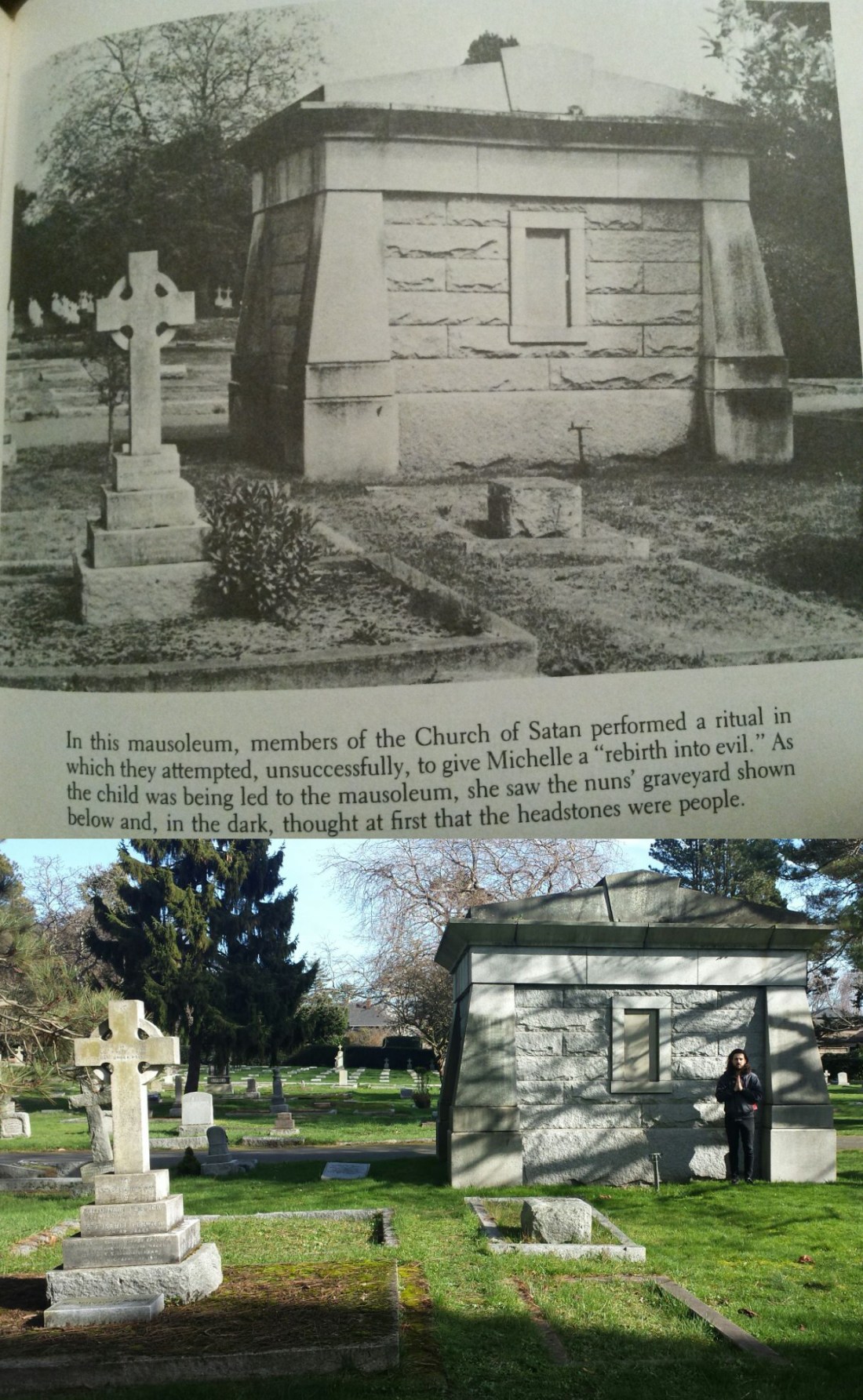
Speaking of marriage, my wife and I were in Victoria recently, and we paid a short visit to Ross Bay Cemetery where much of the book is set. I wanted to see if I could find an entrance to the Satanic Lair that the lads had made, but I didn’t have much luck. However, I did see lots of cool tombstones and decrepit graves.

Some messed up things have actually happened at Ross Bay since the publication of this book. It has suffered a fair bit of vandalism, and has become notorious among heavy metallers due to the alleged actions of a particularly naughty black metal band. While I am all for desecration of hallowed ground, it seems a bit of a shame that people would mess up one of the few interesting historic sites in B.C. If you’re ever in Victoria, the cemetery is an awesome place to go for a stroll.

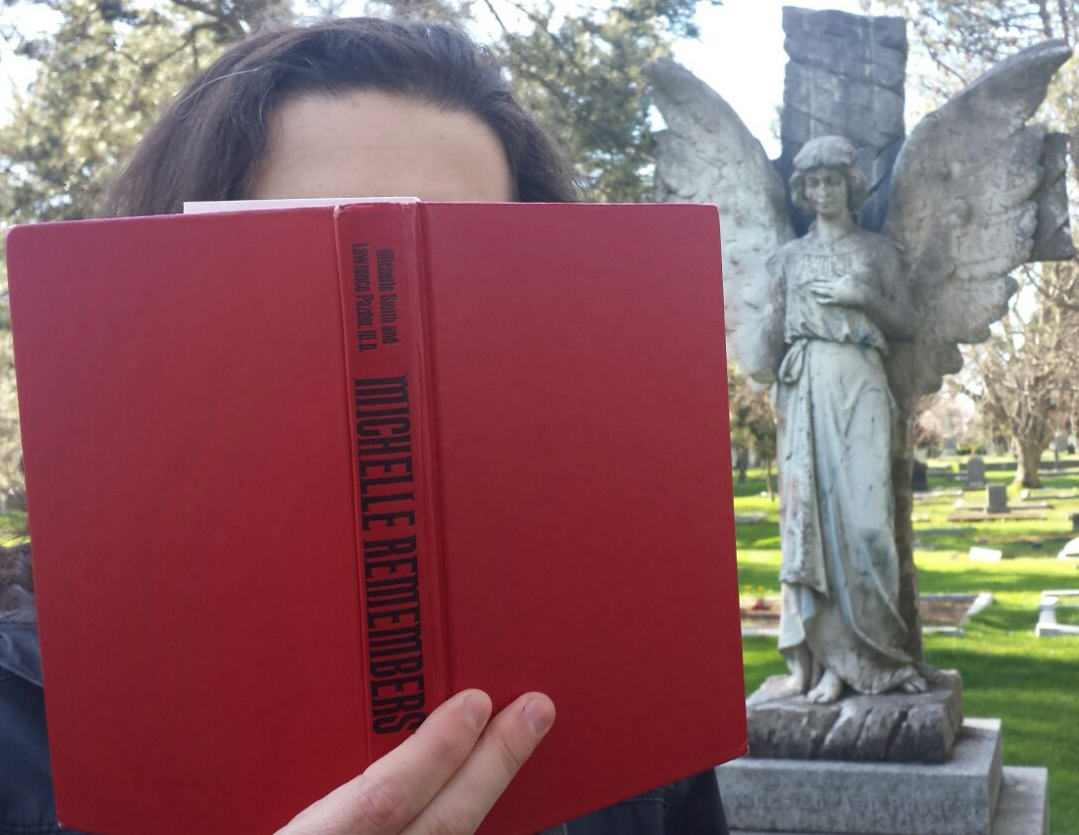
Below, and in the first image of this post, is the Pooley Angel. This statue was spray-painted blue at one stage and is commonly referred to as the Blue Angel of Ross Bay. Apparently tears can be seen running down its face on the night of a full moon.

ross bay blue angel
COOL!

I recently reviewed Communion by Whitley Strieber, and if you read that review, you will notice that like Michelle, I make fun of ol’ Whit-Strieb for having things shoved up his dirt-box. You may also notice that I didn’t get quite as worked up over the stupid story that he told after regressive hypnotherapy. That’s because Whitley Striber’s equally silly story didn’t end up ruining people’s lives. There are lots of nutty books out there, but Michelle Remembers had a tremendously negative effect on society in the early 1980s. The authors appeared on Oprah and became celebrities, Pazder became known as the leading authority on Satanic Ritual Abuse, and innocent people were publicly  and unfairly accused of child abuse. The only good thing to come from the author’s  irresponsible perversion is the over-the-top 1980s Satanic Heavy Metal that their book inspired. Fundamentalist christians are a pain in the ass, but these two pieces of shit weren’t even particularly devout. (As mentioned above, they divorced their partners and remarried, a mortal sin in the Catholic faith.) They were a pair of attention seeking scumbags who weren’t concerned with how their perverse fantasies might affect the lives of others. I know that Pazder is dead, but we can only hope that Michelle is too.

I hated the authors, but I thoroughly enjoyed this book. If you’ve made it through this review, you’ll probably enjoy it too. Reading it will make you want to listen to Slayer and spit at a priest.

HAIL SATAN 666!!!
michelle remembers mausoleum ross bay

Communion – Whitley Strieber

2016-02-02 22.22.00

Avon – 1988

Wow, what an utterly ridiculous book. Although the accounts herein are presented as fact, this book is often listed as fiction. Fiction or not, it’s not a plot driven book, and I feel that the most appropriate way to review it will be to paraphrase the entire text:

“My name is Whitley Strieber, and this book is an account of my abduction experiences. Twice in the year of 1985, I was taken from my bed by a gang of little men who then took me to a weird room in a crystal in the sky and stuck an ugly pipe into my crapper. That’s right folks. I was abducted, and the things that took me decided to jam a piece of their technology into my rectum; the alien contraption punctured my wrinkled rim and ruptured my shite-filled poobag. The dirty little bowsies were collecting a sample of my gick! [You might find it peculiar that anyone would want Whitley Strieber’s shit, but in fairness, Communion has sold 2 million copies!] Oh yeah, there was another weird lifeform in the crystal too. It looked like an insect, and it raped me. Well, I say rape, but I was actually pretty hard at the time! Can you blame me?

After this happened, I decided not to jump to any conclusions. I did however, start hanging out with Budd Hopkins, the UFO abduction expert. He recommended that I go see a hypnotherapist. I took heed of this good advice, and the hypnotherapist proved to me that I had actually been abducted a bunch of times throughout my life. He reminded me of the time that I built a rocket engine in my bedroom when I was a little kid. The aliens had told me how to make it, but afterwards they decided that I shouldn’t have that information so they burned down my parents house. How did I forget that? Silly me!

I’ve used the word ‘aliens’ a few times, but I’m not actually sure that it’s  spacemen who are abducting me. I’ve no real reason to believe that they’re from another planet. They might just be elves or fairies. Whatever though, they probed my asshole and I got the shag; I hope they come back soon!

At this point, I don’t really have much else to say, but I feel like I can probably write another 150 pages or so. I suppose I’ll just fill up space with eventless interview transcripts and a ton of mystical speculation. Fuck it, yeah, I’ll just make allusions to mythical figures and tarot cards, and my book will get really popular with brainless, new-age morons. They’ll ignore the fact that nothing in this book is remotely compelling, and they’ll all think that I’m really smart.”

That’s pretty much the entire book, although I’m not quite sure I’ve captured the arrogance of Strieber’s tone. It really surprises me that something this utterly trashy could be taken seriously by anyone.

I also watched the film version of Communion with Christopher Walken playing Strieber. I have to say that this was one of the few cases in which I far preferred the movie to the book. The film has pretty bad ratings according to what I have seen, but I thought it was as good a movie as could possibly be made of this rag. There’s something really awkward about the whole film, and the special effects are bizarrely bad. It mostly follows the book’s plot, but it gets fucking weird towards the end. The most bizarre scenes almost feel like a satire on the most bullshitty parts of the text. In fact, part of the reason that I liked the movie so much was that it felt like it was making fun of the book; you could watch the film and argue that it depicts nothing more than a dysfunctional family’s bizarre descent into hysteria.

There’s a story that Strieber saw Walken’s depiction of him and told the actor that he was playing the character too crazy. Walken allegedly responded, ‘If the shoe fits…’ I have liked Christopher Walken as an actor for a long time, but if that story is true, he is truly a king amoungst men.

The book was shit, but I enjoyed reading it. I have the sequel, Transformation, and I’m sure I’ll get around to reading that one too. If you do read the book, make sure to watch the film. I’m not sure if the film would be as enjoyable if you hadn’t read the book, but if you’ve made it this far through my review, you have all the information you need. (Although I still think it might take reading the 350 pages of the book to be able to really savour the embarrassment that the film must have caused Strieber.)

School is a nightmare at the moment, and posts will definitely be slow for the next couple of months, but I have some serious gems coming in the post that you are going to want to read about.

Bigfoot: The Mysterious Monster – Robert and Frances Guenette

20160119_210914
Schick Sun – 1975
I’ve stated before that I think Bigfoot could exist. The purpose of this book is to make his existence seem more feasible, but after reading it, I feel a little more sceptical than I did beforehand. That’s not to say that it’s a bad book; some of the arguments in here are quite interesting. The issue is that it was published 40 years ago, and every day that has passed since its publication has added to the likelihood that Bigfoot is either imaginary or extinct. There are too many cameras in the world for him not to have been photographed clearly at this stage. It would be cool, but the fact that they could exist isn’t enough to convince me that they do exist.
The book is based on a film that you can easily find online, and much like The Outer Space Connection, both the book and movie cover the same material. (I’d recommend watching the film before trying to track down a copy of the book.) There’s not really much to say about the content; it’s pretty much what you’d expect. There wasn’t enough material on Bigfoot, so it includes a relatively big section on the Loch Ness monster, and there’s also a part where they tried to use a psychic’s testimony as evidence for the existence of these creatures. That bit was pretty stupid.


Happy Birthday Edgar Allan Poe!

2015-12-29 23.14.10
(Card made by my wonderfully creative wife)

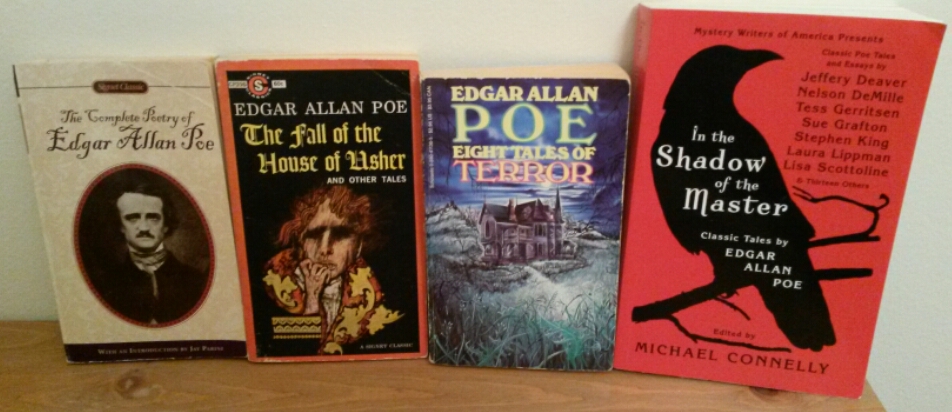
Were he still alive, Edgar Allan Poe would be 207 today. If you haven’t read all of his stories, stop wasting your time on my dumb blog and check them out. It would be rather difficult for me to overstate how much I love Poe. Teaching English, I’ve had to read the Tell-Tale Heart, the Cask of Amontillado, and Masque of the Red Death more times than I can count, and I still get excited every time I get the opportunity to go back to them. There’s so many other great tales though. The Black CatThe Imp of the Perverse, and Fall of the House of Usher are some of my other favourites, but he wrote plenty more that are equally as brilliant.

2015-12-29 23.13.18
The pictured books are just some cheap collections I’ve picked up in the last few years. There are countless editions of Poe’s works out there, and I can’t recommend any in particular. (I will say, as I have said before, that the Complete Poetry Collection is a handy one for taking into the bathroom on a slow Sunday morning.) When I get rich, I’m going to buy a hardback edition of his collected works for my fine mahogany bookshelves. I’d also love a copy of Tales of Mystery and Imagination with the illustrations by Harry Clarke, but I guess shitty thrift store collections and the internet will have to suffice until I hit the big time. Anyways, Happy Birthday Edgar!!!

And just so ye know; I’m right in the middle of the busiest part of my course at the moment, and this blog might get a little slow for the next month or so, but don’t fret; it won’t be long until I get to put down the textbooks and take up some quaint and curious volumes of forgotten lore!

Here is just some of the utter garbage that I’ve picked up recently:2016-01-13 22.56.47

Witchcraft (The Story of Man’s Search for Supernatural Power) – Eric Maple

2016-01-07 23.52.33.jpg
Octopus Books -1973

This is a pretty cool coffee table book on witchcraft from the 70s. Most of it is the kind of stuff you expect from a 140 page overview of an overwhelmingly broad topic, but there were a few cool bits in here that I hadn’t come across before; some of the details on the torture techniques of the inquisitions made me feel rather uncomfortable. The section on Wicca is far too long, but otherwise the book  is pretty good. The images are by far the best part. I have a bunch of other books on the topic that are far more detailed, but I paid less than a dollar for this one, and I feel like it was a wise purchase.

20160107_222308
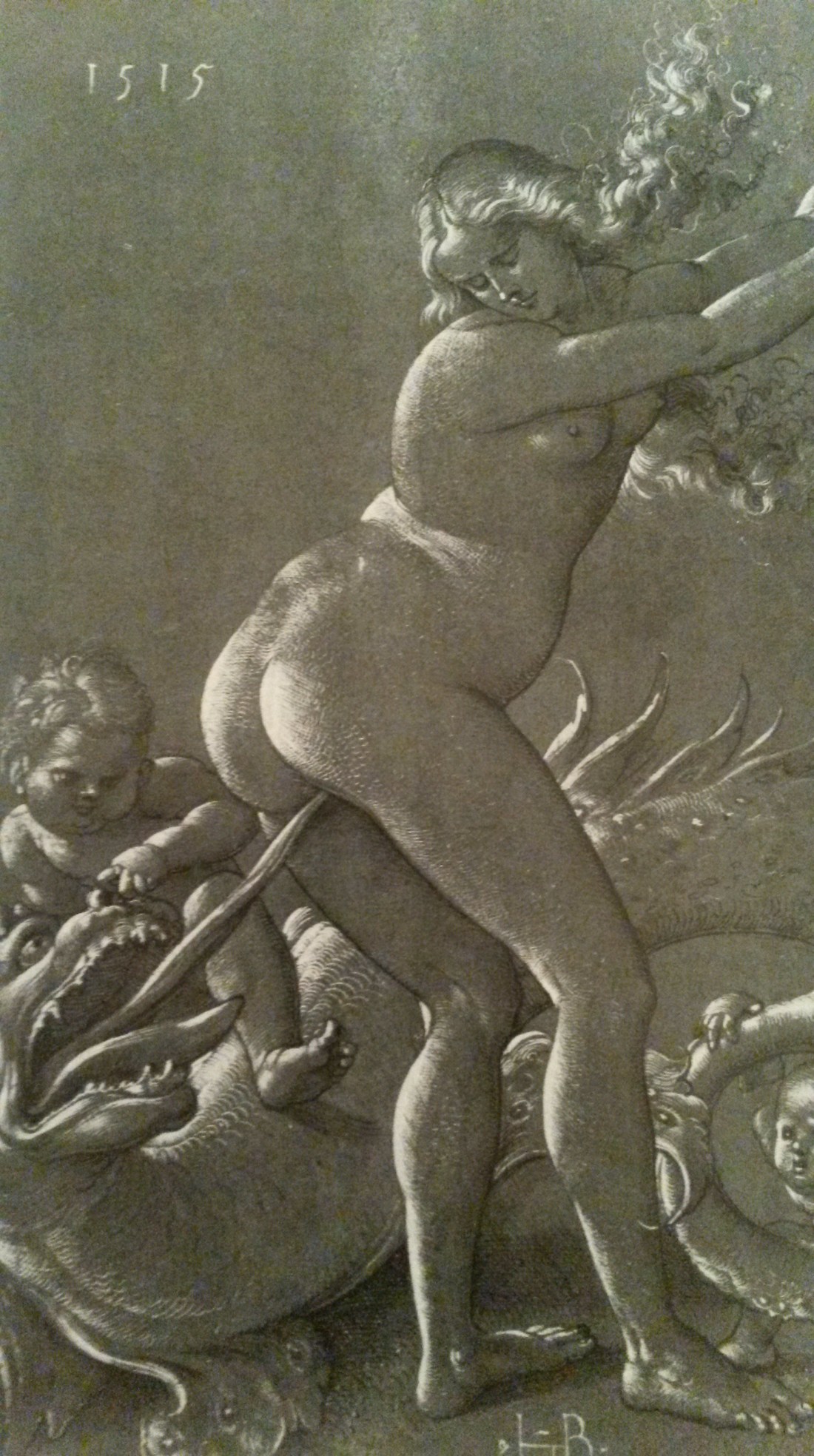
An irresponsible mother allows a dog-like serpent to give her a little bit of licky-licky-bum-bum in front of her kids.

20160107_222216
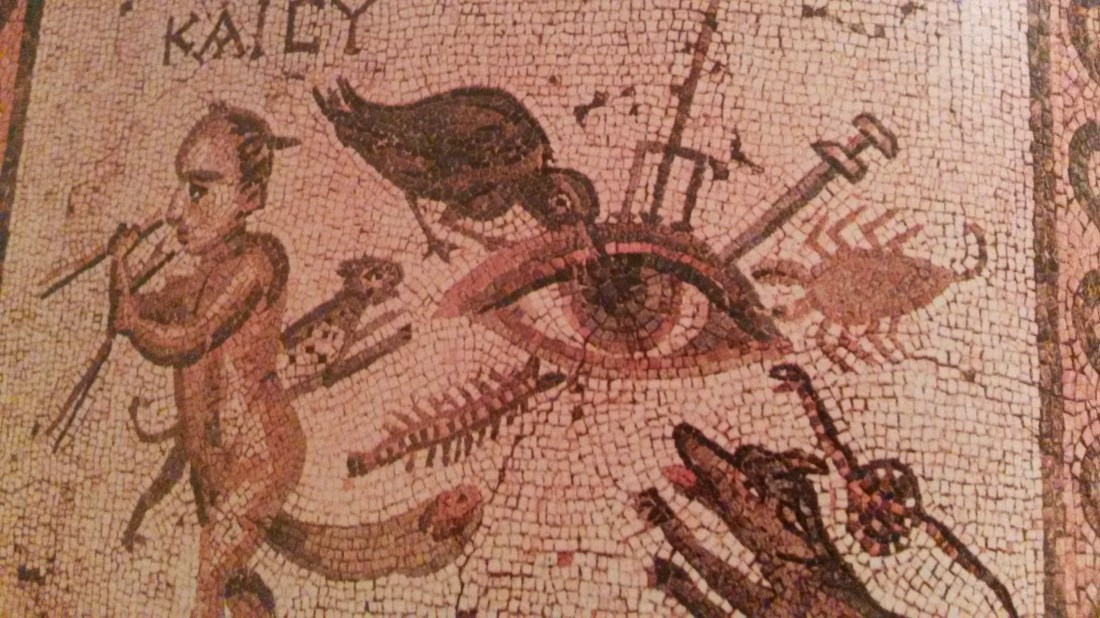
The caption below this Roman mosaic in the book claims that its intention was to “to crush the evil eye’s potency by means of pecks, bites and stabs”. Hang on though! The eye isn’t just being pecked, bitten and stabbed; there’s also a man farting at it.  And is that just a fart? That brown stream spewing from the man’s anus looks like it’s carrying baggage! Either way, think of how disrespectful that is! Imagine being captured by your worst enemy; he pokes you with his trident, throws you in a cage with gross insects and wild animals, stabs you with a sword, and then adds insult to injury by farting in your eye. What a blackguard!

20160107_221636
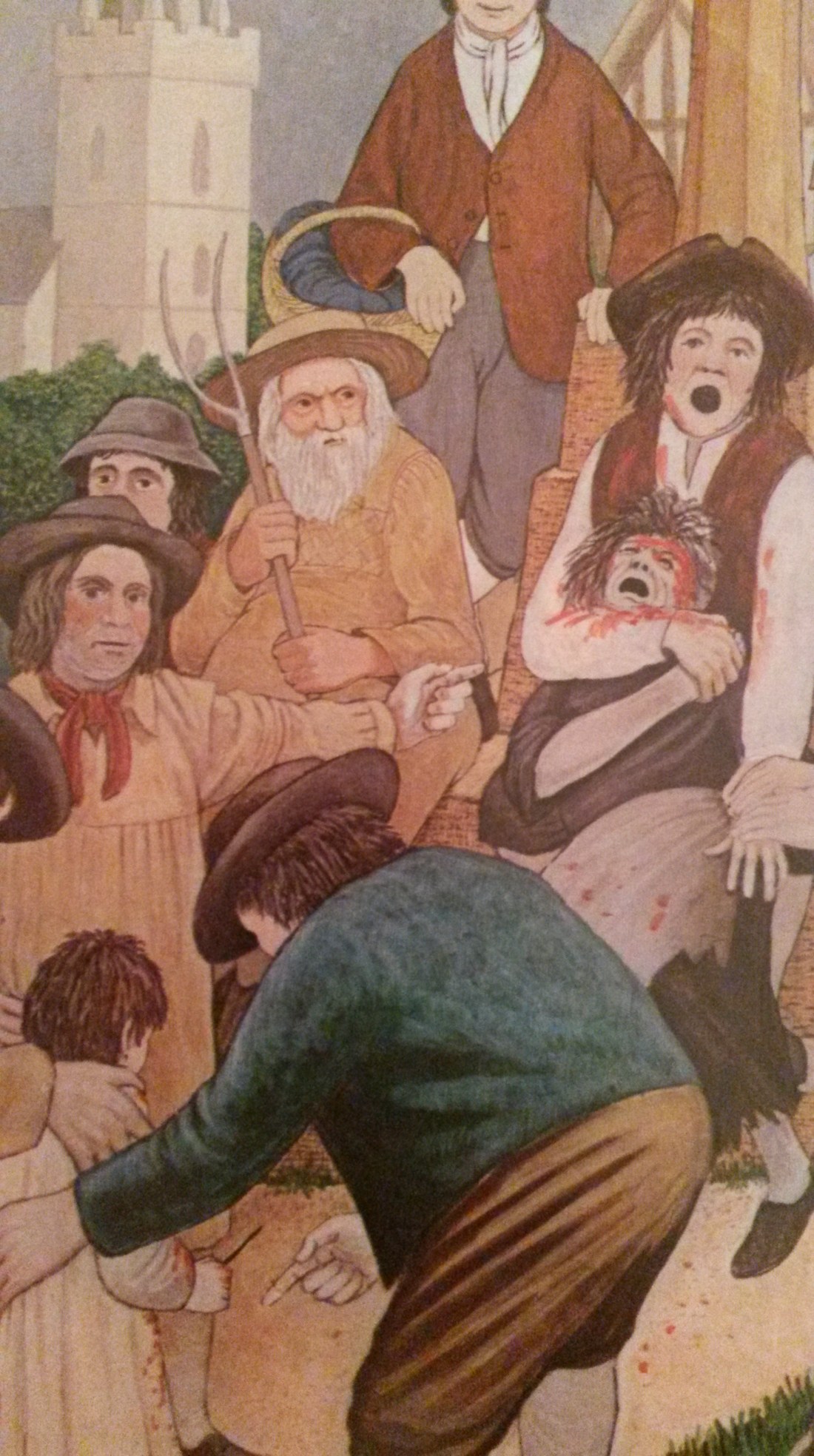
Good boy Jimmy, scratch that mentally handicapped woman’s face with your rusty nail. She won’t be casting any more spells on you after that!

20160107_22211620160107_221758
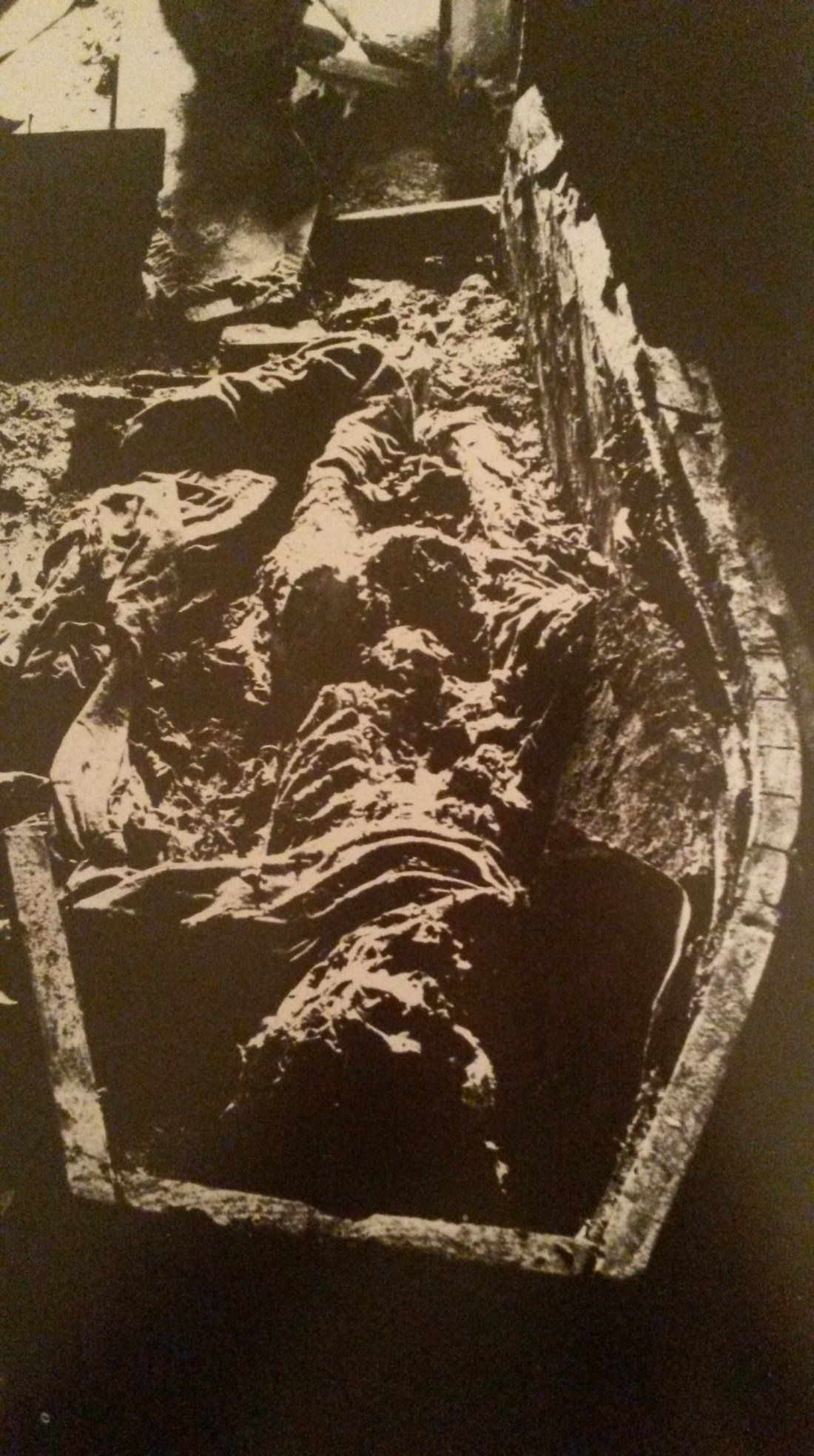
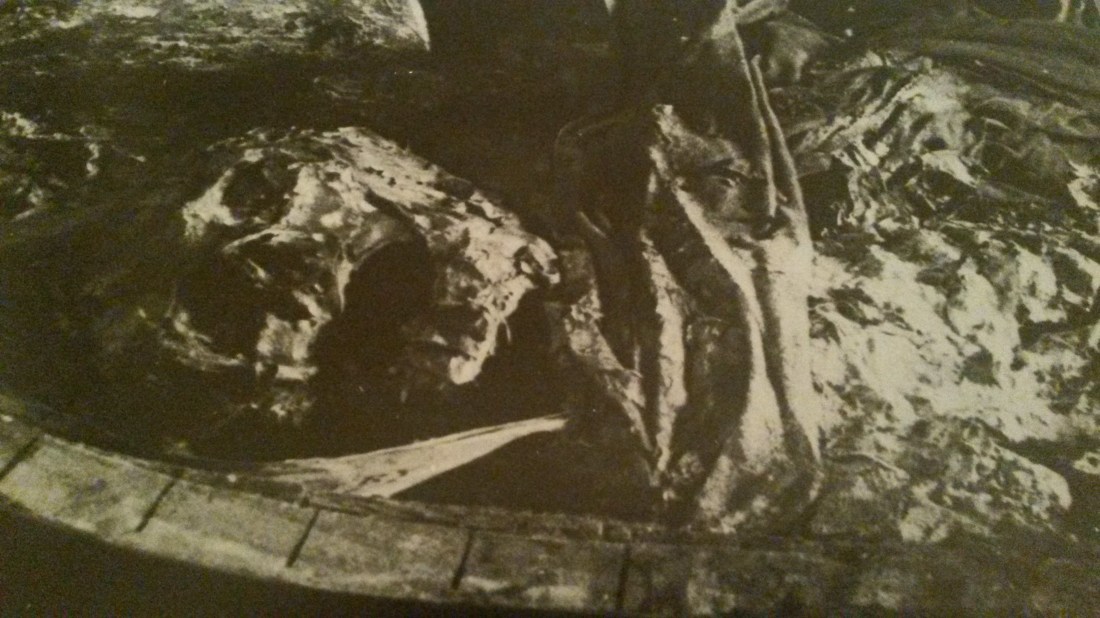
These images are the coolest part of the book. They’re from the aftermath of the 1963 desecration of Clophill Graveyard in England.  These grisly exhumations are thought to have been the work of Satanist Necromancers. 7 graves were desecrated and chicken’s feathers and blood were found strewn across the scene. One of the corpses was a lady named Jenny Humberstone who died in 1722. Her grave was opened 3 more times after the initial incident. I suppose that if you’re going to dig up a corpse, it’s probably more polite to exhume somebody that nobody remembers. It’s still pretty fucked up if you ask me. There was actually a horror movie made about Clophill church a few years ago, but it looks absolutely shit and I probably won’t be watching it.


7 Footprints to Satan – A. Merritt

20160105_214024
Orbit/Futura – 1974

About a year ago, I was in a second-hand book-store when I came across a little black book titled 7 Footprints to Satan. It looked fucking deadly, but it was 30 dollars and I thought that was a bit much to spend on a book I hadn’t heard of. I came home and found a copy online for less than a tenner. The seller provided no image, and I presumed the cover would be the same as the one I had seen in the shop. Can you can imagine my absolute joy when the package arrived and I first saw the above cover?

Look at that thing! It’s some kind of snakey, arachnid alien holding some jewels, a bloody heart, and a hot drink. Book covers do not get much better than that! Now a person who has not read it might presume that the entity on the cover is the Satan referred to in the title of the book, but a person who has read it will have absolutely no fucking idea of what that thing is supposed to be. I doubt that the artist who drew the spiderbaby had actually read the book. Unfortunately, the story didn’t quite live up to the cover, but the cover lives up to itself even after having finished the story. Just looking at it now makes me want to read the book again even though I know how little they have to do with each other. Take a moment there to scroll back up and really soak that image in. Fucking deadly.

So, the book starts off with a lad being kidnapped by a bunch of weirdos who manage to convince the police that he’s a mental patient. They take him to a mansion owned by a chap who claims he is Satan, and that’s where the fun begins. Satan runs a weird culty mafia thing, and he forces his followers to gamble with him on his 7 footprints game. Like all good cult leaders, Satan is a massively tall freak with an enormous head who can’t be killed by bullets. He knows everything about everyone, and he has a seemingly infinite amount of power and wealth. It’s never made definitively clear whether or not he’s really the Devil, but every time that you think that he’s actually just a fat Chinese drug dealer who picked a cool name for himself, something weird happens that suggests he at least has some connection with the archfiend. It wouldn’t be accurate to describe this as supernatural horror, but it does feature individuals with superhuman strength,  doppelgängers, and even telepathy.

It also features plenty of casual racism, but this seems to have been a trend in early 20th century horror. I’m sure that there were plenty of racist authors outside of the horror genre in that era, but I think that the ways in which race is presented within the texts written to frighten people is quite telling of the real fears of the readers of the day. (Maybe some day I’ll write a blog post, if not a master’s dissertation, on that topic.) Some of the stuff in here is pretty rough; there’s a passage that reads:
There was a Hebraic delegation of a half-dozen on their way home to the Bronx, a belated stenographer who at once began operations with a lipstick, three rabbit-faced young ‘sheiks’, an Italian woman with four restless children, a dignified old gentleman who viewed their movements with suspicion, a dumb-looking black…
Pretty good right? Within the space of a single sentence he’s managed to be nasty about three different ethnicities. At another stage, he refers to a black guy as an ‘ape-faced monstrosity’, and at the point when Satan admits to having killed his daughters, the protagonist has an Ah-Hah! moment and explains that Satan must be Chinese. Oh! and there’s also a scene featuring the most offensive stereotype of all! In the second chapter, Officer Mooney appears. He’s a New York cop with a ridiculous Irish accent that is made visible in the text; “Sure,lad. Ye’re in no danger, I’m tellin ye. Would ye want a taxi, Doctor?’ (Admittedly, that accent is entirely accurate.) The thing is though, that I wouldn’t even call this is a racist book; it would be more accurate to call it a book with some racist parts, and that’s actually worse when you think about it. The racist parts don’t add anything to the story. I’m not saying that it would be excusable if the racism were a motivational force in the plot, but that would at least give an understanding of the author’s purpose. As it stands, it looks like Merritt was just throwing his bigotry in for a laugh. As I’ve said before, I wouldn’t pay for a book that contained that kind of nastiness if I thought the author was going to get any of my money, but my copy is second-hand and the author died 70+ years ago.

I read this in two sittings, and I had a dream about being stuck in Satan’s mansion after reading it. It definitely wasn’t what I was expecting, but I enjoyed it. Merritt wrote some other books with equally cool titles, and I doubt that this is the last book of his that will appear on this blog.


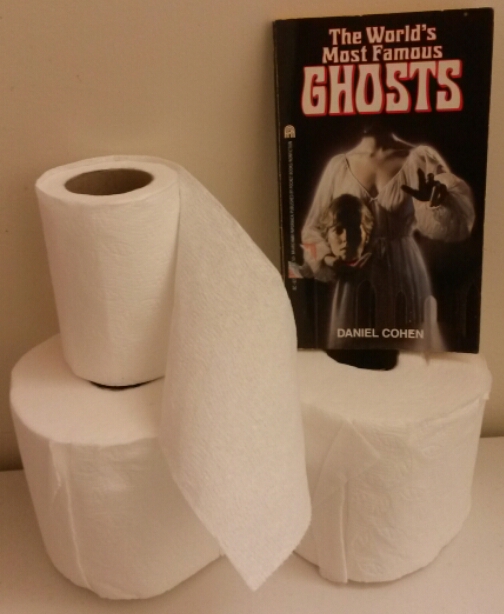
The World’s Most Famous Ghosts – Daniel Cohen

2016-01-01 20.13.02
Archway Pocket Books – 1985

I picked this one up as part of a collection a few weeks ago. I’m not really interested in ghosts, and I’m pretty sure this is a kids’ book, but its size and short chapters made this a perfect book for some potty-reading.

So this is a collection of accounts of different ghosts and hauntings, from the ghost of Abraham Lincoln to the Flying Dutchman. It’s written in the style of writing that 12 year olds are taught to use; every paragraph in here has an introductory sentence and a concluding sentence that rephrases the introductory sentence (Teachers call this the sandwich or hamburger paragraph.). What follows is an actual paragraph from the book:

The local people were very happy. They gave Dickie all the credit. They said he didn’t want noisy trains so close to his home. So he used his supernatural powers to stop them. Dickie is a great favourite.

Come on Daniel! You’re an author; please try to use some complex or compound sentences!

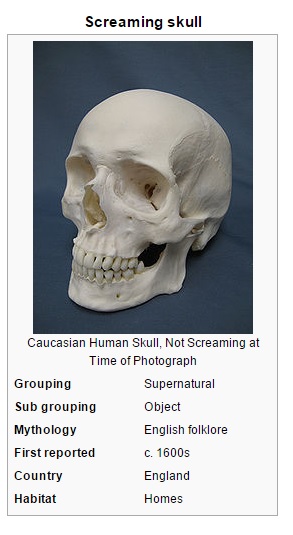
While it doesn’t contain the most eloquent writing in the world, it does contain some cool stories ( And I mean, the writing is bad, but it’s not Gothic Ghosts bad.). I like the chapter on Sarah Winchester, the millionaire’s mad widow who designed a mansion to house ghosts. There’s also the tale of the Baychimo, a ghost ship from Vancouver. I’ll definitely be doing a little more research on that one. The section I found most interesting though, was the chapter on the Screaming Skulls. These cacophonic crania are alledged to shriek whenever they are moved from their particular resting spots in certain  English mansions. I looked the skulls up, and I found the following on their wikipedia page:

skull
Whoever captioned that is a genius.

Like I said, I’m not hugely interested in ghosts, and I can’t say I believe in them, but three days ago, I spent about half an hour in the certainty that my home had been invaded by a poltergeist. My wife and I were sitting down, watching tv when our couch was lifted half a foot off the ground and instantly dropped back down. We don’t have any room-mates or pets, and nothing else in the room had moved. Neither of us had stirred, and our couch is right up against the wall, so we were able to deduce that whatever had done this wasn’t visible.  It wasn’t just a little bump either; this is a heavy couch, and it would take something very powerful to move it with the two of us sitting on it. Now I’ve spent the last two weeks reading books about ghosts and monsters, and so I immediately assumed that we were under some kind of infernal assault. I thought that I had perhaps awoken an evil spirit through my perusal of forbidden texts. I couldn’t sit back on that couch again without a weapon in my hand, and so I took down my trusty bullwhip from its mount and prepared to give 50 lashes to any intrusive ghoul! On seeing that I was ready for business, the spectre took his leave, and we were free to watch tv in relative peace. A while later, my wife checked facebook and saw that there had actually been an earthquake. I had never experienced an earthquake before, and so the thought hadn’t really crossed my mind. It was pretty funny to see how easily my scepticism was shaken in just a few moments of uncertainty.

Anyways, this book is alright. I wouldn’t recommend that you run out and buy a copy, but if you’re stuck on the crapper with nothing else, this will do trick. First you can use the ghastly tales to entertain your mind, and then you can use the nice soft pages to wipe your shitty rim.

Did Aleister Crowley Create Strange Lifeforms? Moonchild, The Magician and To the Devil – a Daughter

2015-12-28 02.38.38
It’s taken a while, but I’ve finally gotten around to writing a post about Aleister Crowley. It’s hard to know what to believe about the man; some see him as a prophet, while many others see him as a charlatan. In this post I discuss three different portrayals of Crowley. The three accounts come from novels, but the authors of these novels actually knew Crowley in real life. Their accounts are therefore infinitely more reliable than the many biographies written by people who never met him. I’ll start off with Crowley’s own novel.

2015-12-29 18.12.45
Moonchild – Aleister Crowley
Weiser – 1996

He may have been many things, but a good novelist, Aleister Crowley was not. This book is about a team of magicians who force a woman to undergo a ritual pregnancy to create a “moonchild” (Don’t ask what that is. I’ve read the book, and I don’t fucking know.). Another team of evil magicians, the Black Lodge, tries its best to stop this from happening. The premise is promising, but the plot reads as if it was made up as the book was being written; it starts off decently, but by the end it feels like Crowley has gotten bored with his own story and wants to be done with it as soon as possible. The ending is so unsatisfying that it makes the rest of the book feel like a waste of time. (Imagine getting halfway through Jaws and witnessing the characters giving up and saying “Fuck it. Let’s just move to Colorado where there’s no sharks.”) Also, the mix of fiction and mystical philosophy is tolerable at first, but unless you’re a fedora-wearing goth, it will get very boring very quickly.

All of the black magicians are based on people who Crowley disliked in real life. Edwin Arthwait is Arthur Edward Waite, the lean Protestant-Irishman named Gates is W.B. Yeats, and S.R.M.D is Samuel Liddell MacGregor Mathers. (All of these lads were Crowley’s former Golden Dawn buddies.) Cyril Grey and Simon Iff are a Stephen Dedalus/Leopold Bloom tag-team version of Crowley himself. The fact that the author put two versions of himself into his book might give you an idea of his inflated sense of self-importance.

There were two parts of this book that I really liked. The first is when a lad called Balloch calls a lad called Akbar a “piece of dirt”. The second is a depiction of a grisly necromantic ritual. I won’t ruin it for you, but it involves a lot of animal blood and the corpse of William Butler Yeats. The book is actually worth reading for that particular scene alone.

This is a novel, but I’m sure that some of it was based on personal experiences. The characters representing Crowley are the good guys, and their magic is limited to a little astral projection here and there, but Crowley himself could well have been privy to depraved rituals similar to those of the Black Lodge. From what I understand about the man, he revelled in the air of mystery that surrounded him, and this book serves to propagate that air.

I bought this book ages ago, and I was fairly disappointed when I got around to reading it. The plot is shit, the characters are annoying, and ultimately it serves as little more than an ego wank. Overall, it provides the least interesting account of Crowley out of these three books.


20151228_012546
The Magician – W. Somerset Maugham
Penguin – 1967

What a relief it was to read this book after slogging through Moonchild! This is a fast-paced, gothic thriller about an evil magician who does his best to fuck up the relationship between a young couple. He uses black magic to take control of the girl, and he forms despicable plans to use her in an unspeakable experiment. Maugham wrote this novel early in his career and later claimed to have completely forgotten about it. It’s not supposed to be his greatest work, but I fucking loved it. It’s genuinely exciting, it doesn’t shy away from violence, and it doesn’t get bogged down in tedious mysticism. The ending is fucking glorious too; I don’t want to ruin it for anyone who might read it, but holy shit, there are freaks in the attic!

So why am I including this book in this post? Well, the evil magician, one Oliver Haddo, is based on Aleister Crowley. In an introductory note, Maugham describes how he met Crowley in Paris and took an instant dislike to him. He claims that Crowley served as a model for Haddo, but that Haddo is not supposed to be a portrait of Crowley.

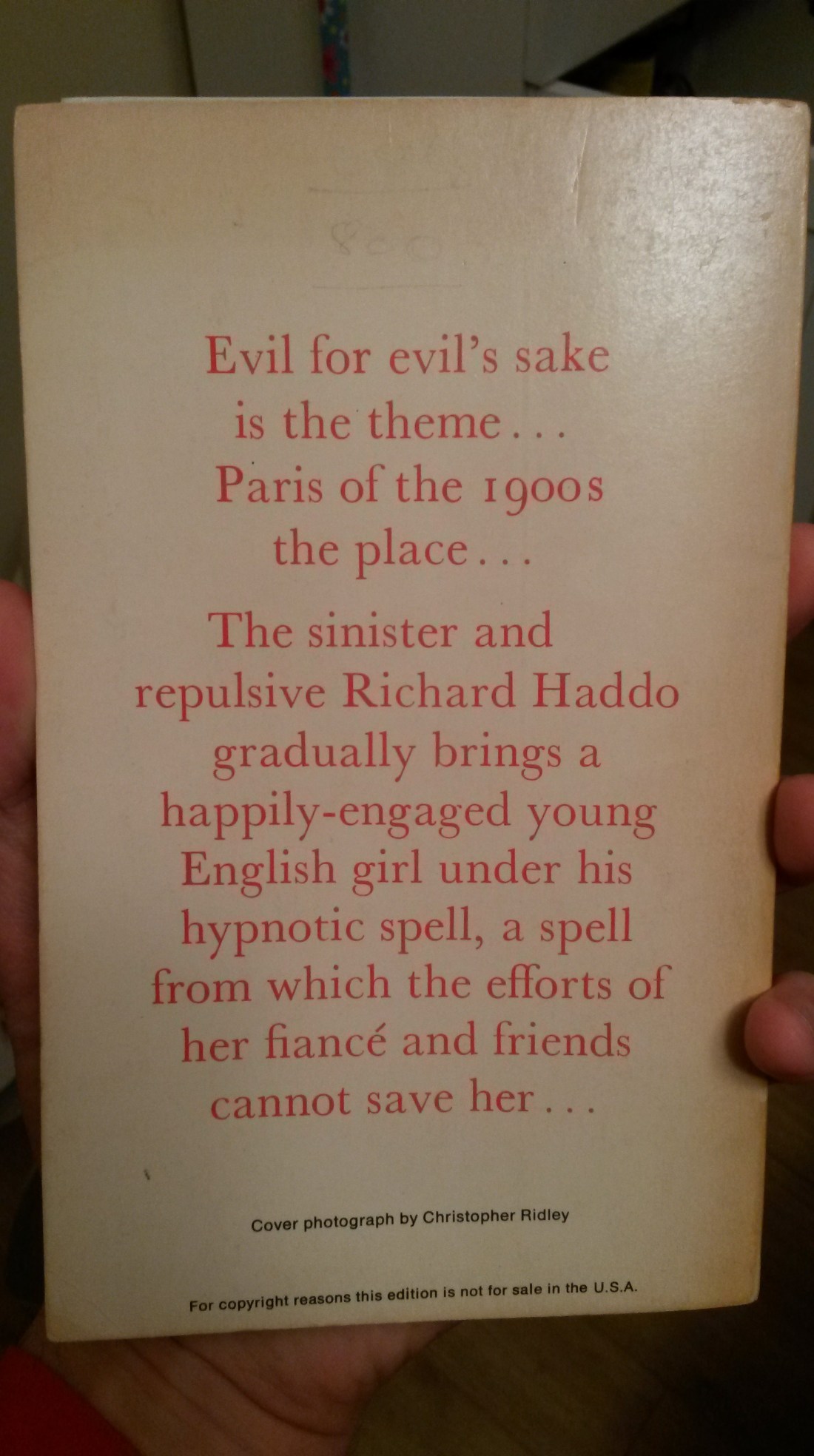
20151228_012606
This is the back cover of my copy of The Magician. Note that the magician is mistakenly referred to as Richard Haddo instead of Oliver. Oh Drat!

So what’s Oliver Haddo like? Well, one point that is made perfectly clear is that he is a plus-sized gentleman. References to his girth are made whenever he appears; indeed, the subtext of this entire novel reads “Aleister Crowley is a fatty-fatty-boombalatty”. What I found more interesting though, were the similarities between Haddo and Crowley’s own depiction of himself in Moonchild. In both books he is described as having a peculiar glare and the ability to enter or exit a room without notice. He is also depicted as being a very difficult man to read; he seems in both books to have a very odd, yet intriguing manner about him. Maugham claims that he was simultaneously interested, amused and repulsed by Crowley in real life.

Haddo’s most sinister plan is to use the blood of a virgin to create homunculi (little goblin people that are made through magic). Could the real Crowley have been so fiendish? Well, homunculi are also discussed at length in Moonchild. Crowley there puts forth a theory of reincarnation in which souls compete for human bodies. Every incarnated soul will have three forces acting on it: the soul itself, heredity and its environment. Souls should therefore look for bodies whose heredity and environments come with as few restrictions as possible. (By their nature, homunculi have no heredity and would therefore be freer than other bodies.) The aim of the magicians in Moonchild is to magically induce a scenario where a powerful soul will be convinced to enter the body of their ritual baby. This baby was conceived in the normal way and so can only be considered a homunculus in a very loose sense of the word. Conversely, Haddo’s creations in The Magician are homunculi in the very literal sense of the world. The unholy, fabricated mutants are probably the most fantastic element of Maugham’s story, but the real Crowley clearly had come across the idea in his own practice. Is it possible that he attempted to create life out of nothing? I see no reason to believe that he wouldn’t have tried to do so; it’s not like the guy was renowned for his ethical integrity.

Anyways, so transparent was Maugham’s use of Crowley as a model for Haddo that Crowley actually wrote a review of The Magician for Vanity Fair. He even signed the article as Oliver Haddo. His main criticism was that Maugham had plagiarized much of the material in his book. (Note that one of the sources he recognized as plagiarized was a passage on the creation of homunculi from Franz Hartmann’s book about Paracelcus!) This would be a fair complaint if The Magician was an essay, but the plagiarism doesn’t make the novel any less entertaining. Also, I probably wouldn’t have discovered this wonderful novel if it weren’t for the plagiarism herein. Crowley’s response to the novel and his further comments on Maugham are quite interesting; he gets a little bitchy at him, but he’s never really nasty. From the little I know about the man, I reckon he gained enormous pleasure from the fact that somebody had written a book about him, regardless of the content.

20151228_012632To the Devil a Daughter – Dennis Wheatley
Arrow – 1966

I read this book a year and a half ago, and as I remember, it’s the story of an evil priest called Canon Copely-Syle who is trying to get control of a girl to use her in his attempt to create a homunculus. The girl in question is a quiet, well-behaved young woman during the day, but at night, a satanic influence causes her to become a brazen little jezebel. This is a Dennis Wheatley novel, and so the victim is obviously saved by a team of upper-class Brits who have both served in the military and somehow amassed a wide knowledge of the occult. It’s also full of the casual racism and weird demons appearing out clouds of smoke that I have learned to expect in a Wheatley novel. This is total trash, but it is the exact kind of trash that I adore. My goodreads review for this book simply reads; “I can’t say this is one of the best books that I have read, but I can certainly say it’s one of my favourites. A damn fine novel.” There is a film that was loosely based on it too. It’s not nearly as good as the film version of The Devil Rides Out, but it’s definitely worth a watch.

It’s interesting coming back to this book after having read The Magician. When I started reading The Magician, I kept thinking to myself that it was like a more stylish  version of a Dennis Wheatley novel. Once I got a bit into it, I realized that it is pretty much exactly that. Wheatley draws heavily from The Magican for the plot of To the Devil a Daughter. He does it in a pretty cool way though. The girl in The Magician slowly goes from good to bad, but the girl in this one alternates between the two every 12 hours. And if Oliver Haddo is supposed to be an over-the-top version of Crowley, then Canon Copely-Syle is the same thing pushed 1 step further. There’s even a cool scene in this novel where the Canon discusses Crowley. He initially refers to him as a charlatan, but he is told a story that leads him to accept that Crowley had reached the magical degree of Ipsissimus.

I have another book about Crowley called Portable Darkness. I bought it because it was cheap and it features a foreword by Robert Anton Wilson. The foreword begins: “Everyone knows the sinister story of how Aleister Crowley and his son, MacAleister, went one dark night into a hotel room in Paris and howled within a magic triangle the nameless names that invoked the Devil. The results, we are told, were eldritch and abominable, as the late great H.P. Lovecraft would say.  MacAleister  was found dead of a heart attack.” (I have read other versions of this story in which the son’s head was either torn off or turned 180 degrees around by the demon.) Wilson notes that this story, which is accepted as true by many occultists, has its basis in the story told to the Canon in To The Devil A Daughter. Wilson therefore dismisses it as entirely fictional. Wheatley however, did not consider the story to be fictional at all. In his non-fiction work, The Devil And All His Works, he tells how he was quite fond of Crowley and how he would often have him over for dinner. This book was published 18 years after To The Devil A Daughter, and in it he also recounts the aforementioned story of the disastrous summoning ritual. Regardless of whether that story is true or not, you could say that it has been accepted into the official Crowley “Canon”. Hahaha, get it?

I have alluded to fact that I would not have discovered Maugham’s novel were it not for his plagiarism. It would be more accurate to say that I would not have discovered Maugham’s novel were it not for Wheatley’s plagiarism of Maugham’s plagiarism. There is a passage in Wheatley’s novel that discusses the succesful attempts of Count Von Küffstein and Abbé Geloni to create homunculi. Wheatley knew his stuff, and when I read this passage, I decided to try to find out whether it was based on anything or if it was directly from Wheatley’s imagination. When I looked up those names, I came across an almost identical passage from Maugham’s book. That passaged mentioned a mysterious text called Die Sphinx as a source. I looked that up, but I couldn’t find anything so I presumed that Maugham had made it up. I put The Magician on my to-read list and didn’t think much else of it. After I had read The Magician, I looked at Crowley’s review of it and noticed that the passage from Maugham’s book that mentions Count Von Küffstein and Die Sphinx was supposedly taken directly out of Franz Hartmann’s book on the Life of Paracelcus. Crowley also alludes to the improbability of Maugham having made his own translation of Die Sphinx, and that made me reconsider the existence of such a text. Well, I found a pdf copy of Hartmann’s book on the alchemist, and it mentions the publisher and other details of Die Sphinx. It is real afterall! It’s a bizarre masonic handbook by a guy named Emil Besetzny, and it contains an entire chapter on the lives of the Homunculi. After an intensive google search, I actually managed to track down a copy of the original work. Unfortunately, my German is extremely poor, and I can’t understand much of it at all. Here is a pdf copy of the chapter that deals with the homunculi. Anyone want to translate it?

Wheatley’s first hand account of the catastrophic experiments of Crowley suggest that he was willing to delve into the diabolical. Also, the fact that Crowley knew of Die Sphinx supports the idea that he might have tried to create his own homunculi. These facts, along with Maugham’s fictional accusations and his own willingness to discuss the topic, suggest that it is almost certain that Aleister Crowley attempted to create unhallowed bastard lifeforms. The only question remaining is whether or not he succeeded…

2015-12-30 22.30.04
I gave it a go myself; these boys are coming along nicely!