A History of Secret Societies – Arkon Daraul

2015-08-12 21.21.10
Citadel – 1997

I’m not really interested in secret societies. There’s a few interesting ones, but they’re mostly pretty boring. A few months ago,  I saw this book for sale on craigslist for fairly cheap. I wasn’t really bothered, but I was reading the Illuminatus! Trilogy at the time, and when I saw it mentioned therein and recalled the craigslist ad, I took it as a sign that I should buy it. (Coincidences don’t exist.)

2015-08-10 18.34.14
Why I bought this piece of trash. Note the misspelling of the author’s name.

I decided to read the book because I am currently reading Zanoni by Bulwer Lytton, and as that book is about Rosicrucians, I thought this would complement it well. It’s certainly as fantastic; in fact, there are more references in Lytton’s work than there are here. Arkon Daraul is full of shit.

This book is garbage. It doesn’t seem reliable at all. Daraul’s choices of which secret societies to discuss are completely arbitrary. There is a lengthy chapter on peacock worshippers in modern England, but there’s no chapter on the freemasons. Admittedly, I was relieved that I didn’t have to read the same crap about freemasons that I have already read in 10 other books, but it did seem a little odd that the most famous secret society of all were barely mentioned in this “historical account”. Also, Daraul doesn’t really bother to distinguish between secret societies and cults.

I don’t really have much else to say on this book. It was crap. The cover (Is that Satan?) makes it look way better than it is. There were some interesting parts, but there are lots of other books on the same topic that are much better. I reviewed a shitty little book on this kind of crap before that covered more ground and was way less bullshitty.
Don’t bother reading this one.

prayer
The best part about this book was this prayer leaflet that the previous owner had left in it.

Le Fanu’s Short Stories – Madam Crowl’s Ghost and In a Glass Darkly

2015-07-07 16.49.31
Sheridan Le Fanu – Madam Crowl’s Ghost & Other Stories / In A Glass Darkly
Wordsworth Editions – 2006 and 2008

Here are two collections of short stories from one of my favourite writers. I would recommend the Oxford edition of In A Glass Darkly, as that one contains nice notes at the back. Wordsworth editions are bare bones and rarely contain annotation. They are cheap however, and I own quite a few of them.

In A Glass Darkly is the better of the two collections. It’s been a few years since I read it, but I distinctly remember the joy I felt when the evil monkey appeared the first story. It’s also great because it contains lesbian vampires in a vampire story that predates Dracula. I think my favourite story in here is the novella: The Room in Le Dragon Volant. It’s not as spooky as the others, but I really like Le Fanu’s writing

Madam Crowl’s Ghost is a nice collection of ghost stories compiled by none other than M.R James. I read this one more recently, but I read the first two stories on a transatlantic flight and didn’t end up enjoying them as much as I would have were I to read them on the couch at midnight with a cup of peppermint tea. The stories in here are collected from different sources, and the quality and tone varies quite a bit. Some are great though, and most of them are set in Ireland. You can imagine my sheer delight on finding a story in here about a man from my hometown who shares my name. I loved this book, but the other collection is probably a better place to start if you haven’t read Le Fanu before.

Elvis Presley Speaks – Hans Holzer

elvis
New English Library – 1981

This book was not my first encounter with the work of Hans Holzer. Some of you may remember my review of Gothic Ghosts. If you have read that review, you will probably wonder why I bothered to read another book by this chump. (If you haven’t read that review, I strongly suggest that you do. It’s one of my personal favourites.) Well, after reading that utter piece of shit, I needed somewhere to direct my hate, and so I did a google image search for the author. An image of this book appeared, and I simply could not help myself. I bought a copy immediately.

This is a book about a woman named Dorothy who believes that the spirit of Elvis Presley exists in an Astral realm between earth and heaven. This realm is peopled by souls awaiting reincarnation, and it is managed by a mysterious bearded figure named Matthew. (My first guess was that it was the gospelly Matthew, but this is neither confirmed nor denied in the book.) The astral residents spend their days going to school, attending jam sessions and sometimes making contact with the living.

Elvis descends from the astral realm and appears to this woman for two reasons.
1. They have been soul mates in many previous lives, but because of some heavenly error, they ended up apart in their most recent incarnations. (Dorothy was a housewife from New Jersey; Elvis was the king of rock and roll.) This separation was partly to blame for the untimely death of Elvis. After death, Elvis’s soul realizes what he has been missing and decides to spend all of his time watching over this woman.
2. Elvis wants Dorothy to contact the famous parapsychologist, Dr. Hans Holzer so that he can send a message to the world. His message is that there is existence after death and that dead souls can get quite lonely.

So what is the ghost of Elvis like? Well, he’s a weird creep. He gets annoyed about impersonators, worries about his family and tries to ruin a woman’s marriage. At one point he climbs on top of Dorothy when she is in bed with her husband and asks her if she wants to “fool around”. There’s not much insight into Elvis’s character here that wouldn’t be available in other biographies or interviews. Let’s remember that Elvis is one of the most famous people to ever walk the earth, and it would probably be a challenge for Elvis himself to give any additional insight on his character. Given that, I have to say that Dorothy Sherry’s portrait of the king is incredibly underwhelming.

This is a very poorly written book. It’s mostly repetition, and Holzer has no interviewing skills whatsoever. As soon as Elvis starts answering any of his questions, Holzer will immediately interrupt him with another unrelated question. I don’t know if Dorothy Sherry even existed, but if she did, I wonder how much of this book is based on her own subjective experiences and lies and how much is based on Holzer’s personal agenda. It seems a bit odd that Elvis Presley, the most famous entertainer in the world, would come back to substantiate personally the claims of a fiddeldy-dee parapsychologist. I got the impression that Dorothy was being led on by a manipulative cadger, anxious to profit from the unfortunate woman’s mental instability.

Obviously the book is completely stupid and unbelievable, but the most annoying thing about it is Holzer’s sense of self importance. He mentions several times that Elvis had read many of his books and that Elvis wanted Holzer to deal with this case personally. The book is about  a famous musician, and Holzer can’t help but announce that he too is a professional musician. At one point in the book he offers to write music for new Elvis songs. Later Dorothy recounts a vision of a past life in ancient Egypt. In this life she was a slave, but she was able to alleviate the misery of servitude by basking in the glory of a noble and intelligent teacher figure. This teacher was none-other than an early incarnation of Hans Holzer himself. Why did Holzer include this vision in a book about  the ghost of Elvis?

Hans Holzer, you are an arsehole.

This book is shite. Pure shite. I found myself questioning my own intelligence when I was reading it. In the hours that it took me to read this garbage, I could have tidied my bedroom or gone for a walk. Sometimes I justify reading stupid books to myself by viewing the activity as an exercise in critical thinking. This book provided no such exercise. The critical thinking involved in the reading of this book was limited to my evaluation and immediate repudiation of the book’s subtitle, “The astonishing evidence of spiritual contact with Elvis from beyond the grave”. This book is scraping the bottom of the barrel, and the only good that can come from reading it is the contrast of quality that you will immediately notice in whatever book you read after it. I doubt that I will be reviewing anything this bad for quite a while.

The Worship of the Serpent – The Rev. John Bathurst Deane

worship serpent
Health Research Books – ?

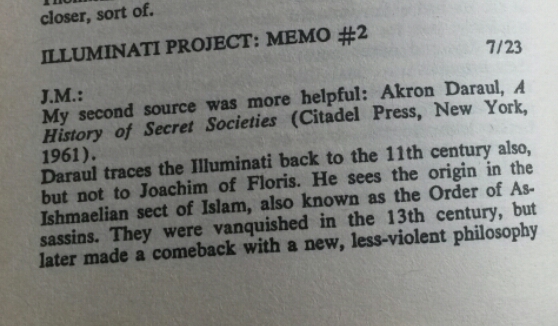
I’m not entirely sure how this book ended up on my wanted list (I think I came across the title when researching the Ophite gnostics), but I spent a few months last year trying to find an affordable copy.  The book was originally published in 1833 and text is available online, but I don’t like print-on-demand books and I ended up ordering a copy that was supposedly published in 1970. The publishing company is called Health Research Books, and there is a website url given on the back cover of the book. Strange for a book from 1970 right? The cover looks like shit; I don’t know what that fucking picture is supposed to be, but inside is a decent facsimile copy of the original book.

The idea behind the book is rather interesting. The author claims that the events in the Book of Genesis are literally true, and that all of humanity can trace its origins back to Noah’s family on the ark. He notes that all mythologies feature serpents or serpent-like creatures in some form or another, and he argues that all mythological serpents have their origins in the serpent of Eden. The fact that so many myths and stories contain serpents is intriguing, but the argument here is pretty weak. Deane spends most of the book discussing the etymologies of the names of different mythological serpents and gods and showing how these names could have originated in different words for snake. It was enjoyable enough, but at no point did I feel remotely convinced in what Deane was saying. Some mythological serpents are representatives of evil, but others are benevolent creators. Deane’s thoroughly protestant response to this is to claim that any culture in which the serpent has become a positive force must have been made up of savages.

Mankind’s obsession with serpents is fascinating; we just can’t get enough of those slithery fucks. Why do so many cultures incorporate snakes into their mythologies? This is a legitimately interesting question, but I don’t believe that the answer lies in-a-gadda-da-vida. This book’s responses to this question come from within a Christian paradigm, and the book ultimately serves as an example of the phenomenon it discusses rather than as an answer to the question it poses. The worship of the serpent  is a damn cool topic, but this book is only going to be useful to a psychology student interested in studying the egocentrism of 19th century Christian clergymen.

This picture of Medusa’s minging face was one of my favourite parts of the book.mingin

Maldoror and Poems – Le Comte de Lautrémont

Maldoror

Penguin – 1978
The full title of this work is “Les Chants de Maldoror”, and it is supposedly a collection of “songs”  written by an extremely nasty individual. Imagine all of the bad guys of gothic literature rolled into one and you’ll get an idea of what Maldoror is like as a person. He’s equal parts Manfred and Melmoth, but he also has a little Dracula and Curval in him too. He hates man, god and almost everything else. Sounds pretty cool right? Well some of it definitely is. The parts where he recounts his crimes and insults god are  damn sweet. He isn’t just a little bit naughty either; he’s full on evil. He boasts about brutally torturing people and he’s a bit rapey too. I’m surprised more metal bands haven’t used the name Maldoror. I can only find one black metal band from Italy with the name, and they look absolutely shit.

This wasn’t a book that I rushed through. I enjoyed the protagonist’s horribly nihilistic outlook, but I read the book in July, and it felt wrong to sit down with it when the sun was shining. I had to wait until the hour of 12 before delving into this hateful work of misanthropy. Also, the prose is quite dense, and it was a bit of a chore to get through. Some of the sentences are ridiculously long (the narrator comments on this himself), and there’s no underlying plot to the book, so it can be difficult to follow.

Nobody knows much about Le Comte de Lautrémont, but his real name was Isidore Ducasse, and he died at 24, only a few years after this book was written. I would imagine that parts of this book are autobiographical and reflect the author’s outlook. There are brief incidents in the text where a hitherto unknown character appears and is treated as if he has been part of the story all along. These parts struck me as probably having meaning to the author alone; perhaps they are masked accounts of his own experiences. That’s one of the difficulties with surrealist writing though; the author is under no obligation to explain himself.

And this book is quite surreal. There are some truly mental parts in it. Some of them are entertaining; I particularly enjoyed Maldoror’s dalliance with a shark, but many are confusing and are made downright unenjoyable by frustratingly convoluted prose. This confusion is not accidental though, and the difficulties facing the reader of this book are undoubtedly deliberate. One of the opening lines of the book reads; “It is not right that everyone should read the pages that follow; only a few will be able to savour this bitter fruit with impunity.” Maldoror does not want his readers to enjoy these songs; he wants them to suffer. This is basically a deliberately discordant black metal album in the form of a book.

I wanted to like this book more than I did. It’s a cool idea; I just don’t think it was executed as well as it could have been. In saying that though, this is a translation, so maybe the fault lies with Paul Knight. Then again, maybe I just didn’t get it. This is definitely a book that you have to ‘get’ to enjoy. It’s surrealist fiction, so a load of it is utter bollocks that makes no sense. I would say that the grisly parts make it worth reading, they’re gross, funny and metal as fuck, but don’t expect to enjoy the whole thing. If you find yourself having a great time while reading this book, you are definitely doing it wrong.

This edition also contains Lautrémont’s poetry. Apparently he had gotten all of this negativity out when he wrote Maldoror, and his poems are supposed to focus on more positive things. I didn’t read them. I probably never will. The edition that I am reviewing also has a deadly cover. It’s from part of this painting by Anton Wiertz.wiertzL’Inhumation précipitée

The Legend of the Sons of God – T.C. Lethbridge

2015-06-24 17.12.46
Arkana – 1990

This books contains some of the choiciest bullshit I have ever come across. Did you know that the rocks of Stonehenge are from Tipperary? Were you aware that the craters on the moon are the results of an interstellar nuclear war between the Martians and Venusians? Had it ever occurred to you that Jesus was a ghost alien from the future? I can’t say I had ever wondered about these things before reading this book, but now I am convinced that they are all entirely true.

T.C. Lethbridge doesn’t even bother to present his ideas as fact. He openly admits that the bulk of this book is conjecture. He reminds his reader that there are gaping holes and inconstencies in our accounts of history. The standard scientific approach to solving these mysteries is to use proof and evidence. This method doesn’t quite satisfy Lethbridge though, and he suggests that it would be more productive to make up ridiculous stories and then look around for evidence of the events that we imagined. This book was written by a grown man playing make-believe.

“Although much of what has been written so far is not strictly orthodox, the present chapter is far worse and deals with matters which are fit really only for the television plays called ‘Doctor Who’.” Thus opens the seventh chapter of this masterpiece.

This book came out at roughly the same time as Von Däniken’s Chariot of the Gods, and it contains some similar ideas, but this one is definitely more enjoyable. It’s short, the writing is engaging and the claims herein are silly enough to be thoroughly entertaining. This is a must read.

Transcendental Magic, Its Doctrine and Ritual – Eliphas Levi

2015-07-06 20.53.53
Senate – 1995

This book is a load of bollocks. I’ve seen it mentioned in other books, and I thought that I should check it out. In fairness, I was probably underwhelmed because I have come across these ideas in so many other books (Although they were bollocks in those books too.) There is a story that the secrets disclosed herein were once the private knowledge of a secret society to which Levi belonged*, but I think it would be unfair to blame anyone other than Levi for this stinking garbage heap of nonsense. Levi links the usual ancient traditions together and adds a bunch of his own bullshit into the mix to create a completely incoherent mess of esoteric diarrhea.

This is actually two books in one. The first is a book on the dogma of magic, the second is a book on the rituals. The chapters in each book correspond to each other, and if I were to read it again, I would read the corresponding chapters in pairs. I am almost definitely not going to read this book again though. The first ten chapters in each text are on numbers. For example, the second chapter is on the number two. For this chapter, Levi thinks of all the things that exist in pairs, and occults them. Cain and Abel represent the Yin and the Yang. Yin is the Angel Lucifer, but Yang is the Angel Michael. Yin depends on Yang, so death (Lucifer) depends on life (Michael). Death is a penis, but it is also life, therefore a penis is actually a vagina. Now this is of course corroborated by the two pillars of the temple of Solomon: they enclose the tree of life and the tree of knowledge, duhh! It’s all so obvious!

So each book starts off with ten chapters of that kind of crap. It’s only after the number chapters that Levi gets into necromancy and witchcraft. Those chapters are alright. There are some fucked up rituals described in detail. My favourite is the ritual that requires the necromancer to somehow put themselves in a position whereby they are assisting a priest in the celebration of mass on Christmas Eve. They must help the priest until the host is consecrated and then  interrupt the ceremony by yelling ‘LET THE DEAD RISE FROM THEIR TOMBS!” After this they run from the church to the graveyard, continually screaming. Wouldn’t it be amazing to see that happening? Levi also gives detailed instructions on the steps you need to take to become master of the Gnomes of the earth. Yep, this is all fairly pragmatic stuff…

The translator, A.E. Waite, provides lots of footnotes, most of which criticize Levi’s nonsense in a manner so harsh that one would wonder why he bothered with it at all.  Waite, who wasn’t exactly the most rational man in the world, describes Levi’s ideas as ‘fantastic’, ‘without authority’, ‘idle nonsense’, ‘incredibly bad’ and ‘made up out of his own head’. I also own his translation of Levi’s History of Magic, a book that I now doubt I will ever read.

The illustrations are cool though. The Sabbatic goat on the cover is quite deadly, and there’s a fair few images in here that I’ve seen elsewhere.  That’s the thing about this book; it has been used as a source for lots of other books that explain its contents far more clearly than it does itself (I would recommend Cavendish’s The Black Arts to anyone who’s interested.)

I was also delighted to find a brief reference to the tarte Bourbonnaise of Panurge. The Borbonesa tart is a dessert mentioned in Gargantua and Pantagruel. It is a “filthy and slovenly compound, made of store of garlic, of assafoetida, of castoreum, of dogs’ turds very warm, which he steeped, tempered, and liquefied in the corrupt matter of pocky boils and pestiferous botches” This is Rabelais’ description, not Levi’s. Levi only mentions the tart in comparison to the smell that might emerge from one of the potions described in the chapter on charms and philtres.

If you want to read a mess of mystical bullshit about the astral plane and tarot cards, then this is the book for you. Otherwise, skip to the chapters on necromancy, witchcraft and the Sabbath, and leave it at that.

*My source for that information was Wade Baskin’s Dictionary of Satanism, so it’s almost definitely untrue.

Please share the below image, and let’s hope somebody takes the challenge!

necromancer challenge

The Political History of the Devil – Daniel Defoe

2015-06-22 21.34.54
Nonsuch – 2007
When I was a kid, somebody described Hell to me as “the worst thing imaginable”. This naturally resulted in several nights of me lying awake in bed, trying my hardest to imagine the worst thing imaginable. I amused myself coming up with several repulsive and intrusive tortures involving instruments of both the sharp and blunt varieties, but I remember becoming quite upset after realizing that the worst imaginable punishment wouldn’t be being sentenced to an eternity of any kind of physical torment; no matter how bad the pain could be, it would be always be far worse if my shitty deeds had resulted not only in an eternity of torment for myself, but also for my family. Worse still would be my shitty deeds dooming every soul to an eternity of torment. If Hell was truly the worst scenario imaginable, then all it would take would be one sinner to doom every other soul: if Satan really wanted to obliterate any positivity in the suffering soul of a sinner, he would weigh them down with the guilt of having doomed everyone else to the same misery as themselves. I myself felt horrendously guilty after imagining this, because according the logic of my thought, Hell would evolve to correspond to the worst scenario ever imagined up until the present moment in time. As I was sure nobody else had yet thought of something so horrible, I concluded that I had just become responsible for dooming every soul to an eternity of communal torment. For even if I led a pious life, my irrevocably imagined worst-of-all-possible-hells would be activated on the death of the next sinner, and all would be lost.

There are countless other paradoxes that occur when reason is applied to religious dogma, and a few of these are discussed in The Political History of the Devil. In this book Daniel Defoe attempts to apply reason to dispel several myths about the Devil and his minions. Defoe however, was a solemn believer in the powers of Heaven and Hell, and there is a strange irony in his writing here. He uses reason to mock those who claim that the Devil might appear to human eyes, while simultaneously positing Satan’s existence. Although he feels comfortable making fun of the unfounded beliefs of children and the elderly, he is still willing to acknowledge every event in the Old Testament as true.

Now this book is written as satire, so attacking the writer’s logic is fairly pointless, but I just thought it was bloody cheeky to be making fun of people for their silly ideas about silly beliefs when the author himself clearly held those same silly beliefs. Truly, this is a silly book.

The book is divided into two sections. The first is a commentary on the different appearances of Satan within both Paradise Lost and the Bible (particularly the Old Testament). Some of this part is fairly interesting if you have read those texts. There was one part that I liked in which Defoe discusses the curse of Ham. The Curse of Ham, for those of you who don’t know, is the curse that God put on the descendants of Noah’s son Ham. Ham angered God, and God put a curse on him and his descendants, particularly his son, Canaan; “he said, Cursed be Canaan; a servant of servants shall he be unto his brethren.” (Genesis 9:25) This passage was used as a biblical justification of slavery. Apparently black people were believed to be the descendants of Ham and Canaan. Now I have deliberately withheld some information here. I’m sure you’re wondering what Ham could have done to deserve such a horrendous punishment. Let me tell you: Noah, the great Holy man and patriarch, got pissed drunk a few years after the flood, and his son Ham found him in a heap. Ham pulled up Noah’s gaberdine and buggered his own father. That’s right: Noah of the Ark was arse-raped by his son. Ok, it doesn’t actually say that his ring was penetrated in the Bible, but ‘seeing the nakedness of his father’ has long been understood as a euphemism for sodomy. And let’s be realistic here, even the angry God of the Old Testament wouldn’t be so cruel as to doom an entire race of people to centuries of oppression just because one man saw his dad’s willy by accident.

It really sucks that they never read that part of the Bible in mass – Ham by name, Ham by nature.

The second part of Defoe’s book is incredibly boring. It’s full of references to people and events that I’ve never heard of, the humour is dry and dated, and I don’t really care about what the author of Robinson Crusoe has to say about the Devil. This is by no means an ‘occult book’; there’s no esoteric knowledge in here. It’s supposed to be funny, but I wasn’t amused. It was a chore to finish, and the last 100 pages were extra shitty.

This particular edition looks nice on the outside, but there’s quite a few typos in the text. It was published in 2007, and the original price sticker on my copy says 25 euros. I bought it for 6 in 2013, and I was back in the bookshop recently, and it’s now down to 3.

I don’t want to be unfair. I’m sure Defoe was a good writer, but this is not a great book. I don’t get the jokes, and I don’t care about what he’s saying. This is what I get for buying a book based on its cover. If I lost my copy, I wouldn’t spend the 3 euro for another. I’ll give this turd of a book a measly 2/10.

The Satanic Mass – H.T.F. Rhodes

satanicmassgif
Arrow – 1964

Arrow – 1973

Through an unfortunate postal error, I ended up with two copies of this little gem. I came across the title in the bibliography of Richard Cavendish’s Black Arts, and I knew that I had to read it. I’m glad I did; it’s really not as trashy as it looks.

Rhodes seems convinced that the heretical Cathars have been almost entirely responsible for all varieties of Satanic worship since their untimely end in the early 14th century. He portrays the Cathars as neo-Gnostics who renounced the physical world and the Demiurge that had created it. The Cathars supposedly believed that the Catholic church was worshiping this evil creator God, and hence saw any inversion of Catholic ritual as a positive form of worship of the true God.

Rhodes maintains that most Satanism is rooted in Christian dualism. This basically means that devil worshipers only worship the devil because they think that God is the evil one, and anything that goes against this bad God’s wishes must therefore be good. And sure, what other reasons could a person have for turning to Satan? A few dolts aside, I doubt there’s many people who get involved in Satanism solely through their desire to do evil.

What’s interesting about Rhodes hypothesis is that he pinpoints a specific movement and tentatively links their practices with the charges brought against the Templars, witches, Sabbat attendees and dodgy French aristocrats. One of the less convincing, but very interesting arguments he makes is that the alleged homosexuality of the Templars and later heretics had its roots in the Cathar practice of ejaculating into anything other than vaginas. The Cathars preached that sex was evil because it brought forth more souls into the material world. Abstinence may have been their goal, but they were realists. They understood the physical need to ejaculate, and they supposedly preached that it was better to be a sodomite or an onanist than to risk reproducing. Apparently their homosexual compromise was to become institutionalized in later Satanic movements.

Well, at least he’s being creative.

2015-06-07 22.34.57
If I were to judge this book by its cover, it would get a 10/10.

My biggest complaint about this book is that Rhodes presumes his reader has a solid understanding of all of the stuff he’s talking about. He introduces obscure characters and events from history and presumes that the reader is familiar with them. I would recommend checking out Huysman’s Là Bas  and the wikipedia articles on the affair of the poisons and the Taxil hoax before picking this one up.

There are some really cool parts in here. I was particularly interested in the account of the mass of Saint-Sécaire.  A mass “murderous in intention. The victim against whom its malevolence is directed is supposed to wither away and die of the mysterious St. Secaires sickness which no physician can cure.” Apparently there is no St. Secaire on record, and it seems rather uncertain where the origins of this legend come from. I’ve also come across mentions of this suspicious ceremony in Summer’s History of Witchcraft and Demonology, and apparently Aleister Crowley wrote a short story about it too.

I cannot deny that I laughed heartily when reading the details of the ancient and esoteric ‘ritual of the faggot’. The spell spoken during this ritual, which is used to gain control of another individual, contains the line; ” In the name of all demons, depart, faggot”. Imagine the accusations of hate-speech that could be made if a  modern day magician was overheard attempting this ritual from inside their garage.

2015-06-07 22.35.55
Doesn’t that make you want to read this book?

One final thing that I found very interesting was a biblical quotation on the title page book. It says:
‘Get thee abacko me owld scrat.’
Luke iv, 8 (dialect version)
The King James version of this line from Luke 4:8 is:Get thee behind me, Satan
I can’t find information on the dialect version mentioned in the text. I don’t know if it was an actual text, a joke, or something else. Either way, I would love to read more scripture in that dialect.

I would imagine that a more academic book on Satanic ritual would probably be quite dull.  This one has a nice balance of objectivity and goat worship. Rhode’s claims aren’t all believable, but they are worth thinking about. He rarely discusses the rationality or morality of the practices and beliefs of the Satanists, and he tries neither to polish nor to tarnish their already squalid reputation. The links between some of the sections are a bit weak, and in honesty, the last chapter is extremely dry, but overall there is more good than bad. Plus, the 1964 edition is worth owning just for the cover! (I reckon the more-boring later version was redesigned to look  like the Satanic Bible.) I’ll give it 7/10 and recommend this book to anyone interesting in Satanism.

Kyteler’s Inn

kyteler sign
Hark! What is this treachery? This looks like a review of a restaurant, not a book!

This isn’t really a review at all; it’s more an appendix to my earlier post on St. John D. Seymour’s Irish Witchcraft and Demonology.

Alice Kyteler was a wealthy woman from Kilkenny, Ireland. By her mid forties, three of her husbands had died, and her latest was dying. An opportunistic bishop named Richard de Ledrede jumped at the chance to confiscate the immense wealth that Alice had built up from her previous marriages. In 1323, she was accused of killing her husbands through poisoning and heretical sorcery. She was also accused of sacrificing animals to the divil, and having communications with a incubus named Robert, Son of Art.

The whole affair was fairly mad. The bishop himself spent some time in prison for underestimating Alice’s powerful connections. Alice’s first son and her maid Petronella were accused of being in on the mischief, and poor Petronella was tortured and burnt alive. Alice managed to escape from Kilkenny, and nobody is quite sure what happened to her.

There’s much better, and more detailed versions of the story online; my favourite account of her life is this TG4 documentary (as Gaeilge). I think that her story would make a really great film.

Anyways, apparently this inn used to be her home. It’s a cool pub, and the food was nice. I’ll definitely go back if I’m ever in Kilkenny again.
Here’s the website: http://www.kytelersinn.com/
cat

Alice’s familiar, Robert filius Artis and I.