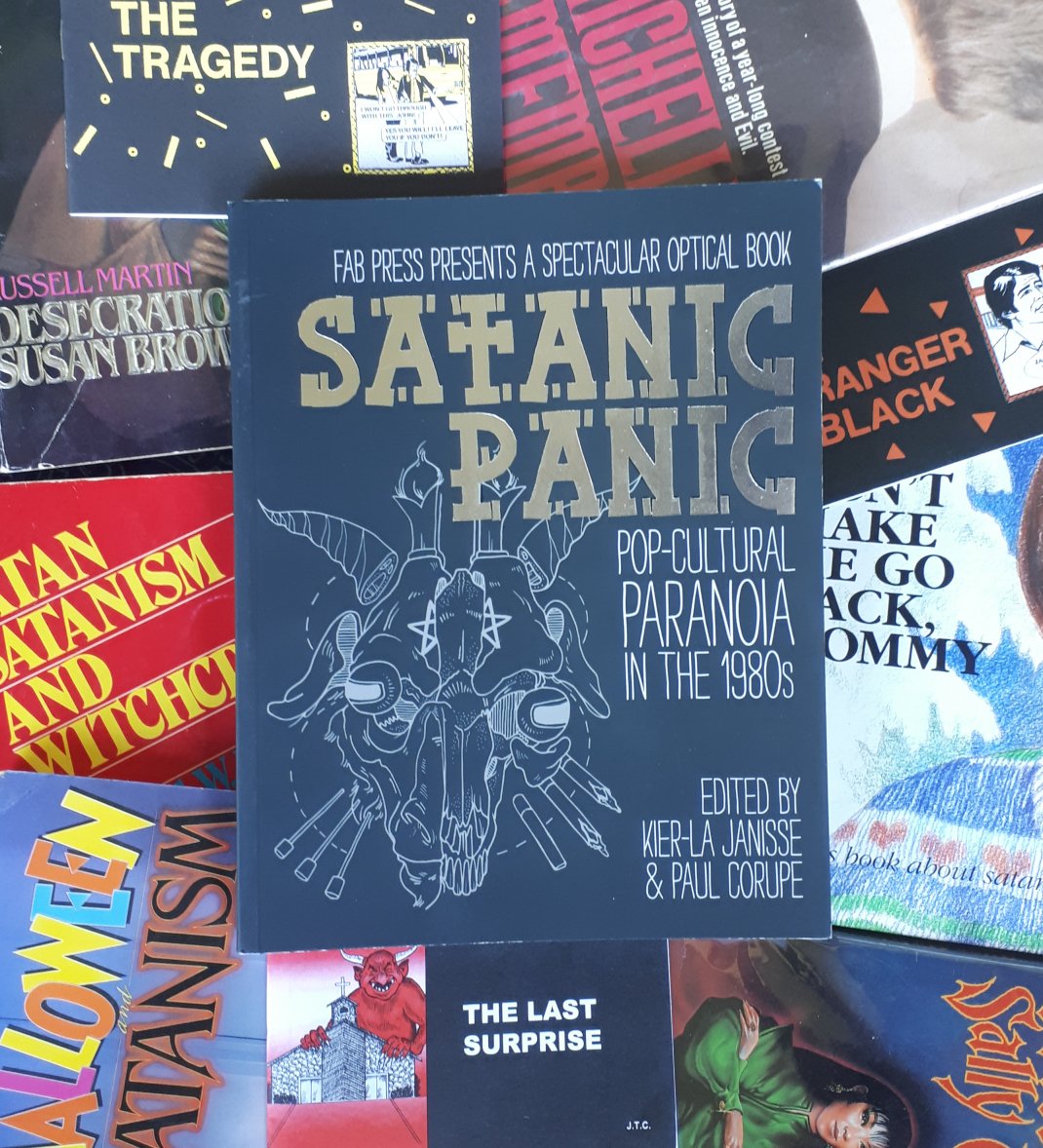
Satanic Panic: Pop Cultural Paranoia in the 1980s – Edited by Kier-La Janisse & Paul Corupe

satanic panic pop-cultural paranoiain the 1980s.jpgSatanic Panic: Pop Cultural Paranoia in the 1980s 
Edited by Kier-La Janisse & Paul Corupe
FAB Press – 2018 (Originally published 2015)

This is a collection of essays about different elements of the Satanic Panic of the 1980s. I remember seeing something about this book when it came out and thinking that it looked cool, and when I recently saw that it contained an essay on Russ Martin’s sexy Satanic mind-control novels, I knew I’d have to read it. I got a couple of gift vouchers from work over the past year, and I was delighted to find a way to use those vouchers to pursue my interest in Satanism.

The essays in here are of varying quality, but most are pretty good. I guess it’s inevitable that each reader will like some better than others. Together they present a pretty comprehensive look at the Satanic Panic of the 1980s.

Reading the book over the course of a few days was a bit odd as the introductory background information in some of the essays is pretty similar. Geraldo’s infamous Exposing Satan’s Underground special gets quite a few mentions. I guess this two hour TV special is probably the defining peak of the panic. Despite multiple attempts, I’ve never managed to watch the whole thing through. After a few moments of it, I feel a maddening urge to listen to Slayer and throw stones through church windows.

I’ve encountered a lot of the material in this book before, and covered some of it on this blog. There’s essays on Michelle Remembers, Bob Larson, books by Phil Phillips, and one on the McMartin preschool trial. The McMartin essay was one of the more interesting in the book. It argues that the claims of Satanist involvement in that case actually prevented prosecutors from busting a real paedophile ring. There are also interesting essays on Chick Tracts, Dungeons and Dragons, and heavy metal in here.

I felt that a few of the writers went a bit overboard trying to make their essays feel academic. One of them even references Foucault. Ugh. We get it guys, you went to college…

(Haha, after writing that last bit, I looked up the guy who made the reference to Foucault, and he actually teaches a course on college writing in a college. Classic! Referencing ol’ Michel might be a surefire way to dazzle your liberal arts prof, but it don’t impress me much.)

This is a far fancier book than the ones I usually read. It looks and feels really nice. There’s so many cool pictures, and it felt like a lot of work was put into the layout. Just to flick through it is a cool experience. In sincerity, if you know any goths who have a birthday coming up, this would be perfect for their coffee table.

I don’t have much more to say about this one. Overall, it’s a very cool book. I’m quite sure I’ll reread some of these essays as research for future posts.

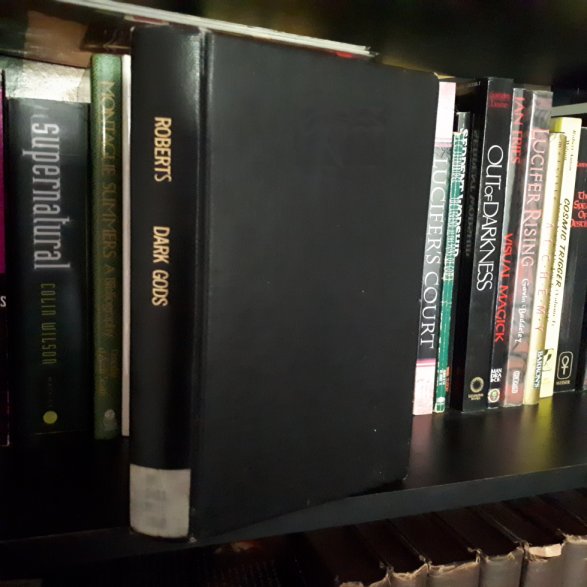
Dark Gods – Anthony Roberts and Geoff Gilbertson

dark gods - anthony roberts and Geoff Gilbertson.jpgDark Gods – Anthony Roberts and Geoff Gilbertson
Rider/Hutchinson – 1980

Malevolent forces from another dimension have long been plotting against humanity. Throughout history these forces have manifested as demons, angels, spirits, fairies, vampires, dragons, aliens and Men in Black. They have convinced some humans to create secret societies that unwittingly aim to bring about the downfall of humanity. Lovecraft’s tales are not mere fiction. Nyarlathotep and Cthulhu are very real, and they’re patiently waiting for misguided humans to call them forth so that they can lead us into an era of blasphemous anarchy and interdimensional terror.

I mean… if you don’t want to read this book after that description, you’re on the wrong blog.

There’s so much to unpack here. This utterly insane book takes the work of H.P. Lovecraft, Bulwer Lytton, Erich Von DänikenFrancis King, Pauwels and Bergier, Eliphas Levi, Aleister Crowley, Trevor Ravenscroft, and John Keel and mixes it with Biblical Lore, black magic, cryptozoology, secret society conspiracy theories and UFO abduction stories. This is essential reading.
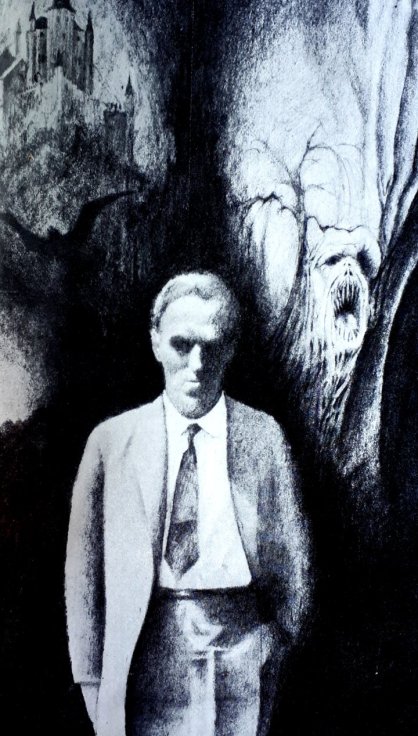
h.p.lovecraft - tom evesonjpg.jpgI’ve seen this image of Lovecraft before. It’s by Tom Eveson.

When I read Colin Wilson’s The Occult, I complained about the author’s unquestioning acceptance of ridiculous ideas. This approach made a little more sense to me after I read Morning of the Magicians by Pauwels and Bergier and understood their concept of fantastic realism, but I still thought of Wilson as a fairly credulous yet knowledgeable individual. Wilson actually wrote the foreword for this book, and it’s rather telling that he seems uncomfortable accepting this book’s findings. While he praises the authors of Dark Gods’ inquisitive vigor, he can not endorse their blind acceptance of their own conjecture. What is too much for Wilson will be far too much for almost everybody else.

Truly, this is a ridiculous book. There is no consideration given to the reliability of any of the authors’ sources; they even accept testimony from individuals they acknowledge as being liars.  They make no distinction between myths, fiction and eye-witness witness reports. Lovecraft’s short stories, extracts from The History of the Damnable Life and Deserved Death of Doctor John Faustus and Bulwer Lyton’s novel The Coming Race are presented alongside historical documents as proof of the conspiracy.

I don’t mind authors being ridiculous if the material they’re presenting is entertaining, but unfortunately, not all of the stuff in here is hugely interesting. Much of the second half of the book is taken up with descriptions of different secret societies such as the Golden Dawn, the Illuminati and even the Bilderburg Group. I recently wrote about my current disdain for conspiracy theories, and I found this section of the book to be grueling. The general message of the last 100 pages or so can be summed up by saying that any secret society that claims to offer illumination is actually run by Satanic forces that aim to enslave the society’s members and ultimately destroy humanity. I will give the authors some credit for briefly suggesting Reptilian government leaders 10 years before David Icke went mad, but this part of the book was painfully dull.

dark gods crowley blavatksy weishauptMadame Blavatsky, Rudolf Steiner, Adam Weishaupt, Aleister Crowley, Houston Stewart Chamberlain and Dietrich Eckart – Satanic Illuminatists (Picture by Tom Eveson)

Overall, the writing is quite bad. The authors seem to dance around the points they’re trying to make rather than just stating them clearly. This is particularly unfortunate as the points they are making are hardly common-sense ideas.

Perhaps the most confusing, convoluted part of this book is the bit explaining the motives of the entities who seem to abduct people in UFOs. ‘The phrase ‘seem to’ is very deliberate in that sentence. The authors of Dark Gods don’t believe that aliens are coming to Earth and abducting humans; they believe that interdimensional beings are coming to Earth and pretending to be aliens that are coming to Earth and abducting humans. We’re talking about malevolent ultra-terrestrials, not inquisitive extra terrestrials. (The idea of ultra-terrestrials rather than extra-terrestrials can be found in Whitley Strieber‘s abduction books too, but ol’ Whitley never imagines his visitors to be so deceptive.) Why are these weird entities playing such an elaborate hoax on humanity? According to Gilbertson and Roberts, it’s basically just to confuse us.

golem dark godsThis image of a Golem later appeared on the cover of a book by David Schow.

Think about that for a second. Inter-dimensional creatures are crossing over into our dimension and then pretending to be aliens because they think that will make us feel afraid and uncertain. The pretending to be aliens part just seems a little bit redundant to me. They’re inter-dimensional creatures – that’s plenty frightening and confusing. What kind of deranged people came up with this nonsense?

There’s sparse information on the authors available online, and I had to dig around quite a bit for it to paint a cohesive picture. What I could find was fairly depressing. Both men are now dead.

Anthony Roberts had previously published some other books on Atlantis and mythology. Paul Weston, an expert on Glastonbury’s mythology, claims that the mood of Roberts’ earlier books were “considerably different” to Dark Gods. Roberts ran a publication company called Zodiac House with his wife. He died in 1990 while climbing up Glastonbury Tor to see a lunar eclipse. He died of a heart attack, but some have suggested that he was actually killed by fairies for planning to summon the ghost of Robert Kirk, a folklorist who was supposedly abducted by the fairies in 1692. Most accounts of Anthony Roberts that I have found have presented him as a rather temperamental individual. (Sources: an essay on meeting Roberts, Paul Weston’s notes, and Roberts’ obituary on page 12 of The Ley Hunter Winter 1989/1990)
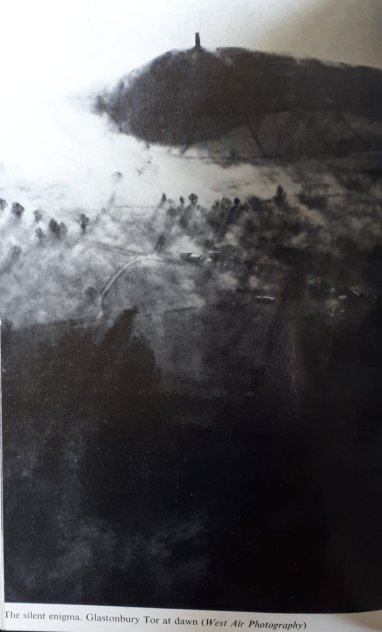
glastonbury tor - dark gods.jpgThis creepy image from the book shows the spot where Anthony Roberts would later die.

Geoff Gilbertson died more recently, in 2017. Despite living longer, he seems to have been the more tragic of the pair. He died alone of untreated cancer. I believe Dark Gods is his only book. After publishing it, he supposedly became convinced that the Dark Gods were after him for doing so. He apparently suffered several psychotic breakdowns and spent time living on the streets and in a mental institution. One of his friends believed that he was on the autism spectrum. This guy genuinely seems to have suffered horribly with his mental health. People that knew him seem to have thought him a very nice guy though, a fact which is not true for Anthony Roberts. Nearly all of the information I could find on Gilbertson came from this article.

I’ve read accounts describing both men as unstable. I don’t know how they met or what their relationship was like, but it seems that their interactions with each other created an echo-chamber of Fortean paranoia. Dark Gods doesn’t read like some transparent attempt to synthesize occult ideas in order to make a quick buck. No, this book is a genuine trek into Crazy Town.

I first saw Dark Gods being mentioned on twitter. Somebody was discussing how difficult it is to find these days. Underneath that comment, somebody else had posted a video review of the book by Occult Book Review, one of my favourite youtube accounts. (He’s another Irish dad with an interest in occult books, basically a nicer, smarter, more respectful version of me.) After the first few minutes of that video, I knew I’d have to track down and read this thing as soon as possible.

Doing so wasn’t easy. This book really is quite tricky to find. You’ll be very lucky to buy a copy for less than 200 dollars, and I wasn’t able to find a digital version. With a little bit of work, I managed to get my greedy little claws on a physical copy. It’s actually a very tedious read, but if you’re determined to read it and can’t afford to spend a bunch of money, ask me nicely and I might be able to help you out.

Conjuring Spirits – Michael Osiris Snuffin

conjuring spirits a manual of goetic and enochian sorcery michael osiris snuffin.jpgConjuring Spirits: A Manual of Goetic and Enochian Sorcery
Michael Osiris Snuffin
Concrescent Press – 2010

Here’s a book about communicating with demons.

There are two parts to this text. The first is a modern guide to Goetic evocation. It simplifies some of the steps that you’ll find listed in older manuals. This part was fine. I don’t practice Goetia, but I’ve read enough about it to have been able to follow along. Everything here seems to make sense in the context of modern ceremonial magic.

The second part of the book looks at the author’s system of Enochian magic. Enochian magic, for those of you who don’t know, originated in the scrying experiments of John Dee and Edward Kelley. I found it very difficult to bother with this section for a few reasons. First of all, Enochian magic is a system of communicating with angels. I’m more of a demon guy myself. Next up, Enochian magic is a load of bollocks – from what I’ve read, it seems that Edward Kelley was a just conman who strung John Dee along so that he could fuck his wife.

On top of this, the author has his facts mixed up about Dee and Kelley. He says in the opening paragraph of this section, “Between 1851 and 1859 , Elizabethan Magus Dr. John Dee and his seer Edward Kelly (sic) received one of the most powerful systems of magick in Western Occultism.” The problem here is that John Dee died in 1608, roughly 250 years prior to these dates. Queen Elizabeth reigned from 1558 until 1603.

Kelley’s relationship with Dee was actually confined to the 1580s, and I thought that the dates given by Snuffin might just have been a typo, getting the 1580s mixed up with the 1850s, but Snuffin later says that it has been more than 250 years since Dee and Kelley did their experiments. This is technically more accurate than his original dates, but Snuffins book was published in 2010, so this number places Dee and Kelley’s work together somewhere in the mid 1700s.

I know that historical accuracy isn’t entirely necessary for a functioning magical system, but I was quite surprised by this lack of attention to detail. I’ve read that Snuffin is going to release a second edition of this book, so hopefully these errors will be corrected there.

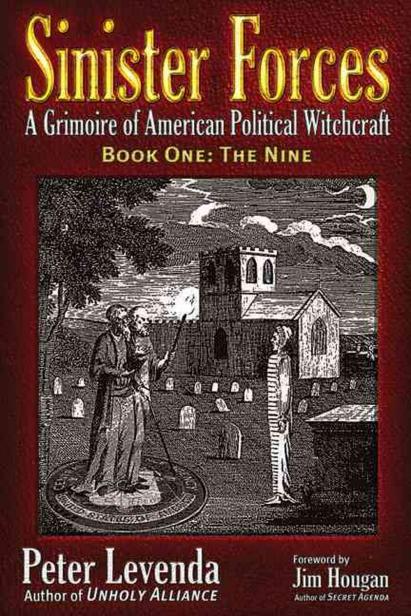
Sinister Forces: A Grimoire of American Political Witchcraft (Part 1: The Nine) – Peter Levenda

sinister forces the nine levendaSinister Forces: A Grimoire of American Political Witchcraft (Part 1: The Nine)
Peter Levenda

I used to think that I was more interested in conspiracy theories than I really am. Investigating these theories becomes far less alluring after you’ve done it a little bit.

There’s a few reasons why I think researching conspiracy theories is a waste of time:

  1. The internet has to be your main source of information – these theories evolve too quickly for books to be worthwhile anymore. But anyone can post information on the internet. There is such an abundance of crap online that you’ll rarely get to the bottom of anything.
  2. At this point in global history, the current state of politics is actually as twisted, shady and worrying as any conspiracy you can imagine.
  3. In the era of QAnon and fake news, belief in conspiracies has become too mainstream to be cool. I want to be in the same party as Frohike, Langly and Byers, not Margery from Nebraska.

Peter Levenda’s Sinister Forces series is about American conspiracy theories. It covers everything you’d expect; MK Ultra, the Manson family, the UFO phenomenon and everything in between. Unfortunately, Levenda doesn’t just describe these theories; he tries to link them all together. Can you remember Umberto Eco’s book, Foucault’s Pendulum? Levenda is like a comic-book version of the characters in that novel.

This was a very boring read. Every now and then an interesting bit would pop up, but I didn’t come across a huge amount of interesting information that I wasn’t already aware of.

I found the stuff on the mind control of Candy Jones interesting, but this was largely because of the similarity of her name to the name of one of the characters in Russ Martin’s Satanic mind-control series.

candy jones candy sterlingTwo books about mind-controlled beauties. Is there a link?

The only part of the book that actually convinced me of anything was the discussion of government agencies’ use of disinformation. That the American government has fed its citizens deliberately obfuscating untruths is undoubtedly true. The extent and nature of these untruths is a remarkably interesting topic, but it’s also one that very few, if any,  people can discuss with certainty. There’s always another layer of deception that could be peeled away.

A lot of the stuff in this book is pretty X-Files-y, and Levenda actually references the work of Mulder and Scully a few times throughout. I love the X-Files, but that series presents itself as fiction. Levenda’s talking about real life, and his ideas are far too convoluted to be remotely convincing.

I was planning on finishing the series, but I couldn’t get more than a few pages into the second book. I’ve had a copy of Levenda’s Unholy Alliance on my shelf for a couple of years now, and I reckon it’ll be another few before I get the courage to pick it up. Levenda recently co-authored a book about aliens with the singer from Blink-182. Yuck.

Gilles De Rais, the Perverted Son

trial of gilles de rais george batailleThe Trial of Gilles De Rais – George Bataille
Amok Books – 1991 (Originally published 1965)

Gilles de Rais is the kind of person that makes the belief in Heaven and Hell extremely appealing. There is no satisfaction to be derived from the fact that he was executed for his crimes. Those crimes were so hideous that their perpetrator deserves an eternity of agonizing torment – a quick execution is no payback for the brutal torture, rape and murder of countless children.

Gilles was an extremely powerful and ludicrously wealthy nobleman in 15th century France. For roughly 10 years, the Baron De Rais had his servants abduct poor children to satiate his hideous desires. He would slowly torture and murder them, usually stabbing them in the neck, sometimes severing their heads completely. As they perished, he would sit on their stomachs, peer into their dying faces and laugh. These victims would be raped at various stages during this process. After decapitating them, the Baron would kiss the children’s severed heads.

Oh, and while these horrendous acts were doubtlessly the result of de Rais’ depraved sexual impulses, he performed them in the name of the Devil. He employed several black magicians to help him communicate with demons. These sorcerers took De Rais for a fool. They would attempt to raise demons in front of him and after a while of nothing happening, they’d send him out of the room and lock the door. Then they’d start screaming in terror, and when Gilles would come back they’d tell him that the Devil told them to ask for some more money. Gilles would grant this request immediately. At other times, they would ask the Baron to provide them with the limbs and organs of dead children. These same sickos would also be present when Gilles was torturing kids. It seems that they were part of an abhorrently disgusting necro-paedophile ring. These scum were worst of the worst.

Gilles De Rais was eventually brought to trial for kidnapping a priest, and when the authorities started investigating the Baron, they heard the terrible rumours that had spread about him.

During a relatively painless trial (no torture on record), Gilles de Rais confessed his guilt and repented. He was excommunicated, but he was soon thereafter re-communicated by the Catholic Church because he had willingly confessed. The Church took the allegations of kidnapping a priest and being an alchemist more seriously than the rape and murder of countless children. Gilles was executed quickly, and the locals in his area were given a 3 day holiday to grieve for their master.

I don’t know guys. This is remarkably unsatisfying. I wanted to read about this lad dying slowly in unspeakable agony. His crimes are so gruesome that my initial response (and the response of many others) was to assume that the charges against him were false – they’re just a bit too extreme to imagine them really happening. That being said, the best evidence that is available to us, the court documents of his trial, provide a very cohesive and damning account.

It is these documents that make up most of the text of George Bataille’s The Trial of Gilles De Rais.

This is a very repetitive book. The first section is comprised of Bataille’s philosophical ramblings on the case. The second part is a very, very detailed timeline of Gilles De Rais’ life, much of which was already covered in the previous section. The last section is made up of the court documents of the trial. There is very little information in these documents that has not been discussed previously in the book. Also, court documents are fairly repetitive by their nature, so this book ends up delivering the same story about 5 times. I do appreciate the comprehensive nature of this book, but I think it would have been more effective to put the timeline first and Bataille’s thoughts after it.

The content of this book makes its repetitive nature remarkably depressing. You get to read about poor parents searching for their murdered children over and over again. This is fucking harrowing stuff. Bataille was a bit of a weirdo though, and I guess this was intentional. I read his Story of the Eye years ago, but I remember very little of it.

I’ve already mentioned that some people think that Gilles De Rais was the innocent victim of a conspiracy. He was a wealthy politician with plenty of enemies, and it is likely that many other people would profit from his downfall. My old friend Aleister Crowley was one of the individuals to proclaim the innocence of the Baron de Rais.

In an infamous lecture that was never delivered, Crowley argues that it was very likely that De Rais was framed. He argues that the claims against de Rais are too ridiculous to be taken seriously – they sound too similar to rumours spread to villainise the Jews throughout history. Crowley seems to have read a very different account of the trial of De Rais to the one presented in Bataille’s book though. Aleister claims that De Rais only confessed to his crimes when tortured, but the court documents presented by Bataille show that De Rais actually managed to avoid being tortured by confessing. Also, while the number of victims in Bataille’s text ranged from 35-140, Crowley gives the number of victims as 800 on the authority of Montague Summers. Summers, as we all know, was either very gullible individual or just prone to sensational exaggerations, and Crowley, an acquaintance of Summers, had to have known this. The swarmy, sarcastic and provocative tone that Crowley uses throughout the lecture make it seem all the less convincing.

I’ve encoutered De Rais a couple of times in fiction. The protagonist in Huysman’s Là-bas spends his time researching the evil Baron, and Gilles himself comes back from the dead to appear in Philip José Farmer’s Image of the Beast. And Ough! – he’s obviously a heavy metal hero too. I have a tshirt with a picture of him on it. I don’t wear it to work.

gilles de rais macabre shirt.jpgIt’s for this rather silly but historically detailed song.

I’d like to believe that De Rais was innocent, but the testimonies collected in Bataille’s book are very cohesive. It would be far more comfortable to believe that Gilles De Rais died an innocent man than to accept the horrendous deaths his victims suffered at his hands. This guy seems to have been a real piece of shit.


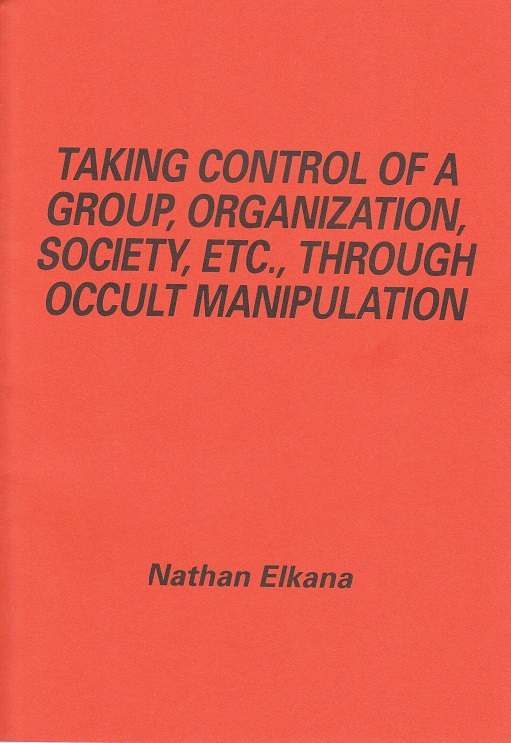
Taking Control of a Group, Organization, Society, etc., through Occult Manipulation – Nathan Elkana

Taking Control of a Group, Organization, Society through Occult Manipulation - Nathan ElkanaTaking Control of a Group, Organization, Society, etc., through Occult Manipulation
Nathan Elkana
Finbarr International – 2008

Jesus Christ, the world is home to some seriously pathetic human beings. I read this piece of garbage on the bus today. It’s awful shit, but it’s only 9 pages long. Here’s what the cretinous author has to say for himself:

There must be an unseeable world because existence is dualistic – there is no black without white, so if there is something that physically exists, it follows that there must also be something that does not physically exist. The author doesn’t mean that there are things that don’t exist though; he means that there are things that don’t exist physically. That which spiritually exists is obviously this. (Whoever believes this is a Grade-A moron. It doesn’t make any sense, but the rest of the book is based on this idea, so let’s just get on with it.)

Every place, company and type of worker is influenced by its sign and planet. This idiotic statement is followed by long lists of professions and places that are influenced by the different signs of the zodiac. These lists take up about one third of the entire text, but they’re followed by the claim that the influence of the stars doesn’t really matter all that much.

Ok, now to the most important part of the book. This is how to influence a group of people that you’re not part of. Imagine the group you want to influence as an individual human being on the astral plane. Picture a person who looks like what this group stands for. Imagine bossing this person around and telling them what you want to do. This figure will soon appear to the group’s members in their dreams and convince them to do what you want.

If the astral being resists, threaten to chain them up. If they continue, imagine them in chains. They’ll soon learn their lesson.

This method will work to influence any group, but it’s a bad idea to do it to a coven because they’ll figure out whats going on and send the entity back to attack you.

That’s it.

So, if you want to become a millionaire, all you have to do is imagine a lad named Sam with a computer for a head. Tell him to convince the executives at Microsoft to give you a percentage of their profits. If your new imaginary friend refuses, imagine him tied up. Then, a little later, imagine untying him and then wait for him to go and work his magic. Pretty soon you’ll be rich.

Some people probably paid to read this book…

There’s very little information online about the author of this text. He also published a book called The Master Grimoire of Magickal Rites & Ceremonies in which it is mentioned that he has published under many other names. Some people believe that Nathan Elkana is actually a pseudonym for Basil Crouch. It could be – both Elkana and Crouch are stupid cunts.