Bob Larson’s Book of Rock

bob larson book of rockLarson’s Book of Rock – Bob Larson
Tyndale House – 1987

I don’t think anyone gives a shit anymore, but pop music was a scary thing in the 80s.  Sure, conservative/religious types had been upset by Elvis and the Beatles before, but MTV and the popularization of music videos made it harder for parents to avoid the boldness that was popping up in the pop music of the day. While Lou Reed’s make-up and naughty lyrics might have been able to slip under some parents’ radars in the 70s, Twisted Sister’s music videos weren’t quite as subtle.

Bob Larson, evangelical preacher, talk show host, exorcist extraordinaire and all-round obnoxious cunt, was concerned. As a young man, his experiences playing guitar led him to become convinced that rock music could be used as a tool of destruction and evil. Larson’s Book of Rock is his 5th book on the subject. Written as a self help guide for good church-going parents of the 80s who were upset by their child’s interest in popular music, The Book of Rock offers insight into how this music can fill an impressionable youth’s head with homosexuality, violence, occultism, satanism, Eastern Mysticism and the desire to do drugs and alcohol.

bob larson ugly faceTwat.

Larson clearly has no concept of art or expression, and he seemed to view the music industry as a state institution that owed the general public respectable output. I suppose this attitude towards the music industry is probably confusing for people who have grown up with internet access. There would have been fewer sources of new music available to young people at the time when this book was being written, and the music industry probably looked like a unified whole to a person whose sole source of new music was MTV. The idea that people wrote songs to express how they were feeling never seems to have struck Larson. He views music as a means to tell other people how to think and how to act.

Most of his complaints about specific songs and artists are ridiculous. I don’t know much about Madonna or Cyndi Lauper, but I noticed quite a few untruths and mistakes in his depiction and description of heavy metal bands. On page 53 he mentions Rulan Danzig from Sam Hain, a rock band that got their name from the “Luciferian Lord of the Dead”. He presumably means Glenn Danzig from Samhain, the band that got their name from a traditional Gaelic harvest festival. He says of Anthrax, “Onstage, they dress in a sinister array of biker gear.” Anthrax are famous for introducing bermuda shorts into heavy metal attire. Here they are onstage in 1987, the year this book was written, looking far more like geeks on their way to the beach than a troop of bikers. He refers to Tony Iommi as the one-time lead singer of Black Sabbath. I suppose that could be true (Iommi is Sabbath’s guitarist and the only permanent member of the band), but I couldn’t find any evidence of it. At one point he mentions King Diamond’s ‘Metal Forces’ album. Metal Forces was actually a magazine that featured King on the front cover, not a King Diamond album.

0fb7d4bb5e1c67f123d110cc7afe1bacAnyone who would complain about something as cool as this deserves to be shot.

Judas Priest are one of my very favourite bands, so I was pretty excited when I came to the section on them in this book. After reading Larson’s description of Rob Halford’s habit of baring his ass on stage, I realised that I had heard of this book before. This is the book that Nardwuar was quoting from in his interview with Halford. One can only wonder about the kind of vitriol that Larson would have spewed about the Metal God if he had known that he was gay.

Most of Larson’s claims and the evidence he provides for them are pure nonsense, but his idea that listening to Heavy Metal leads youths away from Christ might well have something to it. I stopped going to mass a few months after buying my first Slayer album. It’s hard to tell if it was the heavy metal that led me away from the church or if it was the realization that Christianity is dumb that led me towards anti-Christian music, but there was definitely some correlation. Either way, any person who writes a book warning parents to prevent their children from listening to Judas Priest, Black Sabbath, Metallica, Anthrax, Slayer, Venom, Mercyful Fate, Dio, Deep Purple, Iron Maiden, Scorpions, Twisted Sister and WASP deserves to be swiftly executed. Heavy metal is one of the few things that makes life worth living.

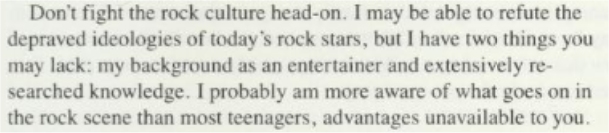
In fairness to Larson, he does repeatedly point out that a parent’s relationship with their child has more influence on the child’s mind than their tastes in music. I would have thought that this would be obvious to any parent, but this book was obviously written for idiots. I’m quite serious about that – regardless of Larson’s own intelligence, his writing makes it entirely apparent that he was very deliberately and consciously writing for morons. His condescending, know-it-all attitude is embarrassing. There’s one chapter explaining in embarrassing detail why children like loud music and another where he scolds his braindead imbecile readers for listening to country songs about sex and booze and having the audacity to complain about their kids’ Madonna records. The only people who could stomach this nonsense would have to be lowest-of-the-low, seriously stupid rubes.
bob larson is a virgin Seriously, what a damn virgin.

I first encountered Bob Larson in a video of him interviewing Satanists in the 80s. Vice have done a documentary on him, and there’s loads of videos online showing him to be a con-man and a crook. He has a youtube channel that is updated quite frequently. I have another one of his books lined up to read soon.
Raped by the Devil – The Worst of the Worst

The Devil must be one of the most frequently occurring characters in the canon of Western literature. Over the last few years, I’ve been seeking out and reading books in which he makes an appearance, but I’ve now gotten to a stage where I’ve read most of the really well known ones and I’m having to move on to slightly less popular texts. As I do so, I’m noticing that the quality tends to be dropping. Reading Dennis Wheatley’s The Satanist after having read Milton’s Paradise Lost, one understands how Lucifer must have felt when he was falling from the heavens; it’s a pretty steep decline.

Finding myself travelling down this highway to literary Hell, I decided to rev up my engines and aim for rock bottom. I have no time for dull diabolism; if I’m reading a book about the devil, I want it to be either really fucking good, or REALLY fucking bad. I decided to seek out the single worst book in which Satan plays a starring role, and guess what!

I’m pretty sure I found it.

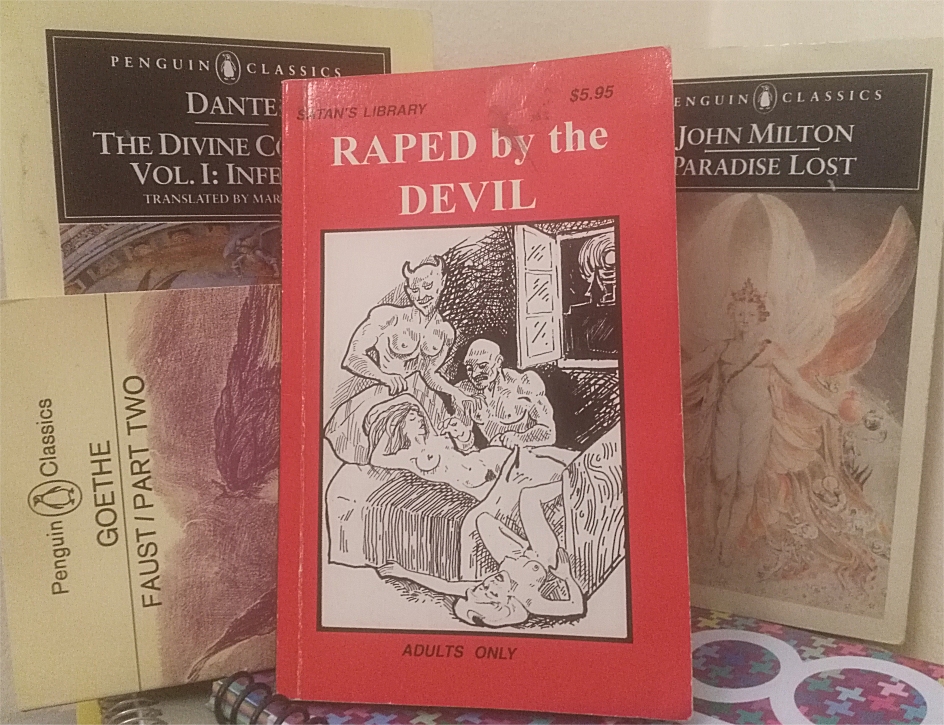
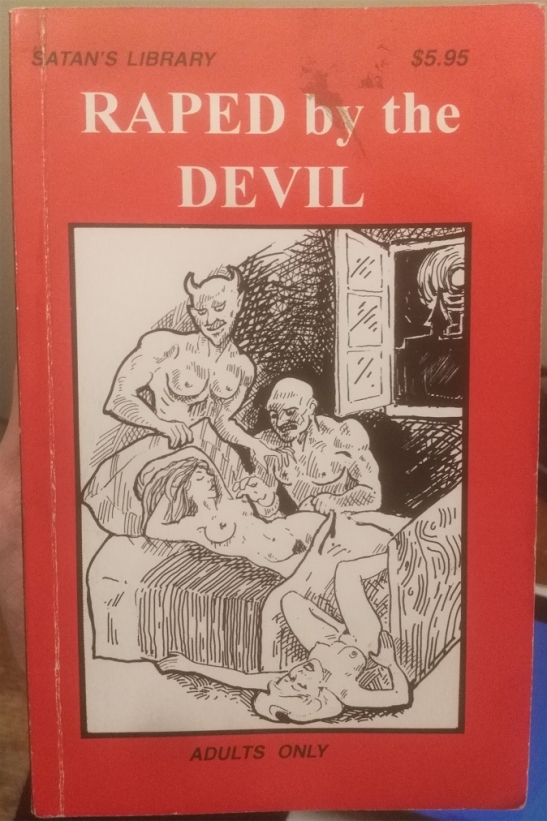
raped by the devil - satans libraryRAPED by the DEVIL – Anonymous
Star Distributors (Satan’s Library) – 1997 (First Published 1979)

I honestly can’t imagine a shadier title than “Raped by the Devil”. I mean, sure, you could throw a few adjectives or a prepositional phrase in there to make it sound a bit grosser, but I reckon its simplicity is what makes this title truly special. It’s not called “The Raping Devil” or “The Devil Raped Me”; that would give undue importance to the subject of the novel. The author, who unsurprisingly chose to remain anonymous, used the passive voice to title this work. Look at the phrasing: “Raped by the Devil”. The action itself is given more importance than its subject or object; thus suggesting that this is primarily a book about rape.

On that note, I’ll just take a moment to clarify that I don’t think rape is funny at all and that I don’t want to make light of a horrible topic. I read this book with a mind to explore the shadiest reaches of Satanic literature, not for sexual excitement. Also, my copy of this book is second hand, and I would not have bought it if I thought that any of money was going to go to individuals profiting off the promotion of rape. The publishing company that put this out, Star Distributors, released loads of similar, Satanic themed pornography. I chose to review this one as it seemed a little bit worse than all of the others (Devil’s Incest Daughter came a close second!), and as I’ve already noted, I wanted the worst of the worst.

I’d imagine that most of the people reading this post have no interest in actually reading the book, so I am going to give a complete plot summary. If you are seriously thinking of reading this book, skip the next few paragraphs or I’ll ruin all of the suspense that the author has so carefully weaved into this masterpiece of romantic fiction.

A psychiatrist comes to a small nunnery at the request of a priest. There are four nuns living there: Sister Mercy, Sister Grace, Sister Charity and the Mother Superior. Sister Mercy had a dream in which she was raped by Devil. The psychologist demands that she recount the experience in vivid detail. After the virginal nun does so, the psychiatrist declares that it was just a manifestation of her sexual frustration and decides to leave.

nun confessionIt was her first time.

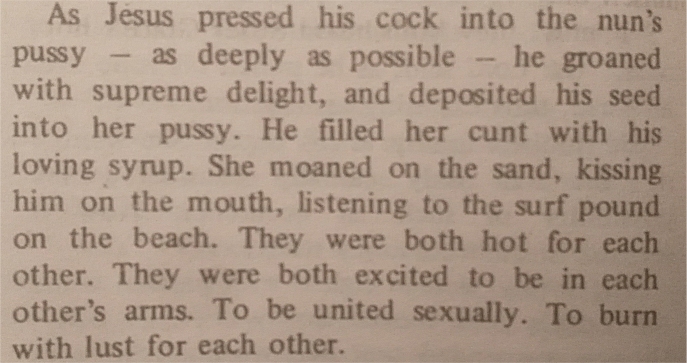
On his way home, the psychiatrist picks up a hitchhiker named Char. After driving about 50 meters down the road, they get out of the car and have sex. Afterwards she turns into the Devil. The psychiatrist presumes it was a hallucination brought on by his earlier conversation with the nun, but he decides to head back to the nunnery just to check things out. Once he gets there, he proceeds to have sex with Sister Mercy, the nun who had dreamt about Satan. Meanwhile, Jesus Christ appears to Sister Grace and has sex with her. This was my favourite part of the book.

jesus nun sexInterestingly enough, Jesus is the only male in this novel who does not insist on ending  his lovemaking with a bit of uppah-de-bummeh.

After hearing Grace orgasming on Jesus’s cock, the psychiatrist runs to her aid and proceeds to have sex with her. While this is happening the Mother Superior is having sex with the priest who works at the nunnery, and Sister Charity, who we soon realize was the horny hitchhiker, has entered a void with the Devil and is repeatedly making him cum. It is during this tryst that Devil informs her of his plan to impregnate the Mother Superior with the antichrist. There’s a pretty funny moment during this bit when the Devil gets really salty with Charity after she says “Oh God” when she’s cumming.

After the psychiatrist anally rapes Sister Grace, Jesus Christ possesses her and orders her rapist to crucify Sister Charity to prevent the birth of the Antichrist. (Sister Charity is somehow physically linked with the Devil, so killing her will kill him and prevent conception.) Unfortunately, the Devil has already started to rape the Mother Superior, and when the novel ends with Sister Charity being nailed to a wall by the anal rapist and his last victim, the reader is unsure as to whether this ritual crucifixion was performed early enough to prevent the conception of the Antichrist.

chicks with dicks speedoAt the end of the book, there’s some pretty good ads for phone sex lines.
As blasphemous and sometimes laugh-out-loud funny this book was, I honestly feel like it could have been much better. It reads as if it were written by somebody who was having a wank. It’s full of misspellings, missing words, faulty punctuation, and other technical flaws that probably occurred as the author reached across his type writer to grab a kleenex to wipe the snotty gip out of his crusty bellybutton. Those mistakes, I’m willing to forgive as they don’t really detract from the story; what annoyed me were the missed opportunities for blasphemy. There’d be parts where the nuns are lying in bed, looking up towards the crucifix on their cell wall, and I’d start anticipating that crucifix being misused in hilarious ways, but no; the sex acts in this book are frustratingly vanilla (a spot of rimming is as tropical as it gets). In fact, in spite of title, all of the sex acts in this book are mutually enjoyable, and even the titular raping is surprisingly consensual; the victim admits that she “wanted the demon’s seed in her ass more than anything.” Confusing, right?

It makes me wonder who the target audience this book and the other books in the Satan’s Library series were. Despite the book’s title, most of its sex is had between humans, and aside from the couple of rapey bits, the book doesn’t really go for any specific kink. I had been hoping it would be aimed at perverts with a Devil or blasphemy fetish or something interesting, but the plot and the actual sex acts in this book don’t really have much to do with each other; you could change all of the characters to aliens and space-colonists living on mars by changing a few words.

Realistically, this book was first published in 1979, at the end of what Grady Hendrix referred to as “the Devil’s Decade”, an era in which the inclusion of the Archfiend on the cover of a paperback would guarantee the publisher some small amount of success. This book is fucking garbage, and I wouldn’t be in the least surprised if the writer was given the title and a deadline by which to finish the book. No care or thought went into this rubbish; it’s just 180 pages of repetitive sex scenes with the Devil and a horrible title thrown in an attempt to draw an audience.

In complete honesty, I’m not really used to reading pornography, and I’m a little annoyed with this book. I knew full well that it was going to be shit when I ordered it, but after reading it, I can’t help but feel that it could have been so much better. I mean, I don’t know the first thing about writing erotic fiction, but I can tell the difference between Satanic porn and porn featuring Satan, and this crap is definitely the latter. In this book, the Devil has the power to change his shape and transport people into different dimensions, yet when he has the chance to do whatever he wants to his lover, he chooses to give her a long, romantic kiss on the lips. I mean, come on! I would have included some twisted form of the osculum infame or had the nun receiving her first unholy communion in the form of a facial from Satan’s goaty udders. Another thing; there wasn’t a single same-sex sex scene in this entire book! Homosexuality is a sin in Christianity, so surely the Devil invented gayness. Why is there no gay or lesbian scenes in here? I understand that gay/lesbian sex doesn’t suit everyone’s tastes, but there isn’t even a threesome! Also, the omission of a full blown Satanic orgy suggests to me that the author of this book knew next to nothing about the lore of Satanism and possession. Finally, my favourite part of the book, the Jesus bit, should have been drawn out more. Think of the potential!

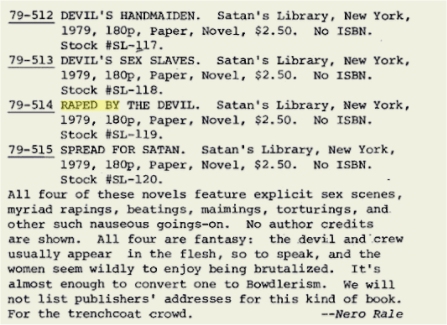
I’ve only been able to find one other review of this book, and in that review this book is being lumped in with three more of the same series. It’s rather short, so I’ll include it here. It’s from the Science Fiction & Fantasy Book Review, October 1979.

raped by the devil reviewFor the trenchcoat crowd. LOL

As far as I know then, mine is the longest review of Raped by the Devil ever written. Coming to terms with the fact that I am publicly giving this book more attention than anyone else is a bit strange. I want to just state for the record that I am not a rape-pervert and that my interest in this book was and is purely literary. I have written nothing in this post that should surprise anyone. Raped by the Devil is a truly terrible piece of work. After reading it, I have little interest in reading any of the other books from the Satan’s Library series. These texts are generally very expensive, but the book I attained is a reprint from 1997 and I got it for quite a bit cheaper than the other copies I have seen online. I wanted the worst of the worst, and I reckon that Raped by the Devil is just about as bad as you can get. I’ve read books that are more morally repugnant than this, but I don’t recall ever having read a book that clearly had as little effort put into it. Taken together, this book’s negative characteristics make it spectacularly awful.

satanic classicsThe penguin classics edition of RAPED by the DEVIL is yet to be published.

Black Easter – James Blish

black easter - james blishBlack Easter – James Blish
Equinox/Avon Books – 1977 (First published 1968)

This is definitely one of the better novels about black magic that I have read. The particular nature of this story renders it difficult to discuss without giving away some fairly crucial plot details, so if you’re like me and like to know as little as possible about a book before reading it, maybe you should come back to this review after reading the book itself. If you were hoping that this review would help you decide whether or not to read the book, know that I loved it. If you have any interest in the other books that I’ve reviewed on here, you’ll probably enjoy this one.

Spoilers start here:

The plot of this novel could be charted with a single ascending line. There is no falling action, denouement or resolution; it ends with the climax, and a rather climactic climax it is too. I like when books are gutsy enough to have brutal endings (unless they’re love stories), and finishing off with the ultimate victory of evil over good as brutal as it gets. I was expecting the priest to do something to thwart Baines and Ware, but I was delighted that he didn’t.

The ending was both shocking and abrupt, and for the first time that I can remember, I wanted to reread a book as soon as I had finished it. There is a sequel though, The Day after Judgement, so I’m going to wait till I get my hands on that before I reread Black Easter. To be honest, I was so happy with the ending that I am a bit worried that the second part of the story will ruin the first. I don’t want the characters to get a chance to fix things.

The final revelation of Black Easter, the claim that God is dead, is particularly chilling given the nature and timing of his death. He has died at a time when Earth is infested with demons, demons that have hitherto been under the guidance of ceremonial magicians using the dead God’s names as their instrument of control. By creating this scenario, Blish calls into question the inherent conflict of ceremonial magic as noted by A.E. Waite. Black magicians using grimoires such as the Lesser Key of Solomon and the Grand Grimoire, both of which are alluded to in Black Easter, need to ask God for his help in controlling the demons they conjure. Why would a loving God help an individual who was intent on massive acts of terror, and, in this case, why would an all knowing God accommodate his own destruction? Could it be that God is so upset with his creations that he wants to die? There’s a depressing thought.

While Black Easter and The Day after Judgement make up one larger work, that combined work (sometimes called The Devil’s Day) makes up a single part of Blish’s After Such Knowledge trilogy. The other books in this thematic trilogy are A Case of Conscience and Doctor Mirablis. I have a copy of Doctor Mirablis on my shelf, and I’m planning on picking up the other two books soon. It’s been quite a while since I finished a book and wanted to read more from the same author.

Part of the appeal of Blish’s writing, and I’ve already alluded to this, is his attention to accuracy. While this is a fantasy novel, much of its content comes from real grimoires. Blish addresses this in a note at the beginning of his book; he states,  “All of the books mentioned in the text actually exist; there are no “Necronomicons” or other such invented works”. Despite this, he later quotes from The Book of the Sayings of Tsiang Samdup, a fabled tome, similar to the Necronomicon in that the first references to it appeared in works of fiction, two novels Talbot Mundy. (This wasn’t the only time that elements of Mundy’s work managed to will themselves out of the confines of fiction.) On top of all this, there are those who say that Theron Ware, the central character of Black Easter, is based on Aleister Crowley. Ware certainly resembles the kind of person I’d imagine Crowley to have been, but I had read of this comparison before reading the novel, so I can’t be sure how much of the similarity was legitimate and how much of it was projected by my expectations.

Like I said, I’m planning to read the sequel, so I’ll doubtlessly come back to this book. In the meantime, make sure you eat loads of chocolate for the celebration of Christ’s resurrection.

The Satanist – Dennis Wheatley

dennis wheatley the satanistThe Satanist – Dennis Wheatley
Heron Books – 1972 (Originally published 1960)

While trying to infiltrate a gang of communists responsible for the death of his coworker, Barney Sullivan, an Irish Lord working as a spy in England, falls in love. Unbeknownst to him, the woman he falls in love with is both a) the vengeful wife of the man he himself has set out to avenge and b) a former lover of his own. One thing leads to another and pretty soon, Satanists get their evil claws on an atomic bomb and plan to use it to bring about the downfall of civilization.

Much like the rest of the plot, the means by which the antagonistic force of the story transforms from Communism to Satanism is complicated, confusing and a bit silly. Just know that it involves a disgusting Indian man with an upset tummy, a pair of psychic twins and week’s worth of casual rape. Sensible, believable plotlines weren’t what made Dennis Wheatley a best selling author though, and, silly as it is, I really quite enjoyed the story. The real problem with this text is the writing itself.

the great ram satanistLike the other Heron editions, this book has a few illustrations thrown in here and there.
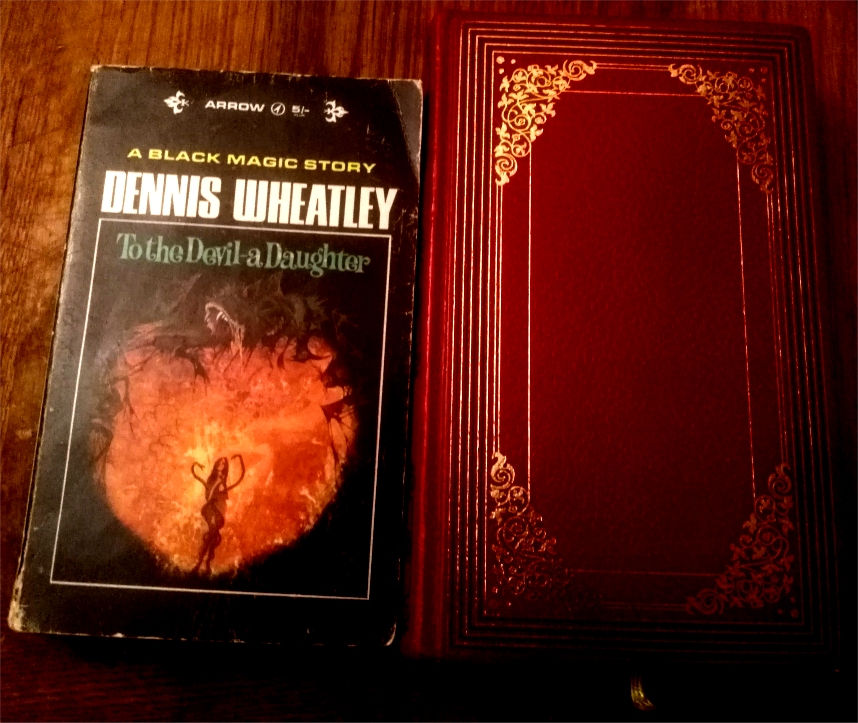
At 440 pages, this is the longest Wheatley novel I’ve read to date. It is not generally considered to be one of his better books, although I reckon that it would have been if he had spent a few weeks editing it and trimming it down to the 270-300 page range. As it is, this book is painfully wordy. The story will get to an interesting bit and Wheatley will proceed to dampen the excitement by giving two detailed paragraphs on how the characters had to go back to their apartments to shower, eat and spend a few sleepless hours tossing and turning in bed before rising to action. This really could have been a lot better.

the satanist to the devil a daughter

A few years ago, I reviewed To the Devil – a Daughter by Wheatley. If you look online, you will come across suggestions that this book is a sequel to that one, but that’s not really the case. I know that books in Wheatley’s other series don’t depend on the reader having read the previous entries, but the books in those series at least feature the same protagonists. Both To the Devil – a Daughter and The Satanist feature Colonel Verney as a fairly important character, but he’s the protagonist in neither, and aside from a couple of brief references, the two texts are quite separate. I was a little disappointed with this as I hoping for the Crowleyesque Canon Copley-Syle from To the Devil – a Daughter to make a return. Speaking of Crowley, The Satanist includes repeated allusions to the “Do what thou wilt shall be the whole of the law” mantra of the Devil worshippers. It seems that Wheatley didn’t differentiate Thelema from Satanism. It should be noted though that Wheatley was personally acquainted with Crowley and probably knew more about him than you do.

Like Wheatley’s other novels, The Satanist contains lots of old fashioned racism. There’s a part in here where he describes the revulsion that any white woman is bound to feel after touching the skin of any man that isn’t white. It’s still a bit weird to see words like nigger and chink being used so casually in literature. The two protagonists of the story are Irish, and although they let out a few Bejasuses when they’re excited, they don’t come across too badly. That being said, Mary, the female lead, is a former prostitute. At first I thought this depiction might have been an attack on the loose morals of Irish women, but Wheatley is surprisingly sympathetic towards her. He makes it very clear that she only has sex to get ahead when it is absolutely necessary, pretty progressive stuff for our Dennis!

It’s been almost 2 years since I read a novel by Dennis Wheatley, and after reading this one, I’ll be in no hurry to return to his work. I mean, I will eventually get through all of his Black Magic novels, but I don’t think I’ll bother with much (if any) of the other stuff he wrote.

Marx and Satan

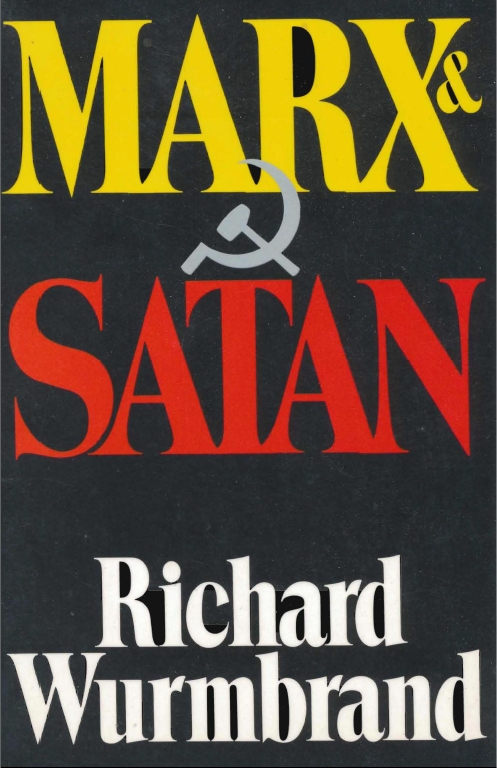
marx and satan wurmbrandMarx and Satan – Richard Wurmbrand
Crossway Books – 1986

Wow.

As far as I know, I’m not a Marxist. I encountered a small amount of Karl Marx’s writing when I was in university, but I’ve never read Das Kapital or the Communist Manifesto. I certainly have no interest in defending or attacking Marx’s views, and even if I did, my horror/occult book blog would not be the place to do it. It might seem strange then that this blog is the perfect place to attack a book critiquing Marx, but there you go.

This book, you see, claims that Karl Marx, the man who famously referred to religion as “the opiate of the masses”, was in fact a devout theistic Satanist. Again, I’m not an expert on Marx, but the general consensus is that we was actually an atheist who had complex opinions about religion. The writer of this book, a mad person named Richard Wurmbrand, builds his case against Marx by exaggerating or misreading every single time the words devil, evil, demon, etc., appear in the entire, enormous corpus of Marx’s writings. Richard Wurmbrand probably read Marx’s books, but when you look at this title of this book, you’ll notice that it’s not a biography. It’s called Marx and Satan. To me, that suggests that this book should be equal parts Marx and Satan, or that at least the same amount of research should have been done on both. Unfortunately, this is not the case. Richard Wurmbrand’s concept of Satanism is contradictory, sensational, inaccurate and absolutely stupid. I may not be an expert on Marx, but I’ve read enough books about Satanism to I feel qualified to point out a few problems here.

First off, at several points throughout his book, Wurmbrand notes that his cause is particularly difficult to fight for because of the secretive nature of the Satanists. He uses the phrase, “the highly secretive Satanist church”. Soon thereafter, he quotes from the Satanic Bible. Despite the aforementioned “highly secretive” nature of the Satanic church, Wurmbrand was somehow been able to track down a copy of their Bible. The Satanic Bible, for those of you who don’t know, is a widely available book that has now gone through 30 printings and sold a million copies. I know that this is the book he’s talking about because I have a copy on my shelf. The Church of Satan, the organization that puts that book out relies on new membership fees and book sales to survive. They also run a popular twitter account with 160,000 followers. You could accuse them of many of things, but secretive they are not.

Now, I know that there are many branches and varieties of Satanism, but by quoting from the Satanic Bible, Wurmbrand has clearly identified the LaVeyan brand of Satanism as the one he is discussing. I don’t think that it’s at all unreasonable for me to make that claim. (Why would he quote from a book if it wasn’t directly relevant to the point he is making?) Ok, but this is interesting because after referring to these Satanists as highly secretive, he also claims that “The Satanist sect is not materialistic.” Of course, the Church of Satan is, and always has been, materialistic. On their website, they boast about their “materialist philosophy“. Obviously, their website wasn’t available when Wurmbrand was writing his book, but this materialist philosophy is clearly propounded in the book that Wurmbrand quotes from. So allow me to recap here. Despite Wurmbrand’s claims to the contrary, the Church of Satan is not “highly secretive”, they are not “not materialistic”, and they are certainly not secretive about their being materialistic. I have no personal reason to defend the Church of Satan here. I am merely pointing out facts that are clearly apparent to anyone who has done even the smallest amount of research on LaVeyan Satanism.

But how did Wurmbrand get things so wrong? How did he misinterpret the Satanic Bible in such a remarkable way? Well, to understand that, let’s take a look at the quotations that Wurmbrand actually used:

“The Satanic Bible,” after saying “the crucifix symbolizes pallid incompetence hanging on a tree,” calls Satan “the ineffable Prince of Darkness who rules the earth.” As opposed to “the lasting foulness of Bethlehem,” “the cursed Nazarene,” “the impotent king,” “fugitive and mute god,” “vile and abhorred pretender to the majesty of Satan,” the Devil is called “the God of Light,” with angels “cowering and trembling with fear and prostrating themselves before him” and “sending Christian minions staggering to their doom.”

Well, yeah. That clears things up a bit. Apart from the first quote there, the crucifix symbolism one, none of those quotations are even from the Satanic Bible. The rest are from the Satanic Rituals, an entirely separate book by the same author. That’s not all though. I did a little research and I found the following passage from a 1977 book called Don’t Waste Your Sorrows: Finding God’s Purpose in the Midst of Pain by Paul E. Billheimer.

waste your sorrows billheimer

Compare the Billheimer quote to the Wurmbrand one. Notice any similarities? Billheimer’s book was published 9 years before Wurmbrand’s. Now, I don’t like jumping to conclusions, but it’s entirely clear that Wurmbrand plagiarized Billheimer’s work. He also made an absolute fool of himself in the process. To provide evidence for his critique of Karl Marx, Richard Wurmbrand quoted from books that he himself had never read. In doing so, he not only highlights the fact that he knows nothing about the concept that he has chosen as the topic for his book, he also proves that he is a cheat with a poor eye for details.

So if he didn’t read the Satanic Bible, what texts did he read during his research for his book? Well, at one point in his text, he directs his readers to Psychic Discoveries Behind the Iron Curtain for more information on occultism in Russia. That particular book was one of the worst I have ever read, but it’s the kind of book that this Wurmbrand guy considers trustworthy.


Two of Wurmbrand’s trustworthy sources

Psychic Discoveries was bad, so bad in fact that I referred to it as both a “horrendous pile of nonsense” and “a load of shite” in my review, but it’s really only guilty of being boring and unconvincing. You come away from a book like that pitying its authors rather than disliking them. If you want the really infuriating stuff, you’ve got to look towards the religious nutjobs. The most popular post I’ve ever done on this blog was about a book called Michelle Remembers. That book made me really angry. It’s about a mad woman who claimed that she had been a victim of Satanic ritual abuse as a child. It has been proven to be complete and utter bullshit on many counts. It’s nothing more than the sinister fantasies of a sex-pervert with a low IQ. Hey, guess what! Richard Wurmbrand bought it hook, line and sinker, and he quotes extensively from that book of absolute garbage. Not only that though; the quotations that he uses are from one of the most cringeworthy and ridiculous sections of the book, the Devil’s nursery rhymes. Anybody who has ever done a lick of research on Satanism would be able to tell that the entirety of Michelle Remembers is rubbish, but even the most gullible Christian should have a hard time swallowing the notion of the Devil singing childish rhymes to a bunch of evil Canadians. It’s not a problem for Wurmbrand though. He unquestioningly presents it as damning evidence in his case against Karl Marx.

Towards the end of the book, he also mentions the whole “if you play Stairway to Heaven backwards…” thing. I couldn’t understand why he did this in a book about Karl Marx, but he did.

I haven’t really said much about the central idea of his book, but I really don’t feel like I need to. I have successfully shown that Richard Wurmbrand was completely oblivious to both the nature and realities of Satanism and argumentative writing. There is absolutely no direct evidence for the claims that he makes. He never read some of the source material on Satanism from which he quotes, and I have no real reason to presume that his research on Marx was any more thorough. Other sources that he chose to include in his book are completely bogus. Throughout the book, Wurmbrand comes across as gullible, arrogant, hysteric, and paranoid; the guy was clearly mentally ill. He had had a tough life, spending 14 years in communist prisons (There’s a poorly animated movie about this on youtube if you’re interested), so it’s understandable that he wasn’t a fan of Marx. I hope that the process of writing this book was therapeutic for him.

Well, there you go. Marx and Satan, what a wonderful way to celebrate 3 years of this blog. I’ve reviewed 177 books so far, and I have no plans on stopping soon.

Lords of Chaos and Unholy Forces of Evil!

lords of chaos coverLords of Chaos – Michael Moynihan and Didrik Søderlind

Feral House – 1998/ 2003

I thought I’d better review this before the movie comes out. It’s a book about the Norwegian heavy metallers who went mad in the early 1990s and burned a load of churches and killed some people. I hadn’t bothered reading it before because I presumed (fairly accurately) that I knew the story already. That being said, this book was written in 1998, and I didn’t become interested in this kind of crap until about 5 years after that, so it is quite likely that some of my knowledge of the history of Norwegian Black Metal came indirectly from this text. If you were unfamiliar with the story of “the bloody rise of the Satanic Metal underground”, I’d imagine some of this book would be fairly shocking.

The first third of the book, the part that outlines the history of the Black Metal movement, was pretty good. Regardless of whether you know the story or not, some of the interviews in here are very entertaining. At one point, Varg Vikernes seems to suggest that he murdered his friend because one of their mutual friends had been snooping around this lad’s bedroom and found “a dildo with shit on it”. There’s lots of cool pictures in here too (Unfortunately, none of them are of said dildo).

After that, the book gets bogged down in fairly boring chapters about pyromania, the Church of Satan and right wing extremism. The pyromania chapter seems like filler (Varg agrees), and the Church of Satan chapter is clearly only included because the author knew LaVey. The stuff on the fascistic elements of black metal is quite tedious. Lots of people have claimed that the focus on far-right politics in this book tells more about the author’s political interests than those of the entire Black Metal scene, and I reckon there’s some truth in this idea. Moynihan is a notorious edgelord.

I initially read the 1998 edition, but when I found out that the 2003 reissue contained a chapter on Varg’s theories about Nazi aliens (and more), I had to track that one down too. It was worth it. It’s interesting to see how much things had changed in those 5 years. Now, 20 years after the book was originally published, almost 30 years after the events it describes, Black Metal has turned into something bigger than any of its progenitors could have reasonably imagined. Let’s be honest though; most of it is cringeworthy muck. It’s such a conceptually ludicrous genre that there’s no real room for mediocrity. Any Black Metal band that isn’t exceptionally interesting is going to be embarrassingly shit.

And even some of the most important bands within the genre are surprisingly crap. I remember the first time I heard Burzum. My friends and I had recently heard tell of these crazy Scandinavian bands who killed and ate each other, and we spent the best part of an evening downloading a Burzum track over a dial-up connection. We were all pretty excited when the download reached 100%, but our excitement dispersed as soon as we heard Varg’s feeble shrieks over the thin sounding guitars. We all thought that this was one of those mislabeled mp3s that were so common on Kazaa at the time (you’d download a song labelled “Pantera and Metallica” and end up with a country blues track), and it wasn’t until we had downloaded a second awful track that we could confirm that yes, this weak sounding garbage was supposed to be the most evil music on the planet.

Fortunately, this book does a decent job of highlighting the insular (and puerile) nature of the genre’s origins. Black Metal (or the second wave of Black Metal if you want to be pedantic about it) started off as a small group of teenagers (and immature young adults) who got carried away with a game of unholy one-upsmanship. Don’t get me wrong; I’m delighted that they burned the churches, but after reading the interviews in this book, I got the sense that the real motives in some (if not most) of these crimes were peer pressure and the teenage desire to show off to one’s friends. Hey, whatever though; it got the job done.

fantoft church burned vargBoys will be boys!

I have a thousand things to say on the topic of Black Metal, but this is a book blog so I’ll keep them to myself for now. Initially, I wasn’t even sure if this book belonged on this blog, but all things considered, I reckon it contains more than enough Satanism to warrant its inclusion. The Satanism of early Black Metal is the most childish, boneheaded and ultimately best variety of devil-worshipping Satanism that exists.

I’m entirely sure the upcoming movie version of this book is going to provide limitless angry responses from the Black Metal community, regardless of how good it is. I’ll probably download it to see what all the fuss is about.


Video Nasty and Year in Review (2017)

2017 was a pretty good year for me. I got a much better job, became a dad and went back to university (again). These changes, while mostly enjoyable, meant that I didn’t get to review or read as many books as I have in the last few years. However, I feel that the quality of this year’s posts has been of a decent standard. Here’s the best of 2017.

liber falxifer10. Liber Falxifer 
A heavy metal grimoire of dark black magic.

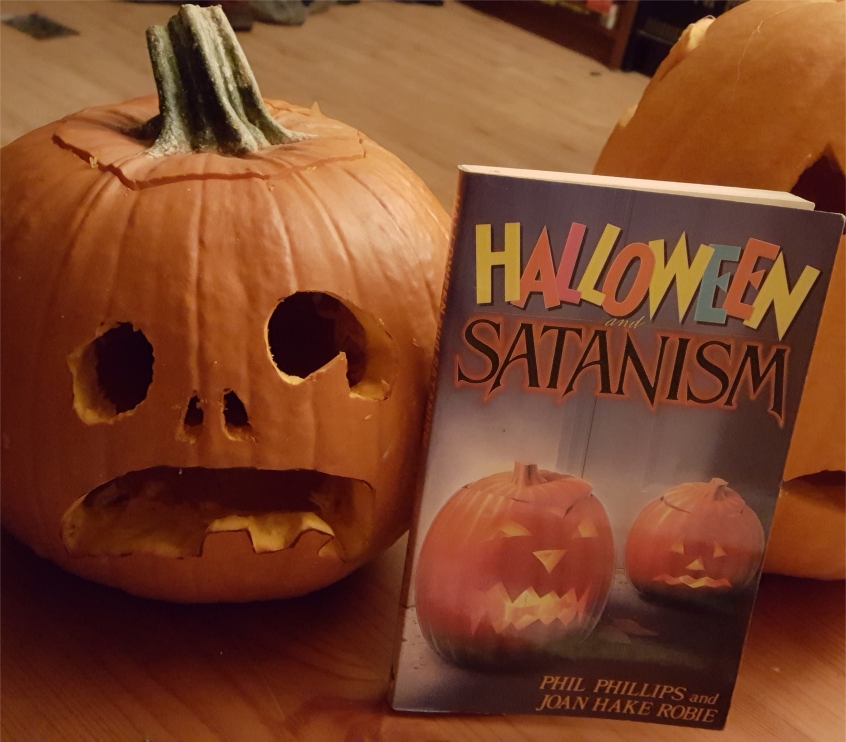
halloween and satanism9. Halloween and Satanism
Anti-Semitic Christian bullshit propaganda for assholes.

tarry thou till i come croly8. Tarry Thou Till I Come 
Including it here because, as far as I know, this is the only review of this book online. The tale of the Wandering Jew.

arktos joscelyn godwin7. Arktos
Some bullshit about Donald Trump. A very cool book.

holy-blood-holy-grail6. Holy Blood, Holy Grail
Jesus had a kid, and Hitler was a descendant of Dracula.

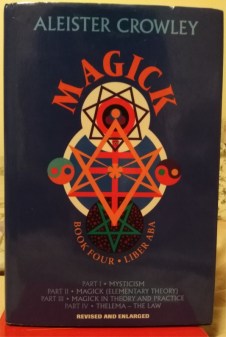
crowley book 45. Aleister Crowey’s Law and Lies
Getting to grip’s with Aleister Crowley’s bullshit.

faust demon 144. The Books of Faust
This one took a lot of work.

red book of appin scarabaeus3. The Red Books of Appin
Myth busted.

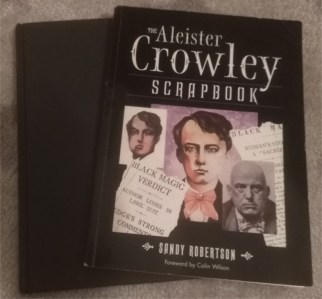
the aleister crowley scrapbook2. The Aleister Crowley Scrapbook
An interview with a Crowley expert.

robert anton wilson the sex magicians1. The Sex Magicians
My contribution to the conspiracy theories about the conspiracy theorist.

Well, there you go: Nocturnal Revelries’ best of 2017. (Just to remind you, as with last year, the links in this post are to the best posts of the year, not the best books that I read.) This blog has been going for nearly 3 years now, and I’ve reviewed about 170 books so far. I recently added an index page to the site in case anybody is looking to see if I’ve looked at a specific book or author.

Thanks for all of the support and interest. Remember, this blog has twitter and facebook pages to help keep you up to date with my ramblings. I’ve a few posts planned for the near future, but who knows what’s going to end up featured here in 2018. I’m going home for Christmas for the first time in years too, so I doubt I’ll post again until January. As always, you can email me with recommendations, questions, comments or threats. If you currently work in retail, know that my heart bleeds for you. For everyone else, enjoy the time off work, and don’t forget to go to mass on the 25th.

The Peculiar Legends of the Red Book of Appin

A few weeks ago, I wrote a review in which I claimed that all of the grimoires that I have thus read have been a little disappointing. The book in question, Liber Falxifer, had a good atmosphere to it, but while the ritual procedures were generally spooky enough, the end goals of the rituals themselves were just a little too similar to what I’ve seen before. In response to this complaint, V.K. Jehannum, infamous demonolater and black magician, kindly suggested that I check out a mysterious little book called The Red Book of Appin.

This “book” is, as far as I know, exclusively available in pdf form. I did a bit of research on it before reading, and the earliest mention I found of this specific text comes from 2003. However, a mysterious book titled ‘The Red Book of Appin‘ has been referenced in many works over the last 150+ years.

I decided to do a little research.

popular tales west highlands J.FPopular Tales of the West Highlands Volume II [1860] by J. F. Campbell
The first written mention of the Red Book of Appin can be found in what is basically a footnote to a story in J.F. Campell’s collection of Scottish folktales. The stories in this book were orally collected from Scottish peasants and the likes by the author and his accomplices during the mid-nineteenth century. Part XXX, The Two Shepherds, is the story of a lad getting assaulted by a very suspicious individual when making his way home one night. It is followed by another, very similar story, and it is in this tale, as told by “an old carter named John in Ardkinglas to Hector Urquhart, a friend of Campbell’s, in 1860, that the Red Book of Appin is first mentioned. The story goes a little something like this:

A man in Appin, a village in Scotland, adopted an orphan boy, and when this kid was old enough, he became a shepherd. One day, when he was out herding sheep, a mysterious stranger approached the boy and offered him a better job. The stranger told the kid that he’d make lots of money in his service; all he had to do was sign his name in the stranger’s little red book. The kid was interested, but he said that he’d have to talk it over with his adoptive father first. The stranger didn’t like this idea and tried to convince him to agree there and then. The kid was having none of it, so they arranged to meet up the next day after he had talked things through at home.

That night, the kid tells his dad what had happened, and this dad congratulates him for acting sensibly. He tells the kid to meet up with the stranger on the following evening, and he gives him instructions on how to make a protective circle around himself with the point of a sword so the stranger can’t touch him. (Note that this guy already seems to have some knowledge of folk magic.) He instructs the kid to accept and steal the book from the stranger only when he’s safely within the circle and to avoid signing it at all costs.

The kid manages to pull it off, much to the dismay of the stranger, who, at this stage, by transforming himself into many likenesses and blowing fire and brimstone, has cast off any doubts over his true identity. The kid waits till morning when the Devil disappears and then takes the book home to his dad.

(I’m by no means an expert on Gaelic mythology, but I have encountered similar stories of Scottish and Irish folk tricking the Devil (Divil). He seems to be a bit of an idiot when he’s in those parts.)

Urquhart notes that he had heard many tales of the Book of Appin from old people but that this particular story was the best. I’m sure that he chose the word “best” to suggest that this story was the most entertaining rather than the most accurate.

Apparently, Campell provided other origin tales for the Red Book of Appin (and other red books), but I haven’t been able to find their sources online. There’s an article by Hugh Cheape that gives these different stories and other information on the book. From both the quantity of accounts and their banality, it seems quite likely that there was an actual man in Appin who had a red book. Most of the stories are about villagers asking this man for advice when their cattle were sick. The actual Red Book was almost definitely just a collection of folk medicine recipes. These stories are too boring to presume that somebody made them up.

Ok, there you have it. The actual Red Book of Appin was a book of cow medicine.

red book of appin - ethan allen hitchcock

What’s this then? It looks fancy. This, my friends, is an 1863 book called The Red book of Appin : a story of the Middle Ages, with Other Hermetic Stories and Allegorical Tales by Ethan Allen Hitchcock. It’s a book in which the author takes folk tales and completely over-analyzes them.

It gives the account from Campell’s book, word for word, and then it goes into a bizarre analysis in which the author compares elements of the story with elements of the Bible. I gave up reading it after he says that the orphan in the story represents Melchisideck. Nothing of note here other than the fact that by 1863, the legend of the Red Book of Appin was already attracting lunatics.

Ok, so we have a quaint Scottish folktale and some historical traces of a curious little book about healing cows. Didn’t I start this post off discussing ultra-violent black magic?

Enter Montague Summers.

montague summers history witchcraft.jpg

Montague Summers, a man infamous for his anachronistic fear of black magic, includes the exact same paragraph on the book of Appin in both his History of Witchcraft and Demonology, 1926 (Chapter 3, p.86) and his Popular History of Witchcraft, 1937 (Chapter 2, p.76). It reads:

Such a volume was the Red Book of Appin known to have actually been in existence a hundred years ago. Tradition said it was stolen from the Devil by a trick. It was in manuscript, and contained a large number of magic runes and incantations for the cure of cattle diseases, the increase of flocks, the fertility of fields. This document, which must be of immense importance and interest, when last heard of was (I believe) in the possession of the now-extinct Stewarts of Invernahyle. This strange volume, so the story ran, conferred dark powers on the owner, who knew what inquiry would be made ere the question was poised ; and the tome was so confected with occult arts that he who read it must wear a circlet of iron around his brow as he turned those mystic pages.

The only part of what Monty wrote that didn’t come directly from the account in Campbell’s book is the line about the iron circlet, but the chapter in Campbell’s book that mentions the Red Book does specifically discuss the notion that “supernatural beings cannot withstand the power of iron”. I think it safe to assume that Campbell was Summers’ direct source for this paragraph.

Ok, so Summer’s paragraph doesn’t really add anything to what we already knew. However, I have little doubt that it was its mention in the works of Montague Summers that brought The Red Book of Appin to the attention of modern occultists.

Somewhere along the way, around 2003 it seems, somebody decided to write (or maybe just translate) a grimoire, but they knew that nobody would pay attention to it unless it had a cool name. On reading about the long-lost, mysterious Red Book of Appin in the works of Summers (or maybe one of Summers’ fans), the author/translator realized that his work would be a whole lot more mysterious (and hence popular with occultists) if it purported to be a resurfacing of that long lost work.

red book of appin scarabaeusThe Red Book of Appin – Translated by Scarabaeus
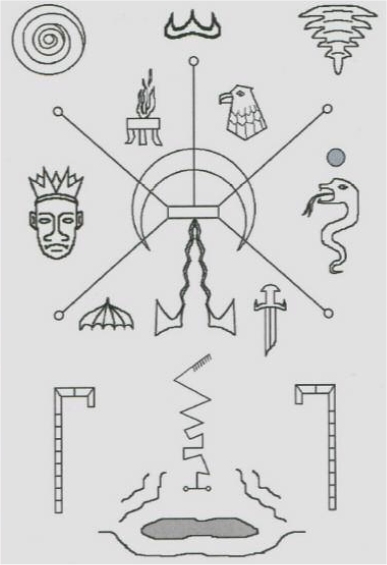
Year of composition and publication unknown

So here we go, the dodgiest book of black magic available for free download.

This grimoire supposedly contains the teachings of Vlad Tepes. That’s right; Vlad the Impaler is supposed to have dictated this malarky to a monk named Kirill. The text claims that “the devil-worshipping of the great romanian general is an unquestionable fact, which no serious black adept can deny.” This is a bit odd considering that we’re speaking of a (V)lad who once attacked the Ottoman Empire “for the preservation of Christianity and the strengthening of the Catholic faith”.

Authorship aside, what the Hell does a grimoire supposedly written by Count Dracula have to do with the Scottish Red Book of Appin that we’ve been talking about? Well, as it turns out, nothing at all; this grimoire is named after “Joseph Appin”, the English merchant who supposedly once owned the manuscript. The fact that the book was red is just another coincidence. Indeed, the only part of the pdf that’s actually red is the Times New Roman heading on the first page.

ritual red book appin scarabaeusOne of the book’s high quality illustrations.

This is definitely not the actual Red Book of Appin, but I suppose it could be a translation of a genuine grimoire to which the translator attached a name for which he knew there would be a market. Indeed there are signs that this is a translation. It reads a lot like the homework of a foreign student who has used Google Translate to change their writing into English. The grammar, spelling and punctuation are all absolutely horrible. I’ll be honest here, even if this is a translation, it’s a translation of absolute garbage. I find it very fitting that translator’s pseudonym literally means dung beetle.

There’s two main sections to the text. The first is a fairly standard list of demons, the same kind of thing that you find in the Goetia and the Grand Grimoire. The next section is on different rituals. These are absurd. The most entertaining was the one in which the wizard constructs a bell with a human corpse as the dingy bit in the middle. I can’t remember what this was supposed to achieve, but it was pretty funny. Most, if not all, of these rituals involve murderous sacrifices, including the killing of babies. I know that I complained that other grimoires weren’t nasty enough, but I found this pretty tasteless. There’s no atmosphere or cleverness here; it’s the kind of thing a teenage death metal fan would write. A load of shit.

sigil red book appinDoodles from a boring math class or the demonic seals of “Superior Creatures”?

There is another book, The True Red Book of Appin, written by Tarl Warwick, but this is an admitted fiction. This lad noticed the hullaballoo that this text was causing online and decided that he could write a much better version. Fair play to him. I haven’t read his book, but I am quite sure it’s more entertaining than the heap of trash by Scarabaeus.

So there you go, the legends of the Red Book of Appin. I somehow doubt that the original text, if it were ever to be found, would be as entertaining as the tales that have told about it.


Death Worship and Current 218

liber falxiferLiber Falxifer: The Book of the Left Handed Reaper – N.A-A. 218
Ixaxaar – 2008
While maybe not quite as old as they claim to be, grimoires such the Grand Grimoire, The Goetia, the Book of AbraMelin and Die Faustbücher have all established their places within the canon of Western Occultism. These texts are referenced in many of the other books that I read, and I read them in turn to help me understand those other books. Liber Falxifer, however, was first printed in 2008, and it has yet to be republished as a Dover Occult paperback. With the internet, anyone can create and publish their own grimoire, so why did I choose to read this one?

The cover is really fucking cool, and the title has a nice ring to it. However, what really drew me to this book were the prices that I saw people paying for it online. You’ll be lucky if you can find a copy of this thing for less than $500. I would never spend that much on a book, but I was intrigued as to why others would. When a friend offered to lend me their copy of Liber Falxifer, I jumped at the chance to see what all the fuss was about. (I’m actually working on a separate post about collecting occult books in which I’ll further elaborate on the potentially ludicrous cost of this hobby.)
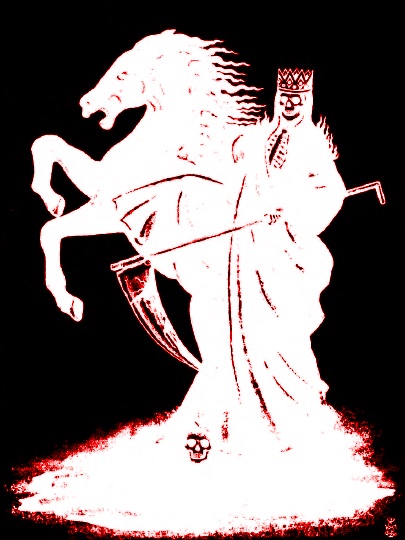
falxifer skeleton.jpgThe Illustrations, sigils and front cover of this book were designed by Soror Sagax. 218.

Liber Falxifer is about the Cult of the Dead and the worship of the Left-handed Skeleton Lord of Death. The first part of the book describes the origins cult of this Señor La Muerte. I presumed this was all bullshit, but I looked it up and it’s a real thing in parts of South America; people there do actually pray to a Saint of death. The book claims that there is an esoteric side to the worship of this Saint that is not publicly discussed or recognized, and it’s this side of things that it focuses on: how to kill your neighbour, how to control people, all of that good stuff…

Links are then drawn between this Saint of Death and Qayin (Cain) of Bible fame. It gets into apocryphal interpretations of the Genesis story and ends up with a really juicy Satanic form of Gnosticism. I absolutely loved this part of the book.

The last few chapters are on the actual practice of Black Magic. These parts, though occasionally rather sinister, were not different enough to what I’ve seen before to hold my interest. I wasn’t reading this as a practicing magician, so this bit was bound to be wasted on me.

falxifer sigilSigil from the cover of the book.

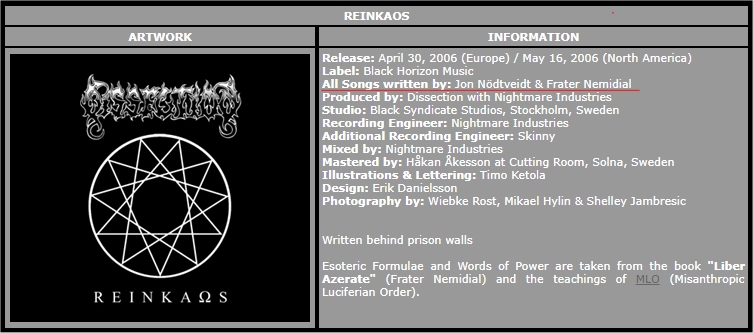
There’s a poem at the very beginning of the book that struck me as very familiar, and some of the phrases in the different summonings and the way in which they were ordered made me think of the lyrics on Dissection’s Reinkaos album. While ruminating on that record, I recalled that the first song is called Nexion 218.  Was it a coincadence that  the author of this book is given as N.A-A. 218? Ixaxaar.com, the publisher’s website states that this book was written by the Magister of the Temple of the Black Light, the same order that Jon Nödtveidt, singer of Dissection, belonged to. This Magister of the Temple of the Black Light (formerly the Misanthropic Luciferian Order) also went by the name of Frater Nemidial, and what do you know, Frater Nemidial gets a writing credit on Dissection’s Reinkaos album. dissection reinkaos

For those of you who don’t know,  Jon Nödtveidt, the singer and guitarist in Dissection ended up shooting himself in the head during a Satanic ritual. He had previously spent 8 years in prison for murder. Reinkaos, his final album, is maligned by many fans of the band because it sounds so different from their earlier releases,  but I’ve always had a soft spot for it.

Anyways, back to Liber Falxifer. It’s definitely a more enjoyable read than other grimoires I’ve slogged through. I really liked the way that it tied Gnosticism, Satanism and the cult of Death together; I love that occulty synthesis stuff. Also, this one is pretty dark. It doesn’t shy away from blood rituals and graveyard desecration. I mean, I’m not going to go out and do that stuff myself, but I like the idea that books like this exist. My interest in Satanism and Black Magic is largely fueled by my love of heavy metal, and while I was surprised that I was able to recognise the author by his turn of phrase, I was not surprised that the individual who wrote this was somehow involved in heavy metal.

skull falxifer

As mentioned before, I am not a practicing magician, so I have nothing to say on the book’s efficacy. I can really only discuss whether or not I enjoyed reading it. When I read grimoires, I like imagining that I’m a character in a tale by Clark Ashton Smith or Lovecraft who has come across some long forgotten book of heinous magic, and as far as grimoires go, this one was quite entertaining. The only way I would have enjoyed Liber Falxifer more would have been if it was more violent. I liked how it touched on blood sacrifices, but I would have enjoyed some brutal torture or some mass killings thrown into the mix. Again, I stress that I read these things as if they were fiction; I really don’t want that kind of thing to happen in the real world. I suppose there’s only so much you can get away with if you’re putting out a book that is going to be taken seriously.

So overall, this book was enjoyable enough, but it fell just short of what I want from a Satanic Grimoire. I feel a bit like Bono. Does my ideal Grimoire exist? I’ve thought of writing one myself, one that was completely over the top in terms of sinister violence and evil, but as much fun as that would be, I’d be terrified that some loon might get their hands on it and take it seriously. There’s two more books in the Falxifer series, and while I sure as Hell won’t be buying them, I’ll consider reading them if they ever come my way.

Halloween and Satanism

halloween and satanismHalloween and Satanism – Joan Hake Robie and Phil Phillips
Starburst Publishers – 1990 (First published 1987)

It’s been a while since I reviewed any Evangelical christian bullshit. While books of this ilk are always terrible and often palpably irritating, they are a necessary evil. The frustration that they cause serves to replenish my patience for awful, left-hand-path books about Black Magic and Satanism. The ol’ devil worship seems violently appealing when compared with this kind of idiotic christian foolishness.

Holy Jesus, this one is particularly bad too. I actually ordered it online last October, but it arrived 2 days into November, so I postponed reading it for the year. It was not worth the wait. I’m going to briefly go through the chapters, just so you can get a taste of how truly moronic this pile of shitty-shitey-farty-bummy-pooey-poo this is.

Chapter 1. The argument here is that fear is not of God; therefore, anything that causes fear intentionally (horror movies, scary costumes, etc…) is not appropriate for a christian. In fact, watching horror movies or dressing up in a costume will probably lead you into practicing witchcraft. I thought that this idea of fear being completely removed from god was fairly interesting.

Say, all my Bible nerds, can you remember what Genesis 20:11, 2 Samuel 23:3, 2 Chronicles 20:29, Nehemiah 5:15, Psalms 36:1, Romans 3:18, 2 Corinthians 7:1, and Ephesians 5:21 all have in common?
Yeah, that’s right; all of these Bible verses specifically address the necessity for “fear of God”.

Christians should not entertain themselves with scary things; the more time you spend being afraid of movies, the less time you’ll spend being afraid of god. That’s how this works, right? Makes perfect sense to me.

Chapter 2 describes the origins and traditions of Halloween. This section was a bit confusing. The text is describing ancient Celtic practices, but the accompanying images are from Disney and Hammer Horror films. There’s no distinction made between historical fact and legend. I’m sure some of what’s written in here is true, but the information is so poorly presented that it would be futile to attempt to distinguish the fact from the fiction. This issue is apparent throughout the book, and it serves to clarify that the only people who could read this book and take it seriously would be individuals completely incapable of critical thought.

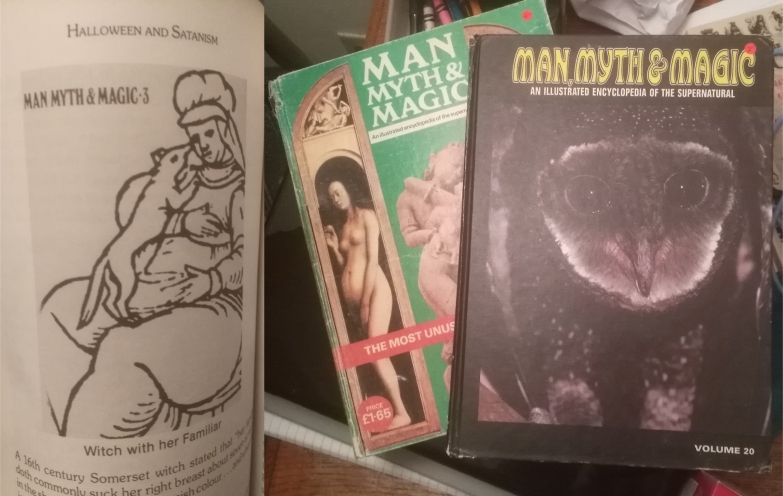
man myth and magic
Many of the images in this seriously shitty book were simply lifted from Richard Cavendish’s Man, Myth and Magic magazine series. I have a few copies of the magazine on my shelf, but I recently found that a nearby college library has the entire collection. I think I might have to spend a few days in there soon doing so some copying.

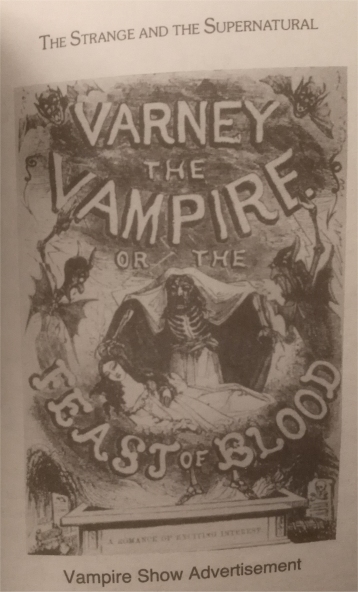
Chapter 3 talks about some animals and supernatural entities that have been linked with Halloween. It doesn’t really pass much judgement on them though. Again, the information here is a weird mix of general knowledge, opinion and fiction. This chapter, like many of the following, doesn’t really support the author’s idea that Halloween is Satanic at all. One of the images here is the cover page of a reprint of Varney the Vampire.

varney halloweenVarney the Vampire is a serialized novel originally published from 1845-1847. It’s a fairly well known piece of literature, and will definitely have come to the attention of anyone who has done any research on vampires. The authors of Halloween and Satanism have taken the cover page of this famous work and given it the heading “Vampire Show Advertisement”. But a book is not the same thing as show, and a title page is not the same thing as an advertisement. This is not a case of me disagreeing with the authors; this is a case of the authors publishing false information. But wait… this isn’t the worst of this variety of mistake to appear in this book. This doesn’t even come close to what pops up in chapter 7…

At the end of chapter 3, the authors suggest that their readers should celebrate “Holy-ween” instead of Halloween. This would entail prayer and dressing up as one’s favourite Bible character. Whoever made this suggestion would doubtlessly go as THE VIRGIN.

Chapter 4 is comprised of descriptions of different occult phenomena, from palmistry to necromancy. The descriptions themselves are basic and generally not condemnatory, but each one is followed by the phrase;
“You can be set free from [insert occult phenomenon here]!”
(You can be set free from Good Luck Charms!, You can be set free from Edgar Cayce!, You can be set free from Tea Leaf Reading!) The effect is generally fairly humorous. I had a hard time picturing the person whose life was being ruined by their commitment to tea-leaf reading. There’s a few irritating grammar mistakes in here too. This book was printed in September, and I imagine it had been rushed to the press to get it out in time for Halloween. I doubt it was ever proofread.

Chapter 5 is just a bunch of Biblical references chosen to support the notion that witchcraft is bad.

Chapter 6 is an awful summary of the history of witchcraft. The complete disregard for separating truth from speculation and opinion renders this fairly difficult to bother analyzing. Anyone with the patience to read a serious critique of this book would never have been capable of taking this rubbish seriously. It’s genuinely appallingly written. There’s a great bit in here about witches’ familiars, the demon-animals that witches use as servants. The authors claim that witches familiars never take the form of fish because fish are linked with christ. I would have thought that this had more to do with the fact that a fish is going to be far less useful as a servant to a human due to the fact that it lives in water. There’s very little mention of Halloween in this chapter.

Chapter 7 discusses the history of black magic and the black Mass. Again, this is awful rubbish and doesn’t really add any weight to the authors’ argument that Halloween is satanic. There’s a fairly lengthy description of a witch being tortured in this chapter that doesn’t serve any function other than sensationalizing the topic. This is objectively terrible writing.

Also included in this chapter is perhaps the most offensive part of the book.

de eewige joodEvangelical christian propaganda vs Nazi propaganda.
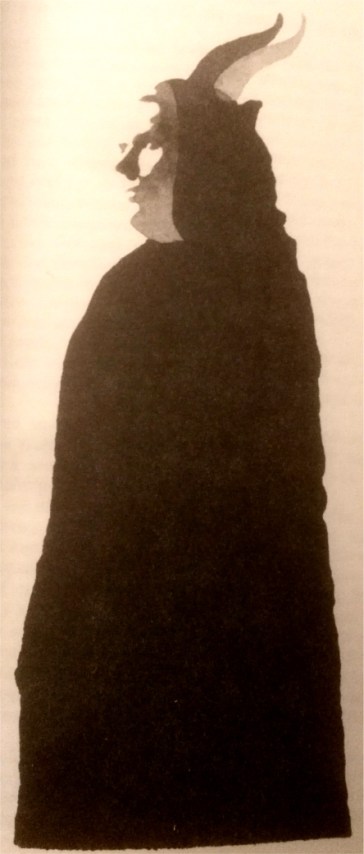
This image of an evil looking man, titled “Satanic Symbol” is thrown in the middle of a section about the Black Mass. This “Satanic Symbol” is actually the movie poster for Der ewige Jude, a repulsively anti-Semitic 1940 film produced for Joseph Goebbels, Nazi Germany’s Minister for Propaganda. The title is still on the poster too. How the fuck did nobody notice this? Either Joan Hake Robie and Phil Phillips didn’t give a fuck about what they put in their book, or they deliberately used an image that the Nazis used in their attempts to dehumanize Jews. Either way, this is a shameful mistake to have made. I’m not easily offended, but when you sit down and think about what’s happened here, it is actually disgusting. They have literally used one of the vilest and sadly, most effective pieces of Nazi propaganda to push their moronic agenda. What a fucking disgrace. They really should be ashamed of themselves.

At this stage, I was getting a bit fed up with this book. The next chapter discusses modern day witchcraft and magic. Nothing of note here.

Chapter 9 gives some satanic terminology and rituals. It actually contains large chunks of text from LaVey’s Satanic Rituals. I wonder if they were given by permission by the Church of Satan… Also included here is a warning to parents to look out for Motley Crue or “Ozzie” Osbourne records in their children’s rooms.

Chapter 10 is weird. It gives accounts of people who played with the occult and suffered because of it. One of them ends up getting attacked by a werewolf Jesus. Utterly stupid.

Chapter 11 is comprised of different news stories. There is mention of the cancellation of a Mercyful Fate concert in Norfolk, Virginia. That must have sucked for Norfolk. I checked it out, and that show was indeed cancelled (although King Diamond played a set in the same venue 4 years later). The rest of these news stories are about kids turning satanic after playing with Ouija boards.

The last 3 chapters wage war on Satan without being very clear on how to achieve victory. There’s some cringey sections in which the authors quote their favourite get-rich-quick, motivational speakers. Unsurprisingly. there’s no brilliant conclusion to tie up all the loose ends into a coherent argument against Halloween.

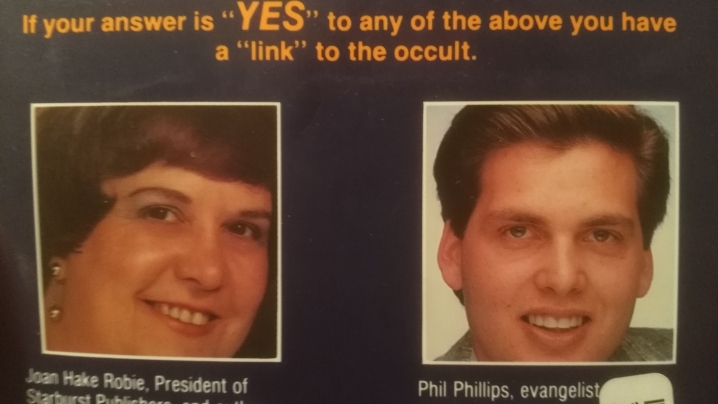
phil phillips joan hake robieThis is a “picture” of the “authors”.

I think that an intelligent person could very easily write a book about why Christians should reconsider how they celebrate Halloween, but I also doubt that any intelligent person would waste their time doing so.  Halloween and Satanism was clearly not written for intelligent people. This is sensational, incoherent garbage that only the most dangerously stupid idiot could take seriously. It’s misleading, it’s untrue and it’s legitimately offensive. Fuck this shitty book.

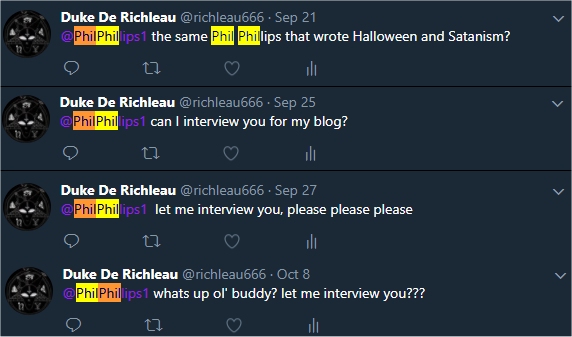
My life is extremely busy at the moment, and I actually wrote this review in September to make sure it would be ready for Halloween. In the meantime, I did a little internet sleuthing to see if I could track down either of the authors. I found Phil Phillips’ twitter account, and to my surprise, he seems to have dedicated a lot of his time to helping people, especially kids, in parts of Africa and Asia. He is a Trump supporter (no surprises there), but the guy is definitely not an out-and-out racist. I’d be willing to bet that the Nazi imagery included his book wasn’t included with the intent to sow the seeds of the fourth reich. With this in mind, I reached out to Phil and asked him for an interview.

tweets to phil phillips
These are the only messages I sent. Friendly and polite, no?

Now look, I know that I’ve written some nasty things about books and authors, but I’m not a complete piece of shit. If a person is willing to take the time to talk to me, I’ll be respectful, friendly and polite, regardless of our differences. The reason I wanted to interview Phil Phillips was the fact that I hated his book but thought I saw goodness in him. I hoped to use that goodness as a bridge between our differences so that we could better come to understand each other’s point of view. It was not to be.

blocked
I thought this was a bit of an over-reaction to be honest. I wanted to give the guy a chance to respond to my criticism of his work. As things stand, I can only presume that he’s aware of the shortcomings of his terrible book and doesn’t want to embarrass himself further by talking about it. Fair enough Phil, but you didn’t have to block me. I wasn’t remotely unpleasant to you.

Ok, all that being said, the big day is almost here. I’ve already carved my pumpkin and filled my phone with Misfits and Type O Negative albums. This is going to be my first Halloween as a dad too, and I’m going to initiate my baby girl into the cult of Satan by dressing her up as a cute little witch and taking her to the trick-or-treat party in our apartment building.

witch hat baby

I encourage you all to watch scary movies, listen to heavy metal and worship at the altar of Satan this Halloween. Keep it spooky and have a good one!
pumpkins